
Foundational work (September 2025): 🚚 AI Datacenter Edge Computing: Ship the Workload Not the Power
Series publications: ⚓ The Grid-Anchored Clean Power Bargain — Powering AI Data Centers Through 2040 | 🔗 The Clean Compute Match — Which Clean Power Pairs With Which AI Compute, And What Stays On Fossil | 📏 Burden-Based Authorization for AI Data Centers, Modular Clean Compute, and the Backlash Gap Between Grid Tariffs and State Law | 🧱 Modular AI Data Center Specialists and the Integrated Offerings That Turn Small Sites Into Authorized Operating Capacity
Thesis: Specialized compute, modular data centers and clean energy now form one market. Each kind of AI work, from model training to real-time answers for users, pairs with the power that can serve it and the building form that can house it. Authorization acts on that market as a second-order dynamic: it decides which matches become operating capacity, and its cost feeds back into which matches form. Mid-scale AI load loses at both levels, and the answer forming in the market is the Authorized Compute Portfolio.
Why now: Texas halted data center permits on September 21, 2026. The state audit of data center power and water demand reports December 1, and the Texas legislature convenes January 12, 2027. Every Simulation Prediction in the series that touches mid-scale load resolves against the rules those dates produce.
I. Executive Summary
The AI data center contest runs on two levels. At the first level, specialized compute, modular data centers and clean energy clear as one market. Work that can move or pause pairs with wind and solar power, while work that must run around the clock near users pairs with nuclear, geothermal and hydro power. At the second level, authorization decides which of those matches become operating capacity, and its cost feeds back into which matches form.
MindCast AI now gathers four publications into The AI Infrastructure Authorization + Clean Energy Series. The series builds on a foundational paper from September 2025, and two companion papers map the approval sequence. Read together, they locate the same casualty three times. Mid-scale AI load sits between a single factory-built module and a hyperscale campus, the multi-billion-dollar sites the largest cloud companies build.
The mid-scale tier falls short of the minimum contract size nuclear and geothermal suppliers require. The tier also falls below the size thresholds for utility programs that reward data centers for cutting power use during grid stress, while state and county hearings still judge it as a campus. The overview names the pattern the Mid-Scale Squeeze: one tier of load failing three independent gates that hyperscalers, the largest cloud operators, pass by scale alone.
The same publications also describe the answer. An Authorized Compute Portfolio is a set of sites chosen and run by type of AI work, usable power, control of the site and measured local burden. No single campus, energy contract or modular supplier can deliver all four, so the portfolio becomes the unit a mid-scale operator needs to pass every gate.
MindCast AI applies Predictive Behavioral Economics + Dynamic Game Theory through MindCast AI Proprietary Cognitive Digital Twin Foresight Simulations (MP CDT FS). Behavioral Economics supplies the decision rules, including the salience that makes a 2-megawatt (MW) module look like a campus to a hearing room. Game Theory supplies the payoff structure among operators, utilities, hosts and approvers. Predictive simulations emerge from the combination.
The overview maps the first-order market the series describes, then the authorization layer that acts on it. The overview then synthesizes the two levels, develops five insights and keys risk mitigation to the Simulation Predictions that decide whether the squeeze persists. Every Simulation Prediction carried here comes from the original publications.
The table below carries the published Simulation Predictions that test the Mid-Scale Squeeze. Each paper numbers its own: P marks a Primary Simulation Prediction, S a Secondary Simulation Prediction and IF an interpretive finding.
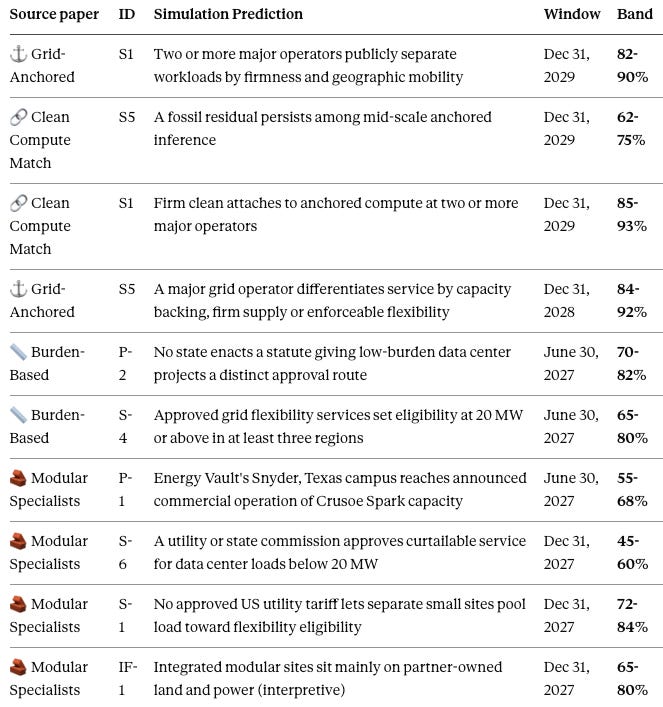
The ten Simulation Predictions split into two groups. Six describe the gates that hold the squeeze in place, and four describe the portfolio routes that could release it.
🏛️ Policymakers. Rules keyed to the “data center” label strand mid-scale load and consolidate capacity toward the largest operators (Burden-Based P-2).
💼 Executives. Mid-scale projects move fastest through an energy company that already controls the site, the power and the approvals (Modular Specialists IF-1).
⚖️ Counsel. A project eligible for a utility flexibility program can still stall at a county hearing, so each increment needs mapping against all three gates (Burden-Based S-4).
📊 Investors. A portfolio of small sites holds commercial value today but gains no standing under utility rates as one flexible load through 2027 (Modular Specialists S-1).
The Mid-Scale Squeeze gives every stakeholder one diagnostic question. Which gate does a given project fail, and which portfolio can carry it through?
II. One Year of MindCast Work Maps the Market and Its Authorization Layer
The series grew one layer at a time, and each publication answered the question its predecessor left open. The first four papers describe the market for specialized compute, modular capacity and clean power. The last two describe the approval layer that decides which matches reach operation.
Together the papers chart the specialized compute landscape: which workloads move, which power serves them, which hosts run them and which approvals let them operate.
A. 🚚 Ship the Workload Established the Founding Principle in 2025
AI Datacenter Edge Computing: Ship the Workload Not the Power set the principle the series still follows, a year before the first series installment. Compute moves toward available energy and community trust rather than forcing power to a fixed campus. The 2025 paper named energy, economics, trust and orchestration as the forces deciding the shift.
The series later refined which work moves. Training and batch work follow energy, while real-time answers for users stay near those users on always-on power.
The principle left one question open for the series to answer. Which compute can move, and what happens to the compute that cannot?
B. ⚓ Grid-Anchored Separates the Compute That Moves From the Compute That Stays
The Grid-Anchored Clean Power Bargain — Powering AI Data Centers Through 2040 answered with what it named the firmness inversion. Moving flexible AI work toward abundant energy lowers total US demand but leaves behind the work that needs dependable power most. Real-time answers for users must stay near those users, so the remaining fleet needs firmer power as flexible work departs.
The paper also established that a grid connection is not a guarantee of power. Permission to connect, power that actually reaches the site and supply the grid counts on during a shortage are separate products, and the weakest one governs. Always-on clean power therefore gains value as flexible AI work leaves.
Grid-Anchored also named a portfolio advantage. Operators able to spread AI work across different kinds of sites gain more clean-power options than operators tied to one large campus. The later papers extend that portfolio from power into hosting and approval.
C. 🔗 The Clean Compute Match Turns the Inversion Into a Market
The Clean Compute Match — Which Clean Power Pairs With Which AI Compute, And What Stays On Fossil sorted AI work and clean generation into matched pairs. Wind and solar carry work that can move or pause, and always-on sources such as nuclear and geothermal carry work that cannot. Work that fits neither pairing stays on gas or grid-mix power, which the paper called the fossil residual.
The paper located that residual among mid-scale AI work that must run around the clock. Grid connection queues, rules on which supply counts during shortages and minimum contract sizes exclude the tier, not a shortage of clean generation. The residual is a market outcome with an authorization cause, and it marks the first sighting of the Mid-Scale Squeeze.
D. 🧱 Modular Specialists Maps Who Supplies the Market and Who Carries the Path
Modular AI Data Center Specialists and the Integrated Offerings That Turn Small Sites Into Authorized Operating Capacity mapped the firms that supply each part of a small, low-impact site. No single firm reduces more than one local burden through its own products, whether new power demand, water use or site reuse. Pairings between an energy company and a module operator cover more.
Power-asset hosts carry the path to operation. A host is an energy company that controls the land and power infrastructure where modules run. The storage company Energy Vault is building a host-owned campus in Snyder, Texas, and the Texas permit halt now tests that route.
E. 📏 Burden-Based Authorization Finds the Gap Between Layers
Burden-Based Authorization for AI Data Centers, Modular Clean Compute, and the Backlash Gap Between Grid Tariffs and State Law found that utility and grid rules now offer faster service to data centers that agree to cut power use during grid stress. State and county rules still treat every project under the label “data center.” Small low-impact projects fall between the two layers.
The paper named four measures a regulator can verify in a filing: power increment, water draw, enforceable curtailment and reuse of an existing site. Uniform conditions meanwhile favor hyperscalers able to self-fund infrastructure and absorb delay. The second and third sightings of the squeeze came through the grid-service gate and the state approval gate.
F. 🛑🧭 Two Companion Papers Map the Approval Sequence
Two companion papers outside the series supply the approval sequence the series assumes. AI Data Center Veto Pointsmapped every stage at which a state or county can stop a data center. The Lowest-Exposure AI Data Center Approval Route for Developers, Hyperscalers and Investors ordered those stages so a single denial stops as little committed capital as possible. Together the two papers turned approval from a single event into a sequence of gates with knowable exposure.
A module and a campus pass through the same stages. Size alone buys no shortcut through the approval sequence.
The foundational paper, the four series publications and the two companions form one argument. The market pairs AI work, power and building form by whether the work can move and how dependable its power must be. Authorization then screens the matches on burden, and hosts assemble the pieces that pass.
III. Series Synthesis: One Market and a Second-Order Authorization Dynamic
The series supplies more than seven separate findings. Read together, the papers describe two linked systems. One is a market for specialized compute, modular capacity and clean power, and the other is the authorization layer that acts on it.
The first-order market. Three attributes decide each match: whether the work can move, how dependable its power must be and how large the building is. Model training and batch work can move, so they pair with wind and solar at sites with abundant energy. Real-time answers for users pair with always-on clean power, and factory-built modules let small increments of either class reach sites a campus cannot.
The second-order authorization dynamic. Authorization acts on the matches after the market forms them. Utility rates, state statutes and county ordinances decide which matches become operating capacity. The cost of passing those layers then feeds back into which matches the market forms next, so authorization shapes the market rather than simply filtering it.
Four second-order effects emerge only from the combined papers. Each one names a mechanism, and each one links to a published Simulation Prediction or an observable.
A. Authorization Cost Creates the Fossil Residual
The Clean Compute Match located the fossil residual among mid-scale AI work that must run around the clock. The paper traced it to grid connection queues, rules on which supply counts during shortages and minimum contract sizes rather than to any shortage of clean generation. The first two causes are approval steps.
A market outcome therefore carries an authorization cause. Clean procurement can rise every year while the residual holds, because more generation does not shorten an approval queue. The Clean Compute Match puts the residual’s persistence through 2029 at 62-75% (Clean Compute Match S5).
B. Uniform Rules Written to Restrain the Industry Concentrate It
Uniform approval conditions reward the operators best able to meet them. Hyperscalers self-fund grid upgrades and absorb disclosure regimes, and public compliance gives them an exit rivals cannot match. Community coalitions then accept that compliance as proof of control, so carve-outs for small projects lose support from both sides.
The loop reinforces itself. Each round of uniform rules raises the relative position of the largest operators. Burden-Based puts the absence of any state burden-based route through mid-2027 at 70-82% (Burden-Based P-2).
C. Utility Size Thresholds Decide How Large Modular Sites Start
Utilities write special rate schedules for very large customers, and most start at 20 to 50 MW. The thresholds exclude small sites from flexibility programs but also spare them the lengthy studies large loads face, so modular sites connect below the thresholds on the local lower-voltage grid. Hosts then grow in phases across them: Energy Vault opens Snyder at 8 MW, plans 25 MW in 2027 and designs the site for 500 MW.
Authorization thresholds rather than engineering therefore set the entry size of the modular market. A site that crosses a threshold later inherits large-customer obligations under the same owner, and the Texas grid operator’s information requests already reach loads of 25 MW.
D. Grid Shortage Rules Raise the Value of Always-On Clean Power
Grid operators increasingly decide who gets cut first in a shortage by whether a customer secured dependable supply. Grid-Anchored puts at least one major grid operator adopting such rules by 2028 at 84-92% (Grid-Anchored S5). An around-the-clock load without dependable supply then faces earlier cuts, so the authorization rule raises the market value of always-on clean power.
The Clean Compute Match expects contract terms for always-on clean power to widen against wind and solar terms as the pairing tightens. A widening gap alongside power purchases matched to specific AI work is the observable sign of the effect.
The four effects share one pattern. Authorization does not wait for the market to finish sorting, and it decides which sorts are worth attempting. Hosts that already hold approvals and portfolios that utility rates may one day recognize as one load follow from the same dynamic.
IV. The Mid-Scale Squeeze: One Tier Fails Three Gates
The overview’s central finding emerges only when the papers sit side by side. Three publications working through three different gates each found the same tier of load left behind. One gate sits in the market, and two sit in the authorization layer.
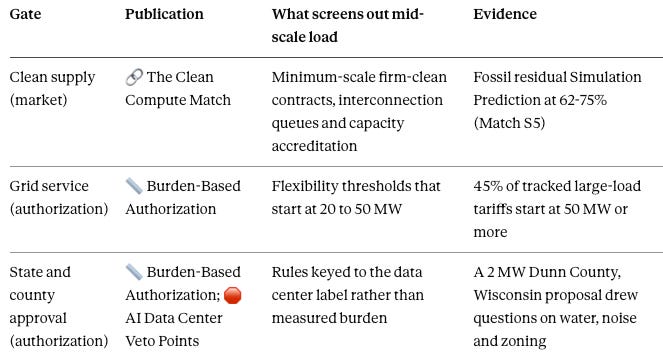
Each paper saw one gate, but the gates stack. A mid-scale project must pass all three to run on clean power under an approval it can defend.
Hyperscalers pass every gate by scale. The largest operators contract nuclear and geothermal power directly, exceed utility size thresholds and self-fund the grid upgrades that uniform state rules now demand. A single factory-built module can sometimes connect to the local lower-voltage grid and skip the large-customer queue. The middle tier holds neither advantage.
Competition for the same scarce supply compounds the squeeze. Real-time AI services and the largest model-training runs both bid for nuclear and geothermal power, as The Clean Compute Match found. The firm-clean supply can therefore run out before a mid-scale buyer reaches it.
The three separate findings point policymakers and investors in one direction. Scarce firm supply and uniform approval rules consolidate AI capacity toward the largest operators.
V. Approval Turns on What a Load Can Prove
A second insight explains why the squeeze forms. Every sorting variable in the series is an attribute a load must prove to the layer that decides.
Clean power suppliers read how dependable the power must be and whether the work can move. Grid operators read size and the willingness to cut power on command. State and county approvers read the “data center” label, because the label is the only attribute current statutes ask a filing to show.
Each layer therefore sees a different project when the same module files. The Burden-Based paper called the result a layer mismatch. The overview adds the cause: no shared definition of burden travels across utility rates, contracts and permits, so a proof accepted at one layer counts for nothing at the next.
Burden legibility names the missing property. A project carries burden legibility when the approving layer can verify its power increment, water draw, curtailment and site reuse from the filing itself. Hyperscalers substitute scale and capital for legibility, and mid-scale projects have nothing to substitute.
The squeeze eases when the four burden measures become shared definitions every layer accepts. Agency rules after the 2027 sessions offer policymakers the first venue to give utility rates and permits one vocabulary.
VI. The Scarce Asset Moved From Generation to Authorized Sites
A third insight follows from the first two. The series began by asking where power lives and now asks who controls the site where power and approval meet.
Ship the Workload assumed compute could follow energy freely. Grid-Anchored and The Clean Compute Match showed that always-on clean power is scarce and already contracted by the largest operators. The two companion papers on approval showed that each additional approval adds a stage where a project can stop.
Power-asset hosts combine three scarce inputs in one party: site control, power infrastructure and existing approvals. A host turns several proofs the middle tier cannot make alone into one filing. Modular Specialists places most modular AI sites on land and power owned by an energy partner through 2027 at 65-80% (Modular Specialists IF-1).
The host model carries a limit. The Texas permit halt has no size floor, so host ownership does not remove state review. Snyder shows whether a host-owned site converts inside a state that has paused data center approvals.
Value now flows to whoever owns a powered site with approvals in hand. For executives and investors, hardware delivery speed no longer decides who reaches operation first.
VII. Curtailment Below 20 MW Would Open All Three Gates
The fourth insight identifies the one instrument that would loosen every gate at once. Curtailment is the ability to cut power use on command during grid stress, and it appears in every paper of the series.
Grid-Anchored showed that a load willing to cut use earns value comparable to new supply where the grid operator counts it. Burden-Based listed enforceable curtailment among the four burden measures. Modular Specialists found that no small-site partnership documents it.
Curtailment below 20 MW would open grid flexibility programs to mid-scale load. The same capability would give state approvers a verifiable burden measure and let movable compute pair with variable clean supply. One instrument therefore reaches all three gates of the squeeze.
The instrument remains unavailable at small scale today. Emerald AI, whose software lets data centers cut power on command, documents its work only at large sites. Approved flexibility programs cluster at 20 MW or above. Modular Specialists puts a sub-20 MW curtailable service approval by December 31, 2027 at 45-60% (Modular Specialists S-6).
Whoever packages curtailment for small sites sells to every host, operator and approver in the series at once. The gap gives executives and investors the widest product opening the series identifies.
VIII. The Authorized Compute Portfolio Answers the Squeeze
The fifth insight turns the diagnosis into a product. The unit that passes every gate is neither a campus nor a module but a portfolio of sites, each matched to one class of work. The portfolio works at both levels: it forms matches in the market and carries each match through authorization.
The series supplies the portfolio in five steps. Classify each type of AI work by whether it can move and how dependable its power must be. Match each class to the power that can serve it. Choose a host that controls the site and power infrastructure.
The last two steps carry the approval work. Establish the route to operation through each veto point before committing capital. Prove the site’s burden in the filing and verify it once the site runs.
Two forms of mobility separate inside the portfolio. Workload mobility lets an operator place or schedule computation around supply. Site mobility lets an operator choose among hosts, and neither grants permission to run.
Four scarce complements decide who assembles a portfolio: suitable workloads, dependable or flexible power, viable host sites and a repeatable approval route. Hyperscalers hold the first two and buy the rest. Hosts hold the third and part of the fourth, and firms holding one complement need partners for the others.
The portfolio works as a commercial unit before utility rates recognize it as a legal one. One module sits below every flexibility threshold, while a network of modules could offer coordinated reductions across a region. Modular Specialists puts the absence of any approved utility rate letting separate small sites combine their load through 2027 at 72-84% (Modular Specialists S-1).
Aggregation therefore remains a market opening rather than an approval shortcut. Until utility rates recognize a portfolio as one flexible load, every site in it faces the gates on its own terms. Counsel should map each site separately until then.
IX. The Simulation Predictions Turn on Four Dated Events
The series’ Simulation Predictions resolve on separate timelines, yet the ones covering mid-scale load turn on the same few events. Four dated events in Texas and one federal track decide most of them.
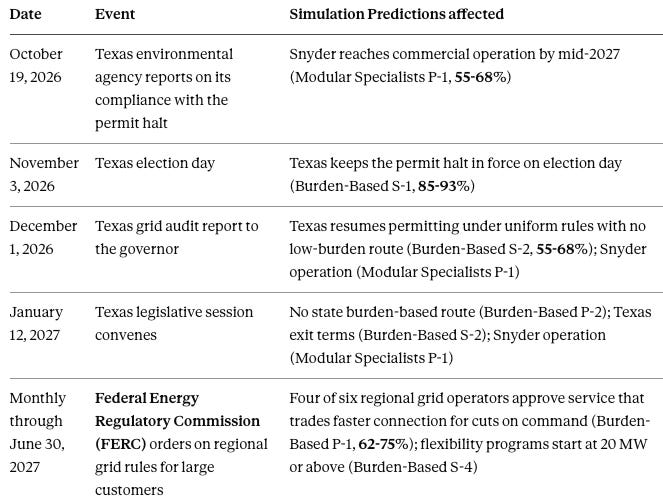
The Simulation Predictions also move together. A Snyder operation announcement (Modular Specialists P-1) alongside a Texas exit under uniform conditions (Burden-Based S-2) would show a host-owned site passing a gate that uniform rules left closed for everyone else. A Snyder delay under the halt would shift weight toward the alternative Modular Specialists names, with operators placing modules outside Texas.
Published Simulation Predictions test the Mid-Scale Squeeze directly. The squeeze eases if a program paying sites under 20 MW to cut power gains approval (Modular Specialists S-6) and modular AI capacity operates in a third state by 2027 (Modular Specialists P-2, 42-58%). Utility rate text letting separate small sites combine their load (a miss on Modular Specialists S-1) would turn the portfolio into a legal unit as well as a commercial one. The squeeze holds if no state enacts a burden-based route (Burden-Based P-2) and mid-scale around-the-clock AI work stays on gas or grid-mix power (Clean Compute Match S5).
The December 1 Texas audit gives every audience the first public test of whether any approving layer begins reading burden.
X. Risk Mitigation Keyed to the Simulation Predictions
Each audience faces a different loss if the squeeze persists. The entries below name the exposure in the unit each audience controls, the actions it can take alone and the residual that survives.
🏛️ Policymakers · Burden-Based P-2 (70-82%). Exposure: uniform rules push mid-scale investment toward self-funding campuses, measured in low-burden projects stalled per session. Actions: legislatures define eligibility on the four burden measures before the 2027 sessions, and agencies adopt the same definitions by rule. The Model AI Infrastructure Authorization Code supplies drafting language for both. Residual: a state route can pass while utility programs still exclude loads below 20 MW.
🏛️ Utility commissions · Modular Specialists S-6 (45-60%) and S-1 (72-84%). Exposure: mid-scale load willing to cut power earns nothing for it, measured in megawatts left outside any program. Actions: commissions approve a program for loads under 20 MW and state in rate text whether separate sites may combine their load. Residual: regional grid operator thresholds sit outside a state commission’s authority.
💼 Executives · Clean Compute Match S5 (62-75%) and Grid-Anchored S1 (82-90%). Exposure: mid-scale around-the-clock AI work stays on gas or grid-mix power, measured in the share of that work without always-on clean supply. Actions: planning sorts every type of AI work by mobility and power need before the next purchasing cycle, and procurement reaches always-on supply through an energy-company host. Residual: new nuclear and geothermal supply takes longer to arrive than a contracting window.
💼 Hosts and operators · Modular Specialists P-1 (55-68%). Exposure: the Texas halt delays host-owned sites, measured in quarters to commercial operation. Actions: development maps each approval a site still needs against the halt, and siting builds a host pipeline outside Texas. Residual: the halt’s scope stays uncertain until the December audit.
⚖️ Counsel · Burden-Based S-4 (65-80%). Exposure: a client’s willingness to cut power goes unrecognized below the program threshold while expansions trigger fresh review, measured in approvals per increment. Actions: counsel maps every increment against the three gates and documents measured burden in each filing. Residual: county review keyed to the data center label persists until a state route exists.
📊 Investors · Modular Specialists IF-1 (65-80%) and S-1 (72-84%). Exposure: pipelines that assume separate sites can combine their load carry value no utility rate yet recognizes, measured in commitments without an approved route. Actions: diligence rates each site on host ownership, curtailment capability and open approvals, and valuation treats combined-load value as upside until rate text confirms it. Residual: a rule change inside the window can move a pipeline in either direction.
Severity and probability run on separate axes, so a lower-band Simulation Prediction with a large loss can still justify early action. Early movers shape the definitions, and late movers inherit them.
What to Watch
Three signals decide whether the squeeze tightens or eases before the Simulation Predictions resolve. Programs paying sites under 20 MW to cut power either appear before state utility commissions or stay absent. Energy Vault either names new host sites or stalls, and so does the partnership between solar developer PowerBank and modular builder Nodiac.
Long-term nuclear and geothermal purchases by the largest cloud operators either accelerate or plateau through 2027. Acceleration tightens the clean-supply gate for every smaller buyer.
Conclusion
Specialized compute, modular data centers and clean energy form one market, and authorization decides which of its matches reach operation. Since September 2025, seven MindCast papers traced that contest from workload placement through clean supply, burden and veto points. Read together, they show one tier of load failing three gates that hyperscalers pass by scale.
The Authorized Compute Portfolio is the unit that answers the squeeze. Power-asset hosts assemble it today, and small-site curtailment would let utility rates and approvers recognize it. The Texas audit on December 1 tests first whether any approving layer begins reading burden rather than the data center label.
Working With MindCast
Published analysis cannot tell a specific operator, host or investor which gate each of its projects fails. The answer depends on workload mix, site ownership, target utilities and target jurisdictions.
MindCast builds an Authorized Compute Portfolio Map for each client. The map classifies every workload and matches it to power and a host. Each site then runs through the clean-supply, grid-service and approval gates. Cognitive Digital Twins of the client’s utilities, suppliers and approvers test each step against likely countermoves.
Operators and hosts can start with a portfolio map for three target sites before the 2027 sessions begin. Investors can commission a screen of mid-scale pipelines against all three gates. Reach MindCast at mcai@mindcast-ai.com. Visit our Corporate Site.
Appendix: The AI Infrastructure Authorization + Clean Energy Series
Foundational Work
🚚 AI Datacenter Edge Computing: Ship the Workload Not the Power (2025). Originates the principle of moving compute to power rather than power to compute.
Series Publications
⚓ The Grid-Anchored Clean Power Bargain — Powering AI Data Centers Through 2040 (2026). Establishes the firmness inversion and the portfolio advantage, and separates interconnection, deliverable energy and accredited capacity.
🔗 The Clean Compute Match — Which Clean Power Pairs With Which AI Compute, And What Stays On Fossil (2026). Sorts compute and clean generation into matched pairs and locates the mid-scale fossil residual.
📏 Burden-Based Authorization for AI Data Centers, Modular Clean Compute, and the Backlash Gap Between Grid Tariffs and State Law (2026). Defines the four burden measures and the layer mismatch between grid tariffs and state approval.
🧱 Modular AI Data Center Specialists and the Integrated Offerings That Turn Small Sites Into Authorized Operating Capacity (2026). Maps the specialist field and identifies power-asset hosts as the party that carries the path to operation.
Companion Publications and References
🛑 AI Data Center Veto Points (2026). Maps every stage at which a state or county can stop a data center.
🧭 The Lowest-Exposure AI Data Center Approval Route for Developers, Hyperscalers and Investors (2026). Orders the approval stages so a single denial stops the least committed capital.
The Model AI Infrastructure Authorization Code (2026). Supplies drafting language for a burden-based state route.
The Data Center Authorization Market: A 50-State Regulatory Atlas (2026). Supplies the state-by-state baseline behind the approval gate.