
Related publications: Burden-Based Authorization for AI Data Centers, Modular Clean Compute, and the Backlash Gap Between Grid Tariffs and State Law · The Clean Compute Match · Modular AI Data Center Specialists and the Integrated Offerings That Turn Small Sites Into Authorized Operating Capacity · AI Datacenter Edge Computing: Ship the Workload Not the Power
Thesis: Integrated modular AI capacity already operates at one site, and a second is under construction on a power partner’s land. Power-asset hosts that control the site and its power infrastructure carry the most promising route to operation, and utility rules and site-specific approvals decide whether that route repeats across sites and states.
Why now: Energy Vault began building an 8 MW Crusoe Spark campus in Snyder, Texas on July 27, 2026. Texas directed its environmental agency on September 21, 2026 to halt permits sought by data center projects pending state audits. Snyder now tests the host route inside a state that has paused data center approvals. Policymakers, operators, counsel and investors each face the Texas audit and the 2027 legislative sessions as their next decision point.
I. Executive Summary
The small modular AI sites operating or under construction today reach operation through the party that controls the power site. Crusoe runs four of its factory-built Spark data center modules on Redwood Materials’ Nevada campus, and Energy Vault is building a Spark campus in Snyder, Texas whose modules it owns and leases to Crusoe. MindCast’s simulation finds that power-asset hosts, meaning energy companies that control the land and power infrastructure where modules run, carry the path to operation. Operators and investors choosing partners now should ask who controls the site before asking whose hardware ships fastest.
Energy Vault targets commercial operation at Snyder in the first quarter of 2027. Texas Governor Greg Abbott directed the Texas Commission on Environmental Quality (TCEQ) on September 21, 2026 to issue no permits sought by data center projects until grid and water audits finish. Snyder therefore becomes the first public test of whether a host-owned modular site converts under a state permit halt.
Integrated modular capacity means factory-built data center units sold together with power and computing demand, and the path to operation covers every filing, approval and grid connection between delivery and a running site. MindCast’s thesis is that integrated modular capacity already operates at one site, but the public examples examined here do not yet show a repeatable approval route across separate small sites and jurisdictions. Host ownership is the most promising route under test, and hosts may hold relevant existing approvals. Utility rules and equipment permits still decide which offerings repeat.
Size thresholds cut both ways for small sites. Utilities write special rate schedules for very large customers, and 45 percent of those large-load tariffs start at 50 megawatts (MW) or more. Small sites therefore miss programs that pay customers to cut demand during grid stress, a practice called curtailment. The same thresholds let hosted sites connect to the local lower-voltage grid without the lengthy studies large loads face.
MindCast AI applies Behavioral Economics + Dynamic Predictive Game Theory through MindCast AI Proprietary Cognitive Digital Twin Foresight Simulations (MP CDT FS). The simulations build a behavioral model of each organization and play those models against one another as rules change. Game theory supplies the payoff structure between hosts and the operators who run modules on their land on one side and utilities and approvers on the other. Behavioral economics supplies the decision rules, including the salience that makes a 2 MW module look like a hyperscale campus at a county hearing.
MindCast AI’s founder has testified before the Washington State Legislature, whose 2026 session changed data center incentive law.
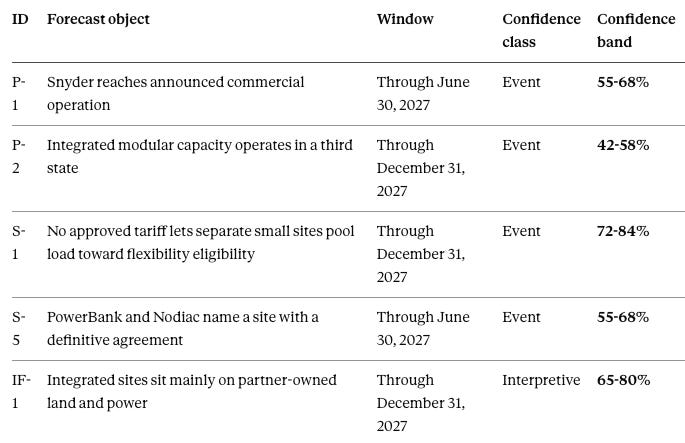
MindCast’s analysis maps the specialists who sell each part of a small, low-impact data center and the partners each works with today. The analysis traces the routes into power service, identifies the party that carries the path to operation and shows where the gaps open room for new entrants, investors and regulators. MindCast issues ten forecasts: eight Simulation Predictions and two interpretive findings on market structure. P marks a Primary Simulation Prediction, S a Secondary Simulation Prediction and IF an interpretive finding judged against a stated rule.
🏛️ Policymakers. Texas’s permit halt may reach an approval the host-owned 8 MW Snyder site still needs, and public sources do not yet show which (P-1). A review route keyed to measured burden would let small hosted sites qualify on evidence rather than on the data center label.
💼 Executives. Operators that pair with power-asset hosts gain site control, power infrastructure and any existing site approvals in one contract (IF-1). Choose partners by site ownership before hardware delivery time.
⚖️ Counsel. Only fully off-grid power removes the utility-service hurdle, and hosted sites such as Redwood keep grid backup (IF-2). Map each site’s utility terms and equipment permits before a client signs.
📊 Investors. Aggregating separate small sites into one flexible load remains unavailable under current tariffs (S-1). Evaluate modular pipelines one site at a time, by host ownership and open approvals.
Integrated modular capacity exists and host-owned sites are multiplying. Whether the host route repeats across states is the question the forecasts below answer.
II. Integrated Modular Offerings Exist, but Repeatable Conversion Remains Unproven
The supply chain for small AI data centers is complete, and the approval system that governs it is not. Specialists, power routes and ten decision-making actors show where conversion succeeds and where it stalls.
A. Crusoe Operates One Modular Site and Is Building a Second on Host Land
Crusoe shows the market has moved past component sales. In March 2026 Crusoe launched Crusoe Edge Zones, a cloud service running its factory-built Crusoe Spark modules. Crusoe manufactures the modules at its own Spark Factory in Brighton, Colorado.
Crusoe builds at both ends of the size range. The company is developing a 1.2 GW campus in Abilene, Texas and states that AI infrastructure needs both training campuses and distributed modular compute. Crusoe’s dual-scale strategy lets the analysis ask which of its routes reaches operation at small sites.
Crusoe’s first modular site sits on Redwood Materials’ industrial campus in Sparks, Nevada. Four Spark modules run there on solar and second-life electric vehicle batteries with grid power as backup. The companies announced an expansion to 24 modules on the same campus in March 2026.
Crusoe’s second modular site sits on Energy Vault’s land in Snyder, Texas. Energy Vault buys the Spark modules and leases them back to Crusoe, supplying powered land, battery storage and electrical infrastructure. Construction began in July 2026, and the first 8 MW phase targets commercial operation in the first quarter of 2027.
Integrated offerings answer the supply question and, at Redwood, the single-site operating question. Snyder is the first attempt to repeat the route at a separate site in a separate state.
B. No Player Covers All Four Burden Measures
Burden-Based Authorization for AI Data Centers, Modular Clean Compute, and the Backlash Gap Between Grid Tariffs and State Law defines four measures that let a regulator verify a data center’s local burden in a filing. Power increment is the new power a site draws, and water draw is the water it consumes. Curtailment is the ability to cut power use on command, and site reuse means building on land that already carries energy assets or approvals.
The matrix below maps each player against the four measures from public descriptions of its products and projects.
Legend: ● documented offering · ◐ partial, partner-dependent or company-described only · ○ nothing documented · Total: measures with a documented offering
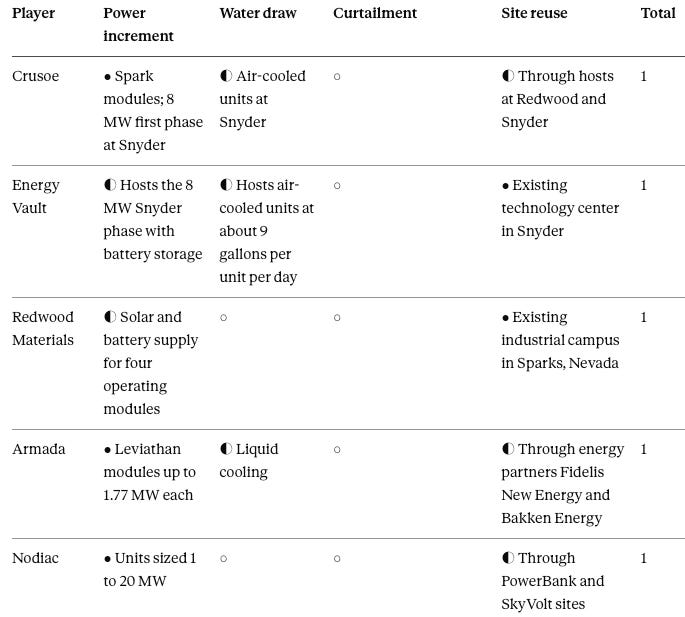
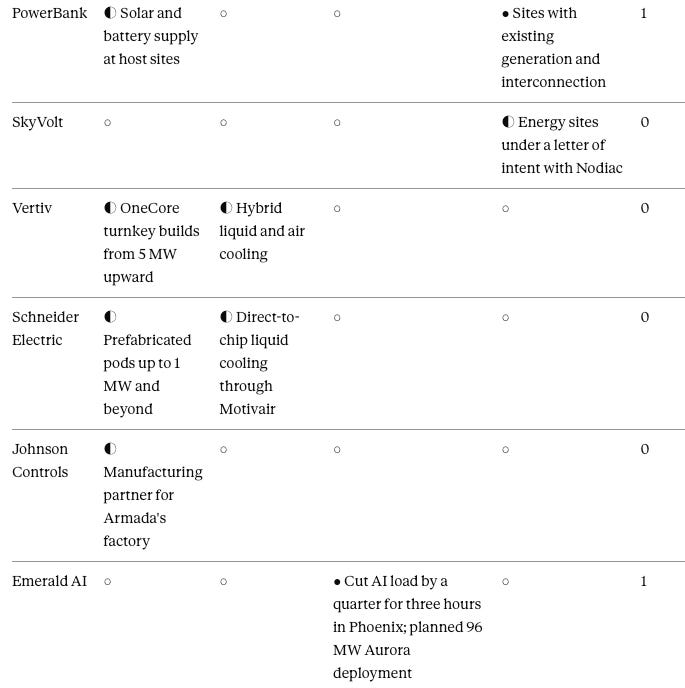
Among the eleven players mapped, none documents an offering on more than one measure through its own products. Host-operator pairs, meaning a host that supplies site and power matched with an operator that supplies modules and computing demand, cover more. Crusoe with Energy Vault spans power increment, low water use and site reuse, and Nodiac with PowerBank spans power increment and site reuse.
Curtailment is the measure no small-site partnership examined here documents. Emerald AI documents curtailment only at large AI factories, so no host-operator pair can yet show enforceable curtailment in a filing.
Snyder shows how low the water burden can run. Energy Vault’s 33 planned modules are air-cooled and use about 9 gallons of water per day each, about 297 gallons for the whole site.
Clean supply cuts across all four measures. The power source behind each module decides its emissions, whether solar and batteries as at Redwood or grid power as a backup.
Host-operator pairs come closest to a complete low-burden filing. Curtailment remains the gap a small-site route must still close.
C. Host Partnerships Anchor the Small-Site End of the Specialist Map
The specialist map lists each firm, the burden it reduces and the partners it works with today. Partners reveal where each specialist expects demand.
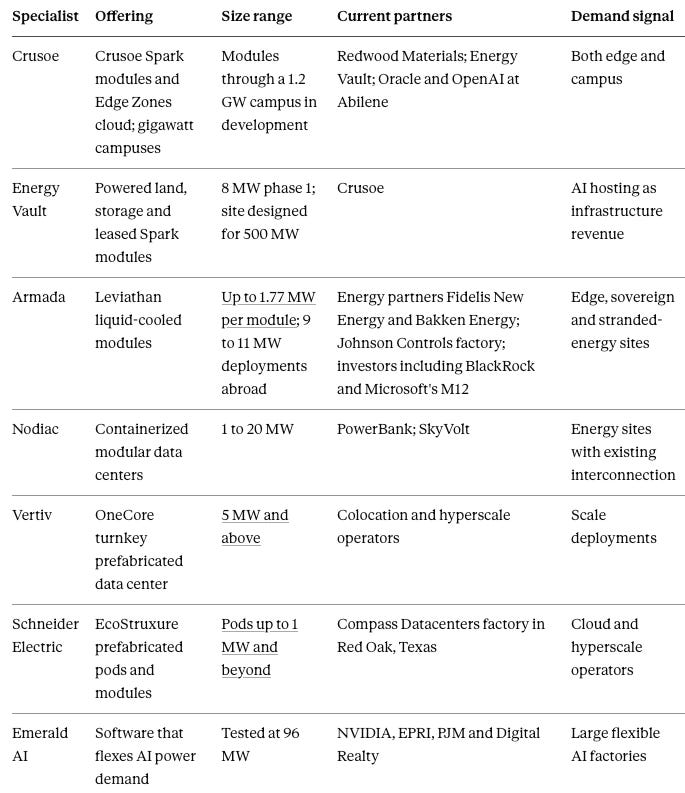
PowerBank and Nodiac moved from a letter of intent to a joint development agreement in June 2026. Nodiac will place 1 to 20 MW units at distribution-level connection points on PowerBank solar and battery sites that PowerBank describes as already holding generation, land and permitting approvals. No named site has been announced under the agreement.
Armada raised $230 million in May 2026 and plans an Arizona factory with Johnson Controls. Armada has named Fidelis New Energy and Bakken Energy as partners for Leviathan rollouts in North Dakota, Texas, West Virginia and Louisiana. Schneider Electric opened a factory in Red Oak, Texas with Compass Datacenters and acquired the liquid-cooling maker Motivair in 2025. Vertiv announced new South Carolina factories in March 2026 for prefabricated power and white-space systems.
Emerald AI’s flagship runs at large scale. NVIDIA plans to deploy Emerald AI’s software at the 96 MW Aurora data center in Manassas, Virginia, built by Digital Realty. An earlier test in Phoenix with Oracle and the utility Salt River Project cut power use by a quarter for three hours.
Host partnerships now anchor the small-site end of the map. Equipment suppliers and curtailment software point mainly toward large operators.
D. Two Routes Lead Into Power Service, and Aggregation Remains Open
A small modular site can take utility service or supply most of its own power. A third possibility, combining several small sites into one large customer, depends on tariff text not yet tested.
Utility service. A site takes power under an ordinary utility rate or a site-specific agreement. Large-load flexibility programs rarely reach it, because 56 percent of tracked large-load tariffs specified thresholds above 20 MW as of March 2026. State regulators report that the lower cluster of thresholds sits around 20 to 25 MW, and most modular units fall below it.
Distribution-level connection below the thresholds. Size thresholds also spare small sites from large-load obligations, and Nodiac’s model places units at distribution-level connection points to avoid multi-year transmission and large-load queues. Regulators have also observed that the right threshold may differ for distribution-connected and transmission-connected loads. A hosted site below the thresholds gives up flexibility credit and gains a shorter path to service.
Self-supplied power. A site generates and stores most of its own power. Crusoe’s Redwood campus runs on solar and batteries with the grid as backup, so it keeps a utility connection. Fully off-grid deployment with no utility connection is a separate route that no example examined here demonstrates.
Aggregation as an open tariff question. Several small sites might combine their flexible load and qualify as one large customer. Pennsylvania’s model tariff sets a 50 MW individual threshold and a 100 MW aggregated threshold, but the published summary does not say whether geographically separate sites qualify together. The answer lies in each tariff’s text and interconnection treatment.
Cross-location flexibility already exists for single owners of many sites. Georgia Power writes cross-location workload shifting into its large-load contracts, and Emerald AI has shifted inference across regions in earlier tests. Whether a fleet operator running many small modules could claim the same position depends on tariff terms no source yet confirms.
Each site’s power route decides which hurdles the site faces. Utility service runs through utility rules, while self-supplied power shifts the question to the approvals its equipment and site trigger.
E. Power-Asset Hosts Carry the Path to Operation
At small sites, hardware can arrive faster than approval. The binding product is therefore a capacity increment backed by contractual responsibility for the path to operation, not a module.
No supplier can promise that an agency issues a permit. A party can prepare filings, coordinate approvals and bear specified costs of delay or failure. Someone must also answer for power delivery, cooling performance and curtailment on command.
Equipment suppliers stop at delivery and schedule. Vertiv markets OneCore as a turnkey data center with a single point of contact and guaranteed scheduling. Neither Vertiv’s commitment nor any supplier’s extends to the approvals a county or state agency must grant.
Power-asset hosts carry more of the path. Energy Vault owns Snyder’s land, power infrastructure and storage. Energy Vault also buys the modules and leases them to Crusoe, which supplies compute demand through its cloud. PowerBank brings sites it says carry existing generation, land and permitting approvals to its agreement with Nodiac.
Host ownership concentrates site control, power infrastructure and existing site approvals in one party. Utility service and the permits each piece of equipment triggers still apply. Whether that concentration converts sites repeatedly is the central test in the forecasts that follow.
F. Workload Fit, Site Reuse and Phase Growth Shape Demand
Modular capacity suits some workloads better than others. Inference and batch computing can run near users and move between sites. Frontier training needs hundreds of megawatts of synchronized power at one location.
Workload determines whether modular capacity forms its own market. If buyers use modules for inference, a distinct small-site segment grows. If buyers use modules only as building blocks for campuses, modular becomes a construction method for hyperscale.
Existing sites offer another path. An operator can add a liquid-cooled block of computing inside an already approved facility. Reuse helps only when the added power, cooling, generators and noise stay inside the site’s existing envelope.
Small first phases can also grow. Energy Vault plans 25 MW at Snyder in 2027 and designs the site for 500 MW. A host site can open as a small increment and cross large-load thresholds later under the same owner.
Workload, reuse and phase growth decide how large the small-site market becomes. Each depends on buyers, hosts and approvers more than on suppliers.
G. Texas Tests the Host Route Under a Permit Halt
Texas now tests every route at once. The September 21 directive barred TCEQ from issuing permits sought by data center projects and told other state agencies not to advance related approvals until state grid and water audits finish. TCEQ reports on its compliance by October 19.
The Texas directive may reach beyond the grid. Legal analysts at Troutman read it as potentially covering projects with non-grid-connected or island-mode generation. Foley & Lardner notes uncertainty over whether the standstill reaches the Texas Department of Licensing and Regulation, which regulates industrialized building manufacturers that supply modular structures.
Snyder’s exposure depends on which approvals the site still needs. Public sources do not identify them, so the halt enters the simulation as delay risk on the Snyder route rather than as a demonstrated stop.
The Electric Reliability Council of Texas (ERCOT), the state grid operator, is gathering the data a finer rule would need. The audit asks planned data centers about power and water use, community impact and ownership. ERCOT’s information requests reach loads of 25 MW or more, a level Snyder’s 8 MW first phase sits below and its planned 25 MW expansion reaches. The permit halt itself carries no size floor. The governor has also said he will work to eliminate state financial incentives for data centers.
Texas shows that host ownership does not remove state review. Whether a given site faces a halted permit depends on its generators, fuel, cooling and location.
H. Repeatable Conversion, Not Hardware Supply, Is the Question Through 2027
MindCast’s simulation answers one question: which integrated offerings can turn a small site into authorized operating capacity, and when do utility rules or local approvals prevent that conversion? The horizon runs through December 31, 2027. The window covers Snyder’s target operating date, the Texas legislative session and most 2027 state sessions.
Frontier training campuses fall outside scope, because modular units cannot supply synchronized gigawatt power at one site. Federal preemption and export controls also fall outside scope.
I. Behavioral Economics Explains Why Suppliers Sell Speed
Suppliers lead with delivery speed, the benefit buyers see first. Months saved on construction appear in every sales conversation. Months lost at a county hearing appear later and belong to someone else.
County approvers apply the opposite bias. A county committee sees the label “data center” before it sees load size, as a Dunn County, Wisconsin review of a 2 MW modular proposal showed in July 2026. Loss aversion leads officials to weigh a visible local cost above a diffuse regional benefit.
Behavioral economics explains why speed claims outrun approval reality. Suppliers, buyers and approvers each attend to a different part of the project.
J. Dynamic Predictive Game Theory Explains How the Field Moves
Every move by a host, operator, utility or approver changes the payoff for the others. A utility that opens a sub-20 MW flexible rate raises the value of curtailment software for small sites. A state that halts permits raises the value of sites that already hold approvals.
Hosts and operators play a joint game against utilities and approvers. A host’s operating history lowers financing terms for its next site, and a stalled site raises them. Dynamic Predictive Game Theory tracks these countermoves as rules change during the contest.
Game theory supplies the payoff structure, and behavioral economics supplies the decision rules. Predictive behavior emerges from the combination, and the simulation models both.
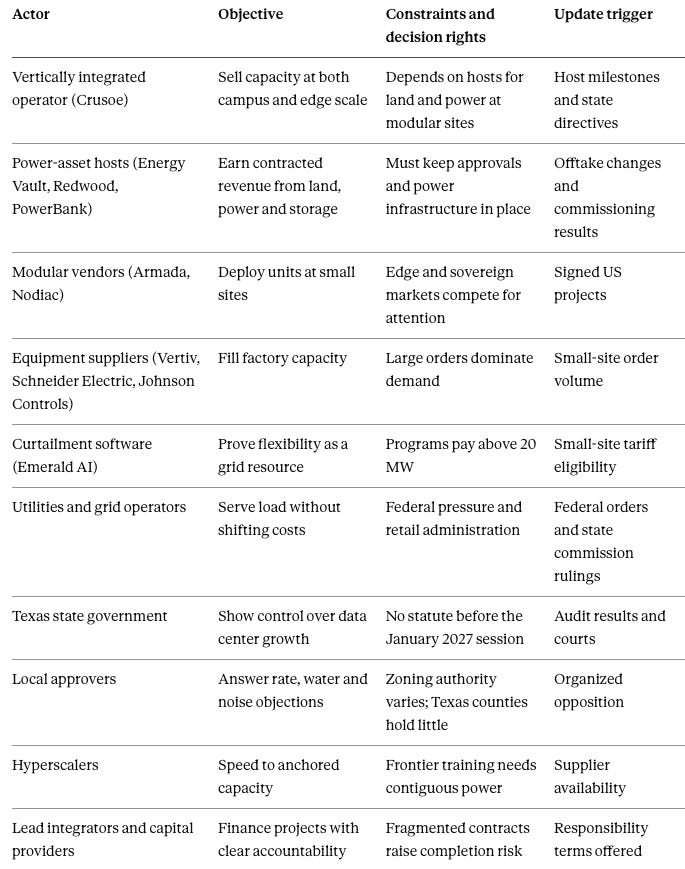
K. Ten Actors Decide Conversion
MindCast’s simulation models ten actors as Cognitive Digital Twins (CDTs), behavioral models of each organization’s goals, limits and likely responses. Each twin carries an objective, constraints and a trigger that updates its behavior.
Four explanations compete to account for which offerings convert.
Contractual responsibility. Offerings convert when one party accepts responsibility for the path to operation, including filings, coordination and specified delay or failure costs. The explanation fails if supplier combinations without such responsibility reach operation at the same rate.
Utility route. Access to power service decides conversion regardless of who carries responsibility for the path. The explanation fails if sites with eligible power service still stall at approval.
Permit route. State and local permits decide conversion regardless of power route. The explanation fails if self-supplied and utility-served sites convert at the same rate under the same permit rules.
No difference. Offerings convert at similar rates whatever their integration or route. The explanation fails if any integration model or route converts measurably faster.
MindCast’s simulation selects contractual responsibility, with the power-asset host as the responsible party. The utility route survives as a parallel branch for grid-served sites. The permit route stays open but does not govern any forecast, and the no-difference explanation fails.
Host ownership governs the forecasts that follow, while grid-served sites take a separate path.
Host control can reduce the coordination gaps between site, power and modules. Utilities and approvers still decide each site’s route to operation.
🏛️ Policymakers. Host-owned sites concentrate the evidence a burden-based review needs in a single filer.
💼 Executives. Curtailment is the missing measure in every small-site partnership on the map.
⚖️ Counsel. Each power route triggers a different approval set, so route choice precedes permit strategy.
📊 Investors. Host partnerships, not factory announcements, mark the pipelines closest to operation.
III. MindCast Simulation Predictions
MindCast issues ten forecasts on small-site conversion: two primary Simulation Predictions, six secondary Simulation Predictions and two interpretive findings. P marks a Primary Simulation Prediction, which tests the core mechanism. S marks a Secondary Simulation Prediction, which tests a specific route or actor. IF marks an interpretive finding on market structure, judged against a stated rule rather than a single event.
MindCast issues ten forecasts on small-site conversion: two primary Simulation Predictions, six secondary Simulation Predictions and two interpretive findings. All ten forecasts are original to this publication. P marks a Primary Simulation Prediction, which tests the core mechanism. S marks a Secondary Simulation Prediction, which tests a specific route or actor. IF marks an interpretive finding on market structure, judged against a stated rule rather than a single event.
A. Snyder and a Third State Test Whether the Host Route Repeats
P-1 | Energy Vault’s Snyder, Texas Campus Reaches Announced Commercial Operation of Crusoe Spark Capacity by June 30, 2027 (55-68%)
Energy Vault or Crusoe announces commercial operation of the first phase of Crusoe Spark modular capacity at Energy Vault’s Snyder campus in Texas by June 30, 2027. Falsifier: no such announcement by the deadline, and withdrawal of Crusoe as operator counts as a miss. Trigger: commissioning disclosures, Energy Vault quarterly reporting and the Texas audit outcome. Verification source: Energy Vault press releases and filings with the Securities and Exchange Commission, plus Crusoe announcements.
P-2 | Integrated Modular AI Capacity Operates in a Third US State by December 31, 2027 (42-58%)
Integrated modular AI capacity is announced in commercial operation at a site in a US state other than Nevada or Texas after publication and by December 31, 2027. Integrated capacity means factory-built modules, site power infrastructure and compute demand assembled as one project. Falsifier: no qualifying announcement in the window, and announcements before publication do not count. Trigger: Crusoe Edge Zones site disclosures, new host agreements and PowerBank and Nodiac site announcements. Verification source: company press releases and securities filings.
B. Power Routes, Local Review and Host Coalitions Carry the Secondary Tests
S-1 | No Approved US Utility Tariff Lets Separate Small Data Center Sites Pool Load Toward Flexibility Eligibility by December 31, 2027 (72-84%)
The forecast covers geographically separate sites, each under 20 MW and operated as a fleet, combining demand toward a flexible-service eligibility threshold. Falsifier: approved tariff text meeting every element; aggregation within one campus or one metering arrangement does not qualify. Linked to the low-probability aggregation route; trigger: separate-site aggregation language in a filed large-load tariff. Verification source: state commission orders and filed tariffs.
S-2 | A US County or City Blocks a Modular Data Center Proposal of 20 MW or Less Through Denial, Moratorium or Withdrawal by December 31, 2027 (75-88%)
The window opens October 1, 2026. A modular proposal is one the applicant or approving body describes as containerized, prefabricated or modular data center units. Falsifier: no such denial, moratorium or withdrawal in the window. Linked to P-2 and IF-2; trigger: county agenda items on small modular proposals. Verification source: county and municipal minutes and local reporting.
S-3 | Emerald AI Announces a Deployment at a Site With Less Than 20 MW of AI Load by December 31, 2027 (35-50%)
Falsifier: no such announcement by the deadline. Linked to S-6 and the utility route; trigger: a sub-20 MW flexibility tariff or rider. Verification source: Emerald AI and partner announcements.
S-4 | Energy Vault Announces a Second Snyder Phase or a Second AI Hosting Agreement by December 31, 2027 (45-60%)
Falsifier: no such announcement by the deadline. Linked to P-1; trigger: Snyder commissioning and operation disclosures. Verification source: Energy Vault press releases and securities filings.
S-5 | PowerBank and Nodiac Name a North American Site With a Definitive Agreement and Target Capacity by June 30, 2027 (55-68%)
The named site must carry a definitive development or customer agreement beyond the June 2026 joint development agreement. Falsifier: no qualifying named site by the deadline. Linked to P-2 and IF-1; trigger: PowerBank and Nodiac site announcements. Verification source: PowerBank and Nodiac press releases and project filings.
S-6 | A US Utility or State Commission Approves Curtailable Service for Data Center Loads Below 20 MW Between October 1, 2026 and December 31, 2027 (45-60%)
The instrument may be a tariff, rider or standard agreement offering dispatchable or curtailable service. Falsifier: no qualifying instrument approved in the window; instruments approved before October 1, 2026 do not count. Linked to the utility route for grid-served sites; trigger: sub-20 MW flexibility tariffs and riders in commission dockets. Verification source: state commission orders and final tariffs.
S-1 and S-6 separate two questions a reader may merge. S-6 asks whether any small site gains a flexibility service. S-1 asks whether separate small sites can pool their load to reach a large-load program, and the simulation expects the first to arrive well before the second.
C. Host-Owned Land and Route-Specific Approvals Define the Market Structure
IF-1 | Integrated Modular Sites Sit Mainly on Partner-Owned Land and Power (65-80%)
Integrated modular AI sites that reach operation or construction through 2027 sit mainly on land and power infrastructure owned by a power or industrial partner distinct from the module supplier.
Evidence covers every US integrated modular AI site announced as operating or under construction through December 31, 2027. A site counts toward the finding when a party other than the module supplier owns its land and power infrastructure. The finding holds when a majority of qualifying sites meet that test and fails when a majority sit on supplier-owned or arm’s-length sites without a power partner.
IF-2 | The Limiting Approval Differs by Power Route (65-80%)
Across US modular AI sites of 20 MW or less that publicly disclose their power design, the last unresolved milestone before operation or stall differs among utility-served, grid-backed hybrid and fully off-grid designs.
Evidence covers those sites’ power-design and permit disclosures through December 31, 2027. For each documented site, the assessment identifies the last unresolved power-service and permit milestones before operation or stall.
The finding holds when at least two power-design classes show different recurring limiting milestones in two or more cases each. The finding fails when a common milestone dominates the documented classes. If fewer than two classes have two documented cases, the finding remains indeterminate.
D. Host-Owned Sites Form the Most Likely of Three Routes
Most likely route: host-owned sites convert. A power-asset host commits land, power and storage, buys modules and leases them to an integrated operator. Snyder reaches operation, and hosts add sites where distribution-level connection is available. The route strengthens when Snyder commissions and a second host names a site.
Leading alternative: the Texas halt delays Snyder. The directive reaches approvals Snyder still needs, and operation slips past mid-2027. Operators then place new modules with hosts outside Texas. The shift trigger is a Texas audit outcome or agency statement that reaches host-site approvals.
Low-probability route: separate small sites aggregate. A utility commission approves tariff text that lets separate small sites combine toward flexibility eligibility. A grid-flexibility market for small sites opens, and fleet operators gain value that hosts alone cannot supply.
E. Hyperscaler Control and the Texas Audit Remain Watch Conditions
Hyperscaler control of modular vendors remains a watch condition rather than a Simulation Prediction. Public evidence of hyperscaler investment in modular suppliers does not yet show a path to control, and a named acquisition or controlling stake would change the investor readout.
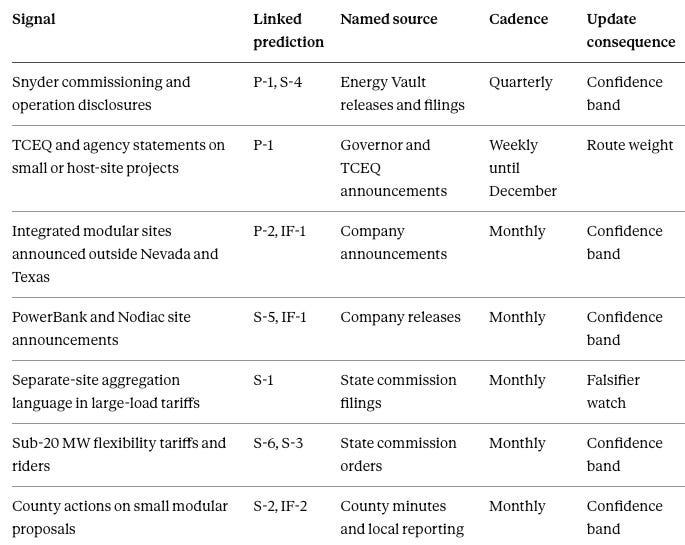
The TCEQ compliance report due October 19 and the Texas audit report expected in December are the gating events for P-1. Either document could shift weight between the most likely route and the leading alternative.
F. Three External Shocks Would Break the Forecasts
Three break conditions would invalidate these forecasts. The first is federal preemption of state data center rules, and the second is a court injunction against the Texas directive. The third is a level 3 Energy Emergency Alert from ERCOT before June 30, 2027. Level 3 is the stage at which ERCOT orders rotating outages.
Two events that could stop Snyder are not break conditions. A Texas halt that reaches Snyder’s approvals moves weight from the most likely route to the leading alternative, and P-1 carries that risk inside its band. Loss of Crusoe as Snyder’s operator would fail the host route P-1 tests, so the outcome counts as a miss.
Working With MindCast: Conversion Route Models
Published analysis cannot tell a host, operator or supplier which of its sites will convert. The answer depends on site ownership, target utilities and the permits each jurisdiction requires.
MindCast builds a Conversion Route Model for each client. The model traces a site from land and power ownership to power route, then through each permit to operating capacity. Cognitive Digital Twins of the client’s utilities, approvers and partners test each step against likely countermoves.
Commissioned work adds complete probability distributions and full scenario trees. Organization-specific trigger dashboards and red-team tests of each filing complete the scope.
Hosts, operators and suppliers can start with a Conversion Route Model for three target sites before the 2027 sessions begin (P-1, S-5). Investors can commission a screen of host-owned pipelines against the approvals each site still needs (P-2, S-4). Reach MindCast at mcai@mindcast-ai.com.
IV. Stakeholder Moves Before Snyder Operates and the 2027 Sessions Begin
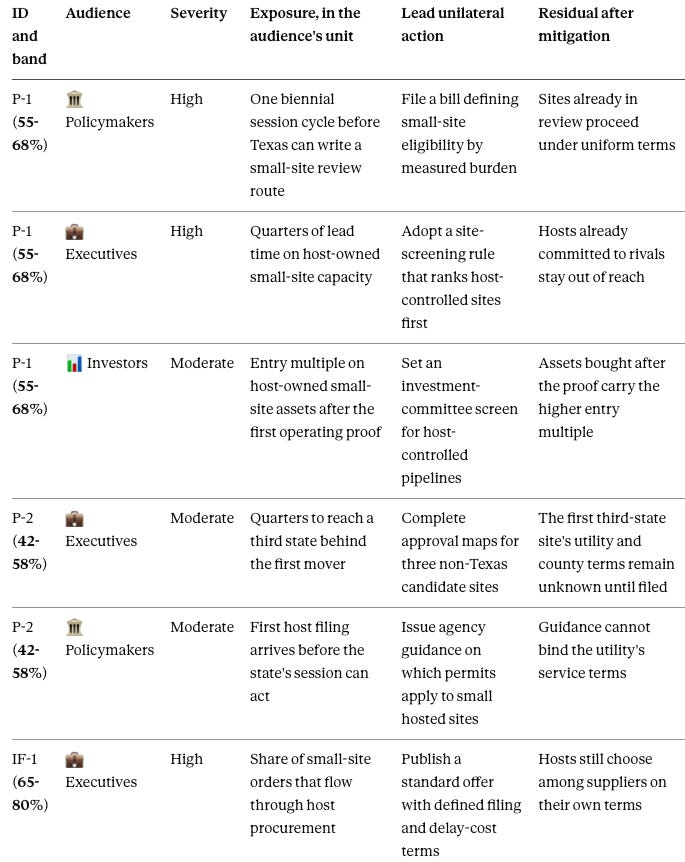
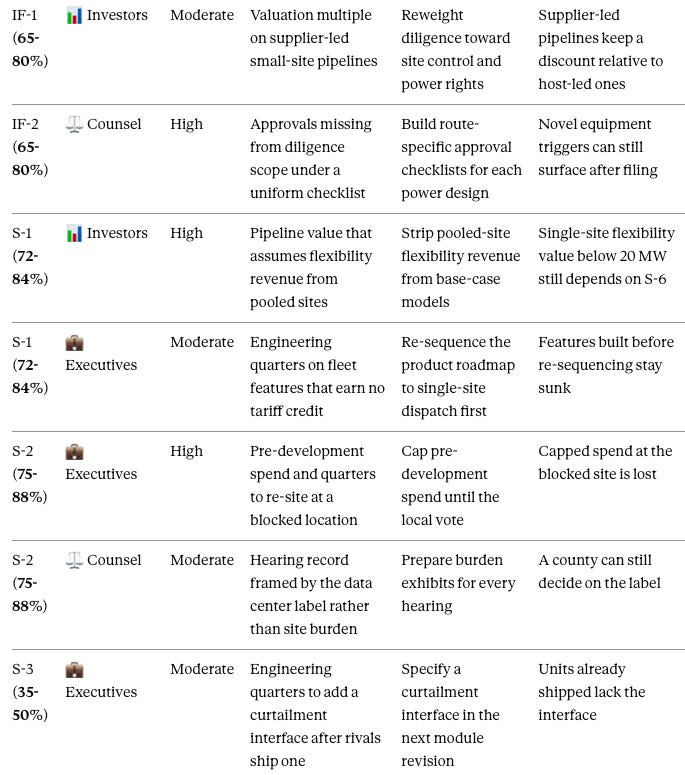
Each forecast carries a different exposure for each audience. The matrix pairs every forecast with the audiences it binds, the severity of their exposure and the lead action each audience can take alone. Two legal limits apply to the actions. Decisions on Energy Vault and PowerBank securities rest on public filings only, because both companies trade publicly. Competitors that take joint tariff positions file individually or through a trade association with antitrust counsel present.
Severity and probability run on separate axes. A forecast with a moderate band and high severity can justify more preparation than a likely forecast with low severity, so the matrix follows forecast order rather than band order. Each band is unconditional, and several forecasts move together, so the matrix gives no combined figure.
The actions describe analytic options available to each audience. None is advice to a specific party.
A. Risk Mitigation Matrix
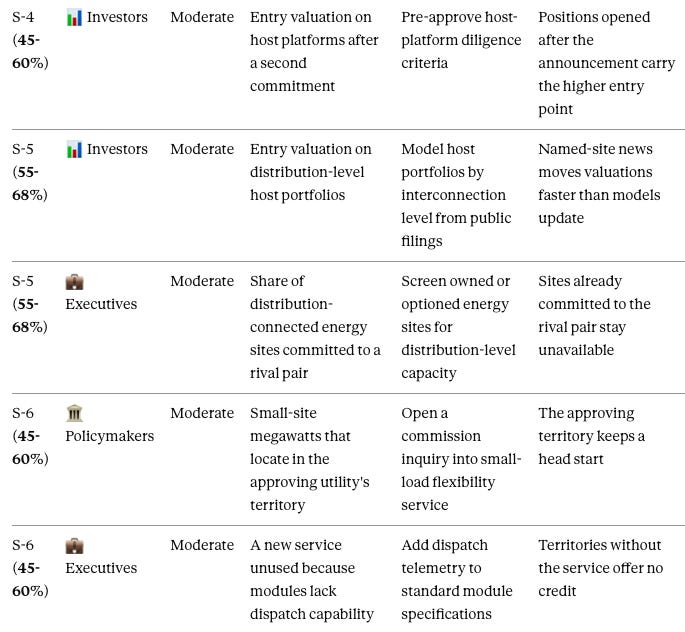
B. Policymakers Hold the Instruments That Open a Small-Site Route
🏛️ Lawmakers and state agencies can recognize projects by what they impose. A route keyed to power increment, water draw, curtailment and reuse would let host-owned sites qualify on evidence. The Model AI Infrastructure Authorization Code, a model state statute MindCast published, offers drafting language.
Utility commissions can act on the power side. A commission that states in tariff text whether separate small sites may aggregate would resolve the question S-1 tests. A commission that approves a sub-20 MW flexibility service would resolve S-6.
Policymakers decide whether Snyder becomes a template or an exception. The Texas audit and the 2027 sessions are the decision points.
C. Executives Should Pair With Power-Asset Hosts
💼 Operators should choose partners by site control before delivery time. A host that controls the site and power infrastructure carries more of the path to operation than any supplier contract can (IF-1).
Suppliers should decide how much of the path they will carry. An offer that covers filings, coordination and specified delay costs alongside hardware competes with host-operator pairs; an offer that stops at delivery does not. The Lowest-Exposure AI Data Center Approval Route for Developers, Hyperscalers and Investors sets out an approval sequence in which a single denial stops as little committed capital as possible.
Executives who pair with hosts now position for the most likely route. Executives who wait for aggregation depend on the low-probability route.
D. Counsel Should Map Approvals Site by Site
⚖️ Counsel should treat each module, generator, battery system and cooling unit as a potential permit trigger. Only fully off-grid power removes utility service from the analysis. Hosted and grid-backed sites keep utility terms, and the equipment list adds approvals of its own (IF-2).
Counsel should also determine whether industrialized building rules reach modular structures. The answer in Texas remains open, and it bears directly on P-1.
Counsel’s task is to find the one approval each site still needs. The missing approval decides the site’s timeline.
E. Investors Should Evaluate Pipelines Site by Site
📊 Investors should classify each modular pipeline by host ownership and power route. A pipeline that depends on multi-site aggregation needs confirmation in approved tariff text (S-1).
Investors should also ask who accepts contractual responsibility for the path to operation. A pipeline without an accountable party carries interface risk that hardware quality cannot offset.
Host ownership and open approvals, not units shipped, measure a modular pipeline. S-4 and S-5 show whether host pipelines convert into named sites.
F. Four Time Gates Structure the Exposure
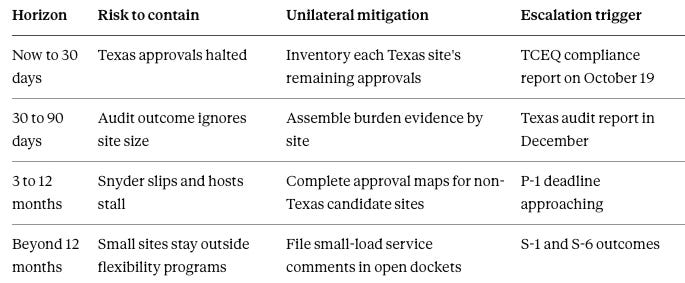
Every stakeholder faces the same sequence of dated events. Early movers shape the rules, and late movers inherit them.
V. Host Ownership Decides Who Captures the Low-Burden Market
Host ownership changes who holds authority, how the contest plays out and where value lands. Each consequence below traces to a forecast.
A. Authority Shifts With the Power Route
Utility service places authority with utilities and state commissions. Fully off-grid power shifts the binding approvals to those tied to each site’s equipment and location, while hosted and grid-backed sites answer to both (IF-2). Hosts and operators shape which approvals apply when they choose a site and its power source.
B. Host-Operator Pairs Change the Strategic Contest
Host-operator pairs compete on conversion rather than delivery (IF-1). Utilities and approvers then face fewer, better-prepared filings from parties that own the site. Equipment suppliers compete for host orders rather than for end buyers.
C. Value Flows to the Party That Owns the Site
Site owners stand to collect contracted infrastructure revenue on every module they host (P-1, S-4, S-5). Energy Vault describes its Snyder role as contracted infrastructure revenue. Suppliers that stop at delivery compete on equipment alone.
D. A Missed Forecast Would Redirect Effort
A miss on P-1 would mean Snyder announced no commercial operation by June 30, 2027. The miss alone would not identify its cause. The Texas halt, site approvals, construction and demand would each require their own evidence. P-2 would then carry more of the test of whether the host route repeats.
A miss on S-1 would open a grid-flexibility market for fleets of small sites. Fleet operators would gain value that hosts alone cannot supply, and investors should re-evaluate aggregation strategies.
A miss on IF-1 would show that suppliers or operators can convert small sites without power partners. Host ownership would then lose its lead as the conversion route.
Host ownership drives all four consequences. Whether it repeats across sites decides whether a low-burden market forms at all.
VI. Hosts, Investors and Regulators Open the Small-Site Market to New Entrants and Incumbent Pivots
The gaps in the specialist map are openings as well as risks. Four gaps give new entrants a product to sell, and the host model gives incumbents with energy sites a new line of business. Investors and regulators decide how fast either group can move.
A. Four Gaps Give New Entrants a Product to Sell
Small-site curtailment is the widest gap. No small-site partnership on the map documents curtailment, and Emerald AI’s documented work runs at large AI factories. An entrant that packages curtailment for sites below 20 MW could sell to every host-operator pair at once, and S-3 and S-6 test whether the market moves that way.
Approval coordination is the second gap. Equipment suppliers stop at delivery, and no firm on the map sells the filings, hearings and permit coordination a small site needs as a separate service. An entrant that prepares those filings and bears defined delay costs would sell the path to operation itself (IF-2).
Distribution-level host networks form the third gap. PowerBank’s agreement with Nodiac shows that solar and battery sites with existing grid connections can host modules. An entrant that assembles such sites across owners could offer operators a portfolio rather than a single location (S-5).
Burden evidence is the fourth gap. County hearings judge small modules by the data center label. Standardized exhibits on power, water, noise and generator hours therefore have value at every hearing (S-2).
Each gap maps to a forecast, so an entrant can test its thesis against a dated outcome. The gaps close fastest where regulators publish the rules entrants need.
B. Incumbents With Energy Sites Can Pivot Into the Host Role
Energy companies hold the asset the host model needs. Energy Vault is turning its Snyder technology center into an AI campus, and Armada markets its modules for sites with stranded natural gas. Owners of solar, battery and gas sites with existing grid connections can earn contracted revenue from modules without changing their core business.
Equipment suppliers can pivot too. Vertiv and Schneider Electric already run prefabricated factories, and either could pair with hosts or offer defined delay-cost terms in a standard contract (IF-1). A supplier that carries part of the path to operation competes for host orders on more than hardware.
Campus developers can use modules to enter new markets. Crusoe runs Spark modules at edge sites while developing its 1.2 GW Abilene campus, which lets it serve inference customers before a campus exists in their region.
Incumbents can move faster than entrants because they already hold sites, factories or customers. The pivot requires a decision to carry approval work, not new assets.
C. Investors Hold the Scarce Input
Capital converts modules into operating sites. Energy Vault buys the Spark modules at Snyder and leases them back to Crusoe. The financing decision rather than the factory decides whether a site gets built. Investors who fund powered land and module leases decide which sites reach the Snyder test (P-1, S-4).
Investors also set the market’s standards. A lender or fund that requires site control, approval maps and burden evidence before committing capital makes those items standard in every filing. Diligence criteria written today become the entry requirements hosts and operators must meet.
Public companies give investors a clear view of progress. Energy Vault and PowerBank report milestones in securities filings, so each named site or operating date becomes a public marker for the host model (S-4, S-5).
Investor leverage stops at the permit. Capital can reach a site’s gate but cannot compel an agency to open it.
D. Regulators Decide How Fast the Market Forms
Regulators decide whether small low-impact sites compete on their merits. A review route keyed to the four burden measures lets a 2 MW module qualify on evidence. Uniform halts favor the best-capitalized firms, because only they can carry sites through an open-ended pause.
Utility commissions create the markets that curtailment entrants need. A published small-load flexibility service (S-6) gives curtailment software a buyer at small sites. Clear tariff text on whether separate sites may pool their load (S-1) tells fleet operators whether aggregation has value.
Environmental and licensing agencies can remove the largest unknown in the approval chain. A written statement of which permits apply to modular structures, including whether Texas industrialized building rules reach them, lets investors fund sites against known requirements.
Regulators do not need to pick winners to encourage entry. Published eligibility definitions let entrants, incumbents and investors compete on the same known terms.
🏛️ Policymakers. A published burden-based eligibility definition lowers the cost of entry for small sites.
💼 Executives. Energy sites with existing grid connections are the fastest path into the host role.
⚖️ Counsel. Approval coordination is a sellable service, and the firms that package it can set the filing standard.
📊 Investors. Diligence criteria adopted now become the requirements every small site must meet.
What to Watch: Snyder, Texas Approvals and Small-Load Tariffs
The dominant fork is whether the Texas halt reaches an approval Snyder still needs. Three dated events move that question: the TCEQ compliance report on October 19, the Texas audit report in December and the Texas session opening on January 12, 2027.
Conclusion: Snyder Decides Whether the Host Route Repeats
Every part of a low-burden AI data center now has a supplier, and one integrated site already operates. Crusoe runs modules on Redwood’s Nevada campus, and Energy Vault is building a host-owned Spark campus in Texas. Power-asset hosts that control the site and its power infrastructure carry the most promising route to operation.
Utility rules and the approvals each site’s equipment triggers decide whether that route repeats. The decisive signals are whether Snyder reaches operation by mid-2027 and whether a third state follows.
Working With MindCast: Conversion Route Models
Published analysis cannot tell a host, operator or supplier which of its sites will convert. The answer depends on site ownership, target utilities and the permits each jurisdiction requires.
MindCast builds a Conversion Route Model for each client. The model traces a site from land and power ownership to power route, then through each permit to operating capacity. Cognitive Digital Twins of the client’s utilities, approvers and partners test each step against likely countermoves.
Commissioned work adds complete probability distributions and full scenario trees. Organization-specific trigger dashboards and red-team tests of each filing complete the scope.
Hosts, operators and suppliers can start with a Conversion Route Model for three target sites before the 2027 sessions begin (P-1, S-5). Investors can commission a screen of host-owned pipelines against the approvals each site still needs (P-2, S-4). Reach MindCast at mcai@mindcast-ai.com. Visit our Corporate Site at https://www.mindcast-ai-simulation.com.
Appendix A: Selected MindCast Works
Frameworks and Methods
The Clean Compute Match (2026). Supplies the pairing of compute classes with clean generation that tells each specialist which power source fits its product.
The Grid-Anchored Clean Power Bargain (2026). Separates interconnection, deliverable energy and accredited capacity, which frames the power routes.
The Model AI Infrastructure Authorization Code (2026). Provides the drafting vehicle for a low-burden state route.
Related Analysis
Burden-Based Authorization for AI Data Centers, Modular Clean Compute, and the Backlash Gap Between Grid Tariffs and State Law (2026). Defines the four burden measures this paper uses to classify specialists.
AI Data Center Veto Points (2026). Maps the stages where state and local bodies can stop a project, which every modular site must pass.
The Lowest-Exposure AI Data Center Approval Route for Developers, Hyperscalers and Investors (2026). Sets out the filing order a host-owned site would follow.
AI Datacenter Edge Computing: Ship the Workload Not the Power (2025). Originates the principle of moving compute to power, which host-owned modular sites put into practice.
Appendix B: External Sources
Primary government and company sources
Office of the Texas Governor. Governor Abbott Directs TCEQ to Halt Data Center Permits. September 21, 2026. The directive text, its scope across state agencies and the October 19 compliance date.
Energy Vault. SnyderAI: Powered AI Campus, Texas. Project page. Phase sizes, target operating date, ownership structure and water use.
Business Wire. Energy Vault Breaks Ground on Powered AI Infrastructure Campus in Snyder, Texas to Deploy Crusoe Spark Modular Data Centers. July 27, 2026. Construction start and module lease-back.
Crusoe. Crusoe Unveils Crusoe Edge Zones to Deliver High-Performance AI Infrastructure, Powered by Crusoe Spark Modular AI Data Centers. March 12, 2026. The dual-scale strategy and Spark Factory.
Crusoe. Crusoe and Redwood Materials Expand Strategic Partnership, Scaling to 7x the Original AI Infrastructure Density. March 24, 2026. Four operating modules, the announced expansion to 24 and grid backup.
Crusoe. Crusoe Introduces Crusoe Spark Modular AI Data Centers. June 26, 2025. The Spark launch and the 1.2 GW Abilene campus in development.
Vertiv. Vertiv OneCore Prefabricated Hybrid-Built Data Center. Product page. The turnkey single-point-of-contact offer.
Schneider Electric. Fast-Track AI Growth With a Modular Data Center Approach. July 29, 2026. The Red Oak factory and Motivair acquisition.
Grid and tariff sources
Smart Electric Power Alliance. Stretching the Possibilities: Where Large-Load Tariffs Fit in the Future of Data Center Flexibility. August 25, 2026. Thresholds, the Pennsylvania aggregation provision and Georgia Power’s cross-location terms.
Smart Electric Power Alliance. U.S. Data Center Gold Rush Drives Surge in New Utility Tariffs. 2026. The share of tariffs with thresholds above 20 MW as of March 2026.
National Association of Regulatory Utility Commissioners. Virtual Roundtable for Utility Regulators: Large Load and Data Center Tariffs. January 20, 2026. Threshold clustering and the distribution-versus-transmission distinction.
Press and legal analysis
Troutman Pepper Locke. Governor Abbott Directs TCEQ to Halt All Data Center Permits Pending ERCOT/TWDB Audits. September 22, 2026. The directive’s possible reach to off-grid generation.
Foley & Lardner. Texas Governor Abbott Directs TCEQ to Freeze All Data Center Permits in a Whole-of-Government Action. September 2026. The industrialized building question and the 25 MW reach of ERCOT’s information requests.
The Texas Tribune. Gov. Greg Abbott Broadens Moratorium on Data Center Approvals to Include Environmental Permits. September 21, 2026. The information the state audit collects.
DatacenterDynamics. Nodiac Partners With PowerBank to Colocate Modular Data Centers With Solar and BESS Across North America. June 2026. The joint development agreement.
DatacenterDynamics. Data Center Start-Up Fossefall Taps Armada for AI Data Center Deployments. August 2026. Leviathan module capacity, overseas deployments and the May 2026 round.
Converge Digest. Armada Secures $131M to Scale Modular Data Centers, Leviathan Launch. July 27, 2025. Energy partners and US rollout states.
HPCwire. Schneider Electric Rolls Out Scalable Data Center Hardware for AI and HPC Workloads. June 20, 2025. The EcoStruxure pod.
TelcoNews. Vertiv Expands Americas Factories for AI Data Centres. March 26, 2026. Vertiv’s South Carolina factories.
DatacenterDynamics. Nvidia to Deploy Emerald AI’s Orchestration Software at 96MW Aurora Data Center. The Aurora project and Phoenix test.
Latitude Media. Emerald AI Integrates With NVIDIA DSX Flex. 2026. Cross-region inference shifting.
Citizen Portal. Proposed 2 MW Modular Data Center Prompts County Questions on Water, Noise and Zoning. July 24, 2026. The Dunn County review.