
Companion to The AI Data Center Authorization Price — A 50-State Baseline
Related works: The MindCast AI Data Center Record · The Authorization Market: Standardized Bargaining, Rationed Power, and the Competition to Build America’s AI Infrastructure · AI Data Center Credit Risk — Permitting, Curtailment, and the Cost of Capital · Three Competing Governance Equilibria for AI Infrastructure · The Two-Ledger Data Center Bargain · The Federal-State AI Infrastructure Collision
Critical references: Data Center Authorization Transition Forecaster · National Authorization Intervention Inventory · The Model AI Infrastructure Authorization Code · The Data Center Authorization Market: A 50-State Regulatory Atlas
See the MindCast Data Center Regulatory Economics Live-Fire Mission
Executive Summary
Permission to build an AI data center has become a scarce, priced good. Roughly $725 billion in annual hyperscaler capital is chasing a fixed pool of authorization slots — grid headroom, tariff capacity, water allocations, community tolerance — and the states that control those slots have started rationing them: auditing speculative demand, scoring bidders, and pausing whole markets while they write terms. Under rationing, the question that decides where capital lands is no longer which firm bids most. It is which firm the state will say yes to, and on what terms.
The ratings in this paper answer that question for the whole field. Every major buyer of authorization — Microsoft, Google, Amazon, Meta, OpenAI, Oracle, Anthropic, xAI, the neocloud tier, the developers who manufacture slots, and the capital behind all of them — is rated on the seven capabilities states actually price: collateral, clean-firm power, conduct, demand credibility, optionality, federal alignment, and speed. The headline finding runs against market instinct: the bargaining ranking does not match the market-cap ranking. Microsoft and Google lead because they carry collateral, clean supply, and governance simultaneously; the announce-first, gas-forward half of the field is racing a shrinking map, and one firm’s conduct record is now the exhibit opposition groups cite in other firms’ hearings.
Twelve Foresight Simulation Predictions freeze the analysis into dated, falsifiable claims. Three set the stakes:
Slot scarcity is measurable and binding — in every rolling twelve-month window through mid-2028, no more than 60 campuses of 250 MW or larger receive binding authorization nationwide, while disclosed demand runs at least three times the cleared count. 70–80%
No hyperscaler builds at home — no principal headquartered in California or Washington breaks ground on a 250 MW campus in its own state through mid-2028; the states that host the buyers’ headquarters will not host their loads. 75–85%
Governance becomes the sales pitch — two or more principals publicly market authorization and governance capability as competitive differentiation, converting conduct from a compliance cost into a marketed asset. 80–89%
Each prediction carries a deadline, a falsifier, and a public settlement source, and the full register appears in Section XI. Readers who want the state side of the same bargain — what the fifty states charge for authorization — will find it in the companion baseline linked below; this paper stands alone without it.
Each stakeholder class holds a different edge in these pages. Operators read the ratings to know which states price their strengths and which price what they lack. Investors and lenders read them to underwrite the stack behind announced capacity — the dependency graph no state statute yet prices. States, counties, and commissions read the same table in reverse: bidder diligence for the RFPs and statutes the 2027 sessions will produce. And the firms rated lowest read it for the only thing that moves a score — the record.
The current publication is the buy-side half of the series’ paired baseline. The AI Data Center Authorization Price — A 50-State Baseline mapped the sell side — what fifty states charge for authorization — with its full evidentiary layer in the The Data Center Authorization Market: A 50-State Regulatory Atlas and its scoring instrument in The Model AI Infrastructure Authorization Code. The papers run on the same frozen baseline and the same instrument-change ledger.
Roughly $725 billion in 2026 hyperscaler capex — the four-company estimate frozen at T₀; later reporting runs closer to $745 billion — is chasing a fixed and shrinking pool of authorization slots: grid headroom, tariff capacity, water allocations, community tolerance. The Authorization Price baseline rated the state side of the bargain; this paper rates the firm side.
Four tiers compete for the same slots by different means: principals whose demand drives the race, neoclouds who build fastest with the thinnest governance, developers who manufacture and hold slots, and capital whose balance sheets determine who can post the collateral that financial-assurance regimes now use to ration headroom.
The question throughout: which firms are best positioned to bargain with states — and the answer is two-sided, because a bargaining position is what the state will pay to have you and what you can extract for showing up.
Disclosure: the roster includes Anthropic, whose Claude models MindCast uses in its research workflow. Anthropic is scored on identical criteria to every other firm, and the reader can audit the scoring against the sourced record like any other row.
I. 🧭 What “Bargaining Position” Means Here
The AI Data Center Authorization Price established the pricing structure: the pause threat sets the floor on conditions, the federal bypass sets the ceiling on price, and buyer competition determines where the price clears inside the band. A firm’s bargaining position is therefore not a single number but a bundle of seven capabilities, each mapped to a mechanism in the main paper:
Collateral capacity. Financial-assurance regimes ($1.5M/MW Virginia, $50k/MW non-refundable in the Texas draft) ration headroom by balance sheet. Firms that post capital effortlessly clear the rationing screen; firms that need backstops inherit their guarantor’s constraints.
Clean-portfolio depth. Binding clean-statute states (the companion’s Form 1 tier — WA, CA, OR, NY, MN, MI and ten more) are structurally the high-price, high-certainty tier, and only firms with 24/7-carbon-free procurement capability clear their bar. Gas-dependent builders are locked out of sixteen states before negotiations begin.
Governance capital (the Conduct column). The terms-first versus announce-first axis. TLSM-11 (one operator’s controversy cited against unrelated companies, 85–92%) makes community tolerance a shared commons; a firm’s conduct record is priced into every rival’s sites, and its own.
Demand credibility. The state’s P(honored): will the load, jobs, and revenue actually materialize? Self-funded demand scores high; circularly financed or speculative demand scores low, and states are learning to tell the difference — AEP’s halved forecast after tariff approval was speculative demand exiting the queue.
Optionality. Outside options are bargaining power. A firm running a fifty-site portfolio credibly walks; a firm locked into one metro cannot. The extreme version inverts the auction entirely (§6).
Federal alignment. The accelerate tempo lives federally; alignment with it buys land access, permitting compression, and political cover — and creates exposure if the administration or the policy changes.
Speed capability. Time-to-compute is the race’s clock. Speed is an asset in accelerate-tier states and a liability everywhere terms matter, because the fastest builders are the ones that manufacture freezes.
One equation organizes the seven, and the series umbrella publishes it as this paper’s governing form: Slot Odds ∝ Capability Bundle × (1 − Conduct Discount). Capabilities add — a thinner collateral position can be partially offset by a deeper clean book or wider optionality. Conduct multiplies — the discount applies to the whole bundle at once, updates on the firm’s record in every jurisdiction simultaneously, and no capability buys it back except performance over time. The multiplicative term is why ⚠️ exists as a category in the master table rather than as a low score: a sufficiently damaged conduct record discounts everything the firm brings to every table it sits at.
Regional market rules are converting the same bundle from negotiating posture into service qualification. Under frameworks like PJM’s proposed Interim Resource Adequacy Service, accredited capacity, enforceable curtailment, and verified flexibility purchase firmness itself, not just goodwill — a capacity-short load that cleared every state gate still stands first in line for shortage curtailment. The seven capabilities below therefore price twice: once at the bargaining table, and again at the regional layer no state statute reaches.
The composite Position rating is a tier judgment, not an arithmetic sum; the legend above the master table defines every column in plain terms.
Two Propositions Under Test
The series umbrella pre-registered two propositions this guide carries, both stated as model outputs with definitions and falsifiers rather than established facts.
The slot-clearing proposition (70–80%). The national market clears only several dozen new large-campus authorizations annually, against disclosed demand several times larger. Definitions, per the umbrella’s contract: minimum campus size is 250 MW; the unit of authorization is a campus holding a binding instrument — an executed large-load service agreement, approved tariff enrollment, or completed interconnection agreement — never an announcement; geographic coverage is the fifty US states; duplicate removal counts each campus once across announcements, re-announcements, and phase splits; oversubscription is estimated as deduplicated disclosed demand (announcements plus interconnection-queue requests) divided by cleared slots. Registered as MC-FG-9. [Operational thresholds bracketed pending freeze: “several dozen” proposed at ≤60 per rolling twelve-month window; “several times larger” proposed at ≥3×.]
The home-state conduct discount (65–78%). A principal’s home jurisdiction applies the largest conduct discount, because local institutions possess the deepest firm-specific record — every unmet commitment, every utility fight, every disclosure gap sits in the local file, and hometown visibility raises the symbolic payoff of opposition. Registered as MC-FG-10, with MC-FG-8’s groundbreaking test as its behavioral corollary: the discount is the mechanism, the absence of home-state campuses is the observable it predicts. §8 locates the paradox in the firm ratings; §9 develops its mechanism.
II. 🗺️ Master Table — The Field at T₀
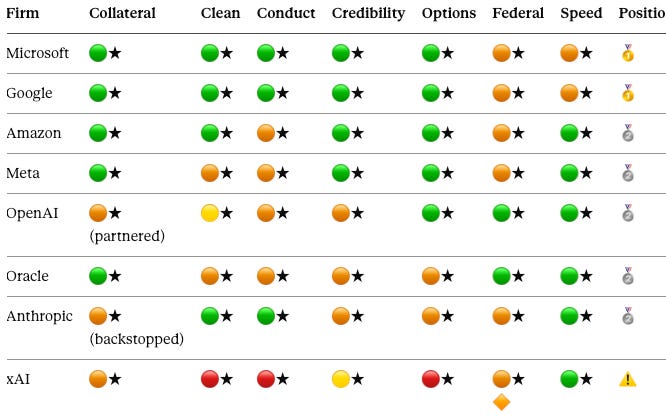
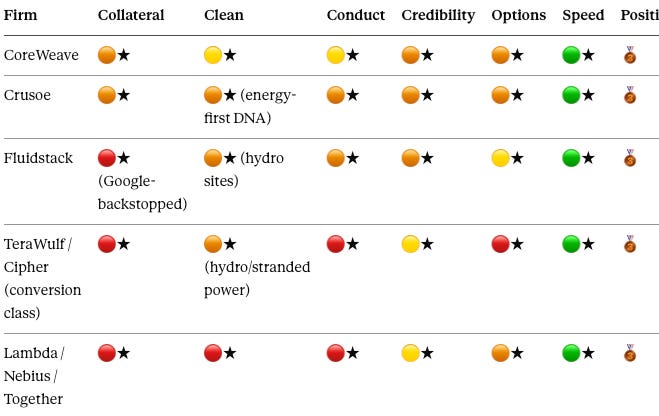
How to read the ratings. Each firm is rated on seven capabilities on an underlying five-star scale, displayed as a single color star:
🟢 strong (4–5 stars) · 🟠 middling (3 stars) · 🟡 weak (2 stars) · 🔴 weakest in the field (1 star)
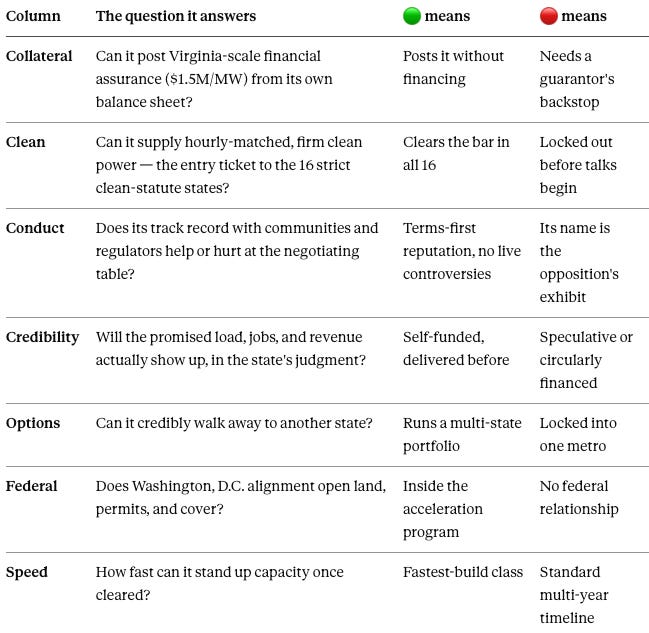
The final column, Position, is the overall judgment: 🥇 structurally advantaged · 🥈 capable with constraints · 🥉 dependent or exposed · ⚠️ conduct record actively damaging its own and others’ bargaining position. Ratings are interpretive classifications at 70–88% confidence, resting on the sourced record through T₀ — not arithmetic scores.
Tier 1 — Principals
Tier 2 — Neoclouds
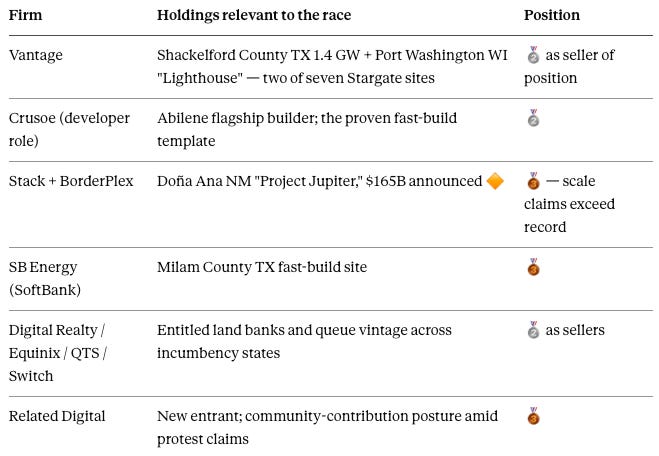
Tier 3 — Developers (Slot Manufacturers)
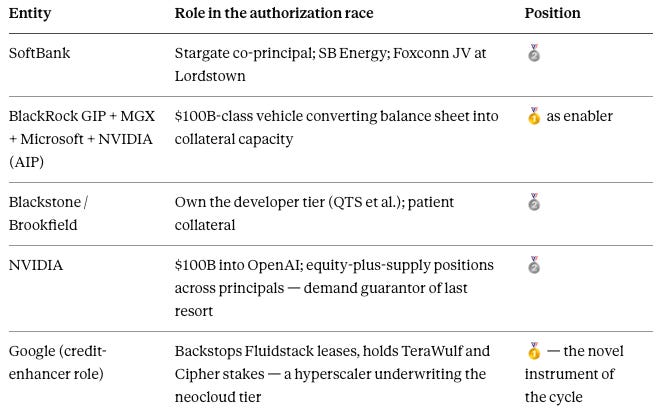
Tier 4 — Capital
III. 📜 Principal Profiles — The Sourced Record
Microsoft — 🥇 the full-stack incumbent. Calendar-2026 capex near $190 billion, capacity-constrained through at least year-end by its own CFO’s account, with the deepest clean-firm portfolio in the field, and the firm publishes the numbers: 40 GW of new renewable supply contracted since 2020 with 19 GW online, 100% annual matching of global electricity consumption achieved in 2025, 29.8 million metric tons of contracted carbon removal, a carbon-negative-by-2030 commitment, the Crane Clean Energy Center (Three Mile Island) delivering from 2027, geothermal in New Zealand, and the first fusion PPA on record with Helion. Worth stating precisely, because the distinction decides Form 1 access: the achieved and published position is annual matching plus contracted firm nuclear, not hourly matching — the 24/7 architecture is Google’s origination and Microsoft’s trajectory.
Collateral capacity is effectively unlimited and further leveraged through the AI Infrastructure Partnership with BlackRock/GIP and MGX. The governance record is strong with one visible dent: Microsoft lobbied alongside Amazon against Washington’s HB 2515, winning the session and guaranteeing a harder 2027 bill — a tactical win purchased at strategic cost in exactly the state where its clean portfolio should dominate. Against that dent sits the field’s most developed community-relations infrastructure: Microsoft Local publishes a standing page for roughly nineteen US jurisdictions and two dozen countries, each carrying the same five Community-First Infrastructure Initiative commitments (January 13, 2026) — pay our own way so datacenters do not raise local electricity prices, minimize and over-replenish water, hire locally, add to the tax base, and fund local AI training and nonprofits — alongside energy and water explainers, operations fact sheets, per-project construction updates, a Datacenter Academy pipeline, and a named local contact channel. Best-fit territory: Form 1 states and high-collateral regimes where rivals thin out. The Washington deficit is only half reputational: CETA compliance headroom and Climate Commitment Act allowance pricing distribute an Eastside load’s cost across every Westside ratepayer, so the legislators pricing Microsoft’s consent represent payers rather than hosts — a discount lobbying cannot repair and conduct cannot fully offset (§9).
Google — 🥇 and playing a second game nobody else plays. Capex $175–185 billion with cloud revenue up 63%, the original 24/7-CFE mover with the broadest advanced-clean pipeline (geothermal, advanced nuclear), and the same Form 1 access as Microsoft. The differentiator is the credit-enhancer role: Google backstops Fluidstack’s lease obligations, took stakes in TeraWulf and Cipher, and thereby underwrites the neocloud tier building Anthropic’s capacity — converting balance sheet into influence over slots it never has to permit itself. No other principal has financialized the authorization race this way. Exposure: the same backstops import neocloud conduct risk into Google’s TLSM-11 ledger.
Amazon — 🥈 the biggest spender with the most utility scar tissue. The largest 2026 program at roughly $200 billion, plus the $11 billion, 1,200-acre Project Rainier campus in Indiana purpose-built for Anthropic — delivered operational while rivals planned, which is genuine speed-with-terms capability. Clean portfolio substantial but shallower than the two leaders; the governance ledger carries the HB 2515 lobbying and a longer history of utility cost-allocation fights, and investor pressure for water and power disclosure lands on Amazon first among the three clouds. Best fit: bargain-enacted states with written tariffs, where its scale prices well and its disclosure gaps price less. Amazon shares Microsoft’s Washington apportionment geometry exactly, which makes the two firms the guide’s cleanest natural experiment: whatever the 2027 successor charges them differently is attributable to conduct, since the structure is held constant (§9).
Meta — 🥈 maximum force, gas-forward. Capex guidance $115–135 billion against multi-hundred-billion multi-year infrastructure signaling, with the largest single self-build campuses in the country and full demand integration — no cloud customers, so P(honored) on load is near-certain.
The constraint is fuel: the flagship program leans on gas generation, which forfeits the sixteen-state Form 1 tier before bargaining begins and concentrates Meta in accelerate and bargain-enacted gas states, where its willingness to fund community benefits at scale buys local consent the fuel mix otherwise costs.
Structural read: the strongest bargainer in the tier of states with the weakest terms — which is leverage today and exposure as the tiers converge.
OpenAI — 🥈 the strongest procedure, the softest foundation. Stargate stands at seven US sites — Abilene operating at ~0.3 GW with four of eight buildings live, Shackelford and Milam in Texas, Doña Ana in New Mexico, Port Washington in Wisconsin, the $16 billion Saline Township campus groundbroken in Michigan on June 1, and Lordstown’s Foxconn JV in Ohio — toward 9-plus GW by 2029.
The RFP that produced them drew over 300 applications from 30 states, the reverse auction analyzed in §6, and federal alignment through the Stargate banner is the strongest in the field. The soft points: capital is partnered rather than owned (Oracle, SoftBank, NVIDIA’s $100 billion), the Abilene expansion reversal shows plans move after groundbreaking, Capitol protests in Texas and water disputes at Doña Ana are accumulating on the commons ledger, and demand credibility rests on a $1.4 trillion ambition running far ahead of revenue.
Position summary: peak leverage now, fragile if the credibility gap widens — states that priced OpenAI’s promises at face value are carrying the P(honored) risk the Two-Ledger model prices at ~2× when it breaks.
Oracle — 🥈 the arms dealer who moved into the fort. Top-five capex with the $300 billion OpenAI agreement at its core, building and leasing Stargate capacity largely developed by others (Vantage, Crusoe), with internal component costs running $30–40 billion above plan by its own CEO’s estimate. Federal alignment high, clean portfolio middling, and the balance-sheet strain of financing someone else’s buildout is the field’s most-watched credit story. Oracle bargains well wherever Stargate’s political umbrella extends and weakly outside it.
Anthropic — 🥈 governance-differentiated, scale-constrained, structurally honest. The $50 billion US program with Fluidstack — Texas and New York first, sites live through 2026, the New York site likely TeraWulf’s hydro-powered Lake Mariner — sits atop the field’s most distinctive multi-cloud position: AWS Project Rainier scaling toward a million Trainium chips, a Google TPU commitment past a gigawatt, and a $30 billion Azure arrangement.
Hydro-backed sites give better Form 1 access than the capex number suggests. Two weaknesses: capital is backstopped rather than owned (Google’s guarantees behind Fluidstack and TeraWulf), and the announced 800 permanent jobs against $50 billion states the thin-benefit-line problem more plainly than any competitor — which is a governance asset with communities that have been burned by inflated jobs promises, and a bargaining handicap with legislatures still running the jobs/MW denominator. Best fit: Form 1 and bargain-enacted states that price enforceability over payroll.
xAI — ⚠️ the negative pole, and the field’s biggest externality. The record, per the litigation file: Colossus 1 in Memphis ran up to 35 unpermitted gas turbines from June 2024, removed them only under notice of intent to sue, and permitted 15; Colossus 2’s power plant in Southaven, Mississippi — sited across the state line where portable-equipment registration outruns Tennessee’s federally delegated Title V program, which plaintiffs call forum shopping — ran 27 publicly acknowledged temporary turbines that regulator correspondence later put at 59, with a fleet near 420–495 MW, potential NOx emissions that would make it the largest industrial source in a metro already failing smog standards, landing on predominantly Black communities.
The NAACP, SELC, and Earthjustice filed the Clean Air Act suit April 14, 2026; Mississippi issued a 41-turbine permanent permit three weeks after a single public hearing; a $7 million sound wall failed to quiet neighbors; the federal government has moved to dismiss.
Bargaining consequence: xAI has speed and one relationship, and has spent everything else — its conduct is now the citation opposing counsel and county boards use against every operator in the field (TLSM-11’s mechanism running at maximum), its Form 1 access is zero, and its optionality is gone because the sunk gigawatt anchors it to the one metro where its name is a rallying cry. The reported SpaceX ownership 🔶 adds consolidation without adding governance.
Contact mcai@mindcast-ai.com to partner with us on Predictive Game Theory AI in Law and Behavioral Economics. We specialize in predictive simulations for Complex Litigation, Innovation Economics, Geopolitical Risk Intelligence and Legacy Innovation. See more about MindCast series at our new website MindCast Corporate.
To test our predictive simulation AI system, in 2026 we simulated the Super Bowl and the World Cup. See 🏈 Super Bowl LX — AI Simulation vs. Reality | ⚽ The 2026 World Cup Final Simulation Validation
To deep dive on MindCast works upload the URL of this publication into any LLM (preferably Google AI mode) and prompt ‘reconstruct MindCast framework with three degrees of cited sub links.’ See Live-Fire Game Theory Simulators, Runtime Predictive Infrastructure.
Working With MindCast
MindCast runs two service lines on one method. Authorization intelligence grades jurisdictions and instruments against the fifty-state baseline. Geopolitical exposure intelligence maps the classification, entity-eligibility, and screening constraints that sit above them. The ratings in this paper are the authorization line applied to the buy side of the market, and every engagement below runs on the same frozen methodology.
Operators and principals can commission a position briefing — the firm’s seven-capability score decomposed against the sourced record, gap-to-leader per axis, tempo-tier exposure across the fifty states, and the record changes that would move each score. Investors and lenders can commission a counterparty assessment separating feasibility from fragility across a named position: the dependency graph behind announced capacity, collateral and backstop structures, and the probability that commitments are honored on the terms disclosed.
States, counties, and commissions running RFPs or drafting 2027 statutes can commission bidder diligence or scoring design — conduct records, demand credibility, and clean-firm supply converted into criteria an instrument can score, keyed to the provisions the coming sessions will contest. Neoclouds and developers can commission a qualification review naming the enforceable instruments, backstop structures, and drafting positions that raise a rating, because scores move only when the record moves.
Advisory sells record changes, never score changes, and runs one principal per contested arena per bargaining cycle. Engagements run as Cognitive Digital Twin simulations with dated, falsifiable outputs, and MindCast grades its record in public.
IV. 🧩 The Lower Tiers — Who Actually Holds the Slots
Neoclouds are the fastest tier and the most dependent: Crusoe built the Abilene flagship and owns the proven fast-build template; CoreWeave carries Stargate workstreams while building a software stack to escape the commodity trap; Fluidstack vaulted from GPU broker to Anthropic’s $50 billion partner on the strength of Google’s credit enhancement.
The TeraWulf/Cipher conversion class turns stranded crypto power into AI slots, which is the cheapest authorization arbitrage on the map — the permits, interconnection, and often hydro power already exist.
The tier’s structural position: it manufactures speed and consumes commons, concentrates in unwritten-terms jurisdictions per the companion analysis, and increasingly survives on principal backstops — meaning its bargaining position is borrowed, and the lender is a hyperscaler.
Developers are the quiet winners of the rationing regime. Vantage holds two of seven Stargate sites; entitled land with queue vintage is exactly the asset class the stringency ratchet appreciates, and every ratchet click raises the price principals pay to buy position rather than build it.
The capital tier’s function is narrower than its press: converting balance sheets into postable collateral (AIP), demand guarantees (NVIDIA), and patient ownership of the developer tier (Blackstone, Brookfield). One entry deserves its own line: Google-as-credit-enhancer is the cycle’s novel instrument — a principal underwriting the tier that builds for its competitor-partner, capturing optionality on both sides of the Anthropic relationship.
V. 🔁 The Reverse Auction — When States Bid for Firms
OpenAI’s RFP drew over 300 applications from 30 states, and sixteen states publicly signaled interest in hosting campuses. Read against the companion paper, the event is structurally significant: the competition layer established buyer competition as the fourth force pushing the authorization price up, and the RFP shows the force running in reverse at sufficient project scale.
A gigawatt-class campus with a $16 billion price tag is large relative to a state’s economy in a way a 100 MW facility is not, and at that ratio the state becomes the bidder — Michigan’s groundbreaking, New Mexico’s approvals over water objections, and Wisconsin’s Lighthouse all cleared processes that smaller projects in the same states would not have cleared on the same terms.
The rule this implies, stated as a hypothesis at T₀: bargaining power flips to the firm when project scale crosses a threshold relative to the host economy, and flips back to the state as the state’s remaining headroom depletes. Both movements are visible in the record — the RFP flip at announcement, and the Washington/Seattle counter-case where 369 MW of quiet demand against a constrained clean grid produced not a bid but a ban.
The synthesis with the companion’s ratchet: mega-projects buy their way past current terms and then become the incumbency that generates the next, stricter terms. OpenAI is simultaneously the biggest beneficiary of the flip and the biggest future contributor to the ratchet. Interpretive confidence in the threshold mechanism: 75–85%.
VI. 🎯 Firm × Tempo Fit — Who Wins Where
Bargaining position is not one national score — it is a fit between a firm's capability bundle and the tempo of the state it faces. A state's tempo tier, from the Authorization Price taxonomy, sets which capabilities the bargain actually prices: bargain-enacted states price collateral and contract tolerance, accelerate states price raw speed, pause states price queue vintage and demand credibility, contested states price pre-coalition instruments, and the clean-statute tier prices the power portfolio before conversation begins. The table below crosses the field against those tiers, naming who each tempo structurally favors and who it excludes.
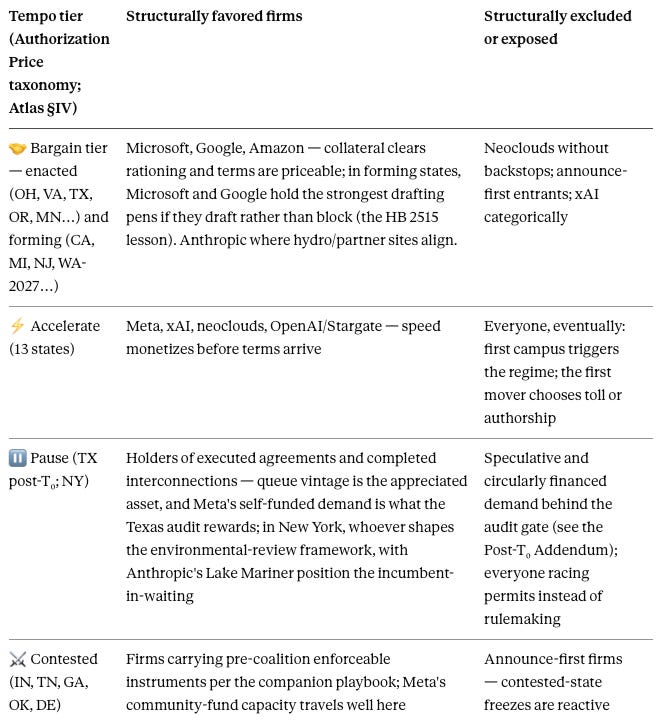
Two structural reads fall out of the cross. First, only Microsoft and Google appear on the favored side of every tempo — the payoff of carrying collateral, clean supply, and conduct simultaneously rather than maximizing one. Second, the exclusion column converges: announce-first, gas-forward, thinly backstopped firms lose across every tempo for different stated reasons, which is one weakness expressing itself four ways. One tier is deliberately absent from the table — the sixteen-state clean-statute axis, where fit is hardening fastest and access is becoming a passport rather than a preference. Section VII gives it the full treatment.
VII. 🌿 The Clean-Energy Axis — Access, Conversion, and the Compounding Passport
Clean-energy bargaining position decomposes into three capabilities the field distributes unevenly, and the Clean column in §2 compresses what this section unpacks.
Access. The sixteen Form 1 states price hourly-matched, firm, additional clean supply — not annual renewable certificates. Google built the 24/7 carbon-free energy framework that effectively defines the standard those states are converging toward, with the broadest firm-clean pipeline in the field (geothermal, advanced nuclear, storage-paired renewables); its supply is bargaining-grade in more jurisdictions with less translation than anyone else’s.
Microsoft’s contracted book is arguably deeper in firm power — the Three Mile Island restart is the single most valuable clean asset any firm holds — and clears the same bar by a different route, though its published position is annual matching plus firm nuclear rather than delivered hourly matching, which narrows the gap to Amazon by one notch and widens Google’s lead by the same amount (interpretive, 70–80%; the two firms disclose on different bases, so the comparison rests on what each publishes rather than on a common metric). Amazon is the largest renewables buyer by volume but predominantly on annual matching, which prices completely in bargain-enacted states and incompletely in Form 1: access to roughly ten of the sixteen.
Anthropic punches above its capex per megawatt because the hydro-backed Lake Mariner position is exactly the asset class Form 1 states want, though the position is held through partners. Meta’s renewables purchases are enormous while its flagship program runs on gas, forfeiting the tier outright; OpenAI’s Abilene runs partly on onsite gas and inherits whatever its developers procure; xAI’s clean position is negative — the turbine record is the anti-passport, citable in every clean-state proceeding.
Conversion. Access clears the bar; conversion extracts value at it. The Washington mechanism from the companion paper is the template: in clean-constrained states the operator who finances new compliant generation is funding the state’s own mandate, which converts stringency into partnership and trades megawatts the state needs anyway for siting terms, speed, and goodwill.
Google and Microsoft both run the play; Google adds a wrinkle nobody else has — the TeraWulf and Cipher positions give it exposure to hydro-backed, already-permitted capacity, clean slots it never had to permit. Microsoft’s nuclear-anchored version is slower but stickier once landed.
Microsoft’s Community-First AI Infrastructure initiative deserves careful grading, because its commitments are more specific than a pledge normally is. Microsoft’s own explainer defines paying its way as paying utility rates high enough to cover its electricity costs and its share of the infrastructure costs to generate and deliver that electricity to its sites — which is the Model Code’s TF-2 no-cross-subsidy rule and TF-3 full infrastructure cost recovery, adopted voluntarily and stated in the enacted template’s own language.
Disclosure follows the same pattern. The same page publishes location-specific FY25 electricity and water data through an environmental data fact sheet and maintains per-jurisdiction operations fact sheets across twelve US states — TR-2 annual operations reporting and TR-3 public aggregates arriving without a statute. Add CE-1 clean share and a CE-2 additionality claim for the PPA program, and the voluntary book covers six leaf codes across three families, while leaving collateral, minimum take, and curtailment untouched — and while every one of the six remains unenforceable.
Enforceability is where the grade lands. Under the Code’s own instrument, a voluntary pledge scores its Consequence component at or near zero whatever its text promises, so the initiative is pre-compliance rather than price. Pre-compliance is nonetheless strategic behavior: publishing the template lowers the drafting cost for any state that decides to make it mandatory — the drafting-seat play executed on the firm’s own letterhead.
Sequence supports the strategic read. Community-First published January 13, 2026, seven weeks before the White House Ratepayer Protection Pledge of March 4; the firm-side instrument preceded the federal one (inference on directional influence rather than coincidence: 70–80%).
The dent in Microsoft’s conversion position is behavioral rather than portfolio: lobbying HB 2515 to death spent goodwill in precisely the state its clean book should dominate, weakening its claim to the drafting seat on the 2027 successor (interpretive confidence: 75–85%).
Compounding. The forward-looking point, stated as the axis’s structural claim: as the accelerate tier converts — and the Authorization Price baseline registers that conversion as Prediction 10 under Register v2.0 — clean-portfolio depth stops being a niche advantage in sixteen states and becomes the field-wide passport. Google’s and Microsoft’s lead compounds on the same clock that shrinks the map the gas-forward half of the field is racing.
Axis ranking at T₀: Google, Microsoft close behind, Amazon, Anthropic per-MW, then a gap, then Meta and OpenAI, then xAI. Interpretive confidence in the ordering: 78–86%. Registered as MC-BP-10 below: the clean-for-terms trade should surface as an explicit, public state partnership within the window.
VIII. 🧭 Firm × State — The Easiest and Hardest Bargains
Crossing the seven-axis scores against the companion’s state map (tempo, price certainty, friction, Form 1 membership, tribal exposure, local dispersion) produces each firm’s bargaining terrain. “Easiest” means the state’s binding constraints match the firm’s strongest axes; “hardest” means the state prices exactly what the firm lacks. Classifications are interpretive inferences at 70–85% per cell, resting on the T₀ record.
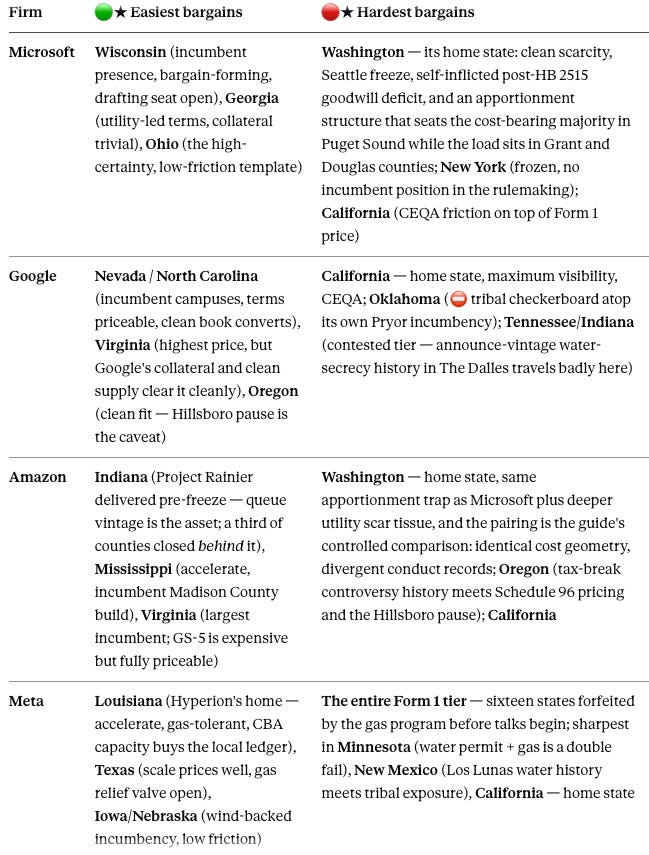
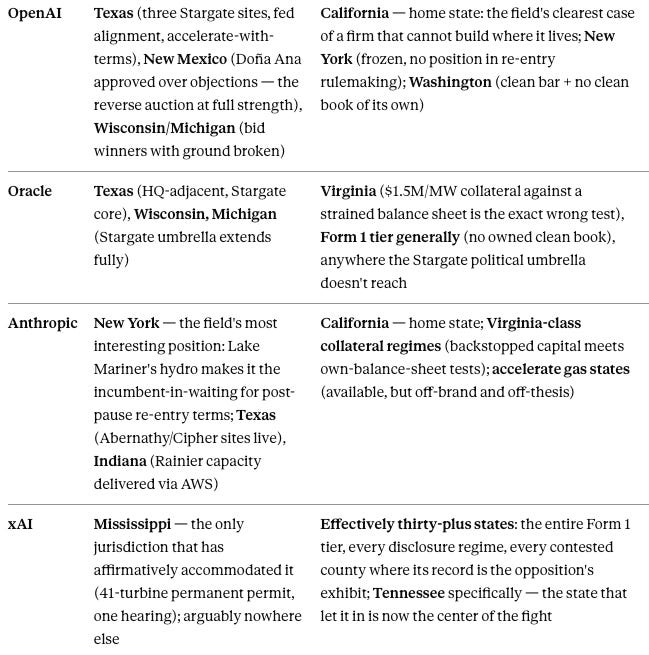
Tier notes. Neoclouds inherit their principals’ terrain where backstopped (Fluidstack maps to Anthropic’s, Crusoe to OpenAI’s) and default to the accelerate tier where not; the conversion class (TeraWulf/Cipher) is terrain-independent — its slots are grandfathered, which is the whole product. Developers hold position in whatever state their land bank sits, and the ratchet appreciates it there. Capital is terrain-agnostic by construction.
Post-T₀ note on the Texas cells. Every “easiest” Texas cell above — OpenAI’s three Stargate sites, Oracle’s HQ-adjacent position, Meta’s scale play — was written against the T₀ record. On August 3, Texas moved to an audit-gated ERCOT interconnection pause, which splits those cells by queue vintage rather than repricing them uniformly; the Post-T₀ Addendum carries the firm-by-firm read.
The home-state paradox — the finding this exercise surfaces. Every principal’s hardest bargaining terrain includes its home state: Washington for Microsoft and Amazon, California for Google, Meta, OpenAI, Anthropic, and xAI’s origin.
The mechanism is overdetermined — home states are Form 1 members with high friction, the firm’s visibility and symbolic value to opponents peak there, and hometown backlash reprices the whole portfolio (Seattle’s 369 MW episode fired at Microsoft’s and Amazon’s front door without either firm being named among the four applicants).
A second mechanism operates alongside record depth and behaves differently: externality geography. Home states are where a firm’s costs distribute most widely and its benefits concentrate most narrowly, so the largest number of legislators pricing its consent represent payers rather than hosts. Record depth is a conduct problem a firm can work off; apportionment is a fixed property of the jurisdiction. §9 develops the mechanism with Washington as the worked example, and carries the two register entries it generates.
The consequence is the buildout’s defining geographic irony: the AI industry’s physical footprint is being placed almost entirely in states where its firms do not live, which exports the externalities, imports the political exposure, and hands the hosting states durable leverage the home states declined to monetize. Registered as MC-FG-8. Interpretive confidence in the paradox’s mechanism: 80–88%.
IX. 🗺️ The Externality Geography of Authorization — Washington as the Worked Example
Costs and benefits do not share a boundary at a data center, and the mismatch decides who writes the terms. Construction spending, operating jobs, and property tax revenue land inside one county. Ratepayer exposure, clean-energy compliance burden, and carbon-allowance pressure spread across the entire state. Legislators therefore price authorization on behalf of constituents who pay without hosting, and the statute reflects that constituency rather than the host community’s.
Washington runs the mechanism at full strength, which is why it serves as the worked example — and why the section closes on whether the argument travels. Three claims follow: cost geography determines sponsorship geography, apportionment converts a diffuse cost into a legislative majority, and accountability asymmetry predicts the resulting statute’s specific shape.
Three transmission mechanisms. Physical spillover is the weakest of the channels carrying an Eastern Washington load onto a Westside utility bill, and the argument does not depend on it — statutory design carries the cost far more reliably than the grid does.
Three statutory channels carry an Eastern Washington load onto a Puget Sound utility bill — none of which requires physical spillover across the Cascades.
The Clean Energy Transformation Act (RCW 19.405) puts every Washington utility on one statewide clock, so a gigawatt-scale load in Grant County consumes non-emitting supply a Westside utility can no longer count toward its own 2030 and 2045 obligations; scarcity attaches to compliance headroom, which is a statewide pool drawn down by any load anywhere in it.
The Climate Commitment Act prices covered emissions through a statewide auction, so load growth that raises marginal emissions raises the clearing price for the gas utility serving a Seattle household that will never see a data center. And load above a utility’s federal preference allocation moves procurement to market, setting Mid-Columbia and transmission costs for parties who hosted nothing and approved nothing.
Compliance capacity is the most analytically important channel and the least discussed, because it is invisible to any framework treating environmental cost as a physical externality (interpretive confidence that compliance-capacity scarcity operates as a distinct, material channel in clean-energy-standard states: 72–84%).
Apportionment inverts the public-choice prediction. Data center siting presents textbook concentrated-benefit, diffuse-cost geometry. Concentrated benefit against diffuse cost ordinarily favors the concentrated interest, because beneficiaries organize and dispersed losers do not. Most of Washington’s population lives west of the Cascades, so the diffuse cost falls on a majority that is already organized — into legislative majorities in both chambers. Dispersed losers who happen to constitute a majority of districts need not solve a collective action problem; they need only vote their existing caucus. Sponsorship of data center legislation concentrating among Puget Sound Democrats while development concentrates in Grant, Douglas, Chelan, and Yakima counties is therefore not urban sentiment intervening in someone else’s county — the cost already arrived in the sponsors’ districts through the three channels above, and legislators of a state legislate for the state (interpretive confidence in the apportionment-inversion reading: 70–82%).
The accountability asymmetry, and what it predicts. Ordinary land use legislation carries a political restraint — a sponsor who wants a project sited in a district must eventually answer to that district — and the externality geometry removes it entirely. A Puget Sound legislator faces no electoral consequence from a Quincy or Moses Lake constituency. Ratepayer protection delivers benefit to that legislator’s voters directly. Host-county revenue sharing delivers benefit to voters the legislator does not represent, at a cost to project viability and therefore to the ratepayer protection that motivated the bill. Washington’s 2027 successor should accordingly run strong on cost causation, minimum take, collateral, exit protection, and disclosure, and comparatively weak on mandatory community benefit agreements, host payments, and dedicated local revenue shares — registered as MC-FG-11 below and graded against the Model Code’s PB-2, PB-3, and PB-8 leaf codes.
What separating the mechanisms buys the firm. Record depth predicts a discount that grows with the length and visibility of a firm’s local history, and conduct can repair it. Externality geography predicts a discount that grows with the ratio of statewide cost distribution to host-county benefit concentration, appears even for a firm with a short local record and a clean file, and no amount of conduct repairs it — apportionment is a fixed property of the jurisdiction, leaving three responses: price it, concede on it, or build elsewhere. A principal’s home state is where the ratio peaks, because home-state operations are large enough to move statewide compliance and rate variables while employment and revenue still land in specific counties. Interpretive confidence that both mechanisms operate and neither alone accounts for the home-state pattern: 65–78%.
Washington as the controlled comparison. Two principals headquarter in King County, both operate substantial Eastern Washington capacity, and both bargain with the same legislature under the same apportionment geometry — while their conduct records, disclosure postures, and clean-portfolio depths differ materially. Structure holds fixed; firm variables move. No other state supplies the configuration: California hosts headquarters without comparable in-state hyperscale load, Virginia hosts the load without hosting either principal. Visibly different treatment of Microsoft and Amazon by the same legislature under the same cost geometry is therefore attributable to conduct rather than structure, which is the proposition this guide advances — and Washington is its strongest available test.
Does the argument travel? A mechanism that works in one state is a description rather than a finding, and three jurisdictions test portability. Northern Virginia legislators represent both the Loudoun and Prince William host communities and a substantial share of affected ratepayers, so cost and benefit overlap more than in Washington — predicting stronger host-benefit provisions and weaker sponsorship-geography effects. Ohio’s load concentrates around Columbus with cost distributed across AEP Ohio’s territory and statewide through PUCO ratemaking: partial overlap. Georgia Power serves nearly the whole state as a vertically integrated monopoly, collapsing cost distribution into a single ratemaking forum. Host-benefit provision strength should correlate positively with host-jurisdiction/cost-jurisdiction overlap — registered as MC-FG-12 (interpretive, 62–75%, constrained by the small comparable set and by confounds from legislative professionalism and session length).
Three limits. Apportionment does not exhaust the explanation — party control, utility structure, labor coalition strength, and the presence of a clean-energy standard all bear on sponsorship patterns, and externality geography is one variable among several rather than the dominant one. Sponsorship geography here is observed, not tested: the Washington pattern rests on the E2SHB 2515 and SB 6171 sponsor and cosponsor records, and a rigorous version would code sponsorship geography against host-county location across every state with introduced data center legislation in 2025 and 2026 — mechanical work this guide has not done, which is why no national version of the claim enters the register. And the mechanism predicts drafting incentives rather than outcomes: legislators also respond to caucus discipline, Governor Ferguson’s priorities, tribal consultation obligations under EO 25-10, and organized labor, so a package the incentive favors can still fail or be amended for reasons the mechanism does not reach.
The specimen in the firm’s own information architecture. Microsoft’s Washington community page carries the URL slug /quincy/ and opens on Quincy, Malaga, and East Wenatchee — Grant, Chelan, and Douglas counties, with TechSpark Washington headquartered in the same corridor. Every Washington asset in the firm’s public community infrastructure sits east of the Cascades. No comparable page exists for the Puget Sound districts whose ratepayers absorb CETA compliance headroom and Climate Commitment Act allowance pricing, because there is no facility there to anchor one. Community relations follow the benefit; the statute follows the cost; the two never meet. A firm can staff, fund, and publish its way into standing with the counties that host it, and none of it reaches the legislators who write the terms — which is the externality geometry made visible in an org chart rather than a bill.
Which firms are equipped to bargain against it. Apportionment sets a price no firm can talk down, which turns the question from persuasion to capability — and the capability it rewards is not one the seven columns score directly. Bargaining against a payer majority requires assembling the host side of the divide into a visible counterweight: Grant County PUD load commitments, Eastside legislators with a revenue interest, building trades with a project calendar, chambers of commerce willing to host the corridor conversation. Incumbency supplies the raw material — twenty years in the Wenatchee valley is a standing coalition, not a talking point — and a newcomer with a clean file and a strong balance sheet cannot buy it inside one session. Microsoft and Amazon therefore hold an asset in Washington that partially offsets the same state’s discount against them, while a first-time entrant faces the discount with nothing on the host side of the ledger. The same explainer names the venue outright: Microsoft describes itself as participating in utility regulatory proceedings alongside consumer advocate groups to keep infrastructure planning current for all customers. A principal publicly seating itself beside the ratepayer advocates in commission dockets is the drafting-seat strategy stated in its own words, executed in the forum where the authorization price is actually set, and it is a posture no newcomer can adopt credibly on arrival. Microsoft Local is the industrialized version of the asset — roughly nineteen US jurisdiction pages carrying identical commitments, fact sheets, hiring pipelines, and contact channels, maintained continuously between sessions rather than assembled when a bill drops. Standing infrastructure of that kind is precisely what the seven columns fail to score, and it is the strongest argument yet for an eighth.
Two consequences follow for the ratings above. The Options column understates the position of firms with deep host-county presence, because optionality inside a state — the ability to relocate a project to a friendlier corridor rather than a friendlier state — behaves differently from portfolio optionality across states. And the Conduct column is doing work at two resolutions at once: statewide reputation with the legislature, and corridor-level standing with the host community, which the Wenatchee and Seattle pairing shows can point in opposite directions simultaneously. Both refinements are candidates for the next revision of the master table rather than adjustments made silently here (interpretive, 70–82%).
Why the section sits here rather than in the firm ratings. Externality geography explains a pattern §8 observes: every principal’s hardest terrain includes its home state. Record depth and apportionment produce the same observable through different causes, and only the separation tells an operator which discounts are repairable. The mechanism belongs beside the ratings it explains, not inside them.
X. 💡 Findings
The sorted order does not match the market-cap order — observed at T₀. Google and Microsoft top the field on the axes states actually price (collateral, clean supply, conduct), while the largest spender (Amazon) and the fastest ambition (OpenAI) rank behind them, and the loudest builder (xAI) ranks last. Capital and compute are abundant in this field; authorization capability is scarce, which is TGE-4’s mechanism visible in cross-section. Confidence: 80–88%.
Governance capital is compounding exactly as predicted — consistent-with, not proven. The Seattle withdrawals, the xAI litigation’s citation across unrelated dockets, and the HB 2515 blowback all show conduct converting into price. The ledger test: firms in the ⚠️ and low-Conduct classes should experience measurably longer approvals and more litigation than terms-first firms through 2028 (TLSM-7 restated firm-side).
The dependency graph is the hidden map. Anthropic depends on Fluidstack depends on Google’s credit; OpenAI depends on Oracle depends on Vantage and Crusoe and SoftBank; xAI reportedly folds into SpaceX 🔶. States negotiating with a principal are often actually negotiating with a stack, and the P(honored) that matters is the weakest link’s — a diligence point no state statute yet prices. Confidence: 75–85%. Post-T₀: the Abbott audit directive now requires ownership-structure disclosure across the ERCOT queue — the first state instrument to diligence the stack; the addendum grades it.
Clean portfolios are becoming the passport, and the field is splitting into two leagues. Sixteen Form 1 states — including five of the six highest-certainty jurisdictions — are accessible to roughly half the field. The gas-forward half (Meta, xAI, most neoclouds) is competing for a shrinking accelerate tier that the Authorization Price baseline predicts converts within two sessions of its first campus (Prediction 10). The strategic clock on gas-powered speed is shorter than its practitioners are pricing. Confidence: 75–85%.
The thin benefit line is now a bargaining variable firms choose. Anthropic’s 800-jobs-per-$50B candor and OpenAI’s 25,000-onsite-jobs framing are opposite plays on the same denominator problem; the companion’s loss-aversion mechanics predict the enforceable-guarantee play beats the jobs-headline play as communities learn (TLSM-4, 76–84%), which favors the candid framing over the cycle even though it prices worse today.
🚨 Post-T₀ Addendum — After the Freeze (August 3–14, 2026)
The Atlas recorded the week’s events on the sell side; the addendum below reads the same events from the buy side. Nothing in the body above has been rewritten — T₀ ratings stand, the addendum carries the changes, and every affected claim is graded against what the baseline said before the news.
The Texas audit, read firm-side. Governor Abbott’s August 3 directive ordered PUCT and ERCOT to audit every data center project advancing through the ERCOT interconnection queue — power consumption and onsite generation, water use, tax incentives received, ownership structures, and local-impact mitigation — with non-compliant projects denied connection and the Batch Zero study postponed. ERCOT called the directive an effective pause. The Atlas records the tempo change (BARGAIN → executive audit-gated PAUSE, its ledger’s first row); the firm-side consequences run deeper than the map change.
First, the queue splits by vintage, exactly as §2’s Collateral and Credibility columns predicted the rationing would run. Operators holding executed agreements and completed interconnections hold the appreciated asset; everyone behind them holds an audit obligation. Stargate’s three Texas sites — Abilene operating, Shackelford and Milam in development — now divide along that line, and the division prices OpenAI’s Texas position lower than the T₀ “easiest terrain” cell without touching its operating capacity. Oracle’s strained balance sheet meets a verification screen at precisely the moment its credit story is the field’s most watched. Meta’s position strengthens on a relative basis: self-funded, fully integrated demand is what a verification audit exists to distinguish from the speculative tail, and Meta’s P(honored) is the tier’s highest.
Second — the structurally larger event — a state is now formally diligencing the dependency graph. §9 called the stack behind each principal “a diligence point no state statute yet prices,” and five days after the freeze the second-largest data center state ordered ownership-structure disclosure across a 474 GW queue. The directive verifies rather than scores, and it arrives as a gubernatorial order rather than an RFP or statute, so MC-BP-6 receives adjacent evidence and no settlement credit — the entry’s terms require explicit scoring of conduct or clean-firm supply in an RFP or statute, and grading discipline holds even when the direction flatters the thesis. The neocloud tier carries the sharpest exposure: borrowed bargaining positions are exactly what ownership disclosure surfaces, and the audit converts the tier’s dependency on principal backstops from a private credit fact into a public authorization variable.
Wenatchee, read firm-side. On August 5, the Wenatchee Valley chamber of commerce hosted Microsoft and Sabey Data Centers to a welcoming room, citing twenty-plus years of coexistence in the hydro corridor — the same week Cle Elum, ninety miles south, passed an emergency moratorium three days after its first project surfaced. The Atlas reads the pairing as the local consent market setting Washington’s real price in both directions at once; the firm-side read is what it does to Microsoft’s row. §8 scores Washington as Microsoft’s hardest terrain, and the statewide judgment stands — but the Wenatchee panel shows the terrain is corridor-specific, and incumbency is the one consent asset the conduct discount cannot touch: twenty years of demonstrated benefits lowered the grievance floor in a way no concession package can replicate at entry. Chamber-circuit work by incumbents is bargaining capability in action — the Conduct column operating between sessions, in rooms no register tracks. The specimen also sharpens MC-BP-9’s mechanism: the home-state discount concentrates where the firm-specific record is adversarial (Seattle, HB 2515) and inverts where it is twenty years of quiet performance (Wenatchee), which is the conduct-discount logic operating at sub-state resolution. Interpretive confidence in the corridor-specific reading: 75–85%.
Firm-side response, inside two weeks. Microsoft’s Texas community page — Bexar and Medina counties, Greater San Antonio — carried responsive material within days of the Abbott directive, and the Governor’s office announced on August 13 that Microsoft, alongside Hut 8 and Equinix, had formally committed to comply with the state’s data center standards. The observable is the response time and the channel. A firm that maintains standing per-jurisdiction community infrastructure can answer a gubernatorial directive on its own channel inside a business week, in the host counties, without a press cycle or a lobbyist. Speed of that kind is a capability, and it belongs in the same column as the coalition assets §9 describes — the audit arrived on a Monday and the incumbent’s answer was posted before the second week closed.
What the week did not change. No firm’s composite Position moves. xAI’s row gains nothing and loses nothing — its litigation calendar, not the Texas audit, remains its settlement clock. The sorted-order headline holds: the week’s two events rewarded verified demand, queue vintage, and incumbency conduct, which are the axes the T₀ table already ranked the field on.
XI. 📡 Prediction Register — Frozen at T₀ (July 30, 2026), Entries 9–12 Added August 6 and 8
Event probabilities, settled through named sources, Brier-eligible; interpretive confidence stays in the prose above and never pools with these. Entries MC-FG-1 through MC-FG-8 carry the [T₀] freeze; MC-FG-9 and MC-FG-10 carry [A6] (August 6, 2026); MC-FG-11 and MC-FG-12 carry [A8] (August 8, 2026). The MC-FG namespace is the register native to this paper and is unaffected by the Atlas’s August 6 move to plain-number identifiers; Authorization Price baseline entries are cited here as Prediction n per its Register v2.0 concordance.
Twelve Foresight Simulation Predictions (FSPs) — dated, falsifiable forecasts produced under MindCast’s Cognitive Digital Twin Foresight Simulation discipline — close the paper under the register prefix MC-BP (MindCast Bargaining Power), grouped by theme and numbered in order. Every entry carries the same contract: a percent band, a deadline, a falsifier, and a public settlement source. Interpretive confidence stays in the prose above and never mixes with these. Eight FSPs froze July 30, 2026; the four marked with their dates were added August 6 and 8.
Slot Scarcity and the Price of Authorization
MC-BP-1 — Authorization value gets a disclosed price. A principal publicly buys queue position or entitled slots from the developer tier at a premium attributed to authorization value. 60–75% · by December 31, 2027. Fails if no disclosed transaction is framed on authorization value. Settles in company filings and transaction press.
MC-BP-2 — Google’s credit-enhancement model is copied. Another principal backstops a neocloud’s lease or debt obligations. 70–82% · by July 30, 2028. Fails if no comparable backstop is disclosed. Settles in company filings and credit disclosures.
MC-BP-3 — A Stargate site slips and a host jurisdiction reacts. A Stargate site misses its announced capacity milestone by a year or more, and a host jurisdiction responds with a clawback, renegotiation, or public dispute. 55–70% · by July 30, 2028. Fails if all sites stay within twelve months of milestones, or misses draw no jurisdictional response. Settles in local government records and project announcements.
MC-BP-4 — Slot-clearing stays scarce (added August 6). In each rolling twelve-month window through the deadline, no more than 60 campuses of 250 MW or larger receive binding authorization across the fifty states, while deduplicated disclosed demand exceeds three times the cleared count. 70–80% · by July 30, 2028. Fails if any window clears more than 60, or demand falls below the 3× multiple. Settles against binding-instrument status per the Atlas's criteria, with interconnection-queue and large-load survey data for the demand side.
Conduct at the Table
MC-BP-5 — xAI’s turbine record reaches a legal reckoning. xAI loses, settles with material conditions, or is enjoined in the NAACP Clean Air Act action — or removes or permits all contested turbines under pressure. 70–80% · by December 31, 2027. Fails if the suit is dismissed with turbines operating unpermitted and unconditioned. Settles at the federal docket.
MC-BP-6 — Conduct becomes a scoring criterion. At least one state RFP or statute explicitly scores bidders on governance and conduct record or clean-firm supply. 65–78% · by July 30, 2028. Fails if no state instrument adopts such scoring. Settles in session laws and state RFP documents.
MC-BP-7 — Governance capability becomes marketing. Two or more principals publicly market authorization or governance capability as competitive differentiation. 80–89% · by July 30, 2028. Fails if fewer than two do so. Settles in company communications and earnings materials. First qualifying specimen logged: Microsoft’s Community-First Infrastructure Initiative, January 13, 2026, with location-specific energy and water disclosure attached; one further principal required to settle. The entry restates a companion Atlas prediction — same mechanism, same band — and the two settle jointly against the same sources, counting once in scoring.
Home-State Geography
MC-BP-8 — The home-state paradox holds. No principal headquartered in California or Washington breaks ground on a campus of 250 MW or larger in its home state. 75–85% · by July 30, 2028. Fails if any does. Settles in state and local permitting records.
MC-BP-9 — The home-state conduct discount is real (added August 6). Any principal filing for a 250 MW+ home-state authorization receives materially stricter conditions, longer timelines, or denial relative to its own contemporaneous out-of-state record; if no principal files by the deadline, the entry settles void rather than graded. 65–78% · by July 30, 2028. Fails if a home-state authorization clears at parity with the same firm’s out-of-state record. Settles in permitting records, utility service agreements, and company announcements.
State Bargains and Statute Design
MC-BP-10 — The clean-for-terms trade goes public. Google or Microsoft announces a state-level partnership explicitly trading new firm-clean generation or transmission funding for siting terms in a strict clean-statute state. 70–82% · by July 30, 2028. Fails if neither announces such a trade. Settles in state agency records and company announcements.
MC-BP-11 — Washington’s 2027 statute protects ratepayers, not host communities (added August 8). The enacted statute runs strong on ratepayer-protection instruments and comparatively weak on host-community benefits — no mandatory community benefit agreement, no mandatory host-county revenue share, no dedicated local mitigation fund. 68–80% · by June 30, 2027. Fails if the enactment contains any one of the three host-benefit instruments. Settles against Washington’s enacted session law, graded on the Model Code’s host-benefit provisions.
MC-BP-12 — Host-benefit strength tracks who bears the costs (added August 8). Virginia enacts materially stronger host-benefit provisions than Washington, with Ohio and Georgia falling between — because Virginia’s host and cost jurisdictions overlap and Washington’s do not. 62–75% · by July 30, 2028. Fails if Virginia enacts materially weaker provisions than Washington under comparable load concentration. Settles against enacted law in the four states, graded on the same Model Code provisions.
Register notes, for auditors rather than readers: entries are Brier-eligible event predictions settled through the named sources; the MC-BP namespace is native to this paper — entries froze under a prior working prefix and sequence, and were renamed and renumbered by theme on the paper’s retitle with content, bands, deadlines, and falsifiers unchanged — and is unaffected by the Atlas’s August 6 move to plain-number identifiers; Authorization Price baseline entries are cited as Prediction n per its Register v2.0 concordance; the paired Atlas entries behind MC-BP-7 are its Predictions 27 and 28, with no credit taken on 28 because Microsoft’s framing answers community concern rather than naming misinformation.
XII. ✅ Verification and Maintenance
Facts verified by web search July 30, 2026: capex figures from Q1-2026 earnings compilations (FT via Tom’s Hardware; Data Center Frontier-class trackers); Stargate site status from Epoch AI’s April 2026 satellite survey, OpenAI’s own announcements, and CNBC’s June 1 Michigan groundbreaking coverage; the xAI record from the SELC/Earthjustice litigation file, the February 2026 notice of intent, and July 2026 investigative reporting on the 59-turbine count; Anthropic’s program from its November 12, 2025 announcement and DCD’s site-level analysis; Google’s backstop structure from DCD’s financing reporting.
Firm-side primary sources: Microsoft Local jurisdiction pages (local.microsoft.com), specifically the Washington page (Quincy, Malaga, East Wenatchee; modified June 24, 2026) and the Texas page (Bexar and Medina counties; modified August 11, 2026, carrying TX_AbbottAug2026.pdf); Community-First Infrastructure Initiative announcement (blogs.microsoft.com, January 13, 2026); Understanding energy use at Microsoft datacenters (local.microsoft.com, published March 30, 2026, modified August 14, 2026), carrying the cost-causation definition, PUE disclosure, and clean-portfolio figures cited above; FY25 Datacenter Environmental Data Fact Sheet; per-jurisdiction datacenter operations fact sheets (twelve US states); Datacenter Community Pledge (June 2, 2024).
Post-T₀ sources (August 3–6, 2026): Abbott letter to PUCT/ERCOT via Argus Media, KERA News, ABC13 Houston, and TechCrunch, with the ERCOT effective-pause statement via Fox News; Wenatchee Valley Chamber of Commerce Coffee & Commerce panel post (LinkedIn, August 5, 2026); Seattle Times on Cle Elum (August 5, 2026); Financial Times 2026 hyperscaler capex reporting for the $725B→$745B movement noted in the opening.
Single-source items carry 🔶: the SpaceX-xAI ownership claim, the Stack/BorderPlex $165B figure, and Related Digital’s posture. Highest-churn rows: OpenAI (site plans moved once already), Oracle (credit narrative), xAI (litigation calendar), the Texas cells (audit-standard publication is the trigger), and every capex figure at the next earnings cycle. Refresh quarterly at minimum; refresh the xAI, Stargate, and Texas rows on event.
The scoring axes inherit their definitions from The AI Data Center Authorization Price §I–III, the identifier definitions from the Atlas’s Appendix H, and the provision vocabulary from the Model Data Center Authorization Code; this paper is the firm-side half of the same evidence layer; its twelve Foresight Simulation Predictions are its simulation output, graded through the register above.
XIII. Conclusion
Bargaining power in the authorization market is a manufactured asset, not an inherited one. Seven capabilities decide who wins scarce slots, conduct multiplies or discounts the whole bundle, and the master table’s medals fall out of that arithmetic: Microsoft and Google lead not because they are largest but because they carry collateral, clean supply, and governance simultaneously, while the announce-first, gas-forward half of the field loses across every tempo for what is ultimately one weakness wearing four costumes.
The field is splitting into two leagues on a clock. Sixteen clean-statute states already price the power portfolio before negotiation begins, the accelerate tier is converting, and clean-portfolio depth is compounding from a regional advantage into the field-wide passport. Firms holding the passport bank terms; firms without it are racing a shrinking map — and the strategic clock on gas-powered speed runs shorter than its practitioners are pricing.
States reading these ratings should notice the reciprocal: the same table that tells a firm where it can bargain tells a state which bidders can actually deliver. Conduct records, collateral capacity, and demand credibility are diligence variables a state RFP can score today, and the first statutes to score them will set the template the rest copy.
Twelve Foresight Simulation Predictions turn the analysis into a wager — on slot scarcity, on conduct converting into a scored criterion, on the home-state paradox, on whose statutes protect whom. Each carries its band, deadline, falsifier, and settlement source, and the ratings above should be judged by how that register grades. The companion papers price the states’ side of the bargain; the record from here forward prices ours.