
Companion instrument: MindCast Authorization Transition Forecaster (PDF) · Evidence base: National Authorization Intervention Inventory (PDF)
Related works: The Authorization Market: Standardized Bargaining, Rationed Power, and the Competition to Build America's AI Infrastructure · The Data Center Authorization Price: A 50-State Baseline · AI Data Center Authorization Bargaining Power — Ratings for Hyperscalers, Neoclouds, Developers, and Capital · The 50-State Regulatory Atlas · The Model AI Infrastructure Authorization Code · AI Data Center Credit Risk — Permitting, Curtailment, and the Cost of Capital · The MindCast AI Data Center Record
See the MindCast Data Center Regulatory Economics Live-Fire Mission
I. Executive Summary
Authorization — the institutional right and practical ability to build, energize, and operate hyperscale infrastructure — is repricing on timelines capital planning rarely anticipates. Cle Elum, Washington moved from project announcement to enacted moratorium in three days. New York imposed the nation’s first statewide data-center pause by executive order. Oregon, Arizona, and Illinois froze tax-incentive eligibility mid-year while their land-use moratorium bills stalled. Capital deployed into a jurisdiction that reprices mid-project absorbs delay carry and terms it never underwrote.
MindCast AI built the Authorization Transition Forecaster to answer the decision question before markets price it: where does authorization risk reprice next, through which legal instrument, at which approval gate, and inside what time window? Users upload the instrument to any web-enabled AI system; the instrument researches the live public record and returns a county-level early-warning map, a ranked forecast register, and — for every forecast — a model-derived probability band, a dated window, a named falsifier, and a public settlement source that will prove the forecast right or wrong.
The simulation behind this paper has already run, and its register is frozen. Three headline Foresight Simulation Predictions set the stakes:
The county wave keeps rolling — at least 20 additional U.S. counties enact moratoriums or application pauses by January 31, 2027, on top of the 54 already enacted nationwide. 75–85%
Pauses mature into pricing rules, not bans — a majority of local moratoriums expiring by June 30, 2027 are replaced by explicit siting, infrastructure, and resource rules rather than reverting to the old regime; the emergency pause is a bridge, not an endpoint. 70–82%
Silence breaks before strictness — in pre-registered matched jurisdiction pairs, the authorization-silent jurisdiction experiences material intervention before its strict-framework peer, reversing the site-selection instinct that permissive means safe. 65–75%
The full register appears in Section VIII.
Each reader class holds a different edge in these pages.
Developers and hyperscalers read the map to time site commitments and sequence entitlement before a jurisdiction reprices mid-project.
Investors and lenders read it to underwrite transition risk — which jurisdictions in a portfolio sit one docketed study session away from a freeze.
Utilities and commissions see controversy forming before the rate case turns political, and see where blocked land-use pressure migrates to their gates next.
State and local lawmakers learn the difference between “low regulation” and authorization silence — why silence is what breaks, why the pause is a bridge to explicit terms, and what the jurisdictions that wrote rules early got for it.
Counsel reads the vesting boundary: where litigation concentrates, and which projects the instruments cannot reach.
The sections below spell out the vision, the archetypes that motivate it, the simulation behind it, the intended usage for eleven stakeholder classes, the mitigation architecture, and the full prediction register.
II. The Vision
Authorization is the priced input of AI infrastructure. MindCast established the framing in The Authorization Market, which defined permission to build and operate as an economic good carrying a price, and measured that price across every state in The Data Center Authorization Price: A 50-State Baseline and the standing 50-State Regulatory Atlas. Power can be contracted, land assembled, and capital raised, but counties, cities, utilities, commissions, and legislatures grant the right to build — and across 2026 they repriced that right on timelines few site models anticipated.
Application pauses arrived days after project announcements. Statewide instruments arrived by executive order where legislatures had failed. Tariffs and incentive programs moved while site plans sat in review.
Markets treat these interventions as political surprises. MindCast treats them as observable state transitions inside a coupled institutional system — and state transitions can be forecast. A jurisdiction moves through five states: silence, salience, institutional disequilibrium, material intervention, and a new authorization equilibrium. Each stage emits evidence before the next arrives: a docketed study session, a staff-directed ordinance draft, a newly opened utility proceeding, a neighboring county’s vote entering the same media market.
Moratorium trackers count what already happened. The Forecaster models the jurisdictions that have not yet acted, reads their emissions, and names the instrument, gate, and window before the vote. Forward sight, not retrospective counting, is the product.
III. Five Archetypes, Not One Event Class
Five 2026 interventions show why “moratorium” is the wrong unit of analysis. Each case stopped or repriced data-center development, and no two used the same instrument, authority, or stop point — which means no two carry the same durability, falsifier, or settlement source.
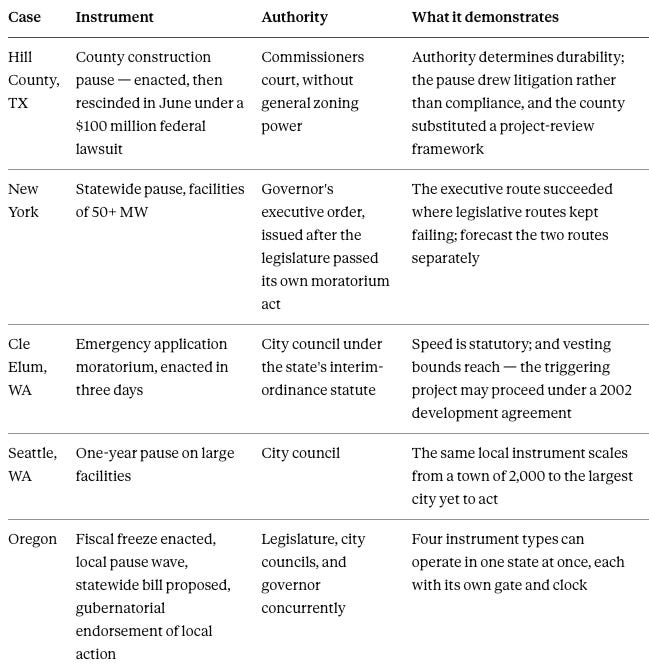
Collapsing these five into one "moratorium" category mispredicts all three things a forecast must get right: how long the intervention lasts, what evidence would falsify it, and which public record settles it. The companion instrument therefore types every intervention (T1–T6) before banding it, and treats the type as part of the forecast rather than a footnote to it.
Archetype sources, dated — one short paragraph per archetype.
Texas. Hill County adopted the first Texas county pause in early 2026. A developer’s $100 million federal lawsuit forced its rescission in early June, and the county substituted a project-review framework — the authority lesson settling in real time. San Marcos became the first Texas city to ban data centers outright through zoning.
New York. Executive Order No. 62 — one year, facilities of 50 megawatts or more — took effect July 14, 2026, one month after the legislature passed the Responsible Data Center Development Act, which awaits the Governor’s action and an expected veto.
Washington. Cle Elum’s council enacted its emergency moratorium on July 31, 2026, three days after Blue Fern Development’s announcement, under the state’s interim-ordinance authority. Whether the pause reaches the triggering project turns on a 2002 development agreement, with a public hearing set for September 8. Seattle’s one-year pause passed in June, followed by Spokane and Federal Way.
Oregon. H.B. 4084’s Enterprise Zones freeze took effect June 5, 2026, running until 90 days after the 2027 session adjourns. Hillsboro enacted the state’s first local pause in late July and Salem followed in early August. Governor Kotek cancelled a state land sale for the Salem project on July 30, then endorsed local moratoriums on August 7 while stating the state lacks statewide authority. Four legislators proposed a three-year statewide moratorium on August 4 for the 2027 session.
Contact mcai@mindcast-ai.com to partner with us on Predictive Game Theory AI in Law and Behavioral Economics. We specialize in predictive simulations for Complex Litigation, Innovation Economics, Geopolitical Risk Intelligence and Legacy Innovation. See more about MindCast series at our new website MindCast Corporate.
To test our predictive simulation AI system, in 2026 we simulated the Super Bowl and the World Cup. See 🏈 Super Bowl LX — AI Simulation vs. Reality | ⚽ The 2026 World Cup Final Simulation Validation
To deep dive on MindCast works upload the URL of this publication into any LLM (preferably Google AI mode) and prompt ‘reconstruct MindCast framework with three degrees of cited sub links.’ See Live-Fire Game Theory Simulators, Runtime Predictive Infrastructure.
Working With MindCast
MindCast runs two service lines on one method. Authorization intelligence grades jurisdictions and instruments against the fifty-state baseline. Geopolitical exposure intelligence maps the classification, entity-eligibility, and screening constraints that sit above them. The forecast in this paper is the authorization line applied to the transition side of the market — where the rules reprice next — and every engagement below runs on the same frozen methodology.
Developers and hyperscalers can commission a portfolio placement — named sites scored against the authorization-state model, precursor exposure at each jurisdiction, vesting posture per project, and a sequenced entitlement plan keyed to the windows the register predicts. Investors and lenders can commission a transition-risk screen across a named portfolio: which holdings sit within reach of a precursor threshold, which instrument class each jurisdiction is most likely to produce, and what the repricing does to delay carry and exit assumptions.
Utilities and commissions can commission a gate-migration assessment — where blocked land-use pressure arrives at their dockets next, keyed to tariff, interconnection, and water proceedings and to the federal filing cycle now in motion. States, counties, and commissions drafting 2027 frameworks can commission a transition drafting review — converting a temporary pause into explicit authorization terms, keyed to host-community provisions, durable employment categories, and the clauses the coming sessions will contest.
Forecast entries move only when the public record moves; engagements buy application of the map, never revision of it. Engagements run as Cognitive Digital Twin simulations with dated, falsifiable outputs, and MindCast grades its record in public.
IV. The Foresight Simulation
Vision becomes method through simulation, and the simulation is where MindCast’s architecture does its work. The method runs on published theoretical foundations — The Dynamic Predictive Game Theory Collection for contests where the rules change during play, and Field-Geometry Reasoning for how constraint fields close paths as commitments become irreversible.
The architecture has run before. The same MP CDT FS engine executed the nine-twin simulation behind AI Data Center Credit Risk and the live-fire validations against the Super Bowl and the World Cup final.
The Forecaster begins with Cognitive Digital Twins of seven core actors: the governing body, the planning institution, the utility, the state regulator, the developer, the organized residents, and the neighboring jurisdiction. Additional institutional actors — a water authority, a court, a governor, an environmental regulator, a transmission owner — enter when the authorization pathway requires them.
Simulation runs each jurisdiction forward under five scenarios — the base case, a project-acceleration shock, a contagion shock, a utility or resource shock, and a developer concession. Each run identifies the actor whose strategy changes first, the trigger that moves it, the most likely intervention and its legal gate, the timing, the strongest counterforce, and the falsifier. Concession testing matters most for practitioners: the simulation shows whether infrastructure funding, phased load, or community benefits reduce intervention probability or merely change the intervention’s form.
The MindCast AI Data Center Record shows the discipline in operation: twelve months of dated claims graded against the public record, including three published corrections.
V. What Each Stakeholder Does with the Forecast
Eleven stakeholder classes face the same repricing risk from different directions, and each can run the identical instrument. Every call-out below names the distinct decision the instrument improves.
Data-center developers and site selectors — the site-commitment decision. A county with no data-center regulation is not low-risk; it is authorization-silent, and silence under project pressure is among the strongest precursors of an abrupt pause. The Forecaster informs the choice between committing now, accelerating entitlement before optionality closes, opening concession negotiations, or paying a higher but known authorization price elsewhere.
Infrastructure investors, private equity, and lenders — the underwriting decision. The Forecaster converts regulatory change into a portfolio variable: exposure by risk tier, exposure through land-use gates versus utility gates, and the share of committed capital still subject to government optionality. AI Data Center Credit Risk supplies the companion instruments — Financeable Authorization Coverage and the Capital Irreversibility Ratio — that score which projects convert an authorization shock into a credit event.
Foreign investors, sovereign wealth funds, and foreign-affiliated developers — the disclosure-and-jurisdiction decision. Foreign capital carries authorization exposure in its sharpest form, because ownership identity is itself an intervention trigger. A pension fund holding project debt is anonymous to a county hearing; a sovereign fund or foreign strategic investor is not, and the disclosure remedy that lowers a domestic sponsor’s capital price can raise a foreign sponsor’s authorization price by handing organized opposition its most effective argument. National-security review stacks on top of every local gate the Forecaster maps, and neither layer appears in conventional country-risk analysis. Foreign Ownership and Control carries MindCast’s full treatment, including its own prediction register.
Jurisdiction selection is therefore a narrower problem for foreign-affiliated capital than for anyone else at the table, and the Forecaster narrows it deliberately: which states are advancing foreign-ownership disclosure or restriction statutes, which localities convert foreign identity into political salience fastest, and which authorization gates — land-use, utility, or state legislative — a foreign-linked project will actually face. Sequencing matters as much as selection. Disclosure timed before the salience forms reads as transparency; disclosure forced after opposition organizes reads as concealment, and the two carry different authorization prices.
Hyperscalers and capacity buyers — the capacity-reliability decision. Two campuses identical on power price, land cost, and incentives can differ sharply in interruption risk. The Forecaster ranks a pipeline by which jurisdictions are likely to hold their authorization terms through the deployment window.
Utilities — the tariff-design and engagement-timing decision. Service territories where load growth, ratepayer salience, and a weak local framework converge become public controversies on a forecastable schedule. Tariff structures, infrastructure agreements, and stakeholder engagement all cost less ahead of the controversy than inside the rate case.
State legislators and agencies — the framework-timing decision. The instrument diagnoses where project pressure is outrunning authorization architecture and which localities will improvise pauses absent a statewide framework. The 2026 record constrains the realistic menu: executive instruments succeeded where legislative ones stalled, and fiscal instruments passed where land-use bills failed.
County and municipal governments — the rule-writing decision. A deep dive on your own jurisdiction, run while policy optionality is still open, shows whether current code can distinguish a hyperscale campus from ordinary industrial use. Governments that write rules before the first controversial application are far less likely to reach for the emergency pause their neighbors improvised.
Economic-development organizations — the positioning decision. Permissive is not competitive when permissiveness signals an unpriced repricing ahead. Marketing regulatory certainty — explicit, bounded, stable terms — targets the capital that stays.
Law firms and regulatory counsel — the exposure-mapping decision. Diligence concentrates where the Forecaster maps pressure: contested intervention authority, vesting postures that determine litigation exposure, and community pressure blocked at the zoning gate migrating toward water and power proceedings.
Public utility commissions and RTO-facing stakeholders — the docket-anticipation decision. Authorization conflict migrates from land-use gates into tariff, interconnection, and cost-allocation proceedings, and vested projects that local pressure cannot stop through zoning arrive at the commission next. The Forecaster flags the migration before the docket opens.
Researchers, journalists, and policy analysts — the hypothesis-testing decision. Seven causal hypotheses — regulatory lag, strictness-as-stability, physical constraint, two contagion mechanisms, salience-times-optionality, and fiscal asymmetry — publish as falsifiable claims with named evidence standards, and every national run grades them.
Symmetry across the table is deliberate. Developers and regulators can interrogate the same evidence from opposite sides of the authorization table. Foresight serves the table.
VI. Mitigation: Changing the Pathway, the Timing, and the Price
Identifying authorization-transition risk without addressing what changes it would leave developers and capital with a map and no steering wheel. Mitigation deserves its own architecture, and the architecture rests on one governing principle: mitigation does not eliminate authorization risk — it changes the intervention pathway, the timing, or the price. The strongest mitigation often does not prevent government action at all; it converts a threatened moratorium into a conditional-use regime, an infrastructure agreement, a phased-load schedule, or a bounded framework.
MindCast’s own simulation makes the point directly: register entry MC-ATX-S4 predicts that developer concessions change the instrument more often than they restore the prior permissive regime. The developer’s realistic objective is rarely to make regulation disappear. It is to move a jurisdiction from an unpredictable emergency intervention into a priced, bankable authorization framework.
Three strategic classes organize every mitigation below. Prevent transition reduces the probability that a jurisdiction moves from silence or salience into material intervention. Shape transition accepts that intervention is likely and steers it toward a more predictable instrument. Preserve exit maintains alternative sites, phasing, and capital flexibility in case the authorization price becomes unacceptable. Sophisticated sponsors run all three simultaneously, because the classes hedge one another.
Reduce regulatory lag before the project becomes salient (prevent). Sponsors should determine whether a jurisdiction holds a mature data-center authorization framework before filing, and where rules are incomplete, negotiate explicit standards proactively rather than relying on silence or by-right ambiguity. Moving a jurisdiction toward an explicit authorization equilibrium before controversy peaks reduces the likelihood that officials reach for an emergency pause simply to create a decision framework.
Sequence entitlement before salience peaks (prevent and preserve exit). Vesting stage governs exposure: sponsors should know exactly when rights attach, which approvals remain discretionary, and which gates — power, water, transmission, environmental — stay open after land-use rights close. The objective is not merely filing faster; it is avoiding peak controversy while government still holds maximum optionality, because that combination is where the simulation finds interventions concentrate.
Phase load rather than forcing an all-or-nothing grid decision (shape). A single 600 MW request creates a different regulatory game from a staged build in tranches. Phased energization reduces transmission urgency, tariff exposure, stranded-asset concern, and ratepayer salience — the exact variables that convert a private development matter into a commission controversy.
Internalize infrastructure costs before government imposes them (shape). Developer-funded substations, transmission upgrades, water infrastructure, and minimum-take commitments change the utility’s and regulator’s payoff structure directly. Expect instrument substitution rather than deregulation — the concession typically becomes a condition, and a priced condition is the bankable outcome.
Target the politically legible externality, not a generic benefits package (prevent and shape). The binding constraint differs by jurisdiction — water in one, residential proximity or transmission corridors in another, electricity prices or farmland conversion elsewhere. Mitigation aimed at the variable actually driving local salience outperforms broad community-benefit spending aimed at none of them.
Make fiscal benefits legible and durable to the constituency absorbing the cost (prevent). Intervention risk rises when perceived burdens outrun perceived local benefits, and the perception is what votes. Long-duration property-tax commitments, host-community agreements, and transparent employment and revenue projections shift the ratio — but only when the benefits demonstrably land on the residents and ratepayers carrying the externalities.
Preserve geographic optionality until the critical gates close (preserve exit). Authorization-transition risk deserves the same treatment as power availability: maintain alternative sites until entitlement and energization gates actually close. A jurisdiction that looks cheap because it is silent can become more expensive than an explicitly strict alternative after repricing — the matched-pair prediction MC-ATX-P11 exists to test exactly that reversal.
Manage ownership disclosure before it becomes adversarial (prevent). For foreign-backed and sovereign-linked sponsors, early ownership transparency keeps a local land-use dispute from unexpectedly stacking foreign-ownership statutes, federal review, and political scrutiny onto the project. Disclosure timed before salience forms reads as transparency; disclosure forced after opposition organizes reads as concealment, and the two carry different authorization prices.
Mitigation, run well, is authorization-price management rather than opposition management. Sponsors who reduce lag, sequence entitlement, phase load, internalize costs, and keep exit options open do not escape the transition the Forecaster maps — they choose which instrument meets them, on which timeline, at which price. Regulators reading the same list should notice the symmetry: every mitigation above is also a template for what a jurisdiction can ask of a project before the emergency pause becomes its only option.
VII. Bargaining Against Transition Risk
Transition risk is not identical across firms, because firms carry different bargaining capabilities into the same repricing. MindCast’s companion ratings, Who Bargains Best with the States: AI Data Center Authorization Bargaining Power (the buy-side ratings of the AI Infrastructure Authorization Series) rate the field — hyperscalers, neoclouds, developers, and capital providers — across seven capabilities: collateral capacity, clean-portfolio depth, governance capital, demand credibility, optionality, federal alignment, and speed. The Forecaster measures the probability that the bargaining environment changes; the ratings measure the firm’s position when it does. Six connections show where the two instruments meet.
Optionality becomes transition insurance — a firm holding several viable jurisdictions credibly walks when authorization reprices, while a single-site developer absorbs whatever instrument arrives.
Collateral converts intervention into negotiable conditions — balance-sheet strength turns infrastructure contributions, minimum-take requirements, and guarantees into terms a firm can accept, where the same conditions would be fatal to a thinner sponsor. Clean-portfolio depth expands substitution options — a builder that clears the strict clean-statute states can migrate toward explicit-framework jurisdictions rather than staying trapped in permissive-looking but unstable ones.
Governance capital reduces political salience — terms-first conduct lowers the probability that a project’s externalities become the trigger for emergency intervention at all. Demand credibility changes regulator payoffs — a state or utility negotiates around credible long-duration load and pauses on speculative queue positions. Speed cuts both ways — it carries a firm through an open authorization window, and the ratings’ sharper observation is that aggressive speed manufactures the freezes this paper forecasts.
Together the two instruments describe a single underwriting object: a firm’s authorization resilience is a function of its exposure to regulatory transition and its capacity to absorb, negotiate, or escape that transition. MindCast leaves the relationship conceptual rather than formalized — how the dimensions interact is an empirical question the graded registers of both papers will answer before any composite deserves a formula.
Readers pricing a specific portfolio should read the two papers as halves of one transaction: the Forecaster names where the rules of the bargain are most likely to change, and the ratings name who can bargain through the change.
VIII. Foresight Simulation Predictions
The MindCast AI Proprietary Cognitive Digital Twin Foresight Simulation has executed for this paper, and its output is a register of Foresight Simulation Predictions (FSPs) — dated claims carrying model-derived confidence bands, explicit falsifiers, and named public settlement sources, frozen August 16, 2026 and published under the prefix MC-ATX(MindCast Authorization Transition).
The register’s composite claim is a sequence of institutional adaptation: local pause wave → state instrument substitution → gate migration → framework formation → pricing equilibrium. Twelve primary FSPs test the links in that sequence. Bands are foresight judgments, not calibrated frequencies, and every entry settles under the typology, precursor scoring, and inventory protocol specified in the companion instrument, against the record maintained in the National Authorization Intervention Inventory.
MC-ATX-P1. At least 20 additional counties or county-equivalents enact a new moratorium or application pause by January 31, 2027. 75–85%.
MC-ATX-P2. At least 3 additional Oregon localities enact pauses before October 31, 2026. 70–80%.
MC-ATX-P3. The Cle Elum moratorium fails to reach the vested Blue Fern project — concession or adverse ruling by December 31, 2026. 60–70%.
MC-ATX-P4. Zero states enact a statewide land-use moratorium by statute through the 2027 adjournments, under a frozen instrument definition. 65–75%.
MC-ATX-P5. At least 1 additional state acts through the executive corridor — order, audit-conditioned pause, or administrative halt with operative effect — by December 31, 2027. 55–65%.
MC-ATX-P6. At least 2 additional states enact tax-incentive pauses or restrictions in 2027 sessions. 65–75%.
MC-ATX-P7. At least 2 projects materially insulated at the land-use gate face new contested utility, water, or environmental proceedings by June 30, 2027. 60–70%.
MC-ATX-P8. At least 1 state enacts data-center-specific foreign-ownership disclosure or restriction by the 2027 adjournments. 55–65%.
MC-ATX-P9. Among jurisdictions reaching the Forecaster’s maximum administrative-precursor score, at least 70% adopt a material intervention within 90 days. 70–80%.
MC-ATX-P10. At least 2 states convert study bodies or moratorium windows into enacted statewide frameworks — or preemption statutes bounding local authority — by December 31, 2027. 55–65%.
MC-ATX-P11. In at least 3 pre-registered matched pairs, the authorization-silent jurisdiction experiences material intervention before its strict-framework peer. 65–75%.
MC-ATX-P12. A majority of local pauses expiring by June 30, 2027 are replaced by explicit pricing rules rather than reverting to the prior regime. 70–82%.
Eight secondary FSPs supply the diagnostic layer beneath the primary set, most in the interpretive class and reported separately from event probabilities:
MC-ATX-S1. State instruments concentrate outside framework states. 70–80%
MC-ATX-S2. Framework states produce bounded, sunset-dated local instruments. 70–80%
MC-ATX-S3. Learning contagion outruns developer displacement. 65–75%
MC-ATX-S4. Concessions change the instrument rather than restore the regime. 65–75%
MC-ATX-S5. A strict jurisdiction publicly captures displaced development. 55–65%
MC-ATX-S6. Litigation concentrates where entitlements are advanced and capital is sunk. 70–80%
MC-ATX-S7. Utility-side actions grow their share of the intervention mix by at least 10 percentage points. 60–70%
MC-ATX-S8. Opposition predicts intervention only where government retains authorization optionality. 65–75%
One structural read closes the set: MC-ATX-SR1 — the wave settles into pricing, not prohibition (70–80%), with the pause-replacement ratio of MC-ATX-P12 as its observable. Grading MC-ATX-P12 grades the thesis.
Three entries hold QUALIFIED status until their pre-registration conditions execute — the framework-state cohort list, the matched pairs, and the national Top 25 — and the register reports those dependencies openly. Readers should judge the Forecaster by how this register grades.
IX. Foundational Works
Six published MindCast works carry the load underneath the Forecaster, and each supplies a proposition the instrument operationalizes. No claim in this vision statement requires reading them; readers who want the underlying studies will find each one self-contained.
The Authorization Market defines permission to build as a scarce economic good carrying a price, with predictable terms outperforming nominal permissiveness because capital can underwrite them. The Data Center Authorization Price: A 50-State Baseline measures that price in every state on one instrument, and the 50-State Regulatory Atlas maintains the standing jurisdictional record the Forecaster’s screens run against.
The Model AI Infrastructure Authorization Code supplies the gate hierarchy that separates material authorization from routine administration. AI Data Center Credit Risk translates authorization uncertainty into credit spread and carries its own sixteen-entry prediction register. The MindCast AI Data Center Record grades twelve months of dated claims against the public record and demonstrates the settlement discipline the Forecaster’s register will follow.
Theoretical foundations sit one layer deeper: Chicago School Accelerated for authorization as bargaining rather than administrative process, The Dual Nash-Stigler Equilibrium Architecture for where contests settle and when search stops, Field-Geometry Reasoning for constraint fields and closing paths, and The Dynamic Predictive Game Theory Collectionfor contests whose rules change during play. Frameworks publish in full; the runtime architecture applying them does not.