
Compass, Inc. · California Regional Multiple Listing Service · Central District of California · Southern District of New York
Related works. Compass Runs the Same MLS Playbook Against CRMLS That It Ran Against NWMLS (October 6, 2026) issued the Simulation Predictions on the New York filing that this paper resolves and extends. CRMLS v. Compass: A Briefing for California MLS Leaders, Counsel and Lawmakers (October 9, 2026) framed the buyer-access question that paragraph 70 of the California complaint now pleads as fact and issued a Simulation Prediction on whether Compass frames its first New York filing as seller choice, which stays open below. The Compass Commission Consolidation Strategy and Real Estate Marketing Transparency (February 19, 2026) supplies the economic mechanism behind that question. What the Private-Listing Economics Add to Magloire v. Compass, the Securities Act Case Already Pending Over the Anywhere Merger (October 16, 2026) is the companion publication; it carries the securities exposure that this publication leaves outside scope and is cited below as the Magloire securities publication.
Thesis. Compass answered CRMLS’s declaratory action with a 48-page damages complaint that attacks mandatory submission itself, the principle Compass endorsed in its November 2024 letter and preserved in its August 31 agreement with the Northwest Multiple Listing Service. The same complaint asks a court to protect listings withheld from the MLS or submitted to it late, which is broader than the First Look window Compass accepted in Washington, where every listing enters NWMLS on time and only Active status is delayed. Whether Compass’s campaign seeks a court ruling that strikes mandatory submission, or a negotiated marketing window like the one it accepted in Washington, is the question the simulation resolves. The simulation expects the New York court to keep the dispute, the per se boycott theory to fail, and the fine program to keep the California docket alive by amendment whichever court holds the case.
Why now. CRMLS must answer or move in California within the responsive-pleading window. Compass faces the same clock in New York. Both decisions fix the forum for a dispute every multiple listing service holding a Compass demand letter will inherit. The audiences are MLS boards and REALTOR association counsel; brokerage general counsel; state enforcers; and Compass investors.
I. Executive Summary
Compass’s California complaint reveals the campaign’s end state and its contradiction in one document. Relief B (the complaint’s second prayer for relief) asks a court to protect listings “withheld from, or submitted later to” the multiple listing service. The Northwest MLS agreement gave Compass less than that: a First Look window inside the MLS with every listing submitted on time and Active status delayed. Count I pleads as a per se illegal boycott the same two-day submission mandate that the Washington agreement preserved. The consequence is a forum contest the New York court probably wins, a per se theory that probably fails without deciding the rule-of-reason case, and a fine program that keeps the California docket alive by amendment.
Compass filed Compass, Inc. v. California Regional Multiple Listing Service, Inc., No. 5:26-cv-06121 in the Central District of California on October 16, 2026. CRMLS had sued first in New York eleven days earlier, and two federal courts now hold the same dispute.
The complaint attacks two rules. The September 8 demand targeted Rule 7.9, which fines agents who market publicly without submitting within one business day. The complaint also pleads Rule 7.8, the two-day mandatory submission requirement, as a per se illegal group boycott.
CRMLS filed Compass’s November 2024 letter endorsing mandatory submission as Exhibit D in New York. The California complaint never mentions the letter or Washington or NWMLS.
Three institutions have already constrained private marketing through three different mechanisms. NAR’s March 2025 policy added a delayed-marketing status inside MLS submission; the August 31 NWMLS agreement kept submission by contract and added First Look; Washington’s SSB 6091 requires concurrent public marketing as a matter of broker conduct. None of the three moved the submission mandate, so litigation is Compass’s principal remaining route to a ruling that moves it.
Compass also pleaded the buyer-access question as fact. Paragraph 70 states that any buyer and any buyer’s agent can learn about, tour, and make an offer on one of Compass’s See It First pre-marketing listings without hiring a Compass agent. CRMLS’s Exhibit C alleges the opposite. Showing logs and offer logs are now relevant discovery in whichever forum survives.
MindCast AI applies Predictive Behavioral Economics + Dynamic Game Theory through MindCast AI Proprietary Cognitive Digital Twin Foresight Simulations (MP CDT FS). Behavioral Economics supplies the decision rules. Game Theory supplies the payoff structure. Predictive simulations emerge from the combination.
Nine actors become Cognitive Digital Twins (CDTs): Compass; CRMLS; the two courts; the fined agents; the neighboring listing services; the peer boards; the REALTOR associations; and state enforcers. The framework is The MindCast MLS Equilibrium Series, whose October 9 briefing on CRMLS v. Compass documented Compass’s demand campaign across eight listing services before this filing. MindCast testified on the private-listing mechanism before the Washington State legislature in January 2026.
The paper proceeds in five steps. Section II sets out the two complaints and the actors; Section III states twelve MindCast Foresight Simulation Predictions. Section IV translates them into stakeholder moves and risk mitigation. Section V traces consequences, and the closing sections give the signals and the conclusion.
Simulation Prediction Highlights
P-1 (55–66%) · The California action is stayed or transferred or dismissed in favor of the New York action · Through June 30, 2027
P-2 (80–89%) · CRMLS’s first substantive California filing is a first-to-file or Rule 13(a) motion · Responsive-pleading deadline
P-3 (70–81%) · The per se count is dismissed or rule-of-reason analysis is held to govern Rules 7.8 and 7.9 · Through December 31, 2027
S-5 (78–88%) · No negotiated resolution of either action · Through June 30, 2027
S-4 (40–54%) · At least one of the eight demand-letter listing services amends its rule toward a pre-portal window without being sued · Through December 31, 2027
Stakeholder Readout
🗂️ MLS Leaders: Compass pleads at paragraph 33 (¶33) that CRMLS “encouraged other MLSs to adopt and maintain” similar rules. Cross-MLS discovery into communications with the California and national associations follows. First move: preserve those communications and confirm that a non-exclusive route (an open-listing option that Rule 7.9 does not reach) and a Limited Exposure equivalent exist, Limited Exposure being CRMLS’s status that keeps a listing visible to member brokers while it stays off public portals.
⚖️ Counsel: P-2 at 80–89% makes forum the first contested question in California. CRMLS counsel files the forum motion before any answer; brokerage counsel issues preservation holds on showing and offer communications for phased listings.
🏛️ Policymakers: Relief B names Compass’s acceptable end state as a defined pre-MLS window. A broker-conduct statute of the Washington type can regulate broker access and representation independence inside that window without ruling on the window itself.
💼 Executives (brokerage): S-6 at 82–92% says CRMLS keeps the submission requirement for publicly marketed exclusive listings through June 2027. The fine program covers only Compass-affiliated agents who assign their claims. Brokers audit phased listings against Rule 7.9 and use the non-exclusive route or Limited Exposure.
📊 Investors: S-5 at 78–88% describes a litigation line that grows rather than closes. The Magloire securities publication explains when a visible retreat from the private-listing strategy becomes a securities-disclosure event.
The summary reduces to one sequence. CRMLS’s first California filing fixes the forum question, the order on that motion fixes which court decides the per se question, and the fine program keeps the claim count growing while both courts deliberate. Every callout above keys to one of those three events.
II. The Dispute and Its Simulation Fit
Two federal complaints eleven days apart define the dispute, and the gap between what Compass accepted in Washington and what it pleads in California defines the question. The facts come first: the two filings; the six counts and their silences; the Washington comparison; and the governing question. The analysis follows: why the behavioral variable is the gap between declared and revealed goals, why the forum contest is a sequential game, and how nine Cognitive Digital Twins carry both into the simulation.
A. Two Complaints and Two Clocks
CRMLS filed CRMLS v. Compass, Inc., No. 1:26-cv-08796 in the Southern District of New York (S.D.N.Y.) on October 5, one day before the deadline Compass’s September 8 demand letter had set. The complaint pleads two declaratory counts and asks for an anti-suit injunction. Compass’s spokesperson promised a suit “soon.”
Compass filed eleven days later in the Central District of California (C.D. Cal.). The complaint names three plaintiffs and pleads six counts with a jury demand. Eimer Stahl LLP signs with Burhenn & Gest as local counsel.
The “5:” docket prefix places the case in the Eastern Division at Riverside. Paragraph 32 pleads that CRMLS is the only listing service in named Riverside and San Bernardino sub-areas. Three of the four homeowner vignettes sit in Los Angeles County. Filing in the Eastern Division places the case where the sole-MLS allegation is strongest, whatever reason Compass had for the choice.
On October 16 Compass also announced that it will pay CRMLS fines for agents at its Compass and Coldwell Banker Realty and Sotheby’s International Realty brokerages who market outside CRMLS on a homeowner’s written instruction. Agents submit the fine notice and assign their right to sue to Compass. The program appears in the press release and in chief executive Robert Reffkin’s post, not in the pleading. The four homeowner matters pleaded at paragraph 82 (¶82) are pleaded as Compass’s own tort claims on existing listing agreements; any assigned agent claims would be separate additions by amendment, and none has been pleaded.
B. What the Complaint Pleads and What It Avoids
The complaint pleads six counts: per se group boycott and rule-of-reason restraint under Sherman Act Section 1; the Cartwright Act; the Unfair Competition Law on its unlawful and unfair prongs; and two tortious-interference counts anchored to the four homeowners in ¶82. Four of six counts rest on California law. Two are torts with named victims. The structure gives a California court reasons to keep the case that the compulsory-counterclaim rule (Federal Rule of Civil Procedure 13(a)) and the first-to-file rule would otherwise send to Manhattan.
Compass dropped Sherman Act Section 2. The NWMLS complaint pleaded monopolization; this one pleads two Section 1 theories and uses MLS-market power only to support per se treatment. The complaint states no reason for the change. The narrower pleading makes the group-boycott characterization central to Compass’s preferred liability theory, while its rule-of-reason claim remains available if per se treatment fails.
The complaint answers CRMLS’s free-riding theory with dues and a 93 percent submission rate, and ¶72 concedes the figure rests “on experience elsewhere.” Paragraph 74 argues that Rule 7.9.1 No Cooperation Listings and open listings are inadequate alternatives, the argument MindCast’s October 9 briefing expected Compass to avoid. Paragraph 17 attacks CRMLS’s 21-day limit on Coming Soon status, the same duration Compass accepted as its First Look window in Washington.
The complaint’s silences carry as much as its pleading. The complaint never mentions the November 2024 letter or the NWMLS agreement. The pleading never names Washington or the Clear Cooperation Policy (NAR’s rule that a publicly marketed listing must enter the MLS within one business day), and it attaches no exhibits. CRMLS will supply the Washington documents the complaint omits.
Three of the four ¶82 matters involve listings compliant with the program of the California Listing Alliance of West Los Angeles (CLAW) that drew CRMLS citations. The Coachella Valley listing appeared on three listing systems and drew a citation from one, CRMLS. Whether CLAW’s program and CRMLS’s rule conflict is a governance question independent of antitrust. CLAW’s program terms are not yet verified.
C. Comparison With the Washington Complaint and Agreement
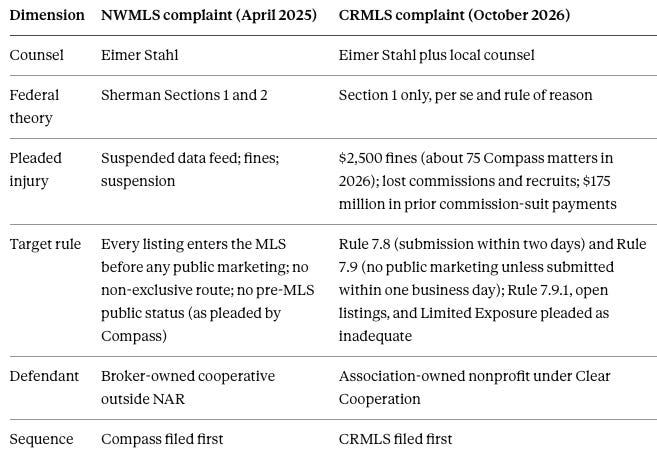
The August 31 NWMLS agreement kept mandatory submission and gave Compass a 21-day First Look status that delays the move to Active, not the submission itself: every First Look listing enters NWMLS on time and is accessible to its more than 30,000 member brokers. Compass called its objective in the Washington litigation “fully realized.” Forty-six days later Compass pleads in California that a two-day submission mandate is a per se boycott.
Compass’s August 31 announcement as reported by Inman states that sellers decide whether showings and open houses are allowed and whether offers are accepted during First Look. The status took effect September 4 with the listing submitted to NWMLS throughout. The same announcement sets an October 15, 2026 requirement that websites using NWMLS data display the listing agent’s name and contact information prominently beside inquiry and tour controls, which governs who reaches the buyer first rather than who sees the listing. The complete operative agreement and rule text are not in hand, and the agreement is a negotiated outcome rather than a merits ruling.
Relief B asks to protect listings “withheld from, or submitted later to” the MLS, and First Look does neither: the listing is submitted on time and only its Active status waits; the two arrangements also part on broker visibility, which First Look requires for every member and Relief B does not request and which CRMLS’s Limited Exposure status already provides. Showing and offer access during the window is the third variable: First Look leaves it to the seller, and the complaint does not address it. The simulation’s dominant fork is whether Compass wants a window or a ruling. Relief B is evidence for the window branch, and Count I with the Rule 7.8 attack is evidence for the ruling branch, because Compass accepted a cooperative submission framework in Washington and seeks protection from the submission requirement itself in California.
D. Governing Question
Which forum holds the dispute through mid-2027, whether Compass prefers delay or resolution, and whether national replication proceeds by suit or by quiet amendment. The target system is the two federal actions, the CRMLS enforcement pipeline, and the eight listing services holding demand letters. The horizon runs to December 31, 2027. The merits of any assigned agent claim, the Zillow litigation, and the securities exposure sit outside scope; the Magloire securities publication carries the securities exposure.
E. Why Behavioral Economics Adds Value
Compass’s declared goal is seller choice. The revealed goal from Washington and Relief B is a marketing window before full exposure, inside the MLS in Washington and outside it under Relief B, while the pleading demands a ruling. The gap between declared and revealed goals is the behavioral variable, and the simulation treats the accommodation-or-rule question as a fork rather than a premise.
The institutions have already answered the accommodation half of that fork, each through a different legal mechanism. NAR’s March 2025 delayed-marketing policy kept MLS submission and added a delayed-marketing status inside it. The August 31 NWMLS agreement kept submission by contract and added the First Look window. Washington’s SSB 6091took effect June 11, 2026 and regulates broker conduct rather than MLS submission: a broker who markets a residential listing to a limited group must market it concurrently to the general public and all other brokers, subject to a health-and-safety exception.
Each of the three mechanisms constrains private marketing without accepting public marketing outside the MLS, and none has moved the submission mandate itself. Compass’s California complaint attacks the mandate because no board or legislature or agency has moved it, and litigation is Compass’s principal remaining route to a ruling that moves it. The fork is whether Compass accepts the windows the institutions built or keeps paying litigation cost for the ruling.
The fine program changes the agent’s decision rule. A $2,500 fine stops being a salient personal cost and becomes a corporate line item. CRMLS’s reference point is rule integrity, so it treats each withheld listing as a loss rather than a foregone gain. An actor that frames each withheld listing as a loss litigates rather than negotiates.
F. Why Dynamic Game Theory Adds Value
The forum contest is sequential and observable. CRMLS’s first-to-file position is strong because it filed in Compass’s home district. Compass’s anticipatory argument is strong because CRMLS filed one day before a stated deadline. Each side holds the argument it needs, and the first ruling anchors the second court.
The fine program adds a repeated game. Every eligible citation after October 16 gives Compass an opportunity to acquire the agent’s claim through its reimbursement program, so CRMLS chooses between enforcement that can feed the suit and forbearance that concedes the rule. The game changed four times in eleven days: CRMLS’s first filing; Compass’s standalone complaint; the fine program; and the securities docket with the Senate letter. A game whose rules change while it is being played is the condition the simulation models.
G. Simulation Architecture
Compass. Objective: window or ruling; campaign credibility. Constraints and decision rights: forum motions; amendment; resolution terms; next target; a visible retreat is a candidate corrective event in the securities docket if it reveals an earlier misstatement or omission. Update trigger: forum ruling; per se ruling; citation volume.
CRMLS. Objective: rule integrity; New York forum; cost containment. Constraints and decision rights: forum motion; citation volume; rule amendment; defense fund. Update trigger: assigned-claim count; California ruling.
New York court. Objective: efficiency; first-to-file. Constraints and decision rights: retain, stay, transfer. Update trigger: Compass’s forum motion.
California court. Objective: avoid duplication; Ninth Circuit law. Constraints and decision rights: retain, stay, transfer. Update trigger: CRMLS’s forum motion.
Fined Compass-affiliated agents. Objective: avoid fines; keep listings. Constraints and decision rights: enroll and assign, or comply. Update trigger: citation; program terms.
CLAW and the desert listing service. Objective: own rules; reciprocity. Constraints and decision rights: program terms. Update trigger: CRMLS citations on compliant listings.
Peer boards (eight). Objective: avoid suit; keep shared standard. Constraints and decision rights: rule text. Update trigger: ¶33 discovery; fund commitments.
California and national associations. Objective: Clear Cooperation; defense funding. Constraints and decision rights: funding; model rules. Update trigger: ¶33 exposure.
State enforcers. Objective: preservation; access. Constraints and decision rights: demands; statute. Update trigger: ¶70 pleaded as fact.
The simulation tested four hypotheses, each with its falsifier. First, New York holds and the case proceeds on CRMLS’s narrow counts; falsified by a California retention order. Second, both courts proceed in parallel; falsified by a stay in either.
Third, a negotiated window resolves one action while the other pends; falsified by no accommodation through 2027. Fourth, both courts stay pending the other; falsified by any merits ruling in the window.
The dispute reduces to one fork and one repeated game. The fork is whether Compass wants the window Washington built or the ruling California could give, and the repeated game is CRMLS’s citation decision under a fine program that converts each citation into an assignable claim. The Simulation Predictions that follow rate the docket events those two structures produce.
III. MindCast Simulation Predictions
Prediction date: October 16, 2026. Data cutoff: October 16, 2026. Twelve Simulation Predictions follow: three Primary (P); eight Secondary (S), of which six are new and two are carried from the October 6 paper; and one Interpretive (I). The October 2 California paper cited below is California Private Listing Law After Washington SSB 6091: Broker Conduct Rules for Listing Visibility, Showing Access and Buyer Representation, which issued the California entries resolved here. The resolution of prior entries is stated separately below.
Synthesis. The dominant mechanism is forum doctrine favoring the first filer in the defendant’s home district, joined to a fine program that keeps Compass’s claim count growing regardless of forum. The active regime is parallel federal actions with reciprocal forum motions. The regime changes when either court issues a first ruling or when one side offers a window that preserves broker access. The behavioral equilibrium is CRMLS enforcing at reduced volume and litigating while Compass absorbs fines and amends.
Scenario structure. Base route: reciprocal forum motions; New York retains; California stayed; per se fails; an adequacy-of-alternatives case; quiet peer amendment. Secondary route: California retains on the state-law counts and the access record forms there. Tail route: a window offer modeled on Limited Exposure resolves one action while the other pends. The routes appear in the simulation’s order of likelihood; the issued bands below carry the probabilities.
Primary Simulation Predictions
P-1 · The California action yields to New York (55–66%). The Central District of California stays, transfers, or dismisses No. 5:26-cv-06121 in favor of No. 1:26-cv-08796 by June 30, 2027. Falsifier: a California order denying the motion and setting a case schedule, or a New York transfer or dismissal of its own action first. Verification source: the two dockets.
P-2 · CRMLS moves on forum before answering (80–89%). CRMLS’s first substantive California filing is a motion to dismiss, stay or transfer under the first-to-file rule or Rule 13(a), filed by its responsive-pleading deadline including any stipulated extension. Falsifier: an answer or counterclaim docketed first. Verification source: the California docket. Exposure: the defense fund bears early motion cost; Compass’s tort counts wait.
P-3 · The per se theory does not reach summary judgment intact (70–81%). Whichever court holds the dispute dismisses the per se group-boycott count or rules that rule-of-reason analysis governs Rules 7.8 and 7.9, at or before summary judgment and by December 31, 2027. Falsifier: an order allowing per se treatment past summary judgment, or no ruling in the window. Verification source: docket orders. Exposure: Compass’s damages theory narrows; CRMLS’s alternatives become the merits question.
Secondary Simulation Predictions
S-1 · Compass contests forum in New York first (74–85%). Compass’s first substantive New York filing is a motion to dismiss, stay or transfer as anticipatory, filed by its responsive-pleading deadline. Falsifier: an answer with counterclaims first. Verification source: the New York docket. The October 6 paper’s P-1 (62–75%) addressed the same event and remains open on its own terms.
S-2 · CRMLS citation volume falls (58–70%). CRMLS’s Rule 7.9 citations on Compass-affiliated listings from October 16, 2026 through April 16, 2027 run below the January–October 5 monthly rate of about 7.5 per month derived from ¶81. Falsifier: citation counts at or above the prior rate in any filing or statement. Verification source: CRMLS filings or statements; Compass amended pleadings.
S-3 · Showing and offer records are produced (55–67%). A court orders production of showing or offer records for See It First listings in the CRMLS service area by December 31, 2027, or Compass produces them under protective order. Falsifier: a docketed denial of production, or no order and no production by the date. Production under a protective order that leaves no public trace is production that observers cannot confirm, not production that failed to occur; the entry is then reported as unconfirmed at the window and resolves when any filing or party statement discloses it. Verification source: docket and protective-order filings; party statements.
S-4 · Quiet replication (40–54%). At least one of the eight listing services documented as Compass demand-letter recipients in the Zillow v. MRED record amends its public-marketing or submission rule toward a window before portal distribution with broker visibility by December 31, 2027, without being sued. Falsifier: no such amendment among the eight. Verification source: rule publications and trade press.
S-5 · No negotiated resolution (78–88%). No stipulated dismissal or agreement or announced accommodation ends either action before June 30, 2027. Falsifier: a stipulation, agreement, or announced accommodation docketed or reported. Verification source: the dockets and party announcements.
S-6 · CRMLS does not open public marketing without submission (82–92%, carried from the October 2 California paper as its S-4). CRMLS does not amend its rules to permit public marketing of an exclusive listing without MLS submission between October 6, 2026 and June 30, 2027. Falsifier: an amendment permitting that marketing. Verification source: the CRMLS Rules and Policy Change Summary. An amendment to a showing provision or another rule leaves the entry intact.
S-7 · Assigned-claim amendment (42–56%). Compass files an amended complaint in either forum by June 30, 2027 pleading at least 25 assigned agent claims arising from CRMLS citations, separate from the four ¶82 matters. Falsifier: fewer than 25 pleaded, or no amendment. Verification source: the amended complaint.
S-8 · Second listing-service complaint (69–84%, carried from the October 6 paper). Compass files an antitrust complaint against at least one listing service other than CRMLS by December 31, 2026. Falsifier: no second complaint. Verification source: the federal dockets and trade press.
Interpretive Simulation Prediction
I-1 · Accommodation rather than ruling (56–68%). Compass’s first substantive New York filing (or any overture docketed or reported before June 30, 2027) seeks or offers a defined pre-MLS window with submission preserved, rather than demanding invalidation of Rules 7.8 and 7.9 as the exclusive remedy. Rubric: a window is any proposal under which the listing enters the MLS within a stated period after public marketing begins. Falsifier: the filing or overture disclaims any window. Adjudication: MindCast, published with the text.
Resolution of Prior Simulation Predictions
Two hits and one miss. The October 2 California P-2 (77–90%) resolves true: Compass filed against a listing service by December 31, 2026. The October 2 California S-3 (58–74%) resolves true: the complaint named CRMLS.
The October 6 S-1 (66–76%: conditional on asserting claims against CRMLS anywhere, Compass asserts them first as New York counterclaims) resolves as a miss. Compass asserted them first as a standalone California complaint; the compulsory-counterclaim rule pointed to New York, and Compass chose California anyway. The October 9 entry on seller-choice framing in Compass’s first New York filing (60–74%) stays open.
Limits and Break Conditions
The simulation depends on both circuits applying first-to-file doctrine as they now do. A stipulation to consolidate would collapse P-1 and P-2 into one event. Fine-program uptake is unobserved, so S-7 is the most sensitive entry.
CLAW’s program terms are unverified. The First Look showing and offer terms rest on Compass’s August 31 announcement as reported; the complete operative agreement and rule text are not in hand.
Twelve entries and one adjudicated question carry the paper’s claim. The forum entries (P-1 · P-2 · S-1) resolve first and anchor the rest; the per se entry (P-3) decides whether the merits turn on adequacy of alternatives; the fine-program entries (S-2 · S-7) and the replication entries (S-4 · S-8) decide whether the campaign grows while the courts deliberate. I-1 names the fork the whole set depends on.
Working With MindCast
The published Simulation Predictions answer the forum and per se questions at issued bands. The set cannot answer what a specific board or general counsel does with its own demand letter, rule text, and enforcement record when the forum ruling lands.
MindCast builds organization-specific Cognitive Digital Twins from the board’s rule text, its enforcement history, and its counsel positions. The simulation then reruns the two-forum environment against the board’s actual options. The same build serves a brokerage weighing a fine-coverage program or a state office timing a preservation demand.
Commissioned scope adds complete probability distributions and the full scenario tree. Commissioned scope also adds decision thresholds keyed to docket events and a monitoring dashboard across both dockets and the citation pipeline. The resolution of the October 6 entries in Section III shows how the method resolves. The bounded next step is a diagnostic session on the organization’s exposure under P-1 and P-2, scoped to the next 30 days of docket activity.
IV. Stakeholder Strategy and Risk Mitigation
Each stakeholder faces a decision that must be made before the first forum ruling arrives. The strategic posture names that decision and its gate for each audience. The four-part risk entries state what each audience loses if a Simulation Prediction resolves true and they did nothing, with owned actions and the exposure that remains, and the time gates order those actions by horizon.
Strategic Posture by Stakeholder
🗂️ MLS Leaders. The forum ruling will be the template for every listing service holding a Compass demand letter. A board whose rule mirrors Rule 7.9 and whose data-share agreement imports CRMLS’s rules (Rule 6) should expect its communications to be requested under ¶33. The decision gates are CRMLS’s first California filing (P-2) and the New York ruling on Compass’s forum motion (S-1).
Zillow’s listing-access standards have been in force since June 30, 2025 and supply a second enforcement mechanism that does not depend on the board’s own rule: a listing marketed publicly before MLS submission is excluded from Zillow’s portals under the standards. The mechanism is contested rather than automatic. Compass sued Zillow over the standards in June 2025 and voluntarily dismissed the case in March 2026. Zillow’s May 12, 2026 complaint against MRED and Compass followed MRED’s suspension of feeds covering more than 30,000 Chicago-area listings.
On September 15, 2026 the Northern District of Illinois denied Zillow’s preliminary injunction and dissolved the restraining order and sent the claims to arbitration without reaching the antitrust merits. Contractual feed access can constrain a portal’s standards without eliminating them. A board that adds a window concedes nothing on the rule.
⚖️ Counsel. For CRMLS the forum motion comes first. For brokerage counsel ¶70 converted a disputed allegation into a pleaded fact, and S-3 expects production in one forum. Holds issued now cost little.
🏛️ Policymakers. Relief B names the window Compass will accept. A conduct statute regulating broker access and representation independence inside a pre-MLS window survives any forum outcome.
💼 Executives. S-6 says CRMLS keeps its submission requirement through June 2027. The non-exclusive route and Limited Exposure exist today and carry no citation risk.
📊 Investors. S-5 and S-7 together describe a litigation line that grows rather than closes. The Magloire securities publication carries the securities-disclosure Simulation Predictions.
Risk Mitigation by Simulation Prediction
Placement: a four-part entry under each Simulation Prediction, with the time gates beneath. The trade-off is length over a scannable grid; commissioned work expands each entry with the full scenario tree.
P-1 (55–66%) · ⚖️ Compass and brokerage counsel
Exposure if true and unmitigated: California yields and the dispute proceeds on CRMLS’s two declaratory counts: Compass’s tort and state-law counts wait for a New York ruling or for refiling as counterclaims on a schedule the New York court sets, and the showing and offer evidence on buyer access (¶70) forms in New York under CRMLS’s framing.
Severity · Probability: High · Moderate.
Mitigating actions (owner · deadline): Plead the tort and California counts as New York counterclaims within the responsive window (Compass counsel · New York deadline); brokerage counsel issue preservation holds now so the record is complete wherever it forms (general counsel · now).
Residual exposure: A New York ruling on narrow declaratory counts that leaves the damages theory for a later forum.
P-2 (80–89%) · ⚖️ CRMLS counsel
Exposure if true and unmitigated: The forum motion is made and still loses: a denial leaves CRMLS litigating six counts in Riverside with a second cycle of motion cost, and the motion’s briefing fixes CRMLS’s forum arguments before the New York court rules on Compass’s anticipatory motion.
Severity · Probability: High · High.
Mitigating actions (owner · deadline): Brief the motion on the home-district and stated-deadline facts so it also serves as the New York opposition (litigation lead · deadline); seek a stay pending the New York ruling as alternative relief in the same motion (same · same); no counterclaims until forum resolves (board · same).
Residual exposure: A denial that sets a California schedule before New York rules.
P-3 (70–81%) · 🗂️ Boards; 🤝 associations
Exposure if true and unmitigated: Per se fails and the case turns on adequacy of alternatives: a board whose rules lack a non-exclusive route and a Limited Exposure equivalent enters the rule-of-reason case without an answer to the ¶74 inadequacy argument, and adequacy of alternatives stays a disputed merits issue.
Severity · Probability: High · Moderate-high.
Mitigating actions (owner · deadline): Confirm and document the non-exclusive route and a broker-visible delayed status (board · before any merits briefing); brief the federal statement of interest and cooperative-rule cases on the first motion (CRMLS counsel · first motion); fund the brief (associations · same).
Residual exposure: Alternatives held inadequate on the ¶74 theory.
S-1 (74–85%) · ⚖️ CRMLS counsel (New York)
Exposure if true and unmitigated: Compass’s anticipatory motion lands against an unprepared opposition: loss of the first-filed position and one added forum cycle of two to four months.
Severity · Probability: High · Moderate-low.
Mitigating actions (owner · deadline): Draft the opposition on the home-district and stated-deadline facts before Compass’s deadline (CRMLS New York counsel · Compass’s responsive-pleading deadline); seek a California stay that cites the pending New York motion (California counsel · same deadline).
Residual exposure: Court treats the one-day-before-deadline filing as anticipatory despite the home-district fact.
S-2 (58–70%) · 🗂️ CRMLS enforcement
Exposure if true and unmitigated: Reduced citations buy fewer assignable claims at the cost of coverage: uncited phased listings become the compliance norm for Compass-affiliated agents, other brokerages ask for the same exception, and a six-month enforcement gap becomes evidence that the rule is not uniformly applied.
Severity · Probability: Medium · Moderate.
Mitigating actions (owner · deadline): Publish a written citation standard so reduced volume reads as selectivity rather than forbearance (board · next rule cycle); document every uncited phased listing and its reason (compliance · monthly to April 16, 2027); apply the standard identically to non-Compass brokerages (compliance · same).
Residual exposure: Each citation that is issued still becomes a claim Compass can acquire by assignment.
S-3 (55–67%) · ⚖️ Brokerage counsel; 🏛️ enforcers
Exposure if true and unmitigated: Records lost before production: a spoliation finding or an evidentiary gap on ¶70.
Severity · Probability: Medium · Moderate.
Mitigating actions (owner · deadline): Preservation holds on showing and offer records (general counsel · now); preservation demand keyed to ¶70 (state office · now).
Residual exposure: Production under protective order limits public use.
S-4 (40–54%) · 🗂️ Peer boards
Exposure if true and unmitigated: A visible coordinated amendment draws ¶33 discovery across eight boards.
Severity · Probability: Medium · Moderate.
Mitigating actions (owner · deadline): Confirm a non-exclusive route and a Limited Exposure equivalent (board · next cycle); amend individually through counsel (same).
Residual exposure: Any amendment reads as concession in trade press.
S-5 (78–88%) · 📊 Investors
Exposure if true and unmitigated: Litigation line runs through mid-2027 with no reserve guidance: two to three quarters of unquantified exposure.
Severity · Probability: Medium · High.
Mitigating actions (owner · deadline): Read Compass’s stated refusal to negotiate a resolution as a disclosure constraint (analyst · Q3 10-Q); model fine-program cost (same · 10-K).
Residual exposure: Asymmetric resolution in one forum.
S-6 (82–92%) · 💼 Brokers
Exposure if true and unmitigated: Phased listings cited under 7.9: $2,500 per listing plus hearing time.
Severity · Probability: Low · High.
Mitigating actions (owner · deadline): Audit phased listings (broker · now); route sellers to the non-exclusive route or Limited Exposure (agents · each listing).
Residual exposure: CRMLS amends a showing or window provision; audited listings need re-review.
S-7 (42–56%) · 🗂️ CRMLS board
Exposure if true and unmitigated: An assigned-claim docket survives a stay and outlives the rule question.
Severity · Probability: Medium · Moderate.
Mitigating actions (owner · deadline): Model per-citation economics (finance · before any amendment); agents read assignment terms before enrolling (agent counsel · on citation).
Residual exposure: Claims already assigned cannot be unwound.
S-8 (69–84%) · 🗂️ Peer boards
Exposure if true and unmitigated: Becoming the second defendant: a defense budget in the low seven figures by year-end.
Severity · Probability: High · High.
Mitigating actions (owner · deadline): Same as S-4; prepare a shared protective-order position (association counsel · December 31, 2026).
Residual exposure: A second complaint before year-end.
I-1 (56–68%) · All
Exposure if true and unmitigated: Misreading the campaign as merits-only forecloses a window negotiation.
Severity · Probability: Medium · Moderate.
Mitigating actions (owner · deadline): Treat Compass’s first New York filing as the evidentiary record (all · deadline).
Residual exposure: Filing is ambiguous on the window.
Risk Mitigation by Time Gate
Now to 30 days. Risk to contain: Forum motions filed without a preservation posture. Mitigation: Holds on showing, offer, and inter-MLS communications. Escalation trigger: First CRMLS docket entry in California.
30 to 90 days. Risk to contain: Parallel proceedings with inconsistent schedules. Mitigation: Stipulated stay in one forum pending the other. Escalation trigger: Denial of either forum motion.
3 to 12 months. Risk to contain: Per se ruling shapes damages exposure for all listing services. Mitigation: Early briefing on the federal statement of interest. Escalation trigger: Order on the motion to dismiss Count I.
Beyond 12 months. Risk to contain: Assigned-claim docket outlives the rule question. Mitigation: Per-citation economics; rule amendment preserving broker access. Escalation trigger: S-7 amendment filed.
Three actions are common to every audience and cost little before the first ruling: preservation holds on showing and offer records, a documented non-exclusive route with a Limited Exposure equivalent, and a forum position fixed before any answer. The residual exposure that no action removes is the assigned-claim docket, which outlives the forum question in every scenario.
V. Implications
If P-1 holds, the New York court decides the cooperation question for the second-largest listing service in the country outside the Ninth Circuit. If P-1 fails, two courts decide overlapping questions and the first merits ruling anchors the other. Either way P-3 moves the dispute from how the rule is characterized to whether adequate alternatives exist. A per se failure does not win the case for CRMLS; whether the non-exclusive route and Limited Exposure are adequate alternatives remains the open rule-of-reason question after it.
The fine program changes CRMLS’s enforcement calculus (S-2, S-7). Each eligible citation creates an opportunity for Compass to acquire the agent’s claim through its reimbursement program; forbearance concedes the rule. The ¶33 allegation penalizes the coalition response the listing services need, which pushes replication toward quiet amendment (S-4) rather than a second suit (S-8).
The costs fall unevenly. CRMLS’s defense fund bears the forum-motion cost. Compass bears the fine program’s cost and the discovery exposure ¶70 created. Peer boards capture the forum ruling as a template at no cost. The option worth preserving is the Limited Exposure design, which already separates portal exclusivity from broker access.
If P-1 fails, the California court retains the antitrust and tort counts subject to CRMLS’s later motions and adjudication. CRMLS then chooses claim by claim whether to plead its seven reserved claims in California under Rule 13(a) or hold them for New York or forgo them. Which are compulsory depends on the operative pleadings and on the transaction each claim arises from. P-1 then resolves as a miss with the mechanism assessed. If I-1 resolves against the window reading, Compass is litigating for the ruling, and the reason no negotiated resolution arrives (S-5) shifts from a securities-disclosure constraint to a litigation commitment.
What to Watch
The dominant fork is whether Compass seeks an accommodation (a marketing window) or a ruling, and Compass’s first New York filing is the evidence that decides it.
First CRMLS filing in California (P-2, P-1) · Docket · Weekly
First Compass filing in New York (S-1, I-1) · Docket · Weekly
Order on either forum motion (P-1) · Docket · On entry
Briefing and order on Count I (P-3) · Docket · On filing
Citation counts in any filing or statement (S-2) · Docket; CRMLS · Monthly
Amended complaint with assigned claims (S-7) · Docket · On filing
Second Compass complaint (S-8) · Docket; trade press · Weekly
Rule publications at the eight demand-letter services (S-4) · Service sites; trade press · Monthly
CRMLS amendment opening public marketing without submission (S-6) · CRMLS Rules and Policy Change Summary · Monthly
Production of showing or offer records (S-3) · Docket · Monthly
Conclusion
The New York court probably keeps the dispute, and the California action probably yields to it by stay or transfer or dismissal. Compass’s per se boycott theory probably fails, which leaves the rule-of-reason case on adequacy of alternatives open rather than won by CRMLS. The fine program probably keeps the California docket alive by amendment whichever court rules first, because each citation Compass reimburses becomes a claim it can plead. Underneath the forum contest sits one fact both forums share: Compass accepted a cooperative submission framework in Washington and seeks protection from the submission requirement itself in California.
Whether Compass wants a marketing window or a court ruling is the open question, and Compass’s first New York filing will answer it (I-1). Stakeholders act now on preservation holds and forum position and wait for the first ruling. The decisive signal is CRMLS’s first California filing, and the next threshold is the court’s order on that motion.
Appendix A: Selected MindCast Works
The MindCast MLS Equilibrium Series (May 13, 2026): the series index and framework that this paper and the works below extend.
CRMLS v. Compass — A Briefing for California MLS Leaders, Counsel and Lawmakers (October 9, 2026): the demand-campaign documentation across eight listing services and the seller-choice entry still open.
Compass Runs the Same MLS Playbook Against CRMLS That It Ran Against NWMLS (October 6, 2026): the New York Simulation Predictions resolved here.
The Compass Commission Consolidation Strategy and Real Estate Marketing Transparency (February 19, 2026): the economic mechanism behind the access question.
The Compass–NWMLS Settlement Changed the Private Governor After Washington Changed the Governing Law(September 1, 2026): the August 31 agreement as the Washington comparator, which MLS requirements survived, what First Look changed, and how SSB 6091 constrains private marketing on its own track.
California Private Listing Law After Washington SSB 6091 — Broker Conduct Rules for Listing Visibility, Showing Access and Buyer Representation (October 2, 2026): the California legislative framework, the distinction between MLS submission rules and broker conduct and independent buyer representation, and the California entries resolved in Section III.
Compass Private Listings Behind the Discovery Wall — NWMLS Subpoenaed Moya Skillman and Tested the Same Buyer-Capture Variables MindCast Published From Public Data (October 6, 2026): the showing, offer, and buyer-routing questions examined in NWMLS discovery, which connect ¶70’s access assertion to concrete discovery questions for the California dispute.
Appendix B: External Sources
Press. Real Estate News, “CRMLS files suit against Compass over listing rules” (Oct. 5, 2026) · Inman, “Compass files antitrust suit against CRMLS over listing rules” (Oct. 16, 2026) · HousingWire, “Compass takes CRMLS fight to court and promises to cover agent fines” (Oct. 16, 2026) · Inman, “Compass-NWMLS counterclaims” (Apr. 3, 2026) · Inman, Compass–NWMLS settlement rule changes (Aug. 31, 2026) · RISMedia, Zillow restraining-order motion against MRED(May 21, 2026) · Real Estate News, September 15 ruling in Zillow v. MRED (Sept. 15, 2026).
Allegations summarized from court filings are pleaded claims, not findings.