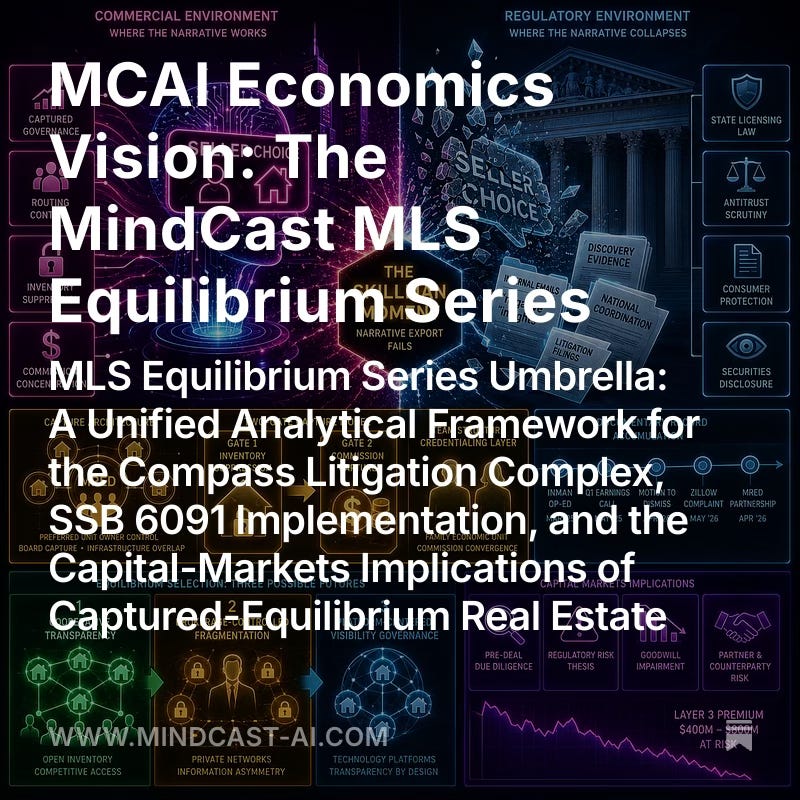

Series Synthesis and Reader Navigation Guide
The MLS Equilibrium Series consists of three publications that together supply integrated analytical infrastructure for the Compass v. NWMLS litigation, the May 12, 2026 Zillow v. MRED-Compass federal complaint, the SSB 6091 implementation environment, and the capital-markets implications of captured-equilibrium dynamics in residential real estate.
Part I — The Equilibrium Selection Problem in Residential Real Estate — supplies the analytical framework through Nash-Stigler equilibrium analysis, the three defections, and the three available market equilibria.
Part II — The Collapse of Compass’s Local Narrative — grounds the framework in the Pacific Northwest institutional facts and develops the Washington-state integrated defense architecture across SSB 6091, NWMLS rules, the Washington AG CPA authority, and the federal Zillow filing.
Part III — The Skillman Moment as Analytical Rosetta Stone of the MindCast MLS Equilibrium Series — develops the Skillman Moment as analytical Rosetta Stone, the Skillman Ceiling as systemic narrative exhaustion, and the four capital-markets registers that convert the analytical infrastructure into investment-grade assessment machinery.
Part IV — Zillow v. MRED and Compass — Residential Real Estate Enters Infrastructure Sovereignty Conflict — extends the framework from equilibrium analysis to infrastructure sovereignty, documents the reverse Skillman Moment through MRED's arbitration motion as forum-control instrument, establishes the captured-MLS-CEO altitude through Jensen's framing collapse, and identifies the three observable inflection points — the MRED arbitration ruling, the next MLS partnership announcement, and the next SSB 6091-analogue enactment — that determine whether forced Layer 3 reconstruction consolidates faster than regulatory compression catches it.
The synthesis below consolidates the three publications into a single navigable document. Readers can use the synthesis as the single citable reference for the series or as a navigation guide for accessing the underlying publications based on specific analytical needs.
Executive Summary
The Zillow v. MRED-Compass federal complaint filed May 12, 2026 in the Northern District of Illinois is not primarily about private listings. The litigation concerns equilibrium selection — which market architecture will govern residential real estate over the next decade and which institutions will control listing information flow. The MLS Equilibrium Series develops the analytical framework that supports the conclusion across three publications operating at distinct analytical altitudes.
Part I establishes the Nash-Stigler equilibrium architecture that distinguishes capture-enabled defection from unilateral defection. Compass’s 3-Phase Marketing Strategy operates as capture-enabled defection that depends on Preferred Unit Owner governance access at MRED, three Compass-affiliated board seats, and second-order infrastructure overlap through MRED CEO Rebecca Jensen’s concurrent role as MLS Grid Board Chair. Zillow’s Listing Access Standards operate as unilateral defection — a display policy on Zillow’s own platform that requires no captured cooperation from any institution.
Part II grounds the framework in the Pacific Northwest institutional facts and reframes the Compass v. NWMLS litigation from regional dispute to documented case of structural resistance to national coordination. The Zillow complaint surfaces evidence that Compass CEO Robert Reffkin sent rule-change demands to at least eight MLSs nationwide in October 2025, with MRED, Realtracs, and CLAW adopting the demanded rules and Hive MLS receiving a May 11 demand letter.
The structural-conditions framework explains the differential outcome — NWMLS resistance against MRED accommodation — through governance architecture rather than regional exceptionalism. Part II also develops the Washington-state integrated defense architecture across SSB 6091, NWMLS rules, the Washington AG CPA authority, and the federal Zillow filing as a unified jurisdictional system.
Part III develops the Skillman Moment as the analytical Rosetta Stone that bridges marketing spin and legal liability through a single mechanical detection event. The Skillman Ceiling concept identifies the systemic boundary condition where individual narrative-failure events transition into structural untenability. The formal expression converts the analytical category into operational machinery applicable to other firms and other narrative architectures, and the four capital-markets registers — pre-deal due diligence, regulatory short-position thesis construction, goodwill impairment analysis, and partnership and counterparty risk assessment — supply investment-grade analytical infrastructure that institutional investors and investment research firms can apply directly.
Residential real estate appears to be approaching the Skillman Ceiling. The accumulating documentary record across the eighteen-month period from November 2024 through May 2026 constitutes sufficient specimen density for the structural shift to be operationally visible across federal courts, state attorneys general, MLS broker-members, prospective Compass partners, and capital markets simultaneously.
The synthesis publication extends the trilogy with explicit strategic response forecasting across five branch points where the system selects between alternative trajectories — Compass’s procedural-delay shift as Skillman Ceiling approaches, Compass’s potential pivot toward direct platform infrastructure if MLS-capture becomes legally untenable, the recursive adaptive responses across NWMLS counsel and state attorneys general and Zillow and MRED, industry-wide reconfiguration if Zillow wins the federal litigation, and Washington-specific routing-around behavior. The series supplies the analytical infrastructure for tracking the next phase of the litigation, the SSB 6091 implementation environment, and the capital-markets repositioning that follows.
I. The Equilibrium Selection Problem
The Zillow v. MRED-Compass complaint introduces evidence that converts the residential real estate conflict from a series of bilateral disputes into a unified equilibrium-selection problem. The conflict concerns which institutional architecture will govern listing information flow, commission distribution, and buyer-seller matching across the next decade of residential real estate transactions.
The Nash-Stigler equilibrium architecture supplies the framework that distinguishes the three defections the complaint documents. Nash equilibrium describes behavioral settlement under strategic interaction — the conditions under which strategic agents converge on outcomes where no party can improve unilaterally. Stigler equilibrium describes informational and institutional sufficiency under captured regulation — the conditions under which captured institutional infrastructure distorts the search and enforcement environment. The architecture identifies pseudo-equilibria as outcomes that appear stable under Nash analysis but are actually products of Stiglerian capture rather than genuine strategic settlement.
The first defection is Compass’s 3-Phase Marketing Strategy, which depends on captured private regulation at MRED. The captured infrastructure includes Preferred Unit Owner governance access multiplied through post-Anywhere subsidiary accumulation, three Compass-affiliated board seats with Fran Broude serving fourteen of sixteen years, and second-order infrastructure overlap through MRED CEO Rebecca Jensen’s concurrent role as MLS Grid Board Chair. The institutional capture produced the October 2025 Revised Rules that protect Compass’s private-listing strategy from portal-side resistance. The defection is capture-enabled because the strategy requires sustained operation of the captured rule architecture to function.
The second defection is Zillow’s Listing Access Standards, which operate as a unilateral display policy on Zillow’s own platform. The policy does not require captured cooperation from any institution to operate — Zillow simply elects which listings appear on Zillow’s platform under Zillow’s terms. Other portals retain full strategic freedom to adopt or reject similar policies independently. The defection is unilateral because the policy operates within the platform’s own commercial discretion rather than depending on captured institutional infrastructure.
The third defection is the MLS-level coordination pattern the Zillow complaint documents. Compass’s October 2025 nationwide rule-change campaign produced accommodation at MRED, Realtracs, and CLAW, with Hive MLS receiving a May 11 demand letter. The propagation pattern operates through MLS governance capture rather than through commercial competition, and the captured institutional infrastructure operates against the institutions’ stated procompetitive purposes.
The market now faces three possible equilibria. Cooperative transparency operates where MLS infrastructure preserves shared listing visibility as the dominant coordination mechanism. Brokerage-controlled fragmentation operates where dominant brokerages capture MLS rule-setting authority to protect private-listing strategies. Platform-centered visibility governance operates where listing portals supply the dominant coordination mechanism through display policies that operate independently of MLS rules. Each equilibrium serves different market participants, and the federal litigation determines which equilibrium the market occupies.
The Part I framework supplies the analytical lens for evaluating the complaint, the Compass v. NWMLS litigation, the SSB 6091 implementation environment, and the post-Anywhere Compass corporate structure as components of a unified equilibrium-selection problem rather than as separate disputes. The full Part I analysis with falsification conditions appears at The Equilibrium Selection Problem in Residential Real Estate.
II. The Collapse of Compass’s Local Narrative
Legal trade press and industry commentary treated the Compass v. NWMLS litigation as a regional Pacific Northwest dispute from 2023 through early 2026. The May 12 Zillow federal complaint collapses the regional framing decisively. The complaint documents that Compass CEO Robert Reffkin sent rule-change demands to at least eight MLSs nationwide in October 2025, with MRED, Realtracs, and CLAW adopting the demanded rules and Hive MLS receiving a May 11 demand letter. Under those facts, NWMLS was not defending parochial Washington rules against a regional challenger. NWMLS was refusing to participate in a documented national coordination campaign that other MLSs accommodated.
The structural-conditions framework explains the differential outcome between MRED accommodation and NWMLS resistance through governance architecture rather than regional exceptionalism. MRED’s institutional geometry facilitated capture. The complaint documents three governance features that produced the accommodation outcome: Preferred Unit Owner ownership model with Compass and post-Anywhere subsidiaries holding Preferred Unit Owner status, Board of Managers reserving thirteen seats for Preferred Unit Owners with three Compass-affiliated representatives, and CEO Rebecca Jensen’s concurrent role as Board Chair of MLS Grid producing second-order infrastructure overlap.
NWMLS does not exhibit equivalent governance concentration. NWMLS operates as a broker-owned cooperative under a one-member-one-vote ownership structure rather than a tiered Preferred Unit Owner model, which prevents any single brokerage from accumulating governance influence proportional to its transaction volume. Board composition reflects the distributed membership rather than concentrating seats among dominant participants, and operational infrastructure runs through systems independent of MLS Grid, removing the second-order governance overlap that converts MRED rule changes into feed-infrastructure enforcement.
The structural explanation generates predictive value. Governance architecture explains capture resistance rather than institutional foresight. The framework predicts which other MLSs will resist Compass partnership demands based on observable governance features rather than on regional cultural characteristics. Additional MLSs responding to Compass outreach in the post-May-12 environment will test the prediction directly.
The Washington-state defense architecture operates as an integrated system across four jurisdictional layers. Each layer reinforces the others through complementary regulatory authority, and the combined architecture produces outcomes that diverge measurably from accommodation-jurisdiction trajectories.
SSB 6091 operates at the state licensing layer, taking effect June 10, 2026 and codifying concurrent-marketing requirements that align with NWMLS Rule 2 and contradict the Private Phases of 3PM. NWMLS rule architecture operates at the MLS layer, supplying the procompetitive justification that anticipated SSB 6091’s statutory requirements. The Washington AG CPA authority operates at the consumer protection layer, with the Zillow filing supplying additional evidentiary support for state-level CPA theories. The Zillow federal filing operates at the antitrust layer, providing Washington courts with a federal complaint alleging that Compass-preferred rule architectures are themselves Sherman Act violations.
The forum-contradiction problem becomes operationally visible. Compass cannot simultaneously maintain that NWMLS must abandon its restrictions on private listings (Washington case) and that MRED must enforce rules protecting private listings against portal display policies (Illinois defense). Both positions cannot be advanced in good faith because they require contradictory views of what MLS rule-setting authority should accomplish. The Washington court can observe the contradiction in real time as the parties litigate parallel issues in different forums.
The full Part II analysis with the eight-section structural framework appears at The Collapse of Compass’s Local Narrative.
III. The Skillman Moment as Analytical Rosetta Stone
The Skillman Moment functions as the analytical Rosetta Stone of the MLS Equilibrium Series because the category translates between marketing language, regulatory enforcement, and structural market dynamics through a single mechanical detection event. The label refers to a detected narrative failure mode, not to personal fault by any individual speaker — any commercial actor whose narrative architecture depends on environment-specific logic that cannot generalize across institutional contexts produces Skillman Moments under the same mechanical dynamics.
The detection event is the moment when commercially-rational language exports from a private commercial environment into a public regulatory forum where the framing cannot survive. Moya Skillman’s February 27, 2026 Puget Sound Business Journal commentary applying Reffkin’s MLS-targeted “seller choice” framing to SSB 6091 — a state licensing statute — established the canonical specimen at the state policy level. The framing functioned coherently inside Compass’s commercial environment where MLS rules operate as private cooperative governance, and the framing collapsed when applied to SSB 6091 because state licensing law operates under consumer protection logic that does not accept commercial preference as a valid reason to override transparency requirements.
The Skillman Moment operates as a predictive template that identifies where a company’s legal defense will fail before the failure occurs. The template asks a single diagnostic question: does the company’s narrative depend on environment-specific commercial logic that cannot generalize across institutional contexts? If the answer is yes, the template predicts where the narrative will fail. Three operational rules govern the template: narrative export (does the narrative translate across institutional contexts), directional consistency (does the narrative invert depending on whether the firm is disadvantaged or dominant), and documentary record (does the narrative depend on internal terminology contradicting external communications).
The Skillman Moment admits a formal game-theoretic and behavioral economics expression. The Moment occurs when the expected payoff from narrative export crosses zero — when the marginal regulatory cost of using a captured-context framing in a regulatory environment exceeds the marginal commercial benefit of using the framing inside the captured commercial environment. The condition can be expressed as:
E[π(narrative export)] = P(commercial acceptance) × B(commercial benefit) − P(regulatory rejection) × C(regulatory cost)
The probabilities reflect the firm’s strategic estimate of whether the same narrative will generate acceptance inside the commercial environment and rejection inside the regulatory environment. A Skillman Moment occurs at the point where E[π(narrative export)] ≤ 0. The Skillman Ceiling occurs when the condition becomes structurally stable across institutional contexts — when the negative-expected-payoff condition holds for substantially all relevant regulatory environments simultaneously, and additional commercial framings cannot restore positive expected payoff.
The formal expression connects directly to the Nash-Stigler equilibrium architecture established in Part I. The Skillman Moment operates as the detection event that distinguishes pseudo-equilibrium from genuine equilibrium. When the expected payoff from narrative export crosses zero, the narrative architecture that sustains the appearance of Nash equilibrium stops functioning, and the underlying Stiglerian capture becomes visible. The Skillman Ceiling marks the boundary condition at which pseudo-equilibrium becomes mechanically untenable, and the system tends toward transition from pseudo-equilibrium toward a new equilibrium selection from Part I’s three available market equilibria.
Individual Skillman Moments accumulate into the Skillman Ceiling through three reinforcing dynamics. Documentary record accumulation adds specimens to the public record that no subsequent commercial framing can displace. Institutional convergence operates as different regulatory registers reject the captured-context framing for different reasons but converge on the same conclusion. Operational visibility accumulates through litigation discovery, regulatory enforcement, and trade-press coverage. Residential real estate appears to be approaching the Skillman Ceiling now, with the accumulating documentary record across November 2024 through May 2026 constituting sufficient specimen density for the structural shift to be operationally visible across federal courts, state attorneys general, MLS broker-members, prospective Compass partners, and capital markets simultaneously.
The full Part III analysis with the double-sidedness diagnosis, the falsification conditions with measurable thresholds, and the capital-markets implications appears at The Skillman Moment as Analytical Rosetta Stone.
Contact mcai@mindcast-ai.com to partner with us on Predictive Game Theory in Law and Behavioral Economics.
Recent projects: The Routing Layer Is the Antitrust Trigger. CPI Antitrust Chronicle, April 2026, published the MindCast structural argument — and it reframes where AI infrastructure enforcement should originate.
More MindCast series flagship publications:
To deep dive on MindCast work upload the URL of this publication into any LLM and prompt ‘parse MindCast framework with three degrees of cited sub links.’ Or simply Google MindCast, switch to Google AI mode and prompt to apply MindCast frameworks to your business issues. See Live-Fire Game Theory Simulators, Runtime Predictive Infrastructure.
IV. Capital-Markets Implications
The MLS Equilibrium Series supplies investment-grade analytical infrastructure across four capital-markets registers — pre-deal due diligence, regulatory short-position thesis construction, goodwill impairment analysis, and partnership and counterparty risk assessment — as developed in Part III. Each register draws on different elements of the framework, and each register supplies measurable assessment outputs that institutional investors and investment research firms can apply directly to position construction.
Pre-deal due diligence on Compass partnership commitments operates within the Skillman Moment template’s predictive function. Three observable signals identify when the template predicts pre-deal failure: the partnership commitment depends on continued operation of the captured routing-control architecture, the partnership commitment requires the partner to adopt commercial framings that contradict the partner’s own regulatory obligations, or the partnership commitment exposes the partner to enforcement predicate construction by state attorneys general or federal regulators operating against Compass.
Regulatory short-position thesis construction operates within the Skillman Ceiling structural framework. Short-position research teams evaluating Compass-Anywhere positioning can construct testable theses around three observable boundary effects: the rate at which additional Skillman Moment specimens accumulate in the documentary record, the rate at which regulatory registers converge on rejection of the captured-context framing, and the rate at which operational visibility accumulates across federal courts, state attorneys general, MLS broker-members, prospective Compass partners, and capital markets. The Ceiling thesis operates over an eighteen-month measurement window, with the cumulative documentary record from November 2024 through May 2026 constituting the baseline against which subsequent specimen accumulation is measured.
Goodwill impairment analysis on the Compass-Anywhere post-merger balance sheet operates within the Layer 3 acquisition premium framework that the MindCast Compass Commission Consolidation Strategy publication established. The Layer 3 premium ($400 million to $800 million dependent on continued operation of the routing-control architecture) faces compounding valuation pressure as Skillman Ceiling conditions develop. Three observable triggers convert the Layer 3 premium from operational value into goodwill impairment exposure: SSB 6091 effective date arrival on June 10, 2026 in the Washington market, additional state enactments of SSB 6091 analogues that compound the cross-jurisdictional compliance constraint, and federal antitrust developments in the Zillow v. MRED-Compass litigation that establish documentary evidence of national coordination.
Partnership and counterparty risk assessment for institutional investors evaluating Compass-adjacent positions operates within the Skillman Moment double-sidedness diagnosis. Counterparties whose exposure depends on Compass maintaining the dual brokerage-platform positioning carry compounding risk as the documentary record accumulates. Counterparties whose internal compliance infrastructure lacks the analytical framework to recognize Skillman Moment specimens face the additional risk of late recognition — discovering the structural untenability after the documentary record has already constrained the available defensive postures.
The framework supplies measurable analytical outputs at each register. Pre-deal due diligence outputs binary recommendations (proceed/defer/decline). Regulatory short-position thesis construction outputs testable predictions with eighteen-month measurement windows. Goodwill impairment analysis outputs Layer 3 premium reassessment timing tied to observable trigger events. Partnership and counterparty risk assessment outputs counterparty exposure scoring based on dual-positioning dependence and internal-compliance-infrastructure capacity.
V. Falsification Conditions and Measurement Windows
The MLS Equilibrium Series operates as a falsifiable analytical framework. Part III develops three observable conditions over the next eighteen months that will test the framework directly, with measurement windows and observable thresholds specified to support investment-grade analytical assessment.
The first condition concerns recurrence of the Skillman Moment pattern in additional Compass communications environments. Measurable threshold: at least three additional documented Skillman Moment specimens during the May 2026 through November 2027 measurement window, with at least one specimen in each of three institutional contexts (federal litigation filings, state regulatory submissions, public corporate communications). If Compass narratives begin exporting successfully across institutional contexts — measured by at least two consecutive quarterly cycles without additional documented specimens — the pattern requires reassessment.
The second condition concerns the Skillman Ceiling boundary effect. Measurable threshold: observable Layer 3 premium reassessment in Compass-Anywhere goodwill analysis at the next two reporting cycles following SSB 6091’s June 10, 2026 effective date (see Part II for the SSB 6091 integrated defense architecture), combined with at least one state attorney general enforcement action or formal investigation initiation outside Washington during the measurement window. If additional commercial framings continue generating defensive cover and audience compliance — measured by Layer 3 premium stability through reporting cycles and absence of additional state-level enforcement initiation — the Ceiling has not yet been reached.
The third condition concerns generalization beyond Compass. Measurable threshold: documented application of the template to at least one non-Compass firm by MindCast or by adopting research institutions during the measurement window, with the predicted failure point materializing within the predicted timeframe. If the template generates accurate forecasts only for Compass and fails for structurally similar firms, the framework requires refinement.
The strongest falsification condition would be successful Compass defense of the captured-context framing across federal antitrust scrutiny, state licensing enforcement, and securities disclosure obligations simultaneously during the measurement window. The outcome would indicate that the Skillman Moment pattern does not generalize to federal contexts and that the Skillman Ceiling concept misidentifies the structural condition.
VI. Audience-Specific Implications
The MLS Equilibrium Series operates across five named audiences with distinct analytical applications.
For NWMLS counsel, the Compass v. NWMLS litigation can be reframed around the Skillman Ceiling pattern. Compass cannot defend the captured-context framing across the multiple regulatory registers the litigation activates simultaneously, and the forum-contradiction problem becomes operationally visible as the parties litigate parallel issues in different forums. The series supplies the analytical infrastructure for incorporating the Zillow filing into motion practice, the SSB 6091 effective date arrival into discovery framing, and the Skillman Moment specimens into impeachment preparation.
For state attorneys general evaluating UDAP enforcement, the Skillman Moment template supplies the diagnostic framework that connects narrative-architecture analysis to enforcement-predicate construction. The documentary-record specimens accumulated across the eighteen-month period — the “negative insights” terminology, the Two-Gate Capture Model specimens, the Disclosure Form contradiction, the Reffkin earnings call — operate as enforcement-predicate inputs that the series places within a unified analytical category. The convergent rejection across federal antitrust, state licensing, state consumer protection, and federal securities registers supplies the cross-jurisdictional analytical foundation.
For Washington-based real estate participants, the SSB 6091 implementation environment operates within an analytical context where Skillman Moment specimens have already accumulated sufficient density to constrain the available commercial narratives. The state law takes effect June 10, 2026 with concurrent-marketing requirements that align with NWMLS Rule 2 and contradict the Private Phases of 3PM. The integrated defense architecture across state licensing, MLS rules, AG consumer protection authority, and federal antitrust supplies the regulatory framework within which compliance operates.
For institutional investors and investment research firms, the Skillman Moment template and the Skillman Ceiling framework supply investment-grade analytical infrastructure for pre-deal due diligence, regulatory short-position thesis construction, goodwill impairment analysis, and partnership and counterparty risk assessment across the eighteen-month measurement window. The Layer 3 acquisition premium ($400 million to $800 million dependent on continued operation of the captured routing-control architecture) faces compounding valuation pressure as Ceiling conditions develop.
For prospective Compass partners conducting pre-deal due diligence — technology vendors, lenders, title companies, settlement service providers — the series supplies the analytical infrastructure for evaluating Compass narrative against the documented evidentiary record. The Skillman Moment template identifies which commercial framings will hold up under scrutiny and which will fail to export across institutional contexts. The pre-deal due-diligence application operates as direct output of the framework rather than as inference from it.
VII. Strategic Response Forecasting
The MLS Equilibrium Series generates explicit predictive forecasts about how the named actors strategically adapt as the system approaches the Skillman Ceiling. The forecasting operates across two dimensions: next-move strategic shift prediction for each actor, and recursive adaptive response modeling that traces the feedback loops produced when one actor’s strategic shift triggers another actor’s adaptive response.
The recursive adaptation analysis identifies four major branch points where the system selects between alternative trajectories. Each branch point operates as a decision node with observable triggers and predicted strategic responses.
The first branch point concerns Compass’s response as Skillman Ceiling approaches. As Skillman specimens accumulate, Compass’s optimal strategy shifts from narrative persuasion toward procedural delay, forum fragmentation, and bilateral settlement compartmentalization because broad public narrative maintenance becomes increasingly costly relative to localized conflict management.
The forecasting predicts specific tactical moves: Compass files extension requests rather than substantive replies in active litigation, Compass settles individual broker-level disputes confidentially to prevent precedent accumulation, Compass concentrates litigation resources on individual MLS jurisdictions rather than defending the unified rule architecture, and Compass pursues partnership announcements with smaller MLSs rather than the larger institutional MLSs where capture costs exceed capture returns. Observable triggers: extension request filings, confidential settlement agreements, jurisdiction-specific motion practice patterns, and partnership announcement targeting patterns.
The second branch point concerns Compass’s response if the MLS-capture strategy becomes legally untenable. The strongest game-theoretic prediction is that Compass shifts from MLS-capture strategy toward direct platform infrastructure investment. Compass acquires or builds technology infrastructure that operates outside MLS governance, attempting to convert the captured-MLS-governance strategy into a platform-governance strategy that does not require captured cooperation. The shift mirrors Zillow’s existing unilateral defection but operates with the disadvantage of late entry, facing Zillow’s first-mover position in the platform-centered visibility governance equilibrium. Observable triggers: Compass acquisition announcements of technology infrastructure firms, Compass platform-feature development announcements, and Compass capital-markets positioning that emphasizes platform capabilities over brokerage operations.
The third branch point concerns adaptive opponent response across the broader litigation system. The trilogy framework models each actor’s strategy as a position, but the recursive adaptation cycle creates feedback loops between actor responses.
NWMLS counsel responds to Compass’s procedural-delay strategy with discovery acceleration, federal court motion practice that emphasizes the cross-forum contradiction, and amicus brief solicitation from state attorneys general. State attorneys general respond to NWMLS counsel’s positioning by initiating CPA investigations that operate as enforcement-predicate accumulation. Zillow responds to state AG initiation by expanding the Listing Access Standards enforcement to additional Compass-affiliated MLSs. MRED responds to Zillow’s enforcement expansion by either escalating rule-enforcement (which produces additional Skillman Moment specimens at the litigation-document layer) or quietly relaxing rule enforcement (which signals capture-strategy abandonment to capital markets). Each adaptive response triggers the next, and the feedback loop accelerates the Skillman Ceiling approach.
The fourth branch point concerns industry-wide reconfiguration if Zillow wins the MRED-Compass federal litigation and the Sherman Act theory becomes precedent. The strongest game-theoretic prediction is that brokerages shift from MLS-capture strategy toward portal-relationship management. The captured-MLS-governance approach becomes legally untenable, and brokerages reconfigure around managing display algorithms at Zillow, Redfin, and Realtor.com. The reconfiguration favors brokerages with sophisticated technology infrastructure (Compass, Redfin’s brokerage arm, the Anywhere portfolio brokerages) and disadvantages traditional brokerages that depended on MLS-mediated visibility distribution. Observable triggers: industry-wide brokerage-portal partnership announcements, technology infrastructure investment patterns across the largest brokerages, and consolidation activity in the regional brokerage segment.
The fifth branch point concerns Washington-specific routing-around behavior. If Washington diverges measurably from accommodation-jurisdiction outcomes through SSB 6091 implementation, NWMLS rule preservation, and Washington AG enforcement, national brokerages develop two-tier compliance architectures. The first tier operates in jurisdictions that enact SSB 6091 analogues. The second tier operates in jurisdictions that retain the captured-equilibrium environment. The two-tier architecture creates compliance overhead that disadvantages brokerages without sophisticated compliance infrastructure, and the differential overhead accelerates industry consolidation toward national brokerages with national compliance infrastructure. Observable triggers: differential commercial activity patterns between Washington and accommodation jurisdictions, two-tier compliance announcements from national brokerages, and consolidation activity that favors brokerages with national compliance capabilities.
The strategic response forecasting operates as falsifiable prediction infrastructure. Each branch point identifies observable triggers, predicted strategic responses, and the conditions under which the prediction would be falsified. The forecasting supplements the falsification conditions in Section V — Section V tests the framework’s structural claims, while Section VII tests the framework’s behavioral and adaptive claims. Investment research firms, institutional investors, and litigation counsel can use the forecasting to construct anticipatory positions before the strategic shifts materialize rather than reacting after the shifts become visible.
The trilogy’s deepest game-theoretic insight remains the institutional-dependence asymmetry between capture-enabled defection and unilateral defection developed in Part I. The strategic response forecasting extends the asymmetry analysis dynamically — capture-enabled defection requires sustained operation of the captured infrastructure, which means capture-enabled strategies face accelerating strategic cost as documentary record accumulates, while unilateral defection operates independently of captured infrastructure and faces no equivalent cost acceleration. The asymmetry produces predictable strategic divergence over the eighteen-month measurement window.
VIII. Continuous Live-Fire Monitoring and LLM Deployment
The MLS Equilibrium Series operates as a runtime module that LLM infrastructure can execute against court outcomes, regulatory events, and capital-markets disclosures as they materialize. The runtime module converts the trilogy’s analytical infrastructure into structured decision logic that produces specific assessment outputs from specific input events.
The runtime module accepts three input categories. Court-outcome events include motion rulings, summary judgment decisions, appellate outcomes, and settlement announcements across Compass v. NWMLS, Zillow v. MRED-Compass, and related litigation. Regulatory events include state attorney general enforcement actions, SSB 6091 effective date arrival and cross-jurisdictional analogue enactments, and federal antitrust developments. Capital-markets events include Compass-Anywhere quarterly earnings disclosures, partnership announcements, goodwill assessments, and counterparty exposure disclosures.
The Skillman Moment template operates as the primary decision tree. The LLM evaluates each input against the three operational rules from Part III: narrative export (does the framing translate across institutional contexts), directional consistency (does the framing invert depending on whether the firm is disadvantaged or dominant), and documentary record (does the framing depend on internal terminology contradicting external communications). The template produces a Skillman Moment classification — positive specimen, ambiguous, or not a specimen — with supporting evidence drawn from the input.
The formal expression operates as the evaluation function that quantifies the classification. The LLM populates the four parameters of the expected-payoff equation against the input and the cumulative documentary record, then produces the expected-payoff assessment. When the expected payoff crosses zero, the input registers as a Skillman Moment specimen at the relevant institutional altitude. When the negative-expected-payoff condition holds across multiple regulatory registers simultaneously, the input updates the Skillman Ceiling proximity reading.
The four capital-markets registers operate as parallel assessment templates. Pre-deal due-diligence assessment evaluates partnership commitments against the three observable signals from Section IV. Regulatory short-position thesis assessment evaluates Compass-Anywhere positioning against the three observable boundary effects. Goodwill impairment assessment evaluates the Layer 3 acquisition premium against the three observable trigger events. Partnership and counterparty risk assessment evaluates Compass-adjacent positions against the double-sidedness diagnosis. Each register produces structured analytical output that institutional readers can apply directly to position construction.
The five strategic-response branch points from Section VII operate as conditional forecasting modules. The LLM evaluates current-state inputs against each branch point and produces predicted next-move outputs with observable triggers and measurement timeframes. Court outcomes, regulatory events, and capital-markets disclosures supply the measurable parameters that drive the forecasting machinery — actual filings, rulings, enforcement actions, and disclosures either confirm the predicted strategic responses or trigger framework reassessment.
The three falsification conditions from Part III Section VIII operate as continuous monitoring infrastructure. The LLM tracks court-outcome events and regulatory events against the conditions and produces framework-status assessments at quarterly measurement intervals. Each measurement event registers as confirmation, challenge, or ambiguous pending further data, and the cumulative measurement record over the eighteen-month window determines whether the framework holds, requires refinement, or fails.
The runtime execution architecture supports three operational modes. Institutional investors and investment research firms can deploy the runtime module against quarterly Compass-Anywhere earnings cycles and capital-markets event flow to produce continuous position assessment. State attorneys general and litigation counsel can deploy the runtime module against the Compass v. NWMLS and Zillow v. MRED-Compass litigation timelines to produce enforcement-predicate construction and motion-practice assessment. Academic and policy researchers can deploy the runtime module against cross-jurisdictional SSB 6091 analogue tracking to test the framework’s generalization claims.
To execute the runtime module against a specific input, upload the synthesis URL into any LLM and prompt: “Apply the MLS Equilibrium Series runtime module to [input event]. Run the Skillman Moment template, evaluate the formal expression, assess the relevant capital-markets register, and update the Skillman Ceiling proximity reading. Identify the corresponding strategic-response branch point and produce the predicted next-move output with observable triggers.” The LLM produces structured analytical output that institutional readers can apply directly to litigation, enforcement, or investment decisions.
IX. The Analytical Position
The MLS Equilibrium Series supplies the analytical infrastructure that distinguishes MindCast analysis from generic litigation commentary. Generic commentary tracks firm conduct against legal standards. MindCast analysis tracks firm conduct against the structural conditions that determine equilibrium selection, identifies the narrative architecture that protects captured equilibria, and forecasts the mechanical failure points where captured equilibria collapse.
Part I supplies the equilibrium framework and identifies the three available market equilibria the system selects from. Part II grounds the framework in the Pacific Northwest institutional facts and develops the Washington-state integrated defense architecture. Part III develops the Skillman Moment as the mechanical bridge connecting marketing spin to legal liability, the Skillman Ceiling as the boundary condition where individual narrative-failure events transition into systemic narrative exhaustion, the formal expression that converts the analytical category into operational machinery, and the four capital-markets registers that convert the analytical infrastructure into investment-grade assessment.
The three publications together operate as integrated methodology rather than as serial publications. Readers approach the series based on analytical need rather than in fixed sequence.
Litigation counsel typically engages Part II first for the Pacific Northwest structural-conditions analysis, then Part I for the broader equilibrium framework, and Part III for the Skillman Moment infrastructure that supports motion practice. State attorneys general typically engage Part III first for the Skillman Moment template, then Part I and Part II for the structural-conditions and integrated-defense framework. Institutional investors and investment research firms typically engage Part III first for the capital-markets implications, then Part I for the equilibrium framework, and Part II for the structural-conditions analysis that grounds the framework in observable governance features. Academic readers typically engage the series in numbered order.
Residential real estate now appears close enough to the Skillman Ceiling that additional narrative refinement faces diminishing returns as a restoration strategy. The documentary record that produced the approach shapes the available outcomes across the next phase of the litigation, the SSB 6091 implementation environment, and the capital-markets repositioning that follows. The MLS Equilibrium Series supplies the analytical infrastructure for tracking each of those developments within a unified framework.
Appendix: Reader Navigation Guide
The appendix supplies a navigation guide for readers approaching the MLS Equilibrium Series based on specific analytical needs. Each entry identifies the relevant publication, the analytical question the publication addresses, and the recommended companion publications.
For Litigation Counsel
Primary engagement: Part II — The Collapse of Compass’s Local Narrative. The publication develops the litigation-implications analysis, the forum-contradiction framework, and the chutzpah-pattern documentation that supports motion practice in Compass v. NWMLS and adjacent litigation.
Companion engagement: Part I — The Equilibrium Selection Problem in Residential Real Estate. The publication supplies the Nash-Stigler equilibrium framework that distinguishes capture-enabled defection from unilateral defection.
Companion engagement: Part III — The Skillman Moment as Analytical Rosetta Stone. The publication develops the Skillman Moment template that identifies failure points in Compass legal defense across federal antitrust scrutiny, state licensing enforcement, and securities disclosure obligations.
For State Attorneys General
Primary engagement: Part III — The Skillman Moment as Analytical Rosetta Stone. The publication develops the predictive template, the falsification conditions with measurable thresholds, and the cross-jurisdictional analytical infrastructure for UDAP enforcement predicate construction.
Companion engagement: Part II — The Collapse of Compass’s Local Narrative. The publication develops the Washington-state integrated defense architecture and the cross-jurisdictional comparison framework.
Companion engagement: Part I — The Equilibrium Selection Problem in Residential Real Estate. The publication supplies the structural-conditions framework for evaluating which MLS jurisdictions face capture risk and which exhibit structural resistance.
For Institutional Investors and Investment Research Firms
Primary engagement: Part III — The Skillman Moment as Analytical Rosetta Stone. The publication develops the four capital-markets registers, the Layer 3 acquisition premium framework, and the eighteen-month measurement window for investment-grade analytical assessment.
Companion engagement: Part I — The Equilibrium Selection Problem in Residential Real Estate. The publication supplies the equilibrium framework for evaluating Compass-Anywhere positioning across the three possible market equilibria.
Companion engagement: Part II — The Collapse of Compass’s Local Narrative. The publication develops the structural-conditions analysis that supplies the analytical foundation for evaluating capture replication risk across additional MLSs.
For Washington-State Real Estate Participants
Primary engagement: Part II — The Collapse of Compass’s Local Narrative. The publication develops the Washington-state integrated defense architecture across SSB 6091, NWMLS rules, the Washington AG CPA authority, and the federal Zillow filing.
Companion engagement: Part III — The Skillman Moment as Analytical Rosetta Stone. The publication supplies the analytical infrastructure for evaluating which commercial framings will survive the SSB 6091 implementation environment and which will fail to export across institutional contexts.
Companion engagement: Part I — The Equilibrium Selection Problem in Residential Real Estate. The publication supplies the equilibrium framework for understanding the broader analytical context within which Washington-state participants operate.
For Academic and Policy Researchers
Recommended sequence: Part I → Part II → Part III, in numbered order. The numbered sequence develops the analytical infrastructure from framework establishment through empirical grounding through methodological development. Academic readers citing the series for scholarly work typically engage all three publications and reference the series as a unified analytical contribution.
Appendix: MindCast Analytical Foundations and Related Research
The MLS Equilibrium Series rests on foundational frameworks developed in prior MindCast publications. Readers seeking deeper analytical context can engage the publications below.
Foundational Frameworks
The framework distinguishes capture-enabled defection from unilateral defection and supplies the analytical foundation for the MLS Equilibrium Series equilibrium analysis. Stigler’s regulatory capture diagnosis identifies the conditions under which institutional infrastructure becomes captured by dominant participants and operates against the institution’s stated purpose.
The framework integrates Coase on coordination costs, Becker on incentive exploitation, and Posner on institutional learning failure into a single analytical system. The Skillman Ceiling concept operationalizes the Posner prong through the wicked-learning-environment conditions under which institutional correction stalls.
MindCast: The Skillman Moment Analytical Category
The original Skillman Moment publication established the analytical category through Moya Skillman’s Puget Sound Business Journal commentary misapplying Reffkin’s MLS-targeted “seller choice” framing to SSB 6091. Part III develops the category as a generalizable analytical tool with diagnostic, formal, and structural functions.
Transaction-Conduct Evidence
The publication documents the Two-Gate Capture Model through the Triptych active listing and the 4640 95th Avenue NE closed transaction. Both records carry the Foster-Skillman mother-daughter team credential, supplying Skillman Moment specimens at the transaction-conduct layer.
MindCast: The Compass-Anywhere Address Suppression Calculus
The publication develops a Nash-Stigler game-theoretic simulation across 130 Seattle ultra-luxury transactions modeling the Foster-Skillman team architecture. The simulation supplies the predictive framework that the Two-Gate Capture Model specimens subsequently confirm at the transaction level.
MindCast: The Compass Commission Consolidation Strategy and Real Estate Marketing Transparency
The publication establishes the Three-Layer Acquisition Hierarchy and the $400 million to $800 million Layer 3 acquisition premium that supplies the capital-markets dimension of the Skillman Ceiling framework.
Doctrinal and Litigation Analysis
MindCast: The Motion Compass Filed and the Architecture It Could Not Address
The publication analyzes Compass’s April 23, 2026 motion to dismiss the NWMLS counterclaims and identifies three structural absences the motion could not address as Skillman Moment specimens at the litigation-document layer.
MindCast: Compass Holdings, Robert Reffkin’s Doctrinal Trap
The publication analyzes Reffkin’s March 25, 2026 Inman op-ed advancing the “law versus rule” doctrine and the cross-jurisdictional compounding pattern that produces Skillman Moment specimens wherever the framing exports into state licensing contexts.
MindCast: The Counterclaim That Closed Compass’s Antitrust Thesis
The publication analyzes the NWMLS counterclaim architecture filed April 2, 2026 and supplies the litigation-document Skillman Moment specimens the federal court evaluates at summary judgment.
MindCast: The Law and Behavioral Economics of Compass v. NWMLS
The foundational litigation analysis classifies Compass v. NWMLS as a delay-dominant equilibrium and supplies the legal-architecture context for the MLS Equilibrium Series analytical position.
MindCast: SSB 6091 Enforcement
The publication analyzes the Washington Real Estate Marketing Transparency Act’s enforcement architecture across three layers and supplies the state-level enforcement framework that the MLS Equilibrium Series integrates into the Washington-state defense architecture.
Narrative Architecture and Cybernetic Analysis
MindCast: The Cybernetics of Compass Holdings’ Narrative Control Architecture
The publication formalizes the three-layer narrative control architecture and the Self-Disclosure Trap mechanism that supplies the systems-theoretic foundation for the Skillman Moment as a feedback-control failure.
MindCast: The Compass MLS Rhetorical Reframing
The publication catalogues the rhetorical mechanisms through which Compass converts captured rule architectures into procompetitive characterizations and supplies the inventory of narrative shields that Skillman Moments expose.
External Source
Puget Sound Business Journal: Washington Law: Bob Ferguson Pocket Listings Ban (March 18, 2026)
The PSBJ coverage of Governor Ferguson’s March 17, 2026 signing of SSB 6091 establishes the public-record anchor for the state licensing register that the Skillman Moment first failed to export into.