


Companion publications: The Law and Behavioral Economics of Compass vs. NWMLS | Compass v. NWMLS — The Counterclaim That Closed Compass's Antitrust Thesis | Compass Goes Quiet When It's Questioned, Loud When It Isn't — and the Loud Parts Keep Ending Up in Evidence | The Compass Astroturf Coefficient at the Washington State Senate | The Compass Collapse: A Post Washington SSB 6091 Passage Reckoning | Compass’s Interpretation of “Public Marketing” May Draw Antitrust Scrutiny from State Attorneys General | Compass’s Skillman Moment Reaches the C-Suite, Cris Nelson Moment Holds at the Regional Tier
Executive Summary
Compass settled the private-governance fight after Washington had already relocated the core constraint into public law. On August 31, 2026 Compass, Inc. and the Northwest Multiple Listing Service (NWMLS) announced an agreement to resolve their federal antitrust case and Compass called its objective “fully realized.” The constraint that binds Compass in Washington is a statute no private settlement can amend.
Compass won real changes to the private rulebook: a 21-day First Look status and protection from public days-on-market and pre-launch price-history accumulation and stronger listing-broker attribution and removal of NWMLS photo watermarks and broader data access. What Compass did not win is more consequential. First Look inventory still enters NWMLS and reaches its 30,000-plus member brokers and a private-only Phase 1 of Compass’s Three-Phased Marketing (3PM) strategy remains prohibited by Washington’s Substitute Senate Bill (SSB) 6091 under any label.
The thesis is institutional substitution followed by cooperative absorption. SSB 6091 substituted public licensing law for private Multiple Listing Service (MLS) governance as the source of the access constraint on June 11, 2026 and the settlement then relaxed the remaining private restrictions while First Look absorbed phased marketing into cooperative infrastructure. Compass renegotiated the private rulebook and Washington had already rewritten the law above it.
The settlement’s language barring NWMLS from “enforcing state law” relinquishes no governmental authority because NWMLS possessed none. NWMLS is the MLS that covers the region and governs its cooperative through its own Bylaws and Rules and private causes of action. SSB 6091 enforcement was the State’s before the settlement and remains the State’s afterward and the next genuine legal question is how Washington interprets “general public” as First Look operates.
Compass also lost in forums that signed nothing. SSB 6091 passed 141 to 1 over an opposition in which 162 Compass-affiliated participants registered and 153 did not identify Compass and Windermere testified for the bill after its president told the committee it held roughly a quarter of the state’s market. The record gives lawmakers and regulators in other states a documented window into how Compass runs a legislative campaign.
Two constructs from the MindCast corpus name the pattern. The Skillman Moment is a controlled-forum framing failing on export into a forum where others control the questions and the Cris Nelson Moment is executive-tier silence under adversarial scrutiny. Washington produced the silence pole before the legislature and the escalation pole in Compass’s press release.
MindCast AI models institutional contests as games among Cognitive Digital Twins (CDTs). Game theory supplies the payoff structure and equilibrium selection and behavioral economics supplies the decision rules and salience effects and predictive behavior emerges from the combination. MindCast’s record on this event runs both ways: a March 23 forecast that NWMLS would prevail at summary judgment or settle on terms preserving mandatory-sharing architecture landed inside its P50–P70 band and a separate forecast of no settlement through year-end missed at 80–90 percent.
The MindCast AI Proprietary Cognitive Digital Twin Foresight Simulation (MP CDT FS) produces MindCast Foresight Simulation Predictions, Simulation Predictions for short. Three follow from the August 31 run: the Washington equilibrium holds as cooperative absorption (84 percent) and enforcement lands on the public-marketing seam rather than on First Look as a category (79 percent) and peer-MLS rule adaptation outruns new statutes (68 percent). The run also resolves the Adaptive Coherence Equilibrium question: NWMLS holds it after two game replacements and Compass adapted operationally while its communications kept the same grammar.
Each forecast carries exposure and unilateral mitigation by audience. The two entries with high severity at moderate probability are enforcement landing on the seam and peer-MLS reform outrunning statutes. Every entry that binds counsel converges on one action: a written conservative definition of public marketing before September 4.
The paper proceeds in twelve parts. Sections I through III state the terms and grade the record and Sections IV through VIII show what the settlement changed and what survives it. Section IX prints the miss before the hit and Section X states the new forecasts and Section XI converts each into exposure and mitigation and Section XII names what to watch.
🏛️ Policymakers: a private rulebook can be renegotiated by its parties in sixteen months and a private settlement cannot amend a statute. The Washington record shows both the model to copy and the advocacy operation to expect.
💼 Executives: Compass won a 21-day coming-soon window and a private-only Phase 1 remains unavailable under current Washington law. Boards at peer brokerages should price the private phase at zero in any state with a concurrent-marketing statute and decide the First Look question before a plaintiff decides it for them.
⚖️ Counsel: three exposures run on separate tracks: DOL enforcement of the statute and NWMLS enforcement of its rules and private litigation under CPA and tort theories. The state-enforcement clause changes none of them and the release scope and the definition of “investigate” are the settlement terms that can.
📊 Investors: the private-inventory premium the merger priced in is gone in Washington and under statutory attack in five other states. Read “fully realized” against the 141–1 vote and price the diffusion race rather than the settlement headline.
I. What Settled
The agreement resolves Case No. 2:25-cv-00766-JNW before Judge Jamal N. Whitehead in the Western District of Washington. NWMLS is the MLS that covers the region. The broker-owned cooperative has more than 30,000 member brokers and carries nearly all of Western Washington’s listing inventory and operates outside the National Association of Realtors’ policy system and sets its own rules with fines up to $5,000 per violation. NWMLS suspended Compass’s IDX feed for two days in April 2025 over private-listing marketing and Compass filed suit a week later and called the cooperative a monopolist.
NWMLS answered in April 2026 with counterclaims under Washington’s Consumer Protection Act (CPA). The schedule had moved three times. Judge Whitehead’s June 22, 2026 order set fact discovery to close November 2 and dispositive motions for February 16, 2027.
Trial was set for June 7, 2027. The parties settled with nine months of runway left. The terms roll out in stages.
September 4, 2026. NWMLS launches “First Look.” Sellers may market publicly for up to 21 days without accruing public days on market (DOM) or public price history. Every First Look property must be submitted to NWMLS and made accessible to all 30,000-plus member brokers. Internal DOM and price data remain in the NWMLS database.
October 15, 2026. Portals using NWMLS data must display the listing broker’s name beside any “contact” or “schedule tour” button. NWMLS stops watermarking photos.
November 15, 2026. NWMLS delivers expanded transaction data to broker platforms.
Undated governance terms. NWMLS agrees to uniform rule enforcement. NWMLS “will not micromanage, investigate, or otherwise challenge a seller’s choice” to use the privacy or safety flexibility state law permits.
Jurisdictional language. Compass says NWMLS agreed not to take action against Compass professionals “under the banner of ‘enforcing state law.’” NWMLS had no statutory enforcement authority under SSB 6091 and the provision does not alter Washington’s enforcement regime.
Sellers may also decline Internet Data Exchange (IDX) distribution during First Look in favor of what NWMLS calls tailored public marketing. The IDX opt-out is the seam Sections IV and VI return to. Several terms remain undisclosed. Money in either direction. Disposition of the counterclaims.
Prejudice status. Release scope. The definition of “investigate.” Inman reported that only a summary was available at announcement.
⚖️ Counsel: the filed dismissal will answer every open item. Read the release clause first.
II. The Prediction That Hit
MindCast published the settlement geometry on March 23, 2026. The paper The Law and Behavioral Economics of Compass vs. NWMLS carried the prediction that resolved on August 31. It matters here because it stated the outcome’s shape while trial was fifteen months away.
The entry read: NWMLS prevails at summary judgment or the case settles on terms that preserve MLS mandatory-sharing architecture. The paper assigned the pair a P50–P70 band. The case settled.
First Look inventory enters NWMLS on submission and reaches every member broker. The architecture held. The March prediction is graded at its original published band and it is a hit. The same paper modeled the leverage mechanism. NWMLS’s leverage rose with time because Compass carried roughly $2.6 billion in post-merger debt and had never posted a full-year profit under Generally Accepted Accounting Principles (GAAP).
In the model Compass could not afford to lose. The observed resolution is consistent with that pathway. A settlement establishes what happened. It does not establish why. Debt pressure and counterclaim exposure and ordinary business judgment produce the same observable outcome.
The companion paper Compass v. NWMLS — The Counterclaim That Closed Compass’s Antitrust Thesis stated the resolution fork on April 3. It matters because it named settlement-before-merits as the branch that would resolve the case. Whichever arrived first would decide the falsification question. Settlement arrived first.
Two grading notes attach. The fork was published when an October 2026 trial date was operative and the date later moved twice. The paper’s narrower hypothesis that a named deposition sequence would open the settlement window remains ungraded because settlement preceded the discovery deadline.
📊 Investors: MindCast called the shape of the resolution in March. The timing mechanism stays open until the deposition record is public.
III. The Playbook Match and What It Understated
The March 23 paper also contained a prescriptive playbook written from NWMLS’s position. Prescription is not prediction. The playbook corroborates without grading. The playbook’s settlement architecture named three elements. An optimal settlement “preserves mandatory-sharing architecture, gives Compass narrow operational flexibility as a face-saving concession, and forecloses adverse per se precedent.”
All three appear in the deal. The architecture held and no precedent will issue. One element understated the outcome. Compass extracted several commercially meaningful rule and platform concessions: First Look and public-history treatment and attribution and watermark removal and expanded data access. The announced state-law language is different in kind because it transfers no regulatory authority and NWMLS had none to transfer.
“Narrow operational flexibility” undersells it. The playbook called the architecture precisely and the width of the concession loosely. A single line captures the result. Compass monetized procedural survival into negotiated rule changes without establishing its antitrust theory as law. The theory cleared a motion to dismiss and never faced summary judgment or a jury.
💼 Executives: litigation leverage against an MLS buys rule changes. It does not buy a ruling other MLSs must follow.
IV. Institutional Substitution
Does a settlement with a private MLS matter after SSB 6091? Yes. The statute and the private rulebook were never the same constraint layer.
Before June 11, 2026 one open-market constraint governed Washington listings: NWMLS Rule 2 and its companions, enforced by NWMLS through membership and contractual governance. Compass attacked that constraint in federal court. SSB 6091 added a second constraint in a different institutional layer: a state-law obligation on licensed brokers enforced by the licensing authority. The settlement then relaxed the first constraint and left the second where the Legislature put it.
Two frozen analyses now mispredict. An analyst frozen before the statute infers that settling NWMLS’s rules restores the private-listing option. An analyst frozen before the settlement infers that transparency requires the old ban on pre-launch marketing. The thesis sits between them.
The floor is specific. A broker may not market residential property to a limited or exclusive group unless the property is concurrently marketed to the general public and all other brokers. The only exception is health or safety of the owner or occupant. A violation is a violation of RCW 18.85.361 and the Department of Licensing (DOL) supplies the disciplinary mechanism. Sanctions reach license suspension and fines up to $5,000 per violation under RCW 18.235.110.
NWMLS rules had sat above that floor. The cooperative banned public coming-soon marketing outright and fined violators and the statute never required the ban. First Look removes the private delta and leaves the statutory floor in place.
The Legislature independently enacted a concurrent-marketing requirement that substantially overlaps the principle NWMLS had been enforcing privately. NWMLS pleaded in its counterclaim that the statute “dovetails with and effectively codifies” Rule 2 and chief executive Justin Haag repeated the alignment on settlement day. Both are NWMLS’s characterizations and neither is the source of the statute’s authority.
NWMLS could amend Rule 2 tomorrow. NWMLS cannot amend RCW 18.85.361.
The settlement changes what NWMLS requires of its members. It does not decide what Washington requires of licensed brokers. Section V sets out why the settlement’s state-law language changes neither.
Two seams open inside the new structure. MindCast’s The Compass Collapse: A Post Washington SSB 6091 Passage Reckoning mapped seven circumvention vectors including the health-and-safety exception. It matters because the settlement now contains a term barring NWMLS from investigating seller use of that exception. The predicted surface is activated. Circumvention through it is not yet shown.
The second seam is the IDX opt-out. SSB 6091 requires marketing to the general public without naming IDX or any portal. A First Look listing entered in NWMLS and withheld from IDX and exposed through one brokerage’s channels raises the question the MLS no longer polices: how public must public be? DOL and the courts now own that question.
MindCast mapped that seam before the settlement existed. Compass's Interpretation of "Public Marketing" May Draw Antitrust Scrutiny from State Attorneys General documented Compass's June 11 theory that listings count as publicly marketed if buyers can find them by contacting Compass or visiting affiliated sites and the bill sponsor's same-day rebuttal that limited-channel marketing "must also be marketed to the general public at the same time." It matters here because it set the standard First Look's IDX opt-out will be tested against: display is not marketing to the general public on equal terms when the public sees a redacted record and the network sees the full one.
🏛️ Policymakers: the statute did the work the private rulebook never could. Write the floor first and let the cooperative adapt above it.
Contact mcai@mindcast-ai.com to partner with us on Predictive Game Theory AI in Law and Behavioral Economics. We specialize in predictive simulations for Complex Litigation, Innovation Economics, Geopolitical Risk Intelligence and Legacy Innovation. See more about MindCast series at our new website MindCast Corporate.
To test our predictive simulation AI system, in 2026 we simulated the Super Bowl and the World Cup. See 🏈 Super Bowl LX — AI Simulation vs. Reality | ⚽ The 2026 World Cup Final Simulation Validation
To deep dive on MindCast works upload the URL of this publication into any LLM (preferably Google AI mode) and prompt ‘reconstruct MindCast framework with three degrees of cited sub links.’ See Live-Fire Game Theory Simulators, Runtime Predictive Infrastructure, MindCast Foresight Prediction Simulations, Synthesizing Behavioral Economics + Game Theory.
Working With MindCast
MindCast runs two service lines on one method. Litigation foresight intelligence assesses proceedings and settlements against the three legal layers that decide whether a listing may be marketed privately: the state statute, the cooperative’s own rules, and the private causes of action a cooperative or competitor can bring. Implementation intelligence maps the fourth layer this paper defines: who enforces what after the private governor changes, where a brokerage’s configuration is reachable by a state, and how MLS rule diffusion changes the contest before any statute follows it.
💼 Brokerage executives can commission a First Look configuration review before September 4: which IDX and tailored-marketing and exception configurations sit inside the statutory corridor, what the written seller disclosure should say, and how to set a firm-wide standard that does not require knowing DOL’s answer in advance. The register places the Washington equilibrium at 80–90 percent to hold as cooperative absorption, and the review states which configurations survive that equilibrium and which are exposed if it does not.
💼 MLS boards and executives can commission a template-adoption assessment keyed to the diffusion race: whether to adopt a First Look-equivalent status, which guardrails (mandatory submission and internal history retention and status labeling) keep the cooperative out of the next complaint, and how the decision changes the board’s litigation exposure. The register places at least two peer-MLS adoptions ahead of new statutes at 60–75 percent by August 2027, and the assessment states whether a given cooperative should be among them.
⚖️ Brokerage counsel can commission a public-marketing compliance audit keyed to the enforcement seam: a written definition of “general public” under RCW 18.85.361 for the firm, a per-listing evidence protocol for IDX-out inventory, and a position on the health-and-safety exception before the filed agreement defines “investigate.” The register places DOL enforcement at 75–85 percent to concentrate on implementation seams rather than on First Look as a category, and the audit is the record a firm needs when that enforcement arrives.
⚖️ Competitor and consumer counsel can commission a private-claims assessment: which CPA and tort theories survive the settlement’s release as between the parties, what the two-tier information-disclosure structure supplies as a harm record, and what to preserve before First Look data ages. The register places visible scrutiny of the public/internal history split at 55–70 percent by March 2027, and the assessment identifies the facts that would convert scrutiny into standing.
🏛️ State legislators and licensing regulators can commission a legislative-record transfer: how the Washington hearing record and sign-in analysis apply to a pending concurrent-marketing bill, what the mandate model and the consent model each produce as an enforcement dataset, and what advocacy operation to expect from the record this paper sets out. The register places another mandate-model bill at even odds within a year, and the transfer states what would move a given state above or below that band.
🏛️ State attorney general offices can commission a multi-state conduct assessment: whether the inventory-routing theory reaches post-merger conduct under the state’s own antitrust and consumer-protection statutes, how the Washington testimony record transfers as evidence, and which disclosure-model records make routing measurable.
📊 Investors and lenders can commission a repricing screen across a named exposure: the private-inventory premium by statute state and template state, the Washington book at a private phase of zero, and the disclosure dates on which management’s “fully realized” framing meets the 10-Q risk factors. The register places peer-MLS reform ahead of statutes at 60–75 percent, and the screen states what each holding is worth under that diffusion path rather than under a single national market.
The Simulation Predictions in this paper are the litigation line applied to the implementation layer now forming around First Look. Every engagement above runs on the same methodology, with dated falsifiable outputs. Contact mcai@mindcast-ai.com.
V. The State-Enforcement “Concession” Gives Up a Power NWMLS Never Had
Compass describes the settlement as preventing NWMLS from acting against Compass under the banner of “enforcing state law.” The formulation sounds consequential only if NWMLS previously possessed authority to enforce SSB 6091. NWMLS did not.
SSB 6091 is enforced through Washington’s licensing regime and a violation is a violation of RCW 18.85.361 with DOL supplying the disciplinary mechanism. NWMLS is a private cooperative whose authority over Compass came from its Bylaws and Rules and membership agreements and ordinary private causes of action and not from any delegated power to prosecute violations of the licensing statute.
NWMLS is not powerless within that authority. The cooperative writes the rules for the marketplace that carries nearly every listing in the region and enforces them with fines and feed suspension and membership discipline. The IDX suspension of April 2025 is the demonstration: two days without a feed brought the largest brokerage in the country to federal court.
NWMLS’s own counterclaim makes the distinction explicit. It sought a declaration that its Bylaws and Rules were lawful and that Compass’s private phases violated those Rules and it separately pleaded claims under the Consumer Protection Act and for fraudulent misrepresentation and tortious interference. It cited SSB 6091 as confirmation that Washington had adopted the same open-market principle and not as a statute NWMLS itself could enforce. The settlement therefore cannot be understood as Compass stripping NWMLS of state enforcement power because there was none to strip.
NWMLS can enforce its rules. DOL can enforce SSB 6091. Those were separate powers before the settlement and remain separate afterward.
The legally consequential settlement questions lie elsewhere and rank in this order. The state-enforcement provision is jurisdictional language that transfers no statutory authority. The investigation limitation is a potentially substantive private-governance constraint because NWMLS does possess the ability to investigate compliance with its own rules and the exact reach of “investigate” awaits the filed agreement. The release is potentially the largest term because NWMLS did possess private causes of action and was pursuing them and a release can extinguish them.
The health-and-safety provision follows the same logic. It does not enlarge the statutory exception and DOL remains free to interpret and enforce it. It may reduce one private institution’s willingness or contractual ability to scrutinize use of the exception and whether that matters depends on implementation and the final agreement. MindCast’s earlier forecast that the exception would become a circumvention surface is partially activated and not validated.
The settlement also changed NWMLS’s incentives inside its own authority. Through August 30 NWMLS was an adversary whose rule-enforcement and litigation incentives pointed the same way and after August 31 NWMLS is a co-signatory with a stake in First Look launching cleanly. The August 31 simulation modeled NWMLS as cross-pressured and Section X carries the result. One boundary holds regardless of the release: a release binds NWMLS alone and consumers and competing brokerages retain whatever claims the facts support.
⚖️ Counsel: three exposures run on separate tracks. DOL interpretation and enforcement of the statute. NWMLS membership and rule compliance. Private litigation under CPA and tort theories where the facts support it. The state-enforcement clause changes none of them.
VI. What “Fully Realized” Leaves Out
Robert Reffkin called Compass’s original objective “fully realized.” Three facts answer the statement without any enforcement analysis. The statutory bar survives. SSB 6091 prohibits marketing to a limited cohort without concurrent public marketing.
A private-only Phase 1 of Compass’s Three-Phased Marketing (3PM) strategy remains barred in Washington under any label. The statute regulates conduct and not nomenclature. The submission mandate survives. Every First Look property enters NWMLS and reaches every member broker. The status absorbs coming-soon marketing into the cooperative rather than building a channel around it.
The data survive. Days on market and price history vanish from public display and persist in the NWMLS database. Every member broker advising every buyer can see them. The settlement legalizes Phase 2 inside the cooperative and leaves Phase 1 barred by a statute no settlement can amend.
Two qualifications keep the architecture claim honest. After September 4 a buyer represented by an NWMLS broker sees First Look history and a buyer on a public portal does not. Washington will run a two-tier information-disclosure structure created by the settlement and independent of private listings. The split creates a potential consumer-information asymmetry worth examining independently of the private-listing dispute.
The second qualification concerns access. Universal member-broker access is formal access. Functional access for buyers runs through portal visibility. A First Look listing withheld from IDX is accessible to every broker and may become materially less discoverable through the public channels consumers ordinarily use. Whether the architecture holds economically depends on opt-out rates and portal policies that do not yet exist as data.
“Fully realized” is defensible only under a narrowed definition of the original objective. Compass can plausibly say it obtained coming-soon flexibility and changes to NWMLS rules. Compass cannot use the settlement as proof that Washington now permits the original three-phase architecture and the statement was delivered as if it could in a forum Compass controls.
The statement has a direct predecessor. On June 11 an unnamed Compass spokesperson told the trade press that Private Exclusives and Coming Soons were "fully compliant" with the statute taking effect that day and the sponsor's office contradicted the reading within twenty-four hours. Compass's Interpretation of "Public Marketing" recorded that exchange and it matters here because "fully compliant" in June and "fully realized" in August are the same grammar applied to the same statute eleven weeks apart.
MindCast’s Compass Goes Quiet When It’s Questioned, Loud When It Isn’t — and the Loud Parts Keep Ending Up in Evidence formalized the pattern as the Compass Recoil Loop. It matters because it predicts exactly this behavior: compression where others control the questions and escalation where Compass controls the microphone. Behavioral economics supplies the mechanism. Salience drives the overclaim and the overclaim migrates into adversarial records because Compass authenticated it.
A Skillman Moment completes when an adversarial forum imports a controlled-forum statement and exposes the mismatch. The August 31 statement is a precursor. Any congressional questioner or regulator can now place “fully realized” beside the surviving statutory bar and ask which objective was realized.
The Skillman Moment has a paired construct. The Cris Nelson Moment names the executive tier that goes silent where the architecture cannot be articulated without exposing it. Section VIII shows the silence pole in the Washington hearing record and the two together bracket the Recoil Loop.
The migration path is visible. Senator Warren Just Asked Compass the Questions Its “Seller Choice” Answer Can’t Survive documented the Senate Banking track. It matters because the settlement is the predictable exhibit in Compass’s response and the statutory-floor facts travel with it. MindCast expects Compass to cite the settlement in congressional or regulatory correspondence within the current response cycle.
Both parties declared victory over the same document. Reffkin says the rules fell. Haag says First Look protects buyers from private networks. Each described the layer he kept.
💼 Executives: a victory statement becomes potential party-opponent evidence the moment it leaves the press release. Draft the statement for the forum that will import it.
VII. Zillow and NWMLS: Two Different Exits
The settlement completes a second specimen of a litigation arc MindCast documented when the first one closed. Compass has now exited two federal antitrust cases before merits testing and declared victory both times. The Cybernetics of Compass Holdings’ Narrative Control Architecture recorded the Zillow arc. It matters because it named the pattern this settlement repeats: narrative escalation marking the exhaustion of forums.
Compass sued Zillow in June 2025 and lost the preliminary injunction on February 6, 2026 after a four-day hearing. Compass dismissed in March 2026 after 268 days with no judicial relief and framed the exit as a consumer-choice win. The NWMLS arc sits beside it. Compass filed in April 2025 and survived a motion to dismiss on the lowest merits-adjacent threshold in federal litigation.
Compass absorbed a four-count counterclaim and exited on August 31 after roughly 493 days with no final merits determination validating its theory. Two filings and two exits and two victory declarations. One asymmetry belongs in the record. The Zillow exit produced a third party’s policy change and no signed concessions.
The NWMLS exit produced signed and dated rule changes. The parallel holds on litigation mechanics and diverges on extracted terms. The pattern is not that Compass always loses. Compass repeatedly exits before final merits validation while translating litigation pressure into narrative or institutional gains of different magnitudes.
📊 Investors: two exits without merits validation is a pattern. Discount the next filing’s press release accordingly.
VIII. The Washington Record the Settlement Cannot Erase
A bilateral settlement resolves claims between two parties. The forums where Compass took its heaviest Washington losses were not parties and signed nothing. Any assessment of what Compass won on August 31 has to be set against what Compass lost between January and March. SSB 6091 passed the Senate 49–0 on February 10 and the House 92–1 on March 3. The opposition record beneath that vote is the part other states can use.
At the January 23 Senate Housing Committee hearing 162 Compass-affiliated participants registered opposition. Nine identified Compass in the organization field and 153 did not. MindCast’s The Compass Astroturf Coefficient at the Washington State Senate quantified the concealment the day after the hearing. It matters because it converted a sign-in sheet into a measurable ratio: seventeen unidentified participants for every identified one.
Concealment ran through 113 blank organization fields and 41 generic trade-association labels. A Seattle managing broker registered without attribution. Compass-affiliated sign-ins fell from 162 at the Senate hearing to 54 at the January 28 House hearing. Pre-drafted VoterVoice messaging and a consumer site claiming a 2.9 percent premium against other Compass listings supported the campaign. The bill passed 141–1.
The testimony record is worse for Compass than the vote. Managing Director Brandi Huff told Senator Emily Alvarado the business model “would not be affected by this bill, specifically with the amendments.” Chair Jessica Bateman asked: “But without the amendments?” Huff answered that the question was “above what I feel comfortable speaking to.”
A senior executive declined on the record to say how the model works under the law as enacted. The exchange is now the question a state attorney general is asking. It sits in an official record that carries evidentiary weight trade-press statements do not.
One tier up the record is silence. Regional Vice President Cris Nelson attended both hearings and registered opposition without listing Compass as her organization and did not testify. MindCast calls the resulting executive-level non-explanation the Cris Nelson Moment. Compass’s Skillman Moment Reaches the C-Suite, Cris Nelson Moment Holds at the Regional Tier documented the paired pattern. It matters because the Cris Nelson Moment marks the executive tier where the architecture goes publicly unexplained under adversarial scrutiny.
Compass also told the House committee that public data access amounted to predatory “scraping.” The characterization supplies a procompetitive justification for the transparency rules Compass was attacking in federal court the same month. The industry record isolated Compass completely. Supporting the bill with full disclosure:
Washington Realtors
Windermere Real Estate
NWMLS
Zillow
Habitat for Humanity
Fair Housing Center of Washington
Association of Washington Business
Opposing: Compass. Windermere supplied the strongest counterexample to the claim that dominant brokers structurally require private inventory. President OB Jacobi told the committee his firm held roughly 25 percent statewide share and 35 percent of the luxury segment. Windermere and not Compass would “clean house” under a private-listing regime. He urged passage anyway: “We’ve worked really, really hard for decades to create a fair and open marketplace that’s transparent.”
Windermere and Compass, Two Philosophies of Real Estate read the exchange as a natural experiment. It matters because the firm with the most to gain from opacity chose transparency and undercut Compass’s claim that private listings serve sellers rather than the platform running them. The January analysis attributed the divergence to profit horizon and balance sheet rather than corporate character. The August 31 simulation carried that attribution into its NWMLS and Compass CDTs and the post-settlement record will test it.
No Anywhere-legacy agents appeared in the opposition pool. Coldwell Banker and Century 21 and Sotheby’s International Realty were absent thirteen days after the merger closed. The opposition was Compass-legacy culture alone.
The record is also a window. Lawmakers and regulators in other states can read the Washington file as a documented pattern of how Compass runs a legislative campaign: large affiliated sign-ins with the employer field left blank or filled with a trade-association label and pre-drafted messaging through VoterVoice and a consumer-facing site making a premium claim measured only against other Compass listings and a named executive witness who deferred the decisive question while the senior regional executive attended and did not testify. The method that surfaced the pattern is replicable in any state: cross-reference hearing sign-ins against brokerage rosters and licensing databases.
None of that record stayed in Olympia. Why Compass Needs Private Listings, The Inventory-Routing Premium — Compass, the Anywhere Merger, and the Multi-State Enforcement Window carried the Washington testimony and the concealment ratio into a memorandum for state attorneys general. It matters because it shows the Washington record providing a ready evidentiary base for enforcers in other states.
Nineteen members of Congress from twelve states had placed the merger on the federal record in two letters. Six states moved against private listing networks within six months: Wisconsin in December 2025 and Washington in March and Connecticut on May 27 and New York on June 1 by a 60–0 Senate vote. Illinois and Hawaii have bills in play.
The settlement changes one line in that record. NWMLS moves from the coalition roster to the counterparty column. Windermere’s testimony stands.
The 141–1 vote stands. Huff’s deferral and Nelson’s silence stand in a record state enforcers can cite without discovery. Compass settled with the one adversary that could sign. The two records complete the construct pair. The hearings were adversarial forums and Compass compressed into the Cris Nelson Moment: the regional executive silent and the managing director deferring the one question that mattered.
The settlement announcement was a controlled forum and Compass escalated into an armed Skillman Moment: “fully realized” beside a record that contradicts it. The Recoil Loop’s two poles appear in one jurisdiction across seven months and the corpus has a name for each.
🏛️ Policymakers: the coalition that carried SSB 6091 is intact and portable. The coalition’s testimony is the template for every state weighing a concurrent-marketing bill.
⚖️ Counsel: the Huff exchange and the Nelson sign-in are admissible legislative record. State enforcers need no discovery to use them.
IX. Grading Discipline: Hit, Miss, Mooted, Qualified
MindCast grades prior forecasts against the probabilities published at the time and does not revise them after outcomes. Hits and misses and mooted entries and unresolved entries are graded separately. The August 31 settlement produces one clear hit and one clear high-confidence miss and three mooted predictions and two still-live entries.
The miss comes first. Compass Goes Quiet When It’s Questioned, Loud When It Isn’t — and the Loud Parts Keep Ending Up in Evidence put 80–90 percent on no settlement in the Seattle case through year-end. The entry resolved false on August 31.
The same paper’s settlement-shock branch activates and its Recoil Loop framework gains a strong specimen in the settlement-day announcements. A useful framework specimen does not erase a failed forecast. Both stand.
The hit is the March 23 architecture prediction graded in Section II. Three March 23 predictions are mooted: that Compass fails to establish monopoly power at summary judgment and that the cross-forum market definition inconsistency surfaces in summary judgment briefing and that the free-rider argument resolves at summary judgment. Each presupposed a stage the parties eliminated and none converts to a hit by arguing what the ruling would have said.
Two entries remain live. The forecast that Compass’s 3PM adoption in Washington falls below 15 percent within six months of June 11 runs through December inside a routing environment First Look has changed. The forecast that Reffkin’s Zillow testimony enters NWMLS discovery awaits a public discovery record.
Three earlier papers indexed forecasts to a litigation environment that ended on August 31. Luxury Concentration as Litigation Context — Why Compass’s Post-Merger Market Position Reframes the NWMLS Dispute tied several to the trial calendar and they now resolve against the settlement architecture and post-September 4 listing behavior. Two NWMLS Records, One Foster-Skillman Team carries a King County luxury entry whose incentives First Look alters. The Compass-Reffkin Consumer Policy Center Quote-Card Specimen documented a party-admission pathway inside the federal case. It matters because that pathway closes with the case and migrates to congressional and regulatory forums.
One framework takes partial adverse evidence. How the Zillow Complaint Reframes Compass v. NWMLS as a National Coordination Case treated NWMLS resistance to Compass-driven rule changes as evidence for its structural thesis and named NWMLS adopting such changes as a condition counting against it. NWMLS made material rule changes under settlement pressure while no court validated Compass’s theory and First Look’s submission mandate is the opposite of a private-listing shield. The framework is qualified and not falsified.
📊 Investors: a forecast record that prints its misses beside its hits is the only kind worth pricing. Weigh the 80–90 percent miss with the P50–P70 hit.
X. MindCast Simulation: Governing Mechanism and Predictions
The probabilities below are the released outputs of the August 31 simulation and will be graded against the stated windows and falsifiers. An independent challenger analysis over the same evidence converged on the governing mechanism and differed on which post-settlement constraint becomes behaviorally decisive. The challenger’s findings appear as mechanisms below and not as competing probabilities. Both applied the Dynamic Predictive Game Theory overlay from Dynamic Predictive Game Theory Meets the Era of AI — Operationalizing Fudenberg’s Research Agenda with Cognitive Digital Twins. The July paper matters here because it supplies the equilibrium object the settlement requires: coherence across game replacements rather than a fixed strategy profile.
Governing mechanism. SSB 6091 moved the binding open-market obligation into licensing law. The settlement relaxed NWMLS’s private ceiling without removing the statutory floor. First Look is an adaptive equilibrium inside cooperative transparency and not a restoration of private-only Phase 1. Authority now partitions across three layers: DOL owns the licensing-law enforcement channel and NWMLS owns cooperative coordination and its data and Compass owns its agent guidance and seller product design.
Why DOL matters. NWMLS’s settlement cannot resolve the statutory boundary because NWMLS never owned it. DOL is the institution whose future interpretation of “general public” decides the seam and P2 is built on that fact.
Adaptive Coherence Equilibrium. NWMLS holds it. The cooperative changed strategy across two game replacements and preserved universal broker access and internal data retention through both. Compass adapted operationally by converting litigation leverage into a compliant pre-launch option while its communications kept the same seller-choice grammar in every controlled forum. DOL remains the legal backstop and has not yet shown its response policy under post-settlement edge conditions.
Primary Predictions
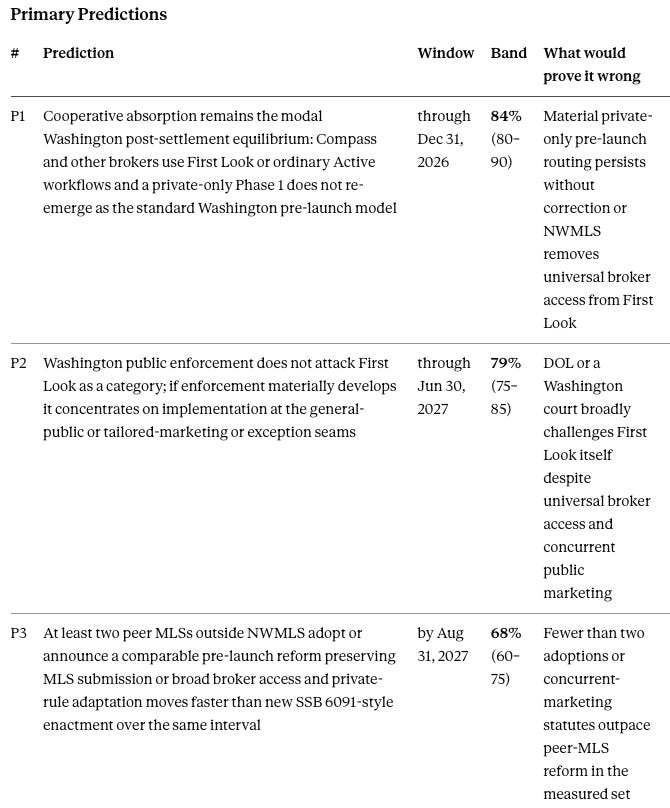
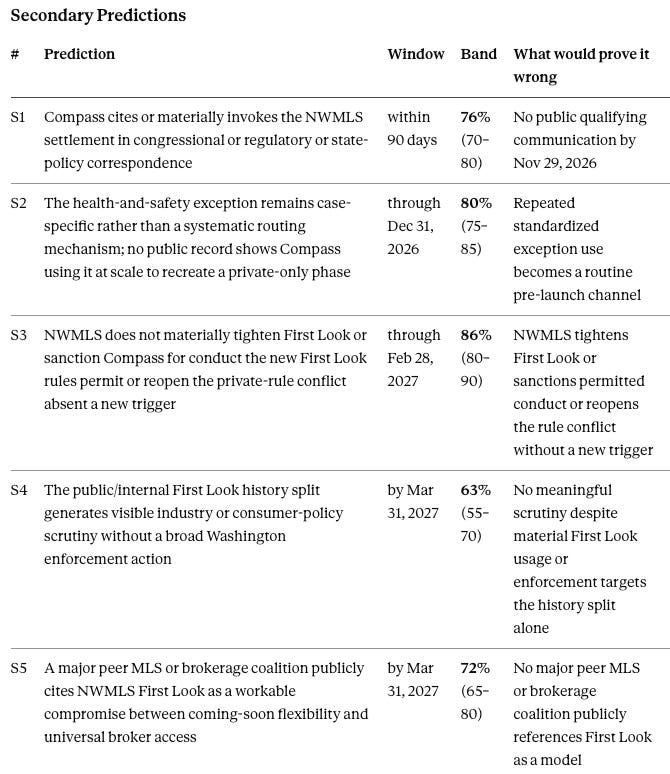
Challenger findings. Four mechanisms from the independent analysis enter the paper as findings rather than as competing bands. Enforcement latency may matter more than the simulation weights: a complaint-driven DOL and a peace-seeking NWMLS can leave the statutory floor behaviorally underdetermined while it remains legally binding. Agent-level listing configuration can adapt per listing while public enforcement moves through institutional loops measured in quarters. NWMLS has become a cross-pressured implementation partner whose referral posture is an unresolved branch rather than a settled disposition. The First Look-versus-statute diffusion race may become the national contest.
Monitoring variables. Compass’s IDX opt-out share relative to peer brokerages and the concentration of health-and-safety invocations by brokerage and First Look’s monthly share of new NWMLS listings are mechanisms to test rather than forecasts. Each becomes a forecast the day a public dataset makes it settleable. The IDX-out default for luxury inventory is a strategy the challenger analysis tests and not an installed Compass agent policy the record shows.
Not forecast because the relevant filing is not yet public: release scope and monetary consideration and dismissal prejudice and disposition of the counterclaims. Numeric First Look adoption and IDX opt-out and exception rates await live implementation data.
📊 Investors: P3 is the entry to price. If peer MLSs adopt before statutes follow the private-inventory premium partially rebuilds outside statute states.
⚖️ Counsel: P2 sets the enforcement locus. Exposure concentrates in IDX-out and tailored-marketing and exception configurations and not in First Look itself.
XI. Risk Mitigation
Each prediction in Section X carries an exposure and a set of unilateral mitigations. Exposure is stated in the unit the stakeholder controls and probability and severity are separate axes. Actions are analytic options and not recommendations to any party; MindCast does not provide legal or investment or fiduciary advice.
The layer sits here as a standalone section after the forecasts with the matrix first. Primary predictions receive full four-part treatment and secondary predictions receive one row each. A client skimming for commissioning signal reads the matrix before the argument.
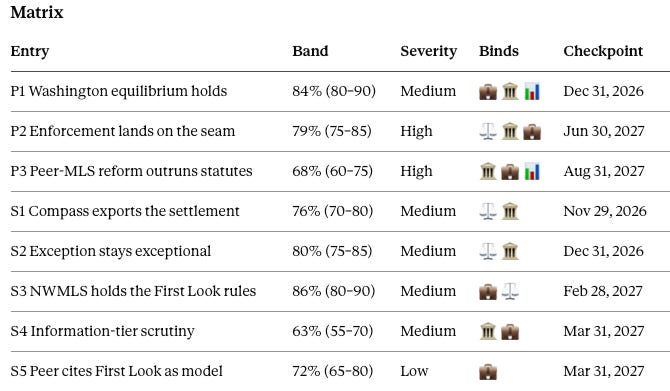
Severity is stated against the binding audience with the largest exposure. P2 and P3 carry high severity at moderate bands and warrant more mitigation spend than S3 at a higher band.
P1. Washington equilibrium holds as cooperative absorption (84%)
💼 Executives. Exposure: a brokerage that plans for a return to private-only marketing in Washington builds pipeline on a phase that does not come back. The unit is listing-side share over the two quarters after September 4.
Brokerage leadership: rebuild the Washington listing pitch around First Look with IDX-in as default before September 4.
Sales leadership: retire private-only marketing materials for Washington inventory by the same date.
Operations: train every Washington agent on First Look mechanics and the statutory bar before the first First Look listing.
Residual: First Look’s economics for the individual seller remain unproven and buyer distrust of suppressed history is a cost the brokerage cannot set.
🏛️ Policymakers. Exposure: other states read a stable Washington outcome as proof the mandate model works. The unit is the next session’s bill text.
Sponsor’s office: adopt the Washington statutory text with the health-or-safety exception and DOL-style enforcement design before pre-filing.
Committee staff: enter the Washington outcome and the First Look rule text as exhibits.
Residual: a stable Washington equilibrium does not transfer to a state without a cooperative willing to absorb.
📊 Investors. Exposure: Washington private-phase revenue in forward models. The unit is Washington’s contribution to the routing premium.
Analyst: model the Washington private phase at zero through 2026 and adjust only on public adoption data.
Residual: First Look adoption data may never be disclosed.
P2. Enforcement lands on the seam (79%)
⚖️ Counsel. Exposure: liability concentrates in IDX-out and tailored-marketing and exception configurations. The unit is listing count times the $5,000 per-violation ceiling plus license exposure on retroactive interpretation.
General counsel: issue a written firm definition of public marketing under RCW 18.85.361 before any IDX-out configuration launches on September 4.
Compliance: require a dated public-marketing evidence log per IDX-out listing from September 4.
General counsel: file a petition for DOL interpretive guidance by March 4, 2027. Filing is unilateral and invites scrutiny of the filer’s own configurations; the constrained version attaches the firm’s conservative definition.
Residual: the firm’s definition stays untested until DOL or a court speaks and closed transactions remain reviewable. Linkage: the evidence log also reduces S4 exposure and credit sits here.
🏛️ Policymakers. Exposure: the seam stays undefined while conduct accumulates in it. The unit is complaint cycles and definitional drift on “general public.”
DOL: publish interpretive guidance on IDX-out configurations by November 30, 2026.
DOL: stand up First Look-specific complaint intake by September 30, 2026.
Residual: guidance without an enforcement action leaves the seam untested in adjudication.
💼 Executives. Exposure: revenue booked under configurations later deemed non-compliant. The unit is IDX-out volume.
Chief operating officer: set one firm-wide configuration standard before September 4 with a review at March 4.
Finance: reserve for compliance remediation on IDX-out volume from September 4.
Residual: transactions closed before guidance remain reviewable under it.
P3. Peer-MLS reform outruns statutes (68%)
🏛️ Policymakers. Exposure: one legislative session. If two MLS templates land before a bill is heard the hearing opens against an installed norm and a “the market solved it” record.
Sponsor’s office: pre-file a mandate-model bill before the next session’s filing deadline.
Committee staff: enter the Washington hearing transcript and the First Look rule text as exhibits before the first hearing.
Licensing regulator: issue an interpretive statement on public marketing under existing license law before any MLS in the state adopts.
Residual: a template adopted before the statute’s effective date sets the practice norm the statute must displace.
💼 Executives. Exposure for an MLS board: member complaints and portal feed disputes if the board adopts under litigation fear without Washington’s guardrails. Exposure for a brokerage: listing-side pipeline share in the first quarter after a peer MLS adopts.
MLS board: decide adoption by recorded vote with mandatory submission and internal history retention and status labeling intact.
Brokerage leadership: set a unilateral coming-soon presentation policy with IDX-in as default before the first peer adoption. Do not coordinate IDX policy with competitors; coordination is antitrust exposure and the constrained version is a published unilateral policy.
Residual: a template adopted with every guardrail still creates a two-tier information structure in that market.
📊 Investors. Exposure: the private-inventory premium reprices toward whichever template wins. The unit is multiple support over four quarters.
Analyst: build a state-by-state map of template versus statute status before the November call.
Analyst: put a state-by-state First Look economics question to management on the Q3 call.
Residual: template adoption in a non-statute state does not settle whether the routing advantage survives portal display treatment.
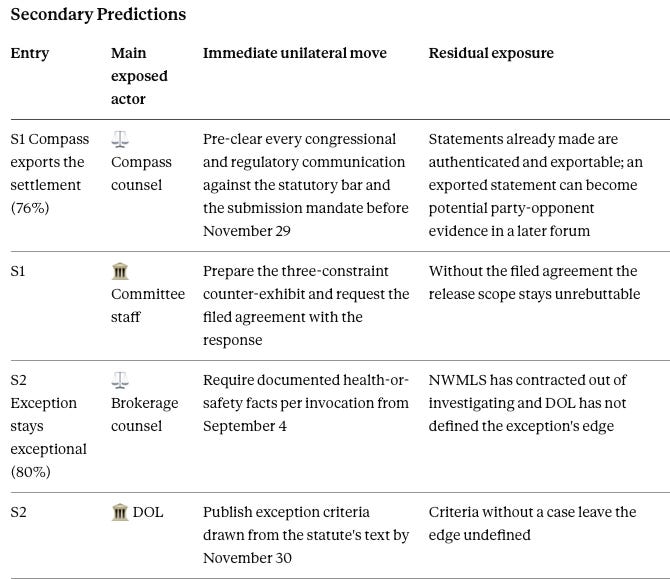
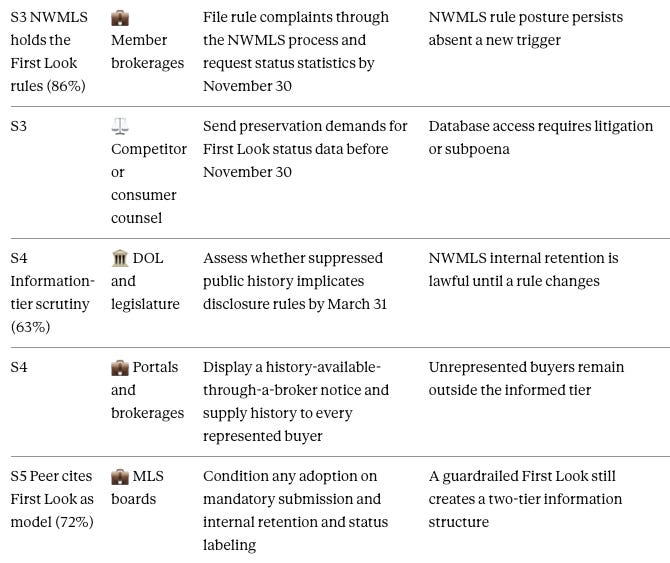
📊 Investors: the matrix is the commissioning signal. P2 and P3 carry high severity at moderate bands and deserve the attention the headline bands will not draw.
⚖️ Counsel: every entry that binds counsel shares one action. Define public marketing conservatively in writing before September 4 and the rest of the layer gets easier.
XII. What to Watch
Seven observable events settle the open questions. Each has a public source. The stipulated dismissal resolves prejudice status and counterclaim disposition and release scope. Two terms inside it carry Section V: the reach of the release and the definition of “investigate.” The September 4 launch begins generating adoption and opt-out data.
The October 15 and November 15 dates test the attribution and data terms. Any Compass citation of the settlement in congressional correspondence supplies the first import specimen. Any public deposition record decides whether the timing hypothesis can grade. One fork dominates. DOL’s posture on the IDX opt-out seam decides whether the statutory floor operates or stays nominal.
A passive DOL paired with a peace-seeking NWMLS could leave the floor untested for a long time. A statutory boundary without enforcement history remains legally binding and behaviorally underdetermined. A second development runs beyond Washington. NWMLS conceded coming-soon status without a precedent forcing it. Peer MLSs facing the same pressure now have a candidate template in First Look.
MLS rule changes are fast and inexpensive while statutes are slow. If First Look templates spread faster than SSB 6091-style statutes the rest of the country gets Washington’s sequence inverted: DOM suppression first and no statutory floor beneath it. Governor Hochul’s pending decision on New York’s consent-model bill is the first test. Compass won something real. The most restrictive major MLS in the country accepted coming-soon marketing and conceded attribution and imagery and data access.
NWMLS preserved something real. Every First Look listing enters the cooperative and reaches every member broker. Washington retained the layer above both. The coalition that carried the statute 141–1 retained every position it took because none of its members signed the agreement. The settlement resolves three questions in three directions and both victory statements are accurate and incomplete.
Compass changed the private governor. Washington had already changed the governing law. The binding constraint shifted from the MLS to the state nearly three months before the parties settled. Beginning September 4 the open question is whether cooperative absorption holds or First Look becomes the surface on which the definition of public marketing gets tested.
🏛️ Policymakers: the dominant fork is enforcement posture. A statute without a first enforcement action binds in law and stays undetermined in behavior.
💼 Executives: First Look is now a candidate template for peer MLSs confronting the same pressure. Whether it becomes the national template is what P3 grades.
Sources
MindCast AI
The litigation record and the forecasts it graded
The Law and Behavioral Economics of Compass vs. NWMLS (March 23, 2026). Published five months before the settlement, the paper forecast that NWMLS would either win at summary judgment or settle on terms that kept every listing flowing through the cooperative. The settlement took the second path, and the paper also explained why Compass’s debt load would make a negotiated exit more attractive than a trial.
Compass v. NWMLS — The Counterclaim That Closed Compass’s Antitrust Thesis (April 3, 2026). Analyzed NWMLS’s counterclaims and concluded the case would end either at trial or in a settlement that pre-empted one. Section V of this paper relies on the counterclaim’s structure to show that NWMLS sued under its own rules and private law, never under the state statute.
The Antitrust Litigation Trap Compass Built for Itself (April 6, 2026). A visual companion to the two papers above that raised MindCast’s odds of an NWMLS-favorable outcome after the counterclaims were filed. The settlement is the event those odds were waiting for.
The Compass-Reffkin Consumer Policy Center Quote-Card Specimen (April 16, 2026). Showed how Compass’s public statements during active litigation could be used against it as admissions in the NWMLS case. The settlement ends that case, so future statements will be used in other forums instead.
How the Zillow Complaint Reframes Compass v. NWMLS as a National Coordination Case (May 2026). Treated NWMLS’s refusal to change its rules for Compass as evidence for its argument, and said that if NWMLS ever did change them, that would count against the argument. NWMLS changed its rules in the settlement, so Section IX records the framework as partly contradicted.
The Cybernetics of Compass Holdings’ Narrative Control Architecture (March 21, 2026). Documented how Compass exited its Zillow lawsuit with no court ruling in its favor and announced the exit as a victory. Section VII shows the NWMLS exit following the same pattern with one difference: this time Compass obtained real rule changes.
The statute and the public-marketing seam
Compass Plan B, Structural Circumvention After Washington SSB 6091 (March 5, 2026). Predicted that after the statute passed Compass would try to preserve its private-listing economics through other channels, including litigation, and told readers to watch settlement terms for provisions that build distribution infrastructure. The settlement’s data-access and First Look terms are what that instruction anticipated.
Why Compass Needs Private Listings, The Inventory-Routing Premium — Compass, the Anywhere Merger, and the Multi-State Enforcement Window (June 6, 2026). Written for state attorneys general, it explained why Compass’s business depends on holding listings back from the open market and mapped the six states that have legislated against the practice. Section VIII draws on it for the argument that Washington’s record is now usable by enforcers elsewhere.
Compass’s Interpretation of “Public Marketing” May Draw Antitrust Scrutiny from State Attorneys General (June 13, 2026). On the day SSB 6091 took effect, Compass claimed its private listings were “fully compliant” because buyers could find them by asking Compass; the bill’s sponsor rejected that reading within a day. The paper recorded the exchange and argued that showing a stripped-down listing to the public is not the same as marketing to the public. Sections IV and VI use it because First Look’s IDX opt-out raises the same question and “fully realized” repeats the same claim in a new form.
The Compass Collapse: A Post Washington SSB 6091 Passage Reckoning (June 25, 2026). Listed the ways Compass might try to work around the statute, including using its health-and-safety exception more broadly than intended. The settlement bars NWMLS from investigating how sellers use that exception, which is why Section V treats the prediction as partly borne out but not yet proven.
The Washington legislative record
The Compass Astroturf Coefficient at the Washington State Senate (January 24, 2026). Cross-referenced the Senate hearing sign-in sheet against Compass’s agent rosters and found that 153 of 162 Compass-affiliated opponents had not identified the company. It also transcribed, with timestamps, the exchange in which Compass’s managing director declined to say how the business model works without the amendments Compass wanted. Section VIII’s account of the hearing comes from this paper.
Windermere and Compass, Two Philosophies of Real Estate (January 25, 2026). Contrasted Windermere, which testified for the transparency bill despite standing to gain from private listings, with Compass, which opposed it. Section VIII uses Windermere’s testimony as the strongest evidence that large brokerages do not need private inventory to compete.
The Recoil Loop, the Skillman Moment, and the Cris Nelson Moment
The Skillman Moment as Analytical Rosetta Stone of the MindCast MLS Equilibrium Series (May 13, 2026). Defined the Skillman Moment: a statement that works in a forum Compass controls but falls apart when someone else asks the questions. Section VI applies that definition to “fully realized.”
Compass’s Skillman Moment Reaches the C-Suite, Cris Nelson Moment Holds at the Regional Tier (May 2026). Showed the Skillman pattern reaching Compass’s CEO and defined the Cris Nelson Moment: the regional executive who attended both Washington hearings and never testified. Section VIII uses both constructs to read the hearing record and the settlement announcement as two halves of one pattern.
Compass Goes Quiet When It’s Questioned, Loud When It Isn’t — and the Loud Parts Keep Ending Up in Evidence(August 2026). Named the Recoil Loop — Compass goes quiet under hostile questioning and overstates in friendly forums, and the overstatements later surface as evidence. The paper also forecast, at 80 to 90 percent, that the NWMLS case would not settle this year. Section IX records that forecast as a miss.
Senator Warren Just Asked Compass the Questions Its “Seller Choice” Answer Can’t Survive (August 2026). Analyzed Senator Warren’s letter to Compass and the questions it asks. Section VI expects Compass to cite the settlement in its reply, which would bring “fully realized” into a forum where the surviving statutory limits travel with it.
Market structure and equilibrium
Two NWMLS Records, One Foster-Skillman Team (April 17, 2026). Used two actual King County listings to show a Compass team capturing both sides of a transaction by controlling when the listing became visible. It carried a forecast about how often that happens in the county’s luxury market, which Section IX notes will now be measured in a market where First Look has changed the rules.
Luxury Concentration as Litigation Context — Why Compass’s Post-Merger Market Position Reframes the NWMLS Dispute (May 6, 2026). Documented Compass’s share of Seattle’s most expensive listings after the Anywhere merger and tied several forecasts to the October 2026 trial date. With no trial, Section IX explains that those forecasts will be judged against the settlement’s effects instead.
The MindCast MLS Equilibrium Series (May 13, 2026). Laid out the three ways the residential listing market could settle: open cooperation, private capture, or fragmentation. Section X reads First Look as the cooperative model bending to absorb phased marketing rather than breaking.
Method
Dynamic Predictive Game Theory Meets the Era of AI — Operationalizing Fudenberg’s Research Agenda with Cognitive Digital Twins (July 8, 2026). Explains the standard MindCast uses to judge which actor comes through a changed game intact: not whether it kept the same strategy, but whether it kept its own architecture while adapting. Section X applies that standard and finds NWMLS met it and Compass met it operationally but not in its public communications.
Primary and press sources
Brooklee Han, “Compass settles NWMLS lawsuit on coming soon listings,” HousingWire, August 31, 2026.
Taylor Anderson, “Compass declares victory as it reaches settlement with NWMLS,” Inman, August 31, 2026.
“Northwest MLS Announces Expanded Listing Options,” RISMedia, August 31, 2026.
Compass, Inc., settlement announcement, August 31, 2026 (quotations from Robert Reffkin).
Northwest Multiple Listing Service, statement of Justin Haag, August 31, 2026.
Substitute Senate Bill 6091, Washington Laws of 2026 (signed March 16, 2026; effective June 11, 2026).
RCW 18.85.361; RCW 18.235.110.
Washington State Department of Licensing, “News and updates: Real estate brokers” (SSB 6091 implementation guidance).
Compass, Inc. v. Northwest Multiple Listing Service, No. 2:25-cv-00766-JNW (W.D. Wash.), amended scheduling order of June 22, 2026.
Northwest Multiple Listing Service, Answer and Counterclaims, Compass, Inc. v. Northwest Multiple Listing Service, No. 2:25-cv-00766-JNW (W.D. Wash. Apr. 2, 2026) (declaratory count on NWMLS Bylaws and Rules; separate counts under the Consumer Protection Act and for fraudulent misrepresentation and tortious interference).
Washington State Senate Housing Committee, hearing on SB 6091, January 23, 2026 (TVW recording; sign-in records via the Legislature’s committee sign-in system).
Senators Elizabeth Warren and Ron Wyden, letter to the Department of Justice and Federal Trade Commission, December 2025.
Representative Becca Balint and Senator Elizabeth Warren et al., letter to the Attorney General, February 2026.