

Compass, Inc. · Anywhere Real Estate Shareholders · Southern District of New York
Related works. The Compass Commission Consolidation Strategy and Real Estate Marketing Transparency (February 19, 2026) supplies the economic-materiality argument used here. The Compass–Anywhere Address Suppression Calculus(February 22, 2026) models the routing mechanism behind the listing-distribution warning the complaint quotes. A companion publication, Mandatory MLS Submission Is the Rule NAR, Washington, and the NWMLS Settlement All Left Standing, and Compass v. CRMLS Is the Suit That Tests It, covers the MLS litigation whose outcomes couple to the securities docket.
Thesis. A Securities Act class action over the Anywhere merger offering materials is already on file. The question the private-listing economics raise is whether Compass told Anywhere shareholders that a material part of the merger’s expected return depended on three things: capturing both sides of the commission through private listings and in-network buyer routing; a nationwide litigation campaign against multiple listing services to keep that channel open; and opposition to state transparency legislation that regulates conduct inside it.
Compass disclosed $225 million or more in operating-cost synergies and a 340,000-professional network, and the prospectus carries management’s financial projections and the fairness analyses of Morgan Stanley for Compass and Goldman Sachs for Anywhere. The offering materials described Private Exclusives as a product.
The offering materials did not identify the NWMLS lawsuit and did not say whether anticipated merger benefits depended on expanding private listings and retaining both commission sides within the combined brokerage. The decisive question is whether Compass’s contemporaneous acquisition assumptions incorporated expected incremental net earnings from in-network buyer representation that depended on private-listing access rather than on ordinary in-network transactions, and whether omitting the associated risks made the offering disclosures misleading.
The omission theory is conditional on two elements counsel must establish from Compass’s own documents: that the dependency existed in management’s merger model, and that omitting it was material to a reasonable Anywhere holder. The NWMLS suit, the generic risk factors, and Compass’s investor statements are evidence toward the first element and context for the second. The omission theory that looked cleanest, that the offering materials omitted NWMLS’s counterclaims, fails on chronology: NWMLS filed those counterclaims four months after the prospectus.
Why now. Lead-plaintiff motions are due December 8, 2026. Compass’s Q3 10-Q is due in November and its fiscal 2026 10-K in early 2027. The audiences are lead-plaintiff candidates and their counsel; Compass’s disclosure and audit functions; open-market purchasers; and state enforcers.
I. Executive Summary
The pending securities case pleads the framework an omission theory needs and stops short of the merger’s economics. Paragraph 8 of the complaint quotes a pre-merger warning that the merger could let “a dominant brokerage … dictate how listings are shared and with whom.” Paragraphs 10 to 12 and 53 to 55 plead that a known uncertainty omitted from risk factors is actionable when “may” and “could” language described a risk already materializing. The organizing question is whether the merger’s expected return depended on exactly the conduct that warning described, and whether Anywhere holders were told.
The dependency has three parts: Anywhere’s inventory and buyer network enlarge the pool of transactions that can stay inside one corporate group; private marketing gives in-network buyers the first look; in-network buyer representation keeps both commission sides inside the group. MLS submission rules and Zillow’s access standards and statutes of the Washington type each cut into that channel. Compass litigates against the first, sued the second and dismissed that case in March 2026, and publicly opposed the third. The portal-contact requirement Compass secured in the NWMLS agreement (detailed in the Compass v. CRMLS publication) shows the weight Compass places on buyer-contact pathways and proves nothing about the merger model.
The incorporated fiscal 2024 10-K describes Private Exclusives as a product; no offering material or incorporated filing names the NWMLS suit or MLS rule disputes or any dependency of merger benefits on private listings. Three questions follow in order: whether the merger model carried incremental net commission contribution from both-sides transactions; whether that contribution depended on private-listing access rather than on in-network transactions under full public exposure; and whether omitting the dependency made an identified offering statement materially misleading. The Seattle transaction evidence carries the materiality argument, and the $400 to $800 million figure from MindCast’s February work serves only as an illustrative gross-opportunity scenario.
Philippe Magloire filed Magloire v. Compass, Inc. et al., No. 1:26-cv-08885 in the Southern District of New York on October 7, 2026, before Judge Ronnie Abrams. The defendants are Compass and ten individuals: Robert Reffkin; Scott Wahlers; eight Compass directors; and Anywhere’s chief executive Ryan Schneider. The complaint asserts Securities Act §§11, 12(a)(2), and 15 for former Anywhere holders who received Compass stock in the January 9 merger and expressly disclaims fraud.
The pleaded theory is that the offering materials misrepresented regulatory-approval efforts and legal compliance while Compass used a politically connected intermediary to reach senior Justice Department officials. Shares closed at $9.19 at filing, down more than 28 percent from the $12.84 reference price on the January 9 exchange date. The declines inform §11(e) damages and the defendants’ negative-causation defense; loss causation in the Exchange Act sense belongs only to a separate §10(b) vehicle, which S-3 rates.
One version of the enhancement, the private-listing omission theory this paper would add to the pleaded case, is closed by chronology. Compass sued NWMLS on April 25, 2025. NWMLS filed its counterclaims in April 2026, and the merger prospectus became effective in December 2025. The counterclaims therefore cannot support an omission claim concerning pending proceedings in the original offering materials. The prospectus phrase “the absence of certain legal proceedings” summarizes Merger Agreement representations (Annex A §5.11) limited by a material-adverse-effect standard and qualified by a disclosure letter and incorporated filings.
What remains after that closure is a materiality question in three parts. First, whether management’s merger model carried in-network buyer representation as a source of return and whether that return depended on private listings rather than on in-network transactions a publicly marketed listing also produces, which only board materials and transaction-model assumptions can show. Second, whether the generic risk factors should have named the NWMLS suit and the demand-letter campaign and the listing-transparency scrutiny as known uncertainties that existed on December 2, 2025. Item 103 of Regulation S-K (legal proceedings) on the incorporated 10-Q is one component of that question.
Third, whether Annex A §5.8 (completeness of supplied information) and §5.9 (compliance and investigations) are the right comparison targets. Compass’s disclosed rationale is its answer to the first part: $225 million or more in operating-cost synergies, management projections set out in the prospectus under “Certain Unaudited Prospective Financial Information,” and advisor analyses that incorporate anticipated synergies. None of those public projections shows incremental net earnings from capturing both sides of a transaction through private listings. The theory must show that the internal model did, with Compass’s documents rather than inference.
MindCast AI applies Predictive Behavioral Economics + Dynamic Game Theory through MindCast AI Proprietary Cognitive Digital Twin Foresight Simulations (MP CDT FS). Behavioral Economics supplies the decision rules. Game Theory supplies the payoff structure. Predictive simulations emerge from the combination. Eight actors become Cognitive Digital Twins (CDTs): lead-plaintiff candidates and counsel; Compass’s disclosure function; the individual defendants; the auditor; the court; open-market purchasers and the firms soliciting them; the New York Attorney General; and the MLS litigants as record suppliers.
The paper proceeds in five steps. Section II sets out the complaint and the prospectus comparison; Section III states ten MindCast Foresight Simulation Predictions on docket and filing events. Section IV gives stakeholder moves and risk mitigation. Section V traces consequences, and the closing sections give signals and the conclusion.
Simulation Prediction Highlights
P-1 (70–82%) · The Q3 2026 10-Q names Magloire and names the CRMLS litigation · On filing, expected November 2026
P-2 (66–78%) · The appointed lead plaintiff is an institutional investor · After December 8, 2026
P-3 (60–72%) · Defendants’ first motion to dismiss is denied at least in part · Through December 31, 2027
S-2 (62–74%) · The fiscal 2026 10-K expands private-listing or MLS-litigation risk language without a figure · Expected by March 2027
S-3 (64–76%) · No Exchange Act action for open-market purchasers pleads private-listing statements · Through June 30, 2027
Stakeholder Readout
📊 Investors: P-1 and S-2 say the next two periodic filings will name the MLS litigation and private-listing regulation as risks. Compare Item 1A of the fiscal 2026 10-K against the fiscal 2025 text line by line.
⚖️ Counsel: the organizing question is the merger model and the decisive evidence is contemporaneous: board materials and transaction-model assumptions and integration plans and legal assessments of the MLS campaign. The counterclaim theory is closed by chronology. Item 103 on the incorporated 10-Q and Items 303 (known trends and uncertainties) and 105 (risk factors) are the pleading hooks, with Annex A §5.8 and §5.9 as the comparison targets. For the defense, S-1 at 82–91% says the disclosed-risk argument leads the motion.
💼 Executives: the accounting characterization of the fine program (Compass’s October 16 commitment to pay CRMLS fines for its agents in exchange for their claims) decides its disclosure. S-4 holds goodwill through the fiscal 2026 10-K at 70–81%.
🏛️ Policymakers: state action on private listings (S-5, 28–40%) is likelier than federal action (S-6, 14–24%) in the window. A preservation demand keyed to ¶70 of the California complaint costs nothing.
🗂️ MLS Leaders: the securities docket is one reason Compass does not resolve the MLS cases; a visible retreat from the strategy becomes a corrective event only if it reveals an earlier misstatement or omission.
The summary reduces to a document question before a legal question. Whether the merger model carried a private-listing dependency is answerable only from Compass’s board materials and transaction-model assumptions, and the December 8 lead-plaintiff gate fixes who gets to ask. Every callout above keys to that gate or to the two periodic filings that bracket it.
II. The Exposure and Its Simulation Fit
A Securities Act case already on file supplies the vehicle, and the merger’s economics supply the question the pleaded complaint does not ask. The record comes first: the filed case and the chronology around it; the complaint’s pleaded statements; the prospectus comparison; Compass’s investor-facing statements; and the valuation link. The analysis follows: the merger-economics question and what the private-listing record adds to it; the governing question; what Behavioral Economics and Dynamic Game Theory contribute; and how eight Cognitive Digital Twins carry the case into the simulation.
A. A Filed Case and Three Days of Pressure
Philippe Magloire filed the complaint on October 7, and Robbins Geller with Girard Sharp and The Hall Firm announced it on October 9. On October 14 the Law Offices of Frank R. Cruz announced an investigation on the same merger-review theory. On October 15 Senators Booker and Warren asked the Federal Trade Commission (FTC) to investigate “private listings that allow [dominant brokerages] to market the homes to a select group of buyers whose agents pay to play,” citing Compass’s own complaint against Zillow. On October 16 Compass filed against CRMLS.
The earlier chronology matters for damages rather than for loss causation. In Magloire the Securities Act claims carry no loss-causation element for plaintiffs to prove; the share declines inform the statutory damages measure under §11(e) and the defendants’ negative-causation analysis, and the recoverable amount depends on the statutory value measure and each holder’s acquisition and disposition. Loss causation in the Exchange Act sense belongs only to the hypothetical §10(b) vehicle.
The merger closed January 9, 2026. The Wall Street Journal reported the same day (as summarized by Real Estate News) that Antitrust Division head Gail Slater sought an extended review and that Compass appealed above her with the help of Mike Davis, the politically connected intermediary the complaint describes.
Eighteen members of Congress wrote to the Attorney General on February 19; shares fell 12.94 percent to $9.08 on February 23. The Real Deal reported a New York Attorney General investigation on June 3 (Real Estate News account) and Law360 confirmed it on June 4; shares fell about 11 percent and then 3.8 percent.
B. The Complaint
The complaint runs 98 paragraphs with three counts and a jury demand. The offering documents are the Form S-4 (filed November 14, 2025 and effective December 2) with the Form 424B3 of the same day, and the Merger Agreement as Annex A. The pleaded statements are the reasonable-best-efforts covenants (¶¶44–46 and 51); the sentence that no consideration would be paid to obtain approval (¶47); the projected second-half-2026 closing (¶48); and the compliance and absence-of-proceedings representations (¶50). Reffkin’s November 4, 2025 “pro-competitive deal” remark (¶37) is the one oral statement pleaded.
Paragraph 47 is the sharpest sentence in the pleading and belongs to the merger-review theory. The offering materials said no party would “pay any consideration to any third parties or give anything of value” to obtain approval. The private-listing theory has no comparable single sentence. The class is fixed by the share exchange at the January 9 closing and excludes open-market purchasers.
C. The Prospectus Comparison and Its Result
The comparison covers three documents: the December 2, 2025 424B3; the attached Merger Agreement; and the incorporated September 30, 2025 10-Q.
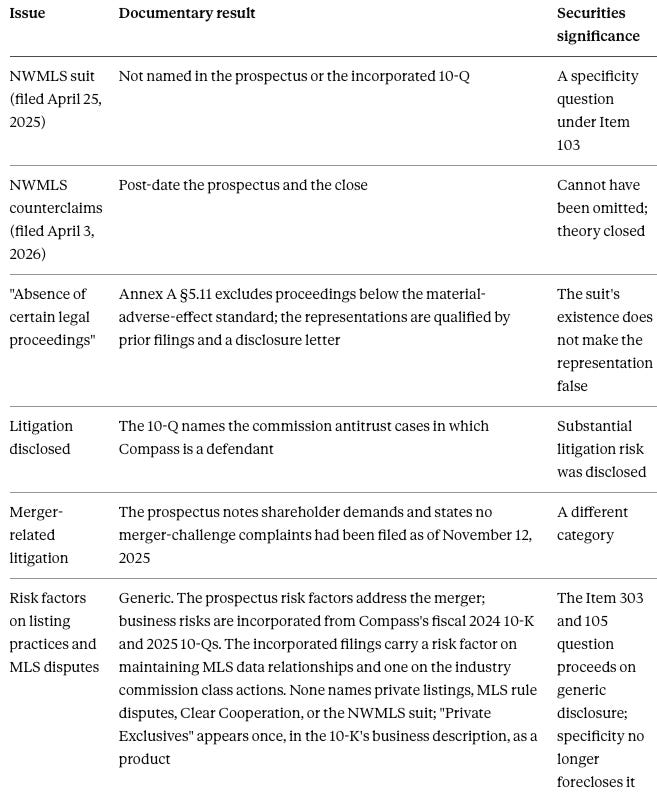
The comparison closes the counterclaim theory. The offering materials reviewed do not identify Compass’s NWMLS litigation, and their general MLS and antitrust disclosures leave the adequacy of disclosure contested rather than resolved. The securities question is whether the omitted information was material under the applicable requirements, with Annex A §5.8 and §5.9 replacing ¶50’s summary phrase as the comparison targets. The documentary basis for the comparison is the 424B3 and the merger agreement and the two incorporated filings (the September 30, 2025 10-Q and the fiscal 2024 10-K) read in context.
A full-text search of Compass’s EDGAR filings from January 2025 through October 16, 2026 serves as a cross-check. The search returns “Northwest” in no filing. “Private Exclusives” appears only in the two 10-Ks and the October 28, 2025 brand letter and the annual report. Keyword absence confirms what the documents show; it does not by itself establish what disclosure the law required.
D. The Investor-Facing Record
Compass quantified the strategy to investors. The February 18, 2025 earnings release reported that 35 percent of 22,138 listings were Private Exclusives or Coming Soons and that 55 percent of new listings started as Private Exclusives. Pre-marketed listings were “associated with a 2.9% higher average close price,” with the caveat that the finding “may vary depending on market conditions and seasonality.” The May 8, 2025 release reported 48.2 percent adoption and restated the 2.9 percent with a 1.9 to 3.9 percent confidence interval and the label “descriptive statistics.”
The April 4, 2025 proxy letter said the strategy “sits at the center of our strategy.” It said inventory “will create differentiated outcomes for you, our shareholders” and nothing about constraints. On the May 8, 2025 call Reffkin said: “That’s the downside, which means there is no downside.” The October 28, 2025 letter to Anywhere brands promised “no mandates or policies from Compass requiring real estate professionals to use Private Exclusives.” The 4.6 percent figure in Compass’s California complaint against CRMLS appears in no SEC filing reviewed.
Compass’s investor statements are materiality exhibits for the Securities Act case, because Compass told investors the strategy mattered. The same statements are candidate misstatements only for a separate Exchange Act vehicle with scienter and an open-market class, and MindCast’s analyses of the Microsoft and Apple and Oracle and Tesla shareholder suits (Appendix A) supply the comparators for that vehicle. The 2.9 percent claim is a weak misstatement candidate because of its stated method and caveats.
E. The Valuation Link
MindCast’s Three-Layer Acquisition Hierarchy separates base operating value and scale synergies from a third layer dependent on regulatory permission for private exclusives. The February paper sized the third layer at $400 to $800 million; this paper uses that range as an illustrative gross-opportunity scenario and not as a capitalized acquisition premium.
The Seattle transaction-level observations carry the argument. In the Seattle sample of 130 top-ten monthly transactions over 13 months, 16 kept both commission sides inside Compass (about 12 percent) and captured $4.2 million in buyer-side commission. The scenario scales that sample to the combined company’s listing volume on the assumptions that the capture rate and price effect hold across markets and that the channel stays open.
Three quantities inside that estimate stay separate. The first is the gross buyer-side commission opportunity, which the sample observes. The second is the incremental in-network representation attributable to private marketing rather than to ordinary affiliation, and the third is the net contribution after agent compensation and operating cost. The second and third remain unproven at merger scale, no bridge from the first to either exists in the public work, and each scaling assumption is a point defendants can contest.
The Q2 2026 10-Q reports goodwill of $2,558 million and a qualitative assessment at the new reporting units finding no impairment. The modeled scenario is an economic inference about strategy dependence and not evidence that goodwill is misstated; its use here is economic materiality.
F. The Merger-Economics Question and What the Record Adds
The omission theory worth pleading is about the merger model, not about one unnamed lawsuit. If Compass projected that the combined company would earn more by keeping both commission sides inside its network through private listings, then every constraint on private marketing was a known constraint on the projected return: the MLS rules that block it and the portal standards that exclude it and the state statutes that regulate it. The litigation campaign and the legislative opposition are the conduct a company with that dependency would undertake. Compass undertook both: the NWMLS suit and the June 2025 Zillow suit before the offering (the Zillow suit was voluntarily dismissed in March 2026), the CRMLS complaint after it, and public opposition to Washington’s bill in January 2026.
Two elements must be proven from Compass’s documents before the theory is more than a hypothesis. The first is the dependency itself, in two steps: whether the merger model carried incremental in-network buyer representation as a benefit, and whether that benefit depended on private-listing access rather than on in-network transactions that occur under full public exposure.
A Compass–Anywhere buyer and seller can both use affiliated agents on a listing with full MLS exposure, so both-sides retention and private-listing dependence are different quantities, and only the increment attributable to private marketing supports the theory. Gross commission retention must also translate to net contribution after agent compensation and operating cost and litigation cost. The second element is the disclosure gap: whether the offering materials gave Anywhere holders what they needed to evaluate that benefit and its constraints.
The public projections are Compass’s alternative explanation of the merger and must be tested rather than assumed away. The projections comprise the September 22, 2025 synergy disclosure of $225 million or more in operating-cost savings and the prospectus’s unaudited prospective financial information and the Morgan Stanley and Goldman Sachs analyses that incorporate anticipated synergies. The projections do not by themselves establish a private-listing dependency. The question for discovery is whether the model behind them assumed incremental net earnings from both-sides capture that the public version does not show.
The private-listing record then supplies three components, and each carries its own limit. First, Compass’s own NWMLS suit has been pending since April 25, 2025 and appears in no Compass filing through October 2026. On generic disclosure the suit is a specificity question under Item 103 and a known-uncertainty question under Item 303; it is evidence that the constraint was known, not proof that the dependency existed.
Second, MindCast’s February transaction research supplies economic context for materiality: it shows the scale of the gross opportunity that depended on listing-distribution permission, and it proves nothing about what the offering materials said. Compass’s own 2.9 percent figure plays the same context-only role. Compass stated it in the February and May 2025 earnings releases with its method and caveats and has restated it in no filing since.
A change in emphasis is not an omission; the figure matters because Compass valued the strategy to investors in a number while the offering materials said nothing about the conduct, and what required disclosure is decided by those materials and their incorporated filings. Third, the CRMLS and Zillow litigation and the Senate letter supply facts for an amended pleading only where the underlying uncertainty existed on December 2, 2025 for §11 and on the exchange date for §12(a)(2).
Compass’s opposition to Washington’s bill came on January 12, 2026, after the prospectus and after the close. The opposition cannot be an omission from the offering materials. The opposition is evidence of what the strategy requires, and it dates the legislative constraint as one Compass knew the shape of before the Washington bill, since the demand-letter campaign and the NWMLS suit already contested the same conduct.
The three components share one dependency. Counsel chooses whether to plead them, and the court decides materiality; the simulation rates the docket events around that choice and cannot make it. The Compass v. CRMLS publication shows the incentives the campaign serves; it does not prove those incentives entered management’s merger model, which only the contemporaneous documents can show.
G. Governing Question
Whether the merger-economics omission enters the pending case as a Securities Act claim, which disclosure event arrives first, and whether a separate Exchange Act vehicle forms. The horizon runs through the fiscal 2027 10-K. The merits of the merger-review theory and the MLS forum contest sit outside scope.
H. Why Behavioral Economics Adds Value
Plaintiff firms file on events, and a firm’s public solicitation of shareholders is a search for a corrective disclosure that moved the stock. Compass’s disclosure function faces the opposite pressure: each risk factor added can be pleaded as acknowledgment of exposure and each omitted invites the omission theory. An expanded risk factor often reflects ordinary developments or new information and is not an admission that an earlier statement was false. The equilibrium is incremental candor without figures, and the auditor updates on cumulative divergence rather than single events.
I. Why Dynamic Game Theory Adds Value
The lead-plaintiff contest is a race under the largest-financial-interest presumption. Compass’s disclosure choice is sequential with the plaintiff bar’s filing choice: a 10-K expansion is a candidate corrective disclosure only if it reveals an earlier misstatement or omission. The MLS litigation and the securities docket couple through one mechanism. A visible retreat from the strategy would be a candidate corrective event if it revealed an earlier misstatement or omission, so Compass’s stated refusal to negotiate a resolution of the MLS cases carries a disclosure dimension.
J. Simulation Architecture
Lead-plaintiff candidates and counsel. Objective: a §11 pleading that survives dismissal. Decision rights: amendment scope after December 8. Update trigger: risk-factor text; prospectus comparison.
Compass disclosure function. Objective: dismiss on disclosed-risk grounds; incremental candor. Decision rights: 10-Q and 10-K text; motion. Update trigger: Q3 filing; litigation events.
Individual defendants. Objective: due-diligence defense. Decision rights: none. Update trigger: oral-communication pleading.
Auditor. Objective: passed Q2 test holds. Decision rights: interim test. Update trigger: adverse ruling; sustained decline.
New York court. Objective: PSLRA process; Item 303 and 105 standard. Decision rights: lead-plaintiff order; motion to dismiss. Update trigger: motions.
Open-market purchasers and soliciting firms. Objective: an Exchange Act vehicle. Decision rights: filing. Update trigger: a private-listing loss event.
New York Attorney General. Objective: merger review. Decision rights: action timing. Update trigger: none.
MLS litigants (record suppliers). Objective: own cases. Decision rights: none. Update trigger: none.
The simulation tested four hypotheses, each with its falsifier. First, the enhancement enters by amendment; falsified by an operative complaint on the Davis theory alone, the pleaded merger-review theory built on the Mike Davis engagement. Second, the Davis theory proceeds alone; falsified by an amendment adding listing omissions.
Third, the case is dismissed in full; falsified by any claim surviving. Fourth, a second vehicle forms; falsified by no Exchange Act complaint on private-listing statements by June 30, 2027.
The record supports a conditional theory and nothing stronger. The counterclaim version is closed by chronology, the generic risk factors leave adequacy contested rather than resolved, and the dependency must be the increment private marketing adds over ordinary in-network transactions. The Simulation Predictions that follow rate the docket and filing events around counsel’s choice whether to plead it.
III. MindCast Simulation Predictions
Prediction date: October 16, 2026. Data cutoff: October 16, 2026. Ten Simulation Predictions follow: three Primary (P) and seven Secondary (S). The amendment question is a contingent watch condition and carries no band.
Synthesis. The dominant mechanism is that the Securities Act frame, which requires no scienter, makes adding the private-listing theory low-cost and makes its viability turn on what the offering materials said rather than on economic proof. The active regime is the pleaded merger-review theory with incremental candor in Compass’s periodic filings. The regime changes when a court reads the generic risk factors as adequate or inadequate disclosure, or when an adverse MLS ruling produces a loss event of its own.
Scenario structure. Base route: Q3 naming; institutional lead; amendment adds Item 303 and 105 omissions on the generic disclosure; motion to dismiss denied in part. Secondary route: the same path with counsel declining the enhancement, so the Davis theory proceeds alone. Tail route: dismissal in full on ¶47 and Item 303 grounds. The routes appear in the simulation’s order of likelihood; the issued bands below carry the probabilities.
A route is a pathway description and not a finding that an actionable omission exists. The base route depends on counsel’s amendment choice and on a materiality ruling the court alone makes; the Simulation Predictions below rate the docket and filing events around that choice.
Primary Simulation Predictions
P-1 · The Q3 10-Q names the MLS litigation (70–82%). Compass’s Form 10-Q for the quarter ended September 30, 2026 names Magloire and names CRMLS v. Compass or Compass v. CRMLS in its legal-proceedings item or contingencies note. Falsifier: either case unnamed. Verification source: EDGAR.
P-2 · Institutional lead plaintiff (66–78%). The lead plaintiff appointed after December 8, 2026 is an institutional investor, whether or not represented by the October 9 filing counsel. Falsifier: an individual appointed lead. Verification source: the docket. Exposure: fixes who decides the amendment.
P-3 · Motion to dismiss denied at least in part (60–72%). The court denies defendants’ first motion to dismiss the operative complaint in whole or in part by December 31, 2027. Falsifier: dismissal in full, or no ruling in the window. Verification source: the docket order. Exposure: Compass bears discovery on the surviving theory.
Secondary Simulation Predictions
S-1 · Disclosed-risk defense leads (82–91%). Defendants’ first motion to dismiss argues that the pleaded omissions were disclosed in the S-4’s risk factors or were not required under Item 303. Falsifier: a motion on other grounds only, or an answer. Verification source: the docket.
S-2 · The fiscal 2026 10-K expands disclosure without figures (62–74%). Compass’s fiscal 2026 10-K (expected by March 2027) adds or materially expands Item 1A language on regulatory or litigation risk to private-listing or off-MLS marketing against the fiscal 2025 text, and states no dollar figure. Falsifier: text unchanged in substance on a published side-by-side, or a quantified disclosure. Verification source: EDGAR.
S-3 · No Exchange Act vehicle on private listings (64–76%). No complaint asserting Exchange Act §10(b) claims for open-market Compass purchasers pleads private-listing or MLS-litigation statements as misstatements by June 30, 2027. Falsifier: such a complaint docketed. Verification source: the federal dockets and the Stanford Securities Class Action Clearinghouse.
S-4 · Goodwill holds (70–81%). Compass discloses no goodwill impairment and no interim test tied to a triggering event for the Anywhere reporting units through the fiscal 2026 10-K. Falsifier: an impairment or a disclosed interim test. Verification source: EDGAR goodwill notes.
S-5 · State action other than New York (28–40%). A state attorney general other than New York’s issues a demand or subpoena or public statement on Compass’s private-listing practices by June 30, 2027. Falsifier: none issued. Verification source: state press offices.
S-6 · Federal trade action (14–24%). The FTC opens a formal inquiry or Section 6(b) study or public workshop on private listings by June 30, 2027. Falsifier: none opened. Verification source: FTC press and the Federal Register.
S-7 · The Cruz investigation folds (72–84%). The Law Offices of Frank R. Cruz investigation results in no separately docketed complaint by March 31, 2027; any client claim proceeds within Magloire or a consolidated action. Falsifier: a separate complaint docketed and not consolidated. Verification source: the dockets.
Contingent Watch Condition
Whether the amended complaint pleads the ¶8 warning, the Item 103 question on the NWMLS suit, or the MLS demand letters as Item 303 and 105 omissions. The generic risk factors leave adequacy contested rather than resolved, since general disclosure can satisfy the applicable requirements and the question is whether the statements read in context were materially misleading; the condition carries no band because it turns on counsel’s choice and on materiality, which the simulation does not rate. Whether any such enhancement survives the motion to dismiss follows from it.
Limits and Break Conditions
The risk-factor result rests on full-text search of the filings and on a read of the fiscal 2024 10-K’s business and risk-factor items; a risk factor phrased without the searched terms would narrow the finding. Two of the three pleaded loss events rest on a single litigation summary and none is benchmark-adjusted. The economic-materiality argument rests on a sampled dataset and is a hypothesis rather than a merger valuation.
Ten entries and one unrated watch condition carry the paper’s claim. The disclosure entries (P-1 · S-2 · S-4) resolve on Compass’s own filings; the docket entries (P-2 · P-3 · S-1 · S-7) resolve on the court’s calendar; the enforcement entries (S-3 · S-5 · S-6) rate whether a second vehicle or a public authority enters. The watch condition names the choice none of the ten can make for counsel.
Working With MindCast
The published Simulation Predictions answer which docket and filing events are likely. The bands cannot answer which statements and which corrective event carry a specific portfolio’s loss, or whether a specific omission is material to a specific class.
MindCast builds Cognitive Digital Twins from the stakeholder’s own position and reruns the environment against the offering-material comparison and the docket calendar. The same build supports a state office deciding whether its preservation demand precedes or follows the 10-K.
Commissioned scope adds complete probability distributions on amendment and dismissal and the full scenario tree including the watch condition. Commissioned scope also adds a source-linked evidence matrix keyed to Annex A §§5.8–5.11 and to Items 103 and 303 and 105. The bounded next step is a diagnostic session on exposure under P-1 and P-3, scoped to the November 10-Q and the December 8 gate.
IV. Stakeholder Strategy and Risk Mitigation
Each stakeholder faces a decision bracketed by the November 10-Q and the December 8 lead-plaintiff deadline. The strategic posture names that decision for each audience. The four-part risk entries state what each audience loses if a Simulation Prediction resolves true and they did nothing, with owned actions and the residual that remains, and the time gates order those actions by horizon.
Strategic Posture by Stakeholder
📊 Investors. The Q3 10-Q (P-1) and the fiscal 2026 10-K (S-2) are the documents to read. The gap between them is the decision window.
⚖️ Counsel. For plaintiffs the surviving questions are specificity and materiality. The comparison targets are Annex A §5.8 and §5.9 and Item 103. For the defense, S-1 says the disclosed-risk argument leads, and a memorandum squaring the August 31 Washington statement with the October 16 California pleading is the document most worth drafting now.
💼 Executives. The fine program’s characterization decides its disclosure. Goodwill is not the near-term event (S-4).
🏛️ Policymakers. State action (S-5) is likelier than federal action (S-6). The preservation demand depends on neither.
🗂️ MLS Leaders. Compass’s stated refusal to negotiate a resolution of the MLS cases is a disclosure constraint as well as a litigation posture.
Risk Mitigation by Simulation Prediction
Placement: a four-part entry under each Simulation Prediction, with the time gates beneath. The trade-off is length over a scannable grid.
P-1 (70–82%) · 💼 Disclosure team
Exposure if true and unmitigated: Naming the CRMLS cases now while the NWMLS suit went unnamed at year-end: one prior-period omission question added to the pleading.
Severity · Probability: Medium · High.
Mitigating actions (owner · deadline): Name Magloire and both CRMLS actions in legal proceedings (securities counsel · November filing); prepare the year-end explanation (same · same).
Residual exposure: The explanation itself becomes an exhibit.
P-2 (66–78%) · 📊 Institutional investors
Exposure if true and unmitigated: Forgoing the lead: no control over amendment scope for a class holding over 160 million shares.
Severity · Probability: Medium · High.
Mitigating actions (owner · deadline): Compute exchange-class loss (portfolio counsel · now); move for lead (same · December 8).
Residual exposure: A larger loss elsewhere.
P-3 (60–72%) · ⚖️ Both sides
Exposure if true and unmitigated: Plaintiffs: partial survival on the Davis theory alone leaves the merger-economics omission unpleaded and the discovery it needs unavailable. Defense: survival opens discovery into the Davis engagement, the offering process, and any merger-model assumptions pleaded.
Severity · Probability: High · Moderate.
Mitigating actions (owner · deadline): Plaintiffs: plead the merger-economics omission before the motion where Compass’s own documents already support a dependency allegation, and otherwise hold it for discovery (lead counsel · amendment); map Annex A §5.8 and §5.9 and §5.11 against ¶¶44–51 (same · before the motion). Defense: reconcile the August 31 and October 16 statements in writing (securities counsel · before the next call).
Residual exposure: Survival limited to the Davis theory.
S-1 (82–91%) · ⚖️ Plaintiff counsel
Exposure if true and unmitigated: Meeting the disclosed-risk motion without the dated filings in hand: one lost briefing cycle on whether generic MLS and antitrust language covers private-listing uncertainty.
Severity · Probability: Medium · High.
Mitigating actions (owner · deadline): Brief the generic-versus-specific distinction with the fiscal 2024 10-K text in hand (lead counsel · before amendment); drop the counterclaim theory (same · now).
Residual exposure: Court reads the MLS-relationship and antitrust factors as adequate disclosure.
S-2 (62–74%) · 💼 Disclosure team; 📊 investors
Exposure if true and unmitigated: A quantified expansion becomes a corrective event for any Exchange Act vehicle only if it reveals an earlier misstatement, and it informs the damages and negative-causation analysis in Magloire; an unchanged text supplies an omission-by-silence argument for the prior period.
Severity · Probability: Medium · Moderate-high.
Mitigating actions (owner · deadline): Assess the material risks from the MLS litigation and private-listing regulation and evaluate whether any quantitative disclosure is required (securities counsel · before the 10-K); confirm the final Item 1A language reflects management’s information (disclosure committee · 10-K); investors compare against fiscal 2025 text (analyst · on filing).
Residual exposure: Expansion pleaded as admission of prior materiality.
S-3 (64–76%) · ⚖️ Soliciting firms
Exposure if true and unmitigated: Filing without a measured loss event: dismissal on loss causation within one motion cycle.
Severity · Probability: Medium · Moderate.
Mitigating actions (owner · deadline): Benchmark-adjust returns around every private-listing event before filing (firm · before any complaint).
Residual exposure: An event surfaces in MLS discovery.
S-4 (70–81%) · 💼 Auditor; Compass
Exposure if true and unmitigated: An interim test disclosed on an unidentified trigger: a candidate corrective event in the next 10-Q, actionable only if it reveals an earlier misstatement.
Severity · Probability: High · Low-moderate.
Mitigating actions (owner · deadline): Document the triggering-event analysis each quarter (controller · each 10-Q).
Residual exposure: An adverse MLS ruling is itself a trigger.
S-5 (28–40%) · 🏛️ State enforcers
Exposure if true and unmitigated: Evidence aged out before any demand: showing and offer records overwritten.
Severity · Probability: Medium · Moderate.
Mitigating actions (owner · deadline): Preservation demand keyed to ¶70 of the California complaint (office · now).
Residual exposure: Records dispersed across two federal dockets.
S-6 (14–24%) · 🏛️ Policymakers; state offices
Exposure if true and unmitigated: Acting as though a federal inquiry will supply the record: showing and offer evidence ages out while the FTC decides.
Severity · Probability: Low · Low.
Mitigating actions (owner · deadline): Define a preservation protocol and information requests that stand without any FTC action (state office · now); route the Senate letter’s questions to state authority (same · next session).
Residual exposure: A Section 6(b) study arrives and changes the disclosure calculus.
S-7 (72–84%) · ⚖️ Cruz firm clients
Exposure if true and unmitigated: A separate filing fragments the class and delays lead appointment one cycle.
Severity · Probability: Low · Moderate.
Mitigating actions (owner · deadline): Evaluate joining Magloire or a consolidated action (client counsel · before December 8).
Residual exposure: Consolidation subordinates the client’s theory.
Watch condition · ⚖️ Plaintiff counsel
Exposure if true and unmitigated: Enhancement pleaded on a closed theory or on an uncertainty that post-dates the offering: a motion-to-dismiss target of plaintiffs’ own making.
Severity · Probability: High · Unassigned.
Mitigating actions (owner · deadline): Date every candidate uncertainty against December 2, 2025 and the exchange date (lead counsel · before amendment); plead Item 103 and ¶8 omissions only where a dated uncertainty and a supportable dependency allegation both exist (same · same).
Residual exposure: Materiality remains the court’s judgment after the pleading.
Risk Mitigation by Time Gate
Now to 30 days. Risk to contain: Q3 10-Q omits the MLS actions. Mitigation: Compare legal-proceedings text against the dockets. Escalation trigger: P-1 fails.
30 to 90 days. Risk to contain: Lead-plaintiff order fixes counsel before the amendment scope is set. Mitigation: Date the candidate uncertainties and fix the amendment scope before December 8. Escalation trigger: P-2 resolves.
3 to 12 months. Risk to contain: Motion to dismiss decided on the Davis theory alone. Mitigation: Brief §5.8 and §5.9 if the enhancement is pleaded. Escalation trigger: P-3 ruling.
Beyond 12 months. Risk to contain: Goodwill divergence reaches the auditor’s threshold. Mitigation: Quarterly triggering-event documentation. Escalation trigger: S-4 fails.
Two actions are common to every audience and cost little before December 8: dating every candidate uncertainty against December 2, 2025 and the exchange date, and reading the Q3 10-Q’s legal-proceedings item against the two MLS dockets. The residual exposure that no action removes is materiality, which stays the court’s judgment after any pleading.
V. Implications
If P-3 holds and the case survives on the Davis theory alone, the Washington documents and the CRMLS exhibits stay in the MLS cases and never enter the securities docket. The enhancement’s fate is a document question before it is a legal question, and the simulation cannot answer the document question from outside Compass’s files.
Compass’s incremental-candor equilibrium (S-2) is stable while no disclosure names a figure. A goodwill impairment or a disclosed interim test would break it. Risk-factor expansions and goodwill events and adverse MLS rulings become corrective disclosures on the same condition as a strategy retreat, and none establishes Exchange Act loss causation or defeats a Securities Act negative-causation defense on its own.
The plaintiff bar’s waiting equilibrium (S-3) is stable while no private-listing event moves the stock. An agreement or MLS rule concession in the Compass v. CRMLS litigation becomes a corrective event here only if it reveals that an offering-period statement was false or an omitted dependency was real; a change of strategy on its own discloses nothing about the past.
The exposure falls unevenly. Anywhere holders who took Compass stock bear the pleaded theory’s risk and would inherit any enhancement under §11(e). Open-market purchasers sit outside the exchange class, and S-3 expects no separate Exchange Act action on private-listing statements in the window; nothing forecloses one later. Compass bears defense cost in a third forum and a disclosure constraint on its MLS strategy.
If P-3 fails and the case is dismissed in full, no vehicle remains and the paper’s contribution reduces to a disclosure analysis. If S-3 fails, the record contained a loss event the simulation did not detect, and the miss is assessed against benchmark-adjusted returns. If a court reads the generic MLS and antitrust factors as adequate disclosure, the enhancement fails on S-1’s ground and the watch condition closes.
What to Watch
The dominant fork is whether lead counsel pleads the listing-distribution omissions against the generic disclosure before the motion to dismiss, and the amended complaint decides it before any court does.
Q3 2026 10-Q legal proceedings (P-1) · EDGAR · On filing
Lead-plaintiff motions and order (P-2) · Docket · On entry
Motion to dismiss and order (P-3, S-1) · Docket · On filing and entry
Fiscal 2026 10-K Item 1A (S-2) · EDGAR · On filing
New securities complaint naming Compass (S-3, S-7) · Dockets; Stanford clearinghouse · Weekly
Goodwill note in each periodic filing (S-4) · EDGAR · Quarterly
State attorney general demands or statements (S-5) · State press offices · Monthly
Federal trade action on private listings (S-6) · FTC press; Federal Register · Monthly
Amended complaint’s omission allegations (Watch condition) · Docket · On filing
Conclusion
The pleaded Securities Act case against Compass probably survives its motion to dismiss in part, under an institutional lead plaintiff appointed after December 8. Compass’s next two periodic filings, the Q3 10-Q and the fiscal 2026 10-K, probably name the MLS litigation and expand the private-listing risk language without a dollar figure. No separate Exchange Act class action over Compass’s private-listing statements is likely to be filed by mid-2027.
The private-listing omission theory this paper adds stays conditional on two proofs from Compass’s own documents: that the merger model depended on double-sided commissions through private listings, and that omitting that dependency was material to Anywhere shareholders. The dependency that counts is the increment private marketing adds over ordinary in-network transactions, not both-sides retention as such. The counterclaim version of the theory is closed by chronology, the generic risk factors leave adequacy contested rather than resolved, and the pleading hooks are Item 103 on the incorporated 10-Q and Items 303 and 105 for uncertainties that existed at the offering. The next threshold is December 8, 2026, when lead-plaintiff motions are due and the amendment decision passes to whoever wins.
Appendix A: Selected MindCast Works
The Compass Commission Consolidation Strategy and Real Estate Marketing Transparency (February 19, 2026): the Three-Layer Acquisition Hierarchy and the economic-materiality argument.
The Compass–Anywhere Address Suppression Calculus (February 22, 2026): the routing mechanism behind the listing-distribution warning.
Compass Runs the Same MLS Playbook Against CRMLS That It Ran Against NWMLS (October 6, 2026): the MLS litigation record.
Why Compass Needs Private Listings, The Inventory-Routing Premium — Compass, the Anywhere Merger, and the Multi-State Enforcement Window (June 6, 2026): the intermediate analysis connecting private-listing routing to anticipated merger benefits and state enforcement exposure; its appendix carries the $400 to $800 million estimate, which this paper uses only as a gross-opportunity scenario.
From Inventory Control to Attention Control — The Compass Commission-Consolidation Model After First Look(September 4, 2026): whether buyer-contact routing and both-sided representation retain value once NWMLS requires cooperative visibility, which separates inventory withholding from capturing buyers who arrive without independent representation.
Compass’s Cross-Forum Contradictions (February 28, 2026): the cross-forum framework for reading statements to Anywhere shareholders against Compass’s litigation and marketing positions, where a contradiction is evidence and not proof of securities liability.
Mandatory MLS Submission Is the Rule NAR, Washington, and the NWMLS Settlement All Left Standing, and Compass v. CRMLS Is the Suit That Tests It (October 16, 2026; companion publication): the Compass v. CRMLS forum contest whose outcomes couple to this analysis.
MindCast shareholder-suit analyses, cited as comparators for the Exchange Act vehicle S-3 rates and for the disclosure doctrine the Securities Act case turns on:
AI Accountability — When AI Promises Meet the Courts (June 19, 2026): the series index for MindCast’s shareholder-suit work, which traces each case from public promise to the system behind it to the enforcer who tests one against the other.
The Microsoft Shareholder Suit and the Arrival of AI’s Third Phase — Why the Next Competitive Edge Is Forecasting the Institution, Not Building the Model (June 17, 2026): City of St. Clair Shores Police and Fire Retirement System v. Microsoft, No. 2:26-cv-02071 (W.D. Wash., filed June 12, 2026), an Exchange Act §§10(b) and 20(a) class action; the paper’s account of governance debt accumulating behind quarterly disclosure is the closest comparator to the incremental-candor equilibrium in Section II.H.
Brief of MindCast AI as Amicus Curiae In Support of Structural Foresight Integrity Under Rule 10b-5 in Tucker v. Apple (July 29, 2025): Tucker v. Apple, No. 5:25-cv-05197 (N.D. Cal.), a Rule 10b-5 class action over Apple’s AI timeline statements; the brief’s narrative-arbitrage frame (confident public statements beside undisclosed internal concerns) is the scienter-stage analogue to the declared-versus-revealed gap in the Compass v. CRMLS publication.
Apple’s AI Illusion Narrative Control and the Law’s Search for Structural Truth (July 28, 2025): Apple’s dual exposure in Tucker (securities) and Landsheft v. Apple (California false advertising), the cross-forum pattern that Compass’s investor, litigation, and marketing statements repeat.
Oracle, OpenAI, and the Capacity Economy — Inside the AI Infrastructure-Financing Lawsuit (June 19, 2026): the Oracle securities class action on AI infrastructure financing disclosure (Barrows v. Oracle, D. Del., filed February 5, 2026; Exchange Act §§10(b) and 20(a)), a comparator for how capital-allocation disclosure becomes a pleaded misstatement.
Tesla’s Self-Driving Revolt: Full Self-Driving, Hardware 3, and the Warranty Substrate Apple’s AI Illusion Already Mapped (April 20, 2026): the Morand v. Tesla securities class action inside a 21-track litigation cascade, the comparator for how inconsistent messages kept in separate forums collapse together.
Bank of America $1.2 Billion Money Laundering Penalty and the Compliance System That Knew Too Much(October 14, 2026): control representations under Omnicare (decided under Securities Act §11), Tongue v. Sanofi, and Singh v. Cigna’s puffery line; the doctrine that decides whether generic risk language is adequate disclosure, which is the ground of S-1.
Compass’s Technology Trap — How IPO Narrative Became Its Antitrust Liability (January 11, 2026): Compass’s investor-facing technology narrative at the IPO, the earlier instance of investor statements becoming litigation evidence that Section II.D extends to the private-listing statements.
Appendix B: External Sources
Primary documents:
Magloire v. Compass, Inc. et al., No. 1:26-cv-08885, Dkt. 1 (S.D.N.Y., filed Oct. 7, 2026); docket
Compass Form 425, merger announcement presentation (Sept. 22, 2025)
Compass Form 424B3 (Dec. 2, 2025), including “Opinion of Morgan Stanley, Compass’ Financial Advisor,” “Opinion of Goldman Sachs, Anywhere’s Financial Advisor,” and “Certain Unaudited Prospective Financial Information”
Compass Form 10-K, fiscal 2024 (Feb. 25, 2025), incorporated by reference; Compass Form 10-Q, Q3 2025 (Nov. 5, 2025), incorporated by reference
Compass earnings releases: Feb. 18, 2025; May 8, 2025; Aug. 4, 2026
Compass DEF 14A (Apr. 4, 2025)
EDGAR full-text search, Compass, Inc. (CIK 1563190), January 1, 2025 to October 16, 2026
Letter from eighteen members of Congress to the Attorney General (Feb. 19, 2026)
Letter from Senators Booker and Warren to FTC Chair Ferguson (Oct. 15, 2026)
Robbins Geller release (Oct. 9, 2026); Law Offices of Frank R. Cruz release (Oct. 14, 2026)
Press:
HousingWire, “Compass sued by former Anywhere shareholders over merger disclosures” (Oct. 12, 2026)
NowBAM, “Senators Warren and Booker Call for FTC Investigation Into 3 Real Estate Practices” (Oct. 15, 2026)
Real Estate News, “How did the Compass-Anywhere deal get cleared so quickly” (Jan. 9, 2026)
HousingWire, Washington private listing bill and Compass’s stated opposition (Jan. 13, 2026)
Inman, “Robert Reffkin: My commitments to Anywhere’s brands” (Oct. 28, 2025)
RISMedia, Q1 2025 call coverage (May 9, 2025)
Inman, Compass–NWMLS counterclaims (Apr. 3, 2026)
Real Estate News, New York Attorney General investigation (June 3, 2026)
Allegations summarized from court filings are pleaded claims, not findings. Valuation figures from sampled data are MindCast estimates, not audited results. MindCast AI is not a law firm or an investment adviser.