

Related MindCast publications: AI Data Center Developers Going Public in America Must Disclose Foreign Ownership and Control | The Data Center Authorization Price | AI Data Center Credit Risk | The 50-State Authorization Price Atlas
See MindCast Data Center Regulatory Economics and Innovation Live-Fire Mission
Executive Summary
Four sponsor-backed colocation and wholesale platforms moved toward public price discovery inside six weeks, and cohort membership stays fixed at those four for every prediction that follows. Vantage Data Centers, Switch, CyrusOne, and DayOne each took a step toward a listing or a sale between early July and mid-August 2026.
Financial coverage has read the wave as AI demand lifting valuations. A closer reading of the calendar points somewhere else.
Vantage reduced the immediate regulatory uncertainty surrounding its largest Texas campus on August 12 and tested the transaction market on August 13. Wisconsin regulators had already rewritten the tariff governing Vantage’s second-largest campus on April 24, attaching a fifteen-year commitment and a collateral requirement keyed to the credit rating of the customer taking service under the tariff.
Sponsors are testing whether public markets will capitalize development pipelines at the moment their largest host jurisdictions began attaching explicit prices, terms, and delays to authorization. The registration statement required to complete a listing is the document most likely to force material authorization terms into public view.
Three consequences follow. Megawatts stop behaving as fungible assets. A public listing operates as a fourth authorization proceeding alongside government, utility, and customer. And the first registration statement places authorization exposure in a liability-backed public document that legislators and investors read at the same time.
What MindCast Forecasts
Section VIII registers forty-three dated calls, each with a falsifier and a named settlement source. Ten test the central mechanism, and the eight headline calls below summarize the argument.
Capacity disclosure arrives first — 80–90%. The first filing quantifies three or more capacity states and names customer concentration.
A state or regulatory regime appears by name — 72–82%. Authorization exposure enters securities disclosure jurisdiction by jurisdiction.
A completed Vantage IPO is the minority outcome — 33–43%. Minority investment or recapitalization runs 24–34%, no major transaction completed 19–29%, control sale 5–13%.
The first cohort listing prices below its anchor — 60–70%. Public markets discount pipelines that private rounds capitalized whole.
Texas codifies its standards by end-2027 — 75–85%. Three more states adopt financial-assurance or cost-protection rules by end-2028 — 70–80%.
A state record cites a cohort filing within twelve months — 55–65%. Securities disclosure reaches legislative drafting.
Equity research names legislative or siting action as a valuation factor — 65–75%. Political risk starts moving price targets.
A listed developer’s shares move on an adverse authorization event — 50–60%. Three points of underperformance against a named benchmark over five trading days.
Every forecast carries a deadline, a falsifier, and a public settlement source, so a reader can grade the analysis against the record rather than accept it on trust.
The sections that follow supply the mechanism behind the numbers: what two Texas actions and one leak did inside nine days, how nineteen states treat the same portfolio under four different authorization regimes, why capital markets now function as a fourth authorizer, and what a single registration statement will expose that three legislative sessions have not.
I. Two Texas Actions and an IPO Leak, Nine Days Apart
Three public actions occurred inside nine days, each reported separately and none connected to the others in the coverage that followed. Placing all three on one timeline changes what the initial public offering means.
August 3. Governor Greg Abbott directed the Public Utility Commission of Texas and ERCOT to audit every data center project in the interconnection queue before any project advances. ERCOT held roughly 474 gigawatts of connection requests, about ninety percent of them data centers, and more than five times the state’s record peak demand. Pending data center interconnection requests hold until each project completes the audit.
August 12. Abbott announced that Core Scientific, SB Energy, and Vantage Data Centers had committed to comply with the state standards. Vantage holds Frontier in Shackelford County — 1,200 acres, 1.4 gigawatts, ten buildings, and more than $25 billion of announced investment. Frontier is the largest campus in the company’s global portfolio.
August 13. Reuters reported that Vantage is exploring an initial public offering that could raise roughly $10 billion at a valuation near $100 billion, with a sale or minority stake sale also under consideration. Deliberations remain preliminary and no formal process has launched.
Vantage moved its largest Texas campus from open regulatory exposure to declared compliance on August 12, with the audit still ahead, and Reuters reported transaction deliberations the following day.
Sellers reduce regulatory uncertainty before testing a market. The incentive operates on any seller holding a gigawatt behind a paused queue.
Wisconsin supplies the second half of the calendar. The Public Service Commission of Wisconsin approved the We Energies Very Large Customer tariff on April 24 after rewriting it — extending the minimum initial term to fifteen years, lowering the eligibility threshold from 500 megawatts to 100 megawatts, removing the capacity-only option, and ordering revisions against transmission cost-shifting. Vantage’s Lighthouse campus in Port Washington, a $15 billion development approaching a gigawatt and scheduled for 2028, takes service under that tariff.
Credit terms sit at the center of the Wisconsin order. Customers that cannot meet the A- credit standard must provide cash, letters of credit, or other required financial assurance, and We Energies asked the Commission in June to revisit the requirement, arguing the standard burdens data center operators.
Vantage is not moving alone. Switch filed confidentially on August 7 for a listing that could arrive in the fourth quarter, while CyrusOne targets 2027 and DayOne could go public next quarter.
Four platforms seeking public price discovery inside one window is not four independent judgments about capital need. Four platforms doing so in the same season that major host states are rewriting authorization terms marks the convergence of two cycles: unprecedented capital demand, and the explicit repricing of power access.
A fifth issuer moves on a faster clock and sits outside the cohort. London-based Nscale told prospective investors it holds roughly $51 billion in contracted revenue and could list in the United States as early as September, with sites developing in West Virginia, Norway, and a 40-megawatt colocation position in Madison, North Carolina. Vertical integration across power, data centers, GPUs, and software places Nscale nearer CoreWeave than nearer Vantage, and a GPU-cloud issuer discloses customer concentration and compute contracts where a colocation platform discloses capacity states and interconnection position. Exclusion from the cohort follows from the disclosure difference rather than from timing, and the predictions below do not settle against an Nscale filing.
Convergence sets the stakes. Authorization terms now determine what the listing wave must disclose and what investors must price.
II. Who Should Read This and Why
Seven groups face different decisions on the same set of facts. Each one takes something different from the analysis that follows, and each is named here with the decision at stake rather than the label alone.
Institutional investors and allocators. Any bid on a data center listing is a bid on capacity that has not yet cleared authorization. Announced gigawatts appear in marketing materials long before the permits, tariffs, and interconnection agreements that convert them into revenue.
Section III supplies a six-class scale for separating capacity that produces revenue from capacity that produces press releases, and states plainly what the scale does not measure. Section IV maps the cohort’s roughly nineteen states onto four recurring authorization patterns and names the two MindCast instruments that make them comparable. Section VII names the five disclosures that would resolve the question, and Groups Six and Seven of Section VIII trace how state legislative sessions, moratoria, and local opposition reach offering execution, analyst price targets, and share prices.
Government affairs and site selection teams at hyperscalers and developers. Capital structure has become an authorization variable, and authorization conduct has become a valuation variable. Both directions are new, and both change how a government affairs function should be resourced.
Section VI explains how credit-keyed collateral rules connect capital structure to authorization, without assuming that public status satisfies the requirement. Section V explains why a firm’s bargaining record across many statehouses now carries a valuation consequence rather than a reputational one, because public markets price the platform rather than the site. A concession made in one state may become evidence of platform-wide bargaining behavior for investors evaluating a campus in another.
Developers should assemble a portfolio-wide authorization record before entering any transaction process, and rank jurisdictions by computability rather than by nominal leniency. Site-selection teams should treat tariff certainty, transferability, collateral exposure, and time to firm power as capital-market variables rather than post-selection regulatory detail.
Hyperscale customers occupy a different seat at the same table. Material concentration, load commitments, credit support, and project dependencies enter public disclosure once they affect platform value, which may strengthen a customer’s apparent credit while narrowing the confidentiality around its bargaining position.
State lawmakers and legislative staff. Legislatures have spent two sessions attempting to compel data center disclosure and have been met with confidentiality agreements and the absence of any authority requiring a private developer to state what it fears.
Section VII identifies the portions of that inventory materiality may force into public disclosure, and the portions securities law will leave untouched. Section VI explains why credit-keyed ratepayer protections and corporate disclosure push in the same direction, which gives drafters a rare alignment to work with. Lawmakers in states holding completed data center capacity should read Sections III and IV first. The six-class scale explains why a state can host a finished campus and still lose the next one, and the regime table shows which neighboring states now produce a computable obligation.
Utilities, commissions, and public power districts. Cost allocation for large loads is being settled state by state, and the settlements are diverging sharply. Wisconsin regulators wrote a fifteen-year term with collateral posted against credit rating. Texas paused an entire interconnection queue pending audit. Several states have written nothing at all.
Section I sets out what the two most aggressive states did and when, and Section IV places both alongside the contested and unwritten regimes the same cohort operates under. Section VI explains why terms that look restrictive on their face can lower a developer’s cost of capital by making obligations legible, and why the absence of any defined term does the opposite.
Commission staff should reconcile disclosed campus schedules, customer concentration, and capacity classifications against utility load forecasts, interconnection assumptions, and financial-assurance calculations. A material gap between a securities filing and a utility docket identifies where ratepayer exposure has been understated or project maturity overstated.
Consumer-owned utilities and public utility districts should note that most large-load tariff frameworks now under debate reach investor-owned utilities first, leaving the fastest-growing rural load outside the framework entirely.
Sponsors, issuers on the listing track, and their transaction advisers. A registration statement converts every authorization negotiation into a disclosure decision, and the disclosure decision arrives before pricing rather than after it. Sponsor liquidity and capital recycling may decide which route the transaction takes.
Section III supplies the capacity classification investors will apply whether or not a filing volunteers it, and Group Two of Section VIII sets a benchmark for what peers will disclose. Section VII names the five disclosures underwriters and counsel will argue over, including the one most often deferred — how much of an offering funds construction, debt reduction, collateral support, or sponsor liquidity.
Advisers should test early whether a listing, sale, or recapitalization triggers change-of-control consent, assignment restrictions, collateral resets, tariff eligibility changes, or incentive clawbacks across the portfolio. Authorization does not always travel with ownership.
County councils and local data center strategists. A developer negotiating in front of public shareholders behaves differently from one negotiating in front of two private sponsors, and the difference shows up at the counter where local agreements get made.
Section V sets out the predicted direction of that change, and Entry 22 in Section VIII tests whether a listed developer takes on recurring, jurisdiction-level disclosure of power, permitting, and community exposure. Local officials should use the first filing to compare a developer’s concessions, timelines, and risk disclosures across jurisdictions before approving incentives, infrastructure commitments, or community agreements.
Ratepayer advocates and community organizations gain a new evidence source rather than a complete accountability record. Securities filings disclose what threatens investors, while legislation, dockets, and local agreements remain the instruments that disclose what threatens ratepayers and communities.
Credit investors, lenders, and rating agencies. A public listing broadens the equity base without eliminating project-level tariff obligations, collateral requirements, or construction exposure.
Section VI identifies the question that governs credit rather than equity: not whether the parent becomes public, but which legal entity takes service, posts financial assurance, and carries the long-dated power commitment. Entries 47, 52, 56, and 58 test whether authorization quality enters formal valuation and credit methodology.
Every reader arrives at the same underlying claim from a different door: authorization has stopped functioning as a permitting cost and started functioning as a valuation input. The sections that follow show the mechanism, then register the falsifiable consequences.
III. Six Kinds of Capacity, Six Different Values
Private infrastructure valuation aggregates. A single headline gigawatt figure can absorb operating capacity, capacity under construction, capacity holding a power reservation, capacity sitting in an interconnection queue, and capacity attached only to controlled land.
Sponsors and their lenders already know which is which, because diligence in a private transaction reaches the underlying agreements. Public investors cannot reliably reconcile the portfolio without issuer disclosure.
Six classes carry genuinely different value. The distinction between them is legal and physical rather than accounting, which is why no financial statement currently discloses it.
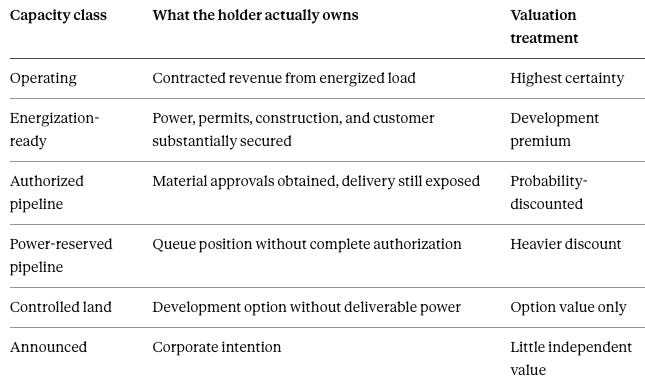
Vantage’s own portfolio spreads across the full range. The Quincy campus in Grant County, Washington sits in class one, at 89 megawatts across three buildings and roughly $1 billion, completed in 2023 on Grant County Public Utility District power. Frontier delivers its first building in the second half of 2026, placing one increment near class two and the remaining nine buildings in classes three and four. Lighthouse completes in 2028 under a tariff whose collateral terms remain contested at the Commission.
The six-class scale measures authorization and deliverability rather than commercial quality. Investors should apply it alongside customer contract term, counterparty credit, cancellation rights, and revenue concentration. An authorized megawatt without durable customer revenue and a contracted megawatt without deliverable power fail for different reasons, and a single capacity total conceals both failures.
Announced gigawatts and revenue-producing gigawatts are separated by exactly the legal and physical steps MindCast measures across all fifty states. The right question for an investor is not how many megawatts a developer has announced. The right question is how many have cleared authorization, and what clearing the remainder will cost.
Contact mcai@mindcast-ai.com to partner with us on Predictive Game Theory AI in Law and Behavioral Economics. We specialize in predictive simulations for Complex Litigation, Innovation Economics, Geopolitical Risk Intelligence and Legacy Innovation. See more about MindCast series at our new website MindCast Corporate.
To test our predictive simulation AI system, in 2026 we simulated the Super Bowl and the World Cup. See 🏈 Super Bowl LX — AI Simulation vs. Reality | ⚽ The 2026 World Cup Final Simulation Validation
To deep dive on MindCast works upload the URL of this publication into any LLM (preferably Google AI mode) and prompt ‘reconstruct MindCast framework with three degrees of cited sub links.’ See Live-Fire Game Theory Simulators, Runtime Predictive Infrastructure.
IV. Nineteen States, Four Authorization Regimes
Four platforms do not share a regulatory problem. Across roughly nineteen states, the cohort operates, develops, or pursues campuses under materially different authorization conditions.
Vantage operates or develops across Texas, Wisconsin, Washington, Ohio, Georgia, California, Virginia, Arizona, Indiana, and Nevada. Switch runs campuses in Nevada, Michigan, Georgia, and Texas, and announced a 382-acre Pennsylvania campus in April 2026. CyrusOne holds facilities in Virginia, Texas, Arizona, Ohio, Illinois, Iowa, North Carolina, New Jersey, New York, Connecticut, Kentucky, and Washington. DayOne brings a largely Asia-Pacific and European portfolio toward a proposed United States listing.
Four recurring patterns illustrate how one portfolio meets materially different state conditions, and each prices differently.
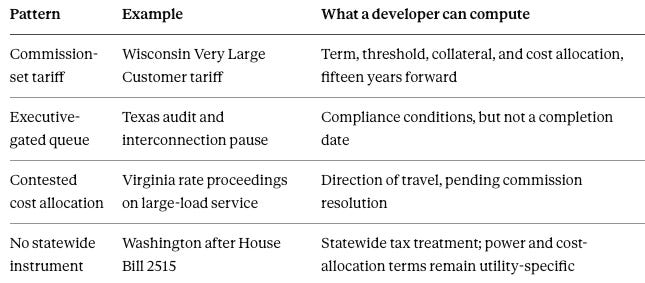
Local institutions carry the load wherever no state instrument exists. Siting approvals for Switch’s Nevada and Pennsylvania campuses run through county and municipal bodies, while power service and interconnection remain subject to separate utility and grid processes. Switch has already committed publicly to funding its own power infrastructure without passing costs to consumers, a concession volunteered ahead of any filing requirement.
Comparing four patterns across nineteen states requires a common scale, and MindCast built two. The 50-State Authorization Price Atlas grades every state on the conditions a developer actually faces. The Model Data Center Authorization Code supplies the strictness scale that converts scattered risk-factor language into one comparable number.
Applied to a registration statement, the two instruments answer a question no filing answers on its own: whether a portfolio concentrates in states that can be priced or in states that cannot.
Washington supplies the sharpest case, and not because of a single company. Two of the four platforms hold Grant County capacity — Vantage at its Quincy campus and CyrusOne at PNW1 — served by a consumer-owned utility outside commission jurisdiction, in a state with no statewide large-load instrument. Neither campus sits inside a state commission tariff docket, and both depend on public-power instruments outside commission jurisdiction.
Investors reading a multi-state filing will therefore encounter jurisdictions that produce a computable obligation and jurisdictions that produce silence. Silence is the harder one to price, and the Atlas exists to convert it into a grade.
V. Governments, Utilities, Customers, and Now Capital Markets
Four institutions authorize an AI data center. Each one can stop a project cold, and a project that satisfies three of them still does not get built.
Governments authorize construction and operation through statute, ordinance, and permit. Utilities and their commissions authorize access to power through tariff, interconnection agreement, and cost allocation. Customers authorize revenue through contract. Capital markets authorize the next development cycle by pricing what the first three have done.
One decisive difference separates the fourth authorizer from the other three. Governments, utilities, and customers each evaluate a single project in a single jurisdiction, on its own schedule, behind its own confidentiality terms. Capital markets evaluate the whole portfolio at once, across every jurisdiction, on a single day, and publish the answer as a number the world can read.
An initial public offering therefore operates as the fourth authorization proceeding, conducted in a different forum under different rules. Underwriters run discovery. Counsel drafts disclosure under liability. Investors render a verdict on the developer’s complete authorization record rather than on any one campus.
Developers that bargained well across many statehouses should receive a different multiple from developers that bargained expediently in a few. A concession made in one state may become evidence of platform-wide bargaining behavior for investors evaluating a campus in another, because public markets price the platform rather than the site.
VI. Why Power Approval Now Changes Valuation, Not Only Cost
MindCast’s baseline work established that every project pays an authorization price, paid in cost, obligation, and delay rather than in permission alone. The credit analysis that followed established that authorization uncertainty travels through the discount rate, the borrowing cost, the schedule reserve, and the covenant package.
A public listing advances the mechanism one step further. Authorization uncertainty stops behaving like a cost and starts behaving like a multiple.
Compounding explains the difference. A cost is subtracted once from one project. A multiple applies to every future megawatt the platform expects to build, so a developer with a demonstrably stronger authorization record earns a premium on capacity it has not yet acquired.
Wisconsin shows the mechanism running in the opposite direction. A fifteen-year minimum term converts a tariff into a long-dated liability with a known counterparty. A collateral requirement keyed to credit rating converts the developer’s capital structure into an authorization input.
A public listing would broaden Vantage’s equity base, add audited financial reporting, and give investors a continuously observable measure of platform credit quality. Whether those changes lower project-level collateral costs depends on which entity a tariff names as the responsible customer, which entity posts financial assurance, and what that entity’s rating actually is. Public status alone resolves none of the three.
Credit-keyed tariff requirements connect corporate finance to authorization. A commission writing collateral rules is writing capital-structure policy, whether or not it intends to.
Legislators should note where the incentive points. Credit-keyed ratepayer protections give a developer reason to improve financial transparency and strengthen the entity standing behind the load. Ratepayer protection and corporate disclosure push in the same direction, which is an unusual and useful alignment for anyone drafting in 2027.
A second lesson runs the other way and matters more for states that have written nothing. A developer can compute a Wisconsin electricity bill fifteen years forward, because the Commission set a term, a threshold, and a collateral rule. A developer cannot compute a bill in a state with no large-load framework at all, and an uncomputable cost gets priced as risk rather than as a number.
Washington illustrates the gap. Vantage completed its Quincy campus, publicly credited the rural tax incentive and its utility partnership, and placed its next 2.4 gigawatts in Texas and Wisconsin. Washington’s large-load tariff legislation passed the House in 2026 and died in the Senate, leaving the state with a tax preference and no statewide instrument for making future large-load obligations legible.
Texas and Wisconsin each handed a developer terms it could compute. Washington hands a developer a tax preference and a blank space where the obligations belong.
Uncertainty costs a state more capacity than strictness does. MindCast carries the proposition as a working hypothesis and tests it through the Group Five entries in Section VIII, where adoption and enactment records settle it against the 2027 and 2028 legislative record.
VII. What an SEC Filing Will Reveal That State Proceedings Have Not
MindCast’s earlier work on missing dockets made a structural argument — material authorization exposure frequently sits outside the proceeding observers are watching. The current IPO wave relocates the docket to a venue no state government monitors.
A registration statement requires disclosure of material risks under securities-law liability. For a development platform whose value rests on a small number of enormous campuses, materiality can force authorization exposure into jurisdiction-specific language. Moratoria, tariff reallocations, audit-gated interconnection pauses, ordinance denials, and cost-allocation rulings stop being operational friction described in a press release. Any such instrument that materially affects portfolio value, project timing, or expected revenue may enter the filing, require updating as the exposure changes, and expose the issuer if stated wrongly.
Five disclosures would carry the most information for every audience named in Section II:
Portfolio split across the six capacity classes. How much of the announced gigawatt total is energized, and how much is intention.
Firm power versus queue position. How much announced capacity holds deliverable, contracted power rather than an interconnection number.
Counterparty concentration. Which customers carry the contracted revenue, and what happens to the platform if one of them slows.
Named jurisdictions. Which states the issuer identifies as sources of authorization risk, and which instruments it names.
Capital destination and obligated entity. How much of the offering funds construction, debt reduction, collateral support, or sponsor liquidity; which legal entities hold the campuses and the power commitments; and whether ownership changes require consent, reassignment, or renewed financial assurance.
Capital destination deserves as much attention as capacity. A ten billion dollar offering that funds construction tells a state one thing about project maturity; the same offering funding sponsor liquidity tells a state something else entirely, and the two are indistinguishable from the headline number.
Foreign issuers carry the mechanism across borders and compress it. Singapore-based DayOne raises American capital to build in Malaysia, Indonesia, Finland, and Spain, while Nscale would register American disclosure covering West Virginia and Texas authorization terms alongside Norwegian ones. A single registration statement written for United States investors then states, in one document and one language, what a developer computes in West Virginia against what the same developer computes in Norway. State authorization terms enter the comparison as line items rather than as background, and the comparison reaches investors who never read a commission docket.
Authorization transferability is the question hiding underneath. Wisconsin keyed collateral to the credit rating of the customer taking service, and Texas requires developers to disclose project ownership and controlling interests. A listing, sale, or recapitalization that moves the obligated entity can therefore reopen collateral, eligibility, and incentive terms that everyone treated as settled.
States should ask a plain question of any developer entering a transaction: which entity carries the obligation after the deal closes, and does the obligation survive the change.
Named jurisdictions deserve particular attention in statehouses. Legislatures have largely failed to compel data center disclosure, blocked by confidentiality agreements and by the absence of any authority requiring a private developer to state what it fears. A filing may produce parts of that inventory voluntarily and under liability, though disclosure will follow securities-law materiality rather than the information needs of legislators or communities.
Securities disclosure reaches a defined perimeter. Filings arrive after siting and tariff decisions are made, cover listed companies only, and describe risk to investors rather than obligations to communities. Legislation governs everything outside that perimeter.
Inside the perimeter, securities law is positioned to deliver more data center transparency in 2027 than data center law has delivered in three sessions. Legislators and county officials should read the first filing the week it appears and treat the contents as drafting evidence.
VIII. Forty-Three Dated Predictions
Forty-three forward claims, dated August 13, 2026. Each carries an explicit falsifier, a named settlement source, a deadline, and a confidence band with its class label. Predictions are numbered 1 through 43 for this publication and correspond to master MindCast register numbers 17 through 59.
Predictions run in seven groups tracing one loop: how the transaction resolves, what the filings disclose, where valuation lands, how later listings behave, how states respond, how legislative sessions and local opposition enter the record, and how all of it returns as price.
Three standing rules govern the register and apply to every prediction below.
Activation. A conditional prediction whose trigger never occurs remains unactivated and is excluded from scoring rather than counted correct or incorrect. Filing-dependent predictions settle only against a registration statement that actually becomes public.
Class. Event-class claims settle against an external record. Interpretive claims carry a stated matching rule and stay out of any probabilistic aggregate.
Priority. Ten predictions marked Primary test the mechanism this note argues. Predictions marked Secondary test jurisdiction and actor behavior around that mechanism and are scored separately.
Independent model runs on the same input set agreed on the governing mechanism and the regime classification. Where independent runs agreed on the mechanism but assigned different route probabilities, the register preserves the full cross-model confidence envelope and reports the equal-weight central estimate separately. Cross-model agreement does not independently raise confidence.
Group One — Transaction Path
Seven predictions covering whether a transaction happens, in what form, and in what order across the cohort. Coherence constraint applied: the probability of launching a qualifying process is set at or above the probability of completing any transaction.
1 — Route Decomposition [Primary] Vantage’s transaction path resolves into one of four exclusive routes by the deadline: a completed and priced initial public offering at 33–43% central, 30–45% envelope; a minority investment or private recapitalization at 24–34% central, 22–36% envelope; no major transaction completed at 19–29% central, 18–31% envelope; a control sale at 5–13% central, 4–15% envelope. Event class. Routes are mutually exclusive and jointly exhaustive, and central-band midpoints sum to 100. Envelope bands span the full cross-model range and do not sum to 100. Scoring: categorical Brier or logarithmic score across the four routes, since a low-probability route occurring does not by itself defeat a distribution. Structural falsifier: the observed outcome cannot be assigned exclusively to one of the four routes. Settlement: SEC filings and company announcements. Deadline: December 31, 2027.
2 — Formal Process [Secondary] Vantage announces or launches a formal transaction process — a public or confidential registration filing, a mandate announcement, or a confirmed sale process. Confidence: 75–85%, event class. Falsifier: no announced or launched process by the deadline. Settlement: company announcements and SEC filings. Deadline: December 31, 2027.
3 — Listing Completion [Secondary] Vantage prices an initial public offering. Confidence: 33–43%, event class. Prediction 3 restates the initial-public-offering component of Prediction 1 and receives no separate score. Falsifier: no Vantage initial public offering prices on or before the deadline. Settlement: SEC filings and pricing announcements. Deadline: December 31, 2027.
4 — Sequence [Secondary] Switch prices, or a Switch registration statement becomes publicly available, before any Vantage registration statement becomes publicly available. Confidence: 70–80%, event class. Falsifier: a Vantage registration statement becomes public first, or neither becomes public by the deadline. Settlement: EDGAR. Deadline: December 31, 2027.
5 — Path Divergence [Secondary] At least one of the four cohort members resolves through a private sale or minority transaction rather than pricing a listing. Confidence: 55–65%, event class. Falsifier: all four either price a listing or take no transaction action by the deadline. Settlement: company announcements and SEC filings. Deadline: December 31, 2027.
6 — Conversion Cap [Secondary] No more than two of Vantage, Switch, CyrusOne, and DayOne complete United States listings. Confidence: 65–75%, event class. Falsifier: three or more of the four complete United States listings by the deadline. Settlement: SEC filings and pricing announcements. Deadline: December 31, 2027.
7 — Offering Size [Secondary] Conditional on Vantage pricing an offering, gross proceeds fall below $10 billion.Confidence: 65–75%, event class. Falsifier: gross proceeds at or above $10 billion. Unactivated if no Vantage offering prices. Settlement: final prospectus. Deadline: December 31, 2027.
Group One tests whether the wave arrives. The remaining groups test what the wave produces once their filing, listing, or pricing triggers activate.
Group Two — Disclosure Content
Nine predictions testing what a registration statement reveals about authorization. Predictions 8 through 10 settle against the same document and count as one line of evidence.
8 — State or Regime Identification [Primary] The first registration statement to become publicly available among the four cohort members identifies at least one state or named regulatory regime as materially affecting power delivery, construction timing, cost allocation, or project economics. Confidence: 72–82%, event class. Falsifier: the filing identifies no state or named regime in connection with those categories. Settlement: EDGAR. Deadline: December 31, 2027.
9 — Named Instrument [Secondary] The same filing names a specific authorization instrument — an identified tariff docket, commission order, state audit directive, moratorium, or interconnection pause. Confidence: 40–50%, event class. Falsifier: the filing names no specific instrument or proceeding. Settlement: EDGAR. Deadline: December 31, 2027.
10 — Two-State Appearance [Secondary] Texas and Wisconsin both appear in the first publicly available Vantage registration statement in connection with power delivery, tariff, interconnection, regulatory, or development risk, counted anywhere in the document. Confidence: 45–55%, event class. Falsifier: either state is absent from those contexts. Unactivated if no Vantage filing becomes public. Settlement: EDGAR. Deadline: December 31, 2027.
11 — Capacity Separation [Primary] The first cohort registration statement quantifies at least three capacity states — drawn from operating, under construction, contracted, committed, and planned — and identifies material customer concentration. Confidence: 80–90%, event class. Falsifier: fewer than three capacity states quantified, or customer concentration omitted. Settlement: EDGAR. Deadline: December 31, 2027.
12 — Capacity-State Standardization [Secondary] At least two of the first three public cohort filings separately quantify operating, under-construction, and contracted or committed capacity. Confidence: 75–85%, event class. Falsifier: fewer than two of the first three filings quantify all three states separately. Unactivated if fewer than three cohort filings become public. Settlement: EDGAR. Deadline: December 31, 2027.
13 — Firm-Power Limit [Secondary] The first cohort filing distinguishes broad development stages without identifying firm, deliverable power separately for every material campus. Confidence: 75–85%, event class. Falsifier: the filing identifies firm, deliverable power on a campus-by-campus basis for every campus it describes as material, or the filing fails to distinguish broad development stages at all. Settlement: EDGAR. Deadline: December 31, 2027.
14 — Portfolio-Table Limit [Secondary] No cohort registration statement discloses a jurisdiction-by-jurisdiction megawatt table covering the full portfolio. Confidence: 65–75%, event class. Falsifier: any cohort filing discloses such a table. Unactivated if no cohort filing becomes public, and not settled correct by absence of filings. Settlement: EDGAR. Deadline: December 31, 2027.
15 — Structural Concentration [Secondary] At least one cohort registration statement discloses a related-party, common-control, or concentration risk arising from overlapping sponsor, customer, or joint-venture relationships across the AI compute stack. Confidence: 45–55%, event class. Falsifier: no cohort filing discloses such a relationship. Unactivated if no cohort filing becomes public. Settlement: EDGAR. Deadline: December 31, 2027.
16 — Regulator-Forced Expansion [Primary] SEC staff issues at least one comment letter to a cohort issuer requesting expanded disclosure on power availability, interconnection status, energization timing, or customer concentration.Confidence: 55–65%, event class. Falsifier: no such comment letter appears in released correspondence for any cohort issuer. Unactivated if no cohort registration statement becomes public. Settlement: UPLOAD and CORRESP filings on EDGAR. Deadline: 18 months after the first cohort registration statement becomes public.
Predictions 13 and 14 mark the perimeter deliberately. Securities disclosure will surface capacity staging and named jurisdictions while leaving campus-level firm power unresolved, and Group Two establishes both halves.
Group Three — Valuation
Three predictions testing whether public markets price authorization quality rather than merely disclose it.
17 — Cohort Haircut [Secondary] The first cohort listing to price does so at an implied valuation below the highest pre-filing figure reported for that company. Confidence: 60–70%, event class. Falsifier: pricing at or above the highest reported pre-filing figure, measured on the same basis the report used. Unactivated if no cohort listing prices. Settlement: pricing announcement compared against the reported anchor. Deadline: December 31, 2027.
18 — Vantage Haircut [Secondary] Conditional on Vantage pricing an offering, the headline valuation prices below $100 billion. Confidence: 65–75%, event class. Falsifier: pricing at or above $100 billion on the basis stated below. Settlement basis stated here: comparison runs on equity value at the offer price against the $100 billion figure read as equity value; where the filing establishes the reported figure was enterprise value, settlement runs on enterprise value at pricing. Unactivated if no Vantage offering prices. Settlement: final prospectus and pricing announcement. Deadline: December 31, 2027.
19 — Authorization-Linked Valuation Split [Primary] Public-market analysis distinguishes operating-yield platforms from development-option platforms and ties the differential explicitly to capacity status, deliverable power, authorization exposure, or jurisdictional risk. Confidence: 70–80%, interpretive class. Matching rule stated here: at least two published sell-side initiation or update notes covering different cohort issuers apply materially different valuation frameworks or capacity discount assumptions, and each states capacity status, power deliverability, authorization exposure, or jurisdictional risk as a stated basis for the difference. Falsifier: no two such notes appear, or the differential rests solely on growth, leverage, scale, or customer mix. Unactivated if fewer than two cohort issuers are publicly listed. Settlement: published equity research. Deadline: December 31, 2028.
Prediction 19 carries the valuation half of the thesis. A differential tied explicitly to authorization quality is authorization uncertainty behaving as a multiple rather than a cost.
Group Four — Later Listings and Market Structure
Four predictions testing whether the first filing sets a template and how the cohort behaves afterward.
20 — Post-Listing Disclosure [Primary] The first cohort member to complete a listing updates, repeats, or incorporates by reference jurisdiction-specific discussion of power availability, permitting, interconnection, cost allocation, or community opposition in at least one of its first two scheduled post-listing periodic reporting cycles. Eligible documents include Forms 10-Q, 20-F, and 6-K earnings materials, or the equivalent required periodic report. Confidence: 65–75%, event class. Falsifier: neither of the first two reporting cycles carries such discussion in any form. Unactivated if no cohort listing completes. Settlement: EDGAR. Deadline: completion of the second scheduled reporting cycle after the first cohort listing prices.
21 — Template Formation [Secondary] The second and third cohort registration statements share at least three of four authorization risk categories with the first: power availability or interconnection, cost allocation or tariff exposure, permitting or siting, and community or political opposition. Confidence: 60–70%, interpretive class. Matching rule stated here: a category counts as shared where the filing devotes at least one dedicated risk-factor heading or equivalent discrete discussion to it. Falsifier: fewer than three categories shared across the three filings. Unactivated if fewer than three cohort filings become public. Settlement: EDGAR. Deadline: December 31, 2027.
22 — Contagion [Secondary] Within six months after the first cohort listing prices, at least one remaining cohort member changes its expected timing, valuation, offering size, or transaction route against the baseline in effect on the pricing date. Confidence: 65–75%, event class. Baseline set at pricing: the most recent publicly reported timing, valuation, size, and route for each remaining member as of that date. Falsifier: no remaining member’s reported plan changes against that baseline within six months. Unactivated if no cohort listing prices. Settlement: company announcements, SEC filings, and reported changes attributed to named sources.
23 — Weak Pricing Substitution [Secondary] Conditional on the first cohort listing pricing below its marketed range or falling at least ten percent across its first thirty trading days, at least one remaining cohort member delays a listing or pursues private capital within six months. Confidence: 70–80%, event class. Falsifier: no remaining member delays or pursues private capital within six months of the trigger. Unactivated if the trigger condition never occurs. Settlement: pricing records, trading data, and company announcements.
Group Four determines whether one filing produces a standing disclosure template or a single disclosure event. Template formation is what converts a filing into a durable market instrument.
Group Five — State and Regulatory Response
Nine predictions testing what legislatures, commissions, and utilities do next.
24 — Filing Enters a State Record [Primary] Conditional on a cohort member filing publicly, at least one state legislative, executive, or utility-regulatory record cites information drawn from that filing within twelve months.Confidence: 55–65%, event class. Falsifier: no such citation appears within twelve months. Unactivated if no cohort filing becomes public. Settlement: committee reports, bill reports, agency filings, commission orders, or executive releases.
25 — Peer Proceedings [Secondary] Three or more additional states open large-load tariff or data center standards proceedings citing ratepayer cost allocation. Confidence: 70–80%, event class. Falsifier: fewer than three additional states open such proceedings. Settlement: state commission dockets and executive orders. Deadline: December 31, 2027.
26 — Financial-Assurance Diffusion [Secondary] At least three additional state tariffs, commission orders, or statutes adopt new credit-support, financial-assurance, usage-disclosure, or project-cost protections for very large loads.Confidence: 70–80%, event class. Falsifier: fewer than three such adoptions. Settlement: state commission orders and enacted statutes. Deadline: December 31, 2028.
27 — Texas Codification [Secondary] Texas enacts legislation incorporating at least two of the following, each counted where the enrolled bill contains an operative requirement rather than a study or intent provision: developer-funded grid infrastructure cost responsibility; mandatory electricity or water use disclosure; cooling efficiency or water reuse standards; noise, setback, or community protection requirements; changes to data center tax incentives; or on-site generation or capacity obligations. Confidence: 75–85%, event class. Falsifier: no enrolled Texas bill contains operative requirements in at least two categories. Settlement: Texas Legislature enrolled bills. Deadline: December 31, 2027.
28 — Texas Attrition [Secondary] At least two data center projects, beyond any project already reported as ended or withdrawn as of August 13, 2026, withdraw, are denied, or are indefinitely delayed following the ERCOT audit. Indefinite delay means removal from the interconnection queue, official suspension, or no recorded advancement for two consecutive quarters. Confidence: 55–65%, event class. Falsifier: fewer than two additional projects withdraw, are denied, or meet the delay definition. Settlement: Governor’s office releases, PUCT and ERCOT records. Deadline: June 30, 2027.
29 — Wisconsin Credit Standard [Secondary] The Public Service Commission of Wisconsin does not materially relax the A- credit standard on rehearing, where material relaxation means removing the standard, raising the eligibility threshold above 250 megawatts, or eliminating the financial-assurance requirement. Confidence: 55–65%, event class. Falsifier: the Commission takes any of the three named relaxation actions. Settlement: PSCW docket order. Deadline: June 30, 2027.
30 — Washington Unbundling [Secondary] A Washington bill addressing large-load tariffs or data center disclosure is introduced in the 2027 session without accompanying tax-exemption changes. Confidence: 50–60%, event class. Falsifier: every 2027 data center bill couples tariff or disclosure provisions to tax-preference changes, or no such bill is introduced. Settlement: Washington State Legislature bill records. Deadline: 2027 sine die.
31 — Washington Coupling [Secondary] Conditional on a 2027 Washington data center bill being introduced that couples tariff or disclosure provisions to tax-exemption changes, that bill fails to reach a floor vote in the second chamber.Confidence: 60–70%, event class. Falsifier: such a bill reaches a floor vote in the second chamber. Unactivated if no coupled bill is introduced. Settlement: Washington State Legislature bill records. Deadline: 2027 sine die.
32 — Consumer-Owned Utility Response [Secondary] A Washington consumer-owned utility or public utility district adopts a large-load service policy, contract standard, or tariff equivalent. Confidence: 40–50%, event class. Falsifier: no Washington consumer-owned utility or public utility district adopts such an instrument. Settlement: utility board records. Deadline: December 31, 2027.
Prediction 24 closes the loop the rest of the note argues. A securities filing cited in a state record converts the disclosure claim from prediction into demonstrated transmission between two systems that have never spoken to each other directly.
Group Six — Political Risk Entering the Record
Six predictions running the causal direction the other groups leave open. Groups Two through Five test what filings disclose and what states do next. Group Six tests the return path — whether legislative sessions, moratoria, and organized local opposition reach offering timing, pricing, and analyst judgment.
Most state legislatures convene between January and April 2027, which places the first full session cycle directly inside the window when the cohort expects to price.
33 — Session-Specific Legislative Risk [Secondary] A cohort registration statement or post-listing periodic report names a pending or anticipated state legislative session, bill, or ballot measure as a risk to power cost, siting, or project timing. Confidence: 60–70%, event class. Falsifier: no cohort filing or periodic report names a pending or anticipated legislative or ballot action. Unactivated if no cohort filing becomes public. Settlement: EDGAR. Deadline: December 31, 2027.
34 — Opposition-Attributed Project Impact [Secondary] At least one cohort issuer discloses a project delay, cancellation, downsizing, or cost increase attributable to local opposition, a moratorium, a referendum, or a permit denial.Confidence: 55–65%, event class. Falsifier: no cohort issuer attributes a project impact to any of those causes. Unactivated if no cohort filing or periodic report becomes public. Settlement: EDGAR and issuer communications. Deadline: December 31, 2027.
35 — Session-Window Offering Effect [Secondary] Conditional on a cohort offering pricing between January 1 and June 30, 2027, at least one contemporaneous state legislative or regulatory action is identified as affecting that offering’s timing, size, or pricing. Confidence: 40–50%, event class. Falsifier: no such action is identified in issuer communications, underwriter research, or two or more named financial press reports. Unactivated if no cohort offering prices inside the window. Settlement: issuer communications, published research, and named financial press reporting.
36 — Research Prices Legislative Risk [Primary] At least one published sell-side note on a listed cohort issuer names state legislative, regulatory, or local siting action as a factor in its valuation, rating, or price target. Confidence: 65–75%, event class. Falsifier: no published note names such action as a valuation, rating, or price-target factor. Unactivated if no cohort issuer is publicly listed and covered. Settlement: published equity research. Deadline: December 31, 2028.
37 — Quantified Moratorium Exposure [Secondary] A cohort filing or periodic report quantifies exposure to local moratoria or siting restrictions by naming a count of affected sites, megawatts, or jurisdictions. Confidence: 35–45%, event class. Falsifier: no cohort filing quantifies such exposure. Unactivated if no cohort filing becomes public. Settlement: EDGAR. Deadline: December 31, 2027.
38 — Post-Listing Policy Posture [Primary] Within four quarters of listing, the first listed cohort member publicly commits to a state standards framework, a ratepayer-protection tariff structure, or a community benefit agreement it had not committed to before listing. Confidence: 60–70%, event class. Baseline set at listing: the issuer’s publicly recorded policy commitments as of the pricing date. Falsifier: no commitment beyond that baseline appears within four quarters. Unactivated if no cohort listing completes. Settlement: governor and commission releases, utility filings, local government records, and issuer communications.
Group Six establishes that legislative and local risk reaches filings, research, and post-listing conduct. Group Seven tests whether the risk reaches price.
Group Seven — Effects on Share Price and Offering Execution
Five predictions measuring whether authorization and political risk produce observable effects on valuation, offering execution, and investor practice. Groups Two through Six establish visibility. Group Seven establishes consequence.
Every prediction below settles against market data, prospectuses, or published methodology rather than against language in a filing.
39 — Adverse-Action Price Reaction [Primary] Following public disclosure of a named adverse state or local authorization event affecting a material campus of a listed cohort issuer, that issuer’s shares underperform the Pacer Benchmark Data & Infrastructure Real Estate ETF by at least three percentage points across the five trading days after disclosure. Confidence: 50–60%, event class. Clean-event condition: the five-trading-day window carries no earnings release, financing announcement, major customer announcement, guidance change, or index reconstitution affecting the issuer. Falsifier: underperformance of less than three percentage points across the window on the first qualifying clean event. Unactivated if no qualifying clean event occurs. Settlement: closing prices for the issuer and the named benchmark. Deadline: December 31, 2028.
40 — Sustained Multiple Spread [Secondary] Two listed cohort issuers sustain a valuation-multiple gap of at least twenty percent, measured on enterprise value to EBITDA or price to funds from operations, across a full calendar quarter.Confidence: 60–70%, event class. Prediction 40 measures the spread only and stays outside the thesis score unless the Prediction 19 attribution rule also settles correct, since leverage, growth, customer mix, geography, and margin structure each produce multiple gaps independent of authorization. Falsifier: no such gap persists across a full quarter. Unactivated if fewer than two cohort issuers are publicly listed for a full quarter. Settlement: reported financials and closing prices. Deadline: December 31, 2028.
41 — Later Listings Price Lower [Secondary] Conditional on Prediction 11 settling correct and at least two cohort listings pricing, the second listing prices at a lower implied valuation per megawatt of disclosed operating capacity than the first. Confidence: 55–65%, event class. Measurement rule: operating capacity and authorized-but-unenergized capacity are compared separately, so a large speculative pipeline cannot improve the ratio. Falsifier: the second listing prices at or above the first on operating capacity. Unactivated if fewer than two cohort listings price, or if operating capacity is not separately disclosed. Settlement: final prospectuses and pricing announcements. Deadline: December 31, 2028.
42 — Allocator Methodology Response [Secondary] At least one institutional investor, index provider, or credit rating agency publishes methodology, criteria, or formal commentary treating authorization status, interconnection position, or power deliverability as a distinct assessment factor for data center issuers. Confidence: 50–60%, event class. Qualifying documents must be newly published or materially revised after August 13, 2026. Falsifier: no such new or revised methodology, criteria, or commentary appears. Settlement: published methodology and criteria documents. Deadline: December 31, 2028.
43 — Offering Execution Effect [Secondary] At least one cohort offering is postponed, downsized, or repriced with authorization, power availability, or regulatory risk identified as a contributing cause. Confidence: 40–50%, event class. Falsifier: no cohort offering is postponed, downsized, or repriced on those grounds. Identification requires issuer or underwriter statement, or two or more named financial press reports. Unactivated if no cohort offering reaches marketing. Settlement: SEC filings, issuer communications, and named financial press reporting.
Prediction 39 supplies the sharpest single test in the register. A measurable share-price reaction to a state or local authorization event, on a clean event window, provides the strongest observable evidence that public markets price authorization risk continuously.
How the Sequence Loops Back to the Statehouse
Seven groups trace one loop, and each link carries its own registered forecast.
States write explicit terms. Wisconsin set a fifteen-year commitment and a collateral standard. Texas paused an interconnection queue pending audit. Predictions 25, 26, 27, and 29.
Filings disclose the exposure. Materiality drives capacity distinctions and named jurisdictions into the registration statement, and may surface specific authorization instruments. Predictions 8, 9, 11, 12, 13, 33, and 37.
Regulators and research read the filings. SEC staff comments; analysts build authorization into frameworks and price targets. Predictions 16, 19, 36, and 42.
Price responds. Offerings discount development pipelines, multiples separate, adverse events move shares. Predictions 17, 18, 39, 40, 41, and 43.
Issuers change conduct. A listed developer facing priced political risk makes public commitments it avoided while private. Prediction 38.
States read the filings and the conduct. Legislative, executive, and regulatory records cite what the filings disclosed. Prediction 24.
Step six returns to step one. Authorization terms written in a statehouse arrive back at that statehouse eighteen months later carrying a price attached by public markets, and the register above dates every link in the sequence.
Thesis Test
Two separable claims carry the authorization-multiple thesis, and each fails on its own terms.
Disclosure test. The first cohort registration statement names a state or regulatory regime and quantifies materially different capacity states. Generic boilerplate defeats the claim. Naming a specific instrument, tested at Prediction 9, counts as stronger confirmation rather than a necessary condition.
Valuation test. Published research applies an authorization-linked valuation differential under the Prediction 19 matching rule, or a qualifying clean authorization event produces the relative-price effect specified in Prediction 39. Differentiated disclosure without either result defeats the claim.
Public documents settle both tests on stated deadlines. Visibility and pricing are separate achievements, and the register scores them separately.
IX. Scope and Limitations
Two limits bound the analysis, and both concern how much the August 13 report can carry.
Reuters described preliminary deliberations rather than a launched process, and sources disagreed materially on offering size — one figure near $10 billion, another near $5 billion. Disagreement of that magnitude indicates a transaction without settled shape.
Reuters also did not state whether the $100 billion figure represents equity value or enterprise value. Reuters expressly described Switch’s comparable figure as including debt, which makes the omission meaningful. Equinix currently carries a market capitalization near $103 billion and Digital Realty near $73 billion, so the reading chosen determines whether Vantage would enter at, above, or below the established public operators. The figure functions as a sponsor-side anchor rather than a discovered price.
MindCast anchors the analysis to the four-platform cohort rather than to Vantage alone. Should Vantage never file, the thesis settles against whichever platform files first.
Source Notes
The principal factual claims above trace to the following public records.
Texas audit directive, August 3, 2026 — Office of the Governor of Texas.
Vantage compliance announcement, August 12, 2026 — Office of the Governor of Texas.
Vantage transaction deliberations, August 13, 2026 — Reuters.
Wisconsin Very Large Customer tariff order, April 24, 2026 — Public Service Commission of Wisconsin.
We Energies rehearing request on credit standards, June 2026 — Wisconsin Watch.
Switch confidential filing, August 7, 2026 — Bloomberg, reported by Reuters.
Cohort listing plans — Data Center Dynamics.
Frontier campus, Shackelford County, Texas — Vantage Data Centers.
Lighthouse campus, Port Washington, Wisconsin — Vantage Data Centers, OpenAI, and Oracle.
Quincy campus completion, Grant County, Washington — Vantage Data Centers.
Washington House Bill 2515 outcome — Davis Wright Tremaine.
CyrusOne data center locations, including Quincy, Washington — CyrusOne.
Switch Pennsylvania campus and cost commitment, April 2026 — Las Vegas Review-Journal.
Foundational Works
AI Data Center Credit Risk supplies the instruments applied here — Authorization Credit Exposure, Financeable Authorization Coverage, Capital Irreversibility, and the Financing Inversion hypothesis.
The Data Center Authorization Price establishes the fifty-state baseline: every project pays an authorization price, and certainty can be worth more than nominal leniency.
The 50-State Authorization Price Atlas supplies the jurisdiction-level conditions behind any national portfolio, and explains why no developer’s capacity deserves a single undifferentiated risk score.
The Model Data Center Authorization Code supplies the measurement scale against which disclosed authorization risk can be graded.
Data Center Investor Confidence establishes that developers pay a second time when capital providers price the credibility of delivery.
Three Competing Governance Equilibria sets out the state-policy regimes that would alter the value of a geographically distributed portfolio after any listing.
The MindCast Data Center One-Year Review records what MindCast identified about authorization, cost allocation, flexibility, and energization risk before the current valuation test.