
Federal Communications Commission · White House and National Security Council · Congress · Bureau of Industry and Security · Department of War and Department of Homeland Security · Department of Energy · US cloud operators · US chip vendors · Device assemblers · Chinese transceiver makers · Allied optical suppliers · Ministry of Commerce of the People's Republic of China · United States · People's Republic of China · Southeast Asia
Companion: Import Controls, Export Controls and the US–China AI Infrastructure Contest.
Interactive war game: The Economics of AI Import Control
Related works: Federal Grid-Security Rules Are Doing to American AI Data Centers What China Could Not · Enforcement Incidence and Capability Denial in Artificial Intelligence Export Controls · The US Bureau of Industry and Security Affiliates Rule Turns Export Controls Into Bargaining Instruments
Why This Case
A reported FCC ban on Chinese optical transceivers is the live decision. The list states the question, the stakes and the fit for a short-horizon simulation.
Key insight. The form of an FCC entry decides who pays. The leading form bars new models from every foreign plant and exempts suppliers by Conditional Approval, so allied plants abroad wait on approval too. An entry naming producers reaches finished devices instead.
Fit for a Simulation Snapshot. The case offers a dated window to January 10, 2027, twelve bounded actors and a thick public file since August 2026.
How MindCast adapts the method. An import ban reverses the export-control board: US buyers carry the first cost, and the rival holds the chokepoint.
Three aspects of the simulation. Equilibrium: deferral or a narrowed entry, because buyers’ losses are salient and dated. Named actor: an FCC with four Covered List additions in a year. Game evolution: the truce expiry and a new Congress.
Significance and pattern. Consequence: quarters of slip on 2028 campuses. Unique to cloud operators and allied suppliers that build offshore, and routine to trade counsel who worked the Huawei, drone and router listings. First of a class: the same contest is forming over battery storage under Executive Order 14421.
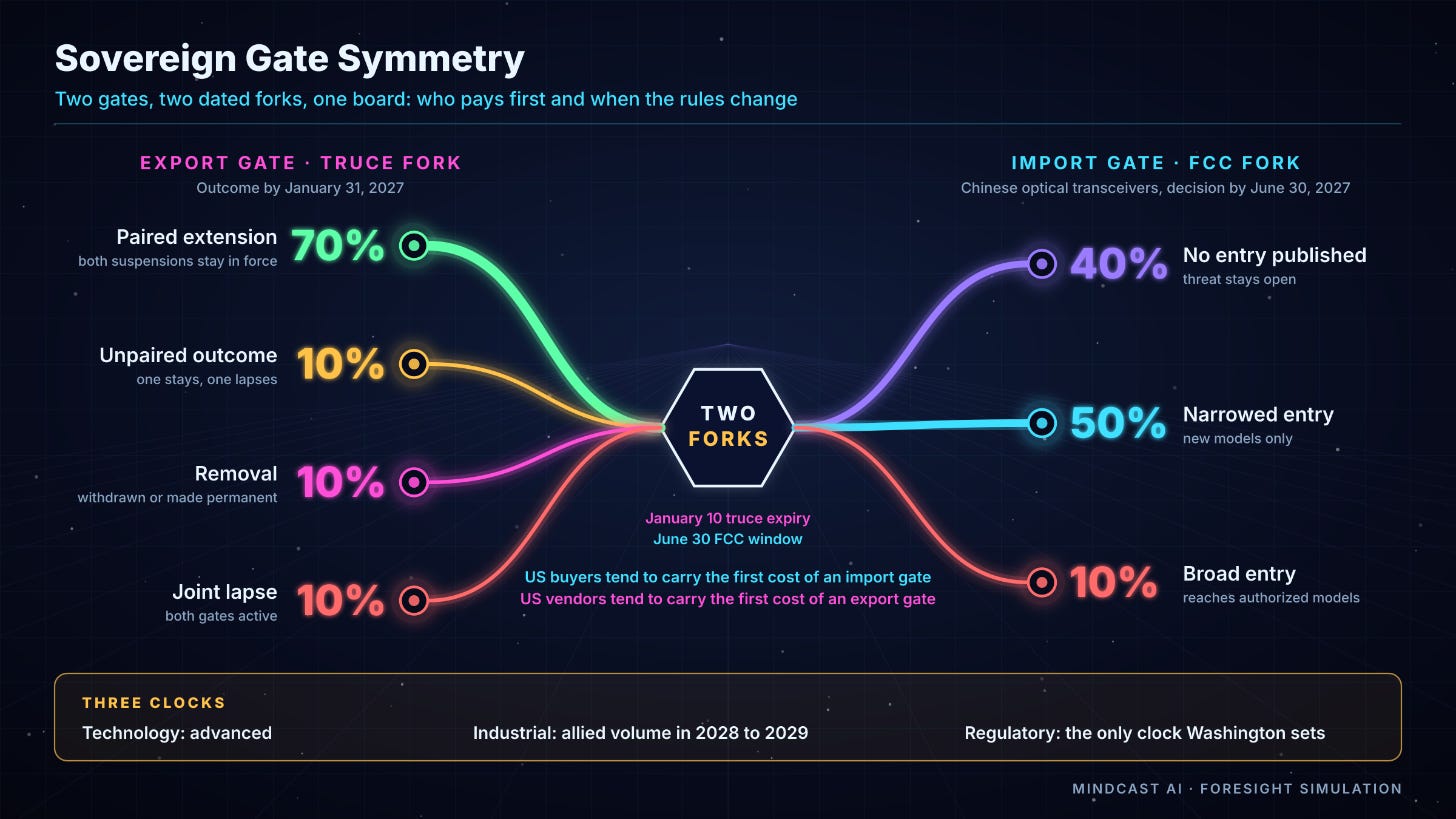
P marks a Primary Simulation Prediction and S a Secondary Simulation Prediction.
🏛️ Policymakers. An approval term shorter than the build clock recreates the shortage a transition is meant to avoid. Set terms against qualified allied shipments.
💼 Executives. Every foreign-produced 3.2T module would need approval under the leading form, allied modules included (P2 at 70%). Campuses designed around Chinese 3.2T modules face two to four quarters of slip, so map module origin by plant now.
⚖️ Counsel. A class entry leaves finished devices outside the component rule, and a named-producer entry reaches those that require FCC authorization (S1 at 20%). Advise by entry form.
📊 Investors. Approved allied suppliers gain, and Chinese-owned offshore plants lose the route for new models. Given a class entry, no approval for a Chinese-headquartered maker within a year stands at 90%. Track approvals, not announcements.
The case turns on the form of an entry and the terms of approval under it. Both remain open while no rule text exists.
I. The Governing Equilibrium: The Ban Comes Before Supply, and Supply Sets When It Bites
Washington wants Chinese optics out of AI data centers and cannot yet replace them. Counterpoint Research estimates that Chinese makers supply nearly two-thirds of global units. A Morgan Stanley note cited by Reuters places the 3.2T production ramp in 2028 and wide installation in 2029. The actors therefore sit in a delay equilibrium, where each month of deferral costs the security agencies credibility and saves cloud operators capacity.
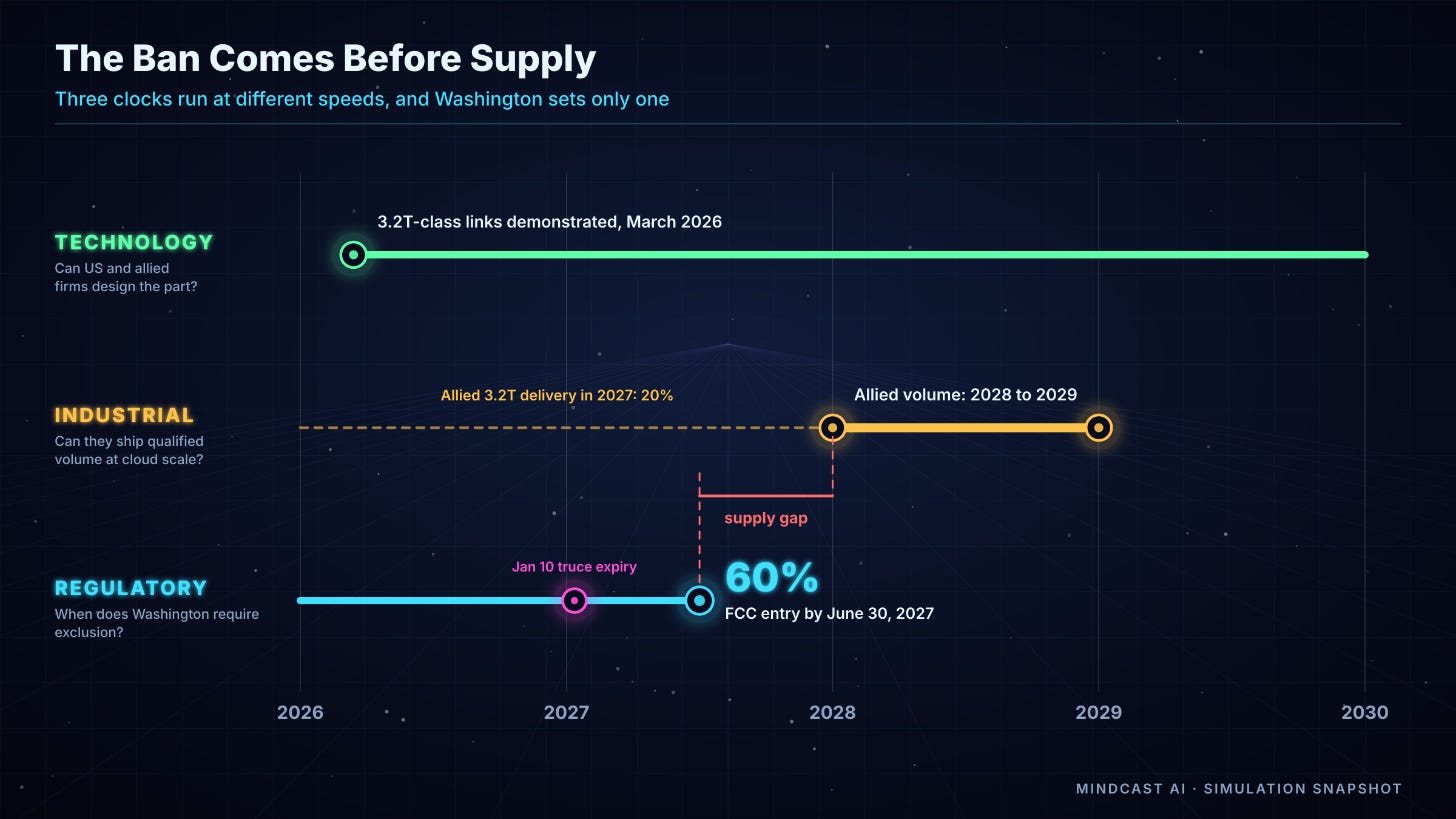
Delay does not mean the ban waits for supply. Washington is likely to act first, with an entry by June 30, 2027 at 60%. Supply limits then set the form and the binding date: new models only, a reported 3.2T threshold that binds in 2028 and approval terms. The delay falls on when the ban bites, not on whether it issues.
Reuters reported on November 10 that Microsoft has pressed the administration to drop the measure. The FCC began drafting the ban in August, and reporting places its scope at new models of 3.2 terabits per second and above.
Why a short delay does not solve the problem. A delay of about six months is the simplest concession Washington could offer, so the Snapshot tests it. Optics form a small share of campus cost, yet a cluster without transceivers cannot run. The loss from a delayed campus dwarfs any saving on modules, which explains the intensity of the lobbying.
Technology clock: can US and allied firms design the part? Design work is advanced. Coherent demonstrated 3.2T-class links in March 2026.
Industrial clock: can they ship qualified volume at cloud scale? Volume arrives in 2028 to 2029, on suppliers’ own ramp dates and the Morgan Stanley estimate.
Regulatory clock: when does Washington require exclusion? The date is contested. The reported draft covers new 3.2T-class models.
Money is not the missing input. Nvidia invested $2 billion in each of Coherent and Lumentum against purchase commitments, and Coherent’s long-term agreements carry upfront customer investment. Lumentum still reports capacity sold out through 2027, and Coherent’s agreement worth about $20 billion ramps only in early 2028.
A six-month delay moves the regulatory clock and leaves the industrial clock where it was. A ban also removes the buyer’s outside option, so pressure on allied suppliers weakens once the Chinese source is barred. Only a transition dated to 2028 or later matches what suppliers can deliver.
The threshold explains the intensity of the lobbying. A 3.2T rule binds few 2027 purchases, if any. Operators fight it because campuses for 2028 and 2029 are designed now, and every foreign-produced 3.2T module would sit behind an approval gate.
Known.
Four class listings since December 2025 share one form: foreign-produced, with Conditional Approval.
The component rule has been in force since October 13, 2026, covering certified and supplier-declared equipment.
Truce instruments expire January 10, 2027.
A Democratic Congress convenes January 3, 2027.
Chinese makers already supply North America from Thailand.
Unknown but discoverable.
Whether approval terms for transceivers would match the 18-month ceiling.
Whether modules built abroad for US operators need their own approvals.
Module exposure by maker in each fleet.
Ownership of Chinese makers’ offshore plants.
Ownership disclosures in any approval filing.
Unknowable until actors move.
Whether the measure enters the January 10 package.
The approval terms the departments set.
The entry form the FCC selects.
Beijing’s choice between pressure and restraint.
Whether a public security finding issues.
📊 Investors. Purchase commitments already exist, so new announcements add little. Qualified shipment dates carry the information.
Takeaway. Washington is likely to act before supply exists, and build time decides when the ban bites and what any approval is worth. A six-month delay changes the regulatory date and leaves supply where it was.
II. The Cognitive Digital Twins: Who Shapes Timing, Approval and Response
Twelve actors shape the outcome. Each entry below states what the actor wants, what it controls and how it has behaved.
FCC. The agency added drones, routers, inverters and robots to the Covered List within a year. The component rule bars new authorizations of devices containing logic-bearing hardware from named producers and leaves previously authorized equipment unaffected. The FCC cannot list on its own initiative, because a determination must come from a national security agency, Commerce or Congress (paragraph 36).
Approval authorities. The Department of War and Homeland Security decide Conditional Approvals, and the FCC holds no discretion over them. Their terms set how long an approved supplier can ship.
White House and National Security Council. The White House holds substantial influence over interagency coordination and timing, while formal authority sits with the determining agencies and the FCC. The truce and its two paired suspensions expire on January 10, 2027, after BIS and Beijing aligned their suspensions. The Bureau of Industry and Security (BIS) rule and the rare-earth controls give the White House a package to trade within.
Congress. A bipartisan Senate bill would bar Chinese transceivers from national security systems. A House bill would require Commerce input before Covered List additions. Both lapse on January 3, when a Democratic Congress convenes.
Cloud operators. Operators anchor on capacity committed for 2027 through 2029. Loss aversion drives direct White House engagement.
BIS and US chip vendors. BIS holds the suspended Affiliates Rule. Chip vendors hold China revenue that depends on the same January 10 package.
Device assemblers. Switch, network card and server makers stay latent unless the FCC names producers. A producer-based entry puts their new models at risk.
Chinese makers.Innolight booked 61.7% of its first-quarter 2026 revenue in the United States. The company told investors that its Thai factory has run for years and can meet North American orders. The plant exists, yet the leading entry form reaches it.
Reuters reports that Innolight sits on the Pentagon’s list of Chinese military companies. A listing of that kind weighs against approval when the departments review ownership.
Allied suppliers. Non-Chinese makers gain demand on every path and depend on inputs China controls. Lumentum reports capacity sold out through 2027. US vendors are shifting toward outsourced Southeast Asian production, so their new models would need approval as well.
Supplier consolidation.Marvell agreed on November 2, 2026 to acquire Lumentum, with closing expected in the first half of 2028. The merger concentrates the US supply base inside the substitution window.
Beijing. The Ministry of Commerce can press inputs to allied substitutes or hold back while current models keep selling.
Takeaway. The White House shapes timing, the security departments control approvals, and Beijing controls the response. No single actor controls the outcome, so the sequence of moves matters.
III. How the Game Evolves: The Leading Entry Form Seats New Players
Three hypotheses compete, and each carries its own breaking condition.
Security-floor hypothesis. The FCC designates because the Huawei lesson dominates. The hypothesis fails if June 30, 2027 passes with no entry and no public finding.
Bargaining hypothesis. The measure moves with the January 10 package. The hypothesis fails if an entry issues on a date unrelated to any truce announcement and cites no trade term.
Capacity hypothesis. The measure waits on allied 3.2T qualification. The hypothesis fails if any entry issues before a non-Chinese supplier delivers qualified 3.2T modules.
The odds favor the security-floor hypothesis on whether Washington acts. An entry by June 30, 2027 stands at 60%, ahead of allied qualification. The capacity hypothesis keeps the 40% no-entry path, and supply limits shape the form: the leading entry covers new models only.
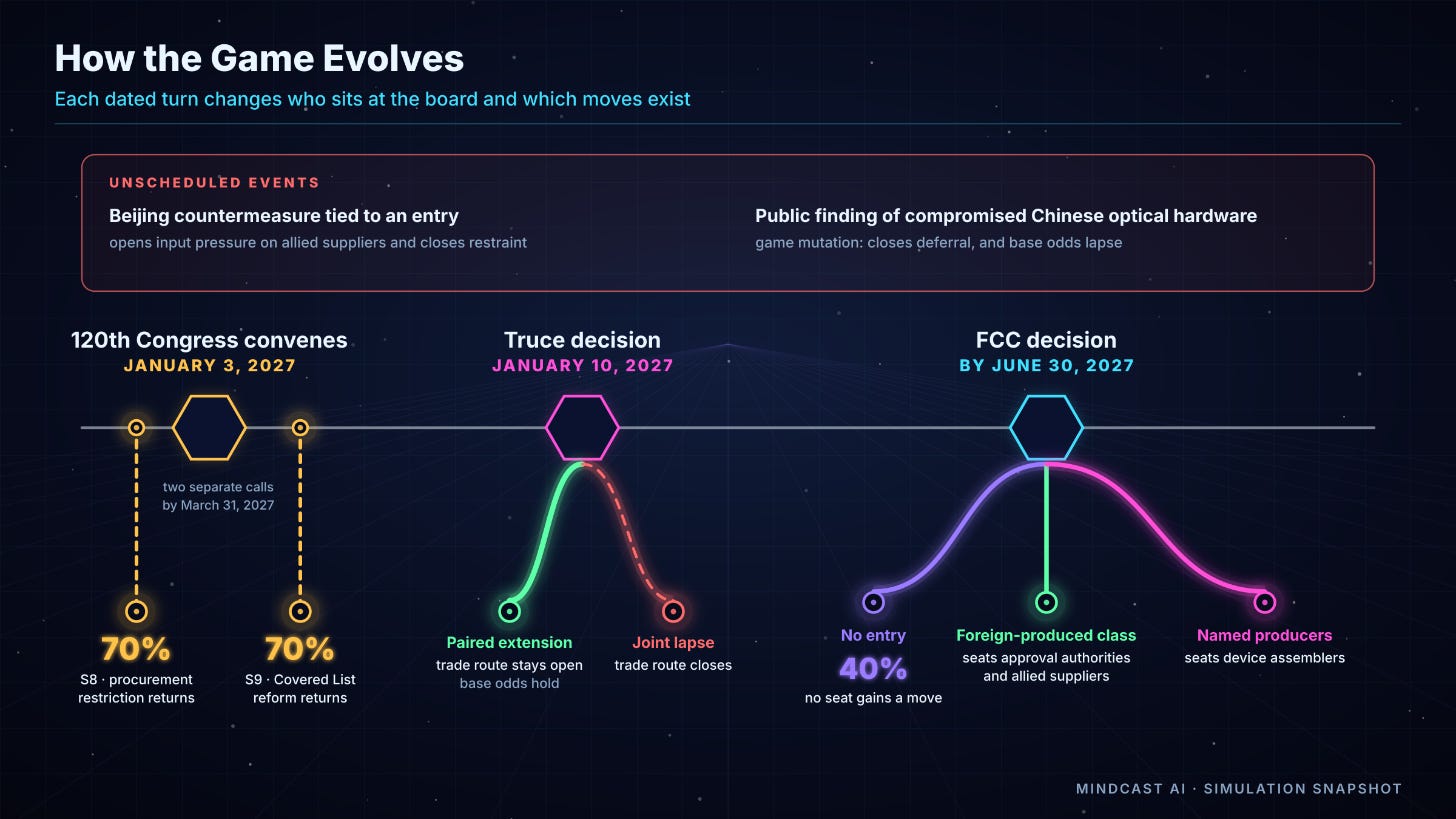
Each event below does more than resolve a fork. An event can open paths, close others and hand some seats moves they lacked before. Seats mean the modeled actors.
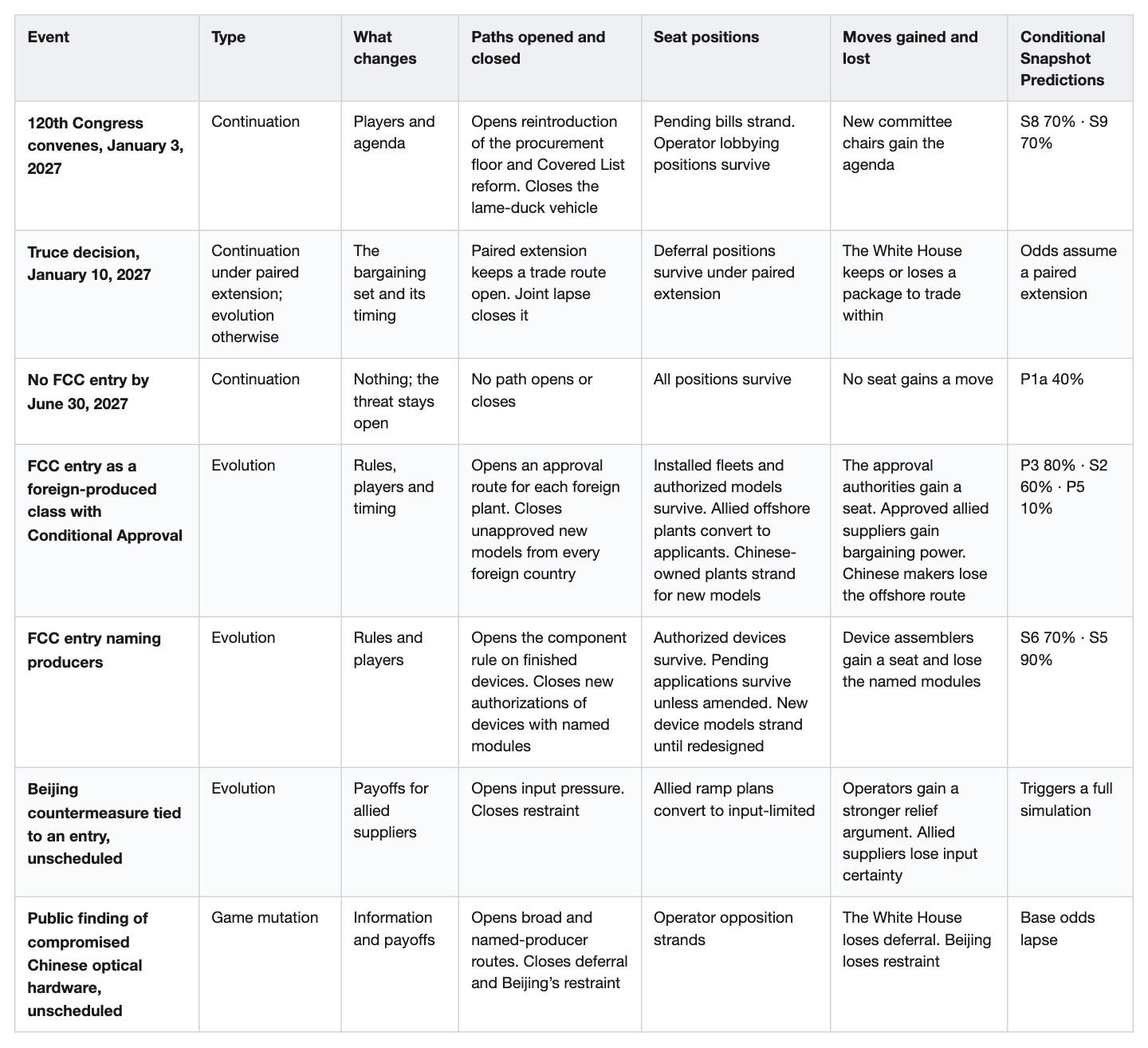
Two rules govern the game-evolution map. Odds assume a paired truce extension and no security finding. Each entry form creates a different board, so conditional odds apply only inside the form they name.
Aligned deadlines alone do not place the measure in the package. An action announced with the truce and citing it supports bargaining. An action that follows allied qualification without truce reference supports capacity.
💼 Executives. The leading entry form puts allied suppliers in an approval queue. Supplier filings become part of campus schedule risk.
Takeaway. The game evolves on January 3 and January 10, and the leading entry form seats the approval authorities and allied suppliers. Device assemblers enter only if the FCC names producers.
IV. MindCast Simulation Predictions: A Narrowed Class Entry Leads
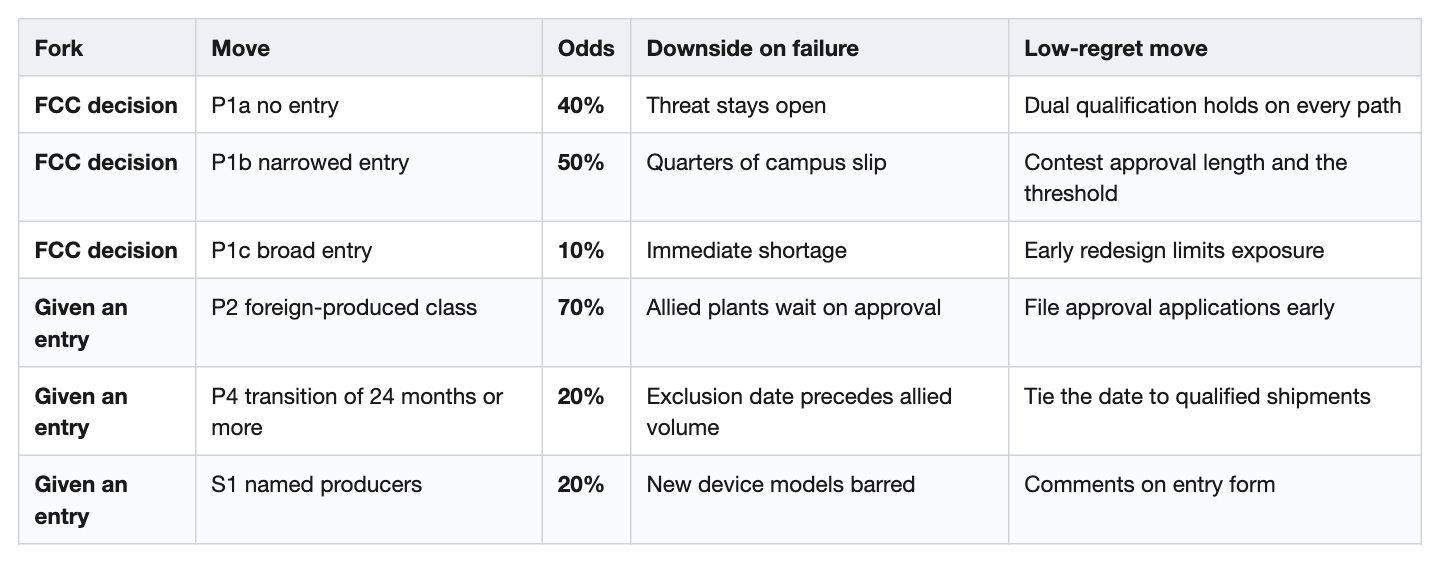
The issue carries fourteen Simulation Predictions across three forks: five Primary and nine Secondary. Odds print in tens.
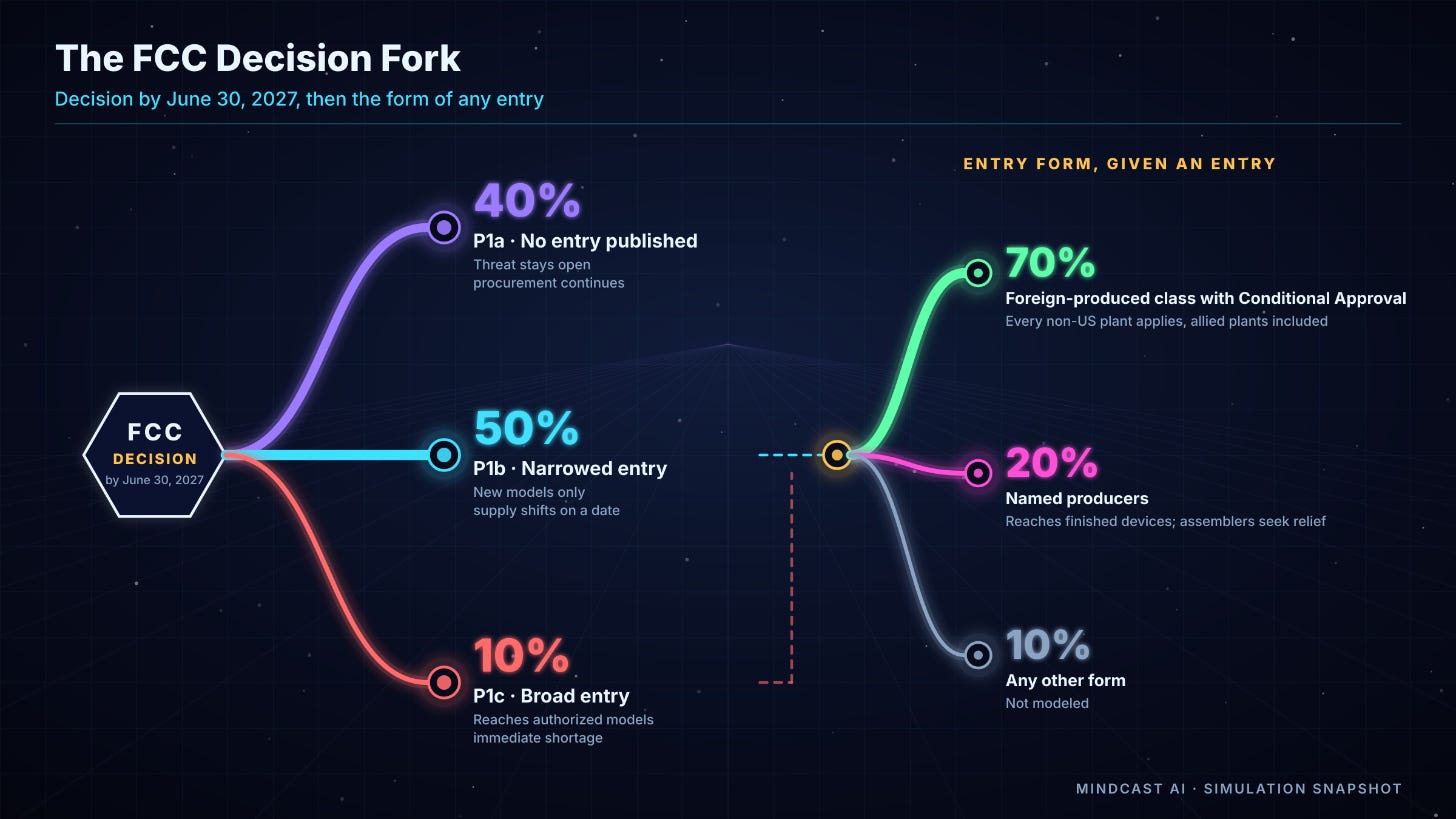
Fork one: the FCC decision by June 30, 2027.
P1a | No entry published: 40%. The threat stays open and procurement continues.
P1b | Narrowed entry: 50%. The entry covers new models only, with or without a speed threshold or a transition. Supply shifts to approved sources on a date.
P1c | Broad entry: 10%. The entry also reaches models already authorized. US buyers face an immediate shortage.
A narrowed entry leads because the leading form lowers the cost of acting. A class entry that exempts approved suppliers, set at a speed that ships in 2028, costs US buyers little in 2027.
Entry form, given an entry.
Foreign-produced class with Conditional Approval: 70%. Every non-US plant applies, allied plants included. Finished devices stay outside the entry, because the component rule needs a named producer.
Named producers: 20%. Device assemblers enter and request relief (S6). The entry reaches finished devices for new authorizations.
Any other form: 10%. The simulation does not model other forms, and reach to finished devices depends on the form.
Precedent drives the 70%. Drones and routers entered the Covered List as equipment produced in a foreign country, whatever the producer’s nationality, and inverters and robots followed in July 2026. Reuters described the transceiver draft the same way: ban all new models, then exempt many non-Chinese suppliers.
Conditionals.
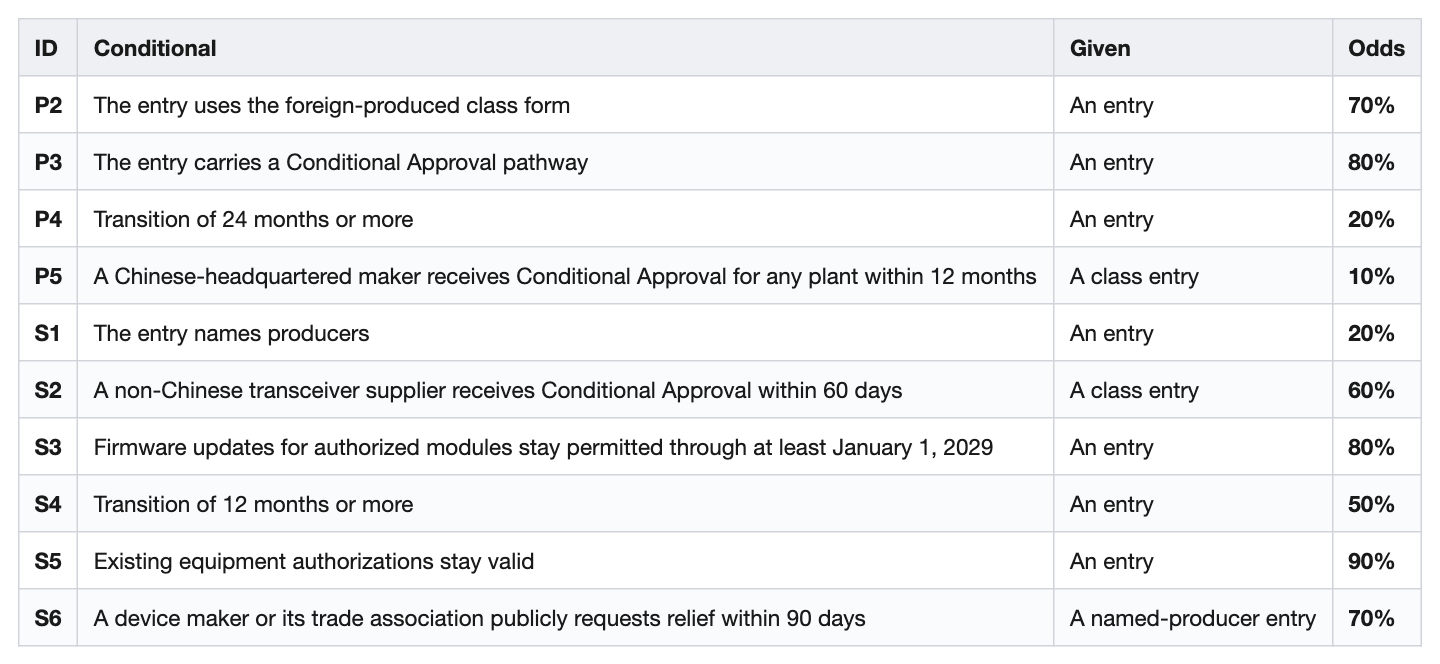
Each call fails if its named event does not occur in its window or under its condition. FCC public notices and the Covered List page verify P1 through P5 and S1 through S5. Trade association filings verify S6, and Congress.gov verifies S7 through S9.
Two Simulation Predictions read more plainly in reverse. Given an entry, a transition shorter than 24 months stands at 80%. Given a class entry, no approval for any Chinese-headquartered maker within a year stands at 90%.
Forks two and three: Congress.
S7 | 30% by January 3, 2027. The enacted defense authorization law carries a transceiver procurement restriction.
S8 | 70% by March 31, 2027. The transceiver procurement restriction returns with sponsors from both parties.
S9 | 70% by March 31, 2027. Covered List procedure reform returns in the House.
Two reported features carry no odds. The 3.2T threshold rests on anonymous sourcing, and Beijing’s response to an entry rests on a contested reading of its restraint.
The Conditional Approval precedent. Approval terms are the real contest under the leading form.
Who decides. The Department of War or Homeland Security decides, and the FCC holds no discretion (Steptoe).
Term. Approvals run up to 18 months (Steptoe).
What applicants disclose. Corporate structure, foreign ownership, supply chain and plans to onshore production (Wiley).
Speed. The FCC listed routers on March 23, 2026. Netgear, Adtran and eero held approvals by April 22 (CAICT summary).
Firmware updates. Previously authorized devices may receive updates through at least January 1, 2029 (Cooley).
An approval granted in 2027 runs for up to 18 months, and wide 3.2T installation is not expected until 2029. An approval can therefore expire before the capacity it protects arrives.
The legal boundary. S1 carries the legal severity. The FCC order answers most of the authorization questions.
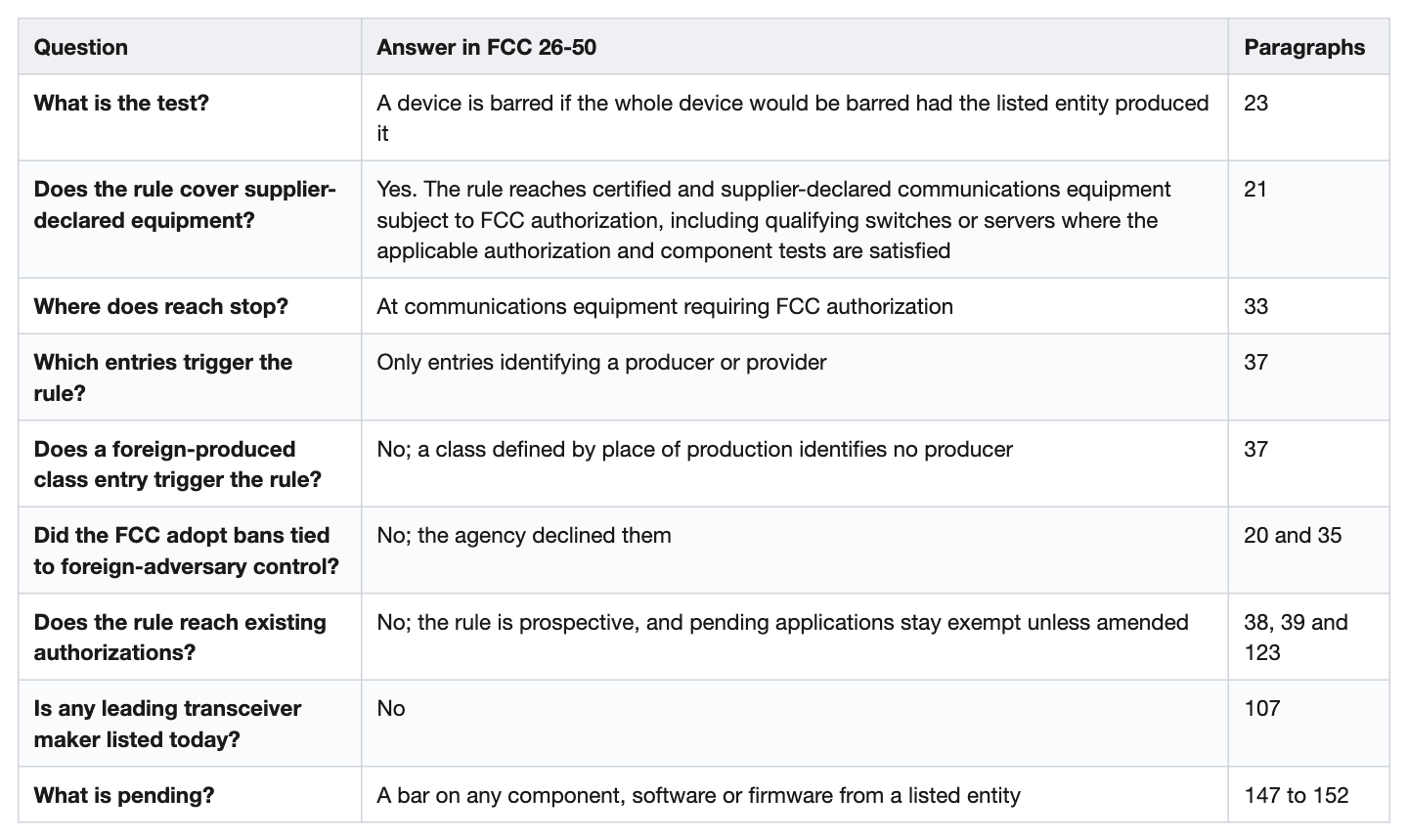
A class entry therefore leaves finished devices outside the component rule. Only a named-producer entry reaches them, and only where a device requires FCC authorization.
Offshore plants. The class form reaches every foreign plant. A Chinese-owned Thai plant must disclose ownership to the approving departments, and approvals to date have gone mostly to non-Chinese makers. Allied modules built in Southeast Asia wait on the same process.
Break condition. A public security finding ends deferral and raises the broad and named-producer routes. The odds above lapse if it occurs.
Escalation triggers. A producer-based entry justifies a full simulation for assemblers and operators. A Beijing input countermeasure justifies one for allied suppliers and their buyers.
🏛️ Policymakers. Given an entry, a transition shorter than 24 months stands at 80%. The gap between the exclusion date and allied volume is the cost to manage.
Takeaway. The entry’s form decides who pays, and approval terms and transition length decide how long. The contest therefore shifts from whether an entry issues to the terms under it.
V. Opportunities and Strategies: File Early and Contest the Terms
The best moves differ by path, and two of them pay on every path. The entries below set them out by fork outcome.
On every path. Allied suppliers assemble Conditional Approval files now: ownership, supply chain and onshoring plans. Operators map which modules in each fleet come from which plant. Both moves win on all three paths of fork one.
On P1a. Operators keep dual qualification as insurance, because the threat stays open. Trade associations convert opposition into proposed terms, because a short delay buys nothing.
On P1b. Government affairs teams contest approval length, renewal and the speed threshold, not the existence of the entry. Suppliers that file first hold allocation ahead of rivals.
On P1c. Assemblers redesign new models around approved modules first. Counsel pursues transition relief through the 120th Congress.
On a named-producer entry. Counsel inventories which client device classes require FCC authorization, because the component rule covers certified and supplier-declared equipment.
For the next component. Government affairs teams build the transceiver filing as a template, because the same argument returns for battery storage and firmware.
For investors. Approved allied suppliers gain most under the class form, and qualified deliveries matter more than announcements. Chinese-owned offshore plants lose the route for new models.
Takeaway. Preparing approval files and mapping module origin win on every path. Both moves cost little now and hold their value under any entry form.
VI. Risk Mitigation: Terms Shorter Than the Build Clock
Actions are options for consideration, not legal, investment or fiduciary advice. Severity and probability appear as separate axes.
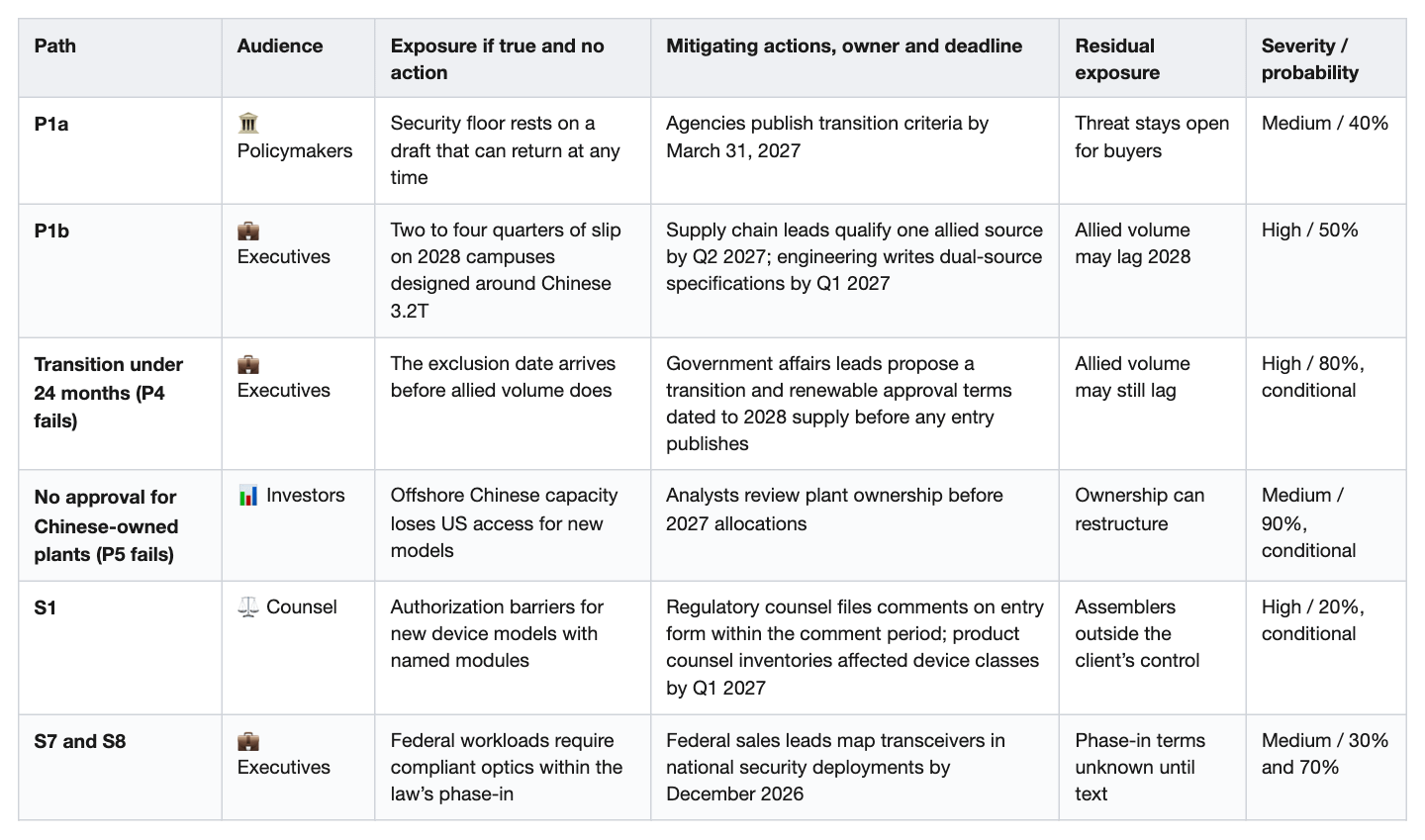
Takeaway. The largest exposures are a transition and an approval term shorter than the industrial clock. Renewable approval terms tied to qualified shipments address both.
VII. Synthesis: Form Decides Who Pays and Terms Decide How Long
The delay equilibrium breaks at one of two points. The January 10 package can carry the measure into a trade outcome, or the FCC can act on its own calendar. Either way, the entry’s form decides who pays. Approval terms and transition length then decide how long they pay.
The next case. The transceiver contest sets the template for later component disputes. Energy Department rules under Executive Order 14421 are due December 24, 2026, and China supplies 50% of US lithium-ion battery imports by value. The same three tests apply: the binding clock, the form of the restriction and the mitigation pathway.
Binding clock. Both cases bind on the industrial clock. Allied 3.2T transceiver volume arrives in 2028 to 2029, and no other origin matches Chinese battery scale.
Form of the restriction. A foreign-produced class leads for transceivers at 70%. Battery storage restrictions attach to entities the Energy Department designates.
Mitigation pathway. Transceivers have Conditional Approval for up to 18 months (P3 at 80%). Battery storage has mitigation agreements and vendor prequalification authorized.
The Snapshot carries no forecast on batteries. The companion paper gives the Energy Department rule 40% by its December 24 deadline.
Simulation Readiness Index. Game stability reads low, because two January turns land inside every operator’s window. Information completeness reads moderate, and decision sensitivity reads high, because the best move differs across entry forms. The reading calls for a commissioned Snapshot with a rule-text overlay.
Takeaway. Watch the January 10 announcements, the form of any FCC entry and the terms of approval under it. Those three observations separate the paths faster than any other signal.
Working With MindCast
The form of an FCC entry and the approval terms under it remain open, and both get decided on a calendar operators do not control. Each organization on the board faces a version of the same four questions. MindCast answers each one with a simulation scoped to that organization’s fleet, filings and counterparties.
Which of our device classes would a producer-based entry reach? An authorization overlay maps every device model against the component rule. The output names the models that need redesign or relief under the named-producer form, which stands at 20%.
How many quarters do our 2028 campuses slip on each path? A capacity overlay runs the campus schedule against P1a, P1b and P1c. The output dates the slip per campus and identifies the purchase commitments that shorten it.
How does Beijing respond to each entry form? A full simulation models Beijing’s choice between pressure and restraint under each form. The output identifies which allied suppliers face input pressure first.
What approval and transition terms should our association propose? An interactive war game seats the agencies, the suppliers and the operators. Members test each proposed term against the 18-month precedent before filing it.
Why now. An entry by June 30, 2027 stands at 60%, and allied volume arrives in 2028 to 2029. Approval filings, relief requests and comment positions take shape before an entry publishes. An organization that waits for the entry starts its filings behind the suppliers that prepared.
First step. Bring one question from the list and the decision it governs. A diagnostic session scopes the Snapshot and its overlay against that decision. Contact: mcai@mindcast-ai.com. Visit our corporate site www.mindcast-ai-simulation.com.
One-Page Sheet
The equilibrium. Washington wants Chinese optics out and cannot yet replace them, so deferral persists until a January turn or an FCC entry breaks it. The dominant fork is the entry’s form: a foreign-produced class with Conditional Approval, or named producers.
Known: four class listings share one form; the January 3 and January 10 turns; Chinese makers supply about two-thirds of units and already ship from Thailand; allied capacity sold out through 2027.
Discoverable: the approval term for transceivers; fleet exposure by maker; offshore plant ownership; firmware-update treatment.
Unknowable: the January package scope; the entry form; Beijing’s response; a public security finding.
Break condition. A public security finding ends deferral and voids the odds.
Escalation triggers. A producer-based entry, or a Beijing input countermeasure.
Pattern. The same three tests return for each later component: binding clock, form of the restriction and approval terms. Battery storage is next, with Energy Department rules due December 24, 2026.
Simulation Readiness. Stability low, completeness moderate, sensitivity high. Recommendation: commissioned Snapshot with a rule-text overlay, reissued after the FCC acts.
Sources
MindCast works
Import Controls, Export Controls and the US–China AI Infrastructure Contest. Companion paper on the four-gate contest and the structure the transceiver case shares with export controls.
Enforcement Incidence and Capability Denial in Artificial Intelligence Export Controls. Establishes the burden pattern this issue applies to an import ban.
The US Bureau of Industry and Security Affiliates Rule Turns Export Controls Into Bargaining Instruments. Models the truce instruments that expire January 10, 2027.
Federal Grid-Security Rules Are Doing to American AI Data Centers What China Could Not. Shows equipment rules converging on time to power.
External sources
Reuters via Business Recorder, Microsoft presses Trump to scuttle expected ban on Chinese data center technology.
Reuters via AJOT, Trump administration drafting ban on Chinese data center devices.
AI Weekly, Microsoft Presses Trump to Scrap FCC Ban on Chinese Transceivers.
Federal Communications Commission, Third Report and Order and Third Further Notice of Proposed Rulemaking, FCC 26-50.
Bureau of Industry and Security, Extension of the Affiliates Rule suspension.
The Star, China extends suspension of rare earth export controls until January.
Office of Senator Gallego, Securing National Security Systems from Chinese Optical Transceivers Act.
House Committee on Energy and Commerce, Communications and Technology Transparency Act.
NPR via OPB, Democrats win full control of Congress.
Counterpoint Research, Who Wins and Loses in the Proposed FCC Ban on Chinese Transceivers?
The Next Web, The US wants Chinese optics out of its AI data centres.
TrendForce via I-Connect007, AI Interconnect Boom Drives Southeast Asia Outsourcing Expansion.
Optics.org, Nvidia investments in Coherent and Lumentum.
The Motley Fool, Coherent third-quarter fiscal 2026 earnings call transcript.
Credence Research, Coherent five-year agreement worth about $20 billion.
Simply Wall St, Lumentum capacity sold out through 2027.
Securities and Exchange Commission, Marvell filing on the Lumentum acquisition.
StreetInsider, Coherent Demonstrates Technologies for Next-Generation Pluggable Transceivers at OFC 2026.
Holland & Knight, Executive Order Declares National Emergency to Secure U.S. Bulk-Power System.
Rystad Energy, US executive order targets Chinese grid hardware, but battery storage serving AI data centers is more exposed.
Reuters via Business Standard, US drafting ban on Chinese data centre networking devices.
Mayer Brown, FCC Expands its Covered List to Include Foreign-Produced Routers.
Mayer Brown, FCC Adds Foreign-Produced Power Inverters and Advanced Robotic Devices to Covered List.
Steptoe, FCC Adds Foreign-Produced Routers to the Covered List.
Wiley, FCC Adds Foreign-Produced Consumer-Grade Routers to Covered List.
Cooley, Foreign-Produced Power Inverters and Advanced Robotic Devices Added to FCC Covered List.
CAICT, FCC updates Conditional Approval for routers and drones.