


Bureau of Industry and Security · White House · Treasury · Beijing · Ministry of Commerce of China · US exporters · Chinese affiliates of listed entities
A Control’s Expected Reach Helps Determine Whether Washington Uses It
Two papers in The Economics of Export-Control Effectiveness series studies one limit on American export controls against China. The Affiliates Rule Turns Export Controls Into Bargaining Instruments asks when using a control costs Washington more than holding it. Enforcement Incidence and Capability Denial in Artificial Intelligence Export Controls asks when a control in force fails to reach Chinese capability.
Transmission links the answers, measured as the share of China’s foreign-chip and rented-compute capability that a control actually denies. Higher transmission makes a control more tempting to use and a broken truce harder to repair, while Chinese substitution lowers transmission and drains the control’s bargaining value the longer Washington holds it.
Geoeconomic power therefore arrives in three steps. Nominal control means Washington holds legal authority over a chokepoint. Credible exercise means it can activate the control without losing more than it gains, and effective transmission means activation still constrains China after it adapts.
Related MindCast works.
Enforcement Incidence and Capability Denial in Artificial Intelligence Export Controls. Measures how much of China’s computing capability US export controls actually block. The Affiliates Rule paper borrows that measure to judge what Washington would gain by reimposing the Affiliates Rule.
AI Chip Export Enforcement Shifts Risk Onto US Firms as China Demand Moves to Domestic Chips, Rented Compute and State Financing. MindCast’s October 31, 2026 forecasts on AI chip enforcement. The set includes the 80% forecast that Washington keeps the Affiliates Rule suspended or narrowed on January 10.
AI Chip Export Enforcement War Game Shows When Verification Protects US Firms and When It Arrives Too Late. Lets readers play Washington, Beijing and US firms through the November 10 and January 10 decisions.
China’s H200 Import Block and the Reordering of National Innovation Control. Correctly forecast in January 2026 that Beijing would block purchases of Nvidia’s H200 chip. A US license alone does not move chips into China.
The Beijing Summit Validation — Geopolitical Ripples for the AI Industry Across the Three-Layer Equilibrium. Confirmed that chips reach China only when Washington licenses them and Beijing allows the purchase.
I. Holding the Affiliates Rule Costs Washington Less Than Using It
The Bureau of Industry and Security (BIS) extended its suspension of the Affiliates Rule through January 10, 2027 in a rule filed on November 5, 2026 (public inspection copy). BIS is the export-control agency inside the US Department of Commerce. The Affiliates Rule extends Entity List restrictions, which bar listed foreign parties from receiving controlled US items without a license, to any company 50% or more owned by listed parties.
The extension changes timing only, and BIS reserved public comments for future rulemaking (Nixon Peabody). Washington has now deferred twice a rule it can activate without new legislation.
The Affiliates Rule functions as a bargaining instrument matched against China’s rare-earth controls, and China’s own suspension ends November 10, 2026. Each side suspends its own instrument on a matching clock, and either can return by short notice.
The paper’s thesis is that possessing coercive authority and exercising it carry very different costs. Washington keeps the rule suspended while the value of Chinese concessions plus the cost of activation exceeds the strategic gain from activation. The gain depends on how much of the restriction would reach Chinese capability. A chokepoint’s bargaining value therefore depends partly on how well it would work if used, which ties this paper to its companion on enforcement incidence.
Reciprocal restraint fits the observed bargaining sequence, and the documented 2025 exchange supports bargaining as the governing mechanism. MindCast’s analytical model finds mutual restraint the only stable outcome in about 75% of tested configurations, with restraint and restriction both stable in the rest.
US exporters therefore face a dated license risk on January 10, 2027. The outcome turns on whether the critical-mineral side of the exchange holds and on how Washington values the rule’s reach.
Method. MindCast AI applies Predictive Behavioral Economics + Dynamic Game Theory through MindCast AI Proprietary Cognitive Digital Twin Foresight Simulations (MP CDT FS). Behavioral Economics supplies the decision rules. Game Theory supplies the payoff structure. Predictive simulations emerge from the combination.
Approach. The payoff structure is one conditional bargaining game whose equilibrium depends on measurable quantities. The game can take two familiar forms. In a Prisoner’s Dilemma each side gains by restricting whatever the other does, though both prefer mutual restraint. In an Assurance game both sides prefer restraint as long as each trusts the other to hold.
Behavioral economics supplies the decision rules: the salience of visible concessions and loss aversion around the suspended reference point.
What the paper does. It sets out the bargaining game and issues MindCast Foresight Simulation Predictions on the January 10 decision. It names the evidence that separates bargaining from four rival explanations for the delay. Section II builds the game and maps how it evolves, Section III states the Simulation Predictions, Section IV maps risk mitigation by audience and Section V draws the implications.
Resolved Simulation Prediction. AI Chip Export Enforcement Shifts Risk Onto US Firms as China Demand Moves to Domestic Chips, Rented Compute and State Financing (2026) assigned 80% to a BIS notice before the rule’s default return. BIS filed the notice on November 5. The same October 31 forecast set supplies every other band except AR-P-2 and AR-P-3, which come from MindCast’s November 8, 2026 simulation.
Simulation Prediction highlights. Four of the paper’s six Simulation Predictions lead the slate. P marks a Primary Simulation Prediction and S a Secondary one.
AR-P-1 (80% extended or narrowed, 20% full return): BIS extends or narrows the suspension rather than letting the rule fully return. Window: January 10, 2027.
AR-P-2 (10%): BIS issues a rule changing scope, exceptions or timing conditions rather than timing alone.Window: by January 10, 2027.
AR-P-3 (60% given a dated extension): Any further extension with an end date matches a US–China truce date. Window: by January 10, 2027.
AR-S-1 (60%): P(a China-linked artificial intelligence hardware customer or host reports ownership cut below 50% given full return). Window: Six months after return.
Stakeholder readout.
🏛️ Policymakers. Rule credibility erodes with each extension that lacks a delivery test. Tie the next extension to measured rare-earth delivery. Window: Before January 10 (AR-P-1, AR-P-3).
💼 Executives. Affiliate sales need licenses if the rule returns. Finish ownership screening to the 50% line. Window: Before January 10 (AR-P-1).
⚖️ Counsel. A modified rule opens exception requests and comment strategy. Draft exception requests for the modification branch. Window: Before January 10 (AR-P-2).
📊 Investors. A lapse on the rare-earth side returns the rule without new law. Model exposed revenue under both January branches before the Miami summit. Window: November 10 to January 10 (AR-P-1).
The rule’s value lies in its suspension, and January 10 tests whether that value survives another round.
II. A Repeated Bargaining Game Governs the Affiliates Rule
A repeated bargaining game explains why Washington keeps the rule suspended, and its rules hold through January 10.
II.A Both Governments Have Suspended Matching Instruments on Matching Clocks
BIS issued the Affiliates Rule on September 29, 2025 and suspended it from November 10, 2025 (90 FR 50857).
The White House paired that suspension with China’s pause of its October 2025 rare-earth controls in the trade truce struck at Busan, which trade press calls the Busan Agreement (China Briefing; White House fact sheet). Treasury Secretary Scott Bessent announced on September 23, 2026 that the truce would run to January 10, 2027 (Bloomberg Government). BIS matched that date six weeks later, the pattern the reciprocal-timing proposition in III.C predicts.
BIS filed the matching extension on November 5, five days before the default return on November 10. China’s suspension under Ministry of Commerce of China (MOFCOM) Announcement No. 70 of 2025 ends November 10, 2026 (CIRS). A second Chinese suspension ends November 27 and covers US-specific bans on gallium, germanium and antimony (JD Supra).
Three Chinese controls stay in force through the truce. MOFCOM’s April 2025 licensing regime for seven medium and heavy rare earths still governs exports, so mineral licenses measure how Beijing administers that regime (China Briefing). Article 1 of Announcement No. 46 of 2024 still bans dual-use exports to US military users (Clark Hill). Announcement No. 23 of June 22, 2026 added 10 US firms to China’s export control list, including MP Materials (Thomson Reuters).
The June listing answered a Pentagon blacklist of Chinese firms two weeks earlier (Al Jazeera). Washington still extended the truce three months later. The listing used an instrument the truce never suspended, so it shows that the truce compartmentalizes disputes without testing whether either side punishes a violation.
Washington compartmentalizes too. Oracle canceled a $7 billion compute lease to Tencent in early November after US officials raised concerns, according to the Financial Times (The Next Web). The pressure used an instrument outside the truce, as Beijing’s June listing did, while the Affiliates Rule stayed suspended.
Four kinds of Chinese action carry different meaning. Reimposing a suspended control contrary to an operative commitment would constitute a defection and test whether the injured side retaliates at its next decision date. Resumption following an agreed expiration date is a separate event and does not by itself establish a violation.
Using a preserved instrument, as in June, tests compartmentalization. Broader diplomatic retaliation tests neither.
Chinese buyers acquire compute through chip purchases, offshore rental and state-backed financing. The October 31 forecast set tracks the third channel: Chinese state-capital lessors that finance accelerator hardware abroad. AR-S-2 and AR-S-3 follow that channel into congressional scrutiny and designation.
Confirmed facts. The extension date, the timing-only scope and the deferred comments. Hypotheses. Five explanations compete for the delay, set out in II.F. The rule itself states no reason.
Two suspended instruments now run on clocks that expire within days of each other.
II.B The January 10 Decision Reveals What Exercising Export-Control Power Costs
The January 10, 2027 decision on the Affiliates Rule shows what exercising export-control power costs Washington. The target system is the US–China bargaining game over the rule. The horizon runs from November 2026 to January 2027, with a long-horizon tail through 2027. Remote compute access and chip diversion fall outside scope and belong to the companion paper on enforcement incidence.
The exercise constraint governs the January decision: activating a chokepoint can cost Washington more than holding it.
II.C Visible Concessions and Loss Aversion Favor Continued Delay
The White House weighs a concession it can announce against a security measure whose benefit stays diffuse. Visible concessions carry high salience after the November 2026 midterms. Beijing weighs reciprocity it can display at home against a domestic-substitution path it already follows.
The Beijing Summit Validation — Geopolitical Ripples for the AI Industry Across the Three-Layer Equilibrium (2026) showed that path at work: Beijing declined licensed H200 deliveries even after Washington approved them. The finding explains why Beijing can treat US restraint as worth less than Washington assumes.
Both sides treat the suspended instrument as a reference point. Returning it reads as a loss for whichever side triggers the return, so loss aversion favors continued suspension while the exchange holds.
Behavioral economics also selects among equilibria. Where mutual restraint and mutual restriction are both stable, the documented 2025 exchange anchors each side’s expectation of reciprocity.
MindCast’s simulation measures how much loss aversion matters. With it, the chance of a substantive rule by January 10 falls from about 16% to 10%. The 2025 Busan deal showed the same pull, because a package agreement produced a suspension rather than a rewrite.
Salience and loss aversion favor delay, and the 2025 exchange anchors which equilibrium each side expects.
II.D Suspension Holds While Concessions Plus Activation Cost Exceed the Gain From Activation
The structure is one conditional bargaining game played repeatedly. Washington compares the value of Chinese concessions at risk plus the cost of activating the rule against the strategic gain from activation. Beijing compares the value of US restraint against the leverage of holding its mineral controls.
The equilibrium depends on where those quantities sit, and evidence rather than preference locates them. Mutual restraint holds while concessions plus activation cost exceed the gain and US restraint outweighs mineral leverage. Concession shortfalls lower the first quantity, and once the gain exceeds it, Washington’s best response flips to restriction.
The familiar games are regions of this one. Where both mutual outcomes are stable, the game takes the Assurance form. Where restriction dominates on both sides yet both prefer mutual restraint, it takes the Prisoner’s Dilemma form.
Analytical model result. Conditioned on observed mutual restraint, the model finds mutual restraint as the only stable outcome in about 75% of tested configurations at the proxy transmission share of about 25%. In the remaining 25%, mutual restriction is also stable. In a stress case above the proxy range, at a share near 40%, mutual restriction stays stable in almost 50% of configurations.
Washington alone restrains in 88-99% of configurations across low, middle and high transmission cases. The 75% and 88-99% figures count model configurations, not probabilities of government behavior.
Measuring the quantities. Mineral export licenses issued under the April 2025 regime and customs volumes measure concessions at risk. Exporter margin exposure and diplomatic cost measure the cost of activation. Every quantity enters as expected value to the deciding government through December 31, 2027, so strategic gains and commercial losses share one scale.
Washington’s gain from activation equals the strategic value of capability denied multiplied by the share of the restriction that reaches Chinese capability. Weak expected transmission keeps suspension attractive even without Chinese concessions. The paper borrows the hardware-access estimate of about 25% from the companion paper, Enforcement Incidence and Capability Denial in Artificial Intelligence Export Controls (2026), as a sensitivity proxy. Low, middle and high cases test the range around it.
Chips are not the only channel that escapes reach. The Runtime Export Problem — Anthropic’s 151 Million-Exchange Distillation Record, Advisory AA26-251A, and the Question Commerce Cannot Yet Answer (2026) shows that millions of ordinary queries to US AI models can add up to a prohibited extraction that export law does not yet cover. Anthropic, Alibaba and the Runtime Theft Problem — How Attribution Cost Moves Frontier-AI Distillation Enforcement From the Courtroom to the Statute (2026) finds that the cost of proving such extraction pushes enforcement from courts toward statute.
Runtime extraction may reduce the strategic effectiveness of hardware controls where extracted model capabilities substitute for compute that restrictions would otherwise deny. Any such reduction strengthens Washington’s case for holding the Affiliates Rule rather than using it.
A static analysis treats the rule as a fixed security measure and misses its bargaining value. The bargain began with the reciprocal suspension of November 2025. Washington and Beijing continued it in 2026 through a negotiated extension in September and a BIS rule in November, two stages of one decision rather than independent rounds. The structure has held for a year with the same players and moves on matching dates.
The conditional game explains why a rule Washington calls important stays suspended, and it names what would flip the outcome.
II.E Better Enforcement Makes a Broken Truce Harder to Repair
The two companion papers study one strategic system at two horizons: the decision to use a control and what the control achieves once used. The map below sets out each game’s players, moves, payoffs and equilibria. It then names the links that join them.
Game 1. The exercise game (Affiliates Rule paper).
Players. Washington and Beijing, each holding a suspended instrument.
Moves. Washington extends or narrows the suspension, or lets the rule return. Beijing extends its rare-earth suspension or lets its controls return, while its April 2025 licensing regime and its ban on US military users stay in force.
Washington’s payoffs. Restraint earns Chinese concessions and avoids the cost of activation. Restriction earns the strategic value of capability denied, multiplied by transmission.
Beijing’s payoffs. Restraint earns continued US restraint. Restriction keeps mineral leverage and costs Beijing the value of US restraint.
Timing and information. Both sides move on synchronized dates, most recently in November 2025, September 2026 and November 2026. The next date is January 10, 2027. Concessions show up in mineral licenses and customs volumes, while transmission stays uncertain.
Equilibria. Mutual restraint is the only stable outcome where concessions plus activation cost exceed the gain and US restraint outweighs mineral leverage. Where both mutual outcomes are stable, the game takes the Assurance form. Where restriction dominates on both sides yet both prefer restraint, it takes the Prisoner’s Dilemma form.
Game 2. The enforcement game (Enforcement Incidence paper).
Players. The Justice Department and the Bureau of Industry and Security against US vendors, hosts, lenders and intermediaries.
Moves. Enforcers choose targets and charges. Firms choose whether to verify customers before a rule requires it.
Payoffs. Enforcers gain from cases they can prove at low cost. Firms trade compliance cost against penalty and disclosure risk.
Equilibrium. Enforcement concentrates on parties inside US legal reach, which the targeting test in III.C checks.
Game 3. The acquisition game (Enforcement Incidence paper).
Players. China-parented buyers choosing among imported, domestic, rented and financed compute.
Payoffs. Each buyer seeks usable compute by the lowest-penalty route. US controls raise the cost of foreign channels, while Beijing’s procurement policy raises the payoff to domestic chips.
Equilibrium. Channel shares stabilize where marginal costs equalize across routes. Deterrence, displacement and independent substitution are three readings of how the shares move.
Game 4. The institutional-evolution game (both papers).
Question. Does adaptation stay inside the current rules or change them? A remote-access law, a host listing or a full return of the Affiliates Rule each rewrites the moves available in Games 1 to 3.
Three links join the games.
Enforcement shapes bargaining. Transmission sets Washington’s gain from activation in Game 1. Higher transmission enlarges the region where mutual restriction stays stable, so in that region stronger enforcement makes a breakdown harder to reverse.
Bargaining shapes enforcement. The January 10 outcome in Game 1 sets the starting state for Games 2 and 3. A full return adds affiliate sales to the enforcement game.
Substitution shapes both. Beijing’s procurement policy lowers what each successive control denies in Game 3. Lower denial means lower transmission, which shrinks Washington’s gain from activation in Game 1. The chip control therefore loses bargaining value as Chinese substitution grows.
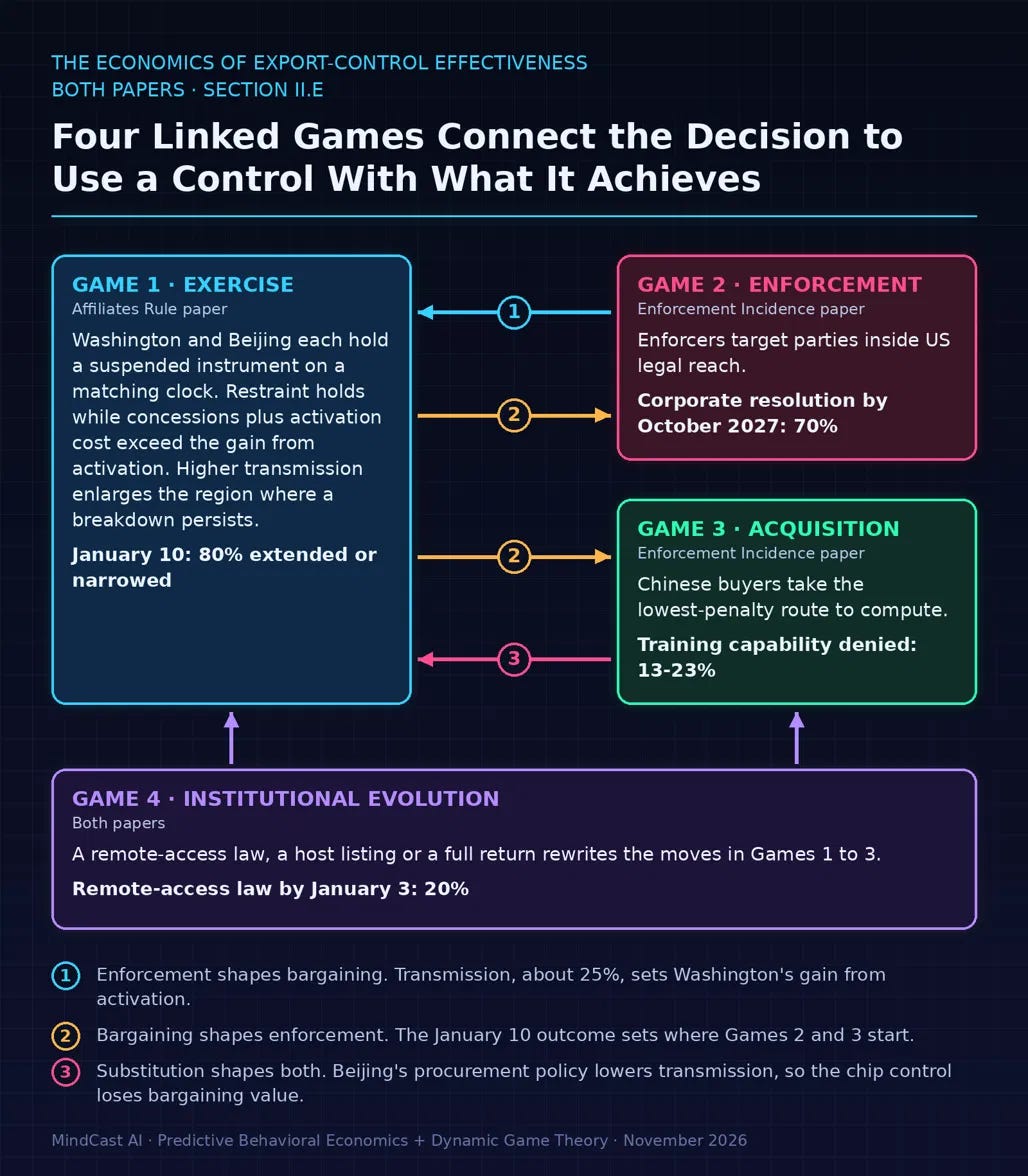
Where behavioral economics enters. Game theory supplies the payoff structure and the set of equilibria. Behavioral economics supplies the decision rules that select among them. Predicted behavior emerges from the combination.
Salient concessions and loss aversion around the suspended rule favor restraint in Game 1. Enforcers anchor on provable shipments in Game 2, and Beijing’s self-reliance identity drives Game 3.
What each audience should take from the map.
🏛️ Policymakers should evaluate any enforcement improvement for its effect on the truce as well as on Chinese capability.
💼 Executives should expect each control to move Chinese demand across channels rather than simply remove it.
⚖️ Counsel should track the January 10 outcome, because it changes which clients sit inside the enforcement game.
📊 Investors should treat the chip control as a bargaining asset that loses value as Chinese substitution grows.
For the Affiliates Rule, the map shows that the January 10 decision depends on what the companion paper measures.
II.F Reciprocal Bargaining Leads Four Rival Explanations for the Delay
Eight Cognitive Digital Twins (CDTs) carry the game. Each models one actor’s objective, its constraints and the event that would change its behavior.
White House. Objective: Visible concessions and national security. Decision rights: Directs BIS timing through executive direction. Moves on: Critical-mineral delivery; truce terms.
Treasury and the US Trade Representative. Objective: Negotiating latitude. Decision rights: Sets the concessions sought. Moves on: Leader-meeting terms.
BIS. Objective: Administer export controls. Decision rights: Can extend, narrow or let the rule return by notice. Moves on: Executive direction; implementation readiness.
Beijing and the Ministry of Commerce of China. Objective: Reciprocity, sovereignty and industrial leverage. Decision rights: Controls its own mineral suspensions. Moves on: US extension or US tightening elsewhere.
Chinese domestic chip producers. Objective: Capture demand from restricted imports. Decision rights: Capacity and yields. Moves on: Procurement mandates.
US exporters. Objective: Keep affiliate sales. Decision rights: License exposure if the rule returns. Moves on: Federal notices.
Chinese affiliates of listed entities. Objective: Keep access to US items. Decision rights: 50% ownership test. Moves on: Rule return.
Congress and the House Select Committee. Objective: Press for tighter controls. Decision rights: No direct role in the rule. Moves on: Announced concessions.
Five candidate causes.
Reciprocal bargaining: the rule tracks the truce. Evidence: officially linked commitments and synchronized decisions.
Administrative readiness: BIS is not ready to implement. Evidence: implementation problems documented apart from the negotiations.
Broader trade strategy: the rule serves presidential trade aims beyond rare earths. Evidence: decisions tied to unrelated trade concessions.
Security discretion: officials judge the restriction unneeded for now. Evidence: security assessments that explain the delay.
Low expected effectiveness: Washington expects the rule to reach too little Chinese capability to justify its cost. Evidence: officials judging the rule weak relative to its cost.
The causes can combine, since reciprocal bargaining and high implementation cost can reinforce each other. Analytical model weights from analyst-set likelihoods put reciprocal bargaining near 50% and broader trade strategy near 33%. A correct January forecast would not by itself show which cause operates. The discriminating propositions sit in III.C.
The Runtime Global Data Market — When Stolen AI Interactions Become a Strategic Technology Supply Chain (2026) found that enforcement against stolen AI interactions changed how China acquired them more than how much it acquired. The same pattern in hardware would support the low-expected-effectiveness explanation for the delay.
Eight seats and five candidate causes frame the forecast, and the propositions in III.C separate the causes.
II.G The Game’s Rules Have Formed and Hold Through January 10
The bargaining game’s rules have largely formed, and the remaining rules hold through January 10, 2027.
How the game formed. Four steps built the current game. BIS issued the Affiliates Rule on September 29, 2025, and China tightened its rare-earth controls on October 9. The two governments suspended both instruments together on November 10, 2025. The truce was extended to January 10, 2027 in late September 2026, and BIS matched it on November 5.
Classification. Each step so far is a continuation or an equilibrium migration within one bargaining game. The paired suspension changed which outcome persists without changing who plays, what each side can do or which rules govern. Game evolution would require an operative change in the strategies, payoffs or rules. A change in players or timing would also qualify.
Why the remaining rules hold. BIS can extend, narrow or let the rule return by notice, so no statute has to pass before January 10. Published instruments fix both governments’ clocks, and the leader meetings at Shenzhen and Miami fall inside the window. The players and their legal options therefore stay constant through the forecast window, provided the game passes its first test.
Stability gate. Beijing’s November 10 decision tests whether the game holds. An extension or narrowing keeps the bargaining game in place, while a lapse with no replacement changes Beijing’s strategy set and sends the Simulation Predictions back for revalidation.
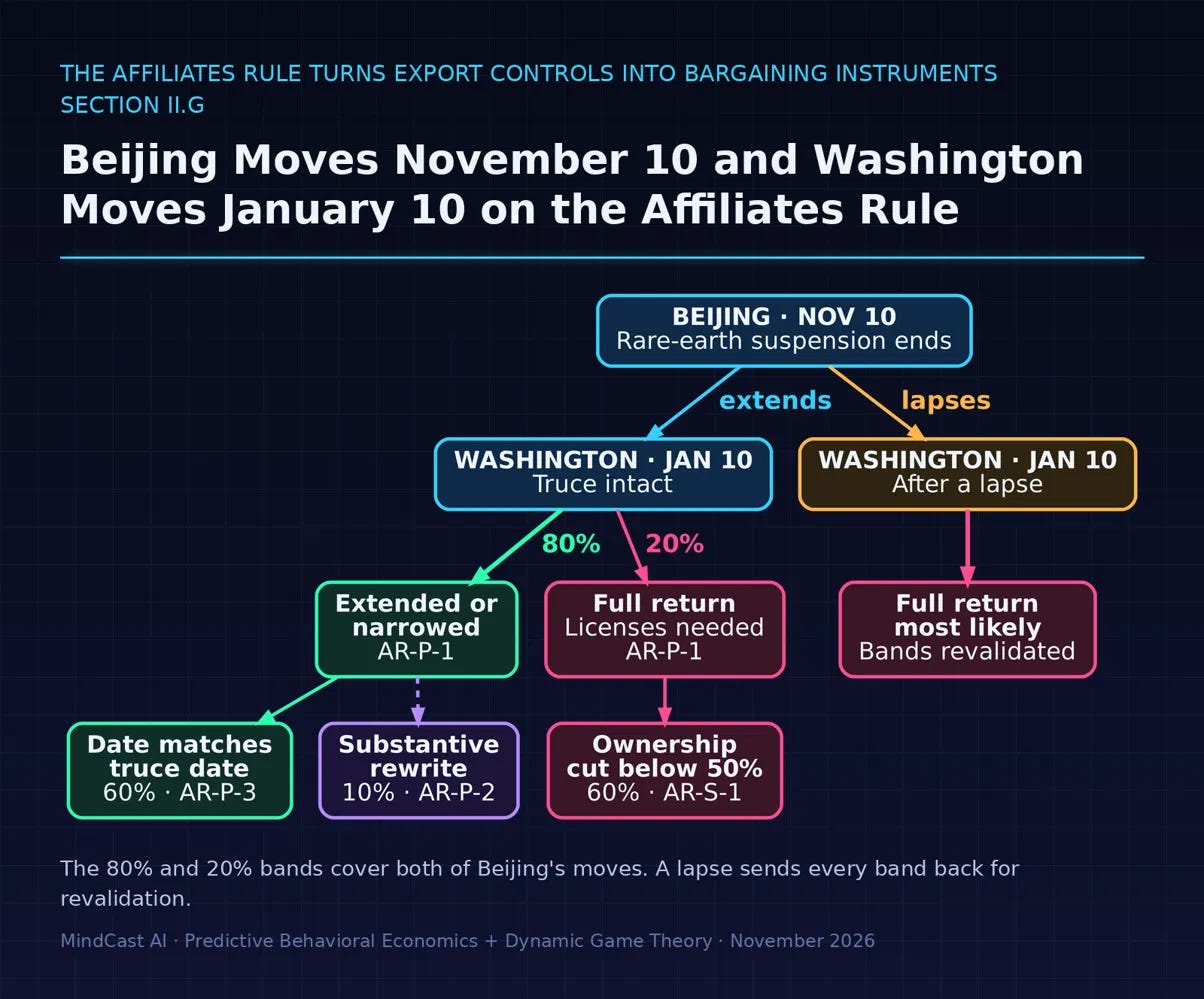
Validity conditions. The Simulation Predictions in Section III hold while each condition below holds.
Both suspensions stay tied to the truce. Broken if Beijing lets its November 10 suspension lapse with no replacement. Result: AR-P-1 needs revalidation, and the tail route becomes modal.
No statute alters the rule. Broken if Congress legislates on affiliate coverage. Result: AR-P-1 to AR-P-3 give way to Simulation Predictions conditioned on the statute.
The game stays a two-government bargain. Broken if a leader-level deal folds the rule into a wider agreement. Result: The paper’s Simulation Predictions give way to ones conditioned on the deal terms.
Enforcement reach stays constant. Broken if remote-access authority or allied enforcement raises the gain from activation. Result: AR-P-1 needs revalidation against the transmission-expectation test in III.C.
Hand-off to the companion paper. The January 10 outcome becomes the starting state for the Enforcement Incidence paper. A full return opens its ownership-restructuring branch, and an extension keeps its current channel mix in place.
AI Chip Export Enforcement War Game Shows When Verification Protects US Firms and When It Arrives Too Late(2026) plays the November 10 and January 10 decisions seat by seat. It shows how each branch moves exporters, hosts and lenders, which this paper’s validity conditions summarize.
The paper’s Simulation Predictions hold inside one bargaining game until one of four named events changes its rules.
III. MindCast Simulation Predictions Favor Continued Suspension on January 10
MindCast Foresight Simulation Predictions favor continued suspension or narrowing at the January 10 decision. The paper carries six: three Primary and three Secondary. Bands carried from MindCast’s October 31, 2026 forecast set keep their original terms. AR-P-2 and AR-P-3 carry bands from MindCast’s November 8, 2026 simulation, and the propositions in III.C carry support levels instead.
Simulation synthesis.
Dominant mechanism: Paired suspensions on matching clocks inside one conditional bargaining game.
Active regime: Rolling extensions tied to truce dates.
Replacement conditions: Lapse of China’s rare-earth suspension; a leader-level deal; a security shock; a gain in US enforcement reach.
Behavioral equilibrium: Delay on both sides while each side delivers enough to justify another round.
Institutional sufficiency: BIS can act by notice; no statute is needed in any branch.
Scenario structure.
Base: further suspension. Washington keeps the rule as leverage. Sequence: Truce extended, then BIS notice. Trigger: Terms at Shenzhen (November 18–19) or Miami (December 14–15). Weight: Inside the 80% band.
Secondary: modified rule. BIS narrows scope or adds exceptions using deferred comments. Sequence: Partial deal, then a substantive rule. Trigger: US pressure to show movement. Weight: 10%, inside the 80% band.
Tail: full return. Concessions deteriorate, security priorities override delay or enforcement reach improves. Sequence: Defection on either clock. Trigger: Beijing lets its suspension lapse. Weight: 20%.
III.A The Suspension Most Likely Continues or Narrows Through January 10
Three primary Simulation Predictions carry the January decision. The three test whether the suspension continues, whether the rule changes in substance and whether its dates track the truce.
AR-P-1 | Affiliates Rule Extended or Narrowed at January 10 (80% Extended or Narrowed, 20% Full Return)
Forecast statement: By January 10, 2027, BIS extends or narrows the Affiliates Rule suspension rather than letting the rule return at full scope.
Confidence band: 80% extended or narrowed / 20% full return.
Time window / gate: Through January 10, 2027.
Trigger conditions: Truce extension at Shenzhen or Miami; China extends its own suspension.
Explicit falsifier: The rule returns at full scope on or after January 10 with no new BIS notice.
Verification source: BIS notices.
Stakeholder exposure: US exporters with affiliates of listed parties; Chinese affiliates.
Monitoring signal: MOFCOM action on November 10; leader-meeting terms.
AR-P-2 | Modified Rule Rather Than a Clean Extension (10%)
Forecast statement: BIS issues a rule by January 10, 2027 that changes the scope, exceptions or timing conditions of the Affiliates Rule rather than its end date alone.
Confidence band: 10%.
Time window / gate: Through January 10, 2027.
Trigger conditions: A partial deal; US pressure to show substantive movement.
Explicit falsifier: A timing-only extension, or full return.
Verification source: BIS notices.
Stakeholder exposure: Counsel and exporters positioned for exceptions.
Monitoring signal: BIS statements on the deferred public comments.
AR-P-3 | Extension Dates Track Truce Dates (60% Given a Dated Extension)
Forecast statement: Any further extension with an end date issued by January 10, 2027 sets that date to match a US–China truce date announced by either government.
Confidence band: 60% given a dated extension.
Time window / gate: Through January 10, 2027.
Trigger conditions: A new truce date announced at Shenzhen or Miami.
Explicit falsifier: An extension end date with no matching announced truce date. If no further extension with an end date issues, the Simulation Prediction does not activate.
Verification source: BIS notices; Treasury and Ministry of Commerce of China statements.
Stakeholder exposure: Policymakers testing the bargaining explanation.
Monitoring signal: Truce announcements at the leader meetings.
AR-P-1 carries its band from the October 31 forecast set, and the November 8 simulation supplies the other two. The second and third test the bargaining explanation directly.
III.B A Full Return Would Trigger Ownership Restructuring, Financing Scrutiny and Designations
Three secondary Simulation Predictions follow the main decision into ownership, financing and designation.
AR-S-1 (60%): P(a China-linked artificial intelligence (AI) hardware customer or host reports ownership cut below 50% given full return). Window: Six months after full return. Trigger: Full return; falsifier: No reported reduction.
AR-S-2 (70%): Congress names People’s Republic of China (PRC) lease financing of controlled AI hardware.Window: By June 30, 2027. Trigger: Hearings or letters on state lessors; falsifier: No such reference.
AR-S-3 (20%): BIS or Treasury designates a PRC lessor or state-capital vehicle. Window: By December 31, 2027. Trigger: none, holds on every path; falsifier: No designation.
Each secondary Simulation Prediction depends on the January outcome or on congressional attention, so each moves with the primary set.
III.C Beijing’s November 10 Decision Gives the First Test of the Bargaining Explanation
Beijing’s November 10 decision and seven propositions test the mechanism behind the Simulation Predictions.
Beijing’s mirror move. China’s rare-earth suspension ends November 10, 2026. Beijing can extend it, narrow it or let it lapse. A lapse with no replacement would move the tail route toward the modal branch.
Interpretive propositions. Seven propositions test the mechanism, each with a support level rather than a band.
AR-H1 Reciprocal timing. BIS and MOFCOM actions keep tracking negotiated dates. Support: Moderate to High. Contradicted by: Decisions uncoupled from negotiated dates.
AR-H2 Exercise cost. Activation cost favors suspension while concessions hold. Support: Moderate. Contradicted by: Return of the rule while Chinese concessions stay intact.
AR-H3 Modification over deferral. Substantive modification becomes preferable to indefinite deferral. Support: Moderate. Contradicted by: Repeated timing-only extensions.
AR-H4 Planning cost. Repeated short extensions raise exporters’ screening and contract costs. Support: Moderate. Contradicted by: Stable measured exposure in disclosures.
AR-H5a Suspension despite deterioration. Washington keeps suspending after mineral licenses or customs volumes run below agreed levels for a full quarter. Support: Moderate. Contradicted by: Reimposition or substantive modification at the next decision date.
AR-H5b Reciprocal punishment. After a documented defection, meaning a violation of a suspended obligation, the injured side restricts at its next decision date. Support: Low to Moderate. Contradicted by: An extension by the injured side after a documented defection.
AR-H6 Transmission expectation. Willingness to activate rises with evidence that enforcement reaches Chinese capability. Support: Moderate. Contradicted by: Activation with no gain in reach while concessions hold.
Beijing’s November 10 move tests the first proposition within days. The others resolve as concessions, extensions and enforcement reach develop through 2027.
III.D The Bargaining Game Holds Unless a Security Shock or Leader-Level Deal Replaces It
A security shock outside the trade relationship could trigger full return without any defection on rare earths. A leader-level deal could fold the rule into a broader agreement and replace the game before January 10.
AR-P-1 carries the January decision, while AR-P-2, AR-P-3 and seven propositions test which cause drives it.
IV. Mitigation Bought Before January 10 Is Worth More Than Mitigation Bought After
Each audience has moves worth making before January 10.
Timing decides most of the value. The War Game found that verification bought before a closing date reduces exposure, while the same program after a filing mostly shapes penalties.
Stakeholder strategy.
🏛️ Policymakers. Objective: Keep the rule credible as leverage. Move now: Condition extensions on verified mineral flows; if triggered: Support modification if AR-P-2 develops. Main risk: Leverage erodes through routine deferral.
💼 Executives. Objective: Protect affiliate revenue. Move now: Map customer ownership to 50%; if triggered: Stage license applications if the tail route activates. Main risk: Undisclosed beneficial owners.
⚖️ Counsel. Objective: Shape any modified rule. Move now: Prepare comments and exception requests; if triggered: File early if BIS signals modification. Main risk: A clean return with no exceptions.
📊 Investors. Objective: Evaluate exposed exporters correctly. Move now: Identify revenue tied to listed-party affiliates; if triggered: Model exposure under each January branch. Main risk: Surprise collapse between meetings.
Strategic posture by stakeholder. Policymakers hold the strongest lever: a delivery test attached to each extension restores the rule’s credibility without spending it (AR-P-1, AR-P-3). Executives gain nothing from waiting, because screening work pays on two of three routes. Counsel should prepare for AR-P-2 despite its 10% band, because a modification would compress the exception window. Investors should read November 10 as the earliest signal of the tail route.
Risk mitigation by Simulation Prediction. Each row routes one Simulation Prediction to one audience in that audience’s terms. The band gives probability from the simulation, and severity is rated separately. Exposure is what the audience loses if the Simulation Prediction resolves true and it has done nothing.
AR-P-1 Suspension extended or narrowed · 💼 Executives · band 80% · medium severity
Exposure. One more quarter of affiliate contracts signed with no clause for a license requirement.
Actions. Contracts lead adds a license-contingency clause to affiliate renewals by January 10; compliance finishes ownership screening to the 50% line by December 31.
Residual. A narrowed rule can redraw the screen and bring screened customers back into scope.
AR-P-1 Suspension extended or narrowed · 🏛️ Policymakers · band 80% · medium severity
Exposure. The next decision moves into the 120th Congress session calendar with no measured concession attached.
Actions. Commerce and Trade Representative staff attach a mineral-delivery metric to the next extension by January 10; committee staff request a BIS briefing on the metric before December 14.
Residual. The metric relies on Chinese customs data that Washington cannot fully verify.
AR-P-2 Modified rule rather than a clean extension · ⚖️ Counsel · band 10% · high severity
Exposure. Days of the comment and exception window lost to drafting from scratch.
Actions. Trade counsel drafts exception requests for 50%-owned affiliate categories by December 1; regulatory counsel prepares a comment for filing within seven days of any notice.
Residual. A modification can set thresholds outside the drafted categories.
AR-P-3 Extension dates track truce dates · 📊 Investors · band 60% given a dated extension · medium severity
Exposure. Multiple compression for exporters whose affiliate revenue sits on a truce clock.
Actions. Portfolio risk staff map affiliate revenue to truce dates by November 18; research staff model each holding under timing-only and modification branches before December 14.
Residual. Leader meetings can move truce dates with days of notice.
AR-S-1 P(ownership cut below 50% given full return) · 💼 Executives · band 60% · high severity
Exposure. Share of affiliate revenue whose owners fall out of screening after restructuring.
Actions. Compliance extends screening to stakes of 25% or more within 30 days of any return; contracts lead adds ownership-change notice clauses before January 10.
Residual. Nominee holdings and leasebacks can hide control, though the same screening lowers exposure in the companion paper.
AR-S-2 Congress names PRC lease financing · 💼 Executives (lenders) · band 70% · medium severity
Exposure. Discovery scope of congressional document requests reaching AI hardware lease books.
Actions. Credit risk identifies state-capital counterparties in AI hardware leases by March 31, 2027; legal sets a document-hold scope for those files before June 30, 2027.
Residual. Letters can name structures a lender cannot see through.
AR-S-3 Financier designation · 💼 Executives (hosts and lenders) · band 20% · high severity
Exposure. Quarters of lease revenue tied to a lessor that becomes designated.
Actions. Contracts lead adds sanctions-termination clauses to new leases from now; treasury operations map lessor ownership by March 31, 2027.
Residual. A designation can arrive with a short wind-down period.
Screening now pays on every route except a clean extension, where it costs little.
V. Negotiating Calendars Now Set the Timing of Export-Control Law
The Simulation Predictions shift who sets export-control timing, who bears its cost and what would disprove the bargaining thesis.
V.A Commerce Keeps Legal Authority While the Truce Calendar Sets the Timing
The repeated suspensions couple the rule’s implementation calendar to the trade negotiations. BIS keeps legal and administrative control of the rule, while the timing tracks truce dates (AR-P-3). A modified rule would show BIS using the deferred comments to reshape the rule itself (AR-P-2).
Authority over the rule stays with BIS in law, while the negotiating calendar sets its timing in practice.
V.B Concession Delivery and Enforcement Reach Decide Whether Restraint Holds
Both governments choose their next move by weighing what restraint earns against what restriction gains.
Beijing matches a US extension while US restraint is worth more to it than holding its mineral leverage. The equilibrium holds while both sides deliver enough. A delivery failure on rare earths is the most likely defection, because US officials have pressed on mineral flows throughout the truce.
Better enforcement reach would shift Washington’s side of the calculation. A remote-access rule that covers rented compute would complement the Affiliates Rule by limiting an alternative acquisition channel (AR-H6). The rule itself gains effectiveness only to the extent that affiliates denied hardware would otherwise rent the same capability abroad. Allied enforcement and location verification would work the same way.
Stronger reach can also make the bargain harder to hold. In MindCast’s analytical model, higher transmission enlarges the payoff region where mutual restriction stays stable once reached. 🏛️ Policymakers should weigh enforcement improvements against the truce terms they put at risk.
Concession delivery and enforcement reach therefore decide whether the equilibrium holds.
V.C Exporters Bear the Cost of Delay While Washington Gains Bargaining Position
US exporters bear the uncertainty cost of each short extension. Chinese affiliates gain time to restructure. The White House keeps a bargaining chip at low cost, which explains its preference for delay.
The cost of delay falls on exporters, while its gains accrue to Washington’s bargaining position.
V.D A Full Return Puts Every Affiliate Sale Under License
On a full return, exporters need licenses for affiliate sales immediately, and AR-S-1 opens.
The political cost of exercising a chokepoint limits the coercive value of possessing it (AR-H2).
The rule couples timing to negotiators, cost to exporters and time to Chinese affiliates.
Beijing’s November 10 Decision Is the First Signal to Watch
Eight signals move the Simulation Predictions, and Beijing’s November 10 decision arrives first.
MOFCOM action on Announcement No. 70 of 2025 (AR-P-1). Source: Ministry of Commerce of China. Cadence: November 10. Effect: Route weight; tail activation if lapse.
China’s gallium, germanium and antimony suspension (AR-P-1). Source: Ministry of Commerce of China. Cadence: November 27. Effect: Route weight.
Shenzhen leader-meeting terms (AR-P-1, AR-P-3). Source: White House; Chinese readouts. Cadence: November 18–19. Effect: Trigger for base route.
Miami Group of Twenty (G20) summit terms (AR-P-1, AR-P-3). Source: White House; Chinese readouts. Cadence: December 14–15. Effect: Trigger for base route.
BIS statements on deferred comments (AR-P-2). Source: BIS. Cadence: Weekly. Effect: Secondary route weight.
Chinese mineral export licenses and customs volumes (AR-H5a). Source: Ministry of Commerce of China; customs data. Cadence: Monthly. Effect: Concession measure for the bargaining game.
Gains in US enforcement reach (AR-H6). Source: Congress.gov; BIS; allied notices. Cadence: Weekly. Effect: Gain from activation.
BIS notice (All primaries). Source: BIS. Cadence: Daily from December 15. Effect: Resolution.
The Affiliates Rule Keeps Its Value as a Suspended Threat
The Affiliates Rule holds its value as a suspended threat matched against China’s rare-earth controls. Washington keeps it suspended while concessions plus activation cost exceed the gain from activation.
The January 10 decision favors continued suspension or narrowing at 80%. A substantive rewrite by that date carries 10%, and a dated extension matches the truce date at 60%. The analytical model adds that the rule’s bargaining value rises and falls with its expected reach.
Stakeholders should screen ownership now and wait to learn the leader-meeting terms. The decisive signal is Beijing’s November 10 move: a matching extension keeps the game stable, and a lapse makes full return the modal outcome. A gain in US enforcement reach is the second signal, because it raises the gain from activation.
Working With MindCast
A published paper cannot tell a specific exporter which of its customers fall under a returned Affiliates Rule. The answer depends on ownership chains, contract terms and license history that only the firm holds.
A commissioned Snapshot builds Cognitive Digital Twins for the firm’s own counterparties and runs the January 10 decision against its customer base. MindCast works from the firm’s ownership data and order schedules under a non-disclosure agreement and delivers within five to seven business days.
Each question below maps to the engagement that answers it and the Simulation Predictions it extends.
Which of our customers fall under a returned Affiliates Rule? Commissioned Snapshot with an ownership overlay (AR-P-1, AR-S-1).
Will the rule come back narrowed, and which exceptions should we request? Rule-change review with a draft exception request (AR-P-2).
Do our leases or loans touch a Chinese state-backed lessor? Financing overlay that maps owners, operators and financiers (AR-S-2, AR-S-3).
How does our position fare through November 10 and January 10? War game session in which the firm’s counsel plays its own seat.
A firm that screens ownership before January 10 keeps its customers on every branch. Contact mcai@mindcast-ai.com. Explore MindCast simulations, war games and commissioned work at www.mindcast-ai-simulation.com.
Appendix A. MindCast Works That Supply the Evidence
Prior MindCast work supplies the bands, a playable version of the game and the validated two-gate model.
Companion paper
Enforcement Incidence and Capability Denial in Artificial Intelligence Export Controls. Supplies the transmission estimate and the capability-denial analysis that complete this paper’s bargaining game.
Prior simulations and validations
The Beijing Summit Validation — Geopolitical Ripples for the AI Industry Across the Three-Layer Equilibrium. Validated the two-gate model in which Beijing’s acceptance matters as much as Washington’s license.
AI Chip Export Enforcement Shifts Risk Onto US Firms as China Demand Moves to Domestic Chips, Rented Compute and State Financing. Supplies the bands for AR-P-1 and the secondary forecasts.
AI Chip Export Enforcement War Game Shows When Verification Protects US Firms and When It Arrives Too Late. Plays the bargaining game seat by seat across the November and January decisions.
Related analysis
The Runtime Export Problem — Anthropic’s 151 Million-Exchange Distillation Record, Advisory AA26-251A, and the Question Commerce Cannot Yet Answer. Shows that AI model outputs form a channel export law does not yet reach, which lowers the expected reach of hardware controls.
Anthropic, Alibaba and the Runtime Theft Problem — How Attribution Cost Moves Frontier-AI Distillation Enforcement From the Courtroom to the Statute. Explains why the cost of proving extraction pushes enforcement toward statute and reachable intermediaries.
The Runtime Global Data Market — When Stolen AI Interactions Become a Strategic Technology Supply Chain. Supplies the composition-over-volume finding behind the low-expected-effectiveness explanation.
Each work is published and linked, so a reader can check the October 31 bands and the two-gate model directly.
Appendix B. External Sources Behind the Factual Claims
External sources supply the legal texts, dates and expiry clocks the paper relies on.
Public inspection copy, FR Doc. 2026-22793. Primary text of the November 5 extension.
Nixon Peabody, BIS Formally Suspends the Affiliates Rule Until January 10, 2027, November 6, 2026. Confirms the timing-only scope and deferred comments.
90 FR 50857, One-Year Suspension of Expansion of End-User Controls for Affiliates of Certain Listed Entities. Primary text of the 2025 suspension.
CIRS, summary of MOFCOM Announcement No. 70 of 2025. Supplies China’s November 10, 2026 expiry.
JD Supra, China Suspends Export Controls on Certain Critical Minerals and Related Items. Supplies the November 27, 2026 expiry.
White House, Fact Sheet: President Donald J. Trump Strikes Deal on Economic and Trade Relations with China, November 1, 2025. Pairs the Affiliates Rule suspension with China’s rare-earth pause.
Bloomberg Government, Bessent Says US, China Extend Their Trade Truce to Jan. 10, September 23, 2026. Supplies the truce extension BIS later matched.
China Briefing, US and China Reach Trade Concessions Following Trump-Xi Meeting. Supplies the April 2025 rare-earth licensing regime.
Clark Hill, China Hits Pause on Rare-Earth Export Controls and What It Means for Supply Chains. Confirms that Article 1 of Announcement No. 46 stays in force.
Thomson Reuters, China publishes decision adding 10 US entities to export control list, June 24, 2026. Supplies Announcement No. 23 of 2026.
Al Jazeera, China adds 10 US firms, including rare-earth miner, to export control list, June 22, 2026. Links the listing to the Pentagon blacklist.
The Next Web, Oracle cancels $7B Tencent AI chip lease under US pressure, FT reports, November 4, 2026. Supplies Washington’s use of an instrument outside the truce.
Pillsbury, BIS Affiliates Rule. Confirms that reimposition needs no legislation.
The rule texts and the Ministry of Commerce announcements carry the dates on which every Simulation Prediction turns.
Appendix C. Research on Coercion, Sanctions and Bargaining the Paper Extends
Three bodies of research frame the paper: work on coercive threats and chokepoints, game-theoretic foundations and evidence on what sanctions cost.
Closest Works
Five works address the paper’s question most directly.
Daniel W. Drezner, The Hidden Hand of Economic Coercion, International Organization 57, no. 3 (2003): 643–659.Drezner shows that successful coercion should end at the threat stage, because a target that prefers conceding acts before the sanction is imposed. The paper studies the mirror case: a sender holds a fully written restriction and keeps deferring it, with the deferral matched by the target’s own suspended counter-instrument.
Christopher Clayton, Matteo Maggiori and Jesse Schreger, A Framework for Geoeconomics, NBER Working Paper 31852 (2023, revised 2024). The framework locates geoeconomic power in a hegemon’s ability to coordinate threats across economic relationships and demand costly actions from targets. The paper adds a measurable condition for when a threat stays unexercised: activation pays only when its strategic gain exceeds concessions at risk plus activation cost.
Henry Farrell and Abraham L. Newman, Weaponized Interdependence: How Global Economic Networks Shape State Coercion, International Security 44, no. 1 (2019): 42–79. Farrell and Newman explain how control of network hubs gives states chokepoint power. The paper studies the cost of using that power when the target holds a chokepoint of its own, here in rare earths. It adds that realized coercive value depends on exercise cost and on transmission through adaptive networks.
Eugene Gholz and Llewelyn Hughes, Market Structure and Economic Sanctions: The 2010 Rare Earth Elements Episode as a Pathway Case of Market Adjustment, Review of International Political Economy 28, no. 3 (2021): 611–634. The authors show that Japan adjusted to China’s 2010 rare-earth embargo and avoided much of its cost. The paper treats Beijing’s mineral leverage as one quantity in the bargaining game, so market adjustment lowers the value of Beijing’s counter-threat over time.
Jonathan Eaton and Maxim Engers, Sanctions, Journal of Political Economy 100, no. 5 (1992): 899–928. Eaton and Engers model sanctions as a strategic game in which costs to both sides shape threats and concessions. The paper extends the logic to repeated suspensions on matching clocks between two governments that each hold a restriction.
The five works explain why threats work and when they cost the sender. The paper adds the interaction among activation cost, a reciprocal chokepoint and expected enforcement transmission.
Theoretical Foundations
Eight works supply the game theory and political economy the paper builds on.
Thomas C. Schelling, Arms and Influence (Yale University Press, 1966). Schelling defines coercion as the power to hurt held in reserve. The paper’s central claim follows from it: a suspended rule carries value because activation remains possible.
James D. Fearon, Rationalist Explanations for War, International Organization 49, no. 3 (1995): 379–414. Fearon explains bargaining breakdown through private information and commitment problems. Both mechanisms appear in the paper’s breakdown region, where mutual restriction follows a defection.
Robert Jervis, Cooperation Under the Security Dilemma, World Politics 30, no. 2 (1978): 167–214. Jervis frames cooperation as an Assurance problem in which both sides prefer restraint but fear exploitation. The paper’s Assurance region applies that game to paired export restrictions.
Robert Axelrod, The Evolution of Cooperation (Basic Books, 1984). Axelrod shows how repeated play sustains cooperation in a Prisoner’s Dilemma. The paper’s repeated bargaining game uses the same mechanism and states its threshold as a theoretical condition.
Daniel W. Drezner, The Sanctions Paradox: Economic Statecraft and International Relations (Cambridge University Press, 1999). Drezner argues that expected future conflict shapes whether coercion between rivals succeeds. The paper applies that argument to a truce in which both sides expect continued rivalry.
William H. Kaempfer and Anton D. Lowenberg, The Theory of International Economic Sanctions: A Public Choice Approach, American Economic Review 78, no. 4 (1988): 786–793. The authors trace sanctions policy to domestic interest groups. The paper’s behavioral layer draws on the same insight: visible concessions carry high salience for the White House.
Albert O. Hirschman, National Power and the Structure of Foreign Trade (University of California Press, 1945).Hirschman shows how asymmetric dependence becomes leverage. The paper’s two-gate structure, in which Beijing’s acceptance matters as much as Washington’s license, follows from it.
David A. Baldwin, Economic Statecraft (Princeton University Press, 1985). Baldwin argues that economic tools should be judged against their costs and alternatives. The paper’s activation-cost term puts that argument into the payoff structure.
The foundations supply the paper’s three game forms and its behavioral layer.
Empirical and Policy Evidence
Three works supply the case base and cost evidence the paper draws on.
Gary Clyde Hufbauer, Jeffrey J. Schott, Kimberly Ann Elliott and Barbara Oegg, Economic Sanctions Reconsidered, 3rd ed. (Peterson Institute for International Economics, 2007). The volume supplies the standard case base on sanctions outcomes. The paper adds a case in which the restriction is never imposed and still shapes the bargain.
Matteo Crosignani, Lina Han, Marco Macchiavelli and André F. Silva, Securing Technological Leadership? The Cost of Export Controls on Firms, Federal Reserve Bank of New York Staff Report No. 1096 (2024, revised 2025).The study measures losses to US suppliers from export controls. The paper uses that evidence for Washington’s activation cost.
Nicholas Mulder, The Economic Weapon: The Rise of Sanctions as a Tool of Modern War (Yale University Press, 2022). Mulder traces how sanctions moved from wartime blockade to peacetime coercion. The paper studies a later stage, where a restriction serves as a bargaining chip inside a trade truce.
The literature explains why threats work and why sanctions cost the sender, and the paper adds the condition under which a ready threat stays unused.