

Justice Department · Bureau of Industry and Security · Congress · Beijing · Taiwan · Malaysia · Japan · Nvidia · Super Micro · Oracle · Tencent · ByteDance
A Control’s Expected Reach Helps Determine Whether Washington Uses It
Two papers in The Economics of Export-Control Effectiveness series studies one limit on American export controls against China. The Affiliates Rule Turns Export Controls Into Bargaining Instruments asks when using a control costs Washington more than holding it. Enforcement Incidence and Capability Denial in Artificial Intelligence Export Controlsasks when a control in force fails to reach Chinese capability.
Transmission links the answers, measured as the share of China’s foreign-chip and rented-compute capability that a control actually denies. Higher transmission makes a control more tempting to use and a broken truce harder to repair, while Chinese substitution lowers transmission and drains the control’s bargaining value the longer Washington holds it.
Geoeconomic power therefore arrives in three steps. Nominal control means Washington holds legal authority over a chokepoint. Credible exercise means it can activate the control without losing more than it gains, and effective transmission means activation still constrains China after it adapts.
Related MindCast works.
The Affiliates Rule Turns Export Controls Into Bargaining Instruments. Explains when Washington uses or holds back an export control it already has. The January 10 decision on the Affiliates Rule sets the starting point for this paper’s forecasts.
AI Chip Export Enforcement Shifts Risk Onto US Firms as China Demand Moves to Domestic Chips, Rented Compute and State Financing. MindCast’s October 31, 2026 forecasts on AI chip enforcement, which this paper carries forward. The forecast set also maps the three ways Chinese buyers get compute: chip purchases, offshore rental and state-backed financing.
Tencent, Oracle, and the Remote-Access Gap in US AI Chip Export Controls. Explains why Chinese firms can rent advanced US chips in overseas data centers without breaking current export rules.
Cross-Border AI Compute — Access Rules, Clean Power and Local Approval Decide Which Operators Win. Shows which data center operators would win under different rules on who may rent advanced compute.
The Runtime Global Data Market — When Stolen AI Interactions Become a Strategic Technology Supply Chain. Found that enforcement against stolen AI model outputs changed how China acquired them more than how much it acquired. The Enforcement Incidence paper tests whether the same holds for computing hardware.
I. Export Controls Deny Part of China’s Capability, but Who Pays Remains Open
On October 1, 2026, prosecutors arrested Greg Lui of Earthmade Computer over about $300 million in Nvidia servers routed to China (Bloomberg Law). The same week, reports surfaced that Tencent leases about 100,000 accelerators from Oracle in Southeast Asia (Network World). One enforcement action disrupted an alleged hardware-diversion route while a far larger rental arrangement remained legal.
A month later, Oracle canceled the Tencent lease after US officials raised concerns, according to the Financial Times (The Next Web). No statute or charge forced the cancellation, and the US host lost the contract. Officials in Guangdong, Tencent’s home province, also pressed the company to back Chinese-made chips.
The paper’s central hypothesis is that US export enforcement lands on the parties it can reach rather than the party that gains the capability. Ordinary offshore rental of compute to a China-parented tenant, meaning one owned by a company headquartered in China, does not by itself count as a controlled hardware export under current Export Administration Regulations. The US vendor, host and lender tied to the transaction face commercial exposure, and some face direct legal duties.
MindCast’s analytical model finds that export controls impose meaningful capability denial, and domestic substitution reduces the marginal effectiveness of successive controls without eliminating the initial effect. The paper also tests whether enforcement and commercial costs shift toward reachable intermediaries, measuring who gets charged, who loses money and how much capability China loses as separate outcomes.
Three routes compete to explain what enforcement does to capability: displacement into other channels, deterrence of total acquisition and independent substitution that would occur anyway. MindCast’s analytical model favors partial deterrence. Across the tested model variants, it estimates mean net training-capability denial of 13-23% against a modeled no-control counterfactual, with independent substitution second and displacement into rental last.
Method. MindCast AI applies Predictive Behavioral Economics + Dynamic Game Theory through MindCast AI Proprietary Cognitive Digital Twin Foresight Simulations (MP CDT FS). Behavioral Economics supplies the decision rules. Game Theory supplies the payoff structure. Predictive simulations emerge from the combination.
Approach. The paper models four interacting games across short and long horizons. Enforcers anchor on salient shipments, and Beijing binds procurement to a self-reliance identity.
What the paper does. It issues MindCast Foresight Simulation Predictions and measures targeting, monetary cost and capability denied as separate outcomes. It tests them against a counterfactual that separates US controls from Beijing’s own procurement policy. Section II builds the games and maps how they evolve, Section III states the Simulation Predictions, Section IV maps risk mitigation by audience and Section V draws the implications.
Resolved Simulation Prediction. China’s H200 Import Block and the Reordering of National Innovation Control (2026) forecast in January 2026 that Beijing would block commercial H200 purchases. The Beijing Summit Validation — Geopolitical Ripples for the AI Industry Across the Three-Layer Equilibrium (2026) confirmed the block, and licensed H200 shipments later stayed under 1% of Nvidia’s quarterly data center revenue (Bloomberg Tax).
Simulation Prediction highlights. Four of the paper’s eleven Simulation Predictions lead the slate. P marks a Primary Simulation Prediction and S a Secondary one.
EI-P-1 (50%): Fourth China-parented offshore lease of 10,000 or more accelerators reported. Window: by June 30, 2027.
EI-P-2 (70%): Corporate-level resolution with a US vendor, server maker or distributor over diversion.Window: by October 31, 2027.
EI-P-3 (20% enacted, 80% lapse): Congress enacts remote-access authority over tenants or hosts. Window: by January 3, 2027.
EI-S-1 (80%): P(new offshore lease reported given a corporate resolution). Window: 12 months after the resolution.
Stakeholder readout.
🏛️ Policymakers. Channel-level success does not prove capability denial. Design a test that reaches the party gaining the capability before the next enforcement cycle. Window: Through 2027 (EI-S-1).
💼 Executives. US vendors, hosts and lenders carry exposure in every channel. Audit resellers and verify tenants. Window: Before the next annual report (EI-P-2).
⚖️ Counsel. Exposure follows legal nexus, not beneficiary location. Write lease clauses that work under both the House and Senate remote-access bills. Window: Before January 3 (EI-P-2, EI-P-3).
📊 Investors. Domestic Chinese accelerator demand rises on every path. Evaluate offshore compute on cash flows that survive a rule change. Window: Through 2027 (EI-P-1).
The paper measures which trajectory enforcement produces and who pays for it, not whether enforcement occurs.
II. Four Linked Games Decide Where Enforcement Costs and Capability Land
Four linked games explain where enforcement costs and capability effects land, and each coming event can change them.
II.A Enforcement Keeps Reaching US Firms and Now Reaches Rental Through Hosts
Enforcement keeps reaching US firms. A March 19, 2026 indictment charged Super Micro co-founder Yih-Shyan Liaw over about $2.5 billion in servers sold to a Southeast Asian intermediary (Converge Digest). Prosecutors allege that at least $510 million of those servers reached China, and Super Micro shares fell 33% the next day (Nasdaq).
Every guilty plea so far comes from individuals or a small distributor: Hao Global LLC and its owner in October 2025 (Justice Department) and Super Micro contractor Ting-Wei Sun in October 2026 (Reuters via GV Wire). Liaw’s trial moved from November 2026 to March 2027 after his lawyer raised a grand jury subpoena to Super Micro at a June hearing (Fortune).
Two federal agencies carry the enforcement. The Justice Department prosecutes export crimes, and the Bureau of Industry and Security (BIS) inside the US Department of Commerce writes and enforces the export rules.
Acquisition keeps moving to channels that current hardware rules do not cover. Three China-parented offshore leases have surfaced: Tencent–Datasection in Japan, ByteDance–Aolani in Malaysia and Tencent–Oracle in Southeast Asia. Chinese vendors shipped 41% of artificial intelligence (AI) accelerator cards sold in China in 2025 (Reuters via Yahoo Finance).
In November, pressure reached the rental channel without a new rule. Nvidia told cloud partners to cap Chinese customers at 49% of new contracts, according to the Financial Times (The Next Web). Oracle then canceled the Tencent lease, while ByteDance and Alibaba kept large leasing deals with US providers (Implicator). The cost of the cancellation fell on the US host, the party enforcement could reach.
Tencent, Oracle, and the Remote-Access Gap in US AI Chip Export Controls (2026) explains why the leases fall outside current hardware rules. Washington licenses chips shipped to China-headquartered firms but not compute rented to them. Rules on US persons, technology releases and restricted counterparties can still apply, as can sanctions.
Remote-access authority has two vehicles. The House passed the Remote Access Security Act (H.R. 2683) by 369 to 22 on January 12, 2026 (The Lobby). Senators McCormick and Wyden introduced the companion S. 3519 in December 2025, and it sits in the Senate Banking Committee (GovInfo). Enactment by January 3 needs Senate passage of either bill or insertion of the authority into the fiscal 2027 defense bill (H.R. 8800 or S. 4784) in conference.
Taiwan’s economics minister announced on October 16, 2026 a plan to put AI chips and servers on Taiwan’s export control list and said unauthorized shipments to China could lead to criminal charges under the Foreign Trade Act (Taiwan News). The announcement set no effective date. Lawfare identifies two routes to control: an administrative listing by the Ministry of Economic Affairs or an amendment to the Foreign Trade Act (Lawfare). Lawfare treats listed items as carrying administrative penalties, so the statutory route is the surer path to criminal liability.
Confirmed facts. The indictments, the three leases and the domestic share. Hypotheses. The leases and the domestic share respond to US enforcement rather than to independent demand or Beijing’s own procurement policy.
Enforcement reaches shipments directly, while rental and domestic supply respond to it only indirectly.
II.B Enforcement Should Be Judged by Who Pays and What China Loses Through 2029
US AI chip enforcement through 2029 should be judged by the path it produces and by who bears its cost. The analysis covers enforcement across hardware, rented compute, finance and AI model outputs. The actors include US agencies, Congress, Taiwan and the countries that host leased compute. The Affiliates Rule bargaining game falls outside scope and belongs to the Affiliates Rule paper.
The Runtime Export Problem — Anthropic’s 151 Million-Exchange Distillation Record, Advisory AA26-251A, and the Question Commerce Cannot Yet Answer (2026) traces the model-output channel. Millions of ordinary interactions can add up to a prohibited extraction.
The forecasts cover paths and the distribution of cost, not single decisions.
II.C Provable Shipments Steer Enforcers and Self-Reliance Steers Chinese Buyers
Enforcers anchor on salient physical shipments because invoices and customs papers prove a case. Anthropic, Alibaba and the Runtime Theft Problem — How Attribution Cost Moves Frontier-AI Distillation Enforcement From the Courtroom to the Statute (2026) found that the cost of proving who did what decides where a remedy lives. A named US company is the most salient defendant available. Vendors weigh losses against a China revenue reference point, which shapes their lobbying long after China revenue shrinks.
Beijing binds procurement to a self-reliance identity. The binding explains why a licensed US chip with a performance edge failed to win demand back after the H200 block, as the Beijing Summit Validation documented.
Salience directs enforcement toward US firms, and identity binding locks in domestic substitution.
II.D Four Games Share Actors, So Pressure on One Channel Moves Demand to Another
Four games run at once and share actors. The enforcement game sets the enforcer against US firms and intermediaries. The capability-acquisition game sets Chinese buyers against the menu of imported, domestic, rented and financed compute.
The bargaining game links Washington, Beijing and third countries through licenses, Beijing’s import approvals and rare earths. The institutional-evolution game asks whether adaptation stays inside the existing game or crosses into a new structure. It works as a state-transition model rather than a game with formal equilibrium conditions, which the other three carry. A static model holds the channel set fixed and misses the migration from one channel to the next.
The three-way incidence distinction extends four lines of work. Gary Becker (1968) and George Stigler (1970) explain why enforcers target the cases they can prove. Henry Farrell and Abraham Newman (2019) explain where chokepoint power comes from, and Matteo Crosignani and coauthors (2025) measure what controls cost US suppliers. The paper integrates enforcement targeting, monetary incidence and capability-adjusted strategic outcomes into one analytical framework, using a two-intervention counterfactual to estimate the capability component while treating targeting and cost incidence as separate empirical tests.
Two interventions. US controls and Beijing’s procurement policy each push Chinese buyers toward domestic chips. Beijing blocked H200 imports in January 2026 for its own reasons. The counterfactual therefore separates four cells: neither intervention, US controls only, Beijing policy only and both. US enforcement gets credit only for the substitution it caused.
Capability denied by workload. The paper measures capability denied for each reference workload at both Beijing policy states. The gap between the two measures shows how US controls and Beijing’s policy interact, and training and inference stay separate with no combined measure.
Capability measure. Accelerator counts miss hardware generation, memory limits and utilization. The paper measures capability-adjusted compute actually used, with training and inference reported apart.
Four interacting games and a two-intervention counterfactual capture a system whose parts move at different speeds.
II.E Better Enforcement Makes a Broken Truce Harder to Repair
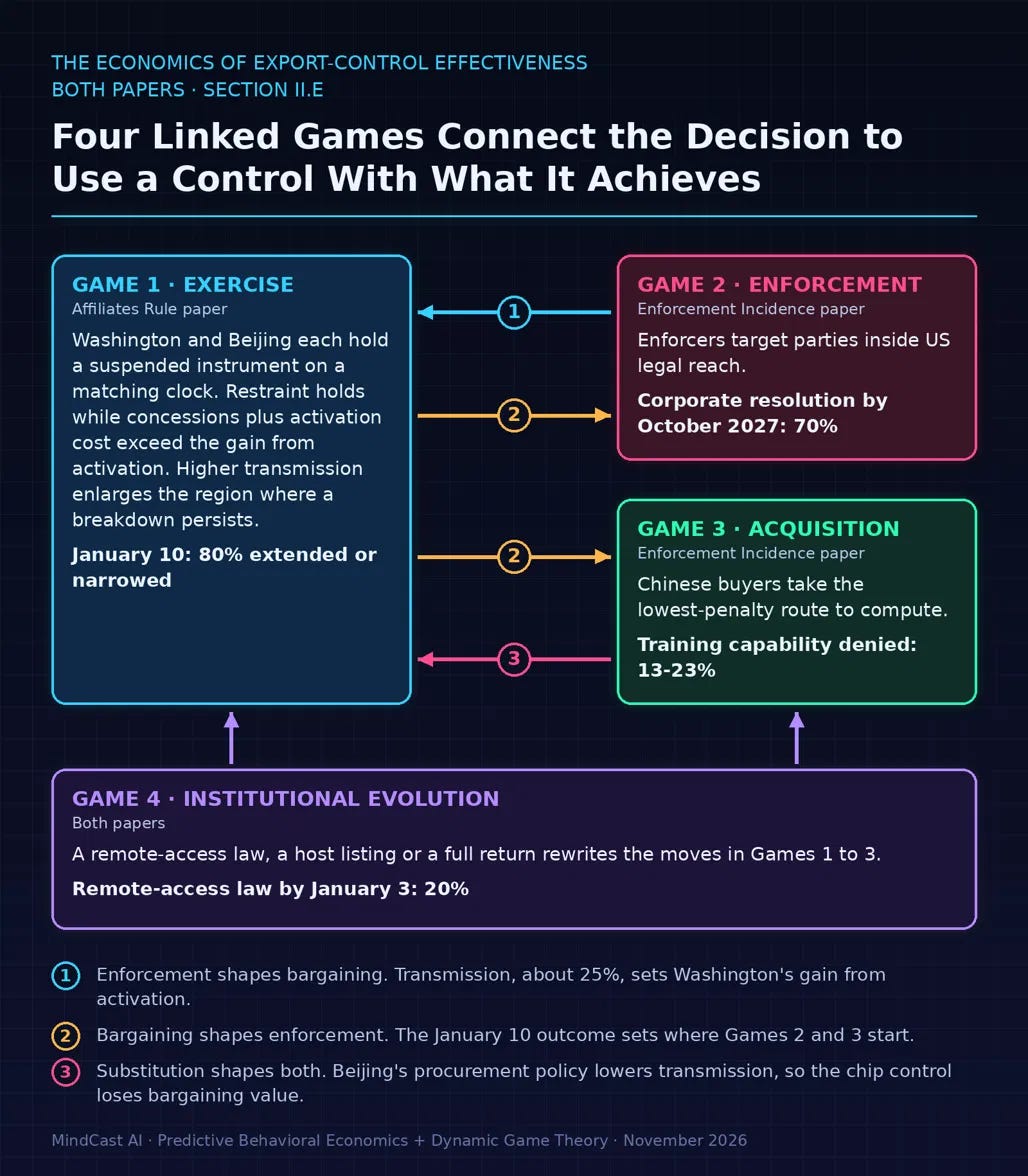
The two companion papers study one strategic system at two horizons: the decision to use a control and what the control achieves once used. The map below sets out each game’s players, moves, payoffs and equilibria. It then names the links that join them.
Game 1. The exercise game (Affiliates Rule paper).
Players. Washington and Beijing, each holding a suspended instrument.
Moves. Washington extends or narrows the suspension, or lets the rule return. Beijing extends its rare-earth suspension or lets its controls return, while its April 2025 licensing regime and its ban on US military users stay in force.
Washington’s payoffs. Restraint earns Chinese concessions and avoids the cost of activation. Restriction earns the strategic value of capability denied, multiplied by transmission.
Beijing’s payoffs. Restraint earns continued US restraint. Restriction keeps mineral leverage and costs Beijing the value of US restraint.
Timing and information. Both sides move on synchronized dates, most recently in November 2025, September 2026 and November 2026. The next date is January 10, 2027. Concessions show up in mineral licenses and customs volumes, while transmission stays uncertain.
Equilibria. Mutual restraint is the only stable outcome where concessions plus activation cost exceed the gain and US restraint outweighs mineral leverage. Where both mutual outcomes are stable, the game takes the Assurance form. Where restriction dominates on both sides yet both prefer restraint, it takes the Prisoner’s Dilemma form.
Game 2. The enforcement game (Enforcement Incidence paper).
Players. The Justice Department and the Bureau of Industry and Security against US vendors, hosts, lenders and intermediaries.
Moves. Enforcers choose targets and charges. Firms choose whether to verify customers before a rule requires it.
Payoffs. Enforcers gain from cases they can prove at low cost. Firms trade compliance cost against penalty and disclosure risk.
Equilibrium. Enforcement concentrates on parties inside US legal reach, which the targeting test in III.C checks.
Game 3. The acquisition game (Enforcement Incidence paper).
Players. China-parented buyers choosing among imported, domestic, rented and financed compute.
Payoffs. Each buyer seeks usable compute by the lowest-penalty route. US controls raise the cost of foreign channels, while Beijing’s procurement policy raises the payoff to domestic chips.
Equilibrium. Channel shares stabilize where marginal costs equalize across routes. Deterrence, displacement and independent substitution are three readings of how the shares move.
Game 4. The institutional-evolution game (both papers).
Question. Does adaptation stay inside the current rules or change them? A remote-access law, a host listing or a full return of the Affiliates Rule each rewrites the moves available in Games 1 to 3.
Three links join the games.
Enforcement shapes bargaining. Transmission sets Washington’s gain from activation in Game 1. Higher transmission enlarges the region where mutual restriction stays stable, so in that region stronger enforcement makes a breakdown harder to reverse.
Bargaining shapes enforcement. The January 10 outcome in Game 1 sets the starting state for Games 2 and 3. A full return adds affiliate sales to the enforcement game.
Substitution shapes both. Beijing’s procurement policy lowers what each successive control denies in Game 3. Lower denial means lower transmission, which shrinks Washington’s gain from activation in Game 1. The chip control therefore loses bargaining value as Chinese substitution grows.
Where behavioral economics enters. Game theory supplies the payoff structure and the set of equilibria. Behavioral economics supplies the decision rules that select among them. Predicted behavior emerges from the combination.
Salient concessions and loss aversion around the suspended rule favor restraint in Game 1. Enforcers anchor on provable shipments in Game 2, and Beijing’s self-reliance identity drives Game 3.
What each audience should take from the map.
🏛️ Policymakers should evaluate any enforcement improvement for its effect on the truce as well as on Chinese capability.
💼 Executives should expect each control to move Chinese demand across channels rather than simply remove it.
⚖️ Counsel should track the January 10 outcome, because it changes which clients sit inside the enforcement game.
📊 Investors should treat the chip control as a bargaining asset that loses value as Chinese substitution grows.
For enforcement incidence, the map shows that what controls achieve feeds back into whether Washington uses them.
II.F Nine Cognitive Digital Twins Test Three Routes, With Partial Deterrence Leading
Nine Cognitive Digital Twins (CDTs) carry the game. Each models one actor’s objective, its constraints and the event that would change its behavior.
BIS. Objective: Enforce export controls. Decision rights: Legal scope against changing technology. Moves on: New diversion evidence.
Justice Department. Objective: Provable cases. Decision rights: Individual against corporate accountability. Moves on: Pending case evidence.
Congress. Objective: Legislate or let remote-access authority lapse. Decision rights: One session; conference text. Moves on: Defense-bill conference.
US suppliers and distributors. Objective: Revenue without legal exposure. Decision rights: Channel audits; disclosure duties. Moves on: Partner indictments.
Compute hosts and operators. Objective: Sell capacity. Decision rights: Tenant visibility; possible host duty. Moves on: Remote-access enactment.
Equipment owners and financiers. Objective: Asset value and returns. Decision rights: Ownership and control rights. Moves on: Designations.
Chinese state and domestic suppliers. Objective: Indigenous capability. Decision rights: Production and yields. Moves on: Procurement mandates.
China-parented compute buyers. Objective: Usable compute by the lowest-penalty route. Decision rights: Workloads and substitutes. Moves on: Rule changes on any channel.
Host and allied governments, including Taiwan. Objective: Investment and security alignment. Decision rights: Enforcement cooperation. Moves on: Control-list designation.
Three competing routes. Displacement: a regulated channel contracts while others expand because of enforcement. Deterrence: restrictions reduce or delay total effective capability. Independent substitution: domestic production and offshore demand expand for reasons that would operate without the enforcement change.
Model evidence. A corporate resolution against a major vendor lowered shipments by 7.5 points and rental by 3.5 points of China-parented tenants’ channel shares in the simulation behind AI Chip Export Enforcement Shifts Risk Onto US Firms as China Demand Moves to Domestic Chips, Rented Compute and State Financing (2026). Domestic accelerators gained 11 points. Hardware enforcement cut both foreign channels in the model, so rental did not absorb the displaced demand. The shifts are simulation output, not observed market change.
Analytical model results. Across the tested model variants, the analytical model estimates mean net training-capability denial of 13-23% relative to its modeled no-control counterfactual. The model covers hardware access through shipments and rental. It excludes controls that cut China’s domestic production, such as limits on chipmaking equipment, so the range does not extend to them.
The 13-23% range measures denial against all of China’s counterfactual training capability, domestic supply included. Measured against foreign chips and rented compute alone, the same denial gives the transmission share of about 25%.
Mean net training denial in the main model variants, with the 10th-90th percentile range in parentheses:
Base case: 18% (9-28%)
Weaker domestic chips: 23% (12-34%)
Stronger domestic chips: 13% (5-22%)
Lower domestic capacity: 18% (4-31%)
Higher domestic capacity: 17% (8-27%)
Full rental utilization: 16% (9-25%)
Domestic chip performance moves the result most, so better evidence on Chinese accelerator performance would narrow the range fastest.
Two further results hold across the tested variants. Beijing’s procurement policy lowers what US controls deny in most configurations, so each successive control achieves less. The transmission share averages about 25%, and inference denial runs below training denial. Targeting and monetary incidence stay separate empirical questions, tested in III.C.
Nine seats and three routes frame the paper, with partial deterrence leading in the analytical model and independent substitution second.
II.G Five Events Can Open or Close Acquisition Paths Through 2027
The enforcement game is still changing. Each event below can open or close acquisition paths and change which Simulation Predictions apply.
How events change the game. Continuation updates information or probabilities inside the current game. Equilibrium migration changes which outcome persists without replacing the game. Game evolution changes the strategies, payoffs or rules once the change takes effect. A change in players or consequential timing also qualifies.
Starting point. Hardware enforcement reaches shipments and ownership. Ordinary rental of compute falls outside current hardware export rules. China-parented buyers mix domestic chips with offshore rental.
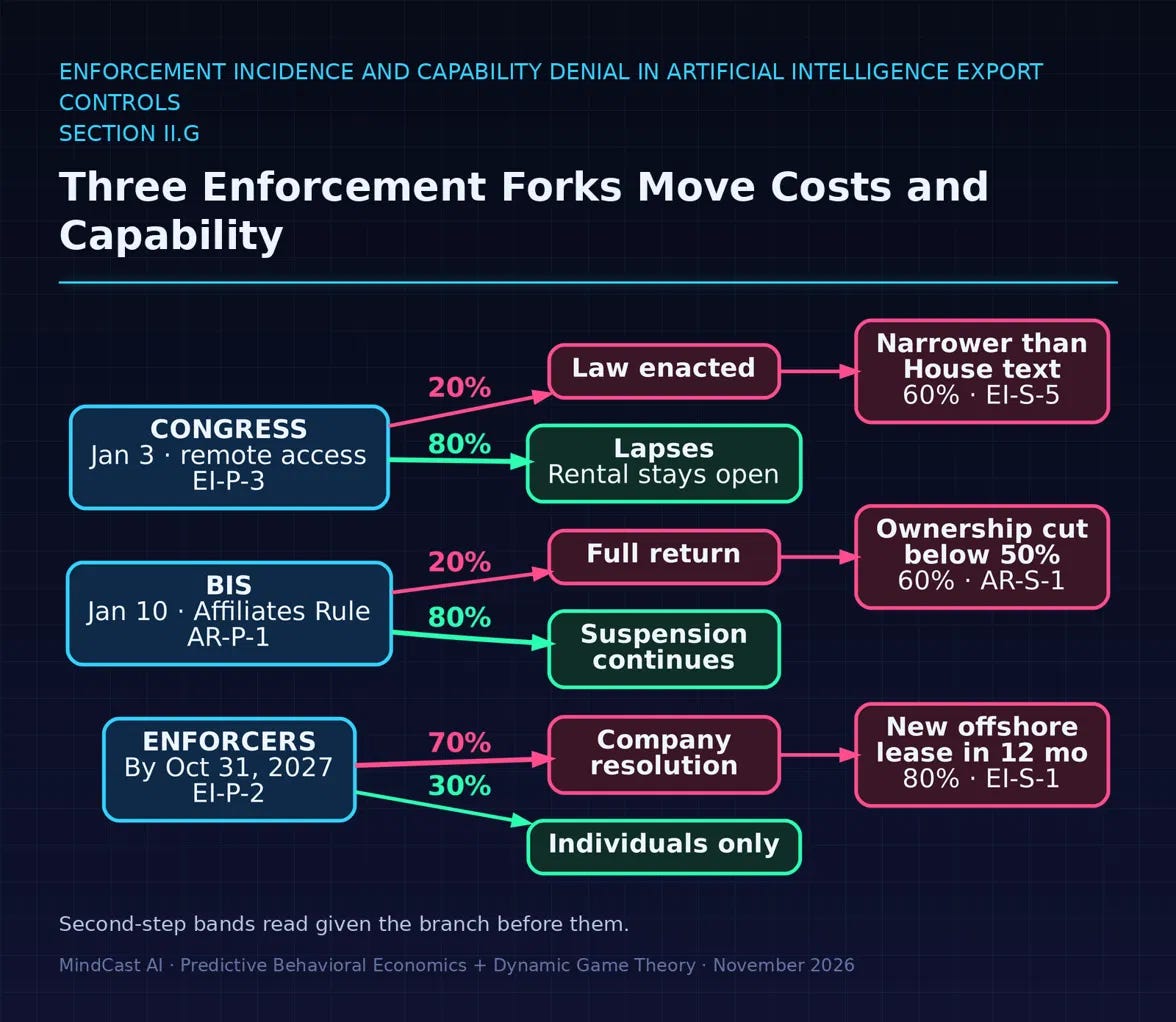
E1. Remote-access authority enacted at the January 3 deadline (EI-P-3: 20% enacted, 80% lapse)
Kind of change: assessed at each stage. Enactment changes legal authority, a serious-risk determination makes categories controllable and an implementing rule changes strategies. Equilibrium migration or game evolution follows only if firms change sourcing and the change persists.
What changes: rules, because rented compute becomes controllable after a serious-risk determination; timing, because an implementation clock starts.
Paths opened and closed: tenant verification and host listing open. Unverified rental of covered items closes once a rule binds.
Positions: existing leases survive with transition terms, convert if hosts add verification and strand under a rule without transition terms.
Moves gained and lost: BIS gains a move over hosts. Hosts gain a verification move, and China-parented tenants lose unregulated rental.
Conditional Simulation Predictions: EI-S-5 (a law narrower than the House text) activates at 60% given enactment. EI-S-4 (a first US instrument beyond hardware) resolves true. EI-S-6 (no charge resting solely on remote access) at 90% needs revalidation.
What follows: The enacted-law state holds until an implementing rule issues, which then sets the duties. On lapse, the starting point continues and EI-S-6 holds.
E2. Affiliates Rule decision on January 10 (AR-P-1 in the Affiliates Rule paper: 80% extended or narrowed, 20% full return)
Kind of change: legal activation on full return, which changes the strategy set for affiliate sales. Game evolution follows only if firms restructure and the change persists. Extension is continuation.
What changes: rules, because 50% aggregate ownership triggers license requirements.
Paths opened and closed: ownership cuts below 50% and leasebacks open. Unlicensed sales to covered affiliates close.
Positions: affiliate sales convert to licensed sales or strand. Leases to covered affiliates convert or strand on the same test.
Moves gained and lost: Chinese affiliates gain a restructuring move. US exporters lose unlicensed affiliate sales.
Conditional Simulation Predictions: AR-S-1 at 60% applies from the Affiliates Rule paper. Affiliate cases join the enforcement-targeting sample tested in III.C.
What follows: The full-return state holds while the rule stays at full scope. On extension, the starting point continues.
E3. Corporate resolution against a major vendor (unscheduled; EI-P-2 at 70% covers any vendor, server maker or distributor)
Kind of change: continuation, which becomes equilibrium migration if hosts change how they verify tenants.
What changes: payoffs, because enforcement salience and compliance cost rise. No legal rule changes.
Paths opened and closed: vendor reseller audits and voluntary host tenant checks open. Some diverted-shipment routes close.
Positions: vendors’ reseller arrangements convert to audited channels or strand.
Moves gained and lost: hosts gain a voluntary verification move. Resellers lose unaudited access to vendor supply.
Conditional Simulation Predictions: EI-S-1 activates at 80% given the resolution. The trigger for EI-S-7 (a new export-control securities suit) at 50% is met.
What follows: The post-resolution state holds while shipments and rental adjust. If both stay unchanged for 12 months, the starting point returns.
E4. Fourth China-parented offshore lease disclosed (unscheduled; EI-P-1 at 50%)
Kind of change: continuation, as an information event.
What changes: information about rental demand. No rule or payoff changes.
Paths opened and closed: none.
Positions: all positions survive.
Moves gained and lost: no seat gains or loses a move unless hosts or Congress respond.
Conditional Simulation Predictions: EI-P-1 resolves true.
What follows: The starting point continues unless the disclosure prompts host verification or legislation.
E5. Beijing deepens domestic procurement mandates (unscheduled)
Kind of change: a policy change on the Chinese side, independent of US enforcement. Game evolution follows only if procurement shifts prove material and persist.
What changes: Chinese procurement rules and the payoffs to domestic suppliers.
Paths opened and closed: guaranteed demand for domestic accelerators opens. Part of the foreign channels’ Chinese demand closes.
Positions: US vendors’ remaining China positions strand in the covered segments.
Moves gained and lost: domestic suppliers gain guaranteed demand. US vendors lose access to covered buyers.
Conditional Simulation Predictions: The persistence test in III.C begins. The Beijing-only counterfactual cell grows.
What follows: The mandate state holds while Beijing enforces the mandate. Withdrawal within 12 months restores the prior state.
Combined outcomes. Only materially distinct outcomes carry forward. The January 3 and January 10 decisions vary independently and yield four combinations, while the unscheduled events layer onto any of them. Combinations that leave the same strategies feasible merge into one state.
The games, the players and the states that coming events can create now support dated Simulation Predictions.
III. MindCast Simulation Predictions Expect Corporate Enforcement and No Remote-Access Law by January 3
MindCast Foresight Simulation Predictions expect corporate enforcement and no remote-access law by January 3. The paper carries eleven: three Primary and eight Secondary.
Bands carried from MindCast’s October 31, 2026 forecast set keep their original terms, except EI-P-1. Oracle’s cancellation of the Tencent lease and Nvidia’s cap on Chinese cloud customers moved EI-P-1 from 70% to 50% on November 9. The propositions in III.C carry support levels instead.
Simulation synthesis.
Dominant mechanism: Enforcement follows legal nexus while capability follows compute access.
Active regime: Enforcement tied to physical hardware.
Replacement conditions: Remote-access authority; host listings; financier designations.
Behavioral equilibrium: Enforcers target US firms; buyers mix domestic chips and offshore rental.
Legal reach: Existing law reaches hardware and ownership; rented compute needs Congress and a serious-risk determination.
Scenario structure.
Displacement. Buyers switch channels because of enforcement. Sequence: Indictments, then new leases. Trigger: Rental stays legal as penalties rise. Weight: tested against the counterfactual, while EI-P-1 tracks the lease channel at 50%.
Enforcement success without denial. Named channels close while alternatives carry demand. Sequence: Corporate resolutions, then new leases. Trigger: Provable shipments. Weight: Carried by EI-P-2 at 70% and EI-S-1 at 80%.
Deterrence. Total effective acquisition falls. Sequence: Host duty plus Taiwan liability close rental while domestic supply lags. Trigger: Enactment with domestic shortfall. Weight: No band.
Independent substitution. Domestic supply grows on its own momentum and Beijing’s mandates. Sequence: Domestic share rises regardless of US moves. Trigger: Procurement mandates. Weight: No band; leading rival in the model.
III.A A Corporate Resolution Is Likely and Remote-Access Authority Likely Lapses
Three primary Simulation Predictions test the paper’s routes. The three test whether offshore leasing continues, whether enforcement reaches a corporation and whether Congress acts on remote access.
EI-P-1 | Fourth China-Parented Offshore Lease (50%)
Forecast statement: A fourth China-parented tenant’s offshore lease of at least 10,000 accelerators is reported by June 30, 2027. The count excludes the three leases already reported, including the canceled Tencent–Oracle lease.
Confidence band: 50%.
Time window / gate: Through June 30, 2027.
Trigger conditions: Rental demand persists at hosts outside Nvidia’s 49% cap and US pressure; remote-access authority lapses.
Explicit falsifier: No such report by June 30, 2027. A new lease marks an acquisition event and does not by itself show displacement.
Verification source: Company filings or two independent major outlets.
Stakeholder exposure: US hosts in Southeast Asia and Japan; their lenders.
Monitoring signal: New China-parented lease disclosures in Southeast Asia and Japan.
EI-P-2 | Corporate-Level Resolution With a US Firm (70%)
Forecast statement: The Justice Department or BIS announces a corporate-level resolution with a server maker, distributor or chip vendor over AI-chip diversion to China by October 31, 2027.
Confidence band: 70%.
Time window / gate: Through October 31, 2027.
Trigger conditions: The Liaw trial in the Southern District of New York, set for March 2027.
Explicit falsifier: Only individuals charged through the window.
Verification source: Justice Department and BIS announcements.
Stakeholder exposure: US vendors and their shareholders.
Monitoring signal: New unsealed diversion cases.
EI-P-3 | Remote-Access Authority at January 3 (20% Enacted, 80% Lapse)
Forecast statement: Congress enacts remote-access authority over tenants or hosts by January 3, 2027, against lapse with the 119th Congress.
Confidence band: 20% enacted / 80% lapses.
Time window / gate: Through January 3, 2027.
Trigger conditions: Conference text in the fiscal 2027 defense bill (H.R. 8800 or S. 4784), or Senate passage of H.R. 2683 or S. 3519.
Explicit falsifier: Enactment by January 3, 2027 resolves the enacted branch. Adjournment of the 119th Congress without it resolves the lapse branch.
Verification source: Congress.gov enrolled text.
Stakeholder exposure: US hosts with offshore leases; their lenders.
Legal condition: Enacted authority still needs a serious-risk determination and an implementing rule; criminal liability keeps the willfulness standard.
Monitoring signal: Defense-bill conference report.
All three carry bands. The first tracks the rental channel most directly.
III.B Enforcement Spreads to New Cases, Taiwan, Legislation and Securities Suits
Eight secondary Simulation Predictions follow enforcement into new cases, Taiwan, legislation and securities suits.
EI-S-1 (80%): P(new offshore lease reported given a corporate resolution). Window: 12 months after the resolution. Trigger: EI-P-2 resolves true; falsifier: No such lease.
EI-S-2 (70%): Three or more new federal diversion cases unsealed. Window: November 1, 2026 to June 30, 2027. Trigger: Ongoing investigations; falsifier: Two or fewer.
EI-S-3 (80%): Criminal liability for unlicensed export of advanced AI chips or servers to China takes effect in Taiwan, by control-list designation or statute. Window: By June 30, 2027. Trigger: Control-list designation or statutory amendment; falsifier: Neither route in force by the date.
EI-S-4 (70%): First US instrument reaching beyond hardware. Window: By December 31, 2027. Trigger: a remote-access statute or rule, a host listing citing tenants or a financier designation; falsifier: None of the three issues.
EI-S-5 (60%): P(enacted remote-access scope narrower than the House text given enactment). Window: Enacted text. Trigger: EI-P-3 enacts; falsifier: Matches the House text.
EI-S-6 (90%): No criminal charge rests solely on remote access. Window: By December 31, 2027. Trigger: none, holds on every path and is reassessed if remote-access authority is enacted; falsifier: An indictment whose only export theory is rental.
EI-S-7 (50%): New export-control securities class action beyond Super Micro. Window: By December 31, 2027. Trigger: Corporate resolution; falsifier: No filing.
EI-S-8 (40%): Super Micro securities action survives dismissal in part. Window: By December 31, 2027. Trigger: Motion ruling; falsifier: Full dismissal or no ruling.
The secondary set shows enforcement spreading across agencies, jurisdictions and courts while the capability question stays open.
III.C Seven Propositions Separate Targeting, Monetary Cost and Capability Denial
Seven propositions state the theory, each with a support level rather than a band.
EI-H1a Enforcement targeting. US-nexus parties outnumber China-parented beneficiaries among parties named in US AI-chip enforcement actions, October 2022 through December 2027. Support: High, conceptual. Contradicted by: The beneficiary count equals or exceeds the US-nexus count.
EI-H1b-M Monetary incidence. US-nexus firms lose more money than China-parented beneficiaries across estimable actions. The paper reports realized losses, lost expected profits, financing costs and valuation effects separately. No loss counts twice. Support: Low to Moderate. Contradicted by: Beneficiary losses exceed US-nexus losses in most estimable actions.
EI-H1b-C Capability-denial incidence. Capability denied per action stays small against the counterfactual, measured in capability-adjusted compute. The paper reports it beside monetary cost without converting either into the other’s unit. Support: Low to Moderate. Contradicted by: Large attributable capability denial per action.
EI-H2 Composition over total. Enforcement changes channel composition more than total effective capability, the pattern The Runtime Global Data Market — When Stolen AI Interactions Become a Strategic Technology Supply Chain (2026) found for AI interaction data. Support: Low after the analytical model, which finds net training denial of 13-23%. Contradicted by: Large attributable net declines in capability-adjusted acquisition.
EI-H3 Governance follows migration. Intermediary governance follows observed channel shifts. Support: Moderate. Contradicted by: Access controls that precede and prevent migration.
EI-H4 Persistence. Domestic substitution persists after restrictions ease. Support: Moderate. Contradicted by: Sustained return to foreign hardware after access relaxes.
EI-H5 Success without effectiveness. Transaction-level success and capability-level effectiveness diverge over time. Support: Moderate to High. Contradicted by: Channel closures that reliably cut aggregate capability.
Counting rules for EI-H1a. The sample and role classification are fixed before any count is made. Roles are mutually exclusive, and a party with several roles takes the one closest to the end user. The rule leans against the proposition. Individuals named with their firm count with the firm, results are reported per party and per action, and intermediaries form their own category.
The targeting test can run on public enforcement records now. The cost and capability tests need data the paper names in Section V.
III.D Domestic Chip Performance Decides How Much Capability Controls Deny
Domestic Chinese chips that reach training scale faster than assumed would shrink the deterrence route, because buyers could replace foreign compute at home. Weak domestic chips would strengthen it.
Firm calls on enforcement sit beside the tests that show what enforcement achieves.
IV. Verification Bought Before a Rule Binds Protects Firms on Every Branch
Each audience has moves worth making before a rule binds.
AI Chip Export Enforcement War Game Shows When Verification Protects US Firms and When It Arrives Too Late(2026) found that verification bought before a closing date reduces exposure. After a filing, the same program mostly shapes penalties and remedies.
Stakeholder strategy.
🏛️ Policymakers. Objective: Reach the beneficiary, not only the nearest US firm. Move now: Commission measurement of total acquisition; if triggered: Design a beneficiary test if a new offshore lease follows enforcement. Main risk: Mistaking case counts for denial.
💼 Executives. Objective: Protect revenue and avoid charges. Move now: Audit top resellers; verify tenants; if triggered: Expand verification if EI-P-3 enacts. Main risk: Partner indictment followed by a disclosure suit.
⚖️ Counsel. Objective: Keep clients outside new duties. Move now: Draft lease clauses valid under both remote-access bills; if triggered: Map self-disclosure decisions after a corporate resolution. Main risk: Prior-period compliance statements.
📊 Investors. Objective: Evaluate exposure correctly. Move now: Separate China-linked tenant cash flows; if triggered: Model tenant cash flows under each remote-access branch. Main risk: Tenant concentration in one China-parented lessee.
Strategic posture by stakeholder. Policymakers should judge enforcement by its effect on total acquisition, not case counts (EI-P-1, EI-S-1). Executives gain most from verification before a rule requires it, because verification pays on every path where the game evolves (EI-P-2). Counsel should prepare for both remote-access bills before January 3 (EI-P-3, EI-S-5). Investors should treat domestic substitution as a trend that holds through rule changes.
Risk mitigation by Simulation Prediction. Each row routes one Simulation Prediction to one audience in that audience’s terms. The band gives probability from the simulation, and severity is rated separately. Exposure is what the audience loses if the Simulation Prediction resolves true and it has done nothing.
EI-P-1 Fourth China-parented offshore lease · 💼 Executives (hosts) · band 50% · high severity
Exposure. Quarters of lease revenue signed with China-parented tenants before any host duty.
Actions. Sales verifies tenant ownership before signing any lease of 10,000 or more accelerators, from now; legal adds transition and workload-visibility clauses to new leases before January 3.
Residual. The scope of any future duty stays unknown until a rule issues.
EI-P-2 Corporate-level resolution with a US firm · 💼 Executives (vendors) · band 70% · high severity
Exposure. Number of resellers without a completed audit when the resolution lands.
Actions. Compliance audits the top 20 resellers by March 1, 2027, before the Liaw trial; the board audit committee receives a quarterly export-compliance report starting in the first quarter of 2027.
Residual. Past shipments stay exposed whatever the audit finds.
EI-P-2 Corporate-level resolution with a US firm · ⚖️ Counsel · band 70% · high severity
Exposure. Discovery scope reaching prior-period compliance statements.
Actions. Counsel runs a privileged internal review of reseller channels by February 2027; any self-disclosure decision follows that review rather than preceding it.
Residual. Privilege protects the review, not the underlying facts.
EI-P-2 Corporate-level resolution with a US firm · 📊 Investors · band 70% · high severity
Exposure. Multiple compression on vendors with distributor exposure; Super Micro shares fell 33% the day after the March 2026 indictment.
Actions. Research staff separate China-routed distributor revenue in valuation models by March 2027; risk staff run each vendor under a resolution scenario before the Liaw trial.
Residual. Resolution terms and penalties stay unknown until announced.
EI-P-3 Remote-access authority enacted · ⚖️ Counsel · band 20% · high severity
Exposure. Number of offshore leases needing amendment inside the implementation window.
Actions. Counsel drafts lease clauses that work under both H.R. 2683 and S. 3519 before January 3; counsel maps which clients’ items could face a serious-risk determination by January 31.
Residual. The implementing rule can set duties neither text specifies.
EI-P-3 Authority lapses with the 119th Congress · 🏛️ Policymakers · band 80% · medium severity
Exposure. Remote-access authority returns to the start of the 120th Congress session calendar.
Actions. Committee staff prepare a refiled text with the serious-risk determination standard for the first weeks of the new session.
Residual. Floor time in the new Congress is not assured.
EI-S-1 P(new lease given a corporate resolution) · 🏛️ Policymakers · band 80% · medium severity
Exposure. Oversight cycles spent on case counts while capability moves to rental.
Actions. BIS and committee staff add a capability-adjusted acquisition measure to the next annual enforcement review.
Residual. Capability data on Chinese buyers stays partial.
EI-S-2 Three or more new diversion cases · 💼 Executives (vendors) · band 70% · medium severity
Exposure. Number of distributors without end-use certification when a partner is charged.
Actions. Compliance requires end-use certification from high-risk distributors by January 31; sales suspends orders from distributors that decline.
Residual. A certified distributor can still divert.
EI-S-3 Taiwan criminal liability in force · 💼 Executives (vendors) · band 80% · medium severity
Exposure. Weeks of shipment delay for Taiwan-assembled servers needing licenses.
Actions. Logistics files Taiwan license applications ahead of the control-list date; contracts lead adds delay clauses to server orders by March 31, 2027.
Residual. Licensing times in Taiwan stay untested.
EI-S-4 First US instrument beyond hardware · 💼 Executives (hosts and lenders) · band 70% · high severity
Exposure. Quarters needed to build tenant verification after a duty arrives.
Actions. Operations builds tenant-identity checks for large training customers by June 30, 2027; credit risk adds verification covenants to new data center loans.
Residual. The instrument may require checks beyond identity, such as workload type.
EI-S-5 P(scope narrower than the House text given enactment) · ⚖️ Counsel · band 60% · low severity
Exposure. Compliance spend built for the broader House text.
Actions. Counsel designs modular clauses that scale to either text before January 3.
Residual. A narrow statute can widen through rulemaking.
EI-S-6 No charge resting solely on remote access · 🏛️ Policymakers · band 90% · medium severity
Exposure. Rental channels stay outside criminal reach through 2027.
Actions. Committee staff pair any refiled authority with an implementing timetable for BIS.
Residual. Willfulness remains a high bar even after enactment.
EI-S-7 New export-control securities class action · 💼 Executives (issuers) · band 50% · medium severity
Exposure. Discovery scope reaching export-compliance statements in filings.
Actions. The disclosure committee checks existing compliance statements for factual support before the next annual report; it makes no new statements solely to head off litigation.
Residual. Plaintiffs can cite statements already made.
EI-S-8 Super Micro action survives dismissal in part · ⚖️ Counsel · band 40% · low severity
Exposure. Precedent that lets discovery reach a vendor’s distributor channel.
Actions. Counsel at other vendors maps distributor documents a similar suit would request by the ruling date.
Residual. The ruling’s reasoning stays unknown until it issues.
Verification is the one move that pays wherever the game evolves, and ownership screening for the Affiliates Rule lowers vendor exposure here too.
V. Enforcement Costs and Capability Effects Can Land on Different Parties
The Simulation Predictions shift who enforces, who pays and what would confirm deterrence.
V.A Congress, Taiwan and Private Plaintiffs Join the Enforcement System
Enforcement authority over hardware stays strong while authority over rented compute stays with Congress (EI-P-3). Taiwan becomes a second enforcer on transit (EI-S-3). The plaintiffs’ bar acts as a third enforcer on US firms through disclosure suits (EI-S-7).
Cross-Border AI Compute — Access Rules, Clean Power and Local Approval Decide Which Operators Win (2026) shows how the form of any rule picks winners. A tenant rule favors hyperscalers, while a country list favors US-sited specialists.
Enacted remote-access authority would not reach tenants automatically. Controls would attach only after a determination that an item’s use poses a serious risk to US national security or foreign policy (H.R. 2683). Criminal liability would keep the willfulness standard of existing export law. The Institute for AI Policy and Strategy reads the House definition as appearing to cover software delivered as a service (IAPS).
Enforcement authority therefore spreads across agencies, courts and Taiwan, while rented compute waits on Congress.
V.B Each Enforcement Step Changes Chinese Buyers’ Best Response
Each enforcement step changes the buyers’ best response. A corporate resolution raises risk on every foreign channel, yet rental keeps enough demand that a new lease stays likely within twelve months (EI-S-1). Vendors respond to cases by auditing resellers. In the model, that pushes diverted demand toward domestic supply, which shifts channel shares without showing how much effective capability China gains or loses.
Under the displacement and substitution routes, each enforcement step reshapes buyers’ options without removing their demand. Under deterrence, demand itself falls.
Effective enforcement also feeds back into the bargaining game of the Affiliates Rule paper, where higher transmission makes restriction Washington’s best reply to a Chinese defection in more configurations. A remote-access rule that covers rented compute would complement the Affiliates Rule by limiting an alternative acquisition channel. The Affiliates Rule itself gains effectiveness only to the extent that affiliates denied hardware would otherwise rent the same capability abroad. Where both restraint and restriction can persist, any such gain would make a breakdown harder to reverse. ⚖️ Counsel and 💼 Executives should plan for both outcomes at once.
V.C Selected Cases Point to US-Nexus Parties as the Main Named Defendants
Selected cases so far point to US-nexus parties as the main named defendants. Hosts and lenders more often bear commercial exposure than enforcement action, and the role-coded sample in III.C will test the full population. Federal Reserve Bank of New York research finds about $130 billion in market-capitalization losses for affected US suppliers as non-US suppliers gained share (Crosignani et al. 2025). The study measures supplier losses only and makes no comparison with Chinese beneficiaries.
The paper’s central hypothesis is that the costs of enforcement and its capability effects land on different parties, and EI-H1a and EI-H1b test it.
V.D A Fall in Capability-Adjusted Acquisition Would Confirm Deterrence
A fall in capability-adjusted acquisition against the counterfactual confirms the deterrence route with market data, the result the analytical model already favors.
If the domestic share rises as fast in the Beijing-only counterfactual cell as in the observed cell, independent substitution explains the shift. US enforcement then earns little credit for it.
Feedback loops. Enforcement success feeds substitution, which shrinks vendor China revenue, which weakens vendor opposition to tighter controls. The loop affects timing: tightening becomes politically easier late in the substitution cycle.
Observed acquisition data will decide how much capability controls deny, and the feedback loop delays tightening until substitution has advanced.
The January 3 Defense-Bill Text Is the First Signal to Watch
Eight signals move the Simulation Predictions, and the defense-bill conference text arrives first.
Defense-bill conference text (EI-P-3, EI-S-5). Source: Congress.gov. Cadence: Weekly to January 3. Effect: Resolution; route weight.
Offshore lease disclosures (EI-P-1, EI-S-1). Source: Company filings; major outlets. Cadence: Monthly. Effect: Resolution.
Unsealed diversion cases (EI-S-2, EI-P-2). Source: Justice Department releases. Cadence: Weekly. Effect: Route weight.
Domestic share of accelerators sold in China (EI-H2). Source: Market research releases. Cadence: Quarterly. Effect: Proposition support.
Taiwan control-list action (EI-S-3). Source: Ministry of Economic Affairs. Cadence: Monthly. Effect: Resolution.
Liaw trial (EI-P-2). Source: Southern District of New York docket. Cadence: March 2027. Effect: Trigger.
Role-classified enforcement tally (EI-H1a). Source: Justice Department, BIS and Treasury releases. Cadence: Monthly. Effect: Proposition support.
Beijing procurement mandates (EI-H4; counterfactual). Source: Chinese government notices. Cadence: Monthly. Effect: Independent-substitution weight.
Controls Deny Part of China’s Capability, and Case Data Will Show Who Pays
Enforcement follows legal nexus, so the paper expects its costs to land on reachable intermediaries. A role-coded enforcement sample will test that hypothesis. Within its hardware-access domain and across tested scenarios, the analytical model finds that controls still deny a meaningful share of Chinese training capability, with Beijing’s substitution eroding each later control.
The simulation carries a corporate resolution at 70% and a new lease after any resolution at 80%. The fourth-lease Simulation Prediction carries 50% after Oracle canceled the Tencent lease.
Stakeholders should verify tenants and resellers now and wait to learn the January 3 outcome. The decisive test is whether Chinese capability falls when US enforcement succeeds. The test runs against a counterfactual that removes Beijing’s own procurement policy.
Working With MindCast
A published paper cannot show a specific vendor, host or lender where its own exposure sits. The answer depends on reseller networks, lease terms and tenant ownership that only the firm holds.
A commissioned Snapshot builds Cognitive Digital Twins for the firm’s counterparties and reruns the enforcement and acquisition games against its contracts. MindCast works from the firm’s channel and tenant data under a non-disclosure agreement and delivers within five to seven business days.
Each question below maps to the engagement that answers it and the Simulation Predictions it extends.
Do our offshore leases survive a remote-access law? Commissioned Snapshot with a lease overlay (EI-P-1, EI-P-3, EI-S-5).
Which resellers expose us to the next corporate case? Reseller overlay with an audit priority list (EI-P-2, EI-S-1, EI-S-2).
How exposed are our Taiwan-assembled servers? Transit review against Taiwan’s control-list and statutory routes (EI-S-3).
What securities exposure follows an enforcement action? Disclosure review for listed hardware firms (EI-S-7, EI-S-8).
A firm that verifies tenants and resellers before a rule binds keeps its customers when the rules change. Contact mcai@mindcast-ai.com. Explore MindCast simulations, war games and commissioned work at www.mindcast-ai-simulation.com.
Appendix A. MindCast Works That Supply the Evidence
Prior MindCast work supplies the method, the bands and the access, compute and data-market analysis behind this paper.
Companion paper
The Affiliates Rule Turns Export Controls Into Bargaining Instruments. Supplies the bargaining game whose January 10 outcome sets this paper’s starting state.
Frameworks and methods
MindCast Foresight Prediction Simulations, Synthesizing Behavioral Economics + Game Theory. States the simulation method the paper applies.
Prior simulations and validations
AI Chip Export Enforcement Shifts Risk Onto US Firms as China Demand Moves to Domestic Chips, Rented Compute and State Financing. Supplies the bands and the three acquisition channels the paper tests.
AI Chip Export Enforcement War Game Shows When Verification Protects US Firms and When It Arrives Too Late. Plays the enforcement game seat by seat for vendors, hosts, exporters and lenders.
China’s H200 Import Block and the Reordering of National Innovation Control. Forecast Beijing’s H200 block, which supplies the resolved Simulation Prediction in Section I.
The Beijing Summit Validation — Geopolitical Ripples for the AI Industry Across the Three-Layer Equilibrium. Validated the two-gate model behind the Beijing-policy cell of the counterfactual.
Tencent, Oracle, and the Remote-Access Gap in US AI Chip Export Controls. Supplies the access-channel analysis behind EI-P-3.
Cross-Border AI Compute — Access Rules, Clean Power and Local Approval Decide Which Operators Win. Shows how a tenant rule and a country list would shift which compute operators win.
Related analysis
The Runtime Global Data Market — When Stolen AI Interactions Become a Strategic Technology Supply Chain. Supplies the composition-over-volume finding.
The Runtime Export Problem — Anthropic’s 151 Million-Exchange Distillation Record, Advisory AA26-251A, and the Question Commerce Cannot Yet Answer. Supplies the model-output channel in the chokepoint migration.
Anthropic, Alibaba and the Runtime Theft Problem — How Attribution Cost Moves Frontier-AI Distillation Enforcement From the Courtroom to the Statute. Explains why attribution cost pushes enforcement toward reachable intermediaries, the mechanism behind the targeting proposition.
Each work is published and linked, so a reader can check the bands and the channel analysis directly.
Appendix B. External Sources Behind the Factual Claims
External sources supply the cases, leases, market shares and legal texts the paper relies on.
Bloomberg Law, Man Charged With Illegally Shipping Nvidia Chips to China, October 2, 2026. Supplies the Earthmade arrest.
Network World, Oracle reportedly lands $7B GPU deal for Tencent, October 9, 2026. Reports the Tencent–Oracle lease.
The Next Web, Oracle cancels $7B Tencent AI chip lease under US pressure, FT reports, November 4, 2026. Supplies the cancellation and the Guangdong pressure on Tencent.
The Next Web, Nvidia tells cloud partners to cap Chinese business at 49%, FT reports, November 3, 2026. Supplies the cap on Chinese customers in new cloud contracts.
Implicator, Double Squeeze: Oracle Drops Tencent’s $7 Billion Lease, November 4, 2026. Supplies the ByteDance and Alibaba leasing deals that remain.
Converge Digest, Supermicro Co-Founder Charged in Alleged $2.5 Billion AI Server Export Scheme, March 21, 2026. Supplies the indictment’s $2.5 billion and $510 million figures.
Nasdaq, Why Super Micro Computer Stock Crashed 29.7% in March But Is Moving Higher in April, 2026. Supplies the 33% one-day decline.
The Lobby, H.R. 2683, Remote Access Security Act. Supplies the House vote of January 12, 2026.
GovInfo, S. 3519, Remote Access Security Act, introduced December 17, 2025. Supplies the Senate companion bill.
Bloomberg Tax, Nvidia Steps Back Into China Market With First H200 Chip Sales, August 26, 2026. Supplies the under-1% H200 share.
Reuters via Yahoo Finance, Chinese chipmakers claim nearly half of local market as Nvidia’s lead shrinks, April 1, 2026. Supplies the domestic share.
Federal Reserve Bank of New York, Staff Report No. 1096, Securing Technological Leadership? The Cost of Export Controls on Firms, by Matteo Crosignani, Lina Han, Marco Macchiavelli and André F. Silva (April 2024, revised February 2025). Supplies supplier-level incidence evidence.
Henry Farrell and Abraham L. Newman, Weaponized Interdependence: How Global Economic Networks Shape State Coercion, International Security 44, no. 1 (Summer 2019): 42–79. Supplies the chokepoint framework the paper extends.
Congress.gov, H.R. 2683, Remote Access Security Act. Primary bill text behind EI-P-3.
H.R. 2683 as passed by the House, January 12, 2026. Supplies the remote-access definition and serious-risk determination.
Baker McKenzie, update on H.R. 2683. Summarizes the determination requirement.
Institute for AI Policy and Strategy, Remote Access Security Act (RASA). Notes the House definition’s reach to software as a service.
Taiwan News, report on Taiwan’s export control list plan, October 2026. Supplies the Taiwan liability plan behind EI-S-3.
Lawfare, The U.S.-Taiwan ART’s Export Control Puzzle. Supplies the administrative and statutory routes to Taiwan export control.
Justice Department, U.S. Authorities Shut Down Major China-Linked AI Tech Smuggling Network. Supplies the Hao Global plea.
Reuters via GV Wire, Super Micro contractor pleads guilty in scheme to divert AI servers with Nvidia chips to China, October 10, 2026. Supplies the Sun plea.
Fortune, report on the Supermicro investigation and the Liaw trial date, August 20, 2026. Supplies the March 2027 trial date and the grand jury subpoena.
Further sources appear in Appendix B of AI Chip Export Enforcement Shifts Risk Onto US Firms as China Demand Moves to Domestic Chips, Rented Compute and State Financing.
The enforcement releases and bill texts carry the dates on which every Simulation Prediction turns.
Appendix C. Research on Enforcement, Sanctions and Compute Governance the Paper Extends
Three bodies of research frame the paper: work on sanctions evasion and incidence, the economics of enforcement and evidence on export-control effects.
Closest Works
Six works address the paper’s question most directly.
Jamal Ibrahim Haidar, Sanctions and Export Deflection: Evidence from Iran, Economic Policy 32, no. 90 (2017): 319–355. Haidar finds that two-thirds of Iranian non-oil exports hit by sanctions moved to non-sanctioning countries. The paper tests the same displacement logic for compute, where one channel is rental that US law does not yet reach.
Bryan R. Early, Busted Sanctions: Explaining Why Economic Sanctions Fail (Stanford University Press, 2015).Early traces sanctions failure to third-party busters who trade with the target. The paper tests whether the reachable parties in AI compute are mostly US-nexus firms and hosts in allied jurisdictions.
Matteo Crosignani, Lina Han, Marco Macchiavelli and André F. Silva, Securing Technological Leadership? The Cost of Export Controls on Firms, Federal Reserve Bank of New York Staff Report No. 1096 (2024, revised 2025).The study measures market-value and revenue losses for US suppliers after export controls. The paper separates who is named in enforcement, who loses money and how much capability is denied.
Yu Cao, Francesca de Nicola, Aaditya Mattoo and Jonathan Timmis, Technological Decoupling? The Impact on Innovation of US Restrictions on Chinese Firms, World Bank Policy Research Working Paper 10950 (2024). The authors find that Entity List designation reduces Chinese firms’ patent output, driven by firms with prior US collaborators. The paper measures capability denied against a counterfactual that removes Beijing’s own procurement policy.
Lennart Heim, Tim Fist, Janet Egan, Sihao Huang, Stephen Zekany, Robert Trager, Michael A. Osborne and Noa Zilberman, Governing Through the Cloud: The Intermediary Role of Compute Providers in AI Regulation, arXiv:2403.08501 (2024). The authors argue that compute providers can verify customers and classify workloads for regulators. The paper asks who bears the cost when those duties become law and what conditions the House text attaches.
Erich Grunewald and Tim Fist, Countering AI Chip Smuggling Has Become a National Security Priority, Center for a New American Security (2025). The working paper catalogues evidence of large-scale AI chip smuggling into China. The paper classifies the parties enforcement actually names and compares them with the beneficiaries.
The six works show that sanctions deflect trade and cost suppliers. None separates who is named, who pays and what capability is denied.
Theoretical Foundations
Four works supply the enforcement economics and network theory the paper builds on.
Gary S. Becker, Crime and Punishment: An Economic Approach, Journal of Political Economy 76, no. 2 (1968): 169–217. Becker models offenders who respond to the expected penalty. The paper applies the model to buyers who move toward the lowest-penalty acquisition channel.
George J. Stigler, The Optimum Enforcement of Laws, Journal of Political Economy 78, no. 3 (1970): 526–536.Stigler shows that enforcers allocate effort where cases cost least to prove. The paper’s targeting proposition follows from it: enforcers name parties whose conduct invoices and customs papers can prove.
A. Mitchell Polinsky and Steven Shavell, The Economic Theory of Public Enforcement of Law, Journal of Economic Literature 38, no. 1 (2000): 45–76. The survey sets out how detection probability and sanction size combine in optimal enforcement. The paper uses that structure to explain why reach over intermediaries substitutes for reach over beneficiaries.
Henry Farrell and Abraham L. Newman, Weaponized Interdependence: How Global Economic Networks Shape State Coercion, International Security 44, no. 1 (2019): 42–79. Farrell and Newman explain coercion through control of network hubs. The paper asks who bears the cost at the hub itself. It adds that legal reach, willingness to act and strategic effectiveness are separate sources of power.
The foundations explain why enforcement would land on the parties easiest to reach.
Empirical and Policy Evidence
Three works supply evidence on market adjustment, trade effects and compute governance.
Eugene Gholz and Llewelyn Hughes, Market Structure and Economic Sanctions: The 2010 Rare Earth Elements Episode as a Pathway Case of Market Adjustment, Review of International Political Economy 28, no. 3 (2021): 611–634. The authors show that market adjustment can blunt a supply restriction. The paper tests whether domestic Chinese supply plays the same role for AI compute.
Kazunobu Hayakawa, The Trade Effects of the US Export Control Regulations, IDE Discussion Paper No. 911 (2024). Hayakawa finds that US exports of integrated circuits to China fell after the October 2022 controls. The paper moves from trade flows to capability-adjusted compute actually used.
Girish Sastry, Lennart Heim, Haydn Belfield, Markus Anderljung, Miles Brundage and coauthors, Computing Power and the Governance of Artificial Intelligence, arXiv:2402.08797 (2024). The authors argue that compute is detectable and quantifiable, which makes it a lever for governance. The paper tests how much of that lever survives when compute moves across borders by lease.
The literature shows that sanctions deflect trade and cost the sender, and the paper adds the split between who is named, who pays and what capability is denied.