
United States · People’s Republic of China · Federal Communications Commission · Bureau of Industry and Security · Department of Energy · White House · Congress · Ministry of Commerce of the People’s Republic of China · US Chip Vendors · US Cloud Operators · Chinese AI Firms · Chinese and Allied Component Suppliers
Interactive war game: The Economics of AI Import Control
Related works: China's H200 Import Block and the Reordering of National Innovation Control · The US Bureau of Industry and Security Affiliates Rule Turns Export Controls Into Bargaining Instruments · Enforcement Incidence and Capability Denial in Artificial Intelligence Export Controls · Federal Grid-Security Rules Are Doing to American AI Data Centers What China Could Not
I. Executive Summary
A state that controls exports holds leverage over a rival. A state that restricts imports tries to end a dependency it has not yet overcome. Washington and Beijing now run both kinds of gate against each other across artificial intelligence (AI) infrastructure. The side that restricts tends to carry the first operating cost, and the gate holds only while that side accepts the cost or builds a substitute.
Four gates now sit on one board. Washington restricts advanced chip exports and weighs a ban on Chinese optical transceivers. Beijing restricts rare-earth exports and has left about 600,000 Nvidia H200 chips waiting in Hong Kong without import approval. On November 10, 2026, Reuters reported that Microsoft has pressed the administration to drop the transceiver ban.
Three instruments frame the forecasts. A US–China truce pairs the two capitals’ export suspensions and expires on January 10, 2027. The FCC’s Covered List bars listed equipment from new US authorization. Executive Order 14421 extends the same approach to power equipment, with Energy Department rules due December 24, 2026.
MindCast AI applies Predictive Behavioral Economics + Dynamic Game Theory through MindCast AI Proprietary Cognitive Digital Twin Foresight Simulations (MP CDT FS). Behavioral Economics supplies the decision rules. Game Theory supplies the payoff structure. Predictive simulations emerge from the combination.
Core insight. Import gates and export gates share one control structure and differ in who holds the chokepoint. An export gate spends leverage the restricting state already owns. An import gate borrows against substitute capacity the restricting state has not yet built.
Thesis. Sovereign Gate Symmetry names the shared structure: each state gates technology flows in both directions, and each gate tends to place its first operating cost on the restricting state’s own firms. Effectiveness is asymmetric, because substitution capacity and security thresholds decide which gates hold. Washington is likely to act before allied supply exists, so supply limits set the form and the binding date of a restriction, not whether it issues.
Recursive gate competition. Each attempt to close one dependency exposes another the rival can exploit. Beijing has so far not answered US controls with input restrictions on US and allied suppliers. A public security finding is the route most likely to end that restraint.
Why the case recurs. The transceiver dispute is one instance of a repeating conflict. Security restrictions are migrating across the AI infrastructure stack, from chips to optics to power equipment. Each new restriction raises the same three questions, so the framework applies to the next component without change.
What distinguishes the MindCast approach: the paper asks three separate questions of every gate. Activation asks whether the state can impose the restriction. Durability asks whether the restriction lasts against domestic cost. Adaptation asks whether the rival can change substitution conditions enough to force a different policy.
What the paper does. Section II sets out the three gate directions, the three responses to dependency, the stack-wide pattern and the actors. Section III sets out seven Simulation Predictions and two structural hypotheses, then maps how each event changes the game. Sections IV and V convert them into strategy, risk mitigation and implications.
The MindCast Prediction Scorecard dated November 10, 2026 shows 47 hits, 9 partials and 4 misses on resolved material calls. In the chip-export vertical, the January 2026 forecast that Beijing would block licensed H200 chips resolved as a hit. The forecast that Chinese firms would shift training to domestic chips resolved as a miss, because they moved training to offshore and rented compute.
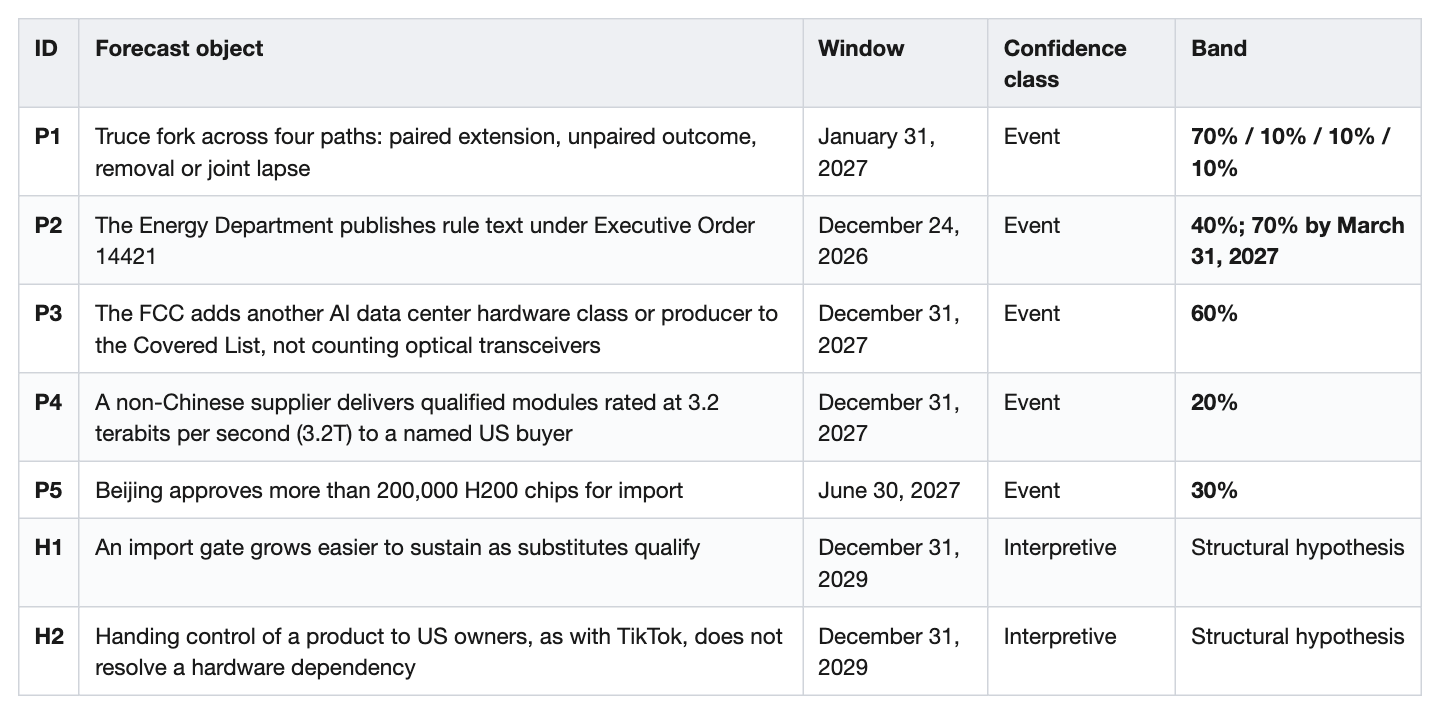
P marks a Primary Simulation Prediction, S a Secondary Simulation Prediction and H a structural hypothesis.
Stakeholder readout.
🏛️ Policymakers. An import gate dated to the substitution curve lasts longer than one dated to the calendar (P4, H1). Allied 3.2T volume ramps in 2028 to 2029, so write transition dates and approval terms against that supply.
💼 Executives. About 600,000 licensed H200 chips sit unsold under Beijing’s import gate, and Chinese makers supply about two-thirds of the transceivers cloud operators buy. Map exposure under both gates before January 10, 2027.
⚖️ Counsel. The truce and its paired suspensions expire together, so one date can reset several compliance regimes within days (P1). Prepare clients for extension, split and lapse outcomes.
📊 Investors. Innolight books 61.7% of its revenue in the United States, and allied suppliers cannot ship 3.2T volume before 2028 (P4). Value substitute capacity against qualified shipments, not announcements.
Takeaway. The gates mirror each other in structure, and substitution capacity decides which ones hold. The January 10, 2027 truce date is the first test of both.
II. Four Gates, One Structure: Why the Contest Fits a Simulation
Washington and Beijing each run an export gate and an import gate on AI infrastructure. The four gates share one structure, and one date in January 2027 can reset all of them. Bounded actors, dated forks and competing explanations make the contest fit a simulation.
II.A Current State: Four Gates on One Board
Washington operates the outbound gate through the Bureau of Industry and Security (BIS). Chip export controls restrict advanced accelerators. The Affiliates Rule extends those restrictions to firms owned 50% or more by listed parties, and BIS extended the rule’s suspension to January 10, 2027 to match the US–China truce. The rule remains suspended, not withdrawn.
Washington operates the inbound gate through the Federal Communications Commission (FCC). The FCC listed drones, routers, power inverters and robots between December 2025 and July 2026. Reuters reported in August that the FCC was drafting a ban on new Chinese optical transceiver models. A federal emergency order over foreign grid equipment adds a third inbound instrument.
Beijing operates both gates in mirror image. The Ministry of Commerce controls rare-earth exports and extended its suspension of the broader controls to January 10, 2027. Beijing also withholds import approval for H200 chips that Washington has licensed for sale.
Takeaway. Each capital runs an export gate and an import gate, and the truce and its two paired suspensions expire on the same day. One date can therefore reset both directions of the contest.
II.B The Governing Question: Which Gates Hold
Under what conditions do sovereign technology restrictions preserve security and advantage, and when do their domestic costs undo them? The target system is the set of US and Chinese gates on AI infrastructure. The horizon runs from November 2026 through December 31, 2027, with structural hypotheses stated to 2029. The technical merits of any specific vulnerability claim sit outside scope.
Takeaway. The question concerns which gates hold, not which gates exist. Durability and adaptation, not activation, decide the answer.
II.C Three Gate Directions Share One Cost Pattern
Technology gates run in three directions: outbound, inbound and embedded. The list compares who holds the chokepoint and who pays first in each.
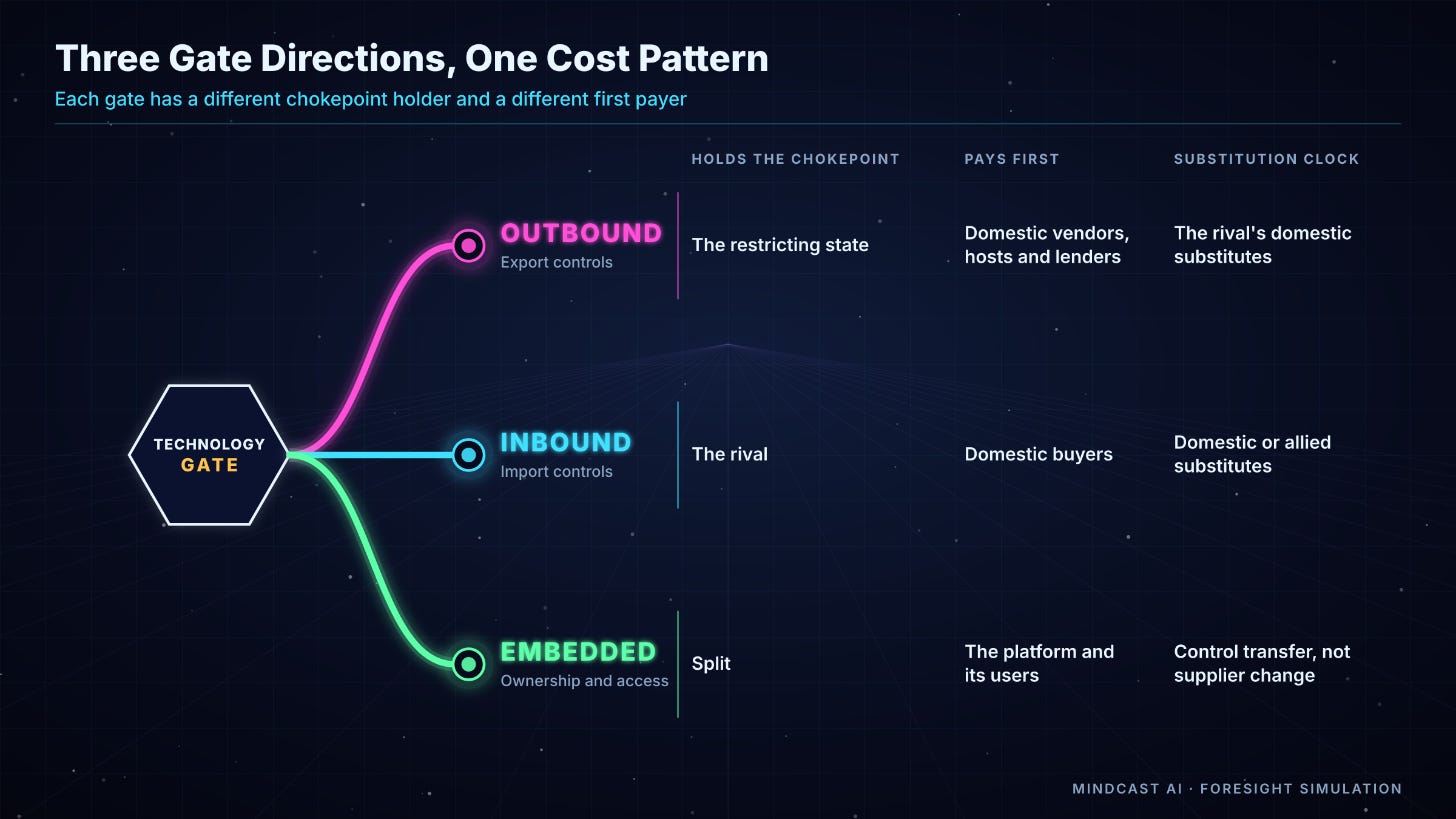
Outbound gate: export controls. The restricting state holds the chokepoint and aims to protect capability and deny rival compute. Domestic vendors, hosts and lenders pay first. The rival’s domestic substitutes set the substitution clock.
Inbound gate: import controls. The rival holds the chokepoint, and the objective is infrastructure integrity or domestic industry. Domestic buyers pay first. Domestic or allied substitutes set the substitution clock.
Embedded gate: ownership and access controls. Control of the chokepoint is split, and the objective is data and algorithm governance. The platform and its users pay first. Control transfer sets the clock, not supplier change.
MindCast’s export work established the burden pattern. Enforcement Incidence and Capability Denial in Artificial Intelligence Export Controls found that enforcement lands mainly on US-nexus parties Washington can reach. The inbound gate repeats the finding from the other side, because US buyers carry the shortage while Chinese suppliers sell elsewhere.
The burden pattern concerns operating cost, not market value. Chinese optics shares fell and American optics shares rose after the August report, so investors charged the targeted makers first. Operating burdens run the other way: approval filings, redesign and delayed campuses fall on US and allied firms.
Beijing’s inbound gate serves a different objective through the same structure. China’s H200 Import Block and the Reordering of National Innovation Control modeled the block as ecosystem discipline in January 2026. Chinese AI firms want the chips, and Beijing makes them wait to protect domestic chipmakers.
Takeaway. Three gate directions share one structure: the restricting state’s own firms tend to carry the first operating cost. A gate therefore needs either tolerance for loss or a substitute.
II.D The Asymmetry: Leverage Spent Versus Capacity Borrowed
An export gate works from strength. The restricting state already holds the technology, so the gate binds on day one and weakens as the rival substitutes. An import gate works from weakness. The restricting state needs the technology, so the gate binds its own buyers on day one and strengthens only as substitutes arrive.
The optical case shows the borrowed capacity. Counterpoint Research estimates that Chinese makers supply nearly two-thirds of global transceiver units. A Morgan Stanley note cited by Reuters places the 3.2T production ramp in 2028 and wide installation in 2029. An import gate imposed before that date draws on capacity that does not yet exist.
Three clocks govern the borrowed capacity, and each runs at a different speed. The industrial clock is the slowest of the three.
Technology clock: can US and allied firms design the part? Design work is advanced. Coherent demonstrated 3.2T-class links in March 2026.
Industrial clock: can they ship qualified volume at cloud scale? Volume arrives in 2028 to 2029, on suppliers’ own ramp dates and the Morgan Stanley estimate.
Regulatory clock: when does Washington require exclusion? The date is contested, and the regulatory clock is the only one Washington sets.
Money is not the missing input. Nvidia invested $2 billion in each of Coherent and Lumentum in March 2026 against purchase commitments. Lumentum still reports capacity sold out through 2027, and Coherent’s five-year agreement worth about $20 billion ramps only in early 2028. Purchase commitments cannot compress the time needed to build lines and qualify parts.
A short delay is the simplest concession Washington could offer, and six months serves here as the test case. A delay of that length moves the regulatory clock and leaves the industrial clock where it was. Only a transition dated to 2028 or later matches what allied suppliers can deliver.
Security thresholds complete the picture. A government can hold a costly gate when it judges the threat intolerable. Durability therefore depends on willingness to absorb domestic cost as well as on substitutes.
Takeaway. Export gates decay as the rival substitutes, and import gates mature only as fast as the industrial clock allows. An import gate timed ahead of supply raises the cost the restricting state must carry.
II.E Three Ways to Overcome a Dependency
A state facing a foreign dependency has three responses. Each response works under different conditions, and the list sets them side by side.
Supplier substitution replaces the foreign maker. Huawei’s removal from US networks is the precedent. Capacity and time are the limit.
Control substitution keeps the technology and moves consequential control. The precedent is TikTok’s US joint venture, closed January 22, 2026. Hardware resists the inspection that software allows.
Risk mitigation keeps the component under safeguards. Update waivers for installed equipment are the precedent. Regulators must accept the safeguard.
TikTok shows control substitution at work. ByteDance kept 19.9% while a US venture took custody of data, algorithm retraining and moderation. Hardware differs, because an operator can sign firmware without verifying the silicon beneath it.
Scale separates the cases as well. Cignal AI notes that only about $150 million of Huawei equipment was ever deployed in the United States. Top American cloud operators are among the Chinese makers’ customers.
Takeaway. Control can replace supplier substitution for software platforms, and the paper tests whether it can for hardware. The TikTok precedent supplies the software case, and optics supply the hardware test.
II.F Recursive Gate Competition and the Case for Restraint
Recursive gate competition means each state’s attempt to close one dependency exposes a different dependency the rival can exploit. The mechanism runs in five steps. Washington restricts Chinese modules, and US buyers shift toward allied suppliers. Allied suppliers need inputs that China controls, so Beijing restricts those inputs and allied substitution slows.
The fifth step returns pressure to Washington. Slower substitution raises the cost of the gate, and US buyers press harder for relief. Beijing can therefore weaken an American import gate without touching American buyers.
Recursive competition has one observable. A state restricts an input to the rival’s substitution effort and ties the move to the rival’s gate. No such restriction has occurred.
Beijing also holds the opposite move, which is restraint. Innolight booked 61.7% of its first-quarter 2026 revenue in the United States. The company told investors that its Thai factory has run for years and can meet North American orders. The plant exists, yet the FCC has listed recent equipment classes by production in any foreign country, which would reach a Thai plant.
Restraint has a commercial logic. Reuters reports that officials are weighing a threshold of 3.2 terabits per second, a speed that ramps in 2028. Chinese makers would therefore lose little US revenue in 2027. Retaliation would put current sales at risk for no near-term gain.
Takeaway. A gate can pass activation and fail adaptation, because the rival chooses where to push back. Restraint has been Beijing’s answer so far.
II.G The Pattern Recurs Across the Infrastructure Stack
Optical transceivers are the current case, not the only one. A data center can hold permits, power and accelerators and still deliver no compute, because one indispensable component fails a security rule or a supply test.
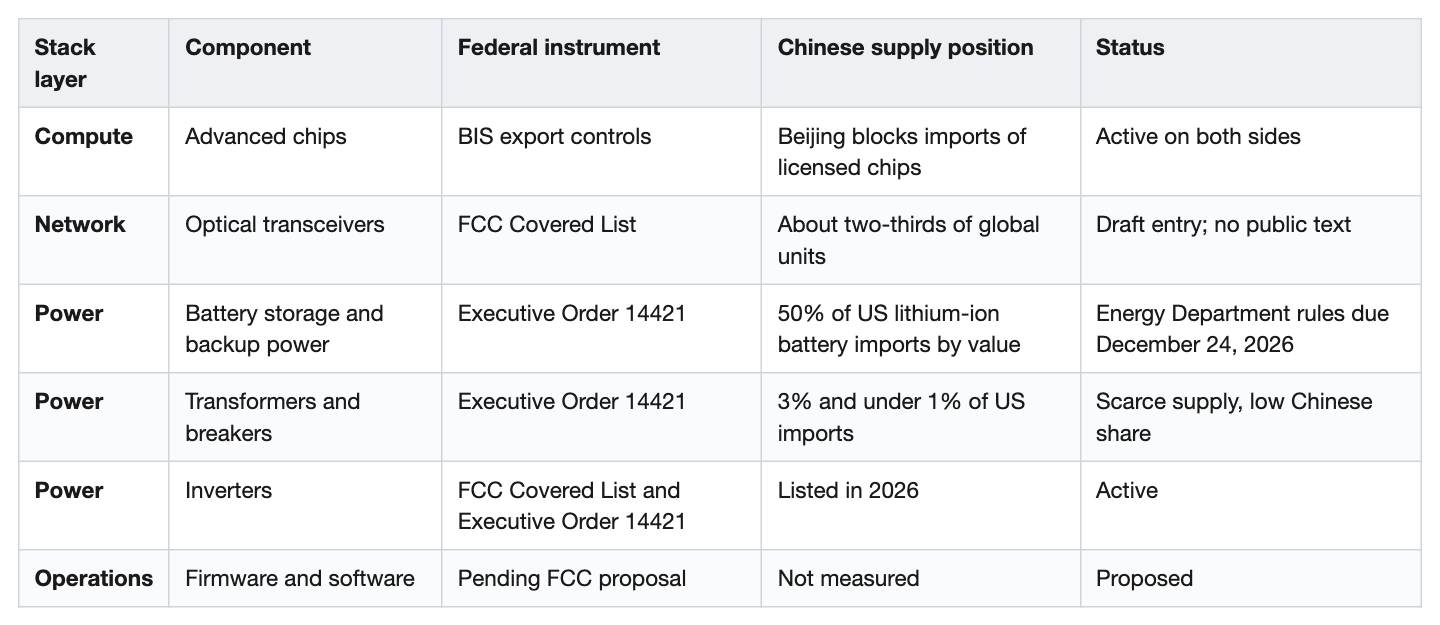
Three tests sort every case in the stack table. The first asks which clock binds: technology, industrial or regulatory. The second asks which form the restriction takes: a foreign-produced class with approvals, or named producers. The third asks whether the instrument offers a mitigation pathway.
The FCC and Energy Department instruments both carry a mitigation pathway. Executive Order 14421 authorizes mitigation agreements and vendor prequalification. FCC class listings carry Conditional Approval for up to 18 months, decided by the Department of War or Homeland Security. The contest therefore moves from whether a restriction issues to the terms of approval under it.
The two instruments also converge in form. Each FCC class listing since December 2025 covers equipment produced in any foreign country, and the Energy Department order tests ownership, control or direction by a covered foreign entity.
Battery storage is the next test of the pattern. China holds half of US lithium-ion battery imports, and no other origin comes close to that scale. Transformers show the opposite profile, where Chinese share is low and total supply is short.
Industry response repeats as well. The Information Technology Industry Council asked the FCC on August 13 to refrain from listing optical transceivers, and Microsoft pressed the White House in November. Both argue from Washington’s own AI leadership goal. The repeatable bargain concedes the legal authority and contests form, timing and mitigation.
Three forecasts cover the Energy Department rules, and none covers cooling or firmware. P3 is the forecast that the pattern recurs inside the FCC, and it stands at 60%. The governing measure for every later case is whether allied capacity builds faster than restrictions migrate across the stack.
Takeaway. The framework transfers: name the binding clock, the form of the restriction and the approval terms for each new component. Battery storage under Executive Order 14421 is the next application.
II.H Why Predictive Behavioral Economics Adds Value
Behavioral economics explains when each actor moves. Buyers under an import gate anchor on committed capacity, so loss aversion makes a delayed campus weigh more than an equal security gain. Vendors under an export gate anchor on lost revenue. Security agencies anchor on Huawei, which makes embedded dependence feel more dangerous the longer it lasts.
Declared and revealed goals diverge. Industry declares opposition to any ban, yet a dated rule with a long transition may serve buyers better than an open threat. Beijing declares that it will answer any harm, yet its suppliers’ US revenue rewards restraint.
Takeaway. Reference points explain the lobbying on both sides of each gate. Each side treats its current access as the baseline and reads any restriction as a loss.
II.I Why Dynamic Game Theory Adds Value
Game theory supplies the payoff structure and equilibrium selection. Each gate functions as a move in a bargaining set, and The US Bureau of Industry and Security Affiliates Rule Turns Export Controls Into Bargaining Instruments showed export rules trading against rare-earth controls. A static cost-benefit estimate misses that each gate’s value depends on the others.
The game also changes mid-play. The Calculus of Predictive Game Theory Evolution and Mutation shows that a forecast reaches only as far as the evidence supports the game that follows each fork. Evidence here supports forecasts through the January 2027 forks. Forecasts dated past January hold only under a paired truce extension.
Takeaway. The gates form one bargaining set, and that set resets on a known date. Forecasts dated past January therefore hold only under a paired extension.
II.J Simulation Architecture
Twelve actors become Cognitive Digital Twins (CDTs). Each row names what the actor wants, what it controls and what moves it.
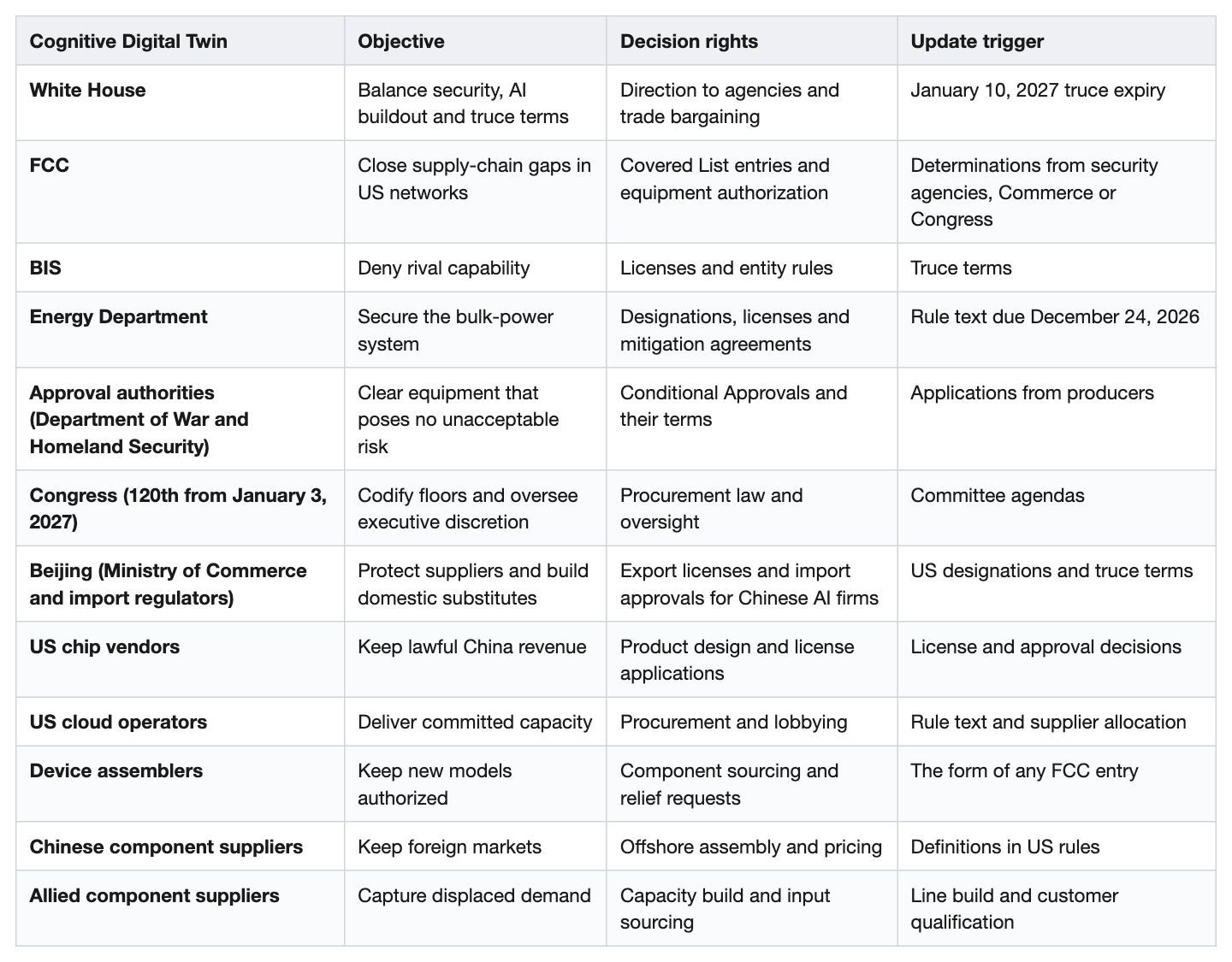
Three causal hypotheses compete, and each carries its own breaking condition.
Bargaining hypothesis. Gates move with truce terms. The hypothesis fails if a gate changes on a date unrelated to any truce announcement and cites no trade term.
Capacity hypothesis. Gates move with substitution milestones. The hypothesis fails if Washington imposes a broad import gate before qualified allied volume exists.
Security-floor hypothesis. Gates move on threat findings regardless of cost. The hypothesis fails if June 30, 2027 passes with no FCC entry and no public finding.
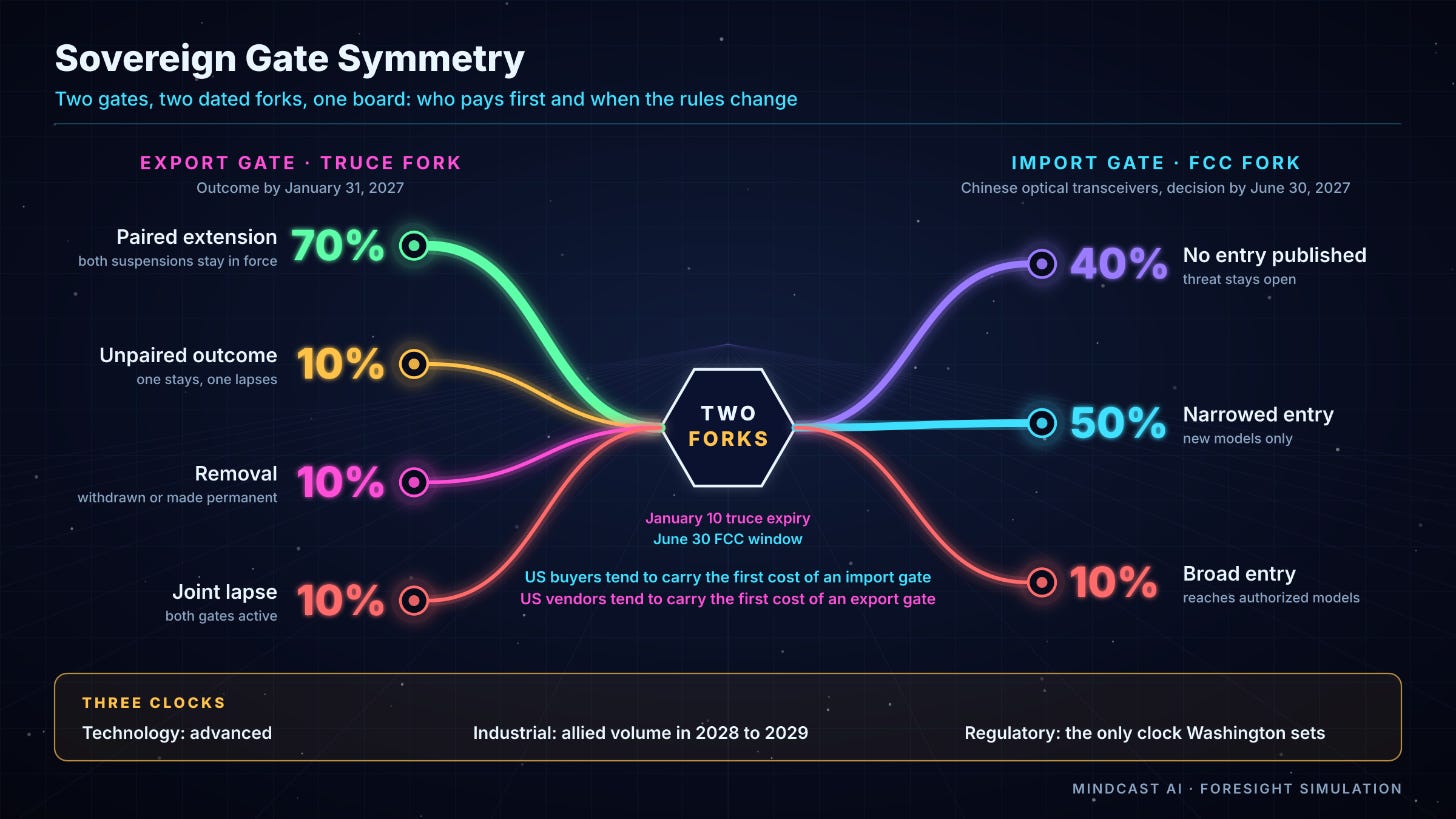
The simulation favors bargaining on the January fork, where paired extension leads at 70%. The odds on the import gate favor action before allied supply qualifies. An FCC entry by June 30, 2027 stands at 60%, and allied deliveries miss 2027 at 80%.
The capacity hypothesis keeps the 40% no-entry path. The null route is the case where nothing changes: all four gates stay in their current state through 2027.
The contest lacks a stable long horizon structure, because the truce expiry and a new Congress can change the game in January 2027. Claims past 2027 therefore stand as structural hypotheses.
Five dated turns structure the simulation. The Energy Department rule falls due on December 24, 2026. The new Congress convenes on January 3, 2027, and the truce expires on January 10. The FCC window closes on June 30, 2027, and allied 3.2T volume begins in 2028.
💼 Executives. A site can hold every permit and still wait on one restricted component. Supply-chain review now belongs in site planning.
Takeaway. Twelve actors, three competing hypotheses and five dated turns define the simulation. Together they bound what the forecasts can claim.
Section conclusion. Four gates, one cost pattern and one reset date define the board. The open question is how the actors move on it.
III. MindCast Simulation Predictions: Paired Extension Leads, Allied Supply Misses 2027 and Power Rules Arrive Late
Nine items follow: five Primary Simulation Predictions, two Secondary Simulation Predictions and two structural hypotheses. Data cutoff is November 11, 2026.
Odds print in tens. A credible public finding of compromised Chinese optical hardware is the break condition for all of them.
III.A The January 10 Truce Fork: Paired Extension Leads
The first fork arrives on January 10, 2027, when the truce and its paired suspensions expire. Four outcomes are possible, and one leads.
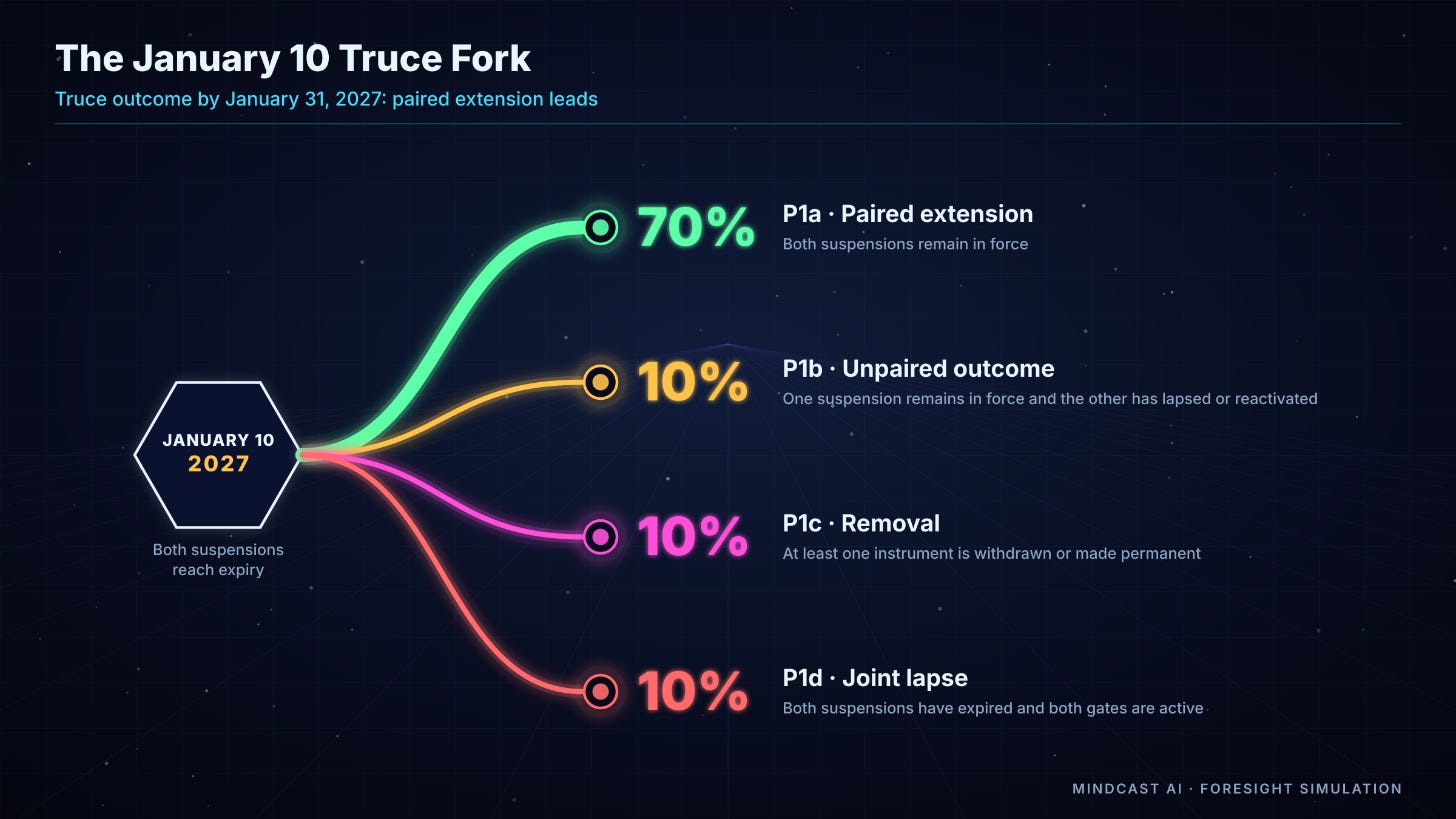
Mechanism. The truce and its two suspensions expire together: the Affiliates Rule suspension and the rare-earth suspension. Pairing makes each gate a chip against the other side’s gate. The fork tracks the two suspensions and tests whether the pairing survives.
P1 | Truce Fork Outcome by January 31, 2027
P1a | Paired extension: 70%. Both suspensions remain in force.
P1b | Unpaired outcome: 10%. One suspension remains in force and the other has lapsed or reactivated.
P1c | Removal: 10%. At least one instrument is withdrawn or made permanent.
P1d | Joint lapse: 10%. Both suspensions have expired and both gates are active.
Each instrument is classified by its legally operative status on January 31, 2027, so the four paths cover every case. Removal takes precedence over an unpaired outcome when both descriptions fit. Extensions to different dates count as paired while both suspensions remain in force. BIS rule notices and Ministry of Commerce announcements verify the result.
Takeaway. Paired extension leads at 70%, and the three other paths share the remaining 30%. Advice written for an extension still needs a version for the other three.
III.B Short Horizon Predictions Through 2027
Six predictions run through 2027. They cover the Energy Department rule, the FCC’s listing cadence, allied supply and Beijing’s import gate.
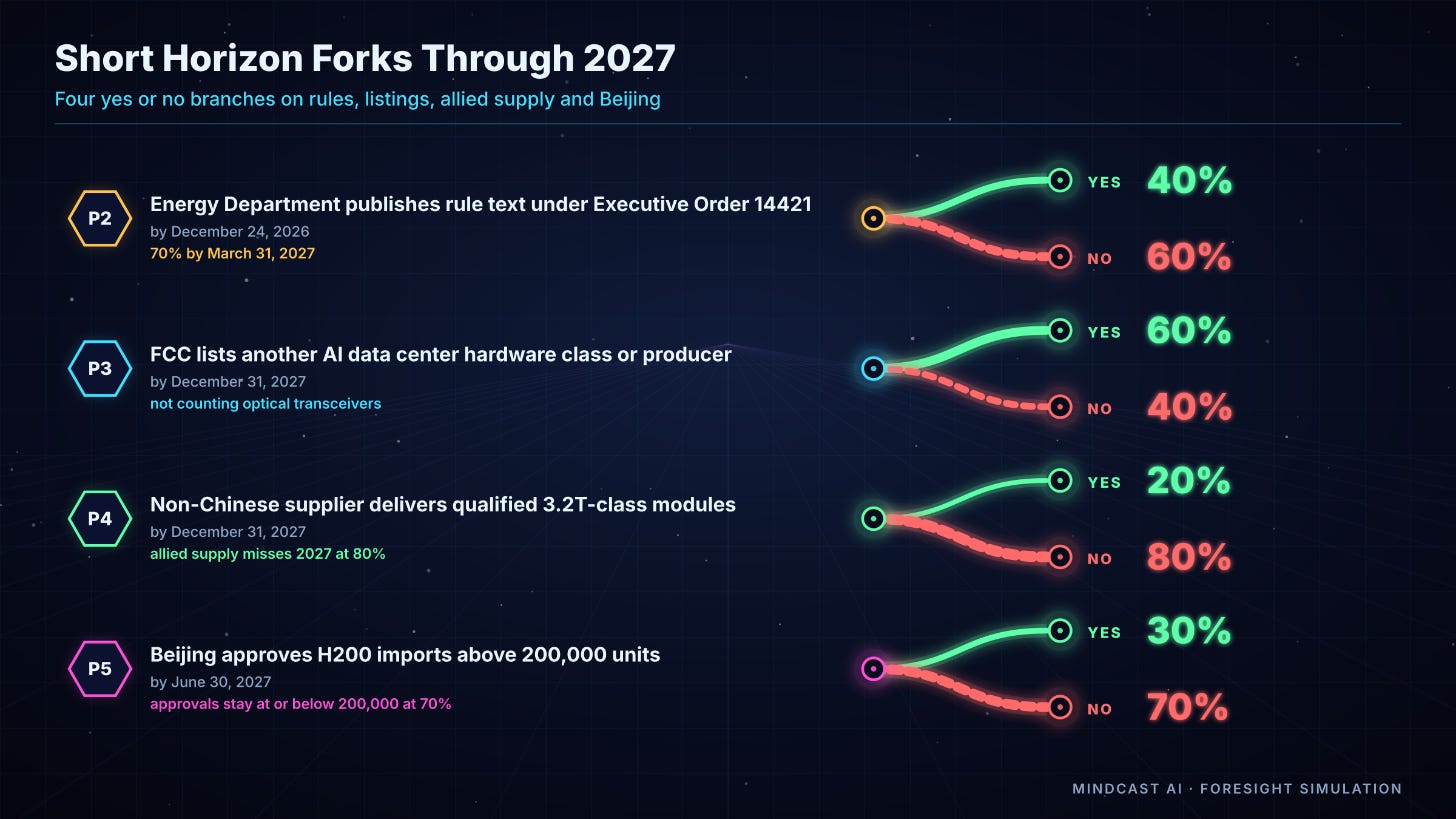
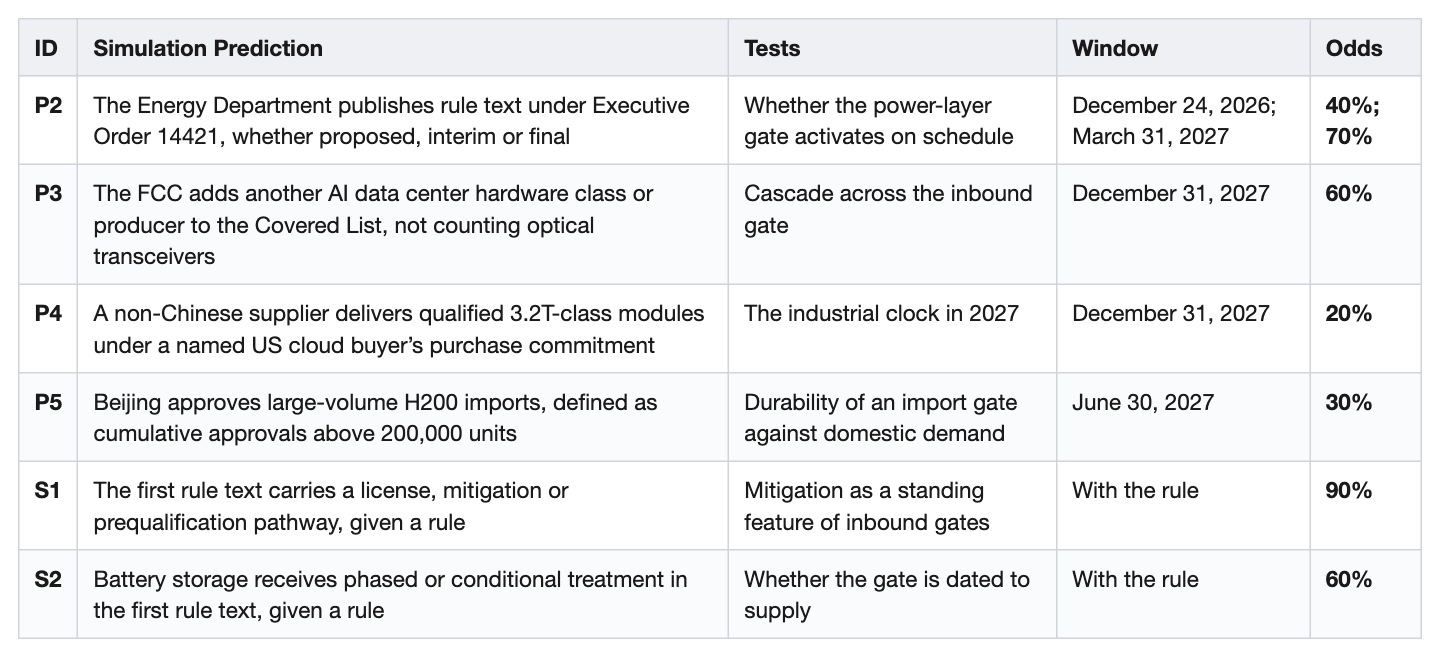
Each Simulation Prediction fails if its named event does not occur within the window. Verification sources are Federal Register notices, agency announcements, company releases and securities filings. P4 counts qualified deliveries only, so capacity announcements alone do not resolve it.
Two Simulation Predictions read more plainly in reverse. Allied 3.2T deliveries miss 2027 at 80%. Beijing’s cumulative H200 approvals stay at or below 200,000 units through June 30, 2027 at 70%.
Offshore relocation carries no forecast, because it has already happened. Chinese makers serve North American buyers from Thailand today, and Thai press reports further Innolight investment there. The FCC’s recent class listings reach plants in any foreign country, so the open question moves to approval.
Two items serve as monitoring signals: qualified 3.2T shipments by mid-2028, and a US cloud operator naming an allied manufacturing partner. Both appear in What to Watch.
Takeaway. A missed 2027 for allied supply and a late Energy Department rule are the two leading calls. In both cases, firms plan through 2027 without the supply or the rule text they need.
III.C Two Structural Hypotheses and One Working Thesis
Two claims reach past 2027, where no forecast carries odds. A working thesis on who pays first sits beside them.
H1 | An Import Gate Grows Easier to Sustain as Substitutes Qualify. Holding the threat constant, domestic opposition to an import gate falls as qualified allied capacity rises. The premise is the industrial clock, which places allied 3.2T volume in 2028 to 2029. The hypothesis fails if buyer opposition holds or rises after qualified allied volume covers the restricted class.
H2 | Control Transfer Alone Does Not Resolve a Hardware Dependency. Absent a hardware verification standard in a federal instrument, no federal instrument through 2029 resolves the risk of new Chinese high-speed transceivers by control transfer alone. The hypothesis fails if an instrument authorizes them on firmware custody or ownership restructuring alone.
Working thesis | First Operating Costs Land on the Restricting State’s Own Firms. Under each new gate, the first documented operating cost falls on firms inside the restricting state or its allies. Market value sits outside the claim, because share prices moved against Chinese makers first.
The thesis fails if the targeted foreign firms report lost revenue before any domestic or allied firm discloses a cost. The export gate supplies a documented case: Nvidia took a $4.5 billion charge after Washington required a license for H20 exports. No firm has yet disclosed such a cost under the transceiver gate, so the thesis carries no odds.
Takeaway. The hypotheses and the working thesis state premises and breaking conditions without odds. Each one names the observation that would end it.
III.D How the Game Evolves: One Event Changes the Rules
A forecast holds only inside the game that produced it. Each event below either leaves the game intact, shifts which outcome persists or changes the moves available. Seats mean the modeled actors, and each row names what the event does to them.
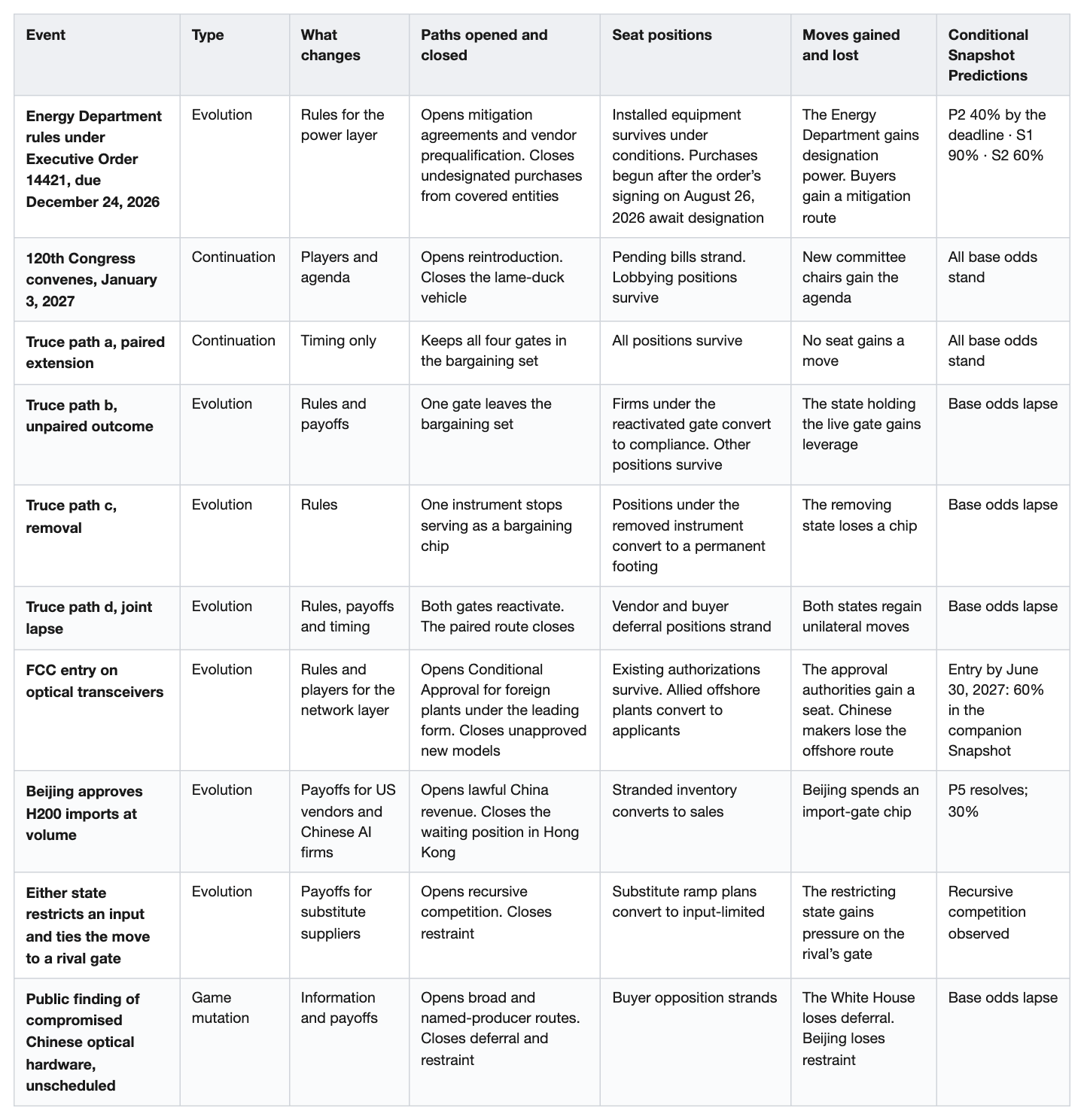
Two rules govern the game-evolution map. Odds assume truce path a and no security finding. Where a row reads “Base odds lapse”, the forecasts need a new simulation in the new state.
Takeaway. One event mutates the game, and the rest move play within it. A public security finding is the event to treat as a new game.
III.E Limits
A negotiated package could move several gates at once. Such a package would shift weight to P1a without testing the capacity hypothesis. Chronology alone cannot separate bargaining from capacity, so resolution needs announcements that cite the truce or cite qualification milestones.
Under a paired extension, vendors and buyers hold position and lobby for the next date. Under an unpaired outcome or a joint lapse, the firms under a reactivated gate move first, because their compliance clock starts at once.
⚖️ Counsel. Odds change outside a paired truce extension. Advice written for an extension needs a second version for a split or a lapse.
Takeaway. The forecast set names the event that would reshape it and the evidence that separates its hypotheses. Outside a paired truce extension, the odds need a new simulation.
Section conclusion. Paired extension leads the January fork, allied supply misses 2027 and the power rule arrives late. Each forecast names its window, its source and the event that ends it.
IV. Stakeholder Strategy and Risk Mitigation: Supply Timing and the January Fork Carry the Exposure
Each stakeholder holds a different lever against the same exposures. The first table sets out moves by audience, and the second converts each prediction into an owned task.
🏛️ Policymakers. Low-regret move now: date import gates to qualified allied capacity in 2028. Once an entry issues: set approval terms to the build clock. Primary risk: approvals that expire before capacity arrives.
💼 Executives. Low-regret move now: map exposure under both gates by business line. If P1b occurs: rebalance supply. Primary risk: one date resetting several regimes.
⚖️ Counsel. Low-regret move now: prepare compliance for all four truce outcomes. If the Affiliates Rule returns: screen ownership. Primary risk: advice keyed to one outcome.
📊 Investors. Low-regret move now: value substitutes against qualified shipments. After P4 resolves: reweight. Primary risk: substitute capacity limited by build time.
Actions below are options for consideration, not legal, investment or fiduciary advice. Severity and probability appear as separate axes.
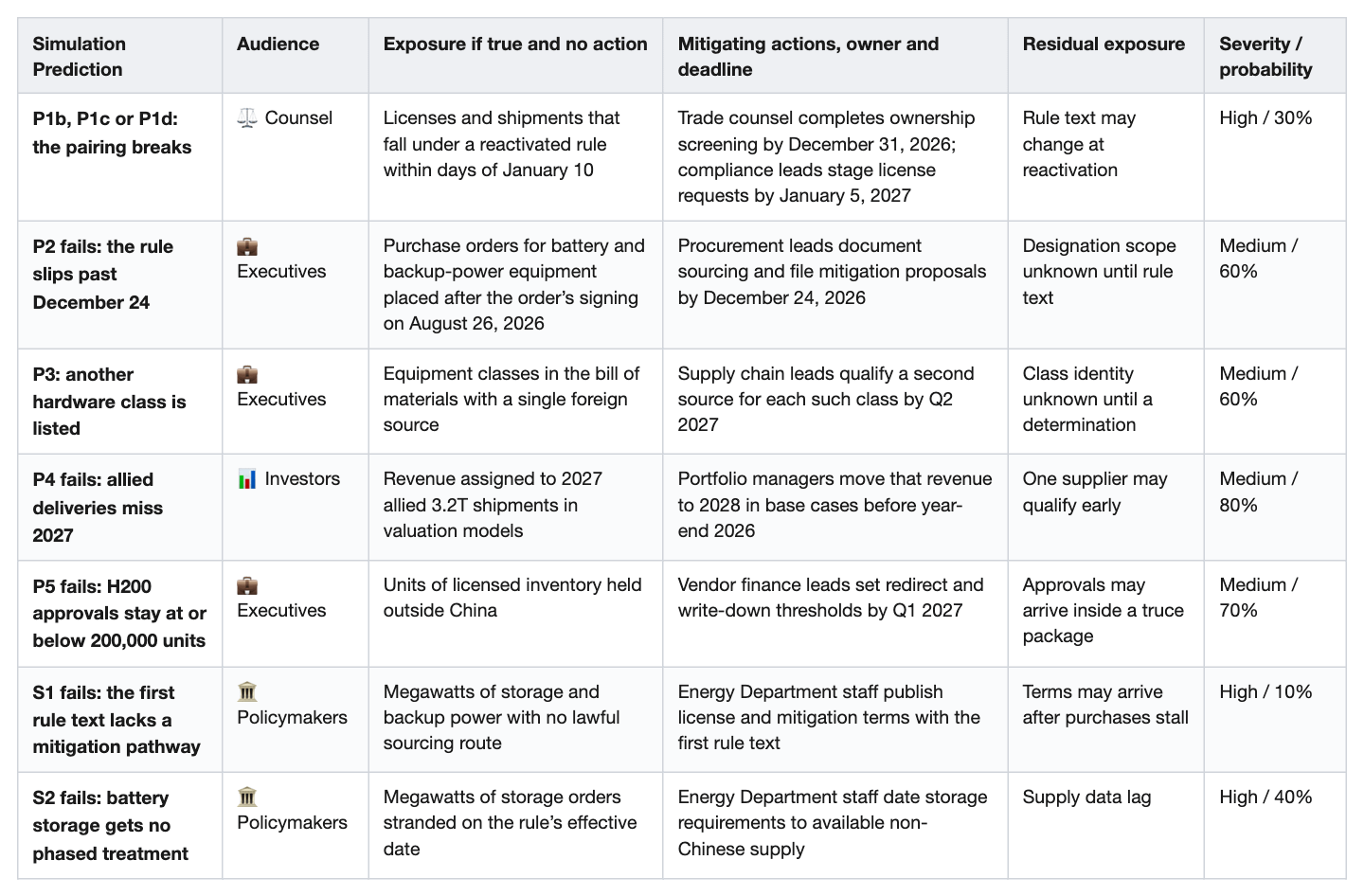
Takeaway. The most likely exposure is allied supply missing 2027, and the most severe sits on the January 10 fork. Each row names an owner and a date, so the exposure converts into a task.
V. Implications: Security Rules Now Set the Pace of Compute
The four-gate contest changes who sets the pace of AI capacity. Five implications follow for institutions, strategy, distribution and supplier power.
Institutional impact. The FCC has become the inbound counterpart to BIS, and the Energy Department is becoming a second one under Executive Order 14421. Federal Grid-Security Rules Are Doing to American AI Data Centers What China Could Not found that equipment rules converge on time to power. Network optics extend the same mechanism to time to compute (P3).
Strategic interaction. Absolute security and relative position can move in opposite directions. A US import gate lowers exposure to compromised hardware and raises US deployment cost. The same gate cuts the US revenue that funds Chinese optics development, so the net effect on relative position stays an open measurement.
Distribution. Substitute suppliers gain on most branches. Buyers and vendors inside the restricting state absorb the first operating costs. The rival chooses between input pressure and restraint.
Supplier leverage. A ban removes the buyer’s outside option, so allied suppliers gain bargaining power once the Chinese source is barred. Marvell agreed on November 2, 2026 to acquire Lumentum, with closing expected in the first half of 2028. The merger closes inside the substitution window, adding supplier leverage and an approval clock of its own.
Falsifier consequences. If H2 fails, control transfer extends to hardware and import gates become negotiable through custody arrangements. If no tied input restriction occurs through 2027, recursive competition remains a possibility without a demonstrated case.
🏛️ Policymakers. Each new component rule adds time before compute comes online. Agencies need one calendar across chips, optics and power equipment.
Takeaway. Security rules on chips, grid equipment and optics now converge on how fast AI capacity comes online. Time to compute now depends on equipment authorization as much as on chips and power.
What to Watch
Ten signals separate the paths in this paper. Each carries a named source and a cadence.
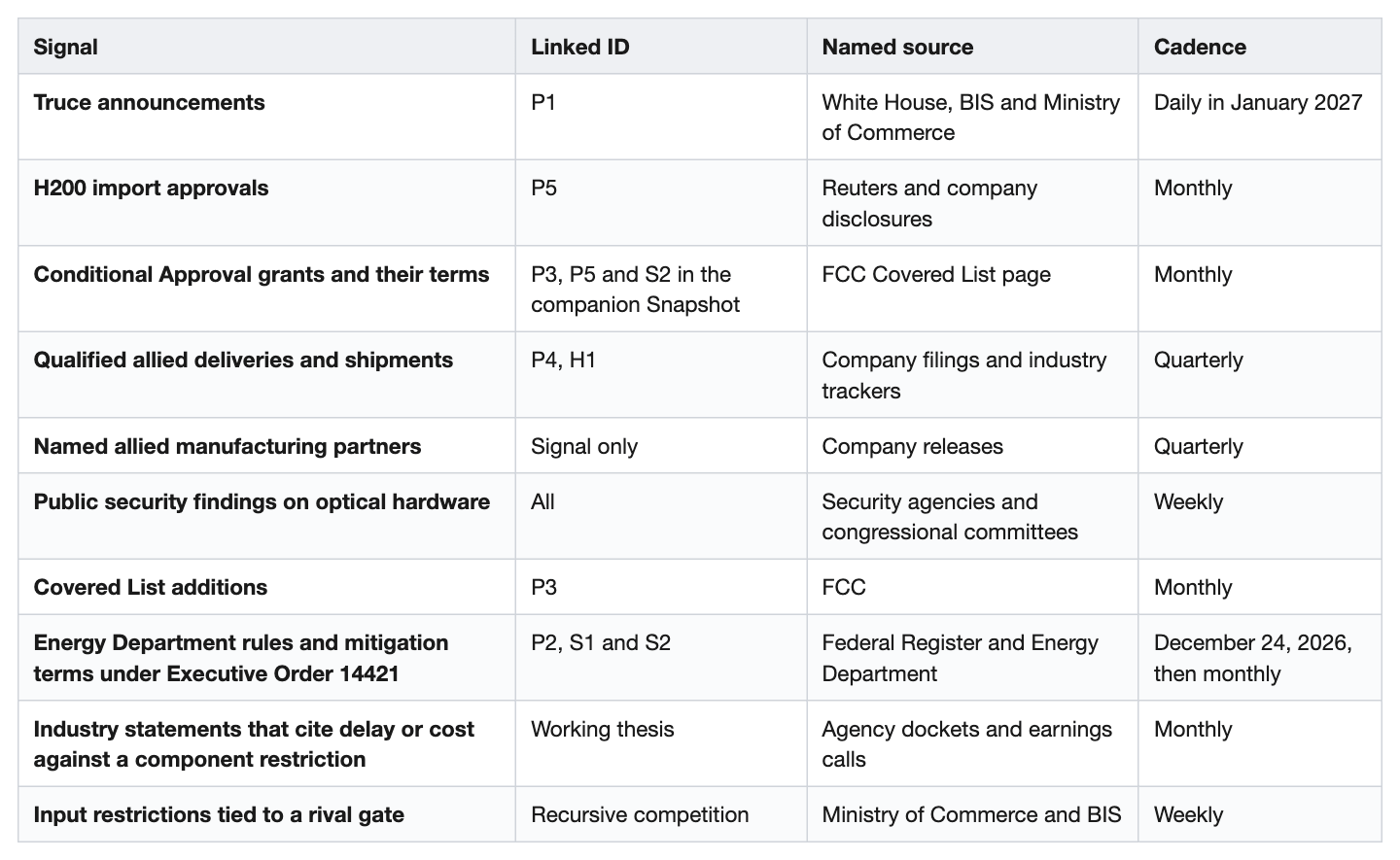
Takeaway. The January 10 announcements are the decisive signal. The December 24 Energy Department deadline arrives first and tests the pattern on power equipment.
Conclusion
Import gates and export gates share one structure. The restricting state’s firms tend to carry the first operating cost, and substitution capacity decides how long they can keep carrying it. Export gates spend leverage, and import gates borrow against capacity not yet built.
The optical transceiver dispute is the first case of a class. Batteries, inverters and firmware sit under instruments that pose the same three tests. The first of those rules is due December 24, 2026.
Stakeholders act now by mapping exposure under both gates and preparing for all four truce outcomes. The open question is whether either capital begins to target the other’s substitutes. The decisive signal arrives on January 10, 2027.
Working With MindCast
The board in this paper resolves on public dates, and every firm on it must commit before then. Supply contracts for 2028 campuses get signed in 2027. Compliance programs for January 10 get staffed in December. A published forecast gives the odds, and a commissioned simulation gives one organization its move.
Three questions MindCast answers for one organization.
Which gate binds first? MindCast maps each business line to the gate, the clock and the approval terms that reach it. The output is an exposure map by business line under both gates.
What does each truce outcome cost? The simulation runs the organization’s own contracts through all four paths, P1a to P1d. The output is a dated loss range per path and the trigger that moves the organization from one plan to the next.
What should the organization ask for? Approval terms and transition dates remain open. MindCast simulates how the FCC, the approval authorities and Beijing respond to each request before the organization files it.
What a commissioned engagement delivers. MindCast builds Cognitive Digital Twins of the organization, its counterparties and the agencies it faces. The four-gate board then reruns against the organization’s actual options. Deliverables include complete probability distributions with P10/P50/P90 ranges, decision thresholds and a monitoring dashboard keyed to the five dated turns.
Why now. Paired extension leads at 70%, which leaves 30% on paths that reset export rules, import rules or both on one date. Allied 3.2T supply misses 2027 at 80%. A firm that plans on the leading path alone carries both exposures without a plan.
First step. Bring one decision due before January 10, 2027. A diagnostic session runs that decision against the four-gate board and returns the paths that change it. Contact: mcai@mindcast-ai.com. Visit our corporate site www.mindcast-ai-simulation.com.
Appendix A. Selected MindCast Works
FCC Ban on Chinese Optical Transceivers: The Form of the Entry Decides Who Pays and Approval Terms Decide How Long. Companion Snapshot on the FCC decision, its entry form and approval terms.
The Calculus of Predictive Game Theory Evolution and Mutation. Supplies the rule that a forecast reaches only as far as evidence supports the game after each fork.
Enforcement Incidence and Capability Denial in Artificial Intelligence Export Controls. Establishes the burden pattern this paper extends to imports.
The US Bureau of Industry and Security Affiliates Rule Turns Export Controls Into Bargaining Instruments. Models gates as paired bargaining instruments.
China’s H200 Import Block and the Reordering of National Innovation Control. Models Beijing’s inbound gate.
Federal Grid-Security Rules Are Doing to American AI Data Centers What China Could Not. Shows equipment rules converging on time to power.
MindCast Prediction Scorecard. Resolved material calls as of November 10, 2026.
Appendix B. External Sources
Reuters via Business Recorder, Microsoft presses Trump to scuttle expected ban on Chinese data center technology.
Reuters via AJOT, Trump administration drafting ban on Chinese data center devices.
Bureau of Industry and Security, Extension of the Affiliates Rule suspension.
The Star, China extends suspension of rare earth export controls until January.
Mayer Brown, Proposed legislation on the FCC Covered List.
Counterpoint Research, Who Wins and Loses in the Proposed FCC Ban on Chinese Transceivers?
Cignal AI, FCC Ban on New Chinese Optical Modules.
The Next Web, The US wants Chinese optics out of its AI data centres.
Data Center Dynamics, Almost 600,000 Nvidia H200s stranded in Hong Kong.
Caixin Global, TikTok Completes US Spinoff to Keep App Online.
NVIDIA, First-quarter fiscal 2026 results, filed with the Securities and Exchange Commission.
Holland & Knight, Executive Order Declares National Emergency to Secure U.S. Bulk-Power System.
Rystad Energy, US executive order targets Chinese grid hardware, but battery storage serving AI data centers is more exposed.
Mayer Brown, FCC Expands its Covered List to Include Foreign-Produced Routers.
Steptoe, FCC Adds Foreign-Produced Routers to the Covered List.
Hogan Lovells, Executive Order targets foreign-sourced bulk-power equipment.
ChinaTalk, China, the FCC and the Logic of Transceivers.
Federal Communications Commission, Third Report and Order and Third Further Notice of Proposed Rulemaking, FCC 26-50.
Bangkok Biz News, Innolight investment plans in Thailand.
Optics.org, Nvidia investments in Coherent and Lumentum.
Credence Research, Coherent five-year agreement worth about $20 billion.
Simply Wall St, Lumentum capacity sold out through 2027.
Securities and Exchange Commission, Marvell filing on the Lumentum acquisition.
StreetInsider, Coherent Demonstrates Technologies for Next-Generation Pluggable Transceivers at OFC 2026.