
Related works: The Trump Administration’s Grid-Equipment Emergency Order Hands Taiwan an AI Data Center Supply Market | Anthropic, Alibaba, and the Runtime Theft Problem | The Beijing Summit Validation | The TSMC China License and the Limits of Hardware Export Controls
Executive Summary
A data center can be stopped without anyone touching it. Chips, model weights and buildings are guarded because someone owns them. No single actor owns the permission layer, so no single actor defends it end-to-end.
The security boundary of AI infrastructure is migrating outward from the machine to the institutions that decide whether the machine may run. Permission is produced by utility commissions and siting authorities, and by interconnection queues and federal equipment reviews. Each is reachable.
Together they form an authorization-security perimeter that conventional infrastructure defenses do not protect end-to-end.
MindCast builds Cognitive Digital Twins (CDT) of the institutions themselves and runs them forward. Conventional analysis reads rules and describes incentives. A MindCast AI Proprietary Cognitive Digital Twin Foresight Simulation (MP CDT FS) simulates how regulators and utilities respond to developers and sovereigns under pressure.
Game theory supplies the payoff structure and selects among equilibria. Behavioral economics supplies the decision rules and the salience effects that determine which payoffs actors perceive.
Game theory and behavioral economics together generate the predicted behavior. Neither produces it alone.
The paper proceeds in four analytical moves, then the simulation. It establishes that American opposition to data centers is authentic and quantified. It shows what two disclosed influence operations do and do not prove.
It then traces how federal grid-security policy converts into an authorization cost, and places allied supply inside the same chain, where equipment qualification and concentrated advanced-node capacity meet obligations that outlive them.
The paper then releases fifteen MindCast Foresight Simulation Predictions carrying bands and falsifiers. A risk mitigation layer routed to four audiences follows.
The Simulation Predictions That Matter Most
Flexibility becomes something developers buy, not something they suffer. At least one grid operator tariff accepted by the Federal Energy Regulatory Commission will condition faster large-load interconnection on curtailability or co-located generation. Band: 72–84%. Load flexibility stops being a penalty and becomes a price paid for speed.
Power obligations will outlive the compute they were signed for. No approved large-load tariff or filed special contract will excuse a customer from minimum-payment or take-or-pay obligations when computing hardware fails to arrive. Band: 76–88%. The instruments states adopted to protect households transfer completion risk onto developers, and the largest correlated shock to that risk sits offshore.
Grid rules converge region by region, not through one national standard. The Federal Energy Regulatory Commission will dispose of at least four of six regional proceedings before issuing any generic rule. Band: 74–85%. Developers face convergent substance arriving through divergent procedure.
Federal equipment security arrives tiered, not absolute. The Department of Energy implementing instrument will carry a mitigation or prequalification pathway rather than categorical prohibition. Band: 72–84%. Transformer scarcity constrains the alternative.
No authority will find that foreign influence caused an authorization outcome. Band: 80–89%. The grievance is domestic, and treating critics as foreign agents creates a second attack surface.
What Each Audience Should Conclude
🏛️ Policymakers. Security policy and infrastructure policy now price the same variable. Rules written for equipment provenance land as delay in energization schedules, and rules written for ratepayer protection land as stranded-asset risk on developers. Write them together or absorb the interaction unplanned.
💼 Executives. Authorization has left permitting. Cost allocation and equipment provenance now belong to one function alongside community legitimacy and time-to-power. Firms still running them separately are optimizing pieces of a single constraint.
⚖️ Counsel. Proving who did what has become the binding constraint on remedy. Where attribution becomes uneconomic, enforcement migrates toward sovereign forums. Contract terms increasingly allocate the risk before litigation can.
📊 Investors. Permit status is no longer the diligence question. Long-duration power obligations survive project cancellation, and the compute that fills the building comes from a narrow set of advanced-node suppliers. Underwrite the covariance or price it after the fact.
I. Permission Is Produced by Institutions the Developer Does Not Control
Conventional security begins at the fence. Harden the network and segment the operational technology. Control credentials and secure the site.
AI infrastructure depends on a longer chain. A campus needs land and transmission before it produces any compute. It also needs generation and interconnection capacity. Rate treatment and water follow, then equipment, capital and political legitimacy.
Every one of those is produced by an institution the developer does not control. Openness is the vulnerability, and closing it is not an option. A siting process that discounts public comment stops being a siting process.
Three properties compound the exposure. Authorization decisions are distributed across thousands of counties and dozens of commissions, so no single body can be hardened. Authorization runs slow while compute depreciates fast. Authorization contests turn on perceived local cost, which responds to information.
An adversary reading the American buildout for pressure points finds the authorization layer outside most conventional infrastructure defenses. The asymmetry is the economic point. A modest intervention could carry strategic value if it reaches an institutional decision point, because even months of delay can reprice a multi-billion-dollar program.
A standing rule governs the scope of the analysis. Any measure that materially affects Chinese capability in artificial intelligence or quantum technology also lands on Taiwan, because Taiwan supplies the compute and increasingly the qualified equipment on which the allied system runs. Restrictions aimed at one side of the contest reallocate sourcing, demand and export scope onto the other, and Taiwan absorbs the first order of that reallocation.
The rule applies here through the artificial intelligence branch. A paper about American authorization costs arising from a China-linked action and an American security response reaches Taiwan by construction, and Section VII takes it up directly.
Takeaway. The perimeter now includes the institutions that decide whether the machine turns on.
II. The Grievance Is Real and Quantified
Serious analysis must refuse the easiest error. American concern about data center electricity costs required no foreign help to exist.
The cost effect is measurable where the grid is tight. Monitoring Analytics, the independent market monitor for the PJM Interconnection, estimated that data center demand raised the region’s cost of holding peak capacity by roughly $9.3 billion in 2025–26. Those costs ran about 174 percent above the counterfactual.
Public concern matches the arithmetic. A June 2026 Reuters/Ipsos survey found that seventy-seven percent of Americans worry artificial intelligence will make power more expensive. A Gallup poll released in May found more than seventy percent of respondents opposed data center construction in their own area, citing energy and water use alongside a general dislike of artificial intelligence.
Majority concern of that scale predates any demonstrated effect from the disclosed operations and cannot reasonably be attributed to them on the available evidence. Opposition is bipartisan and organized locally, appearing in town halls and rallies rather than only online.
Washington State shows the machinery already working. The Utilities and Transportation Commission opened a large-load docket. Rates, cost sharing, interconnection conditions and customer protections are all on the agenda. Utilities and hyperscalers appeared alongside consumer advocates, tribal commissions and environmental groups.
The dispute contains genuine competing interests. Utilities want firm commitments before building. Existing customers want protection from cross-subsidy. Developers want power at scale without open-ended exposure.
Hyperscalers may accept heavy obligations when those obligations buy certainty. A stricter tariff raises the disclosed authorization price while lowering authorization uncertainty. Minimum payments, collateral, and termination charges make a project more expensive and more financeable at the same time.
Elected officials have responded on the record. Texas Governor Greg Abbott, previously a supporter of data center development, directed the state utility commission and grid operator to protect residents from infrastructure costs. Abbott has said the new requirements stopped roughly 1,800 facilities from being built in the state, and has separately rejected the claim that China is behind the American data center debate.
Authority migrated when the legislative route closed. A Washington State data center bill stalled amid significant industry opposition, and state regulators took up the same objective under independent statutory authority. Commissioners have said the resulting guidelines could shape a revived bill.
The contested zone is epistemic rather than monetary. Amazon and Microsoft accept charges for costs that can be measured and traced to them. Utilities and advocates argue the largest effects resist measurement, and the commission has agreed on the record that indirect impacts are real and hard to quantify.
Clean power is rivalrous, and the record illustrates it. Amazon outbid Puget Sound Energy in January for a 1.2 gigawatt solar and storage facility in Oregon. A hyperscaler bidding against a regulated utility for a gigawatt of clean supply removes the resource the utility needs to meet a statutory obligation.
Takeaway. Foreign amplification and legitimate domestic opposition coexist. Evidence of one does not discredit the other.
III. What the Two Disclosed Influence Operations Prove
The public record supports a four-step ladder. Each step answers a different question, and the answers weaken as the ladder rises.
A covert operation existed. OpenAI disclosed a likely China-origin influence campaign in June 2026 that used generative tools to post as American voices arguing that data centers drive household power costs. OpenAI assessed the operators as likely working at a private Chinese technology company serving provincial government clients.
Operator identity is partly established. OpenAI supplied operator-level evidence for its own cluster. X later reported roughly 200,000 suspected Chinese inauthentic accounts. Approximately 200 posted on data centers and energy, without comparable public detail.
Direction is not established. A contractor serving government clients does not prove central government direction. China-linked and Beijing-directed are not interchangeable terms. Neither are likely origin and provincial client.
Effect is not established. OpenAI found no meaningful breakout beyond the operation’s own activity, and independent forensics sharpen the finding. Darren Linvill of Clemson University’s Media Forensics Hub examined the accounts X disclosed and found at least 59 with zero engagement, likely deactivated before they could gather a following.
Linvill traced one obscure hashtag used by the accounts to 90 posts, all created in January. Each account posted two or three times before suspension. His summary is blunt: no real humans saw the posts. He also confirmed the overlap between the accounts X disclosed and the cluster OpenAI reported in June.
No public evidence ties either campaign to a moratorium, tariff, permit or vote.
A second attribution problem. The parties disclosing and amplifying the influence narrative hold commercial interests in data center development. Samuel Woolley of the University of Pittsburgh notes that reports of Chinese data center propaganda have come from large technology firms with a stake in the outcome. Developers, investors and technology commentators have promoted the same narrative.
None of that establishes bad faith, and platform threat intelligence remains the only source with account-level visibility. It does establish that the disclosures require the same evidentiary discipline the paper applies to the operations themselves.
Takeaway. Foreign operators tested narratives aimed at a real American controversy and reached almost nobody. Their institutional effect remains unproven, and preserving that distinction is what makes the analysis durable.
IV. Low Engagement Is Evidence of Failure, Not Proof the Pathway Is Closed
The disclosed campaigns failed to demonstrate meaningful reach. The failure counts against claims of present influence effectiveness. It does not establish that the authorization pathway itself is inaccessible.
Low engagement therefore changes the question from volume to leverage.
A million posts that never reach a decision network do nothing. A far smaller intervention reaching a divided coalition, a close vote, or a jurisdiction near a moratorium threshold can matter out of proportion.
The transmission sequence is longer than exposure. A narrative reaches an audience and salience shifts among relevant actors. Coordination changes, an institution acts and authorization terms move. A campaign earns causal credit only when the chain reaches the final link.
Takeaway. Aggregate pressure is not leverage. Social-media volume is a poor proxy for policy effect, and any analysis using it as one will misprice the threat in both directions.
Contact mcai@mindcast-ai.com to partner with us on Predictive Game Theory AI in Law and Behavioral Economics. We specialize in predictive simulations for Complex Litigation, Innovation Economics, Geopolitical Risk Intelligence and Legacy Innovation. See more about MindCast series at our new website MindCast Corporate.
To test our predictive simulation AI system, in 2026 we simulated the Super Bowl and the World Cup. See 🏈 Super Bowl LX — AI Simulation vs. Reality | ⚽ The 2026 World Cup Final Simulation Validation
To deep dive on MindCast works upload the URL of this publication into any LLM (preferably Google AI mode) and prompt ‘reconstruct MindCast framework with three degrees of cited sub links.’ See Live-Fire Game Theory Simulators, Runtime Predictive Infrastructure, MindCast Foresight Prediction Simulations, Synthesizing Behavioral Economics + Game Theory.
Working With MindCast
MindCast runs two service lines on one method. Authorization foresight intelligence assesses projects, contracts and instruments against the three questions that decide a campus: what permission costs, how long it takes to energize, and which obligations survive if the compute never arrives. Provenance exposure intelligence maps the security surfaces beneath them: the two chains, control topology across equipment, firmware and remote access, and the seams where federal bulk-power authority ends and state cost allocation begins.
💼 Hyperscalers, developers and operators can commission a time-to-power exposure audit against the six-family register: named sites scored on the flexibility-for-speed model, per-region exposure keyed to the regional show cause proceedings, and a qualification sequence timed to the checkpoints the register projects. Firms running procurement, permitting and public affairs as separate functions face the sharpest version of the question, because authorization now prices all three as one constraint.
📊 Investors and lenders can commission an obligation-survival screen across a named portfolio: which holdings carry long-duration power commitments that outlive project cancellation, which instruments assign full directly attributable network-upgrade cost, and what a compute delivery slip does to coverage and exit assumptions. The register prices the absence of any compute-supply excuse at 76–88% through December 31, 2027 — the exposure arrives on financing and delivery clocks, not permit clocks.
🏛️ State commissions, energy offices and legislative staff can commission a diffusion assessment: where the structural risk-transfer architecture arrives next, keyed to the six named tariff elements, the four-region convergence threshold, and evidentiary standards that separate coordinated manipulation from substantive comment. The register prices six additional utility territories at 77–88% and a national template at close to zero.
⚖️ Counsel can commission a contract-stack review against the provenance ladder: where equipment, firmware, maintenance and remote-access exposure sits in executed agreements, which substitution rights are achievable at renewal, and how delivery-linked ramp provisions allocate risk that no tariff will excuse. Attribution cost determines what remedies exist, and the register prices downstream migration into utility instruments at 48–62%.
Allied equipment suppliers and grid manufacturers can commission a qualified-supplier positioning review scored against the covered-entity architecture, because provenance policy creates demand as well as restriction, and the layers that survive a factory move are not the layers that move.
The Simulation Predictions in this paper are the authorization line applied to the security layer now repricing across American infrastructure. Every engagement above runs on the same methodology, with dated falsifiable outputs. Contact mcai@mindcast-ai.com.
V. Federal Grid-Equipment Rules Add Their Own Delay
Information is only half the problem. Equipment is the other half.
On August 26, 2026 the President declared a national emergency over foreign-produced bulk-power-system electric equipment. The order authorizes restrictions on covered equipment. Scrutiny extends to software, firmware and digital services. Maintenance and remote-access capabilities fall inside it too.
Scope is broad above the distribution line. Reported coverage at 69 kilovolts and above runs to substation transformers, reactors and capacitors. Grid-connected inverters and battery storage fall inside it.
Generators including backup units also fall inside, along with industrial control systems, protective relays and metering. Local distribution facilities sit outside.
An early reading held that behind-the-meter configurations therefore escape the regime.
The equipment categories covered by the order substantially narrow that escape thesis. Alternative architectures can remain exposed through generation, storage or control components even when their grid relationship changes. Firmware and other covered elements carry the same exposure.
A second pathway into authorization economics follows. A sovereign security threat produces a provenance review. The review determines vendor eligibility. Vendor eligibility reshapes utility procurement and moves interconnection timing.
A campus can hold land-use approval and a service agreement and still wait on a transformer. Security is not free, and the question is whether the risk removed justifies the capacity delayed.
Takeaway. Defensive policy raises the authorization price even when it succeeds at its own objective.
VI. Control Topology Replaces Country of Origin
First-generation analysis asks where a company is headquartered and where equipment was built. The emerging problem is more granular.
The provenance stack now runs from capital through beneficial ownership to project-entity eligibility. Equipment, software and firmware follow. Maintenance and remote access come next, and the information environment around the authorization process closes the stack.
Access matters more than custody. Earlier MindCast work on semiconductor controls established that physical possession does not define the capability boundary. Routing, joint ventures and access rights move capability without moving the object.
A transformer assembled in a trusted country is not secure if firmware or update authority preserves a control pathway. Remote diagnostics and lifecycle maintenance do the same. Foreign production does not automatically mean prohibited equipment either, since the order permits mitigation and prequalification.
Takeaway. The regulated unit is moving from country of manufacture to control topology, and establishing control topology is expensive.
VII. Taiwan Is the Qualified Alternative the New Rules Create Demand For
Section I stated the rule that measures aimed at Chinese capability land on Taiwan. Equipment provenance is where the rule operates in this paper.
Federal provenance policy does not only restrict. It creates demand for suppliers whose ownership, firmware and maintenance pathways can be verified.
Taiwan already holds a substantial position in that category. The Chung-Hua Institution for Economic Research reported exports of transformers and related heavy electrical equipment to the United States at $1.56 billion in 2024, nearly half of Taiwan’s exports in the category. Exports reached $1.77 billion through October 2025 at 53.8 percent.
Order books show the demand arriving. Fortune Electric reported in June that AI data center transformer orders exceeded NT$20 billion, with the United States its largest market and visibility through 2029.
Taiwan also operates under an unusually intense critical-infrastructure threat environment. The National Security Bureau reported an average of 2.63 million cyberattacks per day against key infrastructure in 2025. Sustained defense at that volume strengthens the strategic case for resilience investment and hardened operational practice. It does not by itself establish the security qualification of any individual supplier or component.
Taiwan is solving the American problem at home at the same time. The Ministry of Economic Affairs now folds AI data centers and semiconductor expansion into its electricity-demand outlook and projects roughly 2.5 percent average annual growth to 2035. A jurisdiction building large-load rules for its own grid is a peer to the American commissions writing them, not only a vendor to the developers subject to them.
Value chains redistribute as procurement preferences shift, and Taiwanese firms are moving assembly, testing and service capacity to North America. Which layers concentrate where is a live commercial question and sits outside the scope of this paper.
One gap runs underneath all of it. Large-load obligations bind on a fixed schedule while the compute that justifies them arrives on a variable one, and advanced-node capacity remains concentrated at a small number of suppliers. The public instruments reviewed for this paper do not price the interaction.
Takeaway. Security policy is creating a qualified-supplier market, and Taiwan enters it with existing market position, visible order demand and a demanding domestic resilience environment. The unpriced gap between firm power obligations and variable compute delivery is a commercial opening on both sides of the transaction.
VIII. Two Chains Converge on Time-to-Power
The equipment-security chain already terminates at time-to-power. The information-provenance chain can terminate there if narrative transmission reaches institutional action, which the current record does not show.
The first runs from information provenance through public legitimacy and regulatory response to authorization conditions, then to time-to-power and capital allocation.
The second runs from a sovereign security threat through equipment and access provenance to vendor eligibility. Procurement redesign and energization timing follow. Time-to-power and capital allocation close the chain.
The chains interact. A security incident raises demand for provenance restrictions. Restrictions lengthen equipment lead times and raise project cost. Higher cost intensifies ratepayer conflict, and conflict raises the salience of the narratives an operator would amplify.
Both chains run through allied supply. The equipment chain reaches Taiwan through vendor qualification, and the obligations created at the end of both chains are settled with compute that a narrow set of advanced-node suppliers produces.
Takeaway. Grid security and information security become economically commensurable with electricity regulation and advanced-node supply concentration. Each transmits into the same unit. The American buildout now faces a joint optimization problem, not two separate ones.
IX. What Would Show the Argument Is Wrong
The phrase attack surface earns nothing unless something counts against it.
Influence operations could continue to generate no authentic reach and no repeatable path into institutional decisions. The information layer would remain a theoretical vulnerability of little strategic value.
Standardized cost-allocation rules could lower total authorization risk by converting political uncertainty into predictable obligation. The disclosed price would rise while the burden of uncertainty fell.
Federal equipment policy could stay confined to upstream procurement. Interconnection requirements, developer contracting and lender diligence would remain untouched.
The paper’s cost premise is conditional rather than absolute.
Research from the Electric Power Research Institute, Lawrence Berkeley National Laboratory and the Brattle Group indicates that data centers may have lowered average rates through most of the last decade. Facilities were smaller then and grids held spare capacity. Ryan Hledik of the Brattle Group observes that locations with available headroom have largely disappeared. The sign flips when headroom is exhausted, and headroom is specific to a place and a date.
Counterweight evidence sits beside the steelman. Wood Mackenzie analyzed twenty proposed or existing large-load tariffs and found them generally inadequate to cover the investment needed to serve the loads.
Takeaway. The thesis survives only if these pathways can materially alter authorization, timing or capital allocation under identifiable conditions.
X. Fifteen MindCast Foresight Simulation Predictions
The simulation built Cognitive Digital Twins of twelve actors. Four sit on the government side: the federal executive, the Federal Energy Regulatory Commission, regional grid operators and a state utility commission. Four sit on the market side: an investor-owned utility, two hyperscalers and capital providers. Four sit outside both: an advocate and tribal coalition, an influence-operation network, platform threat intelligence and Taiwan’s strategic industry.
Each twin was run forward against the others under contested rules. Infrastructure Authorization Vision governs the run, with Coase Vision, Regulatory Vision, Attribution Cost Vision, Picker Vision, Narrative Cascade Vision and Geostrategic Exposure Vision routed alongside it.
Fifteen Simulation Predictions release below. Every entry carries a band and a falsifier. Each also names a settlement source and a deadline. Bands are event probabilities except where marked structural.
Family 1 — Regional Grid Rules Converge Without a National Standard
SP-1. Regional disposition precedes any generic rule. The Federal Energy Regulatory Commission disposes of the June 18, 2026 show cause proceedings for at least four of six regional grid operators before the earlier of two events: issuance of any generic final rule on large-load interconnection, and December 31, 2027.
Band: 74–85%. Falsifier: a generic final rule issues before four regional dispositions, or fewer than four dispositions issue by the deadline. Settlement: Commission orders in the six regional dockets and the rulemaking docket.
SP-2. Grid operators file rather than defend. At least four of six regional operators propose tariff revisions rather than defending existing large-load and co-location provisions without modification, by June 30, 2027. Band: 78–88%.Falsifier: three or more defend without proposing revisions. Settlement: filings in the six dockets.
SP-3. Convergence arrives without a template. No national tariff template or federal tariff mandate exists through December 31, 2027, while at least four of the six regions carry accepted tariffs sharing at least three of the following structural terms: a minimum contract duration, a minimum-payment or take-or-pay obligation, collateral or credit support, an exit or termination charge, direct assignment of network upgrade cost, and a load-flexibility condition. Thresholds and term lengths remain state- or utility-specific.
Band: 76–88%. Falsifier: a federal mandate or national template issues, or fewer than four regions share three structural terms. Settlement: Commission and state orders, with comparative tariff review at settlement.
Family 2 — Risk Transfer Diffuses Through Utility Territories
SP-4. Six more territories adopt structural risk transfer. At least six additional American utility territories adopt or approve large-load tariffs or special-contract frameworks carrying at least three structural risk-transfer elements, by December 31, 2027. Structural elements are those enumerated in SP-3.
Band: 77–88%. Falsifier: fewer than six qualifying territories at the deadline. Settlement: state and Commission orders plus the Edison Electric Institute tariff tracker.
Family 3 — Flexibility Is Purchased With Speed
SP-5. Cost causation survives adjudication. The Commission accepts, in at least one region, a tariff provision assigning full directly attributable network-upgrade costs to the interconnecting large load, by December 31, 2027.
Band: 70–82%. Falsifier: no accepted tariff assigns full directly attributable upgrade cost to the load. Settlement: Commission orders accepting operator filings.
SP-6. Flexibility buys faster interconnection. At least one operator tariff accepted by the Commission conditions expedited large-load study, interconnection, or energization on curtailability, interruptibility, or co-located generation, by December 31, 2027. Band: 72–84%. Falsifier: no accepted tariff ties an accelerated pathway to a flexibility commitment. Settlement: Commission orders and accepted tariff sheets.
Family 4 — Federal Security Deepens Without Federalizing Siting
SP-7. The implementing instrument publishes. The Department of Energy publishes a notice of proposed rulemaking, an interim final rule, or a final rule implementing the bulk-power equipment emergency order, by December 31, 2027. Guidance documents and interpretive notices do not qualify.
Band: 78–88%. Falsifier: no qualifying instrument appears in the Federal Register by the deadline. Settlement: Federal Register.
SP-8. Provenance arrives risk-tiered. The instrument in SP-7 carries a mitigation, waiver or prequalification pathway rather than categorical prohibition. Reported as conditional: P(tiered given publication).
Band: 72–84%. Falsifier: categorical prohibition with no mitigation pathway. Settlement: Federal Register.
SP-9. Congress does not preempt siting. Federal security response deepens through equipment, procurement, cyber, attribution, information-sharing, or supply-chain instruments while Congress enacts no comprehensive federal data center siting or large-load preemption regime, through December 31, 2027. Band: 85–95%. Falsifier: enactment of a comprehensive federal siting or preemption statute. Settlement: public law and agency issuances.
Family 5 — No Demonstrated Foreign-Influence Causation
SP-10. No authority attributes an outcome. No American regulator, court, or federal agency publicly finds that a foreign influence campaign materially caused a named data center tariff outcome, permit denial, moratorium, rate decision, or legislative vote, by December 31, 2027.
Band: 80–89%. Falsifier: any such public finding. Settlement: commission orders, judicial opinions, and federal agency statements.
The governor of the largest data center market has already rejected the causal claim in public.
SP-11. Another operation surfaces and stalls. At least one further platform or government disclosure identifies operators testing American data center electricity-price or grid-reliability narratives, by December 31, 2027, and reports negligible authentic engagement. Negligible engagement means the disclosing party reports no meaningful breakout, no identifiable penetration of a decision network, or equivalent language. The standard is fixed here and does not move at settlement.
Band: 70–83% for disclosure. Band: 68–80% for negligible engagement, reported as P(negligible given disclosure).
Falsifier: no disclosure, or a disclosure reporting material reach into an identifiable decision network. Settlement: published platform and laboratory threat reports.
Family 6 — Power Obligations Outlive Compute
SP-12. Payment obligations survive compute failure. No instrument in the settlement corpus approved through December 31, 2027 excuses a customer from minimum-payment, take-or-pay, or exit obligations on grounds that computing hardware failed to arrive. The corpus is fixed here: tariff filings before the Federal Energy Regulatory Commission in the six regional dockets, together with large-load tariffs and special contracts approved by state commissions in jurisdictions carrying an approved large-load tariff at the freeze date.
Band: 76–88%. Falsifier: any instrument in the corpus granting such relief. Settlement: the corpus as defined.
SP-13. Schedule protection names the delivery trigger. At least one publicly available large-load contract or financing document adds phased-ramp, substitution, reserve, or force-majeure protection expressly triggered by delayed compute or critical-equipment delivery, by December 31, 2027. Generic staged energization does not qualify.
SP-12 and SP-13 predict different objects rather than opposite outcomes. SP-12 concerns survival of the utility payment obligation. SP-13 concerns schedule, ramp, substitution or reserve protection elsewhere in the contract and financing stack, which leaves the payment obligation intact. Utilities have a direct incentive not to reacquire completion risk, so the response appears in private instruments rather than in tariffs.
Band: 52–68%. Falsifier: no instrument names delivery delay as a trigger. Settlement: publicly filed contracts, financing documents, commission filings.
Secondary Simulation Predictions
SP-14. Provenance reaches authorization instruments. At least three public utility, commission, or power-procurement records across at least two states make foreign-controlled equipment, software, remote access, maintenance, or beneficial-control provenance an express condition of large-load interconnection, procurement, or energization, by December 31, 2027. Band: 48–62%. Falsifier: fewer than three qualifying records, or records confined to one state. Settlement: commission and Commission filings, utility procurement records.
SP-15. Capital prices the covariance jointly. At least one major ratings agency or publicly disclosed American data center financing instrument treats long-duration large-load payment obligations together with equipment-related replacement delay as a distinct credit or completion-risk factor, by December 31, 2027. Band: 62–76%. Falsifier: no methodology or instrument treats the two jointly. Settlement: ratings methodologies and actions, securities filings, offering documents.
Structural Findings
Two findings are structural rather than event-settleable. They carry no probability band and never enter a probabilistic aggregate.
Institutional structure currently governs; information has not demonstrated causal leverage. The binding cause of American authorization outcomes remains institutional architecture. Forum authority, evidentiary standard and surviving obligations decide outcomes. Influence operations remain a demonstrated attempted mechanism with no demonstrated institutional effect. The finding breaks if foreign-linked transmission reaches an identifiable decision network and precedes a changed outcome.
The equipment chain transmits, and the information chain converges only on a condition. The equipment-security chain already transmits into time-to-power through vendor eligibility and procurement. The information-provenance chain converges on the same variable if narrative transmission reaches institutional action, which no evidence yet shows. The finding breaks if equipment provenance resolves without measurable effect on energization timing.
XI. Risk Mitigation
Method. Every entry states the exposure in a unit the stakeholder controls. Each names two to four actions carrying an owner function and a deadline tied to the prediction checkpoint, then closes with the residual that survives full mitigation.
Every action is available unilaterally. Each is a decision the named owner executes alone: drafting, filing, budgeting, reserving or withholding a commitment. None depends on a regulator or counterparty agreeing.
Nothing here constitutes legal, investment, or fiduciary advice; the actions are analytic options rather than recommendations to any party.
Severity and probability are separate axes. A low-band entry with severe exposure can justify more spend than a high-band entry with trivial exposure. Bands are not aggregated across entries, because correlated predictions would make any portfolio number false.
Routing Matrix
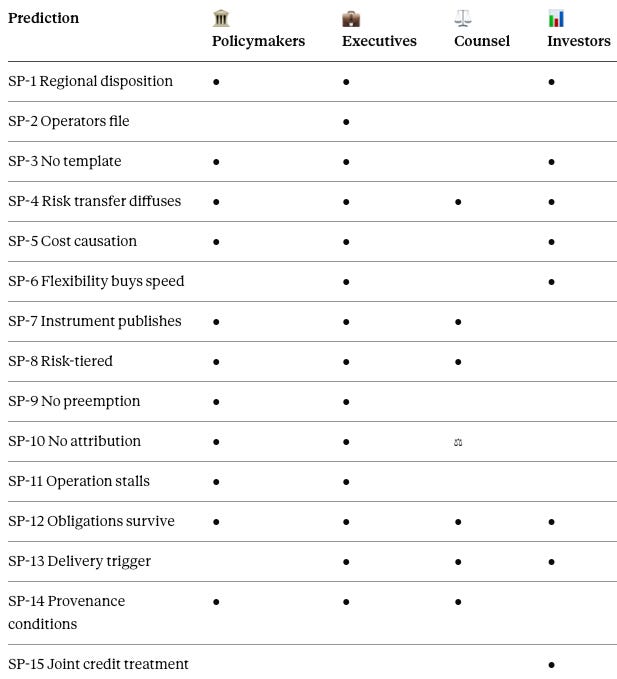
SP-6 · Flexibility Buys Faster Interconnection · Band 72–84%
💼 Executives. Exposure: a firm without a curtailment-capable operating architecture forfeits the accelerated queue position and loses the time-to-power differential between the accelerated and standard queues. Actions: Operations qualifies at least two workload classes as deferrable and documents the load-shedding envelope before the next operator tariff filing in each target region. Engineering specifies dispatchable on-site generation or storage sufficient to cover the committed reduction before site selection closes. Commercial prices the flexibility commitment as a schedule asset in the next power negotiation.
Residual: continuous-service workloads cannot be made deferrable, so a portion of every campus remains firm and pays firm rates.
📊 Investors. Exposure: a portfolio underwritten on uniform interconnection timelines misprices assets by the spread between the flexible and firm queues, which compounds through the construction-interest line. Actions: Credit adds a flexibility-capability field to the diligence template before the next commitment. Portfolio re-runs time-to-power stress cases separately for flexible and firm configurations this quarter. Residual: the spread is unobservable until operators publish accepted tariffs, so early positions price a term that does not yet exist.
SP-12 · Payment Obligations Survive Compute Failure · Band 76–88%
💼 Executives. Exposure: a signed take-or-pay commitment on a campus that cannot be filled runs at full contract value against zero revenue for the balance of the term. Actions: Treasury sizes the maximum unfilled-campus payment obligation across the pipeline and reserves against it before the next financial close. Commercial withholds power commitments beyond the volume covered by confirmed hardware delivery milestones, starting at the next negotiation. Procurement secures alternate-supplier qualification for the hardware classes that gate energization before notice to proceed.
Residual: staggering commitments reduces queue priority, so the mitigation buys balance-sheet protection at the cost of schedule.
⚖️ Counsel. Exposure: a contract portfolio with no delivery-linked excuse leaves the client fully exposed on obligations tied to an event outside its control. Actions: Transactions conditions signature on hardware-delivery-linked ramp provisions in construction and equipment contracts, effective at the next negotiation cycle. Regulatory files the delivery-dependency into the record of each active tariff proceeding before the comment deadline. Residual: utility tariffs will not carry the excuse, so private contracts can allocate the risk among private parties and cannot remove it from the customer overall.
📊 Investors. Exposure: obligations that survive cancellation are senior to equity and sit outside standard completion-risk models, producing a valuation error the size of the residual contract value. Actions: Credit models the surviving obligation as a fixed liability rather than a project cost before the next investment committee. Covenants add a delivery-milestone test to draw conditions on the next facility. Residual: no covenant reaches an obligation already signed, so existing portfolio exposure is fixed at current terms.
🏛️ Policymakers. Exposure: a tariff regime that never excuses payment protects ratepayers and concentrates completion risk in a small number of counterparties, creating a correlated default channel into the utility. Actions: Commission staff issues a data request on hardware-delivery assumptions in pending large-load applications before the next tariff approval. Legislative counsel drafts and publishes a phased-obligation option tied to verified energization rather than contract date. Residual: shifting any part of the risk back toward the utility reopens the cross-subsidy the tariff was written to close.
SP-1 and SP-3 · Regional Disposition and No National Template · Bands 74–85% and 76–88%
🏛️ Policymakers. Exposure: a state that waits for a federal template forfeits the drafting window and inherits terms shaped in other regions. Actions: Commission staff files in the relevant regional proceeding before the comment deadline rather than reserving comment for a future national rule. Legislative counsel drafts against the accepted terms emerging from the earliest-disposing regions this session. Residual: regional outcomes may diverge enough that early drafting locks a state to terms other regions abandon.
💼 Executives. Exposure: a compliance function built for one national standard faces six regional regimes, and each unmapped region costs a full study cycle. Actions: Regulatory affairs staffs each region separately with dedicated filing capacity before the next round of operator filings. Development sequences the site pipeline by regional disposition order rather than by land availability. Residual: convergent substance arriving through divergent procedure still requires six sets of filings, which no internal reorganization removes.
📊 Investors. Exposure: cross-regional portfolios carry unpriced basis between regimes, and mispricing shows up as duration error on assets underwritten to a single assumption. Actions: Portfolio re-underwrites regional exposure separately before the next allocation. Research builds a comparative term sheet across the six regions as regional orders issue. Residual: the comparison is only as good as the earliest orders, and later regions may not follow.
SP-7 and SP-8 · Federal Instrument Publishes, Risk-Tiered · Bands 78–88% and 72–84% conditional
💼 Executives. Exposure: a procurement stack qualified against a single vendor architecture faces replacement lead times measured in quarters if that vendor becomes covered. Actions: Procurement qualifies a second architecture for transformers and control systems before the implementing instrument publishes. Security maps firmware and update-authority pathways across the installed base this quarter. Treasury reserves modeled replacement capital before notice to proceed on affected sites.
Residual: replacement lead times and vendor concentration in transmission-class equipment survive any single firm’s qualification program.
⚖️ Counsel. Exposure: existing equipment and service contracts written before the emergency order carry no substitution right, leaving the client without a contractual remedy when a vendor becomes covered. Actions: Transactions makes provenance-change substitution rights a required negotiating position and withholds renewal absent an approved fallback, effective at the next renewal cycle. Compliance builds a covered-entity screening step into the procurement approval workflow before the instrument publishes. Residual: instruments already executed cannot be reopened unilaterally.
🏛️ Policymakers. Exposure: an overbroad exclusion produces equipment scarcity that lands as energization delay across every project in the state, including those with no security exposure. Actions: State energy offices inventory covered-class equipment in planned interconnections before the comment period closes. Commission staff files comment on lead-time consequences in the federal docket. Residual: federal scope is set federally, and state comment shapes without controlling it.
SP-4 and SP-5 · Risk Transfer Diffuses, Cost Causation Survives · Bands 77–88% and 70–82%
💼 Executives. Exposure: a development model assuming socialized network upgrades misprices every site by the full upgrade cost, which lands as an unbudgeted capital line at interconnection. Actions: Development prices full network-upgrade assignment into site economics before the next land commitment. Finance re-runs project returns with collateral and exit charges as base case rather than downside. Residual: upgrade cost is not knowable until the study completes, so pricing rests on an estimate the operator can revise.
⚖️ Counsel. Exposure: standard-form power agreements drafted before structural risk transfer leave termination and collateral terms unnegotiated at the moment leverage is highest. Actions: Transactions builds a negotiated position on minimum term, collateral step-down, and exit calculation before the next term sheet. Regulatory files intervention and comment in the proceedings shaping those terms before each deadline. Residual: a commission-approved tariff binds regardless of negotiating position, so negotiation reaches special contracts and not general rates.
📊 Investors. Exposure: collateral posted against long-duration commitments is trapped capital that does not appear in return calculations built on permit-stage assumptions. Actions: Credit adds posted collateral and exit exposure to the capital-at-risk calculation before the next commitment. Portfolio diversifies across territories with different collateral structures. Residual: collateral requirements are set by the tariff and cannot be negotiated down by any single counterparty.
SP-9, SP-10, SP-11 · No Preemption, No Attribution, Operation Stalls · Bands 85–95%, 80–89%, 70–83%
🏛️ Policymakers. Exposure: a state that characterizes local opposition as foreign-influenced without sufficient attribution loses procedural legitimacy, hardens the coalition, and adds hearing cycles to every subsequent proceeding. Actions: Commission staff drafts and files a proposed evidentiary standard distinguishing coordinated inauthentic participation from substantive comment in the next contested docket. Legislative counsel drafts allocation rules addressing the underlying cost grievance rather than participation restrictions. Residual: authentication of coordinated participation cannot be made perfect without chilling legitimate comment, so a margin of error persists in both directions.
💼 Executives. Exposure: a developer publicly attributing opposition to foreign influence converts a cost dispute into a legitimacy dispute and loses the siting authority’s trust for the balance of the proceeding. Actions: Public affairs adopts a standing rule against foreign-influence characterization absent government attribution, effective immediately. Community relations budgets and offers ratepayer-cost mitigation before opposition organizes. Residual: the grievance is real and mitigation reduces rather than removes it, so opposition persists at lower intensity.
SP-13, SP-14, SP-15 · Delivery Trigger, Provenance Conditions, Joint Credit Treatment · Bands 52–68%, 48–62%, 62–76%
⚖️ Counsel. Exposure: a client whose contracts lack both delivery-linked schedule protection and provenance substitution rights carries two uninsured exposures on the same asset. Actions: Transactions adds both provisions to the standard form and sets the fallback position before the next negotiation cycle. Residual: counterparties will resist both, and the achievable version may be narrower than the drafted one.
📊 Investors. Exposure: a financing instrument that treats power obligations and equipment delay as separate risks understates correlated loss, and the error appears as basis-point mispricing across the book. Actions: Credit builds a joint stress case combining a delivery interruption with a continuing payment obligation before the next rating engagement. Research prepares the analytic case for ratings dialogue rather than waiting for methodology change. Residual: ratings methodology moves on its own schedule, and no single participant can accelerate it.
Cross-register linkage. Actions taken under SP-7 and SP-8 for equipment provenance also reduce exposure to entries in the MindCast authorization pricing register concerning interconnection timing. The reduction is recorded once, here, and does not claim credit in that register.
XII. Conclusion
Current evidence does not support the claim that China caused America’s data center backlash. Current evidence supports something more precise.
Operators tested narratives built on a genuine American dispute and achieved no measurable institutional effect. The dispute has its own regulatory machinery, and that machinery survives legislative defeat by changing venue.
Federal policy has made power-equipment provenance a national-security variable at the moment electricity dependence is rising. Allied supply carries qualification, capacity and resilience questions in one place. Taiwan sits at that intersection as a qualified supplier and as a jurisdiction solving the same load problem at home.
Authorization is the common structure. A data center runs only after institutions convert capital, land and power into durable permission. Equipment, ownership and public legitimacy convert alongside them.
Seventy-seven percent of Americans worry that artificial intelligence will raise their power bills. Any strategy treating that number as an adversary’s product rather than a political fact will misread the authorization environment. The durable defense against amplification of a legitimate complaint is resolution of the complaint.
The cyber perimeter still matters. For AI infrastructure, the perimeter no longer stops at the machine. It now includes the institutions that decide whether the machine turns on.
Sources
MindCast AI
The Data Center Authorization Price — A 50-State Baseline. Establishes the accumulated cost of permission as a unit of account, which is the variable an adversary would be raising and a security rule would be increasing.
The Authorization Transition. Documents that the price of permission was already moving before any external actor engaged it, which anchors the causal baseline in Section II.
Who Bargains Best with the States. Shows that developer leverage varies with counterparty identity, explaining why no firm defends the authorization layer alone.
Anthropic, Alibaba, and the Runtime Theft Problem. Establishes that proof cost rather than legal theory decides where a remedy lives. The finding governs the attribution analysis in Section III.
The Beijing Summit Validation. Establishes that a state may reject locally superior technology to protect ecosystem sovereignty, which sets the unit of strategic analysis above any single project.
The TSMC China License and the Limits of Hardware Export Controls. Establishes that a hardware gate fails without access-layer control. Section VI applies the finding to firmware and remote access in power equipment.
The Two-Gate Game. Establishes that permission from one sovereign and acceptance by another are separate gates, the general form of the authorization argument.
Why AI Commoditizes Raw Prediction, Why Governance Stays Scarce. Establishes that prediction cheapens while governance cost climbs, which explains why the institution rather than the market becomes binding.
Agent Governance Equilibrium. Asks whether governance capacity scales with decision velocity, applied here to institutions asked to police a pattern rather than an actor.
The Global Innovation Trap. Establishes capability leakage as a strategic externality and shows leakage channels outrunning the regulatory cycles meant to close them.
Predictive Institutional Cybernetics. States the architecture and disciplinary position underlying the simulation method used in Section X.
External
Chung-Hua Institution for Economic Research, “Strategic Positioning of Taiwan’s Heavy Electrical Industry Amid Geopolitical Energy Security Risks” (2026).
Electric Power Research Institute, Lawrence Berkeley National Laboratory and the Brattle Group. Research on historical data center rate effects (2025–2026).
Federal Energy Regulatory Commission. Show cause orders on large-load interconnection and co-location, June 18, 2026. Large-load interconnection rulemaking docket.
Gallup, survey on American attitudes toward local data center construction, May 2026.
Greg Kim. “Data centers can raise electricity prices. WA wants to prevent that.” The Seattle Times, August 28, 2026.
Truman Dickerson. “Many of the Chinese bots X says posted anti-data-center content had no followers or engagement, a researcher found.” Business Insider, August 28, 2026.
John Feng. “The Next Target in China’s Secret War Against US Data Centers.” Newsweek, August 28, 2026.
Monitoring Analytics, capacity cost analysis for the PJM Interconnection, 2025–26 delivery year.
OpenAI, disclosures on China-origin influence operations targeting United States artificial intelligence and energy debates, June 2026.
Reuters and Ipsos, survey on American attitudes toward artificial intelligence and electricity costs, June 2026.
Taiwan Ministry of Economic Affairs, national electricity supply and demand report, August 2026.
Taiwan National Security Bureau, annual report on cyberattacks against critical infrastructure, 2025.
United States Department of Energy. Advance notice of proposed rulemaking on large-load interconnection, October 23, 2025.
The White House. Executive order declaring a national emergency to secure the United States bulk-power system, August 26, 2026.
Wood Mackenzie, analysis of large-load tariff adequacy (2026).
MindCast AI · Predictive Law and Behavioral Economics + Game Theory Foresight Simulation firm · Data Center Global Regulatory Economics and Innovation · Bellevue, Washington · mcai@mindcast-ai.com