


Visual companion to How MindCast Game Theory Differs from Textbook Game Theory. See Super Bowl LX — AI Simulation vs. Reality for stress test demonstration of MindCast Game Theory.
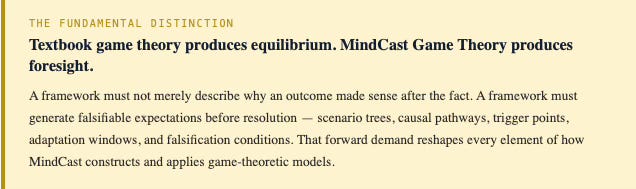
Textbook game theory models assume rational actors, stable rules, and clean payoffs. MindCast Game Theory operates where none of those conditions hold: rules mutate mid-play, feedback degrades, and narrative constrains strategy as much as incentives do. The output is not a cleaner equilibrium proof. The output is a foresight simulation — scenarios, triggers, probability bands, and falsification conditions tied to observable signals.
One framework explains. The other predicts. Classical game theory tells you how a rational actor should behave given the rules as specified. MindCast tells you what a specific institution, carrying its specific constraints and narrative burdens, is most likely to do next.
I. The Core Break — Game Theory as a Predictive Operating System
The most important difference between textbook game theory and MindCast Game Theory is not what the framework contains — it is what the framework produces. Textbook analysis delivers a structural diagnosis: game type, equilibrium logic, optimal strategy under specified assumptions. MindCast delivers a different class of output entirely: the mechanisms, triggers, and probabilities that tell an operator, investor, regulator, or counsel where the system is heading and what to watch for along the way.
A textbook analysis might identify the players face a prisoner’s dilemma, a coordination problem, or a war-of-attrition dynamic. MindCast may still identify those structures — but does not stop there. The MindCast simulation asks: which actor controls the fastest meaningful feedback loop? Which actor benefits from delay rather than resolution? Which institution is misreading a captured loop as genuine signal? Which moves are formally available but geometrically blocked? Which adjacent forum is likely to rewrite the game next?
MindCast does not use game theory as a static language of choice. MindCast uses game theory as a dynamic language of control, adaptation, strategic delay, cognitive lock-in, and structural constraint. The game itself is rewritten while actors are still inside it — and the relevant question becomes what kind of system is rewriting the game, and which actors can survive the rewriting fastest.
II. The Practical Difference in Output
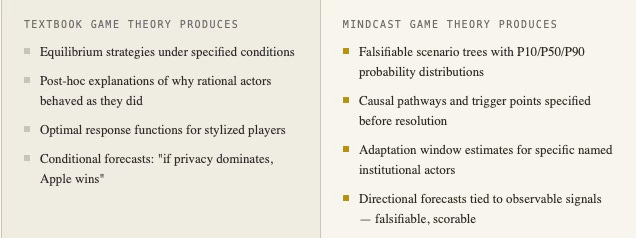
The last comparison is the one that matters most for practitioners. Classical game theory's forecast is conditional — it tells you which firm wins under which assumption, leaving the reader to judge which assumption holds. MindCast's forecast is directional and falsifiable. Descriptions are useful for understanding a field. Predictions are what practitioners need to act before the public story catches up.
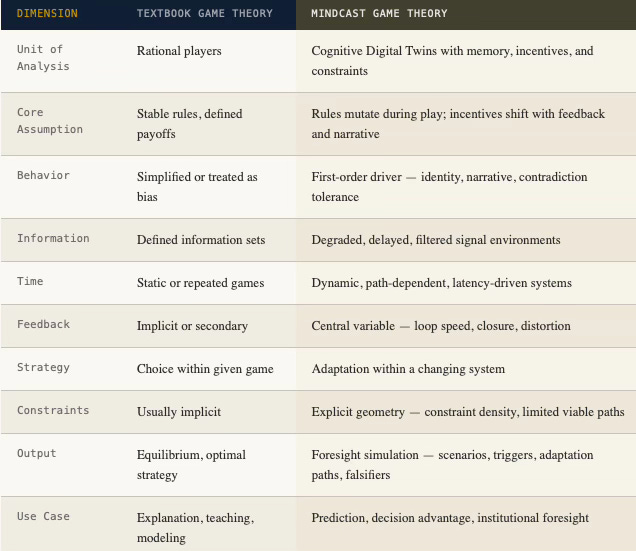
III. Side-by-Side — Ten Analytical Dimensions
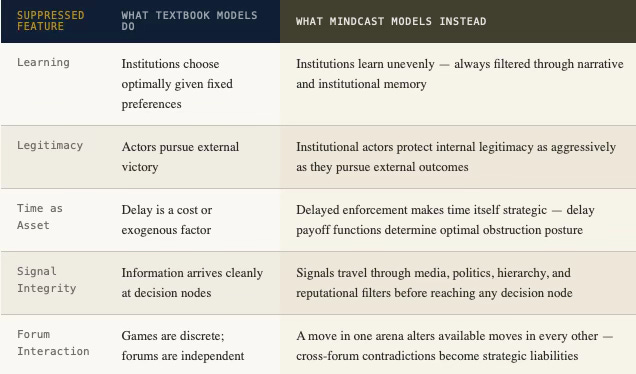
IV. Why Textbook Models Miss Live Institutional Games
Real institutional games depend on exactly the features textbook models suppress for tractability. Five structural mismatches explain why MindCast Game Theory was built as a distinct system rather than an extension.
V. The Player — From Rational Actor to Cognitive Digital Twin
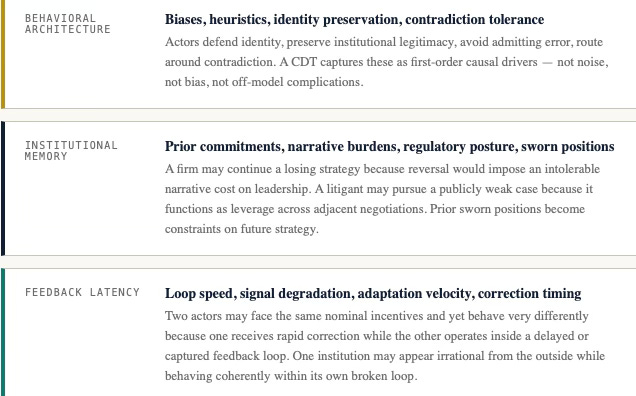
Textbook game theory gains precision by simplifying the player. MindCast makes the opposite move. A Cognitive Digital Twin is not merely a utility function — it is a model of a specific institutional actor carrying the full weight of behavioral architecture, institutional memory, and feedback latency that determine what the actor can actually do under pressure.
VI. Vision Functions — Chicago Accelerated & Nash–Stigler
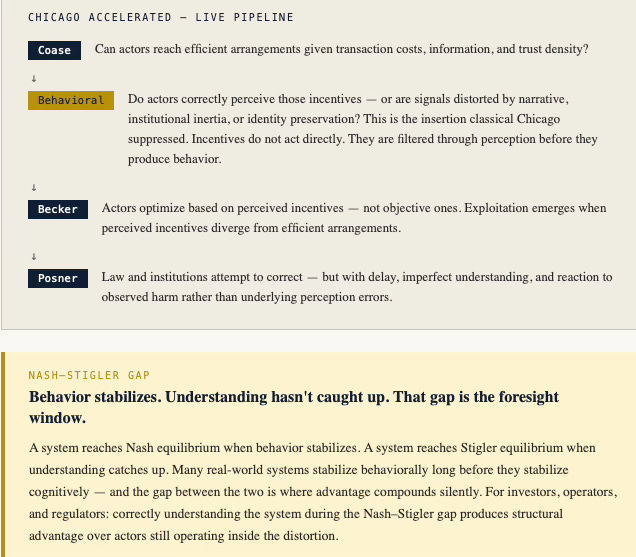
Vision Functions operate as a causal routing system — classifying environments into dominant causal categories before any simulation runs. Rather than assuming every environment is strategy-driven, they select the governing mechanism so prediction reflects how the system actually operates. Chicago Accelerated governs how systems move. Nash–Stigler governs when they are miscalibrated.
VII. Who Uses MindCast Game Theory and Why
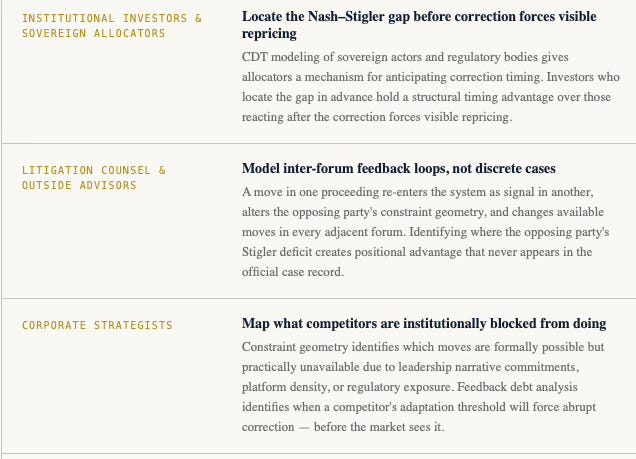
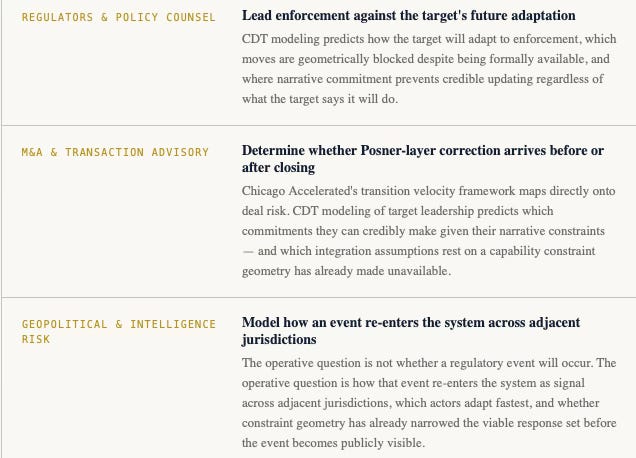
MindCast Game Theory is a survival guide for practitioners operating where standard rational-actor models fail — any environment where rules are rewritten while the game is in progress, feedback arrives late or distorted, and narrative constrains strategy as much as incentives do.
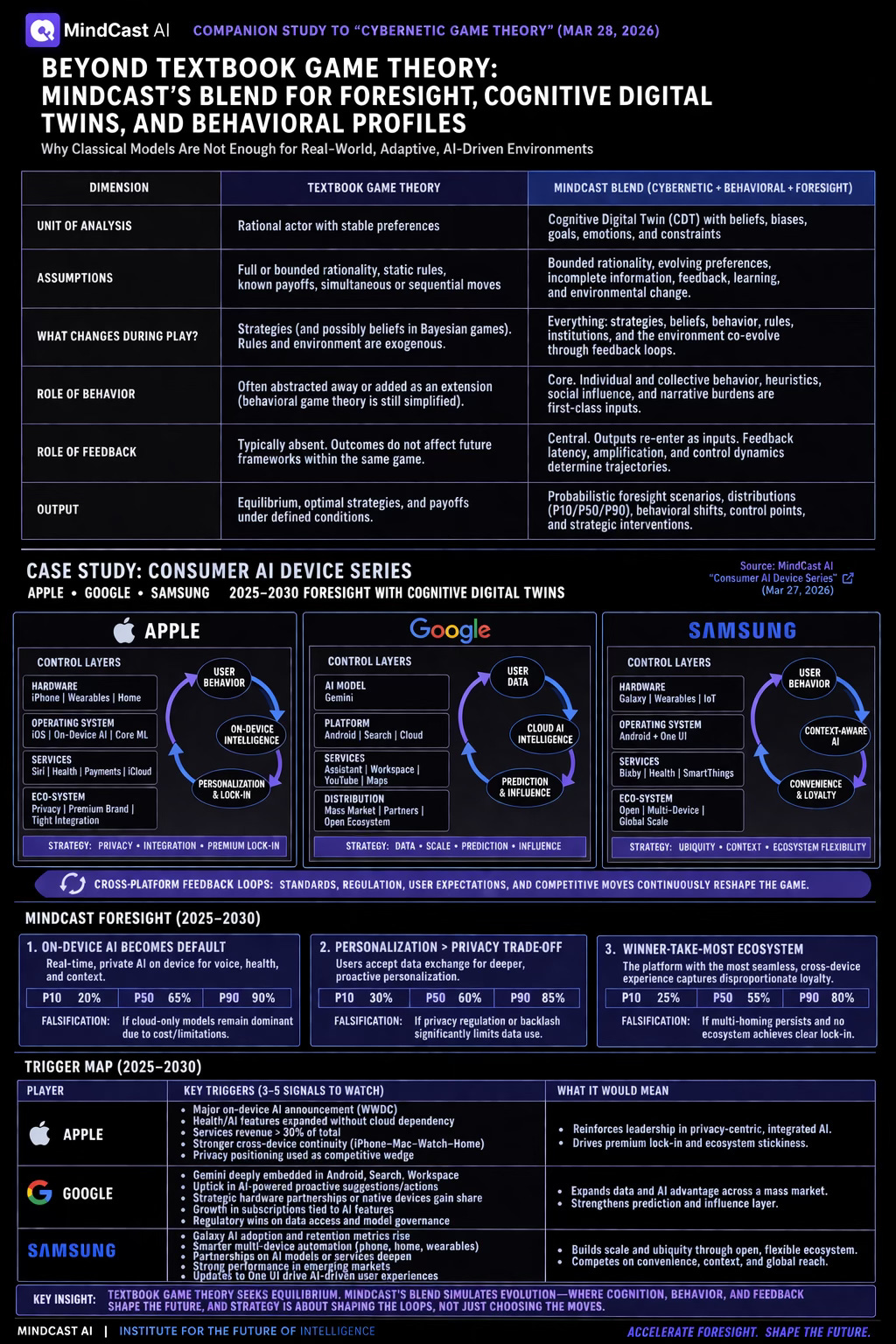
VIII. Textbook Game Theory vs. The MindCast Blend
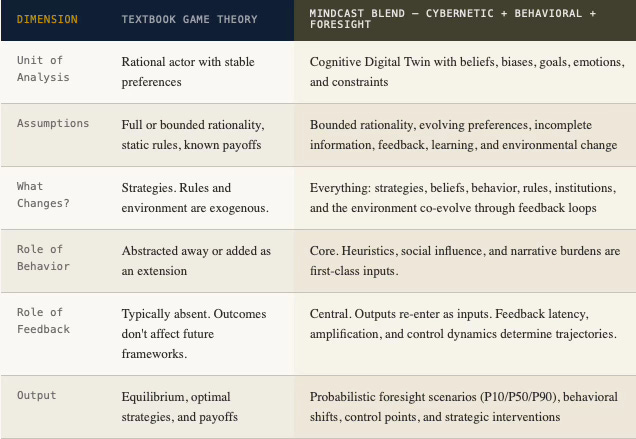
IX. Case Study Application — Consumer AI Device Competition, 2025–2030
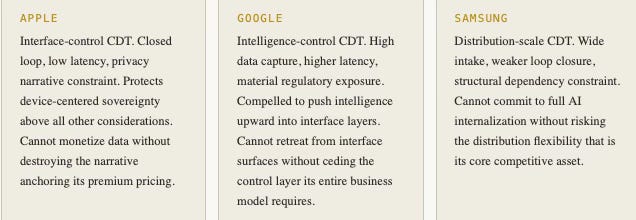
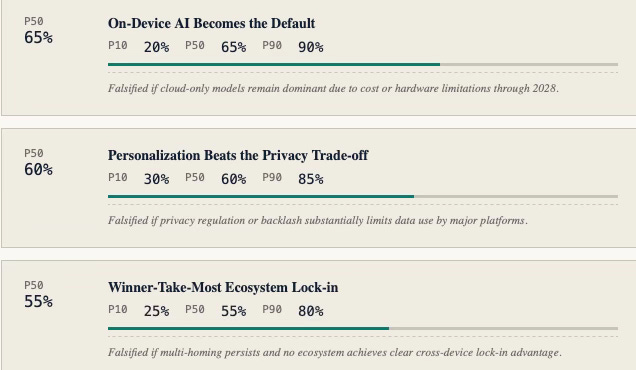
Running both frameworks on the same field — Apple, Google, and Samsung competing across interface, intelligence, and distribution layers — makes the structural difference concrete. Classical game theory produces conditional equilibrium ranges. MindCast produces CDT profiles, P10/P50/P90 scenario bands, trigger maps, and falsification conditions. Cybernetic Overview of The MindCast Consumer AI Device Series
Contact mcai@mindcast-ai.com to partner with us on Predictive Law and Behavioral Economics + Game Theory Foresight Simulations. To deep dive on MindCast work in Cybernetic Foresight Simulations upload the URL of this publication into any LLM and prompt ‘reconstruct MindCast framework with three degrees of cited sub links.’ See Live-Fire Game Theory Simulators, Runtime Predictive Infrastructure.