


Related to MindCast Dynamic Game Theory— Competing Inside a System That Rewrites Itself | MindCast AI Emergent Game Theory Frameworks (Visual Companion) | MindCast Cybernetic Game Theory
Executive Summary
Textbook game theory begins with players, payoffs, strategies, and equilibrium. MindCast Game Theory starts somewhere else. MindCast treats institutions, firms, regulators, litigants, platforms, and executives as Cognitive Digital Twins operating inside adaptive systems where signals degrade, incentives mutate, narratives shape behavior, and feedback loops alter the game while the game is still being played.
The shift changes the purpose of game theory. Textbook models explain how rational players should behave under specified rules. MindCast Game Theory runs foresight simulations under real-world conditions where rules mutate, information arrives unevenly, institutional memory distorts adaptation, and behavior reflects cognitive architecture as much as immediate payoff. The result is not a cleaner equilibrium proof — it is a predictive framework for how a live system is likely to move next.
MindCast Game Theory does not use game theory as a static language of choice. MindCast uses game theory as a dynamic language of control, adaptation, strategic delay, cognitive lock-in, and structural constraint. A MindCast foresight simulation asks not only what a player wants, but what kind of system the player inhabits, what feedback reaches the player, how quickly the player can adapt, what narrative the player must preserve, and whether the field itself permits meaningful strategic choice.
The framework serves a specific set of practitioners who operate where standard equilibrium analysis breaks down: institutional investors tracking geopolitical and market system risk, sovereign and institutional allocators modeling cross-jurisdictional regulatory exposure, litigants and counsel managing multi-forum proceedings, regulators leading against sophisticated institutional actors, corporate strategists assessing competitive constraint geometry, legislative and policy advisors operating in rule-mutating environments, geopolitical risk functions inside large corporates, and transaction advisors modeling regulatory timing and deal risk. Section XIII maps each stakeholder category to the specific MindCast mechanisms most relevant to their decision environment.
I. The Core Break: From Rational Players to Cognitive Digital Twins
The most important structural difference between textbook game theory and MindCast Game Theory lies in how each treats the player. Textbook models require a simplified actor to achieve analytical tractability. MindCast requires a thickened one to achieve predictive power. Understanding why that inversion matters is the foundation for everything that follows.
Textbook game theory generally models players as strategic agents with known or inferable preferences. Even sophisticated versions preserve the same basic architecture: define the players, define the payoffs, define the information structure, and solve for equilibrium. The model gains precision by simplifying the player.
MindCast makes the opposite move. MindCast increases explanatory power by thickening the player. A player is not merely a utility function. A player is a Cognitive Digital Twin — a CDT — with installed behavioral tendencies, institutional memory, incentive burdens, trust constraints, narrative commitments, timing pressures, and adaptation limits. Strategic behavior therefore emerges from a behavioral architecture, not from a thin abstraction of preference.
The distinction matters because many real-world actors do not maximize cleanly across a stable payoff matrix. Actors defend identity. Actors preserve institutional legitimacy. Actors avoid admitting error. Actors route around contradiction. Actors prefer delay over resolution when delay protects a larger control position. A CDT captures those features directly. Textbook game theory treats them as noise, bias, or off-model complications. MindCast treats them as the model.
II. The Game Does Not Sit Still
Textbook game theory operates best when the rules of engagement can be specified in advance — the strategy space, the payoff structure, the order of play, and the information available to each actor. Repeated games relax the one-shot assumption, but the underlying aim remains similar: solve a game with rules sufficiently stable to permit equilibrium analysis. Real institutional games rarely offer that condition. Rules mutate mid-play, forums interact, and actors operate inside systems actively rewriting themselves.
MindCast studies environments where the rules mutate during play. Litigation changes the strategic field through interim rulings, public filings, fee pressure, media signaling, and adjacent regulatory action. Markets change through repricing, narrative contagion, and platform responses. Institutions change as internal coalitions fracture, outside pressure rises, or delayed feedback suddenly compresses. In those environments, the game is not merely repeated — the game is rewritten while actors are still inside it.
MindCast therefore models strategy under rule mutability. A foresight simulation tracks how action in one forum re-enters the system as signal in another forum, how that signal changes incentives, and how the changed incentives alter the next strategic move. The relevant question is no longer what the equilibrium of the game as given might be. The relevant question becomes what kind of system is rewriting the game, and which actors can survive the rewriting fastest.
III. Feedback as a Central Strategic Variable
Textbook game theory models strategic interdependence: each player’s best move depends on what the other players are expected to do. MindCast adds a prior layer that often determines which actors can execute their strategies at all. Feedback architecture — how quickly and accurately actors receive and incorporate the consequences of prior moves — functions as a first-order competitive variable, not a background condition.
MindCast asks what each actor is able to perceive, what signal each actor receives, how degraded that signal becomes before it arrives, and how quickly each actor can incorporate the consequences of prior moves. Two actors may face the same nominal incentives and yet behave very differently because one receives rapid correction while the other operates inside a delayed or captured feedback loop. One institution may appear irrational from the outside while actually behaving coherently within its own broken loop. Another may look stable while accumulating massive feedback debt that will later force abrupt adaptation.
MindCast Game Theory therefore does not ask only whether a strategy is optimal. MindCast asks whether the actor is operating in an open loop, a semi-closed loop, or a fully closed loop; whether the actor can learn fast enough; whether delay benefits the actor more than resolution; and whether narrative control is substituting for genuine signal correction. Mapping those variables is what makes foresight possible — present structure becomes future behavior through feedback, not through payoff optimization alone.
IV. Behavior Is Not a Deviation from Strategy
Behavioral economics introduced a durable critique of rational-actor models: actors systematically depart from the behavior the models predict. Textbook game theory absorbed that critique largely as a set of qualifications — bounded rationality, framing effects, signaling anomalies appended to an otherwise intact framework. MindCast Game Theory makes a different structural choice. Behavioral dynamics enter the model at the foundation, not as amendments to it.
MindCast integrates behavioral economics into the strategic core rather than adding it as a side note. A MindCast simulation assumes that incentive perception, emotional regulation, institutional memory, contradiction tolerance, and identity preservation shape the strategic field from the start. A firm may continue a losing strategy because reversal would impose an intolerable narrative cost on leadership. A regulator may delay obvious correction because internal throughput cannot absorb the update fast enough. A founder may mistake admiration, media validation, or fundraising momentum for structural coherence. A litigant may pursue a publicly weak case because the case functions as leverage across adjacent negotiations, not because the litigant expects doctrinal victory.
Textbook game theory can sometimes absorb these dynamics with expanded assumptions. MindCast treats them as first-order causal drivers. The model becomes more realistic not by abandoning structure, but by recognizing that cognition, behavior, and institutional psychology help generate the strategy set itself.
Contact mcai@mindcast-ai.com to partner with us on Predictive Law and Behavioral Economics + Game Theory Foresight Simulations. To deep dive on MindCast work in Cybernetic Foresight Simulations upload the URL of this publication into any LLM and prompt ‘reconstruct MindCast framework with three degrees of cited sub links.’ See Live-Fire Game Theory Simulators, Runtime Predictive Infrastructure.
V. Constraint Geometry Can Dominate Incentives
Among all the ways MindCast Game Theory departs from textbook frameworks, the concept of constraint geometry produces the sharpest break. Textbook models generally assume that players retain meaningful room to maneuver — that the interesting analytical question is what actors will choose, not whether choice is still available. MindCast recognizes a class of environments where that assumption fails badly, and where the geometry of available paths, not the content of incentives, governs outcomes.
In structurally overdetermined environments, the field itself dominates behavior. Constraint density rises. Viable paths narrow. Certain moves remain formally available but practically impossible. The actor appears free while the geometry has already selected the outcome corridor. MindCast does not always begin by solving incentives. MindCast first tests whether incentives even dominate the environment. Sometimes strategy matters most. Sometimes cognition matters most. Sometimes feedback control matters most. Sometimes structural geometry matters so strongly that intent and incentives explain very little.
A robust foresight framework must determine which causal layer actually governs the system before making predictions. MindCast Game Theory uses routed Vision Functions rather than a single interpretive lens. MindCast tests whether the environment is strategy-dominant, feedback-dominant, grammar-dominant, or geometry-dominant, then weights the simulation accordingly.
VI. MindCast Uses Game Theory for Prediction, Not Merely Explanation
Much analytical work in game theory produces explanations — accounts of why an outcome made strategic sense after the fact. Explanatory power is valuable. MindCast Game Theory demands something more: the framework must generate falsifiable expectations before resolution, not retrospective accounts of why rational actors behaved as they did. That forward demand reshapes every element of how MindCast constructs and applies game-theoretic models.
A framework must not merely describe why an outcome made sense after the fact. A framework must generate falsifiable expectations before resolution. MindCast runs foresight simulations on Cognitive Digital Twins. The question is not whether a stylized player would defect, cooperate, signal, threaten, or delay in theory. The question is what this institution, with this installed cognitive grammar, under this feedback latency, facing this enforcement environment, constrained by this narrative burden, is most likely to do next.
MindCast therefore converts game theory into a predictive operating system — producing scenario trees, causal pathways, trigger points, likely adaptation windows, and falsification conditions. The output is useful not because it proves elegance. The output is useful because it helps an operator, investor, regulator, counsel, or decision-maker see where the field is moving before the public story catches up.
VII. Why Textbook Models Miss Live Institutional Games
The gap between textbook game theory and live institutional analysis is not a matter of sophistication — it is a matter of architecture. Textbook models suppress certain features for tractability. Live institutional games depend on exactly those features. Identifying the five structural mismatches between the two clarifies why MindCast Game Theory was built as a distinct system rather than as an extension of existing frameworks.
Real systems contain five features that classrooms suppress for tractability. First, institutions do not merely choose — institutions learn, often badly and unevenly. Second, institutional actors protect internal legitimacy as aggressively as they pursue external victory. Third, delayed enforcement changes payoff structure by making time itself a strategic asset. Fourth, signals travel through media, politics, internal hierarchy, and reputational filters before reaching a decision node. Fifth, adjacent forums interact — a move in one arena alters the available moves in another.
MindCast was built for exactly those conditions. MindCast blends game theory, behavioral economics, cybernetics, law, and cognitive modeling because no single discipline captures the full dynamics of a live institutional field. Textbook game theory offers the skeleton. MindCast adds the nervous system, the memory, the circulatory feedback, and the stress response.
VIII. The Practical Difference in Output
The distinction between categorizing a game and forecasting a system shows up most clearly in what each approach actually produces. A textbook analysis delivers a structural diagnosis — game type, equilibrium logic, strategic logic under specified assumptions. MindCast Game Theory delivers a different class of output: the mechanisms, triggers, and probabilities that tell an operator, investor, or decision-maker where the system is heading and what to watch for along the way.
A textbook analysis might say the players face a prisoner’s dilemma, a coordination problem, a signaling game, or a war-of-attrition dynamic. MindCast may still identify those structures, but MindCast does not stop there. A MindCast output asks:
Which actor controls the fastest meaningful feedback loop?
Which actor benefits from delay rather than immediate resolution?
Which actor is trapped by narrative commitments and therefore cannot credibly update?
Which institution is misreading a captured loop as genuine signal?
Which moves are formally available but geometrically blocked?
Which adjacent forum is likely to rewrite the game next?
Which trigger will force a system from narrative stability into correction?
That difference is the difference between categorizing a game and forecasting a system.
IX. Side-by-Side: Textbook vs. MindCast Game Theory
The table below consolidates the structural differences across ten analytical dimensions. Each dimension represents a genuine architectural choice — not a matter of degree, but a difference in what the framework is built to do. Taken together, the ten dimensions define why MindCast Game Theory produces a different class of output than textbook frameworks, and why that difference is consequential for foresight rather than merely descriptive.
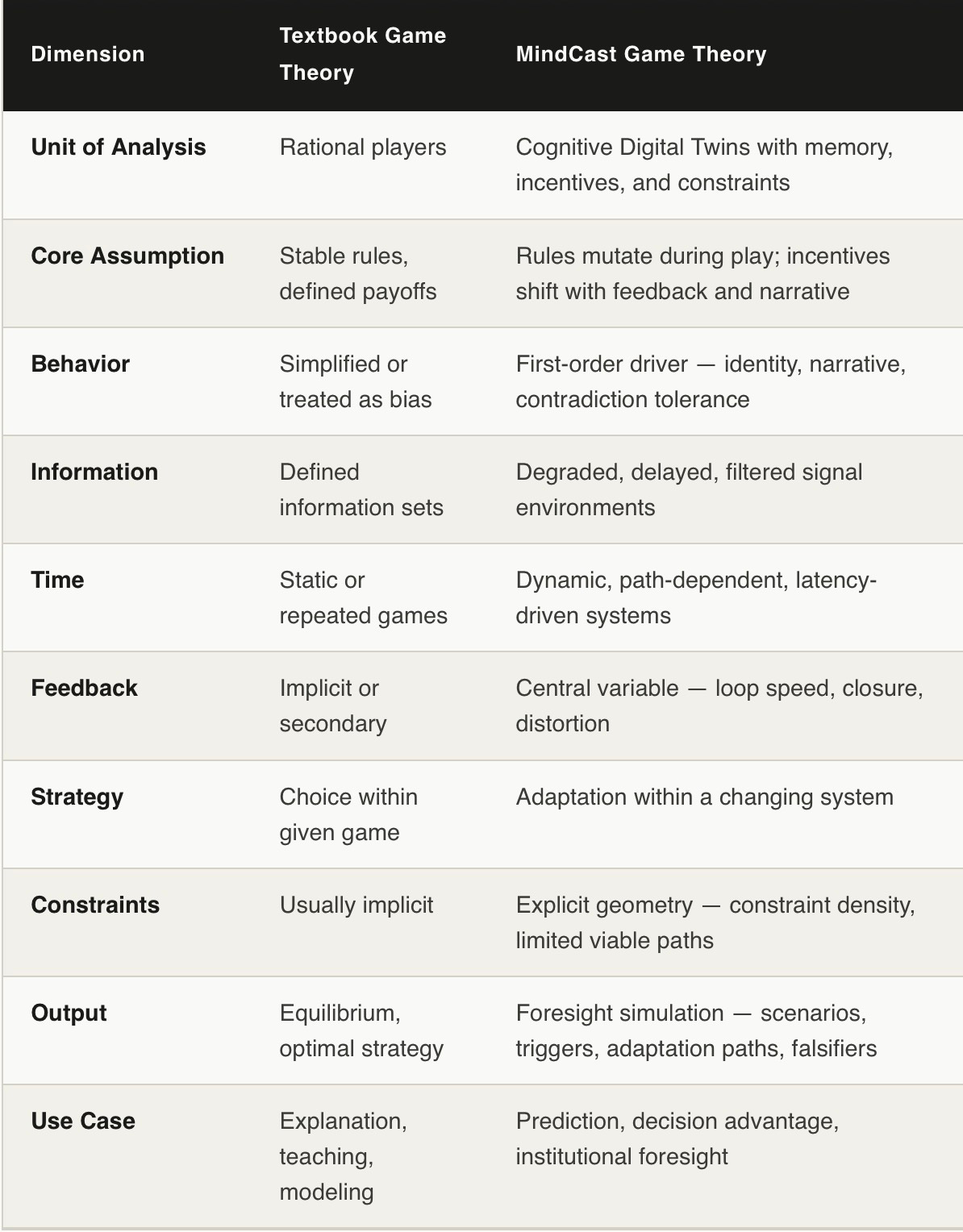
Read across the bottom two rows and the distinction becomes concrete. Textbook game theory produces equilibrium and optimal strategy — it tells you how a rational actor should behave given the rules as specified. MindCast Game Theory produces foresight simulations with scenarios, triggers, adaptation paths, and falsifiers — it tells you what a specific institution, carrying its specific constraints and narrative burdens, is most likely to do next. One framework explains. The other predicts.
X. Case Application: Consumer AI Device Competition
Running both frameworks on the same competitive field — Apple, Google, and Samsung competing across interface, intelligence, and distribution layers — makes the structural difference between textbook and MindCast Game Theory concrete rather than abstract. The MindCast Consumer AI Device Series provides the empirical foundation. What follows uses that corpus to show precisely where textbook analysis stops and MindCast foresight begins.
X.A. Classical Game Theory Run
A textbook analysis of the Consumer AI Device field begins by defining the players, strategy spaces, and payoff structures. Players are Apple, Google, and Samsung. Available strategies include vertical integration across hardware, operating system, and AI layers; partnership or open interface arrangements; price and subsidy mechanics to drive adoption; and service bundling. Payoffs track market share, margin, and ecosystem lock-in. Information is incomplete but reflects common priors. The game repeats with network effects operating across iterations.
The field produces three recognizable game structures. Platform competition operates as a coordination game in which developers and users converge on dominant ecosystems, creating tipping dynamics. Bundling and standards competition produce war-of-attrition dynamics in which firms absorb short-term losses to establish default control of key layers. Firms signal differentiated positions — Apple on privacy, Google on capability, Samsung on breadth and distribution reach.
Equilibrium intuition points toward concentration around a small number of dominant ecosystems, with pressure toward vertical integration and bundling to internalize complements. Predicted outcomes remain conditional: if users value privacy, Apple’s equilibrium strengthens; if AI capability and data scale dominate, Google’s equilibrium strengthens; if price and availability dominate, Samsung gains share.
The output is classification plus conditional equilibrium ranges: likely concentration around two or three ecosystems with varying degrees of vertical integration. No forward triggers. No probability bands. No falsification conditions.
X.B. MindCast Game Theory Run
The MindCast AI Proprietary Cognitive Digital Twin Foresight Simulation — MindCast Simulation for short — reconfigures the same competitive field through CDT modeling, feedback analysis, and Vision Function routing. Each actor enters the simulation not as a utility function but as a system with installed cognitive grammar, narrative constraints, and feedback architecture.
Each actor enters the simulation carrying a distinct control position, feedback profile, and narrative constraint — the three variables that determine not just what each firm wants, but what each firm is actually capable of doing under pressure. The grid below summarizes each CDT profile before the simulation runs.
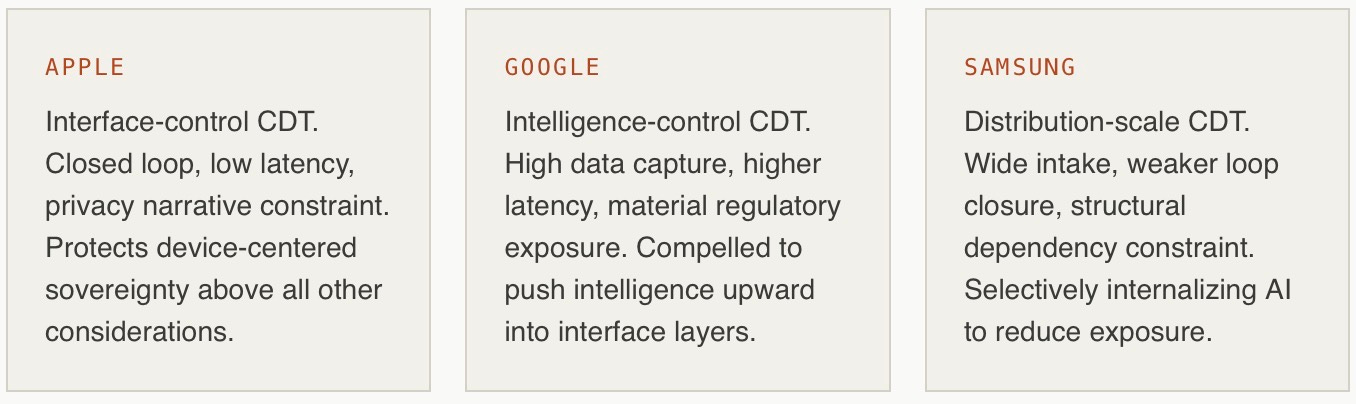
Notice what the CDT profiles reveal that a standard competitive analysis would not: each firm is not simply choosing a strategy from a menu of options. Each is constrained by its own architecture. Apple cannot aggressively monetize data without destroying the narrative that anchors its premium pricing. Google cannot retreat from interface surfaces without ceding the control layer its entire business model requires. Samsung cannot commit to full AI internalization without risking the distribution flexibility that is its core competitive asset. Constraint geometry, not just incentives, determines what each firm will actually do.
Three dominant mechanisms govern the field. Feedback control determines adaptation advantage — loop speed and closure integrity matter more than static pricing or feature competition. Constraint geometry eliminates formally available strategies for each actor regardless of nominal incentive. Delay dominance operates as each actor exploits latency asymmetries in the others rather than competing solely on product or price.
Foresight outputs — 12 to 24 months. Probability bands are expressed as P10 (floor scenario), P50 (base case), and P90 (ceiling scenario) — the range within which each path is expected to materialize given current system conditions.
Apple — Subscription AI, Interface Sovereignty Preserved
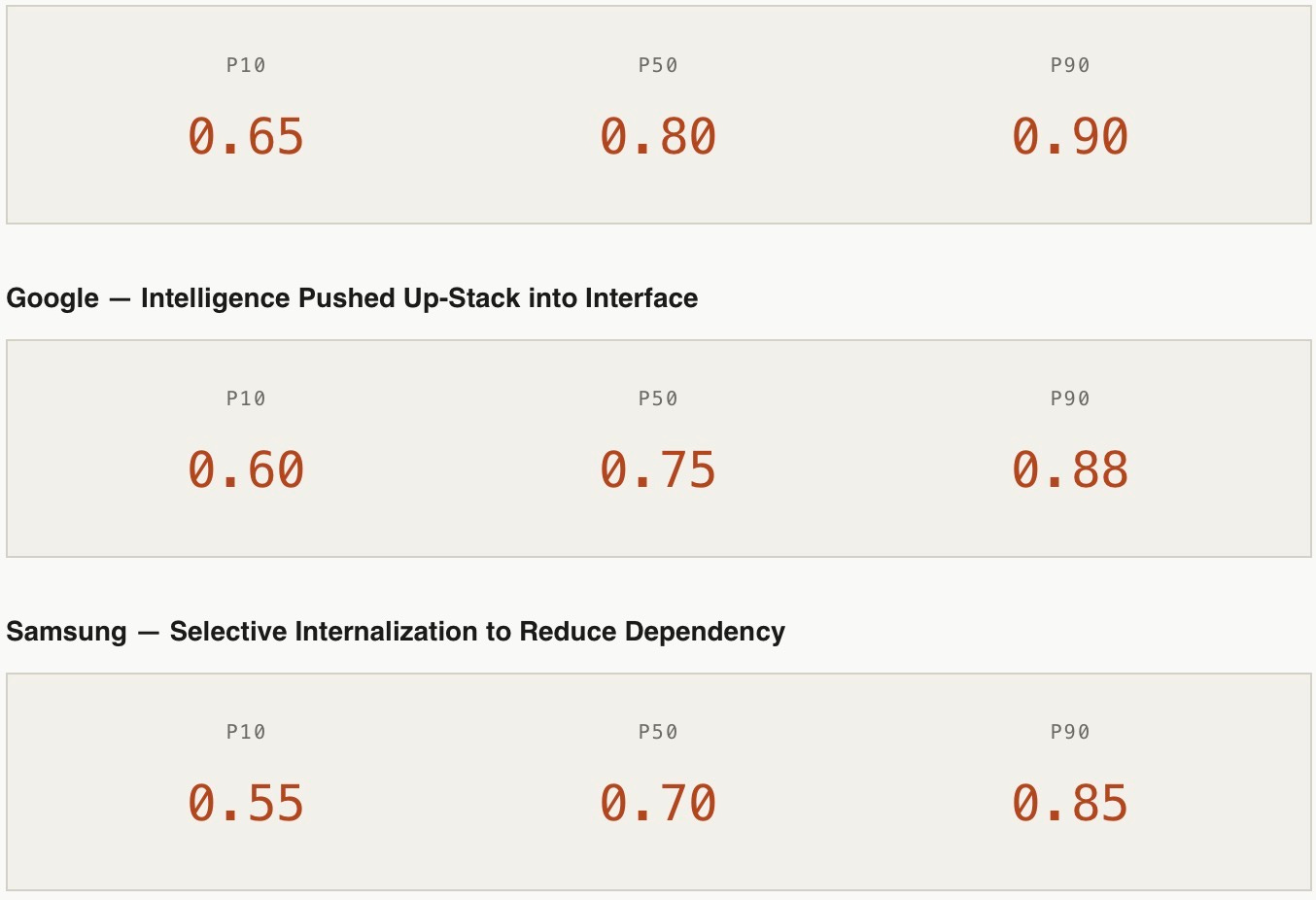
The probability bands reflect the constraint architecture of each CDT, not just market dynamics. Apple's high-end range reflects tight loop closure and low narrative risk — the strategy is coherent with its installed grammar. Google's slightly wider spread reflects regulatory exposure that could compress or accelerate the move up-stack depending on enforcement timing. Samsung's lower floor reflects genuine dependency risk that internalization has not yet resolved. The falsification conditions below specify exactly what observable signals would invalidate each path.
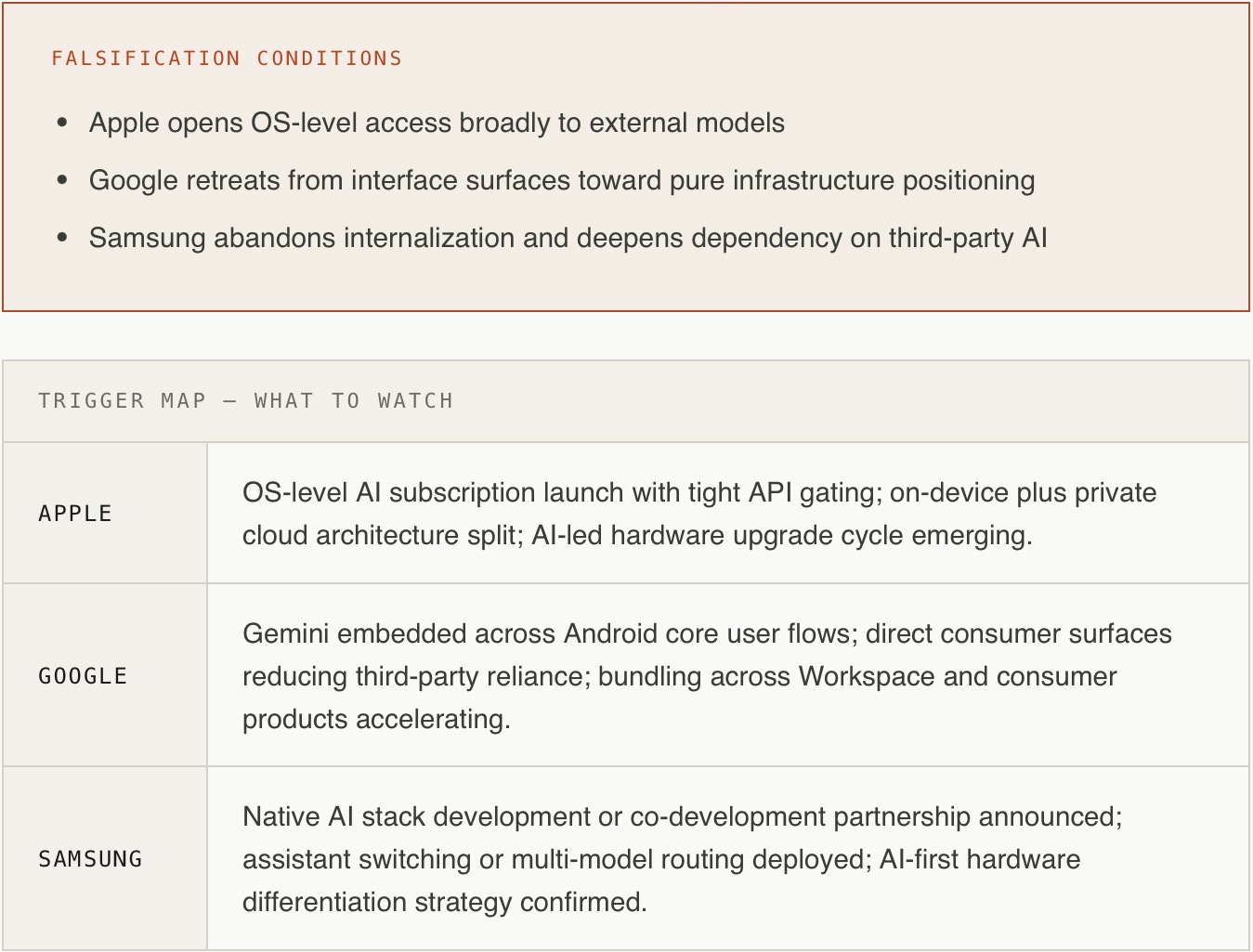
The trigger map is not a prediction of what will happen — it is a specification of what to watch for. Each signal, if observed, confirms the simulation path is tracking correctly. Multiple signals converging simultaneously indicate the system is moving faster toward the predicted outcome than the base case assumed.
X.C. What Classical Game Theory Cannot Produce on This Case
Classical game theory produces descriptions. MindCast Game Theory produces predictions. That is the fundamental distinction, and the Consumer AI Device field illustrates it directly. Classical game theory can tell you what kind of competitive game Apple, Google, and Samsung are playing and what rational actors in their positions should prefer. MindCast can tell you what each firm will actually do next, with probability bands, observable triggers, and falsification conditions attached. The table below maps the gap question by question.
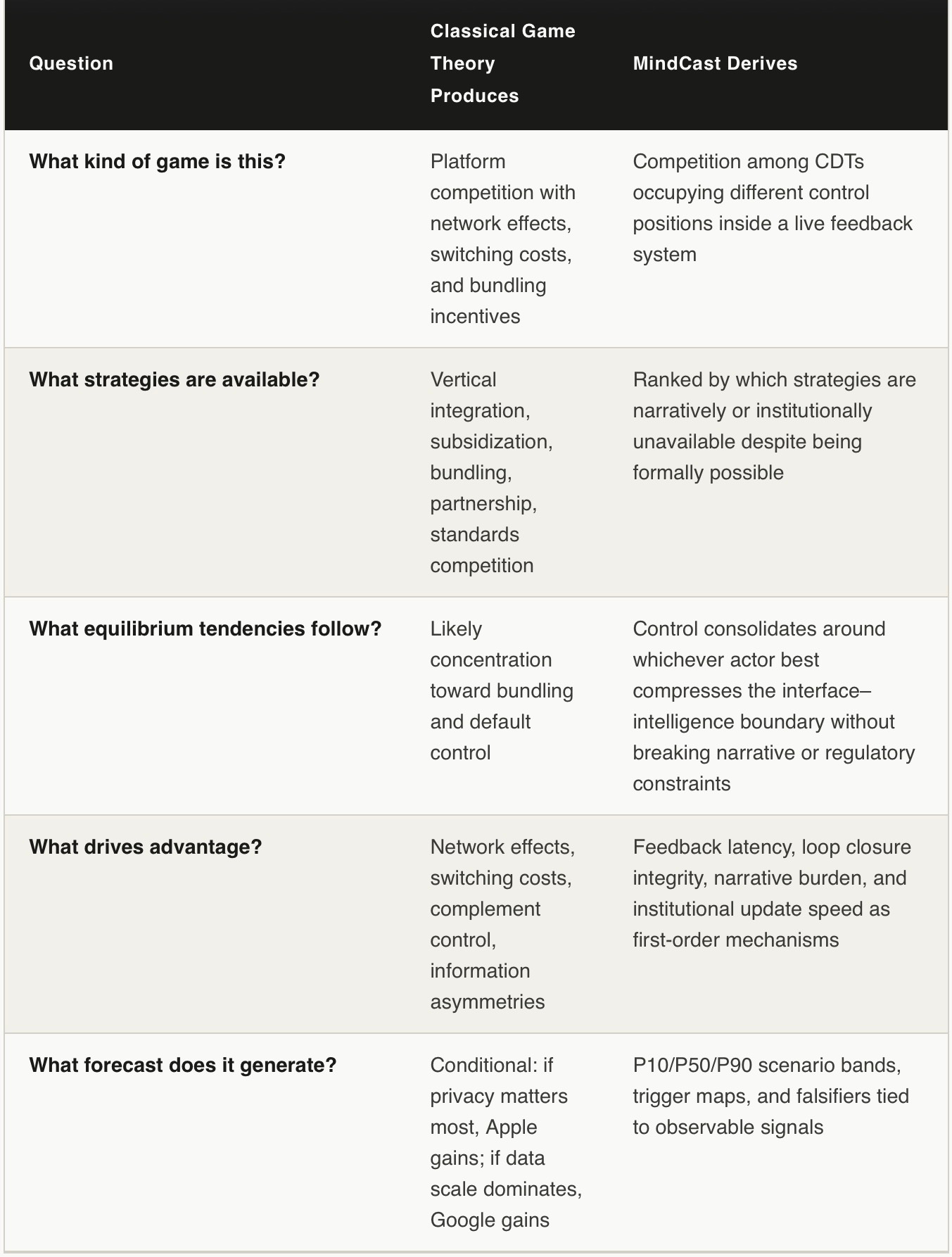
The last row is the one that matters most for practitioners. Classical game theory’s forecast is conditional — it tells you which firm wins under which assumption, leaving the reader to judge which assumption holds. MindCast’s forecast is directional and falsifiable — it tells you which path each firm is most likely on, what probability attaches to that path, and which observable signals would prove the prediction wrong. Descriptions are useful for understanding a field. Predictions are what practitioners need to act before the public story catches up.
XI. MindCast as the Predictive Layer of Behavioral Economics
Behavioral economics produced a durable critique of rational-actor models but has not consistently delivered a predictive successor. Cataloging biases improves description. MindCast Game Theory addresses what behavioral economics left unfinished: converting the insight that actors misperceive incentives into a mechanism for forecasting how those misperceptions drive real-world system behavior over time.
Behavioral economics explains why actors deviate from rational models. MindCast converts those behavioral insights into a predictive mechanism by embedding behavioral dynamics inside Cognitive Digital Twins, then subjecting those twins to feedback loops, latency constraints, narrative commitments, and structural geometry. Behavior is no longer treated as a deviation from strategy — behavior becomes a causal driver that determines how systems adapt over time.
The practical distinction is operational. Behavioral economics diagnoses how actors misperceive incentives. MindCast predicts how those actors will move next given their perception, constraints, and feedback environment. Behavioral economics explains why Apple preserves a privacy narrative or why Google prioritizes data scale. MindCast translates those behavioral traits into forward predictions, probability bands, trigger conditions, and falsifiers. MindCast therefore functions as the missing execution layer — taking the insights of behavioral economics and turning them into system-level forecasts that can be tested against real outcomes.
Each discipline in the stack below addresses a different layer of why actors behave the way they do. Classical economics sets the incentive structure. Behavioral economics explains why actors misread it. Game theory maps how misreading plays out across competing actors. MindCast Game Theory runs that full stack forward under real-world conditions — feedback latency, narrative constraint, structural geometry — and produces a forecast rather than a description.

Each layer is necessary. None is sufficient on its own. Classical economics without behavioral economics assumes actors perceive incentives correctly — they rarely do. Behavioral economics without game theory catalogs individual bias without modeling how those biases interact across competing institutions. Game theory without MindCast’s feedback and constraint architecture explains strategic logic but cannot produce forward predictions for specific actors in specific environments. MindCast integrates all four layers into a single operating system.
XII. Vision Functions: Chicago Accelerated and Nash–Stigler Integration
MindCast Vision Functions operate as a causal routing system that determines what actually governs behavior before any foresight simulation runs. Rather than assuming every environment is strategy-driven, Vision Functions classify systems into dominant causal categories: strategic interaction (game dynamics), behavioral–cognitive architecture (perception, identity, narrative constraints), feedback control (loop speed, latency, adaptation), structural geometry (constraint density and path limitation), and institutional–legal evolution (coordination, exploitation, correction cycles). Each category captures a different mechanism by which outcomes are produced. The purpose is not to layer theories, but to select the governing mechanism so prediction reflects how the system actually operates rather than how a model assumes it should. Vision Functions also serve as the construction logic for Cognitive Digital Twins, defining which forces shape each actor’s behavior, how those forces are weighted, and how the twin updates under pressure over time. As an evolving system, MindCast continuously evaluates the priority and weighting of Vision Functions within each simulation stack and introduces new Vision Functions when emerging domains or behaviors require additional causal resolution.
Within that structure, Chicago Accelerated and Nash–Stigler fall into the institutional–behavioral and equilibrium calibration categories, respectively. Chicago Accelerated governs how systems move over time — tracking coordination breakdown, behavior under perceived incentives, exploitation, and delayed legal correction. Nash–Stigler governs when systems are miscalibrated — distinguishing between behavioral settlement and cognitive sufficiency. Together they are relevant here because the Consumer AI Device field is not a static strategic game; it is a system where actors optimize under distorted perception while institutional understanding lags. Chicago Accelerated explains the movement. Nash–Stigler explains the gap. MindCast uses both to convert that gap into foresight.
Chicago Accelerated
Classical Chicago Law and Economics analyzes coordination, behavioral response, and legal correction as three discrete stages. MindCast Chicago Accelerated collapses them into a continuous loop — and inserts the behavioral perception layer that classical Chicago suppressed. Incentives do not act directly. Incentives are filtered through perception before they produce behavior. That single insertion transforms what would otherwise be an explanatory sequence into a predictive mechanism.
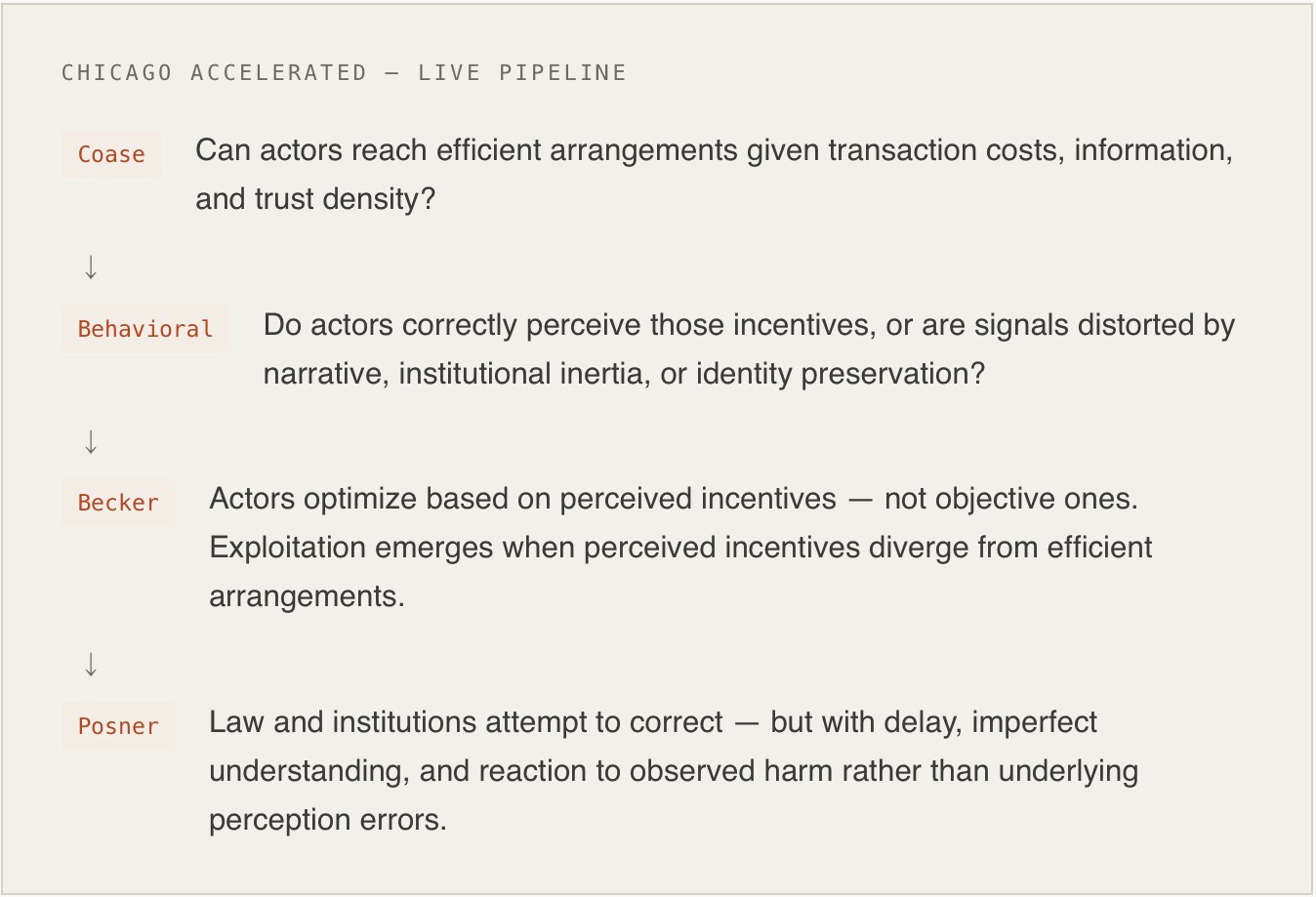
The key variable is not equilibrium — it is transition speed between layers. Fast Coase produces stable coordination. Coase breakdown triggers Becker exploitation. Delayed Posner response allows exploitation to persist and compound. A MindCast simulation tracks where the system currently sits in the pipeline and measures how fast it is moving toward correction.
Behavioral economics is not an overlay in this system. It is the mechanism that determines whether coordination succeeds, whether exploitation emerges, and whether correction arrives in time.
Behavioral economics changes the input, not the output. Actors respond to perceived incentives, not objective ones. Chicago Accelerated turns that perception gap into a predictive mechanism by tracking how misperception drives coordination failure, exploitation, and delayed correction.
Applied to the Consumer AI Device field: coordination exists at the ecosystem level through platform lock-in and developer alignment. Exploitation emerges through bundling, default control, and vertical integration. Legal response through antitrust and platform regulation lags, allowing control positions to solidify. Without specifying when the correction window closes, Chicago Accelerated would do descriptive work rather than predictive work in this case.
Posner Trigger Specification. Posner-layer correction in the Consumer AI Device field becomes operative when one or more of the following signals emerge: a major antitrust action directly targeting interface-intelligence bundling rather than legacy search or app-store mechanics; legislative or regulatory mandate requiring application programming interface (API) interoperability at the OS-AI boundary; or a visible market event in which a non-dominant actor achieves material share through interface-layer displacement rather than feature competition. Until one of those signals appears, the exploitation window remains open and control consolidation continues compounding.
Without behavioral economics embedded in the pipeline, Chicago Accelerated would assume actors respond cleanly to incentives and prediction reduces to equilibrium logic. With behavioral economics embedded, MindCast models misperception as a causal driver, explains why actors persist in suboptimal or self-damaging strategies, and detects when systems will not self-correct. Apple must preserve its privacy narrative and cannot aggressively exploit data even when doing so would be financially rational. Google must justify intelligence dominance and pushes into interface despite regulatory exposure because its CDT grammar demands it. Samsung prioritizes flexibility and scale, delaying full internalization in ways that extend its dependency window. Each firm is not optimizing abstract incentives — each is optimizing within its own narrative and perception constraints.
Nash–Stigler Integration
Textbook game theory stops at Nash equilibrium — the point at which no actor has an incentive to unilaterally change strategy given the strategies of others. MindCast Game Theory requires a second equilibrium condition before declaring a system analytically complete. Named for George Stigler’s work on information and market efficiency, Stigler equilibrium asks whether the system has achieved sufficient understanding to sustain the behavioral settlement it has reached. The gap between Nash and Stigler, the MindCast Nash-Stigler Equilibrium, is where foresight lives.
A system reaches Nash equilibrium when behavior stabilizes. A system reaches Stigler equilibrium when understanding catches up. Many real-world systems stabilize behaviorally long before they stabilize cognitively — and the gap between the two is where advantage compounds silently. The core rule: a system is not complete until behavior stabilizes and understanding catches up. The gap between those two conditions produces persistent mispricing, regulatory lag, and narrative-driven equilibrium lock-in.
Applied to the Consumer AI Device field: at the Nash layer, Apple, Google, and Samsung have settled into differentiated control positions. Each firm optimizes within its domain — interface, intelligence, distribution. Behavioral settlement exists. At the Stigler layer, the market, regulators, and even competitors have not yet processed the full implications of feedback control, data dominance, and interface capture at system scale. Understanding has not caught up. The power shift toward control of the interface–intelligence boundary continues compounding silently inside what the public story still frames as a consumer product competition.
When Stigler equilibrium finally updates — through antitrust enforcement, a major platform shift, or a regulatory event that makes the underlying control architecture visible — the correction will not be gradual. Abrupt repricing, sudden regulatory action, and platform displacement follow. The Nash–Stigler gap is therefore not merely an academic observation about information completeness. For investors, operators, and regulators, the gap is the foresight window — the period during which correctly understanding the system produces structural advantage over actors still operating inside the distortion.
Chicago Accelerated and Nash–Stigler as a Unified System
The two Vision Functions address different but complementary failure modes. Chicago Accelerated explains how systems move: coordination breaks, exploitation adapts to perceived incentives, and correction arrives too late. Nash–Stigler explains when systems are miscalibrated: behavior stabilizes before understanding completes, creating gaps that compound until a correction event forces alignment. Applying both to the same field produces the full MindCast diagnostic — movement mechanics and miscalibration mapping operating together inside a single simulation. MindCast is not replacing classical economics or game theory. MindCast is accelerating them, integrating them, and making them predictive.
XIII. Who Uses MindCast Game Theory and Why
MindCast Game Theory is a survival guide for practitioners operating where standard rational-actor models fail — any environment where rules are rewritten while the game is in progress, feedback arrives late or distorted, and narrative constrains strategy as much as incentives do. Standard equilibrium analysis assumes the game holds still long enough to solve. The practitioners below operate in environments where it never does. Each stakeholder category maps to a specific set of MindCast mechanisms that address failure modes in their existing toolkit — and each identifies an edge that becomes available only when the framework correctly models how the system actually moves.
Institutional Investors and Sovereign Allocators
Standard scenario analysis assumes rule stability. When geopolitical or regulatory frameworks shift, investors running stability-dependent models face abrupt repricing with no prior warning — because the model was never designed to track the underlying movement. MindCast addresses the structural problem directly by modeling transition velocity between coordination, exploitation, and correction across jurisdictions rather than treating each jurisdiction as a static risk factor. Geopolitical systems routinely reach behavioral settlement — stable deterrence postures, trade arrangements, regulatory equilibria — long before market participants or counterpart governments have processed the underlying power shifts driving them. Mapping the Nash–Stigler gap in those systems identifies where behavioral settlement has outpaced cognitive sufficiency. Investors who locate that gap in advance hold a structural timing advantage over those reacting after the correction forces visible repricing. Sovereign wealth funds and institutional allocators face the same dynamic at larger scale: CDT modeling of sovereign actors and regulatory bodies gives allocators a mechanism for anticipating correction timing rather than reacting to it.
Litigation Counsel and Outside Advisors
Traditional litigation strategy treats multi-forum proceedings as discrete battles. MindCast treats them as an interconnected system — precisely the environment Section II describes, where a move in one proceeding re-enters the system as signal in another, alters the opposing party’s constraint geometry, and changes the available moves in every adjacent forum. Modeling the inter-forum feedback loop rather than each court in isolation gives counsel a materially different strategic picture than conventional case-by-case analysis produces. The deeper edge comes from the Nash–Stigler gap applied to opposing counsel and their client: parties frequently settle into stable litigation postures based on an incomplete understanding of their own constraint geometry or their counterpart’s narrative burden. Counsel who correctly maps that Stigler deficit — identifying where the opposing party cannot credibly update because reversal would impose an intolerable narrative cost — holds a positional advantage that never appears in the official case record.
Corporate Strategists
Capabilities assessments show what a competitor can do. MindCast adds the layer that determines what a competitor is institutionally or psychologically blocked from doing — a distinction that standard competitive analysis consistently misses. Constraint geometry maps which moves are formally possible but practically unavailable due to leadership narrative commitments, platform density, or regulatory exposure. A competitor may have the resources and technical capability to execute a strategy that their CDT grammar makes impossible to credibly pursue. The sharper edge comes from feedback debt analysis: competitors accumulating feedback debt — operating inside delayed or captured loops while mistaking the absence of correction for success — reach an adaptation threshold at a predictable point. Identifying which competitors are building that debt, and modeling when the threshold forces abrupt correction, tells the strategist exactly when a wide-open exploitation window will emerge before the market sees it.
Regulators and Policy Counsel
Sophisticated institutional actors typically operate inside exploitation windows long before a regulator can react — Becker exploitation compounding during Posner lag, with the evidentiary record, the narrative frame, and the political environment all shaped in the defendant’s favor before the agency moves. A conventional enforcement posture characterizes past conduct. MindCast produces a different output: a predictive account of how the target will adapt to enforcement, which moves are geometrically blocked despite being formally available, and where narrative commitment will prevent credible updating regardless of what the target says it will do. CDT modeling of the defendant institution allows the regulator to lead enforcement against the target’s most likely future adaptation rather than reacting to the adaptation after it has already occurred. For policy counsel drafting rules, the same logic applies: Chicago Accelerated’s behavioral perception layer maps how institutional actors are already optimizing against their perceived version of the emerging rule, identifying where behavioral settlement will form before implementation and which structural conditions produce rules that are gamed immediately upon taking effect.
Geopolitical and Intelligence Risk Functions Inside Corporates
Standard geopolitical risk tools analyze discrete country risk, sanctions exposure, and political event probability. MindCast adds the systems layer: modeling sovereign actors, regulatory bodies, and competing firms as CDTs operating inside interacting feedback loops across jurisdictions. The operative question is not whether a regulatory event will occur in a given country. The operative question is how that event re-enters the system as signal across adjacent jurisdictions, which actors will adapt fastest, and whether the constraint geometry of the operating environment has already narrowed the viable response set before the event becomes publicly visible. For firms with material cross-border exposure in AI, energy, defense supply chain, and critical infrastructure, that distinction between event probability and system dynamics determines whether the firm is positioned ahead of the correction or reacting to it.
M&A and Transaction Advisory
Transaction risk is not only valuation risk. Target behavior, regulatory response timing, and constraint geometry all determine whether a deal closes on the expected terms, closes under duress, or creates post-close integration failure that no due diligence process predicted. Chicago Accelerated’s transition velocity framework maps directly onto that problem: the critical question is whether Posner-layer correction — antitrust review, regulatory intervention, market repricing — will arrive before or after closing, and how fast. CDT modeling of target leadership predicts which commitments they can credibly make given their narrative constraints, where behavioral adaptation limits will produce post-close friction, and which integration assumptions rest on a target capability that constraint geometry has already made unavailable. Nash–Stigler analysis of the deal environment identifies whether stable regulatory posture and consistent deal pricing reflect genuine equilibrium or behavioral settlement that has outpaced the market’s understanding of the structural shift about to force correction.
Primary textbook reference: Osborne, M.J. & Rubinstein, A. (1994). A Course in Game Theory. MIT Press. Available free at ariel.ac.il/services/micro/gtm.pdf
The canonical Nash equilibrium paper: Nash, J.F. (1950). Equilibrium Points in N-Person Games. Proceedings of the National Academy of Sciences, 36(1), 48–49.
Standard graduate-level reference: Fudenberg, D. & Tirole, J. (1991). Game Theory. MIT Press.