
Compass, Inc. · Northwest Multiple Listing Service · California Regional Multiple Listing Service · Arizona Regional Multiple Listing Service · BridgeMLS · Canopy MLS · REcolorado · Hive MLS · Doorify MLS · MRED · Realtracs · The MLS/CLAW · Bright MLS · Anywhere Real Estate shareholders · Southern District of New York · Central District of California · Western District of Washington
Related works. What the Private-Listing Economics Add to Magloire v. Compass, the Securities Act Case Already Pending Over the Anywhere Merger | How State Attorney General Coalitions Form, Grow, and Hold | Mandatory MLS Submission Is the Rule NAR, Washington, and the NWMLS Settlement All Left Standing, and Compass v. CRMLS Is the Suit That Tests It | The Compass–NWMLS Settlement Changed the Private Governor After Washington Changed the Governing Law
Thesis. Compass’s partnerships with listing services establish a distribution channel under existing MLS rules, and its litigation seeks additional freedom to withhold publicly marketed listings. A listing service’s commercial arrangement with Compass and its position on the submission rule are separate choices, and joint litigation changes what defending the rule costs without yet showing that six boards hold one position.
Why now. Compass’s response in No. 1:26-cv-09253 is due within the responsive-pleading window, its Q3 10-Q follows within weeks, and two listing services holding Compass letters have refused without filing. Investors decide which Compass benefit to value and listing-service boards decide two questions before any court rules.
I. Executive Summary
Compass cited its lawsuit against the Northwest Multiple Listing Service in demand letters to six listing services in September 2026. On October 21 the six answered with one declaratory complaint in the Southern District of New York (No. 1:26-cv-09253) through one law firm, one day after a deadline Compass had extended. In the same six months four other listing services announced data partnerships with Compass. The documents establish a threat and a joint filing and four partnerships, and they do not establish why any institution chose as it did.
The thesis is that Compass’s partnerships establish a distribution channel under existing MLS rules, and the litigation seeks additional freedom to withhold publicly marketed listings. A listing service’s commercial arrangement with Compass and its position on the submission rule are two separate choices, and an institution’s response depends on three quantities: the value it expects from Compass’s distribution offer; the cost selective withholding imposes on its cooperative database; and the resources available to defend its rule. Joint litigation changes the third quantity. Whether it changes the first two is the question the simulation evaluates.
The filing has one immediate effect and several contingent ones. The immediate effect is that six boards pooled one pleading and placed the submission-rule question before one court in Compass’s home district. Future spending, additional participants, sustained enforcement and any merits ruling remain open.
Investors weigh the incremental earnings from additional freedom to withhold against the cost of obtaining and sustaining it, because the partnership channel already delivers distribution and agent recruitment without that freedom. Listing-service boards treat a Compass partnership and a Compass rule demand as separate negotiations, each with its own terms.
MindCast AI applies Predictive Behavioral Economics + Dynamic Game Theory through MindCast AI Proprietary Cognitive Digital Twin Foresight Simulations (MP CDT FS). Behavioral Economics supplies the decision rules. Game Theory supplies the payoff structure. Predictive simulations emerge from the combination.
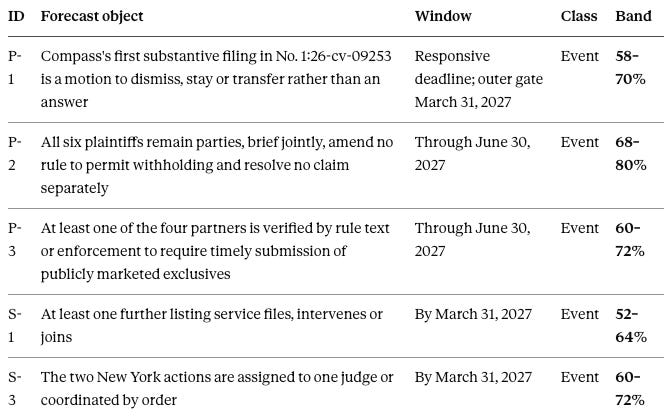
The paper carries nine MindCast Foresight Simulation Predictions: three Primary (P) and six Secondary (S), with the five highest-value entries below. MindCast testified on the private-listing mechanism before the Washington State legislature in January 2026 and made an amicus submission in Compass v. NWMLS.
Simulation Prediction Highlights
📊 Investors. P-1 and S-3 fix when the window-versus-invalidation signal arrives and which court sends it; P-3 says whether the partnership channel runs under submission rules.
🗂 MLS Leaders. P-2 is the board’s durability gate; S-1 is the join signal for a board holding a Compass letter; P-3 is the term a board verifies before taking a partnership.
⚖️ Counsel. Litigation coordination and rule coordination are separate questions, and the coalition’s first brief keeps them apart; brokerage counsel in the four states holds showing and offer records for phased listings.
🏛️ Policymakers. Arizona, California, Colorado and North Carolina hold a broker-conduct statute option that no ruling on the submission rule reaches.
Section II states what the filing changed in the bargaining structure and carries the eighteen-month chronology from the Washington filing to the New York filing. Section III shows which marketing rights Washington proved can coexist with submission, lists the seven Washington antecedents in the New York complaint, and names the statute option the four plaintiff states hold. Section IV separates partnership from rule position with a verification table; Section V asks what sustains six boards in one filing; Section VI sets out Compass’s litigation and commercial responses and the enforcement scrutiny the campaign has drawn, with the motions coalition counsel pre-drafts. Section VII carries the Simulation Predictions, and Section VIII states the implications for investors and listing-service boards.
II. The Six-MLS Filing Changes the Bargaining Structure
Six listing services in four states sued Compass together on October 21, 2026, seeking declarations that their cooperation rules satisfy federal and state antitrust law and an injunction barring Compass from suing any of them over the rules. Joint action matters because Compass’s campaign had run one institution at a time, and a plaintiff-initiated action in Compass’s home district changes who chooses the forum and the sequence of every later move.
The plaintiffs are Arizona Regional Multiple Listing Service and BridgeMLS and Canopy MLS and REcolorado and Hive MLS and Doorify MLS. Robinson, Bradshaw & Hinson of Charlotte signs for all six with McFerrin-Clancy LLC as New York counsel. Count I seeks a Sherman Act Section 1 declaration for all six; Counts II through V map each plaintiff to its home state’s statute and plead that each follows Section 1. Prayer F asks the court to enjoin Compass from pursuing any antitrust claim against any plaintiff over the rules.
Compass sent five demand letters on September 14 and a sixth to Doorify MLS on September 17 (¶¶63–68). Each letter cited the NWMLS suit and was copied to the Antitrust Division and the Bureau of Competition, and each set October 6 as the date for written confirmation that the service would stop enforcing its rule (¶¶61–62). Counsel agreed to extend the deadline to October 20 (¶61); the complaint does not say who asked. Compass sued CRMLS in the Central District of California on October 16, inside the extension, and the six filed the day after the extended deadline expired.
The sequence from Compass’s Washington filing to the New York filing runs eighteen months:
April 25, 2025: Compass sues NWMLS, No. 2:25-cv-00766 (W.D. Wash.); NWMLS counterclaims and takes discovery into buyer-capture conduct.
April 24, 2026: MRED opens nationally with Compass as first partner. April 30: Realtracs opens nationally with Compass and United Real Estate. May 6: The MLS/CLAW announces MLS Exclusive status and a Compass partnership. May 13: Bright MLS announces a Compass partnership.
May 12, 2026: Zillow sues MRED and Compass (N.D. Ill.). September 15: the court denies Zillow’s preliminary injunction and sends claims against MRED to arbitration.
June 11, 2026: Washington’s SSB 6091 takes effect.
August 31, 2026: Compass and NWMLS announce the agreement that keeps submission and adds First Look.
September 8, 2026: Compass’s demand letter to CRMLS. September 14 and 17: demand letters to the six (¶¶63–68). September 30: CRMLS refuses and announces a defense fund; Compass’s chief executive says suits begin mid-October.
October 5, 2026: CRMLS files No. 1:26-cv-08796 (S.D.N.Y.). October 16: Compass files No. 5:26-cv-06121 (C.D. Cal.) and announces the fine-reimbursement program. October 20: the extended deadline expires (¶61). October 21: the six file No. 1:26-cv-09253.
Two changes are observed. The initiative moved: in Washington Compass chose the opening claim and the forum, and in New York the listing services chose both. The forum concentrated: CRMLS’s October 5 action and the six-MLS action sit in one district, and whether one judge hears both is a question the court decides. A common pleading may reduce duplicated legal work and creates another proceeding Compass must address; whether those changes lower each board’s costs or deter selective litigation remains unmeasured.
The consequence is that Compass now chooses among responses to a second New York proceeding while seven listing services hold the forum and the framing. Whether six boards with different tiers and different ownership remain one party through the first merits ruling is the durability question, and P-2 carries it at 68–80%.
📊 Investors. A second New York proceeding adds cost to every Compass branch without fixing which one Compass takes; P-1 (58–70%) is the first observable. 🗂 MLS Leaders. A board holding a Compass letter now has a forum and a pleading to join; S-1 (52–64%) is the join signal.
III. Washington Shows Which Marketing Rights Can Coexist With Submission
The August 31 agreement between Compass and NWMLS is the only completed outcome in Compass’s campaign, and it shows which seller rights Compass accepted inside a submission rule. First Look preserved mandatory submission and member visibility while giving sellers control over showings, offers, portal distribution and public days on market for 21 days. Showing and offer and portal rights, not the number of days, are what every later negotiation turns on.
Under First Look every listing enters NWMLS on submission and reaches every member broker. Sellers may market publicly for up to 21 days without public days on market or price history, decide whether showings and open houses are allowed and whether offers are accepted during the period, and decline IDX distribution in favor of brokerage-channel marketing. Compass called its objective “fully realized.” Washington’s SSB 6091 runs beside the agreement and requires concurrent public marketing of any listing marketed to a limited group; the four plaintiff states hold no comparable statute.
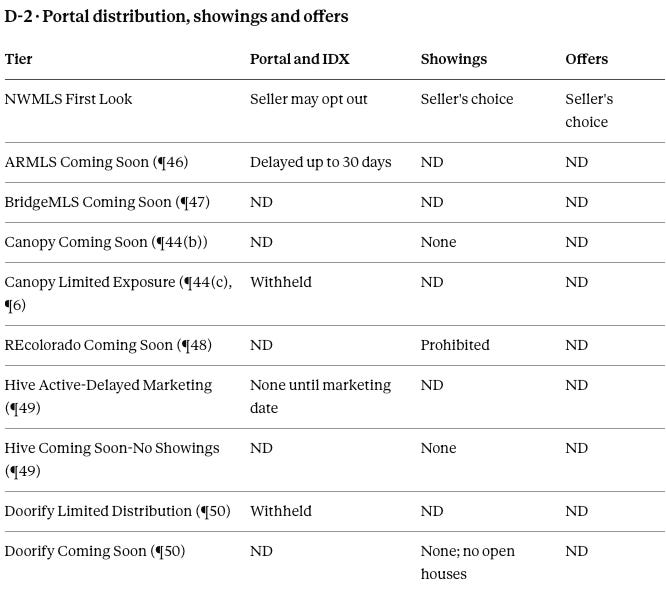
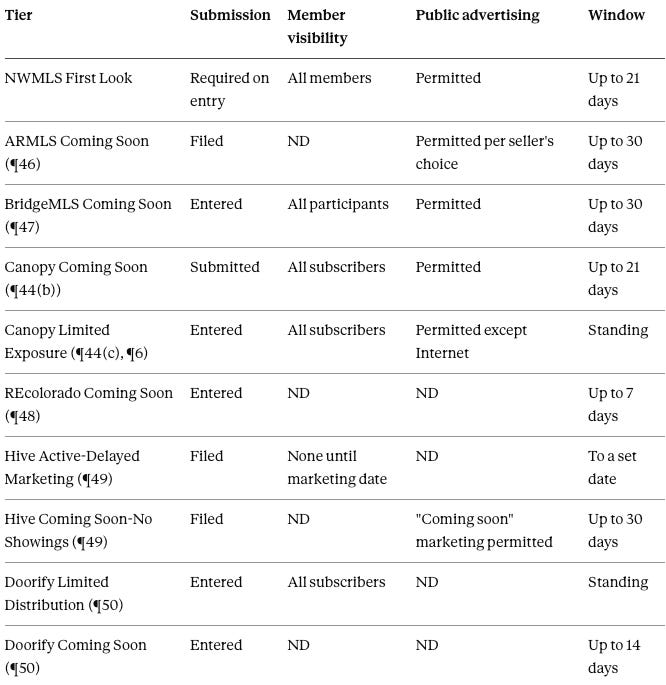
The six plaintiffs plead their own tiers as existing rules (¶¶44–50), and Appendix D sets each tier beside First Look on six rights. On the cells the complaint documents, Canopy’s Coming Soon and BridgeMLS’s Coming Soon match First Look on submission, member visibility and public advertising. No plaintiff tier documents First Look’s seller-controlled showing and offer terms, and most plaintiff tiers leave portal distribution undocumented. The plaintiff rule texts sit in exhibits the public copy omits.
Seven features of the New York complaint have a Washington antecedent:
Filed first rather than defending; NWMLS defended for sixteen months.
Filed in Compass’s home district; both Compass suits were filed in the listing service’s home.
Pleaded the tiers as existing rules rather than negotiable concessions; First Look was consideration.
Answered the seller-choice framing at ¶6 before Compass pleaded it.
Answered the group-boycott theory at ¶86 before Compass pleaded it.
Pleaded independent adoption at ¶41.
Pleaded public evidence NWMLS could obtain only by subpoena: the Zillow v. MRED three-phase finding (¶58); Senator Warren’s August 6 letter (¶29); the Wall Street Journal’s October 15 report of $1,000 agent payments (¶25).
One Washington feature did not travel: NWMLS’s buyer-access discovery, which the New York complaint pleads only as a conditional mechanism at ¶78 with no incident.
The rights that remain negotiable outside Washington are showings, offers and portal distribution inside a window the plaintiffs already provide. Duration cannot establish equivalence, because a thirty-day tier that withholds seller control over showings offers less than a 21-day tier that grants it. A Compass proposal addressed to days alone would obtain nothing the plaintiffs have not already pleaded; a proposal addressed to showing and offer rights would be the first real test of what the six will trade.
Washington’s statute did not travel, and the four plaintiff states can supply it. Policymakers in Arizona, California, Colorado and North Carolina hold the one instrument no court ruling reaches: a broker-conduct statute of the Washington type regulating showing access and buyer representation inside the tiers the plaintiffs already provide. Such a statute survives any outcome on the submission rule.
📊 Investors. A rights-based Compass proposal is the signal that Compass is paying for a window rather than a ruling; the Mandatory MLS Submission paper’s I 1 (56–68%, a Compass window proposal rather than invalidation) carries that question. 🗂 MLS Leaders. Appendix D is the board’s checklist of what it already offers before any negotiation. 🏛️ Policymakers. A broker-conduct statute on showing access and buyer representation survives any outcome on the submission rule.
IV. Partnership and Submission Rules Require Separate Decisions
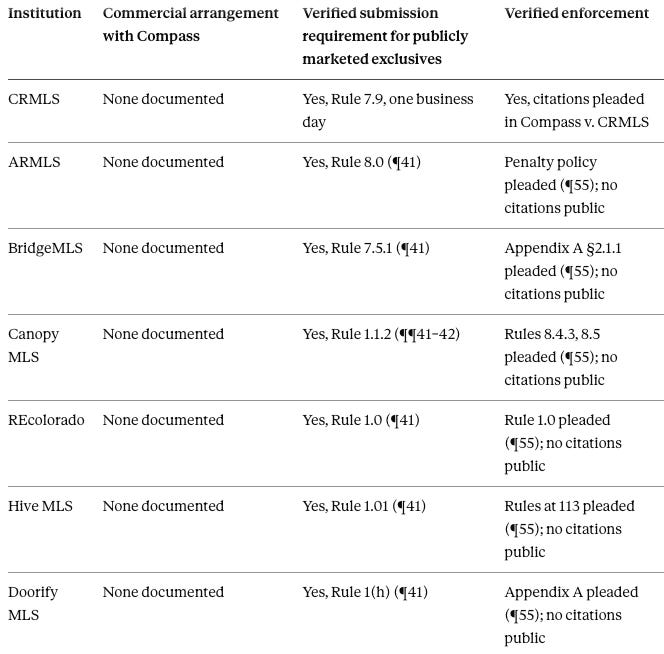
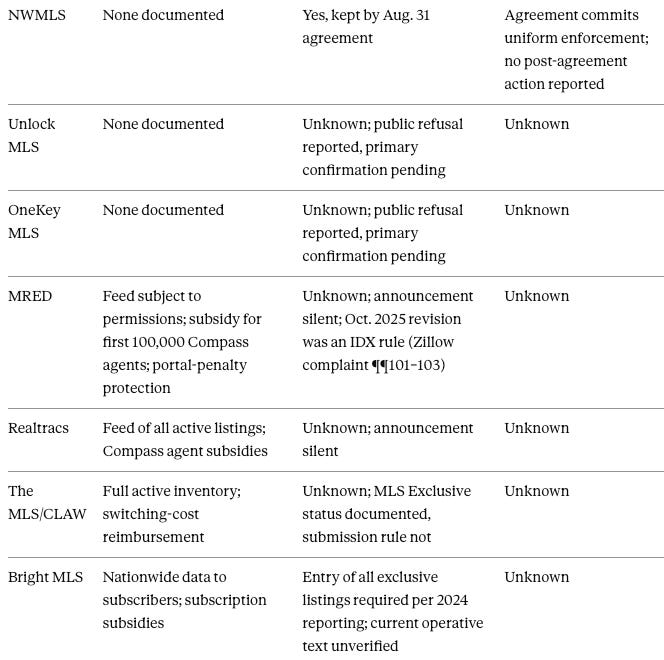
A listing service’s commercial exchange with Compass and its position on inventory withholding are different decisions. A partnership announcement establishes feeds and subsidies, and a declaratory complaint establishes resistance to Compass’s demand. An announcement’s silence on the submission rule establishes nothing about the partner’s rule or its enforcement, so the table below places each institution on three columns and marks every unknown.
The four partnership arrangements share one structure. MRED’s April 24 release opened its service and Private Listing Network to any licensed agent nationwide; Compass committed its nationwide inventory subject to homeowner and agent permission and agreed to subsidize access for the first 100,000 Compass agents; MRED committed to protect participants from portal penalties. Realtracs opened nationally on April 30 with a Compass feed of all active listings and subsidized Compass memberships.
The MLS/CLAW’s May 6 arrangement brings Compass’s full active inventory into CLAW with switching-cost reimbursement for the first 100,000 Compass agents and 10,000 outside agents. CLAW’s MLS Exclusive status is member-visible and off-portal.
Bright’s May 13 arrangement makes Compass’s nationwide data available to Bright subscribers with subscription subsidies. Subsidy amounts and end dates and permission terms are undisclosed in all four arrangements.
The seven litigating institutions plead the reciprocal bargain. A brokerage that wants the comprehensive database joins the MLS and agrees to its rules, and any publicly marketed property must enter the MLS so it reaches every member (¶3). Withholding is pleaded as free riding that leaves the database incomplete and destroys its value (¶¶4 and 52 and 76 and 80). The database lets a one-person brokerage access the same inventory as the largest firm (¶73), and buyer brokers compete on skill and price rather than on holding a particular listing (¶77).
Compass’s September 8 letter to CRMLS named eight services that permit public marketing of office exclusives, of which public sources identify Bay Area Real Estate Information Services and MetroList, and Compass’s own complaint pleads an unnamed class serving “more than 350,000 brokers and agents in at least 12 states” that does not fine off-MLS public marketing (Compass v. CRMLS ¶¶7 and 67). Neither the letter’s remaining six names nor the pleaded class is verified by rule text.
Comparing institutions on characteristics that preceded their decisions is the test the thesis needs, and the sources document few of them. Compass-plus-Anywhere inventory share is documented for MRED only (Compass pleaded as its largest customer, Zillow complaint ¶22), and subscriber trends before 2026 are documented for none.
Existing limited-exposure or private products are documented for MRED and CLAW and Canopy and Doorify. Product availability therefore appears in both the partnered and the litigating groups and does not explain the decisions. Board composition is documented for MRED (three Compass-affiliated seats on the Board of Managers, Zillow complaint ¶¶24 and 91) and for the six (¶¶10–15). Whether Compass offered any litigating institution feeds or subsidies is undocumented.
The documented arrangements establish that Compass has placed inventory and subsidized agents on four platforms whose submission rules and enforcement are unverified, and that seven institutions have refused to drop verified rules. The simulation cannot rank commercial value against governance as the sorting variable until inventory shares and board compositions are assembled for both groups.
📊 Investors. P-3 (60–72%) is the test of whether the partnership channel runs under submission rules. 🗂 MLS Leaders. The verification table is the template a board fills for its own institution before it classifies any neighbor.
V. Shared Defense Depends on Each Board’s Continuing Incentives
Reusable public work and pooled resources could sustain resistance across listing services, and the coalition-formation model from state enforcement explains how. Lead institutions absorb the fixed cost of theory and evidence, and each remaining institution joins when its cost of joining falls below its payoff. The six-MLS filing fits the model’s formation stage, and whether it fits the durability stage depends on incentives each board holds separately.
Three roles stay apart. Active participants are the seven institutions on the docket: CRMLS in one action and the six in another. NWMLS is a historical contributor whose litigation and discovery materials may be usable in New York under whatever protective order governs them; it is not a plaintiff. REcolorado’s ownership by MAZL LLC with no National Association of Realtors (NAR) affiliation (¶39) is a comparison case for the claim that the cooperation rule is a cooperative-venture rule rather than an association policy; no source shows REcolorado’s participation encouraged another service to join.
Two formation conditions are documented. Compass’s letters were “fundamentally identical” (¶7) and went out in one batch to one deadline, which is the common-threat condition. CRMLS announced a defense fund on September 30, which is the cost-lowering condition once commitments are documented; at the cutoff none are.
The joint filing demonstrates pooled initial work. One firm drafted one 35-page complaint for six plaintiffs, and no board’s budget or fee arrangement is public. The mechanism by which pooling lowers cost is the reuse of one pleading, one brief and one evidence set across six parties; whether the reuse lowers any board’s spending below what it would have paid alone is unmeasured.
Each board faces a commitment fork at every stage. The six hold different tiers (Appendix D), different ownership (Appendix C) and exit terms none has published. Any one board can amend its tier or decline to fund or resolve its own case without the other five doing the same, and Compass’s commercial responses in Section VI are aimed at that fork.
Participation is sustained where a board’s cost of selective withholding is high and the pooled work reduces its marginal spend. Individual accommodation becomes attractive where Compass offers a board inventory or subsidies the others do not receive, or where a board’s narrow tier makes it the likely target of a selective suit; REcolorado and Hive MLS plead the narrowest tiers (¶¶48–49) and carry that risk most directly.
📊 Investors. P-2 (68–80%) is the measure of whether the campaign faces one defendant or six through mid-2027. 🗂 MLS Leaders. A board’s exit terms and fee arrangement are the two inputs that decide its own continuation, and neither is public for any plaintiff.
VI. Compass Can Respond Through Litigation and Commercial Terms
Compass holds procedural responses in three courts and commercial responses toward every rostered institution, and each is a branch rather than an outcome the filing fixed. The filing also gives the antitrust agencies an additional basis to examine Compass’s conduct.
The procedural branches open at the data cutoff:
A forum motion in New York arguing the declaratory action is anticipatory or that transfer serves convenience. The six’s post-deadline filing and Compass’s own CRMLS complaint weigh against that characterization without barring it.
An answer with counterclaims against all six in New York, which pleads Compass’s antitrust claims as compulsory counterclaims in the plaintiffs’ chosen forum.
One combined complaint against several plaintiffs in a single district elsewhere.
Selective home-district complaints against the plaintiffs with the narrowest tiers, REcolorado and Hive MLS on the pleaded facts (¶¶48–49).
No filing until the New York court rules on the forum question in CRMLS’s action.
Related-case treatment in New York, which the court decides: assignment to one judge, coordination of schedules, and the order in which the three courts rule.
The commercial responses:
Differentiated terms to one board or narrower targets. Either forces the six to reconcile collective commitment with individual benefit.
Inventory and subsidies to a service whose submission rule is unverified, the terms Compass gave the four partners and can extend to any litigant.
A rights-based proposal on showings or offers or portal distribution inside an existing tier, the first offer that would address what the plaintiffs have not already pleaded.
Disputes over relevance or scope or confidentiality if the plaintiffs seek access evidence, which keep NWMLS’s discovery informative without making it available.
Extension of the October 16 fine-reimbursement and claim-assignment program from CRMLS territory into a plaintiff territory, the one commercial response already documented.
Two points of law shape every branch. Treble damages under Clayton Act Section 4 attach to any antitrust violation, so a rule-of-reason claim supports the same multiplier as a per se claim, and a per se loss in Manhattan narrows Compass’s liability path rather than its remedy. The joint complaint is weak evidence of agreement on the rules: Noerr-Pennington immunizes joint petitioning, Pennington leaves petitioning conduct admissible only to show the purpose and character of other conduct, and the adoption history of each rule decides the agreement question.
The campaign has placed Compass’s own conduct before the antitrust agencies, which had been asked only to view the listing services’ rules. Compass copied every demand letter to the Antitrust Division and the Bureau of Competition, and the two declaratory complaints answer by citing the agencies’ own 1983 and 2007 reports as authority that mandatory submission is procompetitive.
The agencies now hold a pleaded campaign of identical letters and partnership subsidies for up to 100,000 agents per partner, and also hold the Northern District of Illinois’s three-phase finding and Senator Warren’s August 6 letter (¶29) and a reported $1,000 payment program to remove listings from third-party sites (¶25). A federal statement of interest on how cooperative-venture rules are characterized is the low-cost federal entry Compass invited. A conduct inquiry into Compass is a separate and costlier step. The Briefing for MLS Leaders’ S 1 (84–93%, no state statement of interest in a Compass suit through 2027) and the Magloire paper’s S 6 (14–24%, a formal FTC inquiry) stay open.
State attorneys general now hold local plaintiffs and a reusable theory in Arizona and California and Colorado and North Carolina, and Washington holds a statute and a completed case. The Briefing for MLS Leaders’ P 1 (34–50%, a second state office takes a public step by June 30, 2027) gains candidates without gaining a trigger. The consumer-facing injury that moves a state office is a buyer denied a showing or required to change representation, and it remains unpleaded in every docket. Compass’s commercial arrangements rather than its lawsuits are the conduct a state office can reach first, because feeds and subsidies and portal-penalty commitments and buyer routing sit outside Noerr-Pennington and within a civil investigative demand.
Compass’s first New York filing is a signal of which branch it has chosen, and later conduct determines the outcome. Four developments would change the bargaining position: a rights-based proposal from Compass; a differentiated offer to any one plaintiff; a selective complaint against REcolorado or Hive MLS; a related-case or coordination order in New York. A state preservation demand keyed to ¶58 and ¶78 would be the first signal that enforcement scrutiny has moved from the rule to the company.
Counsel for the coalition briefs the post-deadline filing and the home-district choice as arguments against an anticipatory characterization, pre-drafts first-to-file motions for each home district against the six procedural branches, and separates litigation coordination from rule coordination in the first brief. Brokerage counsel in the four states issues preservation holds on showing and offer records for phased listings.
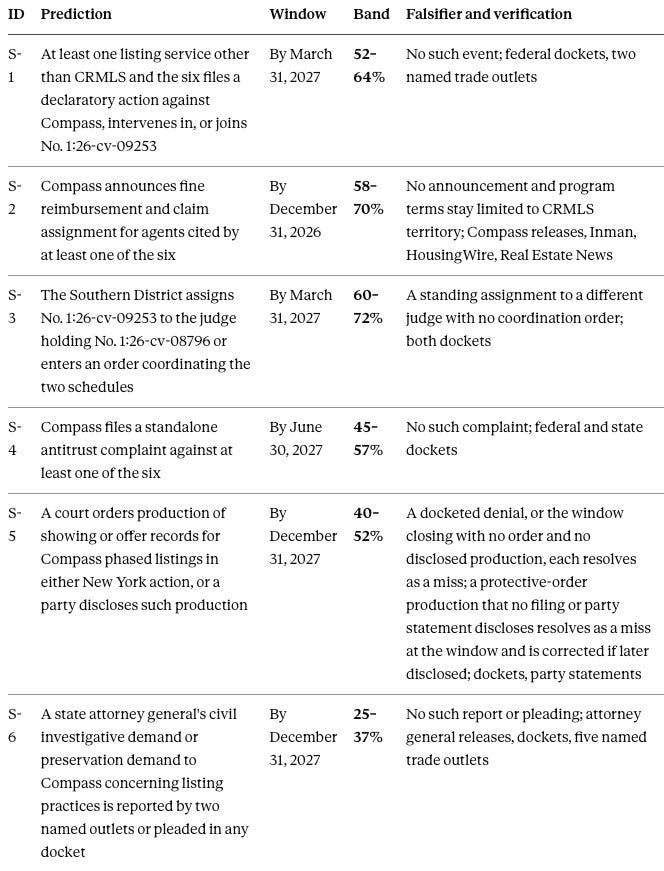
📊 Investors. S-4 (45–57%) and S-6 (25–37%) carry Compass’s selective-suit and enforcement exposure; neither changes its Clayton §4 leverage. 🗂 MLS Leaders. S-2 (58–70%) is the signal that Compass’s fine program has reached a plaintiff territory. ⚖️ Counsel. Each procedural branch above has a first-to-file motion to pre-draft, and the first brief keeps litigation coordination apart from rule coordination. 🏛️ Policymakers. The consumer-facing injury that moves a state office remains unpleaded in every docket; a broker-conduct statute reaches it without waiting for one.
VII. MindCast Simulation Predictions
The simulation issued nine Simulation Predictions: three Primary and six Secondary. Prediction date and data cutoff: October 22, 2026.
Competing Explanations
Three explanations for the October 21 filing compete, and each carries its own falsifier.
Common threat and cost sharing. Identical letters to one deadline and one extended window let six boards share one filing. Falsifier: board documents showing separate counsel and separate filing plans before the extension.
Demonstration. Compass’s October 16 complaint against CRMLS converted a threat into a demonstrated cost and moved the boards. Falsifier: board decisions documented as final before October 16.
Single-matter convenience. One firm offered one filing and the sequence carries no propagation content. Falsifier: joinder by a listing service with no shared counsel and no September letter, or a declaratory filing elsewhere citing the New York action as its model.
The Simulation Predictions below are outcomes, not tests of any one explanation; several can hold at once.
Synthesis and Scenario Structure
The dominant mechanism is plaintiff-initiated forum concentration in New York, joined to a common threat that made one pleading for six boards possible. The active regime is three parallel federal actions with reciprocal forum motions on overlapping clocks while the partnership channel operates beside the litigation. The behavioral equilibrium is six boards briefing jointly while each keeps its tier, with Compass contesting the forum and extending commercial terms selectively.
Four events change the regime: a related-case or coordination order; a selective Compass complaint against a narrow-tier plaintiff; a rights-based Compass proposal; a partner verified as permitting withholding. The routes below print in the simulation’s order of likelihood.
Base route (52–62%): a related-case or coordination order; Compass forum motion then counterclaims after denial; the six hold rules and brief jointly through June 2027; one to two further litigants; no partner verified as permitting withholding; at most one home-district complaint.
Secondary route (22–30%): selective Compass complaints against REcolorado or Hive MLS before any New York forum ruling, with the coalition holding on two tracks.
Tail route A (8–14%): a rights-based accommodation on showings or offers or IDX resolves one action while others pend.
Tail route B (4–8%): a partner receives a Compass demand letter or portal action and becomes a litigant or a refuser.
Primary Simulation Predictions
P-1 · Compass contests the forum before answering (58–70%). Compass’s first substantive filing in No. 1:26-cv-09253 is a motion to dismiss or stay or transfer rather than an answer, filed by its responsive-pleading deadline including any stipulated extension and no later than March 31, 2027. Falsifier: an answer or counterclaim docketed first, or a stipulated dismissal; no filing by the gate because service or an extension has not run is insufficient evidence rather than a miss. Verification: the New York docket.
Mechanism for P-1: an answer requires Compass to plead its antitrust claims against the six as compulsory counterclaims in New York, which places its affirmative case in the plaintiffs’ chosen forum unless a later transfer motion succeeds. Compass contested CRMLS’s identical posture by filing elsewhere. The band sits below the Mandatory MLS Submission paper’s S 1 (74–85%) because the six filed after their deadline.
P-2 · The coalition holds through the first merits phase (68–80%). All six plaintiffs remain parties to No. 1:26-cv-09253 and file joint substantive briefing through June 30, 2027, with no plaintiff amending its rules to permit public marketing of an exclusive listing without timely submission and no plaintiff resolving its own claims separately. Falsifier: a docketed exit or separate resolution by any of the six, or a published amendment permitting withholding; no substantive briefing due by the gate is insufficient evidence. Verification: the New York docket and each plaintiff’s published rules.
Mechanism for P-2: exit inside the first merits phase costs a board the forum it chose and the pleading it signed, and exit requires an observable act, a separate resolution or a published amendment. The band is bounded below by two unknowns: no board has published its exit terms, and a Compass offer conditioned on rule relaxation or separate resolution is the countermove the window leaves room for. The narrowest-tier plaintiffs, REcolorado and Hive MLS, carry the selective-suit risk.
P-3 · At least one partner is verified as requiring submission (60–72%). At least one of the four partners is verified by operative rule text or an enforcement action to require timely submission of publicly marketed exclusive listings by June 30, 2027. Falsifier: verified terms or enforcement showing every one of the four permits withholding; no rule text obtained and no enforcement reported for any of the four is insufficient evidence. Verification: each partner’s published rules; reported citations or hearings.
Mechanism for P-3: Bright has required subscribers to enter all exclusive listings since before its partnership (Real Estate News, September 13, 2024), so Bright’s current rulebook is the most likely verification. The Zillow v. MRED pleading documents rule changes at MRED (¶¶101–103) and Realtracs (¶¶124–125) and CLAW (¶126). Each is an IDX or feed-filter change barring exclusion of listings by participant identity, and none is a submission waiver, so none bears on this entry.
Secondary Simulation Predictions
Prior Entries the Filing Touches
Validated to date in this series: the California Private Listing Law paper’s P 2 (77–90%) and S 3 (58–74%) resolved true on Compass’s October 16 complaint; the Same MLS Playbook paper’s S 1 (66–76%) resolved as a miss when Compass sued CRMLS in California rather than counterclaiming in New York; the Same MLS Playbook paper’s follow-on watch condition on a second declaratory action resolved true on October 21.
The Same MLS Playbook paper’s S 3 and the Mandatory MLS Submission paper’s S 8 (69–84%) expect a Compass complaint against a non-CRMLS listing service by December 31, 2026 and stay open, because the six-MLS action is MLS-initiated; S-4 above states the narrower question against the six. The Same MLS Playbook paper’s watch condition on Compass’s next initiating target stays open. The Briefing for MLS Leaders’ P 2 (48–64%, a pleading alleging denied access) stays open on ¶78. The Mandatory MLS Submission paper’s I 1 (56–68%, Compass’s first New York filing seeks a window rather than invalidation) stays open; four of the six already offer windows of 21 days or more, so a Compass window proposal would need to address showing or offer or portal rights.
Questions the Simulation Does Not Forecast
The simulation issues no entry on which prior characteristics explain an institution’s commercial arrangement and rule position, because Compass-plus-Anywhere inventory share and board composition are unassembled for the four partners and for all but one plaintiff board. It issues no entry on which board exits first, on Compass’s optimal response or on the financial savings from joint litigation, for the same reason and for want of fee and funding terms. A documented Compass partnership offer to any litigating institution would supply the missing input for the first question.
P-3 is the most evidence-sensitive entry, because its verification requires rule text no source yet supplies for three of the four partners.
VIII. Implications for Investors and MLS Leaders
Investors assess the incremental earnings from additional freedom to withhold against its cost, and boards control the terms that separate a partnership that improves a cooperative from one that weakens reciprocal access. Both evaluations can be made now from the documents in hand.
Benefits under existing rules and benefits that need the rules changed. The Anywhere merger closed in January 2026 and gave Compass roughly 83,000 brokerage agents and a franchise network of more than 126,000 (¶56). Compass’s statements describe three benefits from phased marketing: broader distribution of its inventory, recruitment and retention of agents who want that option, and capture of the buyer side of transactions on listings held outside the MLS. The Magloire securities publication advanced a hypothesis rather than an established condition of the merger: that the merger’s expected return depended on the third benefit and on a litigation campaign to keep that channel open and on opposition to state transparency laws.
Compass’s partnerships establish a distribution channel under existing MLS rules. MRED and Realtracs and CLAW and Bright carry Compass inventory and subsidized Compass agents, and none of the four announcements reports a rule change. The litigation seeks additional freedom to withhold publicly marketed listings from the cooperative.
Additional freedom could arrive through a ruling or a negotiated rule change or a resolution by agreement or voluntary accommodation, and mandatory submission does not eliminate every buyer-capture advantage. The defensible distinction is between benefits available under existing submission rules and additional benefits that depend on changing those rules or their enforcement.
The six-MLS filing adds another proceeding to the campaign and potentially changes future spending. Three dockets, a fine-reimbursement program with no disclosed cost, and partnership subsidies with no disclosed amounts are the cost side. No estimate of whether incremental earnings from the additional freedom exceed that cost appears here.
Compass’s Q3 10-Q and fiscal 2026 10-K show whether the litigation, the reimbursement program and the partnership subsidies appear as disclosed cost items, and Compass’s first New York filing signals whether Compass pursues a rights-based window or the rule’s invalidation. If the filings do not disclose those items, the cost side stays unestimated. Treble damages remain available to Compass on a rule-of-reason theory, so a per se dismissal does not end its damages case.
What a board can negotiate. A board that takes Compass inventory and subsidies controls six terms, and each term decides whether the arrangement improves the cooperative or weakens reciprocal access:
Inventory completeness. Does the feed carry every Compass listing or only those with homeowner and agent permission? MRED’s feed is permission-limited, which makes a promised feed worth less than a complete one.
Timeliness. Do Compass listings enter the cooperative within the board’s one-business-day rule or on Compass’s phased schedule?
Member access. Does every member broker see Compass inventory on the same terms, or does a tier limit visibility to Compass’s network?
Seller permissions. Who controls showings and offers and portal distribution inside any delayed-marketing tier? Appendix D shows First Look assigned each to the seller and most plaintiff tiers leave them undocumented.
Subsidies. What amount and duration and conditions attach to any Compass payment for its agents’ memberships? All four partnerships leave them undisclosed.
Enforcement rights. Does the board keep authority to fine or suspend for withholding? Does the arrangement commit the board to protect participants from portal penalties, as MRED’s does?
A partnership that supplies complete and timely inventory to every member under the board’s enforcement improves the cooperative. One that supplies permission-limited inventory on a phased schedule while the board surrenders enforcement weakens reciprocal access. Many proposed arrangements will do both in different respects, and the six terms let a board rate each respect separately.
Decisions now and the evidence that changes them.
Investors decide whether to value the additional freedom to withhold at all, and if so against what cost. Three documents change the decision and are watched on filing: the Q3 10-Q; the fiscal 2026 10-K; Compass’s first New York filing.
Boards decide two questions with six terms. Four events change either decision: a Compass offer stating the six terms; a related-case order in New York; a selective complaint against any plaintiff; fund commitments named by institution. The first three are docket or release events watched weekly, and the fourth is watched monthly.
The investor’s exposure is the cost of obtaining and sustaining a freedom the partnership channel does not need, and the board’s leverage is the six terms. Both are measured against events on three dockets and in two Compass filings over the next two quarters.
Risk Mitigation
Each entry states what an audience loses if the Simulation Prediction resolves true and nothing was done, in a unit the audience controls, with owned actions and the exposure that remains.
P-1 (58–70%) · 📊 Investors. Exposure: one to two quarters in which the window-versus-invalidation signal is deferred by a forum cycle, leaving the ruling-dependent benefit unvalued in any model. Severity · Probability: Medium · Moderate-high. Mitigation: model the partnership channel and the withholding benefit as separate line items before the Q3 10-Q (analyst · on filing); read Compass’s forum motion for any rights-based language (same · on docket entry). Residual: a motion that is silent on the window question.
P-2 (68–80%) · 🗂 MLS Leaders. Exposure: a board that has not assembled its exit terms, fee arrangement and adoption history faces a differentiated Compass offer with no basis to evaluate it, and a selective suit with no independent-adoption file. Severity · Probability: High · Moderate. Mitigation: assemble the three documents before Compass’s first New York filing (board · Compass’s deadline); rate any Compass offer on the six terms in Section VIII before any vote (board · on receipt). Residual: an offer conditioned on separate resolution that the six terms do not reach.
P-3 (60–72%) · 🗂 MLS Leaders; 📊 Investors. Exposure for a board: a partnership taken on the model of MRED without verifying the partner’s rule leaves the board’s own rule position undefined to its members. Exposure for an investor: the distribution channel is valued as if it required rule relief when it may not. Severity · Probability: Medium · Moderate.
Mitigation for P-3: obtain the partner’s operative rule text before signing (board · before any vote); treat the four partnerships as rule-neutral until a rule text or enforcement action says otherwise (analyst · now). Residual: a partner whose rule text is silent and whose enforcement is unobserved.
What to Watch
The dominant fork is whether Compass seeks rights inside a window or invalidation of the submission rule, and Compass’s first New York filing is the first observable on it.
Judge assignment and any related-case or coordination order in No. 1:26-cv-09253 · S-3 · docket · daily.
Compass’s first filing in either New York action · P-1 and the Mandatory MLS Submission paper’s I 1 · docket · weekly.
Any Compass complaint naming one of the six · S-4 · federal and state dockets; trade press · weekly.
A filing, intervention or joinder by any listing service · S-1 · dockets; trade press · weekly.
Compass program announcement naming a plaintiff territory · S-2 · Compass releases; Inman; HousingWire; Real Estate News · weekly; outer date December 31, 2026.
Partner rule publications and enforcement actions · P-3 · service rule pages; trade press · monthly; outer date June 30, 2027.
Joint briefs and any individual filing or rule amendment by the six · P-2 · docket; rule pages · weekly; outer date June 30, 2027.
Showing or offer production in either New York action · S-5 · docket; party statements · monthly.
A state civil investigative or preservation demand to Compass · S-6 · attorney general releases; trade press · monthly.
Compass 10-Q and 10-K language on MLS litigation, the program and partnership subsidies · investor decision · EDGAR · on filing.
Working With MindCast
The published analysis stops where an institution’s own data begins. A board’s Compass inventory share and fee arrangement and adoption history and tier rights are the inputs the decisions above require, and none is public for most institutions.
MindCast builds an organization-specific Cognitive Digital Twin (CDT) from those inputs and reruns the two choices, commercial arrangement and rule position, against Compass’s responses in Section VI and the commitment fork in Section V. The same build serves a brokerage weighing a partnership with a listing service, or an investor modeling the additional freedom to withhold against the distribution the partnership channel already delivers.
Commissioned scope adds complete probability distributions and the full scenario tree across the three dockets. It adds decision thresholds keyed to Compass’s first New York filing and a monitoring dashboard on the events in What to Watch. The bounded next step is a diagnostic session placing one institution in the verification table with its six terms. Contact mcai@mindcast-ai.com or visit MindCast Corporate.
Conclusion
Compass cited its Washington lawsuit to six listing services, and the six answered together in New York while four other services took Compass inventory and subsidies under arrangements whose rule terms are unverified. Compass’s partnerships establish a distribution channel under existing MLS rules, and the litigation seeks additional freedom to withhold publicly marketed listings.
The joint filing moved the initiative and concentrated the forum, and it added a proceeding whose effect on each board’s spending and on Compass’s choices is unmeasured. The Simulation Predictions in Section VII expect Compass to contest the forum before answering (58–70%), the six to hold through the first merits phase (68–80%), and at least one partner to be verified as requiring submission (60–72%).
Investors evaluate the incremental earnings from additional freedom to withhold against the cost of obtaining it, and Compass’s next two filings show whether that cost is disclosed. Boards rate any Compass offer on six terms. The near-term signal is Compass’s first filing in either New York action, and the outcome is decided by the conduct that follows it.
Appendix A · Selected MindCast Works
Frameworks and methods. How State Attorney General Coalitions Form, Grow, and Hold (September 5, 2026) · the coalition-formation model Section V applies. State AG Coalitions in the Landscape of Emerging Federalism (September 4, 2026) · the series map the model sits in.
Prior simulations and validations. What the Private-Listing Economics Add to Magloire v. Compass, the Securities Act Case Already Pending Over the Anywhere Merger (October 17, 2026) · the merger-return hypothesis Section VIII sorts. Compass Runs the Same MLS Playbook Against CRMLS That It Ran Against NWMLS, CRMLS Broke It by Suing First in New York (October 6, 2026). Mandatory MLS Submission Is the Rule NAR, Washington, and the NWMLS Settlement All Left Standing, and Compass v. CRMLS Is the Suit That Tests It (October 17, 2026). Compass Private Listings Are Now Public and Access Is the Antitrust Question, A Briefing for MLS Leaders and REALTOR Associations (October 2, 2026). California Private Listing Law After Washington SSB 6091, Broker Conduct Rules for Listing Visibility, Showing Access and Buyer Representation (October 2, 2026).
Related analysis. The Compass–NWMLS Settlement Changed the Private Governor After Washington Changed the Governing Law (September 1, 2026). From Inventory Control to Attention Control, The Compass Commission-Consolidation Model After First Look (September 4, 2026). Compass Private Listings Behind the Discovery Wall, NWMLS Subpoenaed Moya Skillman and Tested the Same Buyer-Capture Variables MindCast Published From Public Data (October 6, 2026).
Appendix B · External Sources
Court filings. Complaint, Arizona Regional Multiple Listing Service, Inc. et al. v. Compass, Inc., No. 1:26-cv-09253 (S.D.N.Y. Oct. 21, 2026), Dkt. No. 1. Complaint, California Regional Multiple Listing Service, Inc. v. Compass, Inc., No. 1:26-cv-08796 (S.D.N.Y. Oct. 5, 2026), Dkt. No. 1. Complaint, Compass, Inc. et al. v. California Regional Multiple Listing Service, Inc., No. 5:26-cv-06121 (C.D. Cal. Oct. 16, 2026), Dkt. No. 1 (copy hosted by BAM). Compass, Inc. v. Northwest Multiple Listing Service, No. 2:25-cv-00766 (W.D. Wash. filed Apr. 25, 2025). Zillow Group, Inc. v. Midwest Real Estate Data LLC, No. 1:26-cv-05451, 2026 WL 2720641 (N.D. Ill. Sept. 15, 2026). Magloire v. Compass, Inc. et al., No. 1:26-cv-08885 (S.D.N.Y.).
Partnership announcements. MRED, “MRED Expands Its Private Listing Network to All Brokers Nationwide” (GlobeNewswire, Apr. 24, 2026). Real Estate News, “Realtracs opens MLS service nationally” (Apr. 30, 2026). Real Estate News, “The MLS/CLAW partners with Compass, revises its IDX policy” (May 6, 2026). RISMedia, “Bright MLS Announces Nationwide Partnership with Compass” (May 13, 2026). Real Estate News, “Exclusive listings on the MLS? Here’s how Bright is doing it” (Sept. 13, 2024). Complaint, Zillow Group, Inc. v. Midwest Real Estate Data LLC, No. 1:26-cv-05451 (N.D. Ill. May 12, 2026), Dkt. No. 1 (copy hosted by Ars Technica).
Reporting on the six-MLS filing. Robinson Bradshaw, “Six Major MLS Organizations Sue Compass to Protect Equal Access to Home Listings” (PR Newswire, Oct. 22, 2026). HousingWire, “MLSs sue Compass in proactive move to defend cooperation rules” (Oct. 22, 2026). Inman, “6 MLSs across US file lawsuit against Compass” (Oct. 22, 2026).
Agency reports. FTC, The Residential Real Estate Brokerage Industry (1983). FTC and DOJ, Competition in the Real Estate Brokerage Industry (2007).
Allegations summarized from court filings are pleaded claims, not findings.
Appendix C · Listing-Service Roster
Ownership, affiliation, subscriber counts and pre-decision characteristics where a source documents them; rule and enforcement status sit in the Section IV verification table. Blank cells are blank in the sources.
CRMLS · association-owned, NAR · defense fund announced Sept. 30, 2026, commitments undocumented · No. 1:26-cv-08796.
ARMLS · owned by four Arizona REALTOR associations, NAR · ~36,500 subscribers · 30-day Coming Soon with portal delay · ¶¶10, 31, 46.
BridgeMLS · subsidiary of Bridge Association of REALTORS, NAR · ~3,500 subscribers · 30-day Coming Soon, member-visible, publicly marketable · ¶¶11, 32, 47.
Canopy MLS · subsidiary of Canopy REALTOR Association, NAR · ~22,000 subscribers · Firm Exclusive, 21-day Coming Soon, Limited Exposure · ¶¶12, 33, 44.
REcolorado · owned by MAZL LLC, not NAR-affiliated · ~25,000 professionals · Private Exclusive, 7-day Coming Soon · ¶¶13, 34, 39, 48.
Hive MLS · owned by eleven REALTOR associations and nine MLSs, NAR · ~19,000 subscribers · office exclusive, Active-Delayed Marketing, 30-day Coming Soon · ¶¶14, 35, 49.
Doorify MLS · subsidiary of Raleigh Regional Association of REALTORS, NAR · ~14,000 subscribers · Office Exclusive, Limited Distribution, 14-day Coming Soon · ¶¶15, 36, 50.
NWMLS · member-owned · defended No. 2:25-cv-00766 for sixteen months; Aug. 31, 2026 agreement · W.D. Wash. docket.
Unlock MLS · ownership undocumented here · public refusal reported, primary confirmation pending · trade press.
OneKey MLS · ownership undocumented here · public refusal reported, primary confirmation pending · trade press.
MRED · Compass pleaded as largest customer (Zillow complaint ¶22) and three Compass-affiliated seats on the Board of Managers (¶¶24, 91) · IDX and VOW rule revised effective about Oct. 29, 2025 to bar exclusion by participant identity (¶¶101–103) · private network predates partnership by a decade per MRED · Apr. 24, 2026 release.
Realtracs · ~19,000 subscribers at announcement · Brokerage Services Agreement adopted April 2026 · IDX display mandate effective Apr. 29, 2026 (Zillow complaint ¶¶124–125) · Apr. 30, 2026 reporting.
The MLS/CLAW · MLS Exclusive status, member-visible and off-portal · feed-filter rule barring exclusion by participant identity announced May 6, 2026 (Zillow complaint ¶126) · May 6, 2026 reporting.
Bright MLS · requires entry of all exclusive listings including office exclusives (Real Estate News, Sept. 13, 2024) · May 10, 2026 IDX clarification; pre-marketing options promised without terms · May 13, 2026 reporting.
Bay Area Real Estate Information Services and MetroList · named in Compass’s Sept. 8 letter per the Briefing for MLS Leaders · rule text undocumented here.
San Diego MLS · destination of a reported $1,000 switching incentive · no position documented.
Appendix D · Marketing Rights by Tier
“ND” marks a right the sources do not document for that tier. Every plaintiff cell rests on the complaint’s description of the rule; the rule texts sit in Exhibits A through J, which the public copy omits.
D-1 · Entry, visibility, advertising and window
D-2 · Portal distribution, showings and offers