


Executive Summary
In early 2026, brothers Oren, Alon, and Tal Alexander—among the most prominent luxury real estate brokers in New York and Miami—were convicted on federal sex trafficking charges after eleven women testified in Manhattan federal court that they had been sexually assaulted by one or more of the three brothers. The jury returned guilty on 19 counts. All three shook their heads as the foreperson read each verdict. The sentences could put them behind bars for the rest of their lives. The allegations had circulated privately for over a decade. They spanned multiple cities, multiple victims, and multiple social networks whose members had individually observed pieces of a pattern that none of them could see whole. The case did not break because an institution detected it. It broke when investigative journalists aggregated what the network had suppressed.
That gap—between what circulated privately for years and what surfaced publicly only when an outside aggregator forced it into view—is not a failure of individual courage or institutional ethics. It is a predictable structural outcome. Prestige networks create conditions in which silence is the rational choice for every participant, even when multiple participants privately suspect the same thing. The Alexander conviction is not an anomaly. It is a data point in a recurring pattern that runs through Hollywood, venture capital, elite finance, and luxury brokerage alike. This paper explains why that pattern keeps happening—and what market architecture would have to change to shorten the gap between private knowledge and public exposure.
Prestige markets such as luxury real estate, venture capital, entertainment, and elite finance frequently exhibit long latency periods between early warning signals and public exposure of misconduct. Conventional economic explanations invoke isolated mechanisms—information asymmetry, regulatory failure, or reputational incentives—in isolation. Empirical patterns across industries suggest a more systematic institutional dynamic.
This article introduces Signal Suppression Equilibrium (SSE), a framework explaining how network structure, strategic incentives, and narrative interpretation jointly suppress early signals of harmful behavior. The model identifies four core variables: Access Dependence (A), Reputational Retaliation Risk (R), Information Fragmentation (F), and Signal Aggregation Capacity (S). When the product (A × R × F) exceeds institutional aggregation capacity S, rational actors remain silent despite privately observing warning signals.
The framework integrates insights from information asymmetry (Akerlof), regulatory capture (Stigler), network diffusion theory (Granovetter), informational cascades (Bikhchandani–Hirshleifer–Welch), and scale-free network topology (Barabási). MindCast research extends these traditions by incorporating a narrative distortion layer—formalized as a multiplier on information fragmentation—demonstrating how reputation-preserving narratives reduce the perceived credibility of early signals.
The article introduces a measurable diagnostic, the Signal Suppression Index (SSI), enabling cross-industry comparison of suppression risk. Application of the framework to prestige markets—including a qualitative SSI analysis of the Alexander brothers case—illustrates how fragmented signals accumulate for years before external aggregation mechanisms trigger a signal cascade phase, producing rapid institutional collapse.
Understanding suppression dynamics reframes governance failures as signal architecture failures rather than isolated ethical breakdowns. Policy implications emphasize strengthening signal aggregation mechanisms, transparency infrastructure, and independent investigative channels capable of shortening feedback latency within prestige networks.
Keywords: Signal suppression, prestige markets, information asymmetry, regulatory capture, institutional economics, market design, behavioral game theory, narrative distortion
Prestige Markets as Signal Economies
Prestige industries operate as signal economies—markets in which status, reputation, and access function as tradable informational assets. Participants exchange signals about competence, wealth, trustworthiness, and exclusivity. Economic value arises not only from underlying goods or services but from the credibility of those signals.
Luxury real estate brokerage provides a clear illustration. Brokers compete not only on property listings but on signals such as elite client relationships, media visibility, developer access, and transaction history. Those signals reduce search costs for wealthy clients who prefer intermediaries with verified access to scarce inventory.
Signal economies produce a distinctive institutional structure. Actors invest heavily in signal production—branding, reputation building, media exposure, and social visibility—because those signals determine future deal flow. Economic incentives therefore prioritize signal preservation over signal revelation.
Signal preservation creates structural tension with signal revelation. Negative information about high-status actors threatens the credibility of the entire prestige network. Participants face incentives to filter or delay negative signals, producing asymmetric information bandwidth: positive signals propagate rapidly while negative signals propagate slowly.

The signal flow through a prestige network follows a predictable architecture:
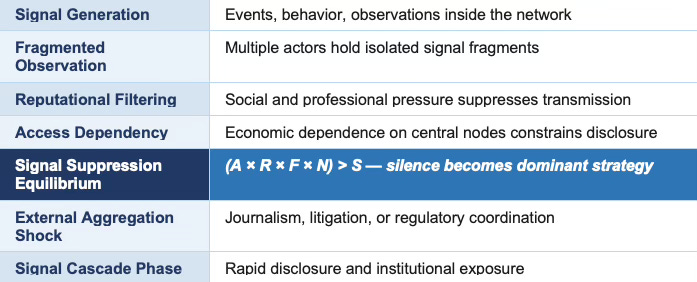
Signal cascades often appear sudden because suppressed information accumulates for years before a catalytic event aggregates previously isolated signals. Exposure events represent systemic signal release, not isolated discovery. Understanding prestige markets as signal economies clarifies why certain scandals appear repeatedly across industries and why they arrive without apparent warning.
Contribution Differentiation: What SSE Explains That Prior Models Do Not
Each prior framework explains part of the suppression phenomenon but not its full architecture. Akerlof’s lemons model explains why evidence fragments structurally—sellers possess information buyers lack—but applies to product quality in markets, not behavioral misconduct within professional networks. Stigler’s capture theory explains why governance actors resist disclosure when concentrated interests dominate, but does not explain why peer observers within the same network remain silent absent regulatory involvement. Granovetter’s network theory explains information transmission velocity through tie strength but does not model the strategic decision to withhold signals already received. BHW cascades explain sudden collective behavior shifts but not extended suppression periods preceding them. Barabási’s topology explains centrality concentration but not the incentive structure overlaid on that topology.
Shiller’s narrative economics comes closest to the SSE’s N multiplier but addresses aggregate market behavior rather than intra-network signal governance. None of the prior frameworks model the interaction between structural fragmentation and cognitive discounting—the dual mechanism by which signals both fail to reach observers and fail to register as credible when they do. SSE integrates these traditions into a unified model specifically designed to explain sustained, multi-layer signal suppression in access-controlled professional networks. That integration, not any single component, constitutes the framework’s contribution.
MindCast Contributions: Narrative Distortion and Governance
MindCast AI research extends traditional economic analysis by incorporating narrative control dynamics into institutional signal processing. Two strands are particularly relevant to SSE.
Coercive narrative distortion describes situations in which influential actors reshape public interpretation of events to preserve status, reputation capital, or institutional legitimacy. Narrative distortion functions as an informational defense mechanism that delays signal aggregation. When successful, narrative control temporarily lowers perceived signal credibility even as underlying evidence accumulates.
The governance dynamics explored in MindCast’s Nash–Stigler Equilibria framework clarify how institutions manage periods of reputational stress. Governance failures often arise not from absence of information but from distorted interpretation of available signals—institutional actors may reframe or discount early warnings to maintain equilibrium stability. SSE formalizes this insight by incorporating a narrative distortion multiplier (N) that amplifies effective information fragmentation.
I. The Economic Puzzle
Institutions rarely collapse because nobody knew something was wrong. Warning signals typically circulate long before public exposure occurs. Brokers hear rumors. Investors notice irregularities. Employees observe behavior that feels off. Yet the system remains stable—until it suddenly does not.
Recent allegations involving luxury real estate brokers Oren and Tal Alexander illustrate how warning signals can circulate within prestige networks for years before institutional exposure occurs. The case serves as an empirical hook rather than the central focus of this paper. Similar dynamics appear across venture capital, entertainment, finance, and technology startups—industries with different underlying products but identical signal architecture.
Economic reasoning reframes the standard question. Individual participants inside prestige networks rarely possess sufficient information or incentives to escalate isolated signals. Brokerage colleagues, clients, and social associates each observe fragments of behavior. Fragmented signals rarely aggregate because reporting carries professional risk. Traditional law-and-economics frameworks predict exactly this outcome: market participants inside elite professional networks face a predictable trade-off in which reporting suspected misconduct risks damaging relationships that generate future income, while silence preserves access to deal flow and social capital.
Prestige markets therefore create an equilibrium in which multiple actors privately suspect wrongdoing while few actors reveal information publicly. Information remains latent until external investigators aggregate independent reports across jurisdictions and time. The failure is not ethical—it is architectural. Structural conditions produce the silence long before any individual actor consciously decides to remain silent.
II. Reputation Capital as Economic Infrastructure
Prestige markets convert reputation into economic infrastructure. Successful brokers accumulate credibility that functions similarly to capital assets—enabling access to wealthy clients, privileged information, and high-value transactions through three reinforcing mechanisms.
First, reputation lowers transaction costs. Clients trust experienced intermediaries when purchasing complex assets, and reduced uncertainty accelerates deal formation. Second, reputation creates preferential access to inventory. Developers and property owners frequently select brokers with established credibility in elite markets, and access to inventory generates future revenue streams. Third, reputation attracts referrals: wealthy clients rely on trusted introductions rather than anonymous market searches.
Reputation therefore operates as intangible capital embedded within social networks. Brokerage professionals invest years building that capital, and economic incentives strongly discourage actions that could destroy it. Potential whistleblowers confront asymmetric incentives: reporting suspected misconduct risks reputational retaliation or exclusion from valuable referral networks, while remaining silent preserves future income.
Economic models of reputation traditionally focus on trust formation between buyers and sellers. Prestige markets require an expanded framework where reputation capital also shapes information disclosure decisions among network participants—a shift from bilateral trust to network-level signal governance.
Contact mcai@mindcast-ai.com to partner with us on Predictive Cognitive AI in Law and Behavioral Economics. To deep dive on MindCast work in Cognitive AI upload the URL of this publication into any LLM and prompt ‘reconstruct MindCast framework with three degrees of cited sub links.’ See Live-Fire Game Theory Simulators, Runtime Predictive Infrastructure.
Related MindCast AI Research: Run-Time Causation — Causal-signal arbitration framework; institutional evaluation of competing causal narratives. Nash–Stigler Equilibria — Equilibrium concept explaining how institutional incentives stabilize inefficient outcomes. Predictive Institutional Cybernetics — Markets as feedback systems governed by signal processing, delay, and equilibrium stabilization. Cybernetics Foundations — Theoretical lineage from Wiener through Ashby, Beer, Bateson, and Hayek into MindCast’s CDT/Vision architecture. Double-Sided Rational Ignorance (DSRI) — How market participants fail to perceive aggregate harm when information remains fragmented. Coercive Narrative Distortion— How influential actors reshape public interpretation of events to preserve institutional legitimacy.
III. Referral Networks and Concentrated Deal Flow
Luxury brokerage networks exhibit strong power-law distributions in transaction activity. A small number of brokers handle a disproportionate share of high-value deals, and the concentration compounds through referral dynamics. Wealth managers, attorneys, developers, and family offices introduce clients to trusted brokers, creating interconnected referral systems where deal flow amplifies around established central nodes.
Economic analysis reveals several consequences for signal suppression. Network participants depend heavily on a limited set of influential brokers, and challenging those actors risks losing access to valuable deal pipelines. Silence becomes a rational strategy when rumors or informal warnings circulate. Information asymmetry also increases: central brokers frequently control market intelligence regarding upcoming listings, developer financing needs, and relocation flows, creating structural dependence among peripheral participants.
Collective-action problems emerge because no individual participant wishes to bear the cost of initiating conflict with a high-value network node. Market structure therefore influences information disclosure outcomes independently of any individual actor’s ethical dispositions. Dense referral networks can stabilize silence equilibria even when multiple participants privately suspect misconduct.
IV. Signal Suppression Equilibrium (SSE): A Reusable Economic Model
Prestige networks produce a recurring equilibrium in which credible warning signals about harmful behavior circulate privately but fail to trigger public disclosure. Signal Suppression Equilibrium formalizes that pattern, capturing conditions under which rational actors choose silence even when multiple participants privately observe misconduct.
Core Variables and the SSE Condition
Three structural variables determine whether signal suppression emerges:
• Access Dependence (A): the degree to which actors rely on central network participants for future economic opportunity.
• Reputational Retaliation Risk (R): the expected professional penalty associated with raising concerns about high-status actors.
• Information Fragmentation (F): the degree to which evidence about misconduct remains dispersed across individuals or jurisdictions.
A fourth variable introduced by MindCast research modifies effective fragmentation:
• Narrative Distortion (N): a multiplier capturing how reputation-preserving interpretive frames reduce the perceived credibility of circulating signals. When central actors successfully shape the narrative, observers discount what they witness. N elevates effective fragmentation without requiring any change in the underlying distribution of information.
A fifth variable offsets suppression pressure:
• Signal Aggregation Capacity (S): the ability of institutions, regulators, platforms, or investigative bodies to aggregate dispersed signals.

The Role of Narrative Distortion
Incorporating N into the SSE formula addresses a gap in traditional information asymmetry models. Akerlof’s framework explains why evidence fragments structurally—actors lack the same information. SSE’s narrative distortion layer explains why evidence that does circulate fails to aggregate cognitively: observers interpret signals through a reputation-preserving lens that reduces perceived credibility. Shiller’s narrative economics provides the mechanism: high-virality personal narratives produced by central actors function as credibility discount factors, reducing the effective informational weight of contradicting signals before any retaliation is necessary.
Narrative distortion therefore enters the model not as a separate mechanism but as a multiplier on F. When N > 1, effective fragmentation exceeds structural fragmentation. Networks dominated by charismatic central actors, strong brand narratives, or media amplification exhibit elevated N values, strengthening SSE conditions independent of underlying evidence distribution.
Comparative Statics
The SSI formula generates clear directional predictions when any single variable changes while others remain constant. Increases in signal aggregation capacity (S)—through regulatory complaint infrastructure, investigative journalism capacity, or cooperative listing platforms—reduce the SSI ratio directly, lowering suppression pressure and shortening expected latency to disclosure. Increases in access dependence (A) or reputational retaliation risk (R) raise the SSI ratio, strengthening the silence equilibrium and lengthening latency. The narrative distortion multiplier (N) interacts with fragmentation (F) multiplicatively rather than additively, meaning that even modest increases in N produce disproportionate increases in effective suppression when baseline fragmentation is already high—as it typically is in prestige markets. Critically, policy interventions that reduce two variables simultaneously—such as cooperative listing platforms that lower both A and F—produce compounding benefits, since the SSI numerator is multiplicative. A 30 percent reduction in A combined with a 30 percent reduction in F produces roughly a 50 percent reduction in suppression pressure, not 60 percent, because the interaction term disappears. Market design reforms therefore yield nonlinear returns when they address multiple SSI variables at once.
Strategic Interaction Formulation
Consider two representative actors inside a prestige network: Observer i and Observer j. Each privately observes a signal of potential misconduct with probability p—where p reflects both the underlying probability of exposure to a signal and the prior belief that the signal is credible (inversely related to N). Each actor chooses between Disclose (D) or Remain Silent (S).

Payoffs reflect the following structure: disclosure imposes professional cost C when undertaken alone; disclosure generates collective benefit B if multiple actors disclose; silence preserves expected access value pA derived from network participation (where p weights access value by the probability that the network remains intact and retaliation-free).
Silence becomes the dominant strategy when pA > pB − C, or equivalently when A > B − C/p. Prestige networks satisfy this inequality when access to wealthy clients, referral pipelines, and future transactions carries substantial economic value. The dominant strategy therefore does not require actors to be indifferent to misconduct—it requires only that the structural economics of network access outweigh the expected benefit of disclosure.
Network Topology Extension
Prestige markets display scale-free network structures where a small number of highly connected nodes control disproportionate deal flow. In these networks, central nodes accumulate reputation capital, peripheral nodes depend on central nodes for opportunity, and retaliation risk increases for actors who challenge central nodes. High centrality therefore increases A and R simultaneously, strengthening SSE conditions most severely around the highest-status network participants.
Signal Suppression Index (SSI)
Operationalizing the model requires a measurable diagnostic. The Signal Suppression Index converts the equilibrium inequality into a practical metric for institutional analysis:

Exportability Across Industries
Signal Suppression Equilibrium generalizes beyond luxury real estate. Any network exhibiting concentrated access power and fragmented information will tend toward suppression unless countervailing aggregation mechanisms exist:

Public equity markets exhibit lower suppression pressure because disclosure rules, market transparency, and regulatory oversight increase S substantially. Analysts, journalists, and regulators observe the same public data, reducing the ability of any single actor to suppress information for extended periods. The contrast with luxury brokerage is architectural, not incidental.
Testable Predictions
The model generates several falsifiable predictions amenable to empirical testing:
• Misconduct scandals in prestige industries should display long latency periods between early signals and public exposure—measurable by comparing report dates to alleged conduct initiation dates.
• Exposure events should coincide with external signal aggregation mechanisms such as investigative journalism, coordinated legal action, or regulatory coordination rather than isolated insider disclosures.
• Industries with transparent information platforms should display shorter signal latency, controlling for misconduct severity.
• Network centralization should correlate positively with suppression duration—the higher the Herfindahl concentration of deal flow around central brokers, the longer the latency.
• Elevated narrative distortion proxies (measured by media brand strength) should correlate with longer latency independent of structural fragmentation.
Cybernetic Interpretation
MindCast AI research frames institutions as cybernetic systems governed by feedback loops and signal processing capacity. Prestige networks exhibiting high SSE pressure function as low-throughput signal systems where feedback signals about misconduct encounter multiple filtering stages before reaching decision-making authorities.
Three cybernetic properties determine whether a system self-corrects: Signal Filtering (social and reputational pressures suppress transmission), Feedback Latency (delays accumulate before signals reach institutional response mechanisms), and Aggregation Capacity (institutions differ in their ability to combine fragmented signals). High filtering and long feedback latency produce unstable institutional equilibria where harmful behavior persists until an external shock introduces sufficient signal aggregation to trigger a cascade.
V. Market Design and Brokerage Infrastructure
Real estate markets differ significantly in information architecture, and those differences directly determine SSI profiles. Market design influences whether brokerage networks amplify or mitigate signal suppression dynamics through two fundamental models: cooperative listing platforms and access-controlled markets.
Seattle: Cooperative Infrastructure as SSE Mitigation
The Northwest Multiple Listing Service (NWMLS) historically achieved near-universal broker participation, meaning that virtually all available inventory entered a shared database accessible to all participating members. Cooperative infrastructure produces three SSE-reducing effects.
First, information fragmentation (F) decreases substantially. No single broker controls exclusive access to inventory, reducing the leverage that central network actors can exercise over peripheral participants. Second, access dependence (A) falls because brokers can source listings and clients through the platform rather than exclusively through personal relationships with gatekeepers. Third, the platform increases effective signal aggregation capacity (S) by creating transparent transaction records that regulators and investigators can audit.
Seattle’s cooperative model does not eliminate SSE dynamics entirely—referral networks and social relationships still generate access dependence in high-value segments. The model does, however, lower the SSI profile materially compared to access-controlled alternatives.
Miami: Access-Controlled Markets and Maximum Suppression
Miami luxury brokerage represents the structural inverse. Social networks and private relationships determine deal access, inventory visibility remains restricted to specific networks, and central brokers accumulate informational advantages that compound over time.
Access-controlled architecture elevates all three suppression variables simultaneously. Access dependence (A) is high because clients and inventory flow through personal relationships with established brokers. Reputational retaliation risk (R) is high because exclusion from those networks represents a material career consequence. Information fragmentation (F) is high because no shared platform exists to aggregate transaction history or complaint patterns.
The result is a market structure that generates maximum SSI pressure. Misconduct by central actors faces minimal countervailing aggregation, and the silence equilibrium can persist for extended periods without external shock.
New York: Hybrid Architecture and Intermediate Suppression
New York occupies an intermediate position. Institutional brokerage firms—large organizations with compliance infrastructure, HR processes, and reputational exposure at the firm level—coexist with elite social networks that operate on access-controlled logic. The firm layer increases S marginally by creating internal reporting channels, while the social network layer maintains high A and R.
The key variable in New York is firm-level aggregation capacity. Large institutional brokerages have organizational incentives to identify and address misconduct before regulatory exposure occurs, which partially offsets individual-level suppression incentives. That offset is incomplete because firm-level reputational interests can also produce active suppression when disclosure would damage the brand.

The comparison across these three markets demonstrates that SSI is not primarily determined by the ethical culture of individual actors but by the information architecture of the market itself. Institutional economics therefore suggests that housing markets benefit from open information infrastructure similar to financial exchanges—not because open architecture improves individual virtue, but because it structurally reduces suppression incentives.
Policy debates surrounding private real estate listings illustrate the broader stakes. Fragmented listing systems increase broker gatekeeping power and raise F and A simultaneously. Cooperative systems encourage information sharing and competition, lowering the SSI profile across the market. Market design reforms may therefore prove more effective than purely punitive approaches targeting individual misconduct.
VI. SSI Application: The Alexander Brothers Case
The allegations surrounding Oren and Tal Alexander provide an opportunity to apply the SSI framework qualitatively, illustrating how each variable contributed to sustained signal suppression before investigative reporting triggered a cascade phase. The analysis below uses narrative justification rather than numerical scoring, consistent with the qualitative approach appropriate given available information.

The Alexander case fits the SSE model’s cascade prediction precisely. Suppressed signals accumulated across multiple jurisdictions and years. External aggregation—investigative journalism combining previously fragmented accounts—served as the mechanism triggering rapid disclosure. Network participants who had privately held signals updated their payoff calculations once early disclosure occurred without catastrophic professional consequences, producing the cascade sequence the model predicts.
The case is instructive not as an anomaly but as a representative instance of a structural pattern. Prestige industries with similar SSI profiles—high A, high R, high F, elevated N, low S—should be expected to produce similar latency periods before exposure, regardless of the specific actors involved.
VII. Behavioral Game Theory and Institutional Equilibria
Game-theoretic analysis clarifies why silence persists inside prestige networks even when multiple actors privately suspect misconduct. The strategic environment resembles a coordination game: each participant benefits if misconduct becomes exposed and removed from the network, but each participant also prefers that another actor initiate disclosure.
Equilibrium depends on expectations regarding others’ behavior. If observers believe colleagues will remain silent, silence becomes individually rational regardless of private moral assessments. The equilibrium is self-reinforcing: rational expectations of collective silence produce individual silence, which confirms rational expectations of collective silence.
MindCast AI research integrates behavioral economics and strategic game theory through its Law and Behavioral Game Theory framework. The framework combines incentive analysis, institutional constraints, and bounded cognition—recognizing that actors do not compute optimal strategies in perfect information environments but respond to observable signals about others’ likely behavior.
Institutional cybernetics extends the analysis by examining feedback loops within organizations. Weak feedback signals allow dysfunctional equilibria to persist. Strong feedback mechanisms—internal compliance systems, external regulatory pressure, or reputational shocks from comparable cases in adjacent industries—correct behavior more quickly. Prestige networks often exhibit delayed feedback because participants filter information through reputational concerns before it reaches institutional decision-making authorities.
VIII. Prestige Network Collapse and the Signal Cascade Phase
Signal Suppression Equilibrium does not persist indefinitely. Accumulated suppressed signals eventually reach a critical threshold where external aggregation mechanisms trigger rapid exposure. The transition from suppression to exposure follows a recognizable four-stage sequence.
First, independent observers accumulate private signals about harmful behavior. Each signal remains individually insufficient to trigger disclosure—below the threshold required to overcome access dependence and retaliation risk in isolation.
Second, an aggregation catalyst emerges. Investigative journalism, coordinated legal action, regulatory investigation, or whistleblower testimony combines previously fragmented signals into a coherent narrative capable of overcoming the reputational filtering layer.
Third, network participants rapidly update expectations about retaliation risk. Once early disclosure occurs without catastrophic professional consequences, additional observers revise their payoff calculations. The dominant strategy shifts: the expected cost of disclosure falls below the expected cost of being known to have remained silent after others have disclosed.
Fourth, suppressed signals propagate quickly through media networks and professional communities. Additional disclosures reinforce the new narrative, and silence ceases to be the dominant strategy. The cascade phase produces rapid institutional exposure after extended latency.
Economic analysis therefore predicts that exposure events appear sudden despite long underlying latency periods. Institutional observers frequently misinterpret cascades as abrupt discoveries when they actually represent the release of previously suppressed information. Understanding the cascade phase matters for institutional design: systems capable of aggregating weak signals earlier can shorten latency periods and reduce the scale of eventual scandals.
IX. Implications for Policy and Market Design
Economic analysis suggests four categories of institutional response capable of reducing signal suppression in prestige markets. The interventions operate on different variables in the SSI formula and are therefore complementary rather than substitutable.
Transparency Infrastructure
Shared information platforms represent the most structurally powerful intervention. Cooperative listing systems, mandatory transaction registries, and public deal databases reduce information fragmentation (F) and access dependence (A) simultaneously. By decoupling deal access from personal relationships with central brokers, transparency infrastructure weakens the gatekeeping power that sustains silence equilibria.
The policy implication extends beyond real estate. Any prestige market where deal flow concentrates through private networks—venture capital, entertainment, private equity—would exhibit lower SSI profiles under mandatory disclosure of investment and transaction data. The tradeoff between privacy interests and signal aggregation capacity is a legitimate policy question, but the SSE framework clarifies the institutional cost of resolving that tradeoff in favor of privacy.
Regulatory Aggregation of Complaints
Cross-jurisdiction data sharing allows investigators to detect patterns that individual victims or reporters cannot observe in isolation. A complaint from a single individual rarely reaches the threshold required to overcome reputational narrative distortion. A pattern of complaints aggregated across jurisdictions, time periods, and victim profiles constitutes a qualitatively different signal.
Regulatory aggregation capacity (S) can be increased through centralized complaint databases, mandatory reporting requirements for professional associations, and coordination protocols between licensing bodies across states. The FINRA BrokerCheck model in financial services—where complaint history and disciplinary actions are publicly searchable—provides a template for real estate licensing authorities.
Whistleblower Protection Strengthening
Reputational retaliation risk (R) remains the most persistent suppression variable because it operates through informal social mechanisms rather than explicit threats. Professional marginalization, exclusion from referral networks, and reputational damage are difficult to regulate directly.
Effective whistleblower protection must therefore address both the legal and economic dimensions of retaliation risk. Legal protections against explicit retaliation are necessary but insufficient. Economic protections—compensation for career disruption, anonymous reporting channels, and professional safe harbor provisions—reduce the expected cost of disclosure for actors who would otherwise rationally choose silence.
Strong whistleblower frameworks shorten the latency period by reducing R, lowering the SSI threshold below equilibrium before the suppression dynamic has fully formed. The cost-benefit analysis favors early intervention: the economic and human cost of a full SSE cycle, including years of ongoing harm followed by cascade exposure, substantially exceeds the institutional cost of investing in early aggregation infrastructure.
Independent Investigative Channels
Investigative journalism has historically served as the primary external aggregation mechanism triggering signal cascade phases across prestige industries—from Hollywood to finance to luxury real estate. Strengthening independent investigative capacity therefore increases S without requiring regulatory infrastructure.
Policy interventions supporting investigative journalism include press freedom protections, source confidentiality frameworks, and public interest litigation funding. Industry-level interventions include funding for ombudsman offices within professional associations capable of receiving and aggregating complaints with source protection.
The broader institutional lesson is that prestige markets require external aggregation mechanisms precisely because internal network incentives suppress signal transmission. Governance reforms that rely solely on internal reporting channels—ethics hotlines, firm compliance systems, self-regulatory organizations—will remain insufficient as long as those channels operate within the same network structure that produces suppression.

X. Relation to Institutional Economics and Market Design
Signal Suppression Equilibrium contributes to a broader tradition in institutional economics examining how market structure influences information flow and governance outcomes.
Ronald Coase emphasized that institutions emerge to reduce transaction costs. Information infrastructure—exchanges, reporting systems, regulatory oversight—reduces the cost of discovering and verifying signals about market behavior. SSE extends this insight by identifying the specific network conditions under which information infrastructure fails to emerge organically, requiring policy intervention to supply it exogenously.
Friedrich Hayek highlighted the importance of dispersed information in economic systems. Markets function effectively only when price signals and knowledge circulate freely among participants. SSE complements Hayek’s framework by focusing on environments where information exists but fails to aggregate because network incentives discourage disclosure. Prestige markets demonstrate that institutions can possess abundant local knowledge while lacking mechanisms capable of combining those signals into actionable governance.
Signal architecture—the mechanisms determining whether warning signals travel through a system quickly or remain trapped within fragmented networks—therefore becomes central to institutional analysis. Strengthening signal aggregation infrastructure represents a key policy lever for preventing institutional collapse in prestige markets and constitutes a natural extension of the transaction cost reduction logic that animates both Coase and subsequent institutional economics.
XI. Conclusion
Prestige networks create structural conditions that suppress early warning signals of misconduct. Economic incentives encourage silence even when multiple actors privately suspect problems, and market design strongly influences those outcomes. Referral-based access networks amplify signal suppression; transparent information platforms mitigate it.
Signal Suppression Equilibrium formalizes this dynamic through a parsimonious model with four suppression variables—access dependence, reputational retaliation risk, information fragmentation, and narrative distortion—offset by institutional signal aggregation capacity. The Signal Suppression Index translates the model into a measurable institutional diagnostic applicable across industries.
Qualitative application of the framework to the Alexander brothers case confirms that all structural SSE conditions were satisfied well before public exposure. Investigative journalism served as the external aggregation mechanism triggering the cascade phase—consistent with the model’s predictions and with the broader empirical pattern across prestige industries.
Economic policy should focus on strengthening information infrastructure rather than assuming misconduct arises purely from individual ethical failure. Market architecture determines whether signals surface early or remain hidden for years. Transparency infrastructure, regulatory aggregation capacity, whistleblower protection, and independent investigative channels are complementary interventions that collectively reduce SSI pressure before suppression equilibria fully form.
Future research should extend SSE empirically across venture capital, entertainment, technology startups, and professional services, developing quantitative proxies for each SSI variable and testing the model’s latency and cascade predictions against documented scandal timelines. Structural analysis across industries may reveal common institutional patterns that traditional economic models overlook—and common design principles that markets can adopt to ensure that the same networks capable of amplifying positive signals can also transmit negative signals when it matters most.
Shiller’s narrative economics establishes that stories shape economic reality at scale. SSE refines that insight for governance contexts: inside prestige networks, narratives are not merely beliefs about value. They are suppression instruments—credibility discount mechanisms that sustain silence equilibria by reducing the effective informational weight of signals that do circulate. Understanding narrative distortion as a structural governance variable, rather than a cultural byproduct, opens a research agenda connecting behavioral economics, network theory, and institutional design. SSE provides the framework for that agenda.
Appendix- Literature Foundations
Signal Suppression Equilibrium builds upon five foundational strands of economic and network theory, synthesizing them into a unified institutional framework.
Information Asymmetry (Akerlof, 1970)
George Akerlof’s seminal paper introduced information asymmetry in markets where buyers and sellers possess unequal knowledge, demonstrating how markets deteriorate when credible signals about quality fail to circulate efficiently. SSE extends that logic from product quality to behavioral information within elite professional networks. Just as low-quality goods drive out high-quality goods in Akerlof’s framework, low-signal transparency drives out high-signal disclosure in SSE.
Regulatory Capture (Stigler, 1971)
George Stigler’s theory of regulatory capture explained how concentrated interests dominate institutional outcomes when benefits are concentrated and costs are diffuse. Capture theory highlights why actors benefiting from existing arrangements resist institutional changes that would expose harmful behavior. SSE incorporates capture dynamics to explain why institutional responses to suppressed signals remain muted even when governance actors possess partial awareness.
Network Diffusion Theory (Granovetter, 1973)
Mark Granovetter’s research demonstrated how information transmission depends on network structure. Dense clusters with strong internal ties often suppress disruptive information, while weak ties facilitate broader signal propagation. Prestige networks rely overwhelmingly on strong ties within closed referral ecosystems, creating structural conditions where negative signals rarely reach aggregation thresholds.
Informational Cascades (Bikhchandani–Hirshleifer–Welch, 1992)
Research on informational cascades demonstrated that individuals frequently rely on observed behavior of others rather than private information when making decisions, producing long periods of apparent stability followed by sudden collective shifts. SSE’s cascade phase draws directly on this mechanism: once early disclosure occurs without catastrophic professional consequences, additional observers revise their payoff calculations and suppression equilibrium collapses.
Scale-Free Network Topology (Barabási)
Albert-László Barabási’s work on scale-free networks demonstrates that many real-world systems concentrate connectivity around a small number of highly connected nodes. Prestige industries display this topology, concentrating economic opportunity around central actors. High centrality increases both access dependence (A) and reputational retaliation risk (R) simultaneously, strengthening SSE conditions specifically around the most powerful network participants.
Narrative Economics (Shiller, 2019)
Robert Shiller’s narrative economics framework, developed most fully in Narrative Economics: How Stories Go Viral and Drive Major Economic Events (2019), argues that popular narratives—stories that spread through social networks like epidemics—exert independent causal force on economic behavior, often decoupled from underlying fundamentals. Shiller demonstrates that the transmission dynamics of narratives follow epidemic models: stories spread, mutate, recede, and revive in patterns that systematically influence how market participants perceive and respond to economic reality.
SSE draws directly on Shiller’s insight but extends it into governance territory his framework did not explore. Where Shiller analyzes how narratives drive aggregate economic behavior—asset prices, consumer spending, investment—SSE analyzes how narratives suppress institutional signal processing within prestige networks. The mechanism is related but distinct: Shiller’s narratives spread virally and shape belief; SSE’s narrative distortion multiplier (N) operates as a credibility discount factor that reduces the effective informational weight of observed signals before they reach any aggregation threshold.
The connection sharpens the N multiplier substantially. In Shiller’s epidemic model, a narrative’s virality depends on its emotional resonance, simplicity, and social proof. Central actors in prestige networks—brokers, investors, producers—actively invest in narrative production precisely because high-virality personal narratives increase N, reducing the informational credibility of contradicting signals even before reputational retaliation is necessary. Narrative construction is therefore not merely a byproduct of status but a strategic instrument of suppression equilibrium maintenance. SSE formalizes what Shiller describes observationally: narratives are not just stories. Inside prestige networks, they are governance mechanisms.