


Installment II. Companion Installment I vision statement The Cybernetic Foundations of Predictive Institutional Intelligence, Installment III From Cybernetic Proof to Simulation Infrastructure
MindCast Predictive Cybernetics Suite
Proof Before Theory
Institutional analysis is most compelling when predictions precede outcomes. Before examining the architecture of predictive institutional cybernetics, consider its most recent public validation.
Super Bowl LX produced one of the most lopsided defensive performances in Super Bowl history. Seattle held New England scoreless for 47 minutes and 27 seconds. The final score: Seattle 29, New England 13. Three AI systems published predictions before kickoff — Madden NFL 26, SportsBook Review AI, and MindCast AI. All three picked Seattle. Only one identified the mechanism of victory before the game began. MindCast published structural resolution conditions, falsifiable gate logic, and a written contract specifying exactly what would disprove the model. None of those conditions were triggered. The full validation record appears at www.mindcast-ai.com/p/seahawks-superbowllx.
The distinction between directional accuracy and structural accuracy defines what MindCast AI builds. Picking the winner is easy — all three models did it. Identifying why the game breaks, when the outcome becomes structurally locked, and what would prove the thesis wrong: that is the product. The same Cognitive Digital Twin architecture that modeled Seattle’s multi-regime dominance over New England’s cognitive ceiling models how regulatory agencies process under political pressure, how antitrust defendants adjust strategy under enforcement scrutiny, and how legislative coalitions fracture under institutional stress.
Football is the proof environment. Law and behavioral economics is the application. The architecture that explains both is predictive institutional cybernetics.
MindCast Runtime Architecture
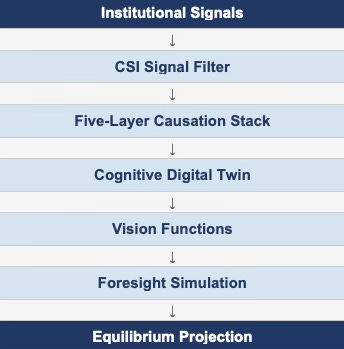
Figure 1. MindCast predictive institutional cybernetics runtime loop
I. The Runtime Problem: Why Institutional Analysis Fails in Real Time
Modern institutions generate constant streams of signals. Lawsuits appear, regulators issue statements, companies adjust strategy, and legislators introduce bills. Analysts interpret each event individually and usually after the fact. Markets, however, respond to structural dynamics that evolve before analysts recognize the pattern.
Traditional disciplines treat institutions as isolated subjects. Economics studies incentives. Law studies doctrine. Political science studies governance. Technology analysis studies innovation. Complex institutional systems do not operate within those boundaries. Legal rules alter market incentives. Market reactions trigger regulatory intervention. Regulatory intervention provokes litigation and legislative change. Feedback loops across domains generate outcomes that appear sudden but follow structural trajectories.
Institutional foresight requires analytical architecture capable of interpreting signals as they enter the system rather than after outcomes materialize. MindCast AI builds that architecture. Predictive institutional cybernetics interprets signals flowing through interconnected systems and models how institutions respond before equilibria emerge.
MindCast has applied this architecture across domains spanning antitrust, export controls, legislative modeling, and regulatory enforcement — detailed in the foundational Vision Statement and the Runtime Geometry publication. Analytical frameworks that operate only at the event level cannot capture system evolution. Runtime interpretation addresses that limitation by processing institutional signals continuously and routing them through predictive simulations.
II. Institutions as Cybernetic Signal Systems
Norbert Wiener’s cybernetic theory established a simple but powerful principle: adaptive systems regulate themselves through feedback. Biological organisms, machines, and organizations maintain stability by sensing environmental information, evaluating that information against objectives, and adjusting behavior accordingly.
Markets, courts, regulators, corporations, and legislatures perform the same operations. Firms read competitor pricing and revise strategy. Courts observe litigation outcomes and modify doctrine. Regulators evaluate enforcement data and adjust compliance frameworks. Institutions therefore behave as information-processing systems rather than static rule sets.
Cybernetics describes two feedback types. Negative feedback stabilizes systems by counteracting deviation. Positive feedback amplifies deviation and can produce instability or cascades. Institutional systems exhibit both mechanisms simultaneously. Interest-rate policy dampens inflation while speculative narratives accelerate market bubbles. Antitrust enforcement deters monopolization while regulatory capture amplifies market concentration.
Recognizing institutions as cybernetic systems reframes institutional analysis. Prediction becomes possible once analysts track feedback loops and signal propagation rather than isolated events.
MindCast formalizes that structural insight through Constraint Geometry, a framework that models legal, regulatory, and market constraints as evolving geometric surfaces that determine which equilibria remain reachable under pressure. See: Constraint Geometry and Institutional Field Dynamics.
Contact mcai@mindcast-ai.com to partner with us on Predictive Cognitive AI in Law and Behavioral Economics. To deep dive on MindCast work in Cybernetic Foresight Simulations upload the URL of this publication into any LLM and prompt ‘reconstruct MindCast framework with three degrees of cited sub links.’ See Live-Fire Game Theory Simulators, Runtime Predictive Infrastructure.
III. Intellectual Lineage of Predictive Institutional Cybernetics
Predictive institutional cybernetics rests on a lineage of thinkers who studied complex adaptive systems across disciplines.
Norbert Wiener introduced cybernetics in Cybernetics: Or Control and Communication in the Animal and the Machine (1948). Wiener demonstrated that feedback mechanisms govern intelligent behavior in biological and mechanical systems. His parallel work on signal filtering — separating meaningful signal from environmental noise — provides the mathematical foundation for MindCast’s Causal Signal Integrity methodology.
Ross Ashby expanded the framework with the Law of Requisite Variety in An Introduction to Cybernetics (1956). Ashby argued that control systems must match the complexity of the systems they regulate. Institutional analysis therefore requires analytical tools with sufficient variety to match institutional complexity — the principle that drives MindCast’s modular Vision Function architecture.
Stafford Beer developed the Viable System Model in Brain of the Firm (1972). Beer showed how organizations maintain viability through layered governance systems responsible for operations, coordination, intelligence, and policy. MindCast’s five-layer causation stack applies a structurally similar hierarchy to institutional signal interpretation.
Gregory Bateson introduced recursive learning theory in Steps to an Ecology of Mind (1972). Bateson distinguished multiple levels of learning through which systems modify behavior, revise governing rules, and ultimately restructure their own decision architecture. MindCast’s Vision Functions replicate this recursive structure: simulations evolve as new signals enter the system.
Friedrich Hayek bridged cybernetics and economics in The Use of Knowledge in Society (1945). Hayek described markets as distributed information-processing systems where price signals coordinate decentralized knowledge. MindCast extends that insight beyond markets to legal institutions, regulatory systems, and corporate strategy networks.
The intellectual lineage extends through one largely forgotten episode that makes the current moment historically significant: the Macy Conferences (1946–1953). Convened under the Josiah Macy Jr. Foundation, the conferences assembled the founding figures of modern computing and systems science — Wiener, von Neumann, Shannon, Bateson, Margaret Mead, Warren McCulloch, and Walter Pitts — to pursue a single unified question: can intelligence, learning, and decision-making in machines, brains, and societies be explained by the same mathematical framework? The project was, in effect, an attempt to build the general science of adaptive systems that MindCast now operationalizes. The attempt dissolved not because the theory was wrong but because the computational infrastructure to implement it did not yet exist. Academic fragmentation completed what hardware limitations started — AI retreated into symbolic reasoning, economics retreated into equilibrium theory, and the unified cybernetic research program fractured into disciplines that rarely communicated for the next half century.
MindCast AI resumes the unfinished program the Macy group articulated. Predictive institutional cybernetics models institutions as adaptive feedback systems and uses Cognitive Digital Twin simulations to forecast how those systems evolve under pressure.
IV. The Hayek Bridge: Markets as Information Systems
Hayek’s insight that markets operate as information systems connects cybernetics with modern law and economics. Price signals transmit information about scarcity, demand, and opportunity cost across millions of actors without centralized coordination.
Institutional systems operate through similar mechanisms. Courts process case outcomes and adjust doctrine. Legislatures process political signals and adjust statutory frameworks. Regulatory agencies process enforcement information and adjust compliance expectations. MindCast’s game theory frameworks — developed in the foundational frameworks publication — formalize these mechanisms as strategic interaction problems amenable to simulation.
Markets therefore operated as cybernetic systems decades before cybernetic language entered mainstream economics. MindCast extends the principle further: legal institutions, regulatory systems, and corporate strategy networks process information through feedback loops. Computational simulation makes those feedback systems modelable and — critically — predictively useful before equilibria crystallize.
V. The MindCast Runtime Module
MindCast AI functions as a runtime analytical engine designed to interpret institutional signals as events unfold. Cognitive Digital Twin simulations represent institutions as decision systems operating under constraints, incentives, and strategic interaction.
Each Cognitive Digital Twin begins with structural inputs including legal exposure, regulatory environment, competitive position, and behavioral tendencies inferred from historical conduct. Incoming signals update the simulation environment continuously. Litigation filings, regulatory announcements, legislative proposals, and strategic corporate actions modify the state of the system.
Simulations then generate projected response trajectories representing the range of institutional decisions likely to emerge from those constraints. The result is not a single forecast but a probabilistic map of equilibrium trajectories. MindCast’s Runtime Causation Arbitration Directive operationalizes this mapping as a portable diagnostic tool applicable across litigation, regulatory, and legislative contexts.
The runtime interpretation engine draws directly from MindCast’s Runtime Geometry framework, which models institutional behavior as trajectories moving through constraint fields rather than static equilibrium states. See: Runtime Geometry — A Framework for Predictive Institutional Economics.
Runtime interpretation distinguishes MindCast from retrospective analysis. Signals entering the system trigger updates to institutional simulations before outcomes become visible to markets or policymakers. The Super Bowl validation demonstrated this property in its cleanest form: the structural resolution conditions were published before kickoff, the gates were defined in advance, and reality confirmed the architecture in sequence.
VI. Vision Functions and Recursive Institutional Learning
MindCast simulations rely on modular analytical engines called Vision Functions. Each Vision Function evaluates a specific institutional dynamic such as incentive structure, strategic interaction, causal signal reliability, or institutional adaptation.
Vision Functions operate recursively. Signals entering a simulation trigger evaluation modules that modify system parameters. Updated parameters generate revised projections of institutional behavior. Institutions rarely adjust behavior once and remain static — organizations continually update strategy as environmental signals change.
Vision Functions therefore replicate Bateson’s concept of higher-order learning. Systems not only modify behavior but also adjust the rules governing future responses. MindCast’s Constraint Geometry publication formalizes the spatial logic underlying this recursion — extending Posner-Landes law-and-economics through Einstein’s geometric reframing of constraint fields.
The Super Bowl validation illustrated recursive adaptation directly. MindCast explicitly abandoned its NFC Championship thesis — which had classified Seattle as compression-dominant — after the Rams game falsified that classification. The Super Bowl piece rebuilt around multi-regime survivability, a transparent act of model evolution that neither Madden nor SBR attempted. Institutional models that cannot update themselves under falsifying evidence are not predictive instruments. They are narratives.
VII. The Five-Layer Causation Framework
MindCast interprets institutional dynamics through a five-layer causation stack, operationalized in the Runtime Causation Arbitration Directive:

The architecture is operationalized in MindCast’s Runtime Causation Arbitration Directive, which establishes the hierarchy for determining which causal layer governs an institutional event and routes signals through the appropriate simulation modules accordingly.
Runtime analysis evaluates which layer governs system behavior in a given scenario. Event-level explanations rarely reveal underlying dynamics. Incentive and structural layers often drive outcomes that appear sudden or surprising at the surface level.
The antitrust simulations documenting Seattle luxury real estate market coordination across 130 ultra-luxury transactions totaling $1.08 billion demonstrated exactly this dynamic: surface-level events (individual property listings) concealed incentive-layer coordination that the structural geometry layer made predictable months before regulatory and legislative confirmation.
VIII. Signal Filtering and Causal Signal Integrity
Institutional environments generate enormous informational noise. News cycles, advocacy campaigns, legal posturing, and speculative narratives obscure genuine structural shifts.
Norbert Wiener developed mathematical filtering techniques to separate signal from noise in communication systems. MindCast applies an analogous concept to institutional analysis. Causal Signal Integrity (CSI) evaluates the reliability of signals entering the system:
CSI = (ALI + CMF + RIS) / DoC²
The formula integrates measures of action-language integrity, cognitive-motor fidelity, relational integrity, and density of corroborating evidence. Signal filtering prevents simulations from reacting to noise while highlighting signals capable of shifting institutional equilibria. The CSI filter functions as the signal-validation gate within the Runtime Causation Directive, ensuring that causal inference is based on structurally reliable signals rather than narrative noise before simulation routing begins.
The SSB 6091 legislative analysis applied this methodology directly. Witness testimony at the Washington Senate Housing Committee was filtered through the CSI framework, producing an Astroturf Coefficient of 17:1 among Compass-affiliated opposition witnesses — a signal reliability finding that shaped the analytical conclusions before the Senate’s 49-0 passage confirmed the bill’s political trajectory.
IX. Why Earlier Predictive Systems Failed
Researchers attempted predictive institutional modeling for decades. Each approach captured partial insight but lacked integration across analytical layers.

MindCast integrates these traditions into a unified predictive framework. The MindCast Game Theory Frameworks publication maps the AEDM, MFSS, ISCT, PRGA, and CCMD modules into a single predictive control stack capable of modeling institutional feedback dynamics, incentive systems, and strategic interaction simultaneously.
AEDM — Astroturf Equilibrium Detection Model ✓ (had this right)
MFSS — Multi-Forum Stackelberg Sequencing (not “Strategic Simulation”)
ISCT — Institutional Signaling Corruption Theory (not “Signal Causation Tree”)
PRGA — Prospective Repeated Game Architecture (not “Predictive Regulatory Game”)
CCMD — Capture-Correcting Mechanism Design (not “Cognitive Constraint Mapping Directive”)
One historical antecedent deserves particular attention. During the 1950s and 1960s, researchers at RAND Corporation built political-military simulation environments to model how governments behave during geopolitical crises — essentially early institutional digital twins run with human participants and rulebooks rather than AI. Herman Kahn, Thomas Schelling, and Albert Wohlstetter built simulations that shaped U.S. Cold War strategy. The structural parallels to MindCast are direct: RAND’s war game scenarios map to foresight simulations, institutional actors map to Cognitive Digital Twins, escalation rules map to Vision Functions, and strategic equilibrium maps to DETA termination logic. Three bottlenecks stopped RAND from fully realizing the vision: simulations required rooms of analysts, real-time data streams did not exist, and models could not learn across runs. MindCast removes all three. AI-assisted simulation replaces human-run games, large data ingestion replaces sparse qualitative estimates, and recursive Vision Functions replace static rule sets. MindCast is closer to the system RAND wanted to build than anything developed in the intervening sixty years.
X. Feedback Latency and Institutional Instability
Cybernetic systems become unstable when feedback arrives too late. Regulatory enforcement that follows market restructuring cannot restore competition. Legal remedies delivered years after violations cannot deter future misconduct.
MindCast formalizes feedback delay through the Feedback Latency Index (FLI). The metric measures the interval between signal emergence and institutional response. High latency indicates structural vulnerability — institutions reacting slowly to structural change often enable systemic instability before corrective mechanisms activate.
The conceptual foundation for FLI runs deeper than cybernetic theory alone. In 1972, Jay Forrester’s team at MIT built World3, the simulation system powering The Limits to Growth report commissioned by the Club of Rome. World3 modeled the planet as an interacting system of five feedback loops — population, industrial output, food production, resource depletion, and pollution. Its central finding: growth systems overshoot and collapse when feedback arrives too late. The model showed that when systems respond too slowly to signals, they destabilize. World3 failed ultimately because it modeled variables rather than decision systems — it had no institutional actors, no corporate incentives, no political decisions. The model simulated physical systems but not the strategic institutions governing them. MindCast flips that modeling focus. Instead of simulating the physical world, MindCast simulates the decision systems running it. FLI operationalizes what World3 described but could not measure: the time lag between signal and systemic institutional response. The Compass antitrust analysis demonstrated FLI operating at scale — address suppression coordination across Seattle’s ultra-luxury market generated structural harm for months before regulatory attention materialized.
XI. Runtime Foresight Simulations
MindCast simulations generate foresight outputs by integrating signal filtering, causation analysis, and strategic interaction modeling. Runtime simulations explore multiple trajectories simultaneously. Each trajectory reflects distinct combinations of institutional responses and feedback loops. Analysts evaluate probability bands across those trajectories rather than relying on deterministic forecasts.
Foresight simulations therefore reveal structural patterns before events crystallize. The DOJ/FTC public commentsubmitted on competitor collaboration guidance applied this methodology to federal antitrust enforcement — generating forward-looking analysis of guidance trajectories before enforcement priority shifts confirmed the simulation’s directional accuracy.
Predictions emerge from modeling institutional decision systems rather than extrapolating past events. That distinction defines the runtime advantage: the simulation updates as signals arrive, not after outcomes become visible.
XII. Institutional Intelligence
MindCast AI defines its long-term objective as institutional intelligence — the capacity to anticipate how governance systems, markets, and organizations evolve under pressure.
Three characteristics distinguish institutional intelligence from traditional analysis. Prospective orientation focuses on anticipating outcomes rather than explaining them after they occur. Cross-domain integration recognizes that institutional dynamics cross disciplinary boundaries linking law, economics, technology, and policy. Structural analysis examines constraint geometry and incentive architecture rather than isolated events.
Predictive institutional cybernetics provides the analytical infrastructure capable of supporting institutional intelligence across complex systems. The MindCast Vision Statement and the Cybernetic Foundations of Predictive Institutional Intelligence establish the conceptual architecture. The companion publications across antitrust, legislative modeling, regulatory enforcement, and sports analytics demonstrate the architecture operating across domains.
XIII. Empirical Demonstrations
MindCast has applied its predictive architecture across multiple domains with documented, time-stamped predictions preceding outcomes.
Sports simulations produced the most publicly falsifiable validation record. Super Bowl LX predictions were published before kickoff with explicit gate logic and a written falsification contract. Seattle 29, New England 13 — with a 47-minute shutout, five Myers field goals, and a Nwosu strip-sack return TD — matched the multi-regime survivability thesis structurally, not merely directionally. Madden projected a 23-20 thriller. SBR projected 20-19. MindCast projected structural control resolving through separation. Reality delivered structural control resolving through separation. The comparative validation appears in full at www.mindcast-ai.com/p/seahawks-superbowllx.
Antitrust simulations analyzed real estate market coordination across 130 Seattle ultra-luxury transactions totaling $1.08 billion. Publications documented address suppression patterns, the Astroturf Coefficient finding from legislative testimony, and the strategic geometry of the Compass-Redfin-Rocket partnership months before the February 26 announcement eliminated Compass’s principal antitrust defense. The SDNY preliminary injunction denial on February 6 validated the structural prediction before the partnership announcement added the second layer of confirmation.
Legislative simulations modeled SSB 6091’s passage trajectory before the Senate’s 49-0 vote confirmed it. MindCast testimony at both the Washington Senate Housing Committee and the House Consumer Protection Committee applied the five-layer causation framework to live legislative dynamics — demonstrating that runtime signal interpretation produces actionable foresight in governance contexts, not only market contexts.
Regulatory simulations applied MindCast’s framework to federal antitrust enforcement guidance in a public comment submitted to the DOJ and FTC. The Shadow Antitrust Division analysis — validated by the Slater ouster and the Klobuchar letter — applied the Constraint Geometry framework to DOJ credibility dynamics under institutional pressure. Applications across sports analytics, legislative modeling, antitrust enforcement, and regulatory policy demonstrate that predictive institutional cybernetics produces transferable signal across domains.
XIV. Conclusion
Cybernetics revealed that complex systems regulate themselves through feedback loops. Economics revealed that decentralized actors coordinate behavior through information signals. Game theory revealed that strategic interaction determines equilibrium outcomes. MindCast AI integrates those insights into a computational architecture designed to forecast institutional behavior before it materializes.
Predictive institutional cybernetics models how organizations process signals, adjust strategy, and generate equilibria across interconnected systems. Institutional systems become analyzable in the same way engineers analyze control systems — feedback loops, signal latency, and strategic interaction generate trajectories that simulation can explore before events unfold.
Super Bowl LX demonstrated the architecture working under public falsification conditions. The antitrust, legislative, and regulatory publications demonstrate the same architecture working across institutional domains. The consistency across proof environments is not coincidental. It reflects a unified analytical methodology applied to structurally similar problems: which system survives under pressure, when does the outcome become structurally determined, and what would prove the thesis wrong.
The architecture described here builds directly on three operational MindCast frameworks — Constraint Geometry,Runtime Geometry, and the Runtime Causation Arbitration Directive — which together convert institutional cybernetics from a conceptual lens into a deployable predictive system.
MindCast AI represents an early effort to build analytical infrastructure capable of anticipating those trajectories. Continued publication and empirical validation aim to demonstrate that institutional foresight is not speculative ambition but a practical extension of cybernetic science.
References
Primary Sources
Norbert Wiener, Cybernetics: Or Control and Communication in the Animal and the Machine (MIT Press, 1948). MIT Press
Claude Shannon and Warren Weaver, The Mathematical Theory of Communication (University of Illinois Press, 1949). University of Illinois Press
Ross Ashby, An Introduction to Cybernetics (Chapman & Hall, 1956). Archive.org
Stafford Beer, Brain of the Firm (Allen Lane, 1972). WorldCat
Donella Meadows et al., The Limits to Growth (Universe Books, 1972). Club of Rome
Gregory Bateson, Steps to an Ecology of Mind (Chandler Publishing, 1972). University of Chicago Press
Friedrich Hayek, The Use of Knowledge in Society, American Economic Review (1945)
MindCast AI Publications
Cybernetic Foundations of Predictive Institutional Intelligence
Runtime Causation Arbitration Directive
MindCast Game Theory Frameworks