


Installment I. Companion Installment II vision statement Predictive Institutional Cybernetics, Installment III From Cybernetic Proof to Simulation Infrastructure
The MindCast-Cybernetics Runtime Suite
I. The Problem: Why Institutions Surprise Us
Markets collapse without warning. Regulatory regimes shift overnight. Legal precedents unravel corporate strategies that took years to build. Analysts explain each outcome after the fact with apparent clarity — yet almost no one saw it coming.
The reason is structural. Traditional disciplines study institutions in isolation. Economics models incentives. Law analyzes doctrine. Political science examines governance structures. Each framework produces valuable insight within its lane. None captures what happens when all the lanes interact at once.
Complex institutions — markets, courts, regulatory agencies, technology platforms — do not operate in isolation. They form interconnected systems whose behavior emerges from continuous feedback loops. A court ruling alters corporate incentives. Changed corporate behavior shifts market structure. Altered market structure invites new regulation. New regulation triggers fresh litigation. Each signal modifies the next.
Anticipating how those systems evolve requires a different kind of analytical architecture — one built to model feedback dynamics across institutional boundaries before outcomes crystallize. MindCast AI exists to build that architecture.
II. The Intellectual Foundation: Cybernetics and Feedback Intelligence
In 1948, mathematician Norbert Wiener published Cybernetics: Or Control and Communication in the Animal and the Machine. Wiener held a professorship at MIT, where he spent the bulk of his career after earning his doctorate from Harvard at eighteen. He made foundational contributions to stochastic processes and signal theory before turning to what would become cybernetics — the unified study of control and communication across biological, mechanical, and social systems. Wiener’s insight in that 1948 work was radical in its simplicity: machines, organisms, and social systems all operate according to the same structural logic. Every adaptive system performs three operations continuously:
Receive information about the environment. A thermostat reads room temperature. A firm reads competitor pricing. A regulator reads market outcomes.
Evaluate that information against objectives. The system compares its current state to its target state and identifies deviation.
Modify behavior based on that feedback. The adjusted behavior generates new information, restarting the loop.
Wiener recognized that intelligence itself arises from these feedback mechanisms. A system does not need a human brain to exhibit adaptive, purposive behavior — it needs only the capacity to process environmental signals and adjust accordingly. That insight became the conceptual seed of modern artificial intelligence.
Ross Ashby and the Law of Requisite Variety
Wiener’s collaborator Ross Ashby — a British psychiatrist and cyberneticist who directed the Burden Neurological Institute in Bristol before joining the faculty at the University of Illinois — extended cybernetics with the Law of Requisite Variety: a control system must possess at least as much variety — complexity and range of response — as the system it attempts to regulate. Simple tools cannot govern complex environments.
Modern institutional systems operate across global supply chains, financial markets, regulatory regimes, and geopolitical competition simultaneously. Traditional analytical tools lack the variety to match that complexity. MindCast’s architecture — Cognitive Digital Twins, Vision Functions, recursive simulations — represents a direct attempt to achieve Ashby’s requisite variety for institutional analysis.
Stafford Beer and the Viable System Model
Stafford Beer — a British theorist who advised the Chilean government of Salvador Allende on applying cybernetics to national economic management and later held visiting chairs at Manchester and Toronto — applied cybernetics to organizational governance in his Viable System Model (VSM), published in Brain of the Firm (1972). Beer described how complex organizations maintain stability through layered control structures: operational systems, coordination mechanisms, enforcement controls, intelligence functions, and policy oversight.
MindCast functions as the intelligence layer Beer described — the analytical apparatus that processes environmental signals, identifies emerging threats, and generates foresight for the policy layer above. Where Beer mapped how organizations remain viable, MindCast models how they will behave.
Gregory Bateson and Recursive Learning
Gregory Bateson — an British-American anthropologist and social scientist who taught at UC Santa Cruz and the University of Hawaii, and whose earlier fieldwork in New Guinea with Margaret Mead established him as a foundational figure in cultural anthropology — extended cybernetics into cognitive science and anthropology, distinguishing multiple levels of institutional learning in Steps to an Ecology of Mind (1972). Learning I involves simple behavioral adjustments — a firm changes its pricing strategy. Learning II involves changing the rules governing responses — a regulator overhauls its enforcement framework. Learning III involves restructuring the system itself — a legal regime fundamentally redefines market obligations.
MindCast simulations operate precisely at the Learning II and Learning III levels Bateson identified. Predicting when and how institutions change their governing rules — not just their surface behaviors — defines the core analytical challenge the MindCast architecture addresses.
Contact mcai@mindcast-ai.com to partner with us on Predictive Cognitive AI in Law and Behavioral Economics. To deep dive on MindCast work in Cybernetic Foresight Simulations upload the URL of this publication into any LLM and prompt ‘reconstruct MindCast framework with three degrees of cited sub links.’ See Live-Fire Game Theory Simulators, Runtime Predictive Infrastructure.
III. The Hayek Bridge: Cybernetics Meets Law and Economics
The connection between cybernetics and Chicago School economics runs deeper than it first appears, and its bridge is Friedrich Hayek.
Most readers associate Hayek primarily with free-market economics. His deeper contribution, however, was cybernetic in structure. Hayek won the Nobel Memorial Prize in Economic Sciences in 1974, sharing it with Gunnar Myrdal, for his work on the theory of money and economic fluctuations. He held chairs at the London School of Economics, the University of Chicago, and the University of Freiburg — intellectual homes spanning the Austrian, Chicago, and German ordoliberal traditions. In his landmark 1945 paper The Use of Knowledge in Society, Hayek argued that markets function as distributed information-processing systems. Knowledge in any economy is necessarily decentralized — no central authority can possess all relevant information. Prices emerge as feedback signals that coordinate behavior across millions of actors without anyone directing the process.
In Hayek’s framework: individuals possess partial information, price signals transmit that information through the system, and actors continuously adjust behavior based on price feedback. That description is structurally identical to how cybernetics describes adaptive feedback systems.

Hayek therefore treated markets as self-organizing cybernetic systems decades before that language became standard. The implication extends well beyond markets: if prices are feedback signals coordinating decentralized knowledge, then any institution that processes information and adjusts behavior through feedback loops operates by the same structural logic.
Courts process case outcomes and adjust legal doctrine. Regulatory agencies receive enforcement data and revise compliance strategies. Legislative bodies absorb political signals and update statutory frameworks. Each institution operates as a cybernetic system — and each can, in principle, be modeled as one.
Hayek’s insight provides the natural bridge between the cybernetic tradition and Chicago School law and economics, the two analytical pillars on which MindCast stands.
IV. The Intellectual Lineage
Placing these thinkers together reveals a coherent intellectual tradition that MindCast AI extends:
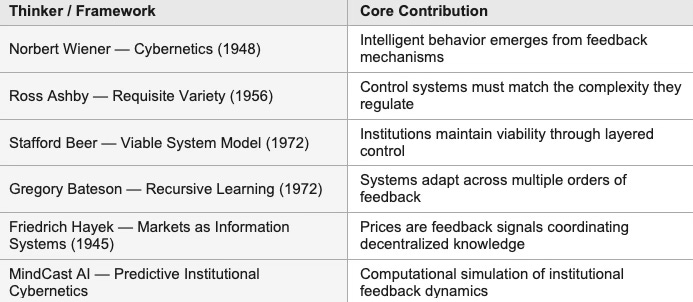
MindCast AI is not a random AI concept. The architecture sits at the terminal point of a seventy-five-year intellectual tradition running from Wiener’s feedback theory through Ashby’s complexity matching, Beer’s viable system modeling, Bateson’s recursive learning levels, and Hayek’s information-system economics — converging on a single analytical ambition: the predictive modeling of institutional behavior.
V. The MindCast Architecture
MindCast AI translates this intellectual lineage into an operational analytical platform. Rather than studying isolated events, the system constructs Cognitive Digital Twin (CDT) simulations of institutions — treating organizations, markets, courts, and regulatory bodies as adaptive decision systems operating under constraints, incentives, and information signals.
A Cognitive Digital Twin is a formal simulation model of an institution treated as a decision-making entity. Each CDT is initialized with the institution’s structural constraints — its legal exposure, competitive position, regulatory environment, and behavioral tendencies derived from prior conduct. The twin then processes incoming signals: new litigation filings, regulatory announcements, competitive moves, legislative developments. Given those inputs, the CDT generates projected response trajectories — the range of strategic decisions the institution is likely to make, the equilibria those decisions produce, and the feedback those equilibria send back into the broader system. A CDT is not a forecast of a single outcome. It is a simulation of the decision architecture that generates outcomes — which is what makes it predictive rather than merely descriptive.
Four analytical traditions integrate into the unified predictive framework:
Chicago School law and economics: Institutions respond to incentive structures. Regulatory regimes shape competitive behavior. Legal rules function as prices that actors optimize against.
Behavioral economics: Actors deviate from rational choice in predictable ways. Cognitive architecture, loss aversion, and status quo bias govern institutional decision-making alongside formal incentives.
Game theory: Strategic interaction between actors under constraint produces equilibria that neither party would choose unilaterally. Anticipating equilibrium trajectories requires modeling the full strategic landscape.
Predictive AI simulation: Computational modeling allows MindCast to run institutional scenarios at scale — mapping how feedback dynamics evolve across multiple interaction layers simultaneously.
The outputs are foresight simulations: analytical instruments designed to identify emerging structural patterns before they become visible to markets or policymakers. Unlike generative AI systems that produce text or code, MindCast operates as a predictive cognitive architecture designed to simulate institutional behavior — the distinction between a system that generates plausible language and one that models strategic decision-making under constraint.
Within each simulation, MindCast deploys Vision Functions: specialized analytical modules that evaluate specific institutional dynamics — incentive structures, strategic interaction patterns, causal signal reliability — and feed those evaluations back into the CDT as updated inputs. Vision Functions are the mechanism through which CDT simulations achieve recursive learning, adjusting projected trajectories as new signals enter the system.
VI. Cybernetic Mechanisms in the MindCast Framework
The cybernetic tradition furnishes specific analytical mechanisms that MindCast incorporates explicitly.
Negative and Positive Feedback Loops
Cybernetics distinguishes two fundamental feedback types. Negative feedback stabilizes systems — antitrust enforcement deterring monopolization, interest rate policy slowing inflation, judicial precedent anchoring legal expectations. Positive feedback amplifies deviation — speculative bubbles, regulatory capture spirals, narrative cascades. MindCast tracks both through the Feedback Stabilization Index (FSI) and Feedback Amplification Score (FAS), identifying whether a given institutional system is converging toward equilibrium or accelerating away from it.
Feedback Latency
Cybernetics emphasizes that delays in feedback loops frequently cause systemic instability. A regulatory body that receives accurate information but responds six months late may enable precisely the harm it intended to prevent. A legal system whose remedies arrive after markets have restructured around a violation produces enforcement theater rather than deterrent effect.
MindCast formalizes this through the Feedback Latency Index (FLI), which measures the delay between signal and institutional response. Systems with long latency are structurally predisposed to instability. FLI analysis identifies which institutional actors are most likely to react too slowly — and what outcomes that latency makes predictable.
Institutional Signal Processing and the Wiener Filter
Wiener’s most concrete analytical contribution beyond feedback theory was the Wiener filter — a mathematical tool for separating genuine signals from noise in a transmission system. The principle is deceptively simple: not every signal that enters a system carries meaningful information. Distinguishing causal signal from institutional noise is a prerequisite for any accurate forecast.
MindCast formalizes this as Causal Signal Integrity: CSI = (ALI + CMF + RIS) / DoC². The formula measures the reliability of causal signals flowing through an institutional system — filtering enforcement noise from genuine regulatory shifts, distinguishing litigation posturing from actual legal risk recalibration, and separating narrative momentum from structural change. Where Wiener built a filter for electronic signals, CSI builds one for institutional signals. The architecture is identical; the domain is different.
The Five-Layer Causation Framework
The MindCast Runtime Causation Arbitration Directive operationalizes a five-layer causation stack — Event, Incentive, Feedback Loop, Structural Geometry, Identity Grammar — as a portable diagnostic instrument. Each layer corresponds to a distinct level of cybernetic abstraction, from surface-level events to the identity structures that determine how actors interpret and respond to signals. Distinguishing which layer drives a given institutional trajectory is the central analytical operation in any MindCast simulation.

VII. Predictive Institutional Cybernetics
MindCast’s core analytical contribution is the establishment of a new field: predictive institutional cybernetics.
Where Wiener described how feedback systems operate, predictive institutional cybernetics poses a forward-looking question: given the current configuration of institutional feedback loops, what equilibrium states does the system move toward?
Answering that question requires modeling three dimensions simultaneously:
Structural geometry: The constraint architecture governing actor behavior — regulatory boundaries, legal doctrines, market concentration, technology capabilities — defines the feasible solution space.
Incentive dynamics: Actor objectives, risk tolerances, and strategic positions determine how each participant responds to environmental signals within that constraint space.
Feedback causation: The five-layer causation framework identifies which signals drive system evolution at each level of abstraction.
Published MindCast frameworks operationalizing this architecture include the Runtime Causation Arbitration Directive, Constraint Geometry and Institutional Field Dynamics, Runtime Geometry, and the Cognitive Digital Twin methodology underlying the full simulation suite.
VIII. The Long-Term Vision: Institutional Intelligence
Financial markets influence political decisions. Technological innovation alters national security strategy. Legal frameworks shape the competitive structure of entire industries. The modern world increasingly operates through interconnected systems whose behavior cannot be understood through isolated analysis.
MindCast AI defines the long-term analytical goal as institutional intelligence: the capacity to interpret and anticipate how complex governance, economic, and technological systems evolve under pressure. Institutional intelligence differs from conventional analysis in three respects:
Prospective rather than retrospective: The objective is anticipation, not explanation. MindCast builds analytical tools designed to produce foresight before outcomes become obvious.
Cross-domain rather than siloed: Institutional systems produce outcomes through feedback loops that cross disciplinary boundaries. Modeling them requires integrating law, economics, behavioral science, and computational simulation.
Structural rather than event-driven: Individual events matter less than the structural dynamics that generate them. MindCast focuses on the geometry of constraint and incentive that makes certain outcomes predictable — often inevitable — before they occur.
As technological change accelerates and global systems grow more interconnected, the capacity to anticipate systemic dynamics will define analytical advantage in law, policy, and markets. MindCast AI represents a sustained early investment in building that capacity.
IX. Empirical Validation: MindCast in Practice
A predictive architecture earns credibility through validated predictions. MindCast has produced foresight outputs across multiple institutional domains, several of which have since been confirmed by observable outcomes.
In the domain of sports analytics, MindCast applied its game theory simulation architecture to Super Bowl LX, producing a structural prediction (Seattle 29, New England 13) derived from team behavioral economics, coaching decision geometry, and competitive equilibrium modeling rather than statistical regression. The methodology was documented in advance and compared against outputs from Madden NFL 26 and SportsBook Review AI. The validation of that prediction demonstrated that the CDT simulation methodology generates genuine predictive signal, not post-hoc rationalization.
In the antitrust and real estate domain, MindCast published a game theory simulation analyzing address suppression across 130 Seattle ultra-luxury transactions — identifying structural patterns of competitive coordination before enforcement actions crystallized. MindCast subsequently testified before the Washington Senate Housing Committee and the House Consumer Protection Committee on SSB 6091, documenting a 17:1 Astroturf Coefficient among Compass-affiliated opposition witnesses. The February 2026 SDNY ruling denying Compass’s preliminary injunction against Zillow validated multiple MindCast predictions published months earlier.
In the federal regulatory domain, MindCast submitted a formal comment to the DOJ and FTC on updated guidance regarding collaborations among competitors, applying the five-layer causation framework to anticipate enforcement priority shifts and structural vulnerabilities in platform-mediated competition architecture.
These applications span sports modeling, antitrust enforcement, legislative foresight, and regulatory strategy — demonstrating that the CDT methodology produces transferable predictive signal across institutional domains, not only within the specific markets where it was first developed.
X. Conclusion
Cybernetics revealed a universal structural truth: complex systems regulate themselves through information feedback. Intelligence emerges wherever feedback loops operate with sufficient richness and adaptability. Hayek showed that markets are such a system. Ashby showed that regulators must match the complexity of what they govern. Beer mapped the control layers through which organizations survive. Bateson described how institutions learn — and change the rules by which they learn.
MindCast AI carries that tradition into the AI era. By integrating cybernetic thinking with law, economics, behavioral science, and predictive simulation, MindCast builds tools capable of forecasting how institutional systems evolve rather than merely explaining how they arrived at their current state.
Cybernetics discovered that intelligent behavior emerges from feedback systems. MindCast AI extends that discovery by constructing computational architectures capable of forecasting how institutional systems evolve under pressure. If institutions operate as cybernetic feedback systems — and the evidence reviewed here suggests they do — their future behavior is not random. It is, in principle, modelable. MindCast exists to build the architecture that makes that modeling possible, and to demonstrate through published predictions that the architecture already works.
References
Ashby, W. Ross. An Introduction to Cybernetics. Chapman & Hall, 1956.
Bateson, Gregory. Steps to an Ecology of Mind. Chandler Publishing, 1972.
Beer, Stafford. Brain of the Firm. Allen Lane, 1972.
Hayek, Friedrich A. “The Use of Knowledge in Society.” American Economic Review, 35(4), 519–530, 1945.
Wiener, Norbert. Cybernetics: Or Control and Communication in the Animal and the Machine. MIT Press, 1948.
MindCast AI Publications:
MindCast AI Vision Statement: AI Era Law and Behavioral Economics
Runtime Geometry: A Framework for Predictive Institutional Economics
Constraint Geometry and Institutional Field Dynamics
The Runtime Causation Arbitration Directive
MindCast AI Emergent Game Theory Frameworks
Super Bowl LX and Seahawks 2025–2026 Season Validation
Nietzsche, the Chicago School, and the Architecture of Predictive Foresight
The Compass Collapse– A Post Washington SSB 6091 Passage Reckoning