
IBM · Google · Microsoft · Meta · NVIDIA · IonQ · Quantinuum · Atom Computing · DARPA · Pacific Northwest National Laboratory · Department of Energy · Clean energy hosts · Enterprise chemistry buyers · Lenders
Companion works: Regional Clean Compute Anchors · What Quantum Computing Contributes to Clean Compute Clusters · How Quantum Technology Changes the AI Data Center Energy, Compute and Environmental Calculus
Why This Installment Matters to Each Audience
Each audience will be asked, within a year, to fund or approve something described as quantum improving AI. The installment states which of five channels can deliver that improvement, in what order and for whom.
🏛️ Policymakers. Program officers and legislators will see quantum access proposals framed as AI acceleration. Only one channel produces AI output within the horizon, and it produces data rather than speed. A program that funds that channel with a data deliverable sets the procurement precedent the field lacks; a program that funds optimization or general AI spends a budget cycle on channels that stay inside measurement noise.
💼 Executives. Hosts, vendors and model builders face the same question in three vocabularies: what will a buyer pay for. The installment ranks the channels by date and value and states the decision rule, net quantum-AI value against the best classical alternative. Executives who sell processor placement on the strength of a quantum-AI product will find that product’s buyers taking delivery remotely.
⚖️ Counsel. The first commercial asset quantum produces for AI, on every route the simulation runs, is a dataset and the model trained on it rather than a machine. Access agreements written today assign that asset by silence. Counsel who allocate label ownership, derived-model ownership and publication rights before the first result exists decide who captures the channel; counsel who wait inherit a dispute.
📊 Investors. Every channel but one attracts a classical matching result within four quarters of publication. The installment supplies the survival test that separates a revenue line from a press release, and the one channel whose value moves to larger systems when classical methods catch up rather than disappearing.
Takeaway. The installment gives each audience the channel to fund, the asset to own and the test to apply, and Sections VII and VIII state what to conclude and what to do.
I. Quantum Improves AI Through Data First, and the Processor Channel Stays Closed
Quantum computing improves artificial intelligence by producing data that no classical method can produce, consumed by models that run on ordinary processors. Five channels carry that contribution. One of them pays within the horizon on the base route, two survive in narrow forms, one stays inside measurement noise and one works today without quantum hardware.
The first channel to produce a result a buyer will pay for is quantum-computed training labels for scientific models. The channel needs nothing undiscovered, it has a consumer already training on worse labels, and its value belongs to whoever owns the trained model. Every other channel either waits on a discovery or loses to a classical match within a year.
Thesis. Quantum improves AI first through labels for scientific models on strongly correlated matter. On the modeled base route the first qualifying publication arrives by 2028 and licensing follows by 2029, and P-1 carries the window through 2031 with a twelve-month survival test.
Sampling-based synthetic data survives in one physics-structured case and nowhere general. Kernels and pipeline optimization stay inside noise, and quantum-inspired software delivers today and gets mislabeled as hardware.
The actor that converts the labels channel into a market is a research buyer who procures labeled data as a deliverable, and that buyer takes delivery remotely.
Product demand therefore does not create processor demand. A buyer of quantum-produced labels needs the output and not the machine, so the first commercial quantum-AI service runs on shared or remote access. Installment Two’s hub-versus-island contest resolves on that fact, and Installment One’s reserved island circuit stays reserved until a tenant names a workload that needs local coupling.
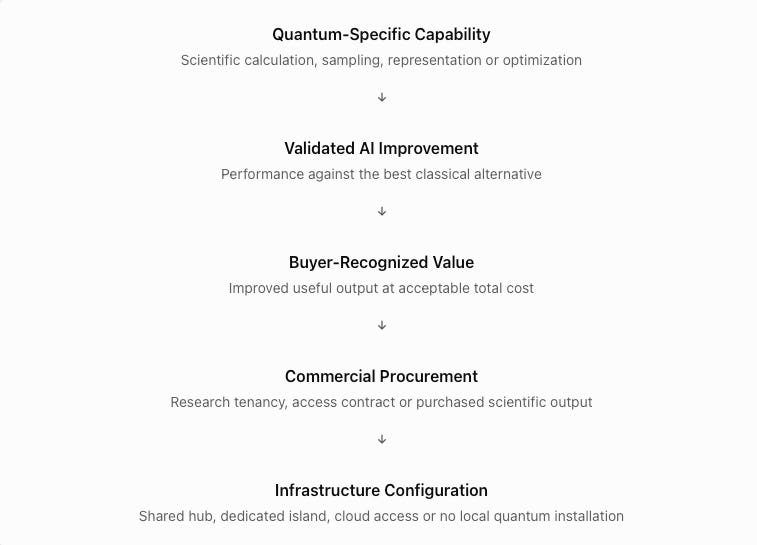
A quantum capability becomes infrastructure demand only after four separate decisions: a validated gain, a buyer’s value test, a procurement that assigns ownership and a delivery mode. Classical catch-up feeds back to the first link and sorts the channels by whether their value survives a match.
Why now. On October 7, 2026 the Defense Advanced Research Projects Agency (DARPA) moved four more companies into the final stage of its Quantum Benchmarking Initiative, and the initiative asks whether any approach reaches utility scale by 2033. IBM’s sample-based quantum diagonalization already runs molecular ground-state problems at 50 to 100 qubits beside classical supercomputers. IBM’s roadmap reaches about 200 logical qubits by 2029.
A hybrid study, Hybrid Boson Sampling-Neural Network Architecture for Enhanced Classification, paired boson sampling with a neural classifier and reported gains over linear and sigmoid kernels on four datasets. A Google Quantum AI and Caltech paper of April 2026 titled Exponential Quantum Advantage in Processing Massive Classical Data showed in simulation that a method called quantum oracle sketching matches classical accuracy on sentiment and single-cell data with four to six orders of magnitude less memory. The method uses under 60 logical qubits. Neither result beat a tuned classical baseline on accuracy or runtime, and the gap between them and a buyer-paid result is the subject of this installment.
What distinguishes the MindCast approach. Vendors publish roadmaps and physicists publish benchmarks. MindCast AI applies Predictive Behavioral Economics + Dynamic Game Theory through MindCast AI Proprietary Cognitive Digital Twin Foresight Simulations (MP CDT FS). Each Cognitive Digital Twin (CDT) models how a named institution decides as evidence and rules change, and Section V names the twelve this installment runs.
Behavioral Economics supplies the decision rules: the hardware label is salient to hosts, lenders and counties while the software delivering the gain is not, and laboratories buy machine access until a replicated result teaches them the resale value of labels. Game Theory supplies the payoff structure: hyperscalers earn publication priority and vendors earn placement. Classical researchers earn by matching every general claim, and buyers pay only against the best classical alternative. Predictive simulations emerge from the combination.
What the paper does. Section II ranks the five channels by date and value against the anchor’s phases. Section III states why labels pay and who owns them. Section IV states where sampling and kernels survive.
Section V states the actor system, Section VI carries the MindCast Foresight Simulation Predictions, Section VII states the strategic insights for each audience and Section VIII carries the Risk Mitigation entries.
Simulation Prediction highlights. Six Simulation Predictions in Section VI.
P-1. Among qualifying results published after October 28, 2026 the first model trained on quantum-produced data to beat the strongest classical baseline is a labels result for a materials or chemistry model. Window through December 31, 2031. 62–74%.
P-2. No quantum-sampled synthetic dataset improves a named general AI benchmark over the best classical generator at equal compute cost, through December 31, 2030. 70–82%.
S-4. The first commercial AI service built on quantum-produced scientific data runs on shared or remote quantum access and not on an operator-owned processor, through December 31, 2033. 64–76%.
Stakeholder readout.
🏛️ Policymakers. Write the first quantum access procurement for a chemistry or materials program with labeled data as the deliverable, before DARPA’s first final-stage report. Tie any state quantum incentive to a named application class and a stated classical baseline (S-2, S-3).
💼 Executives. Sell the anchor’s quantum role as hub access and research tenancy, not processor ownership. License the first published quantum-labeled model regardless of its host (P-1, S-1, S-4).
⚖️ Counsel. Allocate label ownership, derived-model ownership and publication rights in every quantum access agreement now, before any procurement precedent exists (S-3).
📊 Investors. Credit a channel’s revenue only after a replicated result survives twelve months without a classical match. Underwrite labels revenue per validated candidate and nothing per megawatt (P-1, P-2).
II. Five Channels Ranked by Date and Value
Quantum’s contribution to AI arrives through five channels, and the ranking turns on two questions: does the channel need anything undiscovered, and does a buyer already exist for its output. The section states each channel’s mechanism, its unit of improvement and its delivery mode, then places all five against the anchor’s phases.
The Inference Wall Sets the Boundary
Quantum processors do not run inference or training within the horizon. Loading classical data into a quantum state costs about as much as the computation it would accelerate, reading the answer out collapses the state to a few bits, and error correction multiplies every logical gate by hundreds of physical ones. Installment Two states the wall in full, and this installment takes it as the boundary: every channel below delivers something to a classical model, and none replaces the processor the model runs on.
The Channels
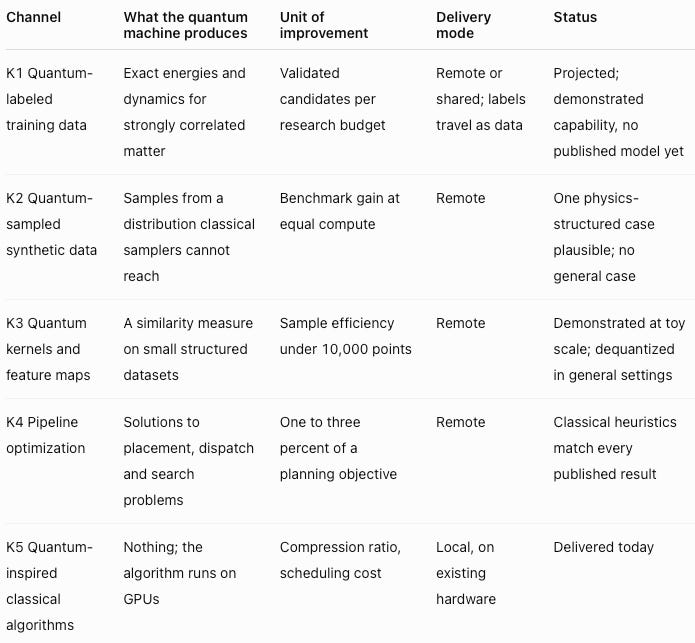

The labels channel opens in the anchor’s year-three phase and carries through the horizon. Kernels close before the island phase begins. Software runs the whole span on hardware the anchor already owns.
Why the Order Holds
K1 ranks first because it combines a demonstrated capability with an existing consumer. Sample-based diagonalization already computes ground-state energies at sizes exact classical methods cannot store, and materials foundation models at Google, Microsoft and Meta already train on classical density-functional labels. The channel’s only missing piece is a label set above a thousand points on a correlated system, which the base route places by 2028 and the alternative route two to three years later.
K2 ranks second because its separation is proven and its application is not. Boson sampling and random-circuit sampling show distributions classical samplers cannot reach, and no research group has identified a distribution that is both provably hard and useful as training data outside physics. The one plausible survivor is molecular conformer sampling, which is a K1 complement rather than a channel of its own.
K3 and K4 rank below because every general claim attracts a classical match. The dequantization line of work, beginning with Tang’s 2018 result on recommendation systems, matched each claimed exponential speedup with a new classical algorithm. Pipeline optimization faces a different wall: classical solvers already produce near-optimal plans in milliseconds, and the gap to optimal is one to three percent, inside the buyer’s measurement noise.
K5 ranks last by novelty and first by availability. Tensor networks and annealing-derived heuristics improve compression and scheduling on ordinary GPUs today. Most quantum productivity cited in corporate materials is this software, and MindCast’s companion Funded Solutions That Can Help Win Quantum-Coupled AI Data Centers Approvable already separates its value from hardware. The separation matters here because a host that credits K5 gains to a processor will build one it does not need.
Takeaway. One channel pays on the base route, one survives narrowly, two stay inside noise and one needs no hardware. The order follows from what each channel needs and who already buys it.
III. Labels Pay, and the Tenancy Decides Who Collects
The labels channel is the one that pays, and its value accrues to whoever owns the model trained on the labels. The section states the mechanism, the decision rule a buyer applies and the ownership question the first contracts leave open.
The Mechanism
Classical simulation of electronic structure is approximate once electrons correlate strongly. Catalysts, battery electrolytes, superconductors and reaction dynamics all live in that regime. A fault-tolerant quantum machine computes those energies to chemical accuracy at sizes classical methods cannot reach. The outputs become labels for neural network potentials and materials foundation models, and the model proposes candidates while the quantum machine validates the few worth the expense.
The value of a label is its cost to produce classically. Where coupled-cluster methods reach the same accuracy, the label is worth its classical cost and the quantum machine adds nothing. Where classical cost grows exponentially with system size, the label has no classical substitute and its value is the discovery it enables. The channel’s frontier therefore moves: when a classical method matches quantum accuracy on the first system, the value shifts to the next size up rather than disappearing.
The Decision Rule
A buyer applies one test. Net quantum-AI value equals the value of the improved AI output less the incremental cost of quantum delivery. The comparison runs against the best practical classical alternative and includes every delivery cost from data preparation through integration.
A positive result justifies commercial evaluation. A positive result does not by itself justify a local processor, because labels travel as data and the buyer takes delivery from wherever the machine sits.
Game Theory supplies the payoff: hyperscalers earn publication priority by publishing the first labels result, so the first qualifying paper carries a hyperscaler affiliation before any laboratory or clean-hosted island reports one. Behavioral Economics supplies the error: laboratories buy machine access with no data clause until a replicated result teaches them the resale value of labels, and only then do they procure data as a deliverable. Predictive behavior emerges from the combination, and P-1, S-1 and S-3 state it.
The Ownership Question
Access agreements in the current market assign output by silence. A laboratory that buys machine time under a standard access contract leaves the labels with whichever party holds them when the program ends, and the model trained on them with whichever party trained it. The first procurement that names labeled data as a deliverable will set the precedent, and every agreement signed before it will be read against that precedent.
Counsel therefore hold the distribution decision for the channel. Label ownership, derived-model ownership, publication rights and export-control treatment of quantum-produced data belong in every access agreement now. Installment Two states the same rule for the island tenancy; this installment extends it to every access contract, hosted or remote, because the asset is the data and not the site.
Takeaway. Labels pay because they have no classical substitute at the frontier, and the party that owns the trained model collects. The tenancy and the procurement decide that party before any result exists.
IV. Sampling and Kernels Survive Only Where Physics Structures the Data
Two channels promise a general improvement to AI and deliver a narrow one. The section states where each survives classical competition and why the general case fails.
Sampling
A quantum sampler draws from distributions that classical samplers provably cannot reproduce at equal cost. The question for AI is whether any such distribution is useful as training data, and the answer so far is one candidate: molecular conformer ensembles, where the physics that makes sampling hard is the physics the downstream model needs to learn. Outside physics, no distribution has been identified that is both hard to sample and informative for a named task.
The classical countermove does not reproduce the distribution. The countermove reproduces the downstream task performance with a task-specific generator, which is cheaper than matching the samples and sufficient for the buyer. The simulation places that countermove within four quarters of any general claim, which is why P-2 states the negative: no quantum-sampled synthetic dataset improves a general AI benchmark at equal compute through 2030.
Kernels and Feature Maps
A quantum circuit can evaluate a similarity measure that is expensive to compute classically, which helps on small datasets with physical structure. The hybrid boson-sampling study is the current state of the evidence: gains against two weak kernels, and no comparison against tuned tree-based or neural classifiers. The 2026 review of quantum kernel methods, Non-Variational Supervised Quantum Kernel Methods: A Review, sets out the conditions a kernel must meet to separate from classical models and finds none of them met on a classical dataset with full data-loading cost included.
Quantum oracle sketching extends the kernel idea in a different direction: it saves memory rather than time. The Google and Caltech result processes data samples one at a time through small quantum operations and matches classical accuracy with far less memory, but data loading still dominates runtime and the result is simulated. The simulation holds it as a contingent extension of the kernel channel rather than a sixth channel, and the activation condition is a result that meets P-1’s qualifying standard on a non-physics dataset running on commercial hardware.
Takeaway. Sampling survives in conformer ensembles and kernels survive on small physics-structured sets. Neither reaches the general AI market within the horizon, and a buyer who hears otherwise should ask for the baseline.
V. Twelve Cognitive Digital Twins Test Which Channel Pays First
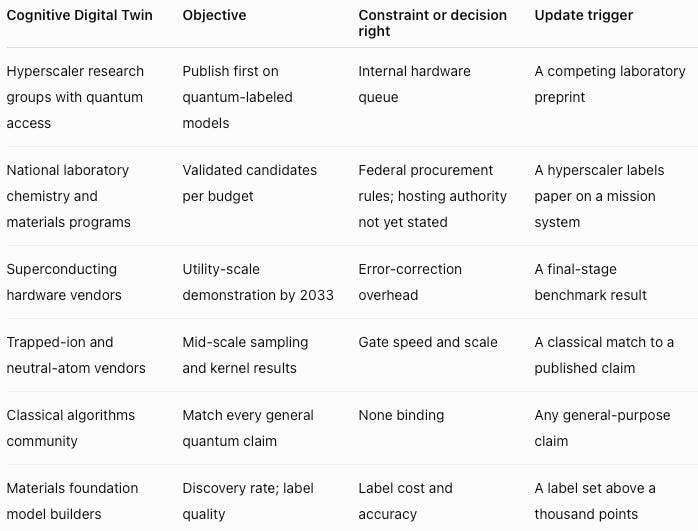
The simulation answers one question. Through which channel does quantum first improve an AI system in a result a buyer will pay for, which actor publishes it, and which actor converts it into a market? The horizon runs from October 2026 through 2033, with the United States as forum for buyers and hosts.
The Actor System
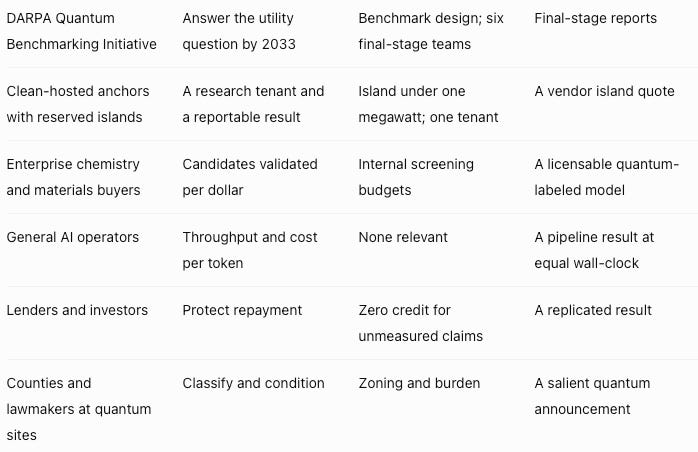
Mechanism
Game theory supplies the payoff structure. A hyperscaler earns priority by publishing first and a vendor earns by placing hardware. A classical researcher earns by matching a general claim, and a buyer pays only when the output beats the best classical alternative at equal cost. The equilibrium is a labels result published by a hyperscaler, matched classically at the first system size, and moved to larger systems where the value persists.
Behavioral economics supplies the decision rules. Hosts and lenders respond to the hardware label while the software delivering the gain is invisible to them. Laboratories buy access with no data clause until a replicated result makes the resale value of labels salient, and counties review the island by label regardless of channel. Predictive behavior emerges from the combination.
Scenario Routes
The base route runs labels first: a hyperscaler publishes by 2028 with a stated classical baseline and a laboratory procures labeled data after replication. DARPA names chemistry and clean-hosted islands report labels. Sampling survives in one structured case, and kernels and pipeline optimization stay inside noise.
The alternative route runs classical catch-up: a classical method matches the first labels result at the first system size within two years, the channel’s value shifts two to three years later, and procurement stays at machine access. The tail route runs no channel: nothing produces a buyer-paid result by 2032 and quantum stays a research instrument.
Takeaway. The simulation resolves labels against samples as a question of what already exists, and publisher against host as a question of who earns priority. The Simulation Predictions follow from both.
VI. MindCast Foresight Simulation Predictions
Six Simulation Predictions follow, two primary and four secondary. P marks a Primary Simulation Prediction and S a Secondary Simulation Prediction. Each names an actor and an outcome with a window, a band, a falsifier and a verification source. No Simulation Prediction in this installment has reached its resolution date, so the validated tally stands at zero hits and zero misses.
Simulation Predictions at a Glance
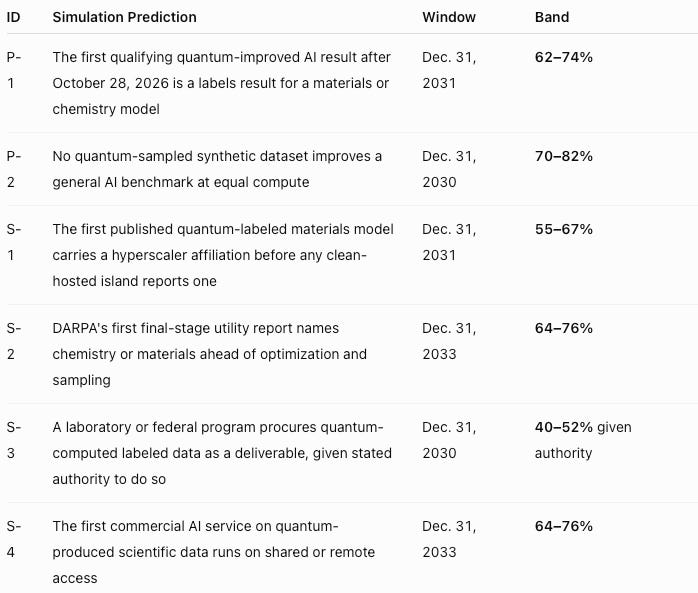
Competing Explanations
Three accounts compete before any result prints.
Labels first. Quantum-computed labels for scientific models produce the first buyer-paid AI result, because the capability exists and the consumer exists. Falsifier: the first qualifying result is a sampling or kernel result.
Classical substitution. Improved classical methods and quantum-inspired software capture every useful gain, and quantum stays an instrument. Falsifier: any qualifying result survives twelve months without a classical match.
Sampling breakthrough. A research group identifies an AI-relevant distribution with provable sampling hardness, and synthetic data becomes the first channel. Falsifier: no such distribution is published with a hardness argument and a downstream task by 2030.
Primary Simulation Predictions
P-1 | Labels Before Samples (62–74%)
Forecast statement: among qualifying results first published on or after October 28, 2026 the first is a materials or chemistry model trained on quantum-computed labels. The first qualifying result is not a model trained on quantum-sampled synthetic data and not a quantum kernel or feature map.
Qualifying result: a peer-reviewed paper or preprint that meets four conditions. It trains or augments a model with data a quantum processor produced. It reports a gain on a named benchmark or discovery metric against the strongest classical baseline the field uses for that task. It accounts for data-loading, execution and readout cost, and it survives twelve months without a published classical match.
Band: 62–74%.
Window: through December 31, 2031.
Trigger conditions: any result meeting the first three conditions appears; the fourth resolves twelve months later.
Explicit falsifier: the first result meeting all four conditions is a sampling or kernel result.
Verification source: arXiv, Nature family journals and hyperscaler and laboratory research publications; the classical-algorithms literature for the survival condition.
P-2 | No General Sampling Advantage for AI (70–82%)
Forecast statement: no peer-reviewed result shows a quantum-sampled synthetic dataset improving a named AI benchmark over the best classical generator at equal compute cost, where the benchmark is not restricted to a physics-structured distribution.
Band: 70–82%.
Window: through December 31, 2030.
Trigger conditions: a vendor or research group claims such a result.
Explicit falsifier: one peer-reviewed result shows it and survives twelve months without a classical match.
Verification source: peer-reviewed publications and the classical-algorithms literature.
Secondary Simulation Predictions
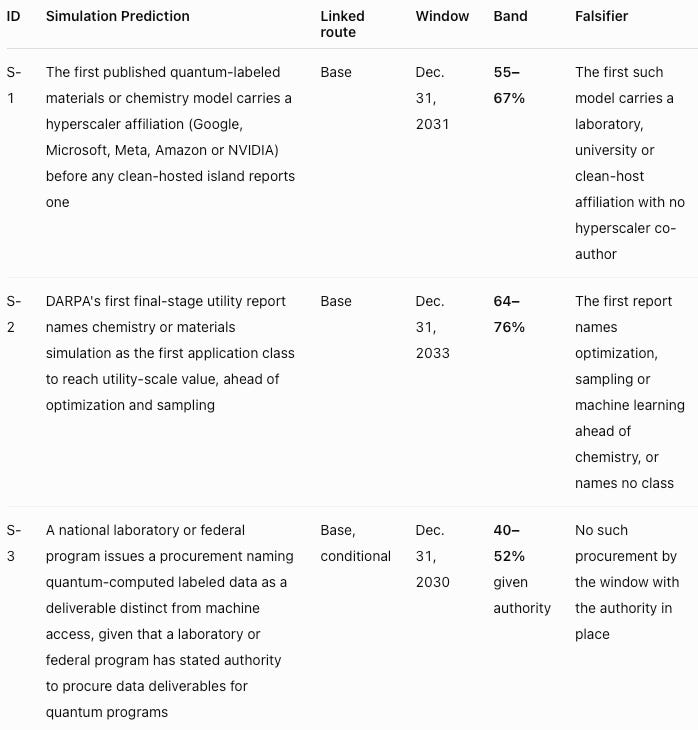

S-3 is reported as P(A given B), and the band is void until a laboratory or federal program states authority to procure data deliverables. A replicated labels result is the trigger that moves S-3 inside the window and is not the condition.
Watch Conditions and Break Conditions
Three conditions carry no band until evidence arrives. A published candidate distribution with a hardness argument and a downstream AI task would open the sampling channel to a band. A published model card reporting discovery rate with and without quantum labels would establish the label value ratio Installment Two states as the proposition under test. A quantum oracle sketching result meeting P-1’s qualifying standard on a non-physics dataset would extend the kernel channel.
Three events would break the set. A demonstrated quantum advantage on general machine learning that survives twelve months unmatched would void P-1 and P-2 together. A DARPA finding before 2030 that no team reaches utility scale would push every window past the horizon. A hyperscaler acquiring the clean-hosted anchor tier would remove the island placement case and reduce S-1 to a publication race with no host side.
VII. Strategic Insights by Audience
One question runs under every audience’s decision: which channel will a buyer pay for, and who owns what it produces. Policymakers meet the question in procurement design. Executives meet it in what to sell, counsel in what to allocate and investors in what to credit.
Strategic Posture by Audience
🏛️ Policymakers. Quantum reaches programs and committees as an AI acceleration request, and only the labels channel produces AI output within the horizon. Fund that channel with labeled data as the deliverable, and tie any incentive to a named application class and a stated classical baseline (S-2, S-3).
Procurement is the lever, and a program that writes the first data-deliverable procurement sets the precedent every later contract reads against. No state incentive reaches that decision; the state’s own laboratories and universities hold it. The observable is a procurement notice naming data rather than machine time.
💼 Executives. Hosts should sell the anchor’s quantum role as hub access and research tenancy. Vendors should target chemistry benchmarks with stated classical baselines. Model builders should ingest the first label set above a thousand points and publish the delta (P-1, S-1, S-4).
Installation and placement are separate markets, and executives who conflate them build processors their buyers never visit. The first commercial quantum-AI service delivers labels as data from wherever the machine sits, so a host earns from the tenant’s program and not from the rack. A vendor’s placement offer and a buyer’s remote delivery point in opposite directions, and the buyer’s direction governs.
⚖️ Counsel. The asset is the label set and the model trained on it. Allocate label ownership and derived-model ownership together with publication rights and export-control treatment in every quantum access agreement before the first result exists (S-3).
Counsel are drafting against a precedent that does not yet exist. The first procurement naming data as a deliverable will fix the market’s reading of every earlier access contract, and an agreement silent on output assigns it by whoever holds it when the program ends. A federally funded label set adds a second question, whether a federal data clause overrides the contract, and the agreement should assign who bears that change.
📊 Investors. Credit a channel only after a replicated result survives twelve months without a classical match. Underwrite labels revenue per validated candidate. Carry sampling and kernel revenue at zero until the survival test passes, and pipeline optimization at zero through the horizon (P-1, P-2).
Classical catch-up is the risk that distinguishes the channels. A sampling or kernel claim that gets matched loses its revenue line, while a labels result that gets matched moves to larger systems and keeps it. The survival test separates the two, and the three-site hub contract from Installment Two is the first observable that converts labels revenue from option value into contracted value.
Where Audience Interests Collide
Hyperscalers and laboratories want different firsts. A hyperscaler wants the first publication and will withhold the label set to protect its model lead, and a laboratory wants the label set for its own programs. The first procurement naming data as a deliverable resolves the collision in the laboratory’s favor, and S-3 reads that notice as the evidence.
Vendors and buyers want different deliveries. A vendor earns on each placed processor and a buyer takes labels remotely, so the vendor’s placement offer competes with the buyer’s procurement for the host’s decision. S-4 resolves which wins, and a host that waits for the buyer keeps the option the vendor’s offer would close.
Classical researchers and quantum vendors want different baselines. A vendor publishes against the baseline that makes the gain visible, and a classical researcher publishes the baseline that removes it. P-1’s qualifying standard adopts the researcher’s baseline, which is why vendor results against linear kernels do not enter the population.
Takeaway. Each audience’s best move follows from treating the label set as the asset, and the collisions resolve on dates the Simulation Predictions already carry.
VIII. Risk Mitigation by Simulation Prediction
Every entry below pairs a Simulation Prediction with the exposure it creates for one audience, the actions that audience can take alone and the exposure that survives. Severity and probability run on separate axes throughout.
Mitigating Actions by Time Gate
Now to 30 days: strip every quantum-AI claim from pending filings and investor documents that lacks a stated classical baseline.
30 to 90 days: add label, model and publication ownership clauses to every quantum access agreement in negotiation.
3 to 12 months: write the first quantum procurement or tenancy for a chemistry or materials program with a named model and a data deliverable.
Beyond 12 months: keep the anchor’s reserved circuit sized for an island and leave the processor unordered until a named tenant workload requires it on site.
Exposure, Actions and Residual for Each Simulation Prediction
The actions are analytic options for each audience and not legal, investment or fiduciary advice to any party.
Entry 1 · 💼 Clean-hosted anchor executives · P-1 (62–74%).
Exposure: a host that specifies its island or its tenancy for a sampling campaign or a general AI buyer loses the one tenant class the island can serve, and carries the island’s fixed cost for the quarters until a chemistry tenant replaces it. Severity: high. Probability: moderate.
Mitigating actions: the commercial lead writes the first tenancy for a chemistry or materials program with a named model, before the island is specified. The engineering lead sizes the island’s coupling for active-learning cycles in minutes rather than sampling throughput. The finance lead models revenue per validated candidate only.
Residual exposure: the first tenant’s model may underperform its classical baseline on the chosen target.
Entry 2 · 📊 Investors in quantum vendors and quantum-equipped sites · P-2 (70–82%).
Exposure: a valuation that credits a vendor’s sampling-based AI claim carries the claim’s revenue until a classical match removes it, which the simulation places within four quarters of publication. Severity: moderate. Probability: high.
Mitigating actions: the diligence lead requires a stated classical baseline and a twelve-month survival test before crediting any sampling or kernel revenue. The credit committee credits labels revenue only after a second group replicates.
Residual exposure: one physics-structured sampling case may survive and carry value the test excludes.
Entry 3 · ⚖️ Counsel to laboratories, hosts and model builders · S-3 (40–52% given authority).
Exposure: an access contract silent on label and model ownership assigns the channel’s value by default to whichever party holds the output when the first procurement names data as a deliverable, and the other party renegotiates under time pressure. Severity: high. Probability: moderate.
Mitigating actions: transaction counsel allocates label ownership, derived-model ownership and publication rights in every access contract now. Regulatory counsel documents the client’s assessment of export-control treatment for quantum-produced data before the first cross-border transfer.
Residual exposure: a federal procurement clause can override contractual allocation for federally funded labels.
Entry 4 · 🏛️ Policymakers and research-program officers · S-2 (64–76%).
Exposure: a program that funds quantum access for optimization or general AI ahead of chemistry spends a budget cycle on the class DARPA’s verification is least likely to name, and loses the procurement precedent to a program that funded chemistry. Severity: moderate. Probability: moderate.
Mitigating actions: program staff write the first quantum access procurement for a chemistry or materials program with a data deliverable, before the first final-stage report. Legislative staff condition any state quantum incentive on the application the program names and the classical comparison it commits to.
Residual exposure: DARPA may name a class the program did not fund, or name none.
Entry 5 · 💼 Model builders and enterprise chemistry buyers · S-1 (55–67%).
Exposure: a buyer who waits for a clean-hosted island to produce the first labels model licenses two to three years later than one who licenses from the first hyperscaler publication. Severity: moderate. Probability: moderate.
Mitigating actions: the research lead licenses or replicates the first published labels model regardless of its host, by the quarter after publication. The procurement lead writes host-neutral data clauses so a later island tenancy can substitute.
Residual exposure: a hyperscaler can withhold the label set and license only the model.
Entry 6 · 💼 Clean-hosted anchor executives · S-4 (64–76%).
Exposure: a host that justifies an island on the expectation that a quantum-AI product creates local processor demand carries the island’s fixed cost while the product’s buyers take delivery remotely from a shared hub. Severity: high. Probability: moderate.
Mitigating actions: the commercial lead sells the anchor’s quantum role as hub access and tenancy for the research program before any island quote. The engineering lead keeps the reserved circuit and defers the processor until a tenant names a workload that needs local coupling.
Residual exposure: a warm-modality processor can make local ownership ordinary and move demand back to sites.
Takeaway. Treating the label set as the asset protects every audience under both outcomes of P-1, because a buyer still pays for labels if sampling never arrives and still takes delivery remotely if it does.
IX. Implications Run From the First Publication to the First Procurement
Hyperscalers capture publication priority on the labels channel, because they hold the hardware queue and the models that consume labels (S-1). Laboratories capture the channel’s market by procuring data as a deliverable after replication, and the procurement activates the multi-site buyer that forms Installment Two’s hub (S-3). Clean-hosted anchors capture tenancy and hub access, and nothing more, because the product delivers remotely (S-4).
Classical catch-up sorts the channels. Sampling and kernel claims lose their revenue line when matched, and labels results move to larger systems and keep theirs (P-1, P-2). Vendors that target chemistry benchmarks with stated baselines keep access revenue; vendors that publish against weak baselines lose lender credit for every later claim.
If P-1 misses on a sampling result, an AI-relevant distribution existed that the simulation did not find, and the sampling channel moves to first. If P-1 misses on a kernel result, the classical match lagged, and the oracle-sketching extension gains weight. If S-4 misses, a warm-modality processor made local ownership ordinary, and the island route in Installment Two gains weight against the hub.
Takeaway. Publication, procurement and placement are three decisions by three actors. A miss at any one moves the date without changing the channel that pays.
What to Watch: The First Label Set, the First Procurement and the First Service
The dominant fork is whether the first qualifying result is a labels result or a sampling result (P-1).
2027 and 2028. A label set above a thousand points on a correlated system released to benchmark groups; the first qualifying paper with a stated classical baseline.
Each DARPA final-stage report. The named application class moves S-2 and the vendors’ benchmark targets.
December 31, 2030. P-2 resolves against peer-reviewed publications; S-3 resolves against procurement notices, given authority.
December 31, 2031. P-1 and S-1 resolve against research publications and the survival condition.
December 31, 2033. S-2 resolves against DARPA’s report; S-4 resolves against the first service announcement naming its quantum source.
Verification sources by Simulation Prediction.
Resolves P-1 and S-1: arXiv, Nature family journals and hyperscaler research publications reviewed quarterly, with the classical-algorithms literature for the survival condition.
Resolves P-2: peer-reviewed publications claiming sampling-based AI gains, reviewed at each claim.
Resolves S-2: DARPA Quantum Benchmarking Initiative reports, reviewed as they appear.
Resolves S-3: federal and laboratory procurement notices, reviewed quarterly.
Resolves S-4: service announcements naming the quantum source, reviewed quarterly.
Moves watch conditions: candidate hard distributions with downstream tasks, model cards with and without quantum labels and oracle-sketching results on commercial hardware, reviewed as they appear.
Conclusion: Fund the Labels, Own the Model and Take Delivery Remotely
Quantum improves AI first through labels for scientific models on correlated matter. On the base route the first qualifying publication arrives by 2028 with licensing by 2029, and the alternative route delays both by two to three years when a classical method matches the first result. Sampling survives in one physics-structured case, kernels and pipeline optimization stay inside noise, and quantum-inspired software delivers today on hardware the anchor already owns. The party that owns the model trained on the labels collects, and the buyer takes delivery from wherever the machine sits.
Stakeholders should act now on what they control: the baseline standard in every claim they credit, the ownership clauses in every access agreement they sign, and the application class in every procurement they write. Stakeholders can wait to learn whether a classical method matches the first labels result and whether DARPA names chemistry first.
The decisive signal is the first qualifying result published after October 28, 2026. If it is a labels result for a materials or chemistry model, P-1 holds and the labels route governs the bridge between the anchor and its quantum tenant. If it is a sampling or kernel result, P-1 misses and the model expects the channel order to invert while the anchor’s classical case stands.
Working With MindCast
Public analysis cannot tell a specific laboratory, host or model builder which system size its first label set should target or what its access agreement should assign. Nor can it say whether the buyer will take delivery remotely. The answers depend on the program’s mission systems, the counterparty’s contracting position and the buyer’s integration cost. Program inputs stay confidential.
MindCast builds Cognitive Digital Twins of the program, its vendor, its model-building partner and its buyer. The engagement ingests the organization’s own decision history and reruns the channel contest and the ownership terms against its actual options.
Commissioned scope adds complete probability distributions, P10/P50/P90 ranges, organization-specific calibration and complete scenario trees. The scope also adds the net quantum-AI value test run on the organization’s own classical baseline and delivery costs, and red-team tests of vendor baseline claims.
Three engagements map to this installment’s readers. A Channel Diagnostic for a laboratory or model builder: one program, one target system and one channel decision (P-1, S-3). An Access Terms Review for counsel tests label, model and publication ownership together with export-control treatment against vendor and buyer responses (S-3). A Procurement Brief for a program office: the data-deliverable procurement run against vendor and laboratory Cognitive Digital Twins (S-2, S-3).
Contact mcai@mindcast-ai.com or visit www.mindcast-ai-simulation.com to arrange one.
Appendix A. MindCast Works
Companions
Regional Clean Compute Anchors, How Much Compute Each Clean Energy Source Yields and Where Washington Builds the First One (Installment One). Sets the anchor configuration and its reserved island circuit. Supplies the host whose quantum role this installment limits to tenancy and hub access.
What Quantum Computing Contributes to Clean Compute Clusters, Tenant First, Training Data Second and Not the Processor Through 2032 (Installment Two). States the inference wall, the training-data loop and the hub-versus-island contest. Supplies the boundary this installment takes as given and the tenancy rule it extends to every access agreement.
How Quantum Technology Changes the AI Data Center Energy, Compute and Environmental Calculus (October 2026). The quantum series overview. Supplies the finding that quantum shifts constraints rather than relieving them, which the five-channel ranking applies to AI output.
Funded Solutions That Can Help Win Quantum-Coupled AI Data Centers Approvable (October 2026). Tests 31 measures across three project types. Supplies the separation of quantum-inspired software from quantum hardware that places the fifth channel.
The series umbrella and the market
AI Data Center Authorization + Clean Energy, the Mid-Scale Squeeze and the Specialized Compute Landscape(September 2026). The series umbrella. Supplies the Mid-Scale Squeeze that defines the enterprise chemistry buyer’s tier.
Where the Clean Energy Host Advantage Holds and Where It Breaks in AI Data Centers (October 2026). Cover letter on host sites. Supplies the hyperscaler hosting forecast behind S-1’s publication race.
AI Datacenter Edge Computing: Ship the Workload Not the Power (September 2025). The founding principle of moving compute toward energy. Supplies the siting logic that S-4 inverts for labels, which move toward the buyer instead.
Appendix B. External Sources
DARPA. “Four More Teams Enter Quantum Benchmarking Initiative Final Stage.” October 7, 2026. The six final-stage teams and the 2033 utility-scale question.
IBM. “IBM Sets the Course to Build World’s First Large-Scale, Fault-Tolerant Quantum Computer.” June 2025. The qLDPC architecture and about 200 logical qubits by 2029.
Google Quantum AI. “Quantum Error Correction Below the Surface Code Threshold.” Nature, December 2024. Logical error falling with code size.
Tang, E. “A Quantum-Inspired Classical Algorithm for Recommendation Systems.” 2018. The dequantization line of work that bounds the sampling and kernel channels.
Sharifian and Bayat. Hybrid Boson Sampling-Neural Network Architecture for Enhanced Classification arXiv preprint of October 2025 with a 2026 journal version. Gains against linear and sigmoid kernels on four datasets; no tuned classical baseline.
Non-Variational Supervised Quantum Kernel Methods: A Review arXiv, April 2026. The conditions a quantum kernel must meet to separate from classical models.
Zhao and six co-authors at Google Quantum AI and Caltech. Exponential Quantum Advantage in Processing Massive Classical Data arXiv 2604.07639 of April 2026 (revised October 1). Quantum oracle sketching; memory advantage in simulation on sentiment and single-cell data under 60 logical qubits.
Equinix and Diraq. “Diraq and Equinix to Deploy Australia’s First Quantum Computer Inside a Data Centre.”September 1, 2026. Remote-access precedent inside a production data center.
IonQ. “IonQ to Advance Quantum Supercomputing by Bringing First QPU to NVIDIA Accelerated Quantum Research Center.” September 23, 2026. Classical-quantum coupling through NVQLink.