
DARPA · IBM · IonQ · Diraq · Quantinuum · NVIDIA · Equinix · Pacific Northwest National Laboratory · Department of Energy · Energy Northwest · Counties · Hyperscalers · Lenders
Companion works: Regional Clean Compute Anchors · How Quantum Improves AI · How Quantum Technology Changes the AI Data Center Energy, Compute and Environmental Calculus · Funded Solutions That Can Help Win Quantum-Coupled AI Data Centers Approvable
Why This Installment Matters to Each Audience
Each audience will meet quantum equipment in a different form, and the installment states what each should conclude before the first request arrives.
🏛️ Policymakers. Quantum equipment reaches committees and commissions first as a continuity request and only later as a research asset. The installment supplies the functional test that separates the two, and it states why a label-based protected-load rule invites every later technology to claim it. Legislators who want the hub in their state learn which lever forms one: a multi-site research procurement rather than a tax incentive.
💼 Executives. Hosts and vendors face a hub-or-island decision in the 2027 hosting cycles, before any utility-scale evidence exists. The installment states the break-even in sites served at each utilization level and the installation-speed asymmetry that lets islands win a race a hub would win on economics. Executives who install an island first carry its fixed cost for the quarters until a tenant arrives.
⚖️ Counsel. The island’s highest-value output is data no existing tenancy template allocates: quantum-produced labels and the models trained on them. The installment identifies the ownership, publication and export-control terms that must exist before the first label does, and the continuity duties the hosting agreement must carry. Counsel who treat the island as ordinary colocation leave the value of every later discovery unassigned.
📊 Investors. Quantum readiness carries option value and zero near-term capacity value, and underwriting cases routinely conflate the two. The installment supplies the utilization assumption, the per-candidate revenue unit and the three-site hub test that separate them. Investors who credit an island with hub-level utilization overstate annual margin by the island’s fixed cost.
Takeaway. The installment gives each audience the unit its quantum decision should run in, and Sections IX and X state what to conclude and what to do with it.
I. Quantum Joins the Cluster as a Tenant First and a Data Source Second
Quantum computing does not make artificial intelligence compute more efficient within this paper’s horizon. No roadmap from IBM, Google, NVIDIA or DARPA claims it will by 2032. Quantum raises research productivity in chemistry and materials, measured in time to a validated candidate. It joins a regional clean compute anchor as a research tenant first and as a source of training data second.
The training data lets scientific models reason about matter whose ground truth classical simulation cannot supply, and that is the whole of quantum’s contribution within this paper’s horizon.
Thesis. A quantum island under one megawatt sits on a firm-clean anchor of 8 to 20 megawatts and serves one workload class: synthesis and simulation for materials, chemistry and optimization. Under the stated assumptions the island covers its fixed cost only as a shared hub serving six or more sites or under a public research tenancy, and never as a local installation at ten to twenty percent utilization. Game Theory favors the shared hub on utilization, and Behavioral Economics predicts that hosts will overbuild local islands anyway.
A research buyer whose programs span several sites is the actor most likely to force the hub, and the paper states that mechanism as conditional because no laboratory has yet stated a hosting position.
Why now. On October 7, 2026 the Defense Advanced Research Projects Agency (DARPA) moved four more companies into the final stage of its Quantum Benchmarking Initiative. Atom Computing, Diraq, IBM and IonQ join Microsoft and PsiQuantum there. The initiative asks whether any approach reaches utility scale by 2033.
Equinix and Diraq announced on September 1, 2026 a planned deployment of a quantum computer drawing under 20 kilowatts inside a production data center. IonQ announced on September 23, 2026 that its Superion 256 will couple to an NVIDIA GB200 NVL72 system through NVQLink, with installation in 2027. Energy Northwest’s reactor project near Richland plans construction by 2030, and the paper models operation in the mid-2030s, after DARPA’s 2033 answer. Seattle holds a quantum cohort of its own: Microsoft, Pacific Northwest National Laboratory and the University of Washington run quantum programs within the latency radius, and IonQ manufactures in Bothell.
What distinguishes the MindCast approach. Vendors publish roadmaps and physicists publish benchmarks. MindCast AI applies Predictive Behavioral Economics + Dynamic Game Theory through MindCast AI Proprietary Cognitive Digital Twin Foresight Simulations (MP CDT FS). Each Cognitive Digital Twin (CDT) models how a named institution decides as evidence and rules change, and Section VII names the eleven this installment runs.
Behavioral Economics supplies the decision rules: “quantum-ready” is salient at the county and the lender while utilization is not. Game Theory supplies the payoff structure: the host and the buyers gain from a shared hub while the vendor’s placement revenue and faster installation pull toward islands. Predictive simulations emerge from the combination.
What the paper does. Section II takes the anchor as given and corrects the assumption that quantum speeds compute. Section III states what quantum contributes by tier and date. Section IV names the training-data loop and holds planning-loop optimization as a watch condition.
Section V ranks the innovations that would enlarge quantum’s role. Section VI states the economics once quantum joins and phases the island across years three and five. Section VII states the simulation architecture, Section VIII carries the MindCast Foresight Simulation Predictions. Section IX states the strategic insights for each audience, and Section X carries the Risk Mitigation entries.
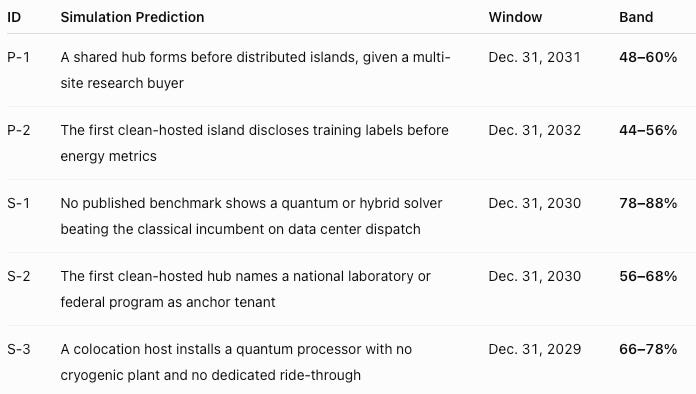
Simulation Prediction highlights. Five Simulation Predictions in Section VIII.
P-1. Given a research buyer whose programs span three or more sites: the first commercial quantum hub on a clean energy host serves at least three remote sites at job level before any second clean host installs a local island. Window through December 31, 2031. 48–60% given the buyer.
P-2. The first clean-hosted quantum island reports a chemistry or materials model trained on its own labels before it reports any energy relief or capacity metric, through December 31, 2032. 44–56%.
S-1. No published benchmark shows a quantum or hybrid solver beating the incumbent classical solver at equal solve time on a data center dispatch problem, through December 31, 2030. 78–88%.
Stakeholder readout.
🏛️ Washington legislators. Quantum equipment adds one continuity objection and no energy relief. Tie any protected-load or critical-load treatment to function and recovery time rather than to the quantum label, and align the state’s laboratory and university hosting authority with the multi-site procurement that forms a hub (P-1, S-2).
💼 Seattle quantum cohort and clean energy hosts. IonQ’s Bothell manufacturing site and Microsoft’s Redmond quantum program sit within the latency radius of the first Washington anchors. Join or form a shared hub before installing an island, and sell the island on per-candidate research output with a named laboratory partner (P-1, P-2).
⚖️ Counsel to the quantum cohort. Training labels and the models trained on them are the island’s highest-value output, and research access is the other revenue channel. Allocate ownership and publication rights and export-control treatment in the tenancy before the first label exists. Write the ride-through duty and protected reserve into the hosting agreement (P-2, S-3).
📊 Investors. Give quantum zero capacity credit and underwrite it at ten to twenty percent utilization until a hub serves three sites. Value output per validated candidate once a trained model exists (P-1, P-2).
II. The Anchor Taken as Given, and the Assumption to Remove First
Installment One is Regional Clean Compute Anchors, How Much Compute Each Clean Energy Source Yields and Where Washington Builds the First One. It sets the anchor: a firm-clean site of 8 to 20 megawatts hosting regional enterprise inference, paired with solar and wind modules that carry movable work, approved as an accessory use at an energy site. The anchor reserves a protected circuit for a quantum island under one megawatt. The question for this installment is what the island contributes, and the answer begins by removing the assumption most readers bring.
Why Quantum Does Not Accelerate Inference or Training
An inference pass is dense matrix multiplication over billions of classical parameters and classical input tokens. Three walls block a quantum machine from that job. Loading classical data into a quantum state costs about as much as the computation it would accelerate, so the input step consumes the speedup. Reading the answer out collapses the state, so a single pass yields a few bits rather than a vector of activations.
Gate speeds run in microseconds against nanoseconds for silicon, and error correction multiplies every logical operation by hundreds of physical ones. The early quantum machine learning results claimed exponential speedups for recommendation and clustering. Classical researchers matched them with new classical algorithms, a line of work known as dequantization, and the claimed advantage disappeared. Grover’s quadratic speedup for search is real on paper and vanishes under error-correction overhead on actual hardware.
IBM, Google and NVIDIA position quantum beside GPUs rather than in place of them for exactly this reason. A one-megawatt quantum island beside a 20-megawatt GPU hub adds zero inference capacity, and a reader who expects otherwise is importing the Moore’s Law frame into a machine that does not run on it.
Takeaway. Quantum raises research productivity measured in time to candidate. It does not raise compute productivity measured in tokens or floating-point operations.
III. What Quantum Contributes, by Tier and Date
Quantum’s contribution arrives in three tiers, and only the first two land within the cluster’s horizon. Each tier names what the machine produces and the unit in which productivity rises.
Tier One, Now Through 2029: A Scientific Instrument and Quantum-Inspired Software
Tier one separates into what is demonstrated and what is projected. Demonstrated: chemistry beyond exact classical reach already runs at 50 to 100 qubits. IBM’s sample-based quantum diagonalization pairs Heron processors with classical supercomputers on molecular ground-state problems at sizes exact classical methods cannot store.
IBM’s demonstrated output is energies and reaction pathways. The productivity gain the paper tests is a compression of laboratory screening time in catalysis and battery chemistry, and no published result has yet measured it on an industrial molecule.
Error correction has crossed its threshold. Google’s Willow result in December 2024 showed logical error falling as code size grew, the precondition for every later tier. Quantinuum’s Helios runs near 100 trapped-ion qubits, and IBM’s roadmapreaches about 200 logical qubits by 2029.
Quantum-inspired classical algorithms deliver gains today. Tensor networks and annealing-derived heuristics improve scheduling, logistics and portfolio optimization, and they run on ordinary GPUs. Most quantum productivity cited in corporate materials is this software, which needs no quantum hardware. MindCast’s companion Funded Solutions That Can Help Win Quantum-Coupled AI Data Centers Approvable already separates its value from quantum hardware, and the separation keeps every software gain out of the island’s case.
Projected: useful advantage on a named industrial molecule has not appeared, and compressed screening time is the expected gain once it does.
Takeaway. Tier one quantum is a demonstrated laboratory instrument and a demonstrated software method, and the productivity gain is projected.
Tier Two, 2029 to 2033: Error-Corrected Machines at 100 to 1,000 Logical Qubits
Materials and drug discovery reach useful fidelity at this tier: electrolyte design, nitrogen-fixation catalysts and protein-ligand binding energies. The classical cost of these simulations grows exponentially with electron count, and the quantum cost grows polynomially. The productivity unit is time to a validated candidate and the number of candidates a research budget can screen. DARPA’s benchmarking initiative asks whether any of its six final-stage teams reaches utility scale by 2033.
Narrow optimization advantage appears in problems with the right structure. The advantage is modest and smaller than annealing vendors claim. Quantum-generated training data becomes the durable product, and Section IV states the loop.
Takeaway. Tier two turns the instrument into a data source.
Tier Three, After 2033: Cryptographically Relevant Machines
Factoring RSA-2048 needs under a million noisy qubits running about a week on 2025 estimates, down from twenty million in 2019. The implication for every data center is defensive: post-quantum cryptography migration, not compute. The cluster inherits that obligation on the same schedule as every other facility.
Takeaway. Tier three changes security budgets rather than compute budgets.
IV. Quantum-Labeled Training Data Is the Real Role
The island’s durable contribution is data that only a quantum machine can produce, consumed by models that run classically at scale. The section states the loop, its volume constraint and the one optimization use that stays a watch condition.
The Training-Data Loop
The loop below is a projected workload. No published materials model yet carries quantum-computed labels.
Train a model on data that only a quantum machine can produce, then run that model on GPUs at scale. Classical simulation of electronic structure is approximate once electrons correlate strongly. Catalysts, battery electrolytes, superconductors and reaction dynamics all live in that regime. A fault-tolerant quantum machine computes those energies and dynamics to chemical accuracy at sizes classical methods cannot reach.
The outputs become labeled training data for neural network potentials and materials foundation models of the kind Google, Microsoft and Meta already train on classical density-functional data. Discovery runs as an active-learning loop. The model proposes candidates and the quantum machine validates the handful worth the expense. The validated labels retrain the model and the next proposals improve, with the quantum island as the oracle and the GPU host as the proposer and learner.
Three quantities decide the loop’s value: whether quantum-generated labels are available at the horizon, their accuracy against the best classical method and their economic value per validated candidate. The comparison that decides them is equal useful output against the best classical alternative. Preparation and error correction sit inside the quantum cost, and so do measurement, verification and queue time.
Tight coupling matters here for the first time in the cluster model, because each cycle moves proposals and labels between the island and the GPU host in minutes, and a remote hub adds queue time to every iteration. Synthesis in Installment One’s workload envelope is this loop.
Takeaway. Quantum supplies the labels that let scientific models reason about correlated matter, and the island becomes an input to a product the anchor already sells.
What “Reasoning” Means Here and the Volume Constraint
The model gains the ability to reason about physical systems whose ground truth was previously unavailable. A language model gains nothing, because quantum data says nothing about text, code or planning. The claim is a new tier of scientific artificial intelligence rather than of machine reasoning in general.
Quantum machines produce few samples slowly, so the value sits in high-cost labels, not bulk data. The economic proposition the paper tests is that a thousand chemically accurate energies on the right molecules are worth more to a scientific model than a million approximate ones, and that ratio would justify a one-megawatt island beside a 20-megawatt GPU hub. The observable is a published materials model whose training set carries quantum-computed labels and whose validated discovery rate beats the classical-only baseline.
Takeaway. A reader who hears “quantum makes models reason better” will apply it to chatbots and be wrong; the exact claim is scientific models and correlated matter.
Planning-Loop Optimization Is a Watch Condition, Not a Benefit
Inference has two loops around it. The control loop routes each request and places prefill and decode in microseconds to milliseconds. The planning loop decides which models sit at which site, how much power goes to inference each hour and when storage discharges, in minutes to a day. Quantum cannot enter the control loop, because a quantum job carries queue, compile and readout time measured in seconds to minutes.
The planning loop is a combinatorial problem that annealers and hybrid solvers target. Classical solvers already produce near-optimal plans for problems this size in milliseconds. The gap between near-optimal and optimal on a daily dispatch is a modeled range of one to three percent of energy cost or utilization, which the simulation tests instead of assuming, and every published quantum advantage on scheduling has been matched by classical heuristics on review. S-1 states the watch condition.
Takeaway. Quantum can improve the plan that shapes inference by low single digits, and only after it beats a classical solver.
V. Innovations That Would Enlarge Quantum’s Role
Six innovations would change how much the island contributes, ranked by their effect on the cluster, each with the observable that marks its arrival.
Low-overhead error correction. IBM’s qLDPC codes cut physical qubits per logical qubit by up to 90 percent. Every reduction shrinks the island’s refrigeration, power and cryogen burden, which is the entire approval cost of local quantum. Observable: a vendor publishes a logical-qubit count with a physical-to-logical ratio under 100.
Room-temperature and warm modalities. Neutral-atom, photonic and trapped-ion systems run without dilution refrigeration or helium-3. A room-temperature processor is an ordinary rack with a laser table, and the continuity, cryogen and hub land-use objections disappear. Observable: a colocation host installs a quantum processor with no cryogenic plant and no ride-through beyond standard uninterruptible power.
Classical-quantum interconnect. NVQLink-class links and cryogenic control electronics push real-time decoding onto GPUs and extend the coupling radius from meters toward a campus. Observable: a published decode loop under a millisecond across a building.
A demonstrated advantage on an industrial chemistry problem. The single event that converts the synthesis tenant from research budget to commercial contract. Observable: a reproducible result on a named catalyst or electrolyte that a classical supercomputer cannot match at equal fidelity.
Quantum networking between islands. Entanglement distribution lets several small islands act as one machine. Observable: two-site logical operations over metro fiber.
Efficient quantum memory and data loading. The only innovation that would touch inference, because it would let a quantum machine ingest classical vectors without the loading penalty. No credible roadmap exists, and the paper names it as the reason quantum stays off the GPU side.
The first three innovations shrink the island until it fits a module. The fourth creates the customer and the fifth expands the hub. The sixth is not coming.
Takeaway. The cluster model is robust to every innovation on the list except the sixth, so the paper states quantum’s role once without waiting on the roadmap.
VI. The Economics Once Quantum Joins, and the Phases in Which It Arrives
The island lands a fixed charge on a small margin and earns through three channels, none of them a GPU-hour product. The section states the cost, the revenue, the equilibrium and the two phases in which quantum arrives.
Cost Lands on a Small Margin
MindCast’s funded-solutions companion puts the quantum delta at about $2.5 million a year at a hub, before specialized staffing and integration software that add another $1 million to $2 million. The island’s fixed cost therefore runs $3.5 million to $4.5 million a year. A 20-megawatt anchor earns a classical operating margin that the paper sets at $5 million to $10 million as a stated assumption, so the island consumes between 35 and 90 percent of it across the endpoints before producing anything. Protected energy stays trivial: under one megawatt of load and about 8 megawatt-hours of load energy for eight hours at the one-megawatt ceiling, before conversion losses and reserve margin set the installed battery above it.
The island also converts part of the anchor from curtailable load into firm demand. The converted megawatt leaves the flexibility programs that earned the site its approval route, and the companion finds approvability falling from 90 to 87 percent at hubs. Quantum spends some of the advantage that justified the anchor.
Takeaway. The island costs the anchor between a third and nearly all of its margin, and three points of approvability, before it produces anything.
Revenue Arrives Through Three Channels
Per-result contracts for synthesis in materials, chemistry and logistics charge for the delivered answer, not the hour. Hub access sold to many remote sites at job level is the lever that matters. Anchor tenancy from a Department of Energy program, a sovereign buyer or a national laboratory underwrites the hub and gives the firm clean host a tenant that cannot leave.
The break-even arithmetic rests on three stated inputs. With fixed cost F of $3.5 million to $4.5 million a year, access revenue R per remote site at full utilization and utilization u, the hub needs F divided by R times u sites. Utilization here means billable quantum processing time, not reserved access or system availability.
At R of $1 million and u of 0.6 the hub needs six to eight sites. At u of 0.3 it needs twelve to fifteen. At u of 0.15, the range a local island reaches, it needs 24 to 30 and no region supplies them. The six-to-eight figure is a sensitivity case and not a deployment threshold.
The simulation carries enterprise synthesis contracts at $0.5 million to $2 million a year as a conditional scenario with no benchmarked contract behind it, so the per-result channel alone needs two to nine contracts or one public anchor to clear the fixed cost. Once the training-data loop runs, the island stops being a tenant and becomes an input to a product the anchor already sells. The synthesis contracts then charge per validated candidate, and the research tenant becomes the first customer rather than the subsidy.
Takeaway. Under the stated assumptions the island pays only as a shared hub or under a public tenancy, and the training-data loop is what converts the tenancy into a product.
The Equilibrium and the Error
Game theory favors the shared hub over distributed islands, because the host and the buyers gain from utilization and lose from duplication. A vendor’s local-placement incentives pull the other way and can reverse the outcome, which is why P-1 carries a band below two in three even with a buyer in place. Behavioral economics predicts the host’s error: islands get overbuilt because “quantum-ready” is salient at the county and the lender while utilization is not. Predictive behavior emerges from the combination, and P-1 states the result.
The actor that converts the equilibrium into an outcome is a research buyer whose programs span sites. Multi-site procurement is the one demand a single-host island cannot satisfy, so a laboratory or federal program that conditions its contract on serving three or more sites forces the vendor to a hub offer. No laboratory has stated a hosting position, so the mechanism is conditional and P-1 carries the condition. A shared hub is an organizational innovation before it is a computational one, because it pools equipment and improves utilization without assuming quantum replaces anything classical.
Takeaway. The equilibrium is a few hubs, the multi-site research buyer is the actor that reaches it, and the observed behavior will include islands that never do.
Two Phases
Year three, 2029. On the modeled base route, one shared quantum hub attaches to a geothermal or hydro anchor and serves the region at job level. The route holds only where a multi-site research buyer contracts for access, and P-1 in Section VIII carries that condition. DARPA’s benchmarking stage and the first coupled installations decide whether the hub is research or product.
The first approval question for the hub is continuity for the protected island, which MindCast’s quantum overview How Quantum Technology Changes the AI Data Center Energy, Compute and Environmental Calculus expects to require backup rather than a curtailment exemption.
Year five, 2031 to 2032. A local protected island sits at the anchor, conditional on utility-scale evidence that the overview places after 2030. The island arrives on hydro or geothermal firm power, because the Richland reactor plans construction by 2030 and operation in the mid-2030s. Synthesis becomes a commercial workload through the training-data loop in this phase.
Year eight and after, mid-2030s. The first small modular reactor module firms an anchor at three times the hydro scale. The Richland corridor then holds a reactor and hydro beside a national laboratory and a quantum tenant under four owners.
Takeaway. On the base route quantum joins at year three as a shared hub and at year five as a local island, and the reactor follows in the mid-2030s rather than on the same calendar.
VII. Eleven Cognitive Digital Twins Test Whether a Hub or an Island Forms First
The simulation answers one question. Does the first clean-hosted quantum installation form as a shared hub serving many sites or as a local island, and which workload does it report first? The horizon runs from October 2026 through 2032, with the United States as the forum and non-U.S. hosting as a comparison case.
The Actor System
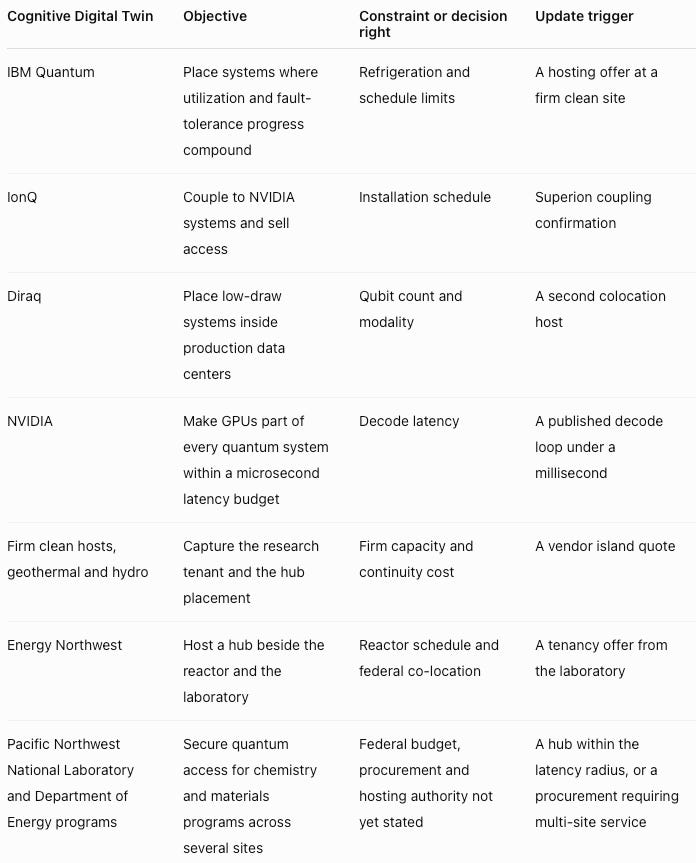
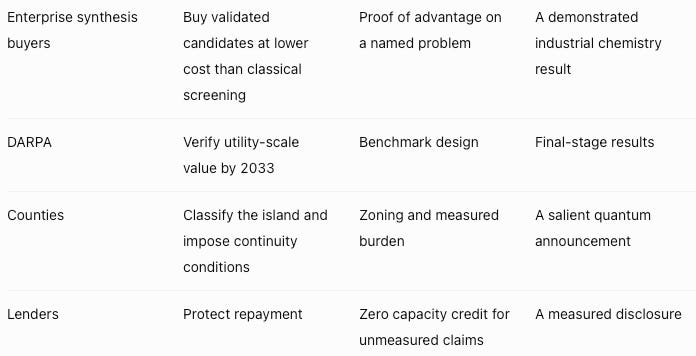
Mechanism and Scenario Routes
Game theory supplies the payoff structure. A shared hub pays every party through utilization while a local island pays the vendor through placement and costs the host through continuity.
Behavioral economics supplies the decision rules. Hosts anchor on the salient label and counties discount claims they cannot measure. Authorities decide under docket pressure with decision noise in place of perfect optimization, and predictive behavior emerges from the combination.
Among configuration outcomes, the simulation places the shared-hub route as the base: a few quantum hubs on firm clean anchors serve many sites. Distributed local islands sit second, driven by vendor placement incentives, label salience and one timing fact: an island installs in two quarters while a hub needs about six to serve three sites. Campus-only quantum sits as the tail, where hyperscalers absorb every island and no anchor forms.
Among workload outcomes, the training-data loop reported first is the base route. An energy or efficiency metric reported first sits second, which signals a host that sold the island on claims the quantum overview expects to fail. No workload disclosure at all sits as the tail.
Takeaway. The simulation resolves hub against island as a timing race the buyer narrows but does not win, and labels against metrics as a sale-framing contest, and the Simulation Predictions follow from both.
VIII. MindCast Foresight Simulation Predictions
Five Simulation Predictions follow, two primary and three secondary. P marks a Primary Simulation Prediction and S a Secondary Simulation Prediction. Each names an actor and an outcome with a window, a band, a falsifier and a verification source. No Simulation Prediction in this installment has reached its resolution date, so the validated tally stands at zero hits and zero misses.
Simulation Predictions at a Glance
Competing Explanations
Three accounts compete before any result prints.
Shared hub. A multi-site research buyer forces vendors to hub terms and one hub serves many sites. Falsifier: a second clean-hosted island installs before any hub serves three sites, with a qualifying buyer in place.
Distributed islands. Vendor placement revenue and two-quarter installation lead times put islands at several hosts before any hub ramps. Falsifier: the first hub reports three sites before any second island installs.
Campus only. Hyperscalers absorb every island and no clean-hosted installation forms. Falsifier: any clean-hosted quantum installation by 2031.
The simulation favors the first account at 50 to 60 percent of the weight, the second at 25 to 35 and the third at 10 to 15.
Primary Simulation Predictions
P-1 | Shared Hub Before Distributed Islands, Given a Multi-Site Research Buyer (48–60%)
Forecast statement: P(the first commercial quantum hub on a clean energy host serves at least three remote sites at job level before any second clean energy host installs a local quantum island, given that a research buyer whose programs span three or more sites contracts for clean-hosted quantum access).
Band: 48–60%, conditional; void if no qualifying buyer contracts by the window. The buyer’s contract pulls the vendor toward a hub, and a second island at another host can still install before the hub serves three sites.
Window: through December 31, 2031.
Trigger conditions: a quantum vendor announces a hosted installation on a geothermal, hydro or nuclear site.
Explicit falsifier: a second clean-hosted local island installs before the first hub reports three remote sites.
Verification source: vendor and host releases and hosting specifications.
P-2 | Training Labels Before Energy Metrics (44–56%)
Forecast statement: the first clean-hosted quantum island reports a chemistry or materials model trained on labels the island produced before it reports any energy relief, capacity or efficiency metric.
Band: 44–56%.
Window: through December 31, 2032.
Trigger conditions: a clean host or its tenant publishes a workload disclosure.
Explicit falsifier: the first disclosure reports an energy or capacity metric with no training use.
Verification source: host, vendor and laboratory publications.
Scope: P-2 tests commercial positioning, meaning what a host chooses to report first. It does not test whether quantum labels improve scientific productivity, which the watch condition on a quantum-labeled model beating its classical baseline carries separately.
Secondary Simulation Predictions
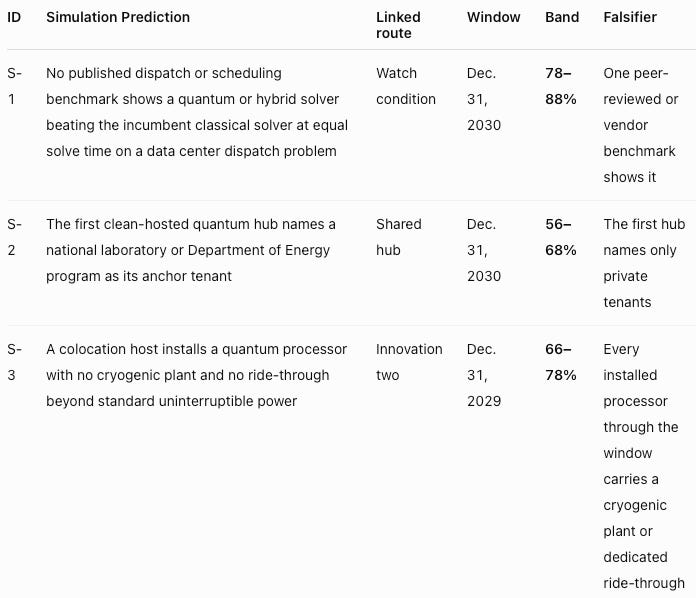
Watch Conditions and Break Conditions
Five conditions carry no band until evidence arrives. A laboratory or federal program stating a position on hosted quantum access would activate P-1’s condition. A published materials or chemistry model trained on quantum-computed labels that beats its classical-only baseline on a named target would establish the productivity claim P-2 does not test. A demonstrated advantage on an industrial chemistry problem would convert P-2 from a disclosure test into a revenue test.
A room-temperature installation under S-3 would move weight toward distributed islands and weaken P-1’s base route. A FERC co-location order at nuclear hosts would decide whether Richland or a geothermal site hosts the first hub.
Three events would break the set. A reversal of the dequantization results, meaning a demonstrated quantum advantage on general machine learning, would move quantum onto the GPU side and void the paper’s central claim. A hyperscaler acquiring regional anchors below 50 megawatts would collapse the customer tier and the shared-hub route together. A DARPA finding before 2030 that no final-stage team reaches utility scale would push every window past the horizon without changing the anchor’s classical case.
IX. Strategic Insights by Audience
One design choice runs under every audience’s decision: build the anchor on classical economics and reserve the island, or build the island first and hope the tenant follows. Policymakers meet the choice in protected-load definitions. Executives meet it in hub terms, counsel in tenancy clauses and investors in capacity credit.
Strategic Posture by Audience
🏛️ Policymakers. Quantum adds one continuity objection and no energy relief. Define protected load by function and recovery time rather than by technology label. A federal research program’s multi-site procurement is the lever that forms a hub, so a state that wants the hub should align its laboratory’s hosting authority with it (P-1, S-2).
A hub is a procurement outcome before it is an energy outcome, and policymakers should treat it as one. A laboratory that buys quantum access for several sites forms a hub by contract, and no state incentive reaches that decision. The state’s lever is the hosting authority of its own institutions, and the observable is a laboratory or university hosting position stated in writing.
💼 Executives. Hosts should join a shared hub before installing an island and isolate refrigeration and control on a protected circuit before the first tenant installs. Hosts should sell the island on per-candidate research output with a named laboratory partner (P-1, P-2).
Installation speed is the fact executives should weigh first. An island installs in two quarters and a hub needs about six to serve three sites, so the island wins the race whenever a vendor offers placement terms, and the host that accepts them sets a template the region follows. Hosts that negotiate hub access first convert the asymmetry into a waiting option they control.
⚖️ Counsel. Training labels and the models trained on them are the island’s highest-value output, and research access is the other revenue channel. Allocate ownership, publication rights and export-control treatment of quantum-produced data in the tenancy before the first label exists. Write the ride-through duty and the protected reserve into the hosting agreement (P-2).
Counsel are allocating a research output rather than a capacity, so the drafting unit is the label and the model, not the rack. Export-control treatment of quantum-produced data remains undetermined, and the agreement should assign who bears a change in it. A tenancy drafted from a colocation template assigns the rack and leaves the output unowned.
📊 Investors. Quantum readiness has option value and zero near-term capacity value. Underwrite the island at ten to twenty percent utilization until a hub serves three sites, and value its output per validated candidate once a trained model exists (P-1, P-2).
Investors should expect the island’s revenue per validated candidate, not per megawatt, which changes the underwriting unit with the asset. A case that applies capacity terms to a research instrument misstates both utilization and revenue timing. The three-site hub contract is the first observable that converts option value into capacity value.
Where Audience Interests Collide
Hosts and vendors want different placements. A vendor earns on each installed island and a host earns on utilization, so the vendor’s placement offer and the host’s hub interest point in opposite directions until a hub serves enough sites to cover fixed cost. P-1 resolves in the hub’s favor only where a multi-site buyer arrives before the vendor’s offer closes.
Laboratories and hosts split on ownership. A laboratory wants publication rights and the models trained on its labels, and a host wants a revenue share in every later discovery. The tenancy decides the split, and P-2 reads the first disclosure as the evidence of which party won it.
Counties and hosts size continuity differently. A county wants continuity conditions sized to the site, and a host wants them sized to the island’s measured load. The functional protected-load test resolves the scope, and S-3 shows whether the processor needed the condition at all.
Takeaway. Each audience’s best move follows from treating the island as a research tenant, and the collisions resolve on dates the Simulation Predictions already carry.
X. Risk Mitigation by Simulation Prediction
Every entry below pairs a Simulation Prediction with the exposure it creates for one audience, the actions that audience can take alone and the exposure that survives. Severity and probability run on separate axes throughout.
Mitigating Actions by Time Gate
Now to 30 days: strip unmeasured quantum efficiency claims from every pending filing and investor document.
30 to 90 days: negotiate hub access terms with at least one vendor before any island quote is accepted.
3 to 12 months: write the tenancy with a named laboratory partner and a named first model, and write label ownership into it.
Beyond 12 months: keep the anchor’s protected circuit sized for an island so one can be added without redesign if the hub route fails.
Exposure, Actions and Residual for Each Simulation Prediction
The actions are analytic options for each audience and not legal, investment or fiduciary advice to any party.
Entry 1 · 💼 Host executives · P-1 (48–60% given the buyer).
Exposure: a host that installs a local island before joining a shared hub carries $3.5 million to $4.5 million a year of fixed cost at 10 to 20 percent utilization, for the quarters until a tenant arrives. Severity: high. Probability: moderate.
Mitigating actions: the commercial lead negotiates hub access terms with at least one vendor before any island quote is accepted, by the first 2027 hosting cycle. The engineering lead designs the protected circuit and ride-through so an island can be added later without redesign, before the first operator agreement. The finance lead models the island on per-result and access revenue only, with zero capacity credit, before any capital commitment.
Residual exposure: a vendor can offer placement terms that make a local island rational for one host and irrational for the region, and the host that accepts it sets the template others follow.
Entry 2 · 📊 Investors · P-1 (48–60% given the buyer).
Exposure: an underwriting case that credits a local island with hub-level utilization overstates annual margin by the island’s fixed cost, $3.5 million to $4.5 million at an anchor. Severity: moderate. Probability: moderate.
Mitigating actions: the credit committee underwrites quantum at 10 to 20 percent utilization until a hub contract with at least three remote sites exists, and tests the case against the six-site break-even in Section VI. The diligence lead requires the hosting agreement’s access terms before closing.
Residual exposure: utilization at the first hub may still fall short of the level that covers fixed cost.
Entry 3 · 🏛️ Policymakers · P-1 (48–60% given the buyer).
Exposure: a commission that grants protected-load status to quantum equipment by label invites every later technology to claim it, and a county that conditions the first island on campus-scale continuity sets a cost no shared hub can meet. Severity: moderate. Probability: moderate.
Mitigating actions: commission staff publish a functional test for protected load keyed to recovery time before the 2027 sessions. County planning staff size continuity conditions to the island’s measured load rather than to the site.
Residual exposure: a statute naming quantum equipment can override functional tests.
Entry 4 · 💼 Research tenants and host executives · P-2 (44–56%).
Exposure: a host that sells the island on energy or efficiency claims rather than on training-data output has no revenue line when the first disclosure shows no relief, and loses the research tenant that would have funded it. Severity: high. Probability: moderate.
Mitigating actions: the commercial lead writes the tenancy as per-candidate or per-label output with a named laboratory partner, before the island is specified. The research lead names the first materials or chemistry model the island’s labels will train, in the tenancy.
Residual exposure: the first model trained on quantum labels may underperform the classical baseline on the chosen target.
Entry 5 · ⚖️ Counsel · P-2 (44–56%).
Exposure: a tenancy silent on ownership of quantum-produced labels and the models trained on them leaves both parties exposed to a dispute over the island’s highest-value output. Severity: moderate. Probability: moderate.
Mitigating actions: transaction counsel allocates label ownership, model ownership and publication rights in the tenancy before any data is produced. Regulatory counsel documents the client’s assessment of export-control treatment for quantum-produced data before the first cross-border transfer.
Residual exposure: export-control treatment of quantum-produced data remains undetermined and can change by rule.
Takeaway. Building the anchor on classical economics protects every audience under both outcomes of P-1, because a hub still attaches if islands spread and the anchor still earns if quantum stalls.
XI. Implications Run From Hub Formation to Label Ownership
Geothermal and hydro hosts capture the first research tenants and the first hub placements, because they alone firm the island at modular scale among clean sources (P-1). Vendors gain from hub placement where utilization covers their support cost, and lose from islands that sit idle. The Richland corridor holds the one place where a reactor and hydro coincide with a laboratory and a tenant under separate ownership. The federal co-location docket decides whether it hosts the first hub.
Training labels and the models trained on them are the island’s highest-value output through 2032 (P-2), and research access earns alongside them. The party that owns the labels captures the value of every later discovery, and the tenancy decides that party. Counsel’s drafting in Section X is therefore the distribution decision for the cluster’s quantum phase.
If P-1 misses, distributed islands spread before any hub serves three sites. Vendor placement incentives then dominate utilization, and the cluster model should expect higher fixed cost per host and slower hub formation.
If P-2 misses, the first island reports an energy metric first. The miss signals that hosts sold the island on efficiency claims the quantum overview expects to fail. The training-data loop then arrives later through research tenancies rather than through host disclosures.
Takeaway. A miss at either Primary Simulation Prediction delays the quantum phase without changing the anchor’s classical case.
What to Watch: The First Clean-Hosted Installation and the Buyer Who Contracts for It
The dominant fork is whether a multi-site research buyer contracts before a second island installs (P-1).
Through 2027. DARPA’s final-stage results and any laboratory or federal statement on hosted quantum access; the latter activates P-1’s condition.
December 31, 2029. S-3 resolves against colocation installation specifications.
December 31, 2030. S-1 resolves against published benchmarks; S-2 resolves against the first hub’s tenant announcement.
December 31, 2031. P-1 resolves against vendor and host releases, given the buyer.
December 31, 2032. P-2 resolves against host, vendor and laboratory publications.
Verification sources by Simulation Prediction.
Resolves P-1: quantum hosting announcements at clean energy sites and hub access contracts, reviewed quarterly in vendor and host releases.
Resolves P-2: workload disclosures from clean-hosted islands and their tenants, reviewed quarterly.
Resolves S-1: dispatch and scheduling benchmarks, reviewed at each vendor or peer-reviewed publication.
Resolves S-2: tenant announcements at the first hub, reviewed quarterly.
Resolves S-3: colocation installation specifications, reviewed quarterly in operator publications.
Moves watch conditions: industrial chemistry advantage results, FERC co-location orders and DARPA final-stage results, reviewed as they appear.
Conclusion: Quantum Joins as a Tenant, Becomes a Data Source and Does Not Run the Model Within the Horizon
Quantum computing does not accelerate inference or training within the horizon, and the cluster should not claim that it will. It joins a regional clean compute anchor as a research tenant, becomes a source of training labels that let scientific models reason about correlated matter, and earns only as a shared hub or under a public tenancy. The island arrives in 2031 to 2032 and the reactor follows in the mid-2030s, and the Richland corridor is where they coincide.
Stakeholders should act now on what they control: hub access terms before any island quote, a tenancy with a named laboratory and a named first model, and label ownership written before the first label exists. Stakeholders can wait to learn whether DARPA’s final-stage teams reach utility scale and whether a room-temperature processor makes the island an ordinary rack.
The decisive signal is the first quantum hosting arrangement on a clean energy site. If it serves three remote sites before a second host builds its own island, P-1 holds and the shared-hub route governs the quantum phase. If a second island installs first, P-1 misses and the model expects higher fixed cost and slower hub formation while the anchor’s classical case stands.
Working With MindCast
Public analysis cannot tell a specific host whether its anchor should host a hub, join one or wait. The answer depends on the host’s firm capacity, its laboratory partner’s budget, its county’s continuity posture and the vendor terms on offer. Site inputs stay confidential.
MindCast builds Cognitive Digital Twins of the host, its candidate vendor, its research tenant and its county. The engagement ingests the organization’s own decision history and reruns the hub-versus-island contest and the tenancy terms against its actual options.
Commissioned scope adds complete probability distributions, P10/P50/P90 ranges, organization-specific calibration and complete scenario trees. The scope also adds utilization modeling for a hub serving the host’s named remote sites and red-team tests of vendor placement offers.
Three engagements map to this installment’s readers. A Hub-or-Island Diagnostic for a host or a quantum cohort member: one anchor, one vendor and one tenancy decision (P-1, S-2).
A Tenancy Terms Review for counsel tests label ownership and publication rights together with export-control treatment and continuity duties against vendor and laboratory responses (P-2, S-3). A Protected-Load Brief for a committee: the functional test run against county and commission Cognitive Digital Twins (P-1). Contact mcai@mindcast-ai.com or visit www.mindcast-ai-simulation.com to arrange one.
Appendix A. MindCast Works
Companions
Regional Clean Compute Anchors, How Much Compute Each Clean Energy Source Yields and Where Washington Builds the First One (Installment One). Sets the anchor configuration, the compute yield per source and the allocation sequence. Supplies the firm-clean host on which the island sits.
How Quantum Improves AI, Five Channels Ranked by Date and Value, and the One That Pays for a Clean Compute Anchor (Installment Three). Ranks the five channels and states the ownership mechanism for quantum-produced labels. Supplies the remote-delivery finding that resolves this installment’s hub-versus-island contest in the hub’s favor.
How Quantum Technology Changes the AI Data Center Energy, Compute and Environmental Calculus (October 2026). The quantum series overview. Supplies the quantum island, the finding that added output absorbs energy savings and the base route of delayed usefulness after 2030 that this installment’s phasing follows.
Funded Solutions That Can Help Win Quantum-Coupled AI Data Centers Approvable (October 2026). Tests 31 measures across three project types. Supplies the quantum cost delta, the hub approval share and the separation of quantum-inspired software from quantum hardware.
Where the Clean Energy Host Advantage Holds and Where It Breaks in AI Data Centers (October 2026). Cover letter on host sites. Supplies the hyperscaler hosting forecast behind the customer tier and the finding that county review holds at energy sites.
AI Data Centers and Clean Energy: Which Projects Reach Operation and Where Clean Technology Companies Can Win(October 2026). The magazine companion. Supplies the segment guide that this installment extends to quantum vendors and research tenants.
The series umbrella and the market
AI Data Center Authorization + Clean Energy, the Mid-Scale Squeeze and the Specialized Compute Landscape(September 2026). The series umbrella. Supplies the Mid-Scale Squeeze that defines the island’s customer tier.
AI Datacenter Edge Computing: Ship the Workload Not the Power (September 2025). The founding principle of moving compute toward energy. Supplies the siting logic that places the hub on the firm clean host rather than in the metro.
The Grid-Anchored Clean Power Bargain: Powering AI Data Centers Through 2040 (September 2026). Establishes the firmness inversion. Supplies the reason the island cannot sit on a curtailable campus.
The Clean Compute Match: Which Clean Power Pairs With Which AI Compute, and What Stays on Fossil (September 2026). Sorts compute and clean generation into matched pairs. Supplies the pairing that puts the island’s continuous load on firm supply.
The approval layer
Burden-Based Authorization for AI Data Centers, Modular Clean Compute, and the Backlash Gap Between Grid Tariffs and State Law (September 2026). Defines the four burden measures. Supplies the measured-burden posture the island must carry at the county.
AI Data Center Veto Points Show Where Projects Get Stopped and How Authorization Risk Moves (September 2026). Maps ten veto nodes. Supplies the continuity node the island adds.
The Lowest-Exposure AI Data Center Approval Route for Developers, Hyperscalers and Investors (September 2026). Ties capital release to durable approvals. Supplies the staging rule behind zero capacity credit for unmeasured quantum claims.
The Data Center Authorization Market: A 50-State Regulatory Atlas (August 2026). State-by-state evidence on approval terms. Supplies the protected-load and critical-load provisions the policymaker entries address.
The Model Data Center Authorization Code (July 2026). Compares any state’s provisions by function. Supplies the common language for the functional protected-load test.
The assembly
Modular AI Data Center Specialists and the Integrated Offerings That Turn Small Sites Into Authorized Operating Capacity (September 2026). Identifies power-asset hosts as the party that carries small sites to operation. Supplies the host that captures the quantum tenant.
AI Data Center Taxonomy for Decision-Making and Clean Energy, Four Categories That Decide Whether a Site Operates(September 2026). Replaces facility labels with four decision categories. Supplies the “can prove” category through which the island’s measured burden enters the approval decision.
Appendix B. External Sources
DARPA. “Four More Teams Enter Quantum Benchmarking Initiative Final Stage.” October 7, 2026. The six final-stage teams and the 2033 utility-scale question.
Equinix and Diraq. “Diraq and Equinix to Deploy Australia’s First Quantum Computer Inside a Data Centre.”September 1, 2026. Sub-20-kilowatt draw with self-contained cooling.
IonQ. “IonQ to Advance Quantum Supercomputing by Bringing First QPU to NVIDIA Accelerated Quantum Research Center.” September 23, 2026. Superion 256 and NVIDIA GB200 NVL72 coupling through NVQLink.
Google Quantum AI. “Quantum Error Correction Below the Surface Code Threshold.” Nature, December 2024. Logical error falling with code size.
IBM. “IBM Sets the Course to Build World’s First Large-Scale, Fault-Tolerant Quantum Computer.” June 2025. The qLDPC architecture and the target of about 200 logical qubits by 2029.
Open Compute Project. “Integrating Quantum Processing Units into Data Center Infrastructure.” White paper, 2025. Modality classes and facility requirements for quantum deployment.
HPCwire. “Colocating Quantum with Classical Computers: Building New Hybrid Data Centers.” July 29, 2024. Vibration, cryogen and maintenance requirements.
Data Center Dynamics. “When Data Centers Meet Quantum Computers.” Oxford Quantum Circuits deployments and the data-residency driver.
Gidney, C. “How to Factor 2048-Bit RSA Integers With Less Than a Million Noisy Qubits.” 2025. The cryptographic timeline in Tier Three.
Tang, E. “A Quantum-Inspired Classical Algorithm for Recommendation Systems.” 2018. The dequantization line of work.
Energy Northwest and X-energy. Cascade Advanced Energy Facility near Richland in Washington State. Up to twelve Xe-100 modules with Amazon investment announced October 2024.