
Energy Northwest · X-energy · Pacific Northwest National Laboratory · Grant, Chelan and Douglas public utility districts · Bonneville Power Administration · Energy Vault · Crusoe · PowerBank · Nodiac · FERC · Washington State Legislature · Counties · Hyperscalers · Lenders
Companion works: What Quantum Computing Contributes to Clean Compute Clusters · How Quantum Improves AI · Where the Clean Energy Host Advantage Holds and Where It Breaks in AI Data Centers · AI Data Center Authorization + Clean Energy, the Mid-Scale Squeeze and the Specialized Compute Landscape
Why This Installment Matters to Each Audience
Each audience faces one decision the installment changes, and the cost of deciding without it differs by audience.
🏛️ Policymakers. State committees and county boards inherit the anchor question in 2027 whether or not they take it up, because the first host filing forces a classification. The installment supplies the compute-yield table that tells a committee how much operating capacity each definition releases, and it names the four instruments that move the outcome. A nuclear-only definition leaves hydro and geothermal anchors in negotiation, and the simulation treats that as the likeliest 2027 result.
💼 Executives. Developers and hosts gain a sorting rule they can apply before any site visit: firm fraction decides whether a site sells inference or interruptible compute, and no later negotiation changes it. The installment states the compute each source yields per 100 megawatts and the cluster size an anchor can reach, which sets the revenue envelope before the first agreement. Executives who skip the sort spend a permitting cycle on a site that cannot host the tier they planned to sell.
⚖️ Counsel. Hosting agreements in the current market are silent on import rights at module load and on allocation of approval delay. The installment identifies both clauses and the federal co-location question at nuclear hosts, and it states which Simulation Prediction each clause protects against. Counsel who draft from campus templates import campus burdens into an accessory-use site.
📊 Investors. The anchor’s revenue rests on two products with different firmness and different counterparties, and the staging gates differ by source. The installment supplies the gates: the executed allocation agreement at hydro sites, the construction permit at reactor sites and the research tenancy only once signed. Investors who underwrite the anchor on campus comparables misstate both scale and schedule.
Takeaway. The installment gives each audience the one classification its decision turns on, and Sections VII and VIII state what to conclude and what to do with it.
I. Clean Energy Source Sets the Compute, and Only Three Sources Firm an Anchor
Clean energy source decides how much compute a modular site can host, and only three clean sources firm enough of it at modular scale to anchor a regional cluster without multi-day storage or grid firming. Geothermal, hydro and the first small modular reactors yield continuous compute at a scale a county can approve as an accessory use. Solar and wind yield more compute per dollar but only for work that can pause. Washington holds all three anchor sources within three milliseconds of two metros and a national laboratory.
Power allocation is the binding economic constraint there even where a county acts first, because a county approval without import rights produces no operating capacity.
Thesis. A regional clean compute anchor is a firm-clean site of 8 to 20 megawatts that hosts enterprise inference for a nearby metro and pairs with solar and wind modules that carry movable work. The anchor’s economics clear on two products: interruptible clean compute at the variable modules and firm regional inference at the anchor.
The anchor reserves under one megawatt for a protected quantum island, and Installment Two states what that island contributes. A small modular reactor firms the anchor at three times the hydro scale. The Richland reactor plans construction by 2030 and operation in the mid-2030s, so a reactor-firmed anchor arrives after the island has already landed on hydro or geothermal power.
Why now. Energy Northwest and X-energy plan up to twelve 80-megawatt reactor modules beside Columbia Generating Station near Richland. Construction is planned by 2030 with operation targeted in the 2030s, with Amazon investment announced in October 2024. The paper models operation in the mid-2030s, later than the early-2030s target in X-energy’s public filings.
Grant County’s public utility district capped data center load growth in April 2025 on transmission grounds, with relief lines due in 2027 and 2029. Washington’s clean technology committees, the state’s clean energy developers and the counsel who advise them each decide before the 2027 session writes the next terms. On October 9, 2026 the Federal Energy Regulatory Commission (FERC) rejected PJM Interconnection’s curtail-first plan for large loads and left retail curtailment with the states.
Energy Vault broke ground on an 8-megawatt modular campus in Snyder, Texas on July 27, 2026. Texas halted data center permits eight weeks later. Washington’s 2026 tax change, Senate Bill 6231, removed the incentive exemption for refurbished facilities while the 2027 session prepares to write the next terms.
What distinguishes the MindCast approach. Engineering firms size the power and counsel reads the rules. MindCast AI applies Predictive Behavioral Economics + Dynamic Game Theory through MindCast AI Proprietary Cognitive Digital Twin Foresight Simulations (MP CDT FS). Each Cognitive Digital Twin (CDT) models how a named institution decides as evidence and rules change, and Section V names the twelve this installment runs.
Behavioral Economics supplies the decision rules: counties react to the salient label while utilities apply thresholds regardless of salience. Game Theory supplies the payoff structure: an anchor survives only when the host beats its outside option and the allocation authority recovers its cost. Predictive simulations emerge from the combination.
What the paper does. Section II converts each clean source into compute and sets nuclear’s three doors. Section III sets the anchor configuration, its workload envelope, its size against a campus and the fixed-versus-reconfigurable contest the simulation leaves open. Section IV states the three conditions that place anchors, lists the six regions that meet them and works the Washington case.
Section V states the simulation architecture. Section VI carries the MindCast Foresight Simulation Predictions with their bands. Section VII states the strategic insights for each audience, and Section VIII carries the Risk Mitigation entries.
Simulation Prediction highlights. Six Simulation Predictions in Section VI.
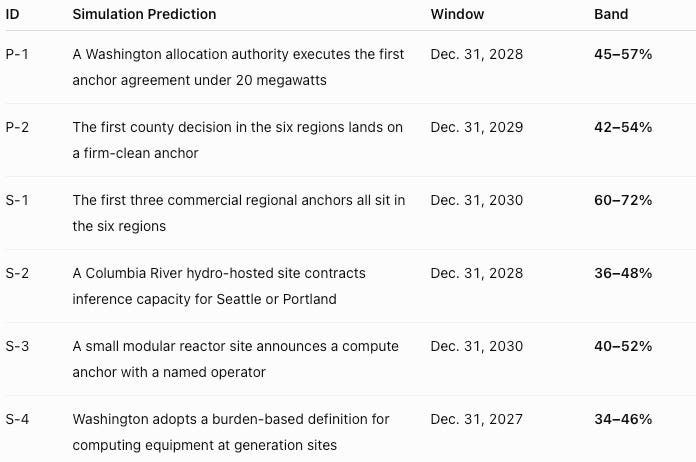
P-1. A Washington public utility district or utility executes a service agreement for a modular compute anchor at an existing hydro or nuclear interconnection, through December 31, 2028. 45–57%.
P-2. The first quantum-equipped project (the island Installment Two describes) to receive a county decision in any county of the six candidate regions is a firm-clean modular anchor under 20 megawatts rather than a campus addition, through December 31, 2029. 42–54%.
S-3. A small modular reactor site announces a modular compute anchor with a named compute operator, through December 31, 2030. 40–52%.
Stakeholder readout.
🏛️ Washington legislators on the clean technology and nuclear committees. Three definitions in the 2027 session decide whether the anchor tier forms in Washington or in geothermal states: added load at an existing generation interconnection, accessory computing use at an energy facility, and the tax classification of compute added inside an existing facility. Treat the Richland reactor site as the first nuclear unit sized to those definitions (P-1, S-3, S-4).
💼 Clean energy developers and hosts. Geothermal, hydro and reactor hosts hold the anchor role and sell regional inference. Solar and wind hosts hold the module role and sell interruptible compute. Classify every site by firm fraction before any county or lender conversation (P-1, P-2).
⚖️ Counsel to clean energy hosts. The anchor adds one allocation question at hydro hosts and one federal co-location question at nuclear hosts. Write import rights and delay allocation into the hosting agreement before the first operator signs, together with phase thresholds and the tax classification (P-1, S-3).
📊 Investors. Underwrite the anchor on regional inference and interruptible compute. Stage capital to the allocation agreement at hydro sites and to the construction permit at reactor sites, with reactor operation in the mid-2030s (P-1, S-3).
II. Compute Yield Per Clean Energy Source Decides Which Sites Can Anchor a Cluster
Nameplate megawatts are not compute megawatts. Three conversions sit between them, and they sort clean sources into anchors and modules before any approval question arrives. The section ends with nuclear, which reaches the anchor model by three routes and fits the anchor through one.
Three Conversions Separate Nameplate From Compute
Capacity factor turns nameplate into average energy. A 100-megawatt solar plant averages about 25 megawatts across a year and a wind plant 35 to 40. A dispatchable hydro plant averages 40 to 50 and a geothermal or nuclear plant 85 to 92.
Firmness then turns average energy into load that can run every hour. Storage raises a variable plant’s firm share, but a four-hour battery cannot carry a winter night, so solar and wind firm only a small fraction of their average output. Storage round-trip losses take about five percent off the firm megawatts that pass through a battery.
Power usage effectiveness turns facility power into information technology (IT) load. Air-cooled modular sites run near 1.2, so a 20-megawatt facility delivers about 16.5 megawatts to servers. A liquid-cooled rack of 72 current-generation accelerators draws about 120 kilowatts, which puts 550 to 600 graphics processing units (GPUs) on each megawatt of IT load.
The chain therefore runs in one direction with one denominator at each step. Nameplate times capacity factor gives average megawatts. Average times firm share gives firm megawatts and firm less storage loss gives facility megawatts. Facility divided by 1.2 gives IT megawatts and IT times 550 to 600 gives GPUs.
A 20-megawatt facility anchor runs 9,000 to 10,000 GPUs, and an 8-megawatt facility anchor runs 3,500 to 4,000.
Takeaway. The source sets the firm fraction and the firm fraction sets the continuous compute. Continuous compute is the number a county, a utility and a lender each read.
Compute Yield Per 100 Megawatts of Nameplate
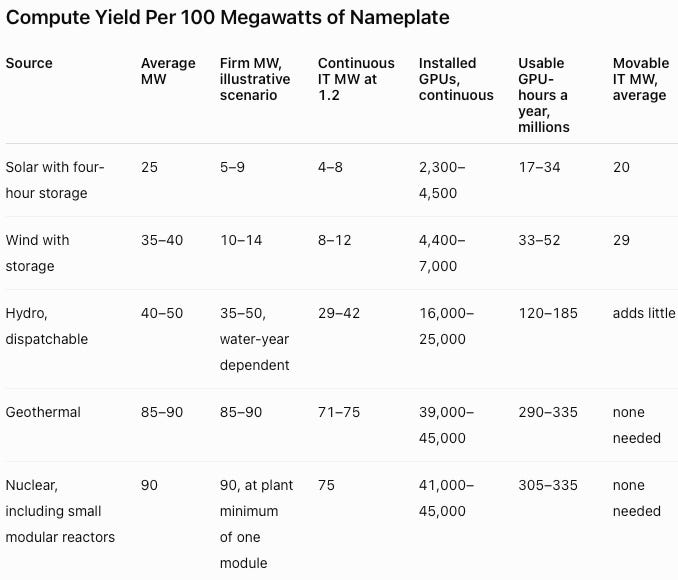
The table separates four quantities that a megawatt figure conflates. Average megawatts is annual energy. Firm megawatts is the load the source can hold every hour at a stated reliability target. For hydro the firm figure cannot exceed average energy across a year however dispatch moves it between hours.
For solar and wind the firm figure does not follow from capacity factor and four-hour storage alone. Storage duration and hourly generation set it together with the reliability target and any backup. Installed GPUs is hardware, and usable GPU-hours at 85 percent availability is the closest the table comes to work.
Completed useful work depends on the workload mix and belongs to a site-specific engagement. Every figure is illustrative until checked against a site’s hourly generation data.
Geothermal and hydro firm a 20-megawatt anchor from a modular-scale plant: about 25 megawatts of geothermal nameplate or 45 to 60 megawatts of hydro. Solar would need over 300 megawatts of nameplate and multi-day storage to firm the same 20 megawatts, which no host will build for a module. Solar and wind therefore supply the movable majority of a cluster’s compute at the lowest power cost per GPU-hour, and they cannot host the inference tier. The table compares power cost per GPU-hour and not total cost per completed job, which also depends on checkpoint overhead and idle time.
Takeaway. Only geothermal, hydro and nuclear build the anchor, and only the first two build it at the scale a county treats as accessory use.
Nuclear Enters Through Three Doors and Fits the Anchor Through One
Nuclear reaches the anchor model by three routes, which the paper calls doors: an existing plant hosting modules, a small modular reactor sized to the anchor and a campus-scale plant.
Existing plants host modules the way Three Mile Island and Palisades host hyperscaler capacity. The module inherits the plant’s interconnection, land and firm output. The veto point is federal, not local: behind-the-meter co-location at a nuclear plant opened the PJM and FERC dispute over who pays for transmission the plant no longer uses for export.
MindCast’s host-advantage simulation Where the Clean Energy Host Advantage Holds and Where It Breaks in AI Data Centers found that the county advantage holds at energy sites and that the federal layer binds first at a nuclear host. The finding matters here because it places the federal question ahead of every local one at reactor sites.
A small modular reactor (SMR) is the first nuclear unit sized to the anchor. One Xe-100 or NuScale module runs 77 to 80 megawatts, which could firm a 60 to 70 megawatt anchor as an allocation scenario, three times the hydro or geothermal anchor.
Energy Northwest’s project near Columbia Generating Station plans up to twelve modules and 960 megawatts, with construction by 2030, and it remains in pre-application with the Nuclear Regulatory Commission. The paper models operation in the mid-2030s as its schedule, and every reactor-route date below rests on that modeled schedule rather than on the project’s own target. No compute allocation from it has been proposed. A reactor-firmed anchor raises compute yield from 9,000 GPUs to 30,000 or more at a single module and removes the water-year risk that caps the hydro band.
Campus-scale nuclear builds campuses rather than anchors. Gigawatt nuclear contracts firm frontier training and consumer inference at the scale that passes every approval gate by self-funding. Burden-based approval does not apply to that tier, and the paper does not argue for it. Nuclear firm power costs more per megawatt-hour than hydro or geothermal and less than any gas-firmed renewable.
Takeaway. Nuclear belongs in the anchor model through the small modular reactor door, and Richland is where that door opens first.
III. The Regional Anchor Configuration and the Workloads It Can Carry
Three constraints select the configuration, and the workload envelope and the cluster’s size follow from them. The section closes by naming who rents the cluster and why hyperscalers do not build it.
Three Constraints Select the Configuration
Firmness comes first. Anchored inference cannot tolerate intermittency, so the host must be firm clean. The 20-megawatt line comes second. Above it a site enters large-load study at most utilities, whose thresholds run from 20 to 50 megawatts, so each site stays below the line and scale comes from a portfolio of sites.
The county’s accessory-use reading is a separate determination governed by local code, and no size line secures it. The line is a conservative design choice against the utility threshold rather than a legal protection at the county.
Coupling radius comes third. Work that needs a shared fabric stays inside one building, and work that tolerates milliseconds moves between sites. The configuration the three constraints select has three parts. One firm-clean anchor of 8 to 20 megawatts holds the enterprise inference tier, two to five variable modules of 2 to 8 megawatts sit at solar and wind sites with storage and carry movable work, and one scheduler assigns work across every site.
The whole set operates as one Authorized Compute Portfolio of 20 to 50 megawatts, the series umbrella’s term for several small sites approved and scheduled as one operating unit, and never as one campus. The anchor reserves a protected circuit for a quantum island under one megawatt. Installment Two is What Quantum Computing Contributes to Clean Compute Clusters, Tenant First, Training Data Second and Not the Processor Through 2032. The companion states what the island contributes and why the anchor’s economics never depend on it.
Takeaway. The anchor is the smallest unit that hosts firm regional inference below most utility study thresholds, and the county reads it on measured burden rather than on size.
The Workload Envelope
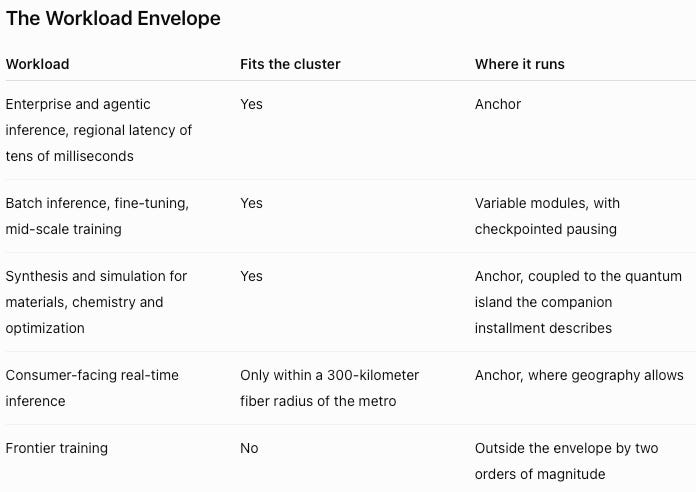
A 9,000-GPU cluster is small for training and large for inference. The paper assumes that scale serves a regional enterprise customer base at production quality, and a workload-specific service benchmark would confirm it. The configuration therefore competes with metro colocation on firmness and burden rather than with hyperscale campuses on scale.
Takeaway. The cluster should claim regional inference and movable training, and it should not claim consumer or frontier work outside the latency radius.
One Scheduler, Many Sites, Job-Level Coupling in Milliseconds
Light in fiber covers about 200 kilometers per millisecond. Modules 50 kilometers apart exchange a message in roughly half a millisecond round trip. A GPU fabric inside a rack runs at microseconds and terabytes per second per accelerator, and a synchronized training run needs that fabric.
Modules can therefore share jobs, route inference, migrate checkpointed work and pool a scheduler. Modules cannot form one training fabric across sites. The scheduler works on three timescales: within the hour on which jobs run or pause, daily on how much power goes to inference against batch work, and quarterly on which physical module to add or retire.
Takeaway. The coupling claim that holds is one scheduler across many sites with job-level exchange in milliseconds, which covers every workload the envelope admits.
Fixed or Reconfigurable Cluster Is a Contest the Simulation Leaves Open
Flexibility carries two economic values, and MindCast’s series has developed only the first. Workload mobility lets movable work follow variable power and reduces dependence on scarce firm supply. Hardware reconfiguration lets a cluster add or retire GPU and power modules as supply and accelerator generations change. Reconfiguration preserves capital value when demand shifts.
The contest is fixed modules with software scheduling against a cluster that reconfigures its hardware. The simulation holds electricity supply and customer demand and available capital constant. It varies orchestration and hardware composition along with quantum access and switching cost. Operators lean toward fixed modules by commissioning cost, and enterprise buyers lean toward reconfiguration only where service guarantees survive it.
If reconfiguration wins, the unit of investment changes from a facility to a managed portfolio and the anchor’s value exceeds its power pairing. If fixed modules win, the cluster’s value reduces to its power pairing and the compute-yield table is the whole economic case. The simulation could not assign a value, because no operator has disclosed workload traces or module exchange costs. The question resolves on matched throughput and total system cost across the two configurations on an operator’s own traces.
Takeaway. Reconfiguration is the one variable that decides whether the cluster is worth more than its power, and an operator’s own traces decide it.
Cluster Size Against an Ordinary Data Center Campus
One 20-megawatt anchor runs about 130 liquid-cooled racks and 9,000 to 10,000 GPUs. A 300 to 500 megawatt campus runs 2,000 to 3,500 racks and 150,000 to 250,000 GPUs. One anchor is therefore one twenty-fifth to one sixtieth of a campus. A full portfolio of 20 to 50 megawatts installs 25,000 to 40,000 GPUs and delivers roughly 15,000 to 20,000 GPU-equivalents of continuous throughput, one sixth to one tenth of a campus.
Water at an air-cooled modular site runs near zero. Energy Vault’s 33 planned modules at Snyder, Texas use about 297 gallons a day for the whole site.
Takeaway. The cluster trades scale for firmness, burden and coupling, and the trade is visible in every unit a county or lender reads.
Who Rents the Cluster and Why Hyperscalers Do Not Build It
Hyperscalers pass every approval gate by scale, and their workloads are frontier training and consumer inference at a size no 20-megawatt anchor serves. MindCast’s host-advantage simulation holds that none of the four largest operators hosts compute at a third-party energy site below 50 megawatts through 2027.
The customer is the tier the Mid-Scale Squeeze strands: buyers too large for cloud spot capacity and too small to command a campus, as MindCast’s series umbrella AI Data Center Authorization + Clean Energy, the Mid-Scale Squeeze and the Specialized Compute Landscape defines them. Enterprises with residency constraints and neoclouds form one group. Sovereign and research buyers and clean energy companies monetizing their own power form the other.
Renting clears on two products. Interruptible clean compute at solar and wind modules undercuts cloud spot rates for batch and fine-tuning because power is the lowest-cost input in the model’s stack. Firm regional inference at the anchor competes with metro colocation on burden, not on cost. Nobody rents a modular site for uptime it cannot promise, so the anchor sells only the firmness its source can deliver.
Takeaway. The cluster differs from a campus in its unit of approval and its power pairing rather than in its hardware, and its customer is the tier campuses leave behind.
IV. Three Conditions Place Regional Anchors in Six Regions, and Washington Holds the Strongest Case
Regional anchors form where three conditions coincide, and the map of those conditions already exists in the Department of Energy’s research footprint. The section closes with Washington, where allocation decides before the county does.
The Three-Condition Rule
A regional anchor forms where a firm clean source sits within about three milliseconds of fiber, roughly 300 kilometers, of a metro of two million people or more. The same radius must hold a research institution that can anchor a specialized tenant. The local utility or public power authority must still hold allocatable firm capacity. Latency sets the radius, firmness sets the source, and allocation decides whether the anchor gets built.
Variable clean regions supply movable modules to a portfolio and cannot host an anchor. Texas therefore enters the model as a module region rather than an anchor region.
Takeaway. Three conditions rather than fifty state rules decide where anchors form.
Six Regions Meet the Rule
Pacific Northwest: Columbia River hydro and the Richland reactor project serve Seattle and Portland. Pacific Northwest National Laboratory and the University of Washington anchor the tenant.
Northern California and Nevada: Geysers and Great Basin geothermal serve the Bay Area and Reno. Lawrence Berkeley National Laboratory and Stanford anchor the tenant.
Great Lakes: the Illinois nuclear fleet and Michigan restarts serve Chicago and Detroit. Argonne and Fermilab anchor the tenant with the Chicago Quantum Exchange.
Tennessee Valley: Tennessee Valley Authority hydro and nuclear serve Nashville and Atlanta. Oak Ridge National Laboratory anchors the tenant.
Mountain West: Utah and Idaho geothermal serve Salt Lake City. Idaho National Laboratory and the Utah and Colorado programs anchor the tenant.
Mid-Atlantic: Pennsylvania and Virginia nuclear serve Philadelphia and Washington. The Maryland institutes anchor the tenant. Metro saturation and Pennsylvania’s township veto make it the hardest of the six.
The paper ranks none of the six, because a ranking needs one definition each of metro proximity, research demand and allocatable power.
Five of the six regions sit on a national laboratory or its university partners. The research tenant and the firm clean source were placed decades ago by the same logic: low-cost firm power drew the laboratories. The Great Lakes and Mid-Atlantic entries work as modules added at existing nuclear plants rather than as new 20-megawatt anchors.
Takeaway. The regional map and the national laboratory map are the same map.
Washington: Allocation Binds Even When the County Acts First
Central Washington hydro sits 150 to 250 kilometers from Seattle and about the same from Portland. Fiber round trip over that distance is 1.5 to 2.5 milliseconds. A consumer response from a large language model budgets hundreds of milliseconds, so a Columbia River anchor sits inside the consumer latency radius for Seattle, Portland and Vancouver. The three metros form a combined market of eight million people, and hyperscalers have run inference in Quincy on this geography for fifteen years.
The binding constraint is hydro allocation rather than latency. Grant County’s public utility district capped data center load growth in April 2025 and named transmission as the limit instead of supply. Relief lines are due in 2027 and 2029.
Chelan and Douglas power is largely contracted and the Bonneville Power Administration’s new-load queue is long. Washington’s 2026 tax change removed the exemption for refurbished facilities while new construction keeps it.
Richland adds the reactor door. Columbia Generating Station and the planned Xe-100 modules sit on the Hanford site north of the city, Columbia River hydro runs past both, and Pacific Northwest National Laboratory’s campus sits in north Richland under separate federal ownership. The assets are related by geography and not by ownership or service arrangement, and the simulation treats them as four actors in one corridor. No other corridor in the country holds an operating reactor, a planned small modular reactor, dispatchable hydro and a national laboratory within one allocation authority’s reach.
Richland also carries two doors in one corridor, and which opens first is the live question. The hydro door opens if a hydro-firmed anchor beside the laboratory operates before the reactor. The reactor door opens if the anchor waits for the Xe-100 modules. FERC’s co-location order and the Nuclear Regulatory Commission’s schedule decide between them, and Energy Northwest leans toward the reactor by project identity while the laboratory leans toward hydro by schedule.
Takeaway. Richland holds both doors, and the first FERC co-location order decides which opens first.
The 2026 Incentive Change Needs a Classification Test Before It Counts Against Washington
Washington’s 2026 session ended the data center sales-tax exemption for qualifying refurbishment from July 1 while retaining the qualifying new-construction route. Whether an anchor that adds compute inside an existing energy facility falls under either route is a classification question the governing tax provisions decide, not a consequence that follows from the facility’s age. The anchor may qualify as new construction, fall under the ended refurbishment route, or qualify for neither.
A zoning definition of accessory use does not by itself restore a sales-tax exemption, because the two statutes classify on different terms. If the anchor falls outside both routes, the remedy is a targeted change to the tax provisions rather than a land-use definition. The legislature’s nuclear working group holds both drafting opportunities, and the simulation models the tax outcome as a classification test with three branches.
Takeaway. The incentive change is a live commercial distinction for Washington anchors, and its weight depends on a classification that must run before the tax treatment enters any strategy.
What the 2027 Session Can Decide
The legislature holds four instruments that move the Simulation Predictions in Section VI, and each can pass without the others. A definition of added computational load at an existing generation or storage interconnection moves allocation from case-by-case negotiation to a rule and releases P-1 early. A definition of accessory computing use at an energy facility keyed to firm import capacity and measured burden carries S-4 and gives counties a test to read. A classification fix in the data center tax provisions decides whether compute added inside an existing facility sits under the new-construction route or outside both routes.
A functional protected-load test keyed to recovery time rather than technology label prepares the continuity question that Installment Two’s island raises.
The simulation places a nuclear-only accessory definition as the most likely 2027 outcome, because the Richland development interest and the local backlash against data center proposals near Cle Elum in Kittitas County pull the working group in opposite directions and a nuclear-site bill splits the difference. A statewide definition keyed to burden across generation types reaches hydro and geothermal anchors as well, which is where the first Washington agreement is likely to land.
🏛️ Legislators. Draft the four instruments as one burden-keyed package rather than a nuclear-site bill, because the first anchor agreement in Washington is likelier at a hydro interconnection than at the reactor site (P-1, S-4).
💼 Clean energy developers. File burden exhibits and import requests before the session cutoff, so the working group drafts against a live project rather than a label.
⚖️ Counsel. Prepare the tax classification analysis for an existing-facility anchor before any bill text circulates, since the remedy differs by which route the anchor falls outside.
📊 Investors. Hold reactor-sited commitments to the construction permit and treat the session’s definitions as the first durable approval a hydro anchor can carry.
Takeaway. Four definitions in one session decide whether Washington’s anchor advantage becomes an agreement or a research-tenant advantage only. Washington is the strongest anchor geography in the country, and the first build turns on a public utility district allocation and a legislative definition. A county acting first changes the schedule without changing which constraint binds.
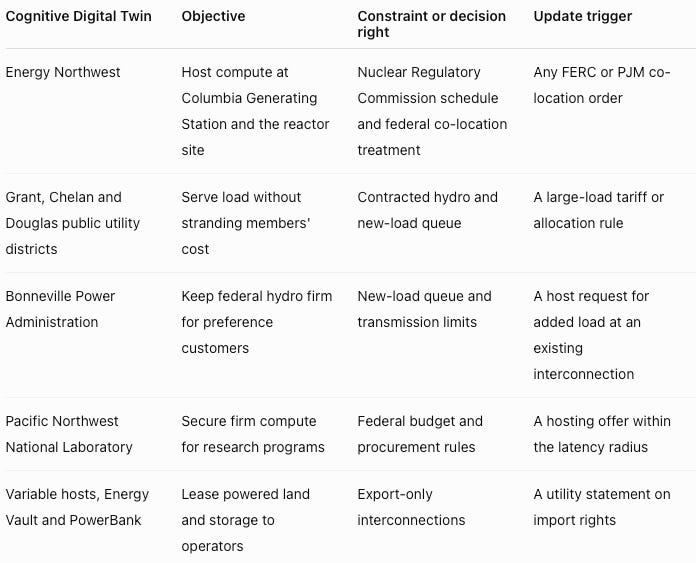
V. Twelve Cognitive Digital Twins Test Whether the Anchor Gets Built
The simulation answers one question. Which configuration of clean energy source and modular compute produces the most continuous compute a county can approve as accessory use, and which constraint binds when a host tries to build it? The horizon runs from October 2026 through 2030, with Washington as the named forum and the other five regions as comparison cases.
Four Events Since September Change the Forum, the Veto and the Tenant’s Date
FERC’s October 9 order moved continuity terms for any protected load from the wholesale level to state forums, which changes the forum for the first instrument any anchor needs. Texas’s September 21 permit halt showed that a state executive can stop energy-site modules as easily as campuses, which adds a state veto the county-centered analysis omits. Washington’s 2026 incentive change ended the refurbishment route to the data center exemption, which reaches anchors only if the governing classification places them there. DARPA’s October 7 final-stage selection tied the research tenant’s budget to a dated federal milestone, which dates the tenant’s arrival to 2033 rather than to vendor roadmaps.
The Actor System
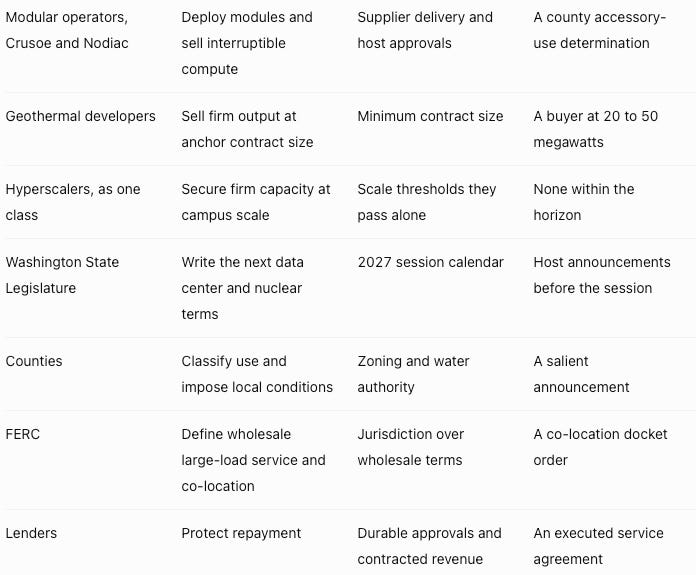
Mechanism
Game theory supplies the payoff structure. An anchor survives only when the host beats its outside option, the allocation authority recovers its cost and the county sees burden it can measure. A reactor host pays the federal co-location question before any local question. A hydro host pays the allocation question first and the county question second.
Behavioral economics supplies the decision rules. Counties react to the salient label, so an air-cooled module at an existing energy site draws little review. Utilities and public utility districts apply thresholds regardless of salience, and legislators anchor on the data center label unless a burden definition arrives before the session. Predictive behavior emerges from the combination.
Scenario Routes
Among institutional outcomes, the simulation places allocation as the binding constraint at hydro hosts and the federal co-location docket at nuclear hosts, whichever authority acts first in time. County accessory-use treatment for anchors under 20 megawatts is the base route. Label review reaching energy sites sits second, and a statewide accessory-use statute sits as the tail.
Among configuration outcomes, the hydro anchor with variable modules is the base route through 2030 and geothermal regions move first where districts cap. The reactor-firmed anchor sits as the mid-2030s route. A hyperscaler absorbing every anchor site sits as the tail.
The fixed-versus-reconfigurable contest returned no value for lack of operator traces.
Takeaway. The simulation resolves which constraint binds and leaves reconfiguration open for lack of operator traces, and the Simulation Predictions follow from the first contest.
VI. MindCast Foresight Simulation Predictions
Six Simulation Predictions follow, two primary and four secondary. P marks a Primary Simulation Prediction and S a Secondary Simulation Prediction. Each names an actor and an outcome with a window, a band, a falsifier and a verification source. No Simulation Prediction in this installment has reached its resolution date, so the validated tally stands at zero hits and zero misses.
Simulation Predictions at a Glance
Competing Explanations
Three accounts compete before any result prints.
Allocation binds. Firm import capacity decides whether an anchor operates whichever authority acts first, and counties read measured filings at energy sites as accessory use. Falsifier: a county pause or denial stops an anchor that already holds import rights.
Label review reaches energy sites. Counties treat modules at generation sites as new data centers, and geothermal states without district caps build first. Falsifier: no county stops a module at an operating energy site through 2028.
Hyperscalers absorb the tier. A campus operator contracts the reactor output and anchor sites below 50 megawatts never form. Falsifier: a hyperscaler announces a third-party energy-site deal below 50 megawatts.
The simulation favors the first account at 50 to 60 percent of the weight, the second at 25 to 35 and the third at 10 to 15.
Primary Simulation Predictions
P-1 | A Washington Allocation Authority Executes the First Anchor Agreement (45–57%)
Forecast statement: a Washington public utility district or utility executes a service agreement for a modular compute installation at an existing hydro or nuclear interconnection, at a first phase under 20 megawatts, with or without a state definition of added load in force.
Band: 45–57%.
Window: through December 31, 2028.
Trigger conditions: a host files for import service at an existing energy interconnection in Washington.
Explicit falsifier: no such agreement executes, or the first executed agreement is at a site above 20 megawatts.
Verification source: public utility district board minutes, utility filings and host releases.
P-2 | First County Decision in the Six Regions Lands on a Firm-Clean Anchor (42–54%)
Forecast statement: the first quantum-equipped project to receive a county land-use decision in any county of the six candidate regions in Section IV is a firm-clean modular anchor under 20 megawatts rather than a campus or hyperscale addition. Quantum equipment is the test case because it carries the continuity objection Installment Two describes, so the first such decision shows whether a county reads an anchor by burden or by label.
Band: 42–54%.
Window: through December 31, 2029.
Trigger conditions: a county docket in a named region lists a project naming quantum equipment.
Explicit falsifier: the first such decision concerns a campus, a hyperscale site or a project above 20 megawatts.
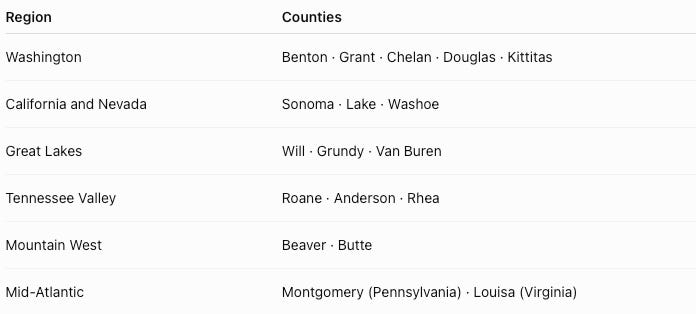
Verification source: county minutes and ordinances in the eighteen counties listed below.
Observable populations. P-2 resolves against a fixed list of eighteen counties in the six regions.
Secondary Simulation Predictions
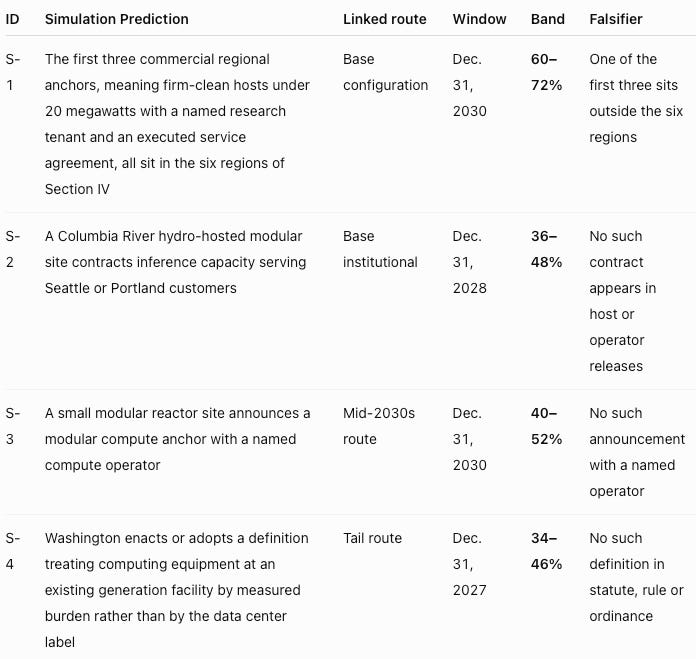
Observable population for S-1. S-1 identifies qualifying anchors nationally and not only inside the six regions. Host and operator releases and executed service agreements supply the population, and a qualifying anchor must meet all three conditions in its definition. A project outside the six regions that meets them counts against S-1.
Watch Conditions and Break Conditions
Two conditions carry no band until evidence arrives. A FERC order resolving co-location cost allocation at nuclear plants would move weight toward the reactor route early. A Bonneville Power Administration statement on added load at existing interconnections would release P-1 early.
Three events would break the set. Federal preemption of state data center rules would remove the county forum P-2 depends on. A hyperscaler acquiring regional anchor sites below 50 megawatts would collapse the customer tier. A Nuclear Regulatory Commission schedule slip past 2034 would void S-3’s window without changing the hydro route.
VII. Strategic Insights by Audience
Every audience faces the same first question in a different vocabulary: how much of this site’s power runs every hour. Policymakers meet it in allocation and accessory-use definitions. Executives meet it in site selection and hosting terms. Counsel meets it in import-rights and co-location clauses, and investors meet it in staging.
Strategic Posture by Audience
🏛️ Policymakers. Public utility districts and the Bonneville Power Administration hold the allocation lever, and counties hold the accessory-use determination. A definition keyed to firm import capacity and measured burden reaches the anchor tier that label-based rules strand. The small modular reactor site is the first nuclear unit sized to that definition.
The federal co-location question is the one the state cannot answer alone (P-1, S-3, S-4).
Sequence is what the simulation adds for policymakers. Behavioral Economics predicts that a committee responds to the salient project, which in Washington is the reactor, and Game Theory shows that a nuclear-only definition leaves the hydro anchor in negotiation at the site where the first agreement is likeliest. A committee that wants the first agreement writes the definition for the source that moves first, and the first bill text of the 2027 session shows which source it chose.
💼 Executives. Firm clean developers hold the anchor role and should sell it as regional inference plus a research tenancy. Variable clean developers hold the module role and should sell interruptible compute to the mid-scale tier. Reactor hosts should resolve the federal co-location question before any module ships (P-1, S-3).
Executives should read the anchor as a competitor to metro colocation, not to campuses. The sales motion then runs on firmness and burden instead of scale. Hyperscalers leave the tier alone because 20 megawatts does not move their capacity plans, and that absence is the developer’s market. The first host to file a burden exhibit writes the county’s template, and a template favors whoever wrote it.
⚖️ Counsel. The anchor turns on two clauses the current hosting market leaves silent: import rights at module load and allocation of approval delay. Nuclear hosts add the federal co-location question, which belongs in the service agreement before any operator agreement. Phase thresholds at 20 megawatts belong in the host agreement as named triggers (P-1, S-3).
For counsel, the binding clause changes with the source. At hydro hosts the agreement turns on import rights and restudy triggers, at reactor hosts on federal co-location cost allocation, and at variable hosts on curtailment terms and checkpoint duties. One template across the three sources imports the wrong risk into two of them.
📊 Investors. Underwrite the anchor on regional inference and interruptible compute. Stage capital to the executed allocation agreement at hydro sites and to the construction permit at reactor sites. Treat the research tenancy as contracted revenue only once signed (P-1, S-3).
Allocation risk and permitting risk resolve on different dates, and investors should hold them in separate gates. A county approval before an allocation agreement produces nothing to fund, and an allocation agreement before a county decision funds a site whose schedule the county still controls. Capital that treats the two as one gate pays for the slower of them twice.
Where Audience Interests Collide
Hosts and allocation authorities want different instruments. A host wants an allocation rule it can file against, and a district short of transmission wants case-by-case negotiation that preserves its discretion until the 2029 lines arrive. The 2027 definition of added load decides which instrument governs, and P-1 resolves in the host’s favor only where the district accepts a rule or the host accepts negotiation terms.
Developers and counties disagree on the test. A developer wants accessory-use treatment keyed to measured burden, and a county wants a reviewable standard it can apply to the next applicant. The first burden exhibit satisfies both only if it arrives before a pause, which is why P-2 turns on who files first.
Investors and reactor hosts run on different clocks. A reactor host wants an early anchor commitment to firm its offtake case, and an investor wants funding staged to the construction permit. The federal co-location docket decides whose schedule governs, and S-3 reads that docket as the gate.
Takeaway. Each audience’s best move follows from the firm fraction of the site in front of it, and the collisions resolve on dates the Simulation Predictions already carry.
VIII. Risk Mitigation by Simulation Prediction
Every entry below pairs a Simulation Prediction with the exposure it creates for one audience, the actions that audience can take alone and the exposure that survives. Severity and probability run on separate axes throughout.
Mitigating Actions by Time Gate
Now to 30 days: classify every candidate site as anchor or module by firm fraction before any county or lender conversation.
30 to 90 days: obtain written confirmation of firm import capacity at anchor load from the public utility district or utility before signing a hosting agreement.
3 to 12 months: file burden exhibits on water, noise and generator hours with the first local filing, and prepare a draft accessory-use definition for the 2027 session.
Beyond 12 months: keep anchor designs that satisfy both the accessory-use route and the large-load route, in case a county reclassifies or a phase crosses 20 megawatts.
Exposure, Actions and Residual for Each Simulation Prediction
The actions are analytic options for each audience and not legal, investment or fiduciary advice to any party.
Entry 1 · 💼 Host executives · P-1 (45–57%).
Exposure: a host that signs an operator agreement before the public utility district confirms import capacity carries equipment deposits and quarters of lead time against an allocation that may not arrive. Severity: high. Probability: moderate.
Mitigating actions: the development lead obtains written confirmation of import capacity at module load before signing, by the next district board cycle. The finance lead stages deposits against the executed service agreement. The commercial lead qualifies one geothermal or out-of-state hydro site as an alternative by mid-2027.
Residual exposure: a district can revise allocation rules after the agreement, and a later phase can trigger restudy.
Entry 2 · 🏛️ Washington policymakers · P-1 (45–57%).
Exposure: a district that allocates case by case sets the terms for every later anchor through negotiation instead of rule, and the legislature then inherits a precedent it did not write. Severity: moderate. Probability: moderate.
Mitigating actions: legislative staff draft a definition of added load at existing generation interconnections before the 2027 bill cutoff. District staff publish an allocation test keyed to firm import capacity and measured burden before the first host files.
Residual exposure: Bonneville Power Administration terms sit under federal authority and can override district tests.
Entry 3 · 💼 Developer executives · P-2 (42–54%).
Exposure: a developer that seeks county approval for a quantum-equipped campus addition before any anchor has set the template loses the permitting schedule when the county has no accessory-use precedent to read. Severity: moderate. Probability: moderate.
Mitigating actions: the development lead files the first quantum-equipped project at a firm-clean site under 20 megawatts rather than at a campus, through December 2028. The government affairs lead frames the equipment by function, recovery time and measured burden in the first filing.
Residual exposure: a county may still classify the whole site by facility label during a pause.
Entry 4 · 🏛️ County policymakers · P-2 (42–54%).
Exposure: a county that decides the first quantum-equipped project without an accessory-use test sets a precedent every later project will cite within one or two session calendars. Severity: high. Probability: moderate.
Mitigating actions: planning staff draft burden thresholds for computing equipment at energy facilities in the next code amendment cycle. The board requests burden data at pre-application by resolution in the first quarter of 2027.
Residual exposure: a statute passed under pro-development pressure can override county tests.
Entry 5 · ⚖️ Counsel at nuclear hosts · S-3 (40–52%).
Exposure: a service agreement at a reactor site that is silent on federal co-location cost allocation leaves the host exposed to transmission charges a later FERC order assigns. Severity: high. Probability: moderate.
Mitigating actions: regulatory counsel documents the client’s assessment of the pending co-location docket before execution. Transaction counsel adds a co-location reopener to every reactor-site agreement before signing.
Residual exposure: FERC can adopt terms neither party proposed.
Entry 6 · 📊 Investors · S-3 (40–52%).
Exposure: capital committed to a reactor-sited anchor ahead of the construction permit carries the Nuclear Regulatory Commission’s schedule as uncompensated delay, with operation in the mid-2030s. Severity: high. Probability: moderate.
Mitigating actions: the investment committee stages funding to the construction permit and to a separate hydro or grid service agreement that firms the first phase. The deal team models the anchor on the interim source until the reactor operates.
Residual exposure: the interim source may carry its own allocation limit.
Takeaway. Classifying the site by firm fraction protects every audience under both outcomes of P-1, because a module still earns if the allocation stalls and an anchor still earns if it arrives.
IX. Implications Run From Allocation to Tenancy
Public utility districts and utilities hold the binding economic determination at every anchor, because firm import capacity at anchor load is the input no county can grant. A county may act first in time, and its approval without import rights produces nothing. Counties decide the accessory-use question for anchors under 20 megawatts (P-2), and at nuclear hosts the federal co-location docket sits ahead of both. The sequence inverts the usual developer intuition that land use is the decisive approval.
Geothermal and hydro hosts capture the first research tenants, because they alone firm the anchor at modular scale among clean sources. Variable hosts capture the interruptible compute market and gain bargaining power by writing the first module terms. Reactor hosts capture the largest anchors and carry the longest schedule.
If P-1 misses, no Washington allocation authority executes an anchor agreement by 2028. The anchor model then moves to geothermal regions first, and Washington’s advantage in latency and research tenancy waits on a legislative definition. If P-2 misses, the first county decision lands on a campus, and the accessory-use template forms under campus burdens.
Takeaway. Allocation binds and county review sets the schedule. A miss at either Primary Simulation Prediction delays the anchor without changing the compute-yield table.
What to Watch: The 2027 Session, the Grant Lines and the First Agreement
The dominant fork is whether a Washington allocation authority executes an anchor agreement before geothermal regions build first (P-1).
January 11, 2027. The Washington legislature convenes on the second Monday of January; bill text on added load, accessory use and tax classification moves S-4 and P-1.
2027. Grant County’s first transmission relief line energizes; headroom under the cap moves P-1 and S-2.
Each FERC co-location order. Cost assignment at nuclear plants moves S-3 and the Richland reactor door.
December 31, 2027. S-4 resolves against Washington statutes, rules and ordinances.
December 31, 2028. P-1 and S-2 resolve against district minutes, utility filings and operator releases.
2029. Grant County’s second line energizes; P-2 resolves December 31 against the eighteen county dockets.
December 31, 2030. S-1 and S-3 resolve against host, operator and reactor releases.
Verification sources by Simulation Prediction.
Resolves P-1: public utility district board minutes and utility filings on added load at existing interconnections, reviewed monthly.
Resolves P-2: county dockets listing quantum equipment, reviewed quarterly.
Resolves S-1 and S-3: anchor announcements naming the host, the source and the operator, reviewed quarterly.
Resolves S-2: inference contracts at Columbia River hydro sites, reviewed quarterly in operator releases.
Resolves S-4: Washington statutes, agency rules and ordinances, reviewed during the 2027 session.
Moves watch conditions: FERC co-location orders and Bonneville Power Administration statements, reviewed as they appear.
Conclusion: Build the Anchor on the Source, and Treat Allocation as the Binding Constraint
Clean energy source decides how much compute a modular site can host, and only geothermal, hydro and the first small modular reactors firm an anchor at a scale a county can approve as accessory use. Washington holds all three sources within the latency radius of two metros and a national laboratory. The public utility district allocation is the binding constraint there whichever authority acts first, and the legislature’s accessory-use definition decides whether that allocation runs by rule or by negotiation and whether the 2026 incentive change reaches anchors at all under the governing classification.
Stakeholders should act now on what they can measure: firm fraction at every candidate site, import capacity at anchor load and the terms of the first hosting agreement. Stakeholders can wait to learn whether the reactor schedule holds and whether a county reads the first anchor as accessory use.
The decisive signal is the first executed service agreement at an existing Washington hydro or nuclear interconnection. If it arrives at a first phase under 20 megawatts by 2028, P-1 holds and the anchor route governs. If it does not, P-1 misses and the model expects geothermal regions to build first while Washington waits on its definition.
Working With MindCast
Public analysis cannot tell a specific host whether its interconnection carries import at anchor load, whether its public utility district will allocate, or whether its county reads the project as accessory use. The answers depend on the site’s service agreement, the district’s contracted position and the county’s code. Site inputs stay confidential.
MindCast builds Cognitive Digital Twins of the host and its allocation authority. The county, the lender and the candidate operators join the same simulation, which ingests the organization’s own decision history and reruns the allocation contest against its actual options.
Commissioned scope adds complete probability distributions, P10/P50/P90 ranges, organization-specific calibration and complete scenario trees. The scope also adds the compute-yield model run on the site’s own hourly generation data, the fixed-versus-reconfigurable contest run on the operator’s own workload traces and module exchange costs, and red-team tests of district and county responses.
Three engagements map to this installment’s readers. An Anchor Diagnostic for a clean energy host: one site, one allocation authority and one configuration decision (P-1, P-2).
A Session Brief for a committee: the four 2027 instruments run against the district, county and host Cognitive Digital Twins (S-4). A Hosting Terms Review for counsel tests import rights and delay allocation together with phase thresholds and tax classification against the simulation’s counterparty responses (P-1, S-3). Contact mcai@mindcast-ai.com or visit www.mindcast-ai-simulation.com to arrange one.
Appendix A. MindCast Works
Companions
What Quantum Computing Contributes to Clean Compute Clusters, Tenant First, Training Data Second and Not the Processor Through 2032 (Installment Two). States what the anchor’s quantum island contributes by tier and date. Supplies the training-data loop that gives the synthesis workload its value.
How Quantum Improves AI, Five Channels Ranked by Date and Value, and the One That Pays for a Clean Compute Anchor (Installment Three). Ranks the channels through which quantum improves AI and finds that product demand does not create processor demand. Supplies the reason the anchor’s island circuit stays reserved rather than built.
Where the Clean Energy Host Advantage Holds and Where It Breaks in AI Data Centers (October 2026). Cover letter with seven Simulation Predictions on host sites. Supplies the five determinations, the finding that county review holds at energy sites and the hyperscaler hosting forecast this installment’s customer analysis relies on.
AI Data Centers and Clean Energy: Which Projects Reach Operation and Where Clean Technology Companies Can Win(October 2026). The magazine companion. Supplies the segment guide that this installment extends to anchor and module roles.
How Quantum Technology Changes the AI Data Center Energy, Compute and Environmental Calculus (October 2026). The quantum series overview. Supplies the quantum island and the finding that quantum shifts constraints rather than relieving them.
Funded Solutions That Can Help Win Quantum-Coupled AI Data Centers Approvable (October 2026). Tests 31 measures across three project types. Supplies the hub, addition and campus approval shares that bound the anchor’s quantum reservation.
The series umbrella and the market
AI Data Center Authorization + Clean Energy, the Mid-Scale Squeeze and the Specialized Compute Landscape(September 2026). The series umbrella. Supplies the Mid-Scale Squeeze and the Authorized Compute Portfolio that this installment instantiates with named sources.
AI Datacenter Edge Computing: Ship the Workload Not the Power (September 2025). The founding principle of moving compute toward energy and community trust. Supplies the siting logic the regional anchor puts into physical form.
The Grid-Anchored Clean Power Bargain: Powering AI Data Centers Through 2040 (September 2026). Separates interconnection, deliverable energy and accredited capacity. Supplies the firmness inversion that keeps the anchor on firm clean power.
The Clean Compute Match: Which Clean Power Pairs With Which AI Compute, and What Stays on Fossil (September 2026). Sorts compute and clean generation into matched pairs. Supplies the assortative matching rule the compute-yield table converts into GPU counts.
The approval layer
Burden-Based Authorization for AI Data Centers, Modular Clean Compute, and the Backlash Gap Between Grid Tariffs and State Law (September 2026). Defines the four burden measures. Supplies the measured-burden test the accessory-use anchor must pass.
AI Data Center Veto Points Show Where Projects Get Stopped and How Authorization Risk Moves (September 2026). Maps ten veto nodes and four state arrangements. Supplies the node sequence that places allocation ahead of county review.
The Lowest-Exposure AI Data Center Approval Route for Developers, Hyperscalers and Investors (September 2026). Ties capital release to durable approvals. Supplies the staging rule behind the reactor-site entries in the risk layer.
The Data Center Authorization Market: A 50-State Regulatory Atlas (August 2026). State-by-state evidence on approval terms. Supplies the state detail this installment leaves to the Atlas while carrying the three-condition rule.
The Model Data Center Authorization Code (July 2026). Compares any state’s provisions by function. Supplies the common language for the accessory-use definition the installment asks the legislature to draft.
The assembly
Modular AI Data Center Specialists and the Integrated Offerings That Turn Small Sites Into Authorized Operating Capacity (September 2026). Identifies power-asset hosts as the party that carries small sites to operation. Supplies the host role that the anchor and module distinction refines by source.
AI Data Center Taxonomy for Decision-Making and Clean Energy, Four Categories That Decide Whether a Site Operates(September 2026). Replaces facility labels with four decision categories. Supplies the “can change” and “can prove” categories through which the module’s curtailment and the anchor’s firm fraction enter the approval decision.
Appendix B. External Sources
Energy Northwest and X-energy. Cascade Advanced Energy Facility near Richland in Washington State. Up to twelve Xe-100 modules with Amazon investment announced October 2024. Schedule as stated in X-energy’s Form 424B4, 2026.
Grant County Public Utility District. Data center load cap, April 2025, as reported by GovTech. Transmission relief lines in 2027 and 2029.
Washington State Legislature. Session calendar. The 2027 regular session convenes January 11, 2027.
FERC. Order of October 9, 2026 in Docket ER26-3515 rejecting PJM Interconnection’s large-load curtailment proposal, with Commissioner Rosner’s concurrence. Retail curtailment as state jurisdiction.
Business Wire. “Energy Vault Breaks Ground on Powered AI Infrastructure Campus in Snyder, Texas.” July 27, 2026. Module count, water use and phase sizes.
Office of the Texas Governor. Directive of September 21, 2026 halting data center environmental permits, as summarized by Holland & Knight.
Duke University Nicholas Institute. “Rethinking Load Growth.” February 2025. Estimate of 76 gigawatts of new load absorbable at 0.25 percent curtailment.
Open Compute Project. “Integrating Quantum Processing Units into Data Center Infrastructure.” White paper, 2025. Facility classes for the anchor’s reserved island.
Washington State Legislature. Senate Bill 6231, 2026. Ends the data center sales and use tax exemption for refurbished facilities and replacement servers from July 1, 2026, as summarized by Leyton.