
DARPA · IBM · IonQ · Diraq · Equinix · NVIDIA · FERC · PJM Interconnection · Texas · Amazon Web Services · Microsoft · Google
Companion work: Funded Solutions That Can Help Win Quantum-Coupled AI Data Centers Approvable
I. Quantum Shifts AI Data Center Constraints More Than It Relieves Them Through 2030
Quantum computing is arriving in AI data centers as small, continuously powered systems linked to classical computers. Through 2030, those systems mostly shift infrastructure constraints instead of relieving them. They add support loads, require protected power and move part of the burden into cryogenics and export-controlled locations.
Thesis. Quantum lowers site consumption when displaced classical energy exceeds supporting overhead and additional output stays below the resulting savings threshold. Reserved capacity can stay unchanged even when consumption falls, so the series tracks it separately. The simulation finds the first condition unproven at scale before 2031 and the second fragile wherever it holds.
Findings by channel.
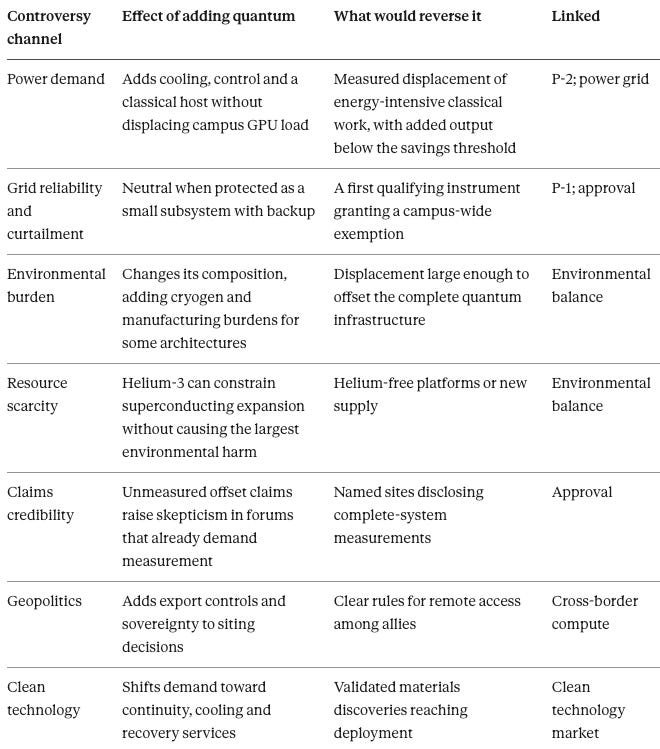
Power grid. Consumption relief is narrow and fragile to added output, while protected power for a quantum island becomes a siting requirement. A quantum island means the refrigeration, control electronics and host computer protected on their own circuit.
Cross-border compute. Globally distributed access can connect locally concentrated computing islands. Real-time control stays within one building, while job-level access crosses continents under export controls.
Clean technology market. The islands need continuity, cooling and recovery services more than energy volume.
Environmental balance. Burden differs by architecture, with helium-3 exposure concentrated in dilution-refrigerated systems.
Data center approval. Quantum can change approval prospects through measured changes in project burden and through the credibility of the developer’s claims.
What helps now. Shared workloads across remote sites and specialized compute matched to clean power help AI data centers far more than quantum will before 2031. Section V.D sets out how much each helps now and later.
Bottom line on the controversy. Through 2030, quantum does not reduce the controversy surrounding AI data centers. Adding quantum without removing classical work raises power demand and environmental burden, though by small amounts at current scale. The larger effect runs through credibility: developers who promise quantum offsets will deepen the controversy, while developers who measure burden and protect a small subsystem will leave it unchanged.
Quantum reduces the controversy only if it avoids more burden than its complete infrastructure creates, after accounting for additional output.
Quantum’s impact on the AI data center controversy through 2030
Why now. On October 7, 2026, the Defense Advanced Research Projects Agency (DARPA) moved four companies into the final stage of its Quantum Benchmarking Initiative. The four are Atom Computing, Diraq, IBM and IonQ. DARPA will test whether any approach reaches utility scale, where computational value exceeds cost, by 2033. Two days later, the Federal Energy Regulatory Commission (FERC) rejected PJM Interconnection’s curtail-first plan for new large loads, finding that it appeared to dictate which retail customers get curtailed.
What distinguishes the MindCast approach. MindCast AI applies Predictive Behavioral Economics + Dynamic Game Theory through the MindCast AI Proprietary Cognitive Digital Twin Foresight Simulation (MP CDT FS). Each Cognitive Digital Twin (CDT) models how a named actor decides as rules and evidence change.
Behavioral economics supplies the decision rule: authorities discount salient claims they cannot measure. Game theory supplies the payoff structure: where backup for a small subsystem is affordable, broad protection adds little for the operator. Predictive behavior emerges from the combination.
What the overview does. The overview releases three MindCast Foresight Simulation Predictions and withholds five conditions the evidence does not yet support. Section VI then maps five installments, from the power grid to data center approval.
Simulation Prediction highlights
Stakeholder readout
🏛️ Policymakers. When the first qualifying instrument addresses quantum continuity, the simulation expects it to require backup rather than grant an exemption (P-1). Before the 2027 sessions, define protected load by function and recovery time rather than technology label.
💼 Executives. Developers, hosts and hyperscalers gain an approvable design in the engineered quantum island (P-1, S-1). Isolate refrigeration and control on a protected circuit with sized ride-through before the first hosted installation.
⚖️ Counsel. Once a client measures a quantum gap, such as unprotected refrigeration or an efficiency claim without support-system data, the file becomes relevant evidence of awareness (P-1, P-2). Assess each gap case by case and document the decision before filing.
📊 Investors. If a site discloses measured relief, the simulation expects added output to absorb it (P-2). Give quantum efficiency no capacity credit until a measured disclosure exists.
II. Quantum Enters Data Centers as a Coupled Subsystem While Authorities Demand Measurement
Quantum enters AI data centers as a small coupled subsystem at the moment authorities demand present measurement from every large load. The collision matters more than quantum’s size, because forums under backlash pressure discount anything they cannot verify. Behavioral economics explains why actors overstate quantum’s efficiency, and game theory explains how state forums respond.
A. Demonstrations Still Outrun Deployments as Authorization Tightens
Commercial integration has begun at small scale. Equinix and Diraq announced Australia’s first quantum computer inside a data centre on September 1, 2026. The announced eight-qubit system would draw less than 20 kilowatts with self-contained cooling and controls.
Vendors have documented how to couple quantum processors to graphics processing units (GPUs). NVIDIA’s NVQLink integration architecture places a real-time classical host inside the quantum system for decoding and calibration. IonQ announced on September 23, 2026 that its Superion 256 will connect to an NVIDIA GB200 NVL72 system through NVQLink, with installation scheduled for 2027.
Demonstrations still outrun deployments. Quandela’s October 13 NVQLink demonstrator used a simulated quantum processor at an exhibition. Researchers have only begun to define energy efficiency across five quantum platforms, in Carrasco-Codina and colleagues’ “Energy Efficiency of Quantum Computers” (2026).
Authorization has tightened around large loads. Texas Governor Greg Abbott ordered the state environmental agency to halt data center permits on September 21, 2026. The halt holds pending an audit of the grid operator’s queue, expected in mid-December.
Takeaway. Quantum is moving into data centers as a coupled subsystem, while approval authorities demand present measurement from every large load.
B. Relief Counts Support Systems, and Reserved Capacity Moves Separately
Seven terms carry the energy accounting, and two of them separate what headlines merge: relief and reserved capacity.
Quantum island: refrigeration, control electronics and host computer protected on their own circuit.
Ride-through: on-site storage that carries protected equipment through a grid interruption.
Curtailment: an order from a grid operator or utility that a load reduce or stop drawing power.
Coupling: the real-time link between a quantum processor and its classical host.
Relief: lower site energy consumption for equivalent useful work, counting support systems.
Reserved capacity: grid capacity a site contracts for, tracked separately from consumption.
Rebound: added output that absorbs energy savings, so total consumption holds.
Takeaway. Relief counts support systems, and reserved capacity moves separately from consumption, so a site can save energy without freeing grid capacity.
C. The Simulation Separates Computational Usefulness From Physical Relief
The simulation answers one question. Which quantum-hybrid deployments convert quantum capability into lower resource requirements, and how do operators, hosts and authorities respond?
Released Simulation Predictions run from October 2026 through 2031. Scenarios extend to 2040 without dated bands. The forum is U.S. federal and state authority, with non-U.S. hosting as a comparison case.
The overview excludes post-quantum cryptography, quantum sensing and the selection of individual securities.
Takeaway. The governing question separates computational usefulness from physical relief and both from institutional treatment.
D. Authorities Discount Quantum Claims They Cannot Measure
Narrative analysis treats quantum as an efficiency story. Behavioral economics shows why actors use that story selectively. Operators anchor capacity plans to firm megawatts, so efficiency claims serve as arguments rather than as reasons to retire capacity.
Salience matters in approval forums. A future quantum offset sounds compelling in testimony, yet authorities under backlash pressure discount claims they cannot measure. Authorities also decide under docket pressure with bounded attention, so the simulation models their choices with decision noise rather than perfect optimization.
Takeaway. Declared efficiency goals and revealed capacity behavior diverge, and the divergence drives the forecasts.
E. State Forums and Operator Learning Shape Quantum’s Continuity Terms
FERC’s October 9 order found that PJM’s plan appeared to intrude on state authority over retail curtailment. Curtailment treatment for quantum equipment therefore runs through state forums with their own pressures. A static estimate of quantum’s energy effect misses that forum.
Operators learn from authorities’ responses. An operator that requests broad protection and receives a backup duty updates its expectations and shifts to a subsystem request. Vendors hold the energy data, so information asymmetry shapes every early claim.
Takeaway. Game theory supplies the payoff structure and the selection among equilibria, and predictive behavior emerges from combining it with behavioral decision rules.
F. Eleven Named Actors Test Whether Quantum Adds Load, Substitutes or Waits
The simulation models eleven actors as Cognitive Digital Twins. Hyperscale clouds (Amazon Web Services, Microsoft and Google) seek firm capacity and sell quantum access under queue, curtailment and export limits. Equinix hosts quantum systems as a premium product. Diraq, IonQ and IBM Quantum pursue placement, coupled results and fault tolerance under refrigeration and schedule limits.
NVIDIA works to make GPUs part of every quantum system within a microsecond latency budget. On the public side, FERC defines wholesale large-load service and PJM admits large loads after FERC’s rejection. Texas authorities admit loads with curtailment and backup duties during a permit halt. The Department of Energy and DARPA verify utility-scale value by 2033, while project lenders protect repayment under terms modeled by stated assumption.
The run tested whether quantum substitutes for classical work, adds load without displacing it or stays too small to matter through 2031. Four executed models fed the test: complete-system energy accounting, continuity sizing, coupling latency and a repeated contest over continuity terms.
Takeaway. The results favor delayed usefulness, added load and subsystem continuity over substitution, while the too-small-to-matter route stays live.
Section conclusion. Quantum’s treatment will turn on measured burden and continuity terms set in state forums, not on its energy draw.
III. Simulation Predictions: Backup Duties Precede Exemptions and Added Output Absorbs Energy Savings
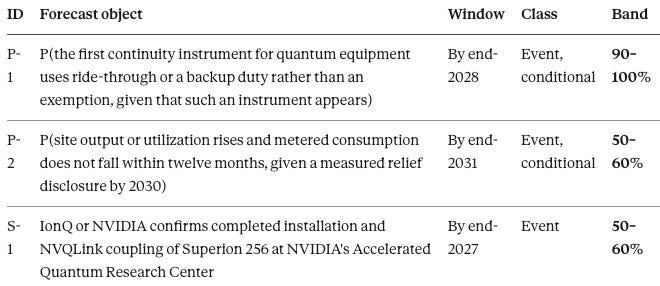
The overview releases three Simulation Predictions, original to the overview, and each tests a different link in the argument. P-1 tests how authorities treat quantum continuity, P-2 tests whether energy savings reach the grid and S-1 tests whether coupling arrives on schedule.
Small Protected Loads Keep Backup Modest While Added Output Erodes Relief
Energy accounting. Site consumption falls when displaced classical energy exceeds the energy of supporting systems: refrigeration, control electronics and the classical host. Added output then consumes part of the savings. Each deployment therefore has a growth threshold beyond which consumption rises, and in typical modeled cases the threshold sits at a few percent of added output.
Reserved capacity. A site can consume less energy while contracting the same grid capacity. The series treats consumption and reserved capacity as separate observations.
Continuity requirement. Protected energy scales with the protected load and the outage duration. Quantum systems are small, so the energy quantity stays modest, while cost and integration still require case-specific assessment.
Coupling distance. Real-time decoding requires a round trip of a few microseconds, which keeps a quantum processor and its classical host within a few hundred meters. Job-level access tolerates delays of tens to hundreds of milliseconds and can cross continents.
Continuity terms. The simulation modeled repeated negotiations between operators and authorities over continuity terms. Where backup for a small subsystem is affordable, broad protection adds little for the operator, and authorities facing measurement demands favor backup duties. Private hosts can require ride-through but cannot grant curtailment exemptions.
Takeaway. Small protected loads keep backup requirements modest in energy terms, while small eligible shares make consumption relief fragile to added output.
Delayed Usefulness and the Equipment Boundary Lead the Scenario Routes
Among physical outcomes, delayed usefulness is the base route: useful advantage at scale arrives after 2030 unless a complete-workflow advantage gets disclosed. Addition without displacement runs second, and measured substitution on a narrow workload remains the tail.
Among institutional outcomes, the equipment boundary is the base route as ride-through and backup duties spread to hosted installations. Generic treatment below the attention of dockets runs second, and a technology-label exemption adopted by a pro-development forum remains the tail.
III.A Continuity Attaches to the Subsystem and Relief Feeds Added Output
P-1 | Backup Duty Before Exemption
Forecast statement: P(the first instrument addressing quantum-equipment power continuity uses storage-backed ride-through or a backup obligation rather than a curtailment exemption or critical-load status given that such an instrument appears by year-end 2028). Band: 90–100%. An instrument means an agreement, tariff, order or published specification.
Class and window: conditional event, through December 31, 2028; void if no qualifying instrument appears.
Trigger conditions: hosted installations outside vendor-owned sites, with continuity requests reaching hosts or state forums.
Explicit falsifier: the first instrument grants an exemption or critical-load status without a ride-through or backup duty.
Verification source: the text of the first instrument, whether a tariff filing, service agreement, colocation specification or order.
P-2 | Added Output Absorbs Energy Savings
Forecast statement: P(the disclosing site’s useful output or utilization rises and its total metered consumption does not fall within twelve months given a measured relief disclosure by year-end 2030). Band: 50–60%.
Class and window: conditional event, twelve months after the disclosure and through December 31, 2031; void if no qualifying disclosure appears by 2030.
Trigger conditions: a named site discloses lower energy consumption for equivalent useful work, with support systems inside the boundary.
Explicit falsifier: neither useful output nor utilization rises, or total metered consumption falls.
Verification source: operator disclosures, service agreements and interconnection filings for the disclosing site.
Missing data counts against P-2. If the condition is met but output or consumption data stay undisclosed, P-2 resolves as a miss and an evidence gap.
III.B Coupling Milestones Test Integration, Not Energy Savings
S-1 | Superion 256 Coupling Confirmed
Forecast statement: IonQ or NVIDIA confirms completed installation of Superion 256 at NVIDIA’s Accelerated Quantum Research Center and its coupling to an NVIDIA GB200 NVL72 system through NVQLink by December 31, 2027. Band: 50–60%.
Linked route: addition.
Trigger: the announced 2027 installation.
Explicit falsifier: no confirmation of completed installation and coupling by the deadline; a further installation announcement does not count.
S-1 tests a coupling milestone only. The outcome carries no claim about energy savings or aggregate GPU demand.
III.C Offset Claims and Relief Disclosures Remain Too Thin to Forecast
The run withheld dated bands for five conditions because the evidence did not support release. Each stays under watch and enters a later set of Simulation Predictions when a gating event or new evidence arrives.
First measured relief disclosure by 2030. Timing evidence remains too thin for a band, and P-2 activates only if the disclosure occurs.
First continuity instrument by 2028. Hosting pipelines exist, but the link from installation to a qualifying instrument lacks support. P-1 activates only if the instrument appears.
Quantum offset citations in state proceedings. No qualifying filing has appeared, and actor intent remains unobserved.
Quantum-inspired energy disclosures first. Vendor claims exist, but no named operator has disclosed measured kilowatt-hours.
Quantum cited as grounds for curtailment exemption. No quantum installation yet sits inside a curtailable U.S. campus.
Takeaway. Offset claims and relief disclosures will reach state forums before the evidence to forecast their timing does.
III.D A Critical-Load Statute Would Break the Backup-Duty Forecast
One rule change breaks P-1. A state statute designating a whole facility class as critical load would grant protection without a quantum-specific contest. Such a statute counts against P-1 only if it names quantum equipment, and it shifts weight toward the broad-protection route regardless.
Lender behavior rests on a stated assumption. No lender has disclosed how it treats quantum efficiency, so the simulation assumes lenders credit capacity rather than unmeasured claims. If lenders credit announcements, P-2 weakens.
Section conclusion. P-1 at 90–100% tells developers and commissions which continuity design will hold, while P-2 at 50–60% tells investors not to count quantum savings as freed capacity. S-1 at 50–60% confirms integration progress only.
IV. Every Stakeholder Should Separate the Quantum Island From the Campus
Every stakeholder faces the same design choice in a different vocabulary: keep the quantum island separate from the campus or bundle the two. Policymakers make the choice in protected-load definitions, executives in electrical design, counsel in filings and investors in capacity credit.
Quantum Gives State Commissions a Clean Test Case for Protected Load
🏛️ Policymakers. State forums now set retail curtailment priorities, as Commissioner David Rosner’s concurrence urged. Quantum gives state commissions a clean test case: a small load with a real recovery cost. Defining protected load by function and recovery time keeps the category narrow as other technologies seek the same treatment (P-1).
💼 Executives. Developers, colocation hosts and hyperscalers share one design answer. Isolate refrigeration and real-time control on a protected circuit, size ride-through to the equipment’s tolerance and keep the GPU campus under ordinary large-load terms (P-1). Hyperscalers placing coupled racks should plan host nodes within a few hundred meters of the processor (S-1).
⚖️ Counsel. Support-system energy data, continuity sizing and recovery tests now document several foreseeable harms. Each can implicate a duty the client already carries: candor in regulatory filings, care in hosting terms and accuracy in sustainability statements. The Foresight-to-Duty list below shows who holds each measurement and who can fund the fix.
📊 Investors. Quantum readiness has option value but no near-term capacity value. A relief disclosure would most likely raise output rather than lower consumption (P-2). Hardware milestones such as S-1 confirm coupling progress, not energy savings. If a site discloses relief, test consumption rebound and contractual capacity release separately (P-2).
Quantum Gaps Become Documented Knowledge Before Any Quantum Rule Exists
MindCast’s Foresight-to-Duty Conversion in AI Governance, Series Introduction (2026) shows how an institution’s own measurement becomes evidence once it keeps the gap it found. The framework applies here because the quantum calculus produces those measurements early: support-inclusive energy data, continuity sizing and recovery exposure.
Judge Learned Hand’s formulation weighs the burden of precaution against the probability and magnitude of harm together. For a quantum island, the energy quantity is modest: an illustrative 1-megawatt system needs about 8.9 megawatt-hours of storage for eight hours.
Energy quantity alone does not establish installation cost, integration feasibility or how the burden compares with expected harm. Documented awareness of an unprotected subsystem therefore counts as relevant evidence, and whether precaution was due requires a case-specific assessment. The party that can fund a correction often differs from the party that verifies it, so the list keeps them apart.
Refrigeration and control without ride-through (P-1). Host engineering holds the measurement and the host funds the fix. Vendor recovery tests and the tenant verify it.
Efficiency claim without support-system data (P-1, P-2). The operator’s regulatory team holds the measurement and the operator funds the fix. Commission staff verify it.
Relief disclosed while consumption holds (P-2). The operator’s sustainability team holds the measurement and the operator funds the fix. Utility metering and investors verify it.
Coupled racks planned on a vendor schedule (S-1). Hyperscaler infrastructure planning holds the measurement and the hyperscaler funds the fix. Vendor milestones verify it.
Takeaway. Quantum gaps become documented knowledge before any quantum-specific rule exists, so exposure can arrive first through a client’s own files.
Unmeasured Quantum Claims Should Leave Pending Filings First
The sequence runs from what a team controls this month to what a legislature could change next year.
Now to 30 days: strip unmeasured quantum claims from pending submissions before a commission requests measurement support.
30 to 90 days: draft ride-through and recovery clauses before a quantum tenant requests protection.
3 to 12 months: separate electrical boundaries in new campus designs before a state opens a large-load rulemaking.
Beyond 12 months: keep designs that satisfy either regime in case a statute names a facility class as critical load.
Broad Protection Requests, Label Exemptions and Early Credit Carry the Exposure
Entry 1 · 💼 Developers · P-1 (90–100%).
Exposure: a developer that seeks campus-wide protection around a quantum tenant loses permitting schedule when the forum demands an engineered boundary. Severity: moderate. Probability: high once an instrument appears.
Mitigating actions: the electrical engineering lead isolates refrigeration and control on a separate circuit before the first 2027 large-load filing. The regulatory affairs lead frames requests by function and recovery time through December 31, 2028. The commercial lead assigns ride-through duty to the host and recovery duty to the vendor before the second hosted installation.
Residual exposure: a forum may still classify the whole campus by facility label during a pause.
Entry 2 · 🏛️ Policymakers · P-1 (90–100%).
Exposure: a commission that grants a label-based exemption sets a precedent that other technologies will cite within one or two session calendars. Severity: high. Probability: low.
Mitigating actions: commission staff publish a functional test for protected load before the 2027 sessions. Legislative staff tie any critical-load designation to demonstrated recovery cost and on-site backup.
Residual exposure: a statute passed under pro-development pressure can override commission tests.
Entry 3 · 📊 Investors · P-2 (50–60%).
Exposure: an underwriting case that credits quantum relief before 2031 overstates free capacity by the full credited amount. Severity: high for capacity-constrained valuations. Probability: moderate given a disclosure.
Mitigating actions: the credit committee grants zero capacity credit to quantum efficiency until a measured disclosure exists. The diligence lead requires complete-system energy data against a tuned classical baseline. The portfolio lead values quantum-inspired software separately from quantum hardware.
Residual exposure: an early advantage on a narrow workload could favor competitors who credited it sooner.
Entry 4 · 💼 Hyperscalers · S-1 (50–60%).
Exposure: a hyperscaler that plans coupled quantum racks on the vendor’s announced schedule can strand floor space and host nodes if installation slips. Severity: low to moderate. Probability: moderate.
Mitigating actions: the infrastructure planning lead reserves convertible space rather than dedicated space through 2027. The procurement lead ties host-node orders to installation milestones.
Residual exposure: early competitors may secure scarce coupling expertise first.
Nothing in Section IV constitutes legal, investment or fiduciary advice.
Section conclusion. Separation protects against both outcomes of P-1. Separated designs conform if backup duties spread, and they remain approvable if an exemption arrives instead.
V. The First Qualifying Instrument Sets the Template for Quantum Continuity
The first qualifying instrument will set the template for quantum continuity, and its effects travel through institutions, hosts and investors. Two other levers, shared workloads and clean-matched compute, matter more for AI data centers before 2031 than quantum does.
A. State Forums Will Define Protected Load for Small Sensitive Equipment
State forums will define protected load for small sensitive equipment, since FERC treated retail curtailment as state jurisdiction. Given that a qualifying instrument appears, P-1 expects it to define protection by equipment function and backup duty. State-law consequences follow only when a public authority issues that instrument, while a private hosting specification shapes commercial practice alone.
B. Hosts With Engineered Continuity Capture the Early Quantum Tenants
Hosts with engineered continuity capture the early quantum tenants, and they gain bargaining power because they write the first private terms. Storage and backup suppliers sell continuity quality rather than energy volume. Utilities keep curtailment flexibility because the protected island stays small.
Investors who wait lose little. The quantum option carries value for future workloads, while near-term capacity value stays close to zero (P-2).
C. Only a Documented Consumption Decline Counts as Physical Relief
If P-1 fails, the first instrument granted an exemption or critical-load status without a backup duty. The result weakens the predicted preference for subsystem protection, yet the subsystem design remains approvable. Where a state authority issued the instrument, other technologies will cite it.
If P-2 fails, the series identifies which failure occurred: flat output, lower consumption or missing data. Only a documented decline in consumption counts as evidence of physical relief.
Takeaway. The first qualifying instrument sets the template for quantum continuity, and added output determines whether relief reaches the grid.
D. Shared Workloads and Clean Specialized Compute Help Now Far More Than Quantum
Two levers do more than quantum: workload sharing across remote sites and specialized compute matched to clean power. Both help AI data centers now far more than quantum will before 2031.
How much do shared workloads help now? Flexibility has become the currency of approval. Duke University’s Nicholas Institute estimated in February 2025 that U.S. grids could absorb 76 gigawatts of new load if those loads accept curtailment 0.25 percent of the time. At 1 percent, the figure rises to 126 gigawatts.
Shared workloads supply the curtailment flexibility the Duke estimate assumes. Inference, batch jobs and checkpointed training can move between sites, so a campus can shed load while the work continues elsewhere. Large training runs resist splitting across sites, but they can pause between checkpoints.
How much does clean-matched specialized compute help now? Smaller sites matched to their power source carry a lighter and measurable local burden. Burden-based authorization rewards that profile, and the benefit grows where backlash runs strongest. Shifting flexible work toward clean hours and regions also cuts emissions without cutting total demand.
How much will the same levers help quantum-coupled data centers? Shared workloads and clean-matched compute help quantum as a siting architecture rather than as a source of relief. Job-level access lets a few quantum islands serve many remote GPU campuses, so not every campus needs cryogenics or a protected circuit. Firm clean hosts with storage and shared cryogenic plants suit a quantum island’s small and continuous load.
Why keep quantum islands apart from flexible campuses? Workload sharing makes GPU campuses curtailable, while quantum islands cannot pause without recovery costs. Combining them in one campus raises the firm-power intensity of the load that stays, the firmness inversion described in The Grid-Anchored Clean Power Bargain: Powering AI Data Centers Through 2040 (2026). Specialized hubs keep flexible campuses flexible, while real-time decoding stays within a few hundred meters of each processor.
The lever comparisons are assessments rather than Simulation Predictions, and each installment’s simulation will test the one it owns.
Takeaway. Shared workloads and clean specialized compute are today’s approval levers, and quantum inherits them as a siting architecture.
Section conclusion. Quantum’s near-term institutional effect runs through one document, the first continuity instrument, while its siting future runs through levers that already help AI data centers today.
VI. Five Installments Turn the Overview’s Mechanisms Into Site-Level Forecasts
Each installment owns a distinct set of Simulation Predictions and carries its own simulation. The overview’s releases do not repeat in the installments.
Power grid: does hybrid computing cut demand, reshape it or raise the value of continuity? The answer informs capacity reservations and backup design.
Cross-border compute: which work stays local and which moves across continents? The answer informs where to place quantum islands.
Clean technology market: what can clean energy developers sell into hybrid computing? The answer informs product and hosting strategy.
Environmental balance: does quantum avoid more burden than its complete infrastructure creates? The answer informs environmental disclosure and review.
Data center approval: when does quantum make a project easier or harder to authorize? The answer informs approval strategy.
VI.A Power Grid Relief Depends on Support Overhead and Output Growth
Leading insight. Consumption falls when displaced classical energy exceeds supporting overhead and added output stays below the savings threshold. Reserved capacity needs its own test, because a site can consume less while contracting the same capacity. The installment tests the relief hypotheses of How Quantum Computing Overcomes AI Data Center Bottlenecks (2025) against support overhead and output growth.
What the simulation will test. The power grid installment will model operator, host and utility choices across measured support overhead by platform. The installment will test whether a site’s reserved capacity falls even when energy per result does. Three comparisons structure the test.
Adding quantum to an existing AI facility adds cooling, controls and supporting classical load. Replacing a classical workload cuts consumption only if the complete quantum workflow uses less energy for an equivalent result. Using the savings for more output can lower energy per result while total consumption holds or rises.
What it cannot establish. Behavioral simulation cannot establish experimental energy advantage. Uncertain technical performance enters as competing inputs.
Takeaway. The grid installment turns the energy accounting into site-level Simulation Predictions on consumption, reserved capacity and peak.
VI.B Real-Time Control Stays Local While Job-Level Access Crosses Borders
Leading insight. Globally distributed access can connect locally concentrated computing islands. Real-time decoding stays within one building, and linked modules work within a campus or metro area. Job-level access crosses continents at round trips of tens to hundreds of milliseconds.
What the simulation will test. The cross-border installment will model which allied jurisdictions win the computing islands under export controls, data-localization law and sovereign-cloud rules.
The U.S. Bureau of Industry and Security’s September 2024 quantum controls govern hardware exports, and remote access remains the open question. Quantum Computing Sovereignty (2025) supplies the premise that integration intellectual property decides access.
What it cannot establish. The cross-border installment cannot forecast distributed quantum computation across continents, which would require entanglement distribution beyond current capability.
Takeaway. Location follows export status, cryogenic supply and talent more than power.
VI.C Clean Technology Sells Continuity and Cooling Into Hybrid Computing
Leading insight. The computing islands need continuity, cooling and recovery services more than energy volume. Clean firm power fits a quantum island but cannot drive procurement. A firm clean host can bundle those services with an allied jurisdiction. The Clean Compute Match (2026) supplies the pairing of firm clean power with anchored compute that the installment extends.
What the simulation will test. The clean technology installment will add firm clean developers, storage suppliers and cryogenic service providers as Cognitive Digital Twins. The installment will also track quantum-assisted materials discovery, such as the Department of Energy’s $37 million Quantum Computing for Computational Chemistry (QC3)program, as a separate opportunity.
What it cannot establish. Discovery benefits require experimental validation and manufacturing. The installment will treat them as staged gates without a fixed arrival date.
Takeaway. The clean technology market for quantum sells service quality, not kilowatt-hours.
VI.D Environmental Burden Moves With Quantum Architecture
Leading insight. The environmental installment assesses the total burden of the computing islands, and exposure differs by architecture. Superconducting and silicon spin systems depend on dilution refrigeration and helium-3, while trapped-ion and neutral-atom systems face different constraints. Prospective research such as Oak Ridge National Laboratory’s study of quantum computing futures concerns scaled superconducting systems in the 2030s and 2040s.
What the simulation will test. The environmental installment will compare electricity, manufacturing and water burdens against equivalent useful work, then add cryogens and rebound. The installment will model the helium-3 supply chain, including forward contracts for lunar helium-3 that depend on unproven extraction.
What it cannot establish. Prospective discovery benefits cannot offset present local burdens. The installment will keep them on separate scenario clocks.
Takeaway. Environmental exposure moves with architecture, so no single quantum footprint exists.
VI.E Approval Turns on Measured Burden and Claim Credibility
Leading insight. Quantum can change approval prospects through measured changes in project burden and through the credibility of the developer’s claims. Unmeasured offset claims lose credibility in forums that demand measurement. Engineered quantum islands offer authorities what they already require. Burden-Based Authorization for AI Data Centers, Modular Clean Compute, and the Backlash Gap Between Grid Tariffs and State Law (2026) supplies the measured-burden test the installment applies.
What the simulation will test. The approval installment will compare three project types against two developer postures. The project types are additions to existing facilities, dedicated quantum installations and new AI campuses claiming quantum benefits. The postures are claimed benefit and measured burden, which yields six approval cells. County and community Cognitive Digital Twins join the state authorities.
What it cannot establish. The approval installment cannot forecast the outcome of a specific pending permit without that project’s filings.
Takeaway. The finale answers whether quantum changes a project’s actual burden enough to change permission to build.
Section conclusion. The installments move from physics to permission: grid and environment test what quantum changes, cross-border and clean technology test where it locates and the finale tests whether authorities let it build.
Hosting Specifications and Relief Disclosures Resolve the Forecasts
Seven signals resolve or move the overview’s forecasts, and most arrive through hosting specifications, commission dockets and operator disclosures.
Activates P-1: quantum hosting specifications and service agreements, reviewed quarterly in colocation operator publications.
Shifts P-1 route weights: state large-load rulemakings and curtailment designations, reviewed monthly in commission dockets.
Breaks P-1: critical-load legislation, reviewed during legislative sessions.
Activates P-2: measured relief disclosures from operators and vendors, reviewed quarterly.
Resolves P-2: output and metered demand at disclosing sites, in operator disclosures and interconnection filings.
Resolves S-1: Superion installation status in IonQ and NVIDIA releases, reviewed quarterly.
Releases watch conditions: the Texas queue audit and permit decisions, reviewed monthly.
Section conclusion. P-1 and S-1 resolve against public documents by 2028, while P-2 activates only if a site discloses measured relief.
Conclusion: Developers Who Measure Quantum’s Burden Keep It From Deepening the Controversy
Quantum lowers AI data center consumption when displaced classical energy exceeds supporting overhead and added output stays below the savings threshold. Through 2030, the simulation finds hybrid computing more likely to shift constraints than relieve them. Continuity moves onto the grid agenda, cryogenics and materials move onto the environmental agenda and export status moves onto the siting agenda. Quantum will therefore leave the controversy around AI data centers unchanged or deepen it, depending on whether developers measure its burden or promise its offsets.
Globally distributed access will connect locally concentrated computing islands. Stakeholders should act now on what they can measure: support-system energy, protected subsystems and the credibility of their own claims. They can wait to learn whether useful advantage arrives on DARPA’s schedule.
The decisive signal is the text of the first qualifying instrument addressing quantum continuity. If it grants an exemption without a backup duty, P-1 fails. The predicted preference for subsystem protection then weakens, while the subsystem design remains approvable.
A Campus’s Quantum Hosting Decision Depends on Confidential Inputs
Public analysis cannot tell a specific developer whether its campus should host quantum equipment. The answer depends on the site’s contracts, its forum and its customers’ workloads. Site inputs stay confidential.
MindCast builds Cognitive Digital Twins of the developer, its utility, its state authority and its prospective quantum tenants. The engagement ingests the organization’s own decision history and reruns the continuity contest and energy accounting against its actual options.
Commissioned scope adds complete probability distributions, P10/P50/P90 ranges and organization-specific calibration. The scope also adds complete scenario trees, decision thresholds, trigger dashboards and red-team tests of counterparty responses.
The bounded next step is a scoped site diagnostic: one campus, one forum and one quantum hosting decision. Contact mcai@mindcast-ai.com or visit www.mindcast-ai-simulation.com to arrange it.
Appendix A. Selected MindCast Works
The series
Which Funded Solutions Keep Quantum-Coupled AI Data Centers Approvable? (October 2026). Tests 31 measures against the burdens the overview names and assesses which keep quantum sites approvable.
Frameworks and methods
The Dynamic Predictive Game Theory Collection (July 2026). Supplies the changing-game frame used to model curtailment treatment in state forums after FERC’s October 9 order.
Field-Geometry Reasoning: A Unifying Framework for Structural Explanation in Law, Economics and Artificial Intelligence (January 2026). Supplies the constraint lens that separates workload, coupling, continuity and materials constraints.
The Authorization Market: Standardized Bargaining, Rationed Power, and the Competition to Build America’s AI Infrastructure (August 2026). Supplies the finding that connected power is not firm power, which frames the continuity contest.
Burden-Based Authorization for AI Data Centers, Modular Clean Compute, and the Backlash Gap Between Grid Tariffs and State Law (September 2026). Supplies measured burden in place of the facility label, the test the approval installment applies.
Foresight-to-Duty Conversion in AI Governance, Series Introduction (October 2026). Supplies the conversion of measured gaps into evidence of awareness, the frame for the Foresight-to-Duty exposure list.
Prior quantum analysis
Quantum Computing and the Future of Economics (May 2025). Frames quantum as a change in how institutions model decisions under uncertainty.
How Quantum Computing Overcomes AI Data Center Bottlenecks (October 2025). Supplies the relief hypotheses that the energy accounting now tests against support overhead and output growth.
NVIDIA NVQLink Validation (October 2025). Supplies the microsecond coupling analysis behind the co-location limit.
Quantum Computing Sovereignty (October 2025). Finds that integration intellectual property decides access, a premise of the cross-border installment.
The AI-Quantum Closed-Open-Hybrid Architecture Problem (March 2026). Grounds the tightly coupled tier that cannot be distributed.
AI × Quantum × Blockchain Convergence, A Three-Clock Framework for Capital Allocation, Verification, and Fault-Tolerant Optionality (April 2026). Separates the clocks that keep discovery benefits apart from near-term AI load.
Related AI data center analysis
The Grid-Anchored Clean Power Bargain: Powering AI Data Centers Through 2040 (September 2026). Supplies the firmness inversion: moving flexible compute toward energy raises the firm-power intensity of the load that stays.
The Clean Compute Match: Which Clean Power Pairs With Which AI Compute, And What Stays On Fossil(September 2026). Pairs firm clean power with anchored compute, the hosting route the clean technology installment tests.
AI Data Center Veto Points Show Where Projects Get Stopped and How Authorization Risk Moves (September 2026). Maps the approval stages where quantum claims would enter.
Appendix B. External Sources
DARPA, “Four More Teams Enter Quantum Benchmarking Initiative Final Stage“ (October 7, 2026).
FERC, Order on PJM Interconnection Large Load Proposal, Docket ER26-3515-000 (October 9, 2026).
Bracewell, “Governor Abbott Orders TCEQ to Pause All Permit Issuance for Data Center Projects“ (September 23, 2026).
Equinix, “Diraq and Equinix to Deploy Australia’s First Quantum Computer Inside a Data Centre“ (September 1, 2026).
IonQ, “IonQ to Advance Quantum Supercomputing by Bringing First QPU to NVIDIA Accelerated Quantum Research Center“ (September 23, 2026).
NVIDIA, “NVIDIA NVQLink Architecture Integrates Accelerated Computing with Quantum Processors“ (2025).
Quandela, NVQLink demonstrator announcement (October 13, 2026).
Carrasco-Codina et al., “Energy Efficiency of Quantum Computers,” arXiv:2605.15090v2 (2026).
Oak Ridge National Laboratory, “Uncertain Quantum Computing Futures and Potential Energy and Physical Resource Implications.”
U.S. Bureau of Industry and Security, quantum computing controls (September 2024).
GeekWire, Interlune helium-3 agreements with DOE and Maybell Quantum (May 2025).
Duke University Nicholas Institute, “Rethinking Load Growth“ (February 2025).
Utility Dive, “FERC Rejects Core of PJM Large Load Interconnection Plan“ (October 2026), reporting Commissioner Rosner’s concurrence.
ARPA-E, Quantum Computing for Computational Chemistry (QC3) program announcement.