


MindCast AI's Super Bowl LX foresight simulation is live. Seattle operates with multi-regime survivability—capable of winning through expansion or compression. New England operates with single-gear compression. The simulation doesn't favor Seattle because Seattle is better. It favors Seattle because Seattle has more ways to win. Vegas prices a coin flip. We agree through halftime—then diverge. Full analysis: https://www.mindcast-ai.com/p/super-bowl-lx
MindCast AI is a law and behavioral economics foresight simulation firm. Our NFL analyses use structural, cognitive, and game-theory language rather than Vegas-style shorthand parlance. Our language reflects the behavioral economics foundation of our AI simulation.
Live update: An updated simulation will be posted in the comments at halftime, recalibrating probability bands based on observed thresholds and game trajectory.
Icon key: 🧱 = where control is built or lost | ⏱️ = where timing decides outcomes | ⚙️ = where cognition and decision stress matter | ⚖️ = where market logic diverges from foresight logic | 🔄 = where branches open or collapse | 📈📉🔍 = how to read the game live | ❌ = how the model can fail
📋 Executive Summary 🧱 ⏱️
Seattle wins the NFC Championship in most high-trust branches by refusing to let the game become the Rams’ kind of game. Los Angeles can still win—but only by hitting early explosives and forcing turnovers before Seattle’s compression system locks in. The separation happens during the Middle Eight.
Foresight simulation verdict: Seattle wins more often because it collapses explosive-dependent branches while operating with superior rest, structural stability, and home-field communication advantage. Los Angeles’s path remains live but narrow, front-loaded, and tempo-dependent.
Bottom line foresight prediction: Seattle by 4–10 points in the modal branch, with separation emerging after halftime.
📈 I. Post–November 16 Trajectories 🧱
Direction of travel matters more than raw records. Championship games reward systems that harden under pressure, not teams that merely accumulate wins. The question is which system improved its internal coherence since the last meeting.
🦅 Seattle Seahawks
Since the Week 11 loss in Los Angeles, Seattle has gone 8–0. Opponents scored 3, 10, and 6 points in the final three games, culminating in a 41–6 Divisional Round blowout over San Francisco. Rashid Shaheed’s 95-yard kickoff return set the tone; Kenneth Walker III added three rushing touchdowns; Sam Darnold went 12/17 for 124 yards and a score while playing through an oblique injury. The 49ers never reached the end zone—Seattle’s defense forced three turnovers and allowed 236 total yards, a live confirmation of the compression thesis against a top-tier offense.
🐏 Los Angeles Rams
The Rams are 7–3 since Week 11, advancing through two consecutive road playoff games decided by a single score: 34–31 at Carolina, 20–17 in overtime at Chicago. Both wins came on late sequences rather than sustained control—field goals and overtime outcomes, not separation. The offensive ceiling remains elite, but outcomes increasingly hinge on leverage rather than dominance.
Trajectory signal: Seattle’s curve shows convergence toward control. The Rams’ curve shows survival through leverage. That asymmetry defines the structural starting point for the third meeting.
⚔️ II. Identity Collision: Compression vs Tempo 🧱 ⚙️
The matchup is best understood as a clash of game-state identities rather than talent or scheme. Each team is optimized for a different kind of football, and one identity tends to dominate once stress accumulates.
🛡️ Seattle’s Preferred World
Fewer possessions. Drives that lengthen as pressure accumulates. Second-half advantage driven by recovery resilience. Quarterback as efficiency anchor, not volatility generator.
⚡ Rams’ Preferred World
Early explosives in the first 12–15 plays. Scripted tempo that forces defensive adjustment. Scoreboard pressure that pushes Seattle into urgency passing. Quarterback as decisive rhythm engine.
The first two meetings validated this split: a low-total 21–19 game when explosives were constrained and a 38–37 shootout when tempo and chaos survived compression attempts. The game turns on which identity imposes its environment first. Compression favors Seattle; tempo favors Los Angeles. The third meeting magnifies this tension rather than resolving it.
MindCast AI builds Cognitive Digital Twins (CDTs) of teams, players, and coaches to simulate how communication, trust, and coordination hold under stress. The simulation integrates behavioral economics to model decision-making under pressure and game theory to capture how each team constrains the other’s options as conditions change.
Instead of assuming static performance, MindCast AI tracks how tempo, clarity, and fatigue reshape behavior in real time. Where traditional analytics describe what already happened, MindCast AI focuses on when structure breaks. It produces dynamic probability bands that shift as pressure accumulates, leverage emerges, or control collapses, offering a forward-looking explanation of how and why games break—not just who wins.
Contact mcai@mindcast-ai.com to partner with us on sports foresight simulations.
See MCAI Football Vision: Betting AI vs. Foresight AI, MindCast AI Comparative Analysis With NFL Models (Sep 2025).
⚖️ III. Market Consensus and Pricing Context
Markets aggregate public information efficiently but smooth away structural asymmetries that are difficult to quantify. The goal here is to identify where market logic diverges from foresight logic.
Current market position: Sportsbooks price Seattle as a narrow home favorite (roughly -2 to -2.5 with a moneyline around -130 to -140) with a total in the high 40s (47.5–48.5), splitting the difference between the low-scoring opener and high-scoring rematch.
The one thing markets can’t see: Whether Seattle converts red-zone control into touchdowns. Market pricing assumes monetization. The simulation treats it as contingent—and that contingency is the entire game.
⚖️ Institutional Variable: Officiating Elasticity
A foresight simulation must account for the officiating crew’s “Strictness Profile.” High-interference crews (frequent holding/DPI calls) lower Seattle’s compression advantage by extending Rams drives on third-down incompletions. Low-interference crews favor physical coverage and allow Seattle’s secondary to play tighter without flag risk.
Constraint implication: If the assigned crew trends toward high penalty frequency, the Rams’ tempo branch gains ~5–8% probability mass. If the crew trends permissive, Seattle’s compression thesis strengthens. The variable does not change the directional prediction—but it widens or narrows the outcome band.
The narrow spread and modest total suggest markets see a close, controlled game. The simulation agrees on game texture but diverges on the mechanism—control is not separation until red-zone efficiency converts it.
🔬 IV. Cognitive Digital Twin Analysis ⚙️ 🧱
The CDT simulation models four causal layers: structural constraint, decision systems, tactical matchups, and stress grammar. Each layer isolates a different dimension of how teams behave under pressure, then recombines to show why certain game paths dominate.
🏟️ Structural Constraint
Lumen Field creates a geometry-first game. Noise, possession compression, and field position explain more outcome variance than scheme creativity. Seattle’s system functions inside constraint. The Rams require cleaner timing paths that degrade as noise and pressure stack.
Regular-season profiling captured the same tension: the Rams led the league in scoring (30.5 per game) while Seattle allowed the fewest points (17.2 per game)—a direct structural clash between ceiling and suppression.
🧠 Decision Systems: Heuristic Drift vs. Tactical Friction
The simulation identifies a critical System 1 vs. System 2 divergence in the Stafford-Macdonald matchup.
Stafford thrives on “Heuristic Fluidity”—the ability to recognize defensive patterns instantly and release within the timing window. Seattle’s coaching-QB spine (Macdonald, Kubiak, Darnold) refuses bad branches and stabilizes under disruption. The Rams’ spine (McVay, Stafford) presses advantage early through intuitive processing.
By layering “Tactical Friction” (delayed blitzes, late-secondary rotations, disguised coverages that shift post-snap), Macdonald is not trying to beat Stafford’s arm—he is trying to overload Stafford’s System 2 processing capacity. When the cognitive cost of a play exceeds the 2.4-second timing window, the Rams experience Grammatical Collapse: force errors (interceptable balls) or stagnation (sacks).
The Rams’ failure mode is Heuristic Drift—where Stafford relies on a pre-snap mental map that is no longer valid post-snap. Lumen Field noise compounds this by taxing the audible-to-snap communication chain, adding processing delay before the play even begins.
🐺 Wolverine Vision (Tactical Matchups)
Defense: Seattle’s win condition is pressure accumulation without blitzing. Target: 10–12 Stafford pressured dropbacks while preserving coverage on Nacua, Kupp, and Adams. If explosives are capped early, Rams drives elongate and efficiency drops under noise.
Offense: Seattle’s advantage is early-down balance and play-action intermediates. The primary failure mode is hesitation against disguised zone—exactly how the Rams captured leverage in Week 11. Deep-drop hero ball is a trap.
🌀 Stress Grammar: Error Propagation Asymmetry
Seattle owns the “storm grammar”—compression, control, second-half recalibration. The Rams own the “clear-sky grammar”—timing precision that degrades under noise, fatigue, and late-game pressure. Lumen Field increases storm frequency.
System Resilience Profile:
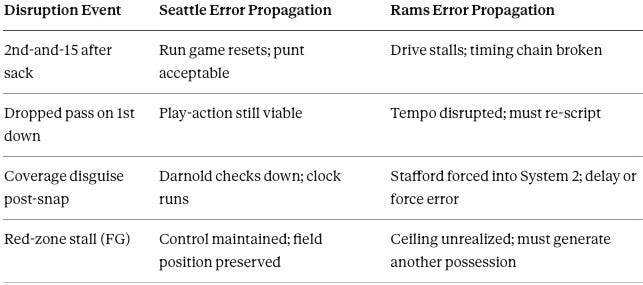
In the Rams’ system, a single timing break (dropped pass, sack, coverage shift) propagates through the entire drive. In Seattle’s system, error propagation is capped by the run game and field position. Seattle can survive mistakes; the Rams need cleaner sequences to access their ceiling.
Across all four layers, the simulation flows resolve toward Seattle once the game moves beyond scripted conditions. The Rams’ path requires early rhythm and sustained timing precision—conditions that Lumen Field and Seattle’s defensive architecture are designed to deny.
⚠️ V. The Darnold Catastrophe Branch 🔄
Every foresight simulation must identify the single-variable failure mode that can override structural advantages. In this matchup, that variable is quarterback-driven turnovers.
The model has already seen the catastrophic branch once: four Darnold interceptions in Week 11 nearly failed to decide the game anyway, but they remain the shortest path to Rams leverage this time. Sam Darnold’s downside tail—early interceptions, tipped balls from hesitation, forced throws under pressure—is the only single-variable catastrophe branch in this matchup. If Darnold commits two or more turnovers before halftime, Seattle’s structural advantages become irrelevant. The game reverts to Week 11 shape: short fields, urgency passing, and a late coin flip where Stafford’s decisiveness can steal it.
The preceding paragraph is not a prediction that Darnold will fail. It is an acknowledgment that Seattle’s system survives unless this specific failure mode activates. The compression thesis assumes Darnold plays within structure. If he doesn’t, the Rams don’t need to impose their system—Seattle will have abandoned its own.
The Darnold downside tail is the only lever that can flip the game independent of all other structural factors. If it activates, none of the preceding analysis applies.
🎯 VI. Decision Thresholds to Watch 📈 📉 🔍
Foresight does not hinge on totals or yardage. It hinges on threshold crossings—observable moments where the game irreversibly shifts toward one system’s advantage. The diagnostics below provide a real-time framework for reading the game as it unfolds.

Threshold logic: If Seattle clears these gates, the Rams’ volatility window closes rapidly after halftime.
✅ Falsification Contract (Halftime Check)
Compression thesis weakens if: Rams lead and have hit ≥2 explosives and Stafford has ≤3 pressured dropbacks. If the Rams meet their early explosive thresholds and carry a multi-score lead, the game has escaped the compression band that a short spread and modest total were implicitly pricing.
Tempo thesis failing if: Seattle tied or leading and Stafford has ≥6 pressured dropbacks
❌ Black Swan Indicator: Structural Containment Collapse
The Seattle Compression Thesis is falsified if the Rams achieve ≥3 first-half explosive plays (20+ yards) against a two-high safety shell. Such an outcome would indicate total collapse of Seattle’s structural containment logic—not a bad beat, but a model failure. The simulation assumes Seattle’s coverage architecture holds against vertical shots; if it doesn’t, the geometry-first premise is invalid and the outcome reverts to talent parity.
The diagnostics above allow real-time model validation. By halftime, the game state should confirm or challenge the compression thesis—providing accountability rather than post-hoc narrative adjustment.
🌲 VII. Outcome Branching 🔄
Outcome branching translates structural analysis into discrete, testable resolution paths. Each scenario specifies the conditions under which one system overwhelms the other or loses control. Probabilities reflect persistence of structure, not narrative confidence.
🟢 Scenario A — Seattle Compression Lock (≈50%)
Explosives capped in the first 15 plays. Pressure accumulates without blitzing. Red-zone trips produce touchdowns. Seattle separates during the Middle Eight and closes in the fourth quarter as Rams timing degrades.
🟡 Scenario B — Rams Script Separation (≈30%)
Two or more early explosives. Stafford finds rhythm before pressure accumulates. A turnover or short-field score tilts leverage. The Rams win if they hold that advantage through the Middle Eight.
🔴 Scenario C — Turnover-Swing Chaos (≈20%)
Early Darnold interception or special-teams shock. Neither system fully imposes itself. The game becomes a fourth-quarter coin flip where Stafford’s decisiveness can steal it.
As the game lengthens, probability mass shifts toward Seattle—unless early separation occurs. The Rams must win early or not at all; Seattle can win early, late, or anywhere in between.
🔮 VIII. Foresight Prediction
MindCast AI does not issue point-spread picks. It issues a foresight resolution: which system the game converges toward once real-world stressors are applied, and under what conditions that answer flips.
In the majority of high-trust simulation branches, the game resolves toward Seattle.
The prediction is not a claim that Seattle is uniformly better. It is a claim that Seattle’s system survives longer under playoff constraint and therefore captures more late-game outcomes.
📏 Predicted Outcome Band
Seattle by 4–10 points in the modal branch, with final margin emerging from second-half control rather than early scoring bursts.
🛤️ Predicted Convergence Path
Los Angeles accesses early offense but fails to sustain explosives beyond the opening script. Seattle accumulates pressure without blitzing, elongating Rams drives. Seattle converts control during the Middle Eight. The game shifts from leverage parity to directional control. Seattle closes with a possession-controlling drive or defensive stop.
❌ Failure Conditions
The prediction fails if: multiple early Darnold turnovers create short fields, or the Rams hit ≥2 explosives in the first 15 plays and maintain clean protection through halftime.
If those conditions do not materialize, the CDT flows converge toward Seattle.
Seattle’s system survives longer under playoff constraint and therefore captures more late-game outcomes. The prediction is conditional, falsifiable, and grounded in observable thresholds—not narrative confidence or momentum.
🏁 Final Framing
Vegas prices the median outcome—who is slightly more likely to win across all scenarios.
MindCast forecasts which system captures the game once stress, noise, and variance are maximized—and identifies the specific threshold crossings where that answer flips.
That conditional resolution is the foresight prediction.
Previous MCAI NFL Vision Publications:
MCAI NFL Vision: Seahawks vs. 49ers, 2026 NFC Divisional Round
MCAI NFL Vision: Seahawks vs. 49ers Week 18, 2025
MCAI NFL Vision: Seahawks vs. Panthers Week 17, 2025
MCAI NFL Vision: Seahawks vs. Rams, Week 16, 2025
MCAI NFL Vision: Seahawks vs. Colts, Week 15 2025
MCAI Football Vision: Betting AI vs. Foresight AI, MindCast AI Comparative Analysis With NFL Models (Sep 2025)
🏈 MindCast AI Foresight Validation | NFC Championship
✅ PREDICTION vs. OUTCOME
📊 Margin: Predicted 4–10 pts → Actual 4 pts ✓
🧱 System: Compression locks after half → Seattle led 17–13, controlled Q4 ✓
⚠️ Darnold Risk: Catastrophe if 2+ turnovers → Zero turnovers ✓
🛡️ Decider: Late defensive stop → Witherspoon 4th-down breakup at 6-yard line ✓
⏱️ THRESHOLDS — All 4 confirmed
1️⃣ Rams explosives capped early — compression held
2️⃣ Seattle led at half, Stafford pressured — tempo thesis failing
3️⃣ Middle Eight decisive — Seattle 17–13 → 24–13
4️⃣ Volatility response — Rams answered (24–20), Seattle re-imposed structure
🔄 SCENARIO RESOLUTION
🟢 Scenario A (Compression Lock, ~50%) → ACTIVATED ✓
🟡 Scenario B (Rams Script Separation, ~30%) → Did not materialize
🔴 Scenario C (Turnover Chaos, ~20%) → Did not materialize
🎯 KEY PLAYERS
Darnold: 25-of-36, 346 yds, 3 TD, 0 INT — catastrophe branch neutralized
Stafford: 374 yds, 3 TD but critical 4th-down miss — ceiling accessible, not sustainable
Witherspoon: Game-defining PBU — defensive architecture validated
❌ FALSIFICATION: No conditions triggered. Model assumptions held.
🏁 BOTTOM LINE
Seattle 31, Rams 27 validates the CDT framework. Margin within band, system resolution matched, all thresholds confirmed. Foresight ≠ luck — it's methodology.
On to Super Bowl LX vs. New England.
Why 24–20 (Q3) validates — not breaks — the foresight simulation
A 24–20 Seahawks lead in the third quarter does not contradict the foresight model. It activates the stress test the model explicitly described. The simulation never predicted a clean, uninterrupted compression win. It predicted that Seattle’s advantage would be tested after a leverage shock — and that the Rams’ only viable response would be an immediate tempo-driven counterpunch.
That’s exactly what happened. Seattle received a non-offensive gift (the muffed punt), converted it into a touchdown to go up 24–13 — a state the model identified as a potential knockout. The Rams’ ability to answer immediately and cut it to 24–20 is not a refutation; it is the volatility branch the foresight warned would open only if tempo survived a compression attempt.
At 24–20, Seattle still leads, but control has narrowed. That outcome was modeled. Foresight fails when reality violates its assumptions. This game hasn’t done that. It has followed the branching logic exactly: compression → leverage shock → volatility test. The model is now being honored, not invalidated, by whether Seattle can re-impose structure or whether volatility resolves in Stafford’s favor.