White House · Treasury Department · National Security Council · Commerce Department · Bureau of Industry and Security · Xi Jinping · Ministry of Commerce of China · Alibaba · ByteDance · Tencent · Nvidia · Senate Banking Committee · Malaysia · Singapore · Indonesia · Thailand · Brazil · Shenzhen · Miami
Companions: Commerce’s Rented GPU Ban Would Exempt Chips Already Delivered, and the Cutoff Date Decides Its Reach · Lutnick and the Commerce Department Likely Miss January 10 on the Rented GPU Rule, and His Tenure Shapes What It Exempts More Than When It Publishes · AI Chip Export Controls After the Remote-Access Rule: Treasury Wrote It, Commerce Signed It, and the Renter in China Stays Unreached
Enjoy the interactive war gaming module of MindCast predictive game theory models for global chip trading.
Thesis. The US-China trade truce never covered technology controls, so Washington’s new rule on remote access to AI chips forces Beijing to choose how to read the truce. Beijing’s August 5 answer to two other US measures shows the likeliest reply: a restrained countermeasure package, then renewal on January 10 without any demand on chips.
Why now. Trump and Xi meet in Shenzhen on November 19, the rule publishes the same day and the truce expires January 10. Four audiences face a decision before that date: policymakers; executives at chip, cloud and rare-earth-dependent firms; counsel to data center operators; and investors with China exposure.

Executive Summary
A truce built on matched suspensions has no rule for a weapon introduced mid-truce. Both governments suspended their strongest measures to January 10, 2027. The remote-access rule sits outside every suspended set, and Beijing has threatened countermeasures.
Beijing’s own precedent sets the likeliest reply. In August, Beijing answered two US measures with a bounded package, and the truce was extended anyway. The simulation finds the same pattern most likely now: a bounded package citing the rule, then renewal without chip terms.
MindCast distinction. MindCast AI applies Predictive Behavioral Economics + Dynamic Game Theory through MindCast AI Proprietary Cognitive Digital Twin Foresight Simulations (MP CDT FS). Behavioral Economics supplies the decision rules. Game Theory supplies the payoff structure. Predictive simulations emerge from the combination.
What the paper does. The paper sets out the truce’s equilibrium, maps the board and its forks and issues eight MindCast Foresight Simulation Predictions. Later sections trace how each dated event changes the game and close with risk mitigation and dated observables.
🏛 Policymakers. Beijing is likely to answer the rule without ending the truce.
💼 Executives. An operator's best move, filing early and deferring any tenant termination, wins on every branch.
⚖ Counsel. Client risk runs through Beijing’s entity lists, not through a tariff war.
📊 Investors. The 24% chance of a lapse on January 10 carries the tail exposure.
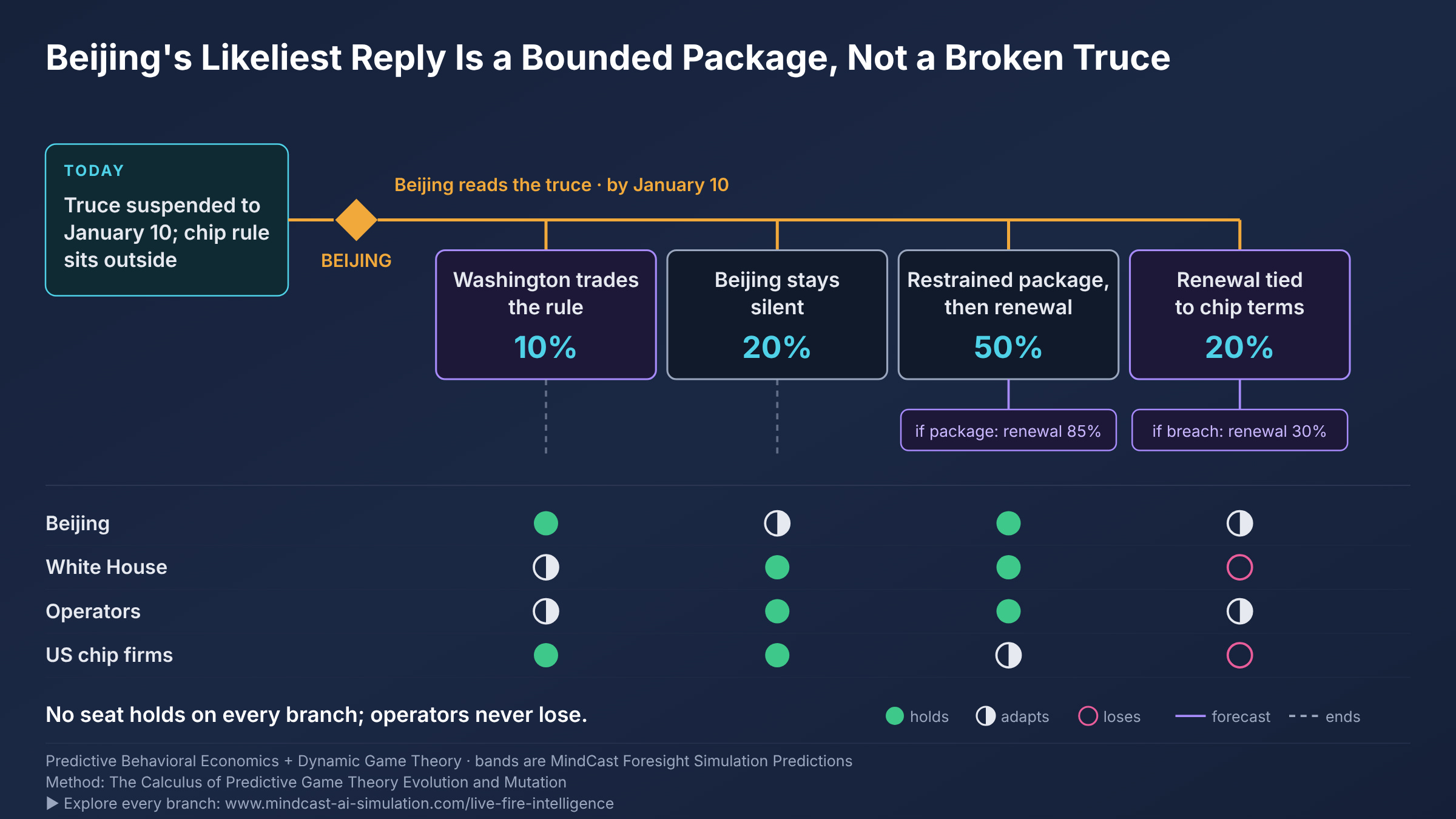
The game at a glance. Beijing’s reading of the truce decides where the game goes, and the map shows where each seat lands on every branch.
Five Dated Events Reshape the Board Before the Compliance Deadline
Dated events replace the game inside any client’s decision window. The Shenzhen bilateral lands on November 19, the Group of 20 (G20) on December 14-15 and the truce expiry on January 10. The case therefore runs as a Simulation Snapshot, which sets odds at the current fork and maps every branch past it.
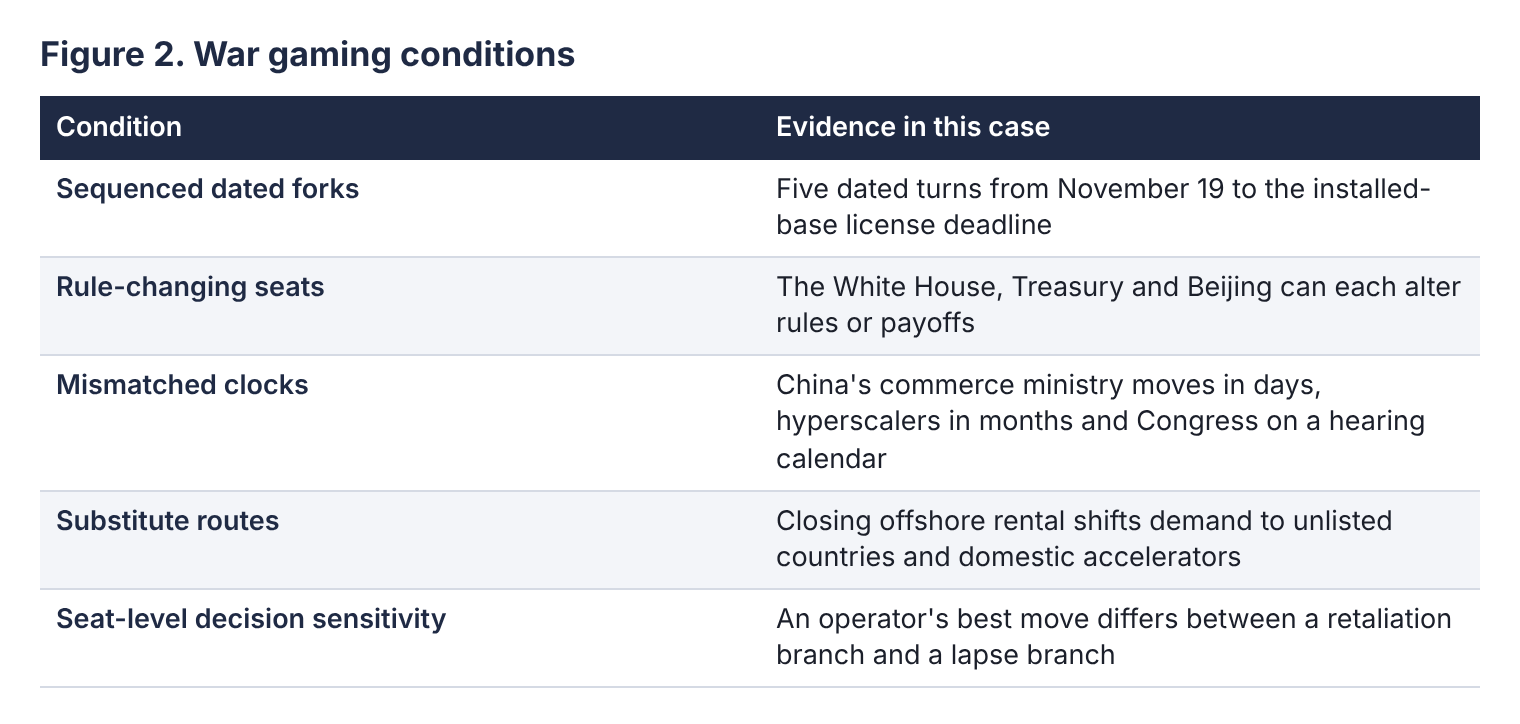
War gaming conditions. All five conditions hold, so the Snapshot carries an interactive war game.
Horizon classification. Each candidate claim received a class before any number attached, under the horizon test in The Calculus of Predictive Game Theory Evolution and Mutation. Snapshot odds round to the nearest 10% and apply only at the current fork. Figure 3 shows the class and outcome for every claim.
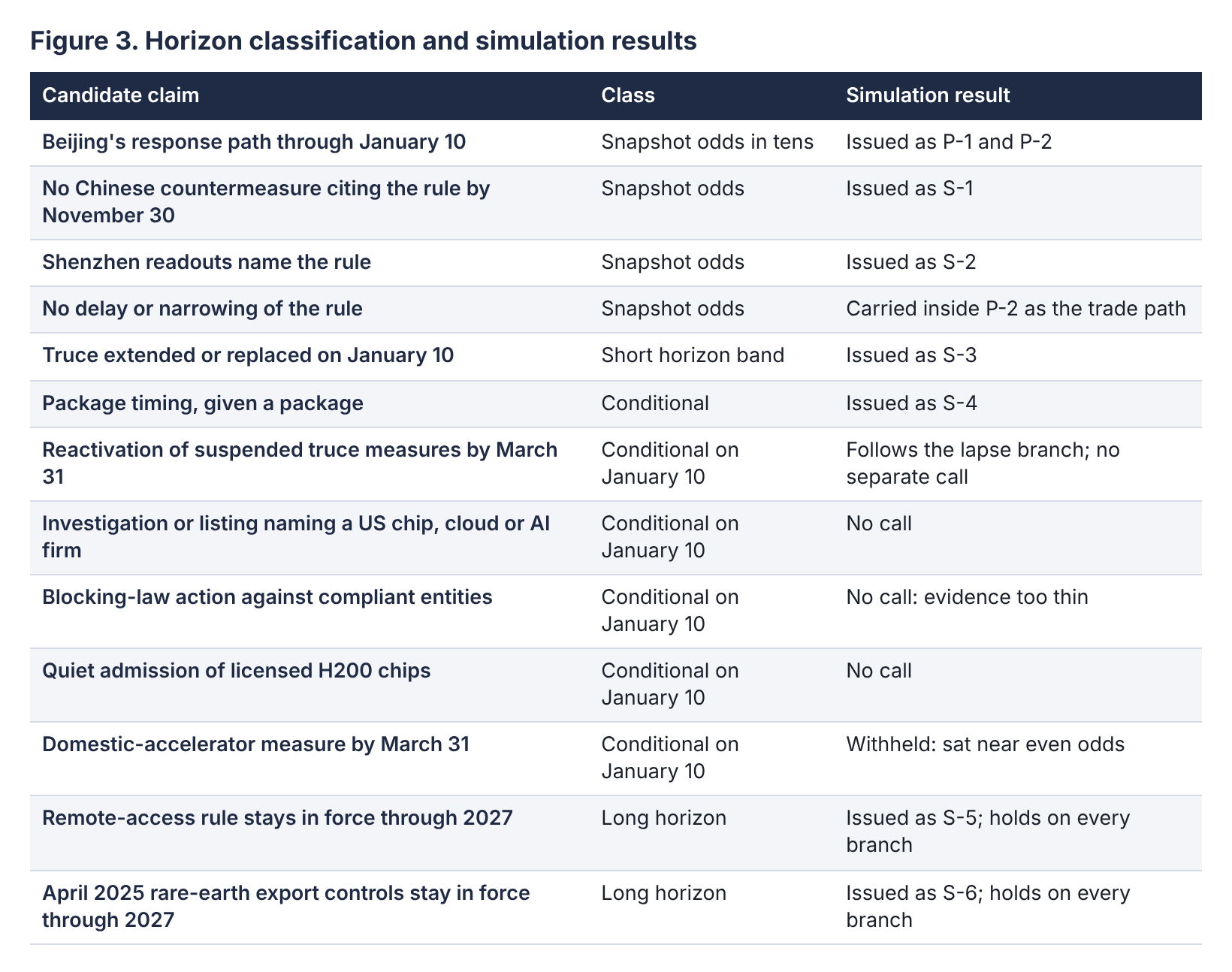
Takeaway: the case carries a war game, and seven of the thirteen candidate claims yield eight predictions.
The Series’ Earlier Calls Point to Four Hits and Four Misses on the Rule’s Text
Where the series stands. AI Chip Export Controls After the Remote-Access Rule: Treasury Wrote It, Commerce Signed It, and the Renter in China Stays Unreached sets eight companion calls to resolve on publication of the rule, scheduled for November 19. Read provisionally against the text the Bureau of Industry and Security displayed November 16, four of the eight point to hits and four to misses. All eight stay open until publication.
The provisional hits and misses. The hits cover a savings clause for chips in transit, a conduct-based element, a licensing path for existing contracts and a provider-side tenant duty. The misses cover delivered chips and publication timing, two calls each. One further call holds that a remote-access rule takes effect by December 31, 2027, and it stays open until the rule has an effective date.
The running tally. MindCast’s November 10 tally stood at 47 hits and 9 partials against 4 misses on resolved material calls. Three published calls carry forward unrevised: H200 license conditions at 64% (55-72%), outside-chain adaptation at 71% (58-82%) and a Megaspeed listing at 58% (48-67%).
What the earlier calls did not cover. No earlier call in the series addressed how Beijing answers a US control issued during the truce. Section IV issues the series’ first MindCast Foresight Simulation Predictions on that question.
Takeaway: the timing misses traced to the actor who wrote the rule, and the same Treasury authorship now shapes how Beijing reads it.
I. The Truce Suspends Both Sides’ Main Weapons but Never Covered the Chip Rule
Suspended deterrence with one expiry date. Both governments hold their strongest weapons in suspension to January 10, 2027. China extended four suspensions to that date: the expanded rare-earth controls; the measures against 11 US firms on its unreliable entity list; 16 firms on its export control list; its port fees. Washington extended its own Section 301 maritime suspensions through January 9, so measures on both sides can resume on January 10 and each side can see the other’s arsenal and its release date.
One rare-earth regime sits outside the truce. The suspension covers the October 2025 controls on five rare earths and related technologies. China’s April 2025 export controls on seven medium and heavy rare earths remain in effect. A lapse on January 10 would return the October controls and leave the April controls where they stand.
The rule landed outside both arsenals. The interim final rule requires a license before a data center supplies large-scale compute to a China-headquartered company. The Bureau of Industry and Security (BIS) press release states that Treasury and the National Security Council (NSC) wrote it. US officials said they do not negotiate American export controls in talks with China.
Beijing answered the rule with a conditional threat. The foreign ministry’s November 13 statement that China opposes the abuse of export control measures predates the rule and answered press reports of it. On November 17 the commerce ministry said China will take countermeasures if the US side insists, as reported by MLQ on November 18, and spokesperson Guo Jiakun criticized the rule in the foreign ministry’s official transcript. The “if the US side insists” clause is the commerce ministry’s standard phrasing and carries little signal on its own.
Beijing has already retaliated once inside the truce. On August 5, 2026, the Ministry of Commerce of China (MOFCOM) answered measures by the Federal Communications Commission and the Department of Homeland Security with a package it called generally restrained. The package placed six US entities on its countermeasure list, tightened drone export controls and opened a national security review of imported printers. MOFCOM warned of more countermeasures if the US insists, and the truce was extended on November 9 with the package in place.
Beijing kept chip controls off the September summit table. At the September summit in Washington, US chip controls took a back seat, with no direct mention in either government’s readout. Summit statements and commerce ministry actions have followed separate tracks this year.
The problem the geometry produces. A truce built on matched suspensions offers no rule for a new weapon introduced mid-truce. Each side therefore chooses a reading of the truce itself, and the reading chosen decides whether January 10 becomes a renewal or a reckoning.
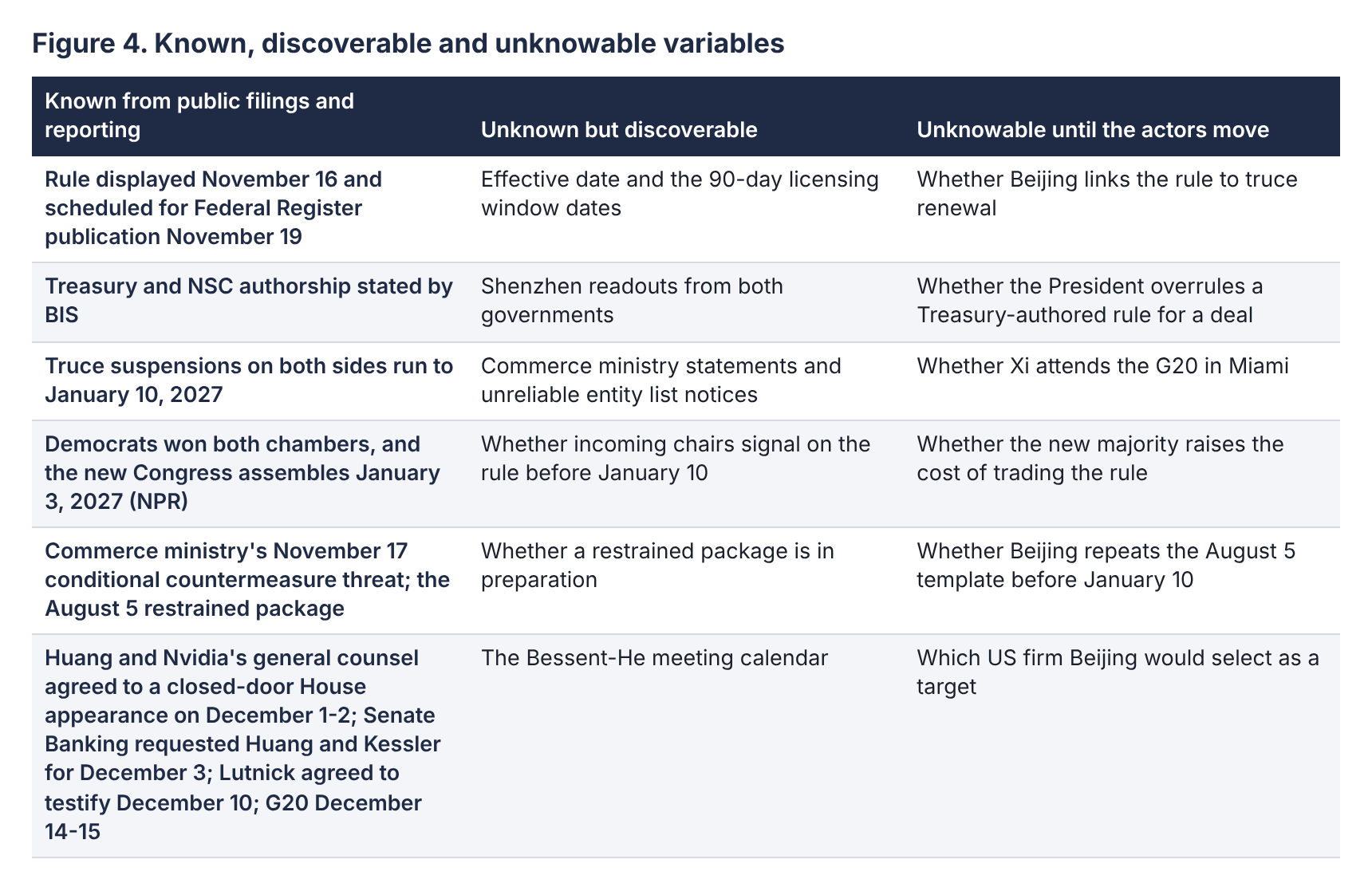
Figure 4 sources: NPR; closed-door House appearance.
🏛 Policymakers. A control written outside every suspended set lets Beijing answer it without breaching the truce.
💼 Executives. The rule reaches Chinese hyperscalers only through the listed-country operators that host them.
⚖ Counsel. The August package named entities rather than sectors, so exposure analysis starts at the legal-entity level.
📊 Investors. Matched expiry dates concentrate the truce's event risk on January 10.
Takeaway: equilibrium selection decides January 10 more than the rule’s text does, and Beijing has shown two patterns this year: quiet summits and a restrained retaliation package that left the truce intact.
II. Nine Seats Move on Five Dates, and a Silent Beijing Is the Less Likely Path
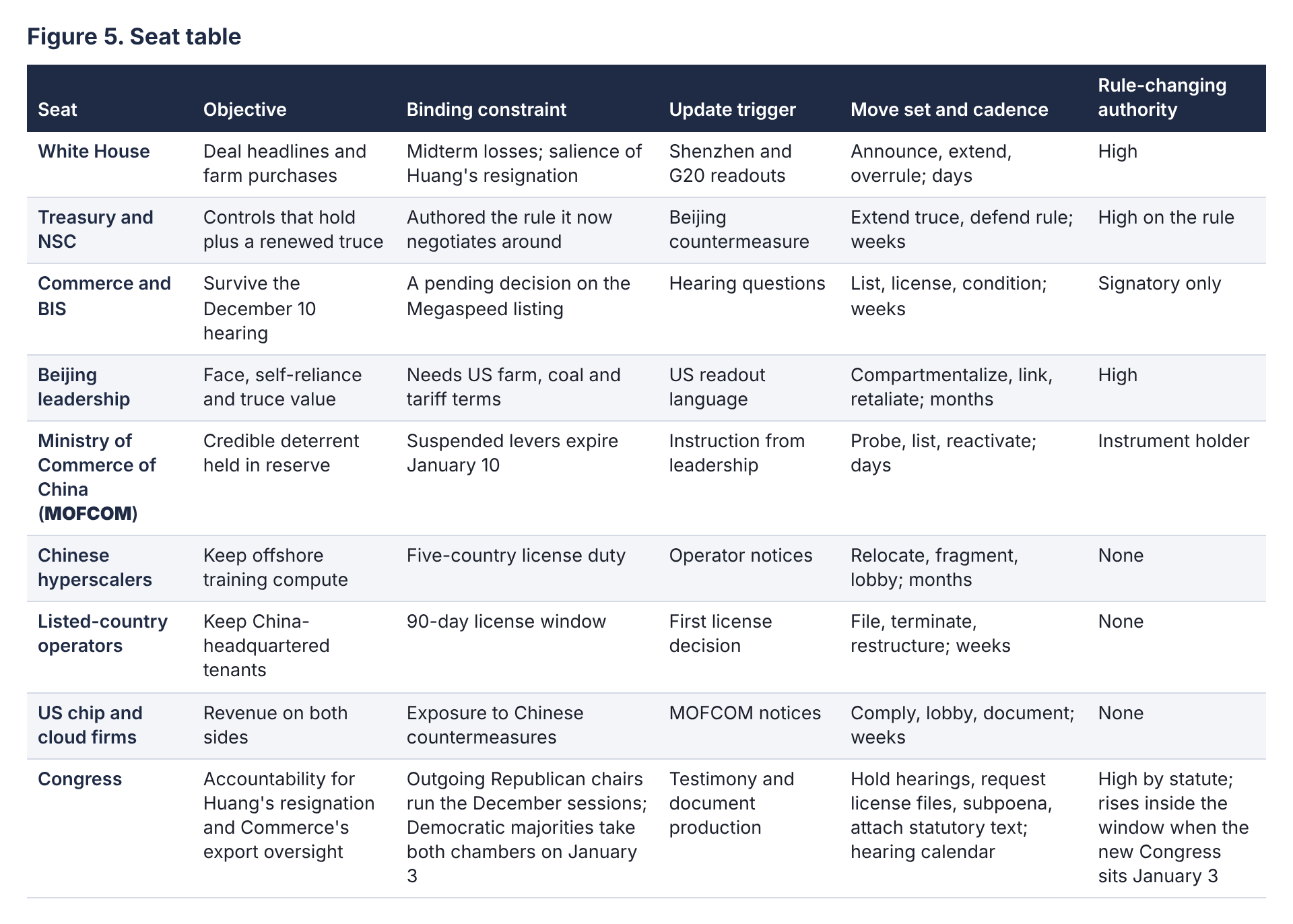
Seat table. Nine actor classes become Cognitive Digital Twins (CDTs), each a model of one actor built from its public conduct. Each seat carries its move set, decision cadence and rule-changing authority.
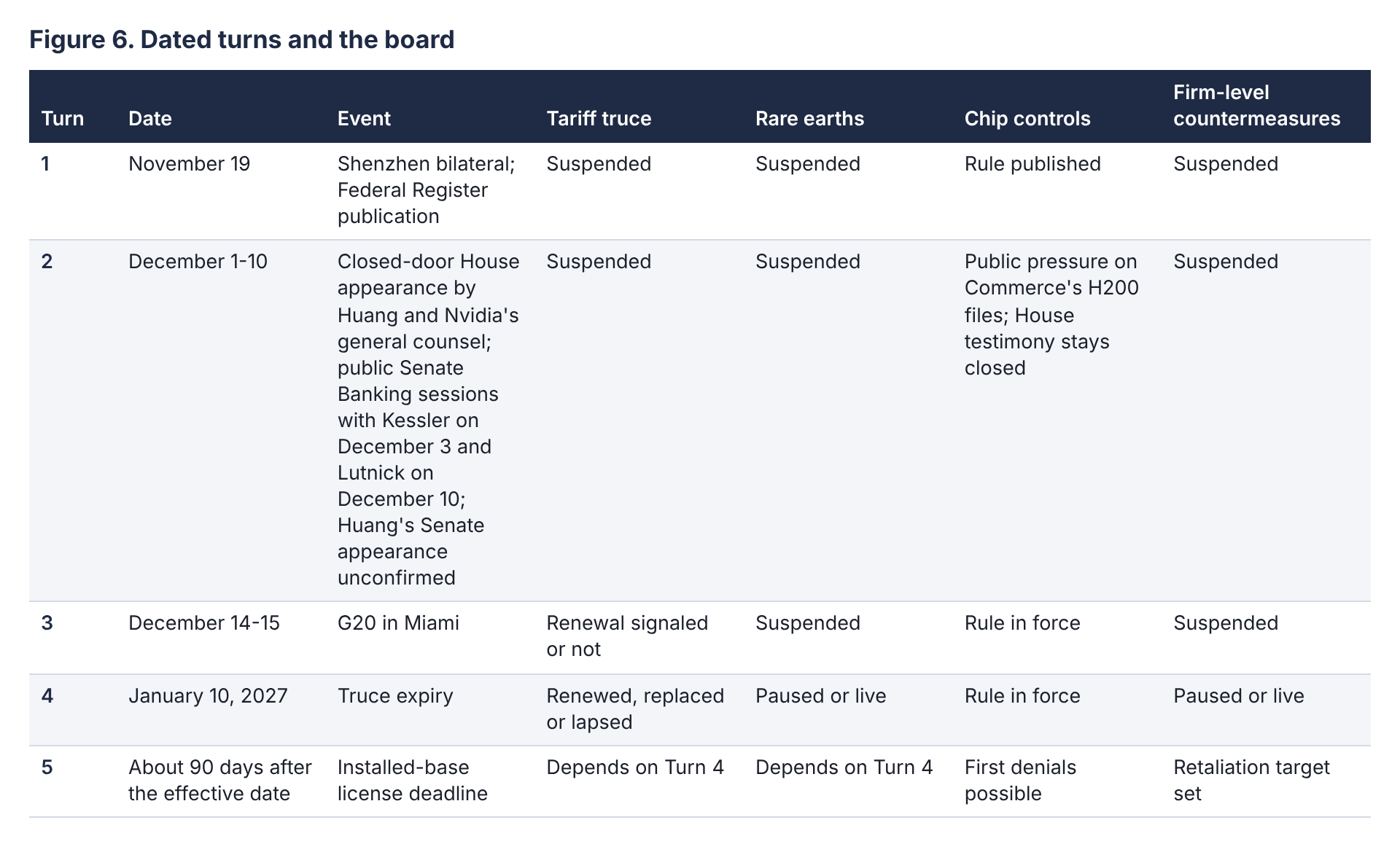
Dated turns and the board. Channels run as columns and turns as rows, with a state in every cell.
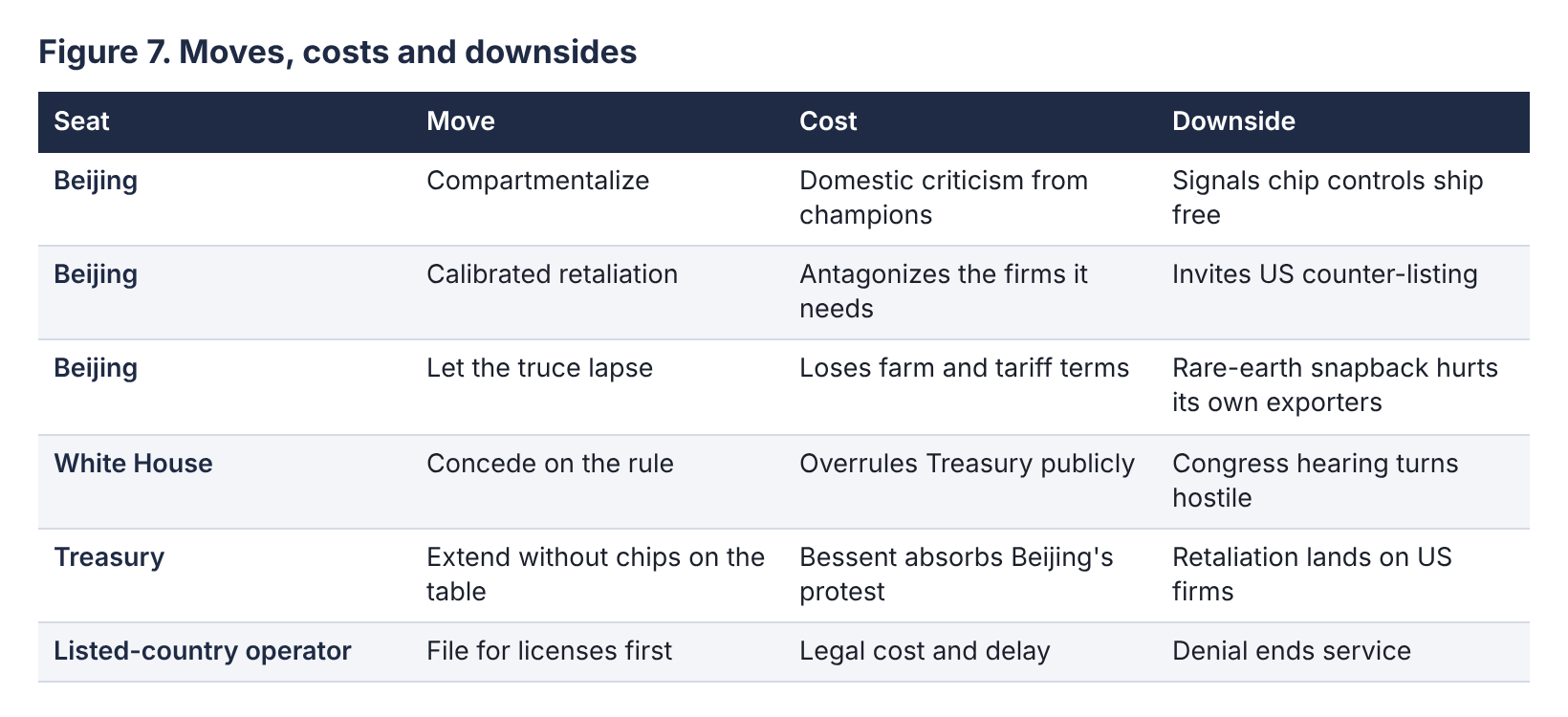
Moves, costs and downsides. Each seat’s main moves carry a cost on execution and a downside if the move fails.
Persistence path. If no seat changes course, the truce rolls forward by short extension, the rule takes effect on schedule and the hyperscalers adapt alone. The simulation places that path, compartmentalization, at 20%. A restrained package followed by renewal leads at 50%.
💼 Executives. Operators hold no rule-changing authority, so their exposure turns entirely on moves by Washington and Beijing.
⚖ Counsel. The 90-day license window is the only seat constraint the rule itself writes, and it runs past January 10.
Takeaway: the board carries all six elements a war game needs, so the same text feeds the Snapshot and the war game without a rewrite.
III. Beijing’s August Package Outweighs Its November Threat as a Guide to Its Reply
The MP CDT FS played nine CDTs against one another across nine rounds of moves and responses. The simulation tests which outcomes emerge from each actor’s conduct and attributes no intent.
Nine Cognitive Digital Twins Model the Board’s Actors
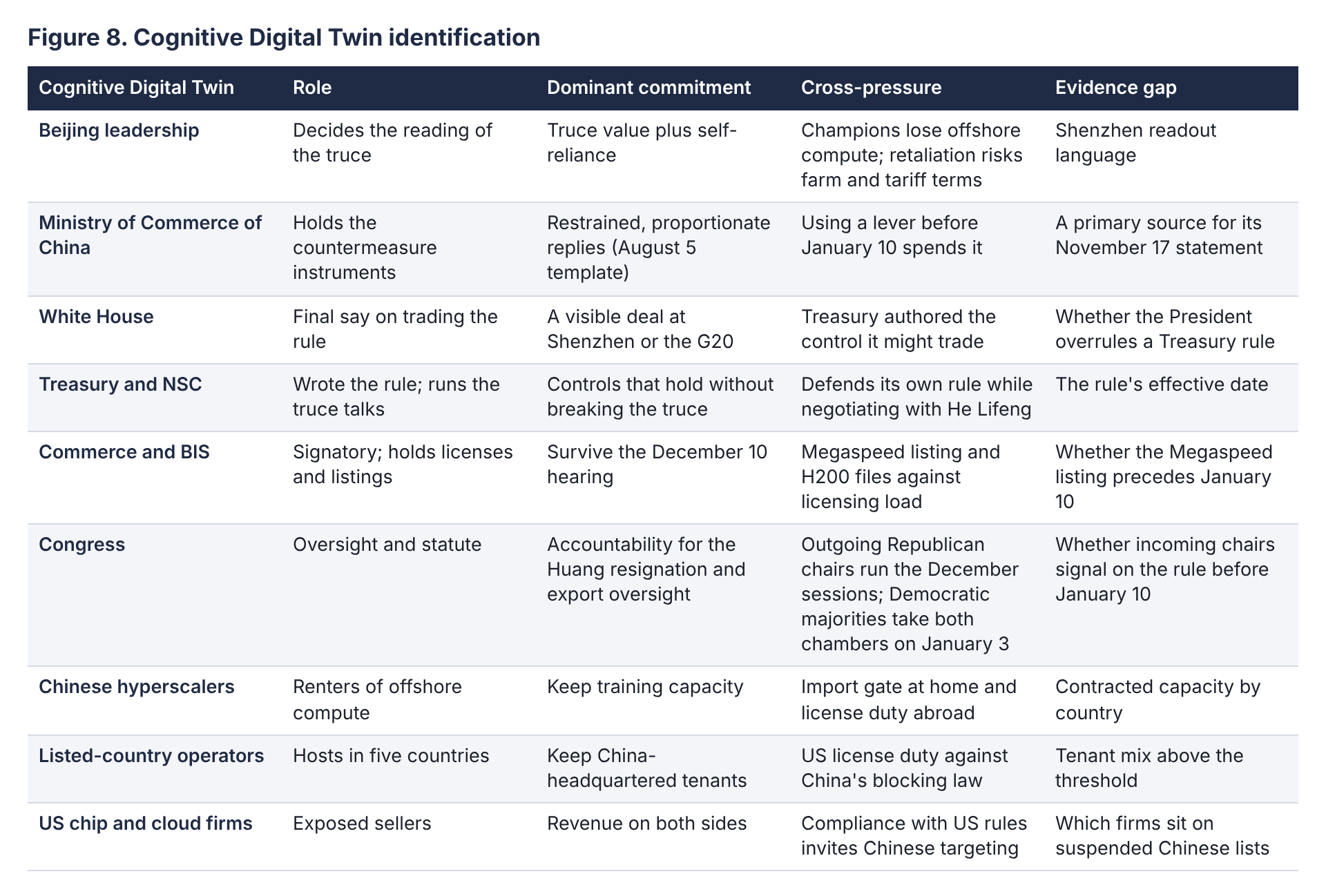
The cross-pressured CDTs are Treasury, MOFCOM and Beijing’s leadership. Each holds a live choice the public evidence does not yet reveal.
Four Competing Hypotheses on Beijing’s Reply
Hypothesis A: Beijing compartmentalizes. Beijing treats the rule as outside the truce, leaves the November 17 threat unexercised and renews without chip terms. Falsifier: a MOFCOM measure citing the rule by March 31.
Hypothesis B: Beijing issues a restrained package. Beijing answers with a bounded package on the August 5 template that cites the rule, then renews without chip terms. Falsifier: no MOFCOM measure citing the rule by March 31, or renewal conditioned on chip terms.
Hypothesis C: Beijing treats the rule as a breach. Beijing conditions renewal on US chip terms. Falsifier: renewal on January 10 with no chip condition in Chinese statements or the extension text.
Hypothesis D: Washington trades the rule. The White House suspends, delays or narrows the rule in a summit or G20 deal. Falsifier: the rule in force on its published terms on January 10.
Three Forks, and Beijing’s Reading Decides the Rest
Fork one: Beijing’s reading of the truce. Beijing’s leadership decides through MOFCOM. Simulation result: Hypothesis B leads at 50%, A and C tie at 20% and D takes the remaining 10%. The face cost of leaving a routine warning unexecuted would rank A against C, but public evidence cannot measure it.
Downstream consequence. Compartmentalization makes chip controls cost-free inside a truce, and a restrained package attaches a bounded cost to each control. A breach reading rarely ends in chip terms, because Washington has little left to concede after the halt in H200 shipments. A breach reading therefore mostly converts into a lapse on January 10.
Fork two: the January 10 disposition. The Bessent-He channel decides whether to extend or replace the arrangement or let it lapse. Simulation result: extension or replacement at 76% (64-85%). Renewal follows a package 85% of the time and compartmentalization 90%. A breach reading renews 30% of the time, and a lapse returns every suspended lever to force at once.
Fork three: the operator compliance sequence. Listed-country operators choose between filing for licenses while keeping service and terminating China-headquartered tenants. If the rule takes effect on publication, the 90-day window for chips already deployed closes around February 17. Operators therefore choose knowing Beijing’s branch, and filing early while deferring any termination wins on every path.
Five Changes Reset the Board Before the Summit
Authorship moved from Commerce to Treasury and the NSC. Before the change, a Commerce desk stalled the rule. Treasury then wrote it under Commerce’s letterhead, leaving a Treasury-designed rule in force while Treasury runs the truce talks. A model of rule timing keyed to the Commerce desk now mispredicts.
A technology control entered a trade truce. The truce covered tariffs, minerals, entity lists and port fees. The rule sits outside every suspended set, so the truce must absorb or exclude technology controls. Treating renewal on January 10 as automatic now mispredicts.
Beijing set a retaliation template inside the truce. The August 5 package against six US entities came mid-truce and the truce survived it. Proportionate retaliation now coexists with renewal, so a two-way choice between compliance and breach mispredicts.
Control of Congress changes on January 3. Democrats won both chambers in the November 3 midterms, and the new Congress assembles at noon on January 3, 2027. A new majority holds the gavel during the truce’s final week, which raises the cost of trading the rule.
Licensed H200 supply stopped. A question from Agence France-Presse (AFP) in the November 18 foreign ministry transcript reports that Nvidia no longer ships licensed Hopper data center products to China. A secondary report says Nvidia’s chief financial officer confirmed zero such shipments this quarter, down from about $4.6 billion in Q1 2026. Colette Kress holds that office and became interim chief executive after Huang resigned, and Nvidia’s own filing or transcript would complete the confirmation.
The Proportionate Package Governs How the Moves Interact
The likeliest sequence. Beijing stays quiet at the summit, issues a restrained package most often before January 10 and renews without chip terms. The proportionate-package mechanism governs because it explains the August 5 episode and no rival mechanism explains it better.
Treasury issues the rule → MOFCOM issues a conditional threat → pressure moves to the August template or to January 10. The threat costs Beijing nothing and keeps both the package and the deadline open.
Holding the reply for January 10 pays only for a Beijing that wants chip terms. A Beijing that wants renewal spends its package before the deadline and keeps the renewal clean. Timing therefore separates Hypothesis B from Hypothesis C.
MOFCOM names US entities → affected US firms lobby Washington → pressure lands on Commerce before December 10. Retaliation reaches Washington through firms rather than through the truce.
An operator terminates a Chinese tenant → MOFCOM invokes the blocking law → other operators shift to filing first. The first named termination teaches the market how to comply.
Nvidia halts H200 shipments → Beijing loses its import-gate lever. Substitution toward domestic accelerators remains a scenario, because the simulation could not separate the halt’s effect from Beijing’s standing self-reliance policy.
The Truce Has a Third Reading Between Acceptance and Breach
Secondary insights. Treasury’s dual role lets the rule work as a commitment device. A lapse on January 10 lets Beijing retaliate by not acting. Filing first moves the act of enforcement from the operator to Washington.
Hidden variables. The face cost to Beijing of leaving a routine warning unexecuted; the target list behind China’s suspended entity measures; Xi’s G20 attendance.
Contrary routes. The President trades the rule for a larger deal at the G20. Beijing acts during the Shenzhen visit despite hosting. A US listing of a Chinese firm before January 10 forces Beijing’s hand early.
🏛 Policymakers. Hearing pressure holds the trade path at 10%, so oversight constrains the White House as well as Commerce.
💼 Executives. Operators choose after Beijing does, so no operator needs to guess Beijing's branch before filing.
📊 Investors. A breach reading mostly converts into a lapse, so the tail risk on January 10 traces to Hypothesis C at 20%.
Takeaway: Beijing’s August conduct sets the odds at Fork one more than its November wording does, and a White House trade remains a narrow path.
IV. MindCast Foresight Simulation Predictions: Beijing Answers Within Bounds and Renews Without Chip Terms
Eight predictions: two Primary Simulation Predictions (P) and six Secondary Simulation Predictions (S). Four print as Snapshot odds at the current fork, and four print as short or long horizon bands. P-2’s paths and the conditionals in Section V carry no bands.
P-1. Beijing renews the truce on January 10 without conditioning renewal on US chip terms, 80%. The figure combines the trade, compartmentalize and package paths. Falsifier: a Chinese statement or extension text conditioning renewal on chip terms by January 10.
P-2. Beijing answers the rule with a restrained package citing it by March 31 and renews without chip terms, 50%. The other Fork one paths: a White House trade by January 10 at 10%, compartmentalization with no measure citing the rule by March 31 at 20% and renewal conditioned on chip terms at 20%. Falsifier: no MOFCOM measure citing the rule by March 31.
S-1. China issues no countermeasure citing the rule by November 30, 90%. Falsifier: a MOFCOM notice citing the rule dated November 19-30.
S-2. Neither the White House nor the Chinese foreign ministry readout of the Shenzhen meeting names the rule, 70%. Generic references to export controls do not count. Falsifier: either readout names the rule or the remote-access measure.
S-3. Washington and Beijing extend or replace the truce by January 10 rather than letting it lapse, 76% (64-85%). Falsifier: China’s suspended rare-earth and entity measures return to force on January 10.
S-4. Given a restrained package, Beijing announces it before January 10, 75% (61-86%). Falsifier: the package’s first notice dated January 10 or later.
S-5. The remote-access rule stays in force through December 31, 2027, 85% (72-93%). The call holds on every branch: 85% after renewal, 70% after a replacement deal and 90% after a lapse. Falsifier: a Federal Register rescission before December 31, 2027.
S-6. China’s April 2025 export controls on seven rare earths stay in force through December 31, 2027, 90% (80-96%). The truce never suspended them, so the call holds on every branch. General licenses that ease shipments do not count as repeal. Falsifier: a MOFCOM announcement repealing the April 2025 controls.
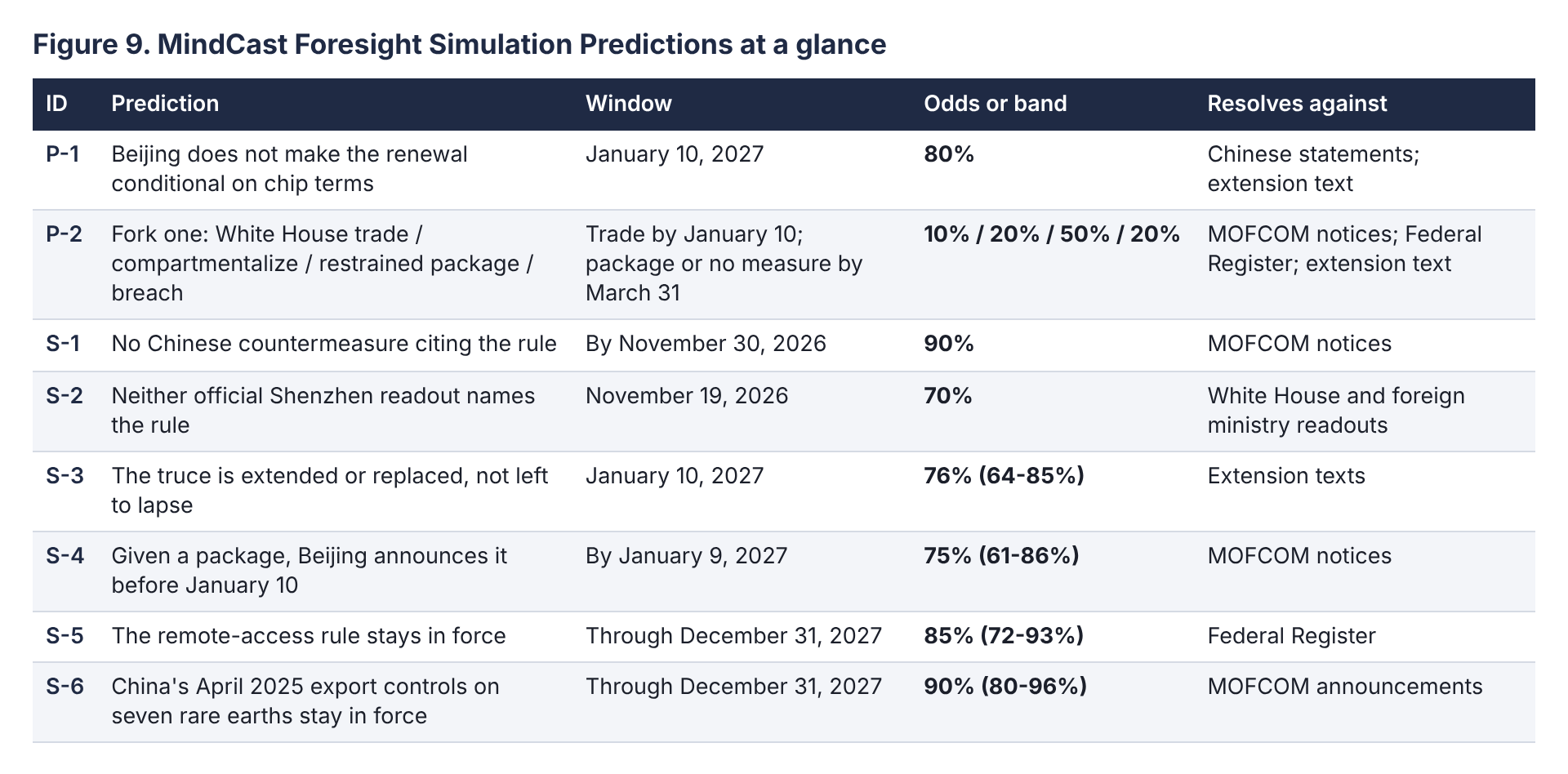
Calls the simulation declined. A domestic-accelerator measure by March 31 sat near even odds, so the simulation withheld it. The suspended October rare-earth controls get no call, because a lapse revives them and renewal keeps them paused. Blocking-law targeting and the identity of firms named in a package lack the evidence for a call.
🏛 Policymakers. P-1 at 80% means a renewal is likely to arrive without a chip concession for Washington to defend.
💼 Executives. S-1 at 90% gives operators and suppliers a quiet window through November 30.
⚖ Counsel. P-2 resolves on citation of the rule, so the first MOFCOM notice shows which clients are in scope.
📊 Investors. S-3 leaves a 24% lapse, the one branch that returns every suspended lever at once.
Takeaway: the eight predictions resolve against dated public sources between November 19, 2026 and December 31, 2027.
V. How the Game Evolves: Six Reachable States, and Only a Lapse Breaks the Baseline
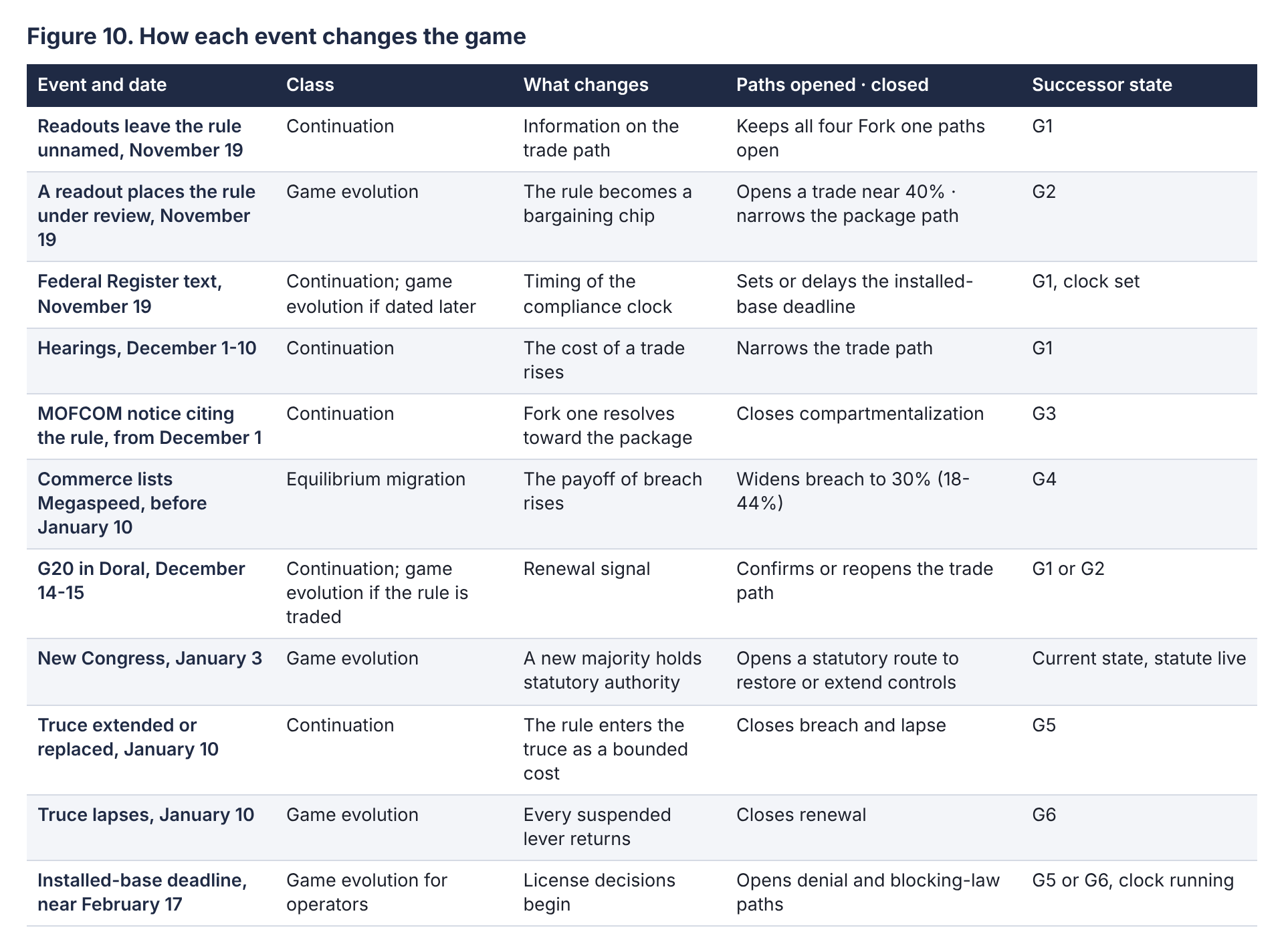
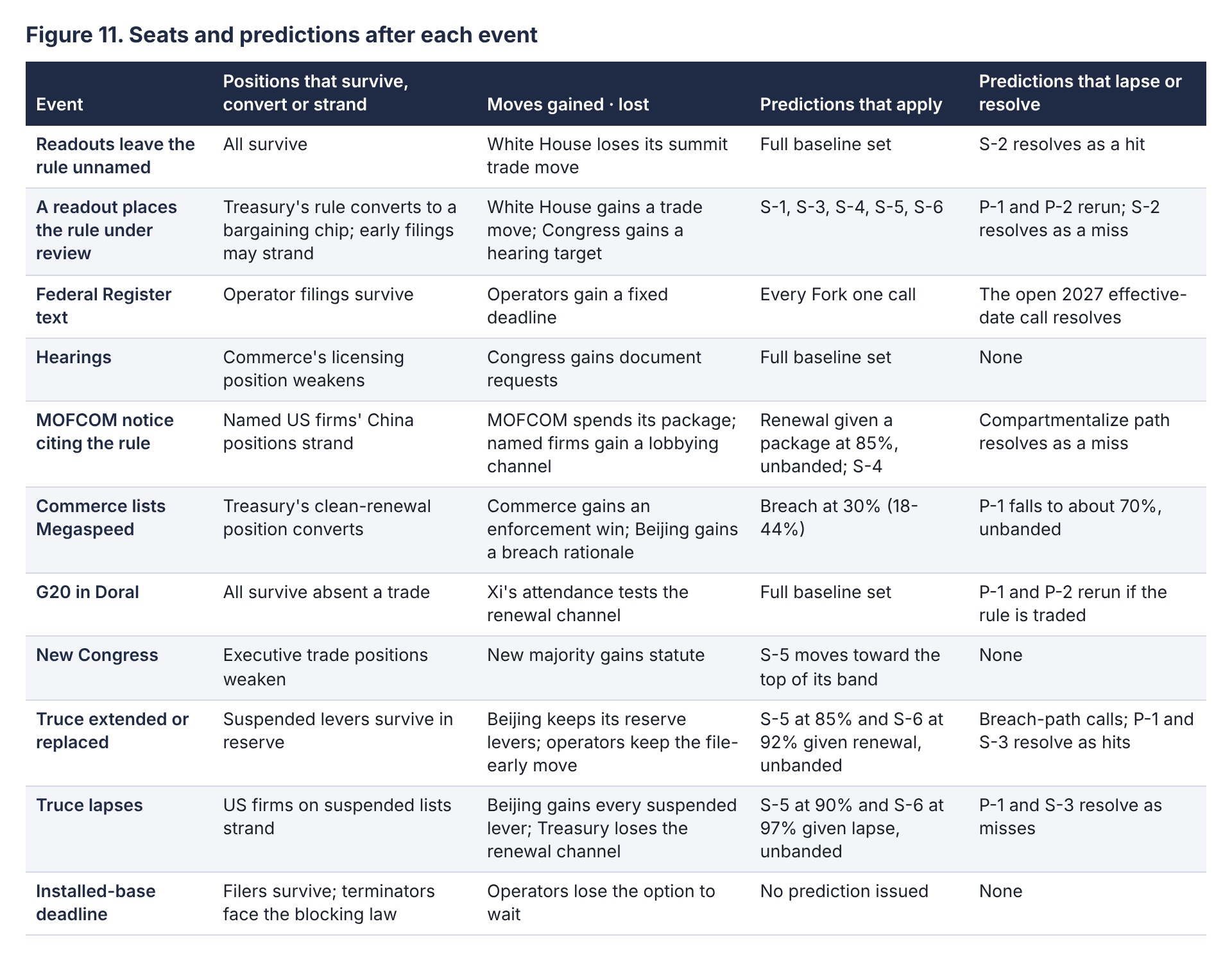
A forecast holds only inside the game that produced it. When an event changes that game, each prediction either holds in the successor state or gives way to a prediction conditioned on the new state. The event map covers every scheduled and unscheduled event before January 10 and the compliance deadline that follows.
Three classes of change. Continuation updates information inside the current game. Equilibrium migration changes which outcome persists without replacing the game. Game evolution changes what later moves depend on: the strategies and payoffs, the rules, the players or the timing.
Event map. Figure 10 gives each event its class, what it changes, the paths it opens and closes and the successor state it creates. Figure 11 carries every seat through the event and names the predictions that apply, lapse or resolve in the successor state.
One outcome would count as an anomaly. A Chinese measure citing the rule during the visit, the 10% that S-1 leaves open, would break Beijing’s hosting pattern. Such a measure would mark a game mutation, because the model of Beijing’s behavior would need rebuilding.
How the Game Branches
The baseline. P-1 holds the renewal free of chip terms at 80%. P-2 sets Fork one’s paths at 10% / 20% / 50% / 20%, unbanded. S-3 places renewal at 76% (64-85%), and S-5 and S-6 hold the rule and the April rare-earth controls through 2027 at 85% (72-93%) and 90% (80-96%).
The dominant fork and its mover. Fork one, Beijing’s reading of the truce, decides every later state. Beijing’s leadership moves it through MOFCOM, and the White House can preempt it only by trading the rule.
G1, rule off the table (continuation). The readouts leave the rule unnamed, which S-2 places at 70%. P(renewal free of chip terms | G1) = 80%, unbanded, carried from the baseline. The White House loses its summit trade move until the G20, Beijing keeps all three readings and MOFCOM’s package stays in reserve.
G2, rule on the table (game evolution). A readout placing the rule under review turns Treasury’s commitment device into a bargaining chip. P(White House trade | G2) = 40%, unbanded, and P-1 and P-2 rerun. The White House gains a trade move and Congress gains a hearing target. Operators who filed early hold positions that strand if the rule narrows.
G3, restrained package issued (continuation). A MOFCOM notice citing the rule realizes the package path. P(renewal | G3) = 85%, unbanded, and P(announced before January 10 | package) = 75% (61-86%). MOFCOM spends its package and holds no new move until Washington moves again. Named US firms gain a lobbying channel into Commerce and lose China revenue, while Treasury gains a clean path to renewal.
G4, Megaspeed listed before January 10 (equilibrium migration). A Commerce listing of a Chinese champion raises the weight on breach. P(breach | G4) = 30% (18-44%), and P-1 falls to about 70%, unbanded. Commerce gains an enforcement win before its hearing, Beijing gains a reason to condition renewal and Treasury’s clean-renewal position turns defensive.
G5, renewal or replacement without chip terms (continuation). The truce absorbs the rule as a bounded cost. P(rule in force through 2027 | renewal) = 85% and P(April controls in force through 2027 | renewal) = 92%, both unbanded. Under a replacement deal the two read 70% and 75%, unbanded. Beijing’s suspended levers survive in reserve, operators enter the compliance clock with the file-early move intact and Congress gains a statutory move after January 3.
G6, lapse on January 10 (game evolution). The lapse breaks the baseline and carries the 24% that S-3 leaves open. Most lapses run through a breach reading, where P(renewal | breach) = 30%, unbanded. Every suspended lever returns at once: the October rare-earth controls, the entity-list measures and the port fees. P(rule in force through 2027 | G6) = 90% and P(April controls in force through 2027 | G6) = 97%, both unbanded.
Seats in G6. Beijing gains every suspended move, US firms on the suspended lists strand and Treasury loses its renewal channel. Operators face China’s blocking law alongside the US license duty when the installed-base deadline arrives near February 17.
Feedback into the next cycle. A lapse hands the new Democratic majority a hostile hearing and hands Beijing its reactivated levers, so the next negotiation opens from escalation rather than suspension. A renewal carries the rule into the next truce as an accepted cost, which lowers the cost Beijing attaches to the next US control.
🏛 Policymakers. Only G2, a readout placing the rule on the table, turns Treasury's rule into a bargaining chip.
💼 Executives. Early filings strand only in G2, and only if the rule narrows.
⚖ Counsel. G6 is the one state where China's blocking law and the US license duty bind at once.
📊 Investors. Only G6 breaks the baseline, so lapse exposure is the one position that changes with January 10.
Takeaway: six reachable states follow from Fork one, and only a lapse breaks the baseline, at 24%.
VI. What the Findings Mean: Each Audience Faces a Bounded Reply, Not a Trade War
🏛 Policymakers. The rule is likely to survive through 2027, at 85% (72-93%). The oversight contest therefore turns on how Commerce grants licenses rather than on whether the rule stands.
💼 Executives. Rare-earth buyers face a split exposure. The April controls stay in force whichever way Beijing reads the truce, and only the five October elements depend on January 10.
⚖ Counsel. A restrained package at 50% would name US entities without ending the truce. Client exposure therefore concentrates in named entities and in operators’ Chinese tenancies.
📊 Investors. Nvidia’s reported halt in licensed Hopper shipments to China leaves the January 10 outcome bearing more on rare-earth supply and named-firm exposure than on licensed chip revenue.
Takeaway: the findings point each audience to a bounded Chinese reply, and the tail risk sits in a lapse rather than in the rule itself.
VII. Risk Mitigation: A Lapse and a Named-Firm Package Carry the Largest Exposure
Each entry names the exposure in a unit the stakeholder controls, the trigger, the mitigating actions and the residual exposure.
Lapse on January 10. Exposure: weeks of inventory in the five October rare earths, and revenue at US firms on China’s suspended lists, on a branch at 24%. Trigger: no extension text by January 10. Mitigating actions: build inventory in the five October elements before January 10 and review supply contracts for force-majeure terms. Residual exposure: the April 2025 controls on seven elements stay in force on every branch, so inventory bought for a lapse leaves that supply unprotected.
A restrained package naming US firms. Exposure: China revenue by legal entity at US chip, cloud and AI firms, on the package path at 50%. Trigger: a MOFCOM notice citing the rule, most often before January 10. Mitigating actions: map China revenue by legal entity and prepare a response through Commerce before the December 10 hearing. Residual exposure: Beijing chooses targets after the hearings close, so no firm can rule itself out in advance.
Operator compliance under two governments. Exposure: the share of capacity leased to China-headquartered tenants. Trigger: the installed-base deadline near February 17 if the rule takes effect on publication. Mitigating actions: file license applications early, keep service pending decision, avoid terminations announced by name and review Chinese contracts for blocking-law exposure. Residual exposure: a license denial forces a choice between US penalties and China’s blocking law.
A White House trade of the rule. Exposure: the oversight agenda and compliance budgets built on the rule, on a path at 10%. Trigger: a readout or G20 statement placing the rule under review. Mitigating actions: request the H200 license files before the December hearings and keep compliance spending modular until the January 10 extension text appears. Residual exposure: a trade would arrive mid-hearings, and Congress could restore the rule by statute after January 3.
Investor exposure to China revenue. Exposure: China data center revenue assumptions in positions tied to US chip firms. Trigger: Nvidia’s own filing or transcript confirming the Hopper halt. Mitigating actions: tie revenue assumptions to the reported halt rather than to a substitution scenario the simulation withheld. Residual exposure: the halt rests on secondary reporting until Nvidia confirms it.
Takeaway: the lapse and the package path carry the largest exposure, and each leaves a residual that no single action removes.
VIII. What to Watch: The Readouts on November 19 and MOFCOM’s Notices From December 1
The dominant fork. MOFCOM’s notices will show which reading of the truce Beijing has chosen.
November 19: the Shenzhen readouts. The readouts resolve S-2 and show whether the White House places the rule on the table.
November 19: the Federal Register text. The effective date sets Fork three’s clock and resolves the open 2027 effective-date call.
December 1-10: the hearings. The closed House briefing and the Senate Banking sessions raise the cost of any trade.
From December 1: MOFCOM notices. A notice citing the rule resolves Fork one toward the package and reveals its targets.
December 14-15: the G20 in Doral. Xi’s attendance and any renewal signal test P-1 before the deadline.
January 10: the extension text. The text resolves P-1 and S-3.
🏛 Policymakers. The December hearings close before Beijing chooses package targets, so the hearing record feeds its choice.
💼 Executives. The November 19 Federal Register text fixes the operator deadline, near February 17 if the rule takes effect on publication.
⚖ Counsel. The first MOFCOM notice citing the rule names the entities in scope.
📊 Investors. The January 10 extension text resolves the lapse branch.
Takeaway: the readouts and MOFCOM’s December notices resolve Fork one before the January 10 deadline arrives.
IX. Conclusion: Beijing’s August Precedent Governs the Truce’s Last Eight Weeks
Return to the equilibrium. The truce expires January 10 with every suspended weapon visible and one new rule outside the set. Beijing’s likeliest reply follows its August template: a package that names the rule and stays within bounds, followed by renewal without chip terms.
Forward lock. If no MOFCOM measure citing the rule appears by March 31 and the truce renews on unchanged terms, the compartmentalize path resolves and the package thesis fails.
Takeaway: the eight MindCast Foresight Simulation Predictions resolve against MOFCOM notices, the Federal Register and the January 10 extension text, starting with the Shenzhen readouts.
Working With MindCast
MindCast AI is a Predictive Game Theory Modeling-Simulation firm. MindCast builds Cognitive Digital Twins of the named actors on a client’s board and models how the game evolves through its next forks.
A readout overlay reissues P-1 and P-2 within a day of the November 19 readouts. A target-mapping engagement sizes a firm’s exposure on the package path in P-2 before December 1. A lapse-branch exposure analysis models the 24% that S-3 leaves open for a rare-earth-dependent supply chain before January 10. A full MP CDT FS fits a client whose best move differs by branch, such as a policymaker weighing a trade.
A complimentary Snapshot uses publicly available information. Private engagements proceed after a nondisclosure agreement and retainer, starting with a diagnostic session on one live decision.
Contact: mcai@mindcast-ai.com · Corporate site: www.mindcast-ai-simulation.com · All MindCast war gaming: www.mindcast-ai-simulation.com/live-fire-intelligence
Sources
MindCast works
AI Chip Export Controls After the Remote-Access Rule: Treasury Wrote It, Commerce Signed It, and the Renter in China Stays Unreached. Source of the carried calls and the four-role chain.
Commerce’s Rented GPU Ban Would Exempt Chips Already Delivered, and the Cutoff Date Decides Its Reach. First paper in the series.
Lutnick and the Commerce Department Likely Miss January 10 on the Rented GPU Rule, and His Tenure Shapes What It Exempts More Than When It Publishes. Second paper in the series.
The Calculus of Predictive Game Theory Evolution and Mutation. Supplies the horizon classification and the game-evolution classes.
Primary and reporting
Bureau of Industry and Security, BIS Issues Rule Addressing Remote Access to American Super Intelligence Technology, November 16, 2026. The rule and its Treasury and NSC authorship.
MLQ, China vows countermeasures over the new US chip rule, November 18, 2026. MOFCOM’s November 17 threat; cited without a link because the page could not be loaded for verification and no primary MOFCOM text was located.
Ministry of Foreign Affairs of China, Foreign Ministry Spokesperson Guo Jiakun’s Regular Press Conference on November 17, 2026. The foreign ministry’s reply to the rule.
Ministry of Foreign Affairs of China, Foreign Ministry Spokesperson Guo Jiakun’s Regular Press Conference on November 18, 2026. The AFP question on the Hopper halt.
Global Times, China’s countermeasures against US generally restrained, August 5, 2026. The August package and its “restrained” framing.
China Daily, Measures unveiled to counter US curbs, August 5, 2026. The August package’s contents and warning.
Global Times, China opposes abuse of export controls amid reported new US chip restrictions, November 13, 2026. Beijing’s statement before the rule.
Digg summary of Financial Times and CNBC, US officials: export controls not up for negotiation. The US position on negotiating controls.
The National, China extends pause on rare earth export curbs for two months, November 9, 2026. China’s rare-earth pause through January 10.
Holland & Knight, USTR Extends Section 301 Maritime Fee, Cargo Handling Equipment Duty Suspension to January 9, November 9, 2026. Washington’s matching suspension through January 9.
Times Live, China extends US trade truce by two months, November 9, 2026. China’s four suspensions.
S&P Global Commodity Insights, China extends rare earth export suspension to January 2027, November 9, 2026. The April 2025 controls outside the suspension.
South China Morning Post, Why US chip controls took a back seat at the Xi-Trump summit, September 2026. The September summit precedent.
CryptoBriefing, Nvidia CFO reports zero data center Hopper shipments to China, down from $4.6B last quarter. The secondary report of the Hopper halt.
TechRepublic, Nvidia’s Jensen Huang resigns. Kress’s appointment as interim chief executive.
NPR via OPB, Democrats win full control of Congress, November 4, 2026. The change in congressional control.
Yahoo News, Huang agrees to testify before House lawmakers. The closed House briefing.
International Business Times, Trump lands in China as Xi breaks protocol to greet him, November 18, 2026. The summit setting.
Al Jazeera, US Senate summons Nvidia’s Huang, Lutnick to testify, November 13, 2026. The Senate Banking requests.
ROIC, Lutnick to face Senate grilling over Nvidia export policies, November 13, 2026. Lutnick’s December 10 appearance.
City of Doral, Doral at the Center of G20. The G20 dates, December 14-15, 2026.
Foundation for Defense of Democracies, China bans foreign AI chips in state-funded data centers, November 10, 2025. Beijing’s self-reliance policy.
China Daily Global Edition, MOFCOM statement on enforcement of foreign measures, May 22, 2025. The blocking-law posture.