

AI liability · Federal and state enforcement · Export controls · Securities litigation · Bank Secrecy Act enforcement · Data center authorization · Quantum computing
Series introduction. The installments: Predictive Game Theory Evolution and Mutation: Short Horizon Games Branch Wide and Resolve Shallow · Predictive Game Theory Evolution and Mutation: Long Horizon Games Resolve Deep Because Their Branches Hold. Companion to Dynamic Predictive Game Theory: From Nash Equilibrium to Adaptive Coherence Equilibrium.
Visit MindCast Corporate and Prediction Scorecard.
Thesis. A firm can choose sound moves before anyone can forecast how a changing legal or regulatory contest ends. Forecasts reach further only as the rules behind each later step become dependable.
Why now. Dated events from November 2026 to June 2027 will reclassify several cases in this series. The most consequential is the January 3, 2027 lapse deadline for remote-access legislation. Counsel and insurers face commitment decisions before those events resolve, as do compliance leaders, policymakers and investors.
I. Strategy Can Move Before Deep Forecasts Arrive
A company can know what to do next without knowing which game will govern next year. Predictive depth depends on supported continuations, while strategic clarity depends on whether the preferred action survives the games still in play. Structural stabilization can improve both, but neither follows from branch count alone. The series builds that claim into a calculus and tests it against eleven published MindCast cases.
The thesis rests on one distinction. Every branch in a strategic tree carries uncertainty over which outcome a known game produces and uncertainty over which game will exist when the branch arrives. Forecasts that assume a fixed game leave the second kind outside the model, and the second kind decides how deep a forecast can reach.
MindCast models both through Cognitive Digital Twins of named actors.
MindCast AI applies Predictive Behavioral Economics + Dynamic Game Theory through MindCast AI Proprietary Cognitive Digital Twin Foresight Simulations (MP CDT FS). Behavioral Economics supplies the decision rules. Game Theory supplies the payoff structure. Predictive simulations emerge from the combination.
The MindCast Prediction Scorecard dated October 31, 2026 shows 38 hits and 5 misses on resolved material calls, an 88% success rate with 6 partials set aside.
Shared material sits in the overview, starting with the governing calculus and the three dimensions of a forecastable game. Horizon control, the mathematical core, the academic foundations and the case matrix follow. Predictive Game Theory Evolution and Mutation: Short Horizon Games Branch Wide and Resolve Shallow applies the frame to games whose rules can still change, with agentic AI liability as the worked tree. Predictive Game Theory Evolution and Mutation: Long Horizon Games Resolve Deep Because Their Branches Hold applies it to games whose rules have begun to hold, with Bank of America enforcement and AI data center authorization as the worked trees.
🏛 Policymakers. A rule’s durability shows in whether other jurisdictions reuse it, and some institutions can make a contest more or less predictable at a known cost (Section IV). Draft AI and enforcement rules for replication now. A commissioned Snapshot earns its cost once a bill or rule text reaches a dated vote or effective date.
💼 Executives. Waiting stops paying when delay and rival preemption outrun what the next ruling will teach (Section V.D). Make the moves that beat waiting in every candidate game today. Commission a timing run before any irreversible commitment keyed to an unresolved fork.
⚖ Counsel. Litigation over a contested theory supports forecasts only to the next ruling, while schedule-bound litigation can support more once its parties form (Section VIII). Prepare every doctrinal route in parallel. A Cognitive Digital Twin build of the opposing parties pays off once a matter faces a dispositive motion or joinder deadline.
📊 Investors. Some distant forecasts hold in unstable games because the outcome is the same in every candidate game (Section II.B). Value positions in unstable games as options and in stabilizing games as paths. A Foresight Simulation becomes worth commissioning when a position’s value depends on a branch three forks out.
The short horizon installment shows how to act while the governing game remains open, and the long horizon installment shows how much further a forecast reaches once the game stabilizes. Each installment stands on its own.
Takeaway. Strategy can move before depth arrives, and the series measures how much depth each game supports.
II. Forecast Depth Follows the Weights on Candidate Games
The calculus starts from one accounting identity: every path probability is a weighted sum across the games that might govern it. The weights compound down a branch, lose their influence when outcomes agree across games, and depend on five questions asked at every fork.
II.A Outcome Uncertainty and Game-Identity Uncertainty Compound Down a Branch
A path probability sums over every candidate game the chance that the game exists times the chance of the path inside it. Each term is conditioned on the history so far.
P(path at fork k | history) = Σ over candidate games G [ P(game at fork k is G | history) × P(path | G, history) ]When one candidate game carries nearly all the weight, the sum reduces to a single term. When the weight spreads across several games, the forecast becomes a mixture. A mixture is legitimate when its weights have support; the short horizon problem arises when they do not.
Depth compounds the problem through a chain of conditionals. Resolving the first fork updates every later term rather than invalidating the forecast. The difficulty lies in the weights deep in the chain, which rest on transition mechanisms the evidence has not yet shown.
P(b1, b2, b3) = P(b1) × P(b2 | b1) × P(b3 | b1, b2)II.B Outcomes That Hold Across Candidate Games Extend the Forecast
One property unifies the series. The weights on candidate games matter only where the outcome differs across those games. When a path is similarly likely in every candidate game, the forecast becomes insensitive to revisions in those weights. Invariance does not remove error within each game, games the model omits, or uncertainty that accumulates with time.
If P(path | G) ≈ k for every candidate G, then
P(path | history) = Σ P(G | history) × P(path | G) ≈ k
A distant forecast can therefore hold in an unstable game. Tencent, Oracle, and the Remote-Access Gap in US AI Chip Export Controls shows the case. The paper published a 97–99% band that no public letter or license condition stops the Tencent-Oracle service through October 31, 2027. The regulatory game around that service remains unstable, yet no candidate game in the published analysis stops the service before that date.
The same property defines strategic clarity, measured against an explicit alternative. An action a has high strategic clarity when it beats the comparator a₀, such as waiting or holding current policy, in every candidate game still retained.
V_i(a, G) − V_i(a₀, G) ≥ 0 for every retained candidate game GThree separate tests follow, and a publication can pass the first two without the third.

Branch trees therefore read best where outcomes diverge and where they reconverge. Several unresolved institutional branches can converge on the same useful action, and a stable institutional branch can still generate many different outcomes.
II.C Five Questions Decide How Far a Branch Can Be Traced
Five questions at every consequential fork decide how far a branch can be traced.
What changes. The players, the rules, the payoffs or the available moves.
What survives. Capabilities, commitments and authority that carry across the fork.
Who repositions. Entrants, exits and coalition switches.
How far the evidence reaches. The depth to which the continuation mechanism has support.
What would invalidate the continuation. Reversal, implementation failure or counter-mobilization.
The usable horizon follows from evidence rather than from the calendar, and it belongs to a particular actor, decision and branch rather than to a whole subject. A matter can run for a decade in the short horizon if its rules keep changing, and a matter can enter the long horizon within months once its rules, participant responses and transition mechanisms hold within the decision window.
The calculus reduces forecast depth to one question asked at each fork: does the evidence support the weights on the games that might govern the next step? Where it does, deeper chains hold. Where outcomes agree across games, the weights stop mattering and a distant forecast can hold without that support.
Stakeholder callouts.
⚖ Counsel. Advice that depends on which doctrine governs three rulings from now rests on weights no court has supported. Advise on the next ruling and on moves that win under every doctrine.
📊 Investors. A thesis that holds across every candidate game needs no deep forecast. A thesis that does not needs its value tested against each candidate game before capital moves.
💼 Executives. Run the five fork questions before any board decision tied to a pending rule. Once the fourth question shows support ending at the next fork, treat any single-point forecast beyond it as a scenario rather than a number.
Takeaway. The horizon is the depth at which the evidence still supports the weights on a game’s candidate successors, and invariance across those successors can extend it.
III. Strategic Clarity Can Run Ahead of Structural Certainty
Two dimensions describe how far a forecast can reach. A third describes what an actor can do about it. Separating the three corrects the assumption that strategic value grows only as forecast depth grows.
Structural certainty. How well the rules and the candidate successor games are understood. Structural certainty rises when a binding act crosses the operative threshold and when response waves subside.
Predictive depth. How many downstream transitions the evidence supports. Depth rises with structural certainty but lags it, because each later link in the chain needs its own supported transition.
Strategic clarity. Which actions stay useful across plausible branches, and which require a trigger. Strategic clarity can be high when structural certainty is low: FTC Investigation of Anthropic and OpenAI leaves the theory of harm unresolved, yet disclosure, evidence and remedy positioning are already clear moves.
The three dimensions convert into a commissioning rule. The Simulation Readiness Index in the MindCast Snapshot format already measures decision sensitivity, which reads near zero when one move wins on every branch. High strategic clarity is that case.
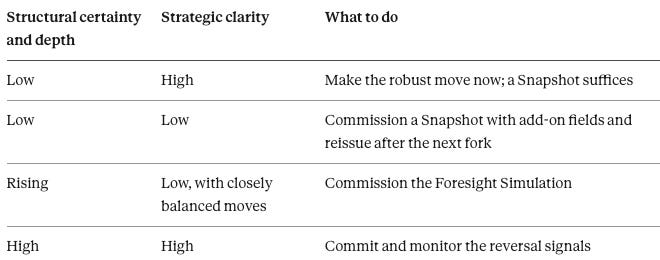
Separating the three dimensions changes what a reader should ask of any forecast. The first question becomes whether a move beats its alternative in every game still in play, not how far the forecast reaches. Depth matters only when the answer is no.
Stakeholder callouts.
💼 Executives. When a move beats waiting in every candidate game, make it now without a deeper run. Hold deeper analysis for decisions whose best move changes with the outcome while the rules stabilize.
🏛 Policymakers. Guidance that states what compliance looks like under each pending outcome raises strategic clarity for every regulated firm. Firms can then act before a rule becomes final.
📊 Investors. Rate each holding on all three dimensions. A holding low on depth but high on clarity needs monitoring, while one low on both needs staged exposure and dated exit triggers.
Takeaway. A game can rate low on certainty and depth while rating high on strategic clarity, and that combination calls for action rather than a deeper run.
IV. Actors Compete Over How Predictable the Game Becomes
Horizon control means any move whose main effect is to keep game identity open or to close it. Actors compete over how predictable the game becomes as well as over outcomes within it. The Dynamic Predictive Game Theory framework states delay dominance: the party whose expected payoff grows with time has an incentive to slow the process. Horizon control generalizes the rule from time to structure.
The value of an action splits into two parts when the action also changes which game arrives. For actor i with adjustable action a, and candidate games g:
V_i(a) = Σ_g p_g(a) × V_ig(a)

dV_i/da = Σ_g (dp_g/da) × V_ig   +   Σ_g p_g × (dV_ig/da)
          value from changing          value from improving
          which game arrives           position within games
The first term captures influence over which game arrives. Horizon control is the subset of that influence that changes how predictable the operative game becomes. The second term is ordinary positioning, and a robust move beats its stated comparator in every retained candidate game. Opponent responses belong inside the continuation values, and discrete moves such as filing a suit use finite differences rather than derivatives.
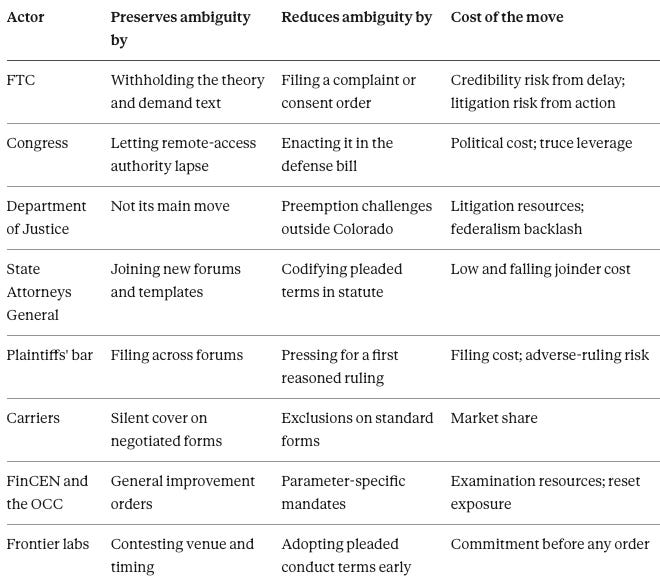
The table lists mechanisms to investigate rather than a general rule. Distributed actors can also standardize conduct through coordinated templates, and centralized actors can prolong uncertainty through discretionary enforcement or unclear guidance. The FTC controls when it discloses its own theory, which shapes the federal channel’s timing without controlling every federal actor.
A published odds shift shows horizon control paying off. OpenAI State Attorney General Lawsuits: Two Pleading Templates Across Ten State Courts reads a frontier lab named within twelve months at 40% without intervention and 20% if the lab adopts the pleaded conduct terms before any order.
Horizon control turns predictability into a contested resource. Actors that open forums, withhold theories or adopt terms early change how deep anyone can forecast, at costs the table makes explicit. Mapping those moves before a contest stabilizes shows who can shorten or lengthen the window a client has to act.
Stakeholder callouts.
🏛 Policymakers. Clear safe harbors and published terms reduce ambiguity for every regulated firm at once. Agencies weighing guidance against case-by-case enforcement should count the cost of prolonged uncertainty to compliant firms.
⚖ Counsel. Identify which party gains from ambiguity before setting litigation pace. Map each opposing party’s gain from delay before agreeing to a schedule.
💼 Executives. Early adoption of pleaded conduct terms cut the modeled naming odds from 40% to 20% in the Attorney General Snapshot. Firms facing similar pleadings can test the same move against their own exposure before the next coalition filing.
Takeaway. Every actor holds a second move beyond its position in the game: deciding how long the game stays unstable, at a cost the table makes explicit.
V. Five Proposed Calculations Describe Movement Along the Branches
Five proposed analytical modules give the calculus its working parts. Branch trees remain the main structure; the modules describe movement along those branches. Probability governs branch selection, while derivatives and integrals apply where rates and accumulation improve a decision.
Each module is a proposed MindCast analytical tool, not a calibrated finding. Unsupported inputs yield symbolic relationships or sensitivity scenarios rather than invented precision, and the worked examples use hypothetical inputs.
V.A Structural Uncertainty Can Change Smoothly or Jump at Events
Structural uncertainty needs a definition before it can carry a rate. For a fixed set of m candidate games with assessed weights p_g(t), normalized structural uncertainty uses Shannon’s entropy.
U(t) = − [ Σ_g p_g(t) ln p_g(t) ] ÷ ln m        (0 = one game certain; 1 = all games equally likely)

S(t) = − dU/dt        (S > 0: uncertainty contracting; S < 0: expanding)
A(t) = dS/dt          (A > 0: contraction accelerating)
A hypothetical three-game board shows the scale. Equal weights give U = 1, and weights of 0.7, 0.2 and 0.1 after a ruling give U ≈ 0.73. The contraction arrives as a jump on the ruling date rather than as a smooth rate.
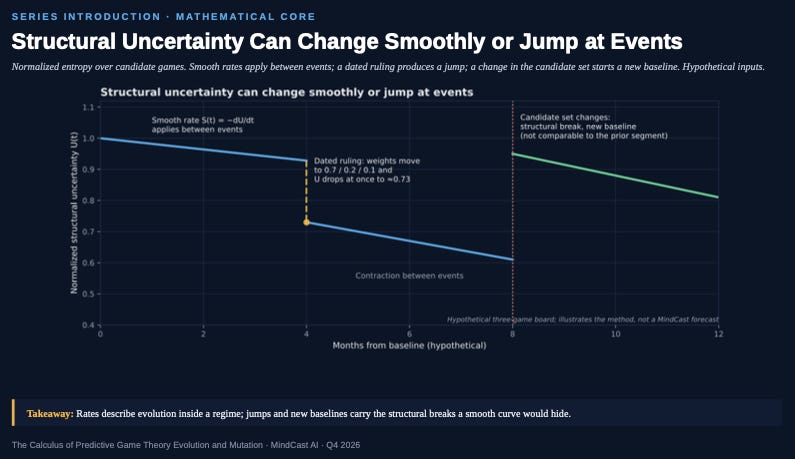
Figure 1. Structural uncertainty can change smoothly or jump at events (hypothetical)
Concentrated weights do not prove the candidate set complete, because a confident belief over an incomplete set looks stable. When the candidate set changes, the analysis logs a structural break and a new baseline rather than comparing normalized values across the break.
V.B Continuous Change and Discrete Events Require Different Representations
Smooth change inside a regime and jumps at dated events need different representations. Let x(t) be measurable game conditions and G(t) the operative game structure.
Between structural breaks:   dx/dt = f_G(t) ( x(t), a(t), t )

At an event time τ:          ( G(τ⁺), x(τ⁺) ) = T_e ( G(τ⁻), x(τ⁻), a(τ⁻) )
The transition operator T_e answers the five fork questions: what changes and what survives, who repositions, and which branches open or close. A discontinuity alone does not establish mutation. Ordinary game evolution includes abrupt rulings and enactments; mutation is reserved for exceptional changes that require rebuilding the operative model.
V.C Each Branch Carries Its Own Usable Horizon
Forecast survival supplies the usable horizon of each branch. Let λ(t) be the hazard that a structural change invalidates a branch’s forecast assumptions.
Q(T) = exp [ − ∫₀ᵀ λ(u) du ] T* = the latest T with Q(T) ≥ q_minQ(T) measures whether a branch’s assumptions survive, not whether its outcome occurs. A forecast survives a rule change it already represents, so λ(t) counts only changes that invalidate the stated assumptions, given the path and actor responses. The analyst states the threshold q_min with the decision’s stakes, and every branch can carry a different usable horizon.
V.D Waiting Stops Paying When Delay and Preemption Outrun Learning
Commitment timing balances three quantities. Let R(t) be the expected loss from committing at time t given the evidence expected by then, c(t) the incremental cost of waiting, and L(t) the expected loss from a rival acting first.
J(t) = R(t) + ∫₀ᵗ c(u) du + L(t)

Interior candidate:   − R′(t) = c(t) + L′(t)
Wait while the expected reduction in commitment error exceeds the combined marginal cost of delay and preemption. Suppose commitment error decays as R(t) = R₀e^(−kt) and delay cost holds constant at c. The preemption term depends on how rivals impose loss, and two models give different conditions.
Steady flow of preemption loss (customers or share lost at rate hΔ per period):
    L(t) = hΔ t          →   t* = (1/k) ln [ k R₀ ÷ (c + hΔ) ]

One-time loss Δ if a rival moves first, arriving at constant hazard h:
    L(t) = Δ (1 − e^(−ht))   →   k R₀ e^(−kt) = c + hΔ e^(−ht), solved numerically
The closed form holds only under the steady-flow assumption or as a short-window approximation of the one-time model. Figure 2 uses the steady-flow model.
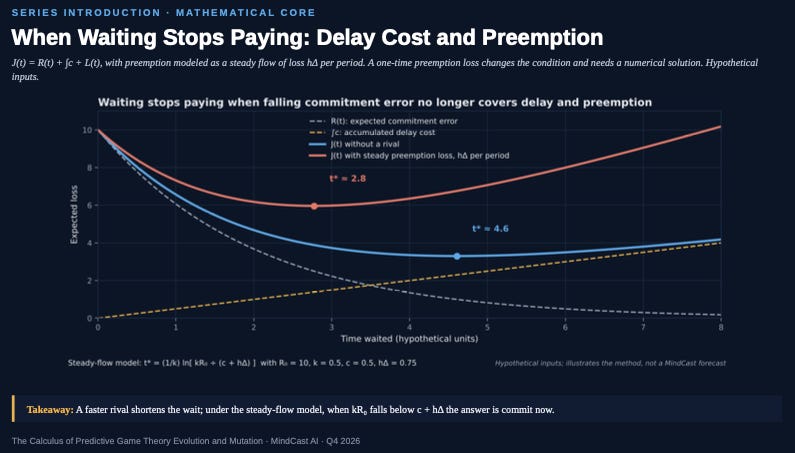
Figure 2. Waiting stops paying when falling commitment error no longer covers delay and preemption (hypothetical, steady-flow preemption)
A faster rival shortens the wait. Under the steady-flow model, when kR₀ falls below c + hΔ the candidate time is zero: commit now.
The derivative condition is a local diagnostic under stated assumptions. A reusable module must also compare boundary solutions and allow decisions contingent on later evidence. The calculation restarts at scheduled rulings and deadlines, which make R(t) jump. A full implementation models rival timing and responses jointly.
V.E Every Module States Its Inputs, Assumptions and Invalidators
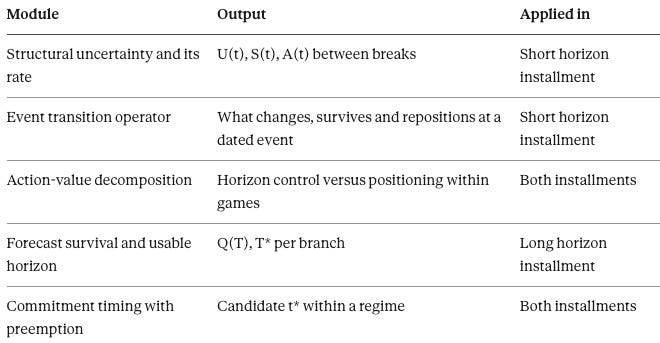
Every module carries the same contract. Each states its input sources, units, assumptions and equation. Each also states its sensitivity range and output, plus an update trigger and an invalidator.
The five modules make the calculus operational without claiming calibration. Each turns an informal instruction into a stated condition with named inputs, and each restarts at the dated events the branch trees already mark. Their value now lies in disciplining judgment, and validation follows as forecasts resolve.
Stakeholder callouts.
💼 Executives. Before any irreversible commitment in an unstable game, write down the commitment error, delay cost and rival preemption terms. Revisit the decision whenever one of those terms changes at a dated event.
📊 Investors. Usable horizons differ by branch, so one contest can support short and long positions at once. A Foresight Simulation estimates those horizons on real inputs rather than hypothetical ones.
⚖ Counsel. Model a scheduled ruling as a jump, never as gradual drift. Advice that assumes gradual change through a ruling date misreads the exposure on both sides of it.
Takeaway. The modules turn “preserve options” and “commit once the game holds” into explicit calculations, while keeping structural breaks as jumps rather than smoothing them away.
VI. Learning, Real Options and Preemption Theory Ground the Calculus
Established theory grounds each component, and the MindCast contribution lies in integrating them into a reusable workflow for named actors in changing institutions.
Learning and stabilization. Drew Fudenberg and David Levine’s The Theory of Learning in Games (1998) studies how equilibrium emerges through learning rather than assuming it at the outset. The work grounds the series’ focus on the process that produces stable behavior, without guaranteeing convergence or steadily falling uncertainty.
False stability and unexplored branches. Fudenberg and Levine’s self-confirming equilibrium (1993) shows that actors can hold beliefs consistent with observed play while staying wrong about unvisited branches. Repeated behavior can make a game look stable because nobody has tested the alternatives, so low uncertainty in beliefs does not by itself establish a dependable horizon. The long horizon installment applies the point to peer banks after the Bank of America order.
Commitment timing under rivalry. Fudenberg and Jean Tirole’s work on preemption in technology adoption (1985) supplies the counterweight to waiting for clarity: a rival’s possible move changes the payoff from waiting. The preemption term in Section V.D draws on that logic as a simplified proposal rather than a stated theorem.
Irreversibility and the value of waiting. Avinash Dixit and Robert Pindyck’s Investment Under Uncertainty (1994) supplies the real-options foundation for irreversible commitment and optimal timing.
Rules that change later rule-changing power. Daron Acemoglu, Georgy Egorov and Konstantin Sonin (2012) analyze institutional choices judged partly by the further changes they enable. Their logic matches secondary and tertiary branches, where actors value a successor arrangement partly by what it permits afterward.
Prediction under incomplete information. Dirk Bergemann and Stephen Morris (2016) characterize equilibrium outcomes that hold across information structures within a fixed game. Their result disciplines the invariance argument in Section II.B, though it does not cover arbitrary game replacement.
Uncertainty measurement. Claude Shannon’s information theory (1948) supplies entropy. Applying it to candidate-game weights and differentiating it as a stabilization diagnostic is a proposed MindCast application.
Exit, voice and the population of a branch. Albert Hirschman showed in 1970 that members of a declining organization choose between exit and voice, and in 1993 that mass flight and mass protest in East Germany fed each other until the regime fell. MindCast applies the same logic to rulings and rules through branch re-formation analysis: stakeholders who stay, leave or switch sides after a decision decide which game actually gets played.
The foundations show which parts of the calculus are established and which are proposed. Learning theory, real options and preemption models each carry deep literatures. Their combination for named actors in changing institutions remains a specification to test.
Stakeholder callouts.
🏛 Policymakers. Self-confirming equilibrium warns that quiet compliance may reflect untested beliefs. Examination programs that probe alternative branches reveal whether a regime is stable or only quiet.
📊 Investors. Real-options logic favors waiting, while preemption logic favors moving first. Positions in contested markets need both terms evaluated before any commitment date.
Takeaway. The literature supplies the foundations; the horizon measures, transition contracts and combined workflow remain MindCast proposals pending specification and validation.
VII. Most MindCast Cases Sit in the Short Horizon, and One Fork Links Three of Them
The matrix classifies each case by its forecast object rather than by its published label. A case sits in the short horizon when a dated event can replace the game inside the reader’s decision window. A case sits in the long horizon when rules, participant responses and transition mechanisms remain dependable through the window.
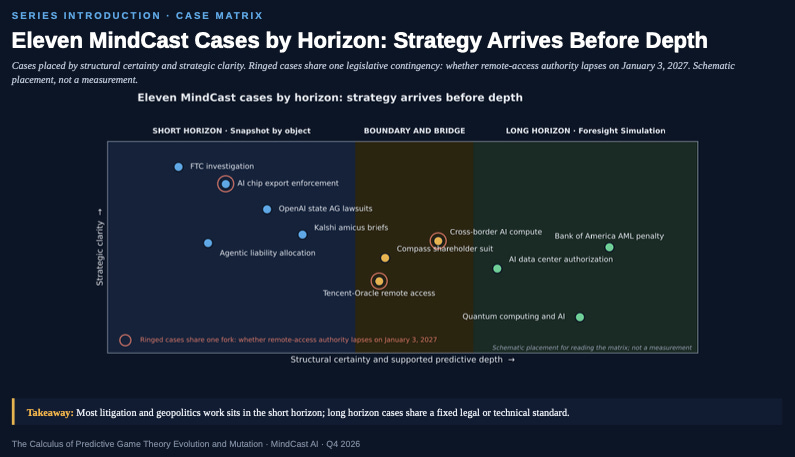
Figure 3. Eleven MindCast cases by horizon: strategy arrives before depth
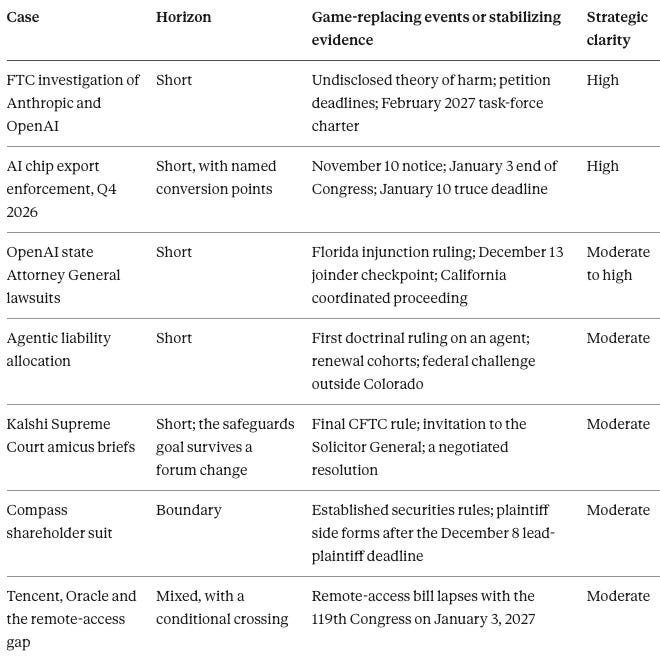
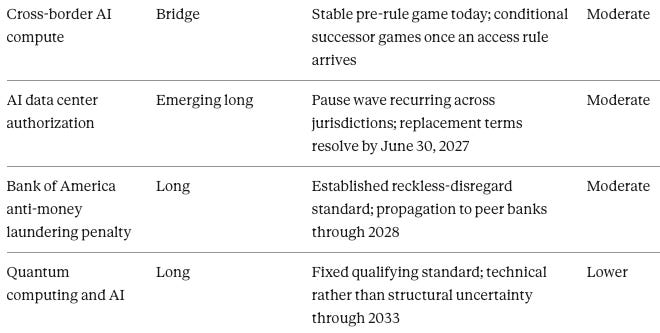
One legislative contingency moves three rows at once: whether remote-access authority lapses when the 119th Congress ends on January 3, 2027. Chip enforcement, Tencent-Oracle and cross-border compute are therefore three applications of one fork rather than three independent confirmations, and Figure 3 rings them.
Five works anchor the short horizon side. The FTC investigation shows a single informed enforcer whose theory selection is its own move. AI Chip Export Enforcement Shifts Risk Onto US Firms as China Demand Moves to Domestic Chips, Rented Compute and State Financing prints odds in tens across three dated forks and names when each channel could convert to a Foresight Simulation.
The Attorney General lawsuits and When AI Agent Liability Meets Common Law and Statute: Predictable Doctrines, Unsettled Allocation complete the Snapshot series. Kalshi Supreme Court Amicus Briefs: The NFL and Dodd-Frank’s Architects Split the Fight Into Jurisdiction and Game-Integrity Safeguards forecasts the path through the certiorari decision.
Three works sit at the boundary. What the Private-Listing Economics Add to Magloire v. Compass runs inside established securities rules, but its dominant fork remains what lead counsel chooses to plead.
Tencent-Oracle splits a short regulatory game from a longer contract layer. Cross-Border AI Compute holds a stable pre-rule game, because the paper places a qualifying access rule after 2028.
Three works carry the long horizon. Bank of America $1.2 Billion Money Laundering Penalty and the Compliance System That Knew Too Much supplies the cleanest stable game, with moderate strategic clarity: below-threshold testing stays useful under propagation and outlier routes and loses value only under a reset. AI Data Center Moratoriums Are Forecastable, and They End in Pricing Rules, Not Bans shows emerging stabilization. How Quantum Computing Can Improve AI: Five Applications, Their Commercial Potential, and the Limits of Quantum Advantage runs windows to 2033 under a fixed qualifying standard.
The matrix turns a library of separate papers into one classification. Eight of eleven cases sit in the short horizon or at its boundary, three share one legislative fork, and the long horizon cases share fixed standards. Readers can locate their own matter by asking which row it most resembles.
Stakeholder callouts.
⚖ Counsel. A matter resembling the short horizon rows needs advice keyed to the next ruling, while one resembling the long horizon rows can support multi-year planning. Placing a client’s matter on the matrix sets the depth any advice should claim.
💼 Executives. Firms exposed to chip enforcement, Tencent-Oracle or cross-border compute face one fork, not three. Plan for the January 3, 2027 outcome once across all three exposures.
📊 Investors. The three ringed cases share a legislative contingency. Assess their combined exposure to that fork while retaining case-specific payoffs, risks and decisions. Complete that assessment before January 3.
Takeaway. Most of the litigation and geopolitics cases in the matrix sit in the short horizon, the long horizon cases share a fixed legal or technical standard, and one dated fork links three rows.
VIII. Litigation Splits by Whether Its Theory Is Contested, Not by Subject
Litigation splits along a line that subject matter does not predict. Cases that run on a fixed filing schedule under established rules, such as a Securities Act suit, can support longer forecasts once their participants form. Cases with a contested forum or governing theory stay in the short horizon, as the Kalshi, Attorney General and FTC matters show.
Every long horizon case holds a fixed standard, and its open question concerns propagation and timing. Bank of America asks how fast an enforcement method spreads to peer banks. The data center case asks how many expiring pauses give way to cost-allocation terms, and the quantum case asks which application first clears a fixed qualifying test.
Mixed cases carry the most information for timing. The chip Snapshot places lapse of remote-access authority on January 3, 2027 at 80%. If the bill lapses and no new instrument appears early in the next Congress, the Tencent-Oracle contract layer becomes a candidate for a Foresight Simulation.
The matrix findings give each product a clear domain. Contested-theory litigation and live rule fights belong in Snapshots, schedule-bound litigation and fixed standards earn Foresight Simulations once their participants form, and mixed cases tell readers when to switch.
Stakeholder callouts.
⚖ Counsel. Once the lead plaintiff and amended complaint fix a securities case’s theory, the dismissal and disclosure path can support multi-step planning.
Takeaway. The matrix sorts cases by whether their rules hold, and that sort predicts which product fits better than subject matter does.
IX. One Installment Covers Acting Before the Game Holds, the Other What Stability Adds
The short horizon installment treats games whose rules can still change. The agentic liability tree shows bands at depth one, conditionals at depth two where a named deployer defines the next game, and open structure at depth three where four doctrines compete. The installment separates the origin of a change from its durability and sets out when early commitment pays before the game holds.
The long horizon installment treats games whose rules have begun to hold. The Bank of America tree shows a stable game with four channels, as wide as the agentic tree, yet with specified mechanisms beneath each. The data center tree shows a path still forming. The installment states the bounded stabilization condition and names false stability as the largest long horizon risk.
Neither installment issues new odds. Each states structural hypotheses with falsifiers and quotes published MindCast forecasts as labeled source annotations.
The two installments answer one question from opposite sides. The short horizon installment asks what an actor should do while the governing game remains open, and the long horizon installment asks how much further a forecast can reach once it closes. Read together, they tell a reader when to act on robust moves and when deeper forecasts justify commitment.
Stakeholder callouts.
💼 Executives. Decisions due before a pending ruling call for robust moves, while multi-year capacity or siting commitments call for the timing condition. Separate the two decision types before either reaches the board.
⚖ Counsel. Advice before the first reasoned ruling should cover every doctrinal route, while advice in a stable regime should test for false stability. Flag any client position that depends on one regulator’s continued posture.
Takeaway. The short horizon installment explains how to act before a game stabilizes, and the long horizon installment explains how much deeper a forecast can reach once it does.
X. Testable Implication: Short Horizon Cases Should Show a Depth Gap
The series carries its own falsifiable implication. Cases classified as short horizon should show worse calibration at depth two and three than cases classified as long horizon, across resolved forecasts through December 31, 2028. The implication fails if adequately sized cohorts show no depth gap between the two classes.
Two dated tests check individual classifications. Tencent-Oracle should become a Foresight Simulation candidate after January 3, 2027 only if the remote-access bill lapses without a successor instrument. The Compass shareholder suit should move toward the long horizon after the amended complaint fixes the plaintiff side’s theory.
The implication exposes the framework to the same discipline as any forecast. If short and long horizon cohorts show no depth gap, the classification loses its claim to predict forecast performance, though it may still organize decisions. If the gap appears, the classification becomes a commissioning tool with evidence behind it.
The Calculus Yields Ten Simulation Predictions
The calculus does more than classify cases. Ten corollaries follow from its mechanisms and govern how forecast depth, durability and commitment behave across every game the series covers. MindCast states them as Simulation Predictions with odds in tens, each resolving against dockets, enforcement records, renewal samples or resolved MindCast forecast cohorts through December 31, 2028.
Forecasts in short horizon games lose accuracy at the second and third fork faster than long horizon forecasts: 70%.
A distant forecast holds in an unstable game whenever the outcome stays the same in every game that might govern it: 80%.
Firms that make moves winning in every candidate game face fewer adverse actions than firms that wait: 70%.
Actors whose payoff grows with ambiguity open new forums and invite new players at higher rates than actors whose payoff grows with predictability: 70%.
A faster rival makes firms commit sooner, because delay and preemption outrun what the next ruling will teach: 70%.
Changes that independent actors reuse persist into later strategy more often than changes no one reuses: 80%.
Firms with reversible moves commit to an emerging path before firms with irreversible capital: 70%.
Once a game stabilizes, early committers capture more of the new payoffs than late movers: 60%.
Games held up by a single enforcer, or by a role with no successor, revert to short horizon shape more often than games held up by continuing reuse: 60%.
Insurance carriers do not converge on common agentic AI terms until the first reasoned ruling applies a common-law doctrine to an AI agent or the first public coverage action over agentic loss is filed: 80%.
The odds print in tens because each call rests on mechanism and case evidence rather than on calibrated cohort frequencies. Calls 2, 6 and 10 reach 80% because their mechanisms need little cohort evidence to show. Calls 8 and 9 sit at 60% because few games will stabilize or revert inside the window.
Each call carries a falsifier. A depth gap that fails to appear, unreused changes that persist as often as reused ones, or carriers converging on common terms before either agentic event would each disconfirm its call.
The ten calls turn the calculus into commitments a reader can check. Most resolve on public dockets and filings, so the series’ claims about depth and durability face the same discipline as any MindCast forecast.
Stakeholder callouts.
📊 Investors. The Tencent-Oracle crossing test arrives on January 3, 2027. Positions exposed to remote-access rules deserve review the week after the deadline.
💼 Executives. Firms in a position like the Compass shareholder suit should expect forecasts to lengthen once the amended complaint fixes the theory. Planning horizons can extend at that point.
Takeaway. The classification itself is testable, and the ten Simulation Predictions turn the calculus into calls a reader can check.
XI. What to Watch: The January 3, 2027 Lapse Deadline Is the Dominant Fork
Seven dated observables will move the matrix between November 2026 and the end of 2028. The January 3, 2027 deadline leads because it reclassifies three rows at once.
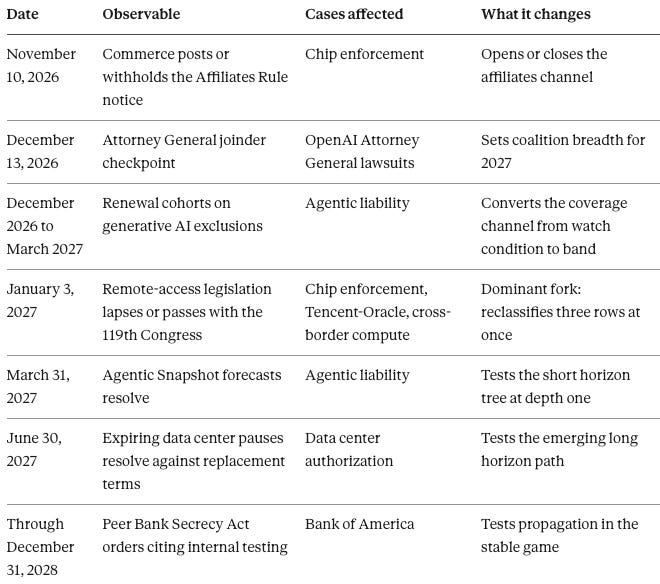
The calendar concentrates risk in the next ten weeks. Three of the seven observables land before January 10, 2027, and each can replace the game for the cases it touches. Readers with exposure to those cases gain the most by acting before the dates rather than after.
Stakeholder callouts.
💼 Executives. Decisions exposed to the November 10, December 13 or January 3 dates should be staged so each can change after the event. Map each exposure to its date before the November 10 notice.
🏛 Policymakers. Legislators weighing remote-access text before January 3 should recognize that lapse or passage reclassifies three distinct markets at once.
Takeaway. The January 3, 2027 deadline moves more of the matrix than any other single event, and the June 2027 pause test checks the long horizon side.
Working With MindCast
MindCast AI is a Predictive Game Theory Modeling-Simulation firm. MindCast builds Cognitive Digital Twins of the named actors on a client’s board and models how the game evolves through its next forks. Both run through Vision Functions, the modular game-theoretic modules inside Predictive Behavioral Economics + Dynamic Game Theory.
What MindCast can do
Cognitive Digital Twin builds of counterparties, regulators and courts, plus carriers and coalitions. Each is calibrated from public conduct and the client’s own decision history.
Strategy and Risk Simulation Snapshots for short horizon matters: odds in tens at the current fork, conditional downstream paths, and strategy and risk per path within five business days.
Foresight Simulations for stabilizing matters: published bands at depth two and three, P10/P50/P90 ranges, complete scenario trees and organization-specific calibration.
Interactive war games that let a client’s team play its own moves against modeled opponents across dated forks.
Commitment-timing and horizon analysis that applies the calculations in Section V to a client’s own costs, rivals and deadlines.
Monitoring dashboards keyed to the dated signals in each What to Watch table.
When an engagement adds the most
A decision depends on which game governs the next step, and the best move differs across candidate games.
A firm holds exposure to several cases that share one fork, such as the January 3, 2027 remote-access deadline.
An irreversible commitment falls due before a dated ruling, vote or deadline resolves.
How engagements begin. A complimentary Snapshot runs on publicly available information. Private engagements proceed after a nondisclosure agreement and retainer, starting with a diagnostic session on one live decision.
Contact: mcai@mindcast-ai.com · Corporate site: www.mindcast-ai-simulation.com
Appendix A. Selected MindCast Works
The series
Predictive Game Theory Evolution and Mutation: Short Horizon Games Branch Wide and Resolve Shallow. Short horizon installment, with agentic AI liability as the worked tree.
Predictive Game Theory Evolution and Mutation: Long Horizon Games Resolve Deep Because Their Branches Hold. Long horizon installment, with Bank of America and data center authorization as the worked trees.
Frameworks and methods
Dynamic Predictive Game Theory: From Nash Equilibrium to Adaptive Coherence Equilibrium. Supplies equilibrium selection, delay dominance and the failure modes of Adaptive Coherence Equilibrium.
Predictive Game Theory Simulations Through War Gaming. Separates Simulation Snapshots from Foresight Simulations by the stability of the game.
MindCast Prediction Scorecard. Resolved material calls as of October 31, 2026.
Cases in the matrix
FTC Investigation of Anthropic and OpenAI. Short horizon; unresolved theory with clear immediate moves.
AI Chip Export Enforcement Shifts Risk Onto US Firms as China Demand Moves to Domestic Chips, Rented Compute and State Financing. Short horizon with named conversion points.
OpenAI State Attorney General Lawsuits: Two Pleading Templates Across Ten State Courts. Source of the published odds shift on adopting pleaded conduct terms.
When AI Agent Liability Meets Common Law and Statute: Predictable Doctrines, Unsettled Allocation. Source of every quoted band on the agentic liability trees.
Kalshi Supreme Court Amicus Briefs: The NFL and Dodd-Frank’s Architects Split the Fight Into Jurisdiction and Game-Integrity Safeguards. Short horizon; a goal that survives a forum change.
What the Private-Listing Economics Add to Magloire v. Compass. Boundary case inside established securities rules.
Tencent, Oracle, and the Remote-Access Gap in US AI Chip Export Controls. Mixed case and source of the invariance example.
Cross-Border AI Compute. Bridge from a stable pre-rule game to conditional successor games.
Bank of America $1.2 Billion Money Laundering Penalty and the Compliance System That Knew Too Much. Source of every quoted band on the Bank of America tree.
AI Data Center Moratoriums Are Forecastable, and They End in Pricing Rules, Not Bans. Source of every quoted band on the data center tree; the source presents its bands as model-derived foresight judgments.
How Quantum Computing Can Improve AI: Five Applications, Their Commercial Potential, and the Limits of Quantum Advantage. Long horizon under a fixed qualifying standard.
Appendix B. External Sources
Academic foundations
Claude E. Shannon, “A Mathematical Theory of Communication,” Bell System Technical Journal 27 (1948).
Albert O. Hirschman, Exit, Voice, and Loyalty: Responses to Decline in Firms, Organizations, and States, Harvard University Press (1970).
Albert O. Hirschman, Exit, Voice, and the Fate of the German Democratic Republic: An Essay in Conceptual History, World Politics 45, no. 2 (January 1993): 173–202.
Drew Fudenberg and Jean Tirole, “Preemption and Rent Equalization in the Adoption of New Technology,” Review of Economic Studies 52 (1985).
Drew Fudenberg and David K. Levine, “Self-Confirming Equilibrium,” Econometrica 61 (1993).
Avinash K. Dixit and Robert S. Pindyck, Investment Under Uncertainty, Princeton University Press (1994).
Drew Fudenberg and David K. Levine, The Theory of Learning in Games, MIT Press (1998).
Daron Acemoglu, Georgy Egorov and Konstantin Sonin, “Dynamics and Stability of Constitutions, Coalitions, and Clubs,” American Economic Review 102 (2012).
Dirk Bergemann and Stephen Morris, “Bayes Correlated Equilibrium and the Comparison of Information Structures in Games,” Theoretical Economics 11 (2016).