Commerce Department · Bureau of Industry and Security · Congress · Nvidia · Southeast Asian Data Center Operators and Lenders · Chinese AI Labs · Malaysia · Singapore · Thailand · Indonesia · Brazil · Norway · South Africa
Companion: Lutnick and the Commerce Department
Related MindCast work.
Geopolitical AI Chip Export Interactive War Gaming. Updated 11/15/2026 to reflect live intelligence developments. Lets readers play the seats in this paper against the rule’s cutoff and country list.
Tencent, Oracle, and the Remote-Access Gap in US AI Chip Export Controls. Set the rental template and the carried calls on transition paths.
AI Chip Export Enforcement War Game Shows When Verification Protects US Firms and When It Arrives Too Late. Shows why controls protect lenders only while the preventive window stays open.
The Runtime Export Problem: Anthropic’s 151 Million-Exchange Distillation Record, Advisory AA26-251A, and the Question Commerce Cannot Yet Answer. Supplies the conduct-based calls the first rule will test.
Cross-Border AI Compute: Access Rules, Clean Power and Local Approval Decide Which Operators Win. Identifies which operators gain under a tenant rule versus a country list.
I. Executive Summary
Commerce’s draft remote-access rule would regulate renting rather than shipping, yet it still draws its license line at delivery. Washington bans sales of Nvidia’s Blackwell-class chips to Chinese companies but lets Chinese labs rent the same chips abroad. As reported, the rule requires a license only for chips delivered after a cutoff, so every chip delivered before that date keeps serving Chinese tenants. The Bureau of Industry and Security (BIS) confirmed on November 12 that it is “actively considering new rules to address remote access with interagency partners” (New York Post).
Thesis. The cutoff date decides how much capacity the rule leaves open to Chinese labs, and the country list decides where new capacity goes. Export rules draw their line at shipment, so the market races to deliver chips before the cutoff. The Foresight Simulation puts the exemption for chips already delivered at 83% if Lutnick signs the rule and 68% under a successor. Operators should plan for a transition of either length.
What distinguishes the MindCast approach. MindCast AI applies Predictive Behavioral Economics + Dynamic Game Theory through MindCast AI Proprietary Cognitive Digital Twin Foresight Simulations (MP CDT FS). Game theory supplies the payoff structure: operators racing to take delivery before a cutoff they cannot yet see, host states shaping the country list and Chinese labs choosing where to rent. Behavioral economics supplies the decision rules: loss aversion around the cutoff date, lenders’ inability to size an unknown rule and the salience a spy scandal gives to tough-looking terms. Predictive behavior emerges from the combination.
What the paper does. The paper explains how the reported design turns delay into a subsidy for chips delivered early and why financing limits the rush. The analysis then traces how the game reached its current form and the conditions that would end its baseline before setting out MindCast Foresight Simulation Predictions on the exemption, the shift of demand to unlisted countries and lender disclosures. A risk mitigation layer opens with lenders and investors. The companion Snapshot Lutnick and the Commerce Department Likely Miss January 10 on the Rented GPU Rule, and His Tenure Shapes What It Exempts More Than When It Publishes covers who decides when the rule publishes.
Prior validation. The Runtime Export Problem: Anthropic’s 151 Million-Exchange Distillation Record, Advisory AA26-251A, and the Question Commerce Cannot Yet Answer (2026) assigned 83% to no Entity List addition or sanctions on six named Chinese labs before the September 24 summit. None occurred.
Foresight Simulation Prediction highlights. The paper carries 16 MindCast Foresight Simulation Predictions: two primary, three secondary, three snapshot and eight carried from published MindCast work.
RG-P-1 · 83% (79-86%) · P(first rule exempts chips delivered before its cutoff given Lutnick is in office at publication) · First rule published by December 31, 2027 · conditional
RG-P-2 · 68% (64-73%) · P(first rule exempts chips delivered before its cutoff given a successor is in office at publication) · First rule published by December 31, 2027 · conditional
RG-SN-2 · 80% (70-80%) · P(first rule exempts chips delivered before its cutoff, whoever signs) · First rule published by December 31, 2027 · snapshot
RG-S-1 · 61% (51-71%) · A China-parented rental commitment is reported in a country outside the rule’s list, given a list of seven or fewer countries · 12 months after the cutoff · event
RG-S-3 · 81% (72-90%) · A listed operator or lender cites the rule in a securities filing · 120 days after publication · event
C-9 · 92% (89-95%), updated from 62-78% · The first qualifying instrument provides a transition, licensing or continuation path for existing contracts · First qualifying instrument · conditional
Stakeholder readout.
📊 Investors · Collateral holds value only while delivered chips stay outside the license and no informal pressure ends the lease (RG-P-1, RG-S-3) · Decision window: Before year-end credit reviews · Immediate move: Stress collateral with and without the exemption
💼 Executives · Operators keep Chinese revenue on delivered chips and lose it on undelivered orders (RG-S-1) · Decision window: Before publication · Immediate move: Confirm export dates for contracted hardware
⚖️ Counsel · The license date and a notice duty set the compliance calendar (C-9) · Decision window: Before publication · Immediate move: Draft tenant clauses for both license and notice designs
🏛️ Policymakers · A seven-country list relocates Chinese demand rather than denying it (RG-P-2, RG-S-1) · Decision window: Before conference closes · Immediate move: Tie statutory text to tenant identity and an early cutoff
Takeaway: the rule’s value to China lies in its exemption for delivered chips, and the cutoff date decides how large that exemption grows.
II. Topic Discussion and Simulation Fit
Section II sets out the problem the rented GPU rule tries to solve and the game it starts. II.A and II.B establish the current state and how the rental route works, and II.C fixes the governing question. II.D and II.E explain what behavioral economics and game theory each add, while II.F and II.G lay out the simulation’s actors and how the game branches.
II.A Current State and Newshook
Washington bans sales of Blackwell-class chips to Chinese companies but leaves rentals abroad open. Malaysia alone has drawn more than $34 billion in data center investment, according to James Chai of Singapore’s Institute of Southeast Asian Studies in a Wall Street Journal review. An Unemployment Labs analysis of published model weights reports that DeepSeek and Moonshot AI initialized their newest models on Blackwell-class hardware.
The rule revived after a scandal. Nvidia chief executive Jensen Huang resigned on November 12 after reports tied him to a former executive of Megaspeed, a Singapore firm that rents Nvidia capacity to Chinese customers (Form 8-K). Paper 2 covers the politics, and this paper covers the rule.
The New York Times and The Information both report that the draft covers seven countries. Four are in Southeast Asia: Singapore, Malaysia, Thailand and Indonesia. The other three are Brazil, Norway and South Africa (New York Times; SBS News).
The two outlets describe the mechanics differently. The Information reports a license requirement on the listed countries’ imports of Blackwell-class chips and a duty to notify Commerce of recipients and uses. US operators would be exempt if they block access from China and Russia. The New York Times reports that the rule applies to future shipments only and that operators would notify Commerce when Chinese customers train models, with no automatic license required.
The two accounts fit one design with two layers. A license on deliveries draws its line at shipment, so chips delivered before the cutoff stay outside it. A notice duty on training regulates use, so it could reach chips already delivered without requiring a license.
Chinese firms are already reserving offshore capacity ahead of the rule. Bankers told regional press that about half of financing deals for new Malaysian data center projects have stalled. Malaysia is weighing a law to monitor data center operations and their chip use.
Confirmed facts. BIS’s statement that it is considering remote-access rules and Malaysia’s proposed monitoring law. Reported by unnamed sources. The country list, the license and notice terms, the capacity rush and the financing slowdown.
Takeaway: the reported license reaches chips delivered after the cutoff, a notice duty may reach the rest, and the market is moving to take delivery first.
II.B How the Rental Route Works
US export controls govern the physical movement of chips. BIS does not treat rented computing time as an export, so a Chinese lab can train on Blackwell-class chips in a third country without a license. Tencent’s lease of offshore Oracle capacity set the template until Oracle cancelled it on November 4 after US officials raised concerns, the Financial Times reported. Tencent, Oracle, and the Remote-Access Gap in US AI Chip Export Controls (2026) found existing service of that kind likely to continue (C-3).
Import Controls, Export Controls and the US–China AI Infrastructure Contest (2026) found that Chinese firms moved training offshore to rented compute rather than onto domestic chips. The finding shows why the rental route now carries the contest.
Washington has tried three partial fixes. Commerce rescinded the Biden diffusion rule in May 2025 and promised a replacement that never came. BIS guidance on May 31, 2026 required licenses for advanced chips sent to overseas subsidiaries of China-headquartered firms, which reaches ownership but not tenancy. The House passed the Remote Access Security Act in January 2026, and the Senate has not acted (Kharon).
Nvidia has filled part of the gap privately. The Wall Street Journal reports that Nvidia pressed cloud partners to cap Chinese customers at 30-49% of their business, a limit written into no contract. Private caps bind only while Nvidia chooses to enforce them, and a rule would turn them into legal duties.
The rule also faces a legal test. Lawyers at Baker McKenzie told The Information that Commerce lacks clear statutory authority over remote access (AI Weekly). A license on chip deliveries rests on traditional export authority. The legal constraint offers one explanation for the shipment-based design that does not depend on the motives of the official who signs it.
Megaspeed shows how rental and shipment overlap. The Singapore firm imported at least $4.6 billion of Nvidia hardware into Malaysia and Indonesia, according to customs data cited by Bloomberg (Thairath). Megaspeed rents computing power to Chinese customers, including Alibaba (Sovereign Magazine). The Justice Department is investigating it for smuggling, a shipment offense, while its rental business remains legal.
Takeaway: the rental route stays legal because export law tracks shipments, and every fix so far reaches ownership or new deliveries rather than tenancy.
II.C Governing Question
Does the first remote-access rule exempt chips delivered before its cutoff, and how long a transition does it allow? What do those terms mean for lenders, operators and Chinese labs? The horizon runs from November 2026 through 2027. When the rule publishes, and who at Commerce decides, belongs to the companion Snapshot.
Physical smuggling of chips into China falls outside scope. Enforcement Incidence and Capability Denial in Artificial Intelligence Export Controls (2026) covers that channel. The paper’s finding that enforcement costs land on parties Washington can reach, such as hosts and lenders, carries into the rented GPU rule.
Takeaway: the paper forecasts the rule’s reach and the exposure it creates for the parties it binds.
II.D Why Behavioral Economics Adds Value
Operators treat the cutoff date as their reference point. Loss aversion pushes them to take delivery before it, because chips delivered after the cutoff need a license to serve Chinese tenants. The rush itself enlarges what the exemption protects.
Lenders face the same reference point from the other side. A loan against capacity that may lose its tenant carries a loss the lender cannot size until the rule text appears. Bounded information drives lenders to pause new projects, so reservations concentrate on sites already built.
Salience shapes the rule writers. The Nvidia spy scandal made Chinese access to rented chips a visible political issue. Salience pushes drafters toward terms that look tough, such as a wider country list, even though the cutoff date does more to decide how much capacity stays open.
Takeaway: loss aversion drives the rush to take delivery, bounded information caps it at built capacity, and salience pulls drafters toward visible terms.
II.E Why Dynamic Predictive Game Theory Adds Value
The core structure is a timing game among operators racing to take delivery before a cutoff they cannot yet see. Each operator’s best response is to accelerate exports already contracted. Together the rush hands policymakers their strongest argument for an earlier cutoff.
Host states play a second game. Malaysia and Singapore can police their own data centers to stay off a wider list or to soften its terms. Malaysia’s trade minister Johari Abdul Ghani said that “Malaysia will not allow itself to be used as a channel to circumvent export controls” (The Edge).
Chinese labs play a location game. A seven-country list makes unlisted hosts with power and capacity the next destination. Foresight Analysis in Illegal GPU Export Pathways (2025–2030) mapped the same spread from Malaysia and Thailand to Indonesia and beyond. The Runtime Export Problem found the same pattern in model extraction, which moved to wherever safeguards were weakest.
AI Chip Export Enforcement War Game Shows When Verification Protects US Firms and When It Arrives Too Late (2026) found that a compliance control protects a US firm mainly while its preventive window stays open. The rented GPU rule sets that window for operators and lenders at the cutoff date. Controls adopted after publication can shape remedies but not the exposure already created.
A static analysis treats the rule as a fixed line. The game shows the line moving in response to the rush it creates.
Takeaway: the rush to take delivery, host-state policing and lab relocation each move the rule’s effective boundary.
II.F Simulation Architecture
Eight Cognitive Digital Twins (CDTs) carry the game.
Commerce leadership · Objective: Supplied by the companion Snapshot · Decision rights: Lutnick or a successor signs the rule · Update trigger: Companion Snapshot’s tenure result
Rule writers at Commerce · Objective: A rule that survives scrutiny and legal challenge · Decision rights: Country list, cutoff, license or notice · Update trigger: Hearing pressure; interagency review
Congress · Objective: Statutory limits on rental access · Decision rights: Defense bill by January 3; oversight after · Update trigger: Conference text; change of majorities
Southeast Asian operators · Objective: Take delivery of contracted chips before the cutoff · Decision rights: Export schedules; anchor tenants · Update trigger: Rule text and license date
Lenders and sponsors · Objective: Collateral that keeps its tenants · Decision rights: Commitment terms; covenants · Update trigger: Rule text; tenant mix
Host governments · Objective: Investment without a place on the list · Decision rights: Monitoring laws; re-export permits · Update trigger: US country list
Chinese labs · Objective: Frontier training on rented hardware · Decision rights: Location choice among hosts · Update trigger: Country list
Nvidia · Objective: Data center revenue under board review · Decision rights: Partner contracts; tenant caps · Update trigger: November 17 results
Commerce leadership enters from the companion Snapshot, whose LC-P-2 forecasts Lutnick’s tenure.
Candidate designs.
Narrow: seven countries, a license only on deliveries after the cutoff, notice on training. Falsifier: the first rule requires a license for Chinese use of chips delivered before the cutoff.
Hybrid: a license on new deliveries plus a notice duty that reaches delivered chips. Falsifier: the first rule carries no notice or reporting duty on delivered chips.
Broad: a license on Chinese training regardless of delivery date, or a list longer than seven countries. Falsifier: the first rule matches the narrow or hybrid design.
Statutory override: Congress writes a remote-access duty that replaces the rule’s terms. Falsifier: no remote-access statute takes effect before the first rule publishes.
Takeaway: eight actors and four candidate designs frame a rule whose reach turns on one date.
II.G How the Game Evolves
The rental game reached its current form in three steps. Commerce had an interagency-approved remote-access rule by July 2025 and left it unpublished for 16 months. The Megaspeed smuggling case and the Nvidia spy scandal then turned rented chips into a political issue. BIS’s November 12 statement and the reported draft fixed the design space at seven countries, a cutoff for new deliveries and a notice duty on training.
The remaining rules hold through the forecast window for two reasons. Operators signed their export schedules and anchor-tenant contracts before the draft surfaced, so the stock of delivered chips changes only at the margin. Commerce’s authority over deliveries is clear and its authority over use is contested, so the design stays within license and notice terms unless a successor or a statute widens it.
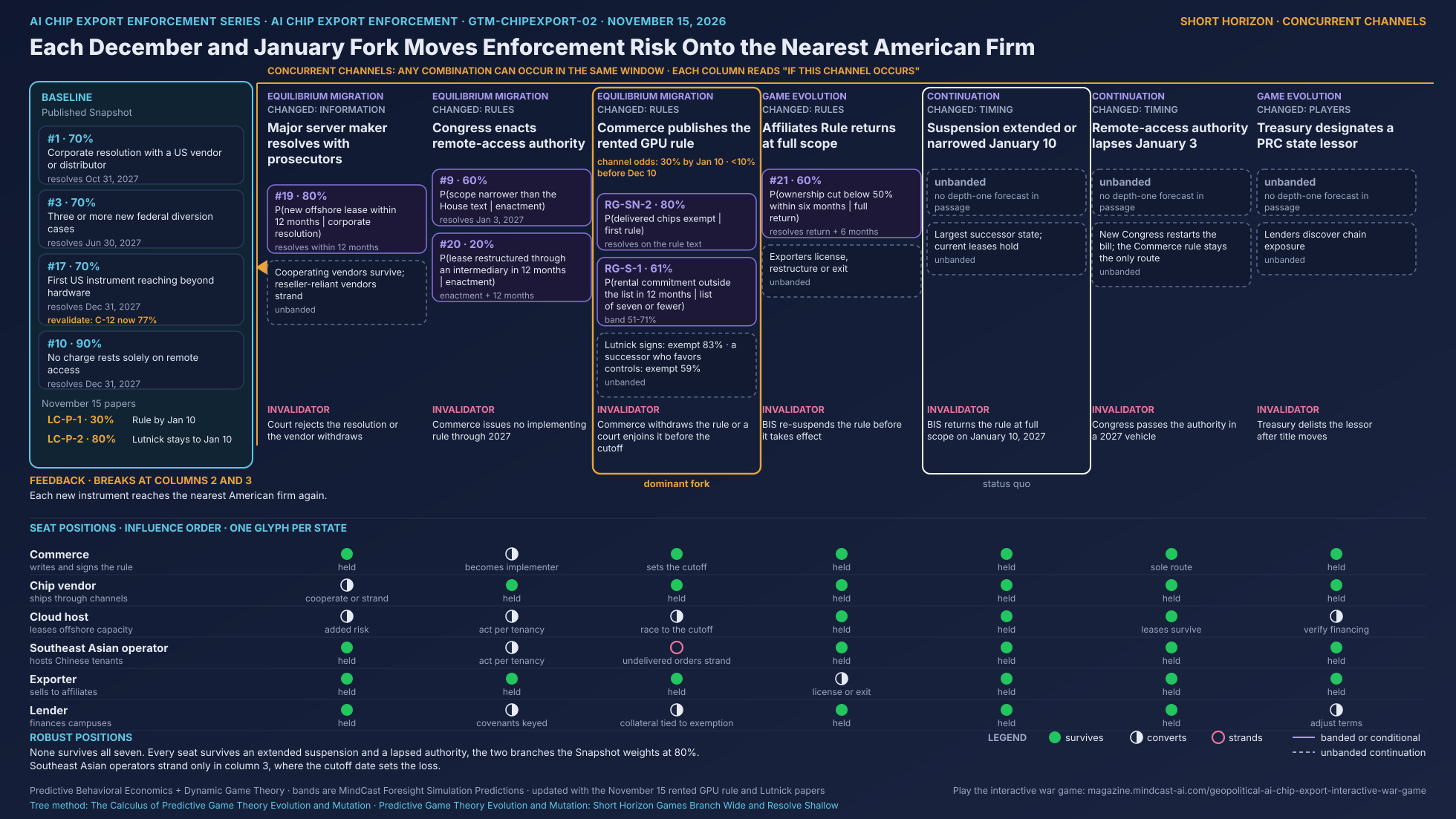
How the Game Branches. The baseline is a first rule that exempts chips already delivered. The exemption holds at 83% (79-86%) if Lutnick signs (RG-P-1) and at 68% (64-73%) if a successor signs (RG-P-2). The dominant fork is who signs the rule, and the President moves it by keeping or replacing Lutnick. Across both signers, the exemption holds at 80% (RG-SN-2) because Lutnick holds office on two-thirds of likely publication paths.
A successor who shares Lutnick’s trade priorities keeps the baseline intact. P(delivered chips exempt | successor shares his priorities) is 83%. Operators, lenders and Chinese labs keep the moves they hold under Lutnick. Four other states would end the baseline.
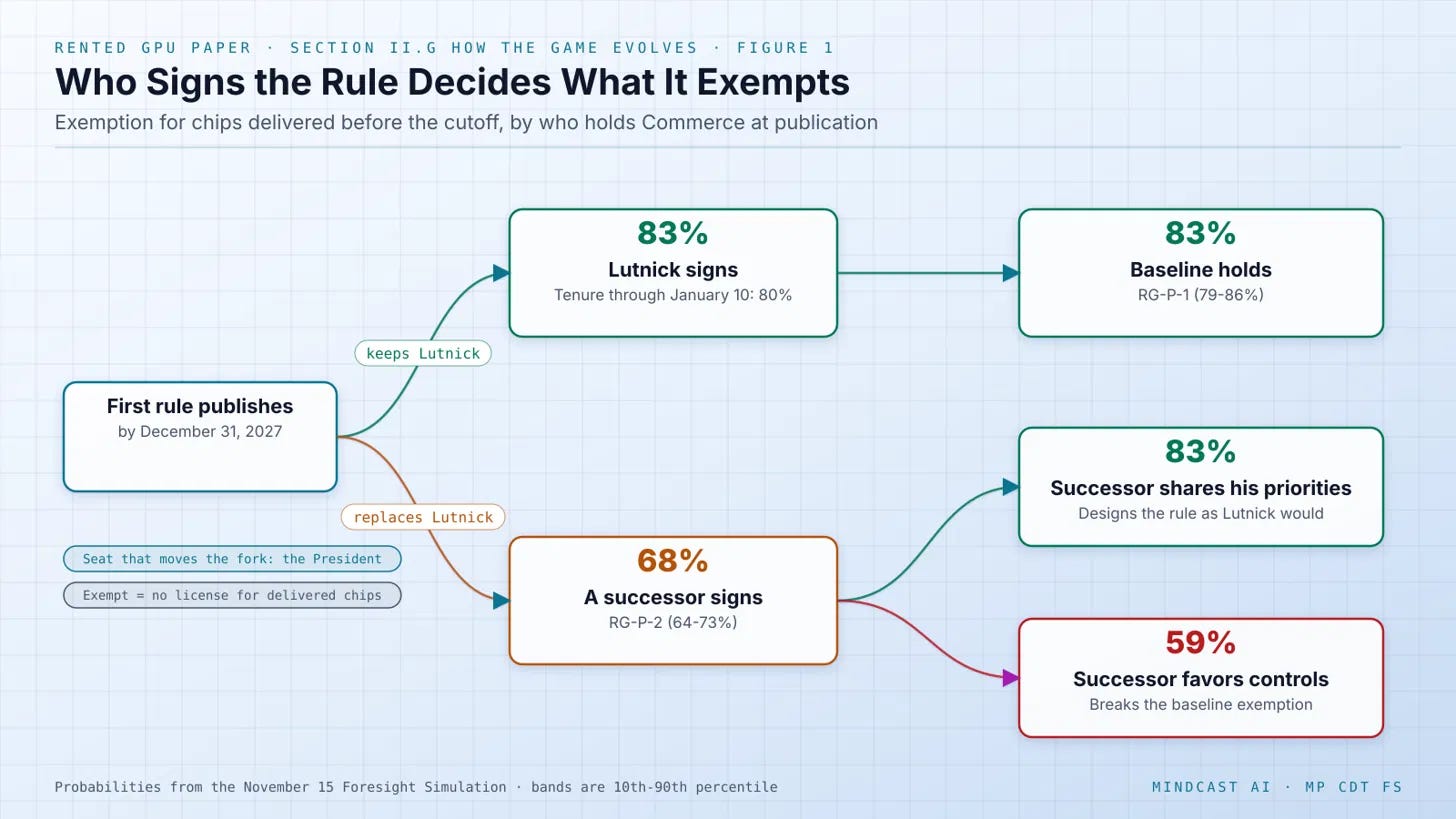
Figure 1. Who signs the rule decides what it exempts.
State 1: a short transition. Class: equilibrium migration. The rule publishes with a license date close to publication, or as an interim final rule effective at once. A short gap carries as much weight as a long one. Operators with chips in transit lose the rush and strand undelivered orders, and lenders lose the window to move collateral onto delivered sites.
State 2: a longer country list. Class: equilibrium migration. The rule names more than seven countries while delivered chips stay exempt (Route C, 23%). Host governments outside the seven lose the move to attract displaced demand. Chinese labs lose their next destinations, which narrows the relocation that RG-S-1 counts at 61% (51-71%) under a list of seven or fewer.
State 3: a statute replaces the rule. Class: game mutation, because Congress takes the design decision away from Commerce. The companion Snapshot carries enactment by January 3 at 20% (C-2). Defense bill conferees gain the decisive move, and Commerce converts from author to implementer. Operators’ positions survive or strand on the statute’s text rather than the draft’s.
State 4: a successor who favors controls. Class: equilibrium migration, and the state that breaks the baseline. Under this successor, delivered chips stay exempt at 59%, and RG-SN-3 puts the snapshot odds of a license on them at 40%. Route D’s 22% gives the overall odds of that license across every signer. Lenders to delivered capacity lose their collateral’s protection, and Chinese labs lose rented capacity already in place.
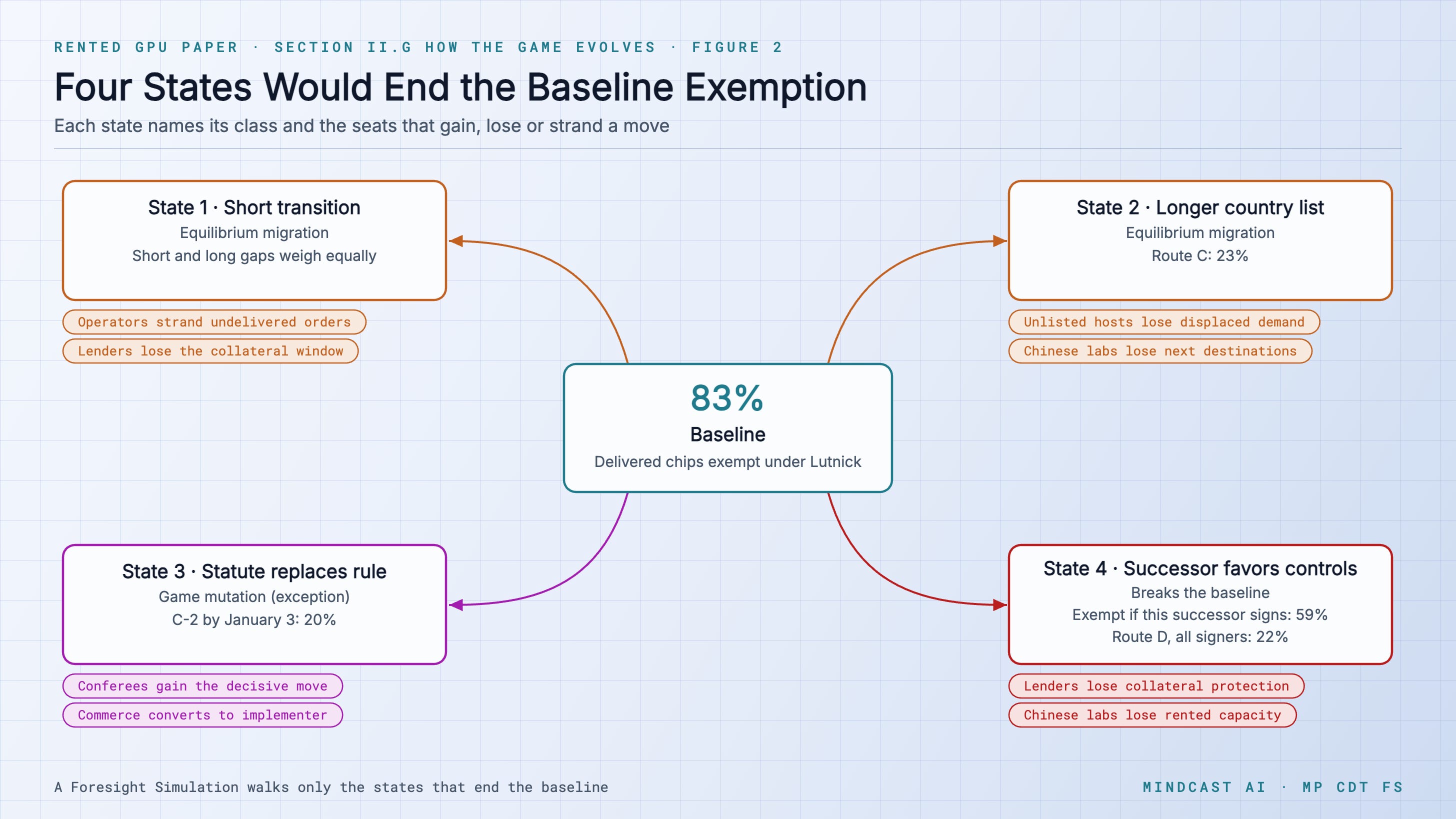
Figure 2. Four states would end the baseline exemption.
The outcome feeds the next cycle through relocation. A license on delivered chips strands capacity in the listed countries and pushes Chinese demand toward unlisted hosts. The country list then becomes the next fork.
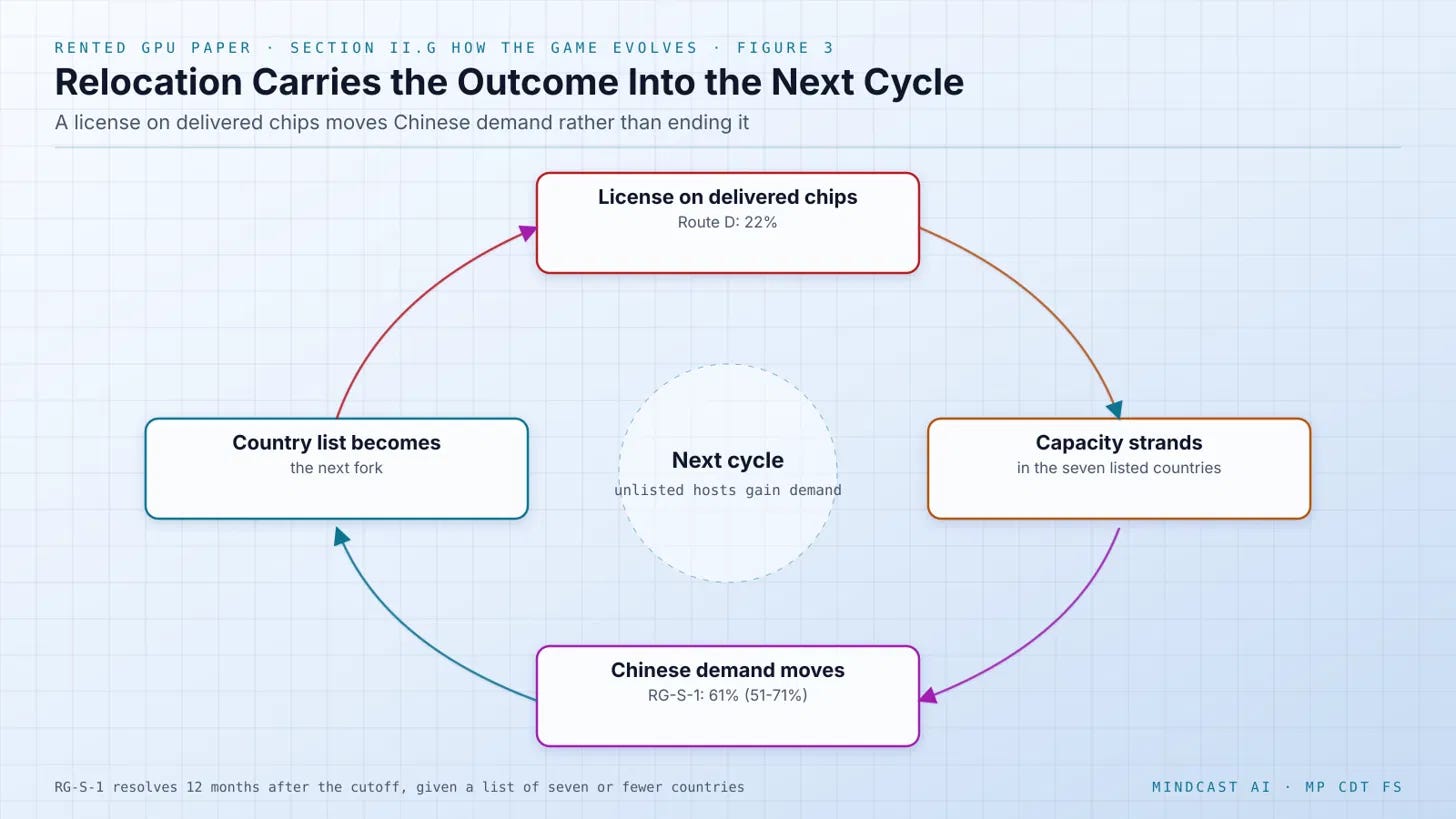
Figure 3. Relocation carries the outcome into the next cycle.
Section II reduces the rented GPU rule to one date and one signer. The cutoff decides how much delivered capacity stays open to Chinese labs, and whoever holds Commerce at publication decides whether delivered chips stay exempt. Four states would end that baseline, and Section III assigns probabilities to each path.
III. MindCast Foresight Simulation Predictions
Section III converts the game into 16 MindCast Foresight Simulation Predictions with defined resolution terms. The set opens with resolution definitions and four scenario routes, then moves to two primary and three secondary Foresight Simulation Predictions. Three snapshot Foresight Simulation Predictions and eight carried from published MindCast work follow, and the section closes with watch conditions and the limits that would break the analysis.
Foresight Simulation Prediction set. The paper carries 16 Foresight Simulation Predictions: two Primary Foresight Simulation Predictions (P), three Secondary Foresight Simulation Predictions (S), three Snapshot Foresight Simulation Predictions (SN) and eight carried from published MindCast work (C). Date: November 15, 2026. Data cutoff: November 15, 2026. Bands come from the November 15 Foresight Simulation and show the central value with the 10th to 90th percentile range.
Resolution definitions.
First rule: the first BIS rule published in the Federal Register, including an interim final rule, that restricts Chinese entities’ remote access to or use of advanced chips in data centers outside China. A first rule must publish by December 31, 2027; otherwise every Foresight Simulation Prediction keyed to it is void.
Cutoff: the date from which the rule’s license requirement applies to new deliveries.
Notice-only design: if the first rule carries no license requirement, RG-P-1 and RG-P-2 resolve on whether the rule prohibits Chinese use of chips delivered before publication, and no prohibition counts as exempt.
Reported draft: seven countries, a license on deliveries after a cutoff and a notice duty on training that requires no license.
Chips delivered before the cutoff: advanced chips delivered to a data center in a listed country before the cutoff, plus chips en route under any savings clause.
Exempt: the rule lets chips delivered before the cutoff keep serving China-parented tenants without a license. A notice, reporting or registration duty that requires no license still counts as exempt. A license requirement or a prohibition on Chinese use of those chips does not.
License date gap: the number of days between publication and the cutoff. An interim final rule whose license requirement applies on publication has a gap of zero.
Simulation synthesis. A rule that licenses only later deliveries turns delay into a subsidy for chips delivered first. The active regime bans sales, leaves rentals open and has no published rule. Rule publication, a license on Chinese use of delivered chips or a statutory duty would replace it. The behavioral equilibrium is a rush to take delivery that financing confines to built sites.
Commerce can act by rule on deliveries, but its authority over use is contested. A statute would override the rule’s design.
Scenario structure.
Route A: narrow design · 25% · Mechanism: Delivered chips exempt; later deliveries need a license · Sequence: Publication, then a rush to take delivery before the cutoff · Trigger: Rule text matching the reported draft
Route B: hybrid design · 30% · Mechanism: License on new deliveries plus notice on training · Sequence: Publication with both layers · Trigger: Interagency push for wider coverage
Route C: longer list · 23% · Mechanism: More than seven countries; delivered chips stay exempt · Sequence: Publication with a wider list · Trigger: Interagency push for global coverage
Route D: delivered chips licensed · 22% · Mechanism: A license on or prohibition of Chinese use of delivered chips, including a license on training · Sequence: Successor or statute widens scope · Trigger: Lutnick departs; enacted duty
III.A Primary Foresight Simulation Predictions
RG-P-1 | Delivered Chips Exempt While Lutnick Is in Office
Statement: P(the first rule exempts chips delivered before its cutoff given Lutnick is Commerce Secretary at publication).
Band: 83% (79-86%) (conditional)
Window: First rule published by December 31, 2027; void if none or if Lutnick is not in office at publication
Trigger: Publication while Lutnick is in office
Falsifier: Rule text that requires a license for, or prohibits, Chinese use of chips delivered before the cutoff
Verification source: Published rule text
Exposure: Lenders to delivered capacity; operators with undelivered orders
Monitoring signal: Leaked draft terms; interagency reporting
RG-P-2 | Delivered Chips Exempt Under a Successor
Statement: P(the first rule exempts chips delivered before its cutoff given a successor to Lutnick is Commerce Secretary at publication).
Band: 68% (64-73%) (conditional)
Window: First rule published by December 31, 2027; void if none or if Lutnick is in office at publication
Trigger: Lutnick’s departure before publication
Falsifier: Successor’s rule text that requires a license for, or prohibits, Chinese use of delivered chips
Verification source: Published rule text
Exposure: Lenders; operators; Chinese labs renting delivered capacity
Monitoring signal: Successor’s confirmation testimony
The 15-point gap between RG-P-1 and RG-P-2 measures how much the rule’s reach depends on one official. The gap depends on who succeeds him: a successor who shares his trade priorities would write the rule as he would, while one who pressed for controls would not. Both relate to carried Foresight Simulation Prediction C-9, which also counts a licensing path and covers statutes.
III.B Secondary Foresight Simulation Predictions
RG-S-1 · 61% (51-71%) · P(a China-parented rental commitment in a country outside the rule’s list is reported given a list of seven or fewer countries takes effect) · Route A · 12 months after the cutoff · Trigger: Cutoff date · Falsifier: No report in the Financial Times, Reuters, Bloomberg or a party disclosure
RG-S-2 · 23% (13-32%) · China-parented capacity commitments of $1 billion or more are reported in the seven countries · Route A · 90 days after first-rule publication · Trigger: Publication with a license date gap · Falsifier: No report in the Financial Times, Reuters, Bloomberg or a party disclosure
RG-S-3 · 81% (72-90%) · At least one listed data center operator or lender with assets in the seven countries cites the remote-access rule as a risk factor or a cause of delay in a securities filing · Routes A and B · 120 days after first-rule publication · Trigger: Publication · Falsifier: No such filing on EDGAR or a listed exchange’s filing system
Relation to earlier lease forecasts. RG-S-1 counts where China-parented demand moves. Tencent, Oracle S-2 and P-4 count leases of $1 billion or more by date. Enforcement Incidence EI-P-1 counts leases of 10,000 accelerators or more. RG-S-2 counts commitments of $1 billion or more inside the seven countries in the 90 days after publication.
Carried Foresight Simulation Predictions from published MindCast work. The two papers share one numbering for carried Foresight Simulation Predictions, so each paper shows only the numbers it uses.
C-1 · 90% · No criminal charge rests solely on remote access · By December 31, 2027 · Source: Enforcement Incidence and Capability Denial (2026)
C-3 · 88-95% · No US rule or statute forces existing offshore compute service to China-headquartered tenants to stop · Before October 31, 2027 · Source: Tencent, Oracle (2026)
C-4 · 71% (64-78%) · The first rule replacing the rescinded diffusion framework carries at least one conduct-based element · First qualifying rule · Source: The Runtime Export Problem (2026)
C-6 · 70% · A corporate-level resolution with a US vendor, server maker or distributor over diversion · By October 31, 2027 · Source: Enforcement Incidence and Capability Denial (2026)
C-7 · 20% · BIS adds a non-Chinese offshore data center operator to the Entity List for serving China-parented tenants · By December 31, 2027 · Source: AI Chip Export Enforcement War Game (2026)
C-9 · 62-78% · The first qualifying instrument provides a transition, licensing or continuation path for contracts signed before its effective date (conditional on a remote-access rule or statute taking effect by year-end 2027) · First qualifying instrument · Source: Tencent, Oracle (2026)
C-10 · 74-88% · The first qualifying instrument imposes at least one provider-side tenant-identity or workload duty (same condition) · First qualifying instrument · Source: Tencent, Oracle (2026)
C-11 · 84% (78-89%) · Federal enforcement operationalizes through entity, intermediary and telemetry measures, rather than licensing ordinary foreign inference · Through September 2027 · Source: The Runtime Export Problem (2026)
Oracle and Tencent. C-3 remains true as worded, because no rule or statute ended the Tencent–Oracle service. The service has ended anyway: Oracle cancelled the lease on November 4 after US officials raised concerns.
Updated call. C-9 set the earlier MindCast view of a transition, licensing or continuation path at 62-78%. C-9 counts every such path, including a license for delivered chips, so it runs above the exemption alone. The Foresight Simulation now puts C-9 at 92% (89-95%).
Scope notes. C-6 includes distributors, and the war game assigns 30% to the narrower case of a resolution with a major chip vendor or server maker. For C-4, the first rule as defined above counts as the first qualifying rule unless BIS publishes a broader diffusion replacement first. A notice duty on Chinese training would test C-4 and C-10 at publication.
III.C Snapshot Foresight Simulation Predictions
Three snapshot Foresight Simulation Predictions cover variables where no equilibrium has formed yet: the overall exemption, the State 4 split and the savings clause. Snapshot odds round to the nearest 10%. The other 13 Foresight Simulation Predictions are long horizon, because each rests on a formed equilibrium with a window past the next three months.
RG-SN-2 | First Rule Exempts Chips Already Delivered Whoever Signs It
Statement: P(the first rule exempts chips delivered before its cutoff), not conditioned on the signer.
Band: 80% (70-80%) (snapshot)
Why snapshot: The signer remains unknown until publication, so the blend of two design equilibria has not resolved into one.
Arithmetic: Lutnick holds office at publication on 66% (56-76%) of simulated publication paths across the full window to December 31, 2027. The figure differs from his 80% tenure through January 10 because most publication paths fall in 2027. The blend gives 66% × 83% (RG-P-1) + 34% × 68% (RG-P-2) = 78%, rounded to 80%.
Route check: Routes A, B and C keep delivered chips exempt and sum to 25% + 30% + 23% = 78%. Route D at 22% carries the remainder.
Window: First rule published by December 31, 2027; void if none
Trigger: Publication of the first rule
Falsifier: Rule text that requires a license for, or prohibits, Chinese use of chips delivered before the cutoff
Verification source: Federal Register text of the first rule
Exposure: Lenders to delivered capacity, in collateral value tied to Chinese-tenant leases
Monitoring signal: Leaked draft terms and Lutnick’s standing after the December 10 hearing
Mechanism: Each signer selects a different design equilibrium, and the President’s tenure decision sets the weight on each. Salience from the spy scandal pulls drafters toward visible terms such as a longer list, which leaves the exemption for delivered chips intact.
RG-SN-3 | A Successor Who Favors Controls Licenses Chips Already Delivered
Statement: P(chips delivered before the cutoff lose the exemption | the first rule is signed by a successor whose confirmation testimony commits to tighter export controls).
Band: 40% (40-50%) (snapshot, conditional)
Why snapshot: No successor exists, and Commerce’s authority over the use of delivered chips remains untested.
Window: First rule published by December 31, 2027; void if Lutnick or a successor without such testimony signs
Trigger: Lutnick’s departure followed by confirmation of a successor who commits to tighter controls
Falsifier: Rule text under such a successor that leaves delivered chips serving China-parented tenants without a license
Verification source: Federal Register text of the first rule and the successor’s confirmation hearing transcript
Exposure: Lenders to delivered capacity and Chinese labs renting it, in contracted Chinese-tenant revenue
Monitoring signal: Names on the White House shortlist and their testimony on remote access
Mechanism: A new gatekeeper resets the payoff from delay, because the cost of a broad rule falls on a predecessor’s allies. Legal risk anchors the successor’s decision rule, so the delivered-chip license stays the minority outcome even under a hawk.
Scope: RG-SN-3 is conditional on that signer. Route D’s 22% gives the overall odds of a license on delivered chips across every signer.
RG-SN-4 | First Rule Protects Chips En Route Through a Savings Clause
Statement: P(the first rule includes a savings clause covering chips in transit on its cutoff date | a first rule publishes by December 31, 2027).
Band: 80% (80-90%) (snapshot, conditional)
Why snapshot: The draft text has not surfaced, and the clause turns on whether a successor issues an interim final rule.
Window: First rule published by December 31, 2027; void if none
Trigger: Publication of the first rule
Falsifier: Published text with no savings clause for items en route
Verification source: Federal Register text of the first rule
Exposure: Operators and freight forwarders with chips shipped but not delivered, in units of hardware in transit
Monitoring signal: Interagency reporting on the rule’s form and any industry comment requests
Mechanism: A savings clause lowers litigation cost for Commerce and buys operator compliance, so both signers gain from including one. Bureau of Industry and Security drafting habit anchors the default, and only a successor rushing an interim final rule departs from it.
III.D Contingent Watch Conditions
Rule timing. The Information reported that the rule could publish in November. If the rule publishes in November, the text resolves RG-P-1. C-4 and C-10 resolve on the same text.
Nvidia disclosure. Nvidia reports results on November 17 under an interim chief executive. Any change to partner terms or tenant caps feeds RG-S-2.
III.E Limits and Break Conditions
The draft’s terms come from unnamed sources, and the final text may differ. One relay of The Information named only Malaysia, Singapore and Thailand. A statute enacted before publication would replace the rule’s design.
A court could find that Commerce lacks authority over remote access. Such a finding would leave a license on new deliveries standing and strike a duty on use.
A remote-access rule also watches only the access interface. The Runtime Global Data Market: When Stolen AI Interactions Become a Strategic Technology Supply Chain (2026) shows capability transfer moving toward purchased corpora of harvested AI interactions, a channel no access rule reaches. The same paper finds that enforcement changes the mix of demand more than its volume, which predicts the relocation in RG-S-1.
Section III anchors the paper in testable claims. RG-P-1 and RG-P-2 measure how much the exemption depends on who signs the rule, and RG-S-3 tests whether lenders treat the rule as a material risk. The carried set ties the rule’s first text to eight earlier forecasts, so a single publication resolves several lines of MindCast work at once.
Engagement Bridge
Published analysis cannot tell a specific lender or operator which of its chips fall inside the exemption. The answer depends on export dates, tenant contracts and delivery schedules that only the firm holds.
A commissioned engagement builds CDTs for the firm’s own tenants and counterparties and runs the cutoff date against its actual capacity. MindCast ingests delivery schedules and tenant terms, then reruns the timing game against the firm’s options and risk tolerance.
The bounded next step is a commissioned Snapshot with a delivery-schedule overlay, delivered within five to seven business days. Contact mcai@mindcast-ai.com.
IV. Stakeholder Strategy and Risk Mitigation
Section IV sets out each audience’s posture and a four-part risk entry for each Foresight Simulation Prediction.
Strategic posture by stakeholder. Investors should treat the exemption for delivered chips as the variable that conditions collateral value (RG-P-1). Executives gain on every path by taking delivery early, unless the rule licenses Chinese use of delivered chips (Route D). Counsel should prepare for both a license design and a notice design now. Policymakers hold the strongest lever in the cutoff date: dating it at publication ends the rush without widening the country list.
Risk mitigation by Foresight Simulation Prediction. Each entry gives the band and the exposure in a unit the audience controls. Actions follow with an owner and a deadline, then the exposure that remains. Probability and severity appear as separate ratings.
Entries for lenders and investors come first. The entries describe exposure categories and are not legal, investment or fiduciary advice.
RG-P-1 | Delivered Chips Exempt · 📊 Investors (lenders to Southeast Asian data centers)
Foresight Simulation Prediction and band. P(the first rule exempts chips delivered before its cutoff given Lutnick is in office at publication). Probability: 83% (79-86%). Severity: medium.
Exposure. Collateral value then rests on an exemption that a statute or a successor can revoke. Informal pressure can also end an exempt lease, as Oracle’s November 4 cancellation of the Tencent lease showed. The exposure sits in loans that mature after new congressional majorities take office on January 3, measured in basis points of loan-to-value headroom.
Mitigating actions. Credit teams rerun collateral cases with the exemption removed before year-end reviews close on December 31. Structuring teams add tenant-mix covenants to new facilities from the publication date. Portfolio managers set a ceiling on new commitments to sites that depend on Chinese tenants until the rule text publishes.
Companion link. The war game’s four-role counterparty trace and tenant-eligibility covenants reduce the same exposure.
Residual exposure. Existing loans keep their exposure to revocation. Covenants reach only new facilities.
RG-S-3 | Filings Cite the Rule · 📊 Investors (project lenders and sponsors)
Foresight Simulation Prediction and band. At least one listed data center operator or lender with assets in the seven countries cites the remote-access rule as a risk factor or a cause of delay in a securities filing within 120 days after publication. Probability: 81% (72-90%). Severity: medium.
Exposure. Projects without committed financing at publication face a funding gap until the rule’s terms are clear. The exposure is measured in months of construction delay on projects still raising money.
Mitigating actions. Lenders condition new commitments on published cutoff terms from the publication date. Sponsors secure committed financing for projects past construction start before publication. Credit teams move projects with non-Chinese anchor tenants into a separate review track by December 31.
Companion link. The US Bureau of Industry and Security Affiliates Rule Turns Export Controls Into Bargaining Instruments assigns 70% to Congress naming Chinese lease financing of controlled AI hardware by June 30, 2027. The war game finds that the financier’s exposure has no closing date.
Residual exposure. Projects that depend on Chinese tenants carry the gap until a successor rule or statute fixes the terms.
License Date Gap · 💼 Executives (Southeast Asian operators)
Watch condition. The days between publication and the cutoff. Operators plan for a gap under 30 days, the case that strands the most hardware. Severity: high if the gap falls short.
Exposure. Contracted hardware not delivered by the cutoff needs a license to serve Chinese tenants. The loss runs in quarters of contracted tenant revenue on undelivered hardware.
Mitigating actions. Supply-chain teams confirm export dates for contracted hardware before publication. Commercial teams add tenant-substitution rights to Chinese-tenant contracts by December 31. Finance secures non-Chinese anchor-tenant letters of intent for undelivered capacity before the cutoff.
Residual exposure. Hardware delivered after the cutoff earns nothing from Chinese tenants without a license. A savings clause protects only chips already en route.
Broader First Rule · ⚖️ Counsel (data center and cloud clients)
Watch condition. The first rule carries a term broader than the reported draft, such as a longer list or a license on delivered chips. Counsel drafts for both, because either design reopens tenant contracts. Severity: medium.
Exposure. Tenant contracts written for the reported draft need amendment under a license on or prohibition of Chinese use of delivered chips or a wider list. The exposure is renegotiation scope: the number of tenant contracts to reopen and the notice period each requires.
Mitigating actions. Outside counsel drafts alternative clauses for license and notice designs before publication. Compliance builds tenant-identity and workload logs now. Regulatory counsel prepares comments on cutoff terms for filing within the comment window.
Companion link. The war game’s lease clauses for transition, suspension and workload visibility serve the same purpose.
Residual exposure. A license requirement adds processing time that no clause shortens.
RG-S-1 | Relocation to Unlisted Hosts · 💼 Executives (operators in unlisted countries)
Foresight Simulation Prediction and band. P(a China-parented rental commitment in a country outside the rule’s list is reported within 12 months given a list of seven or fewer countries takes effect). Probability: 61% (51-71%). Severity: medium.
Exposure. Relocated Chinese demand arrives and a later list expansion strands it. The exposure is contract tenor beyond the next list revision, measured in months.
Mitigating actions. Commercial teams cap Chinese-tenant contract terms at 12 months with renewal options at signing. Compliance applies tenant-identity checks that match the rule from its cutoff. Boards set a ceiling on the Chinese-tenant share of capacity before accepting relocated demand.
Companion link. The same checks also reduce exposure under the tenant-rule Foresight Simulation Predictions in Cross-Border AI Compute.
Residual exposure. Shorter terms earn less than long contracts. A list expansion still interrupts renewals.
RG-P-2 | Exemption Survives a Successor · 🏛️ Policymakers (Congress and defense bill conferees)
Foresight Simulation Prediction and band. P(the first rule exempts chips delivered before its cutoff given a successor is in office at publication). Probability: 68% (64-73%). Severity: high.
Exposure. Delivered chips keep serving Chinese labs even after a change at Commerce. Only statute then closes the route, and language left out of the defense bill by January 3 costs a session of committee time.
Mitigating actions. Conferees insert a tenant-identity duty and a cutoff at publication into conference text before January 3. Committee staff request the draft’s terms for delivered chips from Commerce before December 10. Incoming committee leaders schedule a hearing on the published rule in the first weeks of the new session.
Residual exposure. Chips delivered before any statute stay exempt until Congress acts.
RG-S-2 | Commitments After Publication · 🏛️ Policymakers (BIS rule drafters and Treasury)
Foresight Simulation Prediction and band. China-parented capacity commitments of $1 billion or more are reported in the seven countries within 90 days after publication. Probability: 23% (13-32%). Severity: medium, because lenders have stalled new Malaysian project financing.
Exposure. Each commitment met with chips delivered before the cutoff joins the exempt base. The exposure is measured in H100-equivalent capacity added to the exemption.
Mitigating actions. BIS drafters set the cutoff at publication. BIS writes reporting of tenant contracts signed after publication into the rule text. Treasury coordinates with Malaysia’s proposed monitoring law before the cutoff.
Residual exposure. Chips delivered before publication stay exempt.
Risk classes. Strategic risk: Chinese labs relocate faster than lists expand. Institutional risk: a statute replaces the rule’s design.
Legal and policy risk: the rule licenses Chinese use of delivered chips, or a court strikes a duty on use. Market risk: tenant demand shifts before deliveries complete. Reputational risk: a narrow rule draws the charge that it rewards the rush.
Takeaway: lenders and operators who act before publication keep the most options, and the cutoff date is the term every audience should watch.
V. Implications
Section V traces what the rule changes beyond its own text. V.A covers who bears the rule’s duties, V.B how each actor’s move reshapes the others’ best response and V.C who gains under each design. V.D sets out what follows if the primary Foresight Simulation Predictions fail.
V.A Institutional Impact
The rule regulates who uses compute rather than where chips ship, but its license still keys to shipment. The rule’s duties fall on operators and lenders that Washington can reach, while the Chinese lab renting the capacity sits outside that reach. Enforcement Incidence and Capability Denial predicts the same split for every export instrument it examines (C-6).
V.B Strategic Interaction
Each actor’s move changes the others’ best response. The rush to take delivery gives hawks their strongest argument for a cutoff at publication. Host-state policing gives Commerce a reason to keep the list short (RG-S-1).
Chinese labs answer a short list by moving to unlisted hosts. Relocation then gives Congress a reason to write tenant identity into statute rather than rely on a country list.
V.C Distribution
Under the narrow design, operators that took delivery early and their lenders keep Chinese revenue. Hosts outside the seven countries gain demand until the next list. Under a broad design, data centers sited in the United States gain, and operators with undelivered orders carry the loss.
V.D Falsifier Consequences
If RG-P-1 fails and the first rule licenses Chinese use of delivered chips, the delivery-date mechanism loses force. Lenders would then need to revalue existing loans rather than new commitments.
If the license applies on publication, the rush ends on the day the rule appears. A savings clause would still protect chips en route, and orders not yet shipped would carry the loss.
Feedback loop. Delay feeds the rush, the rush feeds the case for an earlier cutoff, and an earlier cutoff ends the rush. The loop affects timing, because the longer the rule waits, the stronger the argument for a broad design becomes.
The rule’s implications run in two directions. A narrow design rewards operators and lenders who took delivery early, while every month of delay strengthens the case for a broad rule. Washington’s reach stops at hosts and lenders, so the Chinese labs renting the capacity adapt by moving rather than by complying.
Monitoring and Update Protocol
Six signals track the Foresight Simulation Predictions from the draft stage through resolution. Each entry names the source, the cadence and the update it triggers.
Public inspection list (RG-P-1, RG-SN-2, RG-SN-4, C-4, C-10) · Source: Federal Register · Cadence: Daily · Update: Early warning; resolution at publication
Nvidia third-quarter results and call (RG-S-2) · Source: Nvidia · Cadence: November 17 · Update: Partner and tenant disclosure
Securities filings by listed operators and lenders (RG-S-3) · Source: EDGAR; exchange filing systems · Cadence: Monthly after publication · Update: Resolution
Offshore capacity announcements (RG-S-1, RG-S-2) · Source: Company filings; major outlets · Cadence: Monthly · Update: Resolution
Malaysian monitoring law (RG-S-1, RG-S-2) · Source: Malaysian trade ministry · Cadence: Monthly · Update: Route weight
Defense bill conference text (RG-P-2) · Source: Congress.gov · Cadence: Weekly to January 3 · Update: Route weight
Revision protocol. Each update names the observation, the field changed and the Foresight Simulation Predictions affected. A new Foresight Simulation Prediction gets a new identifier rather than replacing an old one.
The Federal Register list carries the most weight, because the rule’s text resolves RG-P-1, C-4 and C-10 on the same day. The remaining signals adjust route weights between publication and resolution.
Conclusion
Chinese labs can rent Blackwell-class chips abroad because no rule yet reaches rented compute. The draft Commerce favors licenses only chips delivered after its cutoff. The cutoff date decides how much capacity stays open to Chinese labs, and the country list decides where new capacity goes.
Low-regret moves come first: lenders stress-test collateral now, and operators confirm export dates or line up other tenants. Larger commitments should wait for the rule text.
The decisive signal is the cutoff in the published rule. A long transition protects the rush. A license that applies on publication ends it.
Working With MindCast
MindCast AI applies Behavioral Economics + Dynamic Predictive Game Theory to the decisions a rented GPU rule forces before its text appears. Each engagement builds Cognitive Digital Twins of the client’s counterparties and reruns the Foresight Simulation against the client’s own contracts, capacity and capital. Four engagements map directly to the Foresight Simulation Predictions in this paper.
Remote-access posture mapping. For counsel and compliance leaders at cloud operators and data center hosts: readiness against a license on new deliveries, a notice duty on training and a longer country list. The review keys to RG-P-1, RG-P-2, C-4 and C-10.
Offshore compute contract review. For operators and tenants: an audit of change-in-law and suspension terms against the transition outcomes in C-9. The audit also tests tenant-substitution, visibility and refund clauses against the license date gap.
Capital posture review. For lenders and for infrastructure, sovereign wealth and global macro funds: a posture determination for each loan or operator position. Each determination keys to the exemption triggers in RG-P-1 and RG-P-2 and the filing and commitment triggers in RG-S-3 and RG-S-2.
Compute placement strategy. For corporate strategists building AI capacity in Southeast Asia and in hosts outside the seven listed countries: where to site capacity and which tenant-identity standard to adopt under each of Routes A through D. The strategy keys to the relocation trigger in RG-S-1.
Published analysis sets the odds for the market as a whole. A commissioned engagement sets them for one firm’s chips, contracts and capital before the cutoff date fixes its exposure.
First step. A scoping call matches the client’s positions to the Foresight Simulation Predictions above. Contact mcai@mindcast-ai.com or visit www.mindcast-ai-simulation.com.
Appendix A. Selected MindCast Works
Appendix A lists the MindCast works the paper cites, grouped by their role in the analysis. Each entry names what it supplies to this paper.
Companion paper
Lutnick and the Commerce Department Likely Miss January 10 on the Rented GPU Rule, and His Tenure Shapes What It Exempts More Than When It Publishes. Supplies the tenure forecast (LC-P-2) that decides which exemption figure applies, RG-P-1 or RG-P-2.
Prior simulations and validations
The Runtime Export Problem: Anthropic’s 151 Million-Exchange Distillation Record, Advisory AA26-251A, and the Question Commerce Cannot Yet Answer. Supplies carried Foresight Simulation Predictions C-4 and C-11 and the validated call on the six named labs; its shift from regulating models to regulating conduct frames the notice duty in the reported draft.
Tencent, Oracle, and the Remote-Access Gap in US AI Chip Export Controls. Supplies carried Foresight Simulation Predictions C-3, C-9 and C-10 and the Tencent lease that set the rental template.
Enforcement Incidence and Capability Denial in Artificial Intelligence Export Controls. Supplies carried Foresight Simulation Predictions C-1 and C-6; its finding that enforcement costs land on reachable hosts and lenders grounds the investor exposure in Section IV.
AI Chip Export Enforcement War Game Shows When Verification Protects US Firms and When It Arrives Too Late. Supplies carried Foresight Simulation Prediction C-7 and the finding that controls protect firms only while the preventive window stays open.
The US Bureau of Industry and Security Affiliates Rule Turns Export Controls Into Bargaining Instruments. Supplies the call on Congress naming Chinese lease financing, which widens lender exposure in Section IV.
Related analysis
Geopolitical AI Chip Export Interactive War Gaming. Turns the paper’s seats and forks into a playable board.
Import Controls, Export Controls and the US–China AI Infrastructure Contest. Shows Chinese training moving to rented compute rather than domestic chips, which grounds the paper’s premise.
Foresight Analysis in Illegal GPU Export Pathways (2025–2030). Supplies the corridor map that the seven-country list confirms and the relocation route extends.
The Runtime Global Data Market: When Stolen AI Interactions Become a Strategic Technology Supply Chain. Identifies the corpus channel that bypasses any access rule and the shift in demand mix that predicts RG-S-1.
Cross-Border AI Compute: Access Rules, Clean Power and Local Approval Decide Which Operators Win. Identifies which operators gain under a tenant rule versus a country list.
Readers new to the series should start with the companion paper and The Runtime Export Problem, which together supply the tenure forecast and the validated record behind RG-P-1.
Appendix B. External Sources
Appendix B lists the external reporting and primary documents behind the paper’s factual claims, with a note on what each supplies.
Ana Swanson, Aaron Krolik and Paul Mozur, “Lutnick Pushed to Weaken Chip Rules That Overlap With His Family Business,” The New York Times, November 15, 2026. Supplies the seven-country list and the future-shipments and notice terms.
New York Post, “Commerce Dept’s Lutnick, Kessler Under Fire Over Inaction on Nvidia’s Megaspeed Spy Fiasco,” November 12, 2026. Supplies the BIS statement.
SBS News, “US Department of Commerce Moves to Block China’s AI Chip ‘Southeast Asia Detour’,” November 12, 2026. Supplies The Information’s country list, license and exemption terms.
The Star/Reuters, “Chinese AI Firms Rush to Secure Nvidia Chip Capacity,” November 12, 2026. Supplies the pre-rule rush.
Headtopics, “Malaysia Working With Singapore, US Against Chip Smuggling as Local AI Sector Braces for Impact,” November 13, 2026. Supplies the financing slowdown.
Finimize, “Southeast Asia’s AI Data Centers Brace for Tighter US Chip Rules,” November 13, 2026. Supplies Malaysia’s proposed monitoring law.
AI Weekly, “Commerce Readies Rule to Block China’s Remote AI Chip Access,” November 12, 2026. Supplies the Baker McKenzie view on statutory authority.
AI Weekly, “Commerce Dept Cuts Off China’s Offshore Chip Purchases,” 2026. Supplies the May 31 guidance on overseas subsidiaries.
Kharon, “The Next Push on US Chip Export Controls,” November 2026. Supplies the status of the Remote Access Security Act.
Sovereign Magazine, “Alice Huang Helped Build Megaspeed Into One of Nvidia’s Largest Buyers in Southeast Asia,” November 2026. Supplies Megaspeed’s rental business and Alibaba as a customer.
The Edge Malaysia, “Malaysia Yet to Receive Evidence on Firm Allegedly Linked to Nvidia Spy Affair Scandal,” November 10, 2026. Supplies the Malaysian trade minister’s statement.
Thairath, “Who Is Megaspeed?,” December 23, 2025. Relays Bloomberg’s analysis of Malaysian and Indonesian customs data on Megaspeed’s Nvidia imports.
To Vima/WSJ, “How Jensen Huang Built the Backdoor Route That Keeps Beijing in the AI Race,” November 15, 2026. Supplies the Malaysian investment figure and Nvidia’s private tenant caps.
Nvidia Form 8-K, CEO Transition, November 12, 2026. Primary source for Huang’s resignation.
Unemployment Labs, “Top Chinese Frontier AI Models Carry the Fingerprint of Export-Controlled NVIDIA Blackwell GPUs,” November 12, 2026. Supplies the weight-forensics evidence of Blackwell access.
The Next Web, “Oracle Cancels $7B Tencent AI Chip Lease Under US Pressure, FT Reports,” November 2026. Relays the Financial Times report of the Oracle–Tencent cancellation.
Several terms of the draft rest on unnamed sources, and Section III.E treats the gap between reported and final text as a break condition.