The President · Commerce Department · Treasury · Senate Banking Committee · Congress · Justice Department · Beijing · Nvidia · Megaspeed · Cantor Fitzgerald
Companion: Commerce’s Rented GPU Ban
Related MindCast work.
Interactive AI Chip Export Enforcement War Game. Updated 11/15/2026 to reflect live intelligence developments. Lets readers play Commerce and the President through the December and January forks.
AI Chip Export Enforcement Shifts Risk Onto US Firms as China Demand Moves to Domestic Chips, Rented Compute and State Financing. Supplies the carried call on remote-access authority by January 3.
The US Bureau of Industry and Security Affiliates Rule Turns Export Controls Into Bargaining Instruments. Explains why the January 10 truce date frames this paper’s forecast window.
Import Controls, Export Controls and the US–China AI Infrastructure Contest. Supplies the carried truce call and the H200 import-approval pattern.
I. Executive Summary
Commerce Secretary Howard Lutnick holds the rule that would close China’s rental route to Nvidia’s Blackwell-class chips, and he has held it since July 2025. A former Commerce official says an interagency-approved version was ready in July 2025. Treasury Secretary Scott Bessent said on November 13 that four agencies favored listing Megaspeed for months, “but Commerce has the pen” (CBS News).
Thesis. Delay remains the likely outcome through January 10, 2027, with a rule by then at 26%. Text readiness and the Shenzhen agenda drive the timing more than tenure does: a departure lifts the odds of a rule by January 10 to 35%, against 24% if Lutnick stays. Tenure matters more for the rule’s design, where the exemption for chips already delivered falls from 83% under Lutnick to 68% under a successor. The December 10 hearing adds pressure, but the time left for interagency review holds a rule before testimony under 10%.
What distinguishes the MindCast approach. MindCast AI applies Predictive Behavioral Economics + Dynamic Game Theory through MindCast AI Proprietary Cognitive Digital Twin Foresight Simulations (MP CDT FS). Game theory supplies the payoff structure: one gatekeeper at Commerce, three routes around him and a calendar that raises the cost of delay at each dated event. Behavioral economics supplies the decision rules: loss aversion over licensed sales and trade with Beijing, and the salience a spy scandal gives to inaction. Predictive behavior emerges from the combination.
What the paper does. Lutnick holds three pending export decisions: the rental rule, a Megaspeed listing and H200 licenses for Chinese buyers. The paper forecasts the rental rule, because it alone reshapes a market and carries a dated fork. The other two appear as context and watch conditions.
The paper explains why the rule stalled and how the hearing and the summit agenda change Lutnick’s choice. The analysis then maps how each scheduled event and a possible departure branch the game before setting out MindCast Foresight Simulation Predictions on timing and tenure, each with a type and a range. Risk entries open with policymakers. The companion paper Commerce’s Rented GPU Ban Would Exempt Chips Already Delivered, and the Cutoff Date Decides Its Reach covers what the rule does once it publishes.
Prior validation. MindCast’s October 31 Snapshot assigned 80% to a BIS notice on the Affiliates Rule by November 10. The Bureau of Industry and Security (BIS) released the notice on November 5 (Baker McKenzie). Import Controls, Export Controls and the US–China AI Infrastructure Contest (2026) reports 47 hits, 9 partials and 4 misses on resolved material calls in MindCast’s November 10 tally.
Foresight Simulation Prediction highlights. The paper carries ten MindCast Foresight Simulation Predictions: two primary, four secondary and four carried from published MindCast work.
LC-P-1 · 26% (12-43%) · Commerce publishes a remote-access rule · By January 10, 2027 · event · short horizon
LC-P-2 · 79% (71-86%) · Lutnick remains Commerce Secretary · Through January 10, 2027 · event · short horizon
LC-S-1 · 5% (0-15%) · A rule publishes before Lutnick’s December 10 testimony · By December 10, 2026 · event · short horizon
LC-S-2 · 30% (20-30%) · P(first rule within 30 days given Lutnick’s departure is announced by January 10) · 30 days after the announcement · conditional · snapshot
LC-S-3 · 24% (10-41%) · P(first rule by January 10 given Lutnick remains through January 10) · By January 10, 2027 · conditional · short horizon
LC-S-4 · 35% (22-49%) · P(first rule by January 10 given Lutnick’s departure is announced by January 10) · By January 10, 2027 · conditional · short horizon
C-2 · 20% / 80% (carried) · Congress enacts remote-access authority, against lapse · By January 3, 2027 · event
Stakeholder readout.
🏛️ Policymakers · The hearing is the last dated lever before the defense bill closes (LC-P-1, LC-P-2) · Decision window: Before December 10 · Immediate move: Request the July 2025 draft and its sign-off file
📊 Investors · Lutnick’s tenure conditions the value of delivered capacity (LC-P-2, LC-S-2) · Decision window: Before December 10 · Immediate move: Build a departure case for each holding
⚖️ Counsel · A rule could publish with weeks of notice over the holidays (LC-P-1, LC-S-1) · Decision window: Before December 10 · Immediate move: Prepare client alerts for both timing paths
💼 Executives · A narrow rule before January 10 closes the delivery window early (LC-S-1, LC-S-2) · Decision window: Before December 10 · Immediate move: Confirm export dates for contracted hardware
Takeaway: delay is the likeliest outcome through January 10, and Lutnick’s tenure shapes what the rule exempts more than when it publishes.
II. Topic Discussion and Simulation Fit
Section II explains why one official holds the rule and what could move him. II.A and II.B set out the current state and Lutnick’s three pending export decisions, and II.C fixes the governing question. II.D and II.E explain what behavioral economics and game theory each add, while II.F and II.G lay out the actors and the seven reachable states.
II.A Current State and Newshook
The rule meant to close the rental route has stalled in one office. A former Commerce official told the New York Post that an interagency-approved Southeast Asia license rule was ready by July 2025 and that Lutnick refused to publish it. The New York Times reports that Lutnick deferred controls several times, citing Nvidia’s business and trade with China.
Other agencies pushed and lost. Axios reported that the President authorized action against suspected chip diversion for the third time this year on November 5, and that Lutnick slowed each step (Axios). Commerce has added no company to the Entity List since October 2025. Bessent placed the decision at Commerce by name on November 13.
Three events in one week changed the actors’ incentives. Nvidia chief executive Jensen Huang resigned on November 12 (Form 8-K) after reports tied him to a former Megaspeed executive suspected of working for Chinese intelligence. Lutnick agreed to testify before the Senate Banking Committee on December 10, and the committee asked Huang to appear on December 3 (CNBC). Senator Elizabeth Warren, who takes the committee gavel in January (Newsweek), says Lutnick and Under Secretary Jeffrey Kessler must explain why they have not closed export-control loopholes.
The Times also reported a possible conflict. Lutnick led Cantor Fitzgerald before joining the cabinet in February 2025 and transferred his stake to his family in October 2025 under a limited waiver. Cantor served as sales agent for Bitdeer, a Singapore operator building a data center in Johor that one person told the Times likely serves Tencent. The Times stated it found no evidence that Cantor’s investments influenced his deliberations.
Confirmed facts. Huang’s resignation, Lutnick’s December 10 testimony date, Bessent’s statement and the Justice Department’s smuggling investigation of Megaspeed. Reported by unnamed sources. The July 2025 rule, the three presidential approvals and the draft’s terms.
Takeaway: the rental route stays open because one official holds the rule, and the week’s events raised the cost of holding it.
II.B Lutnick’s Three Pending Export Decisions
The rental rule is the decision this paper forecasts. An interagency-approved version was ready by July 2025, and the draft now favored covers future shipments only. The companion paper sets out its terms.
The Megaspeed listing is the decision senators will press hardest. Megaspeed is a Singapore firm, formerly 7Road International, that became Nvidia’s largest buyer in Southeast Asia (Tom’s Hardware). Commerce investigators had spent months on the case before Nvidia’s general counsel contacted them in August 2025, and the case later moved to the Justice Department, according to the New York Times (The Next Web). Four agencies favored listing the company for months, and Commerce has not acted.
The H200 licenses are the decision most tied to the President. The President approved H200 sales to China in December 2025, with the US taking 25% of proceeds (Al Jazeera). Reuters reported on May 14, 2026 that the US had cleared about 10 Chinese companies to buy the chip on the first day of the Beijing summit (The Next Web). Senator Wyden and Representative Neal now call the revenue share an unconstitutional export tax (Newsweek).
Beijing has blocked the other side of the H200 trade. The Import Controls paper reports roughly 600,000 licensed H200s waiting in Hong Kong without Chinese import approval. The paper assigns 70% to cumulative Beijing approvals of no more than 200,000 units through the end of June 2027. The licenses senators will question may therefore move few chips.
The three decisions share one gatekeeper but differ in kind. The listing and the licenses are binary choices about named buyers. The rental rule sets terms for a whole market and faces a dated fork at the December 10 hearing, which is why the paper forecasts it.
Takeaway: senators will ask mostly about Megaspeed and the licenses, but the rental rule is the decision that changes the market.
II.C Governing Question
Does Commerce publish a remote-access rule before January 10, 2027, and does Lutnick remain in office through that date? The horizon runs from November 2026 to January 2027. What the rule does to operators and lenders belongs to the companion paper.
The Affiliates Rule bargaining game falls outside scope except where it shares the January 10 date. The US Bureau of Industry and Security Affiliates Rule Turns Export Controls Into Bargaining Instruments (2026) models that suspension as a bargaining chip tied to China’s rare-earth controls. The same truce date marks the end of this paper’s forecast window.
Takeaway: the paper forecasts one rule’s timing and the tenure of the official who controls it.
II.D Why Behavioral Economics Adds Value
Lutnick weighs losses to licensed Nvidia sales and to trade with Beijing more heavily than gains in control. Axios reports that he warned the controls could start a trade war with China (Axios). Loss aversion explains why each proposal met a new request for options rather than a decision. The Import Controls paper finds the same pattern across technology gates: the restricting state’s own firms bear the first cost, so a gate lasts only if the state accepts that cost.
Salience changed the political cost of delay. A spy scandal attached to the largest chip supplier makes inaction visible in a way 16 months of quiet deferral never did. Republican senators now criticize Commerce openly, and Warren takes the Banking Committee gavel in January.
Salience also carried over from one issue to another. The spy story centers on Megaspeed’s shipments and Huang’s relationship, yet it revived a rental rule that had sat unpublished for 16 months. Senators and voters hear a single question, whether Commerce is soft on China, and the rental rule is one visible answer.
Takeaway: loss aversion explains the stall, and salience carried over from the scandal raises its cost.
II.E Why Dynamic Predictive Game Theory Adds Value
The structure is a veto game with one gatekeeper and three routes around him. Lutnick decides scope and timing at Commerce. Congress can enact a statutory duty, Treasury can sanction intermediaries, and the President can replace Lutnick.
The calendar raises the cost of delay at fixed points. Nvidia reports results on November 17, and the President meets Xi Jinping in Shenzhen on November 18 and 19. Huang is expected to testify before Congress before Thanksgiving (AsiaOne/Reuters), the Senate has asked him to appear on December 3, and Lutnick testifies on December 10. The defense bill must pass by January 3, new congressional majorities take office the same day, and the US-China truce expires on January 10.
The hearing raises the cost of waiting but leaves little time to publish before testimony. A narrow rule before December 10 would fix the exemption before Congress or a successor can widen it, yet interagency review holds that path under 10%. The Shenzhen meeting was expected to pull toward delay, because the President could trade delay for truce terms. A US official said on November 14 that export controls are not on the table at Shenzhen, which removes that pull (Seoul Economic Daily).
Publishing also offers Lutnick a substitute for the harder moves. Senators will ask why Megaspeed is not listed and why Commerce licensed H200 sales. A rental rule published before December 10 lets him point to action without listing Megaspeed or reversing licenses.
A static analysis holds the gatekeeper’s incentives fixed. Such an analysis misses the contest between the hearing and the summit, and it misses how the summit agenda shifted that contest.
Takeaway: the hearing adds pressure to publish, but most of the narrow-rule path falls after December 10, and a rule before testimony stays under 10%.
II.F Simulation Architecture
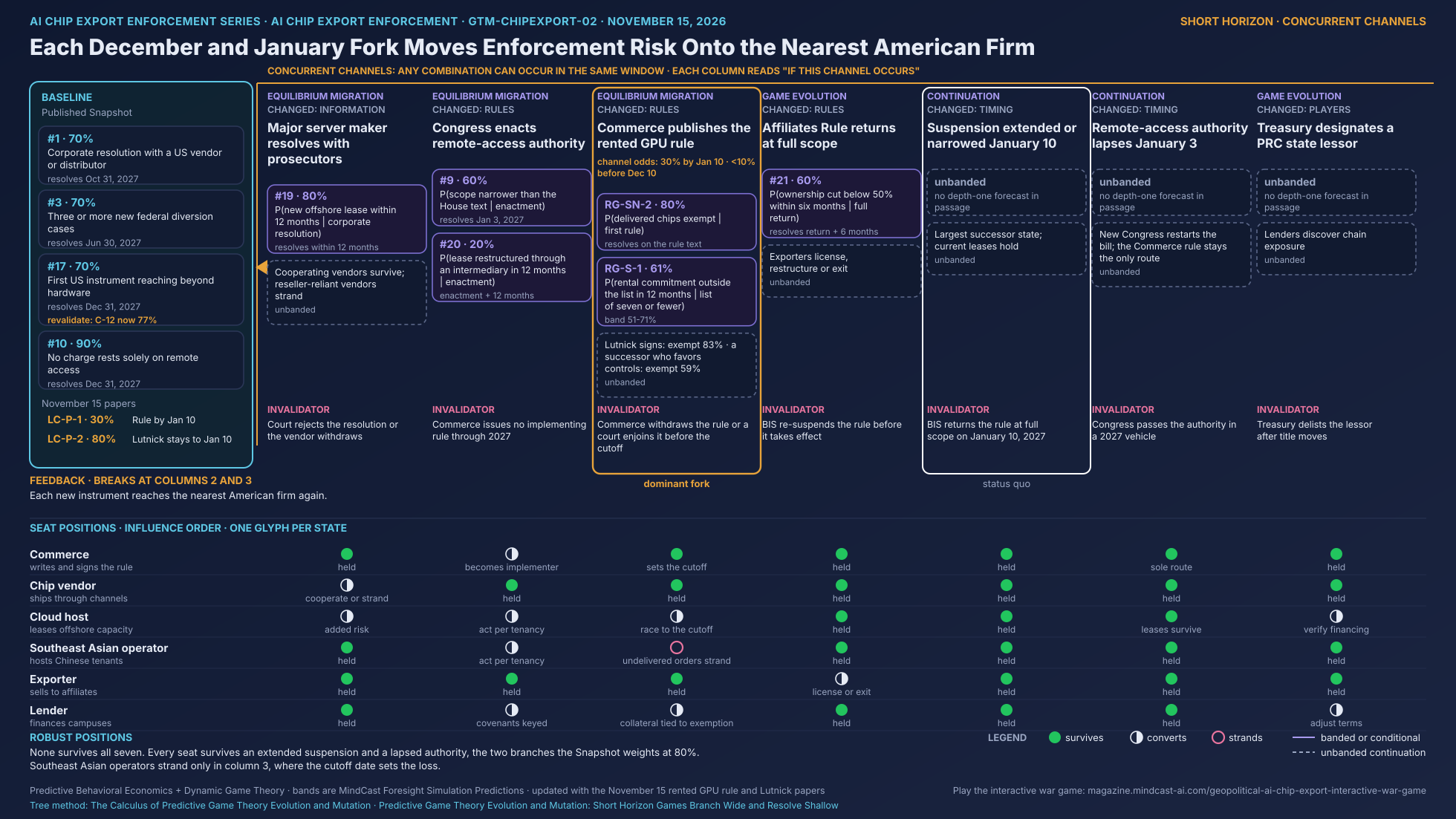
Seven Cognitive Digital Twins (CDTs) carry the game.
The President · Objective: Trade terms with Xi; loyalty to cabinet allies · Decision rights: Decides Lutnick’s tenure and truce terms · Update trigger: Shenzhen outcome; hearing coverage
Howard Lutnick, Commerce · Objective: Licensed sales; a narrow rule · Decision rights: Holds rule scope and timing · Update trigger: Sworn testimony on December 10; tenure risk
Scott Bessent, Treasury · Objective: Truce leverage over Beijing · Decision rights: Can sanction intermediaries without Commerce · Update trigger: Commerce inaction
Senate Banking Committee · Objective: Answers on Megaspeed and the stalled rule · Decision rights: Hearings now; Warren’s gavel from January · Update trigger: December 3 and December 10 testimony
Defense bill conferees · Objective: Statutory limits on rental access · Decision rights: Conference text by January 3 · Update trigger: Hearing testimony; scandal coverage
Beijing · Objective: Truce terms; access for its labs · Decision rights: Can tie new rules to the rare-earth pause · Update trigger: US rule publication
Nvidia board · Objective: Stability under an interim chief executive · Decision rights: Disclosure; partner terms · Update trigger: November 17 results; board inquiry
Candidate causes of the delay.
Truce timing: Commerce waits for January 10. Falsifier: a rule publishes before January 10 with no change in truce terms.
Licensing protection: Commerce protects Nvidia’s sales channel. Falsifier: Commerce suspends H200 licenses while still holding the rental rule.
Tension avoidance: Commerce avoids steps that could upset Beijing. Reuters reported in June that the administration had also held off listing DeepSeek and CXMT. Falsifier: Commerce adds Chinese entities to the Entity List while still holding the rule.
Legal-authority constraint: lawyers doubt Commerce’s power over remote access, so Commerce waits for a statute or narrows the rule to what existing law supports. Falsifier: Commerce publishes a rule that licenses Chinese use of chips already delivered without new statute.
Installed-asset protection: Commerce protects capacity already financed, including Cantor-linked sites. The Times found no evidence of influence. Falsifier: the first rule under Lutnick licenses Chinese use of chips delivered before its cutoff.
Null route: the game persists and no rule issues before 2028. Falsifier: any remote-access rule publishes before 2028.
Takeaway: seven actors and six candidate causes frame a fork whose timing turns on text readiness and the summit agenda, and whose design turns on one official’s tenure.
II.G How the Game Evolves
The game reached its current form when the scandal raised the cost of delay. One gatekeeper held an interagency-approved rule for 16 months while the Entity List stayed frozen. The Megaspeed case and the spy story then made inaction visible, and the December 10 hearing put a date on it. A US official’s November 14 statement that export controls are off the Shenzhen table removed the strongest reason to keep waiting.
Each scheduled event can now branch the game. The Nvidia results on November 17 and the Shenzhen meeting on November 18 and 19 come first. Lutnick’s testimony on December 10, the defense bill deadline on January 3 and the truce date on January 10 follow. A departure is the unscheduled event of known type, and its timing follows the hearing and press coverage rather than the calendar.
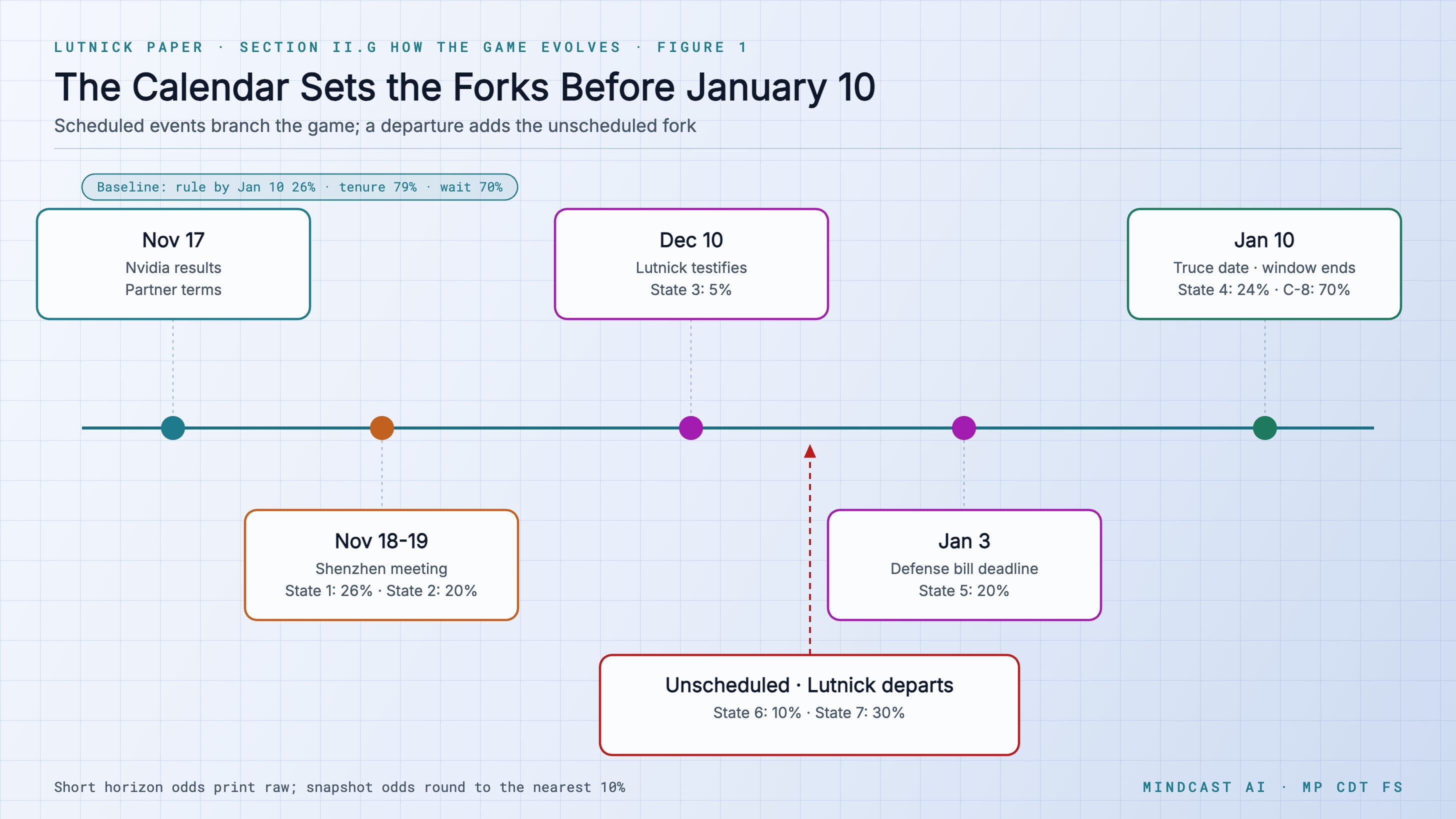
Figure 1. The calendar sets the forks before January 10.
How the Game Branches. The baseline holds delay through January 10. A rule by then stands at 26% (LC-P-1), Lutnick’s tenure through January 10 at 79% (LC-P-2) and the wait past January 10 at 70% (Route A). The dominant fork is whether the rule text is ready and what the Shenzhen readouts say. Commerce’s rule writers move the first and the President the second, while Lutnick’s tenure shapes the rule’s design more than its timing.
Seven states cover the reachable paths, each listed with its class, its conditional Foresight Simulation Prediction and the seats it moves.
State 1: Shenzhen keeps export controls off the table. Class: continuation. The readouts confirm the November 14 statement. The Foresight Simulation already assumes export controls are off the table, so P(first rule by January 10 | controls off the table) stays at 26%. Beijing loses the move of tying the rule to the rare-earth pause.
State 2: Shenzhen puts export controls on the table. Class: equilibrium migration toward Route A. The President gains a trade of delay for truce terms, and Lutnick’s hold converts into presidential policy. P(first rule by January 10 | controls on the table) falls to 20%. Senate Banking loses leverage, while operators with delivered chips keep their tenants.
State 3: a rule before the December 10 testimony. Class: equilibrium migration from delay to a narrow rule. P(first rule by December 10) is 5% (LC-S-1). Lutnick gains a visible action and fixes the exemption before Congress or a successor can widen it. Senate Banking loses the chance to shape the text, and the game passes to the companion paper’s design game, where the exemption holds at 83% under Lutnick.
State 4: Lutnick stays and publishes after testimony. Class: equilibrium migration. P(first rule by January 10 | Lutnick remains) is 24% (LC-S-3). Lutnick’s narrow design survives, and operators with undelivered orders strand at the cutoff. Conferees keep their own move through January 3.
State 5: the defense bill carries remote-access authority. Class: game mutation, because Congress replaces the gatekeeper. Enactment by January 3 stands at 20% (C-2). Conferees gain the decisive move, and Lutnick loses control of scope. Treasury keeps its sanctions move, and Commerce converts from gatekeeper to implementer.
State 6: Lutnick departs and a successor keeps his trade priorities. Class: continuation. P(first rule within 30 days | departure and a successor who shares his priorities) is 10%. Delay survives, and the successor inherits Lutnick’s design. Senate Banking gains a new witness but no new rule.
State 7: Lutnick departs and a successor favors controls. Class: equilibrium migration, and the state that breaks both the delay and the narrow design. P(first rule within 30 days | departure and a successor who favors controls) is 30%. The exemption for delivered chips falls to 59% under such a successor in the companion paper. Lenders to delivered capacity lose protection, Chinese labs lose rented capacity already in place and US-sited data centers gain demand.
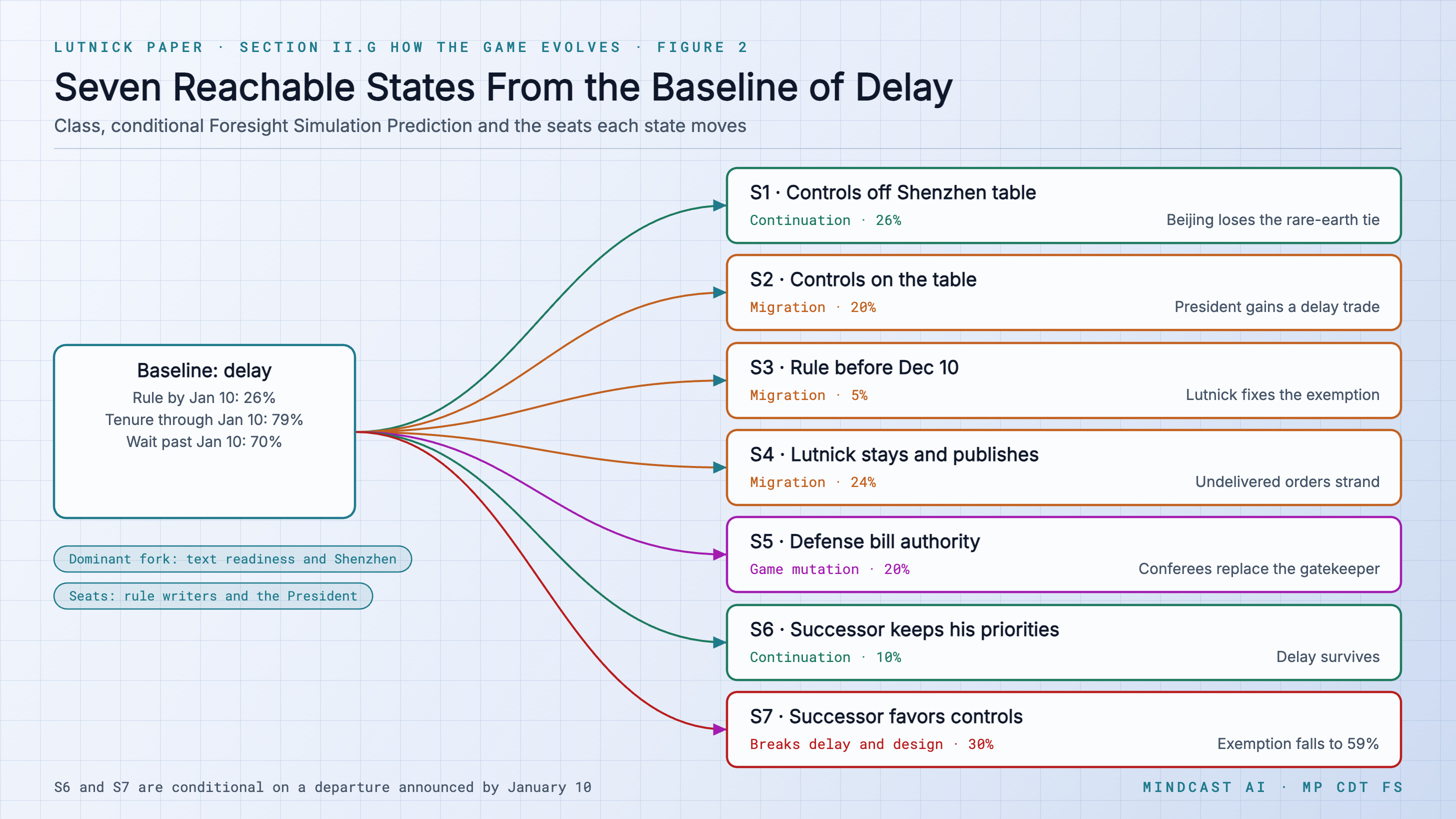
Figure 2. Seven reachable states from the baseline of delay.
The outcome feeds the next cycle through salience. Delay raises salience, and salience raises tenure risk, so every week without a rule strengthens State 7. Any rule published under State 7 carries into 2027, where C-12 now stands at 77% (68-86%). The January 10 truce date closes the window, and a lapse leaves LC-P-1 unchanged.
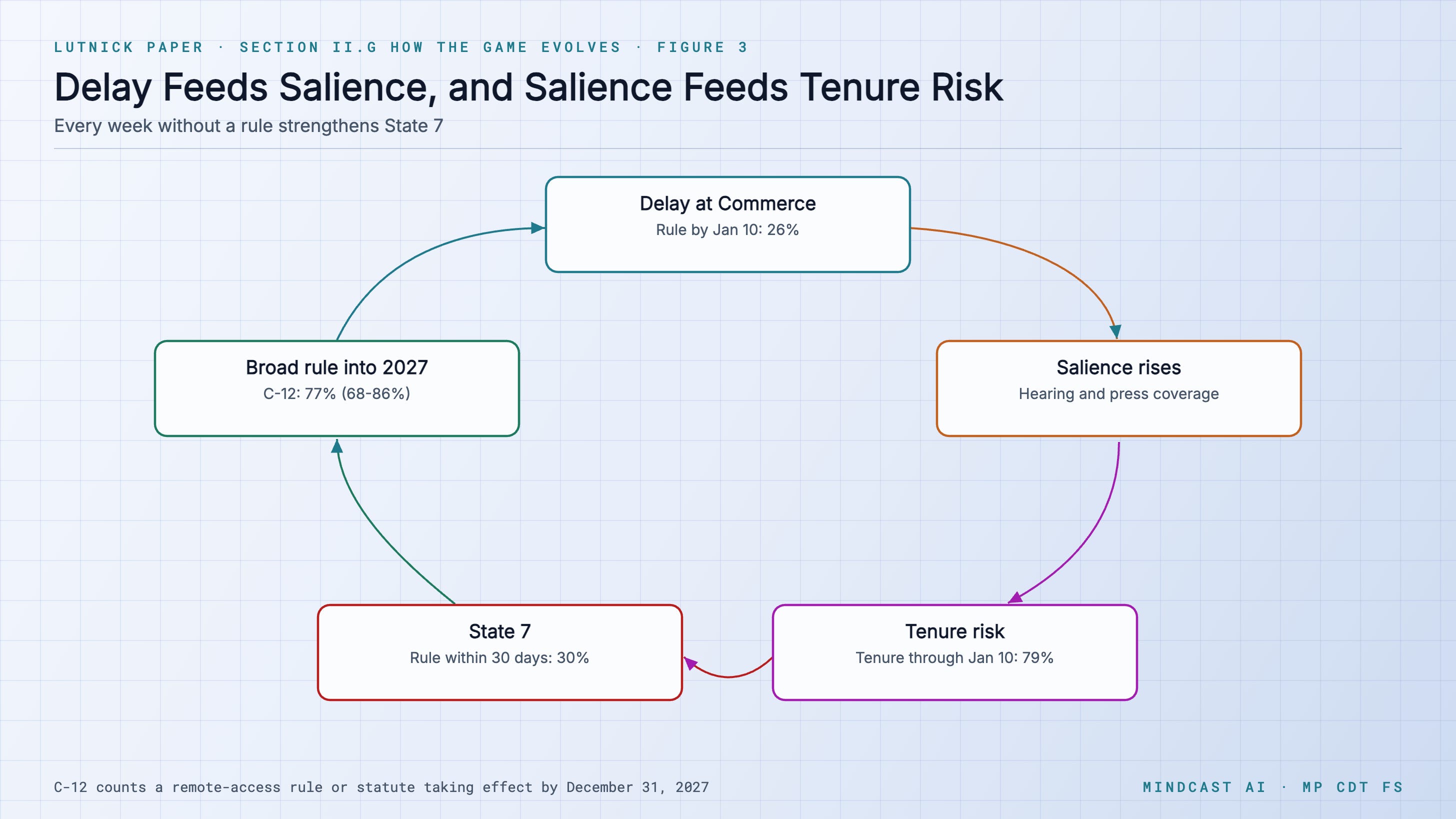
Figure 3. Delay feeds salience, and salience feeds tenure risk.
Section II separates the rule’s timing from its design. Text readiness and the Shenzhen readouts set the timing, and a narrow rule under Lutnick, a statute or a departure can each end the delay. Only a successor who favors controls also breaks the narrow design, and Section III assigns probabilities to each path.
III. MindCast Foresight Simulation Predictions
Section III converts the veto game into ten MindCast Foresight Simulation Predictions, each with a type and a 10th to 90th percentile range. The set opens with the simulation synthesis, three scenario routes and resolution definitions, then moves to two primary and four secondary Foresight Simulation Predictions. Four carried from published MindCast work follow, and the section closes with watch conditions and the limits that would break the analysis.
Foresight Simulation Prediction set. The paper carries ten Foresight Simulation Predictions: two Primary Foresight Simulation Predictions (P), four Secondary Foresight Simulation Predictions (S) and four carried from published MindCast work (C). Date and data cutoff: November 15, 2026. Bands come from the November 15 Foresight Simulation and show the central value with the 10th to 90th percentile range. Short horizon Foresight Simulation Predictions show unrounded values, and the snapshot LC-S-2 rounds to the nearest 10%.
Simulation synthesis. One gatekeeper holds a rule that other agencies and the President have approved. The active regime leaves the rule unpublished and the Entity List frozen while oversight rises. Rule publication, Lutnick’s departure, a statutory duty or Treasury sanctions on intermediaries would replace it. The behavioral equilibrium is delay at Commerce under rising salience.
Commerce can act by rule, and a statute would override it.
Scenario structure.
Route A: wait past January 10 · 70% · Mechanism: Rule text is not ready and Commerce keeps the status quo · Sequence: Interagency review runs past January 10 · Trigger: Review still open in December
Route B: narrow rule under Lutnick · 20% · Mechanism: Lutnick publishes a narrow rule as visible action, before or after testimony · Sequence: Interagency sign-off, then publication by January 10 · Trigger: Hearing date fixed; tenure risk rises
Route C: departure and broad rule · 10% · Mechanism: A successor publishes and widens scope · Sequence: Lutnick departs, then a rule within weeks · Trigger: Departure announced
Resolution definitions. LC-P-1, LC-S-1 and LC-S-2 use the companion paper’s definition of a first rule. The test date is publication in the Federal Register, not public inspection. For C-12, a license on deliveries counts as expressly reaching remote access only if its text conditions the license or an exemption on blocking or reporting remote access; a notice, tenant-identity or use duty counts.
III.A Primary Foresight Simulation Predictions
LC-P-1 | Commerce Publishes a Remote-Access Rule by January 10
Statement: By January 10, 2027, Commerce publishes a first rule restricting Chinese entities’ remote access to or use of advanced chips in data centers outside China.
Band: 26% (12-43%) (event, short horizon)
Window: Through January 10, 2027
Trigger: Hearing date fixed; Lutnick’s tenure in doubt; Shenzhen terms silent on technology rules
Falsifier: No first rule published by January 10, 2027
Verification source: Federal Register; BIS notices
Exposure: Senate Banking; conferees; operators; lenders
Monitoring signal: Public inspection list, daily from December 1
LC-P-2 | Lutnick Remains Commerce Secretary Through January 10
Statement: Howard Lutnick remains Commerce Secretary through January 10, 2027.
Band: 79% (71-86%) (event, short horizon)
Window: Through January 10, 2027
Trigger: White House statements of confidence; the President’s pattern of standing by cabinet members under press pressure
Falsifier: Resignation or removal announced before January 10, 2027
Verification source: White House and Commerce announcements
Exposure: Every audience, because tenure conditions LC-P-1 and the companion paper’s RG-P-1
Monitoring signal: December 10 testimony; Reuters reporting on White House deliberations
III.B Secondary Foresight Simulation Predictions
LC-S-1 · 5% (0-15%) · A first rule publishes before Lutnick’s December 10 testimony · Route B · By December 10, 2026 · Trigger: Interagency sign-off; hearing questions on Megaspeed and licenses · Falsifier: No first rule published by December 10 · Type: short horizon
LC-S-2 · 30% (20-30%) · P(a first rule publishes within 30 days given Lutnick’s departure is announced by January 10, 2027) · Route C · 30 days after the announcement; void if no departure by January 10 · Trigger: Departure · Falsifier: No publication within 30 days · Type: snapshot
LC-S-3 · 24% (10-41%) · P(a first rule publishes by January 10, 2027 given Lutnick remains through January 10) · Route B · By January 10, 2027 · Trigger: Hearing pressure; summit agenda without export controls · Falsifier: No first rule by January 10 with Lutnick in office · Type: short horizon
LC-S-4 · 35% (22-49%) · P(a first rule publishes by January 10, 2027 given Lutnick’s departure is announced by January 10) · Route C · By January 10, 2027; void if no departure by January 10 · Trigger: Departure · Falsifier: No first rule by January 10 after a departure · Type: short horizon
Successor type. LC-S-2 depends on who succeeds Lutnick. A successor who pressed for controls brings a rule within 30 days at about 30%, and one who shares his trade priorities at about 10%.
Carried Foresight Simulation Predictions from published MindCast work.
C-2 · 20% / 80% · Congress enacts remote-access authority over tenants or hosts, against lapse · By January 3, 2027 · Source: AI Chip Export Enforcement Snapshot (2026)
C-5 · 80% / 20% · BIS extends or narrows the Affiliates Rule suspension rather than letting it return at full scope · Through January 10, 2027 · Source: The US Bureau of Industry and Security Affiliates Rule (2026)
C-8 · 70% · The US-China truce and its paired suspensions are extended together · By January 31, 2027 · Source: Import Controls, Export Controls and the US–China AI Infrastructure Contest (2026)
C-12 · 30-49% · A US rule or statute expressly reaching remote access to controlled compute by foreign persons of concern takes effect · By December 31, 2027 · Source: Tencent, Oracle (2026)
Updated call. C-12 set the earlier MindCast view that a remote-access instrument taking effect before 2028 was less likely than not, at 30-49%. The Foresight Simulation now puts it at 77% (68-86%). BIS’s November 12 statement, the reported draft and the December 10 hearing moved the call.
III.C Contingent Watch Conditions
Shenzhen terms. The President meets Xi on November 18 and 19. A US official said export controls are not on the table. If the readouts confirm it, the forecast changes little, because the Foresight Simulation already assumes export controls are off the table. If export controls return to the agenda, a rule by January 10 falls to about 20%.
Megaspeed. The Justice Department’s smuggling investigation runs on its own track. Alice Huang has made no public statement since 2025, and Megaspeed has retained outside counsel for an internal investigation (Sovereign Magazine). An Entity List listing before December 10 would signal that Commerce has begun to move.
H200 licenses. The Wyden and Neal inquiry into H200 approvals runs alongside the hearing. A suspension of those licenses before December 10 would reduce Lutnick’s need for a substitute action and weaken LC-S-1.
III.D Limits and Break Conditions
The July 2025 rule and the presidential approvals come from unnamed sources. A leader-level deal at Shenzhen could fold the rule into broader truce terms and replace the game before January 10. The Cantor connection remains a candidate cause, not a finding.
Section III ties timing and tenure to testable claims. LC-P-1 and LC-P-2 carry the primary forecasts, LC-S-1 tests the pre-emptive route and LC-S-2, LC-S-3 and LC-S-4 measure how much tenure moves the timing. The four carried Foresight Simulation Predictions anchor the paper to published work, with C-8 carrying the truce extension that frames the January 10 date.
Engagement Bridge
Published analysis cannot tell a committee, firm or agency how the December 10 hearing will move its own position. The answer depends on the questions asked, the documents produced and the client’s exposure on each route.
A commissioned engagement builds CDTs for the hearing’s participants and runs the veto game against the client’s options.
The bounded next step is a commissioned Snapshot covering hearing scenarios, delivered within five to seven business days. Contact mcai@mindcast-ai.com.
IV. Stakeholder Strategy and Risk Mitigation
Section IV sets out each audience’s posture and a four-part risk entry for each Foresight Simulation Prediction.
Strategic posture by stakeholder. Policymakers hold the hearing, which is the last dated lever before January 3 (LC-P-2). Investors should treat Lutnick’s tenure as the variable that conditions collateral value. Counsel should prepare for a rule that appears with little notice (LC-S-1). Executives gain by completing contracted deliveries before December 10.
Risk mitigation by Foresight Simulation Prediction. Each entry gives the band and the exposure in a unit the audience controls. Actions follow with an owner and a deadline, then the exposure that remains. Probability and severity appear as separate ratings.
Entries for policymakers come first. The entries describe exposure categories and are not legal, investment or fiduciary advice.
LC-P-2 | Lutnick Remains Through January 10 · 🏛️ Policymakers (Senate Banking members and defense bill conferees)
Foresight Simulation Prediction and band. Howard Lutnick remains Commerce Secretary through January 10, 2027. Probability: 79% (71-86%). Severity: high.
Exposure. The narrow design persists while he stays. Statutory language left out of the defense bill by January 3 moves to the next Congress and costs a session of committee time.
Mitigating actions. Committee staff request the July 2025 draft and its interagency sign-off file before the December 10 hearing. Conferees insert an announcement-date cutoff and a tenant-identity duty into conference text before January 3. Incoming committee leaders schedule a hearing on the published rule in the first weeks of the new session.
Residual exposure. A rule published before any statute sets the baseline Congress must amend.
LC-P-1 | Rule by January 10 · 🏛️ Policymakers (White House and Treasury)
Foresight Simulation Prediction and band. Commerce publishes a remote-access rule by January 10, 2027. Probability: 26% (12-43%). Severity: medium.
Exposure. A failure of LC-P-1 leaves the rental route open through the truce date. The exposure is the number of weeks Chinese labs keep renting newly installed capacity in the seven countries.
Mitigating actions. White House staff set a publication date for the interagency-approved draft before the December 10 hearing. Treasury prepares sanctions on intermediaries that do not depend on Commerce by December 31. The National Security Council confirms in writing that the Shenzhen readout carries no restraint on technology rules.
Residual exposure. Sanctions reach named intermediaries only. Chips delivered before any rule keep serving Chinese tenants.
LC-P-2 | Lutnick Remains Through January 10 · 📊 Investors (equity holders in Southeast Asian operators)
Foresight Simulation Prediction and band. Howard Lutnick remains Commerce Secretary through January 10, 2027. Probability: 79% (71-86%). Severity: medium.
Exposure. While he stays, operator revenue from Chinese tenants survives on chips already delivered, and a departure could end it within about 30 days if a successor who favors controls takes over (LC-S-2). The exposure is the share of operator revenue from Chinese tenants on capacity a successor’s rule could reach, measured in quarters of revenue.
Mitigating actions. Investment teams compile each portfolio operator’s Chinese-tenant revenue share and delivery dates from public filings and operator disclosures before December 10. Risk committees set position limits tied to that share before January 10. Analysts apply the 30-day window in LC-S-2 to each operator’s pipeline before the December 10 hearing.
Residual exposure. Public disclosures lag the actual tenant mix. A departure announced between disclosures reaches positions before new data does.
LC-S-1 | Rule Before the Hearing · ⚖️ Counsel (export-control and data center practices)Foresight Simulation Prediction and band.
Foresight Simulation Prediction and band. A first rule publishes before Lutnick’s December 10 testimony. Probability: 5% (0-15%). Severity: high.
Exposure. Clients receive a rule with no advance alert during year-end contract cycles. The exposure is the number of client contracts needing review in the first two weeks after publication.
Mitigating actions. Practice leaders draft client alerts for the narrow and broad designs before November 30. Associates map client contracts against the reported seven-country list by December 5. Partners schedule client briefings for the week of December 7.
Residual exposure. Terms that differ from the reported draft require a second round of review.
LC-S-3 | Rule Under Lutnick by January 10 · 💼 Executives (Southeast Asian operators)
Foresight Simulation Prediction and band. P(a first rule publishes by January 10, 2027 given Lutnick remains through January 10). Probability: 24% (10-41%). Severity: medium.
Exposure. A narrow rule under Lutnick sets its cutoff during year-end shipping schedules. The exposure is the share of contracted deliveries scheduled after January 10, measured in megawatts.
Mitigating actions. Supply-chain teams move January deliveries into December where suppliers allow by December 15. Commercial teams confirm which tenant contracts depend on those deliveries by December 10. Finance prepares non-Chinese tenant options for capacity that misses the cutoff by January 10.
Residual exposure. Deliveries that suppliers cannot move stay exposed to the cutoff.
LC-S-2 | Fast Rule After a Departure · 💼 Executives (Nvidia and US cloud providers)
Foresight Simulation Prediction and band. P(a first rule publishes within 30 days given Lutnick’s departure is announced by January 10, 2027). Probability: 30% (20-30%). Severity: high.
Exposure. The compliance window shrinks to about 30 days. The exposure is measured in weeks of lead time for customer screening and tenant notices.
Mitigating actions. Compliance pre-screens customers for Chinese parentage before December 10. Sales pauses new multiyear commitments to Chinese-parented customers when a departure is announced. Legal maps contracts with change-in-law termination clauses by January 10.
Residual exposure. Contracts without change-in-law clauses run to term under a rule that bars their use.
Risk classes. Strategic risk: Beijing ties any rule to the truce. Institutional risk: the President overrides Commerce on timing.
Legal and policy risk: a statute replaces the rule. Market risk: a departure moves the rule forward by weeks. Reputational risk: the conflict reporting attaches to any narrow rule.
Takeaway: the December 10 hearing is the dated lever for policymakers and the deadline for everyone else.
V. Implications
Section V traces what the stall and its resolution change beyond Commerce. V.A weighs the two readings of Commerce’s authority, V.B how each actor’s move reshapes the others’ best response and V.C who gains on each path. V.D sets out what follows if the primary Foresight Simulation Predictions fail.
V.A Institutional Impact
Two readings of the stall compete. Bessent says the administration has “all the authorities that we need” (South China Morning Post). Lawyers at Baker McKenzie say Commerce lacks clear authority over remote access (AI Weekly). If Bessent is right, a successor could publish within weeks; if the lawyers are right, any successor faces the same limit and Congress holds the decisive lever.
V.B Strategic Interaction
Each actor’s move changes the others’ best response. A pre-emptive narrow rule invites hawks to attack the exemption with the conflict reporting, which raises pressure to broaden it or replace Lutnick. Waiting exposes Lutnick to sworn questions about the July 2025 draft, which raises the chance a successor publishes a broader rule (LC-S-2).
Beijing can tie any rule to the truce, which gives the President a reason to trade delay for terms. The statement that export controls are off the Shenzhen agenda narrows that opening.
V.C Distribution
If Lutnick stays, operators that took delivery early and their lenders keep Chinese revenue under a narrow rule. If he leaves, a successor’s broader rule shifts the loss to operators with undelivered orders. Data centers sited in the United States gain on the departure path.
V.D Falsifier Consequences
If LC-P-2 fails, Route C activates. Stakeholders should then expect a rule within weeks and read the companion paper’s RG-P-2 as the governing condition.
If LC-S-1 resolves true, Route B has activated. The hearing then turns from the stall to the rule’s exemption.
Feedback loop. Delay raises salience, and salience raises tenure risk. A departure hands the rule to a successor. A successor who pressed for controls is likelier to publish a broader rule within weeks, while one who shares Lutnick’s trade priorities keeps his pace and design.
The stall carries its own expiration date. Each month of delay raises salience, salience raises tenure risk and a departure hands the rule to a successor whose type sets both pace and design.
Monitoring and Update Protocol
Six signals track the Foresight Simulation Predictions from the Shenzhen meeting through the truce date. Each entry names the source, the cadence and the update it triggers.
Public inspection list (LC-P-1, LC-S-1) · Source: Federal Register · Cadence: Daily from November 16 · Update: Early warning; resolution at publication
Shenzhen readouts (LC-P-1, Route A) · Source: White House; Chinese readouts · Cadence: November 18–19 · Update: Route weight
Senate Banking testimony (LC-P-2, LC-S-1) · Source: Committee transcripts · Cadence: December 3 and December 10 · Update: Route weight; tenure risk
White House statements on Lutnick (LC-P-2, LC-S-2, LC-S-4) · Source: White House · Cadence: Weekly · Update: Resolution
Entity List additions (Route A; tension-avoidance cause) · Source: Federal Register · Cadence: Weekly · Update: Route weight
Defense bill conference text (C-2) · Source: Congress.gov · Cadence: Weekly to January 3 · Update: Resolution
Revision protocol. Each update names the observation, the field changed and the Foresight Simulation Predictions affected. A new Foresight Simulation Prediction gets a new identifier rather than replacing an old one.
The Senate Banking testimony carries the most weight, because it moves both route weights and tenure risk on a single day. The public inspection list then resolves LC-P-1 and LC-S-1 at publication.
Conclusion
The rental route to Blackwell-class chips stays open because one official holds the rule that would close it. Other agencies and the President have approved action, and Commerce has not moved. Delay remains the likeliest outcome through January 10.
Low-regret moves come first: committees request the July 2025 draft, and investors build departure cases now. Larger moves should wait for the Shenzhen readouts and the December 10 testimony.
The decisive signals for timing are the rule text and the Shenzhen readouts. Lutnick’s tenure decides more about the rule’s design, because a successor who pressed for controls is likelier to license delivered chips. If he leaves, the pace depends on that successor.
Working With MindCast
MindCast AI applies Behavioral Economics + Dynamic Predictive Game Theory to the decisions the rented GPU rule forces before its text appears. Each engagement builds Cognitive Digital Twins of the client’s counterparties and reruns the Foresight Simulation against the client’s own contracts, capacity and capital. Four engagements map directly to the Foresight Simulation Predictions in this paper.
Remote-access posture mapping. For counsel and compliance leaders at cloud operators and data center hosts: readiness against a narrow rule under Lutnick, a successor’s broader rule and a statutory duty. The review keys to LC-P-1, LC-S-1 and C-2.
Offshore compute contract review. For operators and tenants: an audit of change-in-law and suspension terms against the 30-day window in LC-S-2. The audit also tests tenant-substitution, visibility and refund clauses against a rule published with little notice.
Capital posture review. For lenders and for infrastructure, sovereign wealth and global macro funds: a posture determination for each loan or operator position. Each determination keys to the tenure trigger in LC-P-2 and the departure trigger in LC-S-2.
Compute placement strategy. For corporate strategists building AI capacity in Southeast Asia and in hosts outside the seven listed countries: where to site capacity and which tenant-identity standard to adopt under each of Routes A through C. The strategy keys to the timing triggers in LC-P-1 and LC-S-3.
Published analysis sets the odds for the market as a whole. A commissioned engagement sets them for one firm’s chips, contracts and capital before the December 10 hearing fixes its exposure.
First step. A scoping call matches the client’s positions to the Foresight Simulation Predictions above. Contact mcai@mindcast-ai.com or visit www.mindcast-ai-simulation.com.
Appendix A. Selected MindCast Works
Appendix A lists the MindCast works the paper cites, grouped by their role in the analysis. Each entry names what it supplies to this paper.
Companion paper
Commerce’s Rented GPU Ban Would Exempt Chips Already Delivered, and the Cutoff Date Decides Its Reach. Supplies the first-rule definition that LC-P-1, LC-S-1 and LC-S-2 use and the exemption forecasts that tenure conditions.
Prior simulations and validations
AI Chip Export Enforcement Shifts Risk Onto US Firms as China Demand Moves to Domestic Chips, Rented Compute and State Financing. Supplies carried Foresight Simulation Prediction C-2 and the validated Affiliates Rule notice call.
The US Bureau of Industry and Security Affiliates Rule Turns Export Controls Into Bargaining Instruments. Supplies carried Foresight Simulation Prediction C-5; its bargaining model explains why the January 10 truce date frames this paper’s forecast window.
Import Controls, Export Controls and the US–China AI Infrastructure Contest. Supplies carried Foresight Simulation Prediction C-8 and the H200 import-approval call; its finding that restricting states’ own firms bear the first cost explains Lutnick’s loss aversion.
AI Chip Export Enforcement War Game Shows When Verification Protects US Firms and When It Arrives Too Late. Carries C-2 and C-5 on the same January 3 and January 10 forks this paper uses.
Related analysis
Interactive AI Chip Export Enforcement War Game. Turns the paper’s seats and forks into a playable board.
Tencent, Oracle, and the Remote-Access Gap in US AI Chip Export Controls. Supplies carried Foresight Simulation Prediction C-12, the earlier call on a remote-access instrument before 2028 that this paper’s evidence bears on.
Enforcement Incidence and Capability Denial in Artificial Intelligence Export Controls. Explains why oversight pressure lands on Commerce and US firms rather than on Chinese buyers.
Readers new to the series should start with the companion paper, which supplies the first-rule definition and the exemption forecasts that Lutnick’s tenure conditions.
Appendix B. External Sources
Appendix B lists the external reporting and primary documents behind the paper’s factual claims, with a note on what each supplies.
Ana Swanson, Aaron Krolik and Paul Mozur, “Lutnick Pushed to Weaken Chip Rules That Overlap With His Family Business,” The New York Times, November 15, 2026. Supplies the deferrals and the Cantor connection.
New York Post, “Commerce Dept’s Lutnick, Kessler Under Fire Over Inaction on Nvidia’s Megaspeed Spy Fiasco,” November 12, 2026. Supplies the July 2025 rule account.
CBS News, “Lutnick Agrees to Testify as Bessent Blames Him for Not Banning Nvidia Chip Exports to China-Linked Firm,” November 13, 2026. Supplies Bessent’s statement.
South China Morning Post, “Bessent Blames US Commerce Department for Not Restricting Nvidia Chip Exports to China,” November 14, 2026. Supplies the statement on existing authorities.
Axios, “Scoop: Lutnick Stalled Trump’s Nvidia–China Chip Curbs After Oval Talks,” November 11, 2026. Supplies the third presidential authorization and Lutnick’s trade-war warning.
WSAU/Reuters, “Lutnick Stalled Trump Crackdown, Axios Reports,” November 11, 2026. Supplies the Situation Room meeting and the Entity List freeze.
Tom’s Hardware, “Nvidia’s Biggest Southeast Asia Customer Exposes the Limits of US AI Export Controls,” December 2025. Supplies Megaspeed’s origin as 7Road International and its rank among Nvidia’s Southeast Asian buyers.
The Next Web, “Nvidia H200 China Licences,” 2026. Relays Reuters’ May 14 report of H200 clearances for about 10 Chinese companies.
CNBC, “Nvidia Scandal Draws in Commerce Secretary Lutnick, Who Reportedly Agrees to Testify About China Chip Sales,” November 13, 2026. Supplies the December 3 and December 10 hearing dates.
Seoul Economic Daily, “U.S. Says Trump Unlikely to Raise Nvidia Scandal With Xi,” November 14, 2026. Supplies the statement that export controls are off the Shenzhen agenda.
AI Weekly, “Commerce Readies Rule to Block China’s Remote AI Chip Access,” November 12, 2026. Supplies the Baker McKenzie view on statutory authority.
The Next Web, “Megaspeed Probe Moved From Commerce to Justice After Nvidia Lawyer’s Contact,” November 9, 2026. Supplies the investigation’s transfer.
Baker McKenzie, “BIS Extends Suspension of the Affiliates Rule Through January 10, 2027,” November 2026. Supplies the November 5 notice.
AsiaOne/Reuters, “Curbs Gain Traction in US Congress,” November 14, 2026. Supplies Huang’s expected testimony before Thanksgiving.
Al Jazeera, “Trump Heads to China Amid Nvidia Scandal,” November 12, 2026. Supplies the December 2025 H200 decision.
Newsweek, “Scott Bessent Puts Howard Lutnick on the Spot Over Nvidia Scandal,” November 15, 2026. Supplies the Wyden and Neal inquiry.
Nvidia Form 8-K, CEO Transition, November 12, 2026. Primary source for Huang’s resignation.
Sovereign Magazine, “Alice Huang Helped Build Megaspeed Into One of Nvidia’s Largest Buyers in Southeast Asia,” November 2026. Supplies Megaspeed’s internal investigation.
Reuters, “US Holds Off Blacklisting China’s DeepSeek, More Than 100 Firms Deemed Security Risks, Sources Say,” June 17, 2026. Supplies the held DeepSeek and CXMT listings.
The July 2025 rule and the presidential approvals rest on unnamed sources, and Section III.D treats them as a break condition.