
Commerce Department · Bureau of Industry and Security · Treasury Department · National Security Council · Senate Banking Committee · Senate Commerce Committee · Nvidia · Megaspeed · Speedmatrix · New Matrix · Maginfra · Zhejiang Yindun Cloud · Range Intelligent Computing · Northwestern Polytechnical University · Malaysia · Singapore · Indonesia · Thailand · Brazil · Beijing
Companions: Commerce’s Rented GPU Ban Would Exempt Chips Already Delivered, and the Cutoff Date Decides Its Reach · Lutnick and the Commerce Department Likely Miss January 10 on the Rented GPU Rule, and His Tenure Shapes What It Exempts More Than When It Publishes
Geopolitical AI race war gaming: The Economics of Export Control - Interactive lets readers play Commerce, licensees, hosts and lenders through the December and January forks. Foresight Analysis in Illegal GPU Export Pathways 2025-2030 mapped the Southeast Asian corridors the outside chain now uses. Tencent, Oracle, and the Remote-Access Gap in US AI Chip Export Controls set the rental template the rule now reaches.
I. Executive Summary
Design followed the author, not the signer. On November 16, 2026 the Bureau of Industry and Security (BIS) released a rule on remote access to advanced AI chips whose preamble states that Treasury and the National Security Council wrote it. Commerce signed an instrument it had stalled for sixteen months. Every scope feature went the opposite way from the Commerce design: five countries instead of seven, a license instead of a notice and chips already installed reached within 90 days.
The rule, Addressing Remote Access to Advanced Semiconductors, requires a license before any data center provides more than 12 million aggregate total processing performance to a company headquartered in China. It keeps case-by-case review for H200-class exports into China.
The companion paper tied the rule’s design to the Secretary’s tenure. The rule delivered the successor’s design with the Secretary still in office, which corrects the series’ tenure thesis. The decision now in front of every reader is whether the same principal can move the two decisions still at Commerce, the H200 licenses and the Megaspeed listing, before the chain adds another layer.
Core insight. When a gatekeeper’s payoff diverges from the principal’s, the principal reroutes authorship rather than waiting for the gatekeeper to move, and the instrument’s design follows the new author. The companion papers modeled three routes around a stalled Commerce: a statute, Treasury sanctions and replacement of the Secretary. Events produced a fourth, the principal writing the rule under the agent’s letterhead, and every later forecast about a stalled gatekeeper inherits that branch.
Thesis. The pen moved on the outside chain and stayed conflicted on the inside chain. A licensing authority that collects 25% of licensed Nvidia revenue conditions H200 licenses rather than revoking them, so Commerce conditions at least one H200 license before mid-2027 once the December 10 hearing makes the empty-office licensees the salient case.
The outside chain adapts within a year of the rule’s effective date through relocation, fragmentation or a non-Chinese intermediary. The renter inside China stays the one layer no instrument reaches through 2027. The four-role chain of financier, buyer, operator and renter explains why the two halves diverge.
MindCast AI applies Predictive Behavioral Economics + Dynamic Game Theory through MindCast AI Proprietary Cognitive Digital Twin Foresight Simulations (MP CDT FS). Behavioral Economics supplies the decision rules: licensing officers who satisfice on complete files, enforcers who chase the vivid case, and operators who keep tenants until a rule names them. Game Theory supplies the payoff structure: a principal-agent chain in which each layer trades a fee for deniability, a licensor with a revenue stake in approvals, and a principal that reroutes authorship when its agent stalls. Predictive simulations emerge from the combination.
Companion predictions the rule resolves. Federal Register publication is scheduled for November 19, 2026, and on that date five companion calls resolve as hits (RG-SN-4 · C-4 · C-9 · C-10 · C-12) and four as misses (RG-P-1 · RG-SN-2 · LC-P-1 · LC-S-1). C-3 moves from 88-95% to 51% because the rule makes a denial that stops existing service an available instrument. Section III states each outcome flat.
MindCast’s November 10 tally, reported in Import Controls, Export Controls and the US-China AI Infrastructure Contest, stands at 47 hits and 9 partials against 4 misses on resolved material calls.
What the paper does. Section II names the four roles, traces both chains and sets out the ten Cognitive Digital Twins. Section III releases ten MindCast Foresight Simulation Predictions and carries ten from the companion papers, with the companion calls the rule resolves stated flat. Sections IV and V translate the forecast set into stakeholder moves and consequences. Section VI shows how the game branches from the current state.
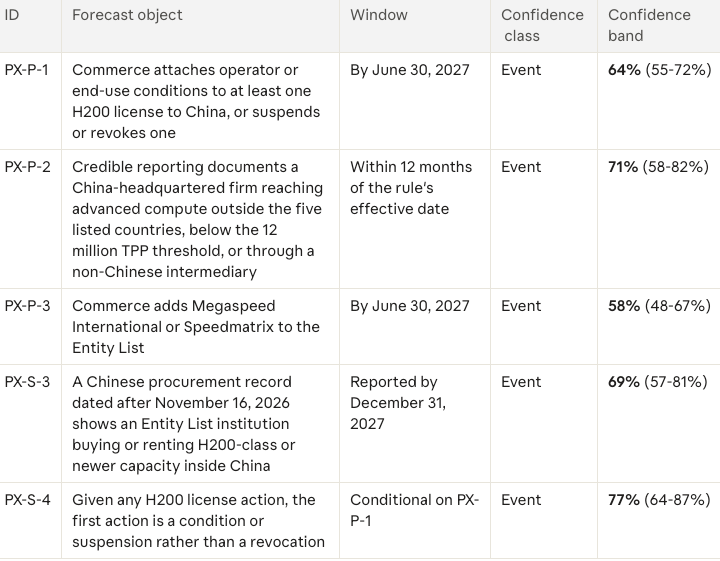
Prediction highlights. Ten new MindCast Foresight Simulation Predictions and ten carried from the companion papers. Five of the ten appear below; Section III prints all ten with triggers, falsifiers and verification sources.
Stakeholder readout.
🏛 Policymakers. Licenses and listings reach the buyer layer only, and the rule leaves the in-China operator untouched (PX-P-1, PX-S-3). Before December 10, request each H200 license file with the operator named in it. The decision window closes at the hearing.
💼 Executives. Operators in the five listed countries now carry a license duty for every China-headquartered tenant above the threshold, with 90 days to file (PX-P-2, C-3). Map each tenant to all four roles before the first denial, and plan for demand to move toward Vietnam, Japan and the Gulf.
⚖ Counsel. Diligence that stops at the licensee no longer protects the exporter, and the rule’s knowledge standard treats a host that withholds customer diligence as a red flag (PX-P-1, PX-S-1). Add operator and renter questions to end-use certifications on the next license application.
📊 Investors. Added layers move exposure toward the operator and its lenders, and the first license denial converts a reporting risk into a revenue event (C-3, RG-S-3). Evaluate data center holdings by operator exposure and by country-list exposure rather than by licensee.
Takeaway: the rule reached the operator outside China through an author Commerce did not choose and with that author’s design, the 25% fee points Commerce toward conditions rather than revocations inside China, and the December 10 hearing decides whether the inside chain gets its first check before the chain moves again.
II. Topic and Simulation Fit
A proxy chain splits one transaction into four roles, and each role faces a different US instrument or none. The section names the roles and traces the two chains the reporting now shows, then states the governing question and sets out the actors the simulation models.
A. Two Chains Run on One Structure
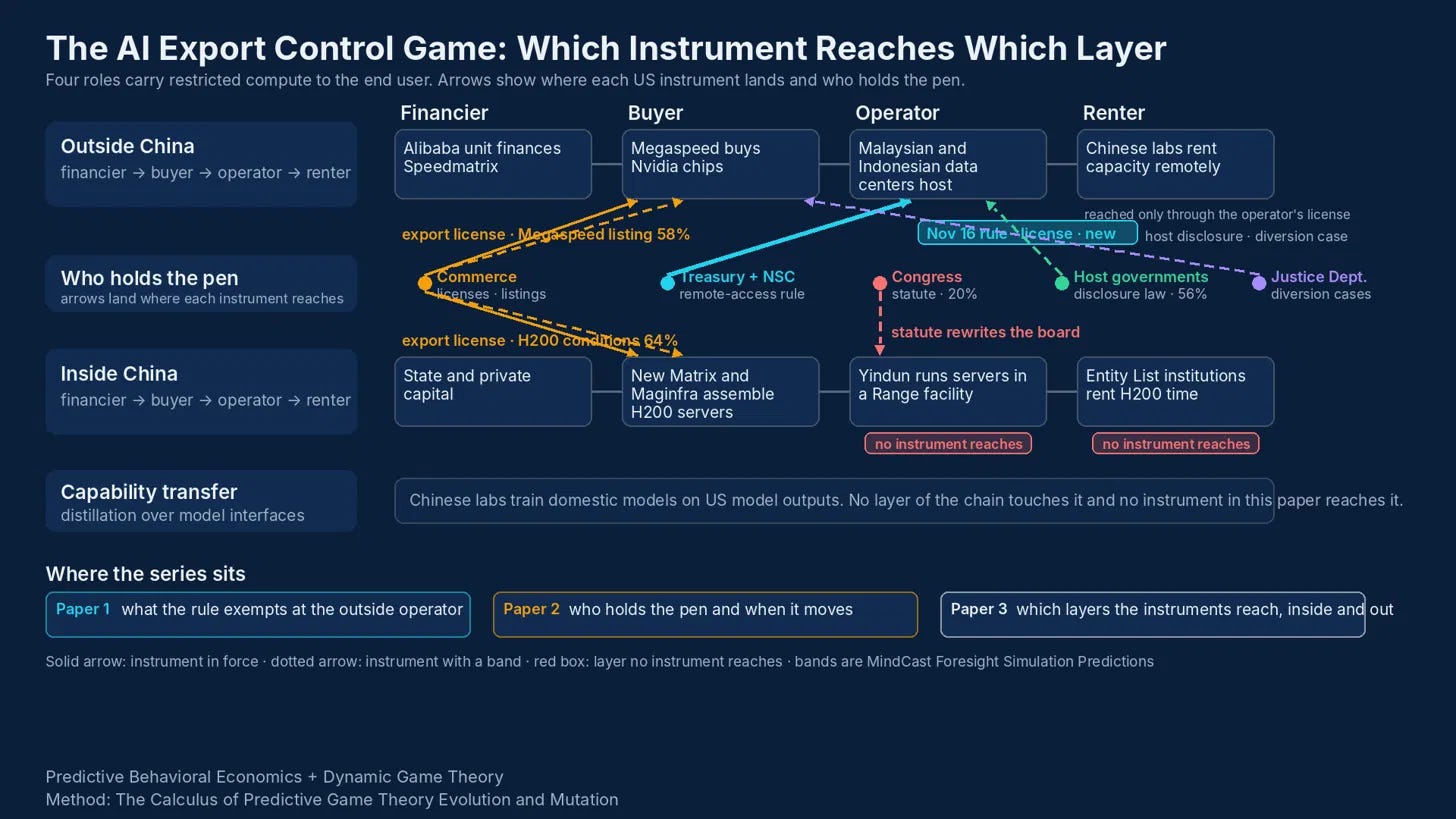
The board shows the two chains, the instrument that lands on each layer, who holds the pen behind it, and the two inside-China layers no instrument reaches.
Four roles make up every chain. The financier pays for the hardware or the data center: Singapore filings show Alibaba subsidiary Apex Enterprise Solutions financing Speedmatrix, a Megaspeed-linked operator in Malaysia (The Star, relaying Reuters). The buyer takes title and files the paperwork: Megaspeed became Nvidia’s largest buyer in Southeast Asia, and inside China New Matrix and Maginfra hold H200 assembly licenses.
The operator runs the servers and controls who logs in: Zhejiang Yindun Cloud operates from a Range Intelligent Computing facility, while DayOne, Aolani and Bitdeer run capacity in Malaysia and Indonesia. The renter buys computing time and never touches the chips: Northwestern Polytechnical University, on the Entity List since 2001, rents H200 servers at home.
The outside chain keeps the chips out of China and rents the capacity back in. Megaspeed bought about $4.8 billion of Nvidia chips over two years according to the New York Times, and Bloomberg’s trade-record analysis found Nvidia’s own tabulations undercounted chips sold to Megaspeed through partners by 50,000 units (Bloomberg via Yahoo Finance). The Justice Department now runs a criminal investigation, Megaspeed has pledged cooperation (NBC News), and Malaysia’s trade ministry is checking with customs whether Speedmatrix re-exported chips while stating it never cleared the company (The Edge Malaysia). Senator Cantwell’s November 15 letter cites reporting that Alibaba and ByteDance trained models in overseas data centers equipped with restricted Nvidia chips (Cantwell letter).
The inside chain moves licensed chips into China and rents them onward. Commerce cleared roughly two dozen Chinese firms to buy or handle H200 chips, and the New York Times found two licensed assemblers with empty offices and ownership ties to Entity List firms (New York Times, November 7, 2026, relayed by AI Weekly). Reuters found an October 21 procurement notice showing Northwestern Polytechnical buying two H200 chips and five contracts renting H200 server access from Chinese providers (Taipei Times, relaying Reuters). None of the reporting establishes diversion to a military user, and the paper describes the chain rather than naming diversion as fact.
The facts above are confirmed. The claim that each chain adapts to a single-layer check by adding a layer is the hypothesis the simulation tests.
B. The Rule Reached One Operator Layer and Left the Other
The November 16 rule attaches a license requirement to exporters, reexporters and in-country transferors who know a data center will provide more than 12 million aggregate total processing performance (TPP) to a China-headquartered company, and the preamble extends the duty to the data center’s owner or operator when access begins after the original export. Linked facilities that share resources count as one. A host that declines to provide customer diligence is a red flag that presumptively establishes knowledge.
Five countries carry a destination-based license requirement: Brazil, Indonesia and Malaysia along with Singapore and Thailand. US-headquartered recipients file monthly reports in place of a license. Data centers already serving China-headquartered tenants must hold a license within 90 days of the effective date or stop if denied.
The rule rescinds the AI Diffusion Rule with its country tiers and model-weight controls, and it keeps case-by-case review for exports below 21,000 TPP to end users in China. The H200 route and its 25% fee therefore sit outside the rule. Every scope feature the draft design attributed to Commerce lost: seven countries became five, a notice duty became a license, and future shipments only became the installed base with 90 days to comply. The Federal Register has scheduled publication for November 19, 2026, and the paper’s companion predictions resolve against that publication.
C. The Governing Question Runs Through December 2027
The simulation answers one question. Which layers do US instruments reach through December 31, 2027 after the rule reached the outside operator, and does the chain adapt or break? The target system is the four-role chain on both sides of China’s border.
The forum is Commerce and BIS for licenses, listings and rule extensions. Congress, Treasury and the National Security Council sit as rule-changing seats alongside host governments and the Justice Department. Outside scope: the merits of any criminal case, Nvidia’s internal investigation and controls on chips other than advanced computing items.
D. Satisficing, Salience and Loss Aversion Decide the Timing
Behavioral economics supplies three decision rules. Licensing officers satisfice: they check documents, ownership filings and stated end uses and stop when the file looks complete, so an empty office passes review. Enforcers respond to salience: an office photographed by the Times and a hearing calendar draw action that a thousand clean filings never would. Operators are loss averse: dropping a Chinese tenant books a certain loss, so they hold tenants until an instrument names them and then race the deadline.
E. A Principal-Agent Chain With a Paid Gatekeeper
Game theory supplies the payoff structure. Each intermediary accepts a fee for deniability and joins when its fee exceeds its expected penalty, so the chain grows until one more layer costs more than the penalty it avoids. Enforcers select the nearest provable layer, which puts US enforcement on the layer US firms touch. The licensing authority sits inside the chain’s payoff structure through the 25% fee on licensed Nvidia sales, so equilibrium selection favors conditions over revocations and narrow rules over broad ones.
The rule added a mechanism the earlier papers did not model: the companion paper treated timing as a function of the one Commerce desk that held the rule, the Megaspeed listing and the H200 licenses. Treasury and the National Security Council wrote the rule instead and said so in its preamble. When a gatekeeper’s payoff diverges from the principal’s, the principal reroutes authorship rather than waiting for the gatekeeper to move. The bypass changed who sits in the game before any branch resolved.
F. Ten Cognitive Digital Twins and Their Moves
Ten actors become Cognitive Digital Twins. Each row carries the objective, the constraints and decision rights, and the update trigger plus the move set and cadence a war gaming board needs.
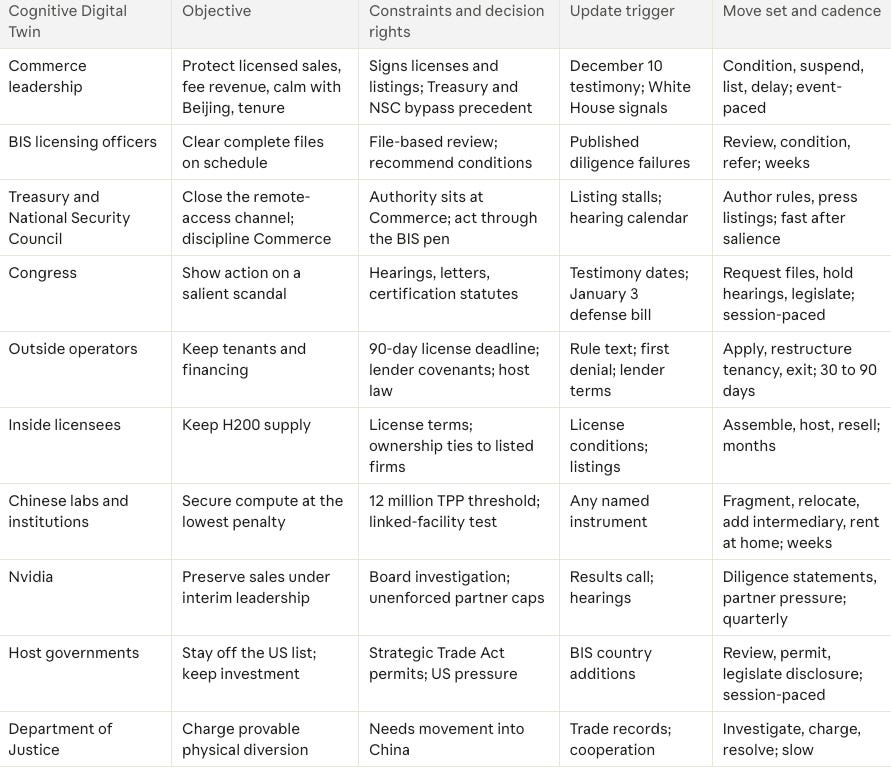
Three causal hypotheses frame the run alongside a null route, each with its own falsifier.
Adaptation. Each single-layer check shifts the chain to the next unchecked layer or unlisted country. Falsifier: twelve months after the effective date, no credible report shows China-headquartered compute outside the five countries, below the threshold or through a non-Chinese intermediary (PX-P-2 fails).
Salience. The December hearings force Commerce to a visible action on the inside chain, and the fee incentive selects a condition over a revocation. Falsifier: no H200 license action by June 30, 2027, or a first action that revokes (PX-P-1 or PX-S-4 fails).
Bypass. Treasury and the National Security Council keep routing around Commerce when it stalls. Falsifier: the Megaspeed listing and any H200 action arrive as Commerce initiatives with no reported Treasury or National Security Council role, or arrive from neither by June 30, 2027.
Null route. Commerce delays past every fork and both chains persist unchanged. Falsifier: any of PX-P-1, PX-P-3 or PX-S-1 resolves yes.
The outside segment supports Foresight Simulation treatment and the inside segment supports short-horizon treatment. The rule is in force for the outside operator, the players are named, and the 90-day window gives behavior time to converge. Inside China the H200 carve-out holds the rules steady, and the hearing and the defense bill are the two dated events that could replace the game.
💼 Executives. The seat table doubles as a tenant map: each operator’s update trigger marks the document that changes its conduct, and the first denial moves every operator at once.
⚖ Counsel. The rule’s knowledge standard makes the operator’s diligence file the exporter’s evidence, so the operator row in the table is now part of every exporter’s compliance file.
Takeaway: the outside chain now faces a license at the operator layer, the inside chain faces nothing below the buyer, and the ten seats above decide whether that gap closes before the chain moves.Takeaway: the outside chain now faces a license at the operator layer, the inside chain faces nothing below the buyer, and the ten seats above decide whether that gap closes before the chain moves.
III. MindCast Foresight Simulation Predictions
The forecast set tests whether checks move to the operator on either side of China’s border before the chain moves again. Ten new Simulation Predictions follow, three primary and seven secondary, with ten carried from the companion papers and the series. Prediction date: November 16, 2026. Data cutoff: November 16, 2026, 9:20 pm Pacific.
Simulation Synthesis
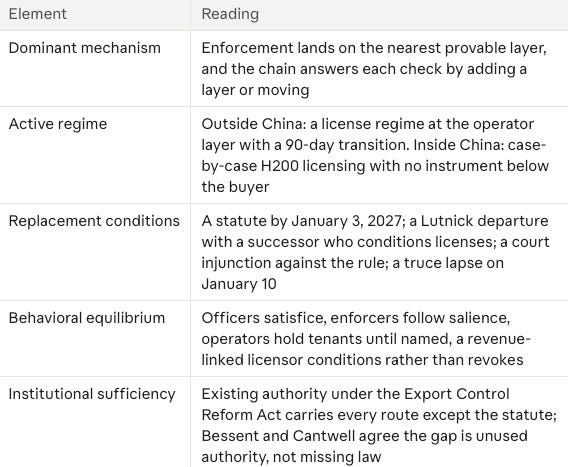
Scenario Structure
Three channels carry most of the weight, and the modal channel for the inside chain is Channel 1: operator conditions on H200 licenses after the December hearing (PX-P-1). If PX-P-1 fails the persistence path governs, buyer-layer checks only. The modal channel for the outside chain is Channel 2, relocation and fragmentation (PX-P-2).
Two tail channels stay live. Channel 6 is a statute that converts Commerce from gatekeeper to certifier at the Snapshot’s 20%, and Channel 5 is a court challenge to BIS authority over remote access (PX-S-6). Section VI walks the full tree.
A. Primary Predictions
PX-P-1 | Commerce Moves H200 Checks Below the Licensee · 64% (55-72%)
Forecast statement: Commerce attaches conditions to at least one Nvidia H200 license to China that name the operating data center or restrict rental to listed end users, or suspends or revokes at least one such license.
64% (55-72%) · short horizon · by June 30, 2027.
Trigger: hearing questions on the Times findings; congressional document requests for license files; a second licensee story.
Falsifier: no published condition, suspension or revocation by June 30, 2027.
Verified by: Federal Register; BIS statements; congressional records of license files; license terms reported by the New York Times, Reuters, Bloomberg, the Financial Times or the Wall Street Journal.
Exposure: inside licensees lose the unconditioned route; exporters gain a diligence anchor; Commerce keeps the fee alive.
Watch: hearing transcript on December 10; BIS license-condition language; weekly.
Mechanism: the hearing makes the empty-office licensees the vivid case, a condition answers the hearing while keeping the license and the 25% fee alive, and the bypass precedent raises the cost of doing nothing. The route fails if Commerce treats the Megaspeed listing as sufficient visible action and lets the H200 files sit.
PX-P-2 | The Outside Chain Adapts Within a Year · 71% (58-82%)
Forecast statement: Within 12 months of the rule’s effective date, one of six named outlets (Financial Times · Reuters · Bloomberg · New York Times · Wall Street Journal · The Information) documents a China-headquartered firm obtaining advanced compute through a data center outside the five listed countries, below the 12 million TPP threshold or through a non-China-headquartered intermediary.
71% (58-82%) · long horizon; the outcome holds across every candidate game · 12 months from the Federal Register effective date.
Trigger: first license denial; lender pressure on listed-country operators; Malaysian disclosure law.
Falsifier: no such report in the named outlets within the window.
Verified by: the named outlets; party disclosures.
Exposure: operators in unlisted countries gain tenants; listed-country operators lose them; BIS faces the country-addition decision.
Watch: capacity announcements in Japan, Vietnam, the Philippines, Canada, Australia and the Gulf; monthly.
Mechanism: a license at one layer raises that layer’s penalty, and the renter’s lowest-cost response is a move to an unlisted host, a fragmented footprint under the threshold or an intermediary whose ultimate parent sits outside China. The threshold and the linked-facility test tell the renter where the line is.
PX-P-3 | Commerce Lists Megaspeed · 58% (48-67%)
Forecast statement: Commerce adds Megaspeed International or Speedmatrix to the Entity List.
58% (48-67%) · short horizon · by June 30, 2027.
Trigger: December 10 testimony; Treasury and State pressure; a Justice Department charging decision.
Falsifier: no Federal Register Entity List addition naming either company by the date.
Verified by: Federal Register Entity List supplements.
Exposure: Nvidia’s reseller channel; Malaysian and Indonesian hosts; lenders to Speedmatrix sites.
Watch: BIS Entity List notices; weekly.
Mechanism: four agencies favor the listing, the hearing demands a visible action from the one desk that holds the pen, and a listing costs Commerce less than an H200 revocation. The route fails if a pending criminal case leads Commerce to defer or if the White House trades the listing for truce calm.
B. Secondary Predictions
PX-S-1 · 31% (20-43%) · A named H200 licensee (New Matrix, Maginfra, Zhejiang Yindun) or Range Intelligent Computing joins the Entity List · by December 31, 2027 · short horizon · Channel 1 · Trigger: document requests reach the license files · Falsifier: no listing by the date.
PX-S-2 · 40% (27-57%) · BIS adds at least one country to the destination license list · by December 31, 2027 · short horizon · Channel 2 · Trigger: reported relocation under PX-P-2 · Falsifier: no addition by the date.
PX-S-3 · 69% (57-81%) · A Chinese procurement record dated after November 16, 2026 shows an Entity List institution buying or renting H200-class or newer capacity inside China · reported by December 31, 2027 · long horizon · Channel 4 · Trigger: continued in-China rental market · Falsifier: no such record reported.
PX-S-4 · 77% (64-87%) · Given PX-P-1, the first H200 license action is a condition or suspension rather than a revocation · conditional on PX-P-1 by June 30, 2027 · short horizon · Channel 1 · Trigger: any license action · Falsifier: the first action is a revocation.
PX-S-5 · 56% (42-70%) · Malaysia enacts or issues binding operator-disclosure or monitoring rules for data centers · by December 31, 2027 · short horizon · Channel 2 · Trigger: MITI consultation; BIS country review · Falsifier: no binding rule by the date.
PX-S-6 · 17% (8-27%) · A party files a court challenge to BIS authority over remote access under the new end-use control · by December 31, 2027 · short horizon · Channel 5 · Trigger: first denial of a US-linked operator; 50 U.S.C. § 4821 bars ordinary Administrative Procedure Act review of export-control functions, so a plaintiff must plead a constitutional or ultra vires theory · Falsifier: no filing by the date.
PX-S-7 · 40% (27-56%) · BIS denies at least one license application under the new end-use control for a data center already serving a China-headquartered tenant · within 90 days of the effective date · short horizon · Channel 5 · Trigger: installed-base applications filed; posture of the first decisions · Falsifier: no denial inside the window.
C. Carried Predictions and What the Rule Resolves
Ten predictions carry from the companion papers and the series. Verification for the first group is Federal Register publication on its scheduled date of November 19, 2026, so each line below resolves on that date. The second group includes Snapshot #6 on the statute; the Lutnick paper’s C-2 tests a different statute by the same date and stays with that paper.
RG-P-1 · 83% (79-86%) · First rule exempts chips delivered before its cutoff, given Lutnick in office · Miss. The rule requires a license for delivered chips within 90 days, which the paper’s definition of exempt excluded.
RG-SN-2 · 80% · First rule exempts delivered chips regardless of signer · Miss, same text.
RG-SN-4 · 80% · First rule includes a savings clause for chips in transit · Hit. Thirty-day savings clause for items en route.
C-9 · 92% (89-95%) · First instrument provides a transition or licensing path for existing contracts · Hit. Ninety-day licensing window.
C-10 · 74-88% · First instrument imposes a provider-side tenant-identity or workload duty · Hit. Know-your-customer duty and the red-flag knowledge standard.
C-4 · 71% · First rule replacing the diffusion framework carries a conduct-based element · Hit. The rule covers training and running models and treats an end-use change as an in-country transfer.
LC-P-1 · 26% (12-43%) · Commerce publishes a first rule by January 10, 2027 · Miss. The rule published inside the window.
LC-S-1 · 5% (0-15%) · A first rule publishes before the December 10 testimony · Miss. The rule published before the testimony.
C-12 · 77% (68-86%) · A US rule reaching remote access takes effect by December 31, 2027 · Hit on the effective date.
The tally on publication: five hits, four misses, and C-3 revised to even odds.
The LC-P-1 and LC-S-1 misses share one cause. The companion paper modeled publication timing as a function of the Commerce desk, and the rule arrived through a different author. The error sits in actor identity, not in the timing logic, and the mechanism this paper adds in Section II.E corrects it. The RG-P-1 miss has a second cause: the authors who took the pen held the opposite scope preference from the desk the paper modeled.
LC-P-2 · 79% (71-86%) · Lutnick remains Commerce Secretary through January 10, 2027 · Open.
LC-S-4 · 35% (22-49%) · First rule by January 10 given a departure announced by then · Void on condition. The rule publishes before any departure, so the conditional cannot resolve inside its window.
RG-S-1 · 61% (51-71%) · China-parented rental commitment reported outside the country list within 12 months of the cutoff · Open; condition met at five countries.
RG-S-3 · 81% (72-90%) · A listed operator or lender cites the rule in a securities filing within 120 days · Open.
C-3 · updated call 51% (37-66%), from 88-95% · No US rule forces existing offshore compute service to China-headquartered tenants to stop before October 31, 2027 · Open; revised because the rule’s license requirement makes a denial that stops service an available instrument. Original wording, window and falsifier stand.
C-11 · 84% (78-89%) · Federal enforcement works through entity, intermediary and telemetry measures rather than licensing ordinary inference, through September 2027 · Open.
Snapshot #6 · 20% · Defense bill carries AI Overwatch text by January 3, 2027 · Open; Channel 6.
Snapshot #11 · 20% · BIS lists a non-Chinese offshore data center operator by December 31, 2027 · Open.
D. Withheld Branches and Watch Conditions
A Lutnick departure before January 10 opens a successor fork whose weight depends on the successor’s type, and the paper carries it as a watch condition rather than a band. PX-S-7 converts C-3 and RG-S-3 from open to resolving.
E. Limits and Break Conditions
The forecast set rests on the rule as displayed on November 16 and on reporting that remains, in most individual links, a single investigation. A court injunction against the rule, a statute by January 3, or a truce lapse that reopens the whole licensing posture would replace the game and shift weight between routes without falsifying the mechanism.
🏛 Policymakers. PX-P-1 and PX-S-1 move on what the hearing produces. Document requests for the license files are the lever that converts a condition into a listing.
📊 Investors. C-3’s revision is the material change in this set. A near-certain continuation call became a coin flip the day the rule published, and the first denial decides it.
Takeaway: three primary calls say Commerce conditions an H200 license and lists Megaspeed while the outside chain adapts within a year, and the renter inside China stays the layer no instrument reaches.
Commissioned Runs Map One Firm’s Chain
Published analysis cannot map a specific firm’s tenants, licensees and financiers to the layers a rule, a listing or a license condition would reach. The answer depends on the firm’s contracts, its ultimate-parent structure at each layer, and the compute each tenant draws against the 12 million TPP threshold.
A commissioned engagement builds Cognitive Digital Twins of the firm’s counterparties, its host regulators and the BIS desk that will read its license application. MindCast then runs the chain against the six channels in Section VI and the persistence path, with the firm’s own tenant mix, lender covenants and exit costs as inputs.
Commissioned scope adds what the public text withholds: the complete scenario tree and P10/P50/P90 ranges on the first denial date and relocation volume, decision thresholds for tenant restructuring, and a monitoring dashboard keyed to the signals in the protocol below. A Strategy and Risk Simulation Snapshot or an interactive war game can deliver the first module within five to seven business days.
The bounded next step is a diagnostic session on one live decision: a license application, a tenant renewal, a lender covenant or a site in an unlisted country. Working With MindCast at the end of the paper sets out how engagements begin.
IV. Stakeholder Strategy and Risk Mitigation
Each audience holds one layer of the chain, and each mitigation moves its check one layer further down. The matrix names the low-regret move now and the move each prediction unlocks.
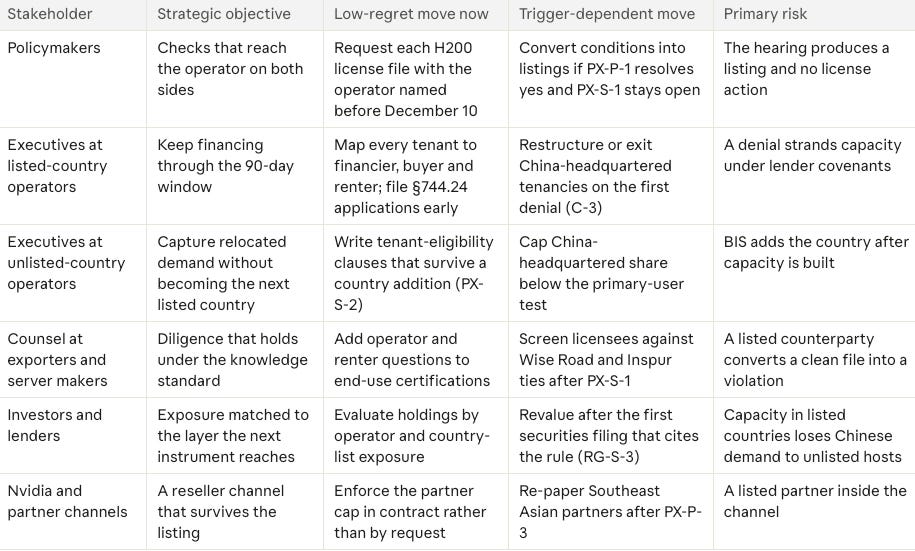
Strategic Posture by Stakeholder
Policymakers. Licenses and listings reach the buyer layer only, and the fee rewards keeping licenses in force. The hearing is the one dated lever that reaches the license files. Ask whether any licensee received a site visit and whether the 25% fee enters license review, then ask what Commerce did after the classified May 2026 Megaspeed warning and who set the rule’s scope before Treasury and the National Security Council took it.
Executives at operators. Operators carry the duty the licensee passed down. In the five listed countries the duty is now a license, and existing China-headquartered tenants above the threshold need one within 90 days.
Treat a single customer above half of capacity as the primary-user test the rule names, as DayOne’s reported 70% concentration shows. Outside the five, the question is how long the country stays unlisted, and PX-S-2 sets that at less than even through 2027.
Counsel. The rule’s knowledge standard makes a host’s refusal to provide diligence a red flag that presumptively establishes the exporter’s knowledge. Diligence that stops at the licensee no longer protects the exporter, and the operator’s customer file is now part of the exporter’s file. Document operator-layer diligence now, because Commerce staff already view some overseas arrangements as possible violations of existing rules.
Investors and lenders. Added layers move exposure toward the operator and its lenders. The first denial under the new control converts a disclosure risk into a revenue event, and RG-S-3 puts a securities filing citing the rule within 120 days at 81%. Track rentals in Japan and Vietnam, the Philippines and the Gulf, and read PX-P-2 as the base case for where demand goes.
Risk Mitigation by Time Gate
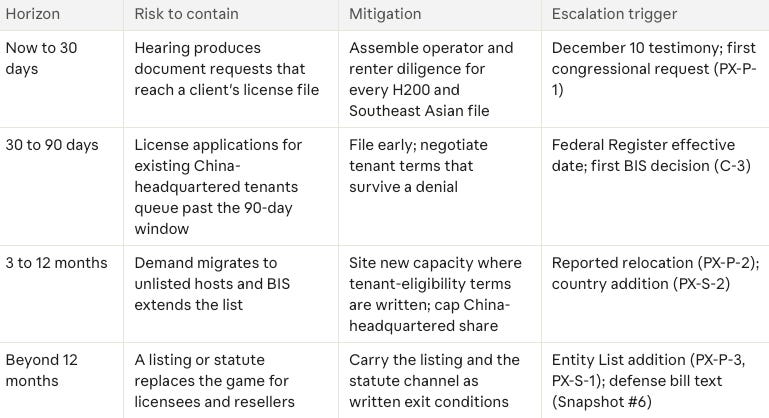
Five risk classes apply. Strategic risk arises when the renter fragments faster than the operator can re-paper tenants. Institutional risk arises when authorship moves again, from Commerce to Treasury and the National Security Council or to Congress.
Legal risk arises from the knowledge standard and from a court challenge to the rule. Market risk arises from capacity stranded in listed countries. Operational risk arises from diligence files that become evidence.
💼 Executives. The 90-day window is the only period in which an operator can restructure a tenancy before a denial does it for them.
⚖ Counsel. The operator row of the seat table is the discovery map: each update trigger names the document the government will ask for first.
Takeaway: policymakers hold the license files and executives hold the tenant contracts, counsel holds the certifications and investors hold the operator exposure, and the time gates say when each lever stops working.
V. Implications
The implications follow from the forecast set and the strategy matrix. Authorship moved, the chain’s next move is already visible, and the value of a Southeast Asian data center now depends on which side of a country list it sits.
A. Authorship Became the Contested Resource
The rule changed who writes export controls more than it changed what they say. Treasury and the National Security Council wrote the instrument and attributed it in the preamble, which converts Commerce from gatekeeper to signatory on the one channel it stalled. PX-P-1 and PX-P-3 test whether the same principal can move the two decisions still at Commerce, the H200 licenses and the Megaspeed listing, or whether Commerce reclaims them by acting first at the hearing. Snapshot #6 carries the statute route at 20%, and the Bessent-Cantwell agreement that the gap reflects unused authority keeps it low.
B. Each Check Teaches the Chain Where the Line Is
Counterparties respond to the rule’s own text. The 12 million TPP threshold and the linked-facility test tell a renter how to fragment, the five-country list tells it where to move, and the ultimate-parent test tells it which intermediary to add. PX-P-2 at 71% says the chain reads the rule faster than BIS can extend it, and PX-S-2 at 40% says BIS extends the list in fewer than half of the cases through 2027. Host governments respond to the same signal from the other side: Malaysia’s reviews and a disclosure law under PX-S-5 are moves to stay off the list, and they reach the operator before any US extension does.
Compute is one of two channels that carry US AI capability into China, and the rule reaches only the first. Reuters reported on November 17 that more than 300 Chinese papers, patents and corporate and government documents show distillation moving from academic experiments into mainstream industrial use with Beijing’s encouragement (Reuters).
Distillation trains a domestic model on the outputs of a US model. It runs over model interfaces rather than rented chips, so no layer of the four-role chain touches it and no instrument in this paper reaches it. The Runtime Export Problem: Anthropic’s 151 Million-Exchange Distillation Record, Advisory AA26-251A, and the Question Commerce Cannot Yet Answer carries that channel, and its C-11 at 84% holds that federal enforcement there works through entity, intermediary and telemetry measures rather than licensing ordinary inference. The wider distillation runs, the less a compute control alone decides what China can build.
C. Value Moves From Licensee to Operator to Country
Value and risk redistribute down the chain. The licensee’s clean file no longer protects the exporter, so exporters absorb diligence cost. Operators in the five countries absorb a license duty with a 90-day deadline and face the first denial, so lenders to those sites absorb revenue risk that C-3’s revision now puts at even odds.
Operators outside the five countries, from Japan and Vietnam to Canada and the Gulf, capture relocated demand until a country addition arrives. Inside China, the renter keeps the easy route under PX-S-3 at 69%, so the in-China rental market captures what the offshore market loses.
D. What Changes If a Falsifier Fires
If PX-P-1 fails, Commerce held the H200 files through the hearing and the persistence path governs the inside chain: licensees keep unconditioned supply and PX-S-1 falls further, and policymakers’ lever shifts from license conditions to a statute or a successor at Commerce. If PX-P-2 fails, the rule’s threshold and list held demand in place for a year. Operators would have dropped tenants rather than tenants moving, and C-3 would resolve as a miss through denials rather than relocation. If PX-P-3 fails, the Justice Department case substituted for the listing, and the buyer layer outside China answered to a court rather than to BIS.
🏛 Policymakers. A rule written by Treasury and the National Security Council and signed by Commerce sets a precedent for every stalled instrument. The next contest over authorship is the H200 license conditions.
📊 Investors. Country-list exposure is now a balance-sheet variable. A site in Johor and a site in Da Nang carry different revenue risk from the same tenant.
Takeaway: the rule moved authorship, the chain is already reading the rule’s own thresholds for its next move, and value follows the layer the next instrument fails to reach.
VI. How the Game Branches
The baseline is the current game: a license rule in force for the outside operator from November 19 and no instrument below the buyer inside China. Ten MindCast Foresight Simulation Predictions hold in that game. Commerce conditions, suspends or revokes an H200 license by June 30, 2027 at 64% (55-72%); the outside chain adapts within 12 months at 71% (58-82%); Commerce lists Megaspeed or Speedmatrix by the same date at 58% (48-67%). The seven secondary calls run from 17% to 77% and print in Section III.B.
The dominant fork is the December 10 hearing, and the seat that moves it is Commerce leadership. Document requests for the H200 license files decide whether Commerce acts on the inside chain or lets the files sit. The channels below run at the same time and any combination can occur, so the walk takes them in the order a reader would draw them.
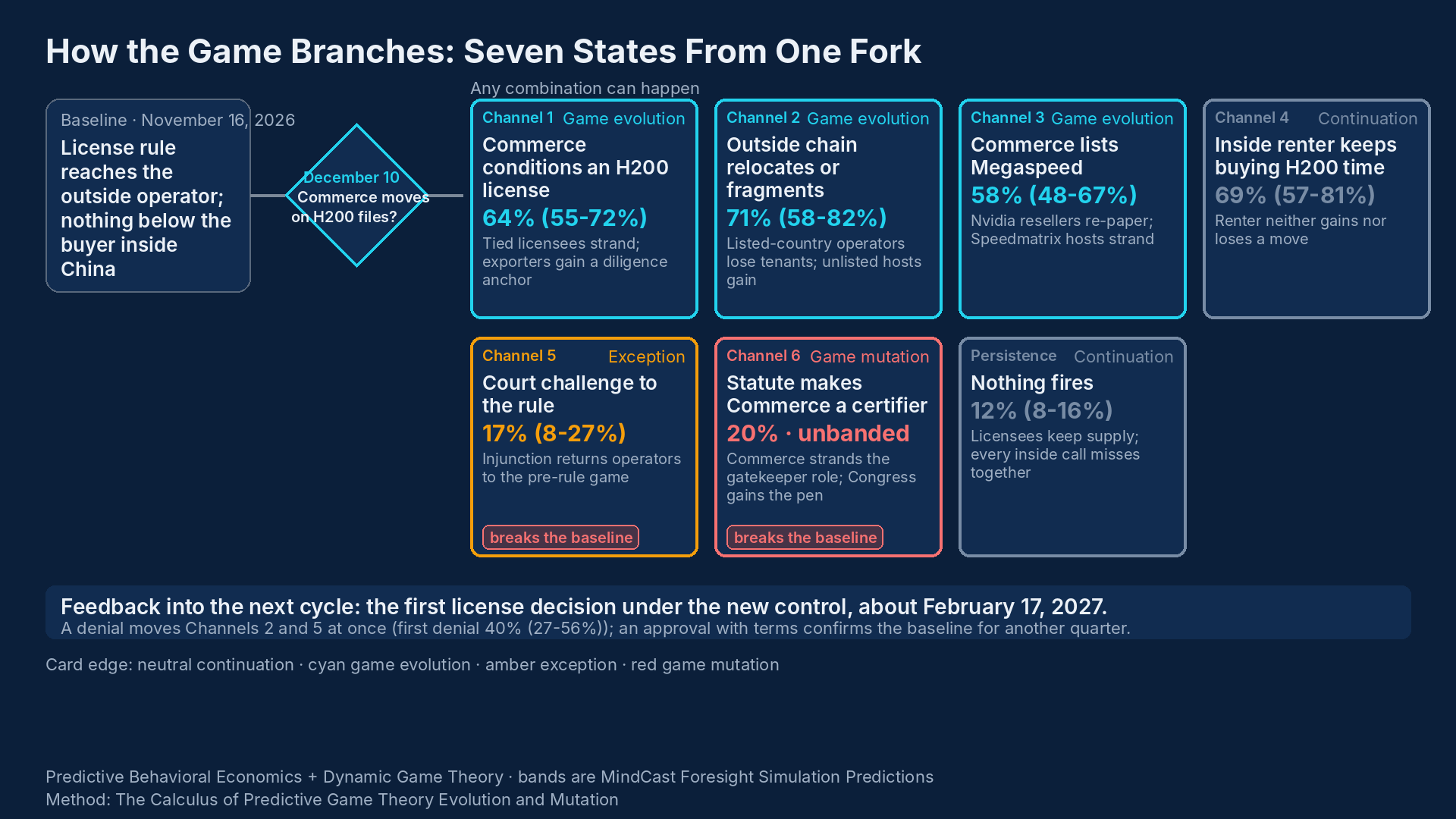
The map shows one fork, seven states and the two states that break the baseline.
Channel 1: Commerce conditions a license. Class: game evolution. P(the first action is a condition or suspension rather than a revocation given Commerce acts) = 77% (64-87%). P(a named licensee or Range Intelligent Computing joins the Entity List by December 31, 2027) = 31% (20-43%), and it rises when document requests reach the files.
Inside licensees with ownership ties to listed firms lose the unconditioned route and strand; exporters gain a diligence anchor; Commerce keeps the fee and gains a move it can repeat on the next file.
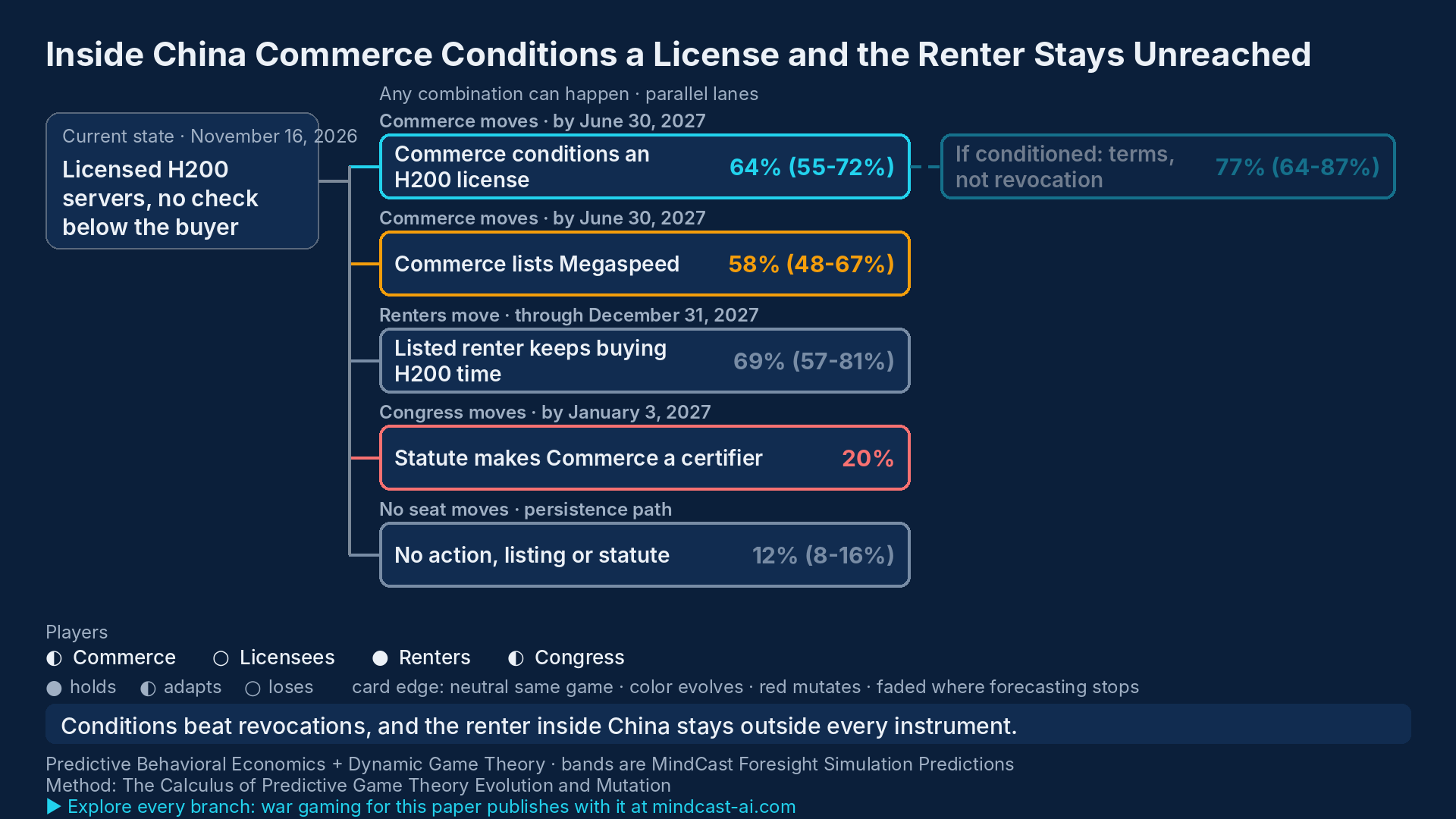
Channel 2: the outside chain adapts. Class: game evolution. P(reported relocation, fragmentation or a non-Chinese intermediary within 12 months of November 19, 2026) = 71% (58-82%). P(BIS adds a country to the list by December 31, 2027) = 40% (27-57%), and P(Malaysia issues binding operator-disclosure rules by the same date) = 56% (42-70%).
Listed-country operators lose tenants; unlisted hosts gain them; lenders gain an exit trigger written into covenants.
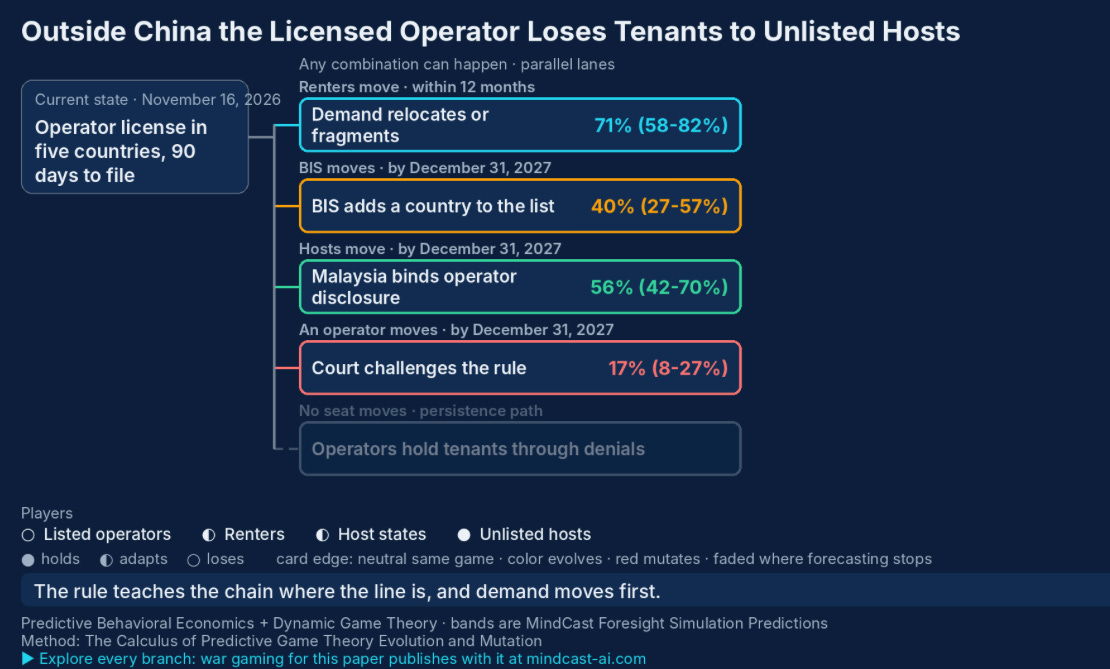
Channel 3: Commerce lists Megaspeed. Class: game evolution. P(a listing of Megaspeed or Speedmatrix by June 30, 2027) = 58% (48-67%), with or without Channel 1. Nvidia’s reseller channel loses a buyer and gains a re-papering move; Malaysian and Indonesian hosts strand capacity tied to Speedmatrix; the Justice Department loses nothing, because a listing runs beside a criminal case rather than replacing it.
Channel 4: the inside renter keeps buying time. Class: continuation. P(a Chinese procurement record dated after November 16 shows an Entity List institution buying or renting H200-class capacity inside China, reported by December 31, 2027) = 69% (57-81%). It holds across Channels 1 and 3 because no instrument reaches the in-China operator, so the renter neither gains nor loses a move while the licensee above it changes.
Channel 5: a court challenge. Class: exception; a win would end the outside game. P(a denial under the new end-use control inside the 90-day window) = 40% (27-56%), and P(a filing against BIS authority over remote access by December 31, 2027) = 17% (8-27%).
The vehicle is narrow because 50 U.S.C. § 4821 bars ordinary Administrative Procedure Act review, so the plaintiff must plead a constitutional or ultra vires theory. An injunction would return every outside operator to the pre-rule game and void the premise of the adaptation call.
Channel 6: statute. Class: game mutation. P(the defense bill carries certification text by January 3, 2027) = 20%, carried from the Snapshot and unbanded. Commerce strands the gatekeeper role and Congress gains the certification pen, and the inside-chain calls re-issue under the new author.
Persistence path: nothing fires. Class: continuation. P(no H200 action, no listing, no licensee listing and no statute) = 12% (8-16%). Licensees keep unconditioned supply and the renter keeps the easy route, and every inside-chain call misses together.
Two states break the baseline: an injunction in Channel 5 and a statute in Channel 6. Either one replaces the game rather than resolving a fork inside it, and the Simulation Predictions then re-issue conditioned on the new state. The first license decision under the new control is the feedback that carries the outcome into the next cycle, because a denial moves Channels 2 and 5 at once and an approval with terms confirms the baseline for another quarter.
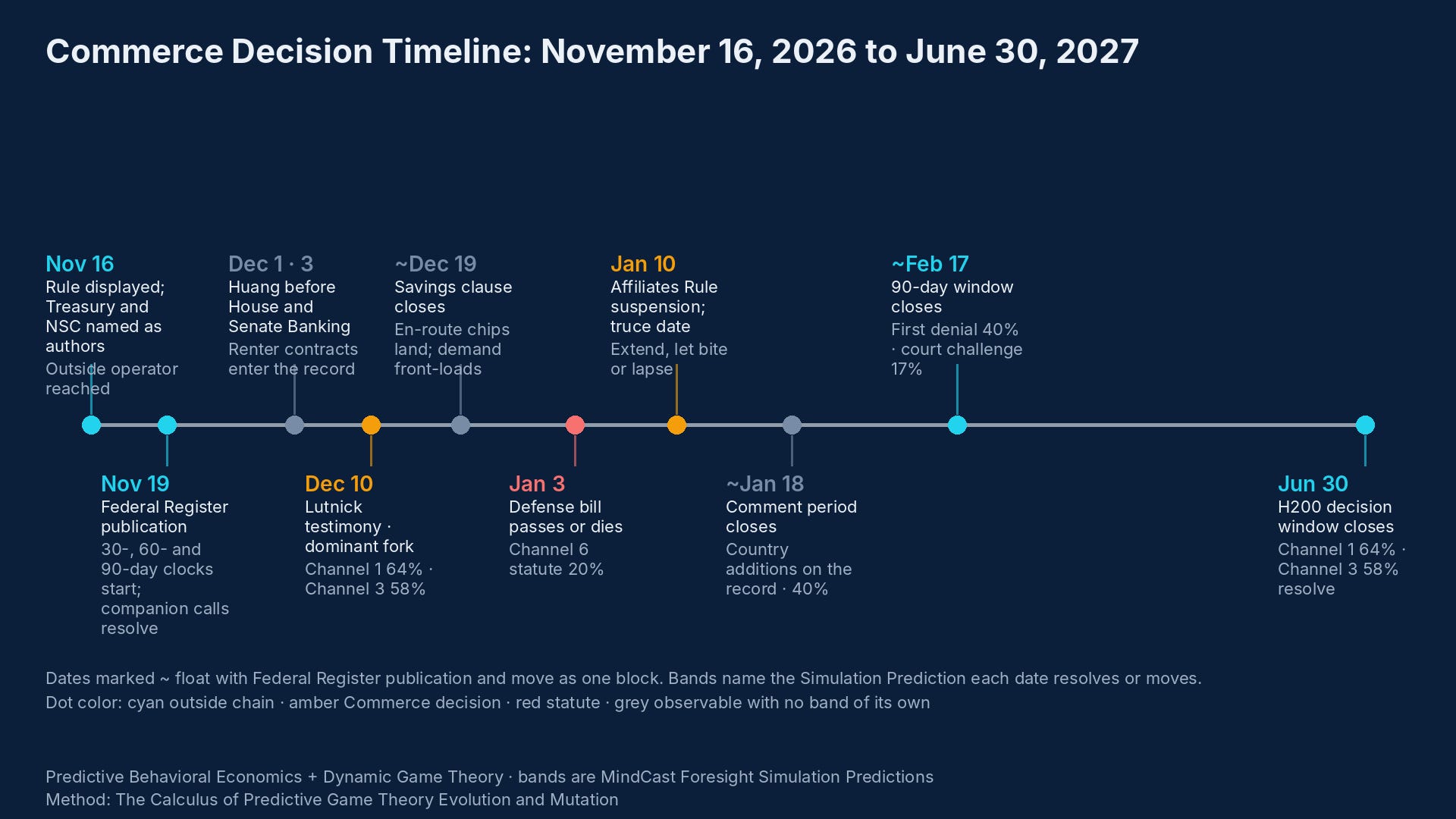
The timeline places each state on the calendar. Dates marked with a tilde float with Federal Register publication and move together.
⚖ Counsel. Channel 1 gives the clearest guidance available: prepare licensee clients for a condition that names the operating data center, because the fee incentive points there before it points to revocation.
💼 Executives. Channel 2 is the base case. Site where the country list does not reach and write tenant terms that survive its extension.
Takeaway: six channels and a persistence path leave the current game, four carry odds above even, and only an injunction or a statute replaces the board.
Monitoring and Update Protocol
Seven signals decide whether the tree deepens or reopens. Each links to a prediction, names its source and cadence, and states what a reading changes.
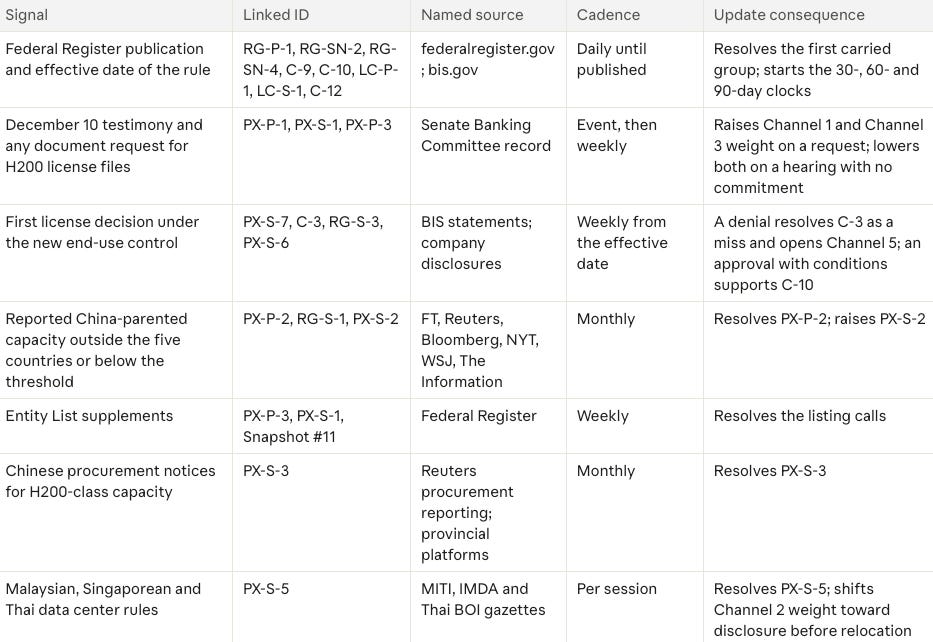
Revisions retain every prediction’s original language and class, its band and window, and its falsifier. Each revision states the new observation and why it bears on the prediction, names the field changed and the predictions affected, and marks whether it is an update or a new prediction. A revision note publishes when a change would alter a stakeholder’s move.
Takeaway: publication starts the clocks, the hearing sets the inside-chain weights, and the first denial decides the one carried call the rule turned into a coin flip.
Conclusion
US controls check the buyer while the operator and the renter decide the end use. The November 16 rule moved one check down the outside chain to the operator, with a license rather than a notice and with the installed base inside its reach, and it did so through an author Commerce did not choose. The inside chain through licensed H200 servers stayed where it was, because the rule kept the China carve-out and no instrument attaches to the in-China operator or renter.
Stakeholders act now on the moves that hold across every channel: file early and map tenants to all four roles, write operator and renter questions into certifications, and value capacity by country-list exposure. Two things remain to learn: whether the December 10 hearing produces document requests that convert into H200 license conditions, and whether the first license decision under the new control approves with terms or denies. The decisive signal is the first denial, because it resolves the carried continuation call, opens the court-challenge channel and tells every operator in the five countries what its own application will meet.
Working With MindCast
MindCast AI is a Predictive Game Theory Modeling-Simulation firm. MindCast builds Cognitive Digital Twins of the named actors on a client’s board and models how the game evolves through its next forks. Both run on Predictive Behavioral Economics + Dynamic Game Theory.
What MindCast can do
Cognitive Digital Twin builds of regulators and counterparties, hosts and lenders, each built from public conduct and the client’s own decision history.
Strategy and Risk Simulation Snapshots for short horizon matters: odds in tens at the current fork, conditional downstream paths, and strategy and risk per path within five business days.
Foresight Simulations for stabilizing matters: published bands at depth two and three, P10/P50/P90 ranges, complete scenario trees and organization-specific inputs.
Interactive war gaming that lets a client’s team play its own moves against modeled opponents across dated forks.
Chain mapping that traces each tenant, licensee and financier through the four roles and runs the chain against every channel in Section VI.
Monitoring dashboards keyed to the signals in the protocol above.
When an engagement adds the most on proxy chains
An operator in one of the five listed countries holds a China-headquartered tenant above the threshold and must file within 90 days.
An exporter or server maker faces a license application after a licensee’s ownership ties surface.
A lender or investor holds capacity on both sides of the country list and needs the first denial modeled before it lands.
A host government weighs a disclosure rule against a country addition.
How engagements begin. A complimentary Snapshot runs on publicly available information. Private engagements proceed after a nondisclosure agreement and retainer, starting with a diagnostic session on one live decision.
Contact: mcai@mindcast-ai.com · Corporate site: www.mindcast-ai-simulation.com · All MindCast war gaming: www.mindcast-ai-simulation.com/live-fire-intelligence
Appendix A. Selected MindCast Works
Companion papers in the series
Commerce’s Rented GPU Ban Would Exempt Chips Already Delivered, and the Cutoff Date Decides Its Reach. Source of RG-P-1, RG-SN-2, RG-SN-4, RG-S-1 and RG-S-3; forecast the exemption question the rule answered against the paper.
Lutnick and the Commerce Department Likely Miss January 10 on the Rented GPU Rule, and His Tenure Shapes What It Exempts More Than When It Publishes. Source of LC-P-1, LC-P-2, LC-S-1 and LC-S-4; modeled timing as a function of the Commerce desk, which Section II.E corrects.
Frameworks and methods
The Calculus of Predictive Game Theory Evolution and Mutation. Supplies the horizon test and the five fork questions behind Section VI.
Dynamic Predictive Game Theory: From Nash Equilibrium to Adaptive Coherence Equilibrium. Supplies equilibrium selection and delay dominance for the Commerce seat.
How Mozart Predicts Game Mutation in Predictive Behavioral Economics + Dynamic Game Theory. Frames the point at which a rule in force turns a short-horizon game into a stabilizing one, which the outside operator reached on November 16.
Predictive Game Theory Simulations Through War Gaming. Separates Simulation Snapshots from Foresight Simulations by the stability of the game.
MindCast Prediction Scorecard. Resolved material calls as of October 31, 2026; the November 10 tally of 47 hits, 9 partials and 4 misses appears in Import Controls, Export Controls and the US-China AI Infrastructure Contest.
Prior analyses and validations
AI Chip Export Enforcement Shifts Risk Onto US Firms as China Demand Moves to Domestic Chips, Rented Compute and State Financing. Source of Snapshot #6 and Snapshot #11 and of the finding that each instrument reaches the nearest American firm first.
Tencent, Oracle, and the Remote-Access Gap in US AI Chip Export Controls. Source of C-3, C-9, C-10 and C-12; set the rental template the rule now reaches.
The Runtime Export Problem: Anthropic’s 151 Million-Exchange Distillation Record, Advisory AA26-251A, and the Question Commerce Cannot Yet Answer. Source of C-11.
Foresight Analysis in Illegal GPU Export Pathways 2025-2030. Mapped the Malaysia and Thailand corridors the outside chain uses.
Interactive AI Chip Export Enforcement War Game. Lets readers play the December and January forks against modeled seats.
Appendix B. External Sources
Primary
Bureau of Industry and Security, Addressing Remote Access to Advanced Semiconductors, interim final rule, RIN 0694-AK50, displayed November 16, 2026. New §744.24 end-use control, five-country destination license, 90-day licensing window, savings clause, China carve-out below 21,000 TPP, repeal of the AI Diffusion Rule.
Senate Commerce Committee, Cantwell Tells Lutnick: You Failed to Protect National Security and America’s Tech Edge, letter dated November 15, 2026, released November 16.
Nvidia, Form 8-K reporting Jensen Huang’s resignation and Colette Kress’s appointment as interim chief executive, November 11, 2026, via Stock Titan.
Reporting on the outside chain
Bloomberg, Nvidia Intervened in US Probe of Megaspeed Chip Smuggling, November 9, 2026, via Yahoo Finance. The 50,000-unit undercount from trade records.
NBC News, Megaspeed pledges to cooperate with US investigation, November 12, 2026.
The Star, relaying Reuters, Chinese AI firms rush to secure Nvidia chip capacity, November 12, 2026. Apex financing of Speedmatrix.
The Edge Malaysia, MITI says never cleared Megaspeed or Speedmatrix, November 13, 2026. Re-export review and the Strategic Trade Act permit regime.
Reuters, Malaysia says it is investigating if any chips linked to Speedmatrix were re-exported, November 13, 2026.
CBS News, Lutnick agrees to testify as Bessent blames him for not banning Nvidia chip exports to China-linked firm, November 13, 2026. December 10 hearing and the four-agency position on the Megaspeed listing.
Financial Times, report that Commerce delayed Entity List additions by two months and left Megaspeed off the list while four agencies pressed for it, November 10, 2026. Relayed by AI Weekly.
Nextgov, Commerce Department moves to close AI chip loophole, November 16, 2026. Treasury and NSC authorship and the timing against the Cantwell letter.
Reporting on the inside chain
The New York Times, “Empty Offices, Ties to Blacklisted Firms: Inside the Chinese Companies the US Cleared for Nvidia Chips,” November 7, 2026. New Matrix, Maginfra, Wise Road and Inspur ties. Relayed by AI Weekly.
The New York Times, same investigation, on Zhejiang Yindun Cloud and Range Intelligent Computing. Relayed by AI Brief.
CTV, relaying Reuters, Military-linked Chinese university bought Nvidia chips despite US blacklist, November 2026. The October 21 procurement notice.
Taipei Times, relaying Reuters, Northwestern Polytechnical rental contracts, November 12, 2026. Five H200 rental contracts.
Reuters, Huang exit and US scrutiny imperil $3 billion in Chinese AI projects reliant on Nvidia, November 13, 2026.
Reuters, China taps US AI models to train homegrown rivals as chip curbs bite, November 17, 2026. Review of more than 300 Chinese documents on distillation; the capability-transfer channel the rule does not reach.