
Grant, Chelan and Douglas public utility districts · Bonneville Power Administration · Energy Northwest · X-energy · Washington State Legislature · Counties · FERC · DARPA · Quantum vendors · National laboratories · Lenders
Companion works: Regional Clean Compute Anchors (Installment One) · What Quantum Computing Contributes to Clean Compute Clusters (Installment Two) · How Quantum Computing Can Improve AI (Installment Three)
War game editions: Clean Compute Anchor War Game Executive Deck · Interactive Clean Compute Anchor War Game
Executive Summary
Core insight. A clean energy host’s move does the most while the instrument that will govern it is still unwritten. Once a district sets terms by negotiation, a county decides the first project or a host signs a tenancy, the same move can shape the next deal but cannot change the first one.
Thesis. The board carries five exposures. Two of them lost a route before any regional anchor filed: unconditioned allocation at Grant County in April 2025 and the refurbishment tax route on July 1, 2026. Four exposures still turn on decisions dated 2027 to 2029, and those two are among them.
The 105-day legislative session convenes January 11, 2027.
Grant County’s 2027 relief line, the first county decision and the first federal co-location order follow. The quantum tenancy has no closing date and stays open until a host signs.
What distinguishes MindCast. MindCast AI applies Predictive Behavioral Economics + Dynamic Game Theory through MindCast AI Proprietary Cognitive Digital Twin Foresight Simulations (MP CDT FS). Behavioral Economics supplies the decision rules. Game Theory supplies the payoff structure. Predictive simulations emerge from the combination.
The war game holds the three installments’ Cognitive Digital Twins (CDTs) fixed and changes one host’s move at a time.
What the paper does. The war game replays six dated turns, maps how the game evolves through three successor states after the 2027 session, plays five alternative moves against the same board and isolates the clock still most open to conduct. The Interactive Clean Compute Anchor War Game lets the reader take one of five seats: hydro host or reactor host, quantum host, legislator or lender. The Clean Compute Anchor War Game Executive Deck carries the board, the turns and the successor states in seventeen slides.
The war game carries the seventeen Simulation Predictions from the three installments and adds no new bands.
🏛️ Policymakers. The session’s four definitions decide whether hydro anchors negotiate under stated criteria or case by case; a nuclear-only bill leaves the likeliest first agreement outside the statute.
💼 Executives. Written import confirmation before an announcement changes what the county reads; after the announcement, the same request rides on deposits already paid.
⚖️ Counsel. A co-location reopener and a label-ownership clause cost little before execution and nothing can add them after.
📊 Investors. Read an anchor as five exposures. Allocation and tax have each lost one route. Four exposures turn on forks inside the next thirty months, and the quantum tenancy has no date.
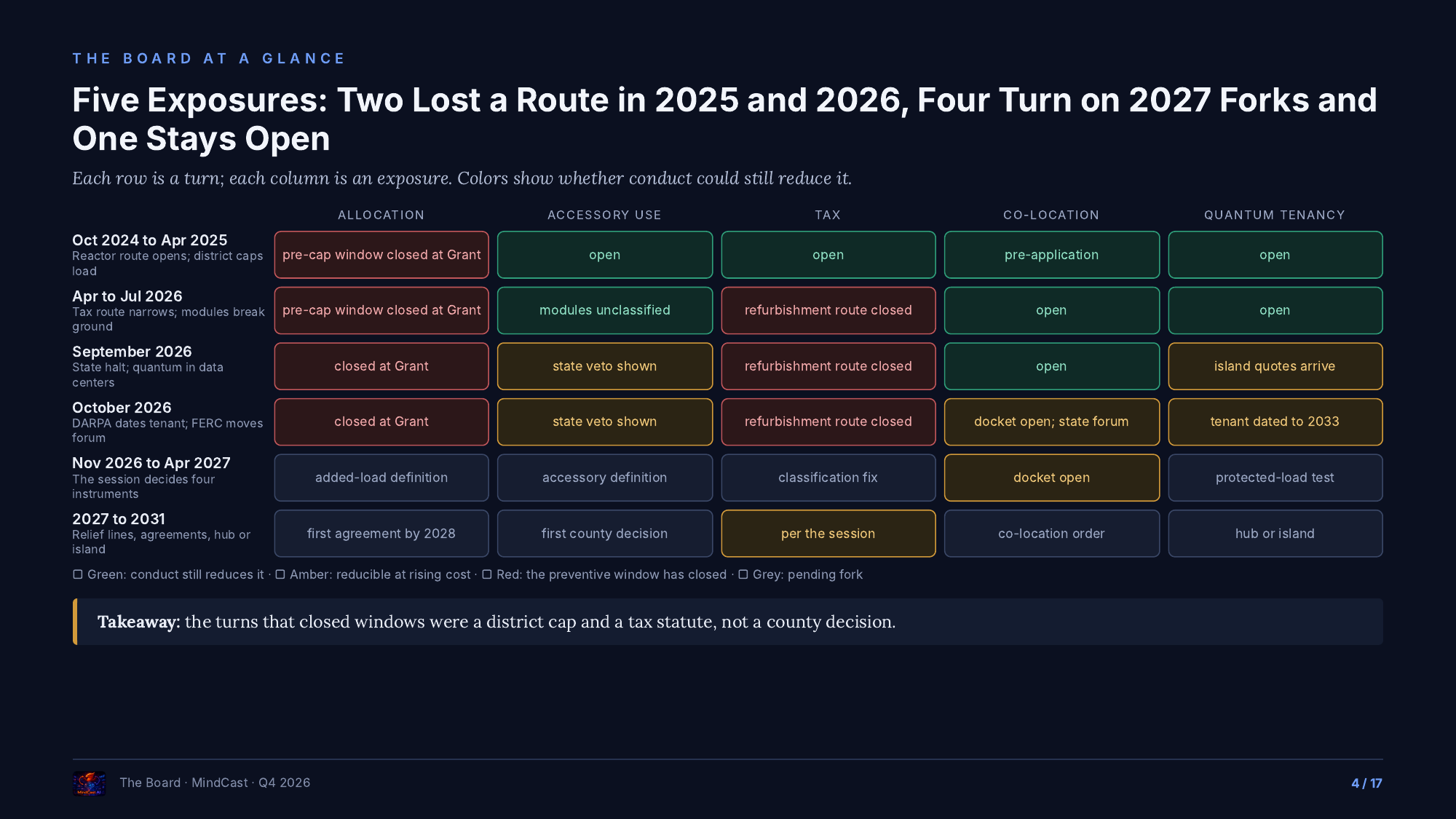
Takeaway. The board shows which moves still secure power and terms, which ones only document what a host could have done, and on what date the line falls.
How the War Game Works
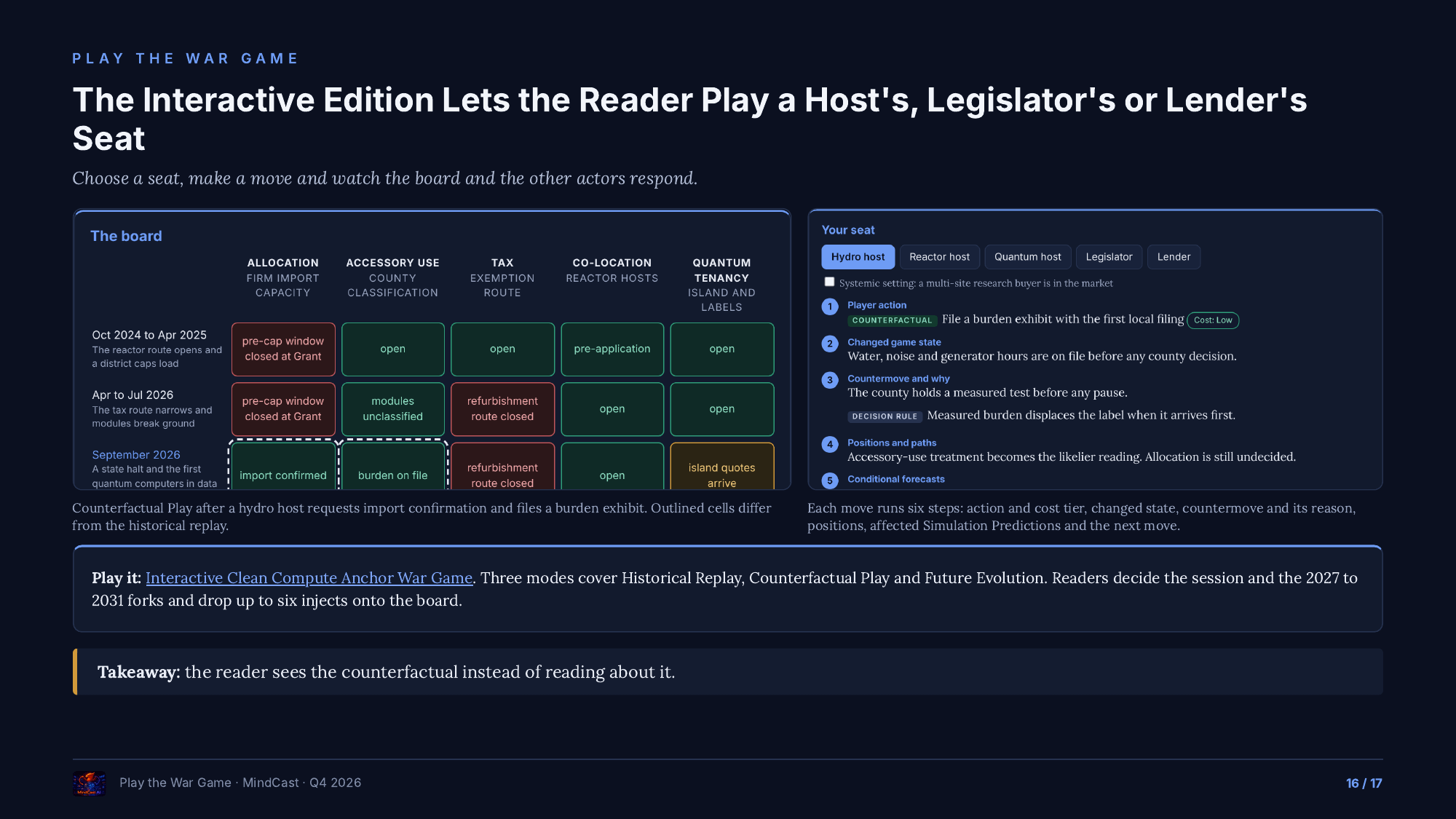
A paper narrates moves someone else made. A war game hands over the pieces: the reader takes a seat, makes a move and watches the other actors respond. The Interactive Clean Compute Anchor War Game runs every move in this paper, and the executive deck shows the same board in summary.
The war game runs in five steps. It sets the board with the Cognitive Digital Twins from the three installments, from districts and counties to vendors and lenders. It dates the clocks by naming each exposure and the public event that closes it.
It replays the turns and maps how each fork evolves the game. It then plays alternatives one move at a time and drops injects onto the board to read which Simulation Predictions move.
Behavioral Economics supplies the decision rules. Counties react to the salient label, so an announcement draws review that a measured filing at an energy site does not. Districts short of transmission prefer negotiation to a rule, and hosts overbuild quantum islands because the label is salient to lenders while utilization is not.
Game Theory supplies the payoffs. A host gains from a rule it can file against, and a district gains from discretion until relief lines energize. A vendor earns on each placed island while a host earns on utilization, and predictive behavior emerges from the combination.
Takeaway. The difference between the replay and the alternative is the finding, shown instead of argued.
I. A Host’s Move Buys the Most Before the Governing Instrument Is Written
A clean energy host faces five decisions made by five different authorities, and each authority writes its terms once. The district allocates import capacity and the county classifies the use. The legislature fixes the tax route and the definitions, FERC assigns co-location cost and the tenancy assigns quantum output. A host’s move changes the terms only while the authority that writes them has not yet written.
The mechanism runs through information. A district that receives a written import request with no announcement attached studies a load; a district that reads an announced operator agreement studies a precedent. A county that holds a burden exhibit before its first decision has a measured test to apply. A legislator who sees a live hydro project before drafting writes a definition that reaches it.
After the instrument is written, the same move changes less. A burden exhibit filed after a county pause becomes evidence for an appeal rather than the basis of the first reading. A label-ownership clause negotiated after the first label exists becomes a dispute rather than a term.
Two exposures depend on conduct and three on documents. Allocation, accessory use and quantum tenancy respond to what a host files and signs. Tax classification and co-location respond to what a statute and an order say, and a host’s move there is to put its facts in front of the drafter before the text is fixed.
Takeaway. Timing is the control. The move does not change between the early and late versions; the authority’s position does.
II. Clean Energy Hosts Carry Five Exposures, and Each Closes on Its Own Date
Each exposure has two dates: when it originates and when a preventive move stops being available.
Allocation. Does the host hold firm import capacity at anchor load? The exposure originates with a host’s first import request at an existing interconnection. Grant County’s public utility district capped data center load growth in April 2025 on transmission grounds, which closed the window for unconditioned allocation there.
Relief lines are due in 2027 and 2029. A statewide definition of added load would make the remaining allocation criteria predictable. The definition cannot create transmission headroom, so allocation stays subject to available capacity and the district’s service authority.
Accessory use. Does the county read the anchor as an accessory use at an energy facility or as a new data center? The exposure originates with the first local filing. The preventive window closes when the first county decides a modular or quantum-equipped project, which Installment One places inside 2029.
Texas showed on September 21, 2026 that a state executive can close the window statewide.
Tax classification. Does compute added inside an existing facility qualify for the data center exemption? Senate Bill 6231ended the refurbishment route on July 1, 2026 and kept the new-construction route. Whether an anchor falls under either route is a classification question the 2027 session can answer.
Co-location. Who pays for transmission a reactor no longer uses for export when compute sits behind the meter? The exposure originates with any compute agreement at a nuclear plant. FERC’s October 9, 2026 order left retail curtailment with the states, and the window closes when a co-location order assigns the cost.
Quantum tenancy. Who owns the labels and the models trained on them, and does the island install before a tenant exists? The exposure originates with the first island quote. No instrument dates its close; a host closes it by signing.
Two of the five have already lost a route for Washington hosts: unconditioned allocation at Grant and the refurbishment tax route. Both still face a later decision, as do accessory use and co-location, so four exposures turn on dated forks. The quantum tenancy stays open-ended.
Takeaway. The board holds five exposures. Two have lost a route, four turn on forks inside the next thirty months, and the quantum tenancy has no date.
III. Six Turns From the Reactor Announcement to the 2027 Forks
The replay steps through what hosts and authorities actually did and how each clock moved. Six turns run from October 2024 to the forks that resolve between 2027 and 2029.
Turn 1, October 2024 to April 2025: the reactor route opens and a district caps load.
Turn 2, April to July 2026: the tax route narrows and modules break ground.
Turn 3, September 2026: a state halt and the first quantum computers inside production data centers.
Turn 4, October 2026: DARPA dates the research tenant and FERC moves the forum.
Turn 5, November 2026 to April 2027: the session decides four instruments.
Turn 6, 2027 to 2029: relief lines, first agreements and the hub-or-island race.
Turn 1 · The reactor route opens and a district caps load. In October 2024 Amazon invested in Energy Northwest’s planned Xe-100 project near Richland, with construction planned by 2030. In February 2025 Duke University’s Nicholas Institute estimated that 76 gigawatts of new load could join the grid at 0.25 percent curtailment. In April 2025 Grant County capped data center load on transmission grounds.
Clocks after the turn: allocation closed for unconditioned requests at Grant; the other four open.
Turn 2 · The tax route narrows and modules break ground. In April 2026 a Google Quantum AI and Caltech team showed in simulation that quantum oracle sketching saves memory on classical data while data loading still dominates runtime. On July 1, 2026 the refurbishment route to the data center exemption ended. On July 27 Energy Vault broke ground on an 8-megawatt modular campus at Snyder, Texas.
Clocks after the turn: tax closed on the refurbishment route; accessory use open with modules still unclassified.
Turn 3 · A state halt and the first quantum computers in production data centers. On September 1 Equinix and Diraq announced a planned quantum computer drawing under 20 kilowatts inside a Sydney data center. On September 21 Texas halted data center environmental permits. On September 23 IonQ announced a 256-qubit system coupled to NVIDIA hardware for installation in 2027.
Clocks after the turn: accessory use reducible at rising cost now that a state veto is on the board; quantum tenancy reducible as island quotes arrive.
Turn 4 · DARPA dates the research tenant and FERC moves the forum. On October 7 DARPA moved four more teams into the final stage of its Quantum Benchmarking Initiative, which asks whether any approach reaches utility scale by 2033. On October 9 FERC rejected PJM’s curtail-first plan for large loads and left retail curtailment with the states.
Clocks after the turn: co-location reducible with the docket open and the state forum named.
Turn 5 · The session decides four instruments. The Washington Legislature convenes its 105-day session on January 11, 2027. Four instruments are available: a definition of added load at existing interconnections, a definition of accessory computing use keyed to burden, a tax classification fix and a functional protected-load test.
Clocks after the turn: allocation, accessory use, tax and the protected-load half of quantum tenancy turn on the session.
Turn 6 · Relief lines, first agreements and the hub-or-island race. Grant County’s first relief line is due in 2027 and the second in 2029. Installment One’s first anchor agreement resolves by December 31, 2028. Installment Two’s hub-or-island race resolves by December 31, 2031.
Clocks after the turn: four forks decided; quantum tenancy open until a host signs.
Takeaway. The turns that closed windows were a district cap and a tax statute, not a county decision; the turns ahead are a session, a relief line and an order.
IV. How the Clean Compute Anchor Game Evolves Through 2031
A forecast holds only inside the game that produced it. The three installments are Foresight Simulations, and each fixed its Simulation Predictions after most of the rules had formed. The war game carries those predictions forward into a game that keeps changing. Readers therefore need to know how the game changes and when a change requires a prediction to be revalidated.
Evolution and Mutation Name Two Different Kinds of Change
MindCast calls an anticipated change in the game evolution. A scheduled session, a dated relief line or a pending federal order changes the game in a direction the simulation already maps. The change can reach the players and their strategies, the payoffs and rules, or the timing. The simulation forecasts evolution, so the Simulation Predictions carry through it with a status change and no new band.
Mutation is reserved for the exception. A mutation is an anomalous or temporary departure the mapped paths do not cover, such as a buyer outside the modeled set or a pause that lifts before any term is written. A mutation suspends the Simulation Predictions it touches until the simulation revalidates them against the new state.
Most events change neither. An event that adds information without changing anyone’s moves is a continuation, and the game stays as it was. The April 2026 oracle-sketching result showed where quantum saves memory but left every seat’s strategies intact.
Takeaway. The game evolves on dated forks the simulation maps; mutation names the anomaly, and continuation names the event that changes only what players know.
The Game Has Evolved Four Times Since 2024
Grant County’s April 2025 cap was the first evolution. Allocation changed from a request a district answers to a negotiation a district controls, and the host lost the move of an unconditioned request.
Senate Bill 6231 was the second. The July 1, 2026 statute removed the refurbishment route, so a host lost one tax strategy and kept the new-construction route.
The September 2026 quantum announcements were the third. Equinix and Diraq brought a quantum processor into a production data center, and IonQ dated a coupled system for 2027. A new seat joined the board: a vendor that earns on each placed island.
FERC’s October 9, 2026 order was the fourth. The order changed the forum rather than the outcome, moving curtailment and continuity terms into state proceedings. DARPA’s October 7 final-stage selections changed timing in the same month by dating the research tenant’s budget question to 2033.
Texas’s September 2026 permit halt was a continuation for Washington hosts. The halt changed no Washington rule, but it showed counties and lenders that a state executive can close the accessory-use window statewide.
Takeaway. Two of the four evolutions closed windows, and the other two added a seat and moved a forum. None changed the payoff a host earns from moving first.
Each Fork Carries Five Entries
Every fork on the board is mapped with the same five entries before any Simulation Prediction attaches to it:
What the event changes in the game: the players and strategies, the payoffs and rules, or the information and timing.
Which paths it opens and which it closes.
Which seat positions survive, convert or strand.
Which seat gains or loses a move.
Which Simulation Predictions apply in the resulting state, and with what status.
The order matters. The simulation fixes the successor state first and attaches Simulation Predictions second, so two branches never rely on conflicting assumptions about the same actor’s authority.
Takeaway. A fork without its five entries gives a reader odds on the event and no map of what follows it.
The 2027 Session Produces Three Successor States
The session that convenes January 11, 2027 is the dominant fork, and each outcome produces a different game.
Burden-keyed package passes: the statewide criteria route. The rules change. Allocation criteria at existing interconnections become predictable, and counties apply a measured burden test. The statute creates no headroom, so each allocation stays subject to available capacity and the district’s service authority.
Hydro hosts’ import requests and burden exhibits convert from evidence into filings against a stated standard. Hosts gain the move of filing against published criteria, and districts lose discretion over the terms of the first agreement while keeping authority over capacity. One S-4 (34–46%) resolves true, and One P-1 (45–57%) moves inside its window under stated criteria.
Nuclear-only definition passes: the split route. The rules change at one source only. Reactor hosts gain a statutory template that waits for operation in the mid-2030s.
Hydro hosts stay in negotiation with their district, so their positions survive but do not convert. Districts keep their discretion over the likeliest first agreement.
Two outcomes separate on this route. One S-4 resolves true if the nuclear-site definition treats computing equipment by measured burden, because the forecast reaches any existing generation facility. A statewide anchor framework still does not form, and One P-1 runs by negotiation at hydro sites. The simulation places the split route as the likeliest 2027 outcome.
No definition passes: the negotiated route. The game continues on its current rules. The first district negotiation becomes the template for every later anchor, and a host that announced before confirming import capacity is the most likely to be stranded.
Districts gain the move of setting the template, and hosts keep only the move of negotiating first. One S-4 resolves false.
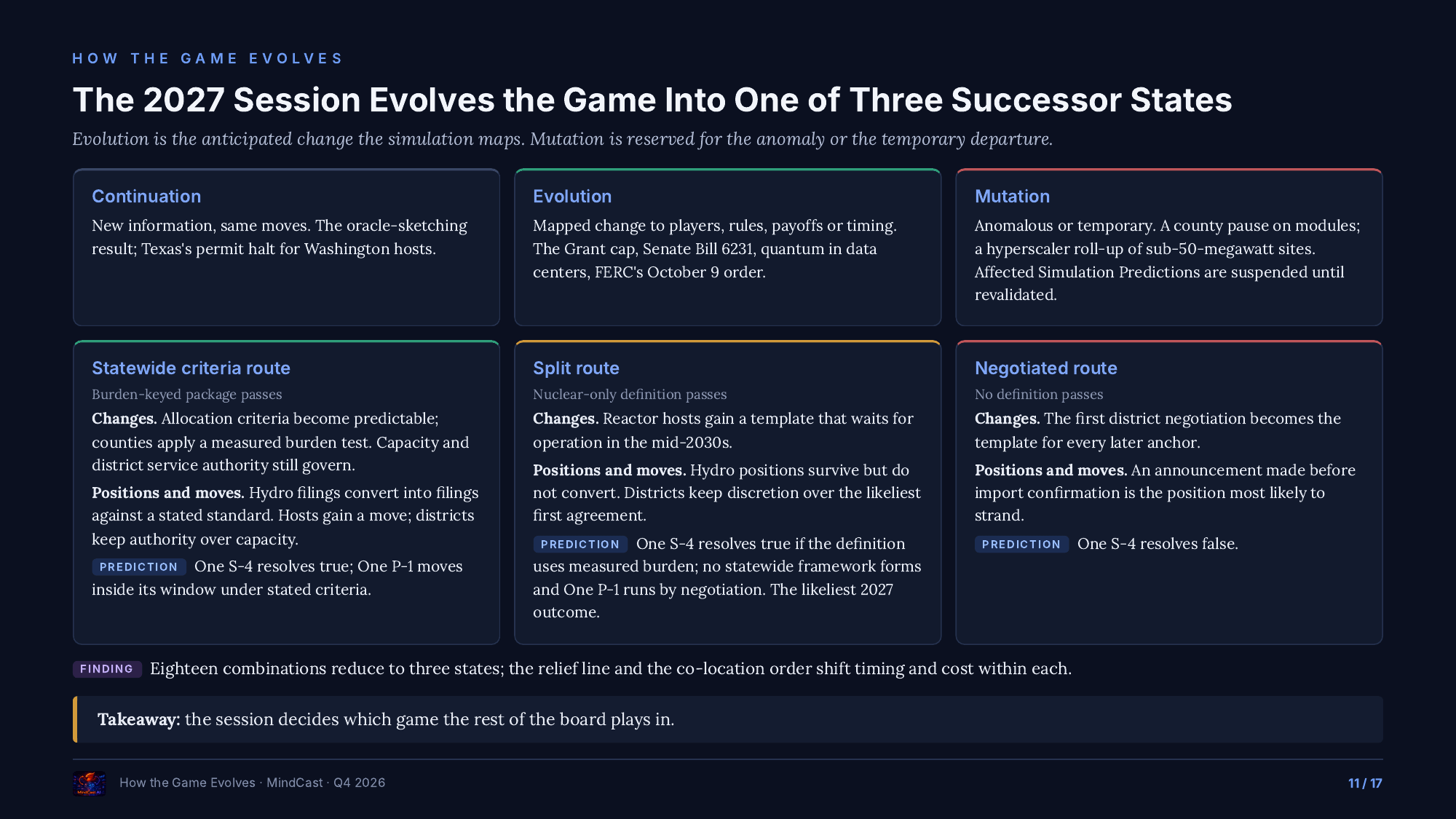
Takeaway. The session decides which game the rest of the board plays in, so a host’s filings before it carry into whichever successor state arrives.
The Board Keeps Only the Distinct States
The session, the relief line and the co-location order produce eighteen combinations on paper. The board keeps three successor states, because the relief line and the co-location order change timing and cost inside each route rather than changing the route.
A relief line that energizes on schedule shortens the wait in every state. A slip moves allocation at Grant to the 2029 line in every state. A FERC order that assigns transmission cost to co-located load triggers the reopener in reactor agreements whichever route the session chose. A playable board maps the reachable states that differ in strategy, not every arithmetic combination.
Takeaway. Three successor states carry the board through 2031, and the remaining forks modify timing and cost within them.
Two Injects Are Mutations, and Four Are Evolution
The Interactive Clean Compute Anchor War Game’s six injects test the board’s response to shocks. Four are evolution of a known type. A Bonneville statement on added load makes allocation criteria more predictable, and a reactor slip past 2034 changes timing. A materials model trained on quantum-computed labels opens the labels channel, and a processor with no cryogenic plant makes local ownership ordinary.
Two are mutations. A county pause on modules at an operating energy site is temporary: label review stalls the accessory-use clock without writing a term, and the game resumes when the pause lifts. A hyperscaler that acquires regional anchor sites below 50 megawatts is anomalous: the customer tier the series models collapses along with the shared-hub route. Under either mutation, the affected Simulation Predictions are suspended until the simulation revalidates them.
Takeaway. Mutation is the exception the board flags, not the default label for change.
What Game Evolution Means for Each Audience
🏛️ Policymakers. The session chooses among three games, not three bills. Only the burden-keyed package gives hydro anchors stated criteria where the first agreement is likeliest. A nuclear-only definition can resolve One S-4 and still leave hydro anchors outside the framework.
💼 Executives. File before the session so the filings convert in the statewide criteria state and survive in the split state. An announcement made before confirmation is the position most likely to be stranded on the negotiated route.
⚖️ Counsel. Draft agreements to read correctly in all three successor states. A co-location reopener and a label-ownership clause carry across every state because they respond to forks that evolve inside each route.
📊 Investors. Underwrite a Washington anchor by successor state rather than by headline. Treat a county pause or a hyperscaler roll-up as a mutation that suspends the affected Simulation Predictions, not as evidence against the route.
Takeaway. The Simulation Predictions hold while the game evolves along mapped paths, and the board shows which state each one belongs to.
V. Five Alternative Moves and How the Board Responds
Each alternative changes one move at one turn and runs the same actors against it. Alternatives carry no band and do not change any Simulation Prediction’s band.
1. Request written import confirmation before announcing.
Turn 3, hydro host. In the simulation, the district studies a load rather than a precedent, and the county later reads a filing with import rights in hand. Changes allocation and accessory use. Cost tier: low, legal and engineering review.
2. File a burden exhibit with the first local filing.
Turn 3, any host. Water, noise and generator hours sit in front of the county before any pause. Changes accessory use. Cost tier: low, measurement and filing.
3. Add a co-location reopener to every reactor-site agreement.
Turn 4, reactor host. A later order resets terms by contract instead of landing on one party. Changes co-location. Cost tier: low, transaction counsel.
4. Negotiate hub access before any island quote and write label ownership into the tenancy.
Turn 3, quantum host. The host keeps its reserved circuit and assigns the output before it exists. Changes quantum tenancy. Cost tier: low to medium, negotiation and counsel.
5. Draft the four instruments as one burden-keyed package.
Turn 4, legislator. Allocation, accessory use and tax classification move together and reach hydro anchors as well as the reactor site. Changes three clocks. Cost tier: medium, session time and coalition.
Two sequencing errors deepen exposure when the simulation runs them against the same actors. Neither describes a documented Washington transaction. An operator agreement announced before import confirmation draws county review as a data center and puts deposits ahead of allocation. An island accepted before a tenant exists carries $3.5 million to $4.5 million a year of fixed cost at 10 to 20 percent utilization.
Takeaway. Played on time, each move changes the evidence and the options at a stated cost; played late, it mostly documents what the host could have done.
VI. Session Filings Before the 2027 Session Are the Exposure Hosts Can Most Readily Move
The session clock is the one most open to conduct now. A working group drafts against the projects in front of it, and Behavioral Economics predicts the committee responds to the salient project, which in Washington is the reactor. A hydro host that files an import request and a burden exhibit before drafting begins puts a second project in front of the committee.
The simulation places a nuclear-only definition as the likeliest 2027 outcome, because the Richland development interest and the backlash against data center proposals near Cle Elum pull the working group in opposite directions. A nuclear-only definition leaves hydro anchors in case-by-case negotiation at the site where the first agreement is likeliest. A burden-keyed definition across generation types reaches all three anchor sources and costs the reactor site nothing.
Installment One carries the band. Washington adopts a definition treating computing equipment at an existing generation facility by measured burden rather than by the data center label by December 31, 2027 at 34–46%. The first anchor agreement at a Washington hydro or nuclear interconnection by December 31, 2028 carries 45–57%.
Under a burden-keyed definition the first agreement runs on stated criteria within available capacity. Without one it runs by negotiation, and the district’s first negotiation sets the terms for every later anchor.
⚖️ Counsel to hosts. Prepare the tax classification analysis for an existing-facility anchor before any bill text circulates, since the remedy differs by which route the anchor falls outside.
Takeaway. The main conduct move still open costs a host a filing now and decides whether the first agreement in Washington runs on stated criteria or by negotiation.
VII. What the War Game Means for Each Seat on the Board
Each seat on the board faces the same first question in its own vocabulary: which authority writes the next term, and has it written yet.
💼 Hydro and geothermal hosts. Allocation is the binding constraint whichever authority acts first. Request written import confirmation before any announcement, file the burden exhibit with the first local filing, and qualify an alternative geothermal or out-of-state hydro site so the district weighs losing the anchor.
💼 Reactor hosts. Federal co-location binds before any state question at a nuclear plant. Add a co-location reopener to every agreement before execution, and firm the first phase on hydro or grid service so capital stages to the construction permit rather than waiting for operation in the mid-2030s.
💼 Quantum hosts and vendors. An island installs in two quarters and a hub needs about six to serve three sites, so an island wins the race whenever a vendor offers placement terms. Negotiate hub access first, keep the reserved circuit, and assign label ownership in the tenancy before any label exists.
🏛️ Lawmakers. The four instruments pass separately or together, and only the package reaches hydro anchors. Draft them as one burden-keyed package and tie the protected-load test to function and recovery time rather than to the quantum label.
📊 Lenders. Allocation and permitting resolve on different dates. Stage funding to the executed allocation agreement at hydro sites and to the construction permit at reactor sites, and underwrite quantum at 10 to 20 percent utilization until a hub serves three sites.
Takeaway. Every seat’s best move follows from dating the authority that writes its next term.
VIII. Competing Hypotheses
Three accounts compete before any fork resolves.
Hypothesis A · Early filings set the terms. Hosts that file import requests and burden exhibits before the session put hydro projects in front of the drafters, and the definition reaches them. Falsifier: a burden-keyed definition passes with no hydro host having filed before drafting.
Hypothesis B · The salient project sets the terms. The working group drafts for the reactor regardless of filings, and hydro anchors negotiate case by case. Falsifier: a statewide definition across generation types passes in 2027.
Hypothesis C · Districts set the terms before the legislature. A district’s first negotiated allocation becomes the template before any definition takes effect. Falsifier: no district executes an anchor agreement before the session’s definitions take effect.
The war game favors Hypothesis B as the base case and shows Hypothesis A as the move that shifts it. Hypothesis C governs wherever the session passes nothing.
Takeaway. The hypotheses differ on who writes first, and each carries a dated falsifier.
IX. MindCast Simulation Predictions
The war game carries seventeen Simulation Predictions from the three installments and adds no new bands. P marks a Primary Simulation Prediction and S a Secondary Simulation Prediction. Seven lead the board.
One P-1 · First anchor agreement at a Washington hydro or nuclear interconnection, first phase under 20 megawatts (45–57%). Window: December 31, 2028. Clock: allocation. Falsifier: no such agreement, or the first one sits above 20 megawatts.
One P-2 · First county decision in the six regions lands on a firm-clean anchor under 20 megawatts (42–54%). Window: December 31, 2029. Clock: accessory use. Falsifier: the first decision concerns a campus or a project above 20 megawatts.
One S-4 · Washington adopts a burden-based definition for computing equipment at generation sites (34–46%). Window: December 31, 2027. Clock: accessory use and allocation. Falsifier: no such definition in statute, rule or ordinance.
Two P-1 · Shared hub serves three sites before a second island installs, given a multi-site research buyer (48–60% given the buyer). Window: December 31, 2031. Clock: quantum tenancy. Falsifier: a second clean-hosted island installs first.
Two P-2 · The first clean-hosted island reports a model trained on its own labels before any energy metric (44–56%). Window: December 31, 2032. Clock: quantum tenancy. Falsifier: the first disclosure reports an energy or capacity metric.
Three P-1 · The first qualifying quantum-improved AI result after October 28, 2026 is a labels result (62–74%). Window: December 31, 2031. Clock: quantum tenancy. Falsifier: the first qualifying result is a sampling or kernel result.
Three S-4 · The first commercial AI service on quantum-produced data runs on shared or remote access (64–76%). Window: December 31, 2033. Clock: quantum tenancy. Falsifier: the first service runs on an operator-owned processor.
The remaining ten carry the bands printed in the installments.
Installment One: S-1 60–72% · S-2 36–48% · S-3 40–52%
Installment Two: S-1 78–88% · S-2 56–68% · S-3 66–78%
Installment Three: P-2 70–82% · S-1 55–67% · S-2 64–76% · S-3 40–52% given authority
Takeaway. Moves, forks and injects change a Simulation Prediction’s status in the war game, never its band.
X. Risk Mitigation Layer
The actions below are analytic options for each audience and not legal, investment or fiduciary advice to any party. Severity and probability run on separate axes.
💼 Hydro host · One P-1 (45–57%).
Exposure: an operator agreement signed before import confirmation carries equipment deposits and quarters of lead time against an allocation that may not arrive. Severity: high. Probability: moderate.
Actions: the development lead requests written import confirmation at module load before any announcement, by the next district board cycle; the commercial lead qualifies an alternative site by mid-2027.
Residual: a district can revise allocation rules after the agreement, and a later phase can trigger restudy.
🏛️ Lawmakers · One S-4 (34–46%).
Exposure: a session that passes no definition, or a nuclear-only one, leaves the first hydro agreement to district negotiation and hands the legislature a precedent it did not write. Severity: moderate. Probability: moderate.
Actions: legislative staff draft the four instruments as one burden-keyed package before the session’s policy cutoff; committee staff request burden data from pending hosts during the interim.
Residual: Bonneville terms sit under federal authority and can override a state definition.
⚖️ Counsel at reactor hosts · One S-3 (40–52%).
Exposure: a reactor-site agreement silent on co-location cost inherits whatever a later order assigns. Severity: high. Probability: moderate.
Actions: transaction counsel adds a co-location reopener before execution; regulatory counsel documents the client’s assessment of the pending docket.
Residual: FERC can adopt terms neither party proposed.
💼 Quantum host · Two P-1 (48–60% given the buyer).
Exposure: an island accepted before joining a hub carries $3.5 million to $4.5 million a year of fixed cost at 10 to 20 percent utilization. Severity: high. Probability: moderate.
Actions: the commercial lead negotiates hub access before accepting any island quote, by the first 2027 hosting cycle; the engineering lead keeps the reserved circuit sized for a later island.
Residual: a vendor’s placement offer can make an island rational for one host and irrational for the region.
📊 Lenders · Two P-1 (48–60% given the buyer).
Exposure: an underwriting case that credits an island with hub-level utilization overstates annual margin by the island’s fixed cost. Severity: moderate. Probability: moderate.
Actions: the credit committee underwrites quantum at 10 to 20 percent utilization until a hub contract with three remote sites exists; the diligence lead requires the hosting agreement’s access terms before closing.
Residual: utilization at the first hub may still fall short.
⚖️ Counsel to hosts and laboratories · Three S-4 (64–76%).
Exposure: a tenancy silent on label ownership assigns the channel’s value by default once buyers take delivery remotely. Severity: moderate. Probability: moderate.
Actions: transaction counsel allocates label ownership, derived-model ownership and publication rights in every access agreement now.
Residual: a federal procurement clause can override contractual allocation for federally funded labels.
Takeaway. Each entry names a move that costs least before its clock’s authority writes and still costs something after.
XI. What to Watch
The dominant fork is the 105-day session that convenes January 11, 2027.
January 11, 2027. The session convenes; bill text on added load, accessory use, tax classification and protected load moves One S-4 and One P-1.
2027. Grant County’s first relief line energizes or slips; headroom under the cap moves One P-1 and One S-2.
Each FERC co-location order. Cost assignment at nuclear plants moves One S-3 and the reactor route.
December 31, 2027. One S-4 resolves against statutes, rules and ordinances.
December 31, 2028. One P-1 and One S-2 resolve against district minutes and operator releases.
The first clean-hosted quantum installation. Hub or island decides Two P-1, given a multi-site buyer.
Takeaway. The session week is the dominant fork, and a host’s filings before it decide whether the hydro anchor is in front of the drafters.
XII. Conclusion
The war game’s dating discipline returns one answer at every seat: move before the authority that writes your next term has written it. A district cap and a tax statute closed two routes before any regional anchor filed. No host could have reopened either one afterward.
The counterfactual for hosts is the same import request filed in a different order. Filed before an announcement, it lets a district study a load and a county read a measured filing. Filed after, it rides on deposits and a salient headline. The session that convenes January 11, 2027 is the next authority to write, and the filings a host makes before it are the move the board shows is still open.
Working With MindCast
A commissioned war game dates the client’s own clocks, then plays the client’s moves against the same Cognitive Digital Twins. A hydro host learns which district and county terms its filings can still shape. A reactor host learns how its agreements read under each co-location outcome. A quantum host learns whether its region forms a hub or islands, and a lender learns which gates its capital should wait for.
Play the war game: the Interactive Clean Compute Anchor War Game runs Historical Replay, Counterfactual Play and Future Evolution. Readers take a seat, decide the session and the 2027 to 2031 forks and drop up to six injects onto the board. The Clean Compute Anchor War Game Executive Deck carries the board, the turns and the successor states in seventeen slides.
A complimentary pilot runs on public filings before any retainer. Contact mcai@mindcast-ai.com or visit www.mindcast-ai-simulation.com.
Appendix A. Selected MindCast Works
Clean Compute Anchor War Game Executive Deck. Carries the five-exposure board, the six turns, the three successor states and the five alternative moves in seventeen slides for a reader with ten minutes.
Interactive Clean Compute Anchor War Game. Runs the paper’s moves as play: the reader takes one of five seats, decides the 2027 to 2031 forks and watches the board and the Simulation Prediction statuses respond.
Regional Clean Compute Anchors, How Much Compute Each Clean Energy Source Yields and Where Washington Builds the First One (Installment One). Supplies the allocation, accessory-use, tax and co-location clocks and the four session instruments the board plays.
What Quantum Computing Contributes to Clean Compute Clusters, Tenant First, Training Data Second and Not the Processor Through 2032 (Installment Two). Supplies the hub-or-island race, the installation-speed asymmetry and the quantum host’s fixed cost.
How Quantum Computing Can Improve AI: Five Applications, Their Commercial Potential, and the Limits of Quantum Advantage (Installment Three). Supplies the label-ownership clause and the remote-delivery finding that separates product demand from island demand.
Regional Clean Compute Anchors, Quantum Tenancy and Quantum-Labeled Training Data: One Summary of the Three Clean Compute Anchor Installments. Supplies the seventeen Simulation Predictions the war game carries in one place.
AI Chip Export Enforcement War Game Shows When Verification Protects US Firms and When It Arrives Too Late. Supplies the war-game method this paper applies: dated clocks, replayed turns and alternatives that carry no band.
The Data Center Authorization Market: A 50-State Regulatory Atlas. Supplies the state evidence behind the accessory-use and allocation clocks.
The Model Data Center Authorization Code. Supplies the common language for the burden-keyed definition the legislator seat drafts.
Appendix B. Sources
Energy Northwest and X-energy. Cascade Advanced Energy Facility, with Amazon investment announced October 2024. Turn 1.
Duke University Nicholas Institute. Rethinking Load Growth. February 2025. Turn 1.
Grant County Public Utility District. Data center load cap, April 2025, as reported by GovTech. Turns 1 and 6.
Zhao and co-authors. Exponential Quantum Advantage in Processing Massive Classical Data. arXiv, April 2026. Turn 2.
Washington State Legislature. Senate Bill 6231, 2026. Turn 2.
Business Wire. Energy Vault Breaks Ground on Powered AI Infrastructure Campus in Snyder, Texas. July 27, 2026. Turn 2.
Equinix. Diraq and Equinix to Deploy Australia’s First Quantum Computer Inside a Data Centre. September 1, 2026. Turn 3.
Holland & Knight. Texas governor halts data center environmental permitting. September 2026. Turn 3.
IonQ. IonQ to Advance Quantum Supercomputing by Bringing First QPU to NVIDIA Accelerated Quantum Research Center. September 23, 2026. Turn 3.
DARPA. Four More Teams Enter Quantum Benchmarking Initiative Final Stage. October 7, 2026. Turn 4.
FERC. Order of October 9, 2026 in Docket ER26-3515. Turn 4.
Washington State Legislature. Session calendar. Turn 5.