
Snap · OpenAI · Google · West Virginia · Utah · New Mexico · Florida · Texas · Pennsylvania · Nevada · UK Information Commissioner · Federal Trade Commission
Related works · OpenAI State Attorney General Lawsuits — Two Pleading Templates Across Ten State Courts Decide Which Game Theory Evolution Arrives First · Interactive OpenAI Liability War Game · Agentic AI Liability and Insurance Exclusions — How Coverage Redirects Who Gets Sued · Agentic Foreseeability and the Modern Duty of Care for AI Agents · AI Accountability — When AI Promises Meet the Courts
Live tracker · AI Enforcement and Litigation Tracker follows federal, state and private AI actions and rates nine common law doctrines as expanding, narrowing or shifting.
Thesis. A chatbot supplier’s published safety warning is weak proof of what its business customer knew. West Virginia’s lawsuit against Snap already holds stronger evidence: Snap’s own launch warning, plus outside tests that show the alleged risk in use. Snap staged My AI over 51 days between its February 27 subscriber launch and the April 19, 2023 rollout to every user. OpenAI’s March 14 warning arrived with 36 of those days left, and the case will turn on what Snap changed in them.
Why now. Among the eight state actions against Snap reviewed for the parent paper, West Virginia alone cites a model supplier’s published limits as notice. Counsel defending artificial intelligence (AI) deployers, state enforcers, insurers writing technology risk and investors in consumer apps built on third-party models face the same question in their own files.
Executive Summary — A Supplier’s Warning Dates the Question, and Snap’s Own Words Answer It
Core insight. West Virginia’s complaint rests Snap’s knowledge on three sources. OpenAI’s technical report identifies a model-family risk, Snap’s February 27, 2023 post shows awareness of hallucination and the reported teen tests show how My AI allegedly failed in use. Knowledge bears on the state’s omission allegations and on whether any violations were repeated and willful enough for civil penalties.
Simulation Predictions. The paper states one MindCast Foresight Simulation Prediction and carries one from the parent paper, for a forecast set of two. P-1 (90%): No qualifying Kanawha County order will treat OpenAI’s March 14 or March 27, 2023 publications alone as sufficient to establish Snap’s knowledge for the issue and stage decided. Window: through December 31, 2027. S-1 (70-90%), from the parent paper: OpenAI remains outside all eight attorney general actions against Snap through December 31, 2027.
What distinguishes MindCast. MindCast AI applies Predictive Behavioral Economics + Dynamic Game Theory through MindCast AI Proprietary Cognitive Digital Twin Foresight Simulations (MP CDT FS). Behavioral Economics supplies the decision rules. Game Theory supplies the payoff structure. Predictive simulations emerge from the combination.
How the method reads this case. Behavioral economics explains why Snap’s own February 27 words dominate: they are the most salient proof of knowledge, so the state and the court reach for them first. Game theory explains two pulls toward a narrow outcome. A trial court prefers the narrowest ground that resolves a motion, and Meta’s per-state framework rewards West Virginia for a negotiated Snap commitment. Behavioral economics and game theory both point away from a broad rule about supplier warnings.
How the paper proceeds. Section I maps the 51 days between Snap’s subscriber launch and its rollout to every user. Sections II through IV set out the parties, the chain of proof and how each event changed the game. Section V frames four competing outcomes and states the Simulation Predictions. Sections VI through IX cover strategy, mitigation, the signals to watch and the conclusion.
🏛️ Policymakers: No statute or rule cited in the complaint says which supplier warnings a deployer must review before serving minors.
💼 Executives: A disclaimer documents a risk without changing the product; dated product changes are what defend a launch.
⚖️ Counsel: Snap’s own disclaimer already shows general knowledge, so proof of receipt decides only what OpenAI’s warning adds. Discovery will center on Snap’s launch approvals and release logs between April 4 and April 19, 2023.
📊 Investors: A single county order binds one case, yet its reasoning can travel to every state with a pending consumer protection action.
🛡 Insurers: No court has yet ruled on coverage for the attorney general cases against Snap. Pleaded knowledge facts will frame a carrier’s deliberate-conduct argument on the duty to defend, and discovery into Snap’s April 2023 safeguards will shape indemnity later.
🧠 Model providers: A supplier’s clear warning can protect the supplier while exposing its customer.
I. Snap Had 51 Days and Six Open Decisions Before Expanding My AI to Every User
The window. Snap released My AI to Snapchat+ subscribers on February 27, 2023 and to all users on April 19, 2023. OpenAI announced GPT-4 on March 14 and first posted its “GPT-4 Technical Report” (2023) on March 15, inside that window. Treating the subscriber launch and the broad rollout as one event would erase the interval in which Snap could still change the product.
Announced versus verified. Snap’s public posts establish what the company said it had done or intended to do. Deployment logs and youth-specific tests would establish what reached users and what it caught.
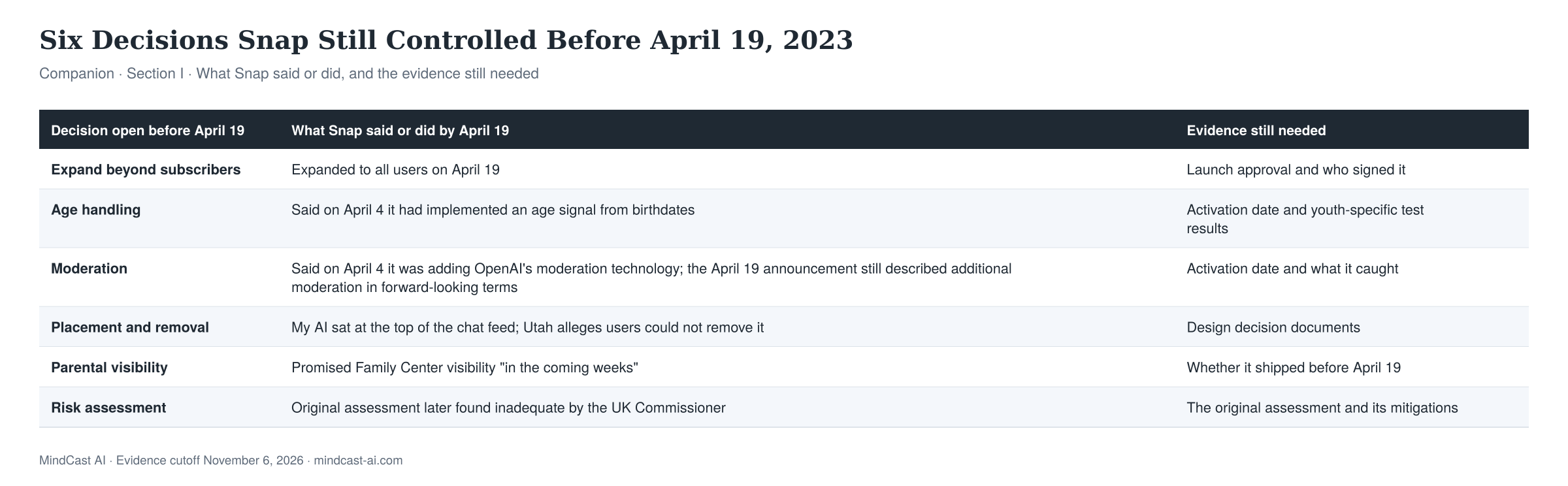
The open decisions. Between the two launches Snap could hold My AI to subscribers or expand it to every user. Snap still controlled placement, removal options, age handling and moderation.
The figure sets each open decision against what Snap said or did by April 19 and the evidence still needed.
The timeline. Each dated event below carries its bearing on the knowledge question.
Feb 27, 2023. My AI launches to Snapchat+; Snap warns users the bot is “prone to hallucination and can be tricked into saying just about anything”. Bearing: Snap’s own words, before any GPT-4 document.
Mar 1, 2023. OpenAI announces its ChatGPT application programming interface (API) and names My AI as running on the GPT-3.5 model (page since updated April 24, 2024). Bearing: Model fit; a public link between supplier and deployer.
Mar 10, 2023. Center for Humane Technology founders test My AI with a user posing as 13 (complaint ¶¶155–156). Bearing: Third-party notice of a teen-specific failure.
Mar 14, 2023. OpenAI announces GPT-4 and publishes its limitations page; the Washington Post publishes “Snapchat tried to make a safe AI. It chats with me about booze and sex.” (2023). Bearing: Supplier warning and press test land the same day.
Mar 15 and 27, 2023. First and third versions of the “GPT-4 Technical Report” post on arXiv. Bearing: The complaint cites the March 27 version at footnote 137.
Apr 4, 2023. Snap says it has implemented an age signal, is adding OpenAI moderation technology and plans Family Center visibility. Bearing: Snap’s announced response before rollout.
Apr 19, 2023. My AI reaches all Snapchat users; Snap’s announcement lists additional moderation technology. Bearing: The decision the knowledge question tests.
Jun 2023 to May 2024. The UK Information Commissioner opens an inquiry, issues a preliminary notice on October 6, 2023 and accepts a revised risk assessment. Bearing: Snap’s original assessment fell short before launch.
Sep 24, 2024. Snap announces that Google’s Gemini powers generative AI in My AI. Bearing: A second model supplier enters the period the state challenges.
Jan 16, 2025. The Federal Trade Commission (FTC) refers a complaint about My AI to the Justice Department. Bearing: Federal track stays open.
Jul 22, 2026. Snap removes Arkansas’s case to federal court. Bearing: Removal is an available delay move.
Sep 23, 2026. Snap removes Pennsylvania’s case (E.D. Pa. No. 2:26-cv-07313); no remand ruling yet. Bearing:Remand timing sets how long removal delays an order.
Oct 14, 2026. The Eleventh Circuit reverses the denial of remand in Florida’s case. Bearing: An appeal can hold a state case in federal court for many months.
Nov 5, 2026. West Virginia sues Snap in one consumer protection count; footnotes 137–138 cite OpenAI’s publications beside Snap’s February 27 post. Bearing: The allegation this paper tests.
What OpenAI published. The “GPT-4 Technical Report” states that the model has similar limitations to earlier GPT models, including hallucination, and that outputs need care where reliability matters. Footnote 138 cites OpenAI’s March 14 announcement page, which added that GPT-4 poses risks like those of previous models such as harmful advice.
What Snap had already said and done. Snap’s February 27 post told users to treat My AI’s answers with caution and not to depend on it for advice. Utah’s complaint, unredacted in part after a subpoena, quotes senior engineering managers calling the rollout reckless because of insufficient testing. The UK Commissioner later found that Snap’s original risk assessment fell short before launch.
Known from public filings and statements.
Snap disclaimed hallucination and manipulation risk on February 27, 2023.
OpenAI named My AI as a GPT-3.5 customer on March 1, 2023.
OpenAI’s report ties GPT-4’s limits to earlier models.
Snap’s April 4 post reports an implemented age signal.
Utah obtained internal Snap communications by subpoena.
Unknown but discoverable.
When OpenAI’s moderation tooling went live in My AI.
Which model served My AI on April 19, 2023.
What OpenAI shared with Snap before March 14.
What Snap’s launch approvals between April 4 and April 19 show.
Whether West Virginia can obtain Utah’s materials.
Unknowable until the parties act.
How the court weighs OpenAI’s publications.
Whether Snap defends its response or contests the warning.
Whether any state subpoenas OpenAI in a Snap case.
Whether discovery reaches OpenAI’s role in the launch.
Whether the Nevada and New Mexico trials proceed in August 2027.
Evidence gaps. The response file is the largest gap: when the age signal and moderation went live, what youth-specific tests showed and who approved the rollout.
What it means.
⚖️ Counsel: The April 4 post converts Snap’s defense from denial into a response that requires proof of execution, so release logs become the decisive documents.
🏛️ Policymakers: Six product decisions sat open after the supplier warning, which gives enforcers a concrete response standard to test.
Section takeaway. The case tests six choices Snap made in a 51-day window, not a single launch date.
II. Seven Parties Shape the Knowledge Question, and Snap and OpenAI Pull in Opposite Directions
Who decides. The Kanawha County court decides how much weight a supplier’s publication carries. The West Virginia Attorney General (AG) chooses which proof to lead with. Snap chooses whether to defend its response or contest the warning, and OpenAI chooses how much to say about its customer. Inside Snap, the people who could delay the rollout form a separate party from the company’s litigators.
West Virginia AG. Pleading, discovery, remedy demands.
Interest on the knowledge question: Plead knowledge from three sources and prove willfulness.
Constraint: The separate West Virginia case against OpenAI challenges OpenAI’s safety statements.
Snap. Response and contest arguments.
Interest on the knowledge question: Defend representations and the April 4 measures.
Constraint: Its own February 27 disclaimer sits in footnote 138.
Snap product and safety owners. Release authority, safeguard configuration and sign-off.
Interest on the knowledge question: Show the April 4 measures reached the product before April 19.
Constraint: Release and safety review may sit with different people.
OpenAI. OpenAI’s documents and any testimony.
Interest on the knowledge question: Show it warned clearly and stay out of Snap’s cases.
Constraint: Its moderation tooling sits inside Snap’s response.
Kanawha County court. Weight given to publication.
Interest on the knowledge question: Decide the deception count, with or without reaching the supplier warning.
Constraint: First court to see this theory against Snap.
Other states suing Snap. Their own pleadings and shared discovery.
Interest on the knowledge question: Reuse West Virginia’s theory or rely on internal documents.
Constraint: Different statutes and trial dates.
UK Commissioner and FTC. Regulatory findings and referrals.
Interest on the knowledge question: Outside the state cases.
Constraint: Findings become evidence.
The parent paper. State Attorneys General Sue Snap, Not OpenAI, Over My AI — West Virginia Cites OpenAI’s Published GPT-4 Limits to Allege Notice Before the Public Rollout maps all eight state cases against Snap. The parent paper’s eight-state review shows West Virginia alone pleads OpenAI’s published limits as notice, so Kanawha County is the first court among those eight cases to test the theory.
West Virginia’s two cases. West Virginia sued OpenAI in October 2026 as one of eight states alleging deceptive practices over ChatGPT safety. In that case the state needs OpenAI’s warnings to look incomplete or contradicted by its marketing. In the Snap case the same warnings must look clear enough to put Snap on notice. Both positions can stand together, yet one available argument for each defendant helps the state against the other.
Crossed incentives. Snap gains by calling OpenAI’s warnings generic, and that argument feeds the failure-to-warn theory against OpenAI. OpenAI gains by calling its warnings specific, and that argument feeds the notice theory against Snap. Public evidence has not yet tested whether each defendant will avoid the argument that hurts the other. The analysis tests whether outcomes emerge from each party’s incentives and conduct; it attributes no intent.
What product liability law already shows. Product liability law lets a supplier’s warning work on two parties at once. Under the sophisticated-user defense, adopted in California in Johnson v. American Standard (2008), a supplier owes no warning about dangers a trained user knew or should have known. The same “should have known” knowledge that discharges the supplier is what a state needs to charge the user. The parallel holds for knowledge only, because the defense governs a supplier’s duty in tort while West Virginia’s count turns on Snap’s own representations.
Common law doctrines in play. West Virginia pleads a statute, but the knowledge question it raises is a common law question. MindCast’s AI Enforcement and Litigation Tracker rates imputed knowledge as an expanding doctrine: agent logs no one reads may still count as company notice. West Virginia’s theory turns the same doctrine upstream and treats a supplier’s published limits as notice to the deployer. P-1 holds that the court will not stretch imputed knowledge that far on publication alone.
Where the common law exposure sits. Voluntary undertaking fits Snap’s April 4 post most closely, because a company that announces a safeguard must carry it out with care. Products liability and negligent misrepresentation reach the same facts through Garcia and Moffatt v. Air Canada. Res ipsa loquitur runs the other way: split control among OpenAI, Google and Snap can defeat the inference of negligence. Private bodily-injury suits carry these doctrines, so the April 2023 safeguard record reaches the claims Snap’s carriers contest.
What it means.
🧠 Model providers: OpenAI’s strongest defense in its own case strengthens the state’s knowledge claim against its customer.
📊 Investors: The two defendants share a product history but not a litigation interest, so joint defense economics cannot be assumed.
Section takeaway. The internal launch owners hold the facts both defendants need, and neither defendant controls how those facts read.
III. West Virginia’s Proof Runs Through Snap’s Response, and Launch Authority Is a Separate Question
Two lines of inquiry. The state’s proof runs in one chain from publication through applicability, receipt and response to violation and penalty. A separate question asks who held launch authority over My AI. Discovery can open that question before any ruling, so the paper treats it separately.
Step 1. OpenAI Published Its Limits After Snap Had Already Warned Users
How the complaint uses the warning. The three sources named in the executive summary support the same allegation: Snap’s safety and age-awareness representations misled users and parents (complaint ¶¶241–245).
Publication date. OpenAI’s GPT-4 announcement came 15 days after Snap’s soft launch. As proof that Snap knew chatbots hallucinate and can be manipulated, the report adds nothing that Snap’s own post had not already said. The date matters for a narrower claim: by March 14 the supplier of Snap’s model had published that its newest model still failed in the ways Snap’s early users were reporting.
Step 2. The Warning Fits My AI’s Model Family but Proves No Receipt
Model fit. My AI ran on GPT-3.5 at launch according to OpenAI’s API announcement, while West Virginia cites limits published for GPT-4. The report narrows that gap by stating that GPT-4 shares the limits of earlier GPT models. A model-fit defense therefore runs into the supplier’s own words. The stronger argument concerns specificity: the report says nothing about teen users or a chatbot persona inside a messaging app.
Receipt. Publication on OpenAI’s site does not prove that anyone at Snap read the report. OpenAI’s API announcement shows the companies were working together publicly, which makes receipt plausible without proving it. Proof would come from Snap’s files: emails circulating the report, briefings from OpenAI or references in the launch approvals.
Step 3. Snap’s Response Is the Contested Ground
Three signals, one decision. Three signals became publicly available before April 19: Snap’s April 4 account of its early review, the outside teen tests of March 10 and March 14 and OpenAI’s GPT-4 disclosures. Snap’s April 4 post attributes its changes to what it learned from early interactions. The announced changes, an age signal and moderation technology, appear to answer the failures the teen tests exposed rather than the limits OpenAI published.
Known versus to be proven. Snap demonstrably knew what its own posts state: the February 27 warning and the April 4 account of early interactions. Whether Snap’s launch team saw the teen tests or OpenAI’s disclosures is what discovery must establish.
A hypothesis to test. Hallucination, the limit at the center of footnote 138, drew no announced engineering change before rollout; Snap’s public statements leave it to the February 27 disclaimer. If deployment evidence confirms that split, teen-specific failures drew product changes while the supplier-published risk drew a warning label. Release logs and youth-specific test results decide whether the announced safeguards reached users and what they caught.
OpenAI inside the response. Snap’s April 4 post said it was adding OpenAI’s moderation technology. Supplier technology thus sits inside the very response the state will test. Snap’s release logs are the direct proof of whether that technology was live and working on April 19.
Steps 4 and 5. Knowledge Shapes Both the Violation and the Penalty
Violation first, penalty second. The state must first establish the challenged acts or practices under the consumer protection act. Knowledge matters to the merits where the state alleges omissions, since § 46A-6-102(7)(M) reaches concealment or omission of material facts with intent that others rely on it. Knowledge matters again at the penalty stage, where the court may assess up to $5,000 per violation for a course of repeated and willful violations. The supplier warning can inform both questions without deciding either.
A second supplier in the challenged period. The complaint’s My AI allegations run into 2026: location data (¶170), privacy notices effective in July and September 2026 (¶¶174, 177) and current Family Center controls (¶192). Snap announced in September 2024 that Google’s Gemini powers generative AI in My AI, and the complaint cites a January 2025 FTC report on content sent to OpenAI (¶176). The complaint names OpenAI and Microsoft Advertising as recipients of My AI data and never mentions Google. A penalty course running from 2023 into 2026 therefore crosses two suppliers’ published limits, and the data-recipient allegations raise a discoverable question about Google’s role.
Representations against knowledge. The complaint’s deceptive-practice allegations line up against what Snap had said and what was public before each representation reached users.
The figure sets each challenged representation against what Snap had said or what was public by April 19, 2023.
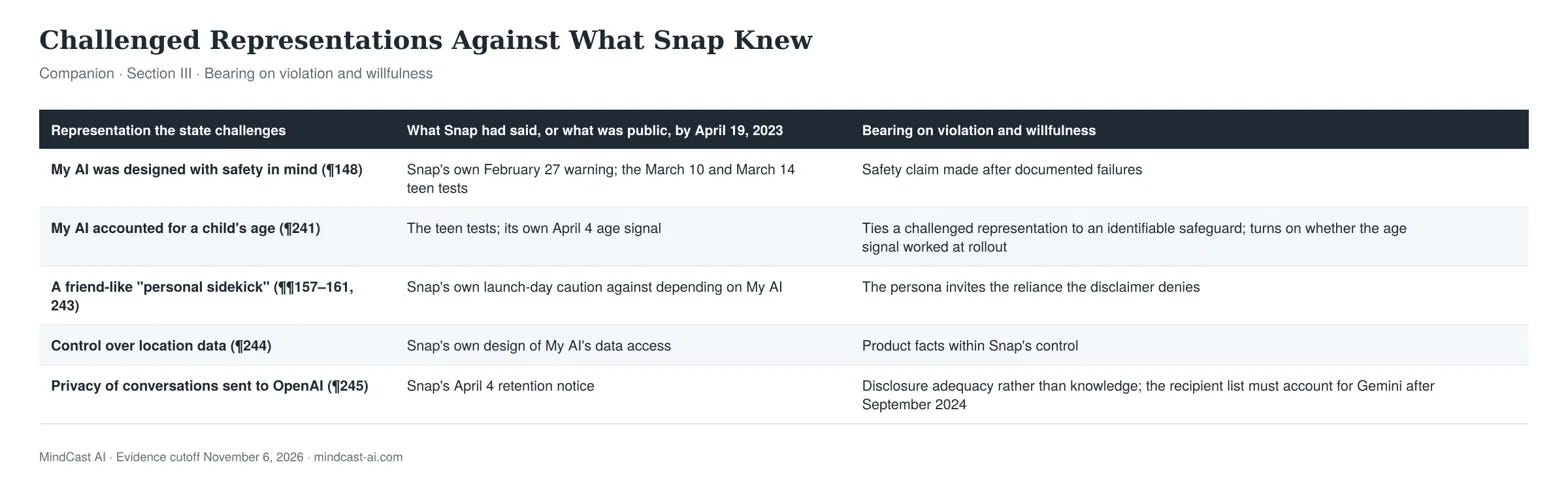
What the comparison shows. The supplier warning supports the first and third rows, where a known model limit sits beside a safety or friendship claim. The age-awareness row ties a challenged representation to a safeguard Snap said it had built, and the persona row sets a disclaimer against a product built to earn a teen’s trust.
The Court Can Weigh the Warning Four Ways
The four outcomes. The first order on knowledge can take one of four forms, labeled A through D. Section V assigns each its band.
A. Publication credited. Expressly treats OpenAI’s dated publications as sufficient for the issue and stage it decides.
Observable test: Order sustaining the knowledge allegations on footnote 137 or 138 without deployer-side facts.
Effect on Snap: Receipt and model fit fall away at that stage; the response defense remains.
B. Deployment link required. Requires receipt, model fit or a connection to Snap’s launch.
Observable test: Order requiring the state to plead what Snap received, reviewed or deployed.
Effect on Snap: The state leans on Snap’s own post, the teen tests and internal documents.
C. Decided on other grounds. Relies on Snap’s own evidence or representations, or the case resolves without a ruling on the warning.
Observable test: Order or agreement silent on what the supplier warning proves.
Effect on Snap: The warning’s weight stays undecided into discovery.
D. No qualifying order. Issues no substantive order on knowledge by December 31, 2027.
Observable test: Docket shows no such order by the deadline.
Effect on Snap: The question stays open.
Why outcome B costs the state little. West Virginia does not need the GPT-4 report to plead knowledge: Snap’s own post establishes generic knowledge, and the outside tests show the alleged risk in use. Internal documents must connect those tests to Snap’s launch decision, so a court that requires a deployment link sends the state to stronger evidence rather than ending the theory.
Who Held Launch Authority May Affect Whether a Participation Claim Becomes Pleadable
When the question opens. The question arises only when discovery reaches the Snap–OpenAI relationship, which can happen before any ruling on knowledge. Snap’s launch post describes My AI as running OpenAI’s GPT technology customized for Snapchat, and the April 4 post adds OpenAI’s moderation tooling. The first test is who could approve, configure, test or delay a specific safeguard or release.
The second figure sets out three launch outcomes: ordinary supply, deeper participation and a publicly indeterminate record.

Two comparators. Garcia v. Character Technologies offers a pleading-stage comparator on its own facts and law: the Florida federal court in May 2025 let component-part claims against Google proceed on allegations of substantial participation in integration. Google has supplied a My AI model since September 2024, so the comparator now reaches both of Snap’s suppliers. FoloToy marks the other end: OpenAI suspended the toy maker’s access in November 2025, yet a consumer group later found the toy still appeared to run on OpenAI models.
No band on the launch question. The public docket may never show who held launch authority, and the question has no fixed calendar date. Any document or witness identifying who approved the release would reopen it.
What it means.
⚖️ Counsel: The age-awareness allegation ties a representation to a named safeguard, which makes activation dates the first discovery fight.
🛡 Insurers: Proof that a safeguard was announced but not live at rollout strengthens a deliberate-conduct reading when carriers contest indemnity.
Section takeaway. The supplier warning does its work at publication; response and willfulness turn on Snap’s own files.
IV. Game Evolution — The April 19 Rollout Turned Warning Evidence Into a Response Question
How the game changed. Each event from February 27, 2023 forward either updated the game, moved it to a new resting point or changed its rules. P-1 holds only while the litigation stays inside the game mapped here. Every event carries one of three labels.
Continuation: the event updates information or odds inside the same game.
Equilibrium migration: the event changes which outcome persists without replacing the game.
Game evolution: the event changes strategies or payoffs, the rules or players, or consequential timing.
Game mutation is reserved for an anomaly that changes the rules beyond one case: appellate adoption, codification or repeated interstate replication. No reachable stage in this paper meets that bar, so court outcome A is classed as game evolution.
Snap’s Knowledge and Response
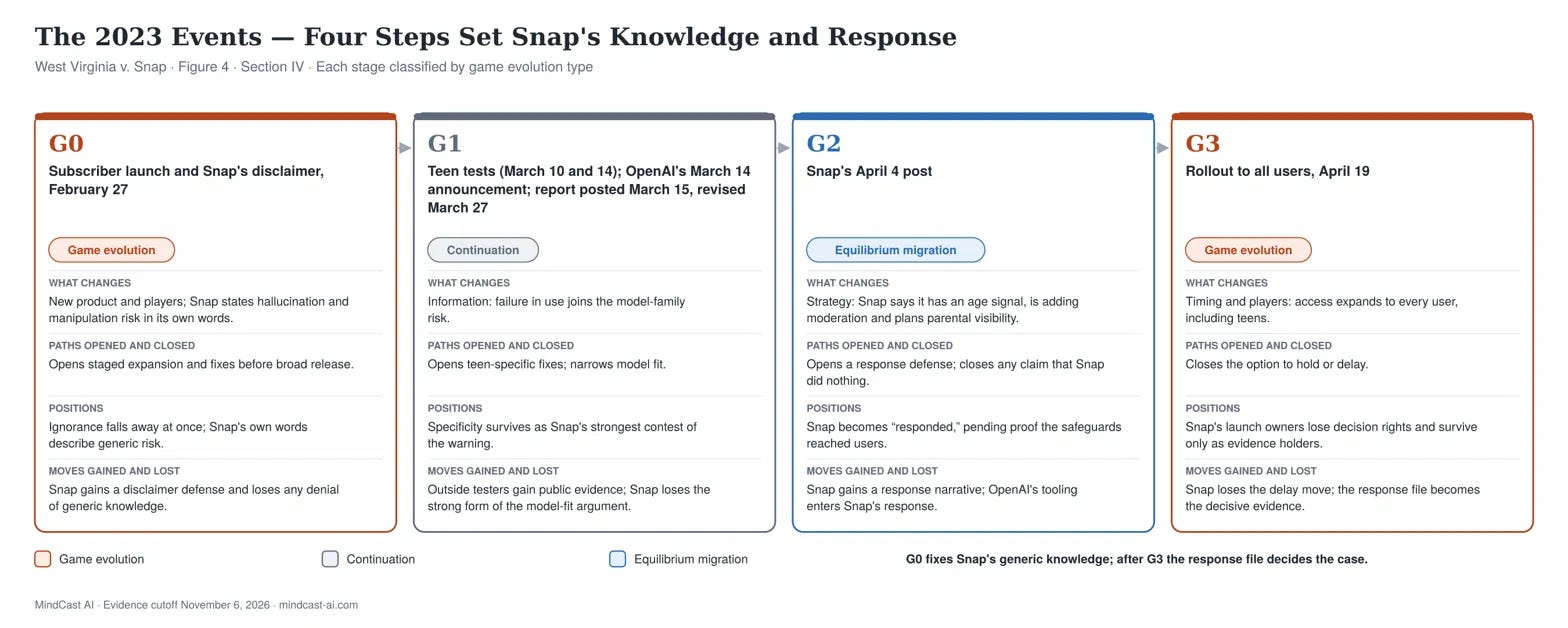
The 2023 stages carry no successor questions because they are fixed history. Each passes its positions to the next stage, and G3 passes them to the litigation.
The Litigation, 2026 Forward
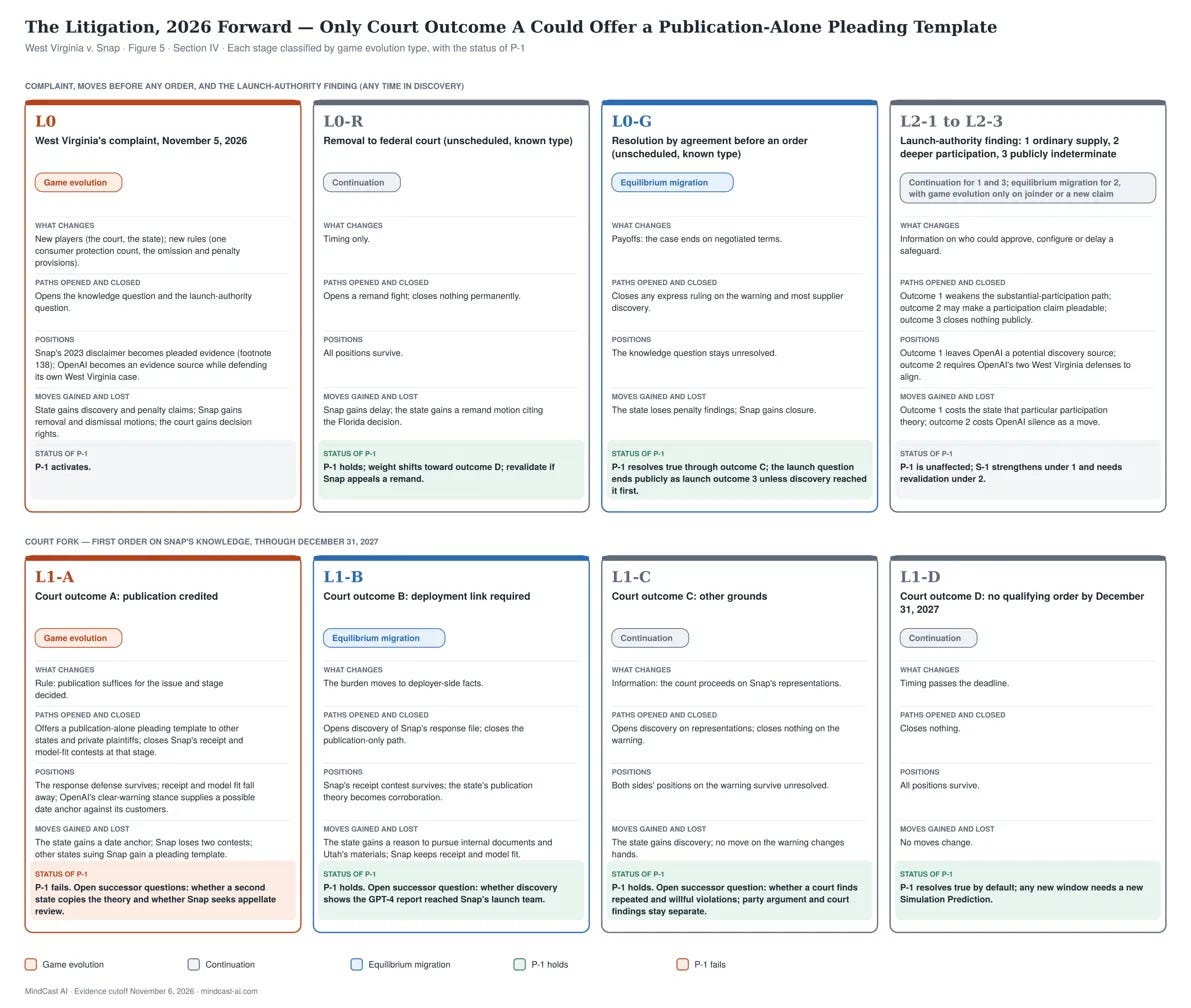
Two Forks Stay Separate, and One Pairing Matters Most
Two forks, not one grid. The figure maps both forks across the short and long horizons. The court fork holds four outcomes, A through D. The launch fork holds outcomes 1 through 3 and stays contingent: supplier discovery can open it before any knowledge order, including inside outcome D.
The two forks combine into twelve pairings, and all remain reachable.
Resolution by agreement offers one route into C-3 (court outcome C with launch outcome 3) and eliminates no other pairing.
A-2, court outcome A with launch outcome 2, carries the greatest consequence.
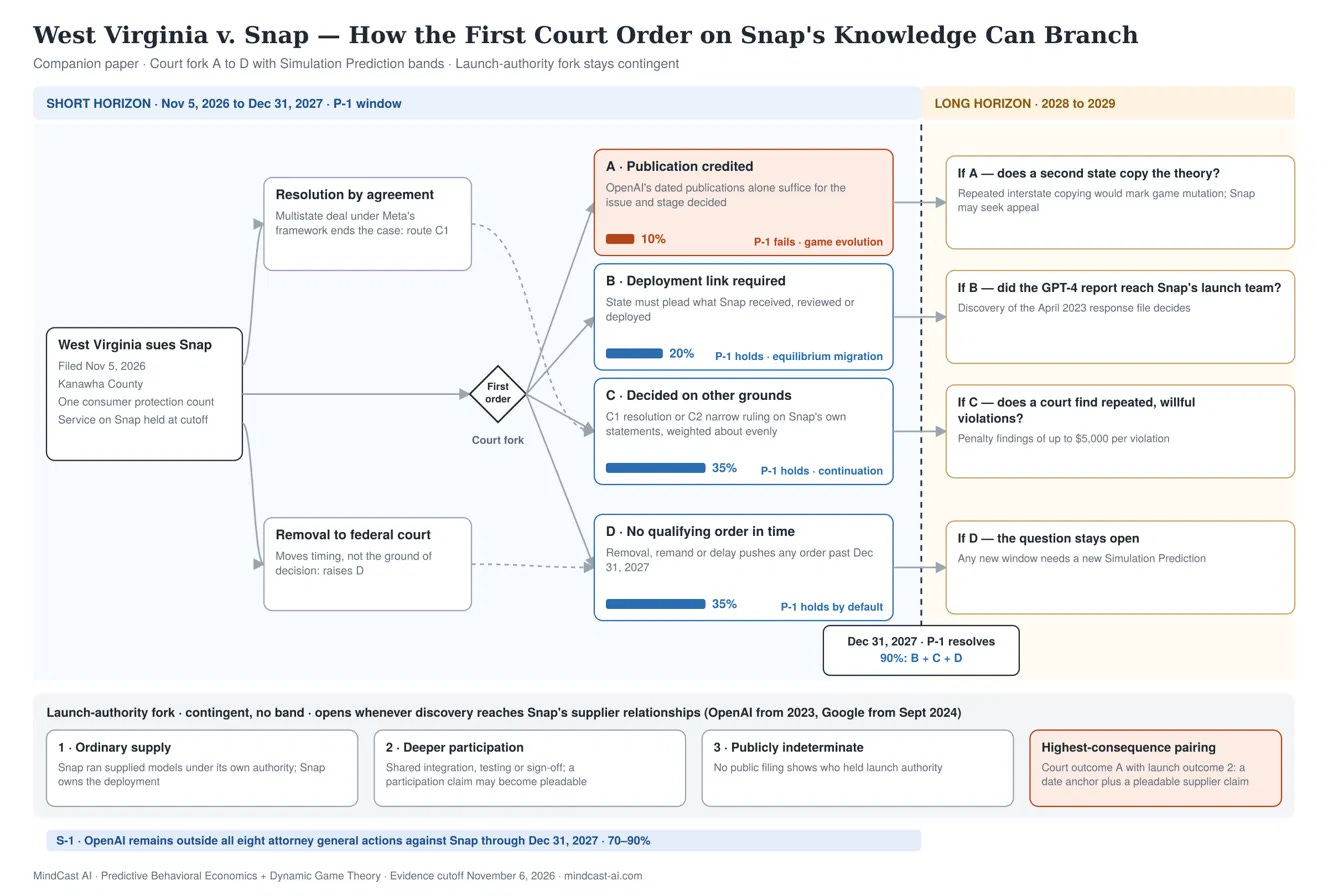
The pairing that changes the most. A-2 would supply a date anchor for this issue and may make a participation claim against OpenAI pleadable at the same time. Both are tails, so any move toward that pairing is the signal that most changes the case for deployers and model providers alike.
What moves the odds. Two unknowns matter most: the model My AI ran on April 19 and the launch approval documents. The model barely moves the knowledge question, because OpenAI’s report says GPT-4 shares earlier models’ limits. The approval documents provide the most direct evidence on the launch question.
What stays a hypothesis. The crossed incentives in Section II and the response pattern in Section III remain untested by public evidence. Neither carries a band.
What it means.
📊 Investors: Only outcome A could offer a publication-alone pleading template. Outcome B would reinforce the need for deployer-specific linkage, while C and D leave the warning’s legal weight unresolved.
🏛️ Policymakers: A rule on supplier warnings is likelier to come from a legislature than from this court, because the court has narrower paths available.
Section takeaway. Every litigation stage inherits the April 19 conversion of warning evidence into a response question, and only court outcome A could offer a publication-alone pleading template, while outcome B would reinforce a deployer-link requirement.
V. MindCast Simulation Predictions — No Qualifying Order Will Treat OpenAI’s Publications Alone as Sufficient
One new Simulation Prediction and one carried from the parent paper. P-1 and S-1 follow the P and S convention: P for Primary Simulation Prediction and S for Secondary Simulation Prediction. P-1 is new to this paper, and S-1 appears verbatim from the parent paper. Section IV lists open successor questions; none carries a band.
Method note. The simulation modeled four principal Cognitive Digital Twins (CDTs): West Virginia, Snap, OpenAI and the Kanawha County court.
Four Competing Hypotheses
Hypothesis A: publication suffices. The court treats OpenAI’s dated public limits as enough to charge Snap with knowledge for the issue it decides. Falsifier: any order on knowledge that requires receipt, model fit or Snap-side facts.
Hypothesis B: a deployment link is required. The court demands proof that the warning reached Snap or fit the deployed model. Falsifier: an order that credits publication alone or never reaches the warning.
Hypothesis C: the court decides on other grounds. The count rests on Snap’s own representations and evidence, or the case resolves by agreement, without any ruling on the warning. Falsifier: an order that expressly weighs the supplier warning.
Hypothesis D: no qualifying order arrives in time. Removal, appeal or ordinary delay keeps any substantive order on knowledge past December 31, 2027. Falsifier: a substantive order on knowledge by that date.
P-1
P-1. No qualifying Kanawha County order will treat OpenAI’s March 14 or March 27, 2023 publications alone as sufficient to establish Snap’s knowledge for the issue and stage decided (90%). Window: through December 31, 2027. Falsifier: a qualifying order expressly treats the March 14 or March 27 publication alone as sufficient for Snap’s knowledge without receipt, model fit, deployer-side statements or a connection to the launch. Resolution source: the Kanawha County docket (CC-20-2026-C-1339) and its filed orders, plus any federal removal docket.
The figure shows each outcome’s band and whether P-1 holds.
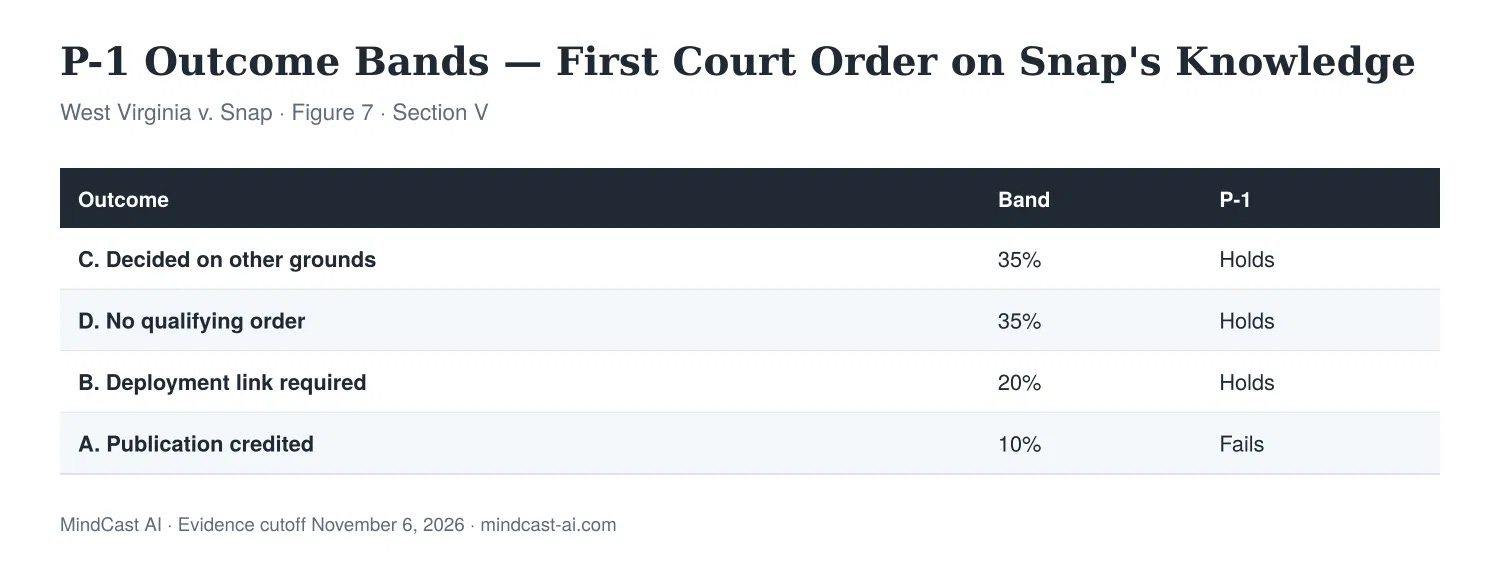
Where the 90% comes from. Three outcomes satisfy P-1: C (35%) and D (35%) never reach the warning, and B (20%) reaches it but requires a deployer link. Outcomes A and B together give West Virginia a 30% chance of an order that squarely weighs the warning by December 31, 2027. Among those outcomes, B outweighs A, so the claim that carries information is the 10% left to outcome A.
Outcome C has two routes. C1 is resolution: Meta’s August 2026 agreement with state attorneys general names Snap a Core Industry Member, and West Virginia sits inside that framework, so a multistate Snap commitment would end the case without a ruling on the warning. C2 is a narrow ruling: a single deception count can survive a motion on Snap’s representations alone, and a trial court that can rest on that ground avoids announcing a broad rule about supplier warnings. The simulation weights the two routes roughly evenly. The parent paper sets out the framework mechanics.
Outcome D ties C on timing alone. West Virginia had not yet served Snap at the evidence cutoff, so no response clock runs. Snap removed the two attorney general suits filed just before West Virginia’s, in Arkansas and Pennsylvania, and neither has returned to state court. Florida’s case spent about 18 months between filing and the Eleventh Circuit’s return to state court, so removal, remand and motion briefing can consume most of the window.
The strongest case for publication alone. The sophisticated-user logic also cuts against Snap. A court could treat a large deployer as a professional user charged with what its own supplier published about its own model, much as courts charge trained technicians with hazards known in their field. Three features keep that path small: the deception count does not need it, the court would have to announce a broad rule and the penalty statute asks about willful conduct. An order that frames Snap as a sophisticated user of OpenAI’s models is the clearest early sign that the tail is growing.
S-1, Carried From the Parent Paper
S-1. OpenAI remains outside all eight attorney general actions against Snap through December 31, 2027 (70-90%).Source: the parent paper. Launch outcome 1 strengthens S-1, and launch outcome 2 requires its revalidation in the parent paper.
Validated outcomes to date: none.
Open Questions Without Bands
Who held launch authority. A contract, joint engineering or safety review, or testimony on approval authority.
What the parties argue on willfulness, and what the court relies on. Briefing, then findings on repeated and willful violations, tracked separately.
Whether OpenAI’s documents enter a Snap case. A public subpoena or a filing citing OpenAI production; public silence establishes nothing.
Whether Google’s role enters a Snap case. A subpoena to Google, or a pleading naming Gemini or Google as a recipient of My AI data.
Whether a supplier-warning theory proceeds against any deployer by 2029. A reported order in any jurisdiction.
Persistence path. If outcome B governs, states plead receipt and response from internal documents, and supplier publications appear only as dated corroboration. If outcome A governs this case, other states suing Snap can add the same paragraphs before their trials and private plaintiffs can follow. Either outcome persists once a second state copies it, and repeated interstate replication would mark game mutation.
What it means.
💼 Executives: The likeliest ruling leaves supplier warnings legally open, so launch practices rather than case law will set the standard in the near term.
🧠 Model providers: At the likeliest outcomes, published safety limits protect the supplier without becoming a liability rule for customers.
Section takeaway. A public supplier warning is unlikely to be held sufficient on its own, and the first order will most likely turn on Snap’s own words.
VI. Each Party’s Strongest Move Carries a Cost
For West Virginia. The state can plead the GPT-4 report as a date marker, rest knowledge on Snap’s own post and seek Utah’s internal documents under a common-interest arrangement. The persona-versus-disclaimer conflict and the age-awareness allegation give it two themes to test against Snap’s response.
For Snap. Snap can accept the generic knowledge its February 27 post already describes and defend the age signal, the moderation tooling and the staged release. The cost is discovery into the April approvals, which may show that the hallucination risk drew only a disclaimer.
For OpenAI. OpenAI can stay silent in the Snap cases and defend its warnings as clear in its own case. The move costs little unless discovery shows joint launch work.
Removal and coverage. Snap removed the Arkansas and Pennsylvania cases, and a removal here would buy time without changing the ground the court is likely to choose. Downstream, Snap’s quarterly report states that several carriers seek summary adjudication on the duty to defend. A Delaware court denied Meta a defense in comparable youth-harm litigation on deliberate-conduct grounds, without reaching the exclusions, so a defense built on documented response avoids feeding that reading. The duty to defend usually turns on what the complaint alleges, so West Virginia’s pleaded knowledge facts reach the carriers first and the April 2023 safeguard record matters most to indemnity.
What it means.
⚖️ Counsel: Leading with the documented response keeps Snap’s first brief on its strongest ground.
🛡 Insurers: A response-based defense moves the indemnity dispute toward the facts of execution and away from what Snap knew.
Section takeaway. Defending its response serves Snap on liability, at the cost of opening its April files.
VII. Risk Mitigation — The Response File Protects Every Audience
Probability and severity. The five audience entries below turn P-1 into exposure and action, with probability and severity stated separately and an owner named for each action. None constitutes legal, investment or fiduciary advice.
⚖️ Counsel for Snap and Similarly Situated Deployers
Probability. Outcome C (35%) or outcome B (20%) governs on the merits path, and outcome D (35%) delays both. Severity: moderate, because each keeps the count alive.
Exposure. Outcomes B and C send discovery into the April 4–19, 2023 approvals, release logs and youth-specific tests. Repeated and willful violations carry up to $5,000 each.
Mitigating actions. Before Snap’s first substantive brief, litigation counsel maps each April 4 safeguard to its activation date and product and safety leads confirm preservation by named custodians. The brief then leads with the documented response rather than model fit.
Residual exposure. Any safeguard announced but not live on April 19 stays discoverable, and the hallucination risk left to the disclaimer remains a willfulness theme.
🏛️ Policymakers — State Attorneys General and Legislatures
Probability. Outcome A carries 10%. Severity for the state: low, because Snap’s own post already establishes generic knowledge.
Exposure. A knowledge section built mainly on OpenAI’s papers invites outcome B (20%) and a repleading cycle, and a removal adds months before any state order.
Mitigating actions. The AG’s litigation unit leads its next filing with Snap’s post and the teen tests and moves to remand within 30 days of any removal. Multistate coordinators seek Utah’s documents before the first motion ruling. Legislative counsel drafts, for the next session, a list of supplier safety documents that deployers must assess before launching to minors.
Residual exposure. A court can still demand proof of receipt, and Utah’s materials may prove unshareable.
💼 Executives at Deployers of General Models to Minors
Probability. Outcome A carries 10%. Severity is high if it occurs, because a supplier publication could supply a possible date anchor for a deployer’s knowledge.
Exposure. Each release to minors after a supplier safety publication, without a logged product decision, becomes a dated exhibit in any later complaint.
Mitigating actions. The product safety lead logs each supplier publication against a dated product decision within one release cycle. The general counsel requires a verified safeguard, not only a disclaimer, before any expansion to minors.
Residual exposure. A logged review still proves knowledge, so the practice narrows the dispute to the quality of the response rather than removing it.
📊 Investors in Consumer Applications Built on Third-Party Models
Probability. Outcome A carries 10%. Severity concentrates in companies that expanded to minors after a supplier publication.
Exposure. Outcome A could offer a publication-alone pleading template to each state already suing a portfolio company; Snap alone faces eight such suits.
Mitigating actions. At the next diligence cycle, teams ask whether launch files map supplier publications to dated product changes, and investment committees weight the answer.
Residual exposure. Answers rest on company self-reporting, and 2023 launch files cannot be rebuilt once a complaint arrives.
🧠 Model Providers
Probability. On the likeliest outcomes the court never reaches the clarity of OpenAI’s warnings. Launch authority remains a contingent discovery question, not a prediction.
Exposure. Discovery showing shared authority over a safeguard or release would supply the facts for a participation claim, measured in integration and safety-review documents.
Mitigating actions. Provider counsel keeps its clear-warning defense consistent with its non-party position by its first substantive brief. The partnerships team documents the line between tool supply and launch approval at each customer renewal.
Residual exposure. Integration documents from 2023 stay discoverable whatever the provider changes now.
Section takeaway. The response file is the most valuable mitigation for every audience, because each likely path runs through it.
VIII. What to Watch — Six Signals on the Court’s First Ruling
The dominant question. The first order on knowledge governs P-1, and each signal below moves weight among outcomes A through D.
Unscheduled. West Virginia serves Snap. Effect: Starts the response clock; each month without service raises outcome D.
Within 30 days of service on Snap. A notice of removal, filed under 28 U.S.C. § 1446(b). Effect: Raises outcome D.
Snap’s first substantive brief. Whether Snap leads with its documented response, model fit or a federal defense. Effect: Response supports C and B; model fit raises B.
Pending in the Eastern District of Pennsylvania. A remand ruling in No. 2:26-cv-07313. Effect: Shows how quickly remand returns a removed case, which bounds outcome D.
August 2027. Scheduled Nevada and New Mexico trials, per Snap’s quarterly report. Effect: A global resolution before trial would end West Virginia’s case through outcome C; the parent paper’s P-1 (60-80%) holds that at least one attorney general action resolves before that trial.
December 31, 2027. P-1 resolves. Effect: Outcome D if no qualifying order has issued.
Section takeaway. Snap’s first filing is the earliest decisive signal, because it shows whether the company fights over the warning or defends its response.
IX. Conclusion — The Warning Dates the Question, and Snap’s Files Answer It
Answer to the controlling question. OpenAI’s published GPT-4 limits can establish that the supplier of Snap’s model told the public its models still hallucinate and still produce harmful content. OpenAI’s March 14 page preceded the rollout by 36 days, and the complaint’s cited March 27 report preceded it by 23 days. The publications cannot alone establish that Snap read them, that they described the model My AI ran or that Snap failed to respond. The supplier’s warning works best as a dated benchmark for Snap’s response, which bears on both the violation and any penalty.
Where the case turns. The decisive evidence sits in Snap’s files between March 14 and April 19, 2023, where deployment evidence must confirm or refute the response pattern set out in Section III. The supplier-participation question enters only if discovery shows OpenAI shared authority over a safeguard or the release.
A reusable test for any deployer. The case yields a five-step test for any company that ships a third-party model to the public.
Publication and specificity. Did the supplier publish a dated limit that covers the deployed model family and names the harm and the affected population?
Applicability and receipt. Do documents show the deployer read the limit, and does the limit fit the deployed model?
Response. Does a dated product change map to the limit, or did only a disclaimer answer it?
Violation. Did the deployer make a representation that contradicts the known limit?
Penalty. Did the contradiction continue after the deployer knew, in a course of repeated conduct, and whose published limits governed each period of that course?
How the two tests align. The five steps extend the parent paper’s four-step notice test. The parent’s specificity step joins publication in step 1, its receipt step sits in step 2 and its review and response steps sit in step 3. Steps 4 and 5 add the violation and penalty that West Virginia’s count requires.
A separate check asks who held launch authority, because that answer may affect whether a participation claim against the supplier becomes pleadable. A deployer that answers step 3 with dated changes narrows its exposure to step 4.
How one county order travels. A Kanawha County order binds one case. The order’s reasoning can still reach other state pleadings, insurers’ readings of deliberate conduct and deployers’ review practices across the industry. Feedback then runs back down: the logs that protect a strong response also prove knowledge against a weak one.
The Simulation Prediction. P-1 holds at 90%: no qualifying Kanawha County order will treat OpenAI’s March 14 or March 27, 2023 publications alone as sufficient to establish Snap’s knowledge for the issue and stage decided. The window runs through December 31, 2027, and the first ruling will most likely rest on Snap’s own words.
Working With MindCast
MindCast AI offers four engagements built on the five-step test and P-1, one for each party that faces a decision before the first Kanawha County order.
Supplier-warning audit for deployers. MindCast applies the five-step test to a client’s launch files, maps each supplier publication to a dated product decision and identifies gaps before a regulator does.
Litigation war game for counsel. MindCast runs the West Virginia game, from court outcomes A through D to the launch-authority question, for defense teams preparing their first substantive briefs.
Enforcement pleading review for attorneys general. MindCast tests whether a complaint links each supplier publication to deployer receipt, review and response, the link outcome B requires.
Coverage brief for carriers. MindCast assesses how pleaded knowledge facts bear on the duty to defend and how a deployer’s response file bears on indemnity.
MindCast’s full offerings appear at MindCast AI Predictive Game Theory Simulations in Law and Behavioral Economics. The firm models and simulates complex litigation for law firms, regulators and economic consulting firms, including case-outcome forecasts and settlement scenarios. The AI Enforcement and Litigation Tracker follows the federal, state and private actions behind each engagement.
Contact MindCast AI at mcai@mindcast-ai.com. Visit our corporate site www.mindcast-ai-simulation.com.
One-Page Sheet — The Question, the Odds and the Triggers
The question. What can OpenAI’s published GPT-4 limits establish about Snap’s knowledge and response before the April 19, 2023 rollout of My AI?
Simulation Prediction. P-1 (90%): No qualifying Kanawha County order will treat OpenAI’s March 14 or March 27, 2023 publications alone as sufficient to establish Snap’s knowledge for the issue and stage decided. Window: through December 31, 2027. S-1 (70-90%), from the parent paper: OpenAI remains outside all eight attorney general actions against Snap through December 31, 2027.
The figure sets each outcome’s band against its downside and the recommended move.
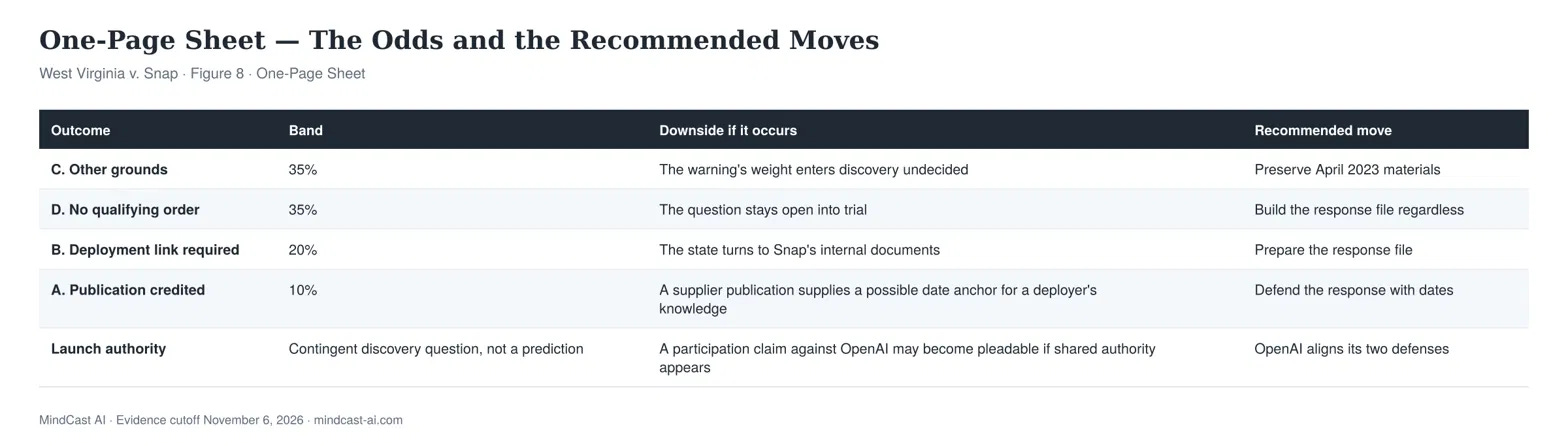
Escalation triggers. Service on Snap; the first Kanawha County order on knowledge; removal to federal court; court findings on willfulness; any production from OpenAI or Google.
Working with MindCast
MindCast AI offers four engagements built on the five-step test and P-1, one for each party that faces a decision before the first Kanawha County order.
Supplier-warning audit for deployers. MindCast applies the five-step test to a client’s launch files, maps each supplier publication to a dated product decision and identifies gaps before a regulator does.
Litigation war game for counsel. MindCast runs the West Virginia game, from court outcomes A through D to the launch-authority question, for defense teams preparing their first substantive briefs.
Enforcement pleading review for attorneys general. MindCast tests whether a complaint links each supplier publication to deployer receipt, review and response, the link outcome B requires.
Coverage brief for carriers. MindCast assesses how pleaded knowledge facts bear on the duty to defend and how a deployer’s response file bears on indemnity.
MindCast’s full offerings appear at MindCast AI Predictive Game Theory Simulations in Law and Behavioral Economics. The firm models and simulates complex litigation for law firms, regulators and economic consulting firms, including case-outcome forecasts and settlement scenarios. The AI Enforcement and Litigation Tracker follows the federal, state and private actions behind each engagement.
Contact MindCast AI at mcai@mindcast-ai.com.
Appendix — MindCast Works Cited
Live tracker. AI Enforcement and Litigation Tracker. Tracks federal, state and private AI enforcement actions. A companion doctrine tracker rates nine common law doctrines as expanding, narrowing or shifting.
State Attorneys General Sue Snap, Not OpenAI, Over My AI — West Virginia Cites OpenAI’s Published GPT-4 Limits to Allege Notice Before the Public Rollout. The parent paper; supplies the eight-state case map, the four-step notice test and S-1.
OpenAI State Attorney General Lawsuits — Two Pleading Templates Across Ten State Courts Decide Which Game Theory Evolution Arrives First. Maps the state suits against OpenAI, including West Virginia’s.
Interactive OpenAI Liability War Game. Replays OpenAI’s moves from 2023 to 2026 and shows how alternative moves and shocks open or close five liability exposures; the supplier-side view of the same contest.
Agentic AI Liability and Insurance Exclusions — How Coverage Redirects Who Gets Sued. Explains where loss moves when a carrier declines a defense.
Agentic Foreseeability and the Modern Duty of Care for AI Agents. Defines what a deployer should have known when a risk is published upstream.
AI Accountability — When AI Promises Meet the Courts. Traces how gaps between stated AI capability and operating reality become legal claims.
Sources
Statutes, Dockets and Filings
State of West Virginia ex rel. McCuskey v. Snap Inc., Complaint, No. CC-20-2026-C-1339 (Kanawha Cir. Ct. filed Nov. 5, 2026), ago.wv.gov. One consumer protection count; ¶¶148–161, ¶¶170–177, ¶192 and ¶¶241–245 on My AI; footnote 137 (¶150) cites the GPT-4 Technical Report and footnote 138 (¶152) cites Snap’s February 27 post and OpenAI’s limitations page.
W. Va. Code § 46A-7-111, code.wvlegislature.gov. Civil penalties of up to $5,000 per violation for a course of repeated and willful violations.
W. Va. Code § 46A-6-102, code.wvlegislature.gov. Subsection (7)(M) reaches concealment or omission of material facts with intent that others rely on it.
28 U.S.C. § 1446, law.cornell.edu. Thirty-day window for removal after service.
Johnson v. American Standard, Inc., 43 Cal.4th 56 (2008), law.justia.com. Adopts the sophisticated-user defense under a knew-or-should-have-known standard.
Attorney General of Florida v. Snap Inc., No. 25-12814 (11th Cir. Oct. 14, 2026) (unpublished), ca11.uscourts.gov. Reverses the denial of remand.
Griffin v. Snap Inc., No. 2:26-cv-00113 (E.D. Ark.), notice of removal (July 22, 2026), dockets.justia.com. Arkansas removal.
Commonwealth of Pennsylvania v. Snap Inc., No. 2:26-cv-07313 (E.D. Pa.), removed September 23, 2026. No remand ruling at the evidence cutoff.
Garcia v. Character Technologies, Order on Motions to Dismiss (M.D. Fla. May 20, 2025), courthousenews.com. Component-part claims against Google proceed on substantial participation in integration.
Federal Trade Commission, “Statement of the Federal Trade Commission In the Matter of Snap, Inc.” (January 16, 2025). Referral of a My AI complaint to the Justice Department.
Snap Inc., Form 10-Q for the quarter ended September 30, 2026. Coverage suit, the December 10 hearing and the August 2027 trials.
Company and Regulator Publications
Snap, “Say Hi to My AI” (February 27, 2023). Launch to Snapchat+ and Snap’s hallucination warning.
Snap, “Early Learnings from My AI and New Safety Enhancements” (April 4, 2023). Age signal, OpenAI moderation tooling and Family Center plans.
Snap, “SPS 2023: What’s Next for My AI” (April 19, 2023). Global rollout and additional moderation technology.
Snap, announcement of Google Gemini in My AI (September 24, 2024). Gemini on Google Cloud’s Vertex AI powers generative AI in My AI.
OpenAI, “Introducing ChatGPT and Whisper APIs” (2023; page updated April 24, 2024). Names My AI as running on the GPT-3.5 API.
OpenAI, “GPT-4 Technical Report” (2023), arXiv 2303.08774. First version March 15, 2023; third version March 27, 2023.
OpenAI, “GPT-4” (March 14, 2023). Describes risks shared with previous models.
UK Information Commissioner’s Office, “ICO warns organisations must not ignore data protection risks as it concludes Snap ‘My AI’ chatbot investigation” (May 21, 2024). Investigation opened June 2023; preliminary notice October 6, 2023.
Utah Department of Commerce, “Utah Sues Snapchat For Unleashing Experimental AI Technology On Young Users While Misrepresenting the Safety of the Platform” (June 30, 2025). My AI claims and default placement.
PIRG Education Fund, “How AI models not for kids are ending up in toys”. Reports OpenAI’s suspension of FoloToy and signs of continued model use.
Press
Geoffrey A. Fowler, “Snapchat tried to make a safe AI. It chats with me about booze and sex.” Washington Post(March 14, 2023).
Utah News Dispatch, “Previously redacted details in Utah’s Snapchat lawsuit are now public”, via Yahoo News.
Troutman Pepper Locke, “Eight State AGs Sue OpenAI Over ChatGPT Safety and Consumer Protection” (October 16, 2026).
Insurance Journal, “Meta Loses Insurance for Defense in Major Social Media Addiction Litigation” (March 3, 2026).
Husch Blackwell, “Insurers Not Obligated to Defend Meta in Youth Social Media Lawsuits” (March 3, 2026).
Engadget, “Sales of a teddy bear were suspended because of its sexually explicit AI” (November 2025).
Gizmodo, “AI Teddy Bear That Talked Fetishes and Knives Is Back on the Market” (November 25, 2025).
Conventus Law, “Snap My AI ICO decision has lessons for everyone undertaking DPIAs”.