
Carrier Product Development and Forms Teams · Carrier and Reinsurer Emerging-Risk and Claims Teams · Coverage Litigation Counsel · AI Integrators and Consulting Firms · Enterprise Deployers · Plaintiffs’ Firms · Frontier Developers · State Attorneys General · State Insurance Regulators · Federal Trade Commission · California
Related works: Who Writes AI Insurance Coverage Conditions — Procurement, Enforcement Decrees, Partner Terms and the Two-Axis Condition · Who Absorbs Correlated AI Loss — Reinsurance Aggregation, Industry Pools, the Public Backstop and the Liability Shield · FTC Investigation of Anthropic and OpenAI
Companion materials: Value Proposition · War Game Companion · Interactive War Game
What MindCast offers. MindCast forecasts how litigants, carriers, regulators and courts will act on agentic AI liability and names the decisions a client can make first. The forecasts rest on common law, statute and live litigation, run through the MindCast Predictive Behavioral Economics + Dynamic Game Theory simulations. MindCast works alongside counsel, auditors and brokers and does not build or audit agents, advise on a client’s legal matter or place insurance.
Carrier product teams: which form wording an agentic claim tests first, and which definitions, exclusions and endorsements to fix before the next filing cycle. Claims teams and reinsurers learn which insureds a spreading theory reaches.
Integrators and consulting firms: when plaintiffs or sued clients gain by joining the firm, and which contract and coverage terms to fix before renewal.
Enterprise deployers: which governance documents become evidence and where retained loss sits once exclusions apply.
What this MindCast Vision adds. Earlier MindCast papers answered three separate questions: who gets sued (When AI Agent Liability Meets Common Law and Statute), which policies exclude AI (Who Writes AI Insurance Coverage Conditions — Procurement, Enforcement Decrees, Partner Terms and the Two-Axis Condition) and which pleading templates plaintiffs reuse (OpenAI State Attorney General Lawsuits: Two Pleading Templates Across Ten State Courts). The present Vision connects the defendant chain to the coverage map and adds four contributions:
The redirection mechanism. Coverage positions, learned after filing, shape how an agentic claim expands and where the residual loss lands. A simulation run shows the move turns on incremental recovery and the insurer’s duty to settle.
A route-by-route coverage map. The deployer, vendor and integrator routes each meet a different policy and a different gap, including possible silent crime cover for a hijacked agent’s transfers.
Two portfolio findings. Integrators may enter agentic litigation through joinder and contribution as well as direct client suits, and the first portfolio-level signal of a spreading theory may appear in a carrier’s own claims files.
Validity conditions. The paper names the rulings and statutes that would require its forecasts to be revalidated.
I. Executive Summary
Core insight. Insurance exclusions do not remove agentic loss: once a defendant is in the case, coverage positions shape how the claim expands and where the residual loss lands. Optional exclusion clauses from the Insurance Services Office (ISO) became available in January 2026. Forty-one property and casualty groups had filed to exclude generative AI in at least one subsidiary by July, and 20 more had filed to delay (S&P Global Market Intelligence via The Insurer, reported by Actuary.info). Plaintiffs learn a defendant’s coverage position during the case and adapt their pleadings to the cover that remains.
Thesis. Agentic liability spreads by pleading template, and coverage positions redirect it after filing. General liability exclusions give plaintiffs reason to add independently supported professional negligence or governance allegations, and crime forms written before agents existed may cover hijacked-agent transfers their drafters meant to exclude. The first court to read the ISO definition of generative AI will set the first reference point for insureds holding the form. Integrator professional liability catches much of the loss that general liability now excludes.
Headline Simulation Predictions. Seven of the paper’s twelve Simulation Predictions lead: the four new ones from this paper’s simulation and three cited from earlier MindCast papers. Each names the actor, the outcome and the window.
Carriers pay before courts rule. In California and equivalent jurisdictions, the carrier funds a reasonable within-limits demand on an agent claim before any ruling on the AI exclusion: 70% for cases filed through December 31, 2028 (EX-P2). The exclusion protects less cash than its filing suggests.
Excluded loss moves to professional and management lines. After an AI-exclusion reservation, a plaintiff whose claim exceeds the deployer’s limits adds independently supported governance or professional negligence allegations: 60% for cases filed through December 31, 2028 (EX-P1).
Deployers, not insurers, sue the AI vendor first. The first public recovery action against an AI vendor after an excluded loss comes from the deployer in its own name: 70% by December 31, 2028 (EX-S1). The vendor’s twelve-month fee cap then binds the deployer’s own money.
Enterprise deployers become defendants. A complaint names an independent enterprise deployer for an AI agent’s act: 45% (30–60%) by March 31, 2027 (P6, cited).
Integrators enter through their clients. A client sues a consulting firm or integrator over an agent the firm operated: 20% (10–35%) by December 31, 2027 (PF-1, cited). Plaintiff joinder and deployer contribution claims may reach integrators sooner (W4a).
Reinsurers write an aggregation trigger. A reinsurer or Lloyd’s publishes an aggregation trigger or sublimit for foundation-model failure: 16–56% by December 31, 2027 (Correlated Loss P-2, cited).
Insurers rarely sue their own insured to recover. An insurer asserts a public reimbursement claim against its own insured over an AI-excluded resolution: 20% by December 31, 2028 (EX-S2). A preserved reimbursement right mostly stays in the claim file.
EX-P marks a primary and EX-S a secondary Simulation Prediction from this paper’s simulation. P6, PF-1 and Correlated Loss P-2 keep the identifiers of the earlier MindCast papers that issued them. Section X gives full statements and falsifiers for all seven, plus five more cited Simulation Predictions, six cited Snapshot Predictions and seven watch conditions.
The MindCast distinction. MindCast AI applies Behavioral Economics + Dynamic Predictive Game Theory through MindCast AI Proprietary Cognitive Digital Twin Foresight Simulations (MP CDT FS). Behavioral economics supplies the decision rules: plaintiffs’ firms reach for the latest filed template, and underwriters anchor on the last renewal. Game theory supplies the payoffs: expanding a claim against a party pays more when its coverage survives, so each coverage position changes how the case grows. Docket monitoring counts filings, while simulation forecasts which way the next amendment and recovery demand will run.
What the paper does. The paper explains how the coverage game reached its current form and traces three routes from the developer to new defendants. It maps the coverage each route meets, works one case through the forecast and tests its reading against three competing explanations. A simulation run shows how a sued deployer’s case branches and yields four new Simulation Predictions. The paper closes with risk mitigation steps and watch conditions for each audience.
Stakeholder callouts
🏛️ Policymakers. California barred the defense that an AI acted on its own while carriers began offering AI exclusions. A California deployer with an excluded policy therefore contests liability with one fewer defense and less insurance. State insurance commissioners decide whether agent-action wording clears filing review, a test that comes before any court’s.
💼 Executives. Product heads face three wording decisions before any court rules: whether the ISO definition reaches an agent’s tool call, whether crime forms reach a hijacked agent and whether integrator professional forms carve out agents the firm operates.
⚖️ Counsel. Coverage counsel should expect the first declaratory judgment on the ISO definition to become a national reference point, though other jurisdictions may read the same wording differently.
📊 Investors. Integrators hold the professional liability insurance that plaintiffs and sued deployers both reach for once general liability excludes AI. A loss that insurers refuse elsewhere tends to land on integrators and their insurers.
Takeaway. The decision a product team faces is which wording an expanding agentic claim tests first, and the coverage map shows where each claim will turn.
Reading Guide: Insurance, Agent and Litigation Terms in Plain Language
Product teams know the forms; the agent and litigation terms at the end of the table come from AI engineering and civil procedure. The insurance terms stay one layer deep for risk, credit and investment analysts. Three quantities carry the argument for any analyst: who keeps the loss, how many companies share one exposure, and when the first public signal appears.
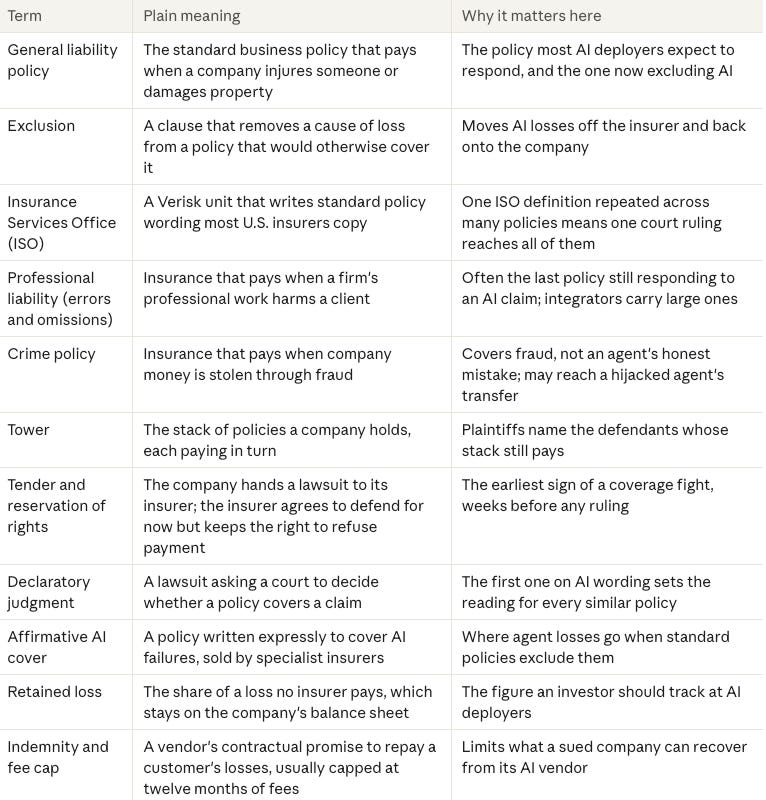
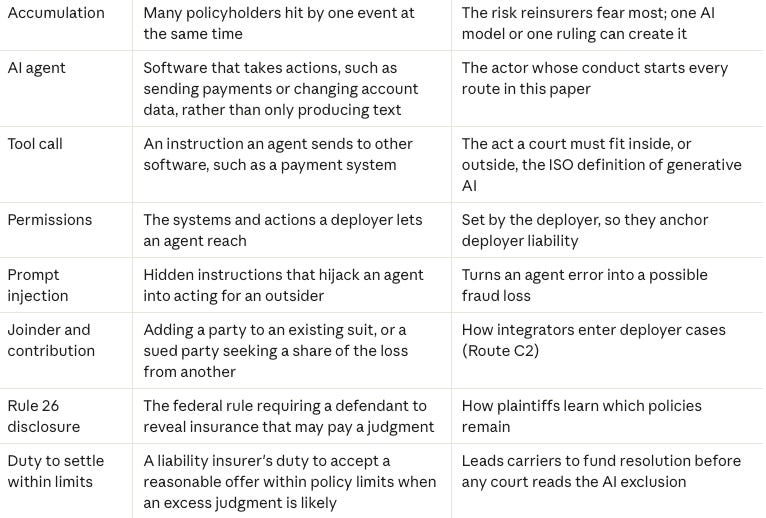
Takeaway. A reader who follows where the retained loss lands can read every section that follows.
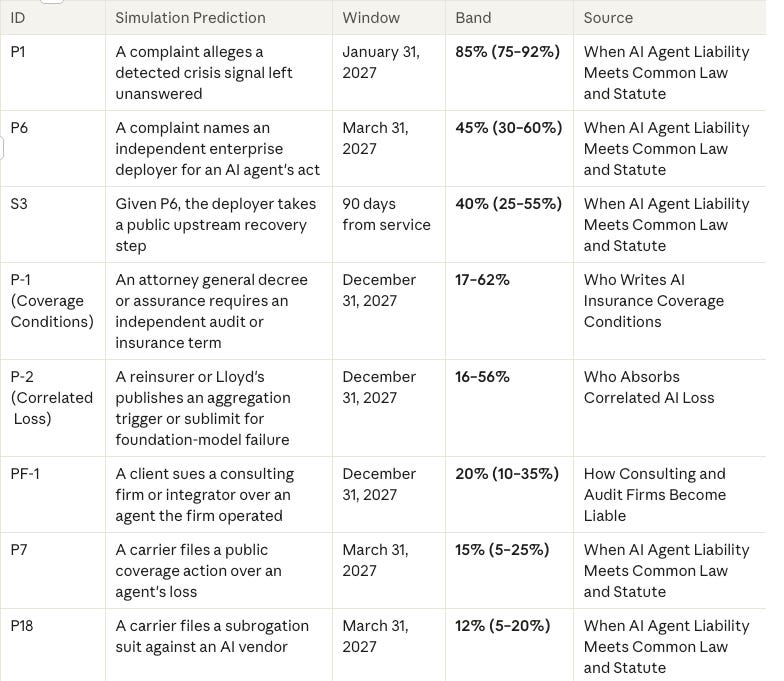
Cited MindCast Simulation Predictions carry the bands of their source papers. New Simulation Predictions print in tens because no court has yet read the ISO definition, and the first ruling can replace the game. Watch conditions, claims the paper derives without forecasting, carry falsifiers but no probabilities. No cited Simulation Prediction has reached its window yet. The earliest window closes January 31, 2027: an earlier MindCast paper forecasts a complaint alleging that an AI system detected a crisis signal and left it unanswered (85%).
II. The Governing Mechanism: Templates Carry the Theory, Coverage Redirects It
Agentic liability moves through filed templates while appellate courts stay silent. Each complaint lowers the cost of the next one, because later plaintiffs copy the theory, the evidence categories and the remedy request. Coverage positions then shape how the copied theory expands once a defendant is in the case. Plaintiffs often learn a defendant’s insurance only after filing, because Federal Rule of Civil Procedure 26(a)(1)(A)(iv) requires disclosure of any policy that may pay a judgment.
How plaintiffs learn the coverage position. Rule 26 discloses the policy, not the carrier’s position on it. A plaintiff can learn that position through five channels:
Policy language disclosed under Rule 26, including any AI exclusion.
A reservation of rights conveyed during negotiation or mediation.
The insured’s own disclosure, made to support an amendment or a contribution claim.
A declaratory judgment action or reimbursement pleading by the insurer.
Coverage correspondence placed on the docket.
Limiting condition. Where the plaintiff cannot observe the exclusion or the carrier’s position before the amendment deadline, coverage cannot explain the amendment.
The templates are on file. Ten states had their own actions against OpenAI by November 2, 2026, including eight coordinated filings on October 14. OpenAI State Attorney General Lawsuits: Two Pleading Templates Across Ten State Courts maps the two templates those offices use. The Federal Trade Commission (FTC) served compulsory process on Anthropic and OpenAI on October 14, the same day as the coordinated filings. FTC Investigation of Anthropic and OpenAI forecasts the federal track.
Coordinated filing and independent reuse are different signals. Eight coordinated filings show that attorneys general can deploy a common pleading across states. Reuse by an unaffiliated plaintiffs’ firm would show that the theory travels beyond the original coalition. The forecast treats reuse by an unaffiliated firm as the stronger trigger for a portfolio review.
Exclusions moved faster than any court. ISO writes the standard policy language most U.S. insurers adopt. Form CG 40 47 removes bodily injury, property damage and personal and advertising injury “arising out of” generative AI from the general liability form. The form defines generative AI as a system trained on data “with the ability to create content or responses” (PropertyCasualty360).
Carriers read “arising out of” broadly, so AI need only sit in the causal chain (Cloud Security Alliance). The carrier Berkley extended an absolute AI exclusion to the policies covering management decisions and professional work. The ISO forms are optional, so form filings show availability and adoption activity rather than the share of issued policies that exclude AI.
Statutes remove defenses without deciding liability. California Civil Code section 1714.46 bars any defendant that developed, modified or used AI from arguing that the AI autonomously caused the harm. Causation, foreseeability and comparative fault defenses survive (AB 316 text). Colorado SB 26-189 allocates fault between developers and deployers from January 1, 2027, but only in discrimination claims over consequential decisions that automated decision-making technology influenced (Seyfarth via JD Supra). Colorado’s statute also voids contract clauses that shift liability for a party’s own discriminatory acts (Buchalter).
Doctrine supplies the next defendants. When AI Agent Liability Meets Common Law and Statute identifies four doctrines a plaintiff can plead beyond the developer: voluntary undertaking, imputed knowledge, apparent authority and shared control. A deployer’s permission and monitoring logs supply the facts each doctrine needs.
What counts as independent conduct. An added allegation counts as independently supported only when it meets all four conditions below. Renaming a count meets none of them.
The allegation rests on a separate act or omission by the deployer, such as ignoring a warning or granting excess permissions.
The supporting facts were available before the carrier’s reservation.
The legal theory does not derive wholly from the excluded AI activity.
The allegation could reach another responsive policy, such as professional or management liability.
Takeaway. The template tells a plaintiff what to plead, the statute tells it which defense has fallen away, and the defendant’s coverage position tells it where to expand the claim.
III. Game Evolution: How the Coverage Game Reached Its Current Form and Why It Holds
Every forecast in this paper holds only inside the game that produced it. The coverage game reached its current form in three steps during 2026. The rules should hold through every forecast window, the latest of which ends December 31, 2028.
Step one: silent cover and a single defendant. Before January 2026 the standard ISO liability forms carried no generative AI exclusion, so AI losses fell inside general liability, cyber and professional forms by default. Plaintiffs sued developers, and no court had decided how liability cover treats an agent’s action.
Step two: a defense fell away while exclusions became available. On January 1, 2026 California barred the autonomy defense, and ISO’s optional exclusions took effect. Carriers filed AI exclusions through the year, some on the ISO forms and some in their own wording. The step changed contractual rules, payoffs and litigation incentives, which marks game evolution rather than a shift within the old game.
Step three: the templates went public. The October 14 coordinated filings and the parallel FTC demands put two pleading templates on file. Each later plaintiff now files at lower cost inside the existing game, so the step is a continuation rather than a new game.
Why the rules hold through the window. Exclusion forms renew on annual cycles, and state regulators approved more than 80% of AI exclusion filings (Actuary.info, citing The Information). Section 1714.46 stays in force, and Colorado’s fault-allocation rule reaches only discrimination claims when it takes effect in January 2027. P7 puts a public coverage action by March 31, 2027 at 15% (5–25%). A court is therefore unlikely to rewrite the coverage rules before March 31, 2027.
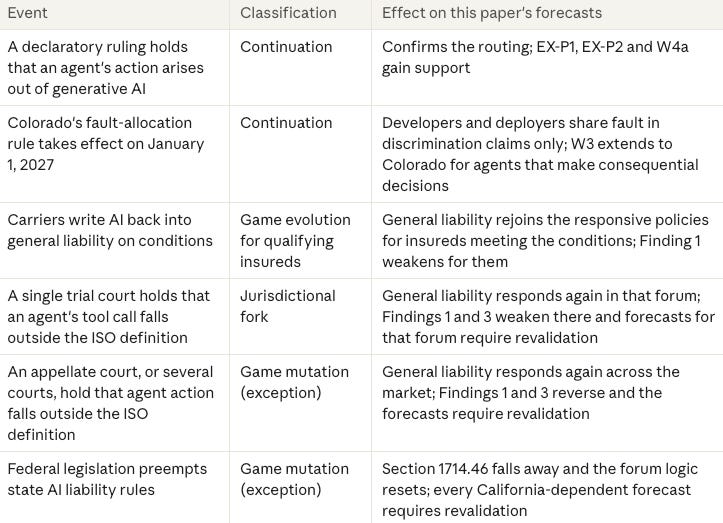
Takeaway. The game evolved by moving loss onto defendants and lowering the cost of filing. Only an authoritative or replicated ruling against the exclusion, or federal preemption, would replace it.
IV. The Defendant Routes: Developer Baseline and Three Ways the Chain Extends
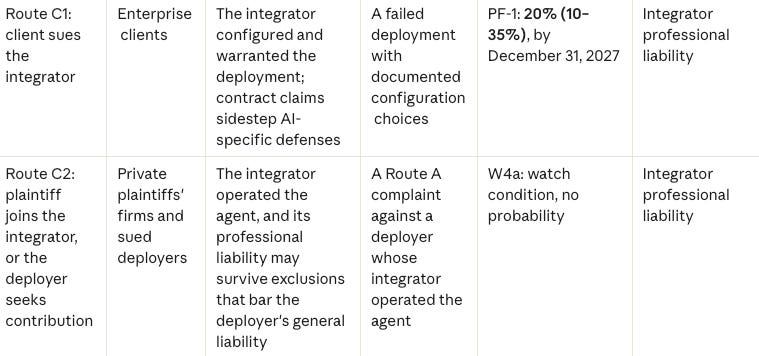
Plaintiffs start with the developer, because the attorney general templates already name it. Three routes run off that baseline, and each pays a different party for a different reason. Route C reaches the integrator two ways: a direct client suit (C1) or joinder and contribution inside a deployer case (C2). Each route starts on a different trigger, so a carrier watching one docket would miss the others.
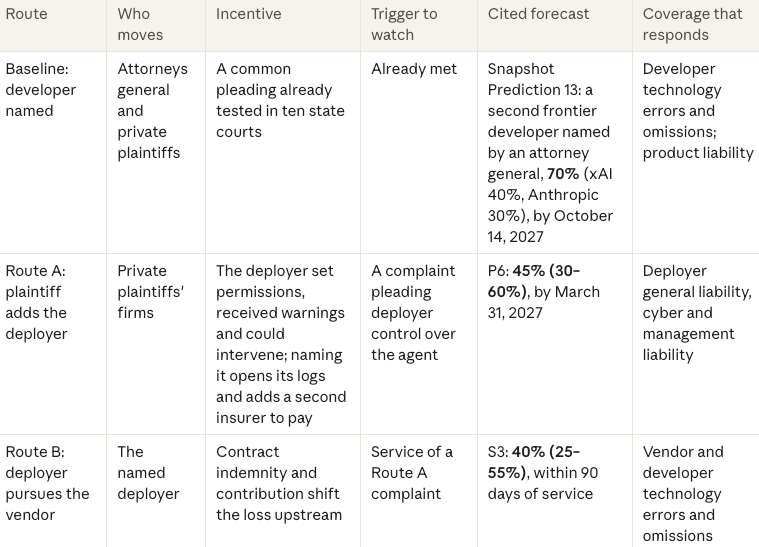
The unanswered-alert theory leads the chain. P1 forecasts a complaint alleging a detected crisis signal left unanswered by January 31, 2027, 85% (75–92%). An unanswered alert turns monitoring into an undertaking and logs into notice, so the theory reaches deployers and integrators as readily as developers.
Carriers enter last. P7 forecasts a carrier filing a public coverage action over an agent’s loss by March 31, 2027, 15% (5–25%). Reservations of rights and renewal changes advance without public litigation, so the coverage contest stays quiet until a large loss forces it.
Takeaway. Each route carries its own trigger, and Section V shows that each also meets a different coverage position.
V. The Coverage Response: Where Each Route Meets an Exclusion
Every route ends at a policy, and the policy decides whether the route pays. The table maps each route to the cover a defendant reaches for and the gap it finds there.
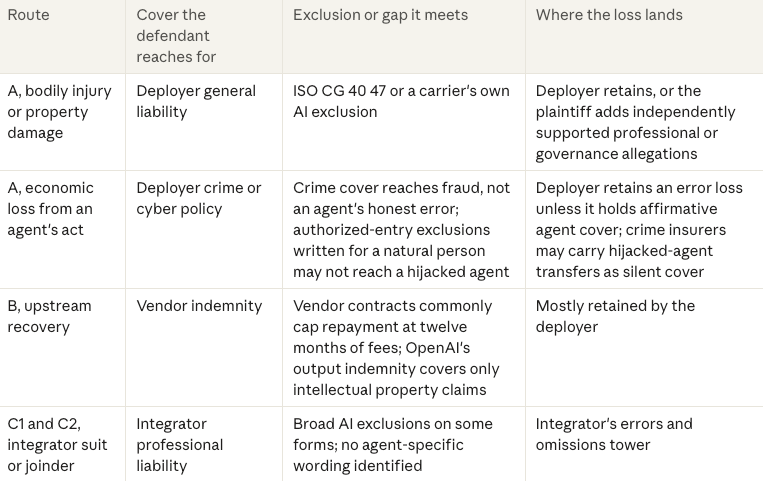
Route A meets the exclusion first. A deployer named under Route A hands the suit to its general liability insurer. The insurer answers with a reservation of rights: it will defend for now but may refuse to pay. An agent’s tool call is an instruction the agent sends to other software, such as a payment system. On the plain wording, such a call fits a definition reaching any system able to “create content or responses.” In California the deployer also cannot argue that the agent acted on its own, though duty, causation and comparative fault remain contested.
The insurer carries the burden. California courts read exclusions narrowly and require the insurer to prove that one applies (Blank Rome via JD Supra). Any doubt about whether the ISO wording reaches a tool call therefore favors the insured.
Agent action meets an old coverage test. A decade of social engineering cases, in which fraudsters trick an employee into wiring money, asks whether a transfer an authorized person made counts as computer fraud. The Fifth Circuit in Apache denied cover because the computer use was incidental to the fraud (Hunton). The Second Circuit in Medidata and the Sixth Circuit in American Tooling treated the deceived employee as a mere channel for the fraud and found coverage (Covington).
An agent’s honest error is not fraud. Crime cover reaches theft by fraud, so an agent that errs within its permissions never triggered it, and that loss sits with the deployer or its affirmative agent cover. The open question is a hijacked agent. In an unpublished 2018 ruling in Aqua Star, the Ninth Circuit applied an exclusion for data entered by “a natural person having the authority to enter” the insured’s system (Ninth Circuit memorandum), and an agent is not a natural person. Crime forms written before agents existed may therefore cover hijacked-agent transfers their drafters meant to exclude, a pattern product teams know as silent cover.
Route B recovers less than it appears. AI vendor agreements commonly cap liability at the fees paid over the prior twelve months. OpenAI’s business terms carry that cap, and ConductAtlas classes the clause as common across the platform agreements it tracks (ConductAtlas). Who Writes AI Insurance Coverage Conditions places the residual loss with the deployer, and OpenAI’s output indemnity reaches intellectual property claims only. S3 forecasts that the deployer pursues its vendor, and the cap limits what that pursuit returns.
Route C runs two ways. In C1 the client sues the integrator directly, the path PF-1 forecasts. In C2 a plaintiff joins the integrator to a deployer case, or the sued deployer brings a contribution or indemnity claim against it. Both paths reach the same professional liability tower, but C2 starts on a Route A complaint rather than a failed deployment.
Both paths reach the tower that survives. Exclusions removed AI from the general liability form, and specialist insurers began selling it as separate cover. Integrator professional liability still responds to negligent configuration and operation in programs that carry no AI exclusion. Some technology errors and omissions forms now exclude claims arising out of AI or automated decisioning, but no agent-specific wording has surfaced (WHINS). How Consulting and Audit Firms Become Liable for the AI Agents They Run for Clients (MindCast, publication pending) supplies the operating-control test plaintiffs would plead.
A new wave writes the cover standard forms exclude. Specialist firms now sell affirmative agent cover. AIUC ties liability coverage to an audit against its AIUC-1 agent standard, Armilla covers agent failures such as incorrect decisions and improper tool use, and Redberry Labs insures organizations deploying autonomous agents. Insurers are also becoming deployers: Counterpart, an AI-native management and professional liability MGA, runs agents in its own underwriting and claims. Carriers therefore sit on both sides of the board, insuring agent losses while answering for their own agents’ decisions.
Reinsurance funds the new wave. The specialist firms write on reinsurer and Lloyd’s capital rather than their own balance sheets. Armilla names five capacity partners, including Swiss Re and Chaucer (Armilla). Munich Re reaches small businesses through HSB, which adds AI liability cover to the business policies of partner carriers rather than selling it directly (HSB). Reinsurers have become the market’s source of capital for agent risk, not only its backstop.
Capacity stops well short of the largest exposures. Armilla’s standalone limit reaches $25 million per organization, and the Wall Street Journal reported caps near $50 million under Munich Re’s AI-error product (AI Weekly, summarizing the Wall Street Journal). The same reporting put frontier developers’ potential exposure in the tens of billions of dollars. Private capacity therefore covers ordinary deployment loss and leaves the largest exposures for retained loss or public policy.
The exclusion wave moves accumulation instead of removing it. Affirmative agent cover concentrates AI exposure with a handful of named capacity providers, where reinsurers can see and cap it. Excluded general liability loss that plaintiffs redirect into professional and management lines (EX-P1) reaches casualty treaties that may carry no AI aggregate terms. Primary carriers shed AI risk at the exclusion, while their reinsurers may take part of it back in a line that no one measures for AI.
The aggregation question stays open. Researchers frame the central reinsurance choice as whether to treat foundation-model failure as a systemic peril, like a named storm in a property treaty (arXiv). One model’s failure across many unrelated deployers would reach agent cover, professional lines and cyber in the same event. Who Absorbs Correlated AI Loss forecasts a reinsurer or Lloyd’s aggregation trigger or sublimit for foundation-model failure by December 31, 2027 (P-2, 16–56%).
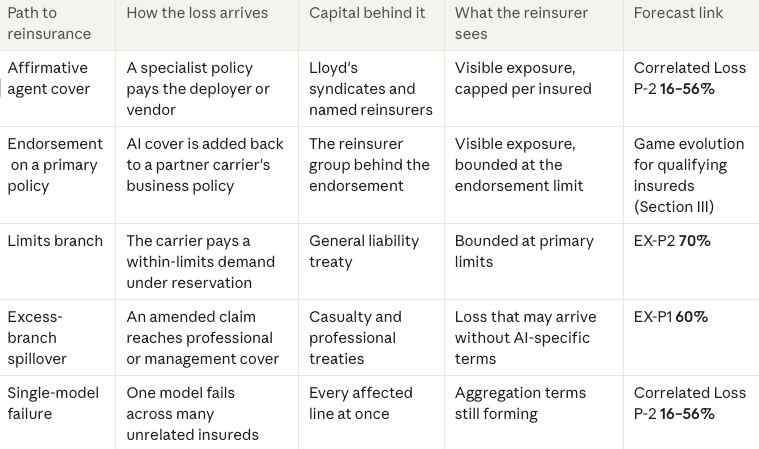
The first two paths put AI loss where reinsurers price it. The fourth returns it to treaties that were never priced for it.
The first coverage ruling creates correlated exposure. The ISO definition sits on every general liability policy that attached the form. The first court to decide whether an agent’s action “arises out of” generative AI sets the first reference point for holders of the form, though other jurisdictions may read the wording differently. Who Absorbs Correlated AI Loss treats foundation-model failure as a capital problem; a ruling on the definition adds a legal route to the same accumulation, in which one event hits many policyholders at once.
Takeaway. Exclusions leave three places for agentic loss to land: the deployer’s own balance sheet, a specialist’s AI agent policy and the integrator’s professional liability insurance. Where one carrier writes both general liability and professional lines for an insured, the exclusion shifts loss into its own professional line, and defense costs keep running while it reserves rights. The rate credit for an AI exclusion can therefore overstate the loss it removes.
VI. Worked Example: When a Developer Case Becomes a Deployer Problem
The forecast asks four questions: who moves next, where, why the move pays now and what would change the forecast. P6 supplies the test case: a complaint naming an independent enterprise deployer alongside a frontier developer, 45% (30–60%) by March 31, 2027. A casualty team can act on the answers before the complaint arrives.
Who moves next. A private plaintiffs’ firm moves, not an attorney general. Private firms can reuse the public pleading at low cost, and a deployer adds a second defendant with separate insurance.
Where first. California state court leads as the candidate forum, because section 1714.46 bars the deployer’s most natural defense: that the agent acted on its own. The strongest alternative runs through the developer. Removal, consolidation or a motion to compel arbitration could delay the deployer question by months.
Why the move pays now. The deployer set the agent’s permissions and could have intervened before the harm. Warnings reached the deployer through prior incidents, vendor notices or internal flags. Voluntary undertaking, imputed knowledge and shared control each attach to one of those facts (Agentic Foreseeability and the Modern Duty of Care for AI Agents). Naming the deployer also puts its logs into discovery.
What would change the forecast. The P6 window could close on March 31, 2027 without a filing. A court could dismiss deployer claims on the pleadings. Consolidation could proceed on developer-only claims and leave deployers out.
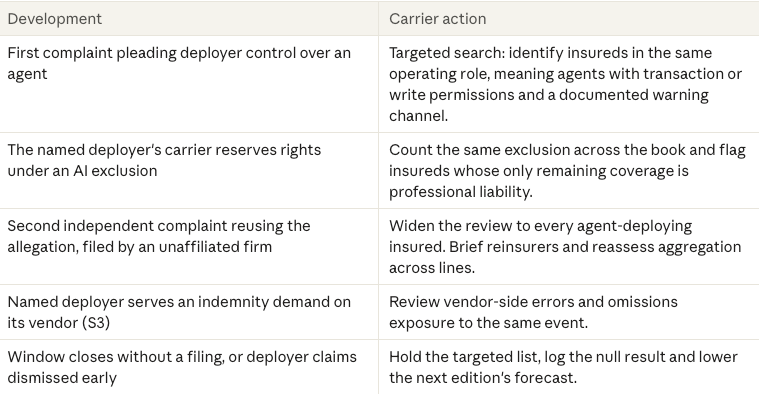
Takeaway. One complaint starts a targeted search, a second independent complaint widens it, and the exclusion schedule tells the carrier which insureds to pull first.
VII. What Emerges When Litigation Meets Coverage
Reading the defendant routes against the coverage map produces four findings and one watch condition that neither analysis shows alone. Each maps to a forecast or watch condition in Section X.
1. Pleading adapts to coverage positions. A plaintiff amends when another allegation or defendant adds enough recovery to justify the cost of the move. Renaming a count does not evade an exclusion, so the added claim needs independent conduct (defined in Section II) that survives the policy wording and the state’s causation law. The simulation run in Section IX yields three branches: no amendment, carrier-funded resolution or an amendment reaching a second policy.
2. Crime forms may carry hijacked-agent transfers as silent cover. An agent’s honest error was never crime-covered fraud (Section V). A hijacked agent’s transfer may escape authorized-entry exclusions written for a natural person, and the first agent-specific dispute will test that reading against each form’s wording (W2).
Watch condition: California may lead demand for affirmative agent cover. Section 1714.46 removes one defense and leaves duty, causation and comparative fault contested. Whether California deployers lead purchases of affirmative agent cover stays open until state-level placement data exist (W3).
3. Integrators may enter through joinder and contribution as well as direct suits. PF-1 forecasts the direct client suit of Route C1. Route C2 may matter as much, because the deployer case is already in court: a plaintiff joins the integrator, or the sued deployer brings a contribution or indemnity claim (W4a). Either path pushes recovery toward integrator professional liability, and integrator carriers may respond by restricting cover for agents an integrator operates (W4b).
4. The first portfolio-level signal may sit inside the carrier. Each complaint precedes its insurer’s reservation of rights, so a single reservation adds little. When unrelated insureds receive reservations invoking the same exclusion, the carrier may see a theory spreading before any complaint is reused or any court rules.
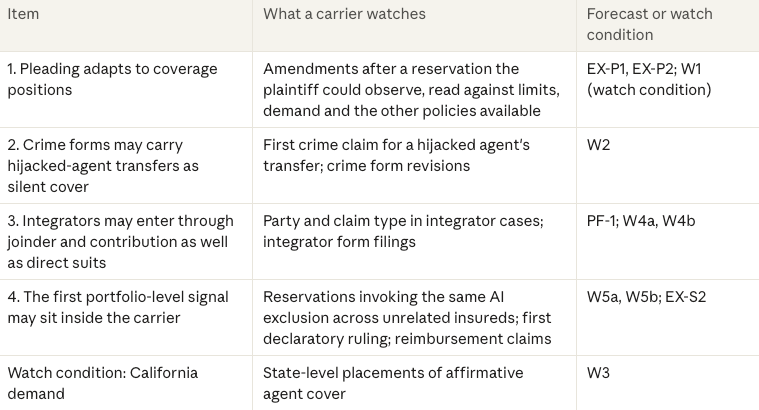
Takeaway. Coverage converts a litigation forecast into a portfolio forecast, because it tells the carrier which of its own policies an expanding claim will turn toward.
VIII. Four Readings Compete for How Agentic Claims Expand
The paper’s reading competes with three others, and each carries its own falsifier. Timing separates the strongest rivals: claims driven by doctrine expand at filing, while claims redirected by coverage expand after insurance is disclosed.
Reading A · Coverage redirection (this paper). Claims expand toward the parties and policies whose cover survives. A plaintiff adds an allegation or defendant when the incremental recovery justifies the move, and coverage positions learned after filing set that recovery. Falsifier: in cases where exposure exceeds total reachable limits and independent-conduct facts are on file, plaintiffs do not amend after an AI-exclusion reservation (EX-P1 fails).
Reading B · Doctrine-first expansion. Plaintiffs add deployers and integrators because voluntary undertaking, imputed knowledge and shared control make them liable, whatever their insurance. Coverage positions would then leave pleadings unchanged. Falsifier: added defendants and governance allegations cluster in amendments after insurance disclosure rather than in original complaints.
Reading C · Exclusion retreat. Carriers write AI back into general liability, or affirmative agent cover becomes standard, before claims mature. Coverage positions would stop varying across defendants, and plaintiffs would gain nothing by targeting one defendant’s coverage over another’s. Falsifier: ISO AI exclusions remain in use and no major carrier restores AI cover to general liability by December 31, 2027.
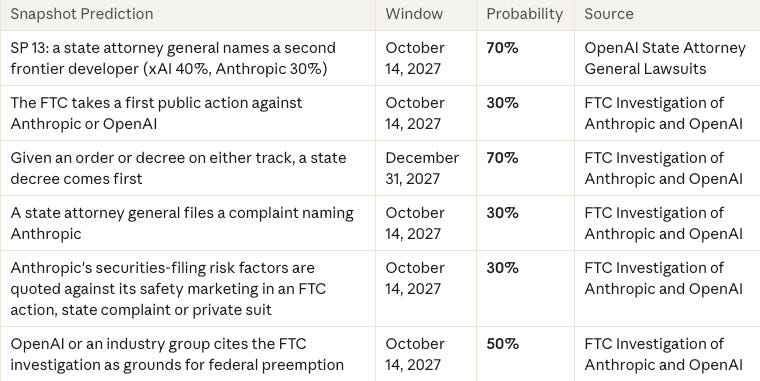
Reading D · Regulator-first resolution. Attorney general decrees and FTC orders set remedies and compensation before private claims mature, so private pleading dynamics matter little. The cited Snapshot Prediction that a state decree precedes any FTC order (70%) is consistent with this reading. Falsifier: private deployer suits proceed and amend before any decree or order carrying a compensation term.
The forecasts rest on Reading A. Reading B is its strongest rival, and the two can hold together: doctrine supplies the theory while coverage decides when the theory is worth pleading against a given defendant. Readings C and D would flatten the coverage differences Reading A depends on, so the event table in Section III tracks both.
Takeaway. Coverage redirection survives its rivals when amendments follow insurance disclosure, exclusions persist and private suits outrun regulators.
IX. The Simulation Run: How a Sued Deployer’s Case Branches
A simulation tested Finding 1 against California’s rules on paying within limits and refined the paper’s mechanism. Claim size matters only through incremental recovery: what an added allegation, defendant or policy would recover against the cost of adding it.
Five Cognitive Digital Twins (CDTs) played out a sued deployer’s case. Each CDT carries the objectives, constraints and decision rules of one party.
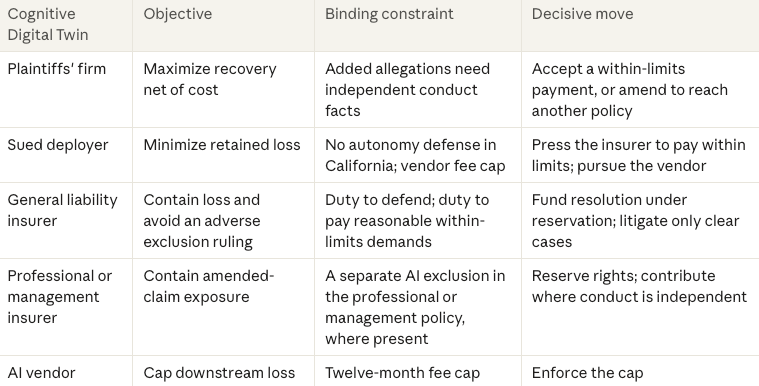
The insurer’s duty to settle decides which cases end early. Comunale v. Traders & General Ins. Co. (1958) requires an insurer to accept a reasonable offer within limits when an excess judgment is likely. Johansen v. California State Auto. Assn. Inter-Ins. Bureau (1975) bars it from refusing such an offer on coverage doubts. Blue Ridge Ins. Co. v. Jacobsen (2001) lets it pay over the insured’s objection and seek reimbursement, provided it reserved rights, gave notice and offered the insured the defense. Where those rules apply, the run forecasts that the insurer pays to end the case before any court reads the AI exclusion (EX-P2, 70%).
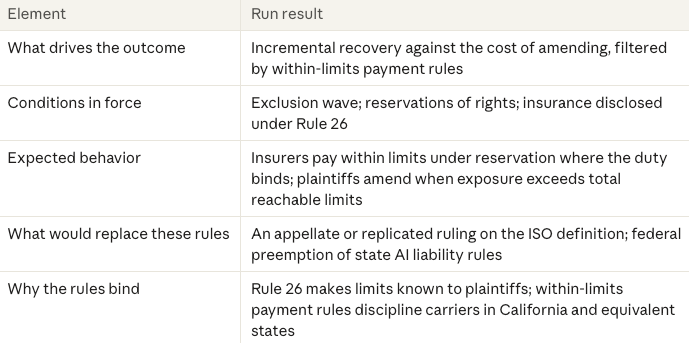
Three branches and a tail route. The run sorts each sued deployer’s case by what an added allegation or defendant would recover.
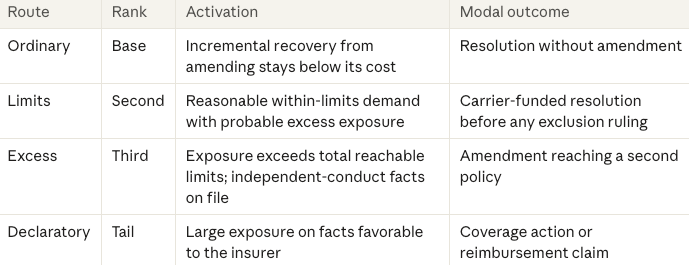
Rank orders the paths from the run’s base route to its tail route and does not measure market frequency. Each Simulation Prediction applies only to cases on its branch.
Recovery moves upstream on the deployer’s money. An insurer that paid nothing after invoking an exclusion holds no subrogation right. The deployer therefore funds any claim against its vendor, and the vendor’s fee cap limits what that claim returns.
Takeaway. A sued deployer’s case branches on incremental recovery, and the insurer’s duty to settle decides which branch ends quietly.
X. MindCast Simulation Predictions and Watch Conditions
The forecast set keeps four tiers separate: primary and secondary Simulation Predictions from this paper’s simulation, cited Simulation Predictions from earlier MindCast work and watch conditions without probabilities. EX-P marks a primary and EX-S a secondary Simulation Prediction, and W marks a watch condition. Data cutoff is November 4, 2026; each cited entry keeps the window, band and falsifier of its source paper.
New Simulation Predictions (four, in tens of percent). Section IX sets out the run and the authorities behind the limits branch. Each primary entry resolves against court filings that reveal the applicable limits: amended complaints and motions attaching Rule 26 disclosures, declaratory or reimbursement complaints, and bad-faith or excess-judgment suits. Cases where no filing reveals limits, or where the plaintiff could not observe the carrier’s position before the amendment deadline (Section II), count toward neither outcome.
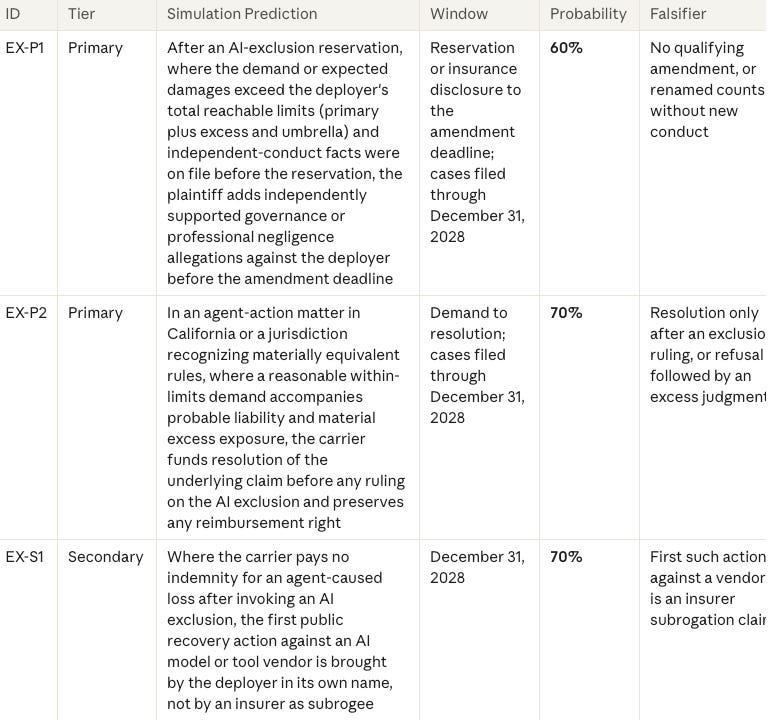

Foundation: cited Simulation Predictions (eight)
Foundation: cited Snapshot Predictions (six, in tens of percent)
Watch conditions (seven). Each is a claim derived in this paper, not a Simulation Prediction, and carries no probability. Each names the observable that would confirm it and the evidence that would overturn it.
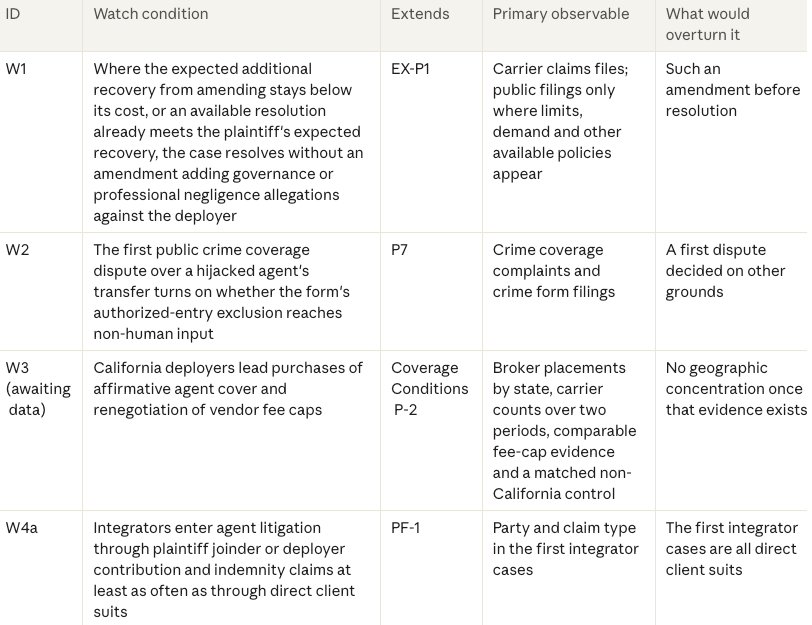
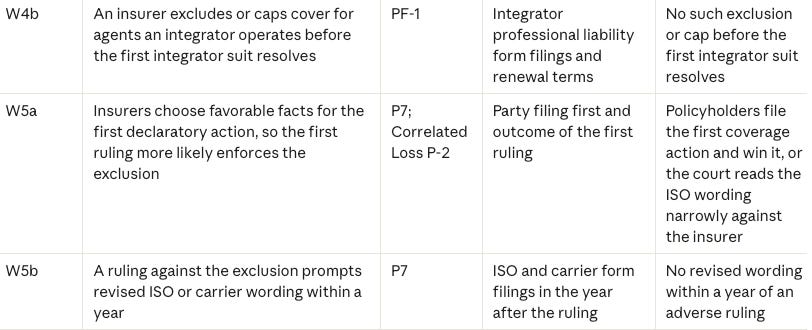
Takeaway. The primary predictions test the mechanism, the secondary predictions track where recovery flows, and the watch conditions name the evidence that would confirm or overturn each remaining claim.
XI. Risk Mitigation: Decisions to Make Before the Next Ruling
Each row ties a forecast to a decision the recipient makes with its counsel or broker. Probability comes from the cited prediction where available; severity depends on the recipient’s limits, retained loss and contractual position. Four rows cover wording decisions that carrier product and forms teams control.
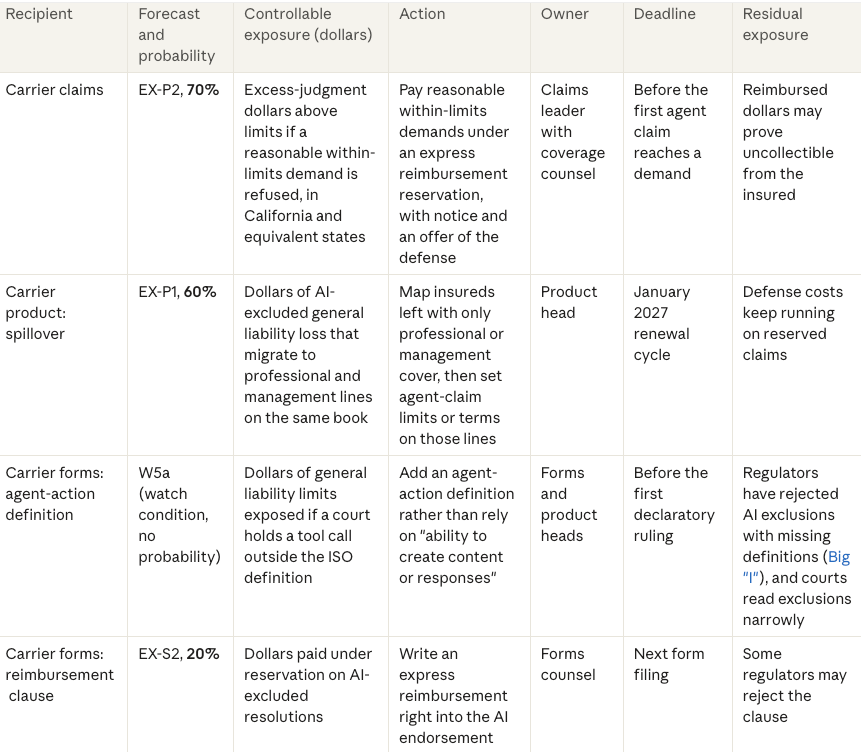
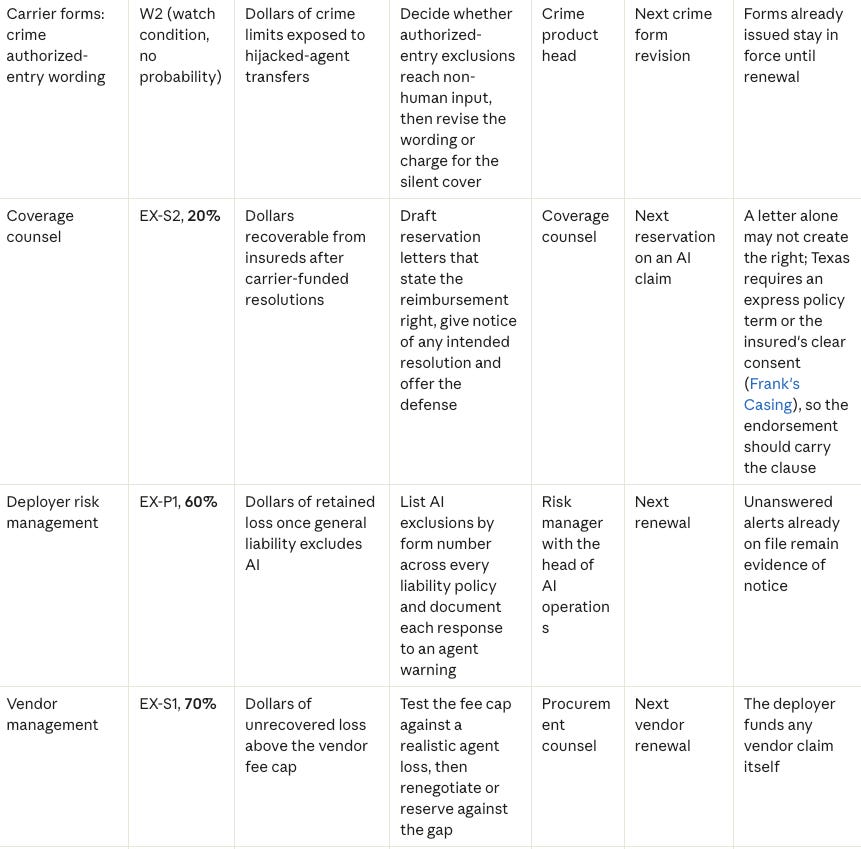
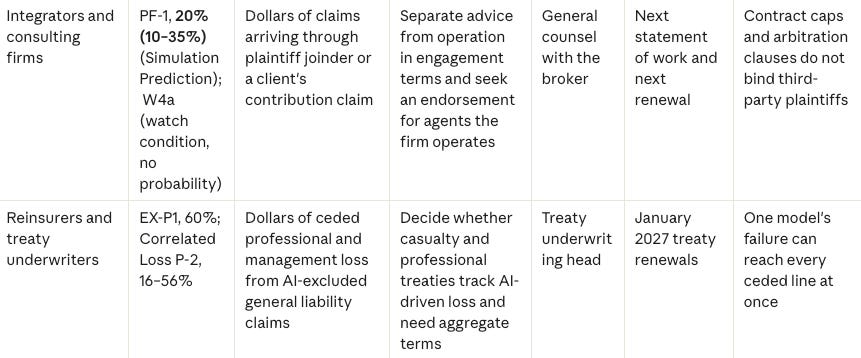
Takeaway. Each audience can change its exposure now, before a ruling or a reused complaint sets the terms.
XII. Conclusion
Coverage redirection runs on incremental recovery. A plaintiff expands a claim when another allegation, defendant or policy adds enough recovery to justify the move, and the insurer’s duty to settle decides which cases end before any exclusion ruling.
The immediate decision belongs to carriers and to the firms that deploy and operate agents. Carriers should count AI-exclusion reservations across unrelated insureds, while deployers and integrators should fix contract and coverage terms before the next renewal.
What confirms or overturns the thesis. The thesis strengthens when the first sued deployer with exposure above its total reachable limits faces an amendment adding independently supported governance or professional allegations before the amendment deadline (EX-P1). The thesis weakens if that case passes the deadline without such an amendment, or if added defendants cluster in original complaints rather than after insurance disclosure. A case whose limits never appear in a court filing counts toward neither outcome.
Working With MindCast
The paper runs one sued deployer through one coverage game. A commissioned simulation runs the same game on a client’s own book. Public filings fix what the paper can see: insurance disclosures, form filings and dockets. A client holds the facts the paper leaves as ranges. Limits by line, reservation practice, vendor fee caps and treaty terms decide which branch each of the client’s cases enters.
MindCast loads those facts into the five Cognitive Digital Twins (CDTs) of Section IX and reruns the four branches. Predictive Behavioral Economics + Dynamic Game Theory supplies the method. Game theory sets each node’s payoffs and equilibrium, and behavioral economics sets the decision rules each institution actually follows. Branch weights, Simulation Predictions with windows and falsifiers, and watch conditions come back for the client’s own cases.
What a client’s facts change. Each finding in the paper rests on public ranges. The table names the client facts that replace each range and what the simulation returns.
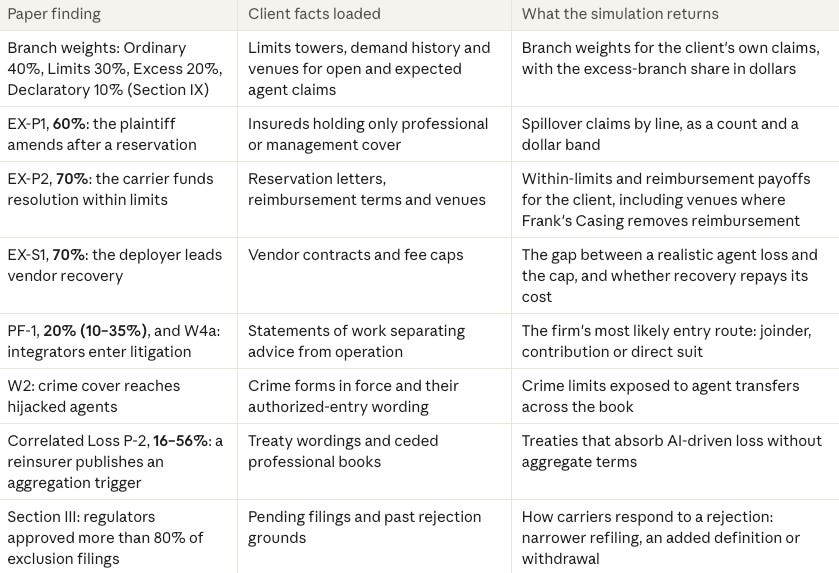
A pilot, worked through. A California carrier holds a reserved agent claim against a deployer insured. The plaintiff demands an amount within limits, and liability looks probable. Johansen bars the carrier from refusing on coverage doubts, so refusal exposes it to the excess judgment. The pilot runs the claim through the within-limits node and returns EX-P2 at 70%: the carrier funds resolution before any exclusion ruling.
The decision the pilot informs comes before the demand arrives: a reservation letter that states the reimbursement right, gives notice of the resolution and offers the defense. Without that letter, payment forfeits recovery. With the letter, the carrier keeps a reimbursement right it rarely presses in public (EX-S2 at 20%). In Texas the letter alone fails under Frank’s Casing, so the pilot flags the endorsement as the carrier’s next filing decision.
Every engagement below returns the same structure for its own decision: the node, the forecast, the action window and the condition that would change the answer.
Commissioned engagements by audience. Each decision in Section XI maps to one engagement.
Carrier claims. A claims decision game runs the client’s next agent demand through the within-limits and reimbursement nodes before the demand arrives.
Carrier product and forms. A portfolio spillover simulation forecasts where AI-excluded loss lands on the client’s professional and management lines before the January 2027 renewal cycle.
Reinsurers. A treaty accumulation simulation traces ceded loss from AI-excluded general liability claims ahead of January 2027 treaty renewals.
Deployers. A retained-loss simulation forecasts exposure across every policy and vendor contract the deployer holds.
Integrators and consulting firms. An integrator exposure war game forecasts how plaintiffs and sued clients reach the firm and when insurers restrict its cover (W4b).
Coverage and defense counsel. A forecast briefing models the opposing carrier’s and the plaintiff’s next moves in a live matter.
State insurance regulators. A filing-response simulation forecasts how carriers refile after a rejection and where excluded loss shifts once an exclusion is approved.
The MindCast Agentic Liability and AI Insurance Exclusions Value Proposition Q4 2026 (publication pending) sets out each engagement and its inputs.
How an engagement runs.
The client names one live decision or exposure from the list above.
MindCast runs a complimentary pilot on public filings and that decision. The pilot returns Simulation Predictions with windows and falsifiers.
Both sides review the pilot against the client’s own judgment and the next public event in its window.
A retained engagement under a nondisclosure agreement loads the client’s policies, claims and contracts. MindCast adds a monitoring plan tied to the dockets and filing systems that carry the leading indicators.
A commissioned war game adds the client’s counterparts as CDTs and plays the six turns from complaint to the game’s response. The MindCast Agentic Liability and AI Insurance Exclusions War Game Q4 2026 (publication pending) shows the format, and an interactive version lets risk owners make the moves.
Why the window is now. Two Section XI deadlines fall in the January 2027 renewal cycle, and most others fall at the next renewal. P7 resolves on March 31, 2027. The first declaratory ruling sets the reference point every later forecast must absorb, and a pilot started now reports before it.
Scope. MindCast forecasts how institutions respond to one another. Counsel, brokers and forms teams decide what to draft, file or pay.
Contact. mcai@mindcast-ai.com · www.mindcast-ai.-simulationcom
Takeaway. The paper forecasts where an agentic loss lands for a sued deployer in public view. A commissioned simulation forecasts where the same loss lands on the client’s own balance sheet before the first ruling.
Appendix A. MindCast Publications and Value Propositions
Publications
When AI Agent Liability Meets Common Law and Statute. Carries P1, P6, S3, P7 and P18 and maps the four doctrines.
Agentic Foreseeability and the Modern Duty of Care for AI Agents. Sets the foreseeability test plaintiffs plead.
Who Sets the Agentic Standard of Care: Common Law, State Legislation and Federal Coordination. Finds insurers closest to the deployment clock.
Who Writes AI Insurance Coverage Conditions — Procurement, Enforcement Decrees, Partner Terms and the Two-Axis Condition. Maps the exclusion wave, the affirmative market and the vendor fee cap.
Who Absorbs Correlated AI Loss — Reinsurance Aggregation, Industry Pools, the Public Backstop and the Liability Shield. Carries the capital bottleneck and the aggregation trigger.
OpenAI State Attorney General Lawsuits: Two Pleading Templates Across Ten State Courts. Traces the templates other offices and plaintiffs reuse.
OpenAI Liability War Game: When AI Safety Controls Reduce Exposure and When They Become Evidence. Shows which safeguards cut exposure and which become evidence; an interactive version lets the reader make the moves.
FTC Investigation of Anthropic and OpenAI. Carries the cited Snapshot Predictions on the federal track.
How Plaintiffs Turn Insurer AI Governance Standards Into Evidence. Shows plaintiffs extending discovery along filed templates.
How Insurers Defend AI Claims Decisions When Their Own Governance Standards Become Evidence. Shows accumulation through a shared claims vendor.
How Consulting and Audit Firms Become Liable for the AI Agents They Run for Clients. Carries PF-1 and the operating-control test.
The Calculus of Predictive Game Theory Evolution and Mutation. Sets forecast depth in short- and long-horizon games.
Value propositions (Q4 2026)
MindCast Overview Value Proposition. The method and the practice areas it serves.
MindCast Predictive Game Theory Evolution and Mutation Value Proposition. When to act, when to wait and how far a forecast reaches.
MindCast Agentic Foreseeability, Duty of Care and Insurance Value Proposition. Ten simulations on what a deployer must find out, which fixes prove control and who holds the loss.
MindCast Agentic Common Law and Statutory Liability Value Proposition. Simulations of who controls the agent, who gets sued and who keeps the loss.
MindCast Second Seat Value Proposition: Mixed Time Horizon Insurance Carrier Exposure. An overview and three papers on plaintiffs, defendants and consulting and audit firms.
MindCast OpenAI Liability War Game. Five exposures, six dated turns and five alternative moves.
Appendix B. External Sources
PropertyCasualty360: General Liability Endorsements, Generative AI. Text of CG 40 47, CG 40 48 and CG 35 08.
Cloud Security Alliance: AI Insurance Exclusion Wave (August 2026). Carrier reading of “arising out of” and Berkley’s absolute exclusion.
California AB 316, Civil Code section 1714.46. Chaptered text barring the autonomy defense.
Hunton: Fifth Circuit Says Computer Fraud Requires More Than Incidental Use of a Computer. Apache Corp. v. Great American.
Rivkin Radler: Authorized Entry Exclusion Precluded Coverage for Hacking Loss. District court decision in Aqua Star v. Travelers (2016).
Covington: Federal Courts of Appeals Clarify Scope of Computer Fraud Coverage. Medidata and American Tooling Center.
Federal Rule of Civil Procedure 26. Rule 26(a)(1)(A)(iv) requires disclosure of insurance that may pay a judgment.
WHINS: How Are AI Exclusions Showing Up in Technology E&O Insurance. Broad and narrow AI exclusions on technology errors and omissions forms.
Seyfarth via JD Supra: Colorado Enacts Artificial Intelligence Replacement Law. SB 26-189 scope and January 1, 2027 effective date.
Buchalter: Colorado Rewrites Its AI Law. Developer-deployer fault framework and the void indemnity clause.
Actuary.info: AI exclusions in management liability, citing S&P Global Market Intelligence via The Insurer (July 23, 2026). Count of 41 property and casualty groups filing to exclude generative AI and 20 filing to delay.
ConductAtlas: OpenAI Business Terms, aggregate liability cap at twelve months of fees. Text of the twelve-month fee cap and its frequency across tracked platforms.
Actuary.info: CGL AI Exclusions and 80 Percent State Approval. Regulators approved more than 80% of AI exclusion filings, citing The Information (April 2026).
Big “I”: Endorsement and Exclusion Filing Trends for 2026. Grounds on which regulators rejected AI exclusions, including overly broad wording and missing definitions of generative AI.
Insurance Journal: AIUC Emerges From Stealth With $15M Seed. AIUC-1 audits and liability coverage tied to audit results.
Armilla AI: Lloyd’s-Backed Coverage Rises to $25M. Standalone AI liability policy covering agent failures.
Redberry Labs. AI liability insurance for organizations deploying autonomous agents.
Business Wire: Counterpart Introduces Agentic Insurance. AI-powered underwriting and claims for management and professional liability.
Armilla: Broker Resources. Names Armilla’s capacity partners.
HSB Introduces AI Liability Insurance for Small Businesses (March 18, 2026). AI liability cover added to partner carriers’ business policies.
AI Weekly, summarizing the Wall Street Journal: AI Firms Rack Up Tens of Billions in Potential Liabilities. Developer exposure against per-policy caps near $50 million.
The Insurability Frontier of AI Risk (arXiv, 2026). The aggregation question for reinsurers.
Comunale v. Traders & General Ins. Co. (1958) 50 Cal.2d 654. Duty to accept a reasonable offer within limits when an excess judgment is likely.
Johansen v. California State Auto. Assn. Inter-Ins. Bureau (1975) 15 Cal.3d 9. Coverage doubts do not excuse refusing a reasonable within-limits demand.
Blue Ridge Ins. Co. v. Jacobsen (2001) 25 Cal.4th 489. Reimbursement after paying over the insured’s objection, subject to reservation, notice and an opportunity to assume the defense.
Aqua Star (USA) Corp. v. Travelers Casualty and Surety Co., No. 16-35614 (9th Cir. Apr. 17, 2018) (unpublished). Applies the exclusion for data entered by a natural person with authority to enter the insured’s system.
Excess Underwriters at Lloyd’s v. Frank’s Casing Crew & Rental Tools (Tex. 2008) 246 S.W.3d 42. No reimbursement without an express policy right or the insured’s clear consent.
Blank Rome via JD Supra: The Ninth Circuit Reconfirms an Insurer’s Heavy Burden on Exclusions. Narrow reading of exclusions and the insurer’s burden of proof.