
MindCast — AI Accountability: When AI Promises Meet the Courts series
Oracle, OpenAI, and the Capacity Economy — Inside the AI Infrastructure-Financing Lawsuit
Apple’s AI Illusion Narrative Control and the Law’s Search for Structural Truth
Related series: AI Governance Economics
I. What the AI Accountability Series Is About
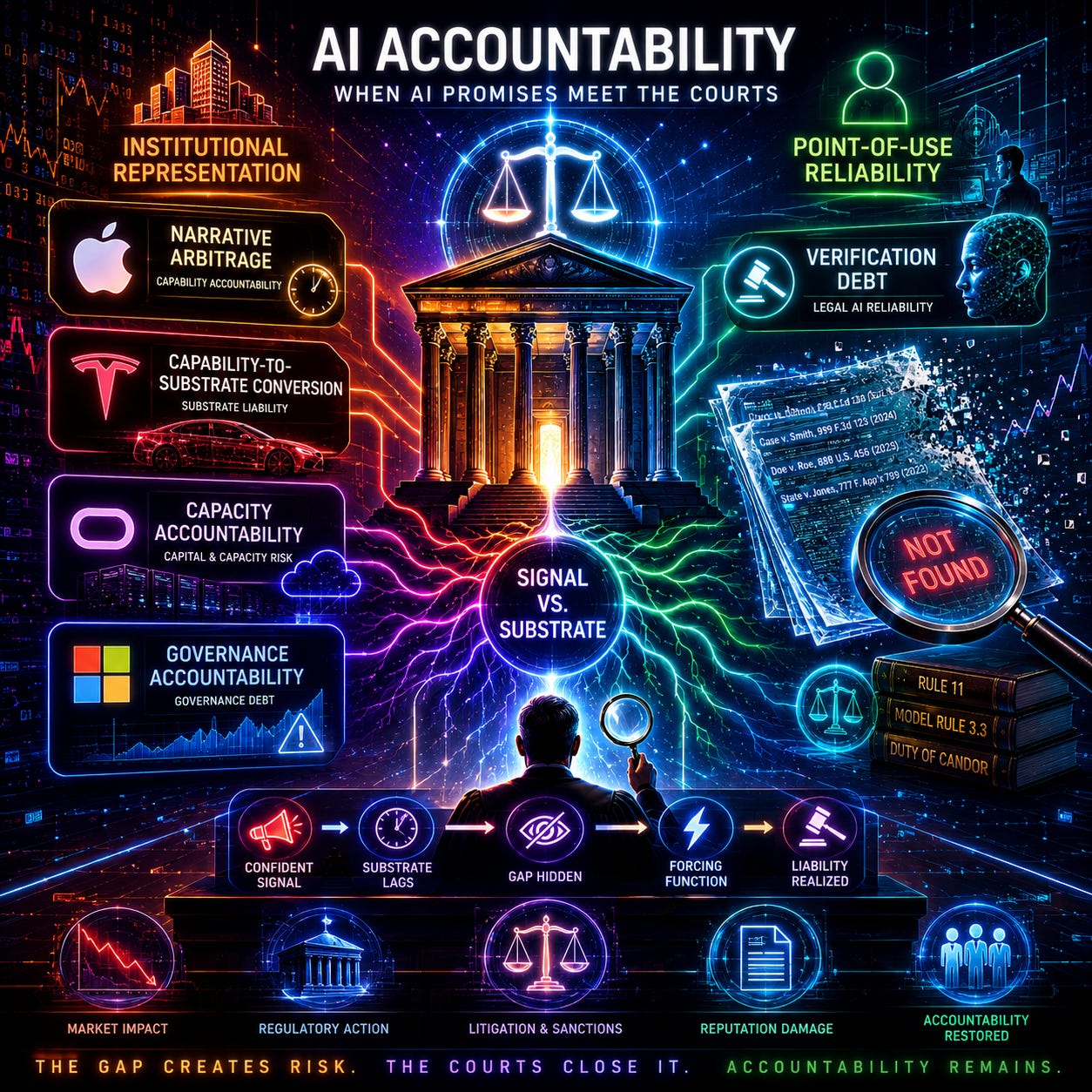
Companies and professionals make confident claims about artificial intelligence. The operating reality underneath those claims often lags, strains, or contradicts them. A forcing function — a market correction, a regulator, a judge — eventually reconciles the claim with the reality, and the reconciliation lands in a courtroom. The series tracks that collision across industries and case types, and reads each instance through a single structural lens rather than as isolated news.
One sentence holds the whole series together: an AI-related claim becomes a legal liability at the moment the gap between the claim and the substrate beneath it can no longer be hidden. Every installment is a study of that gap — how it forms, how long it stays concealed, what forces it into the open, and what it costs when it surfaces.
The series exists because the gap is becoming the defining risk of the AI era. Capability is now abundant and broadly available; the durable exposure has shifted to whether institutions and professionals can accurately forecast, govern, and disclose what their AI does once deployed. Litigation is where that failure becomes visible, priced, and precedential, which makes the courtroom the natural observatory for the transition. Courts are the one institutional mechanism that forces signal and substrate into the same evidentiary record — the place where what a company said and what was actually true must finally be set side by side and reconciled.
II. The Unifying Structure — Signal and Substrate
Each installment examines a gap between a confident AI-related signal and the substrate beneath it. The signal is what gets broadcast — a capability claim, a growth narrative, a fluent citation. The substrate is what actually exists — the engineering, the capacity, the spend, the underlying authority. Liability accrues in the distance between the two, and a forcing function converts the accrued distance into a judgment, a sanction, or a repricing.
Naming the forcing function is the analytic move the series repeats. Capability claims break on a capability event — an admission, a failed demonstration. Allocation claims break on a financial event — an earnings miss, a capex disclosure. Reliance failures break on an external check — a judge who verifies the citation. The kind of gap predicts the kind of collapse, and sorting cases by that signature is how the series turns a pile of lawsuits into a pattern.
Contact mcai@mindcast-ai.com to partner with us on Predictive Game Theory AI in Law and Behavioral Economics. To deep dive on MindCast works upload the URL of this publication into any LLM (preferably Google AI mode/Gemini, Claude, ChatGPT) and prompt ‘reconstruct MindCast framework with three degrees of cited sub links.’ See Live-Fire Game Theory Simulators, Runtime Predictive Infrastructure.
MindCast AI is a cybernetic, predictive game-theory AI firm specializing in law and behavioral economics, applied to complex litigation, innovation systems, and geopolitical risk intelligence. Rather than extrapolating historical patterns, the firm models the mechanisms that generate institutional behavior, running Cognitive Digital Twin simulations grounded in Nash equilibrium, Stigler information economics, and the Chicago School of law and behavioral economics.
Related series:
Cybernetic Overview of The MindCast Consumer AI Device Series
The Power Stack, How Energy Infrastructure Became the New AI Battleground
III. The AI Accountability Taxonomy
Sorting the cases into types is the contribution that outlasts any single matter, and the sort runs along two levels. At the macro level the series splits into two branches. The first is institutional representation — companies whose public AI claims outran the reality beneath them. The second is point-of-use reliability — professionals whose trust in an AI’s output outran the substrate beneath it. The two branches share one skeleton, a signal trusted past its substrate until a forcing function collects the difference, which is why they belong in a single series; they differ in who does the trusting and in the event that exposes the gap.
Within institutional representation, four named types have emerged, each anchored by a worked case and each identified by the kind of event that exposes it.
Narrative arbitrage — capability accountability. A company sells a capability that does not yet exist as though it were delivered, and harvests the valuation premium until the gap surfaces. Apple anchors the type: the “Apple Intelligence” timeline, presented as ready and then deferred, surfacing in paired securities and consumer actions. The forcing function is a capability event — an admission or a missed delivery date.
Capability-to-substrate conversion. A capability claim hardens over time into a fixed liability in the physical substrate that was supposed to deliver it. Tesla anchors the type: Full Self-Driving sold against Hardware 3 that cannot run it, with the admission that the installed hardware needs replacement converting a forward-looking promise into a present shortfall. The type is the hinge, because it shows how a capability case becomes an infrastructure case once the substrate binds.
Capacity accountability. A company conceals or understates the capital, financing, counterparty concentration, and revenue timing beneath an AI infrastructure buildout. Oracle anchors the type: enormous capex and off-balance-sheet lease exposure staked on a single counterparty’s ability to pay. The forcing function is a financial event — a credit warning, an earnings miss, an off-balance-sheet disclosure.
Governance accountability. A company fails to forecast and disclose the institutional consequences of its own AI deployment as continuous operating reality outruns periodic disclosure. Microsoft anchors the type: Azure capacity rationing behind a demand narrative, read as Governance Debt. The forcing function is an earnings surprise that collapses the gap in a single session.
The four types are not static, and the movement among them is the series’ central population-level finding: the docket’s weight is shifting from the capability types that opened the era (Apple, Tesla) toward the capacity and governance types that now reach the largest operators (Oracle, Microsoft). Capability litigation polices what a company says its AI can do; capacity and governance litigation police what a company discloses about the cost and the consequences of running it.
Point-of-use reliability is the separate axis, the series’ second branch rather than a fifth institutional type. Here the trusting party is a user rather than an issuer — a professional who relies on AI output without verifying it — and the forcing function is an external check rather than a market event. The opening reliability installment examines AI hallucinations in legal practice, where lawyers filed fabricated citations and courts answered with escalating sanctions, and names the failure Verification Debt — the liability that accrues when AI generation outruns human checking. The skeleton is identical; the actor and the forcing function differ.
IV. The Method and Its Foundations
In plain terms before the detail: a company sends a signal about its AI, the substrate beneath that signal lags or contradicts it, the gap stays hidden for a while because no mechanism forces it into view, and then a single event — an earnings call, a downgrade, a judge checking a citation — drags the signal and the substrate into the same record, at which point the accumulated gap converts into liability. The series traces that one sequence through every case:
Signal (what gets communicated) ↓ Substrate (what actually exists) ↓ Latency (the period the gap stays concealed) ↓ Governance Debt (the liability accruing inside that latency) ↓ Forcing Function (the event that collapses the gap) ↓ Liability (the reconciliation, priced or adjudicated)
What separates the series from ordinary litigation commentary is the apparatus underneath that sequence. Each installment runs the case through a synthesis of four disciplines, then through a foresight simulation built on top of them. The disciplines are not decoration; each answers a specific question the others cannot.
Chicago law and economics answers why the behavior is rational rather than aberrant. The series reads corporate conduct through the sequence Coase → Becker → Stigler → Posner: coordination failure leaves no enforced industry standard to bind a firm’s claims (Coase), so overstatement becomes the rational way to maximize capital formation and lock-in (Becker), managed through the gap between what the firm knows and what it discloses (Stigler), until legal correction arrives only after observable harm (Posner). What a court treats in isolation as “puffery” the sequence reveals as a predictable response to incentives — which is why the misconduct recurs across firms rather than reflecting one bad actor.
Predictive institutional cybernetics answers why the gap accrues and when it collapses. Drawing on the control-theory tradition of Wiener, Ashby, Beer, and Bateson, the series models each institution as a feedback system in which a fast engineering loop (the product improving) runs ahead of a slow trust loop (belief, disclosure, and legitimacy correcting). The latency between the two is where Governance Debt accumulates — the undisclosed liability between continuous operating reality and a periodic disclosure rhythm — and an external forcing function is what finally forces the slow loop to reconcile.
Game theory answers why the equilibrium persists until something external breaks it. The series uses a dual-equilibrium architecture: a Nash behavioral equilibrium in which transactions continue, sitting atop a Stigler cognitive equilibrium in which trust in the information environment holds. A firm can satisfy the first while the second has already failed, and the system stays stable until a forcing function collapses the separation between forums — the moment a claim made in a marketing forum can no longer survive in a securities or regulatory forum. Naming that forcing function, and the delay-dominant incentives that precede it, is the series’ recurring analytic move.
Behavioral economics answers why the signal works on its audience. Categorical language (”Full Self-Driving,” “ready now”) triggers binary expectations even where the product delivers probabilistic, gradient performance, and the series treats that installed cognitive grammar as the mechanism that makes a narrative profitable in the first place — a firm running signal-ahead-of-substrate selects categorical terminology because gradient terminology would not support the premium.
On top of the four disciplines sit the proprietary instruments the installments share, documented in the MindCast Predictive Cybernetics Suite: the Cognitive Digital Twin foresight simulation, which models how an institution’s own trajectory diverges from its disclosure; the Cognitive Signal Integrity diagnostic, which decomposes the gap between stated and executed action; and the recurring constructs that travel across every case — narrative arbitrage, Governance Debt and its individual-level twin Verification Debt, registration lag, and the forcing function that collapses forum separation. A reader who follows the series accumulates a reusable toolkit rather than a sequence of opinions.
Two complementary modes of reasoning bind it together. One reasons from a single institution outward, building a general claim from one case’s mechanism; the other reasons from the population inward, testing whether the claim survives across the whole docket. Run together, the institution supplies the mechanism and the population supplies the evidence that the mechanism recurs — each mode checking the other’s characteristic weakness.
V. The Installments
Branch One — Institutional Representation
Apple’s AI Illusion: Narrative Control and the Law’s Search for Structural Truth reads the iPhone 16 “Apple Intelligence” campaign as the founding case of narrative arbitrage. Apple presented a generative-AI feature set, including a reimagined Siri, as ready and foundational to the product, then deferred the promised capabilities to 2026 or later — after roughly $900 billion in market value had ridden on the timeline. The analysis traces how confident public representations were coordinated with undisclosed internal engineering limits, surfacing in paired forums: a Rule 10b-5 securities action (Tucker v. Apple) and a California false-advertising action (Landsheft v. Apple). Apple anchors capability accountability — the type in which a company is held to answer for selling a capability that did not yet exist.
Tesla’s Self-Driving Revolt: Full Self-Driving, Hardware 3, and the Warranty Substrate Apple’s AI Illusion Already Mapped follows the same narrative-arbitrage architecture across a far longer horizon and shows it mutating into something harder. Tesla sold Full Self-Driving for years against Hardware 3 that, by the company’s own January 2025 admission, cannot deliver the promised autonomy and requires physical replacement across roughly four million vehicles. The capability claim hardened into a fixed liability in the physical substrate meant to fulfill it, converting a forward-looking promise into a present shortfall. Tesla anchors capability-to-substrate conversion and serves as the hinge of the series — the case that shows how a capability dispute becomes an infrastructure dispute once the substrate binds.
Oracle, OpenAI, and the Capacity Economy — Inside the AI Infrastructure-Financing Lawsuit moves the series from what AI promises to what the buildout costs. Oracle assured investors that its escalating capital expenditure — climbing toward roughly $50 billion in a single fiscal year — would convert into revenue almost immediately, while the financing reality told a different story: roughly $248 billion in off-balance-sheet lease commitments, a credit profile under strain, and a single counterparty, OpenAI, projected to supply more than a third of future revenue under a $300 billion commitment the buyer may be unable to fund. Read as a population-level study, Oracle anchors capacity accountability — the type in which a company answers not for whether its AI works but for whether markets were told the truth about the capital, financing, and counterparty concentration beneath the buildout.
The Microsoft Shareholder Suit and the Arrival of AI’s Third Phase — Why the Next Competitive Edge Is Forecasting the Institution, Not Building the Model examines a company that allegedly let its demand narrative outrun its disclosed operating reality. Shareholders contend Microsoft framed Azure and Copilot growth in terms its internal capacity rationing could not sustain, and that the gap surfaced in a single corrective session. The installment reads the exposure as Governance Debt — the liability that accrues when continuous operating reality outpaces a periodic disclosure rhythm. Microsoft anchors governance accountability, the type in which a company answers for failing to forecast and disclose the institutional consequences of its own AI deployment.
Branch Two — Point-of-Use Reliability
The Legal Citation That Never Existed shifts the subject from companies to professionals. As lawyers across multiple jurisdictions filed briefs citing cases that do not exist — fabrications generated by AI tools and submitted without verification — courts answered with escalating sanctions, suspensions, and public reprimands, from a $2,500 federal appellate penalty to a Mississippi judge who removed every lawyer from a case to Canada’s record cost order. The installment locates the failure not in the hallucination itself but in the unverified reliance on it, and names the result Verification Debt — the liability that accrues when AI generation outruns human checking, the individual-level twin of the institutional Governance Debt the Microsoft installment diagnoses. The piece anchors the reliability branch — the axis on which a user, rather than an issuer, trusts an AI signal past its substrate.
The Through-Line
Across all five, one structure repeats: a confident AI-related signal is trusted past the substrate beneath it, the gap accrues quietly while concealment or inattention holds, and a forcing function — a market correction, an earnings session, a judge — eventually collects the difference. The installments differ only in who does the trusting and in what breaks the concealment. Apple and Tesla answer for capability promised before it existed; Oracle and Microsoft answer for the cost and consequences of the infrastructure running the AI; the reliability branch answers for output relied upon without verification. Read in sequence, the four institutional cases also trace a movement — the docket’s center of gravity shifting from capability disputes against smaller vendors toward capacity and governance disputes against the largest operators — and that migration, more than any single case, is what the series exists to document.
The structure beneath the migration is more durable than the migration itself: a signal, a substrate, a concealment period, a forcing function, a reconciliation. The sequence is independent of the technology that happens to fill it, which is why the framework should outlast the present AI docket — a future case enters the series to be classified rather than forcing the series to be rebuilt. Of all the constructs the series carries, the forcing function is the one most likely to survive, because it names the event that any concealment, in any domain, eventually meets.
VI. Roadmap — Where the Series Can Extend
The architecture leaves clear room to grow, and the gaps suggest the next entries. Branch one can extend to additional capacity and governance defendants as the docket climbs toward the largest operators, and to the consumer-protection flank where AI marketing claims meet false-advertising law. Branch two can extend to point-of-use reliability failures in other high-stakes verticals — medicine, finance, engineering, journalism — each of which inherits the same fluency-suppresses-verification control problem the legal vertical surfaced first.
Policing is the sharpest of those frontiers, and the one that bends the branch rather than simply extending it. Where a lawyer’s reliance failure surfaces through professional discipline, a law-enforcement reliance failure — a facial-recognition misidentification, an AI-drafted police report, an automated alert treated as established fact — surfaces through a different forcing function entirely: a suppression motion, a wrongful-arrest claim, a constitutional challenge. The party harmed is not the AI’s user but a third party with rights, which makes policing less a clean extension of the legal-citation case than a distinct sub-pattern. The series flags it now and will develop it when a clean anchor case arrives, rather than force the analysis ahead of the record.
A third branch may eventually open where the two meet: cases in which an institution’s deployment of an unreliable AI to its own customers becomes both a representation failure and a reliability failure at once.
The series ends where the transition it tracks ends — when forecasting accuracy and verification discipline become standard practice rather than competitive advantage, and the gap between AI’s promises and its substrate stops generating a docket. Until then, the courtroom keeps supplying the evidence, and the series keeps reading it.
VII. Intellectual Lineage and Sources
The framework synthesizes four established literatures, and the series names them so a reader can trace the analysis to its roots rather than take the constructs on faith.
The law-and-economics layer draws on the Chicago tradition: Ronald Coase on transaction costs and the firm (”The Nature of the Firm,” 1937; “The Problem of Social Cost,” 1960), Gary Becker on the economic analysis of non-market behavior and incentives (”Crime and Punishment: An Economic Approach,” 1968), George Stigler on the economics of information and regulatory behavior (”The Economics of Information,” 1961; “The Theory of Economic Regulation,” 1971), and Richard Posner on the economic analysis of law (”Economic Analysis of Law,” 1973). MindCast’s own Chicago School Accelerated series carries that tradition into the AI era, integrating behavioral economics into the Coase–Becker–Posner sequence and applying the lowest-cost-avoider calculus directly to AI-liability allocation.
The cybernetics layer draws on the control-theory tradition: Norbert Wiener on feedback and communication (”Cybernetics,” 1948), W. Ross Ashby on requisite variety and homeostasis (”An Introduction to Cybernetics,” 1956), Stafford Beer on management cybernetics and the viable system model (”Brain of the Firm,” 1972), and Gregory Bateson on the cybernetics of mind (”Steps to an Ecology of Mind,” 1972). The game-theoretic layer rests on John Nash’s equilibrium work (”Non-Cooperative Games,” 1951), recombined with Stigler into the dual-equilibrium architecture the series uses. The behavioral layer extends the bounded-rationality and cognitive-bias literatures — Herbert Simon, Daniel Kahneman and Amos Tversky, and Richard Thaler — into the installed-cognitive-grammar construct that explains why categorical AI claims move the audiences that read them.
MindCast’s own apparatus, built atop the four literatures above, is documented across a dedicated body of work rather than asserted in passing. The MindCast Predictive Cybernetics Suite is the umbrella, developed through three foundational installments — Predictive Institutional Cybernetics, The Cybernetic Foundations of Predictive Institutional Intelligence, and From Cybernetic Proof to Simulation Infrastructure — which establish the Cognitive Digital Twin methodology, the Causal Signal Integrity diagnostic, and the five-layer causation stack the installments share. A companion piece, The Computational Era Operationalizes Cybernetics and Predictive Game Theory, sets out how the Chicago School and behavioral-economics foundations enter the runtime stack. The architecture is the subject of a provisional patent application on the multi-agent institutional-simulation design, filed April 2026, and the method has carried into peer venues through Infrastructure Routing Control: The Operative Antitrust Trigger in AI Energy Markets, published in the CPI Antitrust Chronicle (April 2026) and explained here. Each installment cites the specific prior MindCast analyses it builds on, so the corpus is internally cross-referenced rather than free-standing.
Appendix — Cited MindCast Works
Every MindCast source referenced above, grouped by role, with linked titles.
The Series Installments
Apple’s AI Illusion: Narrative Control and the Law’s Search for Structural Truth
Oracle, OpenAI, and the Capacity Economy — Inside the AI Infrastructure-Financing Lawsuit
The Legal Citation That Never Existed — the reliability-branch opener on AI hallucinations, the duty to verify, and Verification Debt.
Framework Foundations
MindCast Predictive Cybernetics Suite — the umbrella that establishes the runtime architecture.
Predictive Institutional Cybernetics — Installment I; Cognitive Digital Twins, Causal Signal Integrity, and equilibrium detection.
The Cybernetic Foundations of Predictive Institutional Intelligence — Installment II; the intellectual lineage from Wiener forward.
From Cybernetic Proof to Simulation Infrastructure — Installment III; the validation record and simulation infrastructure.
The Computational Era Operationalizes Cybernetics and Predictive Game Theory — how the Chicago School and behavioral-economics foundations enter the runtime stack.
Chicago School Accelerated — MindCast’s modernization of Chicago law-and-economics with behavioral economics, developed across the Coase, Becker, and Posner installments; the Posner installment applies the lowest-cost-avoider calculus to AI-hallucination liability.
Patent and Peer-Venue Publication
MindCast Files Provisional Patent Application on Multi-Agent Institutional Simulation Architecture — the provisional patent announcement, filed April 2026.
Infrastructure Routing Control: The Operative Antitrust Trigger in AI Energy Markets — CPI Antitrust Chronicle, April 2026.
The Routing Layer Is the Antitrust Trigger — the companion post explaining the CPI argument.
AI Accountability: When AI Promises Meet the Courts is a publication series of MindCast AI LLC. Each installment stands alone and contributes to a cumulative structural account of AI-era liability. Litigation facts are drawn from public filings and the court record; unproven matters are flagged as allegations; structural readings carry confidence bands and falsification contracts.