
Snap Inc. · West Virginia · Utah · Texas · Arkansas · Pennsylvania · New Mexico · Nevada · Florida · OpenAI · Meta · Snap’s liability carriers
Companion to West Virginia v. Snap — What OpenAI’s Published GPT-4 Limits Prove About Snap’s Knowledge Before the My AI Rollout
Related works Agentic Foreseeability and the Modern Duty of Care for AI Agents · Who Writes AI Insurance Coverage Conditions — Procurement, Enforcement Decrees, Partner Terms and the Two-Axis Condition · Meta Foresight-to-Duty Conversion Across Privacy, Child Safety and Scam Ads · OpenAI State Attorney General Lawsuits — Two Pleading Templates Across Ten State Courts Decide Which Game Theory Evolution Arrives First · Interactive OpenAI Liability War Game · The Foresight-to-Duty Conversion — Measured Governance Debt Becomes Evidence When Institutions Keep the Gap They Found · Agentic AI Liability and Insurance Exclusions — How Coverage Redirects Who Gets Sued
Live tracker · AI Enforcement and Litigation Tracker follows federal, state and private AI actions and rates nine common law doctrines as expanding, narrowing or shifting.
Executive Summary
West Virginia sued Snap over My AI on November 5, 2026. My AI is the Snapchat chatbot that Snap launched on OpenAI’s GPT models; Google’s Gemini has also powered it since September 2024. The complaint cites OpenAI’s March 2023 GPT-4 limitations to allege that Snap knew the risks before the public rollout (West Virginia v. Snap Inc., No. CC-20-2026-C-1339, ¶¶150–152). OpenAI published those limitations after My AI’s February 27 soft launch and before its April 19 rollout.
Eight states now sue Snap, and none names OpenAI in those cases. Four of them also sue OpenAI separately over ChatGPT: Florida, Arkansas, West Virginia and Texas. The four states hold both sides of the supplier question, since each accuses OpenAI of misleading consumers and pleads My AI against Snap. Snap can use the OpenAI cases to argue that the warnings were too weak to give notice, while OpenAI can use West Virginia’s Snap complaint as the state’s own acknowledgment that it published the risks.
Thesis: A model provider’s published warning gives a state a dated notice allegation against the company that deploys the model. Whether the allegation becomes liability turns on two contests. One asks whether a court requires proof that the deployer received and acted on the warning. The other asks whether the cases resolve before any court answers.
What distinguishes the MindCast approach: The paper treats the eight state actions as one contest on separate clocks rather than eight lawsuits. Meta’s August 2026 agreement with state attorneys general names Snap a Core Industry Member, so each state’s leverage now depends on Meta’s terms as much as on its own complaint.
MindCast AI applies Predictive Behavioral Economics + Dynamic Game Theory through MindCast AI Proprietary Cognitive Digital Twin Foresight Simulations (MP CDT FS). Behavioral Economics supplies the decision rules. Game Theory supplies the payoff structure. Predictive simulations emerge from the combination.
What the paper does: The paper dates the warning inside Snap’s launch window, maps all eight cases and profiles the ten actors who decide whether the notice allegation reaches a court. Sections on trial dates and Meta’s agreement then show what shapes each state’s incentive. Two forks and four competing explanations lead to three Simulation Predictions, followed by the events that would change them, a risk mitigation layer and what to watch.
Why now: West Virginia filed three days after Snap resolved the claims of two more Los Angeles bellwether plaintiffs during jury selection. Nevada and New Mexico have trials set for August 2027, according to Snap’s Form 10-Q for the quarter ended September 30, 2026. Five groups face a decision before that date: AI deployers and model providers, state enforcers, insurers and investors.
Simulation Prediction highlights: The forecast set holds three MindCast Simulation Predictions on a November 6, 2026 evidence cutoff, stated in full in Section VIII. At least one attorney general action against Snap resolves before the first trial opens (60-80%). The first resolution in a state inside Meta’s framework carries Meta-style age-assurance and teen time-limit controls (65-85%).
🏛 Policymakers: State attorneys general are already using general consumer-protection statutes to challenge AI-chatbot conduct. Chatbot bills now in drafting should state whether a supplier’s published warning counts toward a deployer’s notice.
💼 Executives: A supplier’s published limit starts a clock the deployer does not control. Launch files should show who reviewed each supplier disclosure and what changed as a result.
⚖ Counsel: Snap’s February 27 disclaimer already shows general knowledge of the risk, so receipt decides only what OpenAI’s warning adds. The defense that matters most is proof that Snap’s April 2023 safeguards were live before the April 19 rollout.
📊 Investors: Snap’s exposure now runs through Meta’s terms. A resolution in any framework state is likely to carry product controls as well as cash.
🛡 Insurers: The December 10 hearing concerns bodily-injury coverage, so no court has yet addressed coverage for these eight attorney general cases. When one does, the complaints’ pleaded knowledge facts will frame the duty to defend before discovery reaches Snap’s safeguards.
🧠 Model providers: One published limit now serves two state theories at once: concealment against the supplier and notice against the deployer.
I. OpenAI’s Published GPT-4 Limits Fell Between My AI’s Soft Launch and Public Rollout
Two explanations. Two explanations compete for what a published supplier warning does. Under the evidence explanation (Hypotheses B and C below), the warning creates a dated notice opportunity, and liability turns on proof linking it to Snap’s knowledge and rollout decisions. Under the resolution explanation (Hypothesis A), the notice allegation shapes the terms of a resolution before any court tests it.
The warning’s timing. West Virginia’s complaint offers the cleanest test. OpenAI’s GPT-4 limitations appeared on March 14, 2023 and again in the March 27 revision of the GPT-4 Technical Report, inside My AI’s launch window.
The supplier doctrines. Product-liability law already handles a supplier warning that shifts a duty downstream. Under the learned intermediary doctrine, a drug maker meets its duty to warn by warning the prescribing physician. Under the sophisticated intermediary doctrine, a bulk supplier can discharge its duty by warning a knowledgeable buyer (Restatement (Second) of Torts § 388, comment n).
The deployer-notice theory runs the doctrine in reverse: it asks whether the supplier’s warning helps prove what the deployer knew. The doctrine therefore guides the analysis without governing it.
Why OpenAI is not a defendant. The doctrines suggest one reason the states left OpenAI out of the Snap cases: a supplier that warns a knowledgeable buyer can shift the duty to that buyer. The simpler reason is that Snap controls the consumer-facing product and made the challenged statements to families. States that want OpenAI sue it directly, as four of Snap’s eight plaintiff states have done over ChatGPT.
Snap’s defenses. Snap’s strongest answer turns on specificity. OpenAI’s warnings were generic and reached every GPT-4 customer. If publication alone created notice, every deployer would know every published limit, and the standard would approach strict liability. The argument pushes courts toward a warning that names the harm and the user group, here children.
Snap’s own statements. Snap’s own statements narrow the specificity defense. Snap’s February 27 launch post, as Coinspeaker reported, warned that My AI was “prone to hallucination and can be tricked into saying just about anything.” Snap’s April 4 post said Snap was adding OpenAI’s moderation technology to its existing tools before the public rollout. The April 4 post shows Snap engaging with the supplier’s safety tools inside the launch window.
Snap’s posts cut both ways. A disclaimer supports Snap against a deception claim while it supports the states on knowledge, and West Virginia’s complaint itself acknowledges Snap’s warning that users should not rely on My AI’s advice. Pennsylvania pleads the Washington Post’s March 14 test (¶77), a notice fact that needs no supplier at all.
Snap’s answer has a second prong. OpenAI’s March limits described GPT-4, while Snap launched My AI on February 27 on a customized OpenAI GPT model before GPT-4’s public release. Which model ran My AI on April 19 is a discoverable fact. Google’s Gemini has also powered My AI since September 2024, so any penalty period that runs past that date crosses a second supplier’s published limits.
Executives: A supplier warning that names a harm and a user group carries more weight than a generic limitation.
Takeaway: The warning dates a notice opportunity, and specificity decides how much it proves.
II. Seven of Eight State Complaints Plead My AI, and None Names OpenAI
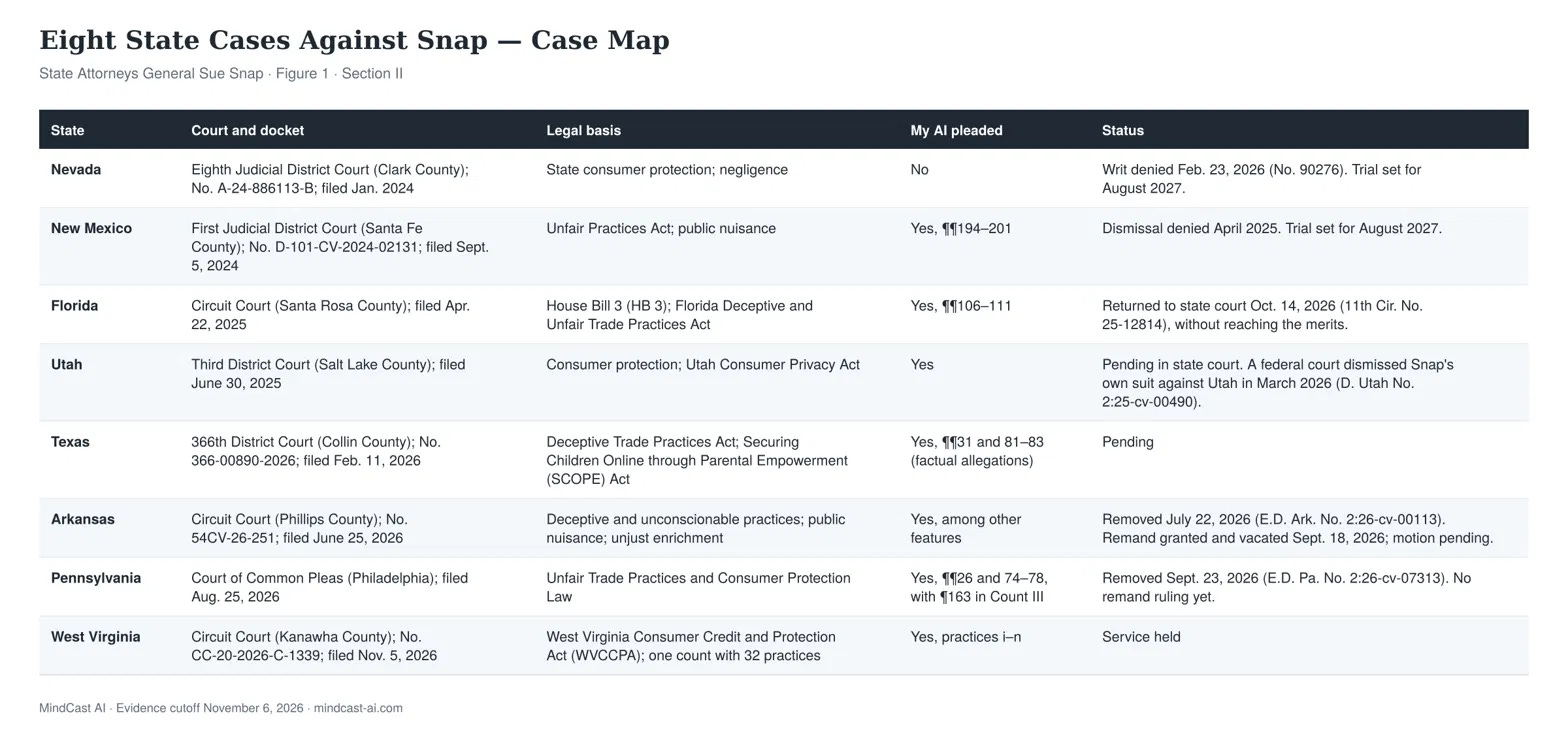
Seven states plead My AI facts against Snap, and Nevada alone does not. New Mexico’s amended complaint pleads My AI at ¶¶194–201, as Snap’s November 18, 2024 motion to dismiss acknowledges. Snap’s motion never argued against those paragraphs. When the court denied the motion in April 2025, as Legal Newsline reported, the My AI allegations moved into discovery without a ruling on them.
The broader state enforcement contest has survived procedural challenges, although Florida’s remand did not reach the merits. The Nevada Supreme Court denied Snap’s writ petition on February 23, 2026. The Eleventh Circuit sent Florida’s case back to state court on October 14, 2026. A My AI ruling would add a new theory to an existing contest rather than open one.
Case map. Figure 1 below lists each state’s court and docket, legal basis, My AI pleading and status.
What is known, discoverable and unknowable.
Known from public filings.
OpenAI’s warnings post-date the soft launch and pre-date the public rollout.
Snap’s Apr. 4, 2023 post responded to the Washington Post’s March 14 test failures.
Snap resolved the claims of all four Los Angeles bellwether plaintiffs set for trial, across three trial settings. The latest two came on Nov. 2, 2026 during jury selection.
Snap sued its carriers on Sept. 15, 2025 over bodily-injury coverage. A duty-to-defend motion is set for Dec. 10, 2026.
West Virginia’s penalty reaches $5,000 per violation for repeated and willful violations under W. Va. Code § 46A-7-111.
New Mexico’s April 2025 order denied dismissal.
Discoverable.
Whether Snap’s product team received or reviewed OpenAI’s published limits.
Snap’s internal testing behind Utah’s charge that Snap exposed young users to “experimental AI technology”.
Whether Snap applies the same approach to attorney general cases.
Whether any policy responds to attorney general defense costs, penalties or restitution.
The contract and indemnity terms between Snap and OpenAI.
Whether that order addresses the My AI paragraphs.
Unknowable until actors move.
Which court first reaches a My AI theory, and on what ground.
Whether any attorney general case resolves before the first trial.
Whether any resolution carries My AI terms.
How other courts weigh a sister-state ruling.
Legislative response in the 2027 sessions.
Whether Snap joins Meta-style terms state by state.
Counsel: New Mexico’s My AI paragraphs have survived dismissal without a ruling on them, so no court has yet defined what a supplier warning proves.
Takeaway: Seven complaints plead My AI facts, Pennsylvania names the chatbot inside a count, and no court has tested any of them.
III. Ten Actors Decide Whether the Notice Allegation Reaches a Court
Each Cognitive Digital Twin (CDT) models one actor’s objective, constraint, revealed behavior and available moves from filings and disclosures. Where a motive stays unproven, the profile says so.
Figure 2 below profiles all ten actors, from Snap and the states to OpenAI and Snap’s carriers.
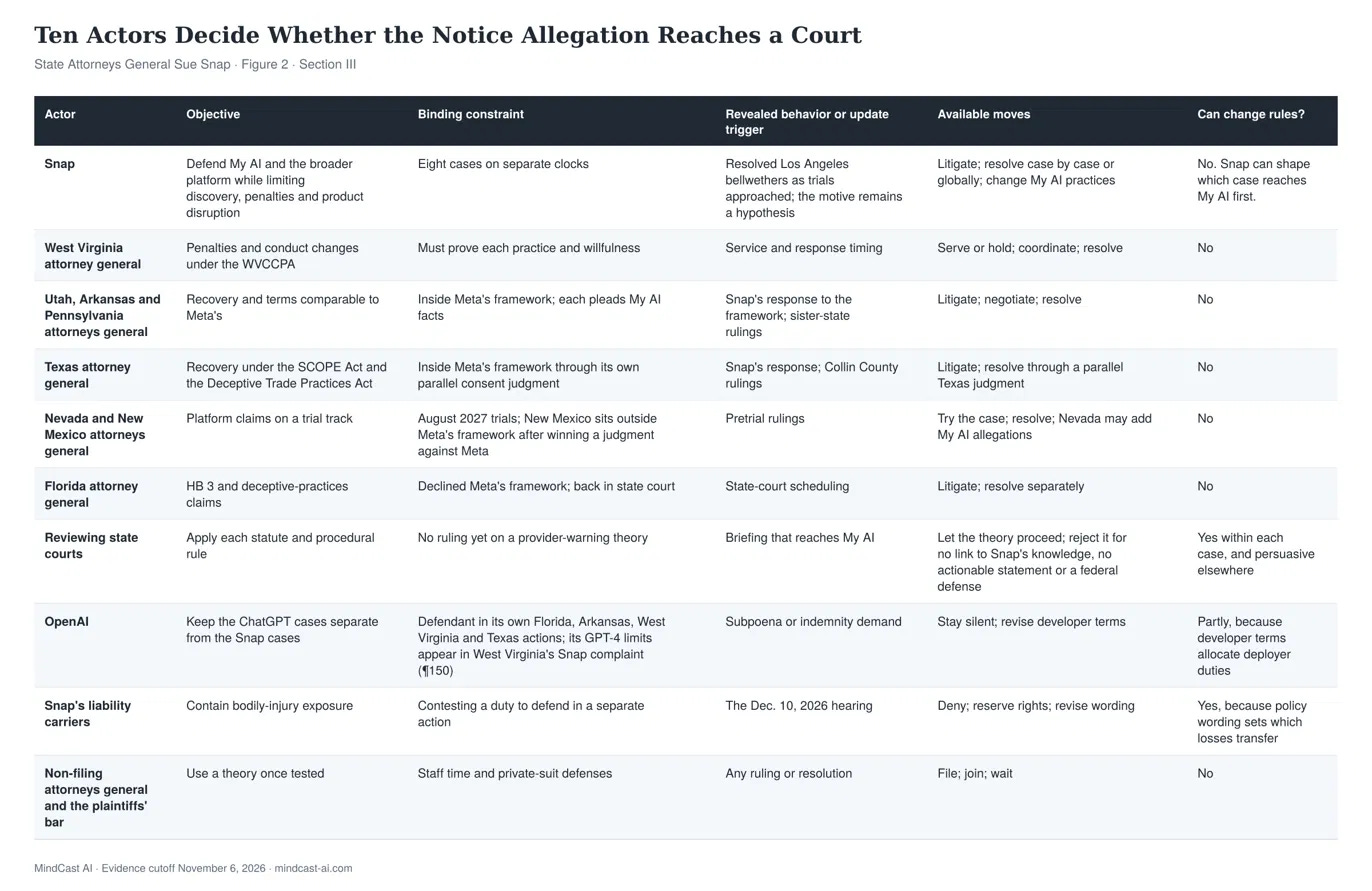
Courts decide the notice question case by case, and carriers decide coverage by policy wording. No single actor can resolve the notice question for all eight cases at once.
Readers can test the supplier’s side of the contest in the Interactive OpenAI Liability War Game. The game replays OpenAI’s moves from 2023 to 2026, lets readers play alternative moves and inject shocks, and shows five liability exposures open or close.
Model providers: West Virginia’s Snap complaint treats OpenAI’s limits as published, a characterization OpenAI can use against the concealment theory in West Virginia’s own case against it.
Takeaway: Courts, carriers and Snap each hold a different lever, and none controls the outcome alone.
IV. Trial Dates Force the Resolution Decision, and Snap Resolved All Four Bellwether Plaintiffs Before Verdict
Each of the eight cases carries its own payoff, and only a trial date forces a decision. A court that lets the notice theory proceed raises Snap’s exposure in that case and gives other courts a persuasive model. A court that rejects it lowers exposure there and leaves the platform-design claims intact. A resolution before any ruling removes the question from that case without answering it.
Dated turns.
T0. Aug. 26, 2026 (occurred).
Event: Meta’s agreement with 52 attorneys general.
Role in the analysis: Supplies a control template that a Snap resolution could adopt.
T1. Dec. 10, 2026.
Event: Duty-to-defend hearing in Snap’s bodily-injury coverage suit.
Role in the analysis: Conditional input; its reach to attorney general claims is unestablished.
T2. August 2027.
Event: First attorney general trials, in Nevada and New Mexico.
Role in the analysis: Anchors the timing fork.
T3. Undated.
Event: First ruling that reaches a My AI theory; Utah offers the likeliest path.
Role in the analysis: Anchors the legal fork.
T4. 2027 renewals.
Event: Carriers apply new wording to youth-harm and AI exposure.
Role in the analysis: Long-horizon follow-on.
The August 2027 trials test platform claims rather than the provider-warning theory, since Nevada pleads no My AI facts. The trials still govern every case, because a set trial date is the event that forces a resolution decision. Snap’s Los Angeles history shows resolution as trials approached. Attorney general cases carry different remedies and parties, so the history informs the timing question without deciding it.
Moves and their costs. Figure 3 below sets each actor’s moves against turn, cost and downside.
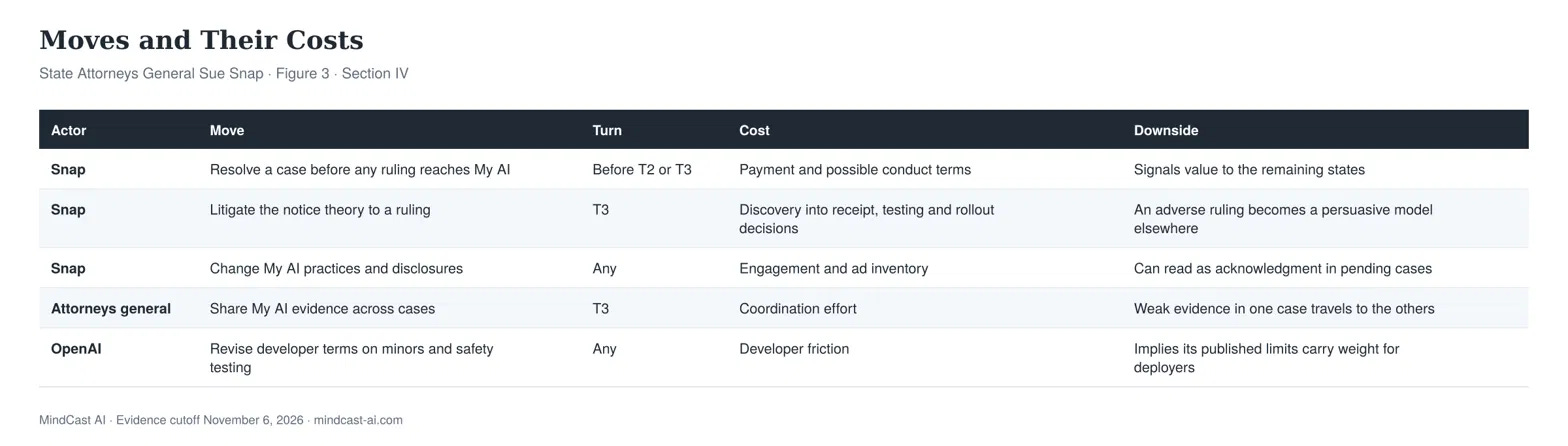
If no actor moves, Nevada and New Mexico approach trial on platform claims, and the My AI theory stays untested elsewhere.
Investors: The August 2027 trial dates set the latest point at which Snap’s resolution pattern either holds or breaks.
Takeaway: The first trial date is the only dated event that forces a decision.
V. Meta’s Framework Makes Each State Want Its Own Snap Commitment
Meta’s agreement with state attorneys general names Snap, TikTok and YouTube as Core Industry Members. The agreement’s tighter controls switch on in a state only after all three companies bind themselves there by consent decree, statute or verified voluntary compliance. Each participating state therefore gains from its own enforceable Snap commitment. A single joint judgment across states adds little to that structure.
Six states that sue Snap sit inside the framework. Meta’s participant list places Arkansas, Nevada and Pennsylvania in that group with Texas, Utah and West Virginia. Texas joined through its own parallel consent judgment and a larger payment. Florida declined, and New Mexico stayed out after winning its own judgment against Meta.
Snap’s cash does not count toward Meta’s contingent payments, because the payment test reaches only Core Industry Members with more than $10 billion in annual profit. Snap’s controls do count. The trigger first requires every Core Industry Member to adopt both teen time-management obligations in a state. Snap is one of them, so each framework state’s contingent Meta payments wait on Snap.
Industry-wide adoption requires both the overnight-access and daily-limit obligations plus binding age assurance, a higher bar than the minimum that Simulation Prediction S-2 (Section VIII) requires. Age assurance and teen time limits are platform-wide terms, so the first resolution is likely to carry them without any My AI-specific provision.
One sequence stands out as a watch item rather than a Simulation Prediction, and it runs through Nevada. Nevada pleads no My AI facts, so a Nevada resolution lets Snap concede platform controls without conceding anything about its chatbot. New Mexico is the likeliest trial holdout, since its judgment against Meta sets a high bar for any early offer. Utah offers the likeliest path to a court ruling that expressly addresses My AI.
Policymakers: Meta’s agreement already sets the controls a Snap resolution is likely to carry, so legislation would mainly add the chatbot terms the agreement omits.
Takeaway: Meta’s agreement gives each framework state a reason to seek Snap’s controls alongside its cash.
VI. Two Forks Decide the Outcome — When Cases Resolve and What Courts Require to Link a Warning to Knowledge
Figure 4 below maps both forks across the short and long horizons. The timing fork leads because it carries the only dated event. The legal fork carries the question AI deployers most need answered.
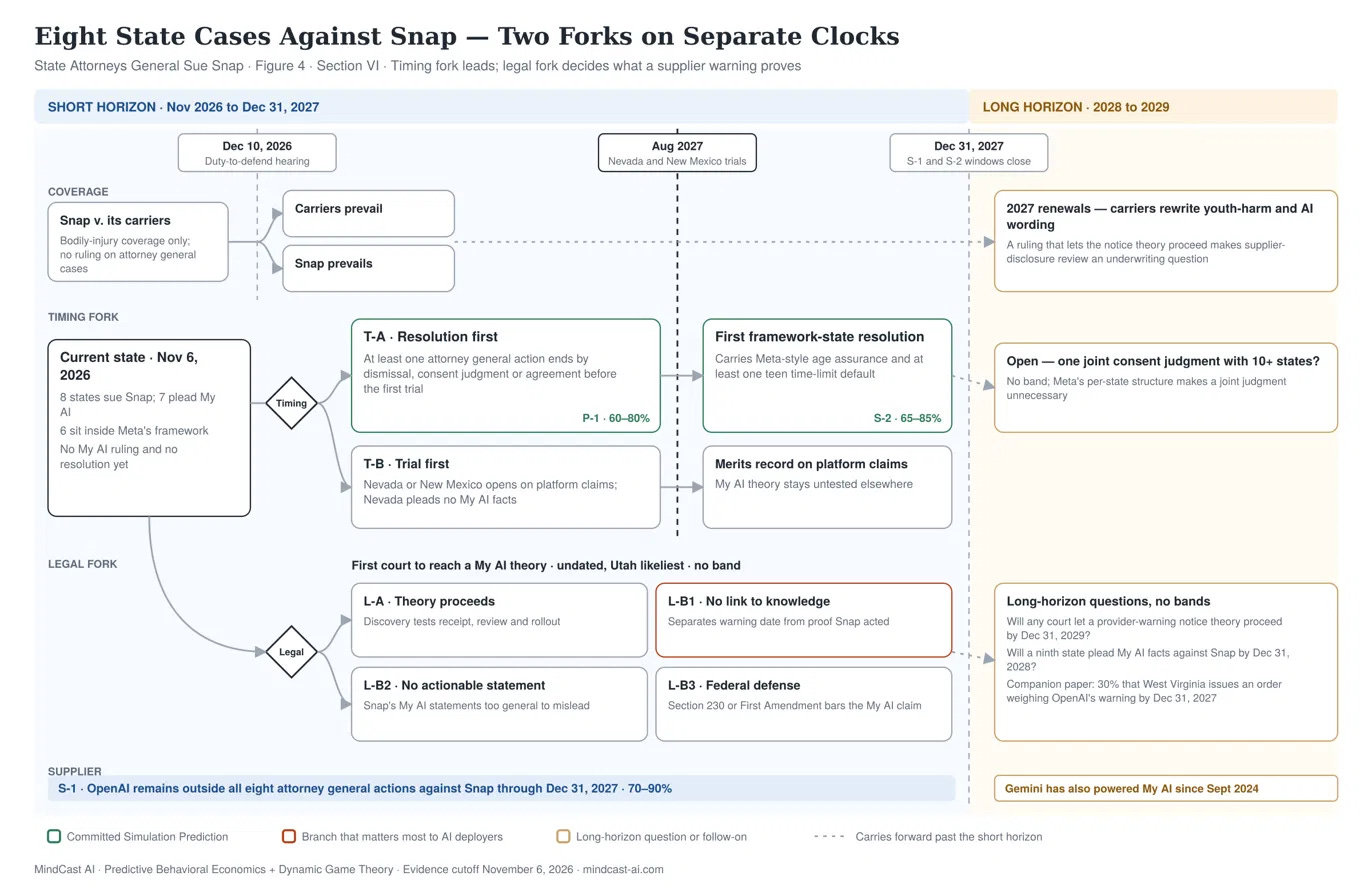
Timing fork: resolution before the first attorney general trial, or trial first
T-A. Resolution first. An attorney general case resolves before the first trial. Whether the terms address My AI stays an open observable.
T-B. Trial first. At least one attorney general case reaches trial and builds a merits case on platform claims.
Legal fork: what the first court to reach a My AI theory does with provider-warning evidence
L-A. Theory proceeds. The court lets the notice theory proceed on allegations that include OpenAI’s published limits. Discovery then tests receipt, review and rollout decisions.
L-B1. No connection to knowledge. The court rejects the claim because the pleadings do not link the warning to Snap’s knowledge or decisions.
L-B2. No actionable statement. The court finds Snap’s My AI statements too general to mislead.
L-B3. Federal defense. Section 230 or the First Amendment bars the My AI claim while platform claims continue.
Every legal-fork outcome informs other courts as persuasive authority, and none binds them. L-B1 matters most for AI deployers, because it would separate the date a warning appeared from proof that the deployer acted on it.
Supplier disclosure notice test. The legal fork implies a four-step test that courts, deployers and carriers can each apply.
Specificity. Did the warning address the harm and the population at issue?
Receipt. Did someone with authority over the launch receive it?
Review. Did the deployer assess the warning against its own product?
Response. Did the launch decision reflect that assessment?
The companion paper extends the test to five steps for West Virginia’s count by adding violation and penalty: West Virginia v. Snap — What OpenAI’s Published GPT-4 Limits Prove About Snap’s Knowledge Before the My AI Rollout.
The four-step test also adds an upstream publication step to the receive, fund and verify sequence in The Foresight-to-Duty Conversion — Measured Governance Debt Becomes Evidence When Institutions Keep the Gap They Found. The earlier paper shows how an institution’s own measurement becomes evidence of what it knew. The Snap cases test whether a supplier’s measurement can play the same role.
Figure 5 below shows how each actor class responds to each legal-fork outcome.
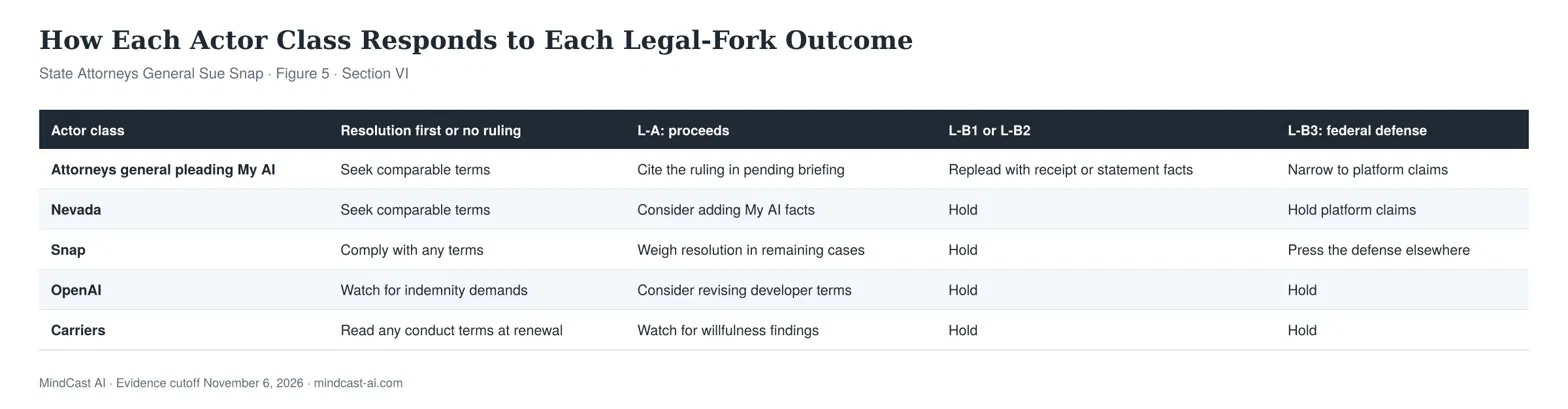
Counsel: A court that adopts the receipt step turns a publication date into a discovery target rather than proof.
Common law doctrines in play. Most of the eight state actions plead consumer protection statutes, while New Mexico and Arkansas add public nuisance and Nevada pleads negligence. MindCast’s AI Enforcement and Litigation Tracker rates seven of nine common law doctrines as expanding, and six of them bear on the Snap cases. The legal fork applies imputed knowledge to a new channel: a supplier’s published limits in place of a deployer’s own logs. Res ipsa loquitur is narrowing, because split control among developer, integrator and deployer can defeat the inference of negligence.
Why the common law carries the exposure. The state actions develop the knowledge facts, but the bodily-injury suits Snap’s carriers contest rest on common law claims. Snap’s April 4, 2023 safeguard announcement fits voluntary undertaking, so proof of what reached users on April 19 travels from the state cases into the insured claims. The legal fork therefore shapes Snap’s insured exposure even where no court rules on OpenAI’s warning.
Common law doctrines in play. Most of the eight state actions plead consumer protection statutes, while New Mexico and Arkansas add public nuisance and Nevada pleads negligence. MindCast’s AI Enforcement and Litigation Trackerrates seven of nine common law doctrines as expanding, and six of them bear on the Snap cases. The legal fork applies imputed knowledge to a new channel: a supplier’s published limits in place of a deployer’s own logs. Res ipsa loquitur is narrowing, because split control among developer, integrator and deployer can defeat the inference of negligence.
Why the common law carries the exposure. The state actions develop the knowledge facts, but the bodily-injury suits Snap’s carriers contest rest on common law claims. Snap’s April 4, 2023 safeguard announcement fits voluntary undertaking, so proof of what reached users on April 19 travels from the state cases into the insured claims. The legal fork therefore shapes Snap’s insured exposure even where no court rules on OpenAI’s warning.
Takeaway: The timing fork decides whether the notice question reaches a court, and the legal fork decides what a court requires.
VII. Four Explanations Compete for How the Notice Question Resolves
Each of the four explanations below carries its own falsifier, and the Simulation Predictions test them.
Hypothesis A · Resolution first: An attorney general case resolves before its trial and before any My AI ruling. Falsifier: a Nevada or New Mexico trial opens with no attorney general action resolved.
Hypothesis B · Notice theory proceeds: A court lets a My AI deception claim proceed on allegations that include the provider’s published limits. Falsifier: the first court to rule expressly on a My AI theory rejects it.
Hypothesis C · Notice theory rejected: A court rejects the My AI claim on knowledge, statement or federal-defense grounds. Falsifier: the first express My AI ruling lets the theory proceed.
Hypothesis D · No court reaches it: No court rules expressly on a My AI theory before the broader cases resolve or go to trial. Falsifier: a court issues an order that expressly addresses a My AI theory before the first trial opens.
The forecasts rest on Hypothesis A as the likeliest route. Hypotheses B and C compete on the legal fork, and the evidence does not yet favor either one. Hypothesis D holds unless Utah or another state forces an express ruling. The companion paper gives West Virginia a 30% chance of an order that squarely weighs OpenAI’s warning by December 31, 2027, consistent with Hypothesis D’s lead.
Counsel: Under Hypothesis A, the notice theory shapes terms without ever producing a ruling, so the first resolution’s text becomes the best evidence of its weight.
Takeaway: Resolution first is the leading explanation, and the legal fork stays open.
VIII. MindCast Simulation Predictions
The forecast set holds three MindCast Simulation Predictions: one Primary Simulation Prediction (P) and two Secondary Simulation Predictions (S). Each entry names an actor, an outcome, a window and a falsifier. Each resolves against court dockets and filed orders.
P-1 · At least one attorney general action against Snap ends by filed dismissal, consent judgment or enforceable agreement before the first attorney general trial opens in August 2027 (60-80%)
Mechanism: a set trial date forces a resolution decision, and Snap resolved the claims of all four Los Angeles bellwether plaintiffs set for trial before verdict.
Counting rule: a dismissal counts whether it follows an agreement or a court order, since either ends the action before trial. A court-ordered dismissal confirms the timing claim without confirming the negotiated route. If the trial dates move, the window moves with the first trial opening.
Falsifier: a Nevada or New Mexico trial opens with no attorney general action resolved.
Source: state court dockets and filed orders.
S-1 · OpenAI remains outside all eight attorney general actions against Snap through December 31, 2027 (70-90%)
Mechanism: the states already sue OpenAI directly where they choose to, and joining it to the Snap cases would merge a concealment theory and a notice theory that cut against each other. Snap would risk strengthening the notice theory by impleading the supplier whose warnings the states cite.
Falsifier: any state names OpenAI as a defendant, or Snap files a third-party claim against OpenAI.
Source: the eight dockets.
S-2 · The first attorney general action against Snap to resolve in a state inside Meta’s framework includes age-assurance terms and at least one teen time-limit default that track Meta’s controls by December 31, 2027 (65-85%)
Mechanism: Meta’s stricter terms take effect in a state only once Snap commits there, so each framework state gains a reason to seek Snap’s controls.
Condition: S-2 applies only if a framework state resolves an action against Snap by December 31, 2027, and lapses without a result otherwise.
Falsifier: the first such resolution omits age assurance or carries no teen time-limit default.
Source: the filed consent judgment or agreement.
Validated outcomes to date: none. No entry has reached its deadline, so the set shows no hit and no miss.
Open questions without a forecast band. The four questions below each carry their own observable.
Snap enters one consent judgment with ten or more attorneys general that adopts Meta’s standards by December 31, 2027. Meta’s per-state structure makes a single joint judgment unnecessary, and ten states would require attorneys general who have not sued. Observable: a filed joint consent judgment.
The first resolution with a state that pleads My AI carries My AI-specific conduct terms. Observable: the filed consent judgment or agreement.
A court issues an order that expressly addresses a My AI theory before the first attorney general trial opens. A general denial of dismissal does not qualify. Observable: court dockets and opinions.
Given such an order, the court lets the provider-warning notice theory proceed. Observable: the opinion’s treatment of publication and receipt.
Long-horizon questions. Will a court in any state let a provider-warning notice theory proceed by December 31, 2029? Will a ninth state plead My AI facts against Snap in a separately filed complaint by December 31, 2028? Will OpenAI expressly assign minors’ safety testing to deployers by December 31, 2027?
Takeaway: Resolution before trial leads the forecast set, and Meta’s controls are the likeliest content of the first resolution.
IX. Each Coming Event Changes the Moves and the Forecasts
Every forecast in this paper holds only inside the conditions that produced it. When an event changes those conditions, the Simulation Predictions either carry forward or give way to forecasts conditioned on the new state.
Events fall into three classes. Continuation adds information inside the current contest. An equilibrium shift changes which outcome persists. Game evolution changes what later decisions face: strategies and payoffs, or rules, players and timing.
Event E0 — Meta’s agreement with 52 attorneys general, Aug. 26, 2026 (occurred).
What changes. Payoffs and players. A control template now exists, and Snap becomes a Core Industry Member whose binding commitment each state needs.
Paths opened and closed. Opens a per-state route to Meta-style controls. Florida and New Mexico stay on separate tracks, and Texas participates through its own judgment.
Positions that survive, convert or strand. Framework states’ suits convert into bargaining positions. Florida’s and New Mexico’s suits survive as litigation tracks.
Moves gained and lost. Framework states gain a ready term sheet. Snap gains a reference point and loses the option to set terms alone.
Conditional Simulation Predictions. P-1 and S-2 apply in this state.
Class. Game evolution.
Forecast validity. Forecasts made before Aug. 26, 2026 that assumed separate bargaining require revalidation.
Current state. Eight cases run on separate tracks, and six of the states sit inside Meta’s framework. No court has ruled on a My AI theory, and no attorney general action has resolved. Arkansas and Pennsylvania sit in federal court pending remand, and the coverage question remains open.
None of the event outcomes below carries a forecast band.
Event E1 — the December 10, 2026 duty-to-defend ruling (scheduled).
Figure 6 sets out what changes if the carriers prevail and if Snap prevails.
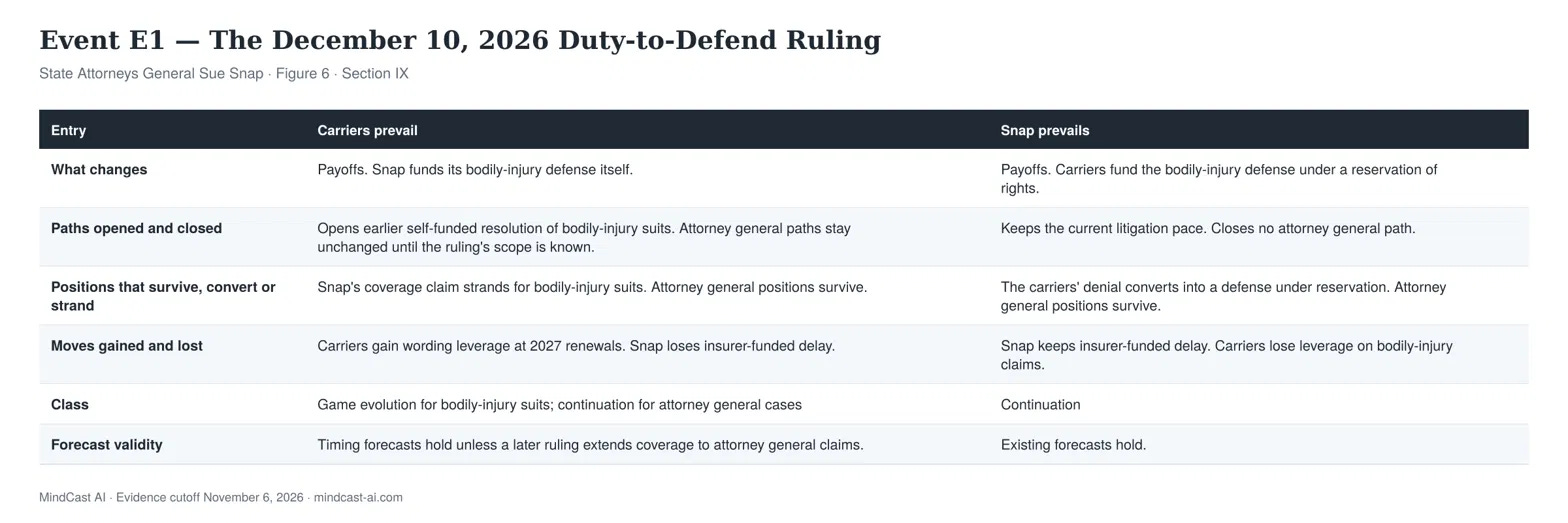
Two coming events reset the forecasts. Event E2 arrives with the first attorney general resolution or the first trial, and the August 2027 trial dates anchor its timing. Event E3 arrives with the first ruling that reaches a My AI theory, and no court has scheduled one. Figures 7 and 8 set each outcome against what changes, which paths open or close and which forecasts survive. A resolution in a state pleading My AI and a ruling that lets the theory proceed carry the widest reach, because each opens a path for the other My AI states.
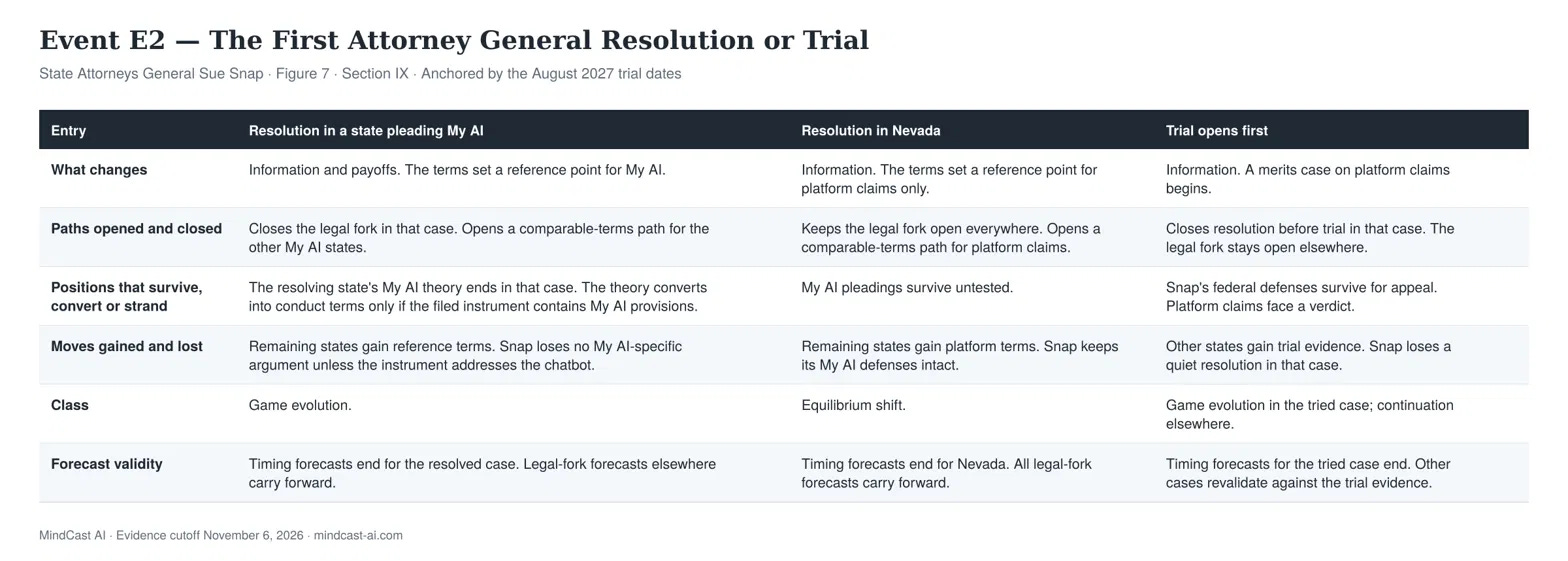
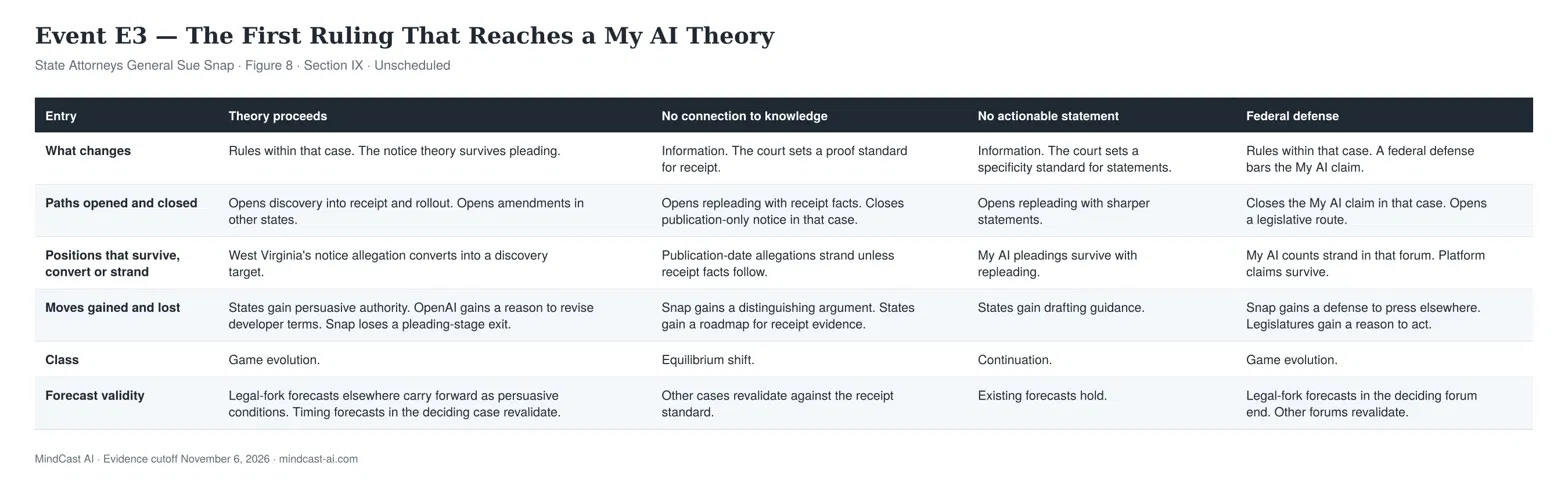
Unscheduled events of known type. A remand ruling in Arkansas or Pennsylvania counts as continuation, because it moves the forum without changing the claims. A new state filing counts as continuation unless it pleads a new theory. West Virginia’s service on Snap counts as continuation and starts that case’s clock. An OpenAI revision of developer terms counts as game evolution, because it hands deployers new duties and gives OpenAI a move it lacks today.
Feedback to model providers. A ruling that lets the notice theory proceed carries a market-wide consequence. If published limits count as deployer notice, model providers gain a reason to publish more and broader warnings, since each warning moves duty downstream at little cost to the provider. Deployers then face a growing body of notice they did not write. Their defense shifts to documenting how they reviewed each disclosure, which the four-step test structures.
Insurers: A ruling that lets the notice theory proceed would make supplier-disclosure review a coverage question at the 2027 renewals.
Takeaway: The event entries name the conditions that follow each scheduled or known event, so readers can track the contest without new analysis.
X. Risk Mitigation Layer
The five stakeholder entries below state exposure in a unit each audience controls, with severity and probability as separate axes and the band as the probability. Actions carry an owner and a deadline tied to the forecast checkpoints.
AI deployers · Provider-warning legal fork (no forecast band): Severity: high. Exposure: launches that proceed after a supplier publishes a relevant limit, measured in launches without a documented review.
Action 1: log every supplier safety disclosure against each product it touches, with the reviewer’s name and the launch decision that followed. Owner: head of product safety. Deadline: before the next model upgrade.
Action 2: add a receipt-and-review attestation to launch approval for features used by minors. Owner: general counsel. Deadline: the first quarter of 2027.
Residual: warnings published before the log existed remain dated notice opportunities.
Model providers · Provider-warning legal fork (no forecast band): Severity: moderate. Exposure: developer terms that leave deployer testing duties unstated, measured in deployers serving minors without an assigned testing duty.
Action 1: state in developer terms which safety testing the deployer owns for minor users. Owner: head of policy. Deadline: the next terms revision.
Action 2: publish warnings that name the harm and the population, so the warning carries weight with the deployer and not only the public. Owner: head of safety. Deadline: each model release.
Residual: a court can still read published limits as notice to every deployer.
State attorneys general and legislators · P-1 (60-80%), S-2 (65-85%): Severity: moderate. Exposure: resolutions that close cases without chatbot terms, measured in resolved cases with no My AI provision.
Action 1: pair Meta-style controls with a chatbot clause in any Snap term sheet. Owner: consumer-protection division chief. Deadline: before the August 2027 trial dates.
Action 2: draft chatbot legislation that defines the role of supplier warnings in proving deployer notice. Owner: judiciary committee counsel. Deadline: the 2027 sessions.
Residual: a resolution can still close the legal question before any court defines the standard.
Insurers · P-1 (60-80%): Severity: moderate. Exposure: renewals written without a view on supplier-disclosure review, measured in AI-exposed policies renewed without that question.
Action 1: add a supplier-disclosure review question to AI-exposed renewals. Owner: product underwriting lead. Deadline: the 2027 renewal cycle.
Action 2: read every Snap resolution’s conduct terms for controls that change youth-harm exposure. Owner: claims counsel. Deadline: within 30 days of each filing.
Residual: a ruling under Hypothesis B would reach policies already written.
Investors · P-1 (60-80%), S-2 (65-85%): Severity: moderate. Exposure: models that treat attorney general cases as cash-only, measured in valuation scenarios without product-control costs.
Action 1: add an age-assurance and teen time-limit scenario to Snap engagement models. Owner: sector analyst. Deadline: before Snap’s next earnings release.
Action 2: track resolutions in framework states separately from Florida and New Mexico. Owner: sector analyst. Deadline: continuous.
Residual: TikTok’s and YouTube’s positions also govern when Meta’s tighter controls switch on.
Takeaway: Every action builds a documented review or a term before a court or a resolution sets one.
Conclusion
Eight states sue Snap; seven plead My AI, and none names OpenAI. West Virginia’s complaint places OpenAI’s published GPT-4 limits inside My AI’s launch window. A dated warning gives the states a notice allegation, and proof of receipt and response decides how much it carries.
Snap resolved the claims of all four Los Angeles bellwether plaintiffs set for trial before verdict, and the August 2027 trial dates force the same decision in the attorney general cases. At least one attorney general action resolves before the first trial opens (60-80%). Whether any court first rules expressly on My AI remains open.
Meta’s agreement sets the likely content. Each framework state gains from its own Snap commitment, and the first framework-state resolution is likely to carry Meta’s age-assurance and teen time-limit controls (65-85%). OpenAI stays outside all eight actions (70-90%).
What to Watch
The first checkpoint falls on December 10, 2026, when the duty-to-defend hearing tests whether Snap’s carriers fund its bodily-injury defense. West Virginia’s service on Snap, the Arkansas and Pennsylvania remand rulings and any Utah ruling on My AI counts follow without fixed dates. The Nevada and New Mexico trial dates in August 2027 close the window for P-1. The dominant fork is timing: whether a resolution arrives before any court expressly addresses My AI.
Every signal maps to a Simulation Prediction or an open question. A filed resolution or dismissal before August 2027 resolves P-1, and its terms resolve S-2 if the state sits inside Meta’s framework. A pleading or third-party claim naming OpenAI resolves S-1. An order that expressly addresses My AI answers the open legal questions and starts the legal fork.
Working With MindCast
Published analysis can describe the contest in general, but it cannot tell a deployer which supplier disclosures its launch files must answer, tell an attorney general which terms Snap will accept or tell a carrier which renewals carry supplier-notice exposure.
MindCast builds Cognitive Digital Twins (CDTs) of attorney general offices, deployers, model providers and carriers and simulates their moves against the same docket. For deployers, the engagement maps each supplier disclosure against the four-step notice test and the launch files behind it, the exposure the legal fork decides. For attorneys general and counsel, it tests term sheets against Meta’s per-state structure and the trial calendar (P-1, S-2). For carriers, it identifies which renewals carry supplier-notice exposure.
MindCast offers a complimentary pilot built from public filings before any retainer. Contact mcai@mindcast-ai.com to schedule the diagnostic session. MindCast’s full offerings, including complex litigation modeling and simulation, appear at MindCast AI Predictive Game Theory Simulations in Law and Behavioral Economics.
Sources
MindCast Works
Live tracker. AI Enforcement and Litigation Tracker. Tracks federal, state and private AI enforcement actions. A companion doctrine tracker rates nine common law doctrines as expanding, narrowing or shifting.
Start Here
West Virginia v. Snap — What OpenAI’s Published GPT-4 Limits Prove About Snap’s Knowledge Before the My AI Rollout. The companion paper; extends the four-step test to West Virginia’s count and sets the court-fork odds.
Interactive OpenAI Liability War Game. Replays OpenAI’s moves from 2023 to 2026 and shows how alternative moves and shocks open or close five liability exposures; the supplier-side view of the same contest.
OpenAI State Attorney General Lawsuits — Two Pleading Templates Across Ten State Courts Decide Which Game Theory Evolution Arrives First. Maps the four Snap plaintiff states that also sue OpenAI and the pleading templates they use.
Agentic Foreseeability and the Modern Duty of Care for AI Agents. Defines what a deployer should have known when a risk is published upstream.
The Foresight-to-Duty Conversion — Measured Governance Debt Becomes Evidence When Institutions Keep the Gap They Found. Supplies the receive, fund and verify test that the notice test extends upstream.
Agentic AI Liability and Insurance Exclusions — How Coverage Redirects Who Gets Sued. Frames the coverage question the December 10 hearing begins to address.
Further Reading
How Plaintiffs Turn Insurer AI Governance Standards Into Evidence. Maps how published model limits and safety pages become notice evidence.
Who Sets the Agentic Standard of Care — Common Law, State Legislation and Federal Coordination. Explains why state courts shape the notice question before any legislature does.
Meta Foresight-to-Duty Conversion Across Privacy, Child Safety and Scam Ads. Supplies the closest platform comparator, built on the same New Mexico office.
Meta and Bank of America Foresight-to-Duty Conversion: Revenue-Funded Versus Cost-Funded Deferral. Supplies the revenue-funded deferral lens for My AI’s training and advertising uses.
Consent Order Remedies at Meta, Boeing, Starling and Wells Fargo — Verified Correction Versus Recurrence. Tests any resolution’s conduct terms against remedies that tie verification to a consequence.
Bank of America $1.2 Billion Money Laundering Penalty and the Compliance System That Knew Too Much. Serves as the control case, where the institution’s own monitoring generated notice.
Who Writes AI Insurance Coverage Conditions — Procurement, Enforcement Decrees, Partner Terms and the Two-Axis Condition. Applies if a resolution includes My AI conduct terms.
Who Absorbs Correlated AI Loss — Reinsurance Aggregation, Industry Pools, the Public Backstop and the Liability Shield. Applies if the notice theory spreads across states and policies.
Primary Sources
State of West Virginia ex rel. McCuskey v. Snap Inc., No. CC-20-2026-C-1339 (Kanawha Cnty. Cir. Ct., filed Nov. 5, 2026), complaint. Pleads the provider-warning notice allegation at ¶¶150–152, with footnote 137 (¶150) citing the GPT-4 Technical Report and footnote 138 (¶152) citing Snap’s February 27 post and OpenAI’s limitations page.
GPT-4 Technical Report, v3 (Mar. 27, 2023). States the GPT-4 limitations West Virginia cites.
Snap, Early Learnings from My AI and New Safety Enhancements (Apr. 4, 2023). Announces OpenAI’s moderation technology in My AI before the rollout.
Snap newsroom on Gemini powering My AI (Sept. 24, 2024). Reports Google’s Gemini behind My AI’s generative features.
W. Va. Code § 46A-7-111. Sets the per-violation penalty for repeated and willful violations.
Snap Inc., Form 10-Q for the quarter ended Sept. 30, 2026. Reports the August 2027 trial dates and the bellwether resolutions.
Meta agreement with state attorneys general, filed text (Massachusetts copy). Defines Core Industry Members, per-state adoption and the payment trigger.
Snap Inc.’s Motion to Dismiss Amended Complaint, New Mexico v. Snap Inc., No. D-101-CV-2024-02131 (Nov. 18, 2024). Cites New Mexico’s My AI allegations at ¶¶194–201 and raises no My AI-specific argument.
Snap, Inc. v. Eighth Judicial District Court, No. 90276 (Nev. Feb. 23, 2026). Denies Snap’s writ petition in the Nevada case.
Attorney General of Florida v. Snap Inc., No. 25-12814 (11th Cir. Oct. 14, 2026) (unpublished). Returns Florida’s case to state court.
Texas v. Snap Inc., Plaintiff’s Original Petition (Collin Cnty., Feb. 2026). Pleads SCOPE Act and deceptive-practices claims, including My AI.
Florida Attorney General complaint against Snap (Apr. 2025). Pleads My AI at ¶¶106–111.
Commonwealth of Pennsylvania v. Snap, Inc., No. 2:26-cv-07313 (E.D. Pa.), docket and complaint. Shows the removal and the My AI paragraphs.
Griffin v. Snap Inc., No. 2:26-cv-00113 (E.D. Ark.), docket. Shows the removal and pending remand motion.
Meta newsroom: agreement with state attorneys general (Aug. 26, 2026). Lists participating states, including Texas.
Secondary Sources
West Virginia Record, McCuskey sues Snapchat for child safety (Nov. 2026). Confirms the Nov. 5 filing, the My AI allegations and Snap’s do-not-rely warning.
Coinspeaker, Snap Floats Chatbot Powered by OpenAI’s GPT (Feb. 28, 2023). Quotes Snap’s launch post and hallucination disclaimer.
Just Security, Eight States Sue OpenAI, Alleging It Misled the Public About ChatGPT’s Safety (Oct. 15, 2026). Lists the Oct. 14 filers, including Arkansas and West Virginia.
The Next Web, Texas sues OpenAI and Sam Altman over ChatGPT’s safety for children (Oct. 26, 2026). Reports Texas’s Oct. 23 petition in Collin County.
ABC7, Florida sues OpenAI and CEO Sam Altman (June 1, 2026). Reports Florida’s suit against OpenAI.
Bloomberg Government report on the K.G.M. resolution (Jan. 20, 2026). Reports the K.G.M. resolution.
Giga Law, Snap Reaches Tentative Agreement in L.A. Social Media Addiction Case (July 20, 2026). Reports the R.K.C. resolution.
Daily Journal report on the Nov. 2, 2026 bellwether resolution. Reports the two-plaintiff resolution during jury selection in the second Los Angeles bellwether trial.
Legal Newsline report on the New Mexico dismissal ruling (Apr. 30, 2025). Reports the April 2025 denial of Snap’s motion.
Kerr County Lead: Texas joins Meta’s master agreement through a parallel consent judgment. Reports Texas’s participation route.
GPB/NPR report on Meta’s agreement with state attorneys general (Aug. 26, 2026). Reports payments of up to $17 billion over ten years, rising if other platforms join.
Arkansas Attorney General news release on the Snap suit (June 25, 2026). Announces the Arkansas filing.
Nevada Attorney General, “Attorney General Ford Wins Major Court Victory as Nevada Supreme Court Clears Path for Snapchat Trial Over Harms to Children” (Feb. 23, 2026). Announces the writ denial.
Utah Department of Commerce news release on the Snap suit (June 30, 2025). Announces the Utah filing.
Florida Attorney General news release on the Snap suit (Apr. 22, 2025). Announces the Florida filing.
Penn Capital-Star, report on the Pennsylvania suit (Aug. 25, 2026). Reports the Pennsylvania filing; the link failed verification and is omitted.
Bloomberg Law report on Texas v. Snap Inc., No. 366-00890-2026. Reports the Texas filing.
Digg report on the Nov. 2, 2026 jury-selection resolution. Reports the latest bellwether resolution.
Open Class Actions report on the Los Angeles bellwethers (Oct. 2026). Reports the earlier bellwether resolutions.
Eric Goldman, Catching Up on Some Social Media Addiction Rulings (Mar. 2, 2026). Summarizes Hartford Casualty Insurance Co. v. Instagram LLC, which found no duty to defend Meta in the addiction suits.