
Foundational work (September 2025): 🚚 AI Datacenter Edge Computing: Ship the Workload Not the Power
Series Overview (September 2026): AI Data Center Authorization + Clean Energy, the Mid-Scale Squeeze and the Specialized Compute Landscape
Series publications: ⚓ The Grid-Anchored Clean Power Bargain — Powering AI Data Centers Through 2040 | 🔗 The Clean Compute Match — Which Clean Power Pairs With Which AI Compute, And What Stays On Fossil | 📏 Burden-Based Authorization for AI Data Centers, Modular Clean Compute, and the Backlash Gap Between Grid Tariffs and State Law | 🧱 Modular AI Data Center Specialists and the Integrated Offerings That Turn Small Sites Into Authorized Operating Capacity
Thesis: A data center taxonomy is decision-useful only when it classifies what a project requires, what it imposes, what it can change and what it can prove. Vendors, grid operators and statutes each classify from their own seat and cover only part of that decision set. The six audiences that decide whether a site operates need all of it, and clean energy enters the decision only through a taxonomy that classifies what a load can change.
Why now: The North American Electric Reliability Corporation revised its proposed computational-load registry criteria on August 19, 2026 to reach only sites of 50 MW or more connected at 100 kV or above. The Federal Energy Regulatory Commission has ordered the final criteria filed by December 31, 2026. The federal vocabulary will not see a 20 MW site or a water draw or a county hearing. Hyperscalers and developers and clean energy firms, investors, regulators and communities each need a classification the federal criteria do not supply.
I. Executive Summary
A data center taxonomy is decision-useful only when it classifies what a project requires, what it imposes, what it can change and what it can prove. Vendors classify buildings, grid operators classify operational behavior above 50 MW and statutes classify a label with a size line, and each covers part of that decision set. The simulation finds that no single institution will write the whole vocabulary through 2027.
Each author writes its part into its own instrument, and each instrument sees a different population of projects. Projects with verifiable power and site control and approvals finance and reach operation first.
The federal vocabulary moved during 2026. NERC revised its proposed computational-load criteria on August 19, 2026 to reach only sites of 50 MW or more connected at 100 kV or above. The Federal Energy Regulatory Commission has ordered the final criteria filed by December 31, 2026.
The federal vocabulary will not see a 20 MW site, a water draw or a county hearing. A mid-scale project now depends on a state, a county or a lender to classify it at all.
MindCast AI proposes four decision categories in place of six facility labels. Requires covers power firmness and date · fiber · cooling · land · reliability · latency. Imposes covers grid burden · water · noise · generator hours · land conversion · cost allocation.
Can change covers workload location · timing · load shape · curtailment · phasing · cooling method · energy architecture · construction method. Can prove covers service capability · curtailment behavior · water consumption · emissions · site reuse · host control · mitigation · authorization compliance.
Each audience reads the same table from a different column. Hyperscalers and developers decide on what a site requires, and regulators and communities decide on what it imposes. Developers and hosts and clean energy firms decide on what a configuration can change, and investors and regulators decide on what it can prove. A classification that fills one column serves one audience.
The four categories are the inputs to every decision in the chain, which is why they are also the inputs to simulating it. A utility decides service on requires and can change, a county decides approval on imposes and can prove, and a lender decides funding on can prove and requires. Simulating those decisions against one another is what MindCast does, and the taxonomy is the schema the simulation reads.
Clean energy depends on the same table. Every existing taxonomy treats a data center as a firm load that runs around the clock, so a variable clean source can never serve it and a firm clean source is scarce and already contracted. The “can change” column states whether a load can move or pause or cut, and only a load classified that way can pair with wind and solar, earn flexible service or host on an energy company’s interconnection. Facility labels keep clean energy out; the four categories let it in.
MindCast AI applies Predictive Behavioral Economics + Dynamic Game Theory through MindCast AI Proprietary Cognitive Digital Twin Foresight Simulations (MP CDT FS). Behavioral Economics supplies the decision rules, including the salience that makes a 2 MW module look like a campus to a hearing room. Game Theory supplies the payoff structure among operators, utilities, hosts and approvers. Predictive simulations emerge from the combination.
The simulation plays Cognitive Digital Twins (CDTs) of ten actors against one another as the rules change. MindCast AI’s founder has testified before the Washington State Legislature, whose 2026 session changed data center incentive law.
The paper compares the three classification systems now in use, sets out the four categories and runs six audiences through one table. The paper then shows how a Configuration Comparison replaces a binary approval, shows why only the new categories let clean energy into the decision, traces how the vocabulary enters binding decisions through four instruments and issues nine forecasts with a risk mitigation layer and a market-entry map.
MindCast issues nine forecasts: four Primary Simulation Predictions, four Secondary Simulation Predictions and one interpretive finding. P marks a Primary Simulation Prediction, S a Secondary Simulation Prediction and IF an interpretive finding assessed against a stated rule. No forecast in this series has yet reached its window, so the validated tally stands at zero hits and zero misses.
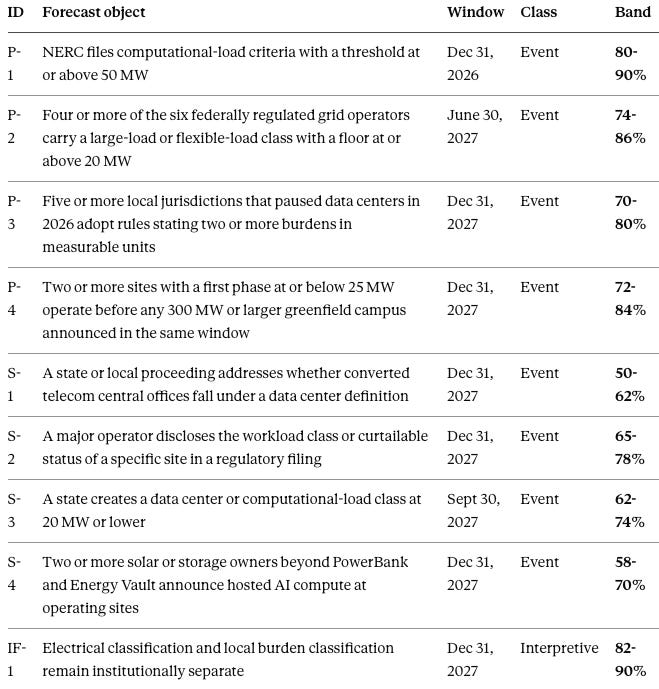
The nine forecasts test four different parts of the paper. Federal classification runs through P-1 and grid implementation through P-2 and S-2. Local burden classification runs through P-3 and S-1 and S-3, and site-conversion timing through P-4 and S-4.
🏛️ Policymakers. Exposure: the federal criteria leave every project below 50 MW for the state to classify, measured in megawatts unclassified per session (P-1, S-3). Window: the 2027 sessions. Move: draft the definition in the four burden measures before the December NERC filing lands.
💼 Executives. Exposure: capital committed to a facility label carries a delivery date the developer does not control, measured in quarters of carry (P-4). Window: before the next land close. Move: fill the four categories for every candidate parcel and build the fallback use into the base case.
⚖️ Counsel. Exposure: a route map written for one configuration misses the approvals the fallback triggers, measured in filings redone per parcel (P-3, S-1). Window: before the first county submission. Move: draft proposed conditions in measurable units and file the fallback route in parallel where the code allows.
📊 Investors. Exposure: pipelines valued on nominal capacity carry a premium that belongs to reuse and phased sites, measured in multiple compression at the next mark (P-4, S-4). Window: before the next valuation cycle. Move: rate every site on deliverable date, host control and proof set, and treat greenfield AI capacity as an option.
The four categories give every audience one test to apply to a project: which column decides its choice, and what in that column the project can prove.
II. Existing Classification Systems Cover Only Part of the Decision Set
Three classification systems describe AI data centers today, and each reflects the decision problem of the party that wrote it. The vendor taxonomy, the grid-operator taxonomy and the statutory taxonomy each answer the question their author needed answered and cover only the part of the decision set that question touches.
A. The Vendor Taxonomy Describes Buildings and Customers
Industry graphics sort facilities into six types: hyperscale · colocation · enterprise · edge · telecom · AI or high-performance computing. The sort mixes five axes. Scale and customer model and ownership answer different questions, and so do network role and workload. A single viable project can be an edge site and a colocation service and a modular installation at once.
Modular construction, green design and disaster recovery belong to none of the six. One is a build method, one a design goal and one a role.
The taxonomy serves the broker and the buyer. The taxonomy says who owns the facility and who pays for capacity and roughly how large the building is. Power date, water draw and approval route go unmentioned, because the parties who wrote it did not need those answers to close a lease.
B. The Grid-Operator Taxonomy Describes Operational Behavior Above 50 Megawatts
Idaho National Laboratory published a large-load taxonomy for the Department of Energy’s Grid Deployment Office in October 2025. The taxonomy classifies loads on three characteristics: size, variability and flexibility. Size runs in three bands from 50 MW upward.
Variability separates slow loads from fast ones, and flexibility separates loads that can raise or lower consumption on the grid’s request from loads that cannot. The three characteristics yield twelve types.
The taxonomy applies only to a single facility capable of consuming at least 50 MW. The North American Electric Reliability Corporation frames data centers with a four-way functional split: cloud · AI training · AI inference · cryptocurrency. The May 2026 large-loads guideline asks planners to model firm and flexible load components and AI training operating windows. Both systems classify what the grid operator sees at the point of interconnection.
The federal criteria moved upward during 2026. NERC’s April 2026 proposal would have covered computational-load sites at 20 MW aggregate load connected at 60 kV or above. The revised criteria posted on August 19, 2026 cover a Computational Load Owner or Operator only for a site with total connected load of 50 MW or more supplied at 100 kV or above. The Federal Energy Regulatory Commission’s order of July 16, 2026 in Docket RD26-7-000 requires the criteria and initial standards filed by December 31, 2026.
The grid taxonomy fills part of the “requires” column and part of the “can change” column, and only for loads large enough to threaten system stability. The authors say so: the characteristics are purely operational from the grid operator’s perspective. On-site generation and criticality and location enter implicitly if at all. A 20 MW site is invisible, a water draw is out of scope and a county hearing does not exist.
C. The Statutory Taxonomy Describes a Label and a Size Line
State law classifies by the words “data center” and a megawatt or investment threshold. Florida’s 2026 statute applies its tariff and water-permitting rules at 50 MW and forbids splitting one electrical load into several smaller connections to stay under the line. Rhode Island’s 2026 debate turned on whether the guardrail should sit at 20 MW or 50 MW.
Wisconsin’s proposed bill directs its commission to define a very large customer class by December 15, 2026. More than 300 data center bills reached state legislatures in the first six weeks of 2026, most shifting from incentive to oversight.
The statutory taxonomy fills one cell: a size line under a label. The label triggers review for everything called a data center, and the size line decides which tariff and which permit apply. Neither tells a regulator what the project imposes or what it can prove, because statutes written for incentives never needed to ask.
D. Redundancy Tiers Sit on a Fourth Axis
The Uptime Institute tiers and the parallel TIA-942 and BICSI ratings classify redundancy and fault tolerance. Any facility type can be built to any tier, and certification is optional. Tiers say nothing about grid firmness, because a fault-tolerant building on a shortage-exposed feeder is still an unmatched load. The tiers belong in the “requires” column under reliability and nowhere else.
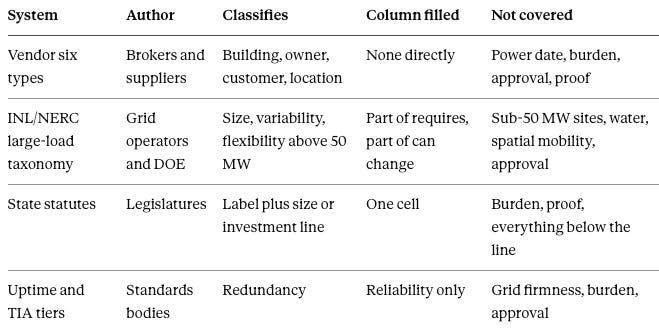
Three authors, three seats, three partial tables. The next section fills the whole table.
🏛️ Policymakers. The federal taxonomy starts at 50 MW, so a state that defers to it leaves every smaller project unclassified.
💼 Executives. A vendor label carries no information a utility or county will act on.
📊 Investors. No classification in use today tells a lender when power arrives or what a site can prove.
III. The Four Categories Classify What a Project Requires, Imposes, Can Change and Can Prove
A decision-useful taxonomy classifies what a project requires, what it imposes, what it can change and what it can prove. The four categories together cover every decision the six audiences make, because each audience’s decision turns on one or two of them.
Four terms carry the framework through the paper. The Decision Taxonomy is the framework as a whole. The Four Decision Categories are requires, imposes, can change and can prove. A Site Classification is the four categories populated for one parcel and one configuration, and a Configuration Comparison sets several Site Classifications for the same parcel side by side.
Requires. The inputs a configuration cannot operate without. Power firmness and the date firm capacity arrives lead the list.
The Grid-Anchored Clean Power Bargain — Powering AI Data Centers Through 2040 showed that permission to connect and energy that reaches the site and capacity the grid counts on in a shortage are three products, and the weakest governs. Fiber and cooling and land complete the column, with reliability and latency. Developers responding to the Department of Energy’s 2025 site inquiry named time to power as the single most critical siting factor, ahead of electricity cost and fiber as well as zoning and incentives.
Imposes. The burdens a configuration places on the grid, the watershed and the neighborhood. Burden-Based Authorization for AI Data Centers, Modular Clean Compute, and the Backlash Gap Between Grid Tariffs and State Lawnamed four measures a regulator can verify in a filing: power increment, water draw, enforceable curtailment and reuse of an existing site. The column adds noise and generator hours, land conversion and the allocation of upgrade costs to other ratepayers. Residents raise those four burdens at hearings.
Can change. The levers a developer or host can pull without abandoning the project. The Clean Compute Match — Which Clean Power Pairs With Which AI Compute, And What Stays On Fossil established the first lever: model training and batch work can move toward wind and solar, and real-time answers for users cannot. Timing · load shape · curtailment · phasing · cooling method · energy architecture · construction method follow. The column is what separates a project that can survive a county condition from one that cannot.
Can prove. The facts a configuration can document to the layer that decides. Service capability under a signed utility agreement · curtailment behavior under a tariff · metered water · emissions · site reuse · host control · mitigation commitments · authorization compliance. Modular AI Data Center Specialists and the Integrated Offerings That Turn Small Sites Into Authorized Operating Capacity found that power-asset hosts carry the path to operation because they concentrate proof of site control, power infrastructure and existing approvals in one filer.
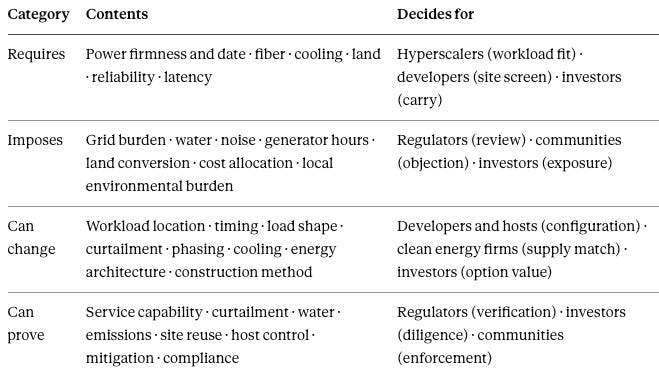
The four categories supplement facility labels with decision variables. A hyperscale campus and a 2 MW module keep their labels and take the same four rows, and the values in the rows rather than the label decide what each can become.
💼 Executives. Fill the four rows for every candidate site before choosing a partner or a label.
⚖️ Counsel. The “can prove” row is the filing; the “imposes” row is what the filing must answer.
🏛️ Communities and local boards. The “imposes” and “can change” rows name what to object to and what a developer can alter.
IV. Six Audiences Read One Table
Six audiences decide whether a site operates, and each reads a different column of the same table. Each learns from its column something its current taxonomy hides.
Hyperscalers read “requires” and “can change.” The largest operators already classify internally by workload, placing training where power is abundant and inference where users are, and disclose externally by campus. The four categories let a hyperscaler match each workload class to a site’s firmness and date, and they expose which sites the operator could offer as curtailable in exchange for faster service under the June 2026 federal orders. The cost is disclosure: a public “can change” column invites flexibility obligations.
Developers read “requires” and “can change.” A developer holding a 200-acre parcel beside a transmission line learns from the “requires” row that acreage decides nothing and the firm delivery date decides almost everything. The “can change” row tells the developer which configuration the parcel can carry now while the AI use waits on the date: storage or solar or a phased module or nothing. The site-first reading replaces the category-first pitch.
Clean energy firms read “can change” and “can prove.” A solar or storage owner learns whether its site can host movable compute on variable supply, whether storage converts that supply into something an anchored workload can use and whether its existing interconnection, land and permits count as proof. Energy Vault’s Snyder campus and the PowerBank and Nodiac agreement show the column in use: hosts that already hold the proof set carry modules to operation faster than suppliers who stop at delivery.
Investors read “can prove” and “requires.” A lender or fund learns which facts must exist before capital commits: a utility agreement with a date, host control, a curtailment capability and an approval map. The “imposes” column tells the investor which sites a moratorium reaches. Diligence criteria written in those units become a private taxonomy, because every developer seeking capital must satisfy them before any regulator acts.
Regulators read “imposes” and “can prove.” A commission or county learns what a configuration draws, emits and consumes and what the filer can verify. The four categories supplement the label with a configuration-specific decision test, which lets a 2 MW module and a campus receive review proportional to what each requires, imposes and can prove. The Model AI Infrastructure Authorization Code supplies statutory language for the burden-based route.
Communities read “imposes” and “can change.” Residents learn which burdens a configuration carries and which levers could remove them. A community can then specify what it opposes: evaporative cooling above a stated draw · generator operation beyond stated hours · noise above a stated level · upgrade costs shifted to residents · expansion before a phase proves itself. The specification replaces a uniform halt, and it gives developers a design target instead of a veto.
Every audience learns something its current taxonomy hides, and every audience learns it from the same table. The table also scales. The same four rows apply to a 2 MW module and a gigawatt campus, to a county in Iowa and a commission in Florida, and to any strategic load that must clear a utility and an approver and a lender. Each audience’s decision reduces to one test it can run on any project.
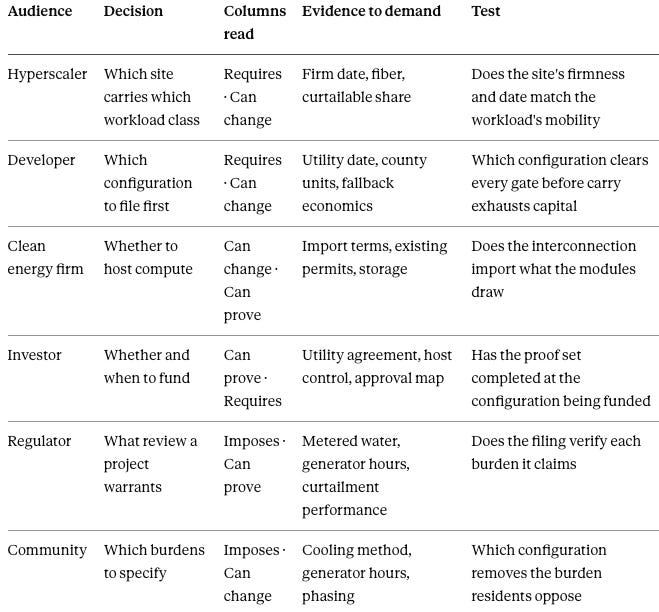
The test column is the unit that repeats. A developer runs it across a pipeline, a commission runs it across a docket and a fund runs it across a portfolio, and each run produces a Site Classification in the same format. The next section shows what the table does to a hearing.
V. Multi-Use Comparison Replaces Binary Approval
Public review of a data center today asks one question: should this proposal proceed. The four categories turn that binary into a comparison among feasible site states, and the comparison opens bargaining space for every audience at once.
A developer presents one preferred project. The community concentrates on the visible burdens, and the regulator faces a yes or no with the developer’s capital already committed. The binary form rewards the parties best able to absorb a no: hyperscalers self-fund upgrades and wait out a halt, and mid-scale projects do not. AI Data Center Veto Points mapped every stage at which that no can land.
The Configuration Comparison changes the question. A parcel supports a bounded set of uses, and the set is knowable before capital moves: a full campus · a phased module · a colocation hall · anchored inference in a converted building · battery storage · solar · industrial reuse · delay · exit. Each use carries its own “requires” and “imposes” rows. Review can then compare Site Classifications for each use rather than judge one proposal.
Linn County, Iowa shows both county instruments in one year. The county adopted an ordinance on February 18, 2026requiring large data center projects to complete a water study, sign a binding water-use agreement with tracking and reporting and meet noise and setback limits. The county then approved an 18-month moratorium on new large-scale applications effective July 1, 2026. The board cited cumulative effects on water and electrical infrastructure and emergency services.
Conditions in units govern a project, and a pause governs a pipeline.
Four site archetypes show the comparison in practice.
An existing power-asset host. A retired plant carries an interconnection, a switchyard and water rights. Homer City Redevelopment is converting Pennsylvania’s largest former coal site into a gas-powered campus with up to 4.4 gigawatts of generation using the property’s existing grid connections. The “requires” row is full, the “imposes” row turns on new generation permits and the “can prove” row waits on a signed customer.
A transmission-adjacent greenfield parcel. The two-hundred-acre pitch. The “requires” row is empty until a utility commits a date, and the wait can run years. Storage and solar sit inside the feasible set today, because a generation interconnection proceeds on a different queue and a storage project earns capacity revenue without a tenant. The comparison tells the developer to build what the parcel can carry and hold the AI use as an option.
A metro building or retrofit. Verizon told investors on its second-quarter 2026 earnings call that it is retrofitting central offices into inference edge data centers that are power-ready, permitted and fully redundant, and that a small trial sold out in a day. The “requires” row is full at the existing service level, the “imposes” row is nearly empty because the building already operates and the “can change” row caps at the rack density the floor and feeder allow.
A generation or storage site. PowerBank and Nodiac agreed in June 2026 to place 1 to 20 MW modular units at distribution-level connection points on PowerBank solar and battery sites that PowerBank describes as already holding generation, land and permitting approvals. The “can change” row is widest for movable compute, and the binding “requires” entry is whether the interconnection permits import at the scale the modules draw.
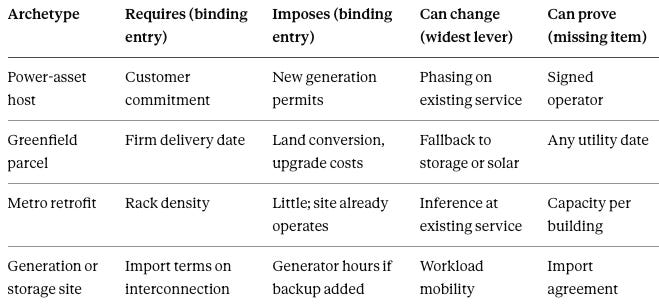
The comparison does three things a binary cannot. The community sees which configuration removes the burden it opposes. The regulator sees which proof to demand for each use. The investor sees at which configuration the proof set completes and capital can move.
A multi-use comparison converts an approval from a contest over one proposal into a choice among site states. The parties who bear the burden and the parties who bear the carry both gain a specification, and the next section asks which of them writes it first.
🏛️ Policymakers. Review that compares configurations can approve the low-burden one without approving the campus.
💼 Executives. Present the fallback configuration alongside the preferred one, because the comparison is where a project survives a no.
📊 Investors. The comparison table shows the configuration at which the proof set completes and capital can move.
🏛️ Communities and local boards. A comparison lets residents choose among site states instead of accepting or refusing one.
VI. Only a New Taxonomy Opens the Door for Clean Energy
Clean energy cannot reach a data center that every classification treats as a firm load. The vendor labels, the grid taxonomy above 50 MW and the statutory label all describe a facility that runs around the clock and must be served whatever the weather, and a load described that way can only be served by firm supply. Firm clean supply is scarce and already contracted by the largest operators, so the label alone routes most data centers to gas or grid-mix power.
The Clean Compute Match — Which Clean Power Pairs With Which AI Compute, And What Stays On Fossil showed the pairing that the labels hide. Model training and batch work can move toward wind and solar, real-time answers for users must stay on firm power, and the work that fits neither pairing stays on fossil supply. The paper put the persistence of that fossil residual among mid-scale around-the-clock work through 2029 at 62-75% (Clean Compute Match S5). The residual exists because no classification any approving layer uses states whether a load can move.
The “can change” column is the door. A load classified by its workload mobility and its curtailment capability can pair with variable clean supply, because the supply’s intermittency matches the load’s tolerance for pausing. A load classified by its energy architecture can host on a solar or storage owner’s existing interconnection, because the classification names what the interconnection must import. A load classified by its curtailment can earn flexible service under the grid operator tariffs P-2 tests, and The Grid-Anchored Clean Power Bargain — Powering AI Data Centers Through 2040 put a major grid operator deciding shortage treatment by capacity backing or enforceable flexibility by 2028 at 84-92% (Grid-Anchored S5).
The “can prove” column completes the pairing. A clean energy firm that hosts compute needs the load to prove its curtailment behavior and its emissions, because the county reads those entries and the lender funds against them. Modular AI Data Center Specialists and the Integrated Offerings That Turn Small Sites Into Authorized Operating Capacity found that no small-site partnership documents curtailment and put a sub-20 MW curtailable service approval by the end of 2027 at 45-60% (Modular Specialists S-6). Without a column that states curtailment, no approver can credit it and no utility can pay for it.
Three doors open at once when a load is classified by what it can change. Clean energy firms see which compute their sites can host (S-4). Utilities can offer variable-supply-backed flexible service to loads that prove they can cut (P-2, S-2). Regulators can credit clean supply and curtailment in a burden review instead of treating every data center as the same firm draw (P-3).
Facility labels keep clean energy out of the data center decision, and the four categories let it in. The next section shows how those categories reach binding text.
💼 Executives. A workload classified as movable or curtailable is the only one a clean energy host can serve on variable supply; classify the workload before choosing the site.
🏛️ Policymakers. A burden review that reads curtailment and clean supply can approve the configuration that runs on wind and solar; a label-based review cannot see the difference.
📊 Investors. Hosted clean compute finances only where the load’s mobility and curtailment are documented, because the host’s revenue depends on them.
VII. How the Shared Vocabulary Enters Binding Decisions
A taxonomy becomes decision-useful when its categories enter binding text. Four authors hold instruments that carry parts of the four categories into tariffs or conditions or filings or term sheets. No author holds an instrument that reaches every layer, and the floor each instrument carries decides which projects that author can see at all.
Grid operators through federal compliance filings. The June 2026 show-cause orders direct six grid operators to justify or revise their large-load rules, including transmission service for flexible loads and study processes for generation serving electrically proximate load. The filings define load classes by operational behavior, in the INL and NERC vocabulary, and each carries a floor (P-2). The Electric Reliability Council of Texas already treats 75 MW as a large load for stand-alone facilities and 20 MW for facilities co-located with generation. A grid-operator vocabulary fills “requires” and “can change” for transmission-connected load and leaves every distribution-connected site outside it.
States through statute and commission order. Legislatures hold the definition of “data center” and the size line. The 2026 sessions moved the line downward in some states and raised incentive floors in others, and the 2027 sessions convene with the Texas audit report in hand. A state vocabulary fills “imposes” if it adopts burden measures and fills one cell if it keeps the label.
Counties through conditions of approval. A county board holds the one instrument that can carry “imposes” and “can prove” into a binding document today. Communities do not hold the instrument; they supply the demand, the salience and the political payoff that make a board adopt it. When a board writes a water cap or a generator-hour limit or a curtailment requirement into a conditional use permit, it has written a burden taxonomy for one parcel. Neighboring boards can copy conditions they can see, and Linn County shows that a board can write conditions and a pause in the same year (P-3).
Lenders through diligence criteria. An investor holds an instrument no regulator controls: the term sheet. A fund that requires a utility agreement with a date, host control, curtailment capability and an approval map before committing capital has written “can prove” into a private standard. Developers must satisfy the standard to raise money, so the standard binds whether or not a public author acts. Energy Vault’s module lease-back at Snyder and PowerBank’s securities disclosures show the proof set already moving into financing terms.
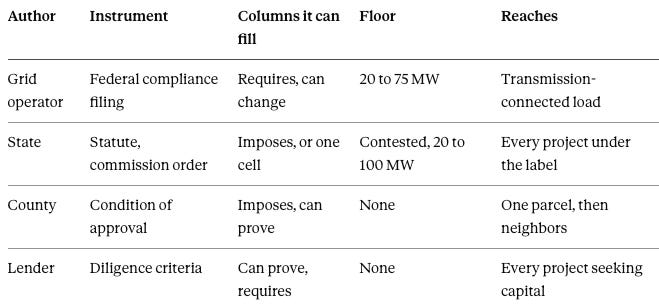
Behavioral Economics explains the sequence. Each author acts on the burden or the risk it can see. Grid operators see load drops, so they write variability and flexibility. Residents see cooling towers and generators, so they demand water caps and hours.
Lenders see carry, so they demand dates and proof. Game Theory explains the payoff: each author writes terms within its own instrument, and the project bears the coordination cost of translating among them.
The four authors move on different calendars, and the floor each carries decides which sites the shared vocabulary reaches. A federal criterion at 50 MW and 100 kV sees one population of projects. A 20 MW tariff floor sees a second, a county condition with no size floor sees a third and a lender’s criteria see whatever seeks capital. Each instrument creates a different project population, and the taxonomy shows which projects fall outside each author’s instrument.
A decision-useful taxonomy therefore does not require one institution to define every project. The taxonomy requires the same project to be legible across the institutions that decide whether it operates. The simulation finds that electrical classification and local burden classification stay separate through 2027 (IF-1), so the translation work falls on the developer, the host and the lender rather than on any regulator.
🏛️ Policymakers. The federal criteria will not reach a 20 MW site, so a state definition decides whether the mid-scale tier is classified at all (S-3).
⚖️ Counsel. Measurable conditions are easier to verify and enforce than vague conditions, so draft the client’s proposed conditions in units.
📊 Investors. Diligence criteria published to a pipeline bind developers whether or not a public author acts.
VIII. MindCast Simulation Predictions
MindCast issues nine forecasts on how the decision vocabulary enters binding text: four Primary Simulation Predictions, four Secondary Simulation Predictions and one interpretive finding. All nine are original to this publication. Major operators means Microsoft and Google and Amazon and Meta and OpenAI and Anthropic and xAI.
Three explanations compete to account for how the vocabulary enters binding text.
One author writes the whole vocabulary. A single institution, most likely the federal reliability framework, defines every project and the other layers adopt its classes. Falsifier: the federal criteria leave sites below 50 MW unclassified while counties and states write their own rules.
Each author writes its own column. Grid operators classify operational behavior and counties classify local burden. States set a size line and lenders set proof requirements, and the same project translates across all four. Falsifier: a single classification binds both bulk-power registration and local land-use review for the same project class.
Differentiation collapses. A visible failure at a site approved as low-burden pushes every author toward uniform restriction and no vocabulary forms. Falsifier: five or more pause jurisdictions adopt rules in measurable units.
Electrical and local burden classifications remain institutionally separate through 2027, while states and capital providers add their own requirements. The August 19 criteria leave the mid-scale tier to states and counties, and uniform restriction survives as the tail route below.
A. Primary Simulation Predictions
P-1 | NERC Files Computational-Load Criteria With a Threshold at or Above 50 MW by December 31, 2026 (80-90%)
Falsifier: no filing by the deadline, or a filed threshold below 50 MW. Trigger: NERC Board action in December 2026. Verification source: the NERC filing in Federal Energy Regulatory Commission Docket RD26-7-000.
P-2 | Four or More of the Six Federally Regulated Grid Operators Carry a Large-Load or Flexible-Load Class With a Floor at or Above 20 MW in Tariffs Filed or Accepted by June 30, 2027 (74-86%)
Falsifier: three or fewer with such a floor. Trigger: compliance filings under the June 18, 2026 orders and commission acceptances. Verification source: the commission’s eLibrary.
P-3 | Five or More US Local Jurisdictions That Imposed or Considered a Data Center Pause in 2026 Adopt Rules Stating at Least Two Burdens in Measurable Units by December 31, 2027 (70-80%)
The window opens October 1, 2026. Qualifying units are numeric caps or hour limits or reporting requirements on water · noise · backup generation · electrical infrastructure · land conversion. Rules stated in adjectives do not qualify, and Linn County’s February 2026 ordinance predates the window.
Falsifier: fewer than five qualifying jurisdictions. Trigger: county agendas in jurisdictions with organized opposition. Verification source: ordinances, development codes and minutes.
P-4 | Two or More US AI Sites With a First Phase at or Below 25 MW Announced After October 1, 2026 Reach Commercial Operation Before Any US Greenfield Campus of 300 MW or More Announced in the Same Window by December 31, 2027 (72-84%)
Falsifier: any qualifying greenfield campus operates first, or fewer than two qualifying small sites operate. Trigger: commercial-operation announcements. Verification source: company releases and securities filings.
B. Secondary Simulation Predictions
S-1 | A State or Local Proceeding, Bill or Guidance Addresses Whether Converted Telecom Central Offices Fall Under a Data Center Definition by December 31, 2027 (50-62%)
Falsifier: no such document. Trigger: carrier inference-site announcements in states with data center statutes. Verification source: state legislative files, agency guidance and local dockets.
S-2 | A Major Operator Discloses the Workload Class or Curtailable Status of a Specific Site in a Federal or State Commission Filing Between October 1, 2026 and December 31, 2027 (65-78%)
Falsifier: no such disclosure in a public filing. Trigger: flexible-load service terms in grid operator tariffs. Verification source: the commission’s eLibrary and state commission dockets.
S-3 | A State Legislature or Commission Creates a Data Center or Computational-Load Class at 20 MW or Lower by September 30, 2027 (62-74%)
Falsifier: no qualifying statute or order. Trigger: the 2027 sessions and commission dockets. Verification source: statutes and commission orders.
S-4 | Two or More US Solar or Storage Owners Other Than PowerBank or Energy Vault Announce Hosted AI Compute at Operating Generation or Storage Sites by December 31, 2027 (58-70%)
Falsifier: fewer than two qualifying announcements. Trigger: host agreements and modular supplier disclosures. Verification source: company releases and securities filings.
C. Interpretive Finding
IF-1 | Electrical Classification and Local Burden Classification Remain Institutionally Separate Through December 31, 2027 (82-90%)
The finding holds unless a single classification binds both bulk-power reliability designation and local land-use review for the same project class. Verification source: NERC and commission rules against sampled state and local codes.
D. Three Routes and Two Break Conditions
Most likely route: each author writes its column into its own instrument. Grid operators file classes with floors, and counties with organized opposition write conditions in units where developers offer comparisons. Lenders tighten criteria after a visible loss, and reuse and phased sites finance and approve first.
Leading alternative: the grid vocabulary captures the field. States defer to grid operator classes, counties keep halts, comparisons stay unoffered and the mid-scale tier stays unclassified through 2027. The shift trigger is a county adopting conditions in units or a state enacting a burden route.
Tail route: differentiation collapses. A visible failure at a site approved as low-burden, or a grid emergency, pushes every author toward uniform restriction.
Two conditions would break the forecasts: federal preemption of state data center rules, and a level 3 Energy Emergency Alert from a major grid operator before June 30, 2027.
IX. Risk Mitigation Keyed to the Simulation Predictions
Each forecast carries a different loss for each audience it binds, and each audience can act on part of that loss alone. Every entry below names the forecast and its band · the exposure in the unit the audience controls · two to four actions the audience can take without a counterparty, each with an owner function and a deadline · the residual that survives full mitigation.
Severity and probability run on separate axes. A lower-band forecast with a large loss can justify more preparation than a likely forecast with a small one, so the matrix states both and the entries follow forecast order rather than band order. Each band is unconditional and several forecasts move together, so no combined figure appears. The actions describe analytic options available to each audience; none is legal, investment or fiduciary advice to a specific party.
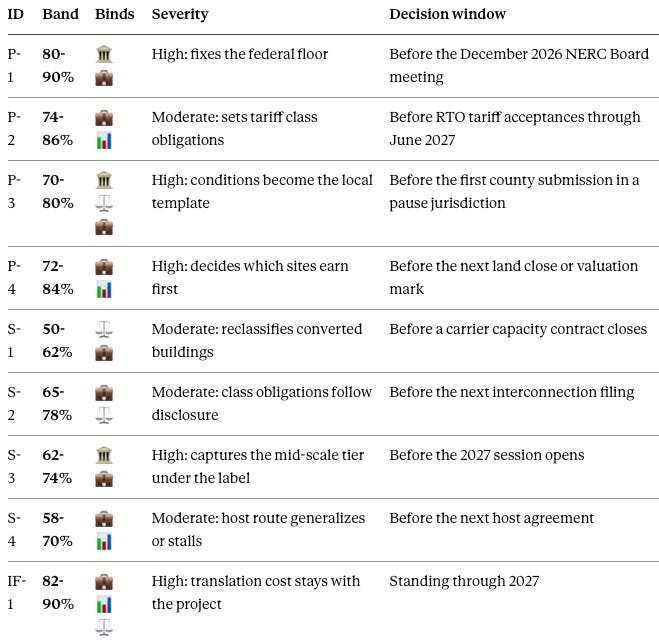
A. Federal Reliability Criteria Fix the Floor at 50 Megawatts (P-1, 80-90%)
🏛️ Policymakers. Exposure: every project below 50 MW or below 100 kV falls outside federal reliability classification, measured in megawatts the state must classify itself per session. Actions: legislative counsel drafts a state definition keyed to the four burden measures for prefiling before the session opens, with The Model AI Infrastructure Authorization Codeas source text; commission staff opens a docket to define a large-customer class with an explicit statement of how phased sites are treated when they cross the line, by the December NERC filing date. Residual: a state definition cannot reach loads the utility serves under a federal tariff class, so a project can be classified twice or not at all.
💼 Executives. Exposure: if NERC adopts the August criteria, a site at 50 MW and 100 kV enters the Computational Load Owner and Operator framework and the applicable reliability standards, measured in months added to commissioning and in continuing compliance headcount. Actions: development phases first increments below the criteria and documents the plan in the interconnection request before the December filing; engineering specifies ride-through and telemetry at design so that a later crossing does not force retrofit. Residual: a phased site crosses the criteria under the same owner and inherits the standards at that point, and a state line can sit lower than the federal one.
B. Four or More Grid Operators Carry a Floor at or Above 20 Megawatts (P-2, 74-86%)
💼 Executives. Exposure: a site above the floor enters large-load study and financial-security terms, and a site below it earns no flexibility credit, measured in months of study and in curtailment value forgone. Actions: procurement sizes each increment against the filed floor in its region before the tariff is accepted; site selection places movable compute at distribution-connected hosts where the floor does not apply; regulatory affairs files comments individually or through a trade association with antitrust counsel present, never as a joint position with competitors. Residual: a floor accepted in one region does not bind a neighbor, and the floor can move on rehearing.
📊 Investors. Exposure: a pipeline assumed to earn flexibility credit at sub-floor sites carries value no tariff recognizes, measured in basis points of yield assumed from curtailment revenue. Actions: portfolio valuation strips curtailment revenue from sub-floor sites until tariff text pays it; diligence requires the filed floor for each site’s region in the investment memo. Residual: a later sub-20 MW service can restore the value, and the timing of that service sits outside the investor’s control.
C. Five or More Pause Jurisdictions Adopt Rules in Measurable Units (P-3, 70-80%)
🏛️ Policymakers. Exposure: a board that pauses without writing units inherits the units its neighbors write, measured in sessions lost while the template is drafted elsewhere. Actions: planning staff drafts water and noise and generator-hour limits in numeric form during the pause rather than after it, with adoption before the pause expires; the board states in the ordinance how cumulative applications are counted so that conditions and a future pause do not conflict, as Linn County’s sequence shows. Residual: a state preemption bill can override local units, and conditions written for one project do not govern a pipeline.
⚖️ Counsel. Exposure: conditions written in adjectives are unenforceable and conditions written in units by the county without applicant input can exceed the design envelope, measured in permit amendments per parcel. Actions: land-use counsel submits proposed conditions in units with the first application, with metered evidence attached; counsel maps each candidate configuration against the county code separately before submission. Residual: a board can adopt stricter units than proposed, and a pause can arrive after conditions are met.
💼 Executives. Exposure: a project designed to a label meets a county rule written in units it cannot satisfy, measured in redesign cost and quarters of delay. Actions: development sets cooling and generator design to the strictest published unit among target jurisdictions before land close; the project offers a Configuration Comparison at the first hearing rather than after a denial. Residual: a jurisdiction can adopt a unit no configuration meets, at which point the parcel exits the feasible set.
D. Small First Phases Operate Before Newly Announced Campuses (P-4, 72-84%)
💼 Executives. Exposure: capital committed to a greenfield campus waits on a delivery date the developer does not control while phased and reuse rivals earn, measured in quarters of carry and in customers signed elsewhere. Actions: development enters every site at a first phase the existing service can carry and designs for expansion without assuming it; land acquisition is structured as an option until the utility commits a date, with the stop date named in the plan. Residual: a utility date can slip after the first phase is built, and phased entry forgoes the scale economics a campus would have earned.
📊 Investors. Exposure: a pipeline valued on announced campus capacity carries a premium that belongs to the sites that operate first, measured in multiple compression at the next mark. Actions: valuation treats greenfield AI capacity as an option and marks reuse and phased sites at operating value; diligence requires the deliverable date and the host control document before commitment. Residual: a favorable federal co-location ruling can move greenfield value upward inside the window.
E. A Proceeding Addresses Whether Central Offices Are Data Centers (S-1, 50-62%)
⚖️ Counsel. Exposure: a converted building that falls inside a statutory definition inherits campus-scale review and tariff terms, measured in permits reopened per building. Actions: counsel documents each building’s existing entitlements and service level before the conversion contract signs; counsel drafts the client’s position on the definitional question for any proceeding in the building’s state, filed individually. Residual: a definition can be written to capture converted buildings regardless of the position filed.
💼 Executives. Exposure: a carrier capacity contract can lose its permitted-status advantage if the building is redefined, measured in capacity that cannot be delivered under the contract. Actions: procurement writes definitional-change terms into the capacity contract before signing; site selection weights buildings in states without a data center statute. Residual: a state can enact a statute during the contract term.
F. A Major Operator Discloses a Site’s Workload Class or Curtailable Status (S-2, 65-78%)
💼 Executives. Exposure: a disclosure that earns flexible service also sets the class obligations rivals inherit, and a non-disclosure forfeits service priority, measured in months of interconnection priority. Actions: regulatory affairs decides per site which loads to disclose as curtailable before the next interconnection filing; operations builds the curtailment capability the disclosure promises before the filing, because a claim without performance invites a compliance finding. Residual: a rival’s disclosure can write the class first, and a public company’s filing disclosure must reconcile with its securities disclosures.
⚖️ Counsel. Exposure: a filed disclosure becomes a binding representation, measured in enforcement exposure per site. Actions: counsel aligns the interconnection filing with securities disclosures and confidentiality designations before submission; counsel scopes the disclosure to the specific site rather than the fleet. Residual: a commission can compel broader disclosure.
G. A State Creates a Class at 20 Megawatts or Lower (S-3, 62-74%)
🏛️ Policymakers. Exposure: a class written to a size line captures the mid-scale tier under the label without a burden test, measured in low-burden projects stalled per session. Actions: legislative counsel pairs any size line with the four burden measures in the same bill; commission staff publishes the phasing rule in the order that creates the class. Residual: the line and the burden test can conflict when a small site carries a large burden.
💼 Executives. Exposure: a 20 MW line pulls phased sites into obligations designed for campuses, measured in compliance cost per site. Actions: development sizes phases and phasing intervals against the lowest line among target states before the 2027 sessions open; regulatory affairs files individually in the state docket. Residual: a co-located threshold can sit below the state line, as ERCOT’s 20 MW co-location rule shows.
H. Two or More Energy-Site Owners Announce Hosted Compute (S-4, 58-70%)
💼 Executives. Exposure: an operator without host partners competes for greenfield service while rivals operate on existing interconnections, measured in quarters to first capacity. Actions: development screens solar and storage owners for import-capable interconnections and existing permits before the next host agreement; procurement writes import terms and expansion rights into the host agreement. Residual: an export-only interconnection cannot be converted by contract, and a host can prefer another operator.
📊 Investors. Exposure: energy assets valued on generation alone omit hosting revenue, and hosting pipelines valued on announcements omit import risk, measured in basis points of yield misallocated between the two. Actions: diligence requires the interconnection agreement’s import terms for any hosting thesis; decisions on Energy Vault and PowerBank rest on public filings only, because both trade publicly. Residual: a host’s second site depends on an operator’s demand the investor cannot underwrite.
I. Electrical and Local Classifications Stay Separate (Interpretive Finding 1, 82-90%)
💼 Executives. Exposure: the translation between the grid vocabulary and the county vocabulary stays with the project, measured in duplicate filings and exhibits per site. Actions: development maintains one Site Classification per configuration and generates each institution’s filing from it; regulatory affairs assigns one owner for cross-layer consistency before the first submission. Residual: a state definition can require a third vocabulary.
📊 Investors. Exposure: a site that passes one layer can still fail another, measured in commitments made on a single approval. Actions: diligence requires proof at every layer the site touches before capital moves; term sheets stage funding to layer milestones. Residual: a layer can add a requirement after commitment.
⚖️ Counsel. Exposure: a representation made to one institution binds at another, measured in inconsistent filings per site. Actions: counsel keeps a single evidentiary source for water, curtailment and site-reuse claims across filings; counsel reviews every filing against the prior ones before submission. Residual: institutions can change what they require from the same evidence.
J. Linkage to Companion Forecasts
Three actions above also reduce exposure to forecasts in companion publications. Phasing below the floor (P-2, executives) also reduces exposure to the Modular Specialists forecast that no utility rate lets separate small sites combine load through 2027. Drafting a state definition in burden measures (P-1 and S-3, policymakers) also reduces exposure to the Burden-Based forecast that no state enacts a burden-based route by mid-2027. Building curtailment capability before disclosure (S-2, executives) also reduces exposure to the Modular Specialists forecast on sub-20 MW curtailable service.
The layer gives each audience the same instruction in its own units. Fill the column the audience controls before the checkpoint, and carry the stated residual as a known quantity.
X. New Investment and Market Entry the Taxonomy Creates
A classification that six audiences act on creates demand for the products that fill its columns. Each column opens a gap with a named buyer and a named class of supplier, and the gaps sit where no existing taxonomy looked.
Demand forms wherever an audience must act on a column it cannot yet fill. Regulators cannot verify “imposes” without meters and standards, and investors cannot underwrite “can prove” without a proof set. Developers cannot exercise “can change” without the tools that move a workload, cut a load or convert a building. Each gap is a product, and each product sells to several audiences at once.
Proof and verification services fill “can prove.” Metered water, curtailment performance, emissions and site-reuse evidence need a party that measures and attests. Regulators need the attestation to approve, investors to fund and communities to enforce. Modular AI Data Center Specialists and the Integrated Offerings That Turn Small Sites Into Authorized Operating Capacity found that no small-site partnership documents curtailment and that standardized burden exhibits have value at every hearing.
Engineering firms, commissioning companies, environmental consultants and telemetry vendors already supply components of that proof set. No standardized product yet assembles the four categories into one attestation that serves all six audiences, and the assembly is the line of business.
Small-site curtailment fills “can change” below the thresholds. Curtailment software today documents its work at large campuses. A product that lets a 5 to 20 MW site cut load on command and prove it sells to hosts seeking flexibility credit, to counties writing curtailment conditions and to investors who need the proof. The demand exists because the four categories make curtailment a column every audience reads, not a feature one buyer wants.
Conversion specialists fill “requires” at reuse sites. Carriers converting central offices, owners converting retired plants and energy firms hosting modules each need firms that retrofit power, cooling and fiber inside an existing envelope. The demand is largest for water-free cooling that keeps a retrofit inside a county’s water limit, and for import-capable interconnection upgrades at solar and storage sites. Equipment suppliers with prefabricated factories can enter by selling the retrofit rather than the greenfield build.
Classification and diligence services fill the table itself. Developers need the four rows filled for every candidate parcel before land closes. Lenders need the same rows in their diligence template. Counties need a review form keyed to burden rather than label. Site selectors, engineering consultancies and law firms already do parts of the work under other names, and the taxonomy gives the work a product definition and a buyer in every audience.
Financing products keyed to proof. Energy Vault’s purchase and lease-back of modules at Snyder shows a financing structure keyed to host control and a delivery date. Capital contingent on a proof set is a product a lender can standardize, whether the proof is a utility date or a curtailment demonstration or an approval milestone. Demand comes from developers who cannot raise on nominal capacity and from funds that will not lend on it.
Host site aggregation. Solar, storage and industrial owners with existing interconnections can host modules but rarely know it. A firm that assembles such sites across owners and fills the four rows for each offers operators a portfolio and offers owners a revenue line. The gap suits an entrant because few asset owners see themselves as hosts until a Site Classification shows what they already hold.
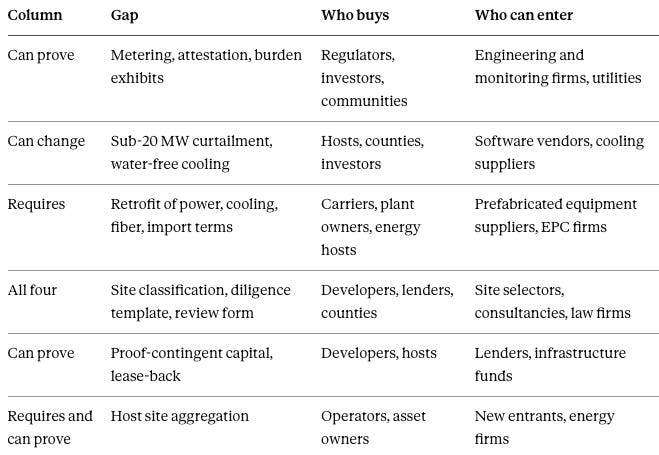
Incumbents can move faster than entrants, because they already hold sites, factories or customers. A utility that sells verification, an equipment supplier that sells the retrofit and an energy company that hosts modules each enter by adding a service to an asset it owns. Entrants have the most room where incumbents hold the asset but not the product, which is why aggregation and small-site curtailment are the widest openings.
The demand the taxonomy creates grows with the number of audiences that act on each column. Regulators, investors and communities all need the same “can prove” evidence. Existing providers supply components of that proof set, and the research behind this paper found no standardized product covering all four categories for all six audiences.
💼 Executives. Verification and retrofit are services an incumbent can add to an asset it already owns.
📊 Investors. Proof-contingent capital and small-site curtailment are the entry points where incumbents hold the asset but not the product.
🏛️ Policymakers. Published burden definitions create the buyer for verification products; a label creates none.
What to Watch: The December Filing, Pause Counties and the First Operating Sites
The dominant fork is whether the county instrument or the grid instrument reaches the mid-scale tier first (P-3 against P-2).
Three signals show which instruments fill their columns first. NERC’s December filing either holds the 50 MW and 100 kV criteria or returns toward April’s 20 MW proposal (P-1), and grid operator tariffs either carry floors at or above 20 MW or reach below them (P-2). County minutes in pause jurisdictions either carry conditions in measurable units or carry halts alone (P-3). Commercial-operation announcements show whether phased and reuse sites run before the greenfield campuses announced alongside them (P-4).
The Texas grid operator’s audit completion on December 10 and the legislative session opening January 12, 2027 decide whether the largest state keys its definition to burden or keeps the label.
Conclusion: Projects With Verifiable Power, Site Control and Approvals Reach Operation First
A data center taxonomy is decision-useful only when it classifies what a project requires, imposes, can change and can prove. Vendors classify buildings, grid operators classify operational behavior above 50 MW and statutes classify a label and a size line. Each covers part of the four-category decision set, and the six audiences that decide whether a site operates need all of it.
The four categories supplement facility labels with decision variables and replace a binary approval with a Configuration Comparison among feasible site states. Four authors hold instruments that carry parts of the categories into binding text, and each instrument sees a different population of projects.
The federal criteria sit above the mid-scale tier and local rules reach the sites the federal criteria miss. Projects with verifiable power and site control and approvals reach operation first. Clean energy reaches AI compute through the same categories, because a load has to be classified as able to move or pause or cut before variable supply can serve it. The December NERC filing is the first observable that tests the finding.
Working With MindCast
Published analysis cannot tell a specific operator, host, fund or county how a given parcel fills the four columns. The answer depends on the utility’s queue, the carrier’s routes, the county’s conditions and the customer the site can serve.
MindCast builds a Site Classification for every candidate configuration on a client’s parcel and a Configuration Comparison across them. The comparison ranks configurations by time to operation and names the proof each approving layer will demand. CDTs of the client’s utility and county and lenders and community counterparties then decide on each configuration the way the real institutions decide, reading the columns each one reads. The client sees which configuration survives every decision before filing any of them.
The same engagement scales from one parcel to a pipeline. A developer or fund with twenty sites receives twenty Site Classifications in one format and one Configuration Comparison per site, ranked by which decisions each site has already passed. A commission or county receives its own definitions run against the same table, showing which projects its instrument can see and which it cannot.
Developers and hosts and investors can start with a Configuration Comparison for three candidate parcels before the 2027 sessions begin (P-3, P-4, S-4). Commissions and county boards can commission a review of their definitions against the four categories before the December filing lands (P-1, S-3). Reach MindCast at mcai@mindcast-ai.com. Visit our Corporate Site.
Appendix A: The AI Infrastructure Authorization + Clean Energy Series
Foundational Work
🚚 AI Datacenter Edge Computing: Ship the Workload Not the Power (2025). Originates the principle of moving compute to power rather than power to compute.
Series Publications
AI Data Center Authorization + Clean Energy, the Mid-Scale Squeeze and the Specialized Compute Landscape (2026). Gathers the series and names the Mid-Scale Squeeze the size floors in this paper reproduce.
⚓ The Grid-Anchored Clean Power Bargain — Powering AI Data Centers Through 2040 (2026). Separates permission to connect, deliverable energy and shortage-backed capacity, the three products in the “requires” column.
🔗 The Clean Compute Match — Which Clean Power Pairs With Which AI Compute, And What Stays On Fossil (2026). Establishes workload mobility, the first lever in the “can change” column.
📏 Burden-Based Authorization for AI Data Centers, Modular Clean Compute, and the Backlash Gap Between Grid Tariffs and State Law (2026). Defines the four burden measures at the core of the “imposes” column.
🧱 Modular AI Data Center Specialists and the Integrated Offerings That Turn Small Sites Into Authorized Operating Capacity (2026). Identifies power-asset hosts as the filers who concentrate the “can prove” column.
Companion Publications and References
🛑 AI Data Center Veto Points (2026). Maps every stage at which a binary approval can stop.
🧭 The Lowest-Exposure AI Data Center Approval Route for Developers, Hyperscalers and Investors (2026). Orders the approval stages so a single denial stops the least committed capital.
The Model AI Infrastructure Authorization Code (2026). Supplies drafting language for a burden-based state route.
The Data Center Authorization Market: A 50-State Regulatory Atlas (2026). Supplies the state-by-state baseline behind the statutory taxonomy.
Appendix B: External Sources
Classification systems
Idaho National Laboratory for the U.S. Department of Energy Grid Deployment Office. Characterizing Large Loads: A Taxonomy to Support Large Load Integration. INL/RPT-25-88356, October 2025. Size, variability and flexibility; the 50 MW floor; the ERCOT 75 MW and 20 MW co-located thresholds; the operational-only scope.
North American Electric Reliability Corporation. Characteristics and Risks of Emerging Large Loads. Large Loads Task Force white paper, 2025. The four-way functional split and firm versus flexible load.
Carbon Direct. Inside NERC’s Level 3 Alert on Data Center Loads. May 7, 2026. The May 2026 reliability guideline and its modeling of firm and flexible components and training windows.
Anvilfield. Data Center Types: Enterprise, Colocation, Hyperscale, and Edge. June 2026. The two-axis vendor classification and the statement that tier systems do not define types.
Umbrex. Types of Data Centers, Industry Taxonomy. May 2026. Workload-based versus ownership-based classification.
Federal and state rules
North American Electric Reliability Corporation. Computational Loads: Proposed Rules of Procedure Revisions Summary. August 19, 2026. The revised registry criteria of 50 MW total connected load at 100 kV or above, the Computational Load Owner and Operator entities and the comment period to September 18, 2026.
North American Electric Reliability Corporation. FERC Sets Year-End Deadline for NERC to Finalize Registry Criteria and Standards for Computational Loads. July 16, 2026. The Docket RD26-7-000 directive and the December 31, 2026 deadline.
Federal Energy Regulatory Commission. Interconnection of Large Loads to the Interstate Transmission System, Docket RM26-4-000. The October 2025 directive.
Morgan Lewis. FERC Presses Grid Operators on Data Center, Large Load Interconnections. July 2, 2026. The June 18, 2026 show-cause orders and their provisions on flexible and electrically proximate load.
Compute Law. Florida Utility Connection and Power Contracts for AI Data Centers. May 2026. Florida §366.043 and §373.203: the 50 MW tariff and water thresholds and the anti-splitting rule.
Server Country. Rhode Island Data Center Policy. July 2026. The 20 MW versus 50 MW guardrail debate.
Sierra Club. Data Center State Policies, 2026. January 2026. Wisconsin LRB 5432 and the December 15, 2026 class-definition directive.
MultiState. State Data Center Legislation in 2026 Tackles Energy and Tax Issues. February 20, 2026. The 300-bill count and the shift from incentive to oversight.
Local rules
Linn County, Iowa. Data Centers in Unincorporated Linn County. The February 2026 ordinance requirements and the 18-month moratorium effective July 1, 2026.
Site examples
Bipartisan Policy Center. BPC Response to DOE RFI on Artificial Intelligence Infrastructure on DOE Lands. 2025. Time to power as the most critical siting factor.
Homer City Redevelopment. Project Overview. Up to 4.4 gigawatts on the former coal site and its existing grid connections.
Fierce Network. Verizon Touts $1B Deal With Google to Connect AI Data Centers. July 28, 2026. Central offices as power-ready, permitted inference sites.
DatacenterDynamics. Nodiac Partners With PowerBank to Colocate Modular Data Centers With Solar and BESS Across North America. June 2026. The joint development agreement.
Energy Vault. SnyderAI: Powere