


Executive Summary
Prior MindCast AI research quantified the economic cost of federal antitrust failure and identified the current enforcement regime as a terminal Tirole Advocacy Arbitrage Phase, a locked-in state (terminal) where enforcement outcomes are decided by who has private access to decision-makers rather than by evidence, and the system cannot fix itself from within.
Comparative Externality Costs in Antitrust Enforcement: A Nash–Stigler Foresight Study of Federal Enforcement Equilibria (January 2026) establishes $22B deadweight-loss baseline; Live Nation criminal-antitrust anchor; Compass-Anywhere civil validation. Source for Attractor Dominance assessment. A Tirole Phase Analysis of Advocacy-Driven Antitrust Inaction at the U.S. Department of Justice (January 2026) establishes Tirole Advocacy Arbitrage Phase; $37.5-47B externality attribution; Institutional Actor Player Grid, Skrmetti Vector showing three indicators tracking progress toward terminal phase exit from US DOJ paralysis by state Attorneys General action. Why the DOJ Banned Algorithms but Blessed a Mega-Brokerage (January 2026) applies these frameworks to a single, time-locked enforcement event, demonstrating how identical economic conduct produced opposite legal outcomes through corporate structure and authority routing rather than consumer-welfare analysis, and confirming January 2026 as the Phase-Lock point for bifurcated antitrust enforcement.
The present study addresses the remaining question: why the Tirole Advocacy Arbitrage Phase phase cannot be exited from within federal institutions, and under what structural conditions—if any—external actors like state AGs can force phase transition.
A “phase” in this framework is a stable equilibrium state—like ice versus water—where the system remains locked in a particular configuration until external conditions force a transition. The Tirole Advocacy Arbitrage Phase is the current state: enforcement outcomes are determined by access rather than evidence, structural remedies are unreachable, and the system cannot self-correct through internal reform. “Phase exit” means transitioning out of this captured equilibrium into a state where adversarial advocacy is restored and structural remedies become achievable—in practical terms, where antitrust enforcement can actually break up anticompetitive consolidations rather than rubber-stamp them with weak conduct settlements.
The Exit Condition specifies what forces that transition: distributed enforcer density (State AG coalitions operating with litigation autonomy) must exceed the threshold at which the federal settlement attractor weakens and adversarial truth-discovery re-emerges. Below that threshold, state action is absorbed into the existing geometry; above it, phase transition becomes possible.
A Free-Market Framwork. The Geometry of Capture advances free-market principles. George Stigler’s 1971 theory of regulatory capture is not an argument against enforcement—it identifies the structural conditions under which enforcement fails and implies the conditions under which enforcement succeeds. Captured enforcement does not preserve market freedom; it enables private coercion to substitute for price competition. When federal antitrust review clears anticompetitive transactions, markets become less free, not more. The beneficiaries are not “the market”—they are concentrated actors who have substituted political investment for competitive performance. Stigler’s framework implies a solution: institutional competition.
When multiple enforcement venues share authority, capture investment must target all venues simultaneously. Distributed enforcement—State Attorneys General operating with litigation autonomy outside the captured federal architecture—is the Stiglerian corrective that restores competitive markets. Structural remedies are not aggressive regulatory acts; they are the most efficient, cost-minimizing interventions available to break extractive equilibria and restore market discovery.
Predecessor MindCast AI publications established that federal antitrust enforcement has entered a terminal capture phase in which Access Arbitrage displaces adversarial advocacy. That analysis identified the economic sequence—Stigler explains capture emergence, Nash explains stabilization, Tirole explains truth collapse—and documented the actors and access channels maintaining the equilibrium.
The present publication answers a different and narrower question: why DOJ cannot self-correct even in good faith.
Using Field-Geometry Reasoning, this study demonstrates that no survivable geodesic exists from career-staff investigation to structural remedy. MindCast AI Field-Geometry Reasoning, A Unifying Framework for Structural Explanation in Law, Economics and Artificial Intelligence (January 2026). Constraint density is high, curvature is steep, and geodesic availability is near zero. The enforcement sequence terminates at front-office override not by policy choice but by structural necessity. Intent–outcome decoupling is severe: stated enforcement posture cannot reach the decision node.
The conclusions are not speculative. Three empirical data layers ground the CDT foresight simulation:
a DOJ Antitrust Master Player Grid mapping authority, access channels, and override points;
a Lobbyist Access Grid capturing off-docket intervention density, retainer scale, and routing frequency; and
longitudinal enforcement outcome data tracking remedy type, timing, and recurrence across Live Nation, Compass–Anywhere, and HPE–Juniper.
The analysis employs Cognitive Digital Twin (CDT) foresight simulation—a modeling approach that constructs behavioral profiles of institutional actors based on observed constraints, incentives, and routing patterns rather than inferred intent. CDT simulation determines which futures remain reachable given current field geometry, generating falsifiable predictions about enforcement trajectories. The methodology does not speculate about what actors want; it calculates what the constraint topology permits them to achieve.
I. Decision Geometry and Actor Mapping
Four data grids operationalize the geometry analysis: the Master Player Grid mapping institutional authority and override frequency; the Lobbyist Access Grid distinguishing routing channels by visibility and cost; the Named Access Arbitrage Agents grid attributing geometric effects to identified actors; and the DOJ Institutional Gatekeepers grid mapping decision-node control. Together, these grids demonstrate how formal authority is geometrically bypassed, producing invariant outcomes regardless of evidentiary quality or stated enforcement posture.
Table 1. DOJ Antitrust Decision Geometry (Master Player Grid – Simplified)
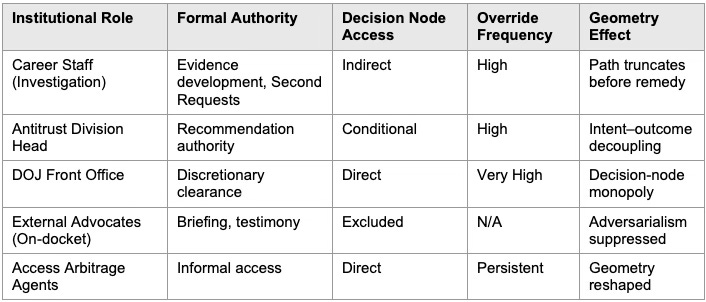
Table 1 reveals the core geometric dysfunction: career staff hold formal authority over evidence development and Second Requests, yet their decision-node access is indirect and their override frequency is high. The Antitrust Division Head holds recommendation authority but experiences equally high override frequency, producing severe intent–outcome decoupling. DOJ Front Office holds discretionary clearance with direct decision-node access and very high override frequency—this combination produces decision-node monopoly. External advocates operating through docketed channels are excluded entirely, suppressing adversarialism. Access Arbitrage agents, by contrast, maintain direct decision-node access through informal channels, reshaping the geometry itself. The pattern is structural, not episodic: formal authority exists but cannot reach outcomes.
Table 2. Lobbyist Access Grid (Routing vs. Merit)
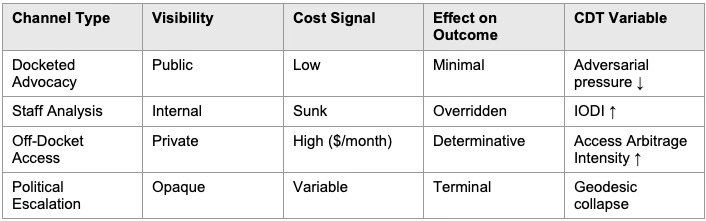
Table 2 exposes the routing inversion at the center of the capture equilibrium. Docketed advocacy—the channel Tirole identifies as essential for truth revelation—is public, low-cost, and produces minimal effect on outcomes; adversarial pressure through this channel has collapsed. Staff analysis, though internal and representing sunk institutional investment, is routinely overridden, driving Intent–Outcome Decoupling Index upward. Off-docket access, by contrast, is private, high-cost ($225,000/month retainers documented in the Tirole Phase Analysis), and determinative of outcomes; Access Arbitrage Intensity rises as this channel dominates. Political escalation operates through opaque channels with variable cost signals but produces terminal geometric effects—geodesic collapse. The grid demonstrates that cost correlates inversely with visibility and directly with outcome determination: the most expensive, least visible channels produce the most decisive results.
Table 3. Named Access Arbitrage Agents (Lobbyist Layer)
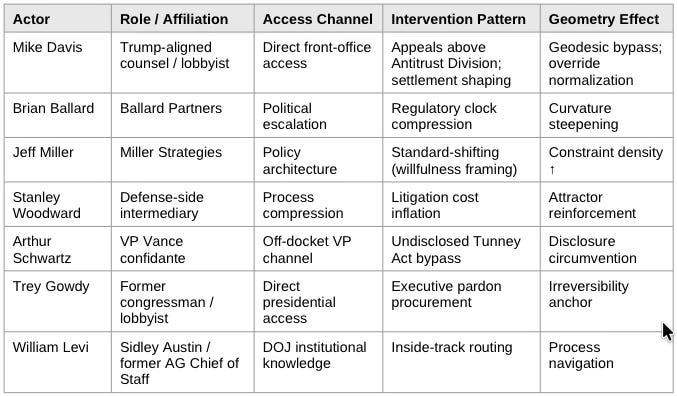
Table 3 attributes geometric effects to named actors. Mike Davis operates through direct front-office access, producing geodesic bypass and override normalization—settlements are shaped before career staff can complete analysis. Brian Ballard compresses regulatory clocks through political escalation, steepening curvature so that time forecloses structural remedies regardless of legal merit. Jeff Miller modifies policy architecture through standard-shifting, increasing constraint density before cases reach adjudication. Stanley Woodward inflates litigation costs through process compression, reinforcing the weak-settlement attractor. Each actor’s intervention pattern produces a distinct geometric effect; together, they reshape the decision field such that structural enforcement becomes unreachable.
Table 4. DOJ Institutional Gatekeepers (Decision-Node Control)
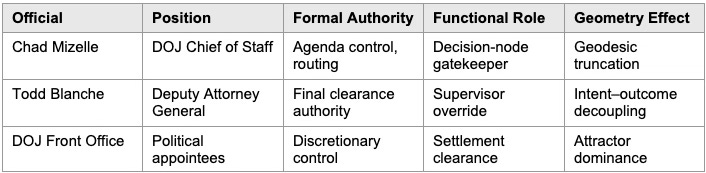
Table 4 maps the institutional gatekeepers who control decision-node access within DOJ. Chad Mizelle, as Chief of Staff, holds agenda control and routing authority—his functional role as decision-node gatekeeper produces geodesic truncation, ensuring that staff recommendations cannot reach final clearance without passing through a chokepoint aligned with Access Arbitrage channels. Todd Blanche, as Deputy Attorney General, holds final clearance authority; his functional role as supervisor override produces intent–outcome decoupling, ensuring that even correct staff analysis cannot determine outcomes. The DOJ Front Office collectively exercises discretionary control over settlement clearance, producing attractor dominance—outcomes converge on weak conduct settlements regardless of the evidentiary record developed by career staff.
Actor-specific grids ground abstract geometry in observable institutional behavior without reducing the analysis to individual intent. Names appear only where necessary to demonstrate repeatable structural roles. The critical insight is functional, not personal: replace any named actor with another occupying the same structural position, and the geometric effect persists. Capture is sustained by positions, not personalities.
The Geometry–Intent Distinction
To avoid misattribution, this study draws a sharp distinction between intent-based and geometry-based explanations of enforcement outcomes:
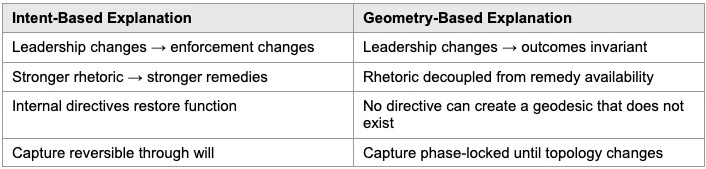
The geometry–intent distinction operationalizes the central thesis before technical parameters are introduced and frames subsequent sections as proofs of geometry dominance rather than critiques of intent.
Core Thesis: The decision geometry of federal antitrust enforcement now terminates the Rule of Law before it can operate. This is not policy failure. It is phase geometry. Career staff cannot exit the phase from within—not because they lack competence or courage, but because no survivable path exists. Courts cannot intervene before harm compounds. Only actors with independent institutional degrees of freedom—State Attorneys General operating with litigation autonomy outside the captured federal architecture—can force phase transition through distributed enforcement density.
Foresight Predictions. The CDT foresight simulation generates four falsifiable predictions anchored to this geometry:
federal actors embedded in DOJ will converge on Post-Consolidation Containment regardless of stated intent—structural remedies will not emerge from internal processes;
lobbyist interventions will continue to bend decision geometry rather than legal standards—override frequency will persist or increase absent external perturbation; (3) internal reform paths will remain non-traversable—career staff who assert boundaries will be removed before reform can occur; and
phase exit will require creation of a parallel enforcement geometry through State AG coalitions exceeding threshold density, not partnership within the federal field.
Falsification would require staff-initiated structural remedies to survive front-office routing, or sub-threshold state action to produce durable structural unwind—conditions not currently observed.
Contact mcai@mindcast-ai.com to partner with us on Law and Behavioral Economics foresight simulations. See recent works: The Stigler Equilibrium- Regulatory Capture and the Structure of Free Markets (Jan 2026), Chicago School Accelerated — The Integrated, Modernized Framework of Chicago Law and Behavioral Economics (Dec 2025), Foresight on Trial, The Diageo Litigation Validation (Jan 2026).
II. Field-Geometry Reasoning: Why Correction Is Structurally Impossible
Field-Geometry Reasoning (FGR) determines when institutional outcomes are governed by constraint topology rather than intent. FGR applied to DOJ antitrust enforcement reveals a structurally closed system: no survivable path connects career-staff investigation to structural remedy. Intent-based reform fails not because reformers lack courage, but because the constraint field contains no traversable geodesic from reform intent to reform outcome.
A. Stigler Vision Function (Capture Baseline)
Stigler Vision Function operates as the baseline layer in the CDT foresight simulation, consistent with the Nash–Stigler Externality Costs and Tirole Advocacy Arbitrage studies. Stigler Vision establishes the capture precondition: once beneficiaries are concentrated and victims diffuse, enforcement supply is systematically acquired by regulated interests. FGR then evaluates reachability and path deletion against this fixed structural baseline.
Operationally, Stigler Vision is parameterized via observed beneficiary concentration, lobbying intensity, and persistent weak-settlement outcomes. The CDT foresight simulation confirms: Capture Presence is confirmed; Enforcement Supply Acquisition registers as High. These outputs are treated as settled inputs. The analytical work then proceeds to show why, given this baseline, intent-based correction is impossible without an external perturbation.
B. Data Inputs and Measurement Basis
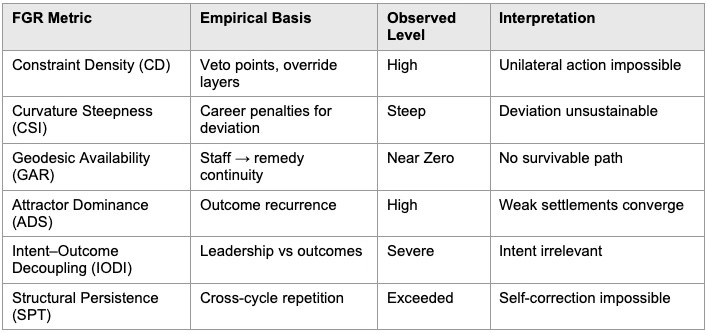
Field-Geometry Reasoning in this study is parameterized using observed institutional data rather than abstract priors. Constraint Density, Curvature Steepness, Geodesic Availability, and Intent–Outcome Decoupling are derived from the DOJ Antitrust Master Player Grid and the Lobbyist Access Grid, which together map where authority formally resides, where decisions are actually made, and how often career-staff pathways are truncated by front-office intervention. These datasets allow geometry to be inferred from routing frequency, override recurrence, and outcome convergence rather than inferred intent.
Operationally, Geodesic Availability Ratio (GAR) can be approximated as the ratio of staff-recommended structural remedies to final consent decrees imposing structural relief; across the cases examined, that ratio approaches zero once Access Arbitrage dominates.
Table 5. Field-Geometry Parameters Derived from Institutional Data
C. Parameter Interpretation
Every major geometric parameter required for self-correction fails simultaneously. High constraint density prevents unilateral action; steep curvature punishes deviation; and near-zero geodesic availability means no continuous path links investigation to remedy. Together, these conditions establish geometry dominance: outcomes remain invariant regardless of intent, leadership, or evidentiary strength.
FGR determines when outcomes are governed by constraint geometry rather than intent. An intent-based explanation would predict that leadership changes, stronger rhetoric, or internal directives could restore enforcement. FGR predicts the opposite: absent a change in constraint topology, outcomes remain invariant to intent. Repeated enforcement failure across administrations, leadership styles, and stated priorities confirms geometry dominance.
Applied to federal antitrust enforcement, FGR reveals a structurally closed system. The decision geometry has been reshaped such that career-staff investigation, Second Request issuance, and structural remedy are no longer connected by a continuous, survivable path. The geometry truncates enforcement at front-office override.
D. Field-Geometry Reasoning Conclusion
Federal antitrust enforcement is geometry-dominant with no available geodesic to structural remedy. Intent-based reform will fail because the constraint field does not contain a survivable path from reform intent to reform outcome. The system cannot self-correct through any mechanism that operates within the existing topology.
If geometry explains why correction cannot occur, it does not by itself explain how such a system remains stable over time; that stability is supplied by narrative infrastructure.
III. Coercive Narrative Governance: How Capture Is Sustained
A geometry-dominant system persists without overt illegality through Coercive Narrative Governance (CNG). CNG does not suppress speech; it suppresses routing. By controlling which analyses reach decision nodes and by raising the cost of boundary assertion, narrative governance stabilizes the Tirole Phase while preserving procedural legitimacy.
The mechanisms below describe how dissent is excluded from outcomes rather than debated on the merits. They convert information asymmetry into institutional inertia, ensuring that access—not argument—determines enforcement results.
A. The Four Coercive Narrative Governance Mechanisms
Mechanism 1: Routing Suppression (Manufactured Consensus)
Internal analyses that contradict front-office preferences do not reach the decision node. Dissent is not debated—it is routed away from outcome-determining processes. The appearance of institutional agreement is maintained by channeling disagreement into administrative dead-ends. Career staff may document concerns through proper channels, but those channels terminate before reaching the actors who control clearance decisions.
Mechanism 2: Pattern Non-Recognition (Reality Denial)
Documented override frequency is treated as a series of independent case-specific judgments rather than evidence of systematic capture. Each weak settlement is framed as a contextual determination; the pattern across Live Nation, Compass–Anywhere, and HPE–Juniper is not acknowledged as data. Pattern recognition is structurally suppressed because acknowledging the pattern would require acknowledging geometry dominance—and geometry dominance forecloses the intent-based explanations on which institutional legitimacy depends.
Mechanism 3: Boundary Reclassification (Role Reversal)
Career staff who assert professional boundaries are reframed as threats to institutional order. Boundary assertion raises coordination costs for the capture coalition; the response is reclassification rather than engagement on the merits. Objection to lobbyist influence becomes ‘insubordination.’ Opposition to weak settlement terms becomes ‘obstruction.’ The boundary-holder is converted from defender of institutional integrity to threat against institutional harmony. This inversion is characteristic of CNG: dissent is not engaged but reclassified into a category that justifies removal.
Mechanism 4: Interpretive Authority Monopoly (Access Control)
Off-docket access channels determine who reaches the decision node. The $225,000/month retainers documented in the Tirole Phase Analysis purchase what Bloomberg Law described as outcomes determined by ‘relationships with the White House and DOJ front office.’ Docketed adversarial advocacy—the mechanism Tirole identifies as essential for truth revelation—loses market value when outcomes are determined through channels that bypass evidentiary contestation. Access control ensures that interpretive authority rests with actors whose presence is invisible to the procedural record.
B. Coercive Narrative Governance Metrics Applied to DOJ
Action-Language Integrity (ALI): Low. The DOJ Justice Manual states that ‘legal judgments must be impartial and insulated from political influence.’ Operational reality shows front-office override of career staff findings based on lobbyist intervention. The gap between stated values and operational conduct exceeds threshold for institutional trust.
Narrative Centrality (NC): High. Institutional energy is directed toward managing the narrative of independence rather than achieving independence. The Blanche Memo’s framing of ‘Ending Regulation by Prosecution’ substitutes narrative for structural enforcement. Story management dominates substance.
Degree of Coercion (DoC): High. Career staff face termination for boundary assertion. The enforcement of narrative compliance is not hypothetical—it is documented in observed terminations and sidelining of enforcement officials who objected to capture dynamics.
C. Coercive Narrative Governance Conclusion
Coercive Narrative Governance explains how the Tirole Phase persists once Stigler-Nash-Tirole dynamics establish it. The system is maintained not merely by economic incentives but by narrative infrastructure that suppresses routing, denies patterns, reclassifies boundaries, and monopolizes interpretive authority. Career staff operate inside a CNG environment where truth-telling is reclassified as threat and accommodation is rewarded as professionalism.
When narrative governance suppresses routing rather than speech, its effects are most visible at the level of individual career actors who attempt to enforce boundaries.

IV. Boundary Integrity Analysis: Career Staff Trajectories
Career staff operating within a geometry-dominant environment cannot correct enforcement failure from within, regardless of competence or good faith. Once CNG and constraint geometry are in place, boundary assertion triggers predictable structural trajectories that end in removal. The focus is not on personal fault but on the mechanisms that eliminate reformers before reform can occur.
Boundary Integrity analysis predicts archetypal class behaviors under coercive narrative conditions. Individual names anchor observed instances, but the pattern holds regardless of personality, ideology, or professional skill. Boundary assertion produces a predictable sequence: good-faith engagement, pattern recognition, boundary sharpening, documentation, and exit.
A. Archetypal Trajectories
Archetype 1: Deviation Penalty Signal
A senior enforcement official asserts a boundary by documenting that off-docket intervention has altered enforcement outcomes. The institutional response activates Moral Inversion Loop (the warning is reclassified as insubordination) and Exit Penalty Activation (termination). The trajectory demonstrates Deviation Cost Increase: the cost of internal dissent has been raised for all observers. Observed instance: Roger Alford termination (December 2025).
Archetype 2: Process Pruning Event
A process gatekeeper (e.g., head of merger enforcement) asserts a boundary by opposing settlement terms that fail to address documented competitive harm. The institutional response is removal. The trajectory represents collapse of internal adversarial checks—the actor who controlled investigation discretion is eliminated once that discretion conflicted with front-office preferences. Observed instance: William Rinner termination (December 2025).
Archetype 3: Suppressed Enforcement Node
A Senate-confirmed division head asserts boundaries through extended review timelines, resistance to weak settlements, and withdrawal from lobbyist engagement. The institutional response activates Interpretive Space Closure (overruled by front-office gatekeepers) and ongoing Exit Penalty pressure (target of removal efforts). The trajectory remains incomplete but follows the predicted path: boundary sharpening, documentation, and eventual exit or accommodation. Observed instance: Gail Slater (ongoing).
B. The Structural Pattern
Alford, Rinner, and Slater trajectories share a common progression predicted by Boundary Integrity analysis:
Phase 1 — Good-faith engagement: Career staff participate genuinely, explain their positions, and assume mutual respect for institutional process.
Phase 2 — Pattern recognition: Career staff notice that their boundaries are treated as obstacles while access channels remain invisible infrastructure. ‘I hear you’ accumulates without accommodation.
Phase 3 — Boundary sharpening: Pressure converts into information rather than compliance. Career staff stop explaining and start documenting.
Phase 4 — Exit as boundary: Career staff withdraw—through termination or departure—because continued engagement requires surrendering limits that define professional integrity.
The four-phase progression explains why DOJ cannot self-correct: dissent raises coordination costs for the capture coalition. Constraint geometry punishes deviation and rewards accommodation. Career staff who hold boundaries are not debated—they are removed.
C. Boundary Integrity Conclusion
Boundary Integrity analysis confirms that career staff cannot exit the Tirole Phase from within. The CNG environment makes boundary assertion expensive through termination, reputational damage, and career consequences. The predicted trajectory—sharpening, documentation, exit—has been validated by observed terminations and the ongoing trajectory of enforcement officials who resisted capture dynamics. Internal reform is structurally impossible because the reformers are removed before reform can occur.
Once internal actors are structurally removed before reform can occur, the only remaining analytical question is whether any external intervention can alter the field itself.
V. The Phase Exit Mechanism: Distributed Enforcement Density
Internal correction is impossible. The remaining question: when can the system be forced to exit the Tirole Phase? The answer is not categorical. Distributed enforcement is necessary, but success depends on where and how external actors enter the field.
State Attorney General intervention is treated here as a geometric problem rather than a moral one. Empirically grounded thresholds distinguish symbolic participation from interventions capable of perturbing the field.
A. Why State AGs Have Institutional Degrees of Freedom
State Attorneys General operate outside the captured federal architecture for three structural reasons:
Political independence: State AGs are elected or appointed through state processes that Access Arbitrage agents operating in Washington cannot directly control. The lobbyist channels to DOJ front-office gatekeepers do not extend to 50 independent state enforcement authorities.
Litigation autonomy: State AGs can file and maintain lawsuits independent of federal enforcement decisions. When DOJ settles, states can continue. When DOJ declines to investigate, states can proceed. The HPE–Juniper intervention—where 12+ state AGs intervened after federal settlement—demonstrates this autonomy in practice.
Jurisdictional divergence: State licensing laws, consumer protection statutes, and market regulation authorities create enforcement pathways that federal Access Arbitrage cannot bypass. State-level behavioral standards (e.g., Washington SB 6091) substitute for structural enforcement that federal capture has foreclosed.
B. Data-Grounded Exit Thresholds
Table 6. Phase Exit Conditions (Distributed Enforcement Geometry)
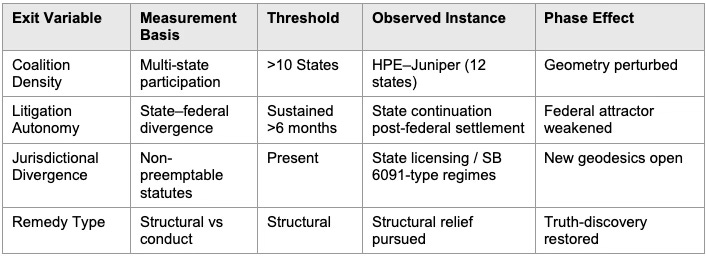
Not all state action disrupts federal capture. Only interventions that exceed coalition thresholds, maintain autonomy from federal settlements, and pursue structural remedies can weaken the dominant attractor. Below these thresholds, state enforcement is absorbed into the existing geometry and fails to produce phase exit.
C. The Skrmetti Vector: Measuring Exit Progress
The Skrmetti Vector—named for Tennessee Attorney General Jonathan Skrmetti, who confirmed that state AGs will continue the Live Nation/Ticketmaster lawsuit if DOJ settles—tracks progress toward the exit condition through three indicators measured in MindCast AI’s CDT simulation:
Indicator 1 — Coalition formation velocity: How quickly are state AGs organizing multi-state enforcement actions? The HPE–Juniper coalition formed within months of the federal settlement announcement, suggesting high velocity.
Indicator 2 — Federal-state divergence frequency: How often do states pursue enforcement that federal authorities decline? Rising frequency indicates increasing autonomy.
Indicator 3 — Structural remedy pursuit rate: What proportion of state enforcement seeks structural remedies rather than conduct settlements? Higher rates indicate that states are filling the structural enforcement void that federal capture has created.
D. Phase Exit Conclusion
Distributed enforcement is necessary but not sufficient. Phase exit occurs only when external intervention enters the field at points where constraint geometry and narrative control can be disrupted rather than absorbed. The path forward is not reform within the Tirole Advocacy Arbitrage Phase. Reform assumes a geodesic exists within the federal architecture—FGR demonstrates that none does. The path forward is forcing phase exit through distributed enforcement density: State AG coalitions operating with sufficient autonomy, at sufficient scale, with sufficient jurisdictional divergence to reintroduce adversarial pressure that federal capture has eliminated.
VI. Party-Level Cognitive Digital Twin Foresight Simulation
CDT foresight simulations apply to identified parties in the federal antitrust decision field. Each party’s structural role emits geometric signals that reinforce or perturb the dominant Post-Consolidation Containment (PCC) attractor. The simulations do not infer intent or prescribe actions; they determine which enforcement futures remain reachable.
A. Simulation I — Mike Davis (Access Arbitrage Agent)
Role: Horizontal Bypass of evidentiary nodes via direct front-office access.
Foresight Output: When Davis-type access dominates, staff analysis is removed from the reachable enforcement path. Structural remedies become unreachable regardless of evidentiary strength. The CDT registers Access Arbitrage Intensity as Very High; Geodesic Availability Ratio as Collapsing; and Attractor Reinforcement as Strong.
Interpretation: Evidence is not rebutted—it is skipped. Enforcement terminates at procedural sufficiency once the evidentiary node is bypassed.
B. Simulation II — Brian Ballard (Temporal Warping Agent)
Role: Regulatory clock compression through political escalation.
Foresight Output: Temporal compression forces premature settlement, foreclosing structural remedies even when legally available in theory. The CDT registers Curvature Steepness as High; Decision-Time Compression as Severe; and Structural Remedy Probability as Near Zero.
Interpretation: Time, not law, becomes the binding constraint. Once clocks dominate, outcomes converge on conduct settlements.
C. Simulation III — Jeff Miller (Boundary Softening Agent)
Role: Policy architecture modification via standard-shifting.
Foresight Output: Enforcement boundaries soften ex ante, narrowing remedy space before cases reach adjudication. The CDT registers Constraint Density as Increasing; Intent–Outcome Decoupling as High; and Regulatory Scope as Contracting.
Interpretation: Staff may prevail on arguments that no longer matter. Enforcement collapses without visible override.
D. Simulation IV — Chad Mizelle (Decision-Node Gatekeeper)
Role: Vertical geodesic truncation through agenda control and routing suppression.
Foresight Output: Staff recommendations become dead-lettered. Decision nodes are unreachable from investigative pathways. The CDT registers Override Frequency as Very High; Geodesic Availability Ratio as Near Zero; and Narrative Stability as High.
Interpretation: Gatekeepers do not decide outcomes; they determine which paths exist.
E. Simulation V — State Attorneys General (External Perturbation)
Role: Creation of a parallel enforcement field with a distinct attractor.
Foresight Output: Phase exit is conditionally achievable when coalition density, litigation autonomy, and jurisdictional divergence exceed thresholds. The CDT identifies threshold conditions: Coalition Density above 10 States; Litigation Autonomy Sustained beyond federal settlement windows; and Attractor Disruption Probability as Moderate-to-High when thresholds are exceeded.
Interpretation: Below threshold, state action is absorbed. Above threshold, the federal settlement attractor weakens and adversarial truth discovery can re-emerge.
F. Integrated Foresight Conclusions
Four integrated conclusions emerge from the CDT foresight simulations:
First, federal actors embedded in DOJ converge on Post-Consolidation Containment regardless of intent. Second, lobbyist interventions bend decision geometry, not legal standards. Third, internal reform paths are non-traversable. Fourth, phase exit requires creation of a parallel enforcement geometry, not partnership within the federal field.
Falsification would require staff-initiated structural remedies to survive front-office routing or sub-threshold state action to produce durable structural unwind—conditions not currently observed.
VII. Synthesis: The Geometry of Regulatory Capture
Federal antitrust enforcement is geometry-dominant. Constraint density is high; curvature steep; geodesic availability near zero; intent–outcome decoupling severe. CNG sustains the field by routing dissent away from decision nodes. Boundary Integrity analysis shows that internal reformers are removed before reform can occur.
The implication is decisive: reform within the Tirole Phase is impossible. Phase exit requires distributed enforcement density sufficient to perturb the field from outside the captured architecture.
The MindCast AI Nash-Stigler-Tirole Federal Antitrust Series:
Comparative Externality Costs in Antitrust Enforcement: A Nash–Stigler Foresight Study (January 2026) quantified the harm.
A Tirole Phase Analysis of Advocacy-Driven Antitrust Inaction (January 2026) identified the phase and the actors.
The Geometry of Regulatory Capture explains why self-correction is impossible and specifies the conditions under which phase exit becomes feasible.
The geometry of regulatory capture is now fully mapped. What remains is execution: building coalition density, maintaining litigation autonomy, and pursuing structural remedies that federal capture forecloses.
VIII. Implications for Stakeholders
Geometry determines what each actor can achieve, not what they intend. Stakeholder implications differ depending on position relative to the captured federal architecture.
Former DOJ Officials
Observed enforcement failure reflects structural impossibility, not personal failure. The trajectory you experienced—good-faith engagement, pattern recognition, boundary assertion, reclassification, exit—is predicted by Boundary Integrity analysis regardless of individual competence or courage. Testimony and contemporaneous documentation of override frequency and routing truncation are the most valuable inputs for external phase-exit actors. Your experience is data.
Current DOJ Career Staff
No geodesic exists from your position to structural remedy. Intent-Outcome Decoupling is severe; your stated enforcement posture cannot reach the decision node. Documentation that survives departure—timestamped, preserved outside internal systems—cannot alter outcomes internally but preserves evidence for future phase exit. Recognize that internal reform is structurally impossible—not because you lack courage, but because the geometry removes reformers before reform can occur.
State Attorneys General
State Attorneys General are the phase exit mechanism. Federal DOJ cannot self-correct; courts cannot intervene in time; only distributed enforcers with litigation autonomy can restore adversarial truth-discovery. Distributed enforcement succeeds only if coalition density and litigation autonomy are sustained beyond federal settlement pressure windows; sub-threshold participation is absorbed by the existing geometry. Phase exit requires coalition density at or above the threshold. Phase exit depends on sustained litigation autonomy from federal settlements. Phase exit demands structural remedies that federal capture forecloses. State enforcement does not supplement federal enforcement—it is the only pathway to phase transition.
IX. Scope and Limitations
The analysis is confined to federal antitrust enforcement under the current DOJ architecture. The scope excludes FTC enforcement dynamics, private litigation pathways, and congressional intervention. The CDT foresight simulation is parameterized on observed institutional data and public disclosures; it does not incorporate classified or non-public routing information. Phase-exit thresholds are empirically inferred from historical multi-state actions and should be interpreted as probabilistic, not deterministic, indicators.
The analysis treats the Comparative Externality Costs (Nash–Stigler Foresight Study) and A Tirole Phase Analysis of Advocacy-Driven Antitrust Inaction findings as settled inputs. Readers who dispute the existence of capture, the occurrence of advocacy arbitrage, or the compromise of federal enforcement should consult those predecessor publications before evaluating the geometry analysis presented here.
Appendix: Sources and References
Primary Sources
Congressional Testimony
Alford, Roger P. ‘Anti-American Antitrust: How Foreign Governments Target U.S. Businesses.’ Testimony before House Judiciary Committee, Subcommittee on Administrative State, Regulatory Reform, and Antitrust (December 16, 2025). Primary source documenting HPE-Juniper override dynamics, lobbyist influence patterns, Leiweke pardon, and internal DOJ dysfunction. Source for observed terminations and routing truncation evidence.
Investigative Journalism
Michaels, D. & Friedman, N. ‘Real-Estate Brokerages Avoided Merger Investigation After Justice Department Rift.’ Wall Street Journal (January 9, 2026). Documents internal DOJ rift over Compass-Anywhere clearance. Validates Agent Substitution Rule and front-office override mechanisms. Source for Intent-Outcome Decoupling assessment.
Michaels, D. ‘A Round of Golf Changed Trump’s Tone on the Concert Industry.’ Wall Street Journal (December 6, 2025). Documents direct presidential access channel and the Leiweke pardon mechanism. Source for Executive Override pathway and Geodesic Collapse evidence.
Global Competition Review. ‘Very Connected People: The Trump-Aligned Lobbyists Winning on Antitrust.’ (August 28, 2025). Documents exponential increase in antitrust lobbying revenue and names Access Arbitrage agents. Source for Lobbyist Access Grid and retainer pricing.
Bloomberg Law. ‘Law Firms Ponder Lobbying DOJ, White House to Get Deals Through.’ (November 24, 2025). Documents institutionalization of Access Arbitrage as standard practice. Source for ‘$225,000/month’ retainer pricing and ‘relationships with front office’ routing mechanism.
The Free Press. ‘Feuding, Factions, and MAGA Operatives Drive Trump’s Antitrust Policy.’ (September 29, 2025). Documents internal conflicts and lobbyist influence on enforcement decisions. Source for Constraint Density assessment.
Academic Sources
Dewatripont, M. & Tirole, J. ‘Advocates.’ Journal of Political Economy, 107(1), 1-39 (1999). Establishes that truth revelation requires adversarial competition between partisan advocates. Theoretical foundation for Access Arbitrage analysis and information-revelation collapse.
Stigler, G. ‘The Theory of Economic Regulation.’ Bell Journal of Economics and Management Science, 2(1), 3-21 (1971). Establishes Capture Theory: regulation is acquired by the industry and operated for its benefit. Foundation for understanding why enforcement supply collapses.
Posner, R. Economic Analysis of Law. Aspen Publishing (9th ed.). Provides efficiency-as-attractor framework and gravity analogies that inform Field-Geometry Reasoning methodology.
Landes, W. & Posner, R. ‘The Independent Judiciary in an Interest-Group Perspective.’ Journal of Law and Economics, 18(3), 875-901 (1975). Source for institutional geometry analysis and attractor dynamics in legal systems.
MindCast AI Theoretical Framework Hierarchy
The MindCast AI analytical architecture operates in layers, with Stigler as the primary (foundational) framework and Tirole as the diagnostic (information-revelation) layer. The causal sequence proceeds as follows: Stigler explains capture emergence; Nash explains stabilization; Tirole explains truth collapse; Field-Geometry Reasoning (FGR) explains non-traversability.
Foundation Layer: Stigler Capture Theory
Stigler establishes the baseline condition: once beneficiaries are concentrated and victims diffuse, enforcement supply is systematically acquired by regulated interests. The Stigler publications form the economic substrate upon which all subsequent analysis depends.
The Stigler Equilibrium: Regulatory Capture and the Structure of Free Markets (January 2026). Defines the Enforcement Capture Equilibrium and institutional competition as the structural response. https://www.mindcast-ai.com/p/stigler-equilibrium
The Dual Nash-Stigler Equilibrium Architecture: Behavioral Settlement and Inquiry Sufficiency as Runtime Constraints (January 2026). Establishes Nash equilibrium as behavioral settlement and Stigler equilibrium as inquiry governance within the CDT simulation framework. https://www.mindcast-ai.com/p/nash-stigler-equilibria
Federal Antitrust Breakdown as Nash-Stigler Equilibrium, Not Accident: The Stigler Equilibrium Series, Installment I on Harm Clearinghouse (January 2026). Formalizes the “Harm Clearinghouse” model and externality mapping. https://www.mindcast-ai.com/p/stigler-harm-clearinghouse
Diagnostic Layer: Tirole Information-Revelation
Tirole’s Advocates model explains why truth collapses once capture is present—adversarial advocacy is necessary for information revelation, and Access Arbitrage displaces it. Tirole is diagnostic (identifies the phase) but depends on Stigler’s capture precondition being satisfied first.
A Tirole Phase Analysis of Advocacy-Driven Antitrust Inaction at the U.S. Department of Justice (January 2026). Establishes the Tirole Advocacy Arbitrage Phase, documents the $37.5–47B externality load attributed to named Access Arbitrage agents, and introduces the Skrmetti Vector. https://www.mindcast-ai.com/p/tirole-advocacy-arbitrage
Application Layer: Externality Measurement
Comparative Externality Costs in Antitrust Enforcement: A Nash–Stigler Foresight Study of Federal Enforcement Equilibria (January 2026). Establishes the $22 billion deadweight-loss baseline, identifies Live Nation as the criminal-antitrust anchor, and validates Compass–Anywhere as the civil case. https://www.mindcast-ai.com/p/nash-stigler-livenation-compass
Foundational Frameworks
Chicago School Accelerated: The Integrated, Modernized Framework of Chicago Law and Behavioral Economics (December 2025). Modernizes the legacy Chicago School framework by integrating it with behavioral economics and identifying “System Coordination Integrity” as a key market diagnostic. https://www.mindcast-ai.com/p/chicago-school-accelerated
Field-Geometry Reasoning: A Unifying Framework for Structural Explanation in Law, Economics and Artificial Intelligence (January 2026). Formalizes the technical parameters—such as Constraint Density and Geodesic Availability—used to analyze institutional outcomes as environmental curvature. https://www.mindcast-ai.com/p/field-geometry-reasoning
Coercive Narrative Distortion and Boundary Integrity (December 2025). Defines the mechanics of Coercive Narrative Governance (CNG) and the triggers that lead to the breakdown of professional boundary integrity among career officials. https://www.mindcast-ai.com/p/coercive-boundaries
Coercive Narrative Shock and the Displacement of Public Trust (October 2025). Identifies how narrative control is utilized to stabilize regulatory capture and systematically displace trust in public institutions. https://www.mindcast-ai.com/p/cngtrust