
MindCast’s prior public comments to the CFTC: Defining “Gaming” Under the Commodity Exchange Act: The Rule 40.11 Gap Driving the Nationwide Kalshi Litigation Web (April 17, 2026) | MindCast Files Second Comment in the CFTC Prediction Markets Rulemaking: Same Day the Proposal Drops(June 10, 2026)
MindCast’s comments on the October 9 rules: MindCast CFTC Public Comments Ask the Agency to Separate Swap Classification From Listing Permission and Preemption — Drawing the Line Between Swaps and Licensed Gambling: Comment on the Interim Final Rule Excluding Casino-Style Gambling Products (RIN 3038-AF81) | Classification Is Not Permission or Displacement: Comment on the Commission’s Proposal to Include Event Contracts in the Swap Definition (RIN 3038-AF82)
The comments turn this paper’s open issues into numbered requests for agency action. MindCast files both when the dockets open on Federal Register publication.
Relevant MindCast publications: Both A Swap And A Bet: Simulating The Looming Supreme Court Battle Over Prediction Markets (August 21, 2026). Separates the three legal questions this paper applies to the new rules | Kalshi At The Supreme Court: 39 State Attorneys General Tribal Gaming Authority and Prediction-Market IPO Risk (October 7, 2026). Forecast Nevada’s position on delay and a state challenge to any final rule | Kalshi Supreme Court Amicus Briefs: The NFL and Dodd-Frank’s Architects Split the Fight Into Jurisdiction and Game-Integrity Safeguards (October 8, 2026). Forecast Kalshi’s use of pending rulemaking in its November 9 brief.
What happened. The Commodity Futures Trading Commission (CFTC) is the federal derivatives regulator. On October 9, 2026 the agency issued two rules.
The interim final rule takes licensed sportsbooks and casinos out of federal swap regulation. The proposed rule would bring exchange-traded event contracts, including Kalshi’s sports contracts, inside it. Three related petitions already sit before the Supreme Court.
Thesis. The new rules give the winners of the prediction-market cases opposite reasons to want the Supreme Court to wait. Kalshi won in the Third Circuit on the same reading the rules adopt, so a delay that lets the rules become final helps Kalshi. Nevada won twice in the Ninth Circuit on the opposite reading, so a delay puts Nevada’s wins at risk of being sent back. Neither rule decides whether federal law overrides state gaming law, and that open question supports Supreme Court review of at least one pending case by June 30, 2027.
Why now. Two comment periods and three Supreme Court response deadlines fall within the next eight weeks. State attorneys general, lawmakers and tribal governments decide now what to file. Exchange executives and investors decide how much revenue to commit before the Court acts.
I. Executive Summary
Core insight: the CFTC’s new rules reverse the value of waiting for the two sides that won below. Kalshi’s Third Circuit win matches the classification the agency now proposes, so time works for Kalshi. Nevada’s two Ninth Circuit wins run against it, so time works against Nevada. Displacement stays open, which keeps Supreme Court review the base case (P-1).
What the agency did. On October 9 the CFTC adopted an interim final rule that takes licensed casino and sportsbook gambling out of the federal definition of “swap.” The agency also published a proposed rule that would put exchange-traded event contracts, including Kalshi’s sports contracts, inside that definition. Each rule opens its own 30-day comment period on Federal Register publication.
Why the agency acted now. Three appeals courts have split on whether sports event contracts are swaps, and three petitions now ask the Supreme Court to resolve the conflict. The White House received both rules for review on September 28, three days after the Sixth Circuit ruled against Kalshi. The interim rule’s own justification says the Ninth Circuit’s reading “threatens to wreak havoc on the operations of DCMs nationwide,” referring to the designated contract markets where event contracts trade.
What the rules signal about the CFTC. The agency has moved from defending its jurisdiction in court briefs to defining it by rule. The agency gave up ground it never claimed over licensed sportsbooks to strengthen its claim over exchange contracts. The same documents hand opponents new material: the proposal describes sports contracts as involving gaming, and the interim rule skipped prior public comment on an emergency rationale that commenters can contest.
MindCast AI applies Predictive Behavioral Economics + Dynamic Game Theory through MindCast AI Proprietary Cognitive Digital Twin Foresight Simulations (MP CDT FS). Behavioral Economics supplies the decision rules. Game Theory supplies the payoff structure. Predictive simulations emerge from the combination.
The paper proceeds in six steps. Section II explains what the rules do and why the agency acted now, and Section III states what MindCast’s earlier work identified. Section IV frames the competing explanations, and Section V reports the Simulation Predictions. Sections VI and VII convert the findings into audience consequences and risk mitigation, and Section VIII names the disputes the rules leave for courts.
MindCast’s earlier calls on this dispute. Confirmed: a Kalshi petition for Ninth Circuit rehearing (66–80%), filed September 9. Confirmed: a certiorari-stage brief from fifteen or more states (75–88%), signed by 39 states on October 7. Not met: a three-to-one or two-to-two circuit count after the Sixth Circuit ruled (70–82%), which stood at two-to-one.
Simulation Prediction Highlights
The paper carries ten Simulation Predictions: two primary (P) and eight secondary (S). Four earlier entries carry forward on their original terms.

What the Findings Mean for Each Audience
🏛️ Policymakers. State attorneys general, lawmakers and tribal governments can put displacement and tribal authority before the agency through comments on both rules (S-4, S-5).
💼 Executives. Exchange operators gain a stronger classification argument but no approval to list any contract. Product plans should assume Supreme Court review (P-1) and state-by-state exposure until a decision.
⚖️ Counsel. Kalshi’s rulemaking argument invites the reply that classification does not decide displacement (S-1). Nevada would hold the stronger position by arguing against delay (S-3).
📊 Investors. Sports-contract revenue now depends on a proposed rule, an interim rule open to challenge and three petitions. Review granted inside a capital-raising window puts the decision and the raise on the same calendar.
Takeaway: the CFTC strengthened its classification argument by rule, and the Supreme Court still has to decide whether state gaming law survives.
II. The Two New Rules Strengthen the Agency’s Classification Argument and Leave Two Questions Open
The CFTC acted on one of three legal questions. The interim rule takes effect on publication, while the inclusion rule remains a proposal.
Classification: is a sports event contract a swap?
Permission: may an exchange list it?
Displacement: does federal law override state gaming law? Courts call this the preemption question.
A. The Interim Rule Excludes Licensed Gambling From the Swap Definition
The interim final rule removes licensed casino and sportsbook products from federal swap regulation. The rule adds paragraph (7) to the swap definition in 17 C.F.R. § 1.3. A product falls outside the definition when it passes two tests.
Provider Test. A state- or tribal-licensed operator offers the product within its license, and state or tribal law regulates it as gaming.
Product Test. The product does not trade on an exchange or any other market where trades execute among multiple participants or through individual negotiation.
The exclusion names three product types. Sports wagers and casino games come first. Other licensed games of chance follow, including pool wagering, lotteries and raffles. The agency adds that a product failing the exclusion does not become a swap by default.
The agency adopted the interim rule without prior notice and comment. The rule becomes effective upon Federal Register publication, according to the CFTC’s October 9 press release. The agency invoked the good-cause exception, and comments run for 30 days afterward.
B. The Proposed Rule Brings Exchange Event Contracts Into the Swap Definition
The proposal adds event contracts to the list of instruments the swap definition covers. The new entry names contracts “based on sports-, politics-, cultural, and weather-related events.” Comments run for 30 days after publication.
The proposal rests on three parts of the statute. The first part covers options. The second covers payments that depend on an event. The fourth covers instruments “commonly known to the trade as a swap.” The proposal also invokes the Dodd-Frank Act’s grant of authority to “further define” swap, citing Loper Bright Enterprises v. Raimondo on statutes that delegate the power to define a term.
The agency separates exchange contracts from sportsbook bets by how they trade. On an exchange, a contract trades through a central order book at prices set by bids and offers, and a clearinghouse stands between the two sides. A sportsbook sets its own odds and takes the other side of every bet. The proposal states that the Securities and Exchange Commission (SEC) joins it.
C. The Circuit Split Set the Timing
The rules followed the court conflict, not the October amicus briefs. The White House Office of Information and Regulatory Affairs received both rules for review on September 28 and cleared them on October 9. The sequence below shows what preceded that submission.
June 2026. The SEC and CFTC jointly ask for comment on how to define swaps, including event contracts.
August 28. The Ninth Circuit rules for Nevada in KalshiEX v. Assad and two companion cases.
September 2. New Jersey petitions for certiorari in Flaherty v. KalshiEX, No. 26-299.
September 9. Kalshi asks the full Ninth Circuit to rehear Assad.
September 10 and 11. Robinhood and Crypto.com petition for certiorari in No. 26-338 and No. 26-344.
September 25. The Sixth Circuit rules against Kalshi in KalshiEX v. Schuler.
October 6 to 8. Amicus briefs in No. 26-299 arrive from 39 states and the District of Columbia and from 145 tribes and tribal organizations. The American Gaming Association, former Senator Dodd, former Chairman Gensler and the NFL also file.
October 9. The CFTC releases both rules.
The agency states its own reasons. The interim rule says “recent developments require the Commission to exercise its statutory authority” to exclude casino-style gambling. The rule names Flaherty, Assad and state enforcement as those developments. The rule describes state actions that “imperil a nascent industry that Congress has entrusted to the ‘exclusive jurisdiction’ of a federal agency.” The rule adds that the exclusion “implements the Third Circuit’s suggested approach.”
D. The Rules Show an Agency Defending Its Jurisdiction by Rule
The CFTC moved from briefs to rule text. The agency had defended exchange jurisdiction as a litigant and amicus. The new rules put its classification position into regulation while the Supreme Court weighs whether to take the question.
The agency gave up ground it never claimed. The exclusion confirms that licensed sportsbooks fall outside federal swap regulation. The concession answers the states’ strongest objection, that a broad swap definition would federalize every sportsbook bet, and protects the agency’s claim over exchange contracts.
The same documents create new exposure. The proposal describes sports contracts as contracts that “involve” gaming, which private plaintiffs suing under Rule 40.11 can cite. The interim rule skipped prior public comment on an emergency rationale, which commenters can contest. The “commonly known to the trade” argument leans on the agency’s own regulatory history.
🏛️ For policymakers: state comments now enter a proceeding that runs alongside the pending petitions, and the agency’s stated reasons invite direct responses.
Takeaway: the proceedings strengthen the agency’s classification argument and leave listing permission and state-law displacement unresolved.
III. The Product Test Adopts the Exchange-Structure Line, and Four Earlier Forecasts Remain Open
The interim rule’s Product Test draws the line an earlier MindCast paper described: exchange structure separates federal contracts from state wagers. The paired exclusion and inclusion design is new, and this paper’s Simulation Predictions address it.
The exchange-structure answer appeared in September. The Kalshi Vehicle Contest (September 2) described three answers Kalshi could give to the problem of off-exchange sportsbook bets. The third answer let exchange structure separate federal contracts from state wagers. The interim rule’s Product Test adopts exchange structure to define the exclusion.
An August entry remains open. Both A Swap And A Bet: Simulating The Looming Supreme Court Battle Over Prediction Markets (August 21) forecast at 40–50% that a CFTC rule would materially change the litigation before any merits decision. The interim rule now exists, and the entry resolves when the rule materially changes the litigation.
Two October entries reach the rules. Kalshi At The Supreme Court (October 7) forecast Nevada’s position on delay and a state challenge to any final rule. Kalshi Supreme Court Amicus Briefs (October 8) forecast Kalshi’s use of pending rulemaking in its November 9 brief.
Takeaway: the new rules test four open entries, and the new Simulation Predictions build on the classification change.
IV. Five Explanations Compete for How the Court Responds
The simulation tests how the new rules change which petition the Court takes up and when, through June 30, 2027. Five explanations compete, and each carries its own falsifier.
A. Behavioral Economics Explains Why Two Winners Diverge
Loss aversion governs each winner. Kalshi and Nevada each defend a lower-court win, and each weighs losing that win more heavily than the chance of a broader victory. The rules change which risk each winner faces. Loss aversion therefore pushes Kalshi toward delay and Nevada away from it.
The sportsbook objection loses its force. States had argued that a broad swap definition would turn every licensed sportsbook bet into a federal swap. The interim rule removes that argument. The broader objection to federal control of exchange sports wagering remains and now carries the states’ case.
Declared goals differ from revealed ones. The agency declares a goal of market clarity, while its timing and citations track the certiorari calendar. Robinhood has called a rule a source of “significant clarity.” Crypto.com has called rulemaking “irrelevant to the statutory preemption analysis.”
B. Game Theory Explains Who Gains From Waiting
Two clocks run at once. The comment periods begin on publication and close 30 days later. Supreme Court responses fall due November 9, 13 and 16. A final inclusion rule also needs a second White House review.
The payoff from delay follows the judgment. Kalshi gains from delay because its judgment matches the proposed rule. Nevada loses from delay because a final rule could support reconsideration of its wins. Robinhood and Crypto.com hold adverse judgments, and Robinhood also expects the rule to help its regulatory argument.
Remand stays possible but narrow. The Court sends a case back when a new development shows “a reasonable probability that the decision below rests upon a premise that the lower court would reject,” under Lawrence v. Chater. A final rule opens that path only if it arrives while a Ninth Circuit petition is still pending.
C. Eleven Cognitive Digital Twins Model the Institutions
The simulation builds eleven Cognitive Digital Twins (CDTs). Each one models an institution’s objectives, constraints, options and response policy.
CFTC: asserts exclusive jurisdiction over exchange-listed event contracts and controls the timing of a final rule.
Supreme Court: chooses among six options: plenary review; denial; a hold; a relist; a call for the Solicitor General’s views; or a remand.
New Jersey: seeks reversal of the Third Circuit and keeps displacement at the center of its petition.
Kalshi: defends its Third Circuit win and seeks rehearing of its Ninth Circuit loss.
Robinhood: seeks relief from its Ninth Circuit loss while relying on the rule.
Crypto.com: seeks statutory review and treats rulemaking as irrelevant.
Nevada: defends two Ninth Circuit wins in Nos. 26-338 and 26-344.
State coalition: comments on the rules and prepares to challenge a final rule.
Tribal governments: protect compact exclusivity and authority under the Indian Gaming Regulatory Act (IGRA).
Licensed operators: defend sportsbook franchises against exchange competition.
Rule 40.11 plaintiffs: sue exchanges under the Commodity Exchange Act’s private right of action. Rule 40.11 is the CFTC rule that bars exchanges from listing contracts involving gaming.
D. The Five Competing Explanations
The Court waits for the agency. The rules give the Court a reason to hold all three petitions. Falsifier: a plenary grant before a final inclusion rule.
The Court grants review on displacement. The rules leave displacement open, and the Court takes a case to resolve it. Falsifier: no plenary grant by June 30, 2027.
A final rule sends the Ninth Circuit cases back. The agency finalizes while those petitions are pending, and the Court remands. Falsifier: no remand order citing the rules.
The winners split on delay. Kalshi argues for waiting, while Nevada argues against it. Falsifier: Nevada asks the Court to wait for the rulemaking.
The rules change nothing. The Court acts as it would have without them. Falsifier: any party’s filing or Court order that turns on the rules.
⚖️ For counsel: the November filings first test the parties’ positions on delay. Later Court orders test the disposition forecasts.
Takeaway: the simulation favors explanations 2 and 4 together, with review as the base case and Nevada as the first party to test the split.
V. MindCast Simulation Predictions: The Court Grants Review and Nevada Argues Against Delay
The simulation produced ten Simulation Predictions dated October 10, 2026: two primary (P) and eight secondary (S). Three mechanisms drive them.
Displacement keeps the Court on course to grant review.
The delay split gives Kalshi and Nevada opposite incentives on waiting.
Agency procedure keeps a final inclusion rule behind the Court’s first substantive order.
A. Four Scenario Paths Through June 30, 2027
Holds, relists and calls for the Solicitor General’s views can precede any of these end states.
Merits grant (base case). At least one plenary grant, with holds, denials or remands possible in the other petitions. The path activates when briefing preserves the displacement conflict.
Still pending. At least one petition stays pending with no grant and no remand. The path activates when the Court values more agency or government input.
All denied. The Court denies all three petitions. The path activates when the preliminary-injunction posture outweighs the value of intervening.
Remand only. At least one remand and no plenary grant. The path activates when a final inclusion rule arrives while a Ninth Circuit petition is pending.
Nevada adapts best. Nevada’s strongest move stays the same on every path: argue for prompt review.
B. Primary Simulation Predictions
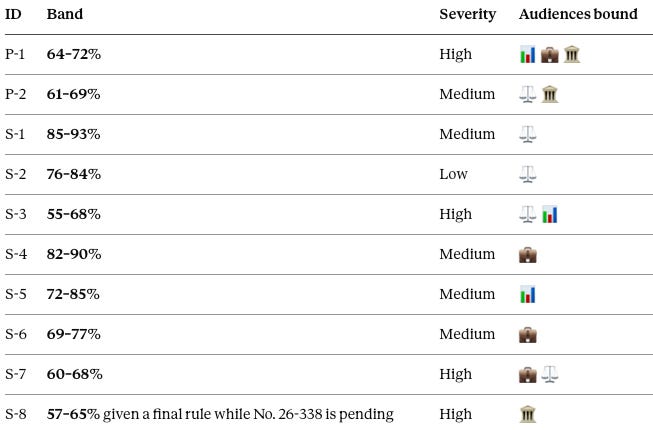
P-1 (64–72%): The Supreme Court grants plenary review in at least one of Nos. 26-299, 26-338 or 26-344 by June 30, 2027.
Trigger: completed briefing preserves the displacement conflict.
Falsifier: no plenary grant in any of the three petitions by June 30, 2027. A grant limited to vacatur and remand does not count. A hold followed by a plenary grant before the deadline confirms.
Verification source: Supreme Court order lists and dockets.
P-2 (61–69%): The Court issues its first substantive order in any of the three petitions before the CFTC publishes a final inclusion rule.
Qualifying orders: a plenary grant; a grant limited to vacatur and remand; a denial; or a call for the Solicitor General’s views. Relists and extensions do not count.
Falsifier: official publication of a final inclusion rule precedes the first qualifying order. The entry is inactive if no qualifying order issues by June 30, 2027.
Verification source: the Federal Register and Supreme Court order lists.
C. Secondary Simulation Predictions
S-1 (85–93%): New Jersey’s first reply in No. 26-299 expressly keeps displacement separate from swap status.Falsifier: the reply omits the distinction, or no reply is filed by June 30, 2027.
S-2 (76–84%): Nevada’s response in No. 26-338 argues that the proposed inclusion rule does not dispose of the statutory dispute. Falsifier: the response omits the argument, or no response is filed by June 30, 2027.
S-3 (55–68%): Nevada’s first response to either industry petition addresses the new CFTC rules and argues they do not justify deferring review. Falsifier: the response omits the rules or argues for deferral. S-3 tests the delay split directly.
S-4 (82–90%): A tribal government or tribal organization raises IGRA in a comment on either CFTC rule.Falsifier: no qualifying tribal comment by the closing dates.
S-5 (72–85%): At least one state attorney general argues in a comment on the inclusion rule that classification does not decide displacement. Falsifier: no state comment makes the argument by the closing date.
S-6 (69–77%): A commenter other than MindCast AI challenges the interim rule’s good-cause justification.Falsifier: no qualifying comment by the closing date. A MindCast comment does not count.
S-7 (60–68%): A private plaintiff cites the proposed rule’s sports-gaming language in a complaint or substantive brief by June 30, 2027. Falsifier: no filing expressly links to the proposal’s text. A generic gaming claim does not count.
S-8 (57–65%, given a final inclusion rule while No. 26-338 is pending): Robinhood asks the Court to vacate and remand in light of that rule. The window runs sixty days from publication or until the Court disposes of No. 26-338, whichever comes first.
Falsifier for S-8: no Robinhood request in the window. Another petitioner’s request does not count.
D. Four Earlier Entries Carry Forward
Four entries from earlier MindCast papers remain open.
From Both A Swap And A Bet: “A CFTC rule or authoritative gaming interpretation materially changes the litigation record before any merits decision” (40–50%).
From Kalshi At The Supreme Court, P-3: “Nevada’s first response to either industry petition states that the preemption question warrants the Supreme Court’s review, and does not argue that review of the question should wait” (71–84%).
From the same paper, S-9: “A final federal rule allowing the contested sports-contract model, issued before July 2027, draws a judicial challenge involving at least two state governments within sixty days” (78–90% given a final rule).
From Kalshi Supreme Court Amicus Briefs, P-1: “Kalshi’s November 9 brief in opposition cites pending CFTC rulemaking as a reason to deny or defer review” (64–78%).
E. Remand Remains a Narrower Path
A remand requires two conditions at once. The final rule must arrive while a Ninth Circuit petition is pending, and it must change the reasoning below. The Court could act first in New Jersey’s case and leave both Ninth Circuit petitions pending until after finalization. S-8 tests the first step on that path: Robinhood’s request.
F. Events That Would Change the Contest
A grant of rehearing in Assad that vacates the Ninth Circuit opinion would change two of the three petitions. The Third Circuit’s conflict with the Sixth Circuit would remain. Congressional action on event contracts or withdrawal of the interim rule would replace the game the simulation models.
Takeaway: review is the base case, Nevada’s November filings test the delay split first, and remand stays a narrow alternative.
VI. What the Findings Mean for Each Audience
Each audience faces a different consequence from the same findings. The table below states consequences only, and the risk mitigation that follows states the available actions.
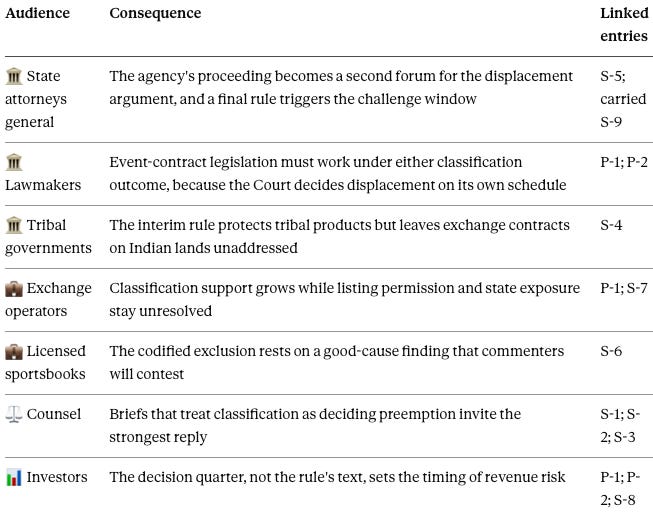
Takeaway: every audience faces exposure before the Court acts, and the comment periods open first.
VII. Risk Mitigation: Exposure, Actions and What Remains
Each Simulation Prediction below carries four parts: the prediction and band; the exposure if it resolves true and the stakeholder does nothing; unilateral actions with an owner and deadline; and the residual exposure. Severity and probability are separate measures, because a lower-probability entry can carry the larger loss.
The actions are analytic options, not legal, investment or fiduciary advice to any party.
P-1 (64–72%): The Court Grants Plenary Review by June 30, 2027
📊 Investors.
Exposure: an early grant could bring argument and a decision within the 2026–27 Term. A later grant could extend uncertainty beyond June. Either way, one or more quarters of a 2027 listing or funding window can overlap a pending merits case.
Actions:
Diligence leads tag each revenue line by state and by contract category before the Court’s first conference on the petitions.
Valuation teams add a decision-quarter case to every model before November 30.
Portfolio committees stage commitments so that the largest tranche falls after the Court’s decision date.
Residual: if the Court reaches displacement on the merits, its ruling would apply across states, and staging does not change that.
💼 Exchange operators.
Exposure: revenue from sports contracts in states with active enforcement stays at risk through the decision.
Actions:
Product leads launch new sports contract categories in tranches tied to the decision date.
Compliance leads keep geolocation controls current for every state with a pending enforcement action before each launch.
Residual: contracts already listed stay exposed to the merits ruling.
🏛️ State attorneys general.
Exposure: merits briefing begins within weeks of a grant, during legislative sessions for many states.
Actions:
Solicitors general assign a merits team before the Court’s first conference.
Lead offices fix amicus sign-on authority and a named contact before January, when new attorneys general take office.
Residual: the decision binds every state whether or not it filed.
P-2 (61–69%): The Court Acts Before a Final Inclusion Rule
⚖️ Counsel.
Exposure: a certiorari-stage brief that relies on a final rule loses its support when the Court acts first.
Actions:
Appellate counsel write the November briefs without depending on finalization.
Counsel draft a supplemental brief under Supreme Court Rule 15.8 ready to file within days of any final rule.
Residual: a final rule published during merits briefing changes the legal materials mid-case.
🏛️ Lawmakers.
Exposure: a 2027 session bill drafted around one classification outcome can conflict with the agency’s final rule or the Court’s decision.
Actions: legislative counsel draft event-contract bills that operate under either classification outcome before sessions open in January.
Residual: a Supreme Court displacement ruling can still preempt parts of any state statute.
S-1 (85–93%): New Jersey Keeps Displacement Separate From Classification
⚖️ Counsel for Kalshi and exchange-side amici.
Exposure: an opposition that leads with rulemaking spends pages on an argument New Jersey answers with the Sixth Circuit’s alternative holding.
Actions: opposition counsel lead with the preliminary-injunction posture before November 9 and present rulemaking as context.
Residual: the displacement question stays in the petition regardless of how the opposition frames it.
S-2 (76–84%): Nevada Argues the Proposed Rule Does Not Decide the Statutory Dispute
⚖️ Counsel for Robinhood.
Exposure: the reply must answer Nevada within the 3,000-word limit for a reply to a brief in opposition.
Actions:
Reply counsel draft the answer to the “proposal is not law” argument before November 13.
Counsel separate the remand request from the merits argument in the reply’s structure.
Residual: a proposed rule carries no legal force until finalized, whatever the reply argues.
S-3 (55–68%): Nevada Argues the Rules Do Not Justify Deferral
⚖️ Counsel for Kalshi.
Exposure: if S-3 and the carried October 8 P-1 both resolve true, Kalshi’s November 9 opposition arrives before Nevada’s November 13 response and leaves Kalshi as the only party urging delay. No reply falls due in the schedule.
Actions: opposition counsel prepare a supplemental brief under Supreme Court Rule 15.8 addressing Nevada’s position before the petitions are distributed for conference.
Residual: if both resolve true, the Court sees the only judgment-holder arguing for delay. A supplemental brief cannot change that posture.
📊 Investors.
Exposure: the case for prompt review strengthens, which can move an eventual decision earlier.
Actions: valuation teams rerun the decision-quarter case on November 17, after both Nevada responses are public.
Residual: the Court controls the timing of any grant and decision.
S-4 (82–90%): Tribes Raise the Indian Gaming Regulatory Act in the Comment Proceedings
💼 Exchange operators.
Exposure: a final rule or later litigation can require geolocation exclusion of Indian lands across every state with tribal gaming.
Actions: compliance leads map tribal territories into geolocation systems before the comment periods close.
Residual: IGRA claims proceed under a separate federal statute that no CFTC rule controls.
S-5 (72–85%): A State Argues Classification Does Not Decide Displacement
📊 Investors.
Exposure: a final inclusion rule delivers less preemption protection than its text suggests, because the displacement argument enters its own administrative file.
Actions: diligence leads value revenue in states with active enforcement as contested, not protected, by any final rule.
Residual: a court can still find displacement in Kalshi’s favor, and a contested valuation would then understate that revenue.
S-6 (69–77%): A Commenter Other Than MindCast Challenges the Interim Rule’s Good Cause
💼 Licensed sportsbooks.
Exposure: a court that rejects the good-cause finding can vacate the codified exclusion and return sportsbooks to the pre-October status.
Actions:
Regulatory counsel file comments supporting the exclusion’s substance before the comment period closes.
Operators file through their trade association, and limit the joint filing to the rule’s merits to avoid antitrust exposure from sharing competitive information.
Residual: the agency’s longstanding position survives vacatur only as policy, not as rule text.
S-7 (60–68%): A Private Plaintiff Cites the Proposal’s Gaming Language
💼 Exchange operators.
Exposure: plaintiffs can ask courts to widen discovery to the listing decision for every sports contract. Whether discovery widens depends on each court’s ruling.
Actions: litigation counsel prepare the response that classification statements do not decide listing permission, before the next briefing deadline in each pending suit.
Residual: Rule 40.11 governs listing until the agency finalizes a replacement.
⚖️ Counsel for issuers preparing securities offerings.
Exposure: risk-factor disclosure may need to address the Rule 40.11 track. Whether a plaintiff’s citation makes the track material is a separate assessment for each issuer.
Actions: securities counsel assess the materiality of the private-action track before any filing date, using only public information.
Residual: the suits’ outcome stays outside the issuer’s control.
S-8 (57–65% Given a Final Inclusion Rule While No. 26-338 Is Pending): Robinhood Seeks Remand
🏛️ Nevada.
Exposure: a remand vacates one of Nevada’s two Ninth Circuit wins and restarts that case.
Actions:
Nevada’s response on November 13 explains why a future rule would not change a judgment resting on the statute’s text.
The Attorney General’s office drafts an opposition to a remand request ready to file within ten days of any final rule.
Residual: the Court decides remand on the equities of the case.
Linked entry. States preparing a challenge under carried S-9 also strengthen Nevada’s opposition to remand. The challenge counts once, under carried S-9.
Takeaway: the highest-severity exposures fall on investors and exchange operators under P-1, S-3 and S-7, and each audience’s first available action falls before November 30.
VIII. The Rules Leave Permission, Displacement and Tribal Authority for Courts
The new rules strengthen the federal classification argument without resolving listing permission, displacement or tribal authority. Courts still decide whether exchanges may list sports contracts, whether state law survives and how IGRA applies.
A. Classification Stays Contestable
The proposal argues that a sports contract is a swap, subject to finalization and judicial review. According to the proposal, the Ninth Circuit decided only the event-payment part of the definition. The options part and the “commonly known to the trade” part stay available to the agency even if the Supreme Court adopts Assad‘s reading.
The “commonly known to the trade” argument leans on the agency’s own history. The proposal counts the CFTC and the firms it oversees as part of “the trade.” Challengers can argue that the evidence measures agency practice and not market understanding.
B. Listing Permission Stays Unresolved
The proposal separates classification from listing. The agency writes that Rule 40.11 “does not provide a basis to conclude that event contracts are not swaps.” It addresses the Ninth Circuit’s listing-bar reading only “even assuming that premise.”
The proposal also describes sports contracts as involving gaming. The agency writes that “sports are a type of ‘gam[e]’” and that sports contracts “involve” gaming. Existing Rule 40.11 governs contracts involving gaming, and the replacement proposal is not final (S-7).
C. Displacement Decides the Case
No classification rule decides whether state gaming law survives. The Sixth Circuit held that no preemption follows even if the contracts are swaps. Former Senator Dodd argues that federal jurisdiction over a market does not displace state or tribal law.
The interim rule makes displacement the states’ main argument. Before the new rules the states could argue that classification proved too much. Now the strongest remaining argument is the preemption question the petitions present (P-1).
D. Tribal Authority Runs Under a Separate Statute
The interim rule protects tribal products but not tribal jurisdiction. The Provider Test covers wagers offered under IGRA. The rules say nothing about exchange contracts placed by customers on Indian lands (S-4).
E. Issues for the Comment Proceedings
Pool wagering. The exclusion lists pool wagering, yet pari-mutuel pools set payouts from many bettors’ combined wagers. The Product Test excludes markets where trades execute among multiple participants.
Licensed betting exchanges. A state-licensed peer-to-peer exchange fails the Product Test, and the rules do not say how such products are treated.
Emergency rationale. The interim rule cites threats to exchange-listed contracts as its emergency, while its text excludes only licensed gambling (S-6).
Volume figures. The proposal reports about $1.5 billion in August monthly volume across exchanges reporting to the Commission. The interim rule cites a third-party figure of $24 billion in April on two markets. Commenters can ask the agency to state the basis of each.
Harm and alternatives. The proposal states that some event-contract features “can be associated with addictive potential,” then identifies no viable alternative.
MindCast’s comments press each issue as a numbered request. The comment on the interim rule covers pool wagering, betting exchanges, the good-cause rationale and the volume figure. The comment on the proposal covers harm, alternatives and both volume figures.
📊 For investors: permission and displacement risks survive any final rule, so a final rule narrows classification risk only.
Takeaway: the agency addressed the narrowest of the three questions through a proposal, and the comment proceedings give commenters another forum to press the other two.
IX. What to Watch: November Filings Decide the First Test
Two timing tests run separately. P-2 tests whether the Court acts before finalization. S-8 separately tests whether a final rule arrives while Robinhood’s petition remains pending and prompts a remand request. The dated observables below resolve the entries in order.
Publication of both rules (date pending). Starts both 30-day comment periods (S-4, S-5, S-6).
November 9. Kalshi’s brief in opposition in No. 26-299 (carried October 8 P-1; S-1 follows).
November 13. Nevada’s response to Robinhood in No. 26-338 (S-2, S-3, carried October 7 P-3).
November 16. Nevada’s response to Crypto.com in No. 26-344 (S-3).
Late November. New Jersey’s reply (S-1).
December onward. The Court’s first substantive order in any petition (P-1, P-2).
Any date. A Ninth Circuit order on Kalshi’s rehearing petition, and a final inclusion rule (S-8, carried S-9).
Takeaway: the November 13 filing gives the first direct test of the delay split.
Conclusion
The CFTC’s new rules change who wants the Court to wait. Kalshi’s judgment matches the proposed classification, so delay helps it. Nevada’s judgments run against it, so delay exposes them.
The rules strengthen the federal argument on classification and leave displacement standing. The displacement question supports a merits grant in at least one petition by June 30, 2027 (P-1, 64–72%).
Nevada’s first response on November 13 provides the first test. A response that cites the new rules as a reason for prompt review confirms the delay split (S-3, 55–68%).
Working With MindCast
Each stakeholder in the prediction-market dispute faces a decision public analysis cannot answer. An exchange must decide which contracts to list before Rule 40.11 is resolved (S-7). A state must decide whether to sue over a final rule or file as amicus (carried S-9). An investor must decide how much of a 2027 capital raise overlaps a pending merits case (P-1).
MindCast builds Cognitive Digital Twins of the stakeholder and its counterparties from the stakeholder’s own decision history. The simulation then reruns the regulatory and judicial contest against the organization’s actual options and risk tolerance.
Commissioned work adds organization-specific scenarios, petition-by-petition timing analysis and decision triggers.
The starting point is a scoped diagnostic session keyed to the comment deadlines. Contact mcai@mindcast-ai.com.
Appendix A: MindCast Works Cited
Prior Simulation Predictions and Comments
Both A Swap And A Bet: Simulating The Looming Supreme Court Battle Over Prediction Markets. Supplies the classification, permission and displacement framework and the carried August entry.
The Kalshi Vehicle Contest: New Jersey Puts Prediction-Market Sports Betting Before the Supreme Court. Supplies the exchange-structure answer the exclusion adopts and the confirmed rehearing entry.
Kalshi At The Supreme Court: 39 State Attorneys General Tribal Gaming Authority and Prediction-Market IPO Risk. Supplies the carried P-3 and S-9 entries and the fifteen-state confirmation.
Kalshi Supreme Court Amicus Briefs: The NFL and Dodd-Frank’s Architects Split the Fight Into Jurisdiction and Game-Integrity Safeguards. Supplies the carried P-1 entry on Kalshi’s rulemaking argument.
The Kalshi Circuit Split: The Ninth Circuit Defines the Prediction-Market Gaming Boundary the CFTC Would Not. Supplies the analysis of Assad‘s Rule 40.11 holding and the circuit-count entry.
Defining “Gaming” Under the Commodity Exchange Act: The Rule 40.11 Gap Driving the Nationwide Kalshi Litigation Web. Supplies MindCast’s April 17 comment to the CFTC.
MindCast Files Second Comment in the CFTC Prediction Markets Rulemaking: Same Day the Proposal Drops. Supplies MindCast’s June 10 comment on the review that now governs listing permission.
MindCast Comments on the October 9 Rules
Drawing the Line Between Swaps and Licensed Gambling: Comment on the Interim Final Rule Excluding Casino-Style Gambling Products. Supplies nine requests on the Provider and Product Tests, tribal jurisdiction and the good-cause finding.
Classification Is Not Permission or Displacement: Comment on the Commission’s Proposal to Include Event Contracts in the Swap Definition. Supplies nine requests on Rule 40.11 and the undefined event-contract term. Further requests address trade-usage evidence, disclosure and the cost-benefit analysis.
Related Analysis
How the CFTC’s Missing “Gaming” Definition Is Losing the Kalshi Prediction-Market Preemption War. Supplies the account of how agency delay moved interpretive control to the courts.
The CFTC NPRM Is a Litigation Brief: Reading RIN 3038-AF65 as the Federal Record for the Preemption War. Supplies the reading of agency rulemaking as a litigation tool.
The Rule 40.11 Paradox: Kalshi, the Third Circuit, and the Class Action the Ninth Circuit Cannot Ignore. Supplies the private-lawsuit track the gaming language reaches.
Appendix B: Sources
Rules and Agency Materials
CFTC, Interim Final Rule: Further Definition of “Swap” to Exclude Casino-Style Gambling Products, RIN 3038-AF81 (Oct. 9, 2026). Supplies the Provider and Product Tests and the good-cause finding.
CFTC, Notice of Proposed Rulemaking: Further Definition of “Swap” to Include Event Contracts, RIN 3038-AF82 (Oct. 9, 2026). Supplies the inclusion text, the Rule 40.11 discussion and the volume figures.
CFTC, Press Release 9309-26 and Press Release 9310-26 (Oct. 9, 2026). Supply the effective-date and comment-period terms.
Office of Information and Regulatory Affairs, review listing for CFTC rules. Supplies the September 28 receipt and October 9 conclusion dates.
17 C.F.R. § 40.11. Supplies the listing rule for gaming contracts.
Court Dockets and Decisions
Supreme Court dockets No. 26-299, No. 26-338 and No. 26-344. Supply the response deadlines and amicus filings.
KalshiEX, LLC v. Flaherty, 172 F.4th 220 (3d Cir. 2026); KalshiEX, LLC v. Assad, No. 25-7516 (9th Cir. Aug. 28, 2026); KalshiEX LLC v. Schuler (6th Cir. Sept. 25, 2026). Supply the three-circuit conflict.
Loper Bright Enterprises v. Raimondo, 603 U.S. 369 (2024). Supplies the delegation principle the proposal invokes.
Lawrence v. Chater, 516 U.S. 163 (1996). Supplies the remand standard.
Secondary Sources
WilmerHale, Harmonizing the Divide: SEC and CFTC Request Comment on Derivatives Jurisdiction and Definitions (June 29, 2026). Supplies the scope of the June joint request.