
Related works: Both a Swap and a Bet: Simulating the Looming Supreme Court Battle Over Prediction Markets | How the CFTC's Missing "Gaming" Definition Is Losing the Kalshi Prediction-Market Preemption War | Kalshi, the Ninth Circuit, and the Prediction Markets Forum Fight
Follow-up publication on New Jersey writ of cert to the Supreme Court: The Kalshi Vehicle Contest — New Jersey Puts Prediction-Market Sports Betting Before the Supreme Court
Executive Summary
The Commodity Futures Trading Commission (CFTC) spent fifteen years declining to define the statutory boundary its jurisdiction turns on. On August 28, 2026, the Ninth Circuit defined it instead. In KalshiEX, LLC v. Assad, a unanimous panel affirmed the dissolution of Kalshi’s preliminary injunction against Nevada gaming regulators as to sports contracts and remanded election contracts to the district court.
The immediate headline is a direct circuit split. The Third Circuit held in April that Kalshi’s sports-event contracts are likely swaps protected from New Jersey gambling law. The Ninth Circuit has now held that the same contracts likely fall outside the swap definition and that Nevada may enforce its gambling laws.
New Jersey’s deadline to petition the Supreme Court arrives on September 3. The dispute has moved from a prospective Supreme Court pathway to an identifiable certiorari vehicle supported by two published appellate opinions answering the same federal question in opposite directions.
The thesis. Kalshi and the CFTC treated exchange registration, contract classification, and federal permissibility as one continuous object. The Ninth Circuit separated them into gates.
Coverage asks whether a court finds the contract inside the Commodity Exchange Act (CEA). Permission asks whether the Commission’s listing rules allow a covered contract to trade.
Under the Ninth Circuit’s preliminary-injunction analysis, Kalshi fails at both gates. The panel held that ordinary sports-event contracts are likely not swaps, and that current CFTC Rule 40.11 independently prohibits gaming-related contracts.
A pending agency proposal can alter the permission gate. No agency rule can compel a court to classify an instrument as a statutory swap.
Five reinforcing grounds carry the judgment through the two gates: the swap definition and its excluded-commodity fallback, Rule 40.11, and the conflict and field preemption routes. Reversal on any single question therefore does not restore the company’s operating position.
The opinion also converts geofencing from negotiated machinery into appellate-approved doctrine. Regulated entities already geofence, Kalshi can do the same, and the court read the refusal as a search for competitive advantage over licensed operators. The geofencing reasoning supplies an appellate foundation for the Nevada–Washington enforcement protocol MindCast identified two weeks earlier.
What distinguishes the MindCast approach to national prediction market litigation. Doctrinal commentary describes what a court held; the MindCast AI Proprietary Cognitive Digital Twin Foresight Simulation (MP CDT FS) models what the institutions holding those doctrines do next, with game theory supplying the payoff structure, behavioral economics supplying the decision rules, and predictive behavior emerging from the combination.
How the paper proceeds. Section I states what the opinion decided. Section II scores the dated register against the ruling. Section III presents the post-Assad register generated after the opinion issued.
Sections IV through IX trace the consequence through doctrine, the parallel dockets, and the Supreme Court path before turning to institutional and capital behavior.
The MindCast Simulation’s Most Compelling Calls
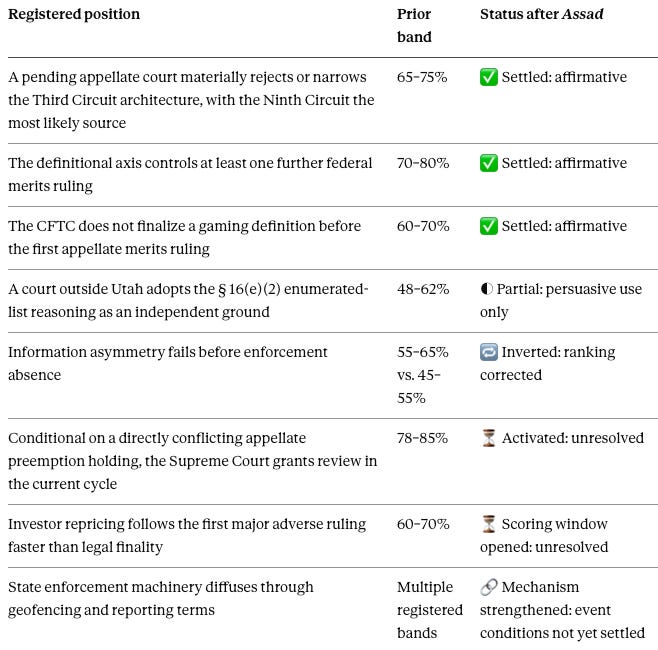
Section III presents the full reconciled register. The Simulation Predictions carrying the most weight:
Kalshi seeks rehearing en banc before or alongside any certiorari strategy (64–77%). A grant runs 14–25%, and a grant that vacates the panel opinion runs 8–16%. Vacatur is the one low-cost event that dissolves the split before the Court acts.
The Supreme Court does not grant New Jersey’s petition at its first distribution (73–85%), with a hold pending the Fourth Circuit the modal disposition (55–68% conditional on no immediate grant).
The Court grants review in some prediction-market preemption vehicle during the 2026 Term (58–72%). Both statements are compatible: hold, relist, and CVSG all preserve a later grant.
Kalshi’s Arizona preliminary injunction does not survive Ninth Circuit application of Assad (83–91%).
The Georgia § 25(b) private action survives a motion to dismiss on the Rule 40.11 listing theory (70–82%, up from 60–70% before any appellate court had construed the regulation).
At least two additional material state enforcement moves occur in the Ninth Circuit before certiorari disposition (77–87%), and the consented compliance architecture appears in a further state order by February 28, 2027 (82–91%).
Kalshi expands non-sports or institutional products before filing for any state gaming license (83–91%) — the highest-confidence operational forecast in the run.
Legal fragmentation changes financing terms, valuation language, or disclosure — 69–81% by February 28, 2027 and 75–85% by certiorari disposition. Any registration statement filed in the window treats the listing prohibition as a principal risk factor (90–96%).
Validation Snapshot
Section III prices how every material actor responds to the new appellate environment, and Section IV states what each stakeholder should do about it. Risk mitigation is a first-class output of the run, not commentary on it.
The Supreme Court path is now the modal national-resolution path. Real vehicle defects remain: both appellate decisions arise from preliminary-injunction orders, additional circuits are already considering the question, and the CFTC’s rulemaking could change one part of the legal record before merits review. Kalshi can also petition for rehearing en banc, where a grant vacates the panel opinion and removes the split before the Court acts on New Jersey’s petition at all. Kalshi built a litigation architecture capable of reaching the Supreme Court, and the paired rehearing and prematurity forecasts imply a preference for arriving later, on a cleaner record — an inference the company’s next filing will test.
The most likely consequence is not immediate uniformity. Accelerated fragmentation under a visible Supreme Court shadow is. States with enforceable local relief can wait, Kalshi cannot easily accept a national exchange divided by circuit boundaries, and the party that built its strategy around delay now has the greater need for finality.
Stakeholder Callouts
Each callout names the mitigation headline; the full packages with exposure units and sequenced moves are in Section IV.
🏛️ Policymakers. Courts and Congress control coverage, and the Commission controls permission inside coverage. Separate permission, process, and surveillance provisions now — a rule or statute assuming the agency holds coverage reproduces the defect the Ninth Circuit just exposed.
💼 Executives. Sports exposure is now jurisdiction-sensitive as published appellate law. Deploy contract-level jurisdiction switches and build the Rule 40.11 evidence file per listing before any regulator or plaintiff demands them.
⚖️ Counsel. Section V supplies the two arguments that travel best into any record, and Section VI.I identifies the liability track federal preemption does not reach. Reconcile every public representation against the 2024 D.C. Circuit record before the next filing.
Tribes. Quantify compact displacement now, while the major-questions record is open. The number is the leverage.
📊 Investors. Re-underwrite by circuit rather than national addressable market, and treat a Supreme Court victory as an upside branch rather than the base case. The transition surface runs through disclosure and financing nodes — your own events, not the courts’.
I. What the Ninth Circuit Decided
The Ninth Circuit’s published opinion does five things at once.
First, it affirms the district court’s order dissolving the injunction that had protected Kalshi from Nevada enforcement against sports-event contracts. Nevada may continue applying its gaming laws while the litigation proceeds.
Second, it holds that courts possess authority to decide whether an instrument qualifies as a swap. Nevada did not collaterally attack a final CFTC determination because no such determination existed. Kalshi self-certified the contracts, and the Commission never conducted the special 90-day review or entered an approval order.
By invoking the CEA as the basis for an injunction, Kalshi invited the judiciary to interpret the statute. The panel accepted the invitation.
Third, the panel finds that ordinary sports-event contracts likely fall outside the statutory definition. The definition cannot be read by isolating the words “event” and “potential financial, economic, or commercial consequence” from the derivatives system surrounding them. Swaps transfer or hedge financial risk, while Kalshi’s sports markets create risk for retail users where none previously existed.
Spreads, propositions, and parlays do not become risk-transfer instruments merely because they clear through a designated contract market (DCM). Every wager pays money. Payment alone cannot supply the limiting principle.
Fourth, the court rejects every preemption route Kalshi offered. Express preemption applies to covered swaps traded on a DCM and does not supply coverage. Conflict preemption fails because geofencing allows simultaneous compliance with state and federal law, and field preemption fails because Congress never occupied the field of gambling.
Fifth, the court treats current Rule 40.11 as a prohibition rather than an invitation to agency discretion through silence. The CFTC never approved Kalshi’s sports contracts, and the pending proposal confirms that the current rule remains in force until amended. Judge Kenneth Lee’s concurrence gives the point independent force by resting his entire vote on the regulation as written.
The result is not a final judgment that Kalshi can never prevail. The court reviewed a preliminary-injunction order and repeatedly used likelihood language. Published appellate likelihood determinations nonetheless govern real operations.
The panel’s published legal holdings control lower federal courts within the Ninth Circuit, although the ultimate merits disposition remains preliminary and may change on a fuller record. The opinion also enters every parallel docket as the most developed state-side answer to the Third Circuit.
Sports Decided, Elections Reopened
The panel separated election contracts from sports. The district court had not independently analyzed whether election contracts fit the swap definition, so the Ninth Circuit remanded that question.
The separation matters beyond Nevada. Event contracts do not travel as a single legal category, and different categories can occupy different positions under identical statutory text.
Kalshi’s expansion into weather and institutional products therefore represents more than diversification. Category separation has become part of the legal survival architecture.
The remand also prevents the opinion from becoming a total state victory. Nevada wins the sports boundary for present purposes and must still litigate elections.
One drafting detail sharpens the remand. Footnote 7 describes the election contracts as illegal under Nevada law and a fraction of Kalshi’s business while remanding the swap question for first-instance decision. The district judge receives the classification question with the illegality characterization already published above him.
II. The Validation Record
MindCast’s National Prediction Market Litigation Architecture separates court outcomes from actor responses. Court rulings score the first register, and conduct after a ruling scores the second. The separation prevents one favorable result from being counted twice.
A. Settled: The Ninth Circuit Was the Most Likely Source of a Direct Conflict
On August 21, Both a Swap and a Bet registered a 65–75% probability that a pending appellate court would materially reject or narrow the Third Circuit’s preemption architecture. The same entry named the Ninth Circuit as the most likely source, which is why the publication anchors this validation.
Seven days later the panel directly rejected the Third Circuit’s swap construction, its Rule 40.11 treatment, and the field-preemption consequence that followed, taking no escape route through jurisdiction, abstention, or a narrow equitable ground.
The related 78–85% conditional forecast of Supreme Court review does not settle with it. The condition has activated, and the grant remains a separate event.
B. Settled: The Definitional Axis Controlled Another Merits Ruling
On July 11, How the CFTC’s Missing “Gaming” Definition Is Losing the Preemption War assigned a 70–80% probability that the definitional axis would control at least one further federal merits ruling within six to nine months. The definitional-axis thesis is the position this opinion settles.
Assad resolves the case through that axis. The court construes swap in statutory context, treats gaming by ordinary meaning, and relies on the Special Rule as proof that state and federal law coexist. The court reads the pending proposal as confirmation that current Rule 40.11 remains operative.
The Commission declined to define the boundary before litigating exclusivity over it. The court then defined the boundary without deferring to the Commission.
C. Settled: No Final CFTC Definition Before the First Appellate Merits Ruling
The same July publication registered a 60–70% probability that the CFTC would not finalize its gaming definition before the first appellate merits event. The comment period closed July 27, and no final rule preceded the August 28 opinion.
Consequence matters more than timing. Delay preserved no agency flexibility and transferred interpretive control to the court.
D. Confirmed: The Stay-Denial Architecture
The May 22 forum-fight analysis resisted the reflex to call the Ninth Circuit’s three coordinated stay denials a Supreme Court split. The stay orders addressed removal jurisdiction while the Third Circuit addressed preemption merits, and different layers cannot form a direct conflict. The forum analysis supplies the posture forecast scored here.
Assad validates the distinction by contrast. The August opinion supplies what May lacked: a published Ninth Circuit decision answering the same classification and preemption questions the Third Circuit answered. Forum loss and merits loss now operate together.
The May analysis also called the posture. The analysis forecast that the operative federal resolution would arrive through a merits appeal with Kalshi positioned as a federal-court plaintiff rather than through the removal appeals.
Assad satisfies both conditions. Kalshi filed as plaintiff-appellant in its own affirmative injunction suit, and the deciding panel was the same Nelson–Bade–Lee bench that issued the May 21 orders.
E. Mechanism Strengthened: The Washington–Nevada Protocol
The August 13 Washington analysis identified five terms that moved from Kalshi’s Nevada contempt settlement into Washington’s amended injunction: a named geolocation vendor, a daily penalty, and a sworn-explanation option plus court-set diligence consequences and cross-state reporting. The protocol analysis supplies the diffusion entries this section tracks.
Assad does not settle the adoption entries because Nevada is the source jurisdiction rather than a new adopter. The opinion instead does something no prior state order could, supplying appellate approval for the mechanism’s legal premises.
The court rejects Kalshi’s impossibility argument, identifies geofencing as available, and characterizes the refusal as a search for competitive advantage. A later state can now cite published appellate reasoning rather than trial-level findings or Kalshi’s consent. The diffusion mechanism strengthens while the adoption entries stay live.
F. Opened, Not Settled: The Nash–Stigler Repricing Clock
The Dual Nash–Stigler companion identified Kalshi’s position as a pseudo-equilibrium supported by enforcement absence and information asymmetry. The companion supplies the two-support model this section scores. NPMLA-II.P5 assigned a 60–70% probability that investor repricing would follow the first major adverse ruling faster than legal finality.
Assad is the qualifying adverse appellate event. The entry now enters its one-quarter observation window and settles only through observable capital behavior: financing terms, valuation language, or IPO timing and investor diligence.
Legal importance is not market transmission. A capital narrative surviving unchanged for a full quarter strains the synchronization thesis even though the legal analysis holds.
G. Partial, Not Settled: The § 16(e)(2) Adoption Entry
New York’s $36 Billion Kalshi Case registered a 48–62% probability that a court outside Utah would adopt Judge Shelby’s enumerated-list reasoning as an independent ground by June 2027. The New York analysis supplies the retrospective-exposure architecture Section VI.C extends.
Judge Nelson uses § 16(e)(2) in Assad the way the MindCast internal preemption map predicted. Congress demonstrated inside the CEA that it knows how to preempt state gaming laws expressly, and it selected which transactions receive that protection. Trading on a designated contract market is not on the list.
The use is a contrast case within the express-preemption analysis rather than a freestanding holding. The entry scores partial, and the independent-ground element stays open.
H. Material Model Updates
Three architectural corrections carry forward into every subsequent run.
Judicial interpretation caused enforcement absence to fail before information asymmetry. The registered monitors were rule finalization, an enforcement action, or a reconstituted Commission. What occurred instead was a published appellate holding that the listing itself violates a mandatory regulation, with no agency action at all. The support ranking inverts, and judicial declaration of unlawful listing joins the monitor set.
Future simulations must model simultaneous multi-ground rulings rather than sequential resolution. Every prior register treated the definitional axis and the preemption axis as arriving in sequence. Assad closed both at once and added three further grounds.
CFTC rulemaking controls federal permission but no longer controls statutory coverage. After Loper Bright, courts exercise independent judgment over statutory meaning. The corrected allocation: courts and Congress control coverage, the Commission controls permission inside coverage, and states control gambling conduct unless federal law displaces them.
III. MindCast AI Proprietary Cognitive Digital Twin Foresight Simulation: The Post-Assad Prediction Registry
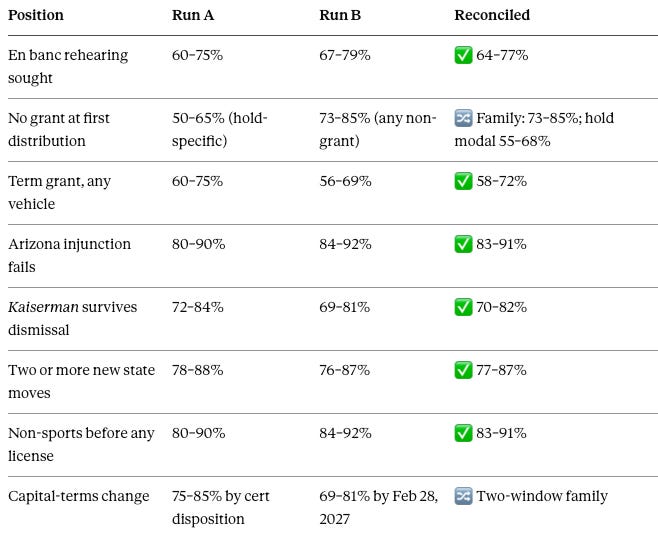
Section III reconciles two independently executed, large-language-model-assisted MP CDT FS runs against the same August 28 record. Cross-run convergence is a robustness check, not mutual validation, because separately executed runs can share facts, assumptions, and architecture. Previously published bands remain separately scored.
The reconciliation rule: where both runs priced the same position with overlapping intervals, the reported band is the intersection-anchored union of the two intervals; where the runs priced different objects, the positions appear as a family rather than an average; positions produced by only one run carry a single-run marker (†A or †B). Run parameters and closure: Run A used k=3, ε=0.05, n=5 and Run B used k=3, ε=0.025 of the normalized payoff range, n=3; both terminated at the frozen August 28 cutoff after additional presently available inputs failed the declared marginal-information-gain threshold.
The runs modeled Cognitive Digital Twins (CDTs) of the courts and the federal executive, the state enforcement offices and private plaintiffs, and Kalshi and the capital markets, played against each other across six adversarial rounds. Probability bands express likelihood of the outcome; ordinal classes (High, Moderate, Low) appear where the claim rests on stability metrics whose scoring thresholds are not yet frozen. Each entry states its settlement condition and a compact action packet: controlled exposure, unilateral actions with owners, and the residual exposure no action removes. The runs withheld propositions concerning unsupported docket timing, unattributed revenue figures, and subjective agency motives or individual Justice votes because the available record could not support release.
Headline Crosswalk
Equilibrium-Level Simulation Predictions (single-run outputs, Run A)
The state-coexistence enforcement equilibrium becomes self-sustaining nationally without Supreme Court action (Ordinal: High). Settles on three or more new state instruments with zero vacaturs of existing orders by February 28, 2027. Falsified by a two-quarter adoption stall or vacatur of two existing orders. Mitigation: states replicate the consent architecture rather than joining a mass caption; firms geofence early. Residual: Supreme Court reversal re-widens the incumbent basin only partially.
Conditional on no Supreme Court merits ruling categorically eliminating state conduct authority during the window, the 24-month modal system equilibrium is split-layer: federal exchange authority plus state conduct authority (62–75% · Moderate). The earlier 55–60% band priced the narrower Court-conditional merits question. Mitigation: separate positions that require exclusive jurisdiction from product controls that survive either outcome. Residual: a categorical merits ruling voids the split-layer base case.
Basin migration completes on any two of four perturbations: Fourth Circuit alignment, two further protocol orders, Kaiserman survival, or a capital repricing event (Ordinal: High proximity). Settles on the observed sequence by June 30, 2027. Mitigation: treat the four perturbations as the trigger dashboard; re-run on any one. Residual: avoidance rulings slow all four without closing any.
Kalshi repricing arrives through a disclosure or financing node rather than aggregate legal pressure (Ordinal: High). Settles on which event class precedes the first observed term change. Mitigation: investors time diligence to disclosure and financing events rather than docket events. Residual: private marks can lag legal impairment.
Conditional on en banc vacatur, basin re-widening is partial only, because existing state instruments rest on consent and state-court orders (70–82% · Moderate-High). Mitigation: states rest instruments on consent and state-court orders independent of the panel opinion. Residual: persuasive-authority erosion still follows vacatur.
Sports remains Kalshi’s revenue plurality through Q1 2027 while share declines (70–80% · Moderate). Mitigation: CFO reports sports and jurisdiction concentration to the board quarterly. Residual: category demand can migrate faster than listings replace it.
Among new state instruments citing Assad that raise credibility, equitable-discretion, or knowledge arguments, a majority cite Kalshi’s 2024 brief or another identified credibility finding (66–78% · Moderate). Mitigation: counsel deploy the 2024 brief as a portable module; the firm reconciles every public representation against it. Residual: the doctrinal grounds propagate regardless of credibility rhetoric.
The tribal coalition files an independent action or formal intervention rather than amicus if the federal-plaintiff campaign continues (45–60% · Low-Moderate). Settles by June 30, 2027. Mitigation: tribes complete the compact-displacement ledger and prebuild the three intervention modules before any triggering filing. Residual:coalition governance friction and compact variation.
Theme One: Kalshi’s Next Move
Kalshi seeks rehearing en banc in the Ninth Circuit before or alongside any certiorari petition from this decision (64–77% · Moderate). Settles on Kalshi’s first responsive filing after the mandate window opens. Falsified if that filing is a certiorari petition without a rehearing request. Exposure: days to mandate; share of Ninth Circuit sports volume exposed at mandate. Actions: litigation lead completes the rehearing decision memo within 72 hours; general counsel preserves a parallel certiorari draft and mandate-stay motion; CFO discloses the procedural branch before the next capital discussion. Residual: denial leaves the precedent and consumes time without improving vehicle quality.
Rehearing en banc is granted (14–25% · Low-Moderate), and granted with vacatur of the panel opinion (8–16% · Low). A grant can narrow rather than vacate; only vacatur dissolves the split. Settles on the court’s order. Actions: litigation leads preserve certiorari and stay papers concurrently; states pause no filings on the possibility. Residual: a narrowing grant leaves most holdings intact.
Kalshi opposes New Jersey’s certiorari petition on prematurity grounds while pressing its own appellate tracks (65–78% · Moderate). Settles on the brief in opposition. Actions: state appellate chiefs draft hold and grant response packages by petition filing; firms maintain a weekly vehicle-comparison matrix. Residual: procedural opposition can succeed without resolving substance.
Kalshi accelerates non-sports and institutional product listing before any state licensing application (83–91% · Moderate-High). Settles on the sequence of listings versus any filing of record with a state gaming regulator. Exposure: product sprint weeks; sports share of volume; liquidity-provider concentration. Actions: product lead prioritizes low-substitutability contracts within 30 days; compliance grades each listing for settlement and state-law risk. Residual: thinner liquidity in new categories; election contracts stay exposed on remand.
Kalshi obtains no state gaming license before any certiorari disposition (75–88% · High Conviction) †A. Settles on regulator filings. Actions: firms price the license-versus-litigation decision explicitly per state; states treat non-application as a continuing enforcement predicate. Residual: the installed identity constraint can outlast its usefulness.
Theme Two: The Supreme Court Path
The Court does not grant New Jersey’s petition at its first distribution (73–85% · Moderate-High); conditional on no immediate grant, a hold pending the Fourth Circuit is the modal disposition (55–68% · Moderate). Settles on the first distribution. Exposure: quarters of fragmentation before a national rule. Actions: investors model at least two quarters of fragmentation rather than an immediate answer; states prepare both hold and grant responses. Residual: an immediate grant remains live because the split is square.
A call for the views of the Solicitor General issues (29–44% · Low-Moderate). The government’s baseline position is already extensively documented; residual value lies in testing whether the Solicitor General adopts, narrows, or abandons the Commission’s maximalist displacement theory. Actions: DOJ and the Commission freeze an interagency position ledger; states and tribes file concise federalism materials before any invitation. Residual: a CVSG can push resolution into another Term.
New Jersey’s petition leads with federal displacement and cites the § 16(e)(2) express-preemption structure affirmatively (91–96% · High Conviction). Settles on the petition’s question presented. Actions: firm and amicus counsel prepare a clause-level response chart. Residual: the Court may reframe the question presented.
Certiorari is granted in the current Term on any vehicle (58–72% · Moderate). The band supersedes the earlier 78–85% conditional figure, which never priced interlocutory maturity. Exposure: months to merits; share of strategy dependent on field preemption. Actions: states and tribes complete amicus modules within 60 days; firms separate exclusivity-dependent positions from durable product controls; investors hold a distinct litigation-duration reserve. Residual: the Court can wait for a final judgment.
The question ultimately carried to the Court arrives from a final-judgment posture (40–55% · Low-Moderate) †A. Unscored absent a grant during the October Term 2026 cycle. Actions: monitor the Tenth Circuit briefing calendar in Cox; states preserve the Utah record. Residual: vehicle selection is the Court’s alone.
Merits briefing surfaces the conflict between the presumption against preemption and the plain-wording approach (70–80% · Moderate-High). Conditional on merits briefing; unscored absent a grant. †A. Actions:counsel build a method-selection module for briefing. Residual: the Court can decide without choosing a method.
Merits briefing on either side draws on the four judicial sources the panel assembled (65–80% · Moderate) †A. Conditional on merits briefing; unscored absent a grant. Actions: counsel adopt the four-source vocabulary in every forum now. Residual: sources do not predict votes.
Theme Three: The Other Appellate Tracks
Kalshi’s Arizona preliminary injunction does not survive Ninth Circuit review (83–91% · High Conviction). Falsified if the injunction is affirmed or the appeal resolves without reaching the preemption theory. Exposure:Arizona sports volume; compliance cutover hours; open contracts at the switch date. Actions: Arizona enforcement submits Assad as controlling supplemental authority immediately; the firm tests an Arizona geofence within five business days; clearing inventories open positions before any cutover. Residual: stays or mootness can delay operational effect.
At least one Fourth or Sixth Circuit merits decision preserves or deepens the conflict by June 30, 2027 (74–86% · Moderate-High) †B. Settles on the Martin and Ohio–Tennessee dispositions. Exposure: jurisdictions governed by an adverse circuit rule; national sports volume by circuit. Actions: state and tribal counsel prepare circuit-specific supplemental packets within 14 days; firms maintain feature flags by circuit; investors update a circuit-weighted revenue bridge on each opinion. Residual: jurisdictional or mootness rulings can avoid the coverage question.
The Fourth Circuit reaches the coverage question rather than resolving on preemption alone (58–72% · Moderate) †A. Settles on the Martin opinion. Actions: Maryland presses coverage squarely; Kalshi preserves the Flaherty alternative. Residual: a preemption-only disposition leaves coverage open.
The Sixth Circuit decision produces a three-to-one or two-to-two circuit configuration rather than avoiding the conflict (70–82% · Moderate-High) †A. Actions: parties brief mechanism divergence explicitly, since converging outcomes with diverging mechanisms shape question selection. Residual: jurisdictional off-ramps remain.
At least one further circuit adopts the mandatory reading of Rule 40.11’s listing prohibition (64–76% · Moderate). Expires June 30, 2027. Actions: firms maintain contract-level public-interest files; the Commission distinguishes proposed from current obligations. Residual: a court may treat the rule as irrelevant to state power.
A federal appellate opinion cites the 2024 D.C. Circuit record against the current federal theory — Kalshi’s own brief primarily, the Commission’s contemporaneous position secondarily (58–72% · Moderate). Expires June 30, 2027. Actions: the Commission and DOJ reconcile institutional positions before the next filing; investors discount claims assuming frictionless agency deference. Residual: citation may be descriptive rather than controlling.
Theme Four: The Federal Executive and the Rulemaking
The Commission does not finalize the pending rule before the next appellate merits ruling (60–73% · Moderate). Settles on Federal Register publication against the Fourth or Sixth Circuit calendar. Exposure: listings exposed to unsettled Rule 40.11 treatment. Actions: the rule team publishes a decision log separating statutory interpretation from policy factors; firms implement durable guardrails now. Residual: expedited Commission action could precede an opinion.
Conditional on finalization, a state or tribal coalition files an APA challenge (70–85% · Moderate) †A. Unscored if no final rule issues in the window. Actions: the coalition pre-drafts challenge modules keyed to severability gaps and administrability. Residual: a severability-hardened rule survives in part.
The Solicitor General narrows the Commission’s theory to venue-layer exclusivity rather than reproducing it, if merits briefing is reached (53–65% · Moderate). Actions: firms map which operations remain exposed under a narrow rule; states identify conduct outside exchange listing and trading. Residual: interagency leadership can select the broader position.
Judge Lee’s Special Rule discretion argument is briefed by Kalshi in a subsequent filing (60–73% · Moderate). Expires at the certiorari disposition. Actions: all litigants build a text-history-consequence matrix on the Special Rule within 30 days. Residual: courts can resolve preemption without construing the provision.
Theme Five: State Propagation and Private Liability
The Georgia § 25(b) action survives a motion to dismiss on the Rule 40.11 listing theory (70–82% · Moderate-High). The band was 60–70% before any appellate court had construed the regulation. Settles on the Kaisermandismissal ruling; conditional on survival, a copycat § 25(b) filing appears in another district within 90 days (65–80% · Moderate-High) †A. Exposure: retrospective damages running against the 95% revenue base. Actions: the firm inventories private-right and consumer-protection exposure and notices insurers early. Residual: survival implies neither certification nor liability.
At least two additional material Ninth Circuit state enforcement moves occur before any certiorari disposition (77–87% · High Conviction). A qualifying move is a new cease-and-desist order, complaint, injunction request, or material expansion of an existing action. Exposure: affected jurisdictions; days to an enforceable order. Actions: gaming directors complete product-specific evidence packets within 30 days; attorneys general coordinate theories while retaining state claims; firms prebuild geofencing and notice playbooks for every Ninth Circuit state within 21 days. Residual: politics and resources slow diffusion.
The consented compliance architecture appears in at least one further state order (82–91% · Moderate-High). Settles on an order entered by February 28, 2027 naming a licensed geolocation provider or requiring cross-state reporting or the sworn-explanation structure. Actions: firms build reusable jurisdictional switches and audit logs; states specify machine-testable obligations. Residual: fragmented technical requirements raise fixed cost.
A state pleading cites the opinion’s revenue-concentration findings in support of monetary remedies (60–75% · Moderate) †A. Settles on any state filing by February 28, 2027. Actions: states tie monetary remedies to the published concentration findings; the firm treats the figures as a discovery predicate. Residual: remedies law varies by state.
No action with five or more state plaintiffs emerges before any certiorari disposition (79–89% · High Conviction). Absence of a multistate caption is optimal state play, not low enforcement risk. Actions: states preserve bilateral information sharing; firms draw no comfort from the missing caption. Residual: parallel unilateral actions impose equal or greater cost.
Theme Six: Capital Markets
Legal fragmentation changes Kalshi’s financing terms, valuation language, or material disclosure — 69–81% by February 28, 2027 and 75–85% by any certiorari disposition (Moderate-High). The earlier one-quarter band was 60–70%. Exposure: portfolio value per 10% impairment of contested-state sports revenue; covenant headroom. Actions: investors require a jurisdiction-weighted revenue bridge and covenant headroom test; firms document board-level responses. Residual: private financing terms may stay unobservable.
Any registration statement filed in this window treats the Rule 40.11 listing prohibition as a principal business risk (90–96% · High Conviction, conditional on filing). Unscored absent a filing. Actions: securities counsel tie the disclosure to revenue concentration and active orders; investors compare risk language against operational controls. Residual: disclosure removes no business exposure.
The next disclosed financing includes structure — preference, ratchet, or milestone — rather than clean equity (60–72% · Moderate) †A. Unscored absent a financing in the window. Actions: transaction leads condition tranches on observable events rather than regulator cooperation. Residual: clean-equity terms can reflect information advantages rather than confidence.
Prediction-market demand redistributes toward diversified brokers and incumbent exchange infrastructure rather than contracting proportionally (70–80% · Moderate). Settles on volume, listing, and partnership disclosures across the two quarters following the opinion. Expires February 28, 2027. Actions: investors track counterparty additions and channel share; firms diversify distribution without weakening surveillance. Residual:migration compresses margins and fragments liquidity.
Scenario Routes (single-run outputs, Run B)
Four integrated routes decompose the system path. Overlap between a hold and a later grant is removed in the integrated Supreme Court bands above.
Route A — Rehearing denied; another circuit rules; the Court selects a later vehicle (38–47%). Fragmentation persists into early 2027; state and firm mitigation dominates.
Route B — Rehearing denied; the Court holds or relists New Jersey, then grants that petition (22–30%). Merits briefing begins on an interlocutory record and a clean conflict.
Route C — Rehearing granted or the panel decision materially altered (12–22%). The split weakens or changes; certiorari timing moves later.
Route D — No grant in the 2026 Term (22–34%). Regional rules harden; Congress and Commission rulemaking gain relative importance.
Tail Events (single-run outputs, Run B)
Low-probability branches with high consequence. Hedge; do not treat as the base case.
The Supreme Court issues emergency relief before ordinary certiorari review (6–13%). Trigger: a mandate-stay or emergency application. First move: shift from state-by-state cutoffs to the scope stated in the order.
Congress enacts an express event-contract preemption rule through June 2027 (4–10%). Trigger: bill text clearing committee with bipartisan support. First move: re-map preserved state police powers and tribal effects clause by clause.
A final Commission rule materially prohibits major sports categories through June 2027 (12–22%). Trigger: a final rule or public Commission vote. First move: execute the open-position runoff and contract-redesign plan.
A material financing or control transaction changes Kalshi’s litigation incentives through February 2027 (18–30%). Trigger: an announced round, acquisition, covenant amendment, or board change. First move: re-run the capital and strategy CDTs within five business days.
Contact mcai@mindcast-ai.com to partner with us on Predictive Game Theory AI in Law and Behavioral Economics. We specialize in predictive simulations for Complex Litigation, Innovation Economics, Geopolitical Risk Intelligence and Legacy Innovation. See more about MindCast series at our new website MindCast Corporate.
To test our predictive simulation AI system, in 2026 we simulated the Super Bowl and the World Cup. See 🏈 Super Bowl LX — AI Simulation vs. Reality | ⚽ The 2026 World Cup Final Simulation Validation
To deep dive on MindCast works upload the URL of this publication into any LLM (preferably Google AI mode) and prompt ‘reconstruct MindCast framework with three degrees of cited sub links.’ See Live-Fire Game Theory Simulators, Runtime Predictive Infrastructure, MindCast Foresight Prediction Simulations, Synthesizing Behavioral Economics + Game Theory.
Working With MindCast
MindCast runs two service lines on one method. Litigation foresight intelligence assesses proceedings, vehicles and remedies against the three questions that decide this litigation: whether a contract sits inside federal coverage, whether federal rules permit it to trade, and how much state authority survives. Jurisdictional exposure intelligence maps the regulatory surfaces beneath them: the two gates, category separation across sports, elections and institutional products, geofencing and reporting architecture — the seams where exchange registration ends and state enforcement begins.
⚖️ Platform counsel and product leaders can commission a category-exposure audit against the Assad benchmark: named contract classes scored on the two-gate model, per-category exposure keyed to Rule 40.11 and the § 2(e) limiting principle, and a compliance sequence timed to the checkpoints the register projects. Crypto.com, Robinhood, Coinbase and Polymarket face the sharpest version of the question, because Assad holds that DCM status establishes neither federal forum control nor contract coverage — the two shields the industry priced as one.
📊 Investors and lenders can commission a litigation-repricing screen across a named portfolio: which holdings sit within reach of the state-enforcement and § 25(b) claim classes, which remedy class each proceeding is most likely to produce, and what the circuit split does to positioning and exit assumptions. The opinion placed 95% revenue concentration into a published federal appellate record, and the register prices transmission into financing terms at 69–81% by February 28, 2027 — the repricing arrives on disclosure and financing clocks, not docket clocks.
🏛️ State attorney general offices, gaming regulators and legislative staff can commission a doctrine-migration assessment: where the consent-based enforcement architecture arrives next, keyed to the Assad six-proposition package, the Nevada–Washington protocol, and machine-testable relief design. A later state now defends the mechanism with published appellate reasoning rather than trial-level findings, and the register prices the next adopters at 77–87%.
Tribes and tribal gaming enterprises can commission a compact-displacement quantification and intervention-readiness review: a compact-by-compact revenue sensitivity ledger plus the three prebuilt modules — Supreme Court amicus, Commission comment, APA challenge — keyed to the sovereignty-reallocation frame the opinion opened. The major-questions record is open now, and the number is the leverage.
💼 Non-sports event-contract builders — weather, economic, and institutional risk markets — can commission a pre-enforcement category review scored against the contextual swap rule, because category separation means their exposure arrives through product-by-product adjudication rather than automatic extension from the sports holding.
The Simulation Predictions in this paper are the litigation line applied to the jurisdictional layer now repricing across prediction markets. Every engagement above runs on the same methodology, with dated falsifiable outputs. Contact mcai@mindcast-ai.com.
IV. Stakeholder Risk Mitigation
The register carries a prediction-level action packet under every released entry; this section is the cross-stakeholder synthesis. The register prices events, mitigation allocates action against those prices, and the allocation follows one mechanism from the run: pressure and leverage are different quantities. A stakeholder can absorb or apply large aggregate pressure while the system stays in its basin, and a smaller move applied at the correct node can cross the transition surface. Each package below names the exposure units to control, the sequenced moves, and the residual exposure no move removes.
Investors and Lenders
Exposure units: share of portfolio value tied to sports-event-contract enterprise value; sensitivity per 10% impairment of contested-state sports revenue; covenant headroom; quarters of runway.
Re-underwrite by circuit, not by national addressable market. Build a circuit-weighted revenue bridge within ten business days, with separate access probabilities for the Third, Ninth, Fourth, Sixth, and unlitigated states. A national number is now a category error.
Separate legal optionality from operating value. The base case assumes fragmentation through at least two post-opinion quarters; a Supreme Court victory is an upside branch, never a base-case entitlement.
Use milestone tranches and structure. Condition incremental capital on observable events — rehearing disposition, a second merits opinion, diversification milestones, tested geofencing — and prefer structured instruments to clean equity while transition proximity stays high. Require an evidence data room: weekly docket changes, state-order inventory, revenue by disputed jurisdiction, and compliance-switch test results.
Residual exposure: private marks can lag legal impairment, financing terms may stay undisclosed, and a merits loss can still produce a discontinuous valuation change.
States and Gaming Regulators
Exposure units: days from detection to enforceable order; enforcement staffing; contested handle per month; technical compliance-test pass rate.
Plead the product, not the label. Map contract design, customer interface, and settlement against state-law elements before filing, and draft separate sports and election modules so a remand or category distinction cannot disable the entire remedy.
Specify machine-testable relief. Geofence accuracy, reporting cadence, open-contract runoff, audit-log retention, and customer notice belong in the proposed order — the consent architecture became the template a court now cites, and replicating it adds more than joining any mass caption.
Coordinate evidence, preserve sovereign choice. Share expert and technical records while keeping state-specific claims and remedies, and keep both preemption methods — the New York presumption route and the plain-wording route — alive until certiorari disposition. Method diversity is state-side option value.
Residual exposure: statutes vary, federal stays are possible, and a Supreme Court preemption ruling can invalidate relief.
Tribes and Tribal Gaming Enterprises
Exposure units: compact or enterprise revenue per 1% shift in sports handle; months of exclusivity erosion; number of affected compacts.
Quantify compact displacement first. A compact-by-compact revenue sensitivity ledger within 30 days converts sovereignty framing into a number courts and agencies must address. The number is the leverage.
Prebuild three intervention modules. Supreme Court amicus, Commission comment, and APA-challenge records keyed to sovereignty, administrability, and reliance — ready before a triggering filing, not after.
File on the sovereignty-reallocation frame, not the parity frame. Tribal payoffs diverge from state payoffs at exactly the point a settlement would be cut; coalition governance with opt-outs preserves distinct compact claims. Recalibrate if the Solicitor General narrows to venue-layer exclusivity, which sharply reduces tribal exposure.
Residual exposure: compact language varies, causation evidence may be incomplete, and a venue-layer rule can reduce state leverage without resolving tribal economic harm.
Prediction-Market Firms and Exchanges
Exposure units: sports share of revenue and volume; users in contested jurisdictions; open contracts at any cutover; liquidity-provider concentration; runway quarters.
Deploy contract-level jurisdiction switches now. Geofencing, order rejection, position-only mode, and runoff notices tested for every contested state — geofence-early dominates consent-later on the cost curve, because Nevada’s consent terms became the appellate template.
Build the Rule 40.11 evidence file per material listing. Settlement provenance, insider controls, market utility, surveillance, and state-law touchpoints recorded before certification. Category separation is legal architecture, not product strategy: separate certifications and separate records per category, because courts are adjudicating one class at a time.
Reconcile representations before disclosure. Every public statement checked against the 2024 D.C. Circuit record before any registration statement, since the first break surfaces at the disclosure forum. Report sports and jurisdiction concentration to the board quarterly, and price the license-versus-litigation decision explicitly per state rather than letting installed identity decide it by default.
Residual exposure: geofencing does not resolve federal statutory coverage, fragmented liquidity impairs price discovery, and election contracts carry separate risk on remand.
Federal Policymakers
Exposure units: staff-months to final rule; unresolved statutory interpretations; interagency position divergences.
Separate permission, process, and surveillance. State which provision authorizes listing, which creates public-interest review, and which supplies data controls, and design for severability so one invalid provision does not collapse the package.
Reconcile the institutional position ledger. The Commission’s 2024, 2026, and appellate positions require reconciliation before the next filing — the panel has already used the record’s internal contradictions.
Legislate the allocation, not the assumption. Congress can allocate statutory coverage and preemption expressly. The Commission can regulate permission within statutory coverage, but a rule cannot create coverage the statute does not supply, and rulemaking cannot itself decide preemption.
Residual exposure: leadership changes can alter litigation posture, and courts may give limited weight to a post-dispute rule.
V. Why Kalshi Lost: Two Gates, Five Grounds
Most reporting will describe Assad as a choice between swap and bet. The opinion damages maximal federal exclusivity more severely because it builds two independent barriers, with five reinforcing grounds arranged behind them.
Gate One: Statutory Coverage
Section 2(a)(1)(A) gives the CFTC exclusive jurisdiction over enumerated transactions traded on a designated contract market. Kalshi’s argument treated the venue as sufficient: once a contract appears on a DCM, federal exclusivity follows.
The Ninth Circuit reverses the sequence. DCM trading satisfies the venue condition, and the contract must independently fall within an enumerated statutory category. Spot transactions occur on designated markets without entering exclusive jurisdiction, so the exchange cannot bootstrap every listed product into federal coverage.
Sports-event contracts fail because the statutory words sit inside a derivatives law. Read in context, the covered event must carry the financial relationship characteristic of risk-transfer instruments. A payout can have financial consequences without converting the underlying transaction into a swap.
The excluded-commodity fallback fails on a stricter standard. Kalshi argued in the alternative that its contracts are futures or options in excluded commodities. The panel rejects the argument twice over.
First, excluded commodities are not listed in § 2(a)(1)(A)’s exclusive-jurisdiction grant at all. Second, § 1a(19)(iv)(II) requires an excluded commodity to be associated with an economic consequence, while the swap definition permits a merely potential one. The fallback demands more of the element the primary argument already could not satisfy.
The limiting-principle trap has no exit. Section 2(e) makes it unlawful for any person other than an eligible contract participant to enter a swap outside a DCM. If a sports-event contract is a swap, every customer placing a point-spread bet at Caesars Sportsbook is entering a swap off-exchange.
Kalshi cannot accept that consequence without rendering ordinary qualifying sportsbook transactions unlawful off-exchange under § 2(e). Denying the premise means abandoning the breadth its own definition requires.
The panel also closes the escape route the Third Circuit majority left open: deferring to hypothetical future CFTC action. Kalshi already lists contracts on TT Elite Series table tennis matches, the precise scenario the Flaherty dissent raised and the Flaherty majority dismissed as far-fetched.
Gate Two: Federal Permission
Even a contract satisfying the broadest reading of swap runs into current Rule 40.11. The regulation prohibits contracts based on excluded commodities that involve, relate to, or reference gaming. Kalshi’s self-certification did not become affirmative approval merely because the CFTC declined to initiate special review.
The Commission’s June proposal seeks to replace the categorical structure with a discretionary public-interest process. Proposed rules do not displace operative rules, and the Ninth Circuit uses the proposal as temporal evidence that the change the agency wants has not happened yet.
The Rule 40.11 boomerang is now complete. Agency non-enforcement once functioned as an implied permission signal in the Third Circuit. In the Ninth Circuit the same silence establishes that Kalshi listed contracts without the approval needed to overcome an existing prohibition.
The insurance hypothetical generalizes the holding past gaming. Judge Nelson poses the case of Kalshi self-certifying a life-insurance contract against the CFTC’s own interpretation, with the agency then declining to remove it. No court would conclude that fifty states thereby lose authority over life insurance.
The device converts self-certification from a source of federal immunity into an ordinary compliance attestation. The conversion applies to every excluded-commodity category, not merely gaming.
The Argument Judge Lee Named That Neither Party Ran
Judge Lee’s concurrence does more than reinforce the present force of Rule 40.11. The concurrence discloses why the strongest available argument went unbriefed.
Lee writes that Nevada stayed largely quiet on the Special Rule because the provision complicates the state’s statutory analysis. Kalshi did not rely on it because the CFTC has already issued a rule banning gaming contracts.
He then names the argument himself. Section 7a-2(c)(5)(C)(i) says the Commission may determine that gaming contracts are contrary to the public interest, which suggests agency discretion rather than a categorical statutory bar. On that reading, some unique sports events could be part of a swap trade if they meet the statutory requirements.
A concurring judge has published the merits argument Kalshi has not run. Lee’s vote rests entirely on 17 C.F.R. § 40.11 as currently written, so finalization of RIN 3038-AF65 removes his stated rationale and promotes his reservation into available reasoning for the next panel. Whether Kalshi’s counsel takes the invitation is a registered settlement condition in Theme Four.
Why Rulemaking Cannot Supply a Complete Rescue
A permissive final rule would weaken the second barrier and would not remove the first. The Commission could declare certain sports contracts consistent with the public interest without resolving whether they are swaps. After Assad, a rule that assumes coverage looks like an agency deciding a statutory question the Ninth Circuit reserved to courts.
Finalization also carries a cost the agency has not priced publicly. The panel refused the Commission deference by name under Loper Bright, and the coalition that appeared against it in this appeal is positioned to challenge a final rule under the APA. The proposed definition additionally classifies sports contracts as gaming, conceding the classification the states need to invoke the prohibition the rule would relax.
The agency’s strongest defensible retreat preserves federal authority over the exchange while acknowledging state authority over wagering conduct. Split-layer resolution was the modal merits outcome in the August 21 simulation. Aggressive defense of total displacement invites the major-questions response Assad has now supplied.
🏛️ Policymakers should read the two gates as an allocation map. A statute or rule assuming the Commission controls coverage reproduces the defect the panel just corrected.
VI. What Assad Changes in the Other Cases
A. Nevada: Enforcement Moves from Negotiated Compliance to Appellate Authority
Nevada no longer relies only on a district-court order, a contempt posture, or Kalshi’s stipulated geofencing terms. The state now holds published appellate authority recognizing its ability to regulate Kalshi’s sports-event contracts.
The practical leverage is immediate:
Kalshi’s impossibility defense has failed.
Geofencing has been found operationally available.
Compliance costs do not constitute irreparable injury.
Claimed harm from continued listing is weakened by the court’s self-infliction analysis.
State and federal law can coexist through location-specific access restrictions.
The remaining Nevada contest concerns election contracts and ultimate merits proceedings. The remand gives Nevada another opportunity to argue category-specific illegality and gives Kalshi a chance to establish that elections carry the economic consequence the court found missing from ordinary games. The sports holding does not mechanically decide elections, but it deprives Kalshi of a category-wide shortcut.
B. Washington: Persuasive Merits Authority Joins a State-Court Remedy
Washington already possesses the operational advantage the Ninth Circuit described. Judge John McHale’s amended injunction requires Kalshi to block Washington access across seven categories using machinery first formalized in Nevada.
Washington’s action proceeds in state court, so the Ninth Circuit does not formally bind the state judiciary’s reading of federal law. The opinion supplies highly persuasive federal authority within the same geographic circuit. Any renewed attempt to create a federal forum now encounters two Ninth Circuit layers: the May jurisdictional orders and the August merits opinion.
Assad also supplies circuit authority for the specific line McHale drew. The panel agrees with the Third Circuit that the CEA field-preempts state regulation of futures trading while holding that Nevada’s gaming statutes target a field the CEA has not preempted. McHale’s distinction between regulating an exchange and regulating gambling conduct is now the Ninth Circuit’s distinction.
Washington’s technology-and-science scope issue remains distinct. Assad limits its holding to sports and remands elections rather than collapsing categories together. Kalshi can therefore use the opinion’s own category separation to challenge an order reaching products the Washington findings did not separately classify.
⚖️ Counsel on both sides should note the symmetry. The opinion strengthens Washington on sports while strengthening the argument for product-by-product adjudication elsewhere.
C. New York: Backward-Looking Claims Gain Force and a Method Conflict Opens
New York’s case was built around the claim no prospective CFTC rule can erase: restitution and accounting for completed transactions from a company headquartered inside the enforcing jurisdiction.
Assad strengthens that architecture in three ways. The opinion rejects the assumption that CFTC registration converts every contract into a federally protected instrument. The opinion also recognizes room for state law inside the federal scheme and demonstrates that a future rule cannot retroactively change which rule governed prior listing conduct.
The methodological conflict is the more consequential effect, and almost nobody is reading it. Judge Torres defeated preemption by applying the presumption against displacing traditional state police powers. Judge Nelson expressly declined to apply any presumption and rested on the plain wording of § 2(a)(1)(A), then held that the provision is preemptive as to genuine swaps.
The two leading anti-Kalshi opinions therefore reach the same result through incompatible methods. Supreme Court review would force a choice between the two methods if the Court reaches the scope of the exclusive-jurisdiction provision. The outcomes could otherwise coexist through different statutory layers or independent grounds.
The choice determines how far the consequences travel beyond prediction markets. A presumption-driven narrowing of the exclusive-jurisdiction provision, published in the circuit housing the nation’s largest concentration of registered exchanges and swap dealers, supplies a construction litigants will carry into clearing and reporting disputes. The Ninth Circuit’s definitional route leaves the exclusivity grant fully intact and confines the loss to one category of contracts.
Stated plainly: Assad is worse for Kalshi and better for the CFTC’s institutional position across the rest of the derivatives complex than a Second Circuit affirmance of Torres would be.
📊 Investors and counterparties pricing agency-authority risk across the derivatives complex should read the Second Circuit appeal, not the Ninth Circuit opinion, as the event that matters to them.
D. New Jersey: A Petition Becomes a Square-Split Petition
The Third Circuit’s April opinion held that Kalshi had a reasonable chance of proving its sports contracts are swaps protected by field and conflict preemption. The decision remains interlocutory, divided, and favorable to Kalshi.
New Jersey opened Supreme Court matter No. 25A1465 to obtain more time for a certiorari petition, and Justice Alito extended the deadline to September 3, 2026. Before August 28 the state could offer district-court disagreement and pending appeals. The state can now attach the conflict itself.
The choice of question presented will matter. A petition framed only around whether sports contracts are swaps invites a binary classification answer. A petition framed around whether CFTC regulation of a DCM displaces generally applicable state gambling law places the coverage-permission-displacement chain before the Court.
The registered petition-architecture entries in Theme Two settle on that choice. Judge Nelson has now used § 16(e)(2) as a contrast provision in a published opinion the petition can cite.
E. Fourth Circuit: A Pending State-Side Case Gains Appellate Support
The Fourth Circuit is considering Kalshi’s appeal in KalshiEX LLC v. Martin, No. 25-1892, after a Maryland district court denied Kalshi preliminary relief. The docket remained active through August without a published disposition.
Maryland can now submit Assad as supplemental authority on coverage, Rule 40.11, and traditional state authority. Assadalso cites the Maryland decision approvingly for the proposition that the Special Rule confirms Congress intended some state laws to operate alongside the CEA. Kalshi will answer with Flaherty.
The Fourth Circuit no longer writes on a blank interstate record. Alignment with the Ninth Circuit turns one split into a two-to-one appellate map, and alignment with the Third produces the reverse. A narrower ruling could preserve the conflict while offering the Supreme Court a cleaner future vehicle.
F. Sixth Circuit: The Panel Now Has the Missing Opinion
The Sixth Circuit heard the Ohio and Tennessee appeals on July 30. The district courts had divided, with Ohio rejecting Kalshi’s preemption theory and Tennessee accepting it. The CFTC filed an amicus brief asserting exclusive federal jurisdiction.
The Ninth Circuit opinion directly answers arguments aired in the Sixth Circuit. The opinion explains why ordinary sports bets are not swaps, why a nationwide exchange does not eliminate state gambling authority, and why current Rule 40.11 cannot be treated as irrelevant.
The Sixth Circuit can now create reinforcement rather than the original split. The Sixth Circuit opinion still matters because the panel may address savings language or the coverage-displacement distinction differently. Multiple routes to one result increase doctrinal convergence, while different routes increase the Supreme Court’s question-selection problem.
G. The CFTC and DOJ Federal-Plaintiff Campaign
The Commission has sued states directly and entered appellate cases as amicus on the theory that state regulation intrudes on exclusive federal jurisdiction. Assad weakens that campaign at its threshold.
A federal plaintiff cannot establish displacement merely by proving that the defendant state regulates gambling. The plaintiff must establish that the challenged contracts fall inside the CEA category carrying exclusivity. State defendants also gain a second argument: the federal government’s current rule prohibits the contracts it asks courts to protect.
The panel recorded one concession that will travel. Arguing as amicus through its Deputy General Counsel for Litigation, the Commission suggested that courts may determine what constitutes a swap under the CEA. The agency’s own appellate posture therefore supplies the answer to Kalshi’s APA argument.
The decision does not automatically dismiss suits outside the Ninth Circuit. The decision supplies state defendants with a published statutory construction and increases pressure on DOJ and the Solicitor General to choose between total displacement and a narrower theory before merits briefing.
🏛️ Policymakers should watch the Solicitor General’s eventual filing. The office must explain why the asserted litigation object qualifies as a swap and why an operative federal rule does not bar it.
H. Crypto.com, Robinhood, Coinbase, and Polymarket
The opinion reaches beyond Kalshi without treating every platform identically.
Crypto.com operates through a federally regulated derivatives structure and advanced substantially similar Nevada arguments. Assad binds federal courts in the circuit on the central sports-contract reasoning.
Robinhood and Coinbase distribute prediction-market products through broader brokerage and crypto businesses. Their diversified structures absorb fragmentation better, and their access rails inherit the legal status of the contracts they distribute.
Polymarket sits weakest on federal exclusivity where it lacks Kalshi’s DCM foundation for the relevant product. The May stay denials showed that DCM status does not create federal removal jurisdiction over state gambling claims. Assad now holds that even DCM status does not establish contract coverage.
💼 Executives should read the industry consequence as product and channel sorting. Sports exposure becomes state-sensitive, weather and institutional risk markets gain relative strategic value, and diversified brokers gain the ability to reroute demand without staking the enterprise on one disputed category.
I. The Private Liability Track That Preemption Does Not Reach
The claim strengthened most on August 28 is not a state claim at all.
Kaiserman v. Kalshi, filed in the Northern District of Georgia in March 2026, invokes the private right of action under 7 U.S.C. § 25(b) and alleges that Kalshi listed the gaming-linked contracts Rule 40.11 forbids. The complaint never argues that states may regulate Kalshi. The complaint argues that Kalshi violated federal law.
Assad supplies a powerful regulatory predicate. The panel holds that § 40.11(a)’s shall-not-list language is mandatory, that self-certification conferred no approval, and that the Commission’s contrary reading merits no deference. The opinion establishes the Rule 40.11 violation theory without resolving § 25(b) standing, causation and damages, or private enforceability.
Preemption answers none of it. Even a complete Kalshi victory at the Supreme Court on state authority leaves the federal-violation theory intact, because the theory does not depend on state law.
Appellate courts allocate authority prospectively while private plaintiffs recover damages retrospectively. Both clocks now run against the same revenue base the opinion quantified at 95% of 2025 revenue. The bands for this track appear in Theme Five.
VII. Supreme Court: The Split, Vehicle Competition, and Merits Path
The word certain now applies to one proposition: a direct appellate conflict exists. Certainty does not yet apply to certiorari.
Why Review Has Become Substantially More Likely
Five features favor review.
The conflict is square. The Third and Ninth Circuits construe the same swap definition and the same exclusive-jurisdiction provision in opposite directions, as applied to the same platform and product class.
The question is national. A designated contract market cannot easily operate a national sports product under contradictory circuit rules. States cannot administer licensing and taxation while federal protection changes at circuit borders.
The issue is recurring. Parallel cases already occupy the Fourth and Sixth Circuits, state supreme courts, and private actions.
The federalism stakes are concrete. The Ninth Circuit grounds its reasoning in traditional state and tribal authority over gambling, while the CFTC grounds its position in national derivatives uniformity. Both sovereign structures claim displacement costs that cannot be localized.
A petition vehicle already exists. New Jersey has a Supreme Court extension docket and a September 3 deadline.
One further feature deserves separate weight. Both circuits agree that the CEA expressly preempts state regulation of swaps traded on a DCM, so the disagreement reduces to a single definitional question. Single-question conflicts present the cleanest vehicles the certiorari process recognizes.
Why Review Is Not Automatic
Both opinions arise from preliminary-injunction orders, and the records beneath them differ sharply. New Jersey arrived through Kalshi’s offensive federal suit and remains protected by an injunction, while Nevada arrived through dissolution of an injunction after an evolving factual record.
The Fourth and Sixth Circuits have already heard argument, which gives the Court a concrete reason to wait for a more complete appellate map. The CFTC’s open rulemaking can change the permission rationale before merits review, giving the Court reason to see the agency’s final position first.
Vehicle defects do not defeat review. They shape its timing and its vehicle, which is what the four routes below price.
The Four Most Plausible Certiorari Routes
Route One: New Jersey files and the Court holds. New Jersey presents the direct conflict on September 3. The Court holds the petition for a Fourth or Sixth Circuit opinion, or requests the Solicitor General’s views. The route preserves the existing vehicle while the appellate record matures.
Route Two: New Jersey files and the Court grants during the current cycle. The Court treats nationwide operational conflict as outweighing interlocutory posture. Merits briefing then forces DOJ and the Solicitor General to choose between the CFTC’s maximalist position and a narrower venue-layer theory.
Route Three: The Court waits for another case. En banc proceedings, a later circuit opinion, or a final judgment produces a cleaner vehicle.
The strongest potential final-judgment vehicle is one the calendar currently disfavors. On August 4, Judge Shelby entered final judgment for Utah on all three preemption theories in KalshiEX LLC v. Cox and closed the case, the only final merits decision anywhere in the national litigation. A Tenth Circuit merits ruling on that judgment would present the question free of the interlocutory defect both existing vehicles carry, and it would arrive well after New Jersey’s petition is distributed.
Route Four: Kalshi removes the split before the Court reaches it. A petition for rehearing en banc runs on a shorter clock than a certiorari petition, and a grant vacates the panel opinion. Vacatur would dissolve the direct conflict before the Court acts on New Jersey’s petition, restoring the pre-August board.
The conventional en banc grounds are available: an acknowledged conflict with a sister circuit, a question of exceptional national importance, and a Rule 40.11 holding with consequences for every registered exchange. Route Four is the least-discussed development in current commentary and the one most capable of resetting every forecast in this section. The Theme One entries settle on Kalshi’s first responsive filing.
Kalshi and the Commission Have Divergent Supreme Court Incentives
Kalshi built this litigation to reach the Supreme Court. The company sued state regulators in federal court across eight states, stacked appellate vehicles, and defended national uniformity as the only workable operating model. A direct circuit split is the classic certiorari trigger, and Assad supplies one.
The split Kalshi wanted is not the split Kalshi got. The optimal sequence ran through accumulation: win the Third Circuit, win the next circuits, and arrive at the Court defending a uniform record, or never need the Court at all. Assad inverts the arrival conditions. The first available petition would come from New Jersey, the adverse opinion is unanimous and written in the interpretive vocabulary of the Justices Kalshi must persuade, and the credibility findings, the § 2(e) trap, and the revenue concentration travel with the vehicle.
Two registered entries function as the revealed-preference test. A party that welcomed this vehicle would acquiesce in New Jersey’s petition and race to the merits. The run instead prices Kalshi seeking rehearing en banc (64–77%), the one move that can dissolve the split, and opposing New Jersey’s petition on prematurity (65–78%). If both moves occur, they would say the same thing: Kalshi still wants the Supreme Court, later, on a cleaner record it did not just lose. The first responsive filing settles which reading is right.
The Commission’s position splits along a different line. On the surface Assad is institutional defeat: the panel refused the agency deference by name, converted its operative rule into the second gate, and used its own proposal as proof the current prohibition still operates. The deeper ledger runs the other way. The Ninth Circuit’s definitional route leaves § 2(a)(1)(A) fully intact, while the New York presumption route narrows the exclusivity provision itself. The Commission’s policy goal lost in Assad while its institutional asset survived.
An agency thinking past the current administration should prefer losing on one product’s definition to winning through a shrunken grant of exclusive jurisdiction. The 53–65% Solicitor General narrowing entry prices exactly that: institutional caution overtaking policy alignment when the merits arrive. Kalshi needs the maximalist theory; the Commission needs the exclusivity provision more than it needs Kalshi. The agency has already suggested in its Ninth Circuit amicus position that courts decide swap status, and the Solicitor General has not yet chosen between them.
Why a Call for the Solicitor General’s Views Is Less Likely Than It Looks
The Court requests the government’s views when the executive position is unknown. Here the CFTC has filed amicus briefs supporting Kalshi across multiple circuits and argued this appeal through its own Deputy General Counsel for Litigation, while the Justice Department has appeared as a plaintiff alongside the agency against several states.
The government’s baseline position is already extensively documented, reducing the informational value of a CVSG. A request could still test whether the Solicitor General adopts, narrows, or abandons the Commission’s maximalist displacement theory.
Certiorari and Merits Are Different Forecasts
A grant would not imply that Kalshi loses. The Third Circuit offers a serious textual argument: the definition includes an event associated with a potential financial consequence, and exclusive jurisdiction exists to prevent state fragmentation of federally regulated markets.
The Ninth Circuit offers the limiting answer. Statutory words take meaning from context, ordinary wagers do not become swaps because money changes hands, and Congress does not hide a national transfer of gambling authority inside open-ended derivatives language.
The Supreme Court’s question selection may determine the result:
Coverage: Are these sports-event contracts swaps?
Displacement: If they are swaps, how much state wagering authority does federal regulation displace?
Permission: What role does Rule 40.11 play when a DCM self-certifies without affirmative CFTC approval?
A fourth question sits underneath all three. The Court must choose between the presumption against preemption applied in New York and the plain-wording approach applied in the Ninth Circuit if it reaches the scope of the exclusive-jurisdiction provision. The choice determines whether that provision is narrowed or left intact, and therefore whether the ruling reaches beyond prediction markets.
The August 21 simulation’s modal merits outcome, at 55–60% conditional on the Court reaching the merits, preserves federal authority over the exchange while leaving some state authority over wagering conduct. Assad strengthens the architecture behind that outcome without settling it. The Court could assume coverage and decide displacement more narrowly.
The major-questions doctrine adds another uncertainty. The prior simulation placed 60–72% on briefing the doctrine but only 22–35% on its supplying the principal Supreme Court holding. Assad‘s own use is consistent with the lower band: Nelson deploys major questions as one of several contextual reasons, and Lee describes it as a tool for narrowing vague terms rather than a freestanding holding.
Why the Ruling Cannot Be Dismissed as Ideological
The Ninth Circuit panel consisted of Judges Ryan Nelson, Bridget Bade, and Kenneth Lee. The opinion was unanimous. The reasoning uses textual context, federalism, and major questions rather than partisan policy preferences.
Composition removes the easiest dismissal. Assad cannot be reduced to a liberal circuit resisting an industry favored by a Republican administration. The state-side theory has now persuaded a unanimous panel using interpretive tools associated with the current Supreme Court’s conservative majority.
The construction runs deeper than composition. Judge Nelson assembled the opinion from materials belonging to specific members of the Court: Justice Barrett’s 2025 book Listening to the Law on statutory context, and Justice Kavanaugh’s dissent in United States Telecom Association v. FCC on major regulatory action. He also drew on Justice Alito’s opinion in Murphy v. NCAA and the Chief Justice’s opinion in West Virginia v. EPA.
The same justices appear in the August 21 cross-pressure map as the decision nodes. The opinion uses interpretive sources and doctrinal vocabulary familiar to several current Justices, which makes the state-side position easier to translate into Supreme Court briefing. Individual votes remain unpredictable, and the states’ translation of their position into the Court’s own language has become materially easier.
⚖️ Counsel drafting for any forum in this litigation should treat the four judicial sources above as the controlling vocabulary. The Theme Two entries settle on whether merits briefing does.
VIII. State, Tribal, Casino, Platform, and Capital Consequences
State Attorneys General: The Filing Cost Falls
Thirty-nine states and the District of Columbia appeared as amici supporting Nevada in Assad. Coordination therefore precedes the opinion, and the ruling gives that coalition a reusable appellate package:
sports contracts likely are not swaps;
federal self-certification is not agency approval;
Rule 40.11 presently bars gaming contracts;
state gambling law and the CEA can coexist;
geofencing defeats impossibility; and
enforcement costs do not establish irreparable harm.
States do not need identical statutes to use the package. The portable unit is the mechanism, not the cause-of-action caption.
Licensing states can demand parity, and prohibition states can order access restrictions. Consumer-protection offices can target age and advertising practices, restitution states can pursue completed transactions, and tribal-compact states can quantify displacement. The propagation entries in Theme Five settle on those instruments.
The Credibility Record Travels Further Than the Holding
Four findings in the opinion will appear in filings the coalition has not yet drafted. None requires a court to adopt the Ninth Circuit’s reasoning.
The panel wrote that Kalshi’s denial that its sports-event contracts are sports bets is disingenuous under a reasonable person’s understanding. The panel added that Kalshi’s attempt to distinguish sportsbook wagering strains credulity.
Footnote 5 records that Kalshi removed all reference to Kalshi Trading, its affiliate market maker, from a public help page shortly after Nevada filed its brief. The panel used the original page anyway.
The fourth is the most portable. The panel quotes Kalshi’s own 2024 D.C. Circuit brief, in which the company told that court that an event contract involves gaming if it is contingent on a game-related event and named the Super Bowl as the classic example. Nelson’s response is two words: “We agree.”
⚖️ Counsel should treat the 2024 brief as the most portable item in the opinion. A litigation position abandoned for business reasons now sits in a published federal appellate opinion. The concession travels into the Fourth Circuit, the Sixth Circuit, and every private action.
Tribes: Major Questions Becomes Sovereignty Protection
The court expressly identifies gambling as an area historically regulated by states and tribes. The language matters because tribal interests are not derivative of state authority. Tribal gaming operates through federal statute and negotiated sovereign compacts.
A national CFTC theory does more than preempt state licensing. The theory can reduce the economic value of tribal-state bargains without bringing tribes into the federal regulatory system that displaces them.
Assad recognizes that transfer as consequential enough to trigger hesitation under the major-questions doctrine, and the Indian Gaming Regulatory Act appears twice in that analysis. Twenty-four federally recognized tribes and eleven tribal organizations appeared as amici in this appeal. The coalition positioned to frame the federal theory as a reallocation among sovereigns without clear congressional authorization already exists.
Licensed Sportsbooks and Casinos: Parity Gains a Judicial Record
Licensed operators have argued that Kalshi offers functionally identical products without equivalent licensing, taxation, or responsible-gaming duties. The Ninth Circuit does not decide every parity issue but accepts the functional premise: spreads, propositions, and parlays remain sports gambling when traded on Kalshi.
The opinion also rejects Kalshi’s claimed structural distinctions. Whether the platform acts as house, whether an affiliate supplies liquidity, and whether odds emerge from trading rather than bookmaking do not decide swap status.
Regulatory parity moves from industry complaint to appellate factual frame.
Kalshi: The Revenue Concentration Becomes Legally Material
The opinion states that more than 90% of Kalshi’s 2025 trades and 95% of its revenue were sports-related. The revenue figures convert classification from a product dispute into enterprise exposure.
Kalshi’s rational response remains bifurcated:
continue litigating coverage and preemption toward the Supreme Court;
comply under protest where orders bind;
narrow compliance disputes to scope, reporting, and category treatment;
expand weather, economic, and institutional products; and
preserve national-scale messaging while avoiding a state gambling license that concedes the characterization.
The legal and product strategies now reinforce each other. Weather and institutional markets are not public-relations offsets. They are lower-friction categories in a system that has begun adjudicating event contracts one class at a time, and the Theme One product-acceleration entry settles on the sequence.
IX. Why the Split Does Not End the Standoff: The Nash–Stigler Read
A direct circuit split might be expected to supply the focal point the Dual Nash–Stigler framework said the system lacked. The split has not supplied it yet.
Game theory supplies the first gate: a system rests when no actor can improve its payoff by moving alone, and resting is not resolving. Behavioral economics supplies the second: an institution that commits before its information search converges has priced its position on an incomplete record. Predictive behavior emerges from the combination, which is why the framework forecasts conduct rather than doctrine.
The Ninth Circuit creates regional source convergence. Courts, state orders, and a published appellate panel now align within the circuit around state authority over sports contracts. Nationally, variance expands because the Third Circuit holds the opposite rule.
The Stigler gate therefore closes regionally while remaining open nationally. The search has produced stronger information without producing one answer. The institutional Stigler state and the simulation stopping rule measure different objects: national actors remain in an open information contest, while the completed runs terminated because additional presently available inputs failed the declared marginal-information-gain threshold.
The Nash gate also remains closed. Kalshi cannot concede state authority without damaging the national-exchange thesis, and the CFTC cannot concede the coverage problem without narrowing its federal-plaintiff campaign. States with enforceable restrictions gain nothing from settling while Supreme Court review remains uncertain.
Tribes cannot trade compact sovereignty for administrative assurances. Licensed operators benefit from continued parity pressure.
One element of the Nash analysis requires updating. The actor audit found Kalshi’s best response to be hold, comply where ordered, and wait for federal rescue. Assad removes the rescuer from the board inside one circuit: the CFTC appeared, argued, and was refused deference by name.
A best response predicated on rescue does not survive the rescuer losing. The equilibrium is now less stable rather than more.
Assad does synchronize clocks. Litigation now speaks through published appellate authority, so capital can no longer treat adverse decisions as preliminary noise while a direct conflict runs over the category generating 95% of reported 2025 revenue. Whether capital actually updates is now observable under NPMLA-II.P5 and the Theme Six entries.
📊 Investors should treat the first post-Assad quarter as a measurement period. Relevant signals include financing terms, valuation language, and product-mix announcements plus any reported shift toward structured rather than ordinary equity capital. Legal finality is unnecessary for information asymmetry to fail; transmission is enough.
X. The Next Checkpoints and What They Decide
The decision opens a short sequence of high-value checkpoints. Each maps to a registered entry in Section III.
September 3: New Jersey’s Petition Deadline
The first question is whether New Jersey files, and the second is how it frames the question presented. Use of § 16(e)(2), Rule 40.11, and the direct Flaherty-Assad conflict settles the Theme Two petition-architecture entries.
The Ninth Circuit Rehearing Window
Two specific filings settle Theme One entries. The first is whether Kalshi seeks rehearing en banc at all, which is the Route Four question. The second is whether any filing briefs the Special Rule discretion argument Judge Lee named.
Fourth and Sixth Circuit Supplemental Authority
The next filings show how each side characterizes the split, and the resulting opinions settle the Theme Three configuration entries. Opinions may converge on outcomes while diverging on mechanisms, a distinction that affects Supreme Court question selection.
The Ninth Circuit’s Arizona Appeal
KalshiEX LLC v. Johnson, No. 26-2978, is the fastest available test of how quickly Assad propagates inside its own circuit. The disposition settles the highest-conviction Theme Three entry.
Nevada’s Election-Contract Remand
The district court must decide whether election contracts carry a different economic relationship from ordinary sports wagers. The result tests category separability and determines whether Assad becomes a sports-only boundary or the start of a wider event-contract taxonomy.
CFTC Rulemaking
Finalization or continued delay settles the Theme Four timing entry. Any final rule activates the conditional APA-challenge entry.
State Diffusion and Capital Transmission
New instruments citing Assad, naming a licensed geolocation provider, or requiring cross-state reporting settle the Theme Five propagation entries. Changes in valuation language, financing structure, or product mix settle NPMLA-II.P5 and the Theme Six entries.
XI. Conclusion: Coverage Now Belongs to the Courts
The Ninth Circuit opinion is the first event that joins six strands of the MindCast prediction-market corpus into one causal chain.
The May stay denials deprived operators of synchronized federal forum control without creating a merits split. The Washington and Nevada orders built portable enforcement machinery while appellate review remained pending. New York demonstrated that state claims can survive whichever definition the CFTC eventually adopts.
The CFTC incoherence analysis predicted that an undefined category would be defined by the courts. The Supreme Court simulation identified the Ninth Circuit as the most likely source of a direct conflict, and the Nash–Stigler model identified the first major adverse ruling as the event capable of synchronizing the litigation and capital clocks.
Assad completes that chain. The opinion does not finish the litigation. The opinion reorganizes it. Section III prices what the reorganized system does next, and Section IV converts the prices into stakeholder action.
The CFTC still regulates designated contract markets, can still revise Rule 40.11, and can still argue for uniform federal treatment. What it can no longer plausibly claim within the Ninth Circuit is that exchange registration answers every downstream question by itself.
Coverage, permission, and displacement are separate. Sports, elections, and economic contracts may separate. State enforcement, tribal sovereignty, and federal market supervision may coexist rather than collapse into a single sovereign winner.
The most consequential institutional change has already occurred. The Commission delayed defining the boundary while litigating exclusive control over it. The Ninth Circuit supplied the definition, limited the agency’s reach, and treated the agency’s own current rule as a prohibition.
The CFTC still holds the permission pen. On August 28, 2026, the judiciary took the coverage pen away.
Appendix: Sources and Record
Each entry carries a relevance statement. Linked titles open the source directly; unlinked entries are docket materials without a stable public URL at publication.
A. The Decision and Its Direct Record
KalshiEX, LLC v. Assad, No. 25-7516 (9th Cir. Aug. 28, 2026) (R. Nelson, J.; Lee, J., concurring). The forcing event: the slip opinion analyzed throughout this paper, hosted by the Ninth Circuit.
Ninth Circuit docket, No. 25-7516. The full appellate record, including the December stay briefing and the status reports the panel drew on; the case was recaptioned from Hendrick to Assad on appeal.
Brief of Ohio, New Jersey, and 37 Other States and the District of Columbia as Amici Curiae (filed across Nos. 25-7187, 25-7516, 25-7831). The coalition document behind Section VIII’s filing-cost analysis; the same coalition is positioned for the APA challenge priced in Theme Four.
Brief of the Indian Gaming Association, National Congress of American Indians, and 24 Federally Recognized Tribes as Amici Curiae, No. 25-7516. The tribal coalition record supporting the sovereignty analysis in Section VIII.
Reuters, “Kalshi cannot block Nevada oversight of sports prediction markets,” Aug. 28, 2026. Day-of wire coverage confirming the holding’s public reception.
B. The Conflicting and Parallel Cases
KalshiEX LLC v. Flaherty, 172 F.4th 220 (3d Cir. Apr. 6, 2026) (Roth, J., dissenting). The opposite answer: the opinion Assad now directly conflicts with, and the source of the escape route the panel closed with the table tennis point.
Supreme Court No. 25A1465, Flaherty v. KalshiEX, LLC (extension granted by Alito, Circuit Justice; petition due Sept. 3, 2026). The live certiorari vehicle; the Theme Two petition entries settle on this docket.
KalshiEX v. Hendrick, 817 F. Supp. 3d 1014 (D. Nev. 2025), and N. Am. Derivatives Exch., Inc. v. Nevada, 815 F. Supp. 3d 1169 (D. Nev. 2025). The district decisions the panel affirmed in relevant part, and the parallel Crypto.com posture Section VI.H tracks.
KalshiEX LLC v. Martin, 793 F. Supp. 3d 667 (D. Md. 2025), appeal docketed, No. 25-1892 (4th Cir.). The pending state-side appeal Assad cites approvingly; the Theme Three coverage entry settles on its opinion.
KalshiEX LLC v. Johnson, No. CV-26-01715 (D. Ariz. May 5, 2026), appeal docketed, No. 26-2978 (9th Cir.). The injunction now contradicted by published circuit law; the highest-conviction Theme Three entry.
KalshiEX LLC v. Schuler, No. 2:25-cv-01165 (S.D. Ohio Mar. 9, 2026), and KalshiEX LLC v. Orgel, No. 3:26-cv-00034 (M.D. Tenn. Feb. 19, 2026). The divided district decisions under Sixth Circuit review; the configuration entry settles on their disposition.
KalshiEX LLC v. Williams, No. 1:25-cv-08846 (S.D.N.Y. July 7, 2026; corrected op. July 13, 2026), appeal docketed, No. 26-1835 (2d Cir.). The presumption-method opinion on the other side of the methodological conflict Section VI.C identifies.
KalshiEX LLC v. Cox, No. 2:26-cv-00151 (D. Utah Aug. 4, 2026). The only final merits judgment in the national litigation; the strongest potential final-judgment vehicle in Section VII.
Kaiserman v. Kalshi Inc., No. 1:26-cv-01525 (N.D. Ga.) (7 U.S.C. § 25(b)). The private liability track preemption does not reach; the Theme Five survival entry settles on its dismissal ruling.
C. Statutes, Rules, and Agency Record
Commodity Exchange Act §§ 1a(19)(iv), 1a(47)(A)(ii), 2(a)(1)(A), 2(e), 7a-2(c)(5)(C), 16(e)(2). The statutory architecture behind both gates, the § 2(e) limiting-principle trap, and the express gaming-preemption contrast.
17 C.F.R. §§ 38.151(b), 40.2, 40.11. The impartial-access rule Kalshi invoked, the self-certification mechanism, and the listing prohibition the panel held mandatory.
CFTC, “Prediction Markets; Public Interest Determinations,” RIN 3038-AF65 (June 10, 2026). The pending proposal the panel used as temporal evidence that current Rule 40.11 remains operative.
“Provisions Common to Registered Entities,” 76 Fed. Reg. 44776 (July 27, 2011). The rulemaking record establishing the categorical structure the June proposal would replace.
CFTC Ltr. No. 25-36 (Sept. 30, 2025). The staff caution letter in the Nevada factual record on sports-contract contingency planning.
Brief for Appellee KalshiEX, LLC, KalshiEx LLC v. CFTC, No. 24-5205 (D.C. Cir. 2024). The most portable item in the opinion: Kalshi’s own statement that game-contingent contracts involve gaming, which the panel quoted and adopted.
D. Judicial and Scholarly Sources
Murphy v. NCAA, 584 U.S. 453 (2018). Justice Alito’s opinion on state authority over sports wagering, one of the four sources the panel assembled.
West Virginia v. EPA, 597 U.S. 697 (2022). The Chief Justice’s major-questions framework the panel applied to the claimed national transfer of gambling authority.
Loper Bright Enters. v. Raimondo, 603 U.S. 369 (2024). The independent-judgment rule under which the panel refused the Commission deference by name.
U.S. Telecom Ass’n v. FCC, 855 F.3d 381 (D.C. Cir. 2017) (Kavanaugh, J., dissenting from denial of rehearing en banc). The major-regulatory-action dissent supplying the panel’s fourth construction source.
Amy Coney Barrett, Listening to the Law: Reflections on the Court and Constitution (2025). The statutory-context method the opinion’s coverage analysis is built from.
E. MindCast Sources
Both a Swap and a Bet: Simulating the Looming Supreme Court Battle Over Prediction Markets. Supplies the coverage-permission-displacement chain and the entry naming the Ninth Circuit as the most likely source of a direct conflict.
How the CFTC’s Missing “Gaming” Definition Is Losing the Kalshi Prediction-Market Preemption War. Supplies the definitional-axis thesis this opinion settles and the account of why agency delay transfers interpretive control to courts.
Kalshi, the Ninth Circuit, and the Prediction Markets Forum Fight. Supplies the forum analysis and the forecast that the operative resolution would arrive through a merits appeal rather than the removal appeals.
The Order Kalshi Wrote: Washington’s Amended Injunction and the Consented Architecture of State Enforcement. Supplies the five-term enforcement protocol whose legal premises this opinion now approves.
New York’s $36 Billion Kalshi Case: The One Claim No CFTC Rule Can Erase. Supplies the retrospective-exposure architecture that Section VI.C reads against the new methodological conflict.
Prediction Markets and the Dual Nash-Stigler Trap. Supplies the two-gate equilibrium model and the pseudo-equilibrium supports whose failure ranking Section II.H corrects.
Slip Opinion Note
The slip opinion contains three typographical errors: a quotation of 17 C.F.R. § 38.151 rendering the phrase as “applied in a discriminatory manner” where the regulation reads non-discriminatory, a misspelled treatise title in the concurrence, and a misspelling of “Commission” in the § 2(a)(1)(A) quotation. The Martin citation omits punctuation in one location.
Footnote 2 cites the corrected July 13 version of the Williams opinion, which first issued July 7. Citations should be reconciled against any amended opinion before reliance.
MindCast AI LLC. National Prediction Market Litigation Architecture. Analysis prepared from primary court documents, agency records, and the dated MindCast prediction registries identified above. MindCast AI LLC holds a U.S. Provisional Patent Application (filed April 18, 2026) covering its Dynamic Predictive Game Theory simulation architecture. Nothing in this publication constitutes legal advice.