
National Prediction Market Litigation Architecture (NPMLA) series: Prediction Markets and the Dual Nash-Stigler Trap — Kalshi, the CFTC, and the Prediction-Market Harm Clearinghouse | CFTC Takes On Nine States — Kalshi, Prediction Markets, and the Federal-Plaintiff Phase
Related MindCast publications: Susquehanna Is Building the Institutional Market the CFTC Does Not Require — but Still Needs | The Dynamic Predictive Game Theory Collection · The Computational Era Operationalizes Cybernetics and Predictive Game Theory
The Commodity Futures Trading Commission (CFTC) is winning fronts and losing the war, and a single undefined word explains both. On July 7, 2026, Judge Analisa Torres of the Southern District of New York denied Kalshi’s preliminary injunction against the New York State Gaming Commission — not because Kalshi argued the case poorly, but because the Commission claims exclusive jurisdiction over a category of contracts no final rule defines. Torres decided the case through that gap. Three months earlier, MindCast filed the prediction that she would.
I. 📌 Executive Summary
Read through MindCast’s Dynamic Predictive Game Theory lens, the New York ruling is one move in a game that rewrites itself as it is played: the Commission’s June 10 proposed rule, the platform’s pivot to non-sports derivatives, and the states’ modular enforcement each change the payoff matrix the next court inherits. The simulations converge on a single structural outcome — bifurcation, in which states keep contest-side sports authority while the CFTC holds consequence-side economic contracts — and on a set of near-term calls readers can score against the public record.
Headline predictions (calibrated judgment, not model output; falsifiers in the registry below):
Bifurcated federal-state authority is the modal national resolution — 50–60%.
The definitional axis (savings clause, Special Rule, and the June proposal) controls at least one further federal merits ruling — 70–80%, within 6–9 months.
Supreme Court certiorari within two terms — 58–70% unconditional, rising to 78–88% on a direct, mature circuit split.
States industrialize instrument-specific enforcement — licensing, taxation, geolocation, consumer protection, and tribal-compact theories — rather than categorical bans — 82–90%, within 12 months.
A private Rule 40.11 action under 7 U.S.C. § 25(b) survives a motion to dismiss independent of the preemption docket — 60–70%, within 12 months.
The Commission does not finalize a gaming definition before the first appellate merits ruling — 60–70%.
II. The Receipt
MindCast filed the prediction on April 17, 2026; Judge Torres ruled on July 7, 2026 through the exact mechanism the filing named. Eighty-one days separated the two, and the filing sits on the Commission’s own docket, RIN 3038-AF65. The April comment on Rule 40.11 and the definition of gaming under the Commodity Exchange Act (CEA) argued that the CFTC’s refusal to define gaming was not a housekeeping omission but the structural fault line that would drive the national litigation web. Torres reached her holding through the CEA’s savings clause and the Dodd-Frank Special Rule for gaming-linked event contracts — the provisions the comment identified as dispositive — and she reached them precisely because Congress flagged gaming for special scrutiny without defining it and no final Commission rule had settled it. The Commission has since proposed a definition — the June 10 notice under the very docket, RIN 3038-AF65, that MindCast addressed — but a proposal is not an operative rule, it arrived a month after the comment, and it sits outside the case Torres decided. One sentence captures the differentiation no outlet covering this ruling can write: the New York opinion is the first judicial opinion consistent with the vulnerability MindCast identified in its April submission to the regulator.
The frenzy is reading the ruling as “Kalshi lost.” The sharper and more accurate read is that the Commission’s exclusivity theory suffered the deeper setback, on the flaw it declined to fix. Everything below builds that case, tests it against the record, and prices what it means for the future of federal prediction-market authority.
III. 📊 The Validation Record
MindCast runs a scored, falsifiable registry on this litigation — in effect, a prediction market on prediction-market litigation, where every call carries a publication date, a confidence band, and a falsifier. The record below dates each call to its public filing, not to hindsight, and it cuts both ways: one working assumption already failed and was retired.
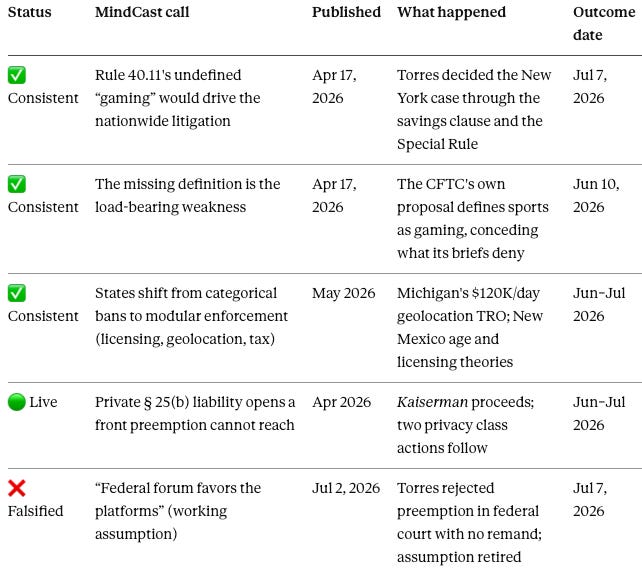
Source publications (each call, linked to the dated MindCast filing that made it):
Defining “Gaming” Under the Commodity Exchange Act: A Rule 40.11 Framework — CFTC public comment, RIN 3038-AF65, Apr 17, 2026 (calls 1 and 2).
The Prediction Markets Rule Architecture — May 2026 (call 3).
MCAI Lex Vision: The Rule 40.11 Paradox — Kalshi, the Third Circuit, and the Class Action the Ninth Circuit Cannot Ignore — Apr 2026 (call 4).
MCAI Lex Vision: CFTC Takes On Nine States — Kalshi, Prediction Markets, and the Federal-Plaintiff Phase — Jul 2, 2026 (call 5, the retired assumption).
Legend: ✅ outcome consistent with the call · 🟢 live and developing · ❌ falsified and retired. The registry scores calls by public-record chronology; the scorecard that follows scores how the confidence bands moved.
IV. What the Framework Got Right
MindCast lists forecasts the way an exchange lists contracts, and an adverse ruling is the settlement event that scores them — including the ones it gets wrong. Reporting a falsified assumption at the same prominence as a validated call is the discipline that separates a track record from advocacy. The scoreboard below is an institutional risk ledger rather than a black-box output — every position maps to an explicit, falsifiable condition a reader can check against the public record. The table marks every live position from the Federal-Plaintiff Phase analysis against the July 7 record.
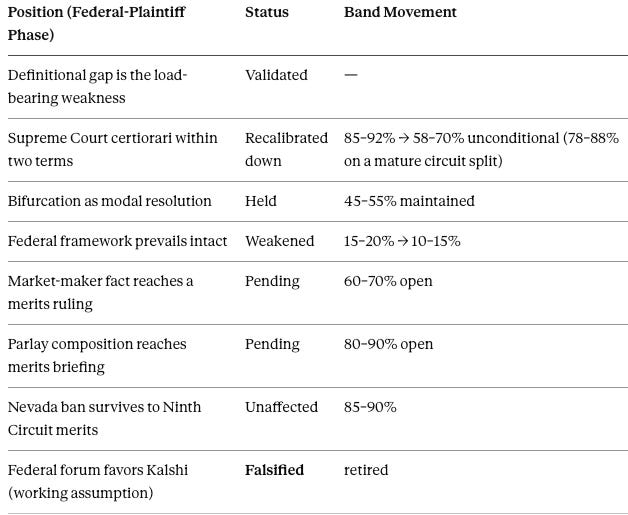
The falsified row carries the most weight, and honesty requires retiring the assumption rather than reinterpreting it. The Federal-Plaintiff Phase analysis treated federal forum as advantageous to the platforms; Torres refuted that directly, applying the presumption against preemption in federal court without any remand. Refinement over rescue (70–80% confidence in the replacement): federal district courts in state-police-power domains can defeat the exclusive-jurisdiction theory without ever reaching characterization, so forum selection no longer predicts merits and the platforms’ remaining structural edge narrows to the Third Circuit line. A framework that buried this entry would forfeit the credibility the analysis is built to earn.
One prior band moves the other way on its own reasoning. The certiorari estimate drops from 85–92% to 58–70% unconditional, because the Court can wait for final judgments, let the June rulemaking mature, and deny review where state statutes differ materially; conditional on a direct, mature circuit split, the estimate rises to 78–88%. Honest calibration cuts against the house as readily as for it.
Contact mcai@mindcast-ai.com to partner with us on Predictive Game Theory AI in Law and Behavioral Economics. Our verticals include simulating complex litigation, innovation economics and geopolitical risks.
To deep dive on MindCast works upload the URL of this publication into any LLM (preferably Google AI mode) and prompt ‘reconstruct MindCast framework with three degrees of cited sub links.’ See Appendix A and Live-Fire Game Theory Simulators, Runtime Predictive Infrastructure. We stress-tested our AI system for this publication by simulating the Super Bowl and the World Cup.
V. The Ruling in Brief
Torres denied the injunction on the merits and on every equitable factor, and the reasoning matters more than the result. Her twenty-two-page opinion in KalshiEX LLC v. Williams, No. 1:25-cv-08846, assumed without deciding that Kalshi’s sports-event contracts may qualify as swaps, then held that the CEA does not preempt New York gambling law. The presumption against preemption governed, because gambling regulation sits in a domain of predominantly state concern. All three preemption theories failed on the same foundation: the CEA’s own limiting language in 7 U.S.C. § 2(a)(1)(A) preserves state authority, and the Special Rule directs the Commission to scrutinize event contracts involving gaming. Torres found Kalshi’s harms largely monetary, treated state-by-state geolocation as an ordinary cost of compliance, credited New York’s consumer-protection and college-sports-integrity interests, dismissed the Gaming Commission on Eleventh Amendment grounds, and left Kalshi to an interlocutory appeal to the Second Circuit filed within days. She also named the national split and declined to follow the Third Circuit — a district judge writing for the appellate record.
Sources: Reuters and trade coverage of the July 7 ruling; the opinion in KalshiEX LLC v. Williams (S.D.N.Y. July 7, 2026). Scorecard figures below draw on trade reporting and warrant reconciliation against primary dockets before republication.
VI. Winning Fronts, Losing the War
The Commission’s problem is structural, not tactical, and the distinction determines everything that follows. Torres did not reject an argument the CFTC pressed badly; she rejected the argument the Commission’s own regulatory posture made impossible to win. The agency asserts exclusive authority over gaming-linked event contracts, a category Congress singled out for heightened review and never defined, and which no final Commission rule yet supplies. Courts applying the presumption against preemption demand a clear congressional command to displace state police powers, and an undefined carve-out is the opposite of a clear command. The CFTC’s central litigating position is undermined by the CFTC’s own rulemaking, which now proposes the very gaming label its briefs deny.
The scoreboard obscures the trajectory, and the trajectory is what stakeholders should track. Kalshi has won in New Jersey, affirmed by the Third Circuit, and in Tennessee, while losing in Maryland, Nevada, Arizona, Ohio, the Sixth Circuit, Michigan, and now the Southern District of New York — and the Commission’s exclusivity theory rises and falls with those results. Reading that as a mixed record misses the pattern: the losses cluster wherever a court reaches the presumption against preemption and finds no defined category behind the claim of exclusivity. The theory prevails where the swaps framing goes unexamined and fails where a judge examines the gaming carve-out — so every serious merits engagement runs toward the flaw. A campaign that fails precisely when scrutiny rises is not mixed; it is exposed.
VII. The Incoherence: Why the Commission Litigates What It Will Not Define
The Commission’s two strategies contradict each other, and naming the contradiction is the fastest route to its future. Litigation presses a maximalist claim — exclusive jurisdiction, asserted against nine states and in amicus for Kalshi. Rulemaking, until June, pressed nothing — and what it now presses cuts the wrong way. On June 10, 2026, the Commission at last proposed a Rule 40.11 definition that classifies sports contracts as gaming, the very characterization its lawyers deny in court after court. So the Commission tells judges it owns a category its own proposal labels for the states, and a plaintiff claiming exclusive title while its own surveyor draws the opposite boundary invites the precise challenge Torres sustained. Four mechanisms explain the mismatch, and they compound rather than compete. The confidence bands below express calibrated judgment — High is 70–80%, Moderate 55–70%, Emerging 40–55% — not the output of a formal model.
Ambiguity is an asset in litigation and a liability in rulemaking, and the Commission optimized for litigation. A defined gaming rule binds the agency: narrow it, and sports contracts fall inside the carve-out; broaden it, and legitimate hedging sweeps in. Litigation lets the Commission assert authority while preserving the flexibility a definition would surrender. The trade was rational until July 7, when Torres treated the missing definition as evidence against exclusivity — converting preserved ambiguity from a litigation asset into a litigation liability and leaving the Commission optimized for a bargain that no longer exists. [High, 70–80%]
The single-commissioner configuration lets the agency litigate but not rulemake. Filing suit needs a general counsel; notice-and-comment rulemaking needs a functioning Commission, a defensible record, and months the agency cannot compress. With one sworn member and four vacancies, the Commission does the thing it is staffed to do and defers the thing it is not, so the mismatch is partly a capacity artifact rather than a choice. The pattern shows in real time: when New Mexico’s attorney general sued Kalshi on June 4, 2026, the Commission answered on June 12 with its own federal suit against the state — its eighth such action — spending scarce litigating capital to block a state prosecutor rather than to finish the rule that would end the fight. [Moderate, 55–70%]
The mismatch may be organizational before it is strategic. The litigation shop reacts to state provocations on a fast clock — Minnesota passed a felony statute and the Commission sued inside a day — while the rulemaking shop runs a deliberate long cycle, and nothing forces the reactive and deliberate tracks onto the same page. Requisite variety fails inside the agency before it fails against the states: two divisions optimizing separately produce a combined posture neither would choose. [Moderate, 55–70%]
A defend-then-define sequencing theory is the charitable reading, and the June proposal complicates it. An agency mid-rulemaking sometimes litigates to hold the line while the rule cooks. The Commission did finally propose on June 10 — but three months into a losing streak, after the advance notice sat from March, and with a definition that concedes the gaming label its briefs resist. A proposal that arrives that late and cuts against the litigating position reads as reaction to adverse rulings rather than a sequenced plan, and it still leaves courts no operative rule to defer to. [Emerging, 40–55%]
A regulatory-capture reading sits underneath all four and deserves stating with appropriate hedges. An industry-friendly Commission that defines gaming must then regulate it, while a Commission that only litigates preemption shields the industry without ever writing a rule that could later constrain it. Winning exclusive jurisdiction in order to under-regulate is coherent as politics even as it fails as litigation — but the evidence is dispositional rather than documentary, so the confidence stays low. [Emerging, 40–55%]
The synthesis is sharper than any single mechanism. The Commission treats jurisdiction as something to win rather than something to earn — asserting ownership through litigation instead of demonstrating stewardship through a rule. Systems theory names the failure in administrative terms. Ashby’s law of requisite variety holds that a controller must command at least as much regulatory variety as the system it governs, and regulatory variety here is bandwidth: a Commission hollowed out by four vacancies and run by a single sworn member cannot process a multi-month notice-and-comment rulemaking while simultaneously prosecuting a nine-front litigation war. The CFTC claimed universal authority over prediction markets while lacking the institutional capacity to build the one instrument — a definition — that would let it exercise that authority. An over-extended controller loses to distributed challengers who each need only local variety, and every state needs one thing: its own gambling law. The center needed one thing it could not staff.
The forward consequence is the part the news cycle misses entirely. By litigating instead of defining, the Commission is not defending its jurisdiction; it is donating the definition to whichever court rules last. Each suit filed without a rule cedes definitional authority to a judge, because a court facing an undefined statutory category supplies the meaning the agency withheld — and Torres just did. The Commission’s own activity is transferring boundary-drawing power away from the Commission, toward the Second Circuit, the Ninth, the Supreme Court, and ultimately Congress, each of which will define gaming if the agency continues not to. [High, 70–80%]
The trap has no cost-free exit, which is why the paralysis holds. A final definition could strengthen the federal position by supplying a stable administrative construction, a developed rulemaking record, and a coherent account of how the Special Rule interacts with exclusive jurisdiction. No administrative construction can itself supply the clear congressional command preemption doctrine requires. And the same definition would bind the exchanges it protects: any definition broad enough to classify sports contracts as gaming threatens the volume that drives the industry, while any definition narrow enough to exclude them invites challenges that the agency ignored product function and the Special Rule. Undefined, the category leaves the federal position weak and the exchanges flexible; defined, it firms the federal position at the cost of binding the very products the Commission wants to protect. The June 10 proposal is that trap made visible: it labels sports contracts gaming to gain an administrable rule, and in the same stroke concedes the classification the states need. The Commission is not merely slow to choose — it is caught between two options that each cost it something, and even its proposal pays both prices at once.
VIII. ⚖️ The June Proposal Cuts the Other Way
The Commission did finally move, and the move deepened the hole. On June 10, 2026, the CFTC published a notice of proposed rulemaking under RIN 3038-AF65 — the docket MindCast addressed in April — amending Rule 40.11 and adding Appendix F, and for the first time proposing a definition of gaming: an activity pursued for recreation, governed by rules, and turning on participants’ luck, skill, or athletic ability. Under that definition sports contracts are gaming, while elections and awards are contests and fall outside it. The comment period closes July 27, 2026, and nothing is final.
Read against the litigation, the proposal is a confession. In court the Commission argues that the “involves” test turns on the nature of the trading, so sports contracts are federally regulated swaps rather than gaming; the proposed rule adopts the opposite reading, keying “involves” to the nature of the underlying event — the very construction the district courts used to rule against Kalshi. The Congressional Research Service put the tension plainly: the proposed interpretation tracks the district court’s reasoning and departs from the CFTC’s own position in the Kalshi litigation. So the Commission now argues one boundary to judges and proposes its opposite to commenters, and both documents carry its name.
The proposal cures nothing Torres decided, for three reasons. A notice of proposed rulemaking is not an operative rule, and it commands none of the deference a final regulation would; Torres ruled on July 7 with the proposal pending and unfinished. A court can read the very need for the rulemaking as proof that the prior law was ambiguous — that Congress never clearly displaced state authority — which converts the proposal from a shield into an admission. And the definition it advances hands the states their classification premise for free: once the Commission’s own rule calls sports contracts gaming, a state arguing that sports contracts are gaming is quoting the regulator, and the public-interest test the proposal builds to spare those contracts from prohibition does not un-ring that bell.
Market makers have already begun supplying the record that test rewards. On July 8, 2026, Susquehanna International Group committed up to $500 million in capacity to facilitate institutional hedging of World Cup outcomes — sponsors, broadcasters, and consumer brands buying protection against team-performance risk — converting the economic-purpose defense from theoretical assertion into demonstrable demand. A companion analysis in this series takes up that front, where the same volume that proves legitimate hedging also supplies the gaming label the proposal concedes.
Inference (Moderate, 55–70%): at least one court treats the June proposal as evidence of prior statutory ambiguity rather than as clarification supporting federal exclusivity, within twelve months.
IX. Function Versus Jurisdiction: Selig’s Self-Defeating Defense
Chairman Michael Selig’s public argument is the argument Torres pre-answered, and the collision explains why the Commission keeps talking past the setback to its position. Two claims dominate the discourse and never touch. Gaming operators and the American Gaming Association press a functional identity claim: parlays and player-tied contracts are sportsbook products in a derivatives wrapper. Selig presses a jurisdictional supremacy claim: economic similarity is irrelevant because Congress assigned authority to the Commission. Each is internally coherent. Each answers a question the other did not ask.
Torres resolved the case by refusing to let the two questions collapse. Granting Kalshi the swaps characterization for argument stripped the functional dispute out of the decision, leaving only the jurisdictional axis — and on that axis the savings clause and the Special Rule pointed one way. The maneuver exposes the flaw in Selig’s position. His strongest move, that economic similarity is beside the point, is legally sound and self-defeating at once: once function drops out, the statute’s express reservation of state authority becomes the whole game, and the statute reserves that authority to the states. A regulator who wins the argument that classification is irrelevant loses the argument that classification confers exclusivity. Selig narrating that losing register on cable television, while the appeal is pending, is a legitimacy signal courts read. The functional-versus-jurisdictional distinction is a reusable primitive — the test that separates what a contract is from who governs it — and it recurs across the NPMLA series as the hinge on which these cases turn.
X. The Five Defeats, and Why Only One Landed
A single opinion can inflict several kinds of loss, and precision about which arrived separates recalibration from retreat. The federal preemption position can be defeated at five levels, and July 7 reached one cleanly while deepening a second.

District-court defeat — landed. Torres denied the injunction and rejected all three preemption theories at the trial level. The loss is real and consequential for New York operations.
Institutional defeat — partial, and borne by the Commission more than by Kalshi. The ruling deepens the single-commissioner legitimacy deficit, because a court deferring to state police powers lands while the agency runs a nine-front campaign through one sworn member. The deficit is a capacity problem the Commission carries; the litigation design that anticipated adverse forums is not itself impeached.
Strategic defeat — not landed. A preliminary-injunction denial is interlocutory, not a merits judgment, and Kalshi preserved posture by appealing within days while the Commission’s cost-socializing campaign continues elsewhere.
Narrative defeat — not landed, and partly inverted. Torres assumed the swaps characterization and never adjudicated whether prediction markets are gambling, leaving the industry’s self-description formally intact. For MindCast’s framing the effect runs the other way: a judge severing function from jurisdiction is the analysis the NPMLA series has advanced since May.
Architectural defeat — not landed. The federal three-instrument structure — rulemaking record, amicus, sovereign litigation — stands, and one district applying a well-established presumption dismantles none of it. The predictive architecture records the event as a scoring validation rather than a loss, because it forecast a sovereign contest converging on a boundary and the ruling is that convergence on schedule.
Commentary reading a district-court loss as strategic or architectural collapse mistakes the level at which the system operates. The Commission’s genuine exposure is institutional, and it is self-inflicted.
XI. The Rule 40.11 Paradox: The Liability the Commission Cannot Preempt
The undefined category does not only lose preemption cases; it manufactures a private-liability track preemption cannot reach, and both edges cut from the same blade. Rule 40.11 prohibits a registered exchange from listing event contracts that involve, relate to, or reference gaming. The Commission left the operative term undefined while the prohibition itself stayed on the books, so a plaintiff can allege that Kalshi’s sports contracts violate the rule on its face, with no classification ruling and no new regulatory finding required. MindCast mapped this mechanism in April as the Rule 40.11 Paradox.
Kaiserman v. Kalshi is that mechanism in motion. Filed March 20, 2026 in the Northern District of Georgia, No. 1:26-cv-01525-VMC, the putative class action invokes the private right of action under 7 U.S.C. § 25(b) against the Kalshi entities and named officers, alleging that the platform listed the gaming-linked contracts Rule 40.11 forbids and seeking damages for every United States trader who lost money on Kalshi sports contracts. The complaint never argues that states may regulate Kalshi. The complaint argues that Kalshi violated federal law, so the preemption victory the platform is spending millions to secure does nothing to answer it. The same statute Kalshi wields as a shield contains the sword.
The paradox tightens as the platform’s own volumes grow. Sports contracts drive the overwhelming majority of Kalshi’s activity and powered a record World Cup quarter, and each dollar of that volume is a data point a section 25(b) plaintiff can cite as facial exposure under a rule the Commission declined to narrow. Classification deferred, liability accumulating: appellate courts allocate authority prospectively while private plaintiffs recover damages retrospectively, and the two clocks run at once. A definition would discipline both tracks; its absence feeds them. Inference (60–70%): a section 25(b) action against a prediction-market operator survives a motion to dismiss on the Rule 40.11 theory within twelve months, wholly independent of the preemption docket — the private-liability layer the sovereign turf war has trained stakeholders to overlook.
The private front is already widening beyond the commodity theory. On July 9, 2026, two days after the New York ruling, a proposed privacy class action hit Kalshi in Manhattan federal court — the second such suit in a month — alleging the platform embedded third-party trackers from Google, TikTok, and LinkedIn that exposed which contracts users researched and traded. Deferred classification does not only breed derivatives liability; it multiplies fronts, forcing Kalshi to fund privacy litigators and section 25(b) plaintiffs at once while the sovereign campaign consumes its senior attention. Combined private drag scales with the platform’s own volume even as the preemption shields hold, and a shield against state regulators does not answer a damages claim.
XII. Strategic Adaptation: How Each Actor Moves Next
Actors respond to incentives, and the ruling changed the incentive structure for six of them at once. Forecasting the litigation now means forecasting the adaptations, because the next filings will answer Torres rather than ignore her.
Three adaptive systems now co-evolve — courts, regulators, and exchanges — each revising strategy in response to the others’ last move. Modeling that interaction is the work of MindCast’s Dynamic Predictive Game Theory framework, built for systems where the game itself changes while it is being played, and it treats the players as behaviorally bounded rather than perfectly rational — loss-averse, reference-dependent, and capacity-constrained in the way MindCast’s behavioral-economics synthesis specifies. Each move regenerates the game: an adverse state ruling forces geofencing, geofencing weakens the impossibility argument, product migration strengthens the derivatives identity, the June proposal alters the judicial evidence, private actions bypass preemption entirely, and circuit conflict raises congressional and Supreme Court salience. The equilibrium the framework keeps returning to is bifurcation, the only regime that leaves every major actor enough of its core objective to stay behaviorally stable — the Nash-and-Stigler condition MindCast’s Dual Nash-Stigler reading of this contest tracks as NPMLA-II, where a party’s response to a ruling scores the next prediction. The six actor-level reads below are that NPMLA-II snapshot: positions scored from party behavior.
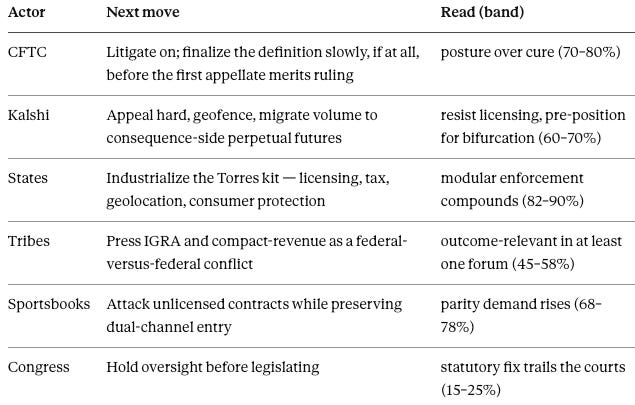
The CFTC faces a forced choice between its two strategies. Torres turned the Rule 40.11 rulemaking from background record into central evidence, and the June 10 proposal is the Commission’s attempt to supply that evidence — yet the proposal defines sports as gaming, conceding in rulemaking what its briefs deny, and remains non-final. Finalizing binds the agency and constrains the industry it favors; not finalizing leaves courts an undefended claim. Inference (70–80%):the Commission finalizes slowly, if at all before the first appellate merits ruling, and the proposal functions more as litigation posture than operative cure.
Kalshi appeals hard while quietly hedging the licensing question. The company presses the Second Circuit, geofences New York, and leans on New Jersey and Tennessee as the surviving proof of its national thesis. The tension is licensing: pursuing a New York license blunts the impossibility argument Torres rejected, yet one state license concedes the state-authority premise the preemption campaign denies. The July 9 disclosure that Kalshi is in advanced talks with the CFTC to extend never-expiring perpetual futures into metals, foreign exchange, and energy is the deeper adaptation in motion — a deliberate migration away from contest-side sports markets the states are dismantling and toward consequence-side derivatives that sit further from any gambling hook. Inference (60–70%): Kalshi resists licensing publicly while accelerating consequence-side volume to soften the gambling-site framing and to pre-position for a bifurcated outcome.
The states industrialize the Torres template. The opinion is a drafting kit, and the sharpest lesson for an attorney general is that winning requires no broad product ban at all: consumer-protection theories, local tax compliance, licensing conditions, and the ordinary cost of geolocation enforcement are sufficient, and Torres ruled each of those an ordinary burden of doing business rather than an unconstitutional intrusion. Michigan proved the kit works. After U.S. District Judge Paul Maloney remanded the Nessel suit to state court on June 25, 2026, Ingham County Judge Rosemarie Aquilina granted a temporary restraining order on June 29 forcing Kalshi to geofence Michigan residents through July 13 under a $120,000-per-day noncompliance fine — localized, emergency, state-court enforcement the platform’s federal shields did nothing to stop. Attorneys general will paste the structure into parallel complaints while New York moves to a state-court restitution action, and each surviving track raises a platform’s cost of clearing a state.
Tribal interests press the federal-versus-federal conflict Torres left open. Four New Mexico tribal bodies have already sued Kalshi on Indian Gaming Regulatory Act and compact-violation grounds, and Michigan’s own order flagged the platform’s diversion of tribal revenue — because a federal preemption theory that erases state gambling law simultaneously erases the state-tribal compacts built on top of it, threatening the sovereign compact revenue that funds tribal governments in Washington, New Mexico, and beyond. Torres’s state-authority language, and the Rhode Island intervention already in a federal docket, arm that argument — and hand state attorneys general their most politically potent lever: defending tribal sovereignty against federal overreach rather than a state licensing monopoly.
Sportsbooks weaponize the licensing off-ramp. Incumbents will argue that if Kalshi can obtain a state license it should be regulated as a sportsbook is, turning Torres’s reasoning into a parity demand, while the American Gaming Association sustains the functional-identity narrative. The incumbents already hedging both channels are the tell that the licensing framing is winning.
Congress adapts slowly, but salience rises. A statutory definition of gaming would end the vacuum in either direction, and each adverse marquee ruling raises the odds that Congress, not the Commission, supplies the damper. Inference (15–25%): statutory clarification precedes judicial resolution.
XIII. The Future: The Commission Is Donating the Definition
Fifteen weeks of record narrowed the outcome space to an allocation question, and the New York ruling sharpens the bands without reversing direction. The forward story is not whether prediction markets survive but who draws the boundary and who pays when it is drawn — and the Commission is losing control of both answers by declining to define the term at the center of the fight.
Revised resolution scenarios (mutually exclusive, resolution-stage):
Bifurcated resolution — contest to the states, consequence to the CFTC: 50–60%, modal. Torres’s function/jurisdiction severance is the posture from which bifurcation emerges at the Supreme Court, and Kalshi’s July 9 push into non-sports perpetual futures is the platform pre-positioning for exactly that split, retreating toward the consequence side it can defend.
Broad gambling classification prevails: 22–28%. The New York merits signal, the market-maker record, and parlay composition carry this path, rising with each adverse federal-forum ruling.
Federal framework prevails intact: 10–15%. Carried by New Jersey, Tennessee, and the Third Circuit; weakened by the SDNY loss.
Fragmented persistence without resolution: 12–18%.
Newly registered predictions (falsifiers and windows stated for runtime scoring; reconcile canonical IDs against the NPMLA-I registry):
▲ The definitional axis controls at least one further federal merits ruling by Q1 2027. Falsifier: a federal court resolves a prediction-market preemption question without relying on the savings clause, the Special Rule, or the presumption against preemption. Window: through March 31, 2027. Band: 70–80%.
▲ The Commission does not finalize a gaming definition before the first appellate merits ruling. Falsifier: the CFTC promulgates a final Rule 40.11 gaming definition, beyond the June 10 proposal, before any circuit rules on the merits. Window: comment period closes July 27, 2026; tracked to the first appellate merits event. Band: 60–70%.
● The Torres opinion is cited as persuasive authority in at least three other prediction-market dockets within six months. Falsifier: fewer than three citing dockets by January 7, 2027. Band: 75–85%.
● A state licensing or access-restriction instrument survives a preemption challenge a direct product ban would have failed, within twelve months. Falsifier: every such instrument tested on preemption grounds is struck down. Band: 65–75%.
The six-to-twelve-month picture reads as a calendared convergence rather than an open-ended brawl. The Second and Ninth Circuit appeals ripen on their own schedules, Minnesota’s felony statute and its injunction ruling arrive near-term, New York’s enforcement action moves the fight into state court on restitution theory, and the cert clock runs from whichever appellate conflict matures first — while the Commission’s window to define gaming on its own terms narrows with every ruling it invites and declines to shape.
XIV. 🎯 Prediction Matrix
The forward calls, consolidated — each scored by confidence and horizon, and reconcilable against the dated registry in Sections III and IV.
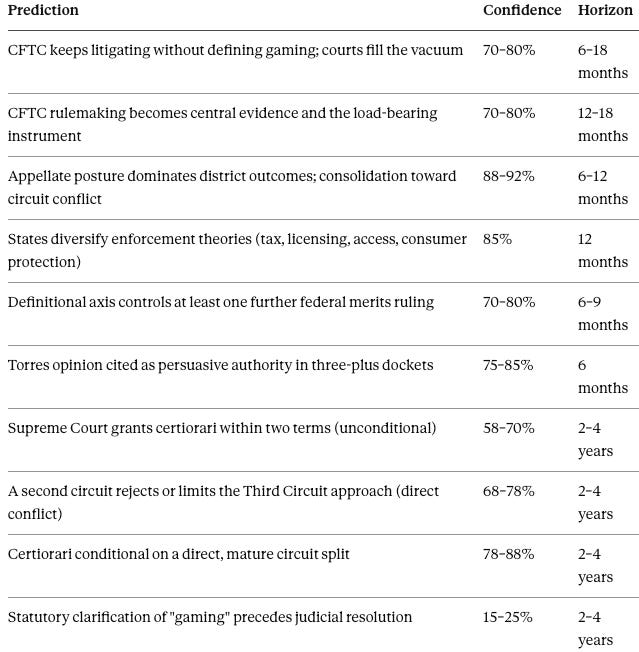
Read together, the bands describe a calendared convergence: district-court noise resolves upward into a circuit conflict, and the definition the Commission withheld gets written by a court or by Congress within two to four years.
XV. 👥 What This Means for Stakeholders
Each stakeholder reads the same ruling and faces a different decision, and the framework earns its keep by telling each which move the record now favors.
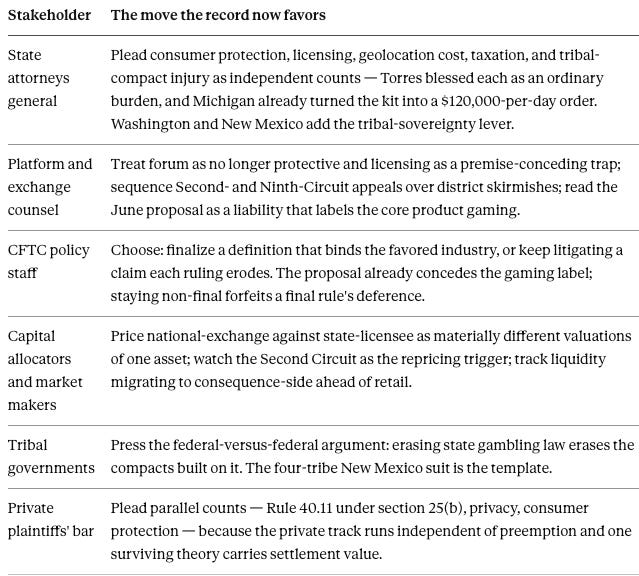
One through-line runs across every row: no stakeholder needs to win the national classification fight to act now. State attorneys general enforce, platforms sequence appeals, allocators reprice, tribes assert compact rights, and plaintiffs plead parallel counts — each moving on the boundary the record already draws, while the Commission's undefined category leaves the center the last actor able to move.
XVI. Conclusion
A regulator can win every battle and still lose the war if it never settles what it was fighting over. The CFTC was not even a party to the case, yet its exclusivity theory suffered the defeat, because Torres decided the question through the one gap the Commission had the power to close and chose not to. Exclusive jurisdiction over a category no operative rule defines is not a legal position but an open commitment, and July 7 is the day a marquee court called the commitment due.
The war ends where the framework said it must begin: at the definition. The Commission’s incoherence — maximalist in litigation, self-contradictory in rulemaking — is not a temporary misstep it will tidy up but a revealed preference, and now a revealed liability, because each undefended assertion of ownership donates the boundary to the next court in line. MindCast identified the vulnerability with the regulator in April, the New York opinion supplied the first judicial evidence consistent with that thesis in July, and the recalibration published before the appeal was docketed. The Commission still holds the pen that would end the vacuum. Every month it declines to finalize, a judge writes for it — and the definition of gaming, the allocation of liability, and the difference between a national exchange and a licensee pass a little further out of the Commission’s hands.
XVII. Appendix: Foundation Corpus and Primary Sources
MindCast AI — National Prediction Market Litigation Architecture (NPMLA)
Defining “Gaming” Under the Commodity Exchange Act: A Rule 40.11 Framework for the CFTC to Stabilize Jurisdiction, Federal Preemption, and Private Liability — official CFTC public comment on RIN 3038-AF65, filed April 17, 2026 (hosted analysis). Relevance: the receipt — the filing that named the definitional vulnerability, addressed to the Commission on the docket that became the June 10 proposed rule, three months before Torres decided the New York case through it.
The National Kalshi Prediction Market Litigation Map — March 2026. Relevance: the descriptive spine, tracking the fragmented state-by-state landscape and establishing that prediction markets occupy an un-administrated crack between commodity-derivatives law and state gambling law.
The Prediction Markets Rule Architecture — May 2026. Relevance: the rule-gap thesis, showing that the CEA already separates commercial hedging from wagering and that the missing agency standard, not a novel economic question, creates the litigation vacuum.
MCAI Lex Vision: The Rule 40.11 Paradox — Kalshi, the Third Circuit, and the Class Action the Ninth Circuit Cannot Ignore — April 2026. Relevance: the private-liability sword, mapping how 7 U.S.C. § 25(b) and Kaiserman v. Kalshi bypass the preemption debate entirely.
MCAI Lex Vision: CFTC Takes On Nine States — Kalshi, Prediction Markets, and the Federal-Plaintiff Phase — July 2026. Relevance: the three-instrument federal strategy (rulemaking record, amicus, sovereign litigation) and the prediction registry scored in this paper.
Dynamic Predictive Game Theory and Behavioral Economics (methodology)
The Dynamic Predictive Game Theory Collection — umbrella for the framework: forecasting strategic behavior in systems where the game changes while it is played.
The Computational Era Operationalizes Cybernetics and Predictive Game Theory — the behavioral-economics and cybernetics foundations (bounded rationality, prospect theory, asymmetric information, feedback control).
How MindCast Evolves the Structural Gaps in Classical Nash Game Theory — why static equilibrium fails when institutions mutate the game during play.
Dynamic Predictive Game Theory Meets the Era of AI: Operationalizing Fudenberg with Cognitive Digital Twins— Adaptive Coherence Equilibrium and the Dual-Equilibrium Termination Architecture.
The Dual Nash-Stigler Equilibrium Architecture — the equilibrium and termination foundations.
Prediction Markets and the Dual Nash-Stigler Trap: Kalshi, the CFTC, and the Prediction-Market Harm Clearinghouse — direct application to this contest; opens NPMLA-II, positions scored from party behavior.
How MindCast Game Theory Differs from Textbook Game Theory — the Chicago Accelerated and Nash–Stigler calibration layers and the behavioral-perception insertion that classical game theory omits.
MindCast AI Emergent Game Theory Frameworks — the constituent frameworks (constraint geometry, cross-forum mapping, coalition detection, prospective equilibrium generation) that construct each Cognitive Digital Twin.
Primary legal sources
KalshiEX LLC v. Williams, No. 1:25-cv-08846 (S.D.N.Y. July 7, 2026) — preliminary-injunction denial (docket link to be inserted at publication).
Kaiserman v. Kalshi Inc., No. 1:26-cv-01525-VMC (N.D. Ga., filed Mar. 20, 2026); private right of action, 7 U.S.C. § 25(b).
KalshiEX LLC v. Flaherty, No. 25-1922 (3d Cir. Apr. 6, 2026) — first federal appellate ruling; exclusive-jurisdiction holding.
CFTC v. New Mexico (D.D.C., filed June 12, 2026) — federal countersuit seeking declaratory judgment and permanent injunction; New Mexico is the eighth state sued. CFTC Press Release 9251-26.
Michigan v. KalshiEX LLC — Ingham County Circuit Court temporary restraining order (Aquilina, J., June 29, 2026; effective through July 13, $120,000/day geolocation fine), following remand by U.S. District Judge Paul Maloney (June 25, 2026).
Kalshi privacy class action (proposed), S.D.N.Y., filed July 9, 2026 — third-party tracking claims; a parallel private-liability front. New York Law Journal report.
Kalshi in talks with regulators to expand never-expiring derivatives — Reuters, July 9, 2026; perpetual-futures pivot toward metals, FX, and energy.
Susquehanna announces World Cup hedging capacity of up to $500 million — Susquehanna International Group press release, July 8, 2026; institutional economic-purpose hedging on a CFTC-registered DCM (also reported by Bloomberg).
CFTC Notice of Proposed Rulemaking, “Prediction Markets; Public Interest Determinations,” RIN 3038-AF65 (published June 10, 2026; Fed. Reg. June 12, 2026; comments due July 27, 2026) — proposes amendments to Rule 40.11 and Appendix F, defines “gaming,” and adopts an event-based “involves” test; CFTC Press Release 9249-26. The 2024 proposal was withdrawn February 6, 2026.
Congressional Research Service, “CFTC Issues Proposed Rule Regarding Prediction Markets” (LSB11441) — analysis noting that the proposed gaming definition brings sports contracts within Rule 40.11 and that the event-based “involves” test tracks the district courts and departs from the CFTC’s litigation position.
Commodity Exchange Act § 2(a)(1)(A) (savings clause); § 5c(c)(5)(C) (Special Rule); 17 C.F.R. § 40.11; ANPRM, 91 Fed. Reg. 12516 (Mar. 16, 2026), Question 19.
Methodological grounding
W. Ross Ashby, An Introduction to Cybernetics (1956) — the Law of Requisite Variety, grounding the agency-capacity analysis.
Stafford Beer, Brain of the Firm (1972) — the Viable System Model, on controllers that cannot match the variety they govern.
Dynamic Games and Applications (Springer; International Society of Dynamic Games), ISSN 0020-7276 — target venue for the formal dynamic-game treatment of the Nash–Stigler and delay-dominant-equilibrium apparatus underlying this analysis.