


Foundational publications The Law and Behavioral Economics of Compass v. NWMLS | The Counterclaim That Closed Compass’s Antitrust Thesis
The Compass Narrative War Against MLSs visual (Apr. 5, 2026) synthesizes six prior MindCast publications covering the commission capture mechanism, cross-forum contradiction matrix, "consumer choice" framing as a control mechanism, and the cybernetics of Compass's narrative architecture. Scope distinction: the Narrative War piece documents what Compass argued commercially and rhetorically across all forums. This synthesis documents what the litigation record now shows — the adversarial process consequences in federal court, including the counterclaim architecture, Paragraph 43's statutory trap door, and the MindCast Simulation probability distribution. Read the Narrative War piece to understand how Compass argued. Read this synthesis to understand where those arguments closed on themselves under oath.
I. The Original Thesis and Its Limits
Compass filed its federal antitrust complaint against the Northwest Multiple Listing Service in April 2025 carrying a deliberately constructed strategic architecture. MindCast: The Law and Behavioral Economics of Compass v. NWMLS established that Compass was not pursuing a straightforward antitrust victory. Compass was sequencing: use the pleading stage to preserve claims without evidentiary testing, deploy elite counsel to impose attrition costs on a regional cooperative, and manage public narrative through seller-choice vocabulary. The motion to dismiss denial on March 19, 2026 validated only the sequencing. Compass cleared the lowest merits threshold in federal civil litigation — a Rule 12(b)(6) standard that accepts all factual allegations as true, hears no evidence, and cross-examines no expert. Nothing more.
The four figures below anchor the structural context before any litigation analysis begins. Each measures a distinct pressure bearing on Compass simultaneously — legislative, financial, procedural, and probabilistic. Read together, they define the operating environment in which the April 2 counterclaim landed.

A 141–1 legislative vote activates Parker v. Brown state action immunity in its strongest available form — federal courts do not compel parties to violate concurrently effective state law absent a constitutional preemption basis Compass has not articulated. A $2.6 billion debt load against zero full-year GAAP profit history converts every dollar of Washington Consumer Protection Act treble damages exposure from an abstract legal risk into a solvency variable. Four independent counterclaim causes of action means NWMLS needs only one theory to proceed to damages. The P70 MindCast Simulation probability reflects all four pressures compounding in the same direction simultaneously.
Compass structured its complaint as a cost-imposition vehicle: deploy elite antitrust counsel to exhaust a regional cooperative without the resources for decade-long federal defense, preserve the pre-MLS marketing window during the proceeding, and manage public narrative through seller-choice vocabulary. The Three-Phased Marketing Strategy (3PM) was positioned as innovation — Phase 1 restricting listings to Compass agents exclusively, Phase 2 expanding selectively to Compass’s own platform, Phase 3 releasing to MLS. NWMLS Rule 2’s concurrent marketing requirement was cast as anticompetitive suppression of competition rather than what it functionally delivered: a transparency mechanism protecting buyer access to full market data.
Compass did not pursue a preliminary injunction against NWMLS. Against Zillow, Compass moved immediately upon filing. Against NWMLS, Compass allowed the motion to dismiss to exhaust at the lowest procedural threshold available. Judge Vargas’s four-day Zillow PI hearing — where Reffkin testified under oath and Compass failed the “serious questions” threshold before the denial on February 6, 2026 — taught Compass what a merits-tested motion produces. Compass separated procedural survival from substantive testing. The legal theory remained structurally unchanged and structurally untested entering the counterclaim phase. As MindCast established, courts have not validated Compass’s theory — they deferred it.
“Compass alleged enough to proceed. Proceeding is not prevailing.” The Law and Behavioral Economics of Compass v. NWMLS
The MindCast Simulation assigns probability bands to litigation outcomes based on structural variables, not sentiment. The table below tracks the distribution before and after the April 2 counterclaim filing — the shift that converted NWMLS from a defendant absorbing Compass’s cost-imposition architecture into an affirmative damages claimant with mandatory fee-shifting under RCW 19.86.090.
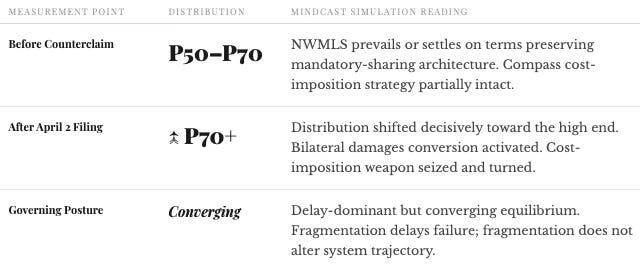
The probability shift captures a structural mechanics change. Before the counterclaim, NWMLS held a defensive posture — win conditions required surviving Compass's attack. After April 2, NWMLS holds affirmative damages claims anchored entirely in Compass's own self-generated marketing materials and public CEO statements. Every dollar of NWMLS's recoverable CPA damages is a dollar subject to statutory mandatory multiplication — payable by a firm that has never posted a full-year GAAP profit and entered the litigation carrying $2.6 billion in post-merger debt obligations.
II. Self-Inflicted Regulatory Capture
Before April 2025, Compass operated Private Exclusives quietly within a legal gray zone. NWMLS rules governed only listings already submitted — pre-submission marketing fell entirely outside enforcement reach. A listing agent could route a property through the brokerage’s internal network for 84 days, submit a fully compliant MLS listing on day 85, and violate nothing. NWMLS held no authority over conduct occurring before submission.
Compass’s decision to broadcast the mechanics of Private Exclusives through public federal complaints handed Washington State legislators a fully developed analytical and evidentiary framework for statutory intervention. As The Law and Behavioral Economics of Compass v. NWMLS, Section II documented in detail, Compass’s elite antitrust counsel drafted, with billable precision, the operative definitions of public marketing, pre-marketing, and selective exposure that SSB 6091 codified. Washington’s drafters needed no regulatory invention of their own. Compass filed one in federal court, and the Legislature applied it 141–1.
The timeline below traces the full sequence from the April 2025 filing through the June 11, 2026 SSB 6091 effective date. Each entry marks a point at which the structural pressure on Compass’s litigation position increased, and at which the cost-benefit calculus of the opposing coalition shifted further toward legislative preemption over bilateral defense.
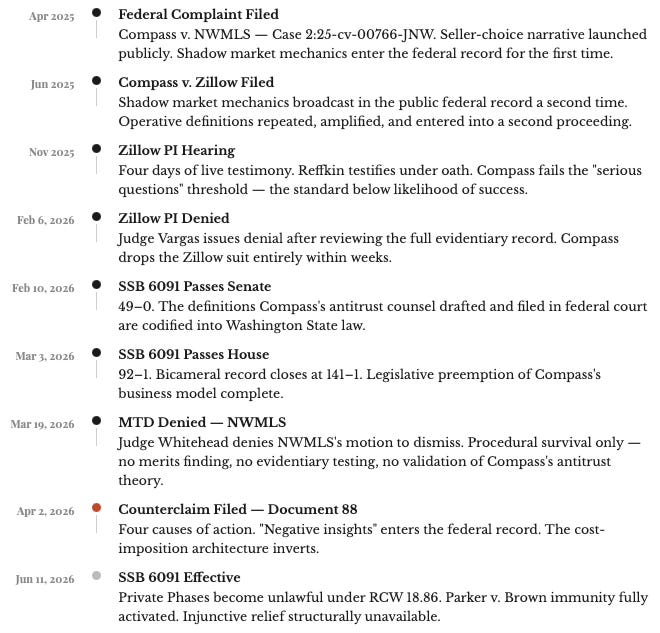
The Nash–Stigler framework explains why legislative preemption became the dominant strategy once Compass filed. Nash equilibrium marks the point at which no coalition actor improves by unilateral defection — locking coordinated behavior without explicit coordination. Stigler equilibrium marks the point at which the evidentiary record suffices to drive settlement without additional proof. Compass’s complaints triggered both thresholds simultaneously, collapsing a fragmented field of NWMLS, Windermere, Zillow, and Washington Realtors into a unified coalition with one dominant strategy. Each actor independently reached the same cost-benefit conclusion: a floor vote requires a committee hearing, not a federal courthouse, and the remedy becomes permanent and self-executing the moment the Governor signs.
The frame inversion table below identifies the single most consequential structural shift in the entire litigation. MindCast: The Counterclaim That Closed Compass’s Antitrust Thesis establishes Document 88’s core architectural move: NWMLS relocated the dispute from competitive restriction to information suppression. Read across the three cells — Compass’s framing, NWMLS’s reframe, and the structural burden shift that follows from relocating the dispute.
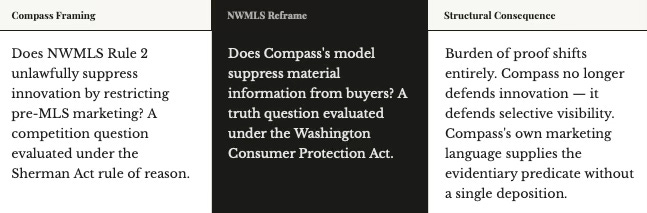
Relocating the dispute from competitive restriction to information suppression changes three things simultaneously: the burden of proof, the standard courts apply to resolve the dispute, and how every other audience — regulators, platforms, investors, brokers, and consumers — interprets the same set of facts. Once framed as information suppression, Compass cannot recover antitrust ground by arguing innovation. Every innovation argument requires explaining why buyers needed less information to make better decisions. No expert will carry that position through cross-examination.
III. The Counterclaim Architecture
Document 88, filed April 2, 2026, brought four independent causes of action against Compass. The Counterclaim That Closed Compass’s Antitrust Thesis provides the full counterclaim analysis. Each claim rests on a different structural foundation, and none requires Compass to win on antitrust grounds to proceed. All four compound simultaneously against a firm carrying $2.6 billion in post-merger debt with no full-year GAAP profit in its history. The four counts below identify the structural foundation for each cause of action and why its evidentiary predicate requires no discovery to establish — Compass’s own materials, CEO statements, and marketing infrastructure supply it in full.
COUNT I · DECLARATORY JUDGMENT
Rule 2 anticipates SSB 6091 — enforcing concurrent marketing requirements constitutes anticipatory statutory compliance, not a private cooperative restraint. Parker v. Brown state action immunity becomes structurally available in its strongest form after June 11, 2026. Federal courts do not issue injunctions compelling parties to violate concurrently effective state law.
COUNT II · WA CONSUMER PROTECTION ACT
RCW 19.86.090 mandates treble damages up to $25,000 per violation plus mandatory attorneys’ fees. Compass’s own marketing materials supply the deceptive practice predicate without a single deposition required. The court shall treble — not may treble — damages on a prevailing CPA claim.
COUNT III · FRAUDULENT MISREPRESENTATION
Evidentiary anchors are entirely self-generated: internal marketing materials, CEO public statements, and Compass’s documented offer to cover broker sanctions for rule violations. Pre-discovery exposure is complete. No deposition produced any of it.
COUNT IV · TORTIOUS INTERFERENCE
NWMLS turns Compass’s own cause of action back against the party that induced the rule violations. The structural judo maneuver converts Compass’s offensive theory into a bilateral liability predicate operating under the same factual record Compass generated.
Four independent causes of action compounding simultaneously means NWMLS needs only one theory to proceed to damages. The Washington CPA count carries the most immediate financial consequence: mandatory treble damages plus fee-shifting on a claim anchored in Compass’s own internal terminology, payable by a firm carrying $2.6 billion in post-merger debt. Compass entered the litigation expecting to impose cost on a regional cooperative. The CPA converted that calculus — every dollar of NWMLS’s recoverable damages is a dollar subject to statutory multiplication.
The “Negative Insights” Paragraph
Paragraph 23 of Document 88 quotes Compass’s own internal marketing materials directly into the federal record. Compass promised listing brokers participating in 3PM that sellers could list properties without accumulating days-on-market and price-drop history — material facts any buyer needed before making an offer. Compass’s internal label for that suppressed information was negative insights. No deposition produced the phrase. No discovery motion compelled disclosure. Compass’s own marketing infrastructure documented the conduct, applied that specific terminology, and positioned the suppression as a seller benefit. The Counterclaim That Closed Compass’s Antitrust Thesis, Section I carries the full evidentiary chain from internal marketing materials to CPA deceptive practice predicate.
The phrase lands with immediate clarity for any buyer who has purchased a home. Days-on-market and price-drop history are the two most fundamental data points a buyer uses to assess negotiating position. Stripping them from NWMLS listings after the Private Phase concluded did not protect sellers — it protected Compass’s internal buyer routing from the scrutiny of a fully informed counterparty. NWMLS’s Consumer Protection Act counterclaim deploys the phrase as the deceptive practice predicate: Compass submitted inaccurate data to NWMLS, those inaccuracies deceived 30,000-plus broker members who relied on the platform, and NWMLS’s data integrity value was measurably degraded at scale.
“Compass’s most damaging evidence is self-generated. The exposure requires no investigation — only compilation.” The Counterclaim That Closed Compass’s Antitrust Thesis
Paragraph 43 · The Statutory Trap Door
Paragraph 43 states that Compass knows its Private Phases will violate Washington state law when SSB 6091 takes effect on June 11, 2026. Converting Compass’s antitrust challenge against NWMLS Rule 2 into an effective challenge against a statute the Legislature endorsed 141–1 produces two structural consequences that neither expert testimony nor further briefing can resolve before the October 2026 trial date. The Counterclaim That Closed Compass’s Antitrust Thesis, Section I identifies both as forward-lock conditions — structural foreclosures that operate independent of how the merits develop.
Injunctive relief becomes structurally unavailable — federal courts do not issue orders compelling parties to violate concurrently effective state law absent a constitutional preemption basis Compass has not articulated. Beyond that, the antitrust damages predicate narrows materially: Compass cannot recover damages for enforcement of a standard state law simultaneously requires after June 11. The trial jury pool draws from the Western District of Washington — the same state whose elected representatives voted 141–1 to mandate exactly what Compass is suing NWMLS for enforcing.
Three Concurrent Structural Vulnerabilities
The three vulnerabilities identified in The Law and Behavioral Economics of Compass v. NWMLS and The Counterclaim That Closed Compass’s Antitrust Thesis operate simultaneously against Compass’s litigation position. All three share a common evidentiary source: Reffkin’s sworn SDNY testimony and Compass’s own marketing materials. Read across the table — each vulnerability reinforces the others, and all three were self-generated.
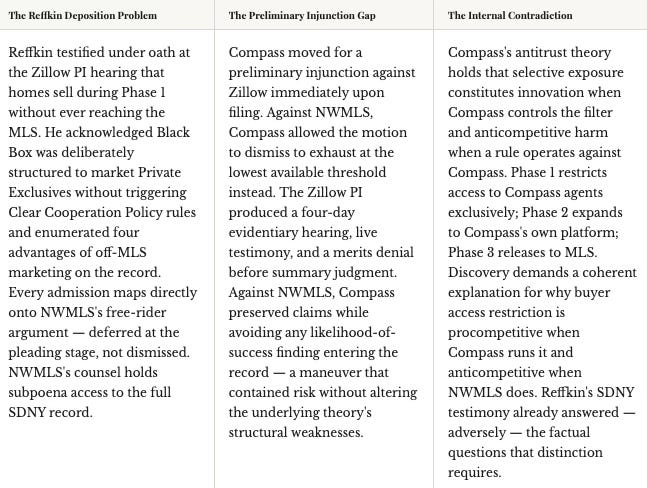
All three vulnerabilities share a common architecture: Compass generated the exposure itself, across multiple proceedings and forums, before any adversarial discovery began. The Reffkin deposition problem derives from Compass’s own litigation choice to seek a preliminary injunction against Zillow. The preliminary injunction gap derives from Compass’s own litigation choice to avoid one against NWMLS. The internal contradiction derives from Compass’s own antitrust complaints simultaneously claiming that identical conduct is innovative when it runs the filter and harmful when a rule constrains it. No external actor manufactured any of the three. As The Law and Behavioral Economics of Compass v. NWMLS and The Counterclaim That Closed Compass’s Antitrust Thesis document across the full analytical arc, and as The Compass Narrative War Against MLSs contextualizes against the commercial architecture that preceded the litigation, self-inflicted causation is the governing pattern — running through Compass, not merely against it.
IV. The Deposition Layer: Nelson, Huff, and Skillman
Three individuals sit at the intersection of Compass’s Washington legislative campaign and its pre-MLS marketing architecture in ways that make their depositions structurally valuable to NWMLS independent of anything the counterclaim pleadings establish. Cris Nelson, Brandi Huff, and Moya Skillman each occupied a different layer of Compass’s three-layer narrative control system — and each operated without enterprise-level message management during the Washington legislative fight. The Washington record captures the Compass institutional system operating without its managed messaging layer, making these witnesses analytically valuable precisely because they are local actors in a regional legislative fight, not national strategists managing enterprise exposure.
The deposition value does not derive from finding new damaging facts. The discovery target is surfacing facts Compass already created — across public statements, legislative testimony, MLS transaction records, and internal communications — and forcing them into a single coherent sworn record. Each witness converts publicly available contradictions into party admissions that travel across every parallel proceeding simultaneously. The full witness architecture appears in the MindCast Narrative Control Architecture analysis, accessible through the The Compass Narrative War Against MLSs and the multi-vector collapse analysis cited in The Law and Behavioral Economics of Compass v. NWMLS.
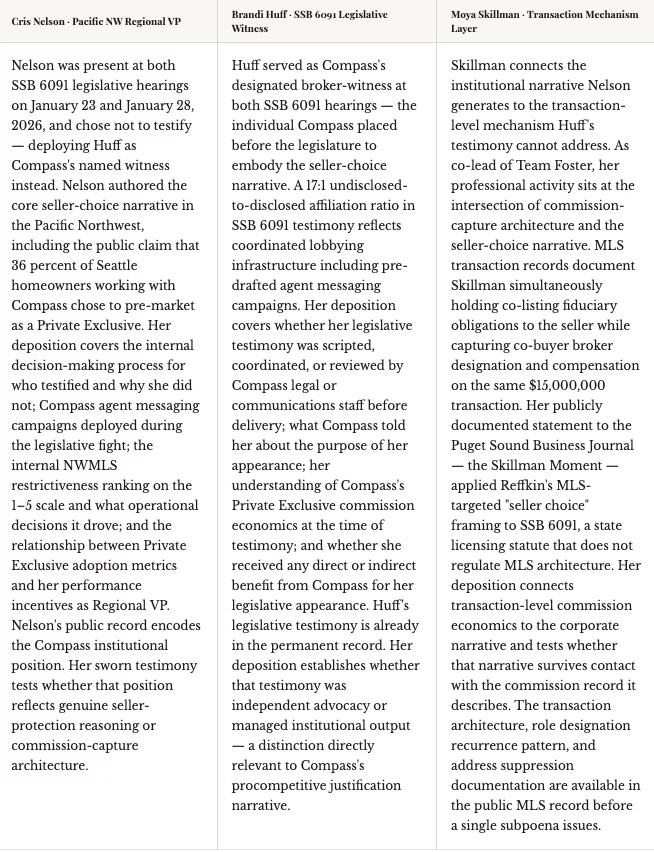
Nelson generates the narrative in media forums that create no cross-examinable record.
Huff absorbs the legislative inconsistency in a forum where cross-examination is limited and answers are non-binding.
Skillman operationalizes the architecture at the transaction layer without ever reconciling the narrative against the commission economics it produces.
Each witness is valuable to NWMLS for a structurally distinct reason — and all three depositions compound simultaneously against the same evidentiary record. Nelson's deposition notice is the moment her 36 percent opt-in claim gets tested against the internal communications and performance incentive records that produced it. Huff's deposition notice is the moment Compass's legislative testimony is tested against the coordination infrastructure behind it. Skillman's deposition notice is the moment the transaction-level commission architecture and the antitrust record formally converge in a single sworn proceeding — and every answer she gives becomes a party admission available across parallel proceedings.
As the MindCast Simulation identified in the multi-vector collapse analysis, Reffkin's deposition notice in the NWMLS case carries the greatest individual settlement pressure: he has already testified four days in the Zillow proceedings and understands what cross-examination produces when the cross-examiner holds his own sworn statements as impeachment material. Nelson, Huff, and Skillman represent the deposition layer that runs beneath that calculus — and their notices, once issued, produce the same structural irreversibility at the regional level that Reffkin's produces at the enterprise level.

Contact mcai@mindcast-ai.com to partner with us on Predictive Cognitive AI in Law and Behavioral Economics. To deep dive on MindCast work in Cognitive AI upload the URL of this publication into any LLM and prompt ‘reconstruct MindCast framework with three degrees of cited sub links.’ See Live-Fire Game Theory Simulators, Runtime Predictive Infrastructure | How MindCast Game Theory Differs from Textbook Game Theory