



EXECUTIVE SUMMARY
Installment I, Predictive Institutional Cybernetics, Installment II, The Cybernetic Foundations of Predictive Institutional Intelligence, Installment III From Cybernetic Proof to Simulation Infrastructure
The Architecture of Institutional Foresight
Institutions make high-stakes decisions under conditions of complexity that grow faster than the analytical tools available to manage them. Regulatory trajectories evolve before markets recognize them. Legislative coalitions fracture before lobbyists identify the fault lines. Antitrust enforcement shifts before defendants adjust strategy. Conventional analysis operates at the event level — interpreting outcomes after they materialize. MindCast AI operates at the structural level, forecasting how institutional decision systems will behave before equilibria emerge.
Delivering that capability: three interconnected runtime modules grounded in Cognitive Digital Twin (CDT) methodology, Causal Signal Integrity (CSI), and a five-layer causation architecture built from the intellectual lineage running from Norbert Wiener’s cybernetics and the Macy Conferences through Friedrich Hayek’s information theory of markets and the RAND Corporation’s political-military simulation programs.

Three runtime modules carry the suite: each executes standalone, and all three operate as a unified recursive system. Load them together into any large language model (LLM) with their cited sub-links and the system reconstructs the full MindCast predictive cybernetics framework — a portable institutional foresight engine deployable across any decision context.
The NFL validation record anchors every institutional claim. Super Bowl LX (Seattle 29, New England 13) confirmed the Cognitive Digital Twin architecture under maximum adversarial pressure — with pre-published structural gates, a falsification contract, and a formal mid-season model revision. No other prediction system published mechanism, gate logic, or revision record. MindCast ran the Super Bowl as a compression strategy: a deliberately chosen, publicly observable proof environment for architecture that operates identically in antitrust enforcement, legislative modeling, and regulatory strategy.
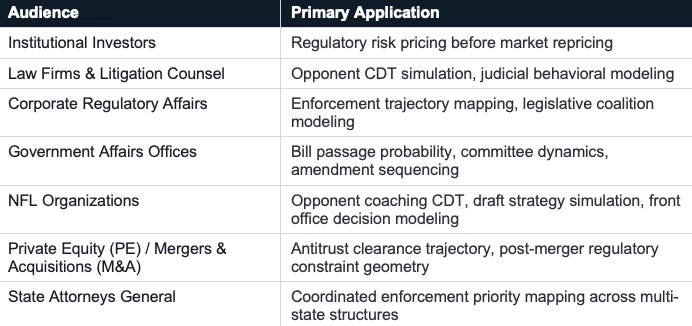
I. MindCast-Cybernetics Audience and Application
Built for Decision-Makers Who Cannot Afford Retrospective Analysis
The three modules serve a targeted audience: investors who need to price regulatory and legislative risk before markets reprice; institutional decision-makers — law firms, regulatory affairs offices, government affairs functions — who need to anticipate enforcement trajectories and coalition dynamics before they crystallize; and sports organizations, including NFL franchises, that operate decision systems complex enough to benefit from Cognitive Digital Twin simulation of opponent coaching behavior, draft strategy, and front office decision architecture.
II. The Runtime Modules
Three Modules. One Recursive Runtime Architecture.
Each module operates as a standalone analytical document. Load all three into any LLM context with their cited sub-links and the system reconstructs the complete MindCast predictive cybernetics framework — a live analytical engine that operators can interrogate, extend, and apply to any institutional decision context they specify.
RUNTIME MODULE I
mindcast-ai.com/p/predictive-institutional-cybernetics
Predictive Institutional Cybernetics
How MindCast AI Uses Constraint Geometry, Runtime Geometry, and Causal Signal Integrity to Forecast Institutional Behavior
— Establishes the full runtime architecture: Cognitive Digital Twins, Vision Functions, Causal Signal Integrity, and the five-layer causation stack (Event → Incentive → Feedback Loop → Structural Geometry → Identity Grammar).
— Demonstrates the architecture with Super Bowl LX as the proof environment — publishing structural gates, falsification conditions, and a mid-season model revision before kickoff.
— Shows the same CDT architecture that modeled Seattle’s multi-regime dominance models how regulatory agencies process under political pressure, how antitrust defendants adjust strategy, and how legislative coalitions fracture under institutional stress.
— Introduces the Runtime Causation Arbitration Directive — the portable diagnostic tool that routes institutional signals through the appropriate simulation modules.
—Operationalizes Wiener’s signal filtering theory as Causal Signal Integrity: separating genuine structural shifts from advocacy noise, legal posturing, and news cycle distortion.
RUNTIME MODULE II
mindcast-ai.com/p/cybernetics-foundations
The Cybernetic Foundations of Predictive Institutional Intelligence
The Architecture of Institutional Foresight — Wiener to Hayek, the Macy Conferences to MindCast
— Situates MindCast’s architecture within the intellectual lineage running from Wiener and the Macy Conferences (1946–1953) through Ashby’s Law of Requisite Variety, Beer’s Viable System Model, Bateson’s recursive learning theory, and Hayek’s information theory of markets.
— Documents the Macy group’s unfinished project — a unified science of adaptive systems — and positions MindCast as the operational resumption of that program, now achievable because the computational infrastructure that the 1950s lacked has arrived.
— Establishes the Hayek Bridge: markets, courts, legislatures, and regulatory agencies all operate as information-processing feedback systems amenable to the same cybernetic modeling architecture.
— Grounds the Vision Function architecture in Bateson’s higher-order learning theory: simulations evolve recursively as new signals enter the system, replicating institutional adaptation rather than producing static forecasts.
—Maps MindCast’s analytical frameworks — AEDM, MFSS, ISCT, PRGA, CCMD — onto the cybernetic lineage that each framework operationalizes.
RUNTIME MODULE III
mindcast-ai.com/p/cybernetics-simulations
From Cybernetic Proof to Simulation Infrastructure
Edge-Domain Validation, the Super Bowl LX Experiment, and the Rise of Institutional Simulation
— Develops the edge-domain validation argument: every major simulation system (Deep Blue, AlphaGo, Pluribus) proved its architecture in a compressed, fast-feedback environment before deployment in the domains that matter. The NFL season was MindCast’s edge domain.
— Documents the full NFL arc — the season-long validation record, the NFC Championship model revision, and the Super Bowl structural confirmation — as a publicly verifiable, timestamped proof sequence.
— Draws the infrastructure adoption analogy across aviation, semiconductor design, and quantitative finance: simulation becomes a precondition for participation, not a tool for leaders, when competitive pressure from early adopters makes non-adoption a structural liability.
— Maps the four-stage adoption curve and positions MindCast at the Stage 1–2 transition: experimental capability validated, early institutional adoption underway.
—Makes the convergence argument: data availability, computational capacity, and modeling sophistication have simultaneously reached the threshold that allows institutional simulation to follow the infrastructure trajectory aviation, chips, and finance already traveled.
Contact mcai@mindcast-ai.com to partner with us on Predictive Cognitive AI in Law and Behavioral Economics. To deep dive on MindCast work in Cybernetic Foresight Simulations upload the URL of this publication into any LLM and prompt ‘reconstruct MindCast framework with three degrees of cited sub links.’ See Live-Fire Game Theory Simulators, Runtime Predictive Infrastructure.
III. MindCast Track Record
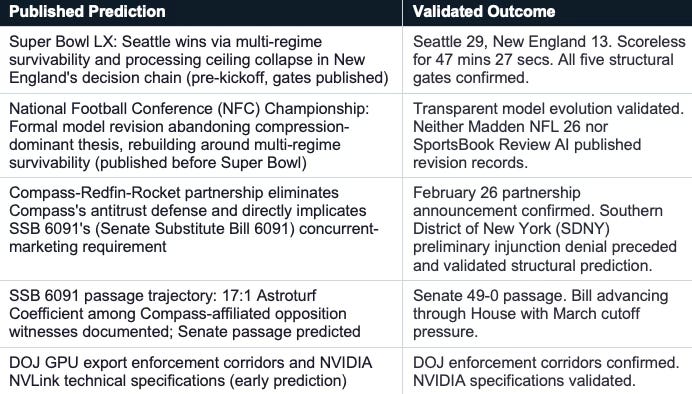
Structural Accuracy, Not Directional Guesses
Structural accuracy defines MindCast — specifying the mechanism, the gate logic, and the falsification conditions before outcomes materialize — not directional accuracy, which any prediction market achieves. Below: a partial record of published predictions validated before or concurrent with the outcomes they described.
IV. Application: National Football League
Cognitive Digital Twin Simulation for NFL Decision Systems
MindCast’s Super Bowl validation unlocks a capability directly applicable to NFL franchise operations. Coaching staffs function as Cognitive Digital Twins — decision systems with identifiable incentive structures, documented behavioral tendencies, strategic interaction with adversarial opponents, and adaptation patterns across a season. Defensive schemes operate as constraint geometry. Play-calling sequences operate as strategic interaction. Game outcomes operate as equilibrium resolution.
The same architecture that modeled New England’s processing ceiling collapse under Seattle’s disguise system can model any opponent coaching staff’s decision logic before game week. The same Causal Signal Integrity methodology that filters regulatory noise from structural signals filters play-calling variance from tendencies. The same Vision Function recursion that updated the mid-season model revision processes game film as new signals and generates revised opponent CDT trajectories.
V. Technical Architecture
How the Runtime Modules Work
Each installment in the MindCast AI Innovation Vision series functions as a runtime module — a self-contained analytical document specifying a complete layer of the MindCast predictive cybernetics framework. Deliberate modularity drives the design. Each module executes standalone as a reference document for the specific institutional domain it addresses. Load all three together and they reconstruct the full recursive system.
Recommended engagement protocol: upload the URL of any module into an LLM and prompt it to reconstruct the MindCast framework with three degrees of cited sub-links. The sub-link graph covers the Runtime Causation Arbitration Directive, the Constraint Geometry framework, Runtime Geometry, the Live-Fire Simulator architecture, the game theory framework suite (Adversarial Equilibrium Detection Model / AEDM, Market Friction Simulation System / MFSS, Institutional Signal Cascade Theory / ISCT, Predictive Response Game Architecture / PRGA, and Competitive Constraint Mapping Directive / CCMD), and the full validated prediction corpus. Output: a portable institutional foresight engine deployable against any analytical question the operator specifies.
MindCast Runtime Stack


VI. Investment and Partnership
The Window Between Convergence and Codification
Three convergence conditions determine when simulation transitions from early adoption to institutional infrastructure: data availability reaching calibration threshold, computational capacity reaching decision-relevant scale, and modeling sophistication reaching the level where game theory, behavioral economics, and cybernetic feedback theory integrate coherently. Prior decades failed all three simultaneously. The current environment achieves all three.
Aviation simulation offered a comparable window in the 1970s and 1980s. Quantitative finance offered it in the 1990s. Institutional governance simulation offers it now. The firms that build CDT simulation infrastructure earliest will develop analytical advantages that compound across each decision cycle — cases analyzed more accurately, regulatory trajectories anticipated further in advance, legislative dynamics modeled before coalitions form. Non-adoption becomes a structural disadvantage that worsens with each cycle.

VII. Access
Engage the Runtime Modules
All three runtime modules publish at mindcast-ai.com and remain freely accessible. The full sub-link corpus — covering the game theory framework suite, the validated prediction archive, the legislative testimony record, the Department of Justice/Federal Trade Commission (DOJ/FTC) public comment, and the Super Bowl validation documentation — runs navigable from any module entry point.
Runtime Module I: Predictive Institutional Cybernetics
Runtime Module II: Cybernetic Foundations of Predictive Institutional Intelligence
Runtime Module III: From Cybernetic Proof to Simulation Infrastructure
Super Bowl LX Validation Record
Live-Fire Game Theory Simulators
Runtime Causation Arbitration Directiven
MindCast Game Theory Frameworks
Structural foresight is not a prediction. MindCast engineers it as a capability — built into an architecture, validated against adversarial reality, and deployable before outcomes materialize.