

MCAI Innovation Vision: Super Bowl LX and Seahawks 2025–2026 Season Validation
Seven Simulations. Seven Winners. One Super Bowl. One Architecture.

MindCast AI NFL Series: Three AIs Walk Into Super Bowl LX and Each Simulation Thinks It Knows the Ending, Seahawks vs. Patriots, 2026 Super Bowl LX, Betting AI vs. Foresight AI, MindCast AI Comparative Analysis With NFL Models, Super Bowl LX — AI Simulation vs. Reality. To assess MindCast AI NFL simulations simply upload the link for this publication to any LLM (ChatGPT, Claude, Gemini, Perplexity) and prompt ‘build MindCast framework with link and 3 degrees of cited sub links.’
Executive Summary
MindCast AI published seven consecutive Seahawks foresight simulations from Week 15 of the 2025 NFL season through Super Bowl LX. Every simulation correctly identified the winning team. More importantly, every simulation correctly identified the structural mechanism that determined the outcome — the governing control regime, the inflection window, and the falsification conditions under which the model would have been proved wrong. Note: this document evaluates structural predictive validity - not commercial performance, betting profitability, or player-level forecasting accuracy.
Super Bowl LX delivered the definitive validation event. Three AI systems — MindCast AI, Madden NFL 26, and SportsBook Review AI — each published complete pre-game predictions. All three picked Seattle. Only MindCast predicted the governing regime (hereafter “GR”) — the structural mechanism determining how and when the outcome would lock in: New England’s single-gear compression would produce a cognitive collapse cascade once game state forced the Patriots out of their preferred regime. Seattle’s 29–13 victory understates the structural dominance — New England failed to score for 47 minutes and 27 seconds of game clock.
MindCast AI published falsifiable time gates, a falsification contract, and a transparent self-correction disclosure (abandoning the NFC Championship compression thesis after the Rams game falsified it). No falsification trigger activated. All three time gates cleared on schedule. Neither Madden nor SBR attempted comparable epistemic accountability.
Validation claim extends far beyond directional accuracy. Cognitive Digital Twin methodology — the architecture that predicted Seattle’s multi-regime survivability over New England’s processing ceiling — powers every domain MindCast AI operates in: antitrust enforcement prediction, complex commercial litigation foresight, state-federal regulatory power analysis, national innovation infrastructure modeling, and export control intelligence. Football serves as the proof environment. Law, regulation, and behavioral economics serve as the application. Across six domains — NFL, antitrust litigation, complex commercial litigation, export control enforcement, AI infrastructure technology, and federal energy regulation — MindCast AI’s CDT framework has produced 29 discrete pre-committed predictions with 29 independent confirmations. One architecture. Six domains. Zero unconfirmed structural predictions.
MindCast AI is a predictive law and behavioral economics firm. We build proprietary Cognitive Digital Twins of decision-makers — institutions, firms, investors, judicial adversaries, innovating nations — and run foresight simulations to predict how they behave under stress, constraint, and strategic uncertainty. Our core work applies to complex litigation, antitrust, regulatory capture, export control regimes, and institutional dynamics where the governing question is not what happened but what breaks next, and why.
We use NFL games as a live testbed and validation scheme for our AI system: the same CDT architecture that models how a quarterback processes under disguised coverage models how a regulatory agency processes under political pressure. Football is the proof environment. Law and behavioral economics is the application. Super Bowl LX is the latest validation event.
Contact mcai@mindcast-ai.com to partner with us.
I. Why Super Bowl LX Constitutes a Validation Event
Validation demands exposure to falsification under real-world conditions — not post-hoc narrative alignment. A prediction system earns credibility by specifying how it could fail, committing to observable thresholds before the event, and allowing reality to adjudicate on its own terms. Super Bowl LX meets every criterion: MindCast AI published its governing thesis, causal mechanisms, time gates, and falsification contract before kickoff, and every element survived contact with a game the model could not control, influence, or retroactively adjust. (See: Super Bowl LX — AI Simulation vs. Reality.)
Super Bowl LX also functions as a second-order validation — a stress test of an architecture already confirmed in a radically different domain. Compass v. Zillow preliminary injunction denial (SDNY, Feb. 6, 2026) validated CDT under institutional opacity, delayed enforcement, asymmetric information, and judicial discretion: slow-time environments where outcomes emerge over months and narrative pressure obscures structural logic. (See: Compass PI Denial Validation.) Super Bowl LX tested the identical architecture under opposite conditions: transparent rules, symmetric information, continuous feedback, and a 60-minute resolution window. When one framework produces confirmed predictions under both slow-time institutional stress and fast-time competitive stress, the inference strengthens — the architecture models governing structure, not domain-specific noise.
Across MindCast AI’s full validation portfolio, second-order logic extends further still. Diageo litigation tested CDT under multi-forum procedural pressure. GPU export control tested CDT against adversarial evasion architectures designed to defeat detection. NVQLink tested CDT against physics-constraint-derived national innovation infrastructure specifications. FERC tested CDT against state-federal regulatory power dynamics where jurisdiction itself is contested. Super Bowl LX stands as the most publicly observable of these tests — but not the first. NFL season validation earns its authority from the portfolio that preceded it.
Sections II through IV document what the Super Bowl validated: the mechanism call, the full season arc, and the head-to-head comparison against competing AI systems. Sections V through VIII connect football validation to the institutional domains where CDT methodology operates at commercial and regulatory scale.
II. The Super Bowl Call — Mechanism, Not Score
Super Bowl LX was not a prediction contest. All three AI systems picked Seattle. Structural mechanism separated the simulations — which one identified how and why the game would break, rather than guessing the final number on the scoreboard. Only one system published the GR, the falsification conditions, and the adaptive correction logic that would govern interpretation of the result.
MindCast AI predicted that New England’s single-gear compression system would reach a cognitive ceiling once game state forced expansion. (See: Pre-Game Simulation.) Before kickoff, the simulation published three observable time gates with falsifiable thresholds, a falsification contract specifying every condition under which the model would fail, and a self-correction disclosure documenting how the NFC Championship result reshaped the Super Bowl thesis. Reality validated each element. Seattle held New England scoreless for 47 minutes and 27 seconds — a period the validation framework designates the “47-Minute Zero,” the most extreme sustained expression of structural dominance in Super Bowl history. New England’s three turnovers in the second half produced the exact cognitive collapse cascade the CDT simulation forecast, and the game reached Terminal Resolution — the point at which structural outcome locks in and remaining play produces only statistical residue of a collapsed branch. Jason Myers’s record-tying five field goals embodied the “payoff structure theft” thesis: Seattle harvested points from field position without needing touchdown-level efficiency. (See: Post-Game Validation.)
III. Full Season Publication Table — Seven Simulations, Week 15 Through Super Bowl
Validation cannot rest on a single event. MindCast AI published seven consecutive Seahawks foresight simulations across the final stretch of the 2025 season and the entire 2026 postseason. Each simulation identified the GR, the inflection window where structural advantage would compound or collapse, and the observable conditions that would falsify the model. Below, the table records the full trail.
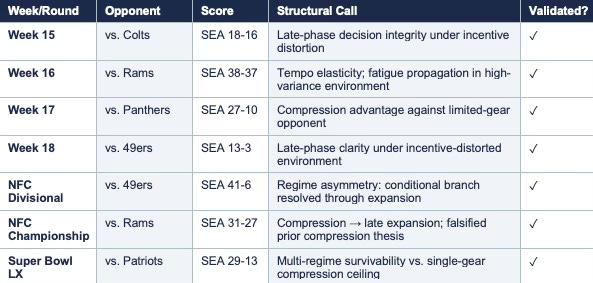
Seven-for-seven on the winner makes the headline. Seven-for-seven on the structural mechanism makes the validation. Each simulation declared its thesis before kickoff, specified what would prove the thesis wrong, and allowed reality to adjudicate. No post-hoc adjustment touched any publication.
IV. The Three-Simulation Comparison — MindCast vs. Madden vs. SBR
Before Super Bowl kickoff, MindCast AI published a comparative analysis framing the prediction not as a contest of scores but as a contest of worldviews: three AI systems, three theories of how football works, one game to adjudicate. (See: Three AIs Walk Into Super Bowl LX.) Madden modeled football as physics with randomness. (See: Madden NFL 26 Simulation.) SBR modeled football as narrative plausibility. (See: SBR AI Prediction.) MindCast modeled football as cognition under stress. Post-game results scored each simulation against reality on structural accuracy, not directional accuracy alone.
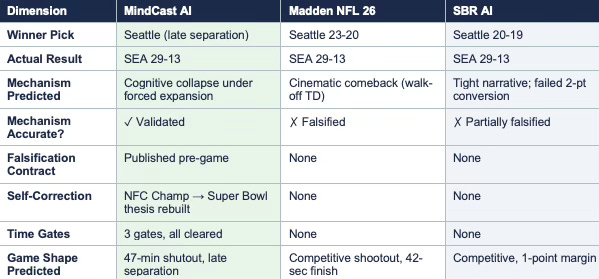
Madden projected a cinematic comeback with a walk-off touchdown and assigned pass-rush pressure to the wrong quarterback (5 Darnold sacks predicted; reality: 1 Darnold sack, 6 Maye sacks). SBR projected competitive symmetry through four quarters and an 87.5% Darnold completion rate; reality delivered 50% completion because the system chose ground-game compression rather than passing efficiency. MindCast predicted the mechanism — which system survives under stress — and published the conditions under which that prediction would fail. No condition was triggered.
V. Methodology Validation Across Contexts — Football as Proof Environment
NFL season validation does not prove MindCast AI excels at football. Football serves as the testbed, not the product. Validation proves Cognitive Digital Twin architecture reliably identifies how decision-making systems behave under stress — when structural control compounds, when it collapses, and what observable conditions distinguish a system operating within capacity from one that has exceeded its processing ceiling.
CDT methodology that modeled Drake Maye’s processing ceiling under Mike Macdonald’s disguise-heavy defensive scheme applies directly to every institutional stress test MindCast AI operates in: antitrust enforcement where firms maneuver across forums, complex litigation where procedural pressure forces institutional consolidation, state-federal regulatory collisions where jurisdiction itself is contested, and national innovation infrastructure where physics constraints dictate capability timelines. One governing question persists: is compression a choice or a ceiling? Can the system shift gears when conditions demand deviation from its preferred operating mode, or has the institution optimized so completely for one regime that no alternative remains available?
Football answered that question seven times in succession. But football was not the first domain to validate the architecture. Before the 2025 NFL season began, CDT methodology had already produced confirmed predictions in antitrust litigation, complex commercial litigation, export control enforcement, AI infrastructure technology, and federal energy regulation. The NFL season represents the most publicly observable validation. The cross-domain portfolio carries the greatest structural significance.
Cross-Domain Validation Portfolio
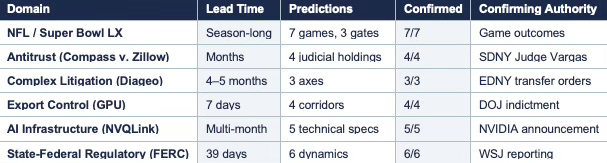
Aggregate: 29 discrete predictions across six domains, 29 independently confirmed. One architecture. No unconfirmed structural predictions.
Antitrust Litigation — Compass v. Zillow (SDNY, Feb. 6, 2026)
MindCast AI published a series of analyses predicting Compass’s antitrust claims against Zillow would fail at the level of legal coherence rather than factual contingency. (See: Compass PI Denial Validation; HB 2512 Hearing Analysis.) CDT identified four structural failure modes: the co-conspirator theory would collapse under the Monsanto/Matsushita requirement to exclude independent action; the monopoly power claim would fail because market indicators (low switching costs, multi-homing, well-capitalized entry) precluded a finding of durable dominance; Zillow’s Listing Access Standards would be characterized as platform governance rather than exclusionary conduct; and Compass’s incompatible positions across federal litigation, state legislatures, and consumer marketing would produce a self-inflicted injury finding.
On February 6, 2026, Judge Vargas denied Compass’s preliminary injunction and adopted each structural conclusion independently. The court classified LAS as governance, rejected the conspiracy theory under Monsanto/Matsushita, found the claimed injury de minimis and self-inflicted (48 removed listings out of 429,111), and declined to infer monopoly power. By declining to reach irreparable harm, the court signaled Compass’s theory failed at the level of structural logic — not factual sufficiency. Four predictions, four confirmed holdings, one independent court. Washington State’s legislative record on HB 2512 functioned as a validation node within the prediction chain: Compass’s testimony advancing a consumer-autonomy theory of private listings in Olympia structurally contradicted the competitive-harm theory advanced in SDNY, and the CDT framework identified that cross-forum incoherence as a failure mode months before the court reached the same conclusion through adversarial process.
Complex Litigation — Diageo Tequila Cases (EDNY, Dec. 2025)
Between May and July 2025, MindCast AI published three foresight analyses and amicus briefs modeling how courts, defendants, and plaintiffs’ counsel would behave when scientific uncertainty intersected with regulatory certification and multi-forum pressure in the Diageo tequila litigation. (See: Diageo Litigation Validation.) CDT predicted consolidation via the first-to-file rule, deployment of regulatory-shield defenses, and procedural neutralization of RICO escalation.
Between December 18 and December 23, 2025, all three parallel cases (EDNY, NDCA, SDFL) transferred and consolidated into the Eastern District of New York within a four-day window. Diageo’s motion-to-dismiss briefing adopted the regulatory-shield posture exactly as modeled. RICO escalation operated as procedural pressure rather than merits-driven differentiation — precisely as the CDT framework predicted. Three independent analytical axes — procedural, substantive, and strategic — each validated within four to five months of publication.
Export Control Enforcement — GPU Transshipment (DOJ, Nov. 2025)
On November 14, 2025, MindCast AI published an analysis identifying Malaysia and Thailand as high-probability transshipment corridors where AI chips would undergo administrative identity transformation before reaching China. (See: GPU Export Pathways Analysis.) CDT modeled the evasion architecture using Causal Signal Integrity scoring, producing a CSI of 0.031 — a supply chain engineered for opacity rather than convenience.
Seven days later, the Department of Justice unsealed indictments confirming those precise pathways: four individuals charged with routing approximately 400 NVIDIA A100 GPUs through Malaysian and Thai shell companies using falsified declarations, document repackaging, and multi-layered intermediaries. All four corridor and mechanism predictions held. Concurrent reporting revealed a parallel remote-access vector through Indonesian data centers during the same week, validating the multi-vector capability laundering thesis and demonstrating CDT’s applicability to national security enforcement intelligence.
National Innovation Infrastructure — NVIDIA NVQLink (Oct. 2025)
In October 2025, MindCast AI published a foresight trilogy modeling quantum-AI data center coupling requirements for national innovation infrastructure. (See: NVQLink Validation.) CDT derived five testable technical specifications from physics constraints, capital flow analysis, and policy momentum: sub-5 microsecond interconnect latency, 300+ Gb/s throughput, coordination among 6–8 U.S. national laboratories, support for 12–15 quantum processor vendors, and network-level orchestration architecture rather than physical co-location.
On October 28, 2025, NVIDIA announced NVQLink. Published specifications matched or exceeded every prediction: sub-4 microsecond latency, 400 Gb/s throughput, eight national laboratory partners, seventeen quantum processor vendors, and fiber-connected network architecture. Five of five technical metrics validated, with multi-month lead time. The validation confirmed not individual numbers in isolation but the entire causal model linking physics constraints to national innovation infrastructure requirements — demonstrating CDT’s capacity to derive technology specifications from structural inevitability rather than insider access.
State-Federal Regulatory Power — FERC / AI Data Centers (WSJ, Dec. 2025)
On November 16, 2025, MindCast AI published a foresight simulation modeling the institutional response trajectory triggered by the Department of Energy’s Section 403 “Large Loads” directive. (See: FERC / AI Data Center Collision.) CDT predicted that when hyperscale AI load growth outpaced state-level processing capacity and collided with interstate transmission constraints, federal acceleration and state resistance would emerge as structurally inevitable responses — not political choices but institutional reflexes dictated by jurisdictional architecture.
Thirty-nine days later, the Wall Street Journal reported the exact institutional collision predicted: state regulators invoking the Federal Power Act, litigation warnings from former FERC officials, Florida advancing consumer-protection legislation against data center cost-shifting, and explicit federal AI preemption posture. Six of six institutional dynamics confirmed or actively materializing within the predicted timeframe. Forward checkpoints with falsification conditions now extend through 2028, tracking whether state-federal regulatory power dynamics follow the structural trajectory or deviate through legislative intervention.
Methodological Significance
No other AI prediction framework in any domain has produced a comparable trail of pre-committed, falsifiable, structurally validated predictions across comparable range. The cross-domain portfolio demonstrates CDT methodology operates at a level of abstraction transcending any single application: the architecture that identifies a quarterback’s processing ceiling under disguised coverage also identifies a regulatory agency’s enforcement ceiling under political pressure, a litigation adversary’s structural incoherence across forums, a national innovation technology’s necessary specifications from physics-first modeling, and a state-federal power collision’s inevitable trajectory from jurisdictional architecture.
VI. Self-Correction Under Falsification — The NFC Championship Thesis Evolution
A prediction system that never updates cannot maintain accuracy. A system that updates without admitting falsification lacks predictive integrity. MindCast AI treats adaptation under falsification as evidence of rigor, not weakness. The NFC Championship provides the cleanest exhibit of that principle in the 2025–2026 validation record.
NFC Championship simulation classified Seattle as a compression-dominant system — winning by narrowing variance against a Rams offense optimized for tempo. (See: NFC Championship Simulation.) Rams game falsified that classification. When the fourth quarter destabilized, Seattle did not retreat into compression. Seattle expanded: pressing tempo, attacking space, accepting volatility, scoring 31 points. Prior thesis proved wrong.
Super Bowl simulation explicitly acknowledged the falsification and rebuilt the framework around a new baseline: multi-regime survivability. Seattle was not a compression team. Seattle was a team capable of operating in either compression or expansion mode without system breakdown. MindCast documented, timestamped, and published the adaptation before the Super Bowl. Neither Madden nor SBR attempted comparable self-correction, because neither framework carries a mechanism for admitting structural error.
Progression from “compression advantage” to “multi-regime survivability” captures the methodological story of the season. Each simulation refined the CDT’s understanding of Seattle’s structural identity. By the Super Bowl, the model had survived stress-testing against its own failures and rebuilt on what endured. The result was the most structurally accurate prediction in the seven-game series — not despite the earlier error, but because of the transparent correction it forced.
VII. MindCast Cognitive Digital Twin → Institutional Analysis Bridge — Football Proves the Architecture
Cognitive Digital Twin methodology does not model football. CDT models how organizations process information, adapt to constraint, and fail under stress — drawing on institutional economics frameworks including Nash-Stigler Equilibriaand Regulatory Capture Geometry. Football provides the ideal validation environment because games produce observable, falsifiable outcomes on a compressed timeline with no ability to influence results. Antitrust enforcement, complex litigation, state-federal regulatory power, and national innovation infrastructure represent the application environments — institutions facing identical structural questions under higher stakes and longer timelines.
Distinction between proof environment and application environment rests not on kind but on runtime geometry: the temporal and informational conditions under which identical structural dynamics play out. Football runs in fast-time geometry — symmetric rules, continuous feedback, 60-minute resolution. Litigation runs in slow-time geometry — asymmetric information, delayed enforcement, months-to-years resolution. Regulatory capture runs in drift-time geometry — incremental institutional erosion visible only at crisis points. CDT models the governing structure persisting across all three.
A four-layer architecture proposed in Super Bowl post-game analysis formalizes the bridge. Layer 1 (Structural Governance) supplies the CDT framework identifying why systems break. Layer 2 (Physics Resolution) resolves individual interactions within structural constraints. Layer 3 (Narrative Coherence) generates realistic output sequences. Layer 4 (Adversarial Integrity) stress-tests the thesis against counter-conditions in real time. Football validated Layers 1 and 4 directly. The falsification contract represents the embryonic form of the adversarial integrity layer. The time gates with live recalibration represent the working prototype.
Cross-domain validation maps each layer to confirmed institutional outcomes. Compass v. Zillow validated Layer 1 — structural governance — by confirming CDT correctly identified why Compass’s litigation posture would break: cross-forum incoherence between federal court, state legislature, and consumer marketing produced a self-inflicted injury finding that no tactical pivot could repair. Diageo consolidation validated Layer 1 through a different mechanism: institutional behavior under multi-forum pressure resolves through procedural convergence before factual adjudication begins.
GPU export control validation confirmed Layer 4 — adversarial integrity — by demonstrating CDT architecture can model evasion systems, not merely legitimate institutional actors. Causal Signal Integrity scoring identified Malaysia/Thailand transshipment corridors seven days before DOJ enforcement confirmed them. NVQLink validation confirmed Layer 2 — physics resolution — by deriving national innovation infrastructure specifications from first-principle physics constraints months before the manufacturer announced them. FERC validation confirmed Layers 1 and 4 simultaneously: structural governance (institutional collision became inevitable once load crossed the federal threshold) and adversarial integrity (falsification checkpoints set in November 2025 remain on schedule through 2028).
Red Team Vision — the dynamic falsification engine formalizing Layer 4 — charts the forward product development path. Applied to antitrust enforcement: does the DOJ’s enforcement posture reflect strategic choice or institutional ceiling? The Compass ruling already answered a version of that question — Compass’s litigation posture was a ceiling, not a choice, because institutional incoherence across forums precluded adaptation. Applied to state-federal regulatory power: can FERC adapt its framework when AI data center demand forces deviation from legacy energy regulation, or has the agency optimized for a regime that no longer exists? The FERC validation shows collision materializing on the predicted timeline. Applied to export control and national security: does the entity’s compliance behavior under new semiconductor restrictions reflect genuine adaptation or performative compression destined to collapse under sustained pressure? The GPU validation demonstrated evasion architectures produce CSI signatures detectable before enforcement acts.
Every one of those questions mirrors the structural question Super Bowl LX resolved: can the Patriots shift gears when game state demands it, or has the institution optimized so completely for one mode that no other mode remains available? The Super Bowl answered the football version. The Compass ruling answered the antitrust version. The FERC collision answered the state-federal regulatory power version. The DOJ indictment answered the national security version. The NVQLink announcement answered the national innovation version. MindCast AI’s institutional analysis practice answers each version using one architecture, now validated across 29 predictions in six domains with zero structural misses.
VIII. What Would Have Falsified the Model — The Epistemic Contract
A model earns credibility by specifying how it could fail. MindCast AI published explicit falsification conditions before Super Bowl LX and committed to live recalibration after each quarter. Absence of falsification carries weight here not as rhetoric but as empirical boundary — each condition was bounded by observable game states and time-based thresholds. Documenting what did not happen matters as much as documenting what did, because the falsification contract draws the line between validated architecture and survivorship bias.
Darnold losing legibility symmetrically — completion rate below 50% combined with two or more interceptions — would have falsified the model. Darnold finished at exactly 50% completion with zero interceptions; completion rate touched the threshold but zero turnovers confirmed the system chose ground-game compression rather than losing quarterback processing. New England demonstrating acceleration grammar — two or more scoring drives under three minutes while the game remained competitive — would have falsified the model. New England’s two touchdowns came trailing 19-0 and 29-7, both in garbage time after Terminal Resolution; neither met the threshold. Multiple early turnovers forcing Seattle to abandon spacing (turnover differential of negative two or worse by halftime) would have falsified the model; Seattle committed zero turnovers for the entire game. New England leading by 10 or more at halftime with at least one scoring drive under three minutes would have weakened the model; New England trailed 0-9 at halftime with zero points through two full quarters.
Every falsification condition was designed for real-time observability, testability against the published threshold, and independence from post-game reinterpretation. No condition triggered. Falsification contract functions as the embryonic form of what the four-layer architecture designates Layer 4 — Adversarial Integrity: a static, pre-committed contract published before kickoff. Red Team Vision extends the concept into dynamic adversarial pressure — live counter-predictions forcing the structural thesis to defend itself against emerging data throughout the event. Identical epistemic contract logic applies across all MindCast AI domains. In the Compass v. Zillow analysis, the falsification condition required the court to find Compass’s positions coherent across forums for the cross-forum incoherence thesis to fail. In GPU export analysis, DOJ enforcement targeting different corridors than those identified would have invalidated the transshipment model. Each contract preceded the adjudicating event. No condition triggered.
Epistemic contracts define the boundary separating validated prediction from fortunate coincidence. MindCast AI publishes those contracts before every forecast — in football, in litigation, in regulatory analysis, and in national innovation infrastructure — because architecture that cannot specify its own failure conditions has not earned the right to claim validation.
Appendix — Citation Sources
All predictions were published before the events they forecast. Timestamps are verifiable on the Substack platform.
NFL Season Publications
Super Bowl LX — AI Simulation vs. Reality (post-game): https://www.mindcast-ai.com/p/seahawks-superbowllx
Super Bowl LX — Pre-Game Simulation: https://www.mindcast-ai.com/p/super-bowl-lx
Three AIs Walk Into Super Bowl LX (comparative): https://www.mindcast-ai.com/p/superbowllx-ai-simulation-matrix
Betting AI vs. Foresight AI (methodology foundation): https://www.mindcast-ai.com/p/bettingforesightai
NFC Championship — Seahawks vs. Rams: https://www.mindcast-ai.com/p/seahawks-rams-2026-nfc-championship
NFC Divisional — Seahawks vs. 49ers: https://www.mindcast-ai.com/p/seahawks-49ers-2026-nfc-divisional
Week 18 — Seahawks vs. 49ers: https://www.mindcast-ai.com/p/week18-hawks-49ers
Week 17 — Seahawks vs. Panthers: https://www.mindcast-ai.com/p/week17-hawks-panthers
Week 16 — Seahawks vs. Rams: https://www.mindcast-ai.com/p/week16-hawks-rams
Week 15 — Seahawks vs. Colts: https://www.mindcast-ai.com/p/wk15-hawks-colts
Antitrust Litigation — Compass v. Zillow (SDNY)
Judicial Deconstruction of Compass’s Narrative Arbitrage: https://www.mindcast-ai.com/p/impact-compass-prelim-injunction-denial-zillow
How Compass’s State Testimony Undermined Federal Claims: https://www.mindcast-ai.com/p/compass-state-leglislature-failure
Compass Co-Conspirator Theory Collapse: https://www.mindcast-ai.com/p/compass-coconspirator-theory-collapse
Compass Astroturf Coefficient at WA Senate: https://www.mindcast-ai.com/p/jan23-wa-senate-housing-committee
Compass v. Zillow (Early Platform-Conflict Framing): https://www.mindcast-ai.com/p/compasszillow
Zillow’s Response and Platform Governance Logic: https://www.mindcast-ai.com/p/zillowreply
State Power vs. Compass Private Exclusives: https://www.mindcast-ai.com/p/compass-competitive-state-driven-federalism
HB 2512 and the Collapse of Compass’s Coordinated Opposition: https://www.mindcast-ai.com/p/jan28-hb2512-hearing
Institutional Economics Frameworks
Nash-Stigler Equilibria: https://www.mindcast-ai.com/p/nash-stigler-equilibria
Antitrust Regulatory Capture Geometry: https://www.mindcast-ai.com/p/antitrust-regulatory-capture-geometry
Complex Litigation — Diageo Tequila Cases (EDNY)
Foresight on Trial, The Diageo Litigation Validation: https://www.mindcast-ai.com/p/diageo-consolidated
Amicus Brief — Systematic Procedural Gaming (EDNY): https://www.mindcast-ai.com/p/diageoamicus
Evidence Before Allegation (pre-litigation simulation): https://www.mindcast-ai.com/p/diaego
Export Control / National Security — GPU Enforcement
Foresight Analysis in Illegal GPU Export Pathways: https://www.mindcast-ai.com/p/dojchinachips
Aerospace’s Warning to AI — Capability Laundering: https://www.mindcast-ai.com/p/aiaerospacelessons
H200 China Policy Validation: https://www.mindcast-ai.com/p/h200-china-validation
AI Infrastructure Technology — NVIDIA NVQLink
NVIDIA NVQLink Validation (FSIM III): https://www.mindcast-ai.com/p/mcainvqlink
The Quantum-Coupled AI Data Center Campus (FSIM I): https://www.mindcast-ai.com/p/quantumaidatacenters
The Physics Nobel Prize That Became an Asset Class (FSIM II): https://www.mindcast-ai.com/p/nobelquantumaidatacenters
Federal Energy Regulation — FERC / AI Data Centers
The Federal-State AI Infrastructure Collision: https://www.mindcast-ai.com/p/ferc-ai-dcs
AI Computing Is Now Federal Infrastructure: https://www.mindcast-ai.com/p/doeai
External Simulation Sources (NFL)
Madden NFL 26 Official Simulation (EA Sports): https://www.ea.com/news/ea-predicts-super-bowl-lx
SportsBook Review AI Prediction: https://www.sportsbookreview.com/picks/nfl/super-bowl-ai-prediction-seahawks-vs-patriots-2026/