Companion to Predictive Game Theory Simulations Through War Gaming, The Calculus of Predictive Game Theory Evolution and Mutation and the running War Gaming Visualization file.
Every MindCast war game is indexed at MindCast Live Fire Intelligence.
Executive Summary
A war gaming board answers one question before anyone moves: which seat still holds in every state the next event can create. Readers who can map three to five successor states, see which way each one travels, name the horizon they are in and tell evolution from mutation make better commitments than readers who forecast one outcome. Every published MindCast board teaches those four moves, and the grammar is the same on every board.
MindCast AI applies Predictive Behavioral Economics + Dynamic Game Theory through MindCast AI Proprietary Cognitive Digital Twin Foresight Simulations (MP CDT FS). Behavioral Economics supplies each seat’s decision rules. Game Theory supplies the payoff structure and the moment the structure changes. Every opponent on a MindCast board is a Cognitive Digital Twin of a real organization rather than a role player.
The guide teaches the four reading moves on one board a reader already understands: a coffee shop raising its latte 10% before the rival’s menu meeting. Six boards carry the lesson, and the prose only names what each board shows. All odds in the guide are teaching values rounded to tens and are not MindCast Foresight Simulation Predictions.
🏛 Policymakers. A new rule is a mutation for everyone inside the game it rewrites. Board 2 shows what happens to every forecast built before the rule, and why firms stop trusting bands that survive a rule change on paper.
💼 Executives. Boards 1 and 3 show when a decision matters less than it feels. If every branch converges, commit; if one branch diverges, buy the next fork before committing past it.
⚖ Counsel. Board 4 sorts a matter by whether a dated event can replace the game inside the client’s decision window. The depth of any advice follows that sort, not the subject.
📊 Investors. Board 5 reads any published MindCast board. A position that holds in every state needs no deeper forecast, and a position that loses in one state is an option rather than a path.
Takeaway. Find the diamond or lane, count the cards, read the strip.
I. The Board Shows Where Each Seat Lands Before Anyone Moves
A war gaming board compresses one contest into a single picture. The trunk on the left names the game as it stands today. The diamond names the mover and the dated event that forks the game, and a lane names a second mover on its own clock. Each card to the right is a successor state, carrying one band and one color.
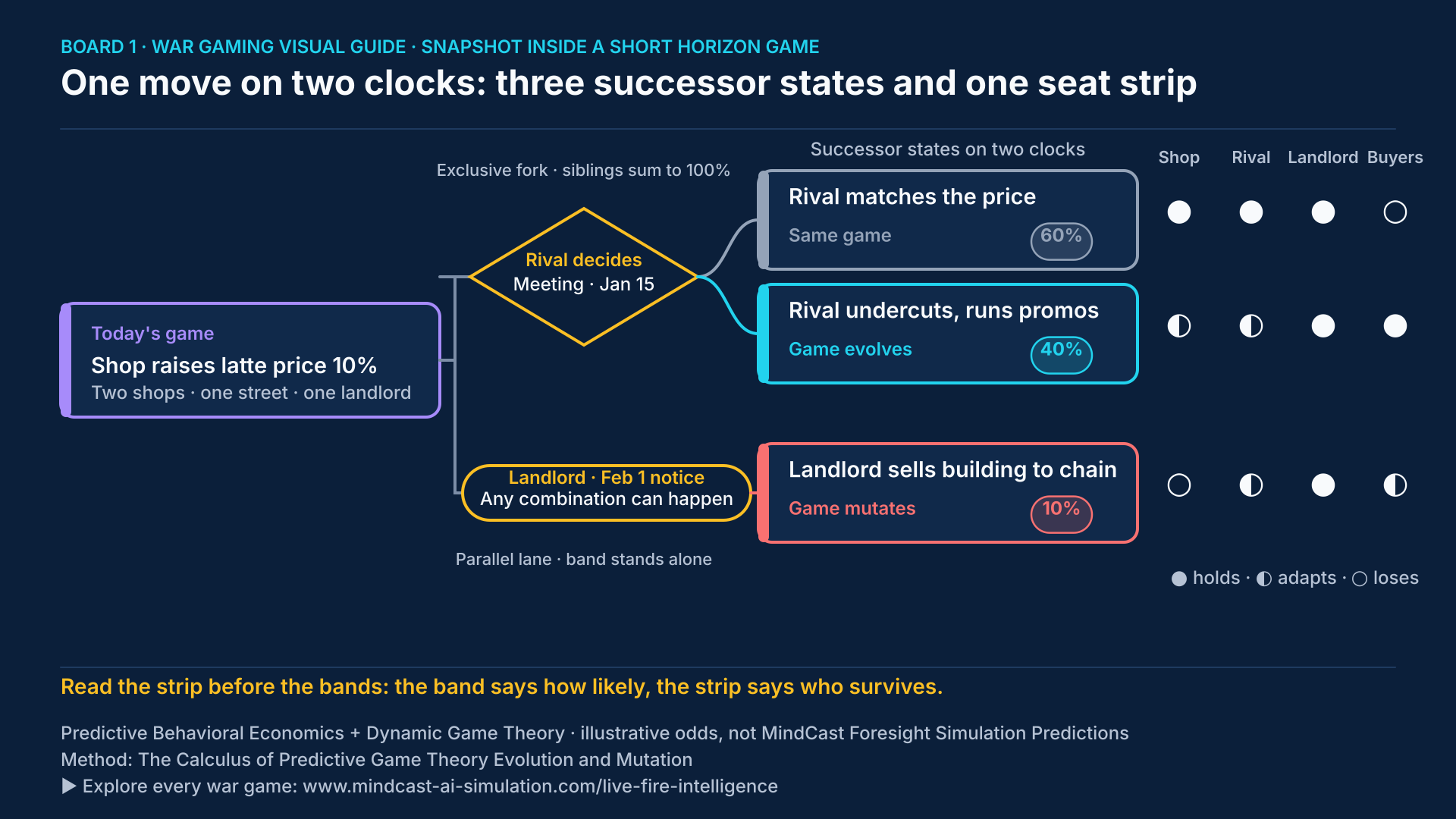
Board 1. One move on two clocks: three successor states and one seat strip (illustrative).
The coffee shop board starts with one move: your shop raises the latte 10% ahead of the rival’s menu meeting on January 15. The rival matches or the rival undercuts and runs promotions, and those two cards are exclusive siblings whose bands sum to 100%. A third state arrives on a different clock: on February 1 the landlord can give notice that the building is sold to a coffee chain. The landlord’s lane runs in parallel with the rival’s fork, any combination can happen, and its band stands alone.
The seat strip beside the cards does the work. A filled circle means the seat holds its position in that state, a half circle means the seat adapts, and an open circle means the seat loses. Your shop holds in one state, adapts in one and loses in one, and the rival adapts in the sale state because the chain becomes its landlord too. The board already says where the risk sits.
Takeaway. Read the strip before the bands: the band says how likely a state is, and the strip says whether you survive it.
II. A Successor State Keeps the Rules and a Successor Game Rewrites Them
Card color encodes the kind of change, and the kind of change sets the instruction for every forecast already in hand. Gray marks a successor state inside the same game: the players, rules and payoffs hold and only positions move. Cyan marks game evolution, where the same players face new moves or new payoffs through a mechanism the analyst can name. Red marks game mutation, where a player with authority over the rules enters or leaves and the operative model has to be rebuilt.
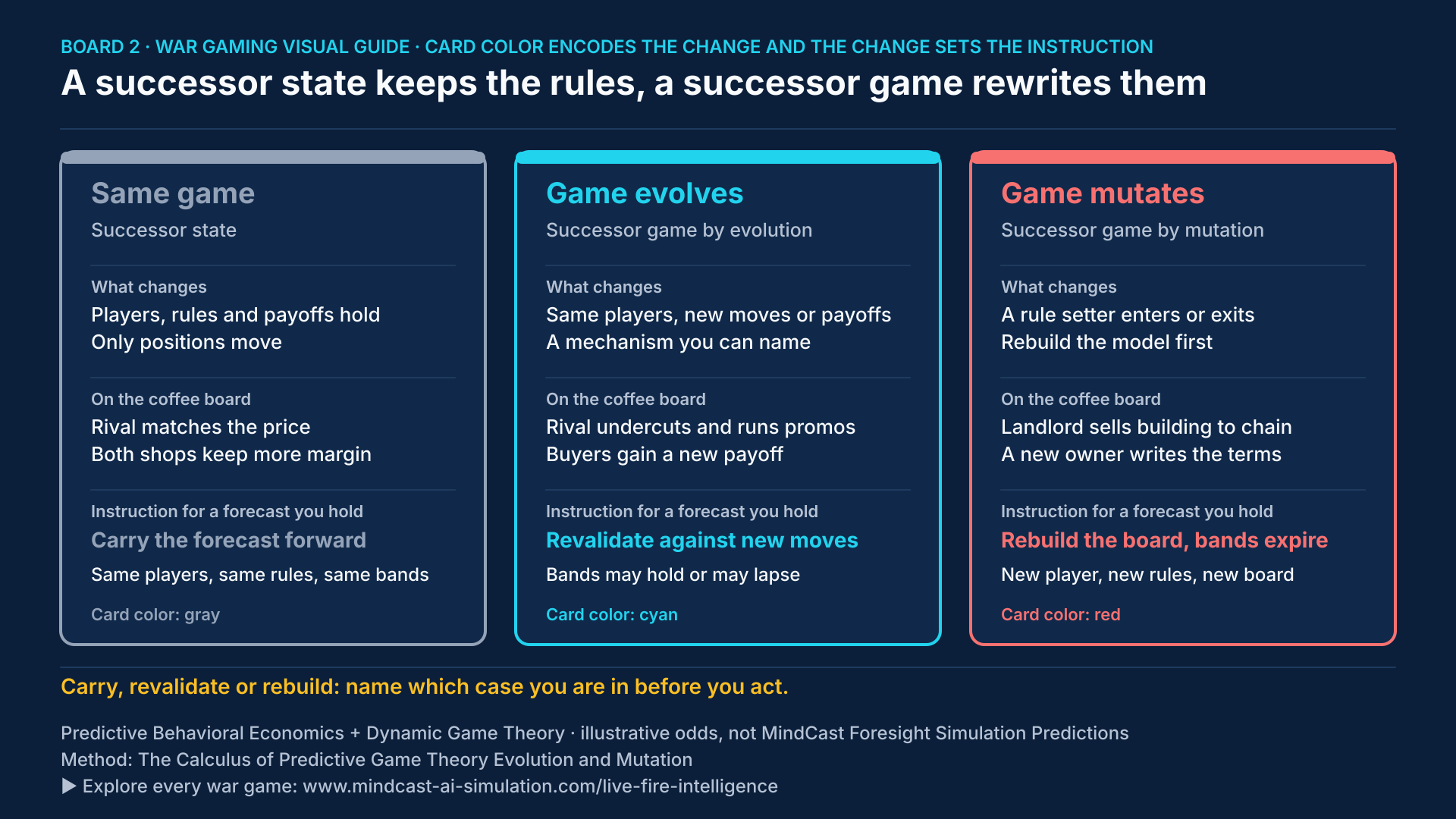
Board 2. Card color encodes the change, and the change sets the instruction.
The coffee board shows all three. A matched price is the same game with more margin. A promo war evolves the game, because the rival adds moves and the buyers gain a new payoff. A sale of the building to a coffee chain mutates the game, because a new owner enters with authority over both leases and the model has to be rebuilt around it.
Each color carries one instruction. When the equilibrium holds, the forecast carries forward unchanged. When the game evolves, the forecast is revalidated against the new moves and may keep its band or lose it. When the game mutates, the forecast expires and a new board is built from the new players.
The coffee owner holds a forecast on January 14 that puts a match at 60%. If the rival matches on January 15, the owner carries every downstream plan forward. If the rival undercuts, the owner revalidates the March 1 lease plan against a promo war. If the landlord gives notice of the sale on February 1, every forecast on the board expires, because the game the forecast described no longer exists.
Mutation is the narrow category. A surprise alone does not establish it, and an abrupt event can still be ordinary evolution. Most readers treat all three cases as the forecast being wrong. The board separates them, and the separation is where the decision value sits.
Takeaway. Gray says carry, cyan says revalidate, red says rebuild.
III. Direction of Travel Separates Branches That Converge From Branches That Diverge
Every successor state has its own successors, and the second layer shows which way each branch travels. A converging branch returns to a state the board already knows. A diverging branch opens paths the other branches never reach.
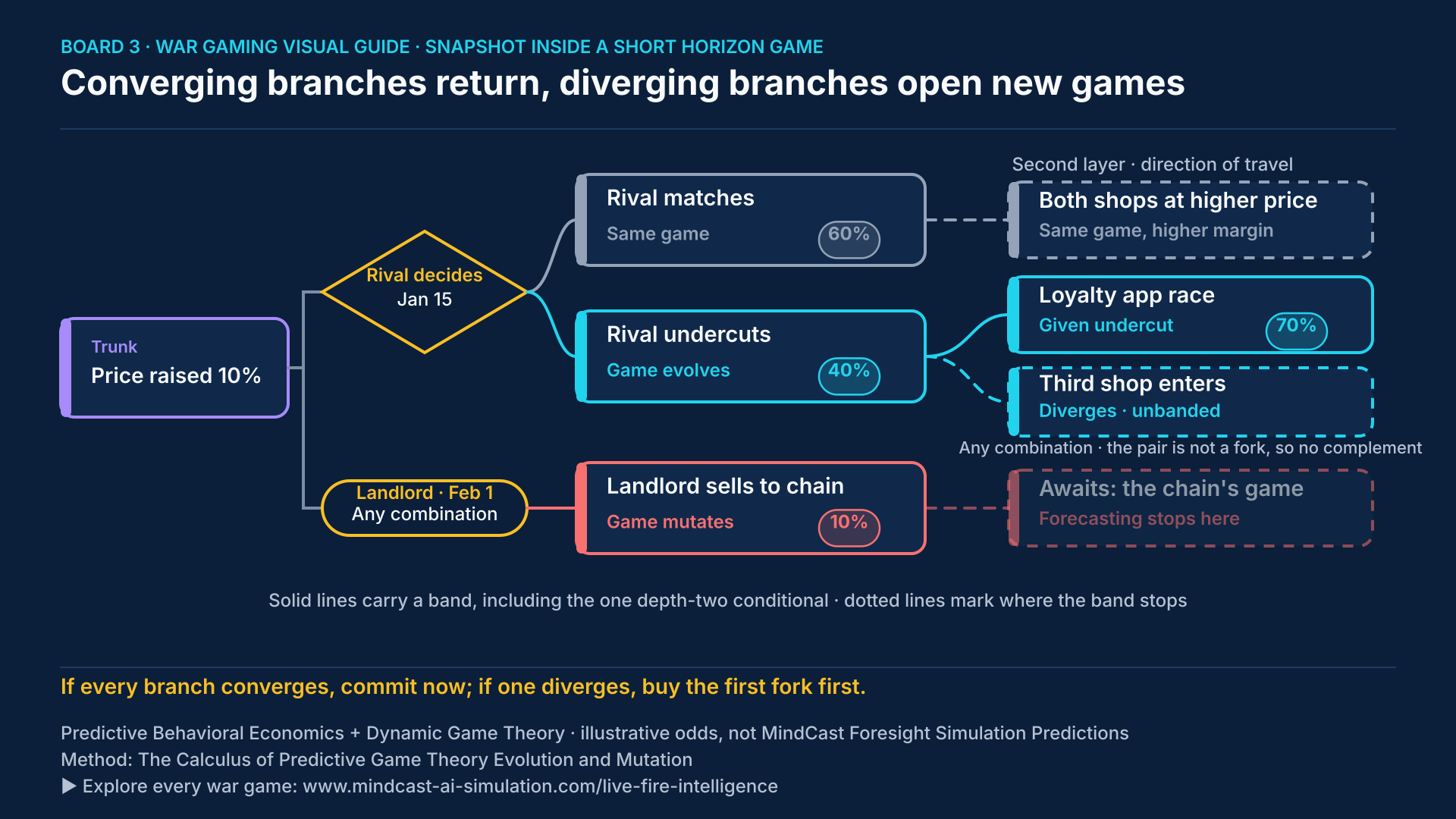
Board 3. The second layer shows which way each state travels.
On the coffee board the matching branch converges: both shops end at the higher price and the game stays the same with more margin. The promo branch diverges, and because the rival is a named actor whose undercut defines the next game, the loyalty app race carries a depth-two conditional of 70% given undercut. The third shop entering stays unbanded, and the sale branch fades because forecasting stops until the chain’s game forms.
Direction of travel tells a reader when a decision matters. If every branch converges, the choice matters less than it feels and the reader should commit. If one branch diverges, the reader should buy information at the first fork before committing past it.
Takeaway. Convergence says commit now; divergence says buy the first fork first.
IV. Three Horizons Decide How Far a Band Can Reach
A board states which horizon it sits in, and the horizon sets how deep the bands go. A snapshot prints odds in tens at the current fork, because no equilibrium has settled and finer precision would be false. A short horizon game is one where a dated event can replace the game inside the reader’s decision window. A long horizon game is one where the rules, participant responses and transition mechanisms hold through the window.
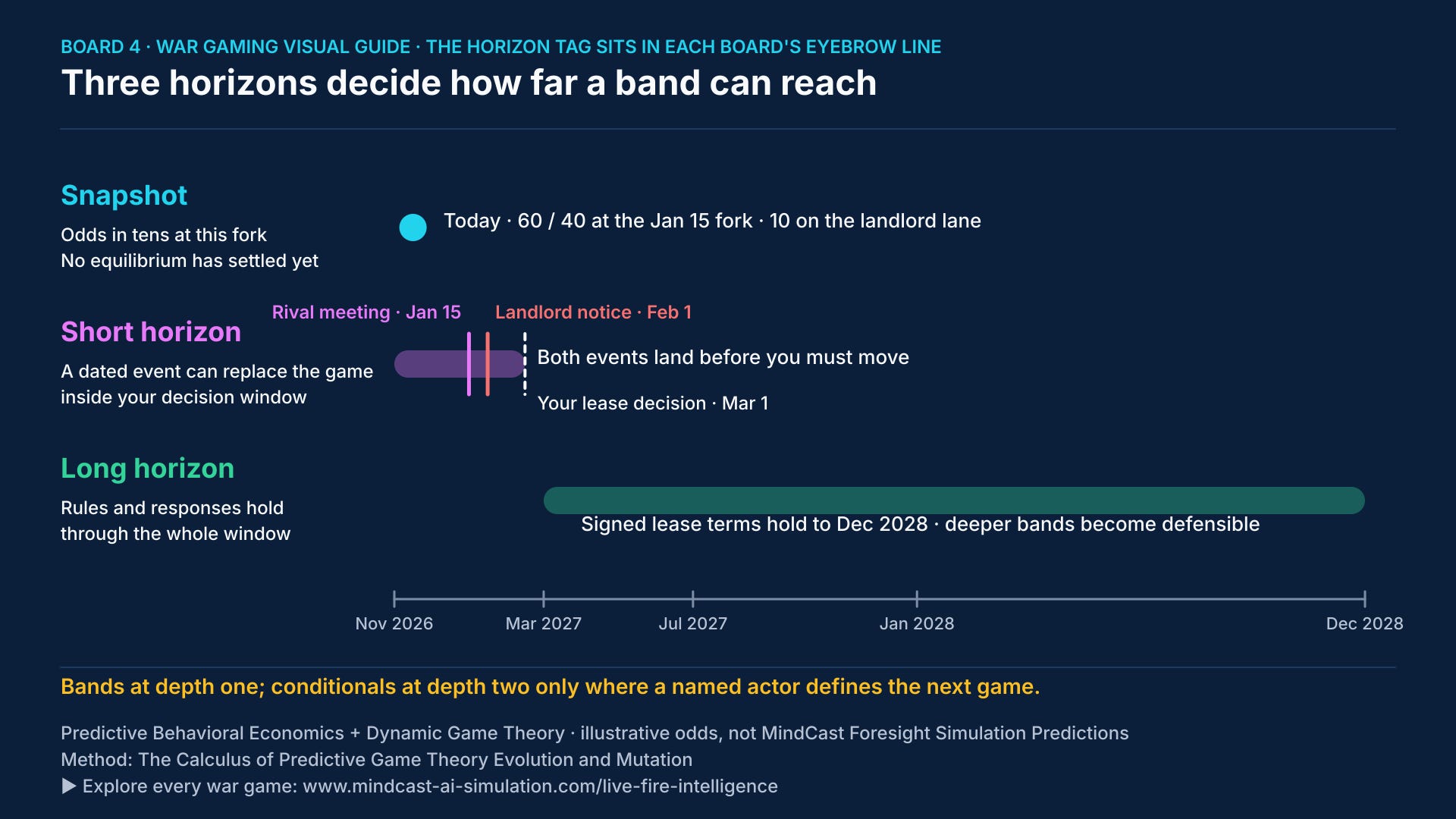
Board 4. The horizon tag sits in each board’s eyebrow line.
The coffee board is a snapshot inside a short horizon game. The rival’s meeting on January 15 and the landlord’s notice window on February 1 both land before your lease decision on March 1, so either event can replace the game before you move. The lease terms themselves run to 2028, so the lease layer becomes a long horizon game once the renewal signs.
The horizon belongs to a decision and a branch rather than to a subject. One contest can hold a snapshot, a short horizon branch and a long horizon branch at the same time, and the eyebrow line of each game board names the horizon it sits in.
Takeaway. Bands at depth one, conditionals at depth two only where a named actor defines the next game, and no band where forecasting stops.
V. Reading Any MindCast Board
Every published MindCast board uses the same grammar, so a reader who can read the coffee board can read the OpenAI liability board or the AI chip export enforcement board. The trunk sits left, and the diamond names the mover and date while a lane names a second mover on its own clock. Cards carry one band each, color encodes the change type, and solid lines carry bands while dotted lines mark where forecasting stops. On a game board the eyebrow line names the horizon.
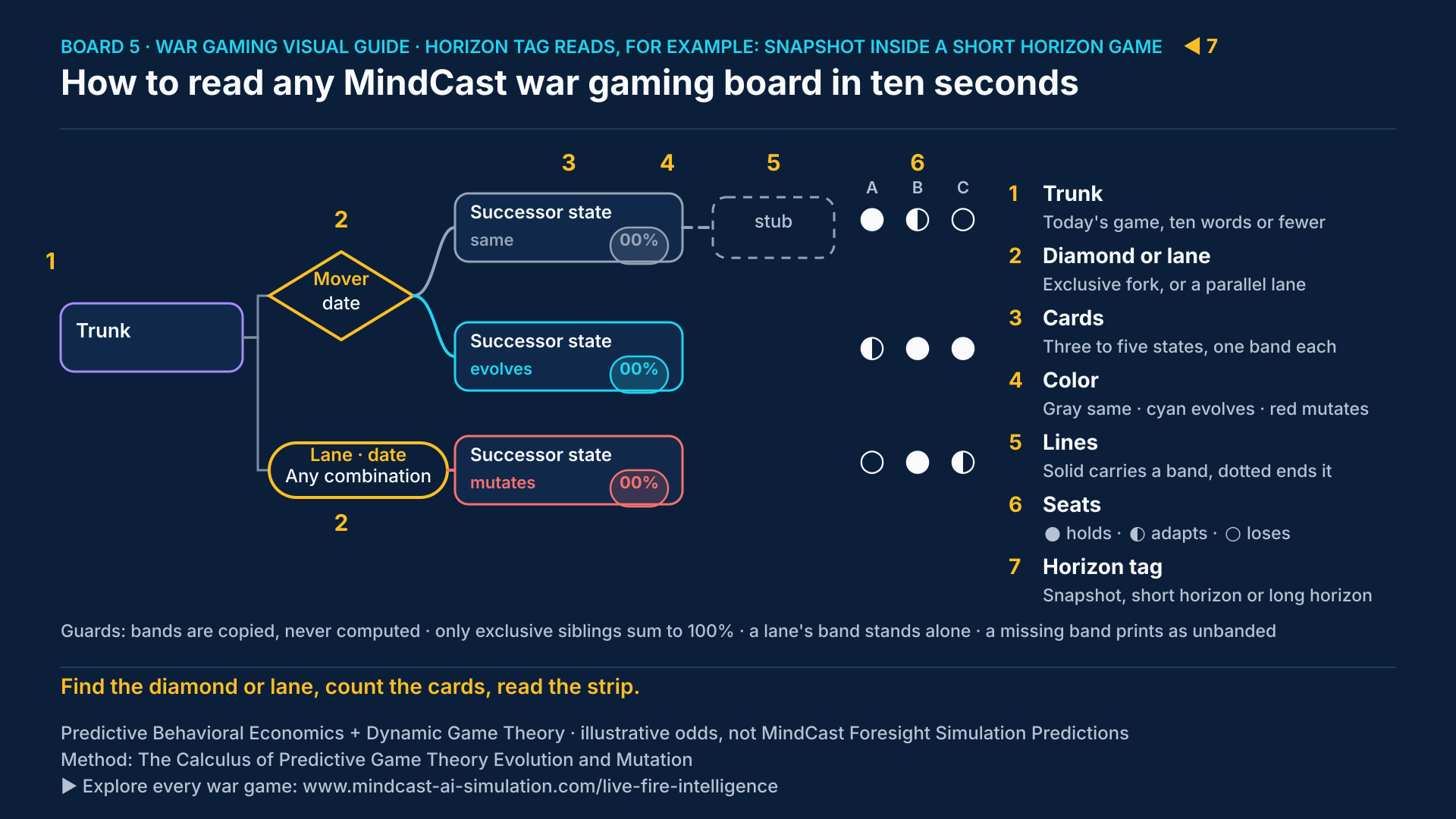
Board 5. The same grammar on every published board.
Four guards protect the reader. Bands are copied from the published war gaming run and never computed from one another, so no card shows a complement or a sum. Sibling cards at an exclusive fork sum to 100% and carry equal visual weight, while a lane’s band stands alone. A missing band prints as unbanded or awaits, never as an estimate.
Takeaway. Ten seconds is enough: find the diamond or lane, count the cards, read the strip.
VI. Four Features Make a Contest a Board
Four features make a contest drawable, and the same four make it forecastable. The first two are a dated decision window and a bounded set of named actors with public records across venues. The second two are a visible and moving reference point for each actor and at least one scheduled event that can replace the game for everyone. A contest with all four fits a board, and a contest missing the fourth produces a landscape read with no bands.
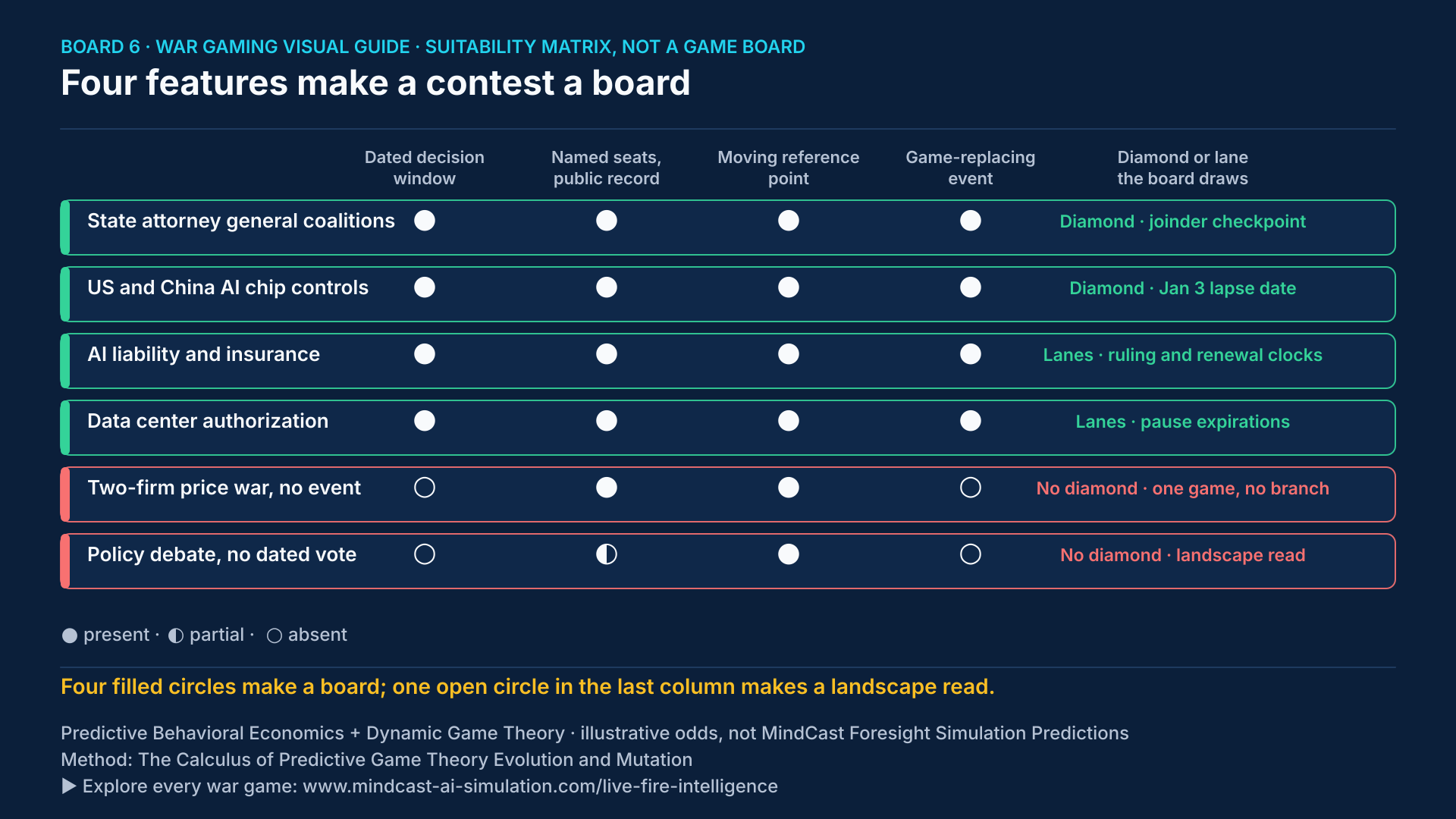
Board 6. A suitability matrix, not a game board.
MindCast’s published boards show the test passing in different fields. State attorney general coalitions carry joinder deadlines, named offices and a bridge state whose filing moves every other office’s reference point. US and China AI chip controls carry a lapse date, named agencies and firms, and a Congress or Commerce action that rewrites the rules for the whole channel. AI liability and insurance run on ruling and renewal clocks, and data center authorization runs on pause expirations and tariff dockets.
The failing rows teach as much as the passing ones. A two-firm price war with no scheduled event stays one game, so the board never branches. A policy debate with no dated vote has no diamond, so the analysis stays a landscape read however many actors it names.
Takeaway. Date, named seats, moving reference points and one game-replacing event: a contest with all four is a board waiting to be drawn.
Working With MindCast
MindCast AI is a Predictive Game Theory Modeling-Simulation firm. MindCast builds Cognitive Digital Twins of the named actors on a client’s board and models how the game evolves through its next forks.
What MindCast can do
Cognitive Digital Twin builds of counterparties, regulators and courts, plus carriers and coalitions. Each is calibrated from public conduct and the client’s own decision history.
Strategy and Risk Simulation Snapshots for short horizon matters: odds in tens at the current fork, conditional downstream paths, and strategy and risk per path within five business days.
Foresight Simulations for stabilizing matters: published bands at depth two and three, P10/P50/P90 ranges, complete scenario trees and organization-specific calibration.
Interactive war gaming that lets a client’s team play its own moves against modeled opponents across dated forks.
War gaming boards for a client’s own contest, drawn to the standard in this guide, with a seat strip for every party at the table.
When an engagement adds the most
A decision depends on which game governs the next step, and the best move differs across candidate games.
A team disagrees about a counterparty’s next move, and a shared board would turn the argument into a question about one branch.
An irreversible commitment falls due before a dated ruling, vote or deadline resolves.
How engagements begin. A complimentary Snapshot runs on publicly available information. Private engagements proceed after a nondisclosure agreement and retainer, starting with a diagnostic session on one live decision.
Contact: mcai@mindcast-ai.com · Corporate site: www.mindcast-ai-simulation.com · All war gaming: www.mindcast-ai-simulation.com/live-fire-intelligence
Appendix A. Selected MindCast Works
Frameworks and methods
Predictive Game Theory Simulations Through War Gaming. Defines the war gaming product, the seat groups and the labels that carry odds.
The Calculus of Predictive Game Theory Evolution and Mutation. Supplies the horizon definitions, the evolution and mutation distinction and the five fork questions.
Predictive Game Theory Evolution and Mutation — Short Horizon Games Branch Wide and Resolve Shallow. Source of the depth-one, depth-two, depth-three band discipline.
Predictive Game Theory Evolution and Mutation — Long Horizon Games Resolve Deep Because Their Branches Hold. Source of the stabilization condition and false stability signals.
Dynamic Predictive Game Theory: From Nash Equilibrium to Adaptive Coherence Equilibrium. Supplies equilibrium selection and delay dominance.
How Mozart Predicts Game Mutation in Predictive Behavioral Economics + Dynamic Game Theory. Frames when a change crosses the operative threshold.
Visuals and war gaming
MindCast Live Fire Intelligence. Corporate index of every MindCast war game; the footer of each board in this guide points here.
War Gaming Visualization. Running file of every published MindCast war gaming board, each linked to its interactive module.
States vs OpenAI Interactive War Gaming. The published board the coffee example mirrors in structure.