
FinCEN · Office of the Comptroller of the Currency · Bank of America · Peer U.S. banks · Local governments · State utility regulators · Utilities · Data center developers · State legislatures
MindCast AI Vision Statement · November 2, 2026 · Noel Le, Founder and Architect
Series: The Calculus of Predictive Game Theory Evolution and Mutation · Predictive Game Theory Evolution and Mutation — Short Horizon Games Branch Wide and Resolve Shallow. Worked cases: Bank of America $1.2 Billion Money Laundering Penalty and the Compliance System That Knew Too Much and AI Data Center Moratoriums Are Forecastable, and They End in Pricing Rules, Not Bans.
Visit MindCast Corporate and Prediction Scorecard.
I. Executive Summary: A Stable Game Buys Depth Without Narrowing
The long horizon begins when the transitions behind each downstream fork become dependable within a decision window. Long horizon games resolve deep because their branches hold: fewer actors hold live moves that can rewrite the game, so continuation mechanisms become easier to specify even when the first layer stays wide. The governing insight follows directly.
Stabilization extends the forecast without creating the initial strategic value. As a game stabilizes, waiting can become costlier than commitment when the remaining value of information falls below delay and preemption costs.
The newshook shows a stable game at work. U.S. regulators imposed more than $1.2 billion in penalties on Bank of America on October 13, 2026, and the bank admitted to willfully violating the Bank Secrecy Act. The order applies an existing reckless-disregard standard rather than creating a new duty, so the open question concerns how far and how fast the enforcement method spreads to peer banks.
MindCast AI applies Predictive Behavioral Economics + Dynamic Game Theory through MindCast AI Proprietary Cognitive Digital Twin Foresight Simulations (MP CDT FS). Behavioral Economics supplies the decision rules. Game Theory supplies the payoff structure. Predictive simulations emerge from the combination.
The MindCast Prediction Scorecard dated October 31, 2026 shows 38 hits and 5 misses on resolved material calls, an 88% success rate with 6 partials set aside.
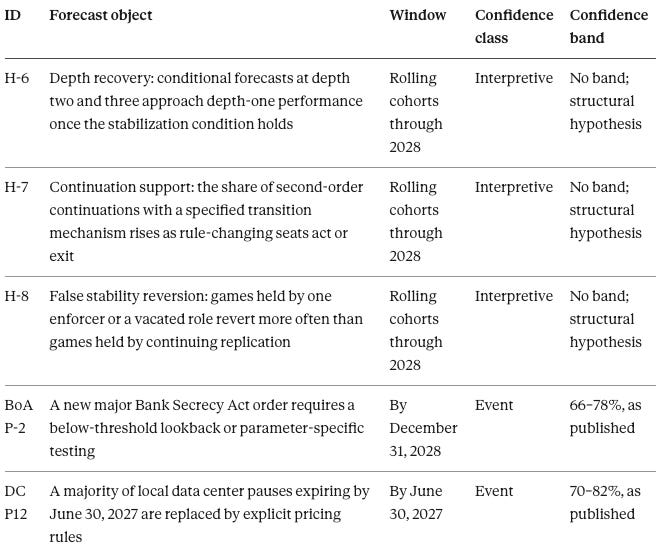
The installment is a Vision Statement. The figures below are structural hypotheses (H) and published MindCast forecasts quoted as source annotations; the installment issues no new odds.
Stakeholder readout.
🏛 Policymakers. States that publish large-load tariff, water and community terms early set the reference point later states must match (DC P10, DC P12). Publish terms before the 2027 sessions close. A commissioned run on a state’s own siting pipeline fits once a pause nears expiration without replacement terms.
💼 Executives. Peer banks holding validation files that show a gap and no response now carry enforcement exposure (BoA P-1, H-6). Fund validated review capacity and write the stabilization evidence into decision triggers. A commitment-timing run earns its cost before any multi-year capacity or siting commitment, because the stable game now supports that depth.
⚖ Counsel. A stable game can still revert when one enforcer carries the persistence or a role sits vacant (H-8). Test every claimed stability for the three false-stability signals before giving long-dated advice. A false-stability review fits when a client’s position depends on one regulator’s continued enforcement.
📊 Investors. Joint path probabilities become valuable once each conditional rests on a supported transition (H-6, DC P12). Value long-dated positions as paths with tipping signals as written exit conditions. The June 30, 2027 date for DC P12 triggers reassessment, and the observed result sets its direction. A Foresight Simulation with published bands fits after a positive resolution, provided each project carries supported local authorization terms.
The stable case supports commitment where evidence of stabilization clears an organization’s threshold, while the emerging case still calls for staged moves. Reversal signals stay live in both.
Takeaway. Stabilization buys depth without necessarily narrowing breadth, and the depth makes conditional forecasting defensible.
II. Bank of America Enforcement Is Stable and Data Center Authorization Is Stabilizing
Two cases sit at different stages of stabilization. Bank of America enforcement applies a fixed standard, and data center authorization shows a path still forming across jurisdictions.
II.A A $1.2 Billion Penalty Applied an Unchanged Standard
Bank of America anti-money laundering enforcement sits in a stable game: the Financial Crimes Enforcement Network (FinCEN) assessed a $1.2 billion penalty, and the Office of the Comptroller of the Currency (OCC) imposed $750 million credited toward it. The legal standard did not change, and the forecastable object is the propagation of an enforcement method.
AI data center authorization sits in emerging stabilization. Local pauses spread across counties during 2026, and states substituted their own instruments. The decisive gate then migrated from land use to utility, water and environmental dockets.
The filings, penalties and published bands are facts. The classification of each game as stable or emerging is a hypothesis this installment frames and tests through observable signals.
II.B The Question Is How Deep a Forecast Reaches Once the Game Holds
The installment answers one question: once a game stabilizes, how deep can a forecast responsibly reach, and which risks remain? The target systems are Bank Secrecy Act enforcement against U.S. banks and data center authorization across U.S. states. The horizon runs from November 2026 through December 31, 2028.
Outside scope: the merits of Bank of America’s remediation, and authorization regimes outside the United States.
II.C Incumbents Keep Short Horizon Habits After the Game Stabilizes
Behavioral Economics explains why stable games still produce misses. Incumbents who lived through a short horizon game keep its decision rules after the game stabilizes: they hold options they no longer need and delay commitments the path rewards. Salience runs the other way at peer banks, where a historic penalty raises the perceived probability of examination and pulls capacity investment forward.
II.D Stabilization Is a Bounded Condition on a Decision Window
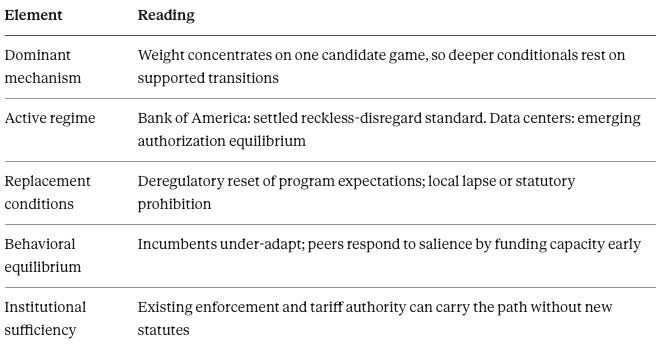
Dynamic Game Theory explains why depth becomes available. A path probability is a weighted sum across the games that might govern the next step: the chance each candidate game exists times the chance of the path inside it. Stabilization shows as weight concentrating on one candidate game, so the path probability rests mainly on a single conditional term.
P(path at fork k | history) = Σ over candidate games G  [ P(game at fork k is G | history) × P(path | G, history) ]

Stabilizing:  P(game at fork k is G* | history) high within the decision window
              →  P(path at fork k | history) ≈ P(path | G*, history)
The series introduction, The Calculus of Predictive Game Theory Evolution and Mutation, develops the full calculus.
A game moves toward the long horizon when one bounded condition holds: the relevant rules, participant responses and transition mechanisms remain sufficiently dependable within the specified decision window. The condition does not require synchronized clocks, a permanently fixed population, exhausted rule-changing authority or a uniquely selected equilibrium. Stability is always relative to a window and a question.
Four kinds of evidence support the condition, and their weight varies by case.
Operative durability. A binding decision, effective rule or enforceable agreement has crossed the operative threshold, and reversing it requires a formal process.
Propagation. Independent actors reuse the change on their own payoffs. Replication supplies evidence that a change may spread, while durability rests on whether the arrangement governs later choices.
Subsiding response waves. Stakeholders exit, enter or take up vacated roles, and the waves subside.
Boundable payoffs. The payoffs that decide the next fork have moved from the unknowable column into the known or discoverable columns.
Forecast survival turns the condition into a usable horizon per branch: the latest date at which a branch’s assumptions still survive above a stated threshold. A forecast survives a rule change it already represents, so only changes that invalidate its assumptions count against it.
II.E Seven Actor Classes Span Enforcement and Authorization
Seven actor classes become Cognitive Digital Twins across the two worked cases. Each carries an objective, the constraints that bound it, and the trigger that makes it update.
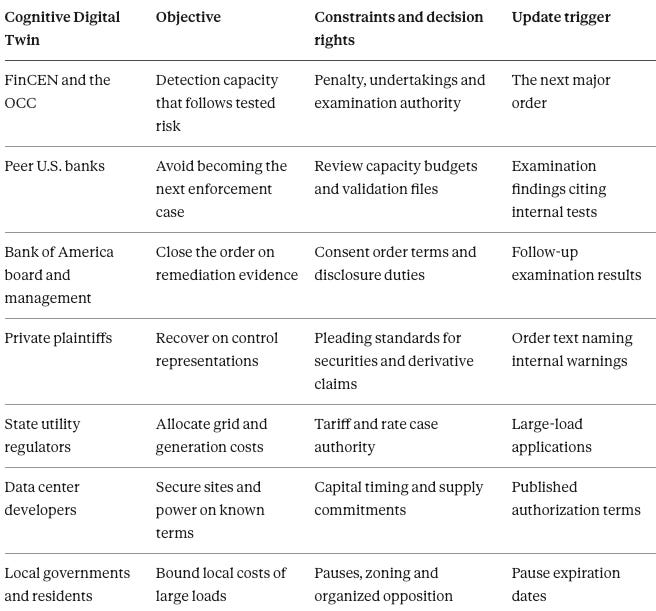
Two causal hypotheses frame the analysis alongside a null route. The propagation hypothesis holds that a fixed standard spreads as peers and regulators reuse its method. The reversal hypothesis holds that a deregulatory reset or a lapse of pauses reopens the game. The null route holds that each case stays confined to its originating matter.
The analysis maps the stable game and its successor states, measures how close a stable-looking equilibrium sits to a tipping point, reads the data center gate migration and integrates the results. Branch re-formation analysis reads whether response waves have subsided. Continuations the installment adds appear as unbanded links, because specifying a mechanism differs from estimating its probability.
The two cases show the stabilization condition at two stages. Bank of America already carries operative durability and boundable payoffs. Data center authorization carries propagation underway with durability still open.
Stakeholder callouts.
💼 Executives. Compliance leaders at peer banks face a game whose rules no longer move, so the question becomes timing rather than direction. Set the capacity decision against the next budget cycle rather than the next ruling.
🏛 Policymakers. Utility regulators now hold the gate the data center path migrated to. Tariff terms filed now shape which jurisdictions capital reaches first.
Takeaway. The two worked cases qualify because one holds a fixed standard and the other shows a path in formation, which lets the installment observe the stabilization condition at two stages.
III. Stable Trees Carry Specified Mechanisms Beneath Wide Channels
The stable and emerging trees quote published forecasts as source annotations and add unbanded continuations specified by mechanism. Set beside the agentic liability tree in Predictive Game Theory Evolution and Mutation — Short Horizon Games Branch Wide and Resolve Shallow, they show that width does not separate the horizons; supported continuations do.
Sources for the Quoted Bands
Hypothesis date: November 2, 2026. Data cutoff: November 2, 2026. Sources: the published Bank of America and data center authorization analyses for every quoted band.
Weight Concentrates on One Candidate Game
Bank of America: Four Channels With Specified Continuations
The Bank of America tree quotes forecasts already published in the worked case as source annotations. The four channels are concurrent and can resolve on separate clocks.
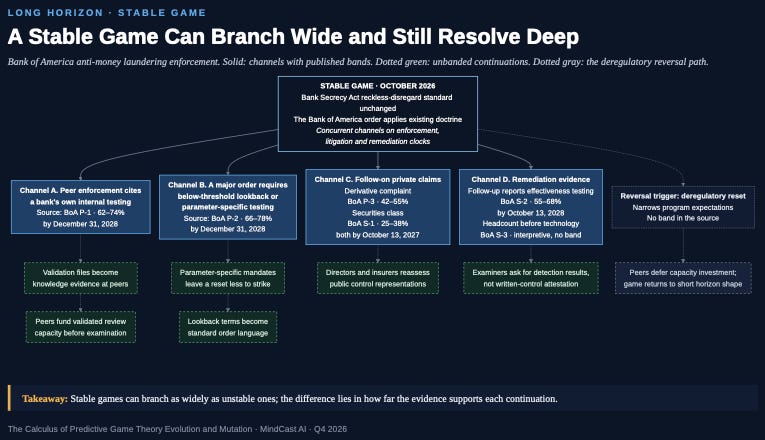
Figure 1. The long horizon tree for Bank of America anti-money laundering enforcement: a stable game with concurrent channels
STABLE GAME · October 2026
Bank Secrecy Act reckless-disregard standard unchanged; the order applies existing doctrine
Concurrent channels on enforcement, litigation and remediation clocks
│
├─ Channel A. Peer enforcement cites a bank's own internal testing
│     Source annotation: BoA P-1, 62–74% by December 31, 2028
│     └┄ Validation files become knowledge evidence at peers
│           ┄ Peers fund validated review capacity before examination
│
├─ Channel B. A major order requires below-threshold lookback or parameter-specific testing
│     Source annotation: BoA P-2, 66–78% by December 31, 2028
│     └┄ Parameter-specific mandates leave a reset less to strike
│           ┄ Lookback terms become standard order language
│
├─ Channel C. Follow-on private claims
│     Source annotations: BoA P-3 derivative complaint, 42–55%;
│     BoA S-1 securities class, 25–38%; both by October 13, 2027
│     └┄ Directors and insurers reassess public control representations
│
├─ Channel D. Remediation evidence
│     Source annotations: BoA S-2 follow-up reports effectiveness testing,
│     55–68% by October 13, 2028; BoA S-3 headcount before technology, interpretive
│     └┄ Examiners ask for detection results, not written-control attestation
│
└┄ Reversal trigger: a deregulatory reset narrows program expectations
      No band in the source
      ┄ Peers defer capacity investment and the game returns to short horizon shape

Solid lines: channels with source annotations. Dotted lines (┄): conceptual
continuations the companion adds, specified by mechanism and carrying no band.
The stable tree carries four channels, as wide as the four-channel agentic liability tree in the short horizon installment, yet specified mechanisms sit at depth two and three beneath its leading channels. Each continuation names a known instrument held by a known actor in a known forum: an examination finding, an order undertaking, a pleading. The source assigns no weights to its four scenarios, so the reversal trigger appears without a band.
Data Center Authorization: A Path Still Forming
AI data center authorization illustrates emerging stabilization rather than a completed crossing. The source describes its bands as model-derived foresight judgments, not calibrated frequencies. Each quoted forecast stands on its own as published.
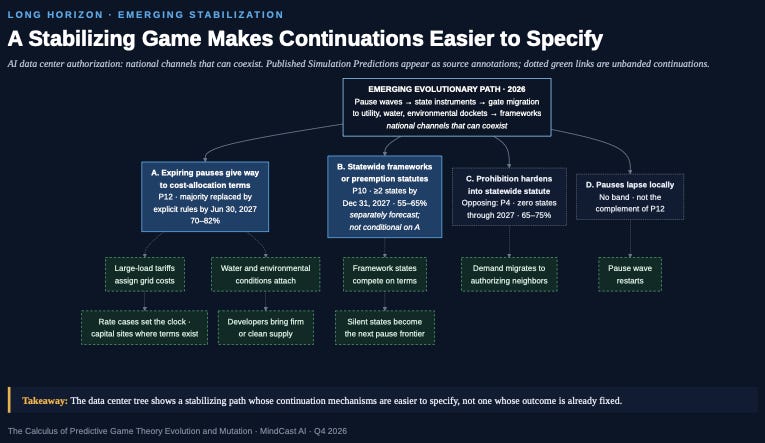
Figure 2. The emerging long horizon tree for AI data center authorization: coexisting channels, source annotations and unbanded continuations
EMERGING EVOLUTIONARY PATH · 2026
Local pause waves → state instrument substitution → gate migration to utility,
water and environmental dockets → framework formation
Channels are national aggregates and can coexist across jurisdictions
│
├─ Channel A. Expiring local pauses give way to explicit cost-allocation terms
│     Source annotation: DC P12, a majority of local pauses expiring by
│     June 30, 2027 are replaced by explicit pricing rules, 70–82%
│     ├┄ Large-load tariffs assign grid and generation costs to the data center
│     │     ┄ Rate cases set the clock and capital sites where terms are published
│     └┄ Water and environmental conditions attach as authorization terms
│           ┄ Developers bring firm or clean supply to meet the condition
│
├─ Channel B. States convert study bodies or moratorium windows into statewide
│     frameworks or preemption statutes bounding local authority
│     Source annotation: DC P10, at least two states by December 31, 2027, 55–65%
│     Separately forecast; not conditional on Channel A
│     └┄ Framework states compete on terms and silent states become the next pause frontier
│
├─ Channel C. Prohibition hardens into a statewide statute
│     Opposing source annotation: DC P4, zero states enact a statewide land-use
│     moratorium by statute through 2027 adjournments, 65–75%
│     └┄ Bans hold locally and demand migrates to authorizing neighbors
│
└─ Channel D. Pauses lapse locally and the prior permissive regime returns
      No band. Not the complement of DC P12, because lapse in some jurisdictions
      can coexist with replacement terms in others.
      └┄ Project pressure recreates salience and the pause wave restarts
The published model runs five stages from silence and salience through institutional disequilibrium and material intervention to a new authorization equilibrium. Hill County and San Marcos in Texas reused moves first seen elsewhere, as did Executive Order No. 62 in New York. Cle Elum in Washington and the Hillsboro and Salem pauses in Oregon followed the same pattern.
Recurrence across independent jurisdictions is evidence that the pause wave is propagating as a path. Durability remains open until replacement terms govern later siting choices. The separate published structural call DC SR1 holds that the wave resolves into cost-allocation terms rather than prohibition, with a band of 70–80%, and DC P12 serves as its observable test.
Width Does Not Separate the Horizons; Supported Continuations Do
Setting the agentic liability tree, with bands at depth one and unsupported doctrinal continuations below, beside the two long horizon trees illustrates the tendency at the core of the calculus. Stable games can branch as widely as unstable ones; the difference lies in how far the evidence supports each continuation.
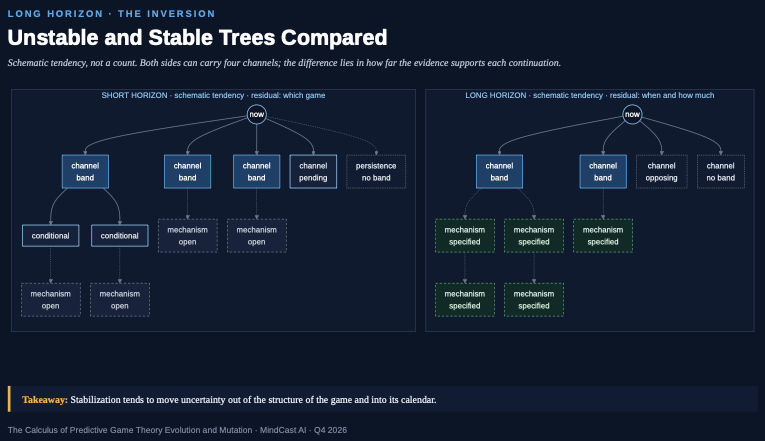
Figure 3. Tree shapes compared across horizons: a schematic tendency, not a count
A joint path probability is a chain of conditionals, each given the history before it. In the short horizon the later links rest on weights without support. As a game stabilizes, each link rests on a supported transition, so the product describes a path the evidence can defend.
Valuation adds a second form. Short horizon positions are best valued as options that pay on several candidate games. Stabilizing games add path valuation, and long-dated capital such as a data center campus becomes easier to defend once its path can be valued as well.
Much of the residual uncertainty migrates from the structure of the game into its timing and size. Rate case calendars, examination cycles and session deadlines become decisive variables, and Cognitive Digital Twins model each actor’s clock and loop speed.
Stability Can Be Self-Confirming
The long horizon is a state the game can leave. Chicago’s Randal Picker Was Simulating Law and Economics Before AInames the diagnostic. An institution can look resilient because actors keep repeating incumbent behavior and past interventions produced no visible response, even when those interventions landed short of the threshold at which the population tips.
Repeated behavior can make a game look stable because nobody has tested the alternatives. Low uncertainty in beliefs therefore does not by itself establish a dependable horizon; the analysis must ask which branches rest on observed play and which rest on untested beliefs about opponents. The theory supplies a test for peer banks that have not yet faced an examination citing internal tests, not evidence that any particular bank holds such beliefs.
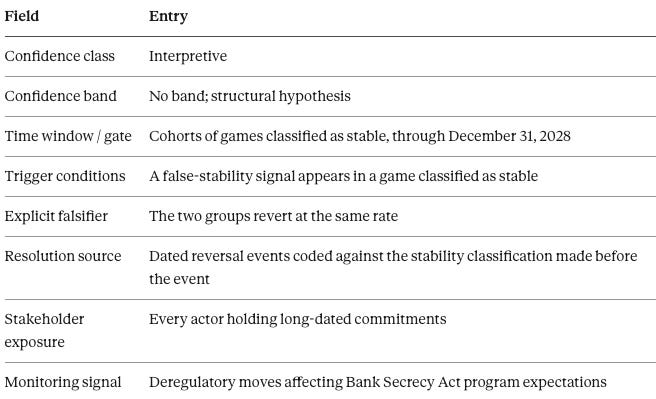
Three signals separate real stability from false stability. Real stability shows replication continuing as new jurisdictions or firms adopt the path’s terms without prompting. False stability shows persistence sustained by one actor’s continued enforcement, a stated position that diverges from what the actor’s payoffs support, or a role that one holder fills with no ready successor.
Each signal triggers reassessment rather than automatic reclassification, because dependence on one enforcer or a succession gap does not by itself establish instability. Shorten the forecast horizon when a signal materially undermines a downstream transition. The Bank of America deregulatory reset and the data center local lapse are the named reversal paths in the two worked cases.
III.A Three Primary Hypotheses Test Depth Recovery, Continuation Support and Reversion
H-6 | Depth recovery once the stabilization condition holds
Statement: Where the stabilization condition holds, cohorts of conditional forecasts at depth two and three approach depth-one calibration and depth-one Brier-rule accuracy.
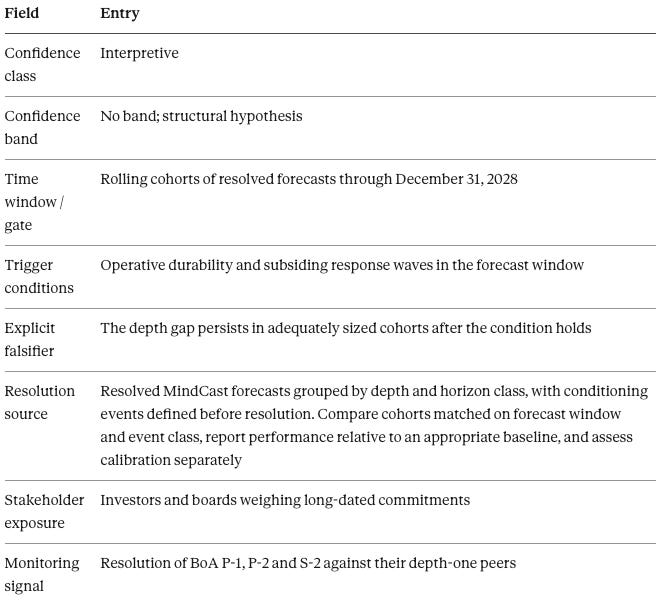
H-7 | Continuation support rises as rule-changing seats act
Statement: As rule-changing seats act or exit, the share of second-order continuations with a specified transition mechanism rises.
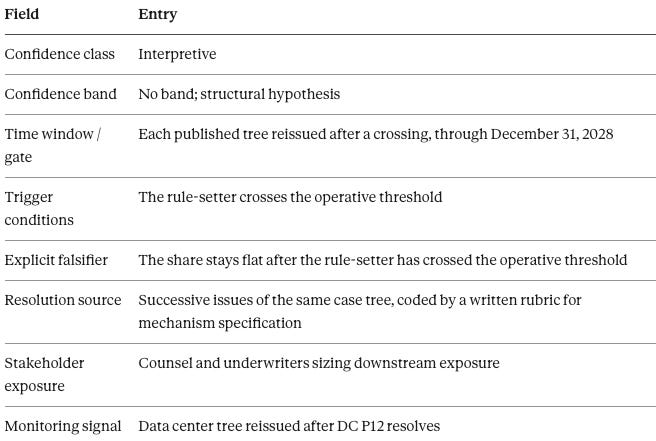
H-8 | False stability reversion
Statement: Games that persist through one actor’s enforcement or through a vacated role with no successor revert to short horizon shape more often than games that persist through continuing replication.
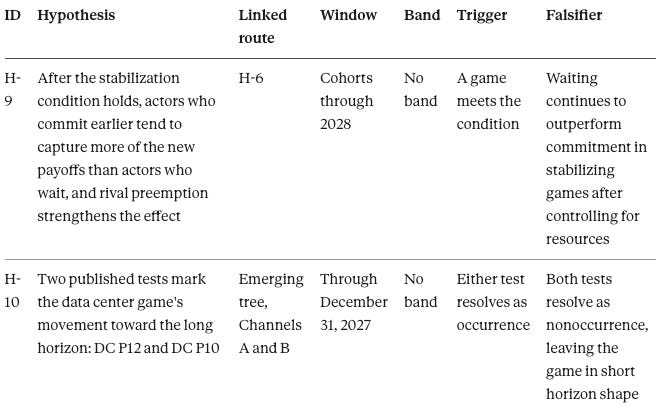
III.B Two Secondary Hypotheses Test Commitment and the Data Center Crossing
III.C The Reset Trigger and Local Lapse Stay Unbanded
The Bank of America reversal trigger carries no band because the source assigns none. Data center Channel D stays unbanded until a source supplies joint information across jurisdictions. BoA S-3 stays interpretive and resolves against its published rubric.
III.D Rules-Based Monitoring Limits the Link to AI
The Bank of America analysis rests on a rules-based monitoring system, so its link to AI-driven monitoring rests on mechanism similarity. The data center channels are national aggregates and can mask divergent local paths. A deregulatory reset or a statutory prohibition wave would shift weight between modeled routes without falsifying H-6 to H-8.
The trees show depth arriving through specified mechanisms rather than through narrower branching. Bank of America carries four channels and continuations beneath each, the data center tree carries them beneath its leading channel, and false stability names the conditions under which either tree reopens.
Stakeholder callouts.
⚖ Counsel. Directors facing derivative exposure under BoA P-3 should treat the order’s internal warnings as the evidence plaintiffs will cite. Document board responses before October 13, 2027.
📊 Investors. A positive DC P12 resolution would strengthen the evidence for path valuation. Each project still requires supported local authorization terms and continuation assumptions. Positions in silent jurisdictions carry the reversal path the tree marks.
🏛 Policymakers. Examination programs that test alternative branches reveal whether peer-bank stability is real or self-confirming. The first peer order citing internal testing is the moment to ask that question.
Takeaway. The stable tree carries specified mechanisms at every depth beneath its channels, the emerging tree carries them beneath its leading channel, and the hypotheses state what would prove the pattern wrong.
Commissioned Runs Test When One Organization Should Commit
Published analysis cannot tell a peer bank, utility or developer when its own evidence of stabilization clears its commitment threshold. The answer depends on that organization’s capital timing, its examination exposure and the reversal paths it can tolerate.
A commissioned engagement builds Cognitive Digital Twins of the organization, its regulators and its counterparties from its own decision history. MindCast then runs the stable game forward against the organization’s actual options, with false-stability signals wired in as exit conditions.
A commissioned run adds MindCast’s commitment-timing calculation on the organization’s own inputs. Complete scenario trees, P10/P50/P90 ranges and reversal triggers feed a dashboard keyed to each channel.
The bounded next step is a diagnostic session on one long-dated decision, set out in Working With MindCast at the end of this installment.
The engagement fits best when an organization’s commitment is large and irreversible and the game sits close enough to stable that a deeper run can bear weight. A peer bank’s capacity build and a developer’s multi-site campus both meet that test.
IV. Commit to the Supported Path and Carry the Reversal Signals
Each stakeholder in the stable and emerging games faces the opposite of the short horizon problem. The rules increasingly hold, so the question shifts toward when evidence of stabilization justifies commitment and which signals should trigger an exit.
Moves Keyed to Bank of America and Data Center Signals
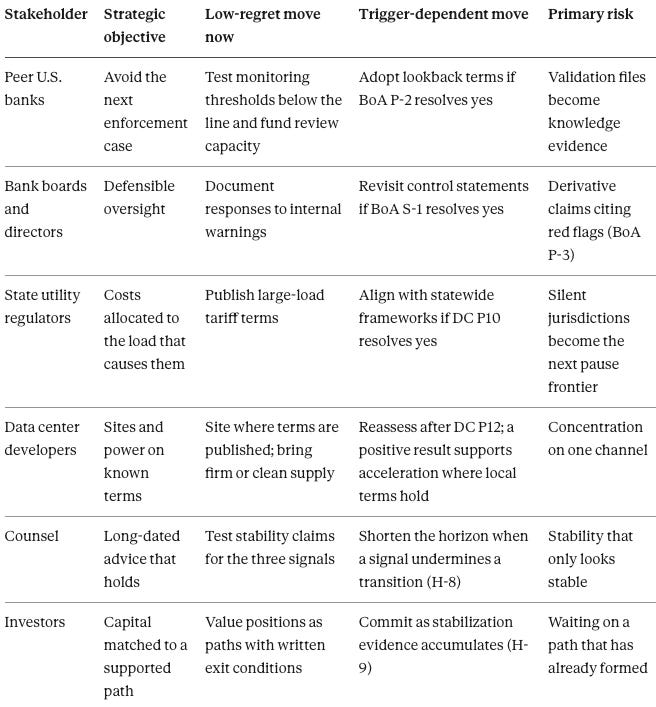
Peer Banks, Boards, Regulators and Developers Hold Different Levers
Peer banks and executives. As a game stabilizes, waiting can become costlier than commitment when the remaining value of information falls below delay and preemption costs. Banks should state the evidence for the stabilization condition as explicit decision triggers and move capital as that evidence accumulates. Validation files that show a gap and no response now carry enforcement weight under BoA P-1.
Boards and directors. Oversight files become the evidence in follow-on claims. Boards that document their response to internal testing warnings lower their exposure under BoA P-3. Public statements about control design should match the testing record.
Policymakers and utility regulators. Once an authorization path forms, the terms of the framework become the decisive variable for where capital lands. States that publish large-load tariff rules, water conditions and community terms early set the reference point that later states must match. States that stay silent become the next frontier of pauses.
Developers. Earlier commitment pays as evidence of durability rises, yet durability never reaches certainty. Developers who secure sites in jurisdictions with published terms, and who bring firm or clean supply to meet the conditions, position for the first-mover share of the new payoffs.
Counsel. A stable game still reverts when a correctly placed shock lands near a tipping band. Counsel should test every claimed stability for the three false-stability signals before supporting long-dated advice.
Investors. Joint path probabilities become valuable once each conditional rests on a supported transition. A stabilizing thesis can name an outcome three forks downstream and defend a band for it, which a short horizon thesis rarely can. Concentration remains the residual risk, because a focused position leaves few channels to diversify across.
Exposure Shifts From Unlogged Warnings to Reversal Risk
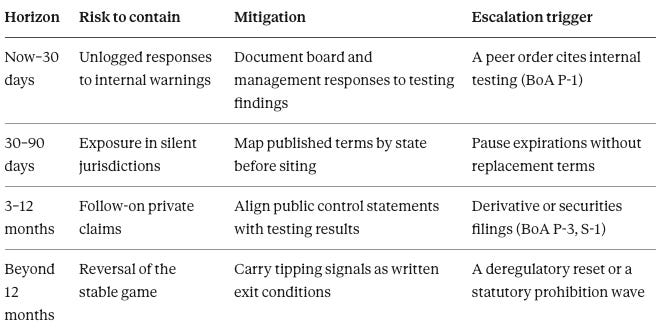
Five risk classes apply. Strategic risk arises when incumbents keep short horizon rules in a stable game. Institutional risk arises from a reset of program expectations, and legal risk from follow-on claims. Market risk arises from concentration on one channel, and operational risk from validation files that become notice.
The matrix, postures and time gates share one rule. Commit where stabilization evidence clears the organization’s own threshold, and carry the reversal signals as written exit conditions. The time-gate table attaches those signals to dates.
Takeaway. Each stakeholder’s best move in the long horizon commits to the supported path while watching for the signal that reopens it.
V. Commitment and Loop Speed Earn the Long Horizon Return
The implications follow from the stable and emerging trees and the strategy matrix. A fixed standard spreads through reuse, loop speed decides who captures the new payoffs, and early movers gain value late movers cannot recover.
V.A A Fixed Standard Spreads Through Reuse
A settled standard spreads through reuse rather than new rulemaking. Each peer order that cites internal testing under BoA P-1 converts a method into an expectation. Parameter-specific mandates under BoA P-2 leave a deregulatory reset less to strike, because the obligation sits in order language rather than in general guidance.
V.B Loop Speed Decides Who Captures the New Payoffs
Loop speed decides who captures the new payoffs. The Dynamic Predictive Game Theory framework holds that actors with faster and sounder feedback loops capture more of the new payoffs than better-resourced actors with slower loops. As the game changes less beneath the actor, loop quality tends to compound rather than reset.
The timing condition follows: wait only while the falling error of committing exceeds the combined marginal cost of delay and rival preemption. Under-adaptation becomes the characteristic failure. Incumbents who continue to play the short horizon game after the path forms keep options they no longer need and miss commitments the path rewards. Adaptive Coherence Equilibrium names the failure: continuing an old game’s logic after it has ended.
V.C Early Movers Capture Value Late Movers Cannot Recover
Commitment and loop speed earn a growing share of the return that options and framing earned in the short horizon. Banks that fund validated capacity before examination, and developers that site where terms are published, capture value that late movers cannot recover. Option value persists, so the shift is a change in balance rather than a reversal.
V.D Failed Hypotheses Change How Much Depth the Evidence Supports
If H-6 fails, reassess how much predictive depth stabilization supports and retain only continuations justified by evidence. If H-8 fails, reduce the diagnostic weight of those signals while retaining the other durability tests. If H-10 fails on both tests, the data center game remains in short horizon shape and its forecasts return to the next fork only.
The long horizon return shifts toward commitment and loop speed, while option value persists. Each falsifier marks how much of that shift the evidence would remove.
Stakeholder callouts.
💼 Executives. Banks that fund validated capacity before examination gain an advantage late movers pay more to reach. Fix the capacity decision before the next budget cycle closes.
🏛 Policymakers. Parameter-specific mandates make enforcement durable against later resets. Agencies choosing between general and specific orders choose how stable their own regime becomes.
Takeaway. Every implication traces to a hypothesis or a published forecast, and each falsifier names the strategy that changes if it fires.
What to Watch: Five Signals Decide Whether the Long Horizon Trees Deepen or Reopen
Five signals decide whether the two long horizon trees deepen, hold or reopen. Each links to a hypothesis or published forecast with its source and cadence.
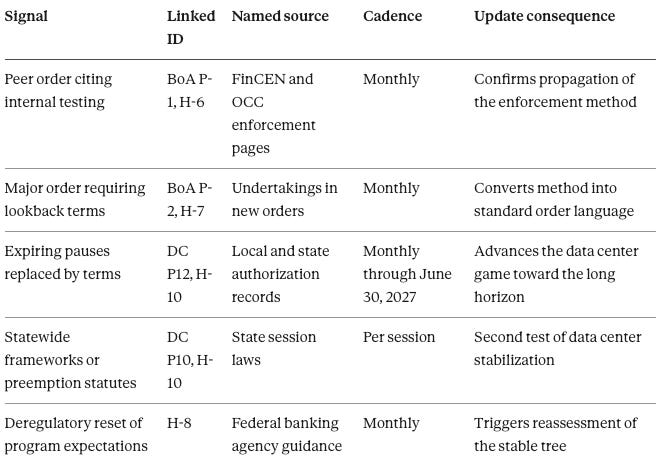
Revisions retain the original language, class, window and falsifier of every hypothesis and quoted forecast. Each revision states the new observation, the field changed and the hypotheses affected, and distinguishes an update from a new forecast.
The next major Bank Secrecy Act order and the June 30, 2027 pause test carry the most weight. Revisions keep every original statement and state only what changed.
Stakeholder callouts.
💼 Executives. Compliance teams should check each new FinCEN and OCC order monthly for citations to a bank’s own internal testing. The first such peer order signals that propagation has begun.
📊 Investors. The June 30, 2027 date for DC P12 triggers reassessment of long-dated siting positions that week. A positive result strengthens the evidence for path valuation, and a negative result keeps the reversal path live. Each project still requires supported local authorization terms.
Takeaway. Five signals decide whether the two long horizon trees deepen, hold or reopen.
Conclusion: The Next Major Order and the June 2027 Pause Test Decide the Depth
The long horizon begins when the transitions behind each downstream fork become dependable within a decision window. The Bank of America tree shows a stable game whose open question is propagation, and the data center tree shows a path still forming. Read together with the short horizon installment, the calculus holds that the usable horizon of a game is the depth at which the evidence still supports the weights on its candidate games.
Stakeholders commit now where stabilization evidence clears their threshold and carry the reversal signals as written exit conditions. The decisive signals are the next major Bank Secrecy Act order and the resolution of DC P12 on June 30, 2027. A forecast reaches as deep as the evidence supports each transition, and the calculus of evolution and mutation measures that support.
Working With MindCast
MindCast AI is a Predictive Game Theory Modeling-Simulation firm. MindCast builds Cognitive Digital Twins of the named actors on a client’s board and models how the game evolves through its next forks. Both run through Vision Functions, the modular game-theoretic modules inside Predictive Behavioral Economics + Dynamic Game Theory.
What MindCast can do
Cognitive Digital Twin builds of counterparties, regulators and courts, plus carriers and coalitions. Each is calibrated from public conduct and the client’s own decision history.
Strategy and Risk Simulation Snapshots for short horizon matters: odds in tens at the current fork, conditional downstream paths, and strategy and risk per path within five business days.
Foresight Simulations for stabilizing matters: published bands at depth two and three, P10/P50/P90 ranges, complete scenario trees and organization-specific calibration.
Interactive war games that let a client’s team play its own moves against modeled opponents across dated forks.
Commitment-timing and horizon analysis that applies MindCast’s commitment-timing, forecast-survival and structural-uncertainty calculations to a client’s own costs, rivals and deadlines.
Monitoring dashboards keyed to the dated signals in each What to Watch table.
When an engagement adds the most on stabilizing games
A peer bank sets a capacity budget or remediation plan before the next major Bank Secrecy Act order.
A client’s position depends on one regulator’s continued enforcement, and a false-stability review would test it.
A developer or utility makes a multi-year siting, tariff or supply commitment before June 30, 2027.
DC P12 resolves positively, and long-dated data center positions with supported local authorization terms and continuation assumptions can be tested as paths with published bands.
How engagements begin. A complimentary Snapshot runs on publicly available information. Private engagements proceed after a nondisclosure agreement and retainer, starting with a diagnostic session on one live decision.
Contact: mcai@mindcast-ai.com · Corporate site: www.mindcast-ai-simulation.com
Appendix A. Selected MindCast Works
The series
The Calculus of Predictive Game Theory Evolution and Mutation. Series introduction: the governing calculus, mathematical core, academic foundations and case matrix.
Predictive Game Theory Evolution and Mutation — Short Horizon Games Branch Wide and Resolve Shallow. Short horizon installment, with agentic AI liability as the worked tree.
Frameworks and prior analyses
Dynamic Predictive Game Theory: From Nash Equilibrium to Adaptive Coherence Equilibrium. Supplies equilibrium selection, delay dominance and the failure modes of Adaptive Coherence Equilibrium.
Chicago’s Randal Picker Was Simulating Law and Economics Before AI. Supplies the False Institutional Stability diagnostic.
Bank of America $1.2 Billion Money Laundering Penalty and the Compliance System That Knew Too Much. Source of every quoted band on the Bank of America tree.
AI Data Center Moratoriums Are Forecastable, and They End in Pricing Rules, Not Bans. Source of every quoted band on the data center tree; the source presents its bands as model-derived foresight judgments.
When AI Agent Liability Meets Common Law and Statute: Predictable Doctrines, Unsettled Allocation. Source of every quoted band on the agentic liability trees.
MindCast Prediction Scorecard. Resolved material calls as of October 31, 2026.
Appendix B. External Sources
Newshook
Associated Press via ABC30, Bank of America fined $1.2B for allegedly violating anti-money laundering, sanctions laws, October 14, 2026. Reports the FinCEN, OCC and OFAC penalties and the admitted willful violations.
Office of the Comptroller of the Currency, News Release 2026-89. The $750 million OCC penalty, credited toward FinCEN’s $1.2 billion.
Data center pauses
Texas Tribune, San Marcos data center ban, June 30, 2026. Hill County and San Marcos.
Office of the Governor of New York, First Statewide Moratorium on New Hyperscale Data Centers. Executive Order No. 62.
Daily Record, Cle Elum calls timeout on data center applications. Six-month moratorium.
OPB, Oregon data centers advisory committee, August 4, 2026. Hillsboro’s 120-day moratorium.
KPTV, Salem pauses data center projects, September 22, 2026. Salem’s four-month moratorium.