
Play the four MindCast war games:
OpenAI Liability War Game: Executive Deck · Interactive War Game
AI Chip Export Enforcement War Game: Executive Deck · Interactive War Game
Clean Compute Anchor War Game: Executive Deck · Interactive War Game
Kalshi Prediction Market War Game: Executive Deck · Interactive War Game
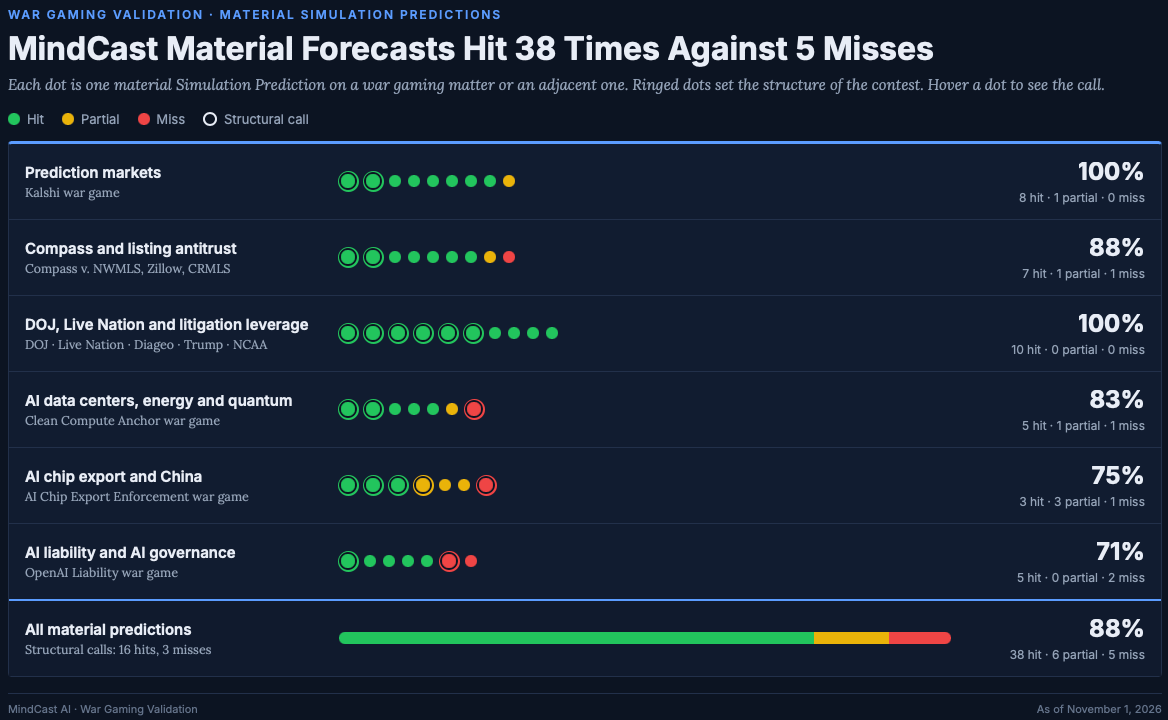
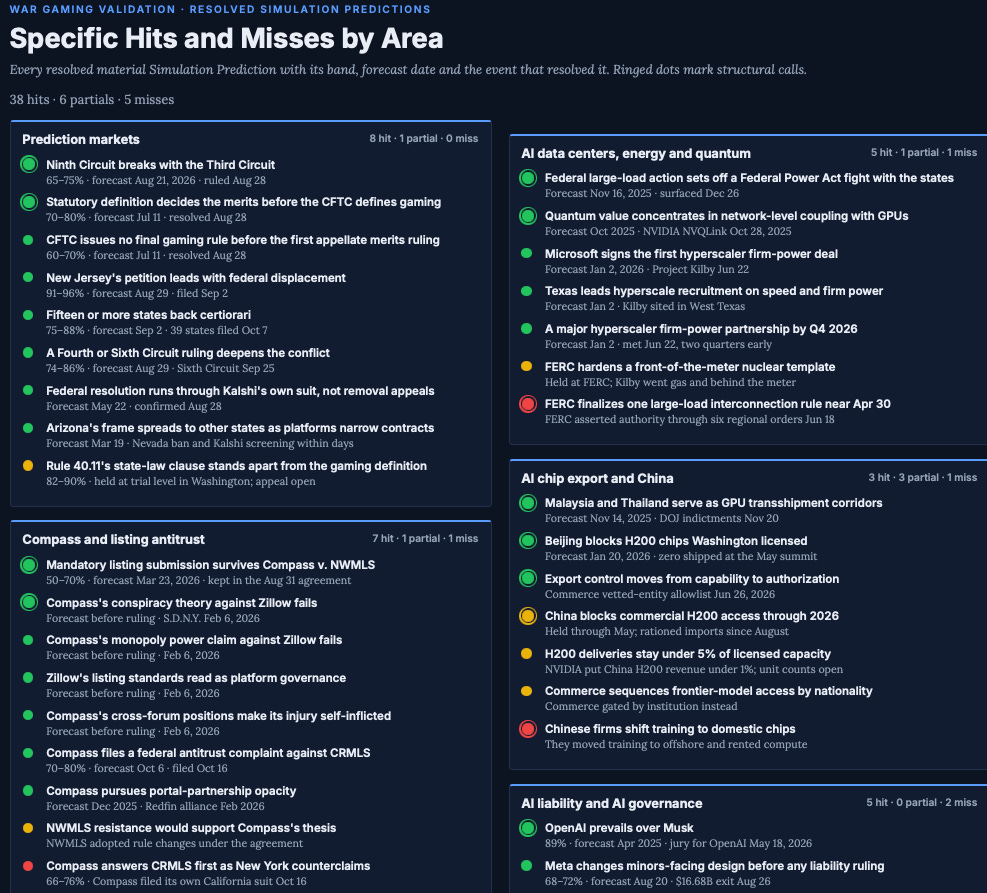
MindCast Prediction Scorecard (November 1, 2026): 38 material hits and 5 misses across six verticals, an 88% success rate on material events across MindCast verticals.
At a Glance
What MindCast war gaming is. A war game in which every opponent is a model of the real organization, built from that organization’s own filings and conduct.
What MindCast war gaming adds. Conventional war games explore adversarial choices. MindCast war games also forecast what named actors will do, by when and with what odds.
What value clients get. A dated map of the exposures the client can still change, how each counterparty will respond and which event should change the plan.
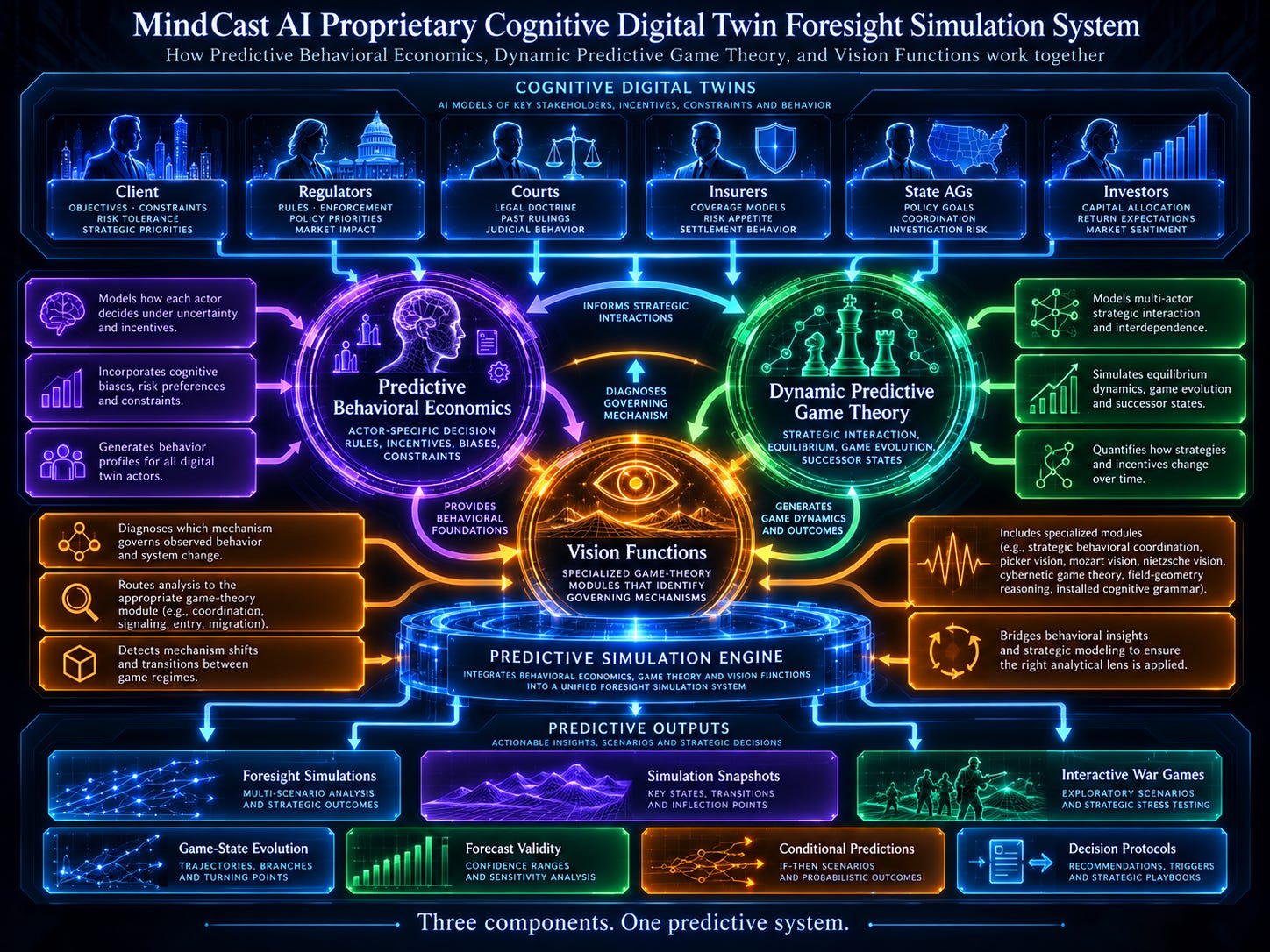
What sets MindCast apart. Predictive behavioral economics through Cognitive Digital Twins (CDTs). Dynamic game theory that maps how the game itself evolves. Modular game theory through proprietary Vision Functions.
How the war game stays current. The board responds instantly to each move. When a ruling, filing or market move lands, MindCast revalidates the board and shows which forecasts still hold.
Which war games are live. OpenAI liability, AI chip export enforcement, clean compute siting in Washington and the Kalshi prediction-market contest before the Supreme Court.
What clients can commission. Cognitive Digital Twin builds and game evolution modeling stand on their own as client engagements, and every war game rests on both.
How the forecasts have performed. Material Simulation Predictions hit 38 times and missed 5 times through October 31, 2026, an 88% success rate that sets 6 partials aside.
Where the war games run. MindCast builds the interactive modules with Claude today. Planned integrations with Microsoft Power BI, ServiceNow and Palantir Technologies would carry the war games into enterprise rollouts.
https://magazine.mindcast-ai.com/prediction-ledger
I. Executive Summary
Consequential decisions increasingly play out inside contests that change while they run. A ruling adds a regulator, an insurance form rewrites coverage and a coalition of states files on one template. MindCast turns the war game from an annual rehearsal into a standing forecast of how named opponents will respond, updated as each event lands. Boards, general counsel and business development leaders can test a move against their real counterparties before they commit capital, file a motion or announce a deal.
Core insight. Conventional war games explore what an adversary might do, and they rarely forecast what a named organization will do or by when. Without forecasts, nobody can check a war game’s results against what happens next.
Thesis. A war game earns its cost when it tells a client what named opponents will do and when to change course. A MindCast war game puts the client in its own chair and a model of each real opponent in every other chair, then forecasts responses that resolve against dated events. Three differentiators make those forecasts possible. Predictive behavioral economics gives each opponent its documented decision rules, dynamic game theory maps how each event changes the game and Vision Functions supply modular mechanisms behind each change.
What distinguishes the MindCast approach. MindCast AI applies Predictive Behavioral Economics + Dynamic Game Theory through MindCast AI Proprietary Cognitive Digital Twin Foresight Simulations (MP CDT FS). Behavioral Economics supplies the decision rules. Game Theory supplies the payoff structure. Predictive simulations emerge from the combination.
What the client gets. A client buys better information before a costly commitment. Each commissioned war game delivers a Strategic Position Map of the exposures still under the client’s control, a Countermove and Transition Map of how counterparties will respond and a Conditional Decision Protocol naming the events that should change the plan. Under the OpenAI war game’s assumptions, a safeguard package adopted between March 2023 and May 2024 could have reduced exposure in all five modeled categories. The same package adopted today reaches one.
What the paper does. The paper starts with what war gaming already does well and the research MindCast builds on, led by Drew Fudenberg’s predictive game theory agenda. One section covers each differentiator and the two changes it makes to conventional practice. Later sections cover real-time updates, run one decision through the OpenAI board and test the method across four war games. The paper closes with capabilities, client value and five carried MindCast Foresight Simulation Predictions.
🏛 Policymakers. A new rule can change the game for every regulated party. Test the rule against models of the parties it binds before it issues.
💼 Executives. A safeguard’s value often depends on its date. Ask which exposures are still open to conduct and act there first.
📣 Marketing and business development. Public statements and announcements are moves on the board. Time them against the events that turn a statement into evidence or a deal into a precedent.
⚖ Counsel. The same precaution can read as care before an injury and as proof of feasibility after one. Test the move against the court and carrier models first.
📊 Investors. A war game that produces only lessons cannot be checked the way dated, banded forecasts can. Ask for the banded Simulation Predictions and the dated events that resolve them. The Kalshi board shows which positions keep their value under every Supreme Court answer.
Takeaway. MindCast keeps what war gaming does well and adds named actors, an evolving game and forecasts a reader can check.
II. What War Gaming Already Does Well and Where MindCast Adds
War gaming began as officer training and grew into a planning tool for militaries, governments and companies. Four moments trace the field.
1824, Berlin. Georg von Reisswitz showed his Kriegsspiel to the Prussian king and to General Staff chief Karl von Müffling, who called it schooling for war (Peterson 2012). An umpire decided each outcome.
1961, Camp David. Thomas Schelling, the game theorist who later shared the Nobel Prize, ran a Berlin Crisis war game with senior officials as players. Game theory shaped the design, and people played every side.
1990. Peter Perla’s The Art of Wargaming set the professional standard. Perla later recalled telling a colleague that war gamers cannot “even predict the outcome of a Super Bowl game.”
2002 and 2023. Millennium Challenge 2002 drew more than 13,500 participants and was restarted after Lieutenant General Paul Van Riper’s opposing force sank much of the fleet. The Center for Strategic and International Studies ran its Taiwan invasion game 24 times and declined to say whether war was probable.
Modern practice goes well beyond tabletop play. Agent-based simulations run computational actors through thousands of trials. AI-assisted red teams generate adversary moves, and formal game-theoretic war games and probabilistic forecasting each add rigor of their own.
Agent-based models, game-theoretic war games and probabilistic forecasting each supply some of these elements. MindCast combines all five on one board.
Named actor models. Each opponent is a named organization, modeled from its own filings and conduct.
Behavioral decision rules. Each actor decides by documented rules of thumb rather than textbook rationality.
Event-to-game transitions. Each consequential event is mapped to the resulting game state, including changes to available moves, incentives and forecast validity.
Forecast inheritance. Each forecast carries forward only into the states where its assumptions still hold.
Client-controlled moves. The client plays its own decisions and watches every other actor respond.
The three differentiators deliver the five elements. Cognitive Digital Twins supply the named actor models and their decision rules. Dynamic game theory supplies the event-to-game transitions and forecast inheritance, and Vision Functions supply the mechanisms behind each transition. The playable board supplies client-controlled moves.
Takeaway. War gaming explores choices well. MindCast adds the machinery to forecast how named actors respond and to check those forecasts against events.
III. The Research Behind MindCast War Gaming
MindCast war gaming builds on six established lines of research. The contribution lies in running them inside one engine.
War gaming. Reisswitz (1824) and Perla (1990) supply the board, turns, shocks and outcome rules.
Game theory. Von Neumann and Morgenstern (1944), Schelling (1960) and Maskin and Tirole (2001) supply payoffs, stable outcomes and play that depends on the situation.
Behavioral economics. Tversky and Kahneman (1981) show how framing changes choices. Lucas (1976) shows why rules learned under old conditions fail under new ones.
Predictive game theory. Fudenberg and Levine (1998) and Fudenberg (2011) model how real players act, learn and converge.
Cybernetics and control. Wiener (1948) and the work of Marden and Shamma supply feedback loops and the speed of response.
Institutional economics. Stigler (1961) explains how institutions gather information, and Picker (1997) explains how new norms spread.
III.A Fudenberg Asked How People Really Play, and MindCast Answers on the Board
Drew Fudenberg’s 2011 Predictive Game Theory agenda is the closest foundation. Fudenberg conceded that solving a game on paper only sometimes matches how people behave. He listed six open questions about how real players act.
Dynamic Predictive Game Theory Meets the Era of AI — Operationalizing Fudenberg’s Research Agenda with Cognitive Digital Twins answers each question with a working method. The paper matters here because each answer becomes something the war game can do.
How do players act in a game they have never played? Cognitive Digital Twins start from each actor’s documented behavior. On the board, opponents act like the real organization from the first turn.
How do players learn? MindCast measures each actor’s updating speed from past responses. On the board, each seat adjusts at its own pace after an event.
What do players believe about each other? Each Cognitive Digital Twin supplies the starting point for reasoning about rivals. On the board, opponents anticipate each other from evidence.
How do players simplify a huge game? MindCast cuts branches to the paths actors would take. On the board, only meaningfully different futures remain.
Which of several stable outcomes do players reach? Each actor’s decision rules pick among them. On the board, adjudication picks the outcome these actors reach.
How should models be tested? MindCast checks each forecast against the public outcome that resolves it. On the board, banded Simulation Predictions resolve against dated events.
Fudenberg’s agenda left one question open: which game will exist next. Every item on his list asks how people play a given game. MindCast’s Dynamic Predictive Game Theory adds the moving game, and war games need that layer because players move in the space each event creates.
Takeaway. Schelling brought game theory into war gaming at Camp David. Fudenberg’s agenda supplies the bridge MindCast uses to let the theory run the board.
IV. Differentiator One: Predictive Behavioral Economics Through Cognitive Digital Twins
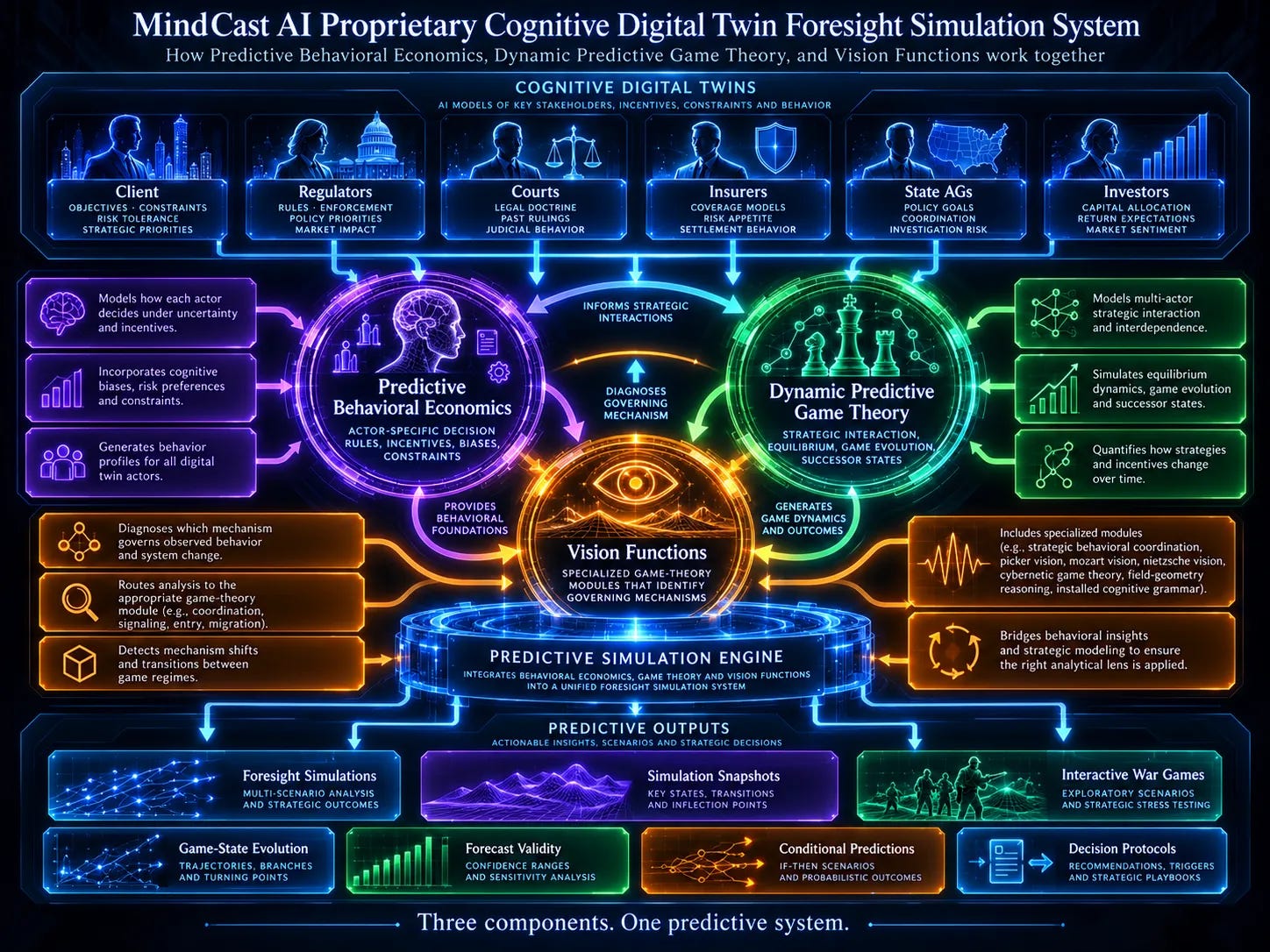
Behavioral economics studies how real people decide: loss aversion, reference points, salience and hindsight. MindCast attaches those decision rules to named organizations through Cognitive Digital Twins. A Cognitive Digital Twin is a model of one actor built from its filings and public conduct, its stated commitments and its known constraints.
Each Cognitive Digital Twin has two layers. The baseline holds steady across a session: how the actor ranks its goals, which constraints bind it and how it updates. The simulated state changes as the game evolves, because the actor learns new facts and gains or loses options.
IV.A Departure One: Modeled Actors Replace Role-Players
The conventional problem. A staff officer playing the other side brings his own training into the chair. An ordinary player may mirror his own side’s thinking, and an exceptional one like Van Riper may play better than the real opponent would.
The MindCast change. Every session starts from the same baseline model of the actor, built from that actor’s own conduct.
The benefit. Alternative moves can be compared against the same modeled opponents. OpenAI Liability War Game — When AI Safety Controls Reduce Exposure and When They Become Evidence holds the attorney general, court and carrier models fixed and changes one OpenAI move at a time.
IV.B Departure Two: Decision Rules Replace the Umpire
Behavioral economics supplies the decision rules. Attorneys general tend to join coalitions by imitation as an issue grows salient. Juries tend to read a late safeguard through hindsight as a precaution declined early.
Game theory supplies the payoffs. One filing costs a state office little and costs the defendant a full docket, so joining pays once a template exists. Where several outcomes could hold, each actor’s decision rule picks among them.
The result can be audited. Anyone holding the same inputs and model version gets the same response, so a disputed result traces back to the rule that produced it.
Predictive Dynamic Game Theory — From Nash Equilibrium to Adaptive Coherence Equilibrium sets out how decision rules pick among stable outcomes. The paper matters here because conventional umpires make that choice by judgment.
IV.C A Modeled Board Compares Moves on Equal Terms
A modeled board gives every alternative move the same opponents and the same assumptions.
Reproducibility. The same inputs, model version and controls produce the same run.
Counterfactual consistency. Alternative moves compare fairly because they run under the same assumptions.
Forecasts that resolve. Each war game carries Simulation Predictions with windows, and each one resolves against events MindCast does not control.
IV.D Cognitive Digital Twins as a Client Engagement
Cognitive Digital Twins also stand alone as a client engagement, not only as an input to war games. A client commissions models of the counterparties, regulators, courts and carriers that shape its decisions. Each model shows how that actor ranks its goals, which constraints bind it and how it is likely to respond to the client’s next move.
Negotiation and deal preparation. The client sees how a counterparty is likely to respond to each offer before the meeting.
Regulatory and policy strategy. The client sees how an agency, legislature or attorney general coalition is likely to read a filing or a proposed rule.
Litigation strategy. The client sees how opposing counsel, a court or a carrier is likely to respond to a motion, a safeguard or a public statement. Court models combine applicable legal doctrine and procedural rules with documented decision tendencies, and the behavioral layer never substitutes for the law.
Standing intelligence. MindCast keeps the models current as each actor’s filings and conduct change, so every later decision starts from an updated baseline.
Takeaway. The opponent becomes a model of the organization the client will face, built from its own conduct and available as a standalone engagement.
V. Differentiator Two: Dynamic Game Theory Models and Simulates Game Evolution
MindCast’s second differentiator models and simulates how strategic games evolve. The model covers how equilibria form and persist, and how they migrate or occasionally break. Conventional war gaming can model changing states, and dynamic game theory supplies mathematical foundations for strategic interaction over time. MindCast integrates those foundations with Predictive Behavioral Economics, Cognitive Digital Twins and Vision Functions to forecast both the evolution of the governing game and the decisions actors make within it.
A strategic contest is a system of interacting actors, not a collection of possible outcomes. Each actor’s decisions change the information and incentives available to everyone else, along with their constraints and opportunities.
A court ruling changes bargaining incentives. A legislative amendment shifts coalition support, and a commercial agreement can alter which counterparties hold leverage. Each response feeds the next round of decisions, so the game evolves even when its formal rules stay the same.
Game evolution is a core simulation function in every MindCast Foresight Simulation, Simulation Snapshot and Interactive War Game. The formats differ in how much equilibrium uncertainty they must represent and how extensively they map the resulting transitions.
V.A Game Evolution Is the Object of Simulation
MindCast models the governing game as an evolving configuration of six interdependent dimensions.
Players and institutional authority. Which actors participate, who can enter or exit, and which institutions can impose consequential decisions.
Strategies and feasible moves. Which actions remain available, which new moves emerge and which earlier strategies drop away.
Payoffs and incentives. How the costs and benefits of competing strategies change, along with their risks and expected rewards.
Rules and binding constraints. How statutes and regulations, contracts and technology, and institutional restrictions shape feasible behavior.
Information and behavioral expectations. What actors know, believe and infer about one another, including how new evidence changes their decisions.
Timing and strategic horizons. How deadlines and delay, commitment windows and adaptation speed change the value of available moves.
The six dimensions evolve jointly. A regulator’s decision may change a company’s permitted conduct and therefore its financing options. The financing change shifts a competitor’s incentives, which in turn shapes the regulator’s next decision. MindCast models the interaction rather than treating each development as an independent event.
At each decision point, actor choices and outside events update the game across the six dimensions. The update identifies which dimensions changed and tests which successor states remain feasible. Only the positions and forecasts whose assumptions survive carry forward, and events that leave the structure intact update the existing state.
MindCast’s simulation follows a repeating sequence.
Governing game → Actor decisions → Strategic responses → Updated constraints and incentives → Equilibrium assessment → Evolved game → Next decisions.
Foresight emerges from modeling which evolutionary pathways remain feasible, which actors control the transitions and which equilibrium the interaction is likely to approach.
V.B Equilibrium Explains the Difference Between MindCast Simulation Formats
Every MindCast forecast depends on the equilibrium conditions of the game in which it was generated. A Foresight Simulation and a Simulation Snapshot differ in how far the governing game has stabilized.
MindCast publishes at three depths, and game stability decides which one a contest supports. A Vision Statement frames the governing equilibrium, the actors and the available moves without forecasting. MindCast may first run a lightweight preliminary simulation that confirms direction and yields hypotheses rather than Simulation Predictions.
A Strategy and Risk Simulation Snapshot runs the full method at lower depth when game evolution is still underdeveloped, the horizon is short and both evolution and mutation remain live. Snapshot Predictions print in tens and sum to 100 at the current fork.
A Foresight Simulation fits a longer horizon in which the game has mostly finished evolving and mutation has become unlikely. Foresight Simulation Predictions carry specific probabilities with confidence bands.
An interactive war game reflects whatever produced its forecasts. A board built on a Snapshot prints odds in tens, and a board built on a Foresight Simulation prints specific probabilities with bands. The Kalshi board runs on a Foresight Simulation, so it prints specific probabilities with bands.
Foresight Simulation: forecast within a sufficiently stable game.
A Foresight Simulation models how the game evolved into its present configuration, including the decisions, institutional changes and competitive responses that established the current equilibrium. The simulation evaluates whether the governing rules, incentives, constraints and actor positions are durable enough to support forecasts over the stated horizon. The simulation then models how the actors are likely to interact within that environment.
Game evolution remains central to a Foresight Simulation. The simulation must explain why the current equilibrium emerged, why it should persist and what developments could destabilize it. The resulting Simulation Predictions carry explicit validity conditions, so a material change in the governing game triggers reassessment rather than silently carrying forward assumptions that no longer hold.
Simulation Snapshot: forecast through an evolving game.
A Simulation Snapshot addresses a strategic environment in which consequential events could alter the governing equilibrium during the forecast window. The simulation must model how actors respond within the current game and how each event changes the environment governing their later decisions.
A court ruling may create new incentives to resolve a case. A legislative amendment can shift the coalition needed for passage. An agency action may open one compliance route while closing another, and new information can alter bargaining power before any binding rule changes.
Each event creates a potentially different successor state. The Snapshot forecasts the transitions among those states and the decisions actors are likely to make after each transition.
Interactive War Game: play within the modeled evolution.
An Interactive War Game makes the Snapshot’s evolving strategic structure playable. The participant selects a move, the modeled actors respond and the simulation determines how the move changes the decision environment. The next available choices depend on the resulting state rather than on the original scenario.
A Snapshot with complete actor positions, event transitions and conditional forecasts can therefore serve as the foundation for an Interactive War Game without reconstructing its strategic model.
V.C Four Kinds of Change, From Continuation to Mutation
Within the broader process of game evolution, MindCast distinguishes four forms of change by their effect on the governing game.
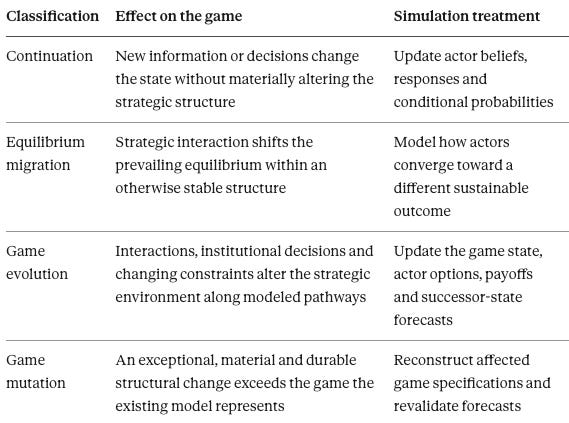
Game evolution is the general process. Continuation and equilibrium migration are forms of development that can occur within it. Game mutation is the exceptional case that requires a more fundamental reconstruction.
How Mozart Predicts Game Mutation in Predictive Behavioral Economics + Dynamic Game Theory examines institutional clock speed, endogenous adaptation and constraint migration. The paper matters here because it shows how to separate ordinary evolution from structural replacement.
The Kalshi war game applies the four classes turn by turn. Kalshi Supreme Court War Game — Which Investor and Operator Positions Hold Up Under Any Ruling on Prediction Markets classifies the first injunctions as a continuation and the circuit split as an equilibrium migration. The criminal charges, the certiorari petitions and the October federal rules each count as game evolution. The board flags only one inject as a game mutation: a congressional amendment that would replace the statutory question the Court is weighing.
V.D Departure Three: From Scenario Outcomes to Simulated Game Evolution
MindCast does not simply forecast outcomes at the end of a predetermined scenario. Instead, MindCast models the evolution of the strategic environment that determines which outcomes remain possible.
Consider a legislative contest over an AI infrastructure project. A proposed bill creates one set of incentives for developers and utilities, counties, lenders and legislators.
Suppose an amendment changes the project’s cost allocation. Utilities reconsider their positions, and lenders revise financing conditions. Developers may offer concessions, and legislators may assemble a different coalition. A conventional scenario exercise can explore these alternatives, while MindCast’s dynamic simulation models their reciprocal effects and the resulting evolution of the game’s equilibrium.
The Clean Compute Anchor War Game provides a concrete example. The 2027 Washington legislative session generates three modeled successor states. Each state changes the conditions under which five participating seats can act, while other developments alter timing, costs or incentives within those routes.
The clean compute simulation does more than assign odds to three legislative outcomes. The simulation identifies the strategic environment each outcome creates and forecasts how the participating actors respond once that environment governs their decisions. The forecast extends beyond the event to the game that follows it.
Transitions can also come from outside the courtroom or the legislature. In January 2026 Verisk generative-AI insurance endorsements, including CG 40 47, took effect at renewal. The edition created a potential market-wide transition, and its realized effect depends on which carriers adopt the forms and which policies carry them.
V.E The Event-to-Game Transition Contract Makes Evolution Executable
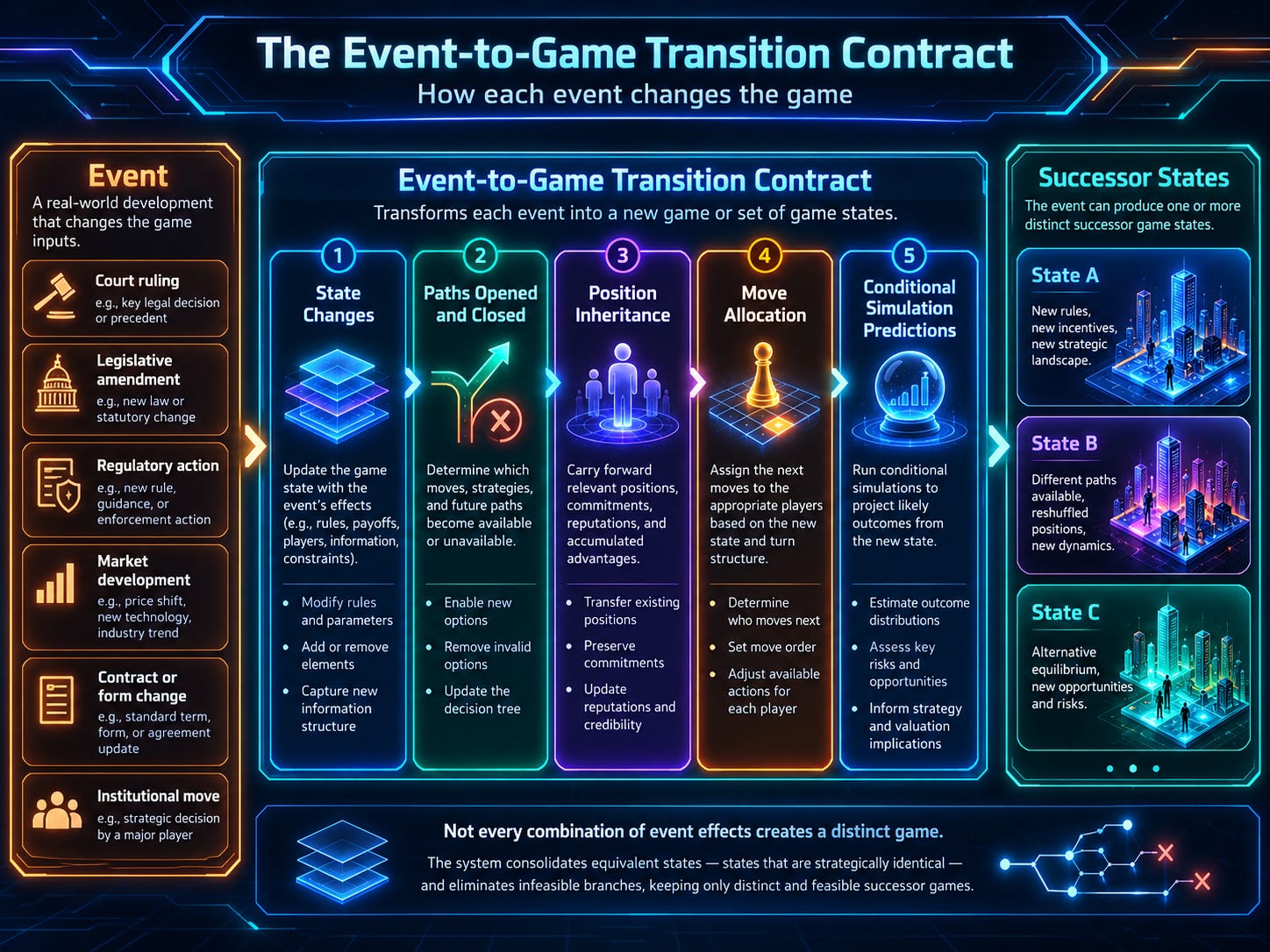
A Simulation Snapshot carries the more demanding representation of game evolution, because each consequential event can change the positions of several actors at once. MindCast’s Event-to-Game Transition Contract specifies five entries for every modeled event.
State changes. Which players and strategies, payoffs and rules, or information and timing conditions change?
Paths opened and closed. Which strategic routes become feasible, remain feasible or disappear?
Position inheritance. Which actor positions survive, convert or become stranded?
Move allocation. Which actors gain or lose strategic options?
Conditional Snapshot Predictions. Which forecasts activate in the resulting state, and under what conditions?
Each transition also receives a successor-state identifier and forecast-validity conditions. The identifier and conditions show which existing forecasts remain applicable, which require reassessment and which new conditional forecasts become active.
The Event-to-Game Transition Contract preserves strategic consistency across branches. A participant cannot execute a strategy that the preceding event eliminated. A regulator cannot exercise authority it has not acquired, and a forecast cannot retain assumptions that the successor state has invalidated.
Two events with three outcomes each can yield nine combinations, but not every combination creates a distinct reachable game. MindCast consolidates equivalent states and eliminates infeasible branches, so the Snapshot represents consequential strategic pathways rather than every arithmetic possibility. The contract specifies how the simulation carries the consequences of one game state into the next.
V.F Departure Four: From Abstract Turns to Strategic Time, Exposure Clocks and Adaptation
Game evolution also changes the economic meaning of time. A deadline does more than tell the simulation when an event occurs. A deadline can alter the incentives and available strategies of every participating actor, along with their relative bargaining power.
MindCast models time through three complementary mechanisms.
Exposure clocks. Each clock marks the interval during which an actor can still prevent, reduce or reshape a risk. A precaution implemented before deployment can carry different legal and economic consequences from the same precaution implemented after an injury or a lawsuit.
Delay dominance. The model identifies which actors benefit from reaching the next strategic state later rather than sooner. A well-funded defendant may benefit from prolonged litigation, while a constrained challenger faces rising pressure to resolve the dispute.
Adaptation velocity. The model measures how quickly actors detect a change, interpret its consequences and alter their behavior. An actor with superior resources can still lose an opportunity because another participant adapts faster.
The OpenAI Liability War Game shows the three mechanisms working together. The board tracks five exposure clocks, each tied to a dated public event.
Negligence. Prevention stayed low cost until GPT-4o shipped without age verification on May 13, 2024.
Consumer fraud. Closed when the pleaded safety statements were made.
Executive. Closed on August 26, 2025, when Raine v. OpenAI named Sam Altman.
Insurance. Turned in January 2026, when the Verisk endorsements reset the available insurance forms at renewal. The war game treats the market-wide route as closed, while OpenAI’s own policy terms are not public.
Coalition breadth. Still open, because it attaches to complaints not yet filed.
The five clocks govern how opportunities, liabilities and strategic leverage evolve.
Four of the five clocks have closed. Consumer fraud, insurance and executive exposure cannot reopen through conduct. The statements are made, the policy forms are set and the defendant is named. Negligence keeps one question open until the first design-defect ruling.
OpenAI’s July 2026 removal of Florida’s case to federal court bought two months before the September remand and, in the war game’s finding, raised the cost of delay in every later forum.
A move that remains legally possible may no longer deliver the same payoff. Conversely, a new event can create a strategy that did not exist at an earlier turn.
V.G A Forecast Holds Only While Its Game Holds
A forecast holds only while the conditions supporting it remain valid. MindCast distinguishes three questions, and each answers something different.
Strategic stability, following Nash. Can any actor gain by changing strategy on its own within the modeled game?
Search sufficiency, inspired by Stigler. Does the expected value of more information still justify the cost of searching for it?
Architecture stability, through Adaptive Coherence Equilibrium. Would an actor gain by changing its whole way of deciding as the game changes?
MindCast issues a forecast only when no modeled actor gains by deviating within the forecast window and further information would not change the forecast.
For a Foresight Simulation, the test is whether the modeled strategic environment has stabilized enough to support the forecast window. For a Simulation Snapshot, conditional forecasts attach to specified successor states. The broader contest need not reach a single terminal equilibrium, but each forecast must identify the state, assumptions and conditions under which it applies.
An Interactive War Game carries the same forecast-validity conditions into live play. When a move creates a materially different state, the board identifies which forecasts remain valid, which become conditional on further events and which require a new simulation.
MindCast’s three structural misses share one cause. Anthropic held its usage terms and accepted termination of its Pentagon work rather than partially conceding. The Federal Energy Regulatory Commission asserted authority through six regional orders rather than one final rule. Chinese firms moved training to rented offshore compute rather than domestic chips.
Each actor took a third route the forecast never framed. MindCast boards now name the exit route behind every structural call and treat a third route as the signal to rebuild the game.
Stability of an actor’s decision architecture and the quality of its adaptation remain separate measures. An actor can hold a stable architecture and still adapt slowly.
A forecast belongs to a game state, not to an event calendar alone. A forecast generated under one governing game cannot automatically survive a change in the strategies, incentives or constraints that produced it.
V.H What Dynamic Game Evolution Adds to War Gaming
MindCast integrates evolving strategic states with named Cognitive Digital Twins and behavioral decision rules. The same system adds Vision Functions, conditional forecasts and explicit controls on forecast validity. Each simulation therefore answers a connected set of questions.
How did the governing game reach its present form?
Which strategic equilibrium governs the current decisions?
How will the actors’ interactions evolve that equilibrium?
Which events will change the available strategic pathways?
What successor game will emerge, and which actors gain or lose leverage?
Which forecasts remain valid once the game changes?
V.I Game Evolution Modeling as a Client Engagement
Game evolution modeling is equally central to MindCast client work. A client commissions a map of how its strategic game reached its current form, which events will change it and which successor states each event can create. The engagement applies the Event-to-Game Transition Contract to the client’s own contest.
Current game diagnosis. Names the governing equilibrium, the binding constraints and the actors who control the next transition.
Successor-state map. Lays out the reachable futures after each scheduled fork, with the moves each seat gains or loses.
Forecast validity conditions. States which forecasts hold in each state and which events would require revalidation.
Timing guidance. Identifies which exposure clocks remain open and which windows close first.
Game evolution modeling often comes before a war game. A Simulation Snapshot built for the client becomes the board the client later plays.
Takeaway. MindCast models game evolution as a governing predictive process across every Foresight Simulation, Simulation Snapshot and Interactive War Game. The system forecasts what actors will do and how their actions change the game in which later decisions occur. MindCast predictive war gaming rests on the link among strategic behavior, equilibrium and forecast validity.
VI. Differentiator Three: Modular Game Theory Through Vision Functions
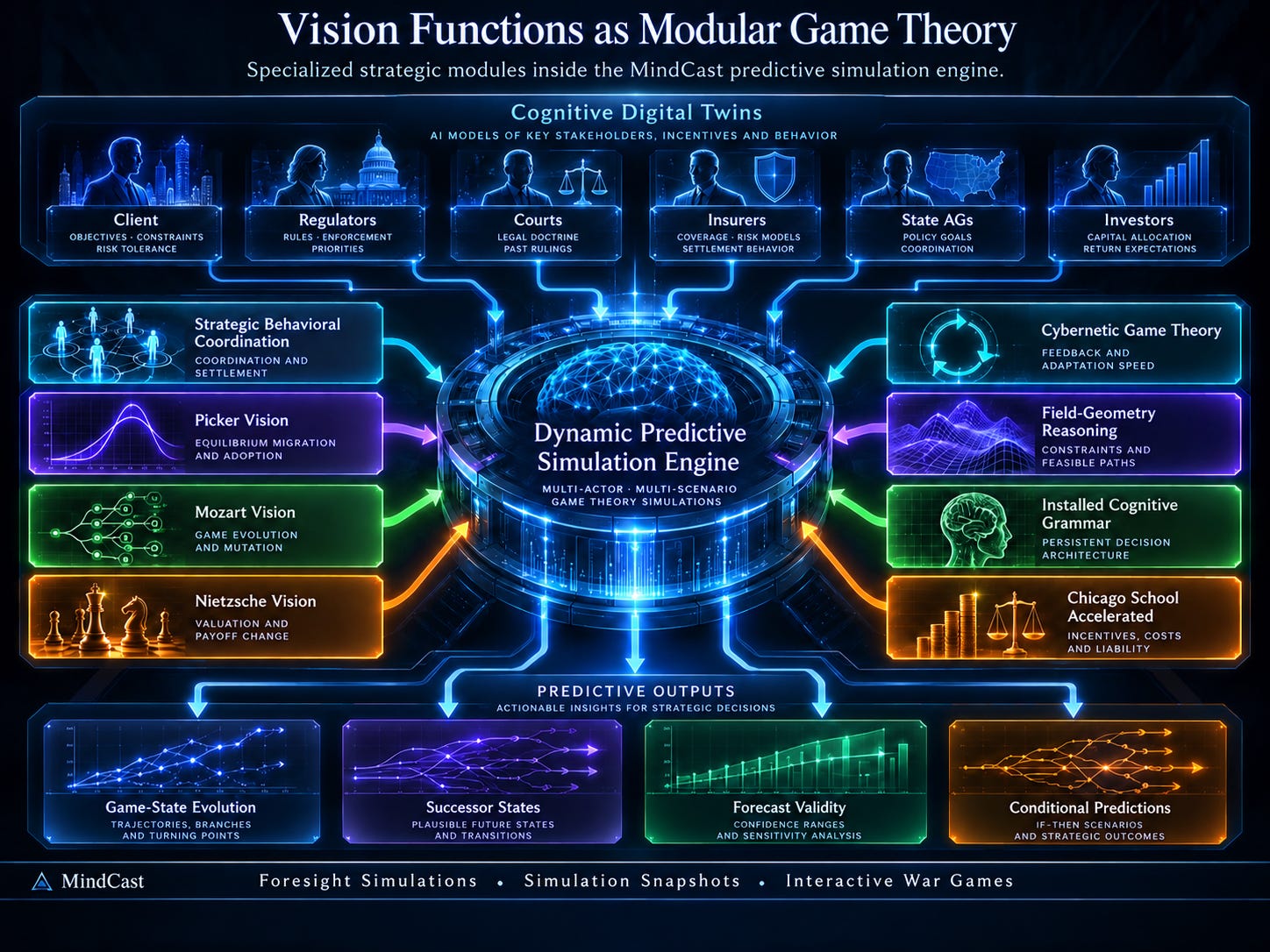
MindCast Vision Functions are specialized modules within its Predictive Behavioral Economics + Dynamic Game Theory system. Each module puts one strategic mechanism to work, such as coalition behavior, equilibrium shifts or game evolution. The simulation selects and combines modules according to the mechanisms present in the governing game. Several modules can contribute to the same event without the system treating their explanations as independent.
The modular design separates identifying a mechanism from simulating its consequences.
Cognitive Digital Twins. Represent the actors, their objectives and their constraints.
Vision Functions. Supply the mechanisms through which the actors’ decisions interact.
Simulation engine. Carries those interactions through evolving game states.
Validation and closure controls. Decide which causal links enter the model and which forecasts can issue and remain valid.
MindCast Foresight Prediction Simulations, Synthesizing Behavioral Economics + Game Theory describes the forecasting system. The paper matters here because the war game inherits every stage of it.
VI.A One Event Engages Several Mechanisms at Once
A real contest rarely runs on one mechanism. In the OpenAI war game, separate modules work on the same evolving game.
Coalition incentives. Why attorneys general join, wait or lead.
Meaning of moves. How courts and carriers read a safeguard depending on its date.
Structural change. Whether a ruling, an insurance form or a regulation changes the game.
Adaptation speed. How fast OpenAI, regulators and insurers respond to each change.
Feasible routes. Which legal and institutional paths remain open.
Composability is a core part of the novelty: MindCast selects, combines and updates modules as the governing mechanisms change. Modules share common definitions of the game state and follow priority rules, so no two modules overwrite the same payoff or transition. The discipline prevents double-counting a mechanism or producing contradictory successor states.
VI.B Modules Become Engagements of Their Own
Modularity also changes what a client can buy. A client may not need a full war game.
A law firm can commission a coalition analysis of the regulators lining up against its client.
An investor can commission an analysis of which routes stay feasible and how the game will evolve.
An insurer can combine an analysis of how safeguards are read with the incentives of the parties it covers.
A full war game composes the relevant modules into one evolving simulation. Each module offered on its own carries a defined input, output and validation test, and the modules themselves remain proprietary.
VI.C Departure Five: A Court or Carrier Decides What a Move Means
Departure Five concerns meaning rather than timing. Dated exposure clocks ask whether a move is still available, while Departure Five asks how a court, carrier or regulator will read the move once it is made.
Before an injury, a safeguard can prove care. The file shows a measured risk, a tested fix and a dated response from someone with authority.
After an injury, the reading narrows. Federal Rule of Evidence 407 bars a later fix as proof of negligence in federal court, with exceptions that include feasibility when disputed. State rules vary, and California does not apply its rule to strict products liability.
A measured gap can become evidence. An organization that finds a problem and keeps it may hand the other side a dated exhibit.
How Nietzsche Predicts Valuation Mutation in Predictive Behavioral Economics + Dynamic Game Theory explains when a change in meaning moves real payoffs. The paper matters here because the war game must model the interpreter that assigns the meaning.
Meta and Bank of America Foresight-to-Duty Conversion — Revenue-Funded Versus Cost-Funded Deferral shows how a gap an institution measured turns into evidence once the institution keeps it. The paper matters here because a client’s own internal findings are moves already on the board.
VI.D Departure Six: Labeled Outputs Replace Lessons
Every item on a MindCast board carries one of six labels.
Fact. A dated public event.
Move. What the client did.
Alternative. A move the client could have made, carrying no odds.
Inject. A hypothetical shock that tests responses and forecasts nothing.
Finding. A mechanism with a stated way to disprove it.
Simulation Prediction. A named actor, outcome and window with a band.
Only Simulation Predictions carry odds, and they resolve against dated events. The board first replays the dated turns that happened, so readers see it reproduce the sequence before exploring alternatives.
MindCast ran the same forecasting method live on Super Bowl LX, the 2026 FIFA World Cup and the 2026 US Open, the kind of contest Perla called unpredictable. Betting AI vs. Foresight AI explains the difference: MindCast forecasts the behavioral mechanisms that decide a contest, while betting models forecast the line.
The Super Bowl LX forecast picked Seattle, which won 29–13, as Super Bowl LX — AI Simulation vs. Reality reports. The World Cup final forecast picked Spain (54%), which won 1–0 after extra time. The 2026 World Cup Final Simulation Validation rates it a partial because Argentina’s predicted late recovery never came.
At the 2026 US Open, MindCast’s primary forecasts went five for six: four for four in the semifinals and one for two in the finals. The men’s final forecast picked Alexander Zverev over Ben Shelton (57–69%), and Zverev won in four sets. The women’s final forecast picked Aryna Sabalenka over Elena Rybakina (50–62%), and Rybakina won in three, as The 2026 US Open Finals Simulation Validation — Matchup History Held the Men’s Call, Mechanism Weight Missed the Women’s reports.
The same discipline runs through MindCast’s institutional forecasts. The Prediction Scorecard counts 38 material hits and 5 misses across six verticals, from prediction markets to AI liability, an 88% success rate on resolved calls that sets 6 partials aside. Structural calls, the ones that decide who controls an outcome or which rule survives, hit 16 times and missed 3 times.
Takeaway. Vision Functions supply modular mechanisms that combine as the contest requires, and labels make every output checkable.
VII. Real-Time Updates and Enterprise Platforms
MindCast updates a war game at three levels, and each level works on its own timescale.
Interactive updating. The board responds immediately when a reader selects a move or drops an inject onto it.
Event updating. When a ruling, filing or market move lands, MindCast revalidates the game state. The update flows to the Cognitive Digital Twins, the payoffs and the paths on the board.
Forecast recalculation. A new simulation run produces new bands when an event changes the game materially.
VII.A An Update Shows Four Things
An update shows four things.
The new successor state. The board moves to the branch the event selected.
Which forecasts still hold. Each Simulation Prediction shows its status in the new state: valid, resolved or paused pending a new run.
Which moves opened or closed. Each seat sees the moves it gained or lost.
Which clocks moved. Exposure clocks advance as events close or reopen them.
Status changes arrive as soon as the game state is revalidated. A new band comes only from a new simulation run.
The Kalshi board shows the distinction at work. Kalshi moved its Supreme Court brief from November 9 to December 7, and the board marked the hold branch as more likely without printing a new band, because only a new simulation run sets one. Automated monitoring of connected external sources belongs to the planned enterprise architecture below.
VII.B Enterprise Platforms Carry the Board Into Client Workflows
MindCast builds its interactive modules with Claude, Anthropic’s AI model, today. The browser modules demonstrate scenario exploration for any reader with no account required. For enterprise-scale rollouts, MindCast plans integrations with three platforms where client teams already work.
Microsoft Power BI. Live dashboards of exposure clocks, successor states and forecast status for leadership, strategy and finance teams.
ServiceNow. Watch events from connected sources that trigger revalidation, tasks and approvals inside risk, legal and compliance workflows.
Palantir Technologies. War game states joined to a client’s operational data for planning by operations, security and government teams.
Takeaway. A MindCast war game stays live after the workshop ends, and the planned integrations would put it inside the tools client teams already use.
VIII. One Decision on the OpenAI Board
The OpenAI war game runs all six departures through one alternative move: ship GPT-4o with age assurance and minor defaults in May 2024. The other actors stay fixed, and under the war game’s assumptions the board answers in sequence.
The attorney general coalition could lose its strongest design fact and lean more heavily on consumer fraud.
Design claims would likely start weaker, and a carrier with the appetite and forms could write cover on a tested precaution.
Each filing office may expect less remedy, so the template could spread more slowly.
OpenAI’s next decision could shift to buying conditioned cover at the 2025 renewal, and the loop runs again.
The OpenAI war game’s main finding concerns timing. From March 2023 to May 2024 every clock stood open, and one set of moves could have reduced all five exposures. Today only coalition breadth still responds to conduct.
A separate published figure in the OpenAI Liability War Game shows how much breadth can move, and it applies to frontier developers not yet named rather than to OpenAI. The chance that an unnamed frontier developer is named within twelve months falls from 40% without unilateral adoption of the pleaded conduct terms to 20% with adoption before any order.
VIII.A The Next Fork: The First Ruling on a Product or Nuisance Claim
The next scheduled fork is the first court ruling on whether product liability and public nuisance claims against OpenAI survive a motion to dismiss. The ruling has three mutually exclusive outcomes, each a distinct successor state. The branch map reads SP-6 across forums: the first surviving claim in any court resolves it true, and dismissals leave it open while other courts can still rule.
After the ruling, each forecast carries one of three statuses: valid at its band, applicable but needing recalibration or resolved. The entries below add no new bands.
Successor state S-1A. Both product and nuisance claims survive.
What changes. The payoff of litigating both theories rises in that forum, and the 2025 safeguards read as late precautions there.
Paths. Plaintiffs in other forums gain a persuasive ruling on both theories, though each court decides its own motion.
Positions. OpenAI’s strategy of holding everywhere loses expected value but remains available through appeal and other motions.
Moves. States not yet suing gain a tested template with two theories.
Forecasts. SP-6 resolves true. SP-2 stays applicable but needs recalibration, because the ruling may change its assumptions. SP-13 stays valid at its band unless the ruling changes how states view other developers.
Successor state S-1B. Neither claim type survives in the ruling court.
What changes. Consumer protection claims carry the coalition template in that forum.
Paths. Product and nuisance remedies close in that forum, while other forums remain open.
Positions. OpenAI’s holding strategy gains expected value.
Moves. OpenAI gains time to adopt conduct terms on its own schedule.
Forecasts. SP-6 stays open while other courts can still rule. SP-2 stays applicable but needs recalibration. SP-13 stays valid at its band.
Successor state S-1C. Exactly one claim type survives.
What changes. One theory gains value in that forum and the other loses it.
Paths. The surviving theory opens its remedy path, and the dismissed theory closes in that forum.
Positions. OpenAI’s strategy splits by claim type.
Moves. Coalition members gain a choice of which theory to lead with elsewhere.
Forecasts. SP-6 resolves true. SP-2 stays applicable but needs recalibration. SP-13 stays valid at its band.
Forecast inheritance follows each forecast’s trigger, conditioning assumptions and resolution criteria. One event can resolve one forecast, leave another unchanged and invalidate a third. A stronger coalition template is a causal hypothesis, not a new number, and a new band requires a new simulation run.
Conventional and MindCast War Games Compared
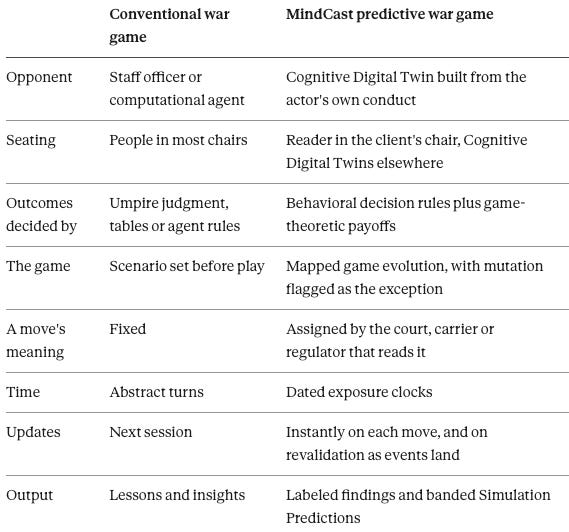
Takeaway. One decision shows all six departures at once, and the successor states show which forecasts carry into each branch.
IX. Three War Games Test Whether the Method Travels
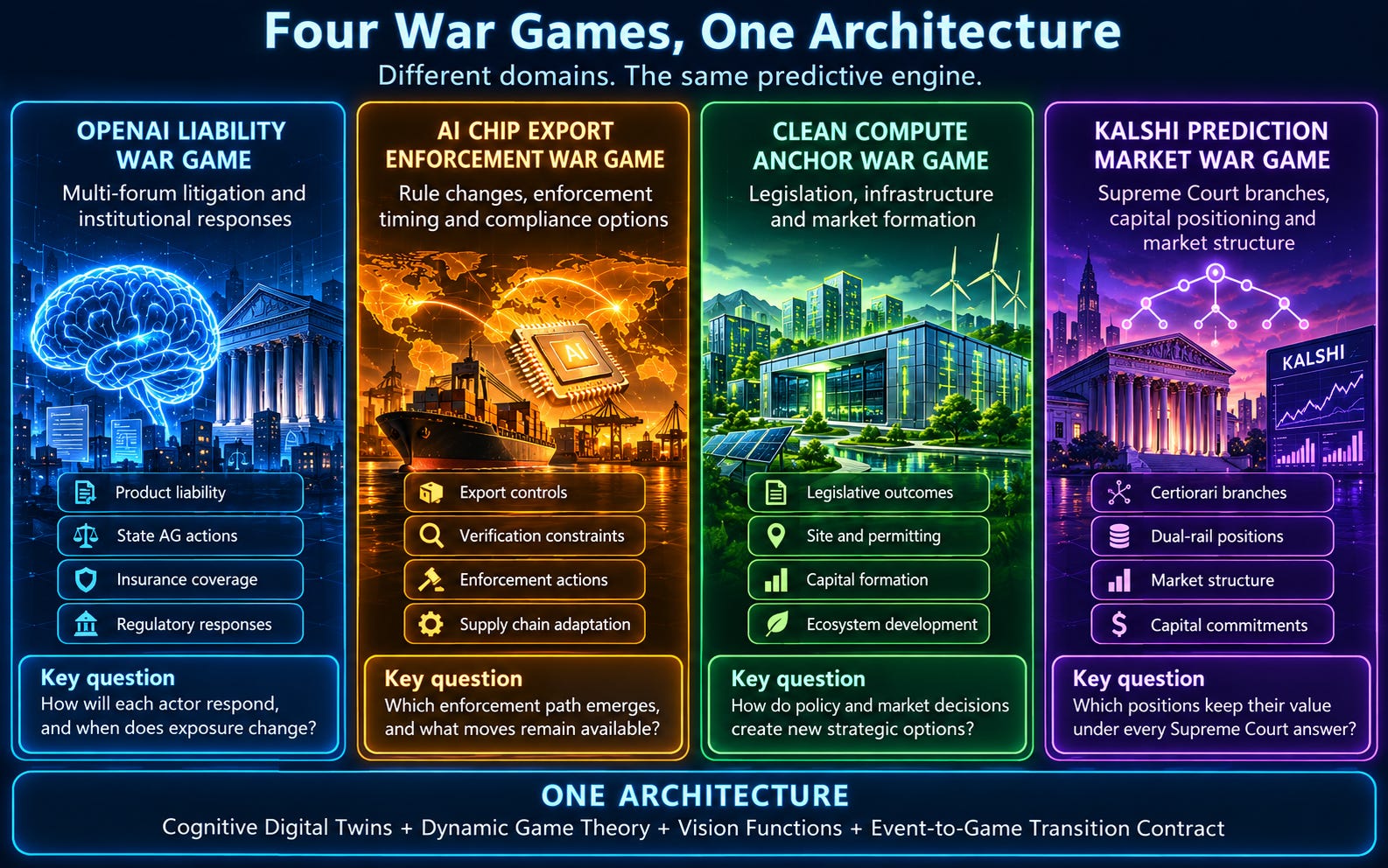
MindCast runs four war games on one architecture. Each one stresses a different mechanism, and together they test whether the method carries across different contests.
OpenAI liability. The war game stresses exposure timing and countermoves across many forums. OpenAI Liability War Game — When AI Safety Controls Reduce Exposure and When They Become Evidence. The board shows how the same safeguard carries different consequences on different dates. Ten state forums let the war game trace how one company’s move changes the incentives of every attorney general still deciding whether to sue.
AI chip export enforcement. The war game stresses enforcement timing and verification limits. AI Chip Export Enforcement War Game Shows When Verification Protects US Firms and When It Arrives Too Late applies dated clocks to export compliance. The paper matters here because it shows how compliance options and enforcement paths change as rules and evidence evolve.
Clean compute anchors. The war game stresses legislative successor states and seat-by-seat transitions. Clean Compute Anchor War Game Shows When a Host’s Early Move Secures Power and When the Session Sets the Terms First lets the reader take one of five seats, from hydro host to lender. The paper matters here because one legislative session creates three strategic environments every seat must navigate.
Kalshi prediction markets. The war game stresses capital and operating commitments made before the Supreme Court acts. The Kalshi companion weights four branches of the certiorari fork: a grant on first consideration (28–38%), a call for the Solicitor General’s views (25–35%), a hold (15–22%) and a denial (14–22%). Kalshi Supreme Court War Game — Which Investor and Operator Positions Hold Up Under Any Ruling on Prediction Markets. The paper’s governing rule ranks every position by its worst branch first, and only dual-rail seats keep their options under all four branches. Each dual-rail seat holds both a state gaming license and a federally regulated prediction channel, as DraftKings, FanDuel and Fanatics do.
IX.A The Four Cases Vary Where It Matters
The four cases vary along the dimensions that matter most. The cases span four kinds of contest: litigation, regulatory enforcement, legislation and a federal–state preemption fight that moves capital before any ruling. The set pairs private defendants with public authorities and backward-looking liability with forward-looking authorization, and each case runs on its own decision clock. The variation shows one architecture representing litigation, enforcement, legislation and capital commitment alike.
IX.B Each Board Rests on Resolved Forecasts
Each war game sits in a vertical with resolved forecasts behind it. Prediction markets, the Kalshi board’s vertical, hit 8 times with no miss (100%). Clean compute hit 5 times against 1 miss (83%), and AI chip export hit 3 times against 1 miss (75%). AI liability and governance, the OpenAI board’s vertical, hit 5 times against 2 misses on adjacent matters (71%).
The four verticals combine for 21 hits, 5 partials and 4 misses, an 84% success rate that sets the partials aside. Structural calls run lower at 8 hits, 1 partial and 3 misses (73%). Each structural miss came from an actor taking a third route the forecast did not frame, the gap game evolution modeling now targets.
https://magazine.mindcast-ai.com/prediction-ledger
Takeaway. The architecture carries across litigation, enforcement, energy infrastructure and prediction markets. Each war game carries its own Simulation Predictions.
X. Novelty, Capabilities and Value
MindCast’s value to a client rests on three links: what the method adds, what the system does and what decisions change as a result. Novelty comes from joining five elements in one working system rather than from any single element. Capabilities turn that integration into operations a client team can run on its own matter. Value follows when those operations change a decision before a costly commitment, and the section closes with the value each client team draws from the board.
X.A Novelty
MindCast’s novelty lies in integration and execution. MindCast joins five elements in one working system: named actor models, behavioral decision rules and event-to-game transitions, plus forecast inheritance and client-controlled moves. Vision Functions supply the mechanism inside each transition, as modules MindCast selects and combines as the contest changes.
MindCast’s strongest claim concerns end-to-end interaction. A client can ask what a decision does to its own exposure. The client can also see what that decision does to the attorney general’s incentives, the insurer’s underwriting options and the moves available in forums not yet opened.
X.B Capabilities
Historical Replay. The board reproduces the dated turns that produced the current position.
Counterfactual Play. One move changes at one turn against the same modeled actors.
Future Evolution. The reader plays the successor states after each scheduled fork.
Seat selection. The reader plays the client’s seat. The clean compute module offers five seats, and the Kalshi module lets the reader play a federal-dependent, state-dependent or dual-rail seat.
Real-time updates. The board responds instantly to each move, and forecast status updates once MindCast revalidates the game after an event.
X.C Value: Better Decisions Before Costly Commitments
A client does not buy a war game because it is interactive. A client buys better information about costly decisions under uncertainty. The value comes from avoiding an unfavorable commitment, keeping an option open until uncertainty resolves, negotiating before a legal window closes or stopping a competitor from exploiting a transition.
David Blackwell’s work on comparing experiments explains why better information is worth buying. Information has value when it improves the expected payoff of decisions, not merely when it sharpens predictions. MindCast’s deliverables apply that test.
A commissioned war game delivers three products.
Strategic Position Map. Which opportunities and liabilities remain within the client’s control, counted as the exposures still reducible.
Countermove and Transition Map. How counterparties will respond and which options their responses create or remove, laid out as the distinct futures the client can reach.
Conditional Decision Protocol. Which observable event should cause the client to continue, change or abandon its strategy, stated as dated triggers and thresholds.
The three products rest on MindCast’s two core engagements. Cognitive Digital Twins supply the counterparty models, and game evolution modeling supplies the successor states and validity conditions.
The Conditional Decision Protocol carries the most commercial weight. In the OpenAI case, counsel could treat the first product liability ruling as the trigger to reassess expected exposure, settlement options and insurance strategy. The board shows the conditions under which one course becomes better than another.
X.D Value by Team
Marketing. Learns which public statements can become evidence and when. In the OpenAI case, safety marketing read against the company’s own technical report shaped whether fraud claims exist.
Business development. Learns when an announcement helps and when it sets a costly precedent. In the clean compute case, a host that announces before confirming power invites county review as a data center.
Risk and compliance. Learns which exposures conduct can still reduce. In the OpenAI case, coalition breadth stays open while four clocks have closed.
Legal. Learns how a court or carrier is likely to read a move on a given date, including where evidence rules differ by state.
Strategy. Learns which game will exist after the next fork. In the clean compute case, Washington’s 2027 session produces three successor states.
Capital and investment. Learns which positions keep their value under every ruling. In the Kalshi case, Kalshi raised $1 billion at a $40 billion valuation on October 29, before the certiorari fork. A grant followed by full preemption runs about 11–17%.
Takeaway. MindCast delivers decision support before irreversible commitments, not just more detailed scenarios.
XI. MindCast Keeps the Strengths of Conventional War Gaming
Conventional war gaming brings three strengths, and MindCast keeps all three by putting a human in the client’s chair.
Invention. Human players find moves no designer expected. Van Riper’s opening in 2002 used tactics the exercise designers had not anticipated. MindCast puts that inventiveness in the reader’s hands. The client’s untried moves run as Alternatives, and an opponent’s surprise moves run as Injects against the same actors.
Training under pressure. Live play builds judgment in a way reading a forecast cannot. Müffling valued the Kriegsspiel in 1824 as schooling, and that purpose still holds for leadership teams facing a crisis. MindCast keeps the training value by giving the client’s own team the moves and letting them feel each consequence arrive.
Shared understanding. A seminar game aligns a leadership team around one picture of the situation. The discussion itself often matters more than the result. A commissioned MindCast war game runs as a working session with the client’s leadership, and the board supplies the shared picture the discussion builds around.
Takeaway. MindCast keeps people where their judgment is the subject of the exercise and models the other side from its own conduct.
XII. Falsifiable Implications and Carried Simulation Predictions
The method makes three structural claims any reader can test. Each names its test, its rival explanation and the result that would disprove it.
Modeled opponents. On held-out dated turns, a board of Cognitive Digital Twins should reproduce the real response sequence more often than human red cells given the same facts. The rival explanation is that skilled human players capture the same behavior. The claim fails if the red cells match or beat the board across a matched sample of cases.
Safeguard timing. An identical safeguard adopted before an exposure’s closing event should reduce later adverse rulings more than the same safeguard adopted after it. The rival explanation is that safeguard type and company size drive the outcome. The claim fails if adoption date adds nothing once those factors are held constant.
Rule-changing actors. War games that seat a non-party able to change payoffs, such as a form drafter or a standards body, should forecast the next game more accurately than games limited to the named parties. The rival explanation is that the named parties already capture the relevant behavior. The claim fails if the added actor leaves accuracy unchanged on held-out cases.
XII.A The OpenAI War Game Carries Five Simulation Predictions
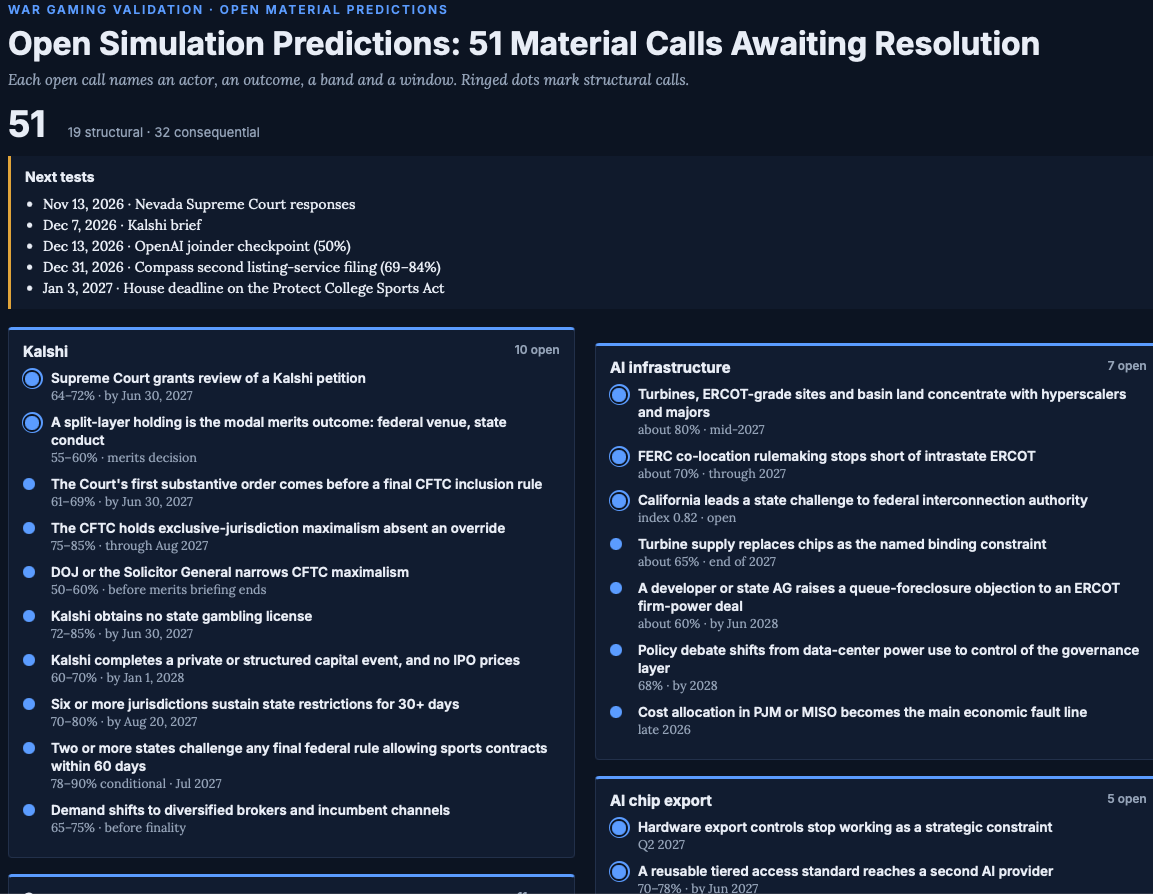
The OpenAI war game carries five MindCast Foresight Simulation Predictions from its source paper, numbered as published. None has reached its window. Across MindCast’s verticals, 19 structural Simulation Predictions remain open, each listed with its band and window.
Highlights
SP-1 · One to two states beyond the ten file against OpenAI (50%). Window: December 13, 2026.
SP-2 · Eleven to twenty-four states litigate against OpenAI (70%). Window: October 14, 2027.
SP-6 · Given a ruling, a product or nuisance claim survives in at least one court (70%). Window: the first ruling.
SP-11 · Given a ruling, claims against Altman survive in Florida or Texas (50%). Window: the first ruling.
SP-13 · A state names a frontier developer other than OpenAI (70%). Window: October 14, 2027.
https://magazine.mindcast-ai.com/prediction-ledger
XII.B Four Events Move the Carried Forecasts First
Four events will move the five carried forecasts first.
December 13, 2026. The joinder checkpoint resolves SP-1.
First ruling on a product or nuisance claim. The ruling selects successor state S-1A, S-1B or S-1C and resolves SP-6 if any claim survives.
Florida’s injunction ruling. The dominant fork for the board. A grant in any part makes pre-release oversight an available remedy and raises the cost of every alternative to adopting the pleaded conduct terms.
January 2027. New attorneys general take office, which decides whether the open breadth clock can still move.
XII.C The Kalshi War Game Carries Its Own Forecast Set
The Kalshi war game carries 41 Simulation Predictions of its own. Nevada’s responses come due November 13 and 16, CFTC comments close November 18 and Kalshi’s brief follows on December 7. The Court’s first substantive order then resolves the four branch entries.
Takeaway. The Kalshi tests begin on November 13, and the first OpenAI test arrives on December 13, 2026. The first OpenAI claim ruling selects the successor state, and Florida’s injunction ruling decides how costly it becomes to hold out against the pleaded conduct terms.
XIII. Stakeholder Implications
🏛 Policymakers. A proposed rule changes the game for every party it binds, but each party responds from its own constraints. Running the rule against Cognitive Digital Twins of those parties before the comment period closes shows which parties comply, which challenge and which move to another forum. The calendar becomes a policy instrument once the responses are visible.
💼 Executives. Every safeguard is an action paired with a date, and its value falls as exposure clocks close. Control budgets earn the most on the clocks still open, which the board names. A safeguard adopted after a clock closes still has value, but mostly as a defense exhibit rather than as prevention.
📣 Marketing and business development. Public statements and announcements are moves that other actors read and act on. A safety claim can later be measured against internal documents, and an announcement can draw scrutiny that a quiet filing would not. Putting both on the board before release shows which clocks they open or close.
⚖ Counsel. The court, the carrier and the form drafter decide what a precaution means, so each belongs on the board as a modeled actor. Evidence rules differ by forum and claim type, which means the same move can carry different weight in different courts. Testing the move against those interpreters before making it turns a legal judgment into a dated, checkable forecast.
📊 Investors. A defensible thesis names the actor, the outcome, the window and the band. The board also shows which dated events would move the thesis, so a position can be sized against the next fork rather than the last headline. The Kalshi board ranks positions by their worst branch, the test any commitment made before a ruling must pass.
Takeaway. Every stakeholder gains the same thing from the board: a dated view of which moves still change the outcome and which only document it.
XIV. Conclusion
Müffling called the Kriegsspiel schooling for war in 1824, and for two centuries war gaming has explored strategic possibilities with growing sophistication. Predictive Behavioral Economics + Dynamic Game Theory extends that tradition toward a testable architecture for institutional decisions. Cognitive Digital Twins represent identifiable actors, and behavioral decision rules shape their responses. Dynamic game theory models how their interaction changes the choices available to everyone on the board.
Vision Functions supply the mechanisms behind each change as modules that combine as the contest requires. The Event-to-Game Transition Contract preserves the link between each event, the successor states it creates and the forecasts that remain valid in each. A forecast stays tied to the game that produced it, and a material change triggers revalidation rather than silent drift.
MindCast’s three execution modes divide the work. A Foresight Simulation forecasts within a game that has mostly stabilized. A Simulation Snapshot maps how the game evolves through consequential events, and an Interactive War Game lets decision-makers test their choices against the resulting states while watching their counterparties’ options change.
MindCast’s central contribution is the integration of Cognitive Digital Twins, game evolution modeling and Vision Functions into a repeatable method for conditional forecasting and decision support. The practical value lies in showing clients which choices remain available, how their opponents are likely to respond and when new evidence should change their decisions. Cognitive Digital Twin builds and game evolution modeling also stand alone as client engagements, and every war game rests on both. Under the OpenAI board’s assumptions, safeguards that could have reduced five exposures in 2024 now reach one, and the board names that one.
The four war games test the same claim on different contests. The OpenAI board dates which safeguards still reduce exposure. The Kalshi board ranks which commitments survive every Supreme Court answer, and the other two boards do the same for export enforcement and clean compute siting.
Working With MindCast
MindCast offers two standalone engagements, and a commissioned war game combines them. Individual Vision Function modules can also be commissioned on their own.
Cognitive Digital Twin engagement. Models of the client’s counterparties and regulators, courts and carriers, built from public conduct and kept current.
Game evolution modeling engagement. A map of the client’s current game, its successor states after each fork and the conditions under which forecasts hold.
Commissioned war game. A playable board that combines both and lets the client test its own moves.
A commissioned war game follows four steps.
Build the actors. MindCast models the client’s counterparties, courts, regulators and carriers as Cognitive Digital Twins from their public conduct.
Date the clocks. The engagement names each exposure the client carries and the public event that would close it.
Replay and play. The board replays the turns that produced the current position, then plays the client’s live alternatives against the same actors.
Hand over the protocol. The client receives the Strategic Position Map, the Countermove and Transition Map and the Conditional Decision Protocol, with banded Simulation Predictions and a watch plan.
Every engagement delivers its outputs with stated assumptions, versioned inputs and falsifiers, so the client can audit each forecast. The behavioral modeling, game evolution and mutation modeling and Vision Function simulations behind them remain proprietary to MindCast.
MindCast builds the interactive modules with Claude today and plans integrations with Microsoft Power BI, ServiceNow and Palantir Technologies for enterprise rollouts. A complimentary Snapshot and simulation run on publicly available information before any retainer, and a private engagement begins after a nondisclosure agreement and a retainer.
Contact Noel Le, Founder and Architect of MindCast AI, at noel@mindcast-ai.com or mcai@mindcast-ai.com. Corporate site: www.mindcast-ai-simulation.com · Research site: www.mindcast-ai.com.
Sources
From MindCast AI
OpenAI Liability War Game — When AI Safety Controls Reduce Exposure and When They Become Evidence(Oct 30, 2026). Supplies the board, clocks, successor states and Simulation Predictions used throughout. Executive Deck · Interactive War Game.
AI Chip Export Enforcement War Game Shows When Verification Protects US Firms and When It Arrives Too Late(Oct 31, 2026). Applies dated clocks to export compliance. Executive Deck · Interactive War Game.
Clean Compute Anchor War Game Shows When a Host’s Early Move Secures Power and When the Session Sets the Terms First. Supplies the three legislative successor states and the five-seat module. Executive Deck · Interactive War Game.
Kalshi Supreme Court War Game — Which Investor and Operator Positions Hold Up Under Any Ruling on Prediction Markets (Nov 1, 2026). Supplies the certiorari fork, the four branch weights and the worst-branch rule. Executive Deck · Interactive War Game.
Dynamic Predictive Game Theory Meets the Era of AI — Operationalizing Fudenberg’s Research Agenda with Cognitive Digital Twins (Jul 8, 2026). Answers Fudenberg’s six questions with working methods.
Predictive Dynamic Game Theory — From Nash Equilibrium to Adaptive Coherence Equilibrium (Oct 23, 2026). Sets out how decision rules pick among stable outcomes.
How Mozart Predicts Game Mutation in Predictive Behavioral Economics + Dynamic Game Theory (Oct 11, 2026). Names the forces that drive game change.
How Nietzsche Predicts Valuation Mutation in Predictive Behavioral Economics + Dynamic Game Theory (Oct 14, 2026). Explains when a change in meaning moves payoffs.
Meta and Bank of America Foresight-to-Duty Conversion — Revenue-Funded Versus Cost-Funded Deferral (Oct 24, 2026). Shows how a measured gap becomes evidence.
MindCast Prediction Scorecard (Oct 31, 2026). Material hits, partials and misses across six verticals, with open structural Simulation Predictions.
Betting AI vs. Foresight AI (Sep 16, 2025). Explains how MindCast forecasts behavioral mechanisms rather than betting lines.
Super Bowl LX — AI Simulation vs. Reality (Feb 9, 2026). Reports the Super Bowl LX forecast and result.
The 2026 World Cup Final Simulation Validation (Jul 19, 2026). Reports the World Cup final forecast and result.
The 2026 US Open Finals Simulation Validation — Matchup History Held the Men’s Call, Mechanism Weight Missed the Women’s (Sep 13, 2026). Reports the US Open finals forecasts and results.
MindCast Foresight Prediction Simulations, Synthesizing Behavioral Economics + Game Theory (Aug 19, 2026). Describes the forecasting system and the rule-change mechanism behind real-time updates.
External
Jon Peterson, Playing at the World (Unreason Press, 2012). History of Kriegsspiel and Müffling’s 1824 endorsement.
Wargaming, Hoover Institution. Schelling’s 1961 Berlin Crisis game.
Perla On Dupuy, The Dupuy Institute (Mar 22, 2018). Perla’s view that war games do not predict.
Peter P. Perla, The Art of Wargaming (Naval Institute Press, 1990). The professional standard.
US military lost million-dollar war game, Stars and Stripes (Oct 30, 2024). Millennium Challenge 2002 and its restart.
Mark F. Cancian, Matthew Cancian and Eric Heginbotham, The First Battle of the Next War, CSIS (Jan 9, 2023). The 24-iteration Taiwan game.
Thomas C. Schelling, The Strategy of Conflict (1960), and “Experimental Games and Bargaining Theory,” World Politics (1961).
John von Neumann and Oskar Morgenstern, Theory of Games and Economic Behavior (1944).
Eric Maskin and Jean Tirole, “Markov Perfect Equilibrium: I. Observable Actions,” Journal of Economic Theory(2001).
Amos Tversky and Daniel Kahneman, “The Framing of Decisions and the Psychology of Choice,” Science (1981).
Robert E. Lucas Jr., “Econometric Policy Evaluation: A Critique,” Carnegie-Rochester Conference Series on Public Policy (1976).
Drew Fudenberg and David K. Levine, The Theory of Learning in Games (1998).
Drew Fudenberg, “Predictive Game Theory” (2011), National Science Foundation research agenda.
David Blackwell, “Equivalent Comparisons of Experiments,” Annals of Mathematical Statistics (1953). The value of information measured by its effect on decisions.
Drew Fudenberg and Annie Liang, “Predicting and Understanding Initial Play,” American Economic Review (2019). Out-of-sample testing of models of first-time play.
Drew Fudenberg, Jon Kleinberg, Annie Liang and Sendhil Mullainathan, “Measuring the Completeness of Economic Models,” Journal of Political Economy (2022). How much predictable variation a model captures.
Norbert Wiener, Cybernetics (1948).
Jason R. Marden and Jeff S. Shamma, “Game Theory and Distributed Control” (2015) and “Game Theory and Control” (2018).
George J. Stigler, “The Economics of Information,” Journal of Political Economy (1961).
Randal C. Picker, “Simple Games in a Complex World: A Generative Approach to the Adoption of Norms,” University of Chicago Law Review (1997).