
AI developers · Enterprise deployers · Insurance carriers · State Attorneys General · U.S. Department of Justice · Courts · California · Colorado · Delaware
eries: The Calculus of Predictive Game Theory Evolution and Mutation · Predictive Game Theory Evolution and Mutation — Long Horizon Games Resolve Deep Because Their Branches Hold. Worked case: When AI Agent Liability Meets Common Law and Statute: Predictable Doctrines, Unsettled Allocation.
Visit MindCast Corporate and Prediction Scorecard.
I. Executive Summary: Agentic Liability Supports Strategy Now and Depth Later
A forecast reaches only as far as the game at each downstream fork is known. Short horizon games tend to branch wide and resolve shallow: many seats can still change the rules, so the first fork opens many channels and the forks beneath them rest on transitions the evidence does not yet support. The governing insight follows directly.
Actors in a short horizon game can choose clear strategies long before anyone can forecast deep outcomes. A central error is committing to a change that does not endure, unless a rival’s move makes waiting costlier still.
The newshook shows the problem in one filing. Character Technologies filed for Chapter 11 protection in Delaware on October 12, 2026 while facing harm lawsuits and state investigations. The filing changed the private-suit game for its own claimants at once, yet no one can yet say whether bankruptcy becomes a recurring route for allocating AI harm or stays confined to one company.
MindCast AI applies Predictive Behavioral Economics + Dynamic Game Theory through MindCast AI Proprietary Cognitive Digital Twin Foresight Simulations (MP CDT FS). Behavioral Economics supplies the decision rules. Game Theory supplies the payoff structure. Predictive simulations emerge from the combination.
The MindCast Prediction Scorecard dated October 31, 2026 shows 38 hits and 5 misses on resolved material calls, an 88% success rate with 6 partials set aside.
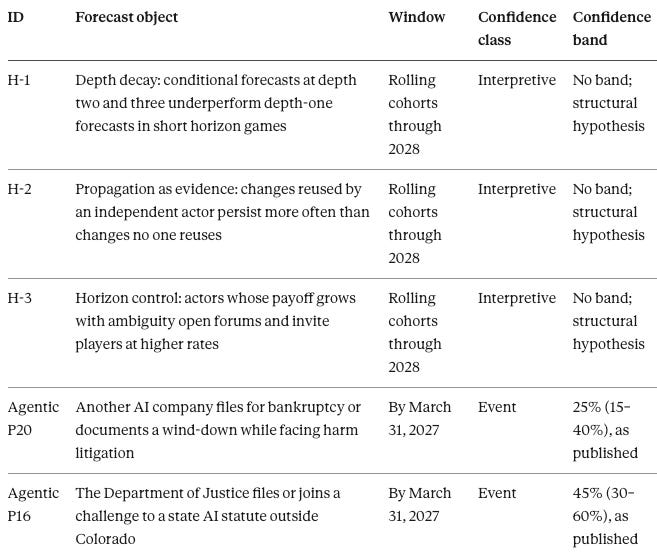
The installment is a Vision Statement. The figures below are structural hypotheses (H) and published MindCast forecasts quoted as source annotations; the installment issues no new odds.
Stakeholder readout.
🏛 Policymakers. A new AI liability statute or enforcement posture invites reversal if no other state or agency reuses it (H-2, Agentic P21). Draft model language and safe harbors before the 2027 sessions. A commissioned Snapshot fits once a bill clears committee, because the vote then replaces the game for every deployer in the state.
💼 Executives. Deployers that restructure contracts around one doctrine before any court applies it to an agent risk stranding (H-1, Agentic P6). Stage rollouts and key vendor allocation clauses to the first reasoned ruling. A private war game earns its cost when a deployer faces a renewal or vendor negotiation before March 31, 2027.
⚖ Counsel. Depth-three advice in this game blends four doctrinal games, so no single doctrine deserves a client’s full preparation (H-1, Agentic S2). Prepare each doctrinal route in parallel until the first reasoned ruling. A Cognitive Digital Twin build of the court, the carrier and the opposing deployer adds the most once a complaint names an enterprise deployer.
📊 Investors. Theses that need a specific depth-three game carry structural uncertainty the cited forecasts do not quantify (H-1, H-3). Hold positions keyed to the next fork through the 2027 renewal cycle. A Foresight Simulation becomes worth commissioning after the first reasoned ruling fixes which doctrine governs.
The agentic case supports clear moves now and deeper forecasts only after the first reasoned ruling on an agent. Readers who act on robust moves today keep every channel open while the doctrine forms.
Takeaway. Forecast depth follows supported transitions, not calendar distance, and strategy can move before depth arrives.
II. Agentic Liability Is a Short Horizon Game on Three Clocks
Agentic AI liability sits in a short horizon game because seven actor classes can still change its rules on three separate clocks. A bankruptcy, a federal intervention and a renewal cycle have already moved the board, and no court has yet applied a common-law doctrine to an agent.
II.A A Bankruptcy, a Federal Intervention and a Renewal Cycle Moved the Board
Common-law liability turns on who knew, who controlled and who authorized. AI agents split those answers across the developer stack, the deployer and the software permissions between them.
Three dated events have already moved the board. The Character Technologies filing on October 12, 2026 paused private suits through the automatic stay, while state enforcement may continue under the police-power exception in 11 U.S.C. § 362(b)(4). The Department of Justice intervention in xAI v. Colorado on April 24, 2026 opened a federal preemption route, and the renewal cohorts binding between December 2026 and March 2027 will show whether carriers write generative AI exclusions into standard commercial forms.
Confirmed facts and hypotheses stay separate throughout. The filings, dates and published bands are facts. The classification of each change as durable or transient is a hypothesis this installment frames and does not resolve.
II.B The Question Is How Far a Forecast Can Reach Before March 31, 2027
The installment answers one question: how far into a short horizon game can a forecast responsibly reach, and which moves stay useful past that point? The target system is the allocation of agentic AI liability among developers, deployers and carriers. The horizon runs from November 2026 through March 31, 2027, the resolution date of the worked case’s dated forecasts.
Outside scope: the merits of any pending complaint, and liability under non-U.S. regimes.
II.C Salience and Loss Aversion Decide When Actors Commit
Behavioral Economics supplies the decision rules that decide when actors commit. Salience inflates the perceived durability of a vivid first event, such as the first AI bankruptcy, and pushes actors toward over-commitment. Loss aversion inflates the perceived cost of committing too early and holds incumbents back. Reference points still move with each announcement in a short horizon game, so the tie between competing equilibria stays open at every fork.
II.D Doctrinal Transitions Leave the Deep Weights Unsupported
Dynamic Game Theory supplies the payoff structure and the logic of game replacement. A path probability is a weighted sum across the games that might govern the next step: the chance each candidate game exists times the chance of the path inside it. Depth compounds through a chain of such terms, and in the agentic case the weights deep in the chain rest on doctrinal transitions no court has yet shown.
P(path at fork k | history) = Σ over candidate games G [ P(game at fork k is G | history) × P(path | G, history) ]The weights matter only where the outcome differs across candidate games. A distant forecast can hold in an unstable game when its path is similarly likely in every candidate game, though that invariance removes neither error within a game nor games the model omits. The agentic tree’s third-order nodes fail the test, because each doctrine installs a different game with different defendants. The series introduction, The Calculus of Predictive Game Theory Evolution and Mutation, develops the full calculus.
II.E Seven Actor Classes Move on Three Clocks
Seven actor classes become Cognitive Digital Twins in the worked case. Each carries an objective, the constraints and decision rights that bound it, and the trigger that makes it update.
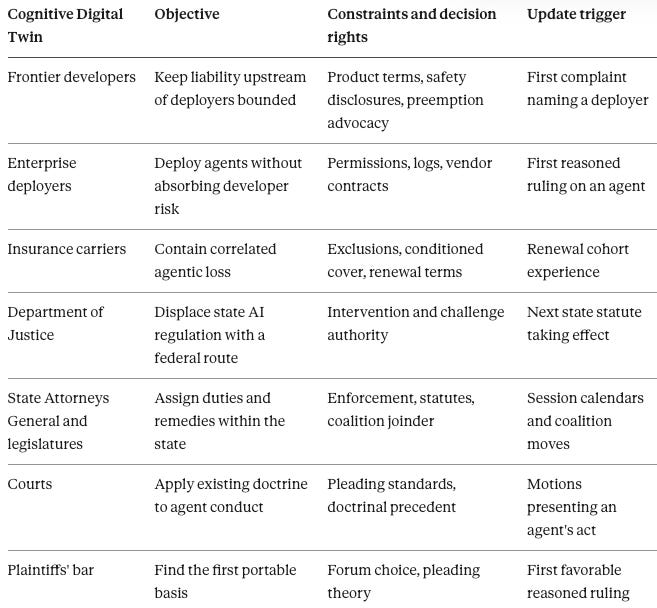
Three causal hypotheses frame the analysis. The game-replacement hypothesis holds that a ruling, statute or federal challenge installs a successor game. The adaptation hypothesis holds that renewal terms and contract allocations shift the game before any court acts. The null route holds that ordinary negligence governs and the competing duties stay latent until a large claim.
The analysis maps which game exists next, tests whether each dated event carries causal weight, reads coalition joinder and integrates the results. Branch re-formation analysis asks who will populate the game each branch installs. Forecasts the evidence does not support stay on the tree as labeled branches without numbers.
The case fits a short horizon analysis on every test. Rule-changing seats remain active, the population of deployers and carriers is still forming, and reference points move with each filing. A forecast here can responsibly reach the next fork and, where a named deployer defines it, one fork further.
Stakeholder callouts.
💼 Executives. Deployers whose agents act for customers sit inside this game today, whether or not a complaint names them. Inventory which agent actions bind the deployer before the December renewal cohort binds.
⚖ Counsel. The seven-actor table doubles as a discovery map, because each actor’s update trigger marks the filing that will change its conduct.
Takeaway. The worked case qualifies for analysis because seven named actor classes move on three clocks, and its governing question is about depth rather than outcome.
III. Bands Hold at Depth One, Conditionals at Depth Two and Open Structure Below
The hypotheses and trees rest on Snapshot Predictions already published for the worked case, quoted as source annotations. Bands appear only at depth one and where a named deployer defines the next game, and every deeper node states which game it awaits.
Hypotheses Date From November 2, 2026
Hypothesis date: November 2, 2026. Data cutoff: November 2, 2026. Source: the published agentic liability Snapshot for every quoted band.
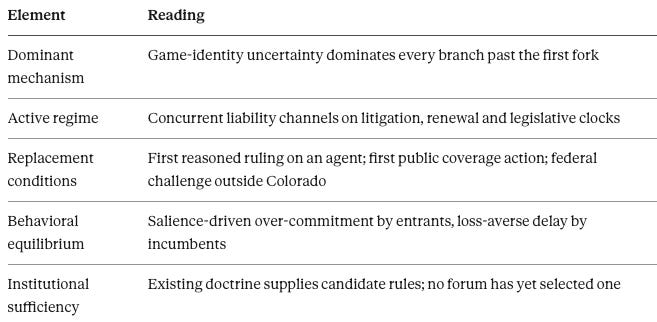
Game-Identity Uncertainty Dominates Past the First Fork
Four Concurrent Channels Leave the Current State
The tree uses only Snapshot Predictions already published in the worked case, so the figures are source annotations rather than new calls. The first layer shows concurrent channels rather than exclusive alternatives, because several can occur in the same window.
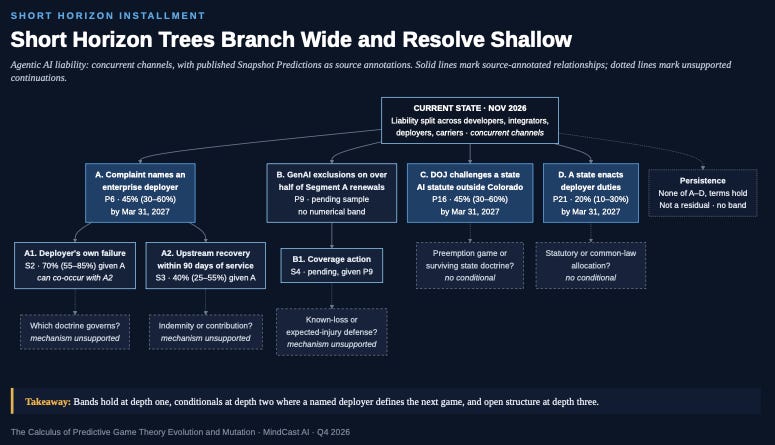
Figure 1. The short horizon tree for agentic AI liability: concurrent channels with source annotations
CURRENT STATE · November 2026
Liability allocation split across developers, integrators, deployers and carriers
Concurrent channels: any combination can occur in the same window
│
├─ Channel A. A complaint names an independent enterprise deployer
│     Source annotation: Agentic P6, 45% (30–60%) by March 31, 2027
│     Conditional outcomes given A (can co-occur, not alternatives)
│     ├─ A1. Complaint alleges the deployer's own permission, representation
│     │     or response failure
│     │     Source annotation: Agentic S2, 70% (55–85%), given A
│     │     └─ Which doctrine carries the claim: undertaking, imputed knowledge,
│     │           apparent authority or res ipsa? Mechanism unsupported. No band.
│     └─ A2. The named deployer takes a public upstream recovery step within 90 days of service
│           Source annotation: Agentic S3, 40% (25–55%), given A
│           └─ Contract indemnity or tort contribution? Mechanism unsupported. No band.
│
├─ Channel B. Generative AI exclusions on over half of Segment A renewals
│     (standard commercial forms)
│     Source annotation: Agentic P9, no numerical band; pending the renewal sample
│     └─ B1. A carrier files a coverage action over agentic loss
│           Source annotation: Agentic S4, pending, given P9
│           └─ Known-loss or expected-injury defense? Mechanism unsupported.
│
├─ Channel C. The Department of Justice challenges a state AI statute outside Colorado
│     Source annotation: Agentic P16, 45% (30–60%) by March 31, 2027
│     └─ Federal preemption game or surviving state doctrine? No conditional issued.
│
├─ Channel D. A state enacts deployer duties beyond disclosure
│     Source annotation: Agentic P21, 20% (10–30%) by March 31, 2027
│     └─ Statutory or common-law allocation for the next claim? No conditional issued.
│
└─ Persistence condition: none of A to D occurs and renewal terms hold
      Not a residual. A probability here requires joint-event information that
      no published source supplies. Competing duties stay latent until a large claim.
Four concurrent channels leave the current state, and three carry numerical bands. Channel B awaits its renewal sample. The persistence condition stays on the tree as a live outcome without a band, because its probability depends on how the channels correlate.
Channel A carries two published conditionals because a complaint against a deployer defines its own next game. A1 and A2 can occur together, so each reads as a conditional outcome given A. Channels C and D carry no conditional: the source supplies no support for weighting a federal game against surviving state doctrine.
Every third-order node asks which game governs rather than which outcome occurs. The first reasoned ruling applying a common-law doctrine to an agent will supply a potentially portable basis among voluntary undertaking, imputed knowledge, apparent authority and res ipsa loquitur. The ruling’s influence depends on jurisdiction, facts and later adoption.
Origin and Durability Are Separate Questions
Every change in a short horizon game raises two questions that analysis tends to merge. Origin asks how the change arose: through ordinary game evolution, or as a game mutation that the existing structure did not anticipate. Durability asks whether the resulting arrangement continues to govern later choices.
The two questions vary independently. A single exceptional event can install a durable successor game, and an ordinary reform can unravel within a cycle. An analyst’s surprise alone does not establish mutation, because a surprising move may come from a route the model omitted.
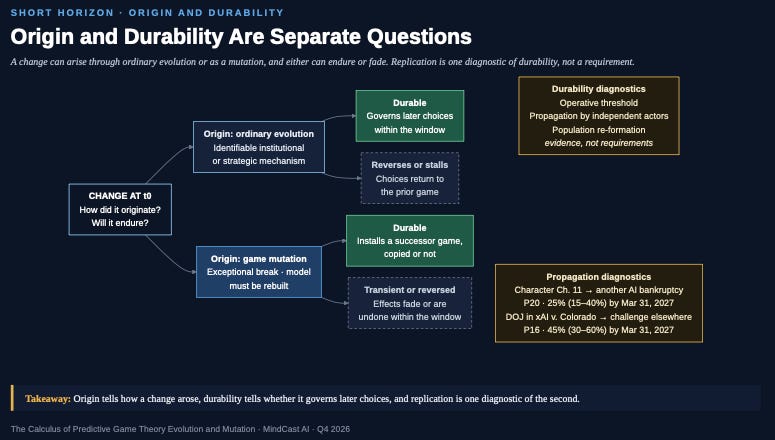
Figure 2. Origin and durability as separate dimensions of a change
CHANGE AT t0
│
├─ Origin: ordinary game evolution (identifiable institutional or strategic mechanism)
│     ├─ Durable: governs later choices within the decision window
│     └─ Reverses or stalls: later choices return to the prior game
│
└─ Origin: game mutation (exceptional break; the operative model must be rebuilt)
      ├─ Durable: installs a successor game, whether or not anyone copies it
      └─ Transient or reversed: effects fade or are undone within the window

Durability diagnostics (evidence, not requirements)
  Operative threshold: a binding act or commitment one actor cannot easily reverse
  Propagation: independent actors reuse the change on their own payoffs
  Population re-formation: stakeholders exit, enter or realign, and the waves subside

Worked propagation diagnostics, source annotations
  Character Technologies Chapter 11 filing, October 12, 2026
    → Agentic P20: another AI company bankruptcy or wind-down amid harm litigation
      25% (15–40%) by March 31, 2027
  Department of Justice intervention in xAI v. Colorado, April 24, 2026
    → Agentic P16: the Department files or joins a challenge outside Colorado
      45% (30–60%) by March 31, 2027
Replication supplies evidence that a change may propagate, while institutional durability determines whether the change supports a longer forecast horizon. How Mozart Predicts Game Mutation in Predictive Behavioral Economics + Dynamic Game Theory frames durability in structural terms: whether a change crosses an operative threshold and shapes later strategy.
The two worked diagnostics read differently. The 25% band on a second AI bankruptcy says propagation of the bankruptcy route is less likely than not, yet says nothing about whether the Character Technologies filing itself endures for its own claimants. The 45% band on a second federal challenge sits close to even, and a diagnostic near even carries the most information about whether federal intervention propagates.
Durability also shows in who remains on the board. Branch re-formation analysis asks which stakeholders stay, leave or switch sides after each change. The lineage runs to Albert Hirschman, who showed that members of a declining organization choose between exit and voice; MindCast applies the same logic to rulings and rules.
III.A Three Primary Hypotheses Test Depth, Propagation and Horizon Control
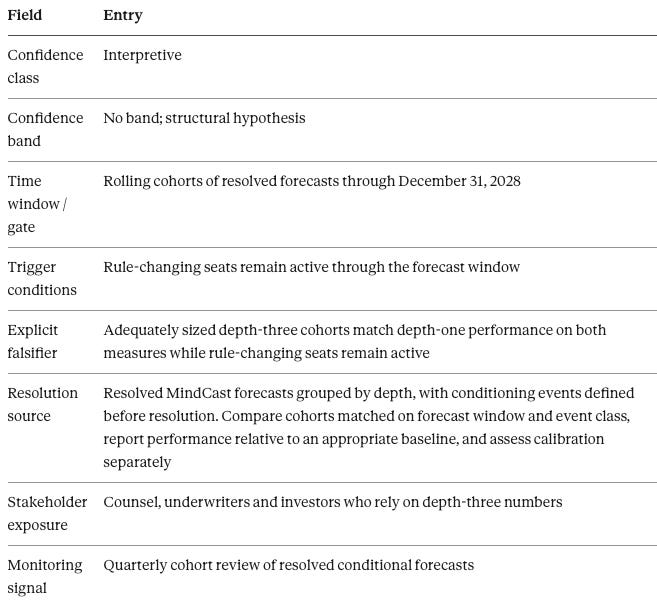
H-1 | Depth decay in short horizon games
Statement: Across cohorts of short horizon forecasts, conditional forecasts at depth two and three show worse calibration and worse accuracy under proper scoring rules than depth-one forecasts.
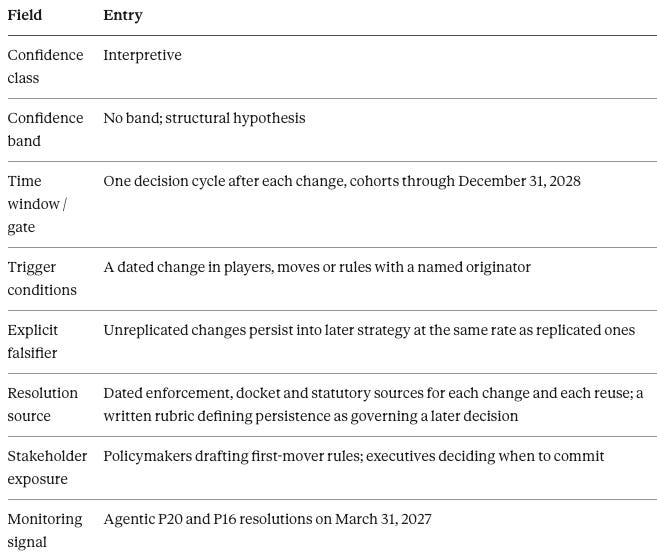
H-2 | Propagation as evidence of durability
Statement: Changes reused by an independent actor within one decision cycle persist into later strategy more often than changes no one reuses, holding origin constant.
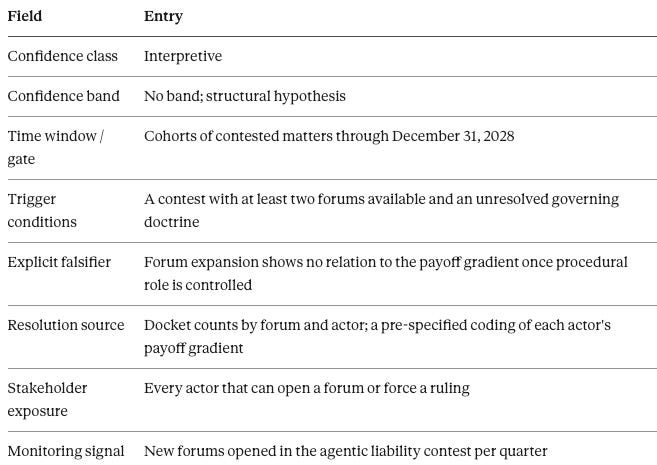
H-3 | Horizon control
Statement: Actors whose payoff grows with ambiguity open new forums or invite new players at higher rates than actors whose payoff grows with predictability, after controlling for procedural role.
III.B Two Secondary Hypotheses Test Commitment Timing and the Crossing
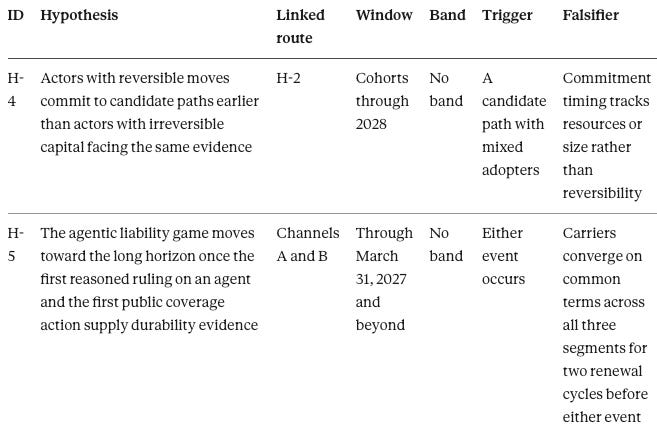
III.C Coverage and Persistence Remain Watch Conditions
Two published forecasts gate the hypotheses rather than resolve them. Agentic P9 and S4 remain pending the renewal sample, so the coverage channel stays a contingent watch condition. The persistence condition stays unbanded until a source supplies joint-event information.
III.D Federal Preemption Would Shift the Tree Without Falsifying It
The hypotheses rest on cohort evidence that does not yet exist at adequate size. A single rule change, such as federal preemption of state AI statutes, would collapse several channels into one game and shift the tree without falsifying H-1 to H-3. The commitment threshold in Section V.B uses a simplified two-action, two-state loss model; the fuller timing condition with rival preemption appears in Section V.D of The Calculus of Predictive Game Theory Evolution and Mutation.
The tree and hypotheses together show where the forecast stops and why. Depth one carries published bands, depth two carries conditionals only under Channel A, and depth three waits on the first reasoned ruling. Each hypothesis names the cohort evidence that would prove the pattern wrong.
Stakeholder callouts.
⚖ Counsel. Channel A’s conditionals give the clearest guidance available, because a complaint naming a deployer defines its own next game. Prepare deployer clients now for allegations of their own permission, representation or response failure.
💼 Executives. Carriers writing the December to March renewals hold the one channel without a band. Carriers that test exclusions against their own book first set the terms others follow.
📊 Investors. The persistence condition carries no band because channel correlations remain unknown. Treat a quiet board as unmeasured exposure rather than safety.
Takeaway. The tree supports bands at depth one, conditionals at depth two where the next game is defined, and open structure at depth three. The hypotheses state what would prove that pattern wrong.
Commissioned Runs Test One Organization’s Commitments
Published analysis cannot tell a specific deployer, carrier or developer which of its own commitments to make now and which to hold. The answer depends on that organization’s cost of committing too early, its cost of waiting too long, and its exposure on each channel.
A commissioned engagement builds Cognitive Digital Twins of the organization and its counterparties from its own decision history. MindCast then reruns the agentic liability board against the organization’s actual options, risk tolerances and contract positions.
Commissioned scope adds what the public text withholds. Complete scenario trees and P10/P50/P90 ranges come with organization-specific calibration. Decision thresholds keyed to each channel feed a monitoring dashboard. A Strategy and Risk Simulation Snapshot or an interactive war game can deliver the first module within weeks.
The bounded next step is a diagnostic session on one live decision, set out in Working With MindCast at the end of this installment.
A commissioned run replaces the public tree’s open nodes with the organization’s own inputs. The engagement fits best when a decision falls due before the first reasoned ruling and the organization’s cost of waiting differs from the public case.
IV. Each Stakeholder’s Best Move Stays Right on Several Channels
Each stakeholder in the agentic game faces the same constraint: no current evidence says which doctrine will govern the next claim. The moves below stay useful on several channels at once, and the triggers name the dated events that justify shifting from robust moves to committed ones.
Low-Regret Moves Now and Triggered Moves Later
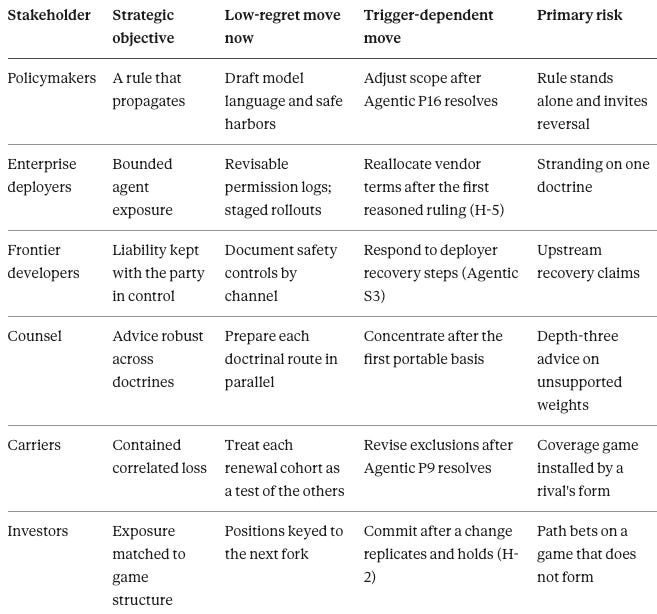
Six Stakeholders Hold Different Levers on the Agentic Board
Policymakers. A new statute or enforcement posture opens a fork whose durability stays uncertain until it governs later choices. Legislators who want a rule to propagate should design for replication: model language, interstate compacts and clear safe harbors lower the cost for the second adopter. A rule that no one copies may still endure, yet it carries less evidence of durability and more exposure to reversal.
Enterprise deployers and executives. The commitment threshold should be set explicitly before a board meeting rather than discovered during one. Staged rollouts, revisable permission logs and vendor clauses keyed to the first reasoned ruling each lower the cost of committing early. Agentic P6 and S2 mark the exposure: a complaint naming a deployer and alleging its own response failure.
Frontier developers. The developer’s leverage lies in documentation that maps each control to a channel. A deployer named under Agentic P6 may seek upstream recovery under S3, so contract terms and safety disclosures should anticipate the recovery claim before it arrives.
Counsel. The first reasoned ruling applying a common-law doctrine to an agent is among the most consequential events on the board. The ruling supplies a potentially portable basis whose influence depends on jurisdiction, facts and later adoption.
Counsel advising deployers should prepare each doctrinal route in parallel. Counsel advising plaintiffs should expect the basis more than the outcome to determine whether a win travels.
Insurers and underwriters. The renewal clock gives carriers the first stabilizing move on the board. An exclusion written into a standard commercial form installs a coverage game before any court acts, while conditioned affirmative cover installs a different one. Agentic P9 resolves against the renewal sample.
Investors. Short horizon games reward options and penalize path bets. A thesis that requires a specific depth-three game carries structural uncertainty that the cited forecasts do not quantify. Positions keyed to the next fork, with exits tied to propagation diagnostics, match the structure of the game.
Exposure Shifts From Doctrine to Coverage to Federal Replacement
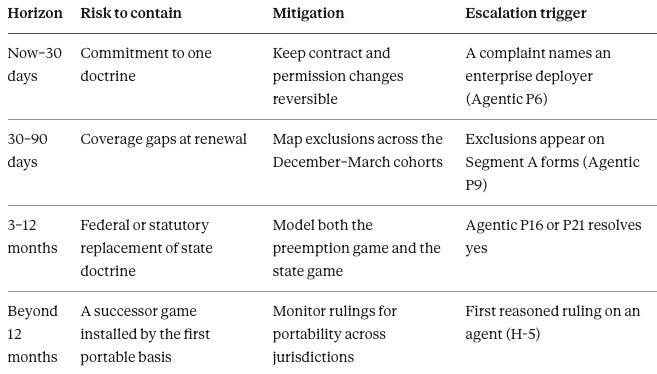
Five risk classes apply. Strategic risk arises when a counterparty adapts faster than the move. Institutional risk arises when authority shifts to a federal forum. Legal and policy risk arises from new statutes, market risk from carrier terms, and operational risk from logs that become notice.
The matrix, postures and time gates converge on one discipline. Make the moves that survive every channel now, and hold the committed moves for the events that define the next game. The time-gate table converts that discipline into dates.
Takeaway. Each stakeholder’s best move in the short horizon is the one that stays right on several channels.
V. Options and Framing Earn the Short Horizon Return
The implications follow from the hypotheses and the strategy matrix rather than adding new forecasts. Institutions, counterparties and value all shift once horizon control and the commitment threshold enter the analysis.
V.A Federal and Carrier Moves Decide Which Institution Names the Game
Horizon control reshapes which institution names the game. Regulators, plaintiffs, carriers and frontier labs each hold moves that make the game more or less predictable at different costs. A federal challenge under Agentic P16 seeks to stabilize the game at the national level by removing state doctrine as a rule-changing seat. Carriers move first on the renewal clock because an exclusion written into a standard form stabilizes their side of the board before any court acts.
Frontier labs hold the clearest published lever. The Attorney General Snapshot reads a lab named within twelve months at 40% without intervention and 20% if the lab adopts the pleaded conduct terms before any order.
V.B Cost Ratios Explain Why Actors Commit at Different Times
The commitment threshold explains why actors move at different points on the same evidence.
Simplified two-action, two-state loss model

Commit when  P(durable | evidence)  >  C_over ÷ (C_over + C_under)

C_over  = loss from committing to a change that does not endure
C_under = loss from waiting on a change that does endure
An actor whose moves are reversible carries a low cost of over-commitment, so its threshold sits low and it can act on thinner evidence. An actor whose capital is irreversible needs stronger evidence of durability before acting. The model omits staged moves, option value and rival preemption. A fuller condition adds preemption: wait only while the falling error of committing exceeds the combined marginal cost of delay and of a rival moving first, so a faster rival shortens the wait.
Behavioral Economics predicts the systematic misses. Salience pushes entrants past the threshold too early after a vivid first event, and loss aversion holds incumbents back too long. A Cognitive Digital Twin carries each actor’s documented history, so a firm whose last bet stranded will wait longer than its cost ratio alone predicts.
V.C First-Come Channels Reverse the Preference for Options
Options and framing capture value in the short horizon. An option tends to be worth more than a commitment, because the commitment pays on one candidate game while the option pays on several. First-come channels reverse the rule: interconnection queues, lead-plaintiff races and coalition leads reward the early mover before any rule stabilizes. An actor who frames the governing question before the first reasoned ruling shapes which doctrine becomes portable, and portability influences which game later claims enter.
Durability is partly chosen. An actor who benefits from a change can recruit a second adopter or supply the portable basis that lets the change travel. Attorney General coalitions show the pattern: lead offices build the file, a bridge state signals that the theory travels, and remaining offices join as the cost of joining falls.
V.D Each Falsifier Names the Strategy That Changes
If H-1 fails, deeper conditional forecasts in short horizon games deserve more weight than this installment gives them, and the disclosure discipline of forecasting to the next fork would loosen. If H-2 fails, reduce the diagnostic weight of replication while retaining the other durability tests. If H-5 fails because carriers converge on terms before any ruling, the coverage channel stabilized the game first, and the long horizon arrives through contract rather than doctrine.
The short horizon return goes to actors who keep options open and frame the governing question early, except in first-come channels where the early mover wins. Each falsifier marks the point at which that advice would change.
Stakeholder callouts.
🏛 Policymakers. Federal preemption and carrier exclusions can each stabilize the board before any state acts. States that want their doctrine to govern need to move before the renewal cohorts bind.
📊 Investors. In first-come channels such as interconnection queues and coalition leads, waiting for rule clarity forfeits position. Secure position before any queue or lead-status deadline where the first-come rule applies.
⚖ Counsel. The first portable basis will shape later claims across jurisdictions. Framing the governing question in early briefs carries more weight than winning the first outcome.
Takeaway. Every implication traces to a hypothesis or a published forecast, and each falsifier names the strategy that changes if it fires.
What to Watch: Five Signals Decide Whether the Agentic Tree Stabilizes
Five signals decide whether the agentic tree stays short or begins to stabilize. Each links to a hypothesis or published forecast and names the source and cadence for checking it.
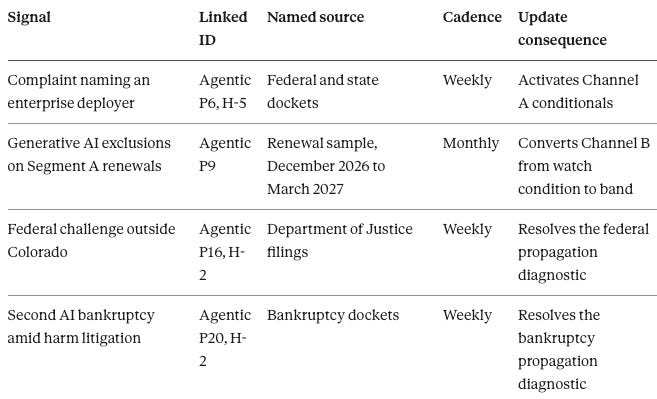
Revisions retain the original language, class, window and falsifier of every hypothesis and quoted forecast. Each revision states the new observation, the field changed and the hypotheses affected, and distinguishes an update from a new forecast.
The first reasoned ruling on an agent outranks the other four signals, because it decides which doctrinal game later claims enter. Revisions keep every original statement intact and state only what changed.
Stakeholder callouts.
⚖ Counsel. Docket alerts on the first complaint naming an enterprise deployer give clients the earliest notice that Channel A has activated.
💼 Executives. The renewal sample through March 2027 shows whether exclusions have become standard on commercial forms. Revisit coverage terms the month the sample reports.
Takeaway. Five signals decide whether the agentic tree stays short or begins to stabilize.
Conclusion: The First Reasoned Ruling on an Agent Opens the Path to Depth
A forecast reaches only as far as the game at each downstream fork is known. The agentic liability tree makes the boundary visible: published bands at depth one, conditionals at depth two where a named deployer defines the next game, and open structure at depth three where four doctrines compete. The short horizon reflects no failure of analysis; shallow resolution tends to mark any game whose rule-changers still hold live moves.
Stakeholders act now on moves that stay right across channels and wait to learn which change endures. The decisive signal is the first reasoned ruling applying a common-law doctrine to an AI agent, together with the first public coverage action over agentic loss. Predictive Game Theory Evolution and Mutation — Long Horizon Games Resolve Deep Because Their Branches Hold follows the same calculus into games whose rules have begun to hold, with Bank of America enforcement and data center authorization as the worked trees.
Working With MindCast
MindCast AI is a Predictive Game Theory Modeling-Simulation firm. MindCast builds Cognitive Digital Twins of the named actors on a client’s board and models how the game evolves through its next forks. Both run through Vision Functions, the modular game-theoretic modules inside Predictive Behavioral Economics + Dynamic Game Theory.
What MindCast can do
Cognitive Digital Twin builds of counterparties, regulators and courts, plus carriers and coalitions. Each is calibrated from public conduct and the client’s own decision history.
Strategy and Risk Simulation Snapshots for short horizon matters: odds in tens at the current fork, conditional downstream paths, and strategy and risk per path within five business days.
Foresight Simulations for stabilizing matters: published bands at depth two and three, P10/P50/P90 ranges, complete scenario trees and organization-specific calibration.
Interactive war games that let a client’s team play its own moves against modeled opponents across dated forks.
Commitment-timing and horizon analysis that applies MindCast’s commitment-timing, forecast-survival and structural-uncertainty calculations to a client’s own costs, rivals and deadlines.
Monitoring dashboards keyed to the dated signals in each What to Watch table.
When an engagement adds the most on agentic liability
A deployer or carrier faces a renewal, vendor negotiation or contract restructuring before March 31, 2027.
A complaint names an enterprise deployer, and counsel needs the court, the carrier and the opposing parties modeled together.
A bill assigning deployer duties clears committee in a state where the client operates.
A frontier developer weighs adopting pleaded conduct terms before the next coalition filing.
How engagements begin. A complimentary Snapshot runs on publicly available information. Private engagements proceed after a nondisclosure agreement and retainer, starting with a diagnostic session on one live decision.
Contact: mcai@mindcast-ai.com · Corporate site: www.mindcast-ai-simulation.com
Appendix A. Selected MindCast Works
The series
The Calculus of Predictive Game Theory Evolution and Mutation. Series introduction: the governing calculus, mathematical core, academic foundations and case matrix.
Predictive Game Theory Evolution and Mutation — Long Horizon Games Resolve Deep Because Their Branches Hold. Long horizon installment, with Bank of America and data center authorization as the worked trees.
Frameworks and prior analyses
Dynamic Predictive Game Theory: From Nash Equilibrium to Adaptive Coherence Equilibrium. Supplies equilibrium selection, delay dominance and the failure modes of Adaptive Coherence Equilibrium.
How Mozart Predicts Game Mutation in Predictive Behavioral Economics + Dynamic Game Theory. Frames when a structural change crosses an operative threshold.
When AI Agent Liability Meets Common Law and Statute: Predictable Doctrines, Unsettled Allocation. Source of every quoted band on the agentic liability trees.
OpenAI State Attorney General Lawsuits: Two Pleading Templates Across Ten State Courts. Source of the published odds shift on adopting pleaded conduct terms.
MindCast Prediction Scorecard. Resolved material calls as of October 31, 2026.
Appendix B. External Sources
Newshook
AI Weekly, Character.AI Files Chapter 11; Disney Bids $20M for IP License. Reports the October 12, 2026 Delaware filing.
Bloomberg Government, AI Media Maker Files Bankruptcy With $20 Million Disney Bid, October 13, 2026. In re Character Technologies, Inc., No. 26-11603 (Bankr. D. Del.).
Primary sources
U.S. Department of Justice, Justice Department Intervenes in xAI Lawsuit Challenging Colorado’s Algorithmic Discrimination Law, April 24, 2026. The federal preemption route.
11 U.S.C. § 362. The automatic stay and its police-power exception.
PPC Land, Automatic stay. Character Technologies’ motion to enforce the stay.
Academic foundations
Albert O. Hirschman, Exit, Voice, and Loyalty: Responses to Decline in Firms, Organizations, and States, Harvard University Press (1970).
Albert O. Hirschman, Exit, Voice, and the Fate of the German Democratic Republic: An Essay in Conceptual History, World Politics 45, no. 2 (January 1993): 173–202.