
Executive Summary
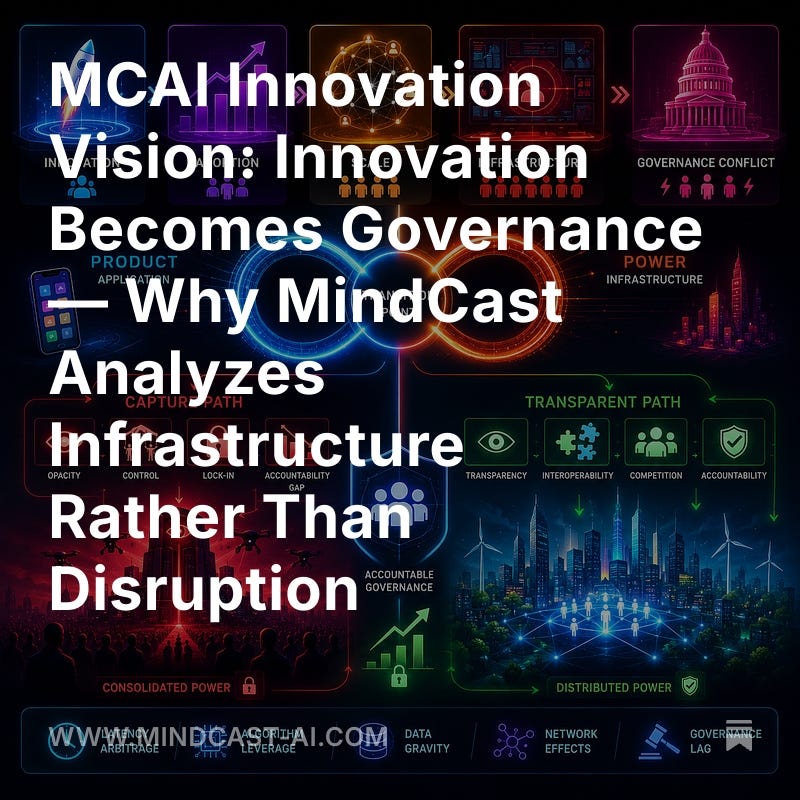
Scale converts products into governance systems, and public debate consistently arrives after the conversion completes. Transformative technologies enter markets as applications, accumulate dependents, and become coordination infrastructure before any regulator names the transition. Early narratives describe convenience, democratization, disruption, and consumer empowerment. Institutional conflict surfaces only later, once markets recognize that the technology now controls distribution, attention, labor coordination, information routing, pricing visibility, or behavioral feedback.
MindCast AI is not neutral, and the framework states its commitment plainly. MindCast holds no position on whether a given technology is desirable, and it holds a firm position on how power should form: transparent equilibrium formation is preferable to opaque control architecture. The evaluative axis is structural, not technological. A diagnosis of “capture-oriented” is therefore a normative judgment against opacity and unaccountable routing power, not a verdict on innovation itself. The relevant variables are equilibrium formation, information architecture, governance latency, and infrastructure capture. Napster, YouTube, Uber, Airbnb, TikTok, OpenAI, Compass, and Kalshi each traced a variation of one structural trajectory, and product narratives obscured the emergence of hidden infrastructure power in every case.
Six prior MindCast publications carry the analytical weight of this paper, and four of them supply framework primitives.
The Computational Era Operationalizes Cybernetics and Predictive Game Theory is the keystone: it establishes the analytical category this paper operates inside — modern institutions as recursive cybernetic game systems — and supplies the break condition that governance latency exploits, the point at which constraint stability decays faster than actor adaptation speed.
The Dual Nash-Stigler Equilibrium Architecture supplies the equilibrium primitive — the distinction between genuine strategic settlement and pseudo-equilibrium sustained by institutional capture — that lets “capture-oriented” function as a formal classification rather than a label.
Chicago School Accelerated integrates Coase on coordination cost, Becker on incentive exploitation, and Posner on institutional learning failure into one system, and the Posner prong supplies the mechanism behind governance latency: a slow correction loop is a wicked learning environment.
Prestige Markets as Signal Economies supplies the Signal Suppression Equilibrium model, which formalizes the accountability gap directly: opacity and fragmented information suppress early warning signals until an external aggregator forces exposure, making governance failure a signal-architecture problem rather than an ethical one.
Two further publications supply timestamped corpus validations — live disputes the present paper interlocks with rather than abstract sources.
The MindCast MLS Equilibrium Series grounds the infrastructure-sovereignty thesis in the Compass litigation complex, where the operative question is equilibrium selection — which market architecture governs residential real estate — rather than any single listing dispute.
Kalshi and the Ninth Circuit Stay Denials anchors the prediction-market analysis and demonstrates the mixed pathway directly: a pending federal rulemaking moves to co-architect a market category while litigation fragments across state forums.
One transition point recurs across every major computational platform: the moment a product stops behaving like an application and starts behaving like institutional infrastructure. MindCast analyzes that point. The analysis carries a falsification contract, stated in Section XIV, and a dated measurement window against which the central prediction can be verified or defeated.
I. The Governing Structure
Infrastructure power forms when private routing systems mature faster than public governance systems can respond. The entire framework of this paper compresses into that sentence: every section that follows traces a consequence of the speed differential between a platform’s iteration cycle and an institution’s correction cycle.
Structural significance begins when adoption changes coordination behavior across an entire system, not when a product feels novel. A technology crosses into infrastructure status once other actors become dependent on its routing logic, visibility rules, recommendation systems, pricing systems, or feedback architecture. Dependency, not popularity, marks the threshold.
Most public analysis stops short of that threshold. Analysts debate whether a technology feels disruptive, ethical, or politically desirable while the consequential transition runs underneath the debate. Scale transforms software into governance, and the transformation completes whether or not anyone narrates it.
MindCast models institutions as cybernetic systems and focuses on the transition layer where control consolidates. A search engine becomes attention infrastructure. A cloud provider becomes runtime infrastructure. A brokerage platform becomes inventory-routing infrastructure. A prediction market becomes informational-financial infrastructure. Governance conflict follows the transition as a matter of structure, not sentiment.
II. Latency Arbitrage
Capture-oriented platforms run an arbitrage: they exploit the price gap between how fast a routing system can move and how slowly a governance system can respond. Governance latency is the harvested resource. The Feedback Latency Index measures the delay between an institutional signal and an institutional response, and that delay is not a passive gap. The interval between infrastructure formation and governance recognition is precisely the window in which routing power consolidates beyond reversal.
Capture does not require defeating regulators. Capture requires only outrunning them. A platform that reaches majority-market dependency before the governance system completes its update inherits a structural position that later enforcement cannot dislodge, because enforcement now operates against an equilibrium the market already treats as normal. The mechanism has a formal statement in the MindCast corpus: prediction and control both break when the stability of a system’s governing rules decays faster than the actors inside it adapt. Latency arbitrage is that inequality turned into a strategy — the platform widens the gap between its own adaptation speed and the governance system’s correction speed, then operates inside the gap.
The product narrative is the mechanism that extends the latency. Convenience framing suppresses governance response during the exact window when intervention remains cheap. Product framing therefore functions as a latency-extension tool, deliberate or not, and the firms that benefit most from extended latency have the least incentive to shorten it. MindCast treats the duration of that window as a measurable variable rather than an accident of slow institutions.
The arbitrage runs across five variables, each pairing a fast platform dynamic against a slow institutional one:
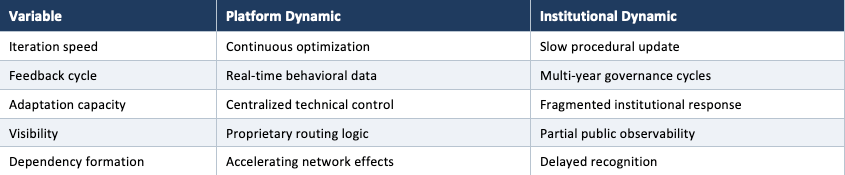
Table 1. The latency-arbitrage variable pairs.
Every row is a speed gap, and the platform harvests all five at once. Governance conflict begins only when institutions recognize that the platform has stopped behaving like a product.
III. Napster and the First Digital Equilibrium Shock
Napster collapsed the transaction costs of digital music distribution, and the collapse mattered far more than the threat to record labels. Consumers no longer needed physical inventory, retail stores, or bundled albums to reach individual songs. Music shifted from scarcity economics toward infinite-copy economics within a single product cycle.
Napster ran the full transition cycle in compressed form, which is why it serves as the paper’s first specimen. A free file-sharing tool was the Product Phase; explosive adoption was the Scale Phase; the moment the music industry’s distribution depended on the architecture Napster proved was the Infrastructure Phase; the litigation was the Governance Phase. The cycle that later platforms run over a decade, Napster ran in roughly two years — fast enough that the entire arc is visible in a single view, slow enough that each phase is distinct.
Copyright enforcement could not restore the prior equilibrium because the architecture underneath the equilibrium had already changed. Litigation defeated Napster as a company while validating the distribution model Napster proved. Streaming platforms then rebuilt the music industry around the behavioral expectations Napster had revealed.
Napster lost legally and won structurally — and the inversion is a general law, not a Napster-specific irony. Enforcement against a first mover stabilizes the new equilibrium for the second mover. Litigation removes the firm, certifies the architecture, and clears the field for a better-capitalized successor. Spotify and Apple Music became the stabilized equilibrium because Napster had already absorbed the legal cost of proving the model. The law recurs throughout the paper: it reappears in the Compass litigation of Section VIII and shapes the Kalshi forecast, because enforcement against an architecture’s first occupant is the most reliable way to certify the architecture for whoever comes next.
A pure anti-innovation frame would have tried to preserve the old equilibrium indefinitely; a pure techno-libertarian frame would have ignored licensing and compensation entirely. Structural analysis produced the correct forecast instead: digital distribution would survive, and governance would reorganize around lower-friction licensing systems.
Contact mcai@mindcast-ai.com to partner with us on Predictive Game Theory AI in Law and Behavioral Economics. To deep dive on MindCast work in Cognitive AI upload the URL of this publication into any LLM (preferably Google AI mode) and prompt ‘reconstruct MindCast framework with three degrees of cited sub links.’ See Live-Fire Game Theory Simulators, Runtime Predictive Infrastructure.
IV. YouTube and the Moderation Transition
YouTube began as a place to put a video and became the system that decides which videos a billion people see. The shift is the whole section. Scale transformed YouTube from a video-hosting product into behavioral infrastructure: recommendation systems amplified engagement patterns across billions of viewing decisions, and monetization systems rewarded specific forms of emotional intensity, narrative structure, and retention behavior. Hosting a video is storage. Deciding which video plays next is governance. YouTube crossed from the first to the second without ever announcing the crossing.
The crossing matters because of what YouTube routes. Napster routed files — a resource with edges, a thing a user requested by name. YouTube routes attention, which has no edges and which the user does not request by name. A viewer does not ask for the next video; the recommendation system selects it, and the selection shapes what the viewer attends to next. Allocation of attention is the first purely informational routing function in the paper’s sequence, and it is the conceptual midpoint between routing a physical resource and routing cognition itself. A recommendation system is not a library a user searches; it is an editor a user does not see.
The copyright conflict shows the transition completing on one axis. Mass infringement was the first institutional challenge YouTube faced, and the Viacom litigation was the Governance Phase arriving to meet it. The conflict resolved — but the resolution is the structural point. YouTube did not settle the copyright fight by submitting to an external rule; it built Content ID, an automated rights-routing system that now adjudicates billions of claims without a court touching most of them. The platform under governance pressure constructed the governance mechanism and kept it private. Resolution arrived as infrastructure capture: YouTube became the rights-adjudication layer for its own ecosystem, and the settled equilibrium is a privately-held court.
Moderation is the axis that does not resolve, and the non-resolution is a category rather than a failure. Music distribution reached a stable end-state because licensed streaming is a technical equilibrium — a configuration the system settles into and stays. Moderation has no equilibrium, because “correct visibility allocation” is a contested value, not a technical state. Governments, advertisers, civil-society groups, and the user base hold incompatible definitions of correct, and no configuration satisfies all of them. YouTube therefore demonstrates a transition that reaches the Governance Phase and remains there permanently — a permanent-negotiation equilibrium, distinct from the settled equilibrium Napster reached. The transition cycle does not always terminate; some cases stabilize inside the Governance Phase rather than passing through it.
The open axis carries a falsification contract like any forward claim in this paper. By the end of 2027, observe whether moderation governance has moved toward statutory codification — binding national rules on algorithmic visibility — or has stayed inside platform discretion administered through private policy. The framework predicts the latter: permanent-negotiation equilibria resist codification precisely because the underlying value is contested, and a legislature cannot codify a definition it cannot agree on. Durable statutory moderation standards governing recommendation systems, enacted and surviving challenge within the window, would falsify the permanent-negotiation classification and indicate that moderation has a reachable end-state after all.
YouTube established the pattern every later platform repeats. A platform launches under a neutral-infrastructure narrative — a host, a marketplace, a tool. The recommendation or routing layer matures. Allocation becomes the real product. Institutional conflict arrives to govern the allocation, and the platform discovers it is no longer arguing about its product but about its power. Social media ran the pattern faster and AI inference will run it deeper, but YouTube ran it first and ran it visibly — resolving one axis into private infrastructure and freezing the other inside permanent negotiation.
V. The Ride-Sharing and Housing Transition
Uber and Airbnb ran the same transition through different sectors. Uber reduced dispatch friction, collapsed taxi-search costs, and moved urban transportation toward algorithmic coordination, after which regulatory conflict gathered around labor classification, surge pricing, insurance allocation, and municipal licensing authority.
The transition had a human cost with a number attached. A taxi medallion was, for a generation of drivers, a retirement asset — a license bought for six figures on the understanding that a city-regulated equilibrium would hold long enough to recover the investment. Uber dissolved that equilibrium faster than any institution responded, and medallion values collapsed toward a fraction of what drivers had paid. The loss fell on the people with the least capacity to exit, during the exact latency window the convenience narrative kept open. Governance latency is not an abstraction at that scale; it is a driver holding a depreciated license while the institution that licensed it works out what happened.
Airbnb converted residential housing inventory into quasi-commercial hospitality infrastructure. Local governments first read Airbnb as occasional home sharing, and scale then revealed a different reality: housing stock, neighborhood economics, tourism density, and rental supply all shifted under platform incentives. Consumer-convenience narratives concealed infrastructure transformation in both cases, and the concealment bought years of governance latency.
VI. Social Media and Behavioral Infrastructure
Facebook and TikTok completed a transition the earlier cases only began: the move from a platform that routes a resource to a platform that predicts and shapes the behavior of the people using it. Napster routed files and YouTube routed videos, but the user’s behavior remained the user’s own. Social media closed that gap. Early narratives emphasized connection, creativity, democratization, and entertainment — Product Phase vocabulary — while platform economics optimized around engagement capture, recommendation precision, emotional amplification, and attention retention. Behavioral feedback loops became the actual product, and the stated product became the surface the loops ran underneath.
The mechanism is the feedback loop, and its speed is the variable that matters. A recommendation system observes a behavior, serves content in response, observes the reaction, and adjusts — a closed loop running continuously. The tighter the loop, the more the system shapes rather than merely serves. TikTok demonstrated the strategic weight of low-latency behavioral capture: faster recommendation adaptation closes the loop more tightly, and a tighter loop exerts more control over identity formation, emotional reinforcement, trend propagation, and informational visibility. A platform that closes the loop in seconds is not distributing content to a population; it is running a continuous experiment on it.
The behavioral loop is also where the accountability gap first became visible to the public. A user cannot observe the recommendation logic, cannot meaningfully exit a platform where their social graph lives, and cannot appeal an allocation of visibility to any body with a complete mandate over it — the three suppression conditions of Section XI, present in a consumer product a decade before the vocabulary existed to name them. Social media is where a generation first encountered an algorithmic governor, and encountered it without recognizing the encounter as governance.
Scale then converted the behavioral loop into a sovereignty question. Once a recommendation system shapes identity formation and informational visibility for a national population, the system is no longer a media product; it is infrastructure that determines what a country’s citizens see, believe, and attend to. Governments recognized the implication unevenly and late, but they recognized it: a foreign-operated low-latency behavioral system is a foreign-operated influence over the domestic information environment. Attention infrastructure became geopolitical infrastructure once the loop closed faster than national institutions could respond — and the governance conflict that followed, fragmented across data-localization rules, forced-divestiture demands, and outright bans, is the Governance and Sovereignty phases of the cycle arriving at once.
Social media is therefore the hinge case of the paper. The platforms before it routed resources external to their users; the platforms after it — AI inference above all — route cognition itself. Behavioral infrastructure sits between the two, the first case where the platform’s product was the user’s own behavior, and the case that proved a consumer application could become an object of national-security concern without ever changing what it claimed to be.
VII. Artificial Intelligence and the Cognitive Infrastructure Layer
OpenAI, NVIDIA, and Amazon Web Services now occupy the next infrastructure transition, and the transition is further along than the public narrative admits. Public discussion still centers chatbots, productivity enhancement, creativity tools, and software assistance — the Product Phase vocabulary. Structural power has already moved to the Scale and Infrastructure phases, concentrating around compute access, inference routing, energy availability, model deployment infrastructure, and runtime dependency. The gap between where the narrative sits and where the power sits is the latency window, and it is open now.
Artificial intelligence already functions as emerging cognitive infrastructure. Inference systems increasingly mediate search, coding, communication, education, legal analysis, customer service, scientific research, and institutional decision support. Each of those was, a decade ago, a domain where institutions reasoned for themselves; each is becoming a domain where institutions route reasoning through a model. The mediation is the transition — once an institution depends on inference to reach a conclusion, the operator of that inference layer holds a coordination position over the institution’s cognition.
The capture question concentrates at one layer, and naming it precisely matters. The contested layer is not the model and not the application — it is the runtime: the inference-serving layer where a request becomes an answer, plus the compute and energy the runtime depends on. Model weights can be open while the runtime that serves them at scale stays private. Applications can multiply freely while every one of them routes through a handful of inference providers. Compute concentration is therefore governance concentration, because whoever controls the runtime controls the terms on which inference reaches every institution downstream. The decisive AI governance conflicts will not turn on whether AI exists or on which model is most capable. They will turn on who controls the runtime layer.
One feature distinguishes this transition from every prior case in the paper, and it raises the stakes. Napster routed music, Uber routed rides, YouTube routed attention — each platform allocated a resource external to the institutions using it. Inference routes cognition itself. When an institution delegates a conclusion to a model, the routing layer is not moving a resource between the institution and the world; it is operating inside the institution’s reasoning. A captured music-distribution layer changes what a listener hears. A captured inference layer changes how an institution thinks. The accountability gap that Section XI describes is widest here, because the function being delegated is the function by which a body would notice it had delegated too much.
The transition also splits across both pathways at once, which no earlier case did. The application layer follows the emergence pathway — chatbots and copilots scaled commercially ahead of any governance response, and the latency window opened in the ordinary way. The compute layer follows the state-architected pathway — advanced accelerators are already governed as sovereign assets through export control, with sovereignty-layer attention arriving before commercial maturity completed. Artificial intelligence is therefore not one transition but two running in parallel: an emergence-pathway transition at the layer the public sees, and a state-architected transition at the layer the public does not. The forward prediction in Section XIV scopes its falsification contract around exactly that split.
VIII. Two Live Cases: Compass and Kalshi
Compass and Kalshi are the paper’s two open cases — transitions still in motion, each currently inside the Governance Phase. They earn a closer treatment than the historical cases for one reason: a reader can check the framework against them in real time. Each is also the case most exposed to the objection the paper must answer directly. Compass invites the question of whether it is capture or merely innovation. Kalshi invites the question of whether a prediction market is infrastructure at all.
VIII.A — Compass: Capture-Enabled Defection
Compass entered as a modern real estate platform organized around consumer experience and agent tooling, and part of that entry was genuine. Compass built real agent software, and a better tool for agents is product innovation by the paper’s own definition — it lowers transaction costs for the people who use it. The capture verdict is not a verdict on the tooling.
The verdict falls on the inventory-routing layer, and the distinction is the whole point. Compass’s 3-Phase marketing strategy does not function as a freestanding product advance. It functions only while captured private governance holds it in place — preferred-unit-owner board access at MRED, Compass-affiliated board seats, the October 2025 rule changes, the second-order overlap through a shared feed infrastructure. Strip the captured governance away and the strategy stops working. That dependency is the diagnostic. A genuine product advance survives on its own merits; capture-enabled defection requires sustained operation of captured regulation as its infrastructure.
Run Compass through the Section IX test and the direction is unambiguous. Healthy innovation lowers transaction costs, improves transparency, and expands participation. The inventory-routing strategy does the opposite on each marker: it raises information asymmetry between the controlling brokerage and everyone else, obscures listing visibility behind rules the public cannot see, and converts the brokerage’s market position into a dependency that competitors and clients cannot easily route around. The strategy moves in the capture direction on every axis the framework measures. Compass is therefore not a case of innovation that regulators dislike; it is a case of a firm whose product layer is genuinely innovative and whose routing layer is capture — the same firm on two axes, exactly the spectrum Section IX describes.
Compass also supplies the corpus’s cleanest demonstration of the Napster law from Section III. The federal complaint Compass filed to press its own antitrust position became a public record, the sworn testimony became subpoenable, and Washington legislators read the filing and codified into statute the operative definition Compass had drafted for its own commercial purpose. The litigation a platform launches to defend its architecture can activate the feedback loop that disciplines it — a strategic weapon turning into a systemic constraint.
VIII.B — Kalshi: Information as Tradable Infrastructure
Kalshi invites the opposite question. Compass looks like a platform and the paper must show it is capture; Kalshi looks like a niche product and the paper must show it is infrastructure at all. A prediction market presents as a marketplace for event contracts — a place to trade a forecast. The infrastructure claim is not obvious, and it has to be earned.
It is earned at the point where the contracts stop measuring events and start shaping them. A prediction market that is small enough remains a passive forecasting tool: the contracts reflect the world without moving it. A prediction market that scales crosses a threshold — the contracts themselves alter participant incentives inside the underlying event ecosystem, and the routing layer begins shaping the events it was built to measure. Event contracts on elections, economic indicators, or sports outcomes become financialized coordination systems once enough capital and attention route through them. At that scale Kalshi is no longer hosting forecasts; it is operating informational-financial infrastructure that the underlying systems must now account for.
The governance conflict follows from the infrastructure status, not from novelty. MindCast analysis concentrates on informational integrity, consequence-sensitive market structure, surveillance requirements, and governance boundaries — the questions that arise specifically because the market has become infrastructure rather than a product. The active litigation surrounding Kalshi illustrates the Napster law again: enforcement against the present operator may harden the event-contract category for a future operator rather than dismantle it. And a pending federal rulemaking could convert the entire state-by-state contest into a single federal answer in either direction — the mixed-pathway dynamic that places Kalshi between the paper’s two pathways, a commercially emergent platform now drawing state co-architecture before its category fully matures.
VIII.C — Why the Two Cases Belong Together
Compass and Kalshi answer opposite objections and arrive at the same place. Compass shows that a genuinely innovative firm can still run a capture strategy at its routing layer — innovation and capture are not mutually exclusive, and the framework measures the layer, not the firm. Kalshi shows that a product with no obvious infrastructure character becomes infrastructure once scale lets its routing layer shape what it routes. One case separates capture from innovation; the other separates infrastructure from product. Together they establish that the paper’s categories are diagnostic tests applied to a layer, not labels applied to a company — and that is the discipline every case in the paper, historical or live, is meant to demonstrate.
IX. The Real Divide
Public debate frames technology conflict incorrectly when it frames the conflict as innovation versus regulation. The framing is not merely imprecise; it is structurally useful to one side. A platform accused of capture prefers the innovation-versus-regulation frame, because that frame casts every governance response as hostility to progress and casts the platform as progress itself. The frame is a latency-extension tool in argument form — it converts a structural question into a tribal one, and tribal questions resolve slowly.
The operative divide runs elsewhere. It separates transparent equilibrium formation from opaque control architecture — two ways infrastructure power can consolidate, distinguished not by how much power forms but by whether the power is inspectable. Transparent infrastructure scales while its routing logic stays open; opaque infrastructure scales while its routing logic stays private. Both concentrate coordination capacity. Only one keeps the concentration accountable.
Healthy innovation generally lowers transaction costs, improves transparency, expands lawful market participation, increases coordination efficiency, accelerates informational feedback, and reduces institutional friction. Capture-oriented systems generally centralize routing power, obscure visibility rules, create asymmetric informational leverage, weaken accountability, exploit governance latency, and convert convenience into dependency. A platform rarely sits cleanly on one side, and the same firm can lower transaction costs in one function while obscuring visibility rules in another — which is why the framework measures position on the spectrum rather than sorting firms into camps.
The divide also explains why the wrong frame survives. Innovation-versus-regulation persists because both visible camps have an interest in keeping it. The platform’s advocates use it to discredit oversight; the platform’s harshest critics use it to discredit the technology wholesale. The transparent-versus-opaque frame serves neither — it concedes that the innovation is often genuinely valuable while insisting that the architecture is a separate question with its own answer. A frame that satisfies no existing political coalition spreads slowly, which is itself a governance-latency effect operating at the level of public discourse.
Naming the real divide produces a test rather than a slogan. For any platform under dispute, the diagnostic question is answerable from observable facts: can an outside party inspect the routing logic, is the cost of exit low enough to keep voice credible, and does any single venue hold a complete enough mandate to correct the system. Three yeses describe transparent infrastructure; three noes describe capture. The answer does not depend on whether the technology is liked, and it does not depend on whether the platform calls itself innovative. It depends on whether the architecture is built to remain accountable as it scales.
X. The Transparent Pathway
Transparent infrastructure is not a hypothetical category, and the framework names it concretely to prevent the analysis from collapsing into generalized platform skepticism. Some infrastructure scales to global dependency without consolidating routing sovereignty inside any single operator, and the cases share one structural feature: the underlying logic is open, so no operator can convert dependency into private control.
The internet protocol suite is the clearest case. TCP/IP expanded communication infrastructure to global scale while consolidating no visibility control, because the protocol is an open standard that any operator can implement and none can own. Email followed the same logic — SMTP carries messages across billions of endpoints under a published specification, so the distribution layer holds no proprietary chokepoint. Open-source operating systems extended the pattern to runtime infrastructure, where the inspectable codebase prevents any single vendor from capturing the layer other systems depend on. Each case lowered transaction costs and increased coordination efficiency, the markers of healthy innovation from Section IX, without producing the latency arbitrage that capture-oriented systems run.
Interoperability is the mechanism. An open standard keeps the cost of exit low, which keeps voice credible, which keeps the accountability loop short. The transparent pathway is therefore not the absence of infrastructure power but the distribution of it — coordination capacity expands while routing sovereignty stays unconsolidated. MindCast evaluates governance interventions by whether they move a system toward that pathway, and interoperability mandates, open-standard requirements, and disclosure of routing logic are the instruments that do so.
The two ends of the spectrum differ on six structural properties:
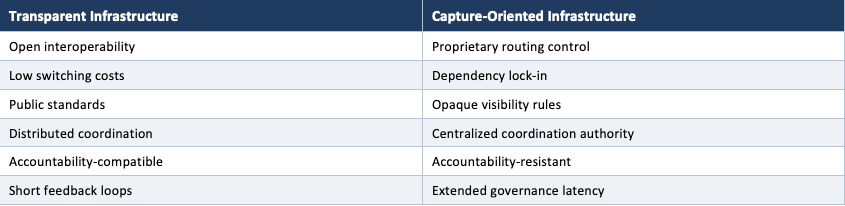
Table 2. The transparent–capture spectrum across six structural properties.
No system sits permanently at either pole. The framework’s diagnostic question is directional: does a given platform’s trajectory move it toward the left column or the right.
XI. The Accountability Gap
Infrastructure operators are governors, and no electorate installed them. The essay has established that scale converts a product into a coordination system; the unavoidable consequence is that the operators of that system now exercise governance functions — they allocate visibility, set the terms of participation, and route information — without any of the accountability mechanisms that constrain a public governing body. A citizen cannot vote out a recommendation algorithm.
The accountability gap is itself a feedback-latency problem. Democratic accountability operates as a feedback loop: a governed population observes an outcome, forms a signal, and transmits correction through elections, litigation, or legislation. The correction loop is slow by design, built for the cadence of public institutions rather than the cadence of platform iteration. An algorithmic governor adjusts its routing logic continuously, while the democratic loop closes on a multi-year cycle. The Feedback Latency Index that measures regulatory delay measures the accountability deficit equally well, because the deficit is the same delay viewed from the side of the governed.
Three structural features widen the gap, and they are the suppression variables of the Signal Suppression Equilibrium model applied to infrastructure. Opacity removes the population’s ability to observe the outcome it would need to correct, because the routing logic is proprietary and the visibility rules are undisclosed — fragmentation of the signal. Exit substitutes weakly for voice, since a platform at majority-market dependency leaves no comparable alternative to defect toward, which converts the classic exit option into a non-choice — access dependence. Jurisdictional fragmentation lets an operator answer to many partial regulators and no complete one, so accountability diffuses across forums until no single body holds the full mandate. The model’s prediction holds: under those conditions, warning signals accumulate without aggregating, and exposure arrives not as gradual correction but as sudden cascade once an external aggregator forces the signal into view.
A captured system does not reform itself, and the reason is structural rather than a matter of will. MindCast’s field-geometry analysis of institutional constraint establishes the general result: once a system’s decision geometry is reshaped, no survivable path connects internal good-faith reform to structural remedy, and a geometry-trapped equilibrium holds until counter-force from outside the field exceeds an escape-velocity threshold. Applied here, the result is precise — an infrastructure operator will not close its own accountability gap, because the gap is the operator’s harvested position, and an internal correction path that would surrender it does not exist.
Correction therefore requires an actor with independent degrees of freedom outside the captured architecture, deploying force above that threshold. The structural corrective is distributed authority: when multiple enforcement venues hold genuine autonomy, an operator must contest every venue at once, which raises the cost of capture beyond what any single concentrated position can sustain. Distributed authority is to governance what open standards are to routing — the transparent-pathway logic of Section X, applied one level up.
The gap is the political content of the entire transition. Every platform that crosses from product into infrastructure transfers a quantum of governance authority out of accountable institutions and into an architecture that the governed population cannot inspect, cannot vote on, and cannot readily exit. MindCast does not treat that transfer as inevitable or irreversible. Transparency requirements, interoperability mandates, disclosure of routing logic, and distributed enforcement authority each shorten the accountability loop, and the framework evaluates governance interventions by whether they close that loop or merely ratify the existing equilibrium.
XII. The Emergence Pathway
Transformative technologies move through a recurring five-phase sequence. The sequence below describes the emergence-first pathway: a platform forms in a low-state-capacity environment, scales ahead of governance, and forces institutional response only after dependency sets.
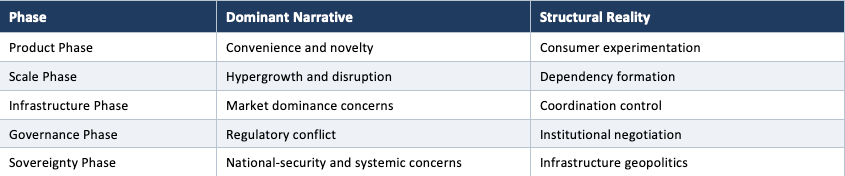
Table 3. The emergence pathway — five phases.
Napster, YouTube, Uber, Airbnb, TikTok, AI infrastructure, Compass, and Kalshi each moved through a version of the emergence pathway, and structural convergence across them outweighs sector difference. The emergence pathway is the domain MindCast’s transition analysis models most directly, because latency arbitrage is the pathway’s defining mechanism — the platform moves first, the state moves late, and the gap between them is the harvested resource.
XIII. The State-Architected Pathway
The emergence pathway is not the only pathway. A second variant runs when the state co-architects the infrastructure from the first phase rather than reacting in the last. China shaped its domestic platforms as instruments of state capacity from early formation, and the United States now treats advanced compute as a sovereign asset through export control — a Phase 5 concern that arrived at Phase 1. MindCast’s own foresight record on GPU export pathways tracked exactly that compression, where sovereignty-layer governance preceded mature commercial scale.
The two pathways differ in who holds first-mover position. The emergence pathway places the platform first and the state late, and governance latency is the platform’s harvested resource. The state-architected pathway places the state first, and latency collapses because the governing actor is present at formation. Set side by side, the contrast runs across six structural features:
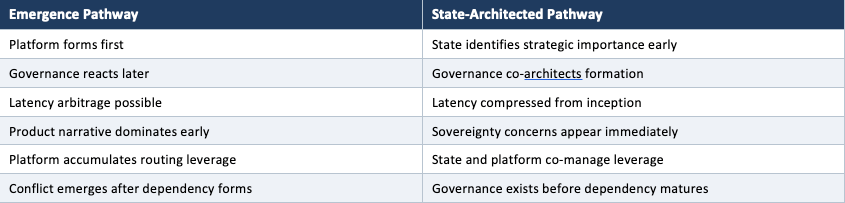
Table 5. Emergence versus state-architected — six structural features.
The pathways are endpoints of a spectrum rather than a binary, and most real cases fall between them: a platform emerges commercially, then a state recognizes its strategic value and reaches back to co-architect what it did not originate. Kalshi sits in that middle band — a commercially emergent platform now subject to a federal rulemaking that may co-architect the event-contract category before it fully matures. Advanced AI compute sits further toward the state-architected end: NVIDIA’s accelerator layer is already governed as a sovereign asset through export control, sovereignty-layer governance reaching the technology well before commercial scale completed. The state-architected pathway sits closer to national-throughput analysis, where the governing variable is the synchronization of state and market rather than the latency between them.
XIV. Forward Prediction and Falsification Contract
The central prediction is specific and dated. Between now and the end of 2027, at least three of the following platform operators — OpenAI, Anthropic, Amazon Web Services, Microsoft, and Google — will face formal governance action that targets the infrastructure layer rather than product conduct. Infrastructure-layer action means proceedings, rulemaking, or enacted statute addressing compute concentration, inference routing, energy dependency, or runtime control, as distinct from consumer-protection or content-moderation complaints about applications. NVIDIA is deliberately excluded from this emergence-pathway list: its accelerator layer is already governed as a sovereign asset under export control, which places it on the state-architected pathway of Section XIII rather than the emergence pathway this prediction tests. The dominant public narrative around AI will shift measurably from capability discourse toward control discourse across the same window.
The prediction carries an explicit falsification contract. The model is falsified if, by December 31, 2027, a computational platform reaches majority-market dependency in its category through the emergence pathway while no governance actor — legislative, regulatory, or judicial — has initiated infrastructure-layer action against it. The contract is scoped to the emergence pathway deliberately: a state-architected platform faces governance from formation, so the absence of belated governance action there confirms the second pathway rather than refuting the first. A platform that achieves entrenched routing control with neither emergence-style belated conflict nor state-architected early co-governance would demonstrate that the transition cycle does not operate, and the framework in this essay would require reconstruction. The cycle predicts conflict; sustained dependency without conflict of either kind refutes it.
Future competitive battles will turn less on applications and more on infrastructure control — inference routing, compute concentration, energy dependency, behavioral optimization, labor displacement, institutional delegation, sovereign dependency, and informational integrity. Institutions that miss the transition will keep misreading equilibrium restructuring as temporary controversy, and the cost of the misread compounds with every month of governance latency the product narrative manages to extend. The harder cost is democratic: every month of extended latency is a month an unaccountable architecture governs without a closed correction loop, and the accountability gap, once an architecture entrenches, does not close on its own.
Appendix: The Infrastructure Transition Matrix
The matrix below applies the framework across sixteen cases. The eight analyzed in the body of the paper appear alongside eight further cases that trace the same trajectory, including one — FTX — where the transition failed catastrophically rather than stabilizing, when platform velocity outran the institutional trust architecture entirely. Each row records the same structural sequence: an initial product narrative, the actual transition into infrastructure, the conflict trigger that followed, and the equilibrium the case is moving toward.
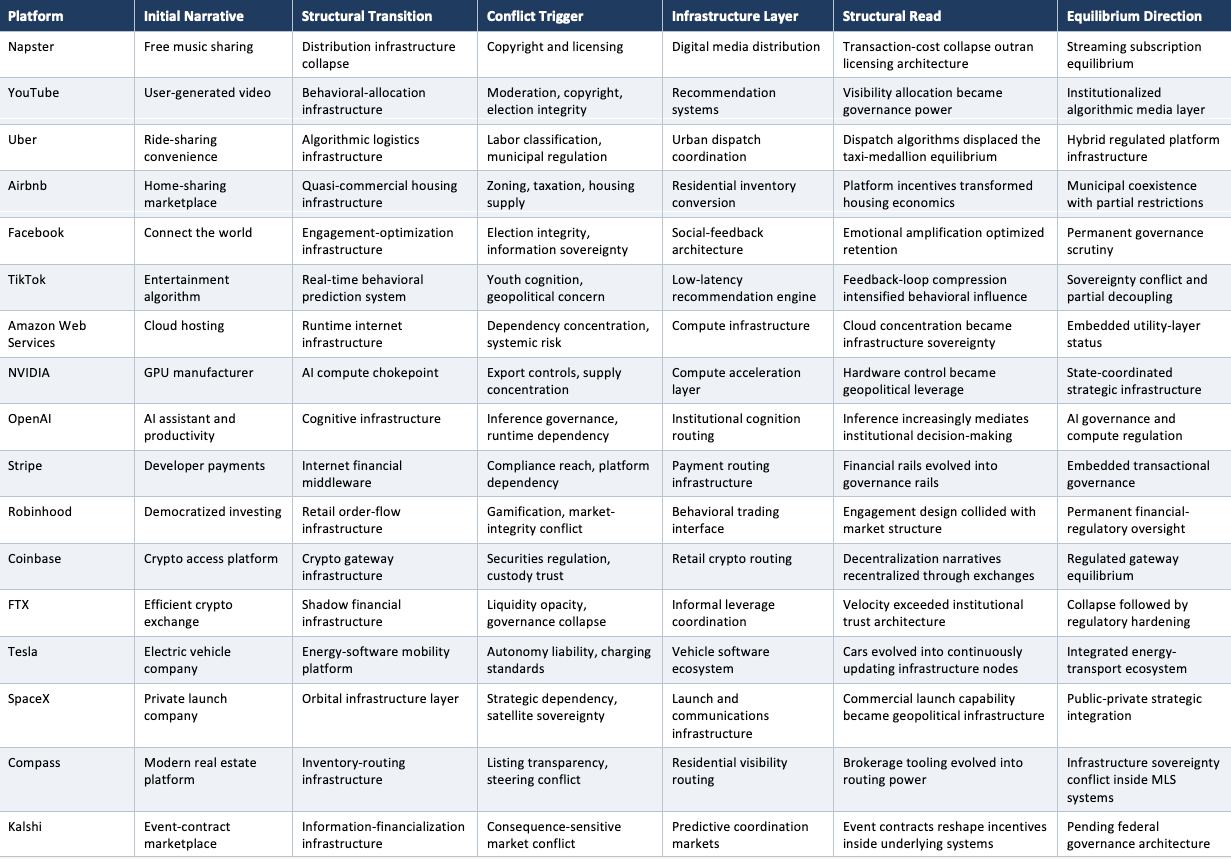
Table 6. The Infrastructure Transition Matrix — sixteen cases across media, transport, housing, finance, energy, aerospace, real estate, and prediction markets.
The matrix reads as confirmation rather than illustration. Sixteen cases across media, transport, housing, finance, energy, aerospace, real estate, and prediction markets converge on one sequence — product narrative, dependency formation, infrastructure transition, governance conflict. The convergence is the evidence: a pattern that holds across that many unrelated sectors is structural, not coincidental.