
Texas · Pennsylvania · Ohio · Georgia · California · Alabama · New Jersey · Washington State · Federal Energy Regulatory Commission · PJM Interconnection · ERCOT · AEP Ohio · Georgia Power · Puget Sound Energy
Companion publications: The 50-State Authorization Price Atlas · The Model Data Center Authorization Code
Value propositions: MindCast 2027 National Legislative Session Data Center Value Proposition · MindCast Washington State 2027 Legislative Session Data Center Value Proposition
War game companions: MindCast 2027 National Legislative Session Data Center War Game · MindCast Washington State 2027 Legislative Session Data Center War Game
Interactive war games: National Interactive War Game · Washington State Interactive War Game
Thesis. The 2026 midterms split data center authorization in two. Local voters now decide where sites can proceed, while governors and utility commissions set the terms of power and service. The 2027 sessions will answer opposition with written conditions far more often than with pauses.
Why now. Texas’s grid audit is due December 10, legislatures convene in January and Pennsylvania plans its final curtailment order for January 28, 2027. State lawmakers · regulators · developers · hyperscalers · utilities will all work under terms written in the first half of 2027.
Prior forecasts in this series. Two forecasts have resolved as hits from AI Data Center Moratoriums Are Forecastable — and They End in Pricing Rules, Not Bans (August 2026). MC-ATX-P2 (70–80%) called at least three more Oregon localities to enact pauses before October 31, 2026: Woodburn (KPTV), Salem (KPTV) and Clackamas County (KOIN) enacted them. MC-ATX-P5 (55–65%) called at least one more state acting through the executive corridor by December 31, 2027, and Oregon’s governor paused state environmental permits for data centers on October 9 (KPTV). Misses: none resolved so far.
I. Executive Summary
The 2026 midterms put data center authorization on two linked tracks: local eligibility and statewide service terms. The governing mechanism is conditional authorization, in which tariffs, cost recovery and curtailment terms convert opposition into written conditions of service. The 2027 sessions test that mechanism across three groups of states: 29 with statewide frameworks, 10 that govern through utility tariffs alone and 11 with neither.
On November 3, voters decided 41 data center measures in ten states, and all 13 proposals to facilitate development failed. Democrats also flipped five Republican-held governorships by Associated Press calls, among them Texas, Ohio and Georgia (CNBC). The vote changed who holds the executive pen while Texas holds both its data center interconnection approvals and its environmental permits pending a state audit.
Thesis. The ballot determines where sites can proceed, while governors and regulators shape the terms of power and service. Three effects carry the change, and each runs on its own unit. Site eligibility moves by municipality, permit timing by covered permit class and service terms by contracted capacity.
What distinguishes the MindCast approach. MindCast AI applies Predictive Behavioral Economics + Dynamic Game Theory through MindCast AI Proprietary Cognitive Digital Twin Foresight Simulations (MP CDT FS). Behavioral Economics supplies the decision rules, including how voters weigh a visible cost against a diffuse benefit. Game Theory supplies the payoff structure among operators, utilities, hosts and approvers. Predictive simulations emerge from the combination.
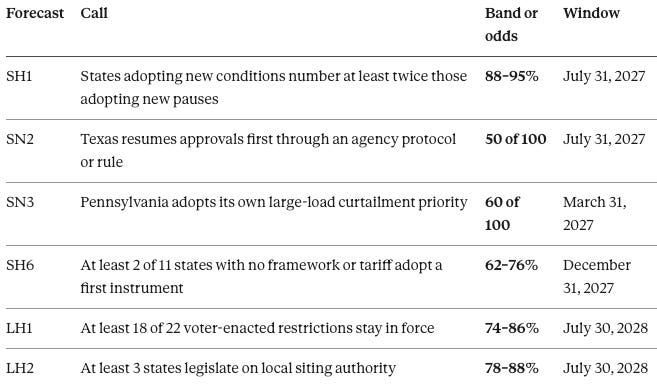
What the simulation finds. Conditional authorization holds as the dominant equilibrium in every group of states. The forecast set contains 28 MindCast Simulation Predictions, and six carry the headline:
What the primer does. Part II traces the three effects through the 2026 evidence and sorts the states into three groups. Part III explains how the game evolves through dated forks, and Part IV states all 28 forecasts. Part V groups states by shared approval challenge and sets out what each decision-maker can do, Part VI follows power into contracts and permits and Part VII supplies a three-gate check for any project or bill.
What existing coverage misses. Coverage counted measures, and the primer separates their legal effects. The 25 binding restrictions (including three temporary moratoria) act on land use, not on the service terms where 2027 bargaining will happen. Voters and utilities converged on the same 25-megawatt (MW) line, so a project sized to avoid a large-load tariff can meet a ban at the same threshold. Pennsylvania tied its proposed curtailment rule to a federal program the Federal Energy Regulatory Commission (FERC) rejected eight days later, so the state must write its own priority order or wait for a revised federal design.
Different questions, not unfinished bills. Lawmakers will not pick up 2026 bills where they left off. Since most 2026 sessions adjourned, governors paused permits, commissions approved tariffs and voters wrote binding local rules. The 2027 question has moved from whether to regulate data centers to how to reconcile terms that three levels of government already wrote.
Cumulative impact. The midterm effects compound rather than add. A local size threshold, a state permit precondition and a utility tariff now act on the same project, and Pennsylvania already makes local approval a precondition of state permits. New governors and Georgia’s new commission majority arrive to terms their predecessors wrote, so each 2027 bill amends a stack of existing terms rather than filling a gap. The compounding raises the stakes of the first statute in each state, because it sets how the three levels fit together.
Stakeholder callouts
🏛 State lawmakers. The first 2027 statute in each state sets the template its neighbors copy.
⚖ Regulators. Commissions will write most 2027 terms, so a pause without a tariff schedule becomes a moratorium no one voted for.
🏗 Developers. Eligibility, permit timing and service terms now fail separately, so a site cleared at one gate can still stop at the next.
☁ Hyperscalers. Curtailment rank, not connection alone, decides what firm capacity is worth in PJM after the October 9 federal order.
⚡ Utilities. Staged-commitment tariffs sort speculative requests out before infrastructure spending starts.
Bottom line. The 2027 sessions will write conditions far more often than pauses, and the first decisive signals arrive by January 31, 2027.
II. The 2026 Election Moved Three Effects on Three Clocks
Three effects changed in 2026, and each has its own decision-maker and unit. Local ballots changed site eligibility, governors changed permit timing and commissions changed service terms. Behavioral Economics and Game Theory explain why executives and commissions moved first.
A. Three Questions Replace One Ranking
Authorization instruments act on projects in three distinct ways, and each effect has its own reversal path.
Site eligibility. Whether and on what local conditions a parcel may host a data center. Local ballots, zoning and bans act here.
Permit timing. Whether covered approvals issue and on what preconditions. Executive orders and agency directives act here.
Service terms. What a project must commit to receive power, and who curtails first in an emergency. Tariffs, commission rules and grid-operator filings act here.
Ballot bans, permit pauses and tariffs share no denominator, so no megawatt total can rank them without matched project-level data.
Takeaway. Every project now faces three questions: where it can proceed, when its permits issue and what it must commit to receive power.
B. Eight Terms Tie Each Effect to an Instrument a Reader Can Find
Eight terms carry the primer’s argument, and each maps to an observable instrument.
Large-load tariff. A utility rate schedule that sets what a customer above a size threshold must commit before service, such as study payments, minimum take and contract length.
Interconnection approval. The grid operator’s or utility’s decision to connect a load to the transmission system.
Curtailment. An order that a load reduce or stop drawing power during a grid emergency.
Critical load. A customer class exempt from emergency curtailment, such as hospitals.
Capacity charges. Payments for generation held available to meet peak demand, set in PJM by auction and passed through to customers.
Use prohibition, size threshold and moratorium. A ban on the use, a ban above a stated scale and a time-limited suspension of applications.
Voter-approval requirement. A rule that sends large projects to a referendum.
Codified verification. Standing rules, adopted by protocol or statute, that test whether a requested load is real before approval.
Sourced statements are verified facts. Statements marked as MindCast analysis are inferences, and Simulation Predictions carry an identifier and a band. Load-bearing assumptions appear with the forecasts in Part IV.
Takeaway. Each term names an instrument a reader can find in a statute, tariff or order.
C. Voters Changed Site Eligibility Through Six Legal Forms
Local voters acted directly on site eligibility, and the legal effect varied by measure. Ballotpedia counted 41 measures on November 3, with 28 that would limit development and 13 that would facilitate it. Ballotpedia’s 2026 tally reached 47 decided measures across 13 states, with 46 favoring limits and three December measures still pending (State Capital Lobbyist). The tally counts passed restrictions, advisory votes and defeated pro-development proposals alike as outcomes favoring limits.
An outcome favoring limits is not an enacted restriction. Appendix C sorts each November 3 measure by legal form from unofficial results: 25 binding restrictions passed, 2 advisory restrictions passed, 1 restriction failed and all 13 pro-development measures lost.
Use prohibitions. Alhambra (CA), Edgewater (FL) and Ohio municipalities including Granville · Piqua · Urbana removed data centers as a permitted use.
Size thresholds. Conneaut, Defiance, Oregon and Sunbury in Ohio and Ottawa (KS) prohibited facilities above 25 MW.
Temporary moratoria. Peru, Wells and Wiscasset in Maine suspended applications for six months or 180 days.
Voter-approval requirements. Grove City (OH) and Janesville (WI) added a referendum gate for large projects.
Incentive conditions. Perry (OH) required financial guarantees for hyperscale incentives.
Project decisions. Wilmington (OH) voters rejected four rezonings tied to one project, and Ashville (OH) voters backed blocking a campus already under construction (Fortune).
Harwood (ND) voters went the other way and rejected added review (State Capital Lobbyist) while a campus rose nearby (KVRR). Ballot law also amends slowly, because a charter amendment or initiated ordinance generally requires another vote to change.
Takeaway. Binding measures act locally and by legal form, so each one needs measure-by-measure reading before a site decision.
D. Communities Moved From Participants to Holders of an Independent Authorization Gate
The November measures changed the role communities play. Data center regulation has expanded from a state–utility bargain into a three-level authorization system that includes communities as independent decision-makers over site eligibility.
Communities moved in three ways.
From council rules to direct legislation. Voters in 25 jurisdictions enacted binding rules themselves rather than leaving them to councils.
From influence to eligibility. Communities moved from influencing conditions to determining site eligibility.
From hearings to classes. Communities moved from project-specific hearings to class-wide bans, thresholds and voter-approval requirements.
The local electorate now stands as a separate decision-maker alongside governors, legislatures and utility commissions. A regulator can approve service terms and a governor can issue permits, yet a community can still make the parcel ineligible. Harwood shows the new gate is not inherently restrictive, because voters can authorize development as well as stop it.
The shift applies where state law permits meaningful local authority. The next contest concerns whether 2027 legislatures codify, constrain or preempt the new role, not whether communities matter. SH10 and LH2 through LH4 forecast that contest.
Takeaway. Communities now hold an independent authorization gate over site eligibility, and 2027 legislatures decide how far state law lets it reach.
E. Governors Changed Permit Timing
Executive instruments acted on permit timing statewide, and the leading examples predate the election. Texas holds two separate gates. Governor Abbott directed the Public Utility Commission of Texas (PUCT) and the Electric Reliability Council of Texas (ERCOT) on June 10 to review the impact of data centers on electric infrastructure and residential ratepayers. His August 3 directive paused Batch Zero, ERCOT’s first group of large-load interconnection studies (Greenberg Traurig).
His September 21 letter directed the Texas Commission on Environmental Quality (TCEQ) to pause the issuance of all permits related to data center projects until ERCOT completes its review (Beveridge & Diamond). The letter sets no megawatt threshold and no firm endpoint (National Law Review). ERCOT officials aim to file the audit report by December 10, and that report informs a resumption decision rather than authorizing one. ERCOT’s large-load queue exceeds 470 gigawatts (Inside Climate News), so requested load cannot be read as committed load.
Pennsylvania’s Executive Order 2026-05 directs its Department of Environmental Protection (DEP) to review permits for projects above 25 MW only after local approval (Morgan Lewis). The order cited more than 100 proposed projects, of which 20 had sought DEP permits. The order removes data center projects from the Permit Fast Track program, while projects that sign a GRID consent order gain rolling review and Permit Decision Guarantee eligibility. The order adds a precondition and a defined path at once.
New York paused discretionary state environmental permits for data centers of 50 MW or more on July 14 (Davis Wright Tremaine). Oregon followed on October 9 (KPTV).
The vote then changed who holds the executive pen in 2027. Hinojosa and Bottoms each made data center regulation a key part of their campaigns (Texas Public Radio; AJC). Ohio’s governor-elect proposed during the campaign a conditional moratorium requiring data centers to pay their own power costs without raising other customers’ rates and to use union labor (Signal Ohio).
Takeaway. Governors set permit timing in 2026, and the 2027 governors in the largest affected states campaigned on writing conditions.
F. Commissions Changed Service Terms
Service terms decide what a project must commit to receive power. AEP Ohio’s data center tariff moved its request pool through successive stages. Of the initial 30,000 MW of requests, 13,022.7 MW paid for an engineering study and 5,642 MW signed binding contracts under the tariff (AEP Ohio). The stages show screening and commitment; they do not show why each request that failed to advance dropped out.
States wrote cost assignment into law and rule between August and October 2026.
California. Seven laws signed September 21 include a tariff regime under the state utility commission, with tariffs due by January 1, 2028 (National Law Review).
Alabama. Act 2026-610 requires utilities to show the Public Service Commission that large-load data center contracts recover incremental costs (ABC 33/40).
New Jersey. S3379/A4096 adds semiannual energy and water reporting (New Jersey Governor).
Nationally. The Edison Electric Institute (EEI) counted 25 states with an approved large-load tariff and 8 with tariffs pending (EEI).
Georgia voters gave Democrats a 3-2 majority on the Public Service Commission (Georgia Public Broadcasting), after races that turned on power bills, with criticism centered on Georgia Power’s data center contracts (AJC). FERC on October 9 accepted PJM’s Large Load definition and its Large Load Registry but rejected the Interim Resource Adequacy Service package (FERC order). FERC found that several provisions appeared to reach retail customers and retail rates. Important retail-load questions now proceed in state forums, while federal transmission and wholesale rules continue to shape the outcome.
Takeaway. The instruments written since August condition power on commitment and also define how a committed project gets served.
G. Twenty-Nine States Have Written Terms, Ten Rely on Tariffs and Eleven Have Neither
A state counts as a framework state when a statute, statewide rule or executive order binds large-load service, siting or local authority. Tax incentives and studies do not count. The 50-State Authorization Price Atlas (2026) supplies the coding behind the groups.
The Atlas coded 22 framework states, and seven more enacted statutes binding large-load service, siting or local authority in 2025 and 2026. Six appear in the Start Business by State tracker: Delaware · Idaho · Indiana · Nebraska · Tennessee · West Virginia. Maryland’s 2026 law lowered its large-load threshold to 25 MW (Maryland Office of People’s Counsel).
Framework states (29). AL · AZ · CA · DE · FL · ID · IL · IN · MA · MD · ME · MN · MO · NC · NE · NJ · NY · OH · OK · OR · PA · SD · TN · TX · UT · VA · WA · WV · WY.
Tariff-only states (10). GA · IA · KS · KY · LA · MI · NV · ND · SC · WI.
States with neither (11). AK · AR · CO · CT · HI · MS · MT · NH · NM · RI · VT. Montana and New Mexico have first tariffs pending.
Takeaway. Framework states choose how far to tighten, tariff-only states choose whether to legislate and states with neither choose whether to act at all.
H. Loss Aversion and First-Mover Advantage Explain Who Moved First
Behavioral Economics explains why regional power costs became a local voting issue. PJM’s market monitor attributes $29.4 billion of capacity charges across four auctions to data center load, or 46.2% of the total (Monitoring Analytics). Voters weigh a visible cost increase more heavily than a diffuse benefit, and approvers answer with conditions rather than bans.
Reference points matter too: Ashville voters judged a campus already under construction by their experience of it, not by its sunk cost. Governors declare support for investment while writing preconditions that sort projects by commitment, and the gap tells developers which commitments buy a permit.
Game Theory explains the order of moves. Executives act on a shorter clock and can condition rather than prohibit, while legislatures enter 2027 bargaining over terms others already wrote. Statewide authorization is therefore the dominant fork, and Texas supplies the earliest test.
Under resumption on the audit’s technical basis, speculative queue entrants leave first because verification demands deposits and load data they cannot supply. Developers with financed load then re-enter under curtailment protocols, since Texas’s 2025 large-load law (SB 6) already requires transmission-voltage loads interconnecting after 2025 to accept them (Compute Law). Resumption on a ratepayer cost-recovery basis would bring ratepayer advocates and municipalities into commission dockets and make the cost terms portable to Ohio, where the governor-elect has proposed that frame.
Takeaway. Loss aversion concentrates opposition on visible costs, and first-mover advantage puts executives and commissions ahead of legislatures.
Conclusion. Ballots, governors and commissions each moved a different effect in 2026, and the 2027 sessions take up all three.
🏛 State lawmakers. States counted as rule-free by tariff surveys may already carry statutory terms that bind the next bill.
🏗 Developers. A size threshold, a moratorium and a voter-approval rule each close a site differently, so legal form decides the next step.
III. The Game Evolves Through Dated Forks Toward Conditions
The election installed two linked games, and each resolves through forks with known dates. Rules written before the sessions hold through the forecast window, so the forks decide form rather than direction.
The forecast horizon runs from November 2026 through July 2028. The forums are state executives, state utility commissions, grid operators and municipal electorates. FERC sets the federal boundary, and the primer excludes federal siting legislation, the outcome of any single pending permit and the 2028 elections.
A. Rules Written Before the Sessions Anchor the Forecast Window
Three moves fixed most of the rules before the 2027 sessions open. Executives and commissions wrote first, FERC returned retail curtailment questions to the states and the November 3 ballot set local eligibility in 25 jurisdictions. Four forces keep those rules in force through the forecast window.
Statutory inertia. Twenty-nine states have terms that a session must amend to change.
Amendment friction. Voter-enacted restrictions change only by another vote.
Federal restraint. FERC most likely leaves state choices open through January (80 of 100).
Session calendars. Legislatures move only inside their sessions.
Validity conditions. The forecasts stay valid while two exceptions remain dormant: an unscheduled reliability or rate shock that multiplies pauses, and an Ohio statute that displaces at least five of the 22 voter-enacted restrictions. The second exception is called here the Ohio displacement statute. If either fires, the affected forecasts no longer hold as stated.
Takeaway. The forecasts rest on rules written before the sessions, and two modeled events carry the largest risk of replacing the equilibrium.
B. Five Competing Hypotheses Frame the Contest
Eleven Cognitive Digital Twins (CDTs) model the decision-makers: Texas executives and agencies · Pennsylvania’s executive and commission · the Ohio and Georgia governors-elect · state commissions · FERC and PJM · utilities · developers and hyperscalers · local electorates · state legislatures. Five hypotheses and a no-change alternative frame the simulation, each with its own falsifier.
H1 · Conditional authorization dominates. Falsifier: new statewide pauses or bans reach half the count of new conditional instruments in the first half of 2027.
H2 · Texas re-enters by agency protocol first. Falsifier: a statute or new executive order resumes approvals first, or none resume by July 31, 2027.
H3 · States set curtailment rank before FERC. Falsifier: FERC accepts a revised PJM design supplying the priority before any state acts.
H4 · Local authority reaches statehouses. Falsifier: no bill to codify or preempt local siting authority is introduced by July 31, 2027.
H5 · New majorities condition rather than pause. Falsifier: Georgia’s commission pauses interconnection before it conditions any contract.
H0 · No change. Falsifier: any of H1 through H5 resolves as stated.
Takeaway. Each hypothesis can fail on a named event, so the forecasts in Part IV test them rather than assume them.
C. Five Current Forks Resolve Between January and July 2027
The fork tree orders every fork by the date it resolves. Current forks carry Snapshot odds in tens, and later forks link to the forecasts in Part IV.
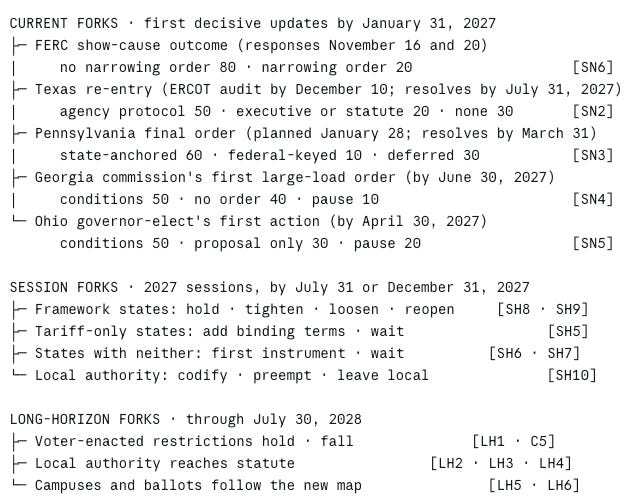
Three mechanisms decide how the forks resolve. Permit holds clear when an agency can verify which loads are real. Staged tariffs ask for money before infrastructure, so requests that cannot commit tend to leave. Council moratoria end in written terms when a path exists, while voter-enacted bans lack that path.
Takeaway. Verification, commitment and an available path to terms decide whether a hold, a request or a moratorium converts into written conditions.
Conclusion. The forks resolve on known dates, and each resolution moves named forecasts in Part IV.
☁ Hyperscalers. A FERC narrowing order would move curtailment from state dockets to PJM compliance filings across a whole portfolio.
⚡ Utilities. Each approved tariff becomes the next commission’s template, so early filers shape the terms their peers adopt.
IV. MindCast Simulation Predictions on the 2027 Sessions
The forecast set contains 28 MindCast Simulation Predictions, all original to this publication and dated November 5, 2026. Four layers carry them, and each has its own prefix.
Snapshot Predictions (SN). Odds in tens at the current forks.
Short-horizon Simulation Predictions (SH). The 2027 sessions.
Conditional Simulation Predictions (C). Outcomes once a named branch occurs.
Long-horizon Simulation Predictions (LH). Outcomes through July 30, 2028.
Every entry is an event probability with a window and a falsifier. Entries without a named verification source resolve against the sources in Part VIII.
Load-bearing assumptions. The measure set certifies as reported. Every group-based forecast counts states as grouped on November 5, 2026. Instruments count on their adoption date, and instruments in force before November 6, 2026 never count.
A. Snapshot Predictions: The State Forks Lead With Conditions
Snapshot Predictions give odds in tens that sum to 100 at each current fork.
SN1 · States answer the election mainly through conditional authorization through July 2027 (60 of 100).Other branches: restrictive delay and fragmentation 30 · federal recentralization 10. Shift trigger: a reliability, rate or water shock that produces new pauses. Verification source: statutes, executive orders and commission orders.
SN2 · Texas first resumes data center approvals through an agency protocol or rule by July 31, 2027 (50 of 100). Other branches: executive framework or statute 20 · no class of approvals resumes 30. Resumption means at least one class of approvals restarts under operative terms. Verification source: PUCT, ERCOT and TCEQ actions, executive orders and session law.
SN3 · Pennsylvania adopts a state-anchored large-load curtailment priority in a final order by March 31, 2027 (60 of 100). Other branches: priority keyed to a revised federal design 10 · deferred, omitted or delayed 30. Verification source: Docket M-2026-3064961.
SN4 · Georgia’s Public Service Commission conditions new or existing large-load contracts in its first large-load order by June 30, 2027 (50 of 100). Other branches: no large-load order 40 · interconnection pause 10. Verification source: Georgia Public Service Commission dockets.
SN5 · Ohio’s governor-elect conditions state incentives or permits as a first data center action by April 30, 2027 (50 of 100). Other branches: legislative proposal only 30 · executive pause 20. Verification source: Ohio executive orders and Tax Credit Authority actions.
SN6 · FERC issues no order narrowing state large-load choices by January 31, 2027 (80 of 100). Other branch: narrowing order 20. Verification source: FERC eLibrary.
Takeaway. The state forks lead with conditions rather than pauses, while FERC most likely leaves state choices open.
B. Short-Horizon Simulation Predictions: The 2027 Sessions Write Conditions
Short-horizon bands hold across the current branches unless a conditional forecast says otherwise.
SH1 · States adopting new conditional instruments number at least twice the states adopting new statewide pauses or bans by July 31, 2027 (88–95%). C counts states adopting a new conditional instrument (tariff · cost recovery · disclosure · verification · local role) from November 6, 2026 through July 31, 2027. P counts states adopting a new statewide pause or ban of any duration. SH1 holds when
C ≥ max(1, 2 × P). Falsifier:C < max(1, 2 × P). Verification source: statutes, executive orders and commission orders adopted in the window.SH2 · Conditions make up at least 75% of statewide data center instruments adopted in 2027 (80–90%).Falsifier: pauses or bans exceed 25% of instruments adopted by December 31, 2027.
SH3 · Pennsylvania adopts a state-administered large-load curtailment priority before FERC accepts a revised PJM design, by July 31, 2027 (60–72%). Falsifier: FERC accepts a revised design supplying the same priority first, or Pennsylvania adopts no priority. Verification source: Docket M-2026-3064961 and FERC dockets.
SH4 · Georgia’s commission opens a large-load cost or contract proceeding before any general interconnection pause, by July 31, 2027 (65–78%). A qualifying order also counts. Falsifier: a pause comes first, or neither action occurs.
SH5 · At least 2 of the 10 tariff-only states add binding terms beyond their tariffs by December 31, 2027 (58–72%). Binding terms mean a statute, an executive instrument or a statewide siting or local-authority rule. Falsifier: one state or none.
SH6 · At least 2 of the 11 states with neither a framework nor a tariff adopt a first statewide instrument by December 31, 2027 (62–76%). Instruments of either polarity count, including a first commission-approved large-load tariff. Falsifier: one state or none.
SH7 · At least 2 of Delaware · Maryland · Montana · New Mexico approve a first large-load tariff by December 31, 2027 (78–90%). Falsifier: one approval or none. Verification source: commission orders.
SH8 · No framework state repeals or suspends its statewide framework without replacement by December 31, 2027 (85–93%). Falsifier: any such repeal or suspension.
SH9 · At least 5 framework states put a new binding obligation into operation during 2027 (65–78%).Qualifying obligations are curtailment rank, a water condition or a disclosure mandate. An earlier statute counts only when its new obligation becomes operative in 2027. Falsifier: four states or fewer.
SH10 · A bill to preempt or codify local siting authority is introduced by July 31, 2027 in a state with a November binding restriction (78–88%). Qualifying states: California · Florida · Kansas · Maine · Ohio · Wisconsin. Falsifier: no qualifying bill is introduced. Verification source: state legislature bill databases.
SH11 · At least 2 state commissions outside Texas pause or condition large-load interconnection pending tariff or rule development by December 31, 2027 (60–72%). Falsifier: fewer than two qualifying orders. Verification source: commission orders.
Takeaway. The 2027 sessions convert opposition into conditions, and the open questions concern which instrument carries the terms.
C. Conditional Simulation Predictions: Five Forks Change the Answer
Each conditional forecast applies only if its named branch occurs, and its falsifier is the outcome failing inside that branch by the stated date.
C1 · If Texas re-enters through an agency protocol, resumed approvals require PUCT large-load registration by July 31, 2027 (80–90%). Condition: the agency-protocol branch of SN2.
C2 · If Pennsylvania adopts a state-anchored priority, a second PJM state commission adopts a large-load curtailment priority by December 31, 2027 (45–60%). Condition: the state-anchored branch of SN3. Given the federal-keyed or deferred branch instead: 20–35%.
C3 · If Georgia’s commission conditions contracts, it also reopens existing Georgia Power data center contracts by December 31, 2027 (25–40%). Condition: the conditions branch of SN4.
C4 · If Ohio’s governor-elect conditions incentives or permits, Ohio enacts a statewide large-load tariff statute by December 31, 2027 (40–55%). Condition: the executive-conditions branch of SN5.
C5 · If an Ohio statute taking effect by July 30, 2028 preempts, displaces or renders inoperative at least five of the 22 restrictions, at least 18 of the 22 still remain materially operative on July 30, 2028 (15–30%).Mechanism: once such a statute takes effect, the measures survive only if a court blocks it in time, and Ohio’s home-rule test makes a bare preemption statute vulnerable. From January 2027, a preemption statute also faces a veto from the incoming governor, and the projected House majority falls short of the three-fifths needed to override; a statute passed in the 2026 lame-duck session and signed by the outgoing governor avoids that veto (MultiState; Signal Ohio).
Takeaway. Five forks change the answer enough to need their own forecasts, and C5 carries the largest swing.
D. Long-Horizon Simulation Predictions: Restrictions Hold Unless Ohio Acts
Long-horizon forecasts cover durability, local authority, project location and ballot repetition through July 30, 2028.
LH1 · At least 18 of the 22 non-temporary binding restrictions passed November 3 remain materially operative on July 30, 2028 (74–86%). The forecast assumes certification of the measure set. Falsifier: five or more are repealed, invalidated, preempted or bypassed. Fifteen of the 22 sit in Ohio, so the Ohio displacement statute carries most of the risk (C5).
LH2 · At least 3 states enact statutes that expressly define, preserve, limit or preempt local data center siting authority by July 30, 2028 (78–88%). Falsifier: two states or fewer. Base rate: Florida · Louisiana · South Dakota · Virginia enacted such statutes in 2025 and 2026 (Start Business by State tracker; MultiState).
LH3 · At least 1 state newly enacts a statute preempting local data center bans or moratoria by July 30, 2028 (30–45%). Falsifier: no state enacts one.
LH4 · At least 1 state requires local voter approval or local consent for large data centers statewide by July 30, 2028 (20–35%). Falsifier: no state enacts one.
LH5 · At least 6 of the next 10 announced US data center campuses of 250 MW or more sit in framework states (70–84%). Counting starts after November 5, 2026. Falsifier: five or fewer. Verification source: company announcements.
LH6 · At least 5 new local data center ballot measures qualify across at least 3 states by June 30, 2028 (75–88%). Measures of either polarity count. Falsifier: fewer than five measures or fewer than three states. Verification source: certified ballot notices.
Takeaway. Local authority moves to statehouses mostly to be defined or preserved, and voter-enacted restrictions hold unless Ohio acts.
Conclusion. Direction remains stable across the current branches, and the open questions concern instrument, forum and the location of local authority.
⚖ Regulators. The mid-range bands mark where commission choices still decide the outcome.
🏗 Developers. Ohio preemption and a grid shock would change site strategy rather than timing.
V. What Each State Group and Decision-Maker Faces
The same forks land on states and decision-makers with different exposure. States first sort into seven clusters by the approval challenge they share. A second table states what changes for each decision-maker and what each can do now, and risk entries size the exposure in units each owner controls.
A. Seven State Clusters Share the Same Approval Challenges
States that face the same blocking gate face the same first decision in 2027, whatever their legal group. A state appears in every cluster whose challenge it faces. Ohio sits in three clusters, and seven states sit in two: Georgia · Kansas · Kentucky · Michigan · Pennsylvania · Texas · Wisconsin. Clusters follow the evidence in Part II and the groups as coded on November 5, 2026.
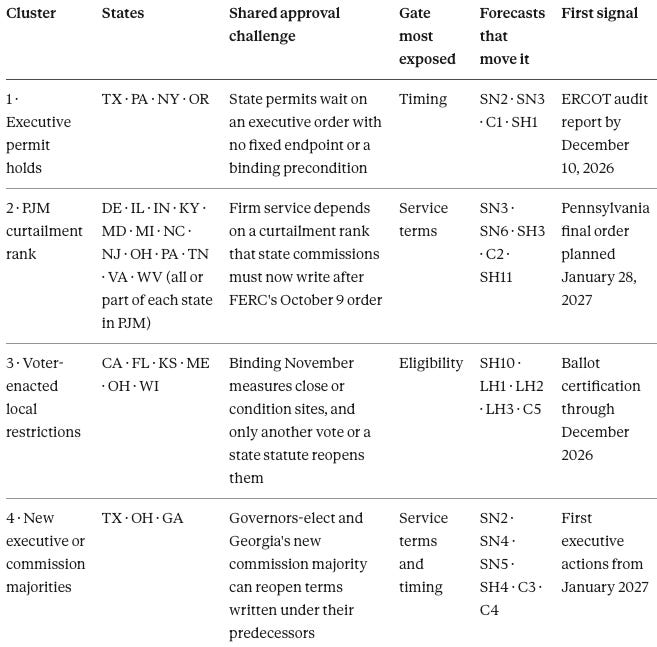
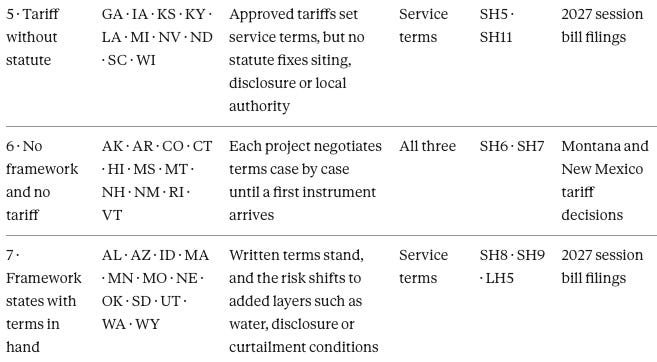
In MindCast analysis, clusters 1 through 4 hold the terms with dated forks pending, while clusters 5 and 6 decide whether new states write terms at all. Cluster 7 has written terms in hand, and LH5 tests whether the next large campuses favor framework states.
Takeaway. The blocking gate, not the legal group alone, sets the first decision each state faces in 2027.
B. Five Decision-Makers Face Different Consequences and Moves
Each row pairs a consequence with a move that costs little whichever branch occurs and a move that waits for a named trigger.
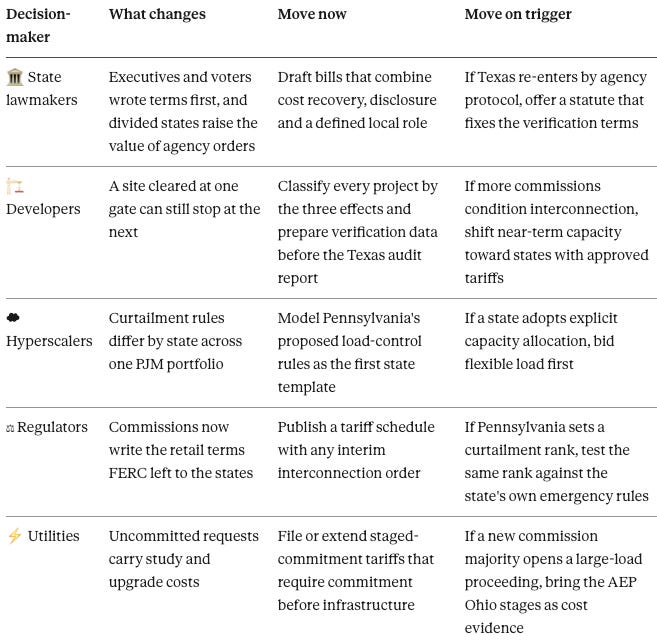
Texas has split legislative control, while Ohio and Iowa keep Republican legislatures (MultiState). Divided government favors agency orders, utility dockets and bipartisan provisions over sweeping statutes.
Takeaway. Every move now separates the three effects, and every trigger move names the event that releases it.
C. Five Risk Entries Size Exposure Before the Forecasts Resolve
Each entry names its forecast source, the exposure in its owner’s unit, unilateral mitigation and the exposure that remains.
Entry 1 · 🏗 Developers · Texas re-enters by agency protocol.
Exposure. A developer that arrives unprepared waits behind verified projects. The loss runs in quarters of energization schedule per Texas project. Severity: high for Texas-concentrated pipelines. Probability: 50 of 100 on the current Texas fork (Snapshot SN2). Given that branch, resumed approvals require PUCT registration at 80–90% (conditional C1).
Mitigating actions. The interconnection lead assembles load, financing and curtailment-acceptance data for every Texas project before the ERCOT audit report due December 10, 2026. The regulatory affairs lead files comments in any PUCT verification rulemaking before the Legislature convenes January 12, 2027. The finance lead reserves deposit capacity for the verification terms before approvals resume.
Residual exposure. A statutory branch can add requirements no developer can meet before bill text exists.
Entry 2 · ⚡ Utilities · Tariff-only states and states with neither adopt binding terms.
Exposure. A utility without an approved large-load tariff draws uncommitted requests as neighboring states adopt them. The utility then carries study and upgrade costs it cannot assign, measured in unrecovered upgrade dollars and rate-case quarters. Severity: moderate to high. Probability: 58–72% that at least 2 tariff-only states add binding terms and 78–90% that at least 2 pending first tariffs win approval in 2027 (short-horizon SH5 and SH7).
Mitigating actions. The rates lead files a staged-commitment tariff modeled on AEP Ohio’s stages in the first half of 2027. The large-load account lead requires study payments before engineering work, starting with the next request. The regulatory lead documents cost causation for each existing large-load contract before the next rate case.
Residual exposure. A new commission majority can rewrite approved terms within one cycle, as Georgia’s result shows.
Entry 3 · 🏗 Developers · Council moratoria end in written terms.
Exposure. Sites in council-moratorium jurisdictions regain eligibility under conditions. A developer who let its options lapse there loses the site and the first position under the new terms. Severity: moderate. Probability: outside the forecast set. Moratorium expirations listed in Part VIII resolve the branch case by case.
Mitigating actions. The land lead classifies each site by legal form before 2027 site decisions: council moratorium, voter-enacted ban or voter-approval rule. The land lead also holds options on council-moratorium sites through each expiration date. The community relations lead drafts host-agreement terms before each moratorium expires.
Residual exposure. Written terms can carry host fees and guarantees, as in Perry, that cut site returns after eligibility returns.
Entry 4 · ☁ Hyperscalers · Commissions pause or condition interconnection.
Exposure. Campuses in states that pause lose quarters of energization schedule. Terms written after commitment also raise the cost of firm service per megawatt. Severity: high for PJM portfolios. Probability: 60–72% that at least 2 commissions outside Texas pause or condition interconnection in 2027 (short-horizon SH11).
Mitigating actions. The energy procurement lead files comments on Pennsylvania’s tentative order before its comment deadline. The site selection lead sequences 2027 commitments toward states with approved tariffs. The engineering lead designs a curtailable load segment into the next interconnection application.
Residual exposure. Curtailment terms can still differ state by state across one portfolio.
Entry 5 · ⚖ Regulators · Commissions pause or condition interconnection.
Exposure. A commission that pauses without a tariff schedule holds an open-ended docket. The cost runs in months of docket time and in interconnection requests held without a decision date. Severity: moderate. Probability: 60–72% for the same branch (short-horizon SH11). A Georgia pause rather than conditions sits at 10 of 100 (Snapshot SN4).
Mitigating actions. Commission counsel pairs any interim order with a dated tariff schedule. Technical staff adopts a large-load reporting list, as Pennsylvania’s tentative order proposes, before the first interim order. Staff aligns state curtailment rules with its grid operator’s compliance filings after the November show-cause responses.
Residual exposure. A governor or legislature can impose a pause the commission did not design.
Nothing in Part V constitutes legal, investment or fiduciary advice.
Takeaway. Each entry sizes exposure in the unit its owner controls, and none claims the exposure disappears.
Conclusion. Each decision-maker can act now without waiting for a fork to resolve, and every residual exposure stays named.
VI. Power Carries Local Opposition Into Contracts, Permits and Water Terms
Power links regional capacity costs to local data center permits. Five concerns carry direct evidence, Washington State shows a state with terms in hand and five competing explanations test the thesis.
A. Five Power Concerns Move Conditions Off the Zoning Map
Each concern moves a condition from the zoning map into the utility contract, the permit or the water supply behind the campus.
Opposition has reached storage. El Dorado (KS) voters approved a prohibition on high-impact data centers and certain battery storage with 71%.
Texas holds onsite-generation permits with the rest. Bracewell reads the September 21 letter as covering permits without an onsite-generation exception (Bracewell).
Pennsylvania proposes curtailment priority by rule. The October 1 tentative order proposes that utilities shed large computational loads first and that data centers not count as critical load (tentative order). A final order is planned for January 28, 2027.
The 25 MW line appears in both tariffs and bans. Five binding November restrictions prohibit facilities above 25 MW, and the same number opens the large-load class in AEP Ohio’s tariff, Georgia Power’s tariff and Virginia’s GS-5 rate class.
Water is becoming a permit condition. California’s AB 2469 requires a water-supply assessment for covered local approvals, and Texas made its water-use survey a condition of TCEQ water permits.
Takeaway. Power converts local opposition into contract, permit and water terms.
B. Washington State Can Write Terms While Larger Markets Renegotiate
Washington State kept its governing party, and Democrats retain legislative majorities, pending certification. The Department of Revenue still holds the Data Center Workgroup’s final report pending tribal consultation (Washington DOR). Texas, Ohio and Georgia now carry the unknown-terms profile the Atlas assigned to Washington State. A modular 2027 bill with tariff machinery first would give Washington State written terms while larger markets renegotiate theirs.
Takeaway. Washington State and utilities such as Puget Sound Energy can file against the cost-causation principle while larger markets reopen theirs.
C. Five Competing Explanations Each Name What Would Weaken the Thesis
Five alternatives test the thesis, and each names an observable that would weaken it.
The election turned on other issues. The primer claims salience rather than causation, and the executive instruments that set timing predate the vote.
Local opposition stays local. Codification or state preemption would each move eligibility decisions to the state level and weaken the thesis.
Tariffs deter rather than sort. AEP Ohio’s stages fit both readings, because the data do not show why requests dropped out. If tariff states lose committed projects to tariff-free states, the sorting mechanism fails even where tariffs spread.
Federal recentralization. A wholesale large-load rule from the FERC show-cause dockets could narrow state choices without preempting any statute.
Supportive electorates. Harwood shows voters accepting a campus they can see operating. If more towns follow, eligibility loosens without state action.
Takeaway. Each alternative names an observable that would weaken the thesis, and none currently displaces the central thesis.
Conclusion. Executives and commissions now write the terms, and power carries them into contracts, permits and water supply.
⚡ Utilities. The 25 MW collision means tariff thresholds now interact with local bans at the same line.
VII. Any Project or Bill Can Be Tested Against Three Gates
The three effects convert into a check that a lawmaker, regulator, developer or utility can run on any project or bill. Each gate names a question, an observable and a consequence.
A. Eligibility, Timing and Service Terms Form Three Separate Gates
Gate 1 · Eligibility. Which legal form governs the parcel? Observable: the measure text and its effective date. Consequence: a size threshold leaves smaller designs eligible, and a moratorium returns eligibility at expiration unless extended.
Gate 2 · Timing. Which authority holds the permit, what pauses it and what lifts the pause? Observable: the directive’s text and its stated endpoint. Consequence: Texas’s interconnection and permit pauses rest on different instruments, so a project needs both lifted.
Gate 3 · Service terms. What must the project commit before it receives power, and who curtails first? Observable: the approved tariff and the state’s load-control rules. Consequence: commitment requirements and curtailment rank set the value of firm service.
The three-gate check assumes the gates operate separately, so clearing one gains nothing at the others. Pennsylvania’s order already links the first two by making local approval a precondition of state permits, and a statute bundling all three would change the check.
Takeaway. Each gate has its own decision-maker, and a project clears authorization only when all three clear.
B. Three Rules Carry the Election’s Lessons to Any Contest
Three rules generalize the election’s lessons for lawmakers, regulators and project teams.
Forum authority. Forecast an approval at the forum that holds authority over the cost being allocated. FERC found PJM’s curtailment design reached retail jurisdiction, so states now write the priority.
Threshold collision. Where a ban threshold and a tariff threshold share a number, a design sized below one line meets the other. Thomas Schelling’s The Strategy of Conflict (1960) explains the convergence: parties coordinate on prominent numbers without negotiating. The transfer holds because voters and commissions both need a bright line a lay reader can apply, and it fails where thresholds come from engineering studies.
Amendment friction. Instruments enacted by ballot change only by another vote, so they sit outside negotiated conversion paths such as council moratoria.
Takeaway. The rules tell lawmakers and regulators where to set thresholds and which forum to watch.
Conclusion. The gates and rules let any reader apply the primer to a project or bill it does not name.
🏛 State lawmakers. A bill that bundles eligibility, timing and service terms changes all three gates at once and should say so.
VIII. What to Watch: Texas Re-Entry Is the First Decisive Fork
Statewide authorization is the dominant fork, and Texas re-entry resolves first after the ERCOT audit report due December 10. Each item names its date, source and the forecasts it moves.
FERC show-cause responses · November 16 and 20, 2026. Source: FERC eLibrary. Moves SN6 and SN1.
ERCOT audit report · by December 10, 2026. Source: ERCOT. Moves SN2 and C1.
Governors-elect first actions · from January 2027. Source: executive orders. Moves SN2, SN5 and SH1.
Pennsylvania final order · planned January 28, 2027. Source: Docket M-2026-3064961. Moves SN3, SH3 and C2.
Bill filings in all three groups · weekly during sessions. Source: state legislature databases. Moves SH1 · SH2 · SH5 · SH6 · SH8 · SH9 · SH10 · LH2 through LH4.
Georgia commission dockets · monthly. Source: Georgia Public Service Commission. Moves SN4, SH4 and C3.
Ohio tariff and preemption bills · weekly in session. Source: Ohio General Assembly. Moves C4, C5, LH1 and LH3.
Large-load tariff approvals · monthly. Source: EEI survey and commission orders. Moves SH7 and SH11.
Ballot certification · through December 2026. Source: county and municipal election authorities. Moves LH1 and corrects Appendix C.
California laws taking effect · January 1, 2027. Source: California statutes and commission decisions. Moves SH9.
Local moratorium expirations · at each expiration date. Source: local ordinance texts. Resolves risk Entry 3 case by case.
New York Executive Order 62 expiration · by July 14, 2027. Source: New York executive orders. Moves SH1.
New local ballot measures and campus announcements · quarterly. Source: election authorities and company announcements. Moves LH5 and LH6.
Takeaway. The ERCOT audit report, the Pennsylvania final order and January’s executive actions supply the first decisive updates.
Conclusion
Local voters prohibited, paused or conditioned data center development where binding measures passed. Governors paused and conditioned state permits, and commissions moved request pools into contracted commitments. Each effect operates on its own unit, and none reduces to a single ranking. Communities now hold an independent authorization gate alongside governors, legislatures and commissions.
The simulation finds that the 2027 sessions will channel opposition through power cost, reliability, disclosure and local-approval conditions. States adopting new conditions will number at least twice the states adopting new pauses by July 31, 2027 (88–95%). Two modeled events carry the largest risk of replacing the equilibrium: the Ohio displacement statute and a grid shock that multiplies pauses.
If states adopting new conditions fall below twice the states adopting new statewide pauses by July 31, 2027, the conditional-authorization thesis fails. Twenty-eight MindCast Simulation Predictions carry the claim, led by SH1 (88–95%), SN2 (50 of 100) and LH1 (74–86%).
Working With MindCast
The forecasts in this paper describe the national board, and no national forecast can tell one developer, utility or state which terms to seek in 2027. The answer turns on facts only the client holds: where its project sits in the queue, how the project is financed, which forum decides and who sits across the table.
MindCast takes those facts in confidence. MindCast builds Cognitive Digital Twins of the institutions that decide the client’s terms: the utility and state commission, the governor’s office and the host community. The simulation then runs the 2027 contest against the options the client actually has. Each engagement is a Live-Fire Mission, meaning MindCast tests one live decision before the client commits to it.
Five engagements cover the decisions most clients face in 2027:
Developers waiting to re-enter Texas. The mission tests how the ERCOT audit report due December 10 and the rules that follow it treat the client’s place in the queue.
Hyperscalers and utilities with campuses in PJM states. The mission tests what Pennsylvania’s final curtailment order, planned for January 28, does to the client’s campus portfolio. The mission also tests whether neighboring PJM states copy the order.
Utilities and commissions writing their first data center terms. The mission drafts those terms from The Model Data Center Authorization Code and tests how developers, ratepayers and lawmakers respond.
Lawmakers and local governments deciding who controls siting. The mission tests bills that preempt, codify or preserve local authority against the measures voters passed on November 3.
Clients with projects or a legislative agenda in specific states. MindCast builds a deck for each state on retainer. Each deck covers the state’s group, the rules already in force, who decides and which forecasts in this paper would move the state. Individual state war games are also available on retainer.
The companion pieces show the method at work. The national value proposition and the Washington State value proposition describe each engagement and what it delivers. The national war game lays out how six national events could branch across fifteen states, and the interactive war game lets readers play those turns themselves. The Washington State war game does the same for one state, and the Washington State interactive war game lets readers play it from the seat of a legislative committee, a utility or a city council.
Contact mcai@mindcast-ai.com. Visit our Corporate site at www.mindcast-ai-simulation.com
Appendix A. Related MindCast Work
2027 Legislative Session Data Center Series
MindCast 2027 Legislative Session Data Center Value Proposition (Q4 2026). Rates the three groups of states on the Model Code’s twelve levers and sets out the engagements keyed to the forecasts.
MindCast Washington State 2027 Legislative Session Data Center Value Proposition (Q4 2026). Applies the primer to Washington State’s two utility regimes and council moratoria.
MindCast 2027 Legislative Session Data Center War Game (Q4 2026). Plays six national events and their successor states from three seats, with state overlays drawn from the Atlas and the Model Code.
MindCast Washington State 2027 Legislative Session Data Center War Game (Q4 2026). Plays six Washington State events and thirteen successor states from three seats.
Interactive War Game (Q4 2026). Runs the national war game’s turn sequence online.
Washington State Interactive War Game (Q4 2026). Runs the Washington State war game’s turn sequence online from three seats.
Frameworks and methods
The Calculus of Predictive Game Theory Evolution and Mutation (2026). Supplies the fork-tree method used in Part III.
The Authorization Market: Standardized Bargaining, Rationed Power, and the Competition to Build America’s AI Infrastructure (August 2026). Supplies the finding that connected power is not firm power.
Prior simulations and reference resources
The 50-State Authorization Price Atlas (PDF, 2026). Supplies the instrument-by-instrument coding behind the three groups of states.
AI Data Center Moratoriums Are Forecastable — and They End in Pricing Rules, Not Bans (August 2026). Supplies the moratorium-to-terms mechanism behind the long-horizon forks and the two resolved forecasts reported at the top.
The Model Data Center Authorization Code (PDF, 2026). Supplies the form-blind coding applied to ballot outcomes in Appendix C.
Related analysis
AI Data Center Veto Points Show Where Projects Get Stopped and How Authorization Risk Moves (September 2026). Maps the approval stages where the three effects enter.
Burden-Based Authorization for AI Data Centers, Modular Clean Compute, and the Backlash Gap Between Grid Tariffs and State Law (September 2026). Supplies measured burden as the alternative to facility labels.
Appendix B. External Sources
Primary legal, regulatory and company sources
FERC Order, Docket ER26-3515 (October 9, 2026). Returns retail curtailment questions to state forums.
Pennsylvania PUC Tentative Order, Docket M-2026-3064961 (October 1, 2026). Proposes the curtailment priority behind SN3 and SH3.
Monitoring Analytics, Market Monitor Report to the PJM Members Committee (July 27, 2026). Attributes capacity charges to data center load.
AEP Ohio: data center load under contract. Documents the staged request pool behind the sorting mechanism.
New Jersey Governor: S3379/A4096. Adds energy and water reporting to New Jersey’s rate-class law.
EEI: Large Load Projects and Tariffs, October 2026. Counts approved and pending large-load tariffs by state.
Washington DOR: Data Center Workgroup. Reports the status of Washington State’s workgroup report.
Ballotpedia: November 3 data center ballot measures. Lists the 41 measures sorted in Appendix C.
Law-firm and policy analysis
Beveridge & Diamond: Texas permitting pause. Quotes the September 21 directive to TCEQ.
Bracewell: Texas TCEQ pause. Reads the pause as reaching onsite generation.
Greenberg Traurig: Texas data center permitting halt. Describes the June 10 review directive and the August 3 Batch Zero pause.
National Law Review: Texas pauses all environmental permitting for data centers. Notes the letter’s missing threshold and endpoint.
Morgan Lewis: Pennsylvania Executive Order 2026-05. Describes the Pennsylvania order’s 25 MW threshold, local-approval precondition and project count.
National Law Review: California data center laws. Summarizes California’s seven 2026 laws.
Davis Wright Tremaine: New York Executive Order 62. Describes New York’s July 14 permit pause.
Maryland Office of People’s Counsel: Utility RELIEF Act updates (July 2026). Describes Maryland’s 25 MW threshold and registry.
Compute Law: ERCOT large-load interconnection. Describes Texas’s curtailment requirement for new transmission-voltage loads.
State Capital Lobbyist: Data Centers on the Ballot. Reports Ballotpedia’s full 2026 tally and the Harwood vote.
MultiState: State Legislatures, 2026 results. Projects 2027 legislative control by state.
MultiState: Local data center regulations gain ground. Describes South Dakota’s local-authority statute in the LH2 base rate.
Start Business by State: data center law tracker. Lists the 2025 and 2026 statutes behind the group recount and the LH2 base rate.
Books
Thomas C. Schelling, The Strategy of Conflict (Harvard University Press, 1960). Explains why parties coordinate on the 25 MW line.
Reporting
Fortune: Ohio data center ballot measures. Reports the Wilmington and Ashville votes.
Texas Public Radio: Hinojosa’s challenge to Abbott. Reports data centers at the center of Hinojosa’s campaign.
AJC: Where Jackson and Bottoms stand on data centers. Reports Bottoms’s data center positions.
KVRR: Harwood data center construction. Reports construction underway near Harwood.
MultiState: Ohio 2026 election results. Projects the Ohio House majority behind C5’s veto step.
Signal Ohio: What comes next after the 2026 midterms. Reports the loss of the veto-proof majority.
CNBC: 2026 midterm election results. Reports the five governorship flips.
Signal Ohio: Acton data center plan. Describes the Ohio governor-elect’s proposal.
Inside Climate News: ERCOT audit. Reports the size of the ERCOT queue.
ABC 33/40: Alabama PSC review rules. Reports Alabama’s large-load contract rules.
Georgia Public Broadcasting: PSC majority. Reports the Georgia commission’s new majority.
AJC: Georgia Democrats take PSC majority. Reports the cost-allocation focus of the Georgia races.
KPTV: Oregon pauses data center permits until 2027. Reports Oregon’s October 9 executive pause.
KPTV: Woodburn pause · KPTV: Salem pause · KOIN: Clackamas County pause. Resolve the Oregon local-pause forecast reported at the top.
Appendix C. November 3 Ballot Measures by Legal Form and Operative Effect
Unofficial results as reported through November 5, 2026, pending certification by each election authority. Source: Ballotpedia via State Capital Lobbyist. Polarity follows Ballotpedia’s yes-vote classification, and each operative effect requires a check against the measure text and its effective date.
Yes would limit development (28 measures)
Binding, passed (25):
Use prohibitions (7). Alhambra (CA) ban · Edgewater (FL) charter ban · Granville · Hubbard · Piqua · Upper Sandusky · Urbana (OH) bans. Operative effect: data centers lose permitted-use status in the jurisdiction.
High-impact or size prohibitions (10). El Dorado (KS) high-impact ban, which also reaches certain battery storage · Emporia (KS) high-impact ban · Ottawa (KS) ban above 25 MW · North Berwick (ME) size ban · Conneaut · Defiance · Oregon · Sunbury (OH) bans above 25 MW · Pataskala and Trenton (OH) large-scale bans. Operative effect: facilities above the stated scale lose eligibility; smaller facilities remain eligible.
Temporary moratoria (3). Peru, Wells and Wiscasset (ME). Operative effect: applications are suspended for the stated period, and eligibility returns at expiration unless extended.
Voter-approval requirements (2). Grove City (OH) · Janesville (WI). Operative effect: large projects require a referendum; no site closes.
Incentive conditions (1). Perry (OH). Operative effect: hyperscale incentives require financial guarantees; no site closes.
Township zoning (2). Monroe and Sprigg (OH). Operative effect: township zoning governs data center siting, with the effect set by each zoning text.
Advisory, passed (2): Bloomington (IL) · Morgan County (IL). Operative effect: none on any permit.
Failed (1): Harwood (ND) added review. Operative effect: no change.
Yes would facilitate development (13 measures, all defeated)
Binding project or land decisions (6). Wilmington (OH) four rezonings: the project parcels keep their prior zoning · Ashville (OH) term summary: voters backed blocking a campus under construction, with the effect on the campus set by its underlying agreement · Boulder City (NV) land opening: the city land stays closed to the project.
Advisory (7). Chouteau · Granite City · Joliet · Nameoki · Venice (IL) · Downe Township (NJ) · Monroeville (OH). Operative effect: none on any permit.