
Supreme Court · Solicitor General · Commodity Futures Trading Commission · New Jersey · Nevada · Utah · State Attorney General Coalition · Tribal Governments · Kalshi · Robinhood · Crypto.com · Polymarket · DraftKings · FanDuel · Fanatics · NFL · NBA · MLB · NHL
Companion to CFTC Seeks to Exclude Sportsbooks and Proposes to Claim Prediction Markets as Kalshi Petitions Reach the Supreme Court and Both A Swap And A Bet: Simulating The Looming Supreme Court Battle Over Prediction Markets. The two papers set the Cognitive Digital Twins and the carried MindCast Foresight Simulation Predictions. The war game replays how the board reached its present form, weights the branches ahead and hands the reader the moves still open.
Play the Kalshi war game: Executive Deck · Interactive War Game
Executive Summary
Prediction markets have grown faster than the law that governs them. A federal statute built for commodity futures and fifty state gambling codes now claim the same sports contract, and the federal appeals courts have split on which claim governs. Operators, investors, leagues and states are all betting on the answer itself until the Supreme Court rules. The war game shows which commitments survive every answer and which need one ruling to pay.
Core insight: In the last week of October 2026, sportsbooks acted on the worst Supreme Court answer while investors acted on the expected one. Utah filed felony charges against Kalshi and its two founders on October 28, and DraftKings and FanDuel pulled their Utah sports contracts within two days. Kalshi closed $1 billion at a $40 billion valuation the same week.
Thesis: Before the Court acts, a commitment is worth what it keeps under the worst branch it could face. Positions that hold value under a grant, a denial, a call for the Solicitor General’s views and a hold keep their options under every answer. Positions that need one answer lose value under the others.
What distinguishes MindCast: The war game holds the published Cognitive Digital Twins fixed and weights the four branches of the certiorari fork. Each branch then splits into its own sub-branches, and every seat carries a stated payoff under each one. A legal memo says who is likely to win, while the war game shows which positions keep their value whoever wins.
What the paper does: Sections I to IV state the governing rule, date five exposure clocks and replay six turns with five alternative moves. Section V weights the four branches and maps the game past each one, and Section VI answers whether the contest is going Kalshi’s way. Later sections assess each group and test competing hypotheses before the full set of 41 Simulation Predictions. A Risk Mitigation Layer, dated observables and a reusable decision rule close the paper.
Three groups: The paper sorts every seat by the legal layer its money depends on. Federal-dependent seats need preemption, state-dependent seats need state authority and hedged seats hold both rails: a state gaming license and a federally regulated prediction channel. Swing seats still choose a group before the Court’s first order.
🏛️ Policymakers: States are winning the contest for access, and the federal executive is winning the contest for the rulebook. The Court’s most likely merits answer gives the federal side the exchange and the states the conduct layer. The conduct layer covers who may trade, how products are advertised and who is excluded, and it becomes the next fight.
💼 Executives: Dual rails keep the most options across the four branches, while licensing costs and regulatory spillovers set the net result. DraftKings and FanDuel showed the mechanism in Utah by pulling sports contracts within two days while keeping both businesses intact.
⚖️ Counsel: Kalshi’s December 7 brief tests whether the company prefers delay while the CFTC finishes its rule. A brief urging review now would falsify that reading.
📊 Investors: The $40 billion round was committed before the fork. A grant followed by full preemption, the one path that pays a standalone exchange in full, runs about 11–17%.
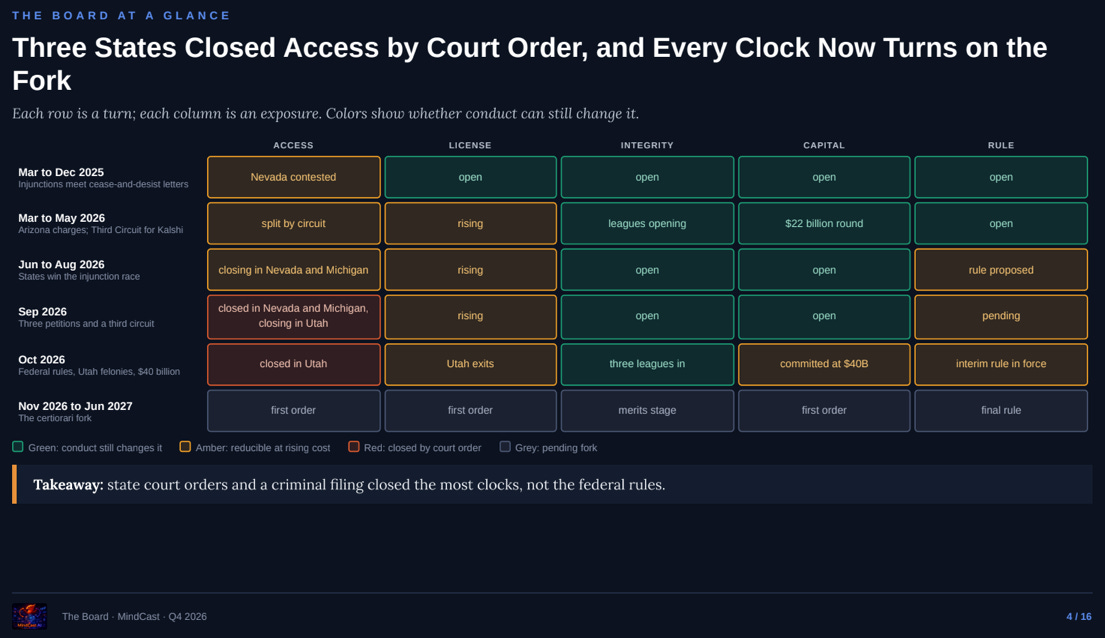
Takeaway: no branch pays every seat, so the choice still open to each reader is how much of its position survives the worst branch.
How the War Game Works
MindCast AI applies Predictive Behavioral Economics + Dynamic Game Theory through MindCast AI Proprietary Cognitive Digital Twin Foresight Simulations (MP CDT FS). Behavioral Economics supplies the decision rules. Game Theory supplies the payoff structure. Predictive simulations emerge from the combination.
Cognitive Digital Twins: Each actor on the board is a Cognitive Digital Twin (CDT) built from its own filings and conduct. The October 10 paper models eleven actors. The federal seats are the Commodity Futures Trading Commission (CFTC) and the Supreme Court. The state seats are New Jersey, Nevada, the state coalition and tribal governments.
The market seats are Kalshi, Robinhood and Crypto.com, plus licensed operators and private plaintiffs. The war game adds the Solicitor General and the leagues as decision seats. Every published decision rule stays unchanged.
Predictive Behavioral Economics: State attorneys general anchor on the salient case, and a felony count against a named founder is the most salient case available. Licensed operators weigh a gaming license far above one state’s prediction revenue, so they exit at the first sign of criminal exposure. Late-stage investors read momentum in valuation steps and discount legal fragmentation until a filing forces it into the terms.
Dynamic Game Theory: A state that loses nothing by enforcing has every reason to enforce while the petitions pend. The federal executive gains by delaying a ruling until its final rule frames the question, unless state escalation makes delay costly for its preferred side. Each seat chooses the move that survives the branch it fears most.
Reading the board: every item carries one label stating what it establishes.
Fact: a dated public event the war game takes as given.
Move: what a seat actually did at a turn.
Alternative: an exploratory move a seat could have made at the same turn, with no odds.
Inject: a hypothetical shock dropped onto the board to test responses, with direction only.
Finding: a mechanism the war game exposes, tested by its falsifier rather than by odds.
Simulation Prediction: a dated event with odds, a window and a falsifier.
Takeaway: the reader changes one move while the same Court, agency, states and operators respond under the same rules.
I. A Commitment Made Before the Court Acts Is Worth What It Keeps Under the Worst Branch
The governing rule draws on the economics of irreversible investment. Ben Bernanke’s 1983 paper Irreversibility, Uncertainty, and Cyclical Investment shows that the choice between committing now and waiting turns on how bad the bad news could be. Good news raises a project’s value but leaves the timing decision unchanged.
MindCast applies the principle as a risk-management rule for commitments made before the fork. The rule ranks positions by their worst branch first and leaves expected-value analysis to decide among positions with similar floors.
The certiorari fork turns that principle into a sorting rule. A dual-rail sportsbook with state licenses and a federally regulated prediction arm has a mild worst case under every branch. A standalone sports-contract venue in a hostile circuit has a severe worst case under three of the four.
Capital follows the same logic. An investor who commits at a valuation that assumes the federal answer holds an option whose value depends on the state branches. The headline valuation measures the good news and leaves the bad news to the terms.
Finding: before the Court acts, positions diverge by their worst branch rather than by their expected branch. Falsifier: single-rail and dual-rail positions show no difference in state access or financing terms before the Court’s first order.
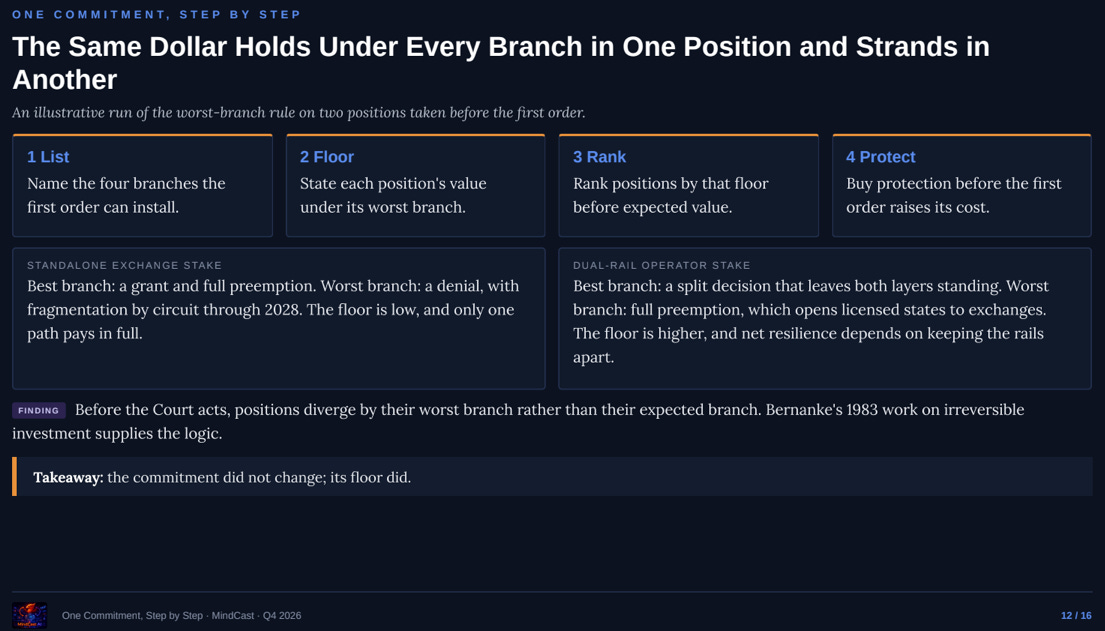
Takeaway: the reader should rank every position by its worst branch first and its best branch second.
II. Five Exposures Run on Five Clocks
Each clock carries two dates: when the exposure originates and when a preventive move stops being available. Each clock belongs to a different kind of player on the board.
Access (exchanges and brokers): The question is whether a platform keeps customers in a state while the petitions pend. The access window has closed for Kalshi’s sports contracts in Nevada, Michigan and Utah by court ruling or injunction. Michigan’s order carries a $500,000 daily fine and requires a geolocation provider licensed by the state (Decrypt).
License (sportsbooks, casinos and tribes): The question is whether a prediction product endangers a gaming license or a tribal compact. The clock closes on each state enforcement step. Utah showed the reaction time. DraftKings restricted its Utah products on October 28, FanDuel followed on October 30 and Fanatics announced its own exit afterward (InGame).
Integrity (leagues): The question is whether a league collects data and integrity terms from both channels. The NBA signed with Kalshi and Polymarket on October 26 and joined MLB and the NHL in signing a memorandum of understanding with the CFTC (The Block). The NFL remains the only major holdout.
Capital (investors): The question is whether financing terms, valuation language and listing timing absorb the litigation. Kalshi raised a $1 billion Series G at a $40 billion valuation on October 29, co-led by Wellington and Sequoia (Kalshi). The next dated tests are any initial public offering (IPO) filing and January 1, 2028.
Rule (every seat, and the technology vendors who build to it): The question is which venue the federal rulebook favors. The CFTC issued an interim final rule (Release 9309-26) and a proposed inclusion rule (Release 9310-26) on October 9. The exclusion rule took effect on publication, and comments on both close November 18.
No finalization date exists for the inclusion rule. The final rule’s own effective-date provision will govern. The Administrative Procedure Act generally sets thirty days after publication, and a major rule generally waits sixty under the Congressional Review Act. A separate final rule on event-contract data reporting has sat under White House review since October 20 (RegInfo.gov).
Finding: certainty on classification is not certainty on preemption. A final rule can confirm that a sports contract is a swap without deciding whether an exchange may list it or which state powers federal law displaces. MindCast CFTC Public Comments Ask the Agency to Separate Swap Classification From Listing Permission and Preemption pressed the same three-layer point in both October filings. Falsifier: a court treats a final inclusion rule as resolving displacement without separate analysis.
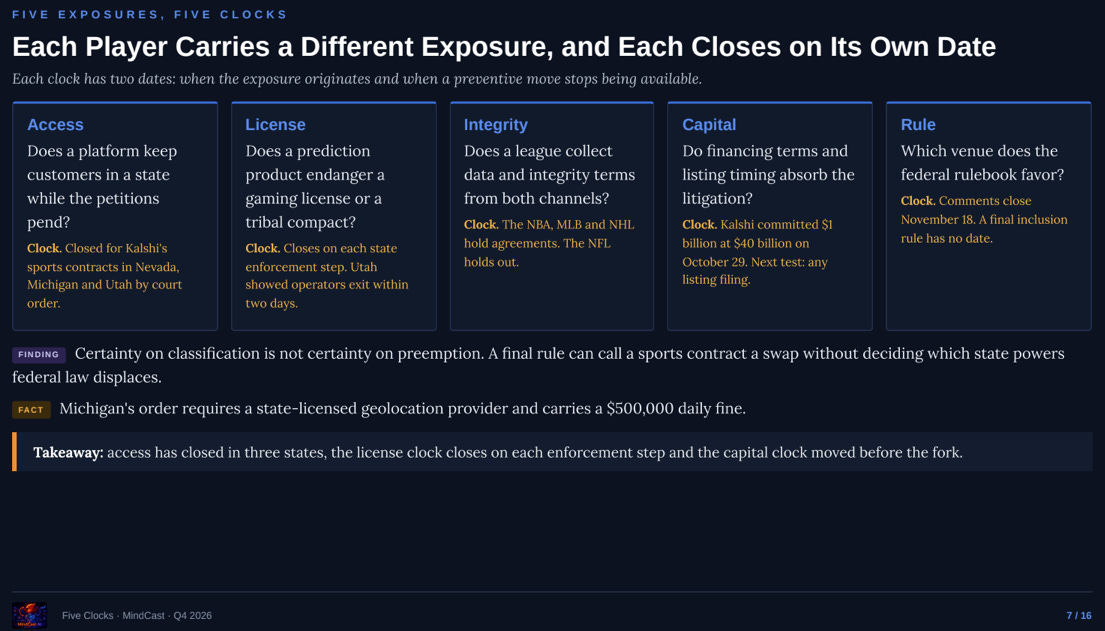
Takeaway: the access clock has closed in three states, the license clock closes on each enforcement step and the capital clock moved before the fork.
III. Six Turns From the First Injunctions to the Certiorari Fork
Six dated turns moved the contest from national access to access by circuit, and state courts drove most of the movement.
Each turn also carries its event class. A continuation updates information inside the same game. An equilibrium migration changes which outcome persists. A game evolution changes the strategies or payoffs that later moves depend on, or the rules, players and timing.
No turn so far meets the bar for game mutation, which the board reserves for an exceptional change that replaces the question itself.
March to December 2025: access contested and the other four clocks open.
March to May 2026: access split by circuit, license rising and integrity opening. Capital open and rule open.
June to August 2026: access closing in Nevada and Michigan, license rising and integrity open. Capital open and rule proposed.
September 2026: access closed in Nevada and Michigan and closing in Utah. License rising, integrity open, capital open and rule pending.
October 2026: access closed in Utah, license tested by the Utah exits and integrity three leagues in. Capital committed at $40 billion and rule interim.
November 2026 to June 2027: every clock turns on the certiorari fork.
Turn 1 · March to December 2025 · Cease-and-desist letters meet the first injunctions: A federal court in New Jersey enjoined state enforcement against Kalshi on April 28, 2025 (KalshiView). Nevada’s federal court dissolved Kalshi’s injunction in November 2025, and Robinhood stopped new Nevada sports contracts on December 1 (SBC Americas; SBC Americas). Robinhood paused, and Kalshi fought on.
Event class: continuation, because the turn tested positions without changing the rules.
Turn 2 · March to May 2026 · Criminal charges and a federal win: Arizona filed the first criminal charges against a federally registered prediction market in March (Deseret News). The Third Circuit ruled 2–1 for Kalshi on April 6 (Third Circuit opinion). Kalshi raised at a $22 billion valuation in May, and the capital clock began tracking the litigation (The Block).
Event class: game evolution, because criminal exposure added a new payoff for continued operation.
Turn 3 · June to August 2026 · States win the injunction race: Michigan secured a temporary restraining order on June 29 (Gaming.net). The federal court in Utah ruled in August that the state may enforce its gambling ban against Kalshi (InGame). The Ninth Circuit ruled unanimously for Nevada on August 28 and created a direct conflict (Ninth Circuit opinion).
Event class: equilibrium migration, because the split moved the persisting outcome from national access to access by circuit.
Turn 4 · September 2026 · Three petitions and a third circuit: Michigan converted its order into a preliminary injunction on September 1. New Jersey petitioned the Supreme Court on September 2 in No. 26-299, and Robinhood and Crypto.com followed in petitions 26-338 and 26-344. The Tenth Circuit denied Kalshi an injunction pending appeal, and the Sixth Circuit ruled for Ohio and Tennessee on September 25 (Sixth Circuit opinion).
Event class: game evolution, because the petitions gave the Court a move it lacked.
Turn 5 · October 2026 · Federal rules, state felonies and a $40 billion round: Ohio and 38 other states filed for certiorari on October 7, and the NFL filed the next day (Ohio coalition brief). The CFTC issued its two rules on October 9, and Utah sued Kalshi and the market maker Susquehanna later that month (SBC Americas). The CFTC sued Utah on October 27, and Utah filed fourteen counts against each of Kalshi and its two founders the next day, thirteen of them felonies (InGame). The same day, 37 states and the District of Columbia backed Utah in the Tenth Circuit.
Event class: game evolution, because the federal rules and the Utah felonies changed who gains from delay.
Turn 6 · November 2026 to June 2027 · The certiorari fork: Nevada’s responses come due November 13 in the Robinhood petition and November 16 in the Crypto.com petition (Nevada extension letter; docket No. 26-344). The Clerk granted Kalshi’s request to move its New Jersey brief from November 9 to December 7 (Supreme Court docket). CFTC comments close November 18, and the Court’s first substantive order then installs one of four successor games.
Takeaway: the turns that closed the most clocks were state court orders and a criminal filing, not the federal rules.
IV. Five Alternative Moves and How the Board Responds
Play mode changes one seat’s move and runs the same Court, agency, states and operators against it. Each alternative states the move, the turn, what it changes and its cost tier. Alternatives are exploratory and carry no odds; only Simulation Predictions carry odds.
Each alternative changes the evidence and the options, not the outcome of any proceeding. A move played after the closing event mostly documents what the seat could have done.
Alternative 1 · An exchange withdraws sports contracts from Utah after the August district ruling (Turn 3): Utah’s felony counts rest on trades an undercover agent placed after a federal court had ruled that state law applies. Withdrawal would have removed that predicate and left the federal appeal as the only contest. Cost tier: medium, from Utah fees the state estimates at $30.6 million to $61.2 million across the period it charges.
Alternative 2 · An investor in the October round keys a ratchet or milestone to the certiorari outcome (Turn 5):The investor would carry the state branches in the terms rather than in a later markdown. The headline valuation would fall or the protection would cost a concession elsewhere. Cost tier: low to medium, from negotiating leverage the round may not have offered.
Alternative 3 · The NFL signs an integrity and data agreement with a termination clause keyed to the ruling (Turn 5): The NBA’s agreements address the case in which prediction markets can no longer offer sports contracts (ESPN). An NFL agreement on the same model would collect integrity data under every branch while keeping its amicus position. Cost tier: low in money and medium in message, because the NFL told the Court that prediction markets are gambling.
Alternative 4 · A tribal gaming authority pairs its litigation with a venture limited to its own lands (Turn 5): The tribe would earn revenue under the federal branches and keep its Indian Gaming Regulatory Act (IGRA) claim under the state branches. Cost tier: medium, because opposing counsel will cite the venture against the tribe’s harm argument.
Alternative 5 · A geolocation or exchange technology vendor certifies its product for both federal venues and state gaming labs before the fork (Turn 6): Michigan’s order already requires a geolocation provider licensed by the state, so the state branch creates vendor demand on its own terms. A vendor certified both ways sells into whichever venue the ruling favors. Cost tier: medium, from duplicate certification.
Kalshi’s own move shows the cost of the opposite choice: it kept operating in Utah after the federal ruling, and the felony counts now rest on that conduct.
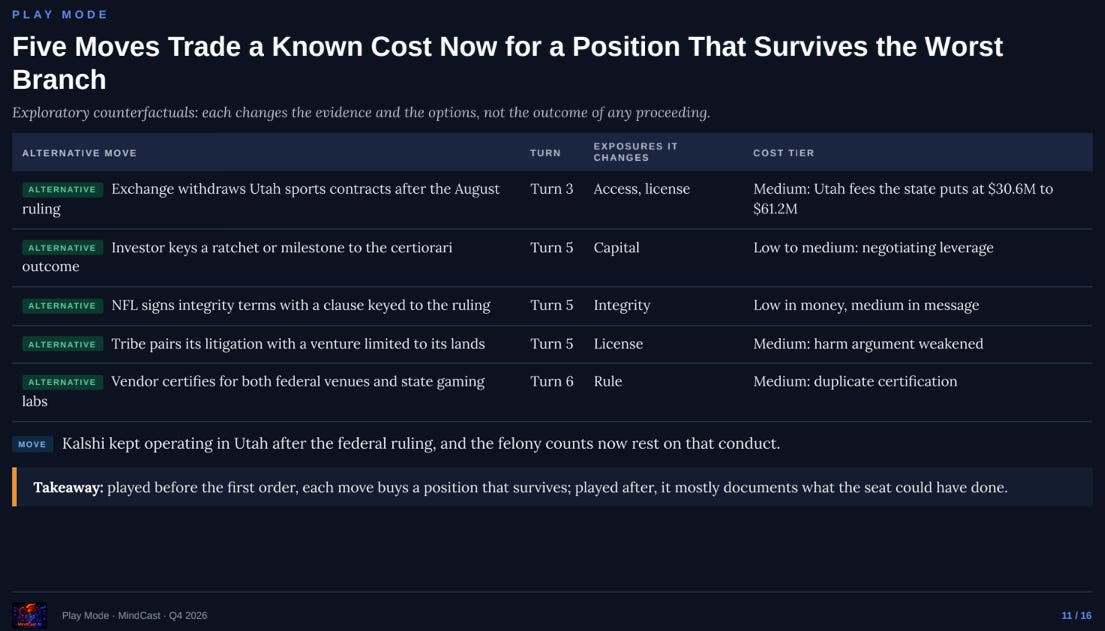
Takeaway: each alternative trades a known cost now for a position that survives the branch the seat fears most.
Injects for Play Mode
Injects test how the board responds to a shock. Each one moves the branch weights by direction only and carries no odds of its own.
Inject 1 · The Seventh Circuit rules for the CFTC in the Wisconsin appeal. The appellate count moves to two-to-two. The grant branch rises and the denial branch falls.
Inject 2 · The CFTC publishes a final inclusion rule before the Court’s first order. The hold branch rises, and a two-state challenge becomes the next state move.
Inject 3 · A federal court enjoins Utah’s criminal case on preemption grounds. The cost of delay falls for Kalshi. The Solicitor General’s case for an immediate grant weakens.
Inject 4 · A state issues a gaming license to a prediction exchange. A standalone venue converts into a dual rail in that state. The license clock opens a path the access clock had closed.
Inject 5 · Congress amends the Commodity Exchange Act to define sports event contracts. The board flags Inject 5 as the one game mutation in the set. The amendment would replace the statutory question the Court is weighing, so every branch map would need rebuilding.
Takeaway: four injects shift weights inside the existing game, and only a statutory amendment would replace it.
V. The Certiorari Fork Installs One of Four Successor Games
A forecast holds only inside the game that produced it. The Court’s first substantive order will change that game, so each branch below carries its own map of what lies past the fork.
The war game’s run of November 1, 2026 weights the four branches of the Court’s first consideration. The weights draw on the published bands, the three-circuit conflict and the state escalation since October 10. Each branch resolves at the Court’s first substantive order on the three petitions, verified by the Supreme Court docket.
Simulation Prediction B-1 · Grant on first consideration (28–38%). The Court grants plenary review in at least one petition when it first considers them. Falsifier: any other first order.
Simulation Prediction B-2 · A call for the Solicitor General’s views (25–35%). The Court invites the Solicitor General to file before deciding. Falsifier: any other first order.
Simulation Prediction B-3 · Hold (15–22%). The Court holds the petitions pending Kalshi’s Ninth Circuit rehearing petition, a final CFTC rule or a Seventh Circuit decision. Falsifier: any other first order.
Simulation Prediction B-4 · Denial of all three petitions (14–22%). The Court denies review, most likely on the interlocutory posture of the preliminary injunctions. Falsifier: any other first order.
The branch weights also bear on carried entry 1, a grant in at least one petition by June 30, 2027 (64–72%). A call for the Solicitor General’s views is the branch most likely to push a grant past June.
Kalshi’s extension to December 7 makes January 2027 the earliest plausible conference month. The Court has not scheduled one. The added month moves weight toward the hold branch by direction only. The Fourth Circuit, the Massachusetts high court and the CFTC each gain time to act before the Court does.
Grant (28–38%): successor state S-GRANT, a game evolution.
Solicitor General invited (25–35%): successor state S-SG, a game evolution.
Hold (15–22%): successor state S-HOLD, a continuation.
Denial (14–22%): successor state S-DENY, an equilibrium migration.
The four branches exhaust the Court’s first order. The bands are rounded ranges, and the midpoints within each set of bands sum to about 100%.
A Seventh Circuit ruling and a final CFTC rule enter as injects rather than as extra branches. The State and Forecast Ledger at the end of the section separates successor states from forecasts.
Branch 1 · Grant: the Court Likely Splits the Layers
A grant installs the merits game. The question New Jersey presents asks whether the Commodity Exchange Act displaces state gambling law for sports event contracts on a federally registered exchange.
Simulation Prediction M-1 · Split-layer resolution (55–60%, carried from August 21). Federal authority over the exchange is affirmed, and some state authority over wagering conduct survives. Resolves at the merits decision.
Simulation Prediction M-2 · Full state win (18–25%). The Court holds that sports event contracts fall outside exclusive federal jurisdiction, and the Ninth Circuit’s reading governs. Resolves at the merits decision.
Simulation Prediction M-3 · Full preemption (17–24%). The Court affirms the Third Circuit, and state gambling law is displaced for contracts on federal exchanges. Resolves at the merits decision.
The justice-level bands explain the shape. Five justices sit above 60% for preserving some state regulatory space. The five are Justices Thomas and Gorsuch together with Justices Sotomayor, Kagan and Jackson. A full Kalshi win needs at least one of them, so the merits game favors a split over a sweep.
Transition map for S-GRANT:
What changes: the governing rule moves from circuit law to a pending national answer. Timing fixes to the Term of argument, and merits amici join as players.
Paths opened and closed: the three merits outcomes open. Denial closes, along with fragmentation as an end state.
Positions: dual rails, state licenses and tribal ventures survive. Standalone venue holdings convert into a binary merits exposure.
Moves gained and lost: leagues, states and the Solicitor General gain merits briefs. Kalshi loses its posture argument.
Simulation Predictions that activate: M-1 to M-3, a league brief supporting New Jersey (56–70% carried) and merits briefing that separates coverage from displacement (78–90% carried).
Simulation Predictions that lapse: B-2 to B-4 and every C, H and D entry.
Validity condition: the map holds until the merits decision issues or the Court dismisses the grant.
Groups under a grant:
Federal-dependent: standalone exchanges and their investors hold a binary merits exposure through briefing. The modal split keeps their exchange layer and hands the conduct layer to the states.
State-dependent: states keep enforcing in the Sixth, Ninth and Tenth Circuits until the decision. Full preemption is the one sub-branch that strips their authority.
Hedged: dual-rail operators and leagues with terms on both channels gain under every merits outcome. The split decision pays them most, because they already hold both layers.
Swing seats: a league without terms gains a merits brief and loses time to sign before the decision.
Branch 2 · The Solicitor General Weighs In: the Administration Chooses the Timing
A call for the Solicitor General’s views hands the federal executive the next move. Utah became the tenth state the CFTC has sued, on October 27 (Covers). The agency’s spokesperson said the Ninth Circuit ruling “teed up a circuit split that calls out for resolution by the Supreme Court” (OddsShopper). The administration will decide whether a ruling now favors Kalshi or whether a final rule should come first.
Simulation Prediction C-1 · The Solicitor General recommends a grant (55–65%, given a call for views). State escalation raises the cost of waiting for the federal side, because every month adds criminal and injunctive exposure for federal exchanges. Resolves when the Solicitor General files.
Simulation Prediction C-2 · The Solicitor General recommends a hold or a remand in light of a final rule (20–28%, given a call for views). The agency would rather the Court read its final inclusion rule than the bare statute. Resolves when the Solicitor General files.
Simulation Prediction C-3 · The Solicitor General recommends denial (12–20%, given a call for views). The executive would prefer to litigate from its own suits against states, where the United States controls the vehicle. Resolves when the Solicitor General files.
A 2009 study by Thompson and Wachtell found that the Solicitor General took about four and a half months on average to answer an invitation. The Court followed its recommendation about 80% of the time (Turtle Talk).
The carried band for a federal narrowing of the CFTC’s broad theory before merits briefing ends stays at 50–60%. A narrower federal brief raises the split-layer odds in Branch 1, because the government would concede a conduct layer to win the exchange layer.
Transition map for S-SG:
What changes: the Solicitor General gains a move, and the timing stretches by months.
Paths opened and closed: a narrowed federal theory and a hold for the final rule open. A grant on first consideration closes.
Positions: dual rails survive. Kalshi’s preference for delay converts into a cost as state cases proceed, and investor plans that need a 2027 listing window strand.
Moves gained and lost: the Solicitor General and the CFTC gain. States gain months of enforcement, and Kalshi loses control of timing.
Simulation Predictions that activate: C-1 to C-3, the carried narrowing band (50–60%) and a Robinhood request to vacate and remand given a final rule (57–65% carried).
Simulation Predictions that lapse: B-1, B-3 and B-4.
Validity condition: the map holds until the Solicitor General files.
Groups under a call for views:
Federal-dependent: exchanges gain time and lose it at once, since the federal brief takes months while state charges proceed. Investors face the longest uncertainty window and the strongest case for terms keyed to the outcome.
State-dependent: states gain months of enforcement under existing rulings. A narrowed federal brief would concede them a conduct layer before the merits.
Hedged: dual-rail operators hold. Counsel should expect the federal brief to define the conduct layer that the merits game later tests.
Swing seats: an investor still deciding gains the longest window to negotiate terms keyed to the outcome.
Branch 3 · Hold: the Court Waits for a Cleaner Question
A hold parks the petitions until a pending event resolves. The carried band puts the Ninth Circuit not granting rehearing with vacatur before first distribution at 75–87%, so a hold for the Ninth Circuit most likely ends quickly.
Simulation Prediction H-1 · Release to a grant (55–65%, given a hold). The held petitions return to conference and the Court grants. Resolves at release from the hold.
Simulation Prediction H-2 · Remand in light of a final CFTC rule (20–30%, given a hold). The Court sends one or more cases back for the lower courts to read the final rule. Resolves at release from the hold.
Simulation Prediction H-3 · Denial after the hold (10–18%, given a hold). The intervening event leaves no question worth review. Resolves at release from the hold.
A remand helps the federal side only if the final rule survives the state challenge that follows. The carried band for a two-state challenge within sixty days of a final rule stands at 78–90%.
Transition map for S-HOLD:
What changes: timing alone. The players, strategies and rules stay as they stand.
Paths opened and closed: a remand in light of a final rule opens. No path closes permanently.
Positions: status-quo positions survive. Standalone venues carry holding costs in hostile states.
Moves gained and lost: the CFTC gains through its final rule, and the Seventh Circuit gains through its first ruling.
Simulation Predictions that activate: H-1 to H-3 and the two-state challenge band (78–90%, given a final rule).
Simulation Predictions that lapse: B-1, B-2 and B-4.
Validity condition: the map holds until the triggering event resolves.
Groups under a hold:
Federal-dependent: brokers that paused in hostile states lose least, because a hold extends the status quo. Standalone exchanges keep paying to stay in hostile states.
State-dependent: states hold their rulings and gain time to legislate the conduct layer.
Hedged: dual-rail operators hold, and vendors certified for both venues gain the clearest signal from the final rule’s venue language.
Swing seats: a single-venue vendor gains time to certify for the other venue before the rule lands.
Branch 4 · Denial: the Next Question Comes From a Final Judgment or From the United States
A denial leaves the split in place. The Third Circuit protects Kalshi in New Jersey, Delaware and Pennsylvania. The Sixth, Ninth and Tenth Circuit states keep enforcing, and the contest moves circuit by circuit until a cleaner vehicle reaches the Court.
Simulation Prediction D-1 · The next vehicle is a case the United States brings (48–58%, given denial). A CFTC suit against Wisconsin, Utah or Arizona reaches a court of appeals, and the Solicitor General petitions. The Court grants more than 70% of the Solicitor General’s petitions against about 4% of paid petitions (Schweitzer, Green Bag).
Simulation Prediction D-2 · The next vehicle is an appellate ruling that changes the count, led by the Fourth Circuit or the Massachusetts high court (20–28%, given denial). Both courts heard argument in May 2026 and have not ruled (Gaming.net; Gambling Harm). Each reviews a preliminary injunction and leaves the posture objection in place. A ruling that deepens the split still raises the cost of a second denial.
Simulation Prediction D-3 · The next vehicle is a challenge to the final CFTC rule (18–26%, given denial). The question shifts from statutory displacement to whether the agency’s swap definition binds the courts after Loper Bright.
The D entries resolve at the next grant of review on the question through October Term 2028, verified by the Supreme Court docket. The next question would most likely ask whether the Commodity Exchange Act displaces state law in a suit the United States itself brings. A denial therefore delays the answer by about one Term rather than ending the contest.
Transition map for S-DENY:
What changes: circuit law becomes the operating law, and the national answer slips at least one Term. The Solicitor General becomes a likely petitioner, and state legislatures gain weight.
Paths opened and closed: the three vehicle paths open. A Supreme Court ruling before 2028 closes.
Positions: state licenses and dual rails survive. National sports-contract strategies in hostile circuits strand, and standalone venues convert toward non-sports products.
Moves gained and lost: states gain enforcement and legislative moves. Kalshi loses its near-term route to a national answer.
Simulation Predictions that activate: D-1 to D-3, six jurisdictions sustaining restrictions by August 20, 2027 (70–80% carried) and legislation in three more state sessions (65–78% carried).
Simulation Predictions that lapse: M-1 to M-3. Carried entry 1 resolves false, because it covers only the three pending petitions.
Validity condition: the map holds until the Court grants review in any case presenting the question.
Groups under a denial:
Federal-dependent: standalone exchanges absorb the worst branch, with geographic fragmentation through at least 2028. Investors face the sharpest markdown risk, and the carried band for fragmentation changing Kalshi’s financing terms or disclosure by any disposition stands at 75–85%.
State-dependent: licensed-only sportsbooks and casinos gain the most, because state licenses stay the only national channel. States gain enforcement authority and a stronger hand in 2027 sessions.
Hedged: dual-rail operators hold or gain, since the licensed rail carries the national business while the prediction rail retreats from hostile states.
Swing seats: an exchange that exits hostile states early converts part of its business into a hedged footprint.
The Four Paths by Group
Read across the four paths, the three groups separate cleanly.
Federal-dependent seats keep the exchange layer but lose the conduct layer under a split decision. Full preemption pays them in full, and a full state win or a denial costs them. A call for the Solicitor General’s views leaves them waiting while state cases mount, and a hold costs them in hostile states.
State-dependent seats keep the conduct layer under a split decision and win under a full state win. Full preemption costs them, a call for views buys them months and a denial pays them.
Hedged seats gain most under a split decision and hold under every other path, including a denial.
Finding: hedged positions preserve more strategic alternatives across the modeled branches, but their exposure does not disappear. State licensing consequences, regulatory spillovers, compliance costs and commercial restrictions can reduce or eliminate the advantage. The war game therefore evaluates option preservation separately from net financial resilience. Falsifier: a second state regulator acts against a licensed operator’s standing over its prediction product before July 2027.
State and Forecast Ledger
The branch maps contain two kinds of entry. Some entries install a new game, and others forecast a move inside a game already installed. The ledger separates the two and prunes duplicates.
S-GRANT, the merits game: reached from B-1, H-1 or a grant after C-1.
S-SG, a pending federal brief: reached from B-2.
S-HOLD, a wait on a triggering event: reached from B-3.
S-DENY, the circuit-by-circuit game: reached from B-4, H-3 or a denial after C-3.
S-SPLIT, a federal exchange layer with a state conduct layer: reached from M-1.
S-FED, full preemption: reached from M-3.
S-STATE, a full state win: reached from M-2.
S-REMAND, lower courts reading the final rule: reached from H-2 or a remand after C-2.
Forecasts, not states: C-1 to C-3 each resolve into S-GRANT, S-REMAND or S-DENY. D-1 to D-3 name candidate vehicles inside S-DENY.
Injects 1 to 5: shocks that apply in any state and move weights by direction only.
Eight distinct reachable states remain after pruning. The Solicitor General’s three recommendations and the three candidate vehicles forecast moves inside an existing state, so the board does not count them as states. S-REMAND inherits the S-HOLD map with one change: the two-state challenge band (78–90%, given a final rule) becomes the first state move. The three merits states inherit the S-GRANT map and produce the group results listed above.
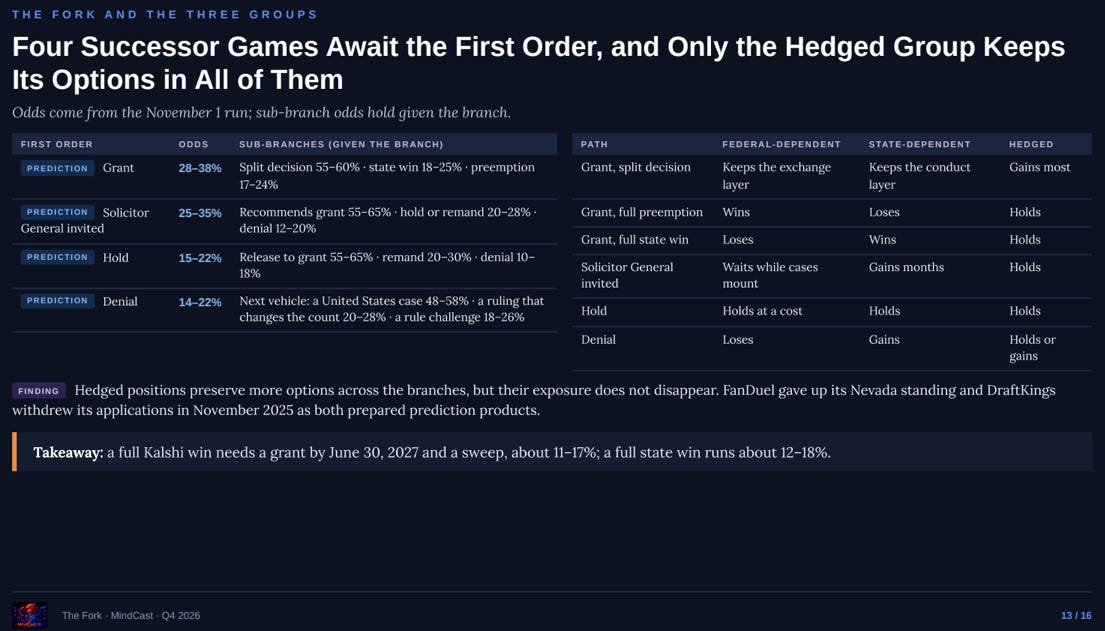
Takeaway: the Court’s first order decides which successor state the board plays, and only the hedged group keeps its options under every branch.
VI. Kalshi Is Losing the State Contest and Winning the Federal One
The contest runs on two fronts, and Kalshi stands on opposite sides of each. On the state front, two of three circuits have ruled for the states. Three states have closed their access clocks by court order, and two have filed criminal charges. The Ohio coalition brief counts more than twenty decisions dividing 18–4 against preemption (Gaming.net).
On the federal front, the CFTC is suing states, writing rules and signing integrity agreements with leagues. Capital markets added $18 billion of valuation between May and October. Three of the four major leagues now hold commercial terms with prediction markets, and only the NFL holds out (The Block).
Finding: the Court sits between the two fronts. The merits bands favor a split that gives Kalshi the exchange layer and the states a conduct layer.
A full Kalshi win needs a grant and a sweep at the merits. Carried entry 1 (64–72%) times M-3 (17–24%) places that path at about 11–17%. A full state win follows the same arithmetic at about 12–18%.
The weakest link in the two-front reading is the conduct layer’s breadth, which no published source yet defines.
Kalshi asked on October 29 to move its brief from November 9 to December 7, one day after Utah’s felony filing. The Clerk agreed the next day (Supreme Court docket). The motion establishes the delay but not the motive. Section VIII tests a strategic preference for delay as Hypothesis D.
Takeaway: Kalshi is ahead where the rules are written and behind where they are enforced, and the Court’s most likely answer leaves both halves standing.
VII. Seats Sort by the Legal Layer Their Money Needs, Not by Industry
The war game sorts every seat by the legal layer its money depends on, not by industry. Industry labels cut across the fork. A sportsbook with a prediction arm and a casino with only a state license face opposite worst branches.
Three groups follow from the sort, and the swing seats still choose among them. Group membership holds while the paths move. The Kalshi contest has not reached a stable equilibrium, so each event changes what a group earns but not which group a seat belongs to.
Group 1 · Federal-Dependent Seats Need Preemption
Standalone exchanges such as Kalshi and Polymarket belong here, along with Crypto.com and the brokers that route sports contracts to exchanges. Private investors in those venues share the group’s exposure. Kalshi itself has begun a swing-seat move. The company reported more than $1 billion in annualized non-sports revenue with its October round, revenue that survives a denial (Kalshi).
The worst branch is a denial, followed by a full state win at the merits. A denial leaves fragmentation by circuit through at least 2028, and criminal exposure continues in Arizona and Utah. The modal split decision keeps the exchange layer and costs the conduct layer. Full preemption is the only sub-branch that pays the group in full, and the path of a grant by June 30, 2027 followed by a sweep runs about 11–17%.
Terms keyed to the outcome protect investors against the state branches, while a clean headline valuation leaves both unhedged. The carried band for Kalshi’s next disclosed financing including structure such as a preference, ratchet or milestone stands at 60–72%. The terms of the October round have not been disclosed. Geofencing a hostile circuit before a criminal filing costs revenue and keeps adverse facts out of the federal case.
Diversified brokers carry the group’s exposure at lower severity. The carried band for Robinhood’s diversified structure proving more resilient to fragmentation than standalone venues stands at 70–80%.
Group 2 · State-Dependent Seats Need State Authority
States and the state attorney general coalition belong here, along with tribal governments and casinos or sportsbooks that hold only state licenses. Vendors built only to state rules share the group’s exposure. Michigan’s order requiring a geolocation provider licensed by the state shows how a state ruling creates that vendor demand.
The worst branch is full preemption, which opens licensed states to federal exchanges and narrows tribal leverage. A split decision still leaves the conduct layer, so the group’s floor depends on how wide that layer runs.
States that define the conduct layer in legislation now enter the next game with written rules. The carried band for prediction-market legislation in at least three more state sessions in 2027 stands at 65–78%. Tribes carry a separate statute in IGRA, and the carried band for further tribal court action before July 2027 stands at 94–99%.
Licensed-only operators lose least by acting early. A licensed operator can add a federally regulated channel and move into the hedged group, the path DraftKings and FanDuel already took.
Group 3 · Hedged Seats Hold Both Rails
DraftKings, FanDuel and Fanatics belong here, because each runs a licensed gaming business and a federally regulated prediction channel. The NBA, MLB and NHL belong here through terms with prediction markets and memoranda with the CFTC, while their sportsbook deals stay in place. Vendors certified for both venues and public investors in dual-rail operators share the position.
The hedged group keeps the most strategic alternatives across the four paths in Section V, though its exposure does not disappear. The group’s main open variables are the breadth of the conduct layer and the cost of keeping the rails apart. The carried band for DraftKings and FanDuel each keeping both businesses at March 31, 2027 stands at 85–94%.
Utah showed the group’s mechanism at work: both operators kept their licensed businesses while their prediction rails left the state. The NBA collects value under every branch through its termination clause.
Dual rails carry costs of their own. Licensing fees, operational separation and state limits on distribution can erode the advantage. A state regulator can also treat a licensee’s prediction arm as a threat to its license, so the board tests dual-rail resilience rather than assuming it.
Nevada has already shown the spillover. FanDuel gave up its Nevada standing and DraftKings withdrew its pending applications in November 2025 as both prepared to launch prediction products (Covers). Both launched sports prediction contracts in states without legal online sports betting, which keeps the two rails apart.
The Swing Seats Decide Where the War Game Moves
The swing seats still choose a group before the Court’s first order. Every alternative move in Section IV is a swing seat moving from one group to another. Each move carries a cost now and a deadline set by the fork.
The NFL. The league holds no prediction-market terms and told the Court that prediction markets are gambling. An agreement with a termination clause would move it into the hedged group. The carried band for no Kalshi agreement with the NFL through June 30, 2027 stands at 66–80%.
Investors deciding whether to enter. An investor who enters on terms keyed to the certiorari outcome takes a hedged position. An investor who enters on clean terms joins the federal-dependent group.
Tribes weighing ventures. A venture limited to tribal lands pays under the federal branches while the IGRA claim covers the state branches. The carried band for an additional Kalshi tribal venture before July 2027 stands at 79–90%.
Exchanges deciding whether to exit hostile states. An early exit converts part of a federal-dependent business into a hedged footprint. Kalshi’s continued operation in Utah after the August ruling shows the cost of staying.
Single-venue technology vendors. Certification for both federal venues and state gaming labs moves a vendor into the hedged group before the final rule.
Takeaway: three groups stay fixed while the paths move, and the swing seats decide how many readers end the fork in the hedged group.
VIII. Four Explanations Compete, and the Utah Exits Already Cut Against Waiting
Four explanations compete for how positions taken before the ruling affect outcomes. Each carries its own falsifier.
Hypothesis A · Courts decide everything, so waiting costs nothing. Falsifier: single-rail and dual-rail positions diverge in state access or financing terms before the Court’s first order. The Utah week already cuts against Hypothesis A.
Hypothesis B · Positions that survive every branch keep their value. The war game’s thesis. Falsifier: after the Court’s first order, a standalone venue gains state access or financing terms in a state where a dual-rail operator loses either.
Hypothesis C · The federal executive decides, and the Court’s answer is secondary. Falsifier: the Court acts before the CFTC finalizes its inclusion rule, and states keep enforcing after the final rule.
Hypothesis D · Kalshi prefers delay because the CFTC’s final rule helps it more than an early ruling. Supporting evidence: the extension request came one day after Utah’s felony filing and keeps Kalshi’s brief behind the CFTC comment close. Falsifier: Kalshi’s December 7 brief urges the Court to grant review now. Carried entry 3 tests the same question.
Takeaway: Hypothesis B predicts divergence by worst branch, Hypothesis A predicts no divergence and Hypothesis C predicts convergence on the federal rule. Hypothesis D resolves on Kalshi’s December 7 brief.
IX. MindCast Simulation Predictions
The forecast set carries 41 Simulation Predictions. Fifteen are new in the November 1 run and print first. Twenty-six carry over at their published bands: two status changes and 24 numbered entries, with M-1 repeated as entry 15 because Section V relies on it. One earlier entry that resolved false prints beside the hits and sits outside the 41.
New in the November 1 run
B-1 · Grant on first consideration (28–38%).
B-2 · A call for the Solicitor General’s views (25–35%).
B-3 · Hold (15–22%).
B-4 · Denial of all three petitions (14–22%).
M-2 · Full state win (18–25%, given a merits decision).
M-3 · Full preemption (17–24%, given a merits decision).
C-1 · The Solicitor General recommends a grant (55–65%, given a call for views).
C-2 · The Solicitor General recommends a hold or a remand in light of a final rule (20–28%, given a call for views).
C-3 · The Solicitor General recommends denial (12–20%, given a call for views).
H-1 · Release to a grant (55–65%, given a hold).
H-2 · Remand in light of a final CFTC rule (20–30%, given a hold).
H-3 · Denial after the hold (10–18%, given a hold).
D-1 · The next vehicle is a case the United States brings (48–58%, given denial).
D-2 · The next vehicle is an appellate ruling that changes the count (20–28%, given denial).
D-3 · The next vehicle is a challenge to the final CFTC rule (18–26%, given denial).
Resolved and pending entries
S-5 from Kalshi At The Supreme Court: 39 State Attorneys General Tribal Gaming Authority and Prediction-Market IPO Risk · A prediction-market platform other than Gemini and Webull stops offering sports contracts in a state after that state’s cease-and-desist letter or enforcement filing, without a court order, before July 2027 (77–89%). Met. DraftKings and FanDuel withdrew sports contracts from Utah after the October 28 filing, and Fanatics followed. The filing named Kalshi rather than the platforms that withdrew.
P-1 from the same paper · The next multistate brief in a state-authority case carries 37 to 41 states (78–88%).Met. The October 28 Tenth Circuit brief carried 37 states and the District of Columbia (InGame).
The Kalshi Circuit Split: The Ninth Circuit Defines the Prediction-Market Gaming Boundary the CFTC Would Not · The Sixth Circuit decision produces a three-to-one or two-to-two circuit configuration rather than avoiding the conflict (70–82%). Not met. The Sixth Circuit ruled for Ohio and Tennessee on September 25, which left the appellate count at two-to-one for the states.
Carried Simulation Predictions
The Court grants plenary review in at least one of Nos. 26-299, 26-338 or 26-344 by June 30, 2027 (64–72%).Falsifier: no grant by June 30, 2027.
The Court issues its first substantive order in any of the three petitions before the CFTC publishes a final inclusion rule (61–69%). Falsifier: a final rule publishes first.
Kalshi’s November 9 brief in opposition cites pending CFTC rulemaking as a reason to deny or defer review (64–78%). Brief now due December 7. Falsifier: no such citation.
Nevada’s first response to either industry petition states that the preemption question warrants review now (71–84%). Falsifier: Nevada argues for waiting.
A commenter other than MindCast challenges the interim rule’s good-cause justification by the November 18 comment close (69–77%). Falsifier: no such comment.
A tribal government or organization raises IGRA in a comment on either CFTC rule by November 18 (82–90%). Falsifier: no such comment.
A final federal rule allowing the contested model and issued before July 2027 draws a challenge from at least two state governments within sixty days (78–90%, given a final rule). Falsifier: fewer than two state challenges.
DraftKings and FanDuel each retain a licensed gaming business and an event-contract channel at March 31, 2027 (85–94%). Falsifier: either drops one.
Kalshi and the NFL announce no integrity, data or prohibited-bettor agreement through June 30, 2027 (66–80%). Falsifier: any such agreement.
Kalshi completes a material private or structured capital event before any IPO, and no IPO is completed before January 1, 2028 (60–70%). The October 29 round meets the first half; the second half remains open.
Kalshi’s next disclosed financing includes structure such as a preference, ratchet or milestone rather than clean equity (60–72%). Open until the October terms are disclosed.
Kalshi further increases non-sports and institutional product emphasis before any IPO filing (80–90%).Kalshi reported more than $1 billion in non-sports annualized revenue and described the round as building a multi-asset exchange (Kalshi).
At least one opposing tribe or tribal gaming association takes further court action against sports event contracts before July 2027 (94–99%). Falsifier: no such action.
Prediction-market legislation appears in at least three additional state sessions in 2027 (65–78%). Falsifier: fewer than three.
Carried entries cited in Sections V and VII
M-1 · Split-layer resolution is the modal merits outcome (55–60%, given a merits decision). Falsifier: a full sweep for either side.
The National Collegiate Athletic Association (NCAA) or another major league files a merits-stage brief supporting New Jersey (56–70%, given a grant). Falsifier: no such brief.
Merits briefing treats coverage and displacement as separate questions (78–90%). Falsifier: briefing merges the two.
The Justice Department or the Solicitor General narrows or conditions the CFTC’s broad theory before merits briefing ends (50–60%). Falsifier: the federal brief adopts the full theory.
Robinhood asks the Court to vacate and remand in light of a final rule (57–65%, given a final rule while its petition is pending). Falsifier: no such request.
The Ninth Circuit does not grant rehearing with vacatur before first distribution (75–87%). Falsifier: rehearing granted with vacatur.
At least six jurisdictions sustain state-specific restrictions for thirty days or more by August 20, 2027 (70–80%). Falsifier: fewer than six.
Legal fragmentation changes Kalshi’s financing terms, valuation language or material disclosure by any certiorari disposition (75–85%). Falsifier: no such change.
Robinhood’s diversified structure proves more resilient to fragmentation than standalone venues (70–80%).Falsifier: Robinhood’s prediction exposure moves its results more than a standalone venue’s.
Kalshi or a tribe announces at least one additional tribal venture before July 2027 (79–90%). Falsifier: no new venture.
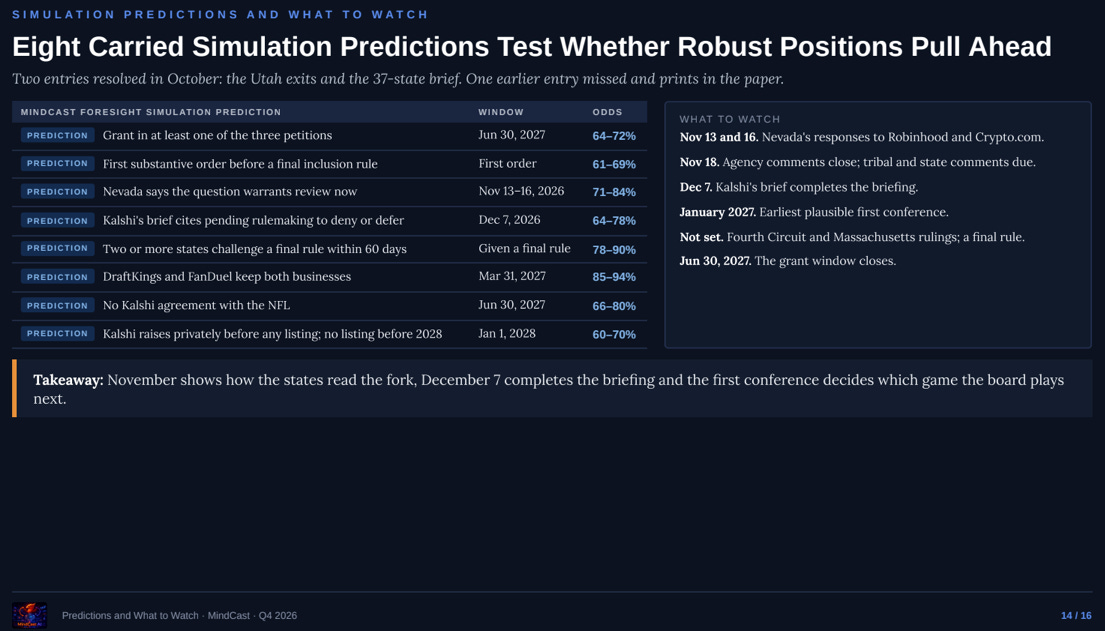
Takeaway: three carried entries resolve between November 13 and November 18, a fourth resolves with Kalshi’s December 7 brief and the branch entries resolve at the Court’s first order.
X. Risk Mitigation Layer
Each entry states the branch odds and the exposure in units the stakeholder controls. Actions carry an owner and a deadline, and the residual follows. The entries run by group, with the swing seats last.
Federal-Dependent Seats
Investors in standalone venues · denial (14–22%) and full state win (18–25% given a merits decision)
Severity: high on denial. Exposure: position value tied to sports-contract revenue in Sixth, Ninth and Tenth Circuit states.
Action 1: request disclosure of sports revenue by circuit (investment committee, before the next funding call).
Action 2: seek terms keyed to the certiorari outcome in any follow-on round (deal counsel, at the next round).
Residual: the October round’s terms, committed before the fork and not yet disclosed.
Exchanges and brokers · denial (14–22%) and state criminal filings
Severity: high. Exposure: active sports-contract customers in states with adverse rulings, counted in monthly fees.
Action 1: geofence any state after an adverse federal ruling and before a criminal filing (general counsel, within ten days of the ruling).
Action 2: separate sports from non-sports revenue in investor materials (finance, before the next financing).
Residual: conduct already charged in Arizona and Utah.
State-Dependent Seats
Licensed-only sportsbooks and casinos · full preemption (17–24% given a merits decision)
Severity: medium to high. Exposure: handle in states that would open to federal exchanges.
Action 1: model license value under full preemption (strategy, before the first conference).
Action 2: evaluate a federally regulated channel that moves the operator into the hedged group (corporate development, before a merits grant).
Residual: market share lost to exchanges in the preemption branch.
States and tribal governments · full preemption (17–24% given a merits decision)
Severity: high. Exposure: licensing revenue, compact terms and self-exclusion programs.
Action 1: write conduct-layer rules for age limits, advertising and self-exclusion into statute (legislature, 2027 session).
Action 2: preserve IGRA claims in every filing (tribal counsel, standing).
Residual: authority lost if the Court sweeps.
Hedged Seats
Dual-rail operators · split decision that hands states the conduct layer (M-1, 55–60% given a merits decision)
Severity: low to medium. Exposure: prediction revenue in states that may regulate conduct after a split decision.
Action 1: keep exit triggers by state in every prediction product (compliance, standing).
Action 2: separate licensed and prediction operations so one regulator cannot reach both (operations, before the first conference).
Residual: a regulator that treats the prediction arm as a license violation.
Swing Seats
The NFL · no Kalshi agreement through June 30, 2027 (carried entry 9, 66–80%)
Severity: medium. Exposure: integrity data and fees on contracts that trade without league terms.
Action 1: sign integrity terms with termination clauses keyed to the ruling (league counsel, before a merits grant).
Action 2: align the league’s amicus position with its commercial terms (commissioner’s office, before merits briefing).
Residual: contracts listed by venues outside any agreement.
Technology and data vendors · a final rule that favors one venue (band pending)
Severity: medium. Exposure: products certified for one venue only.
Action 1: certify for state gaming labs and federal venues (product, before the final rule).
Action 2: license a geolocation product in Michigan and in each state that copies its mandate (compliance, before the first conference).
Residual: certification cost in the branch that never arrives.
Takeaway: every group can still buy protection against its worst branch before the Court’s first order, and for most swing seats the protection is a move into the hedged group.
XI. What to Watch
November 3, 2026 · Midterm elections: The result sets which party controls the committees that oversee the CFTC in 2027.
November 13 and 16, 2026 · Nevada’s responses to Robinhood and Crypto.com: Nevada’s position on whether review should come now tests carried entry 4.
November 18, 2026 · CFTC comment close: Tribal, state and good-cause comments resolve carried entries 5 and 6.
December 7, 2026 · Kalshi’s brief in opposition to New Jersey: The brief completes the briefing on all three petitions and makes January 2027 the earliest plausible conference month.
Dates not set · Fourth Circuit and Massachusetts high court rulings: Both courts heard argument in May 2026. Either ruling can change the appellate count before the first conference.
Date not set · Final event-contract reporting rule: The rule has been under White House review since October 20. The proposal set general compliance sixty days after publication.
Date set after replies · The Court’s first conference on the petitions: The first substantive order installs one of the four successor games.
Dates not set · Tenth and Seventh Circuit rulings: A Seventh Circuit ruling for the CFTC would make the split two-to-two and raise the grant odds.
June 30, 2027 · End of October Term 2026: The grant window for carried entry 1 closes.
Takeaway: November shows how the states read the fork, December 7 completes the briefing and the first conference decides which game the board plays next.
XII. Rank Positions by Their Worst Branch Before Any Dated Legal Fork
The war game yields one rule that transfers beyond Kalshi. Any dated legal fork with enumerable branches sorts positions the same way. A pending petition, a final agency rule and an export-control deadline all qualify.
The rule runs in four steps. List the branches the fork can install. State each position’s value under its worst branch. Rank positions by that value before expected value, and buy protection before the first order raises its cost.
The rule rests on three assumptions. The commitment must be costly to reverse, the branches must be knowable in advance and the worst case must be estimable from public conduct. Where any assumption fails, the rule gives way to ordinary expected-value reasoning.
Three observables show whether a market has adopted the rule. Operators exit hostile states within days of an enforcement step. Late-stage financings carry terms keyed to rulings. League and vendor contracts carry clauses for the branch they cannot control.
Applied to Kalshi, the rule sorts every seat into three groups. The swing seats then face one practical question: what it costs to move into the hedged group before the first order.
Takeaway: the worst-branch rule applies to any dated legal fork, from a certiorari petition to an export-control deadline.
XIII. Conclusion
Kalshi raised at $40 billion in the same week that Utah charged its founders. DraftKings and FanDuel left Utah within two days and kept both businesses. Each move was a bet on a different branch, and the exit keeps the most options across all four.
The war game’s answer to whether the contest is going Kalshi’s way is split. Kalshi leads where the rules are written and trails where they are enforced. The Court’s most likely answer gives Kalshi the exchange and the states a conduct layer, which makes the breadth of that layer the next contest.
The transferable result is a sorting discipline. Rank every position by its worst branch first. Commit capital only where the worst branch is survivable, and buy the protection before the first order raises its cost. For most readers the protection means moving into the hedged group.
Working With MindCast
MindCast AI applies Predictive Behavioral Economics + Dynamic Game Theory through MindCast AI Proprietary Cognitive Digital Twin Foresight Simulations (MP CDT FS). Behavioral Economics supplies the decision rules. Game Theory supplies the payoff structure. Predictive simulations emerge from the combination.
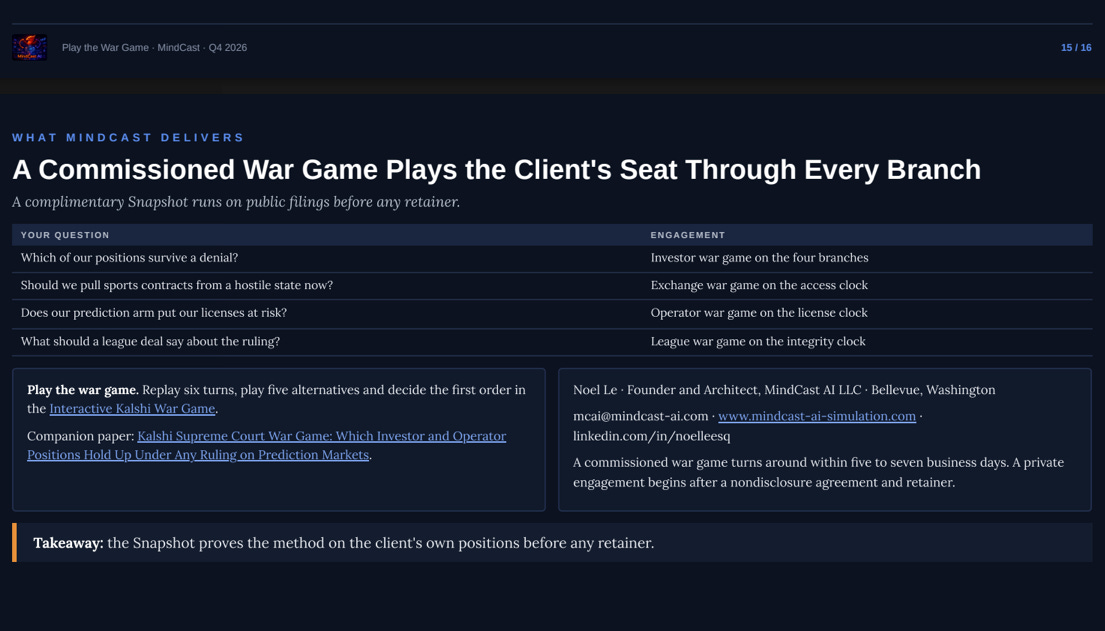
A commissioned war game builds Cognitive Digital Twins of the client’s own regulators, counterparties and competitors. The engagement plays the client’s seat through all four branches and every sub-branch within five to seven business days.
For an investor it maps a position against each branch’s worst case. For an operator it dates the access and license clocks state by state. For a league or vendor it tests commercial terms against the ruling the contract must survive.
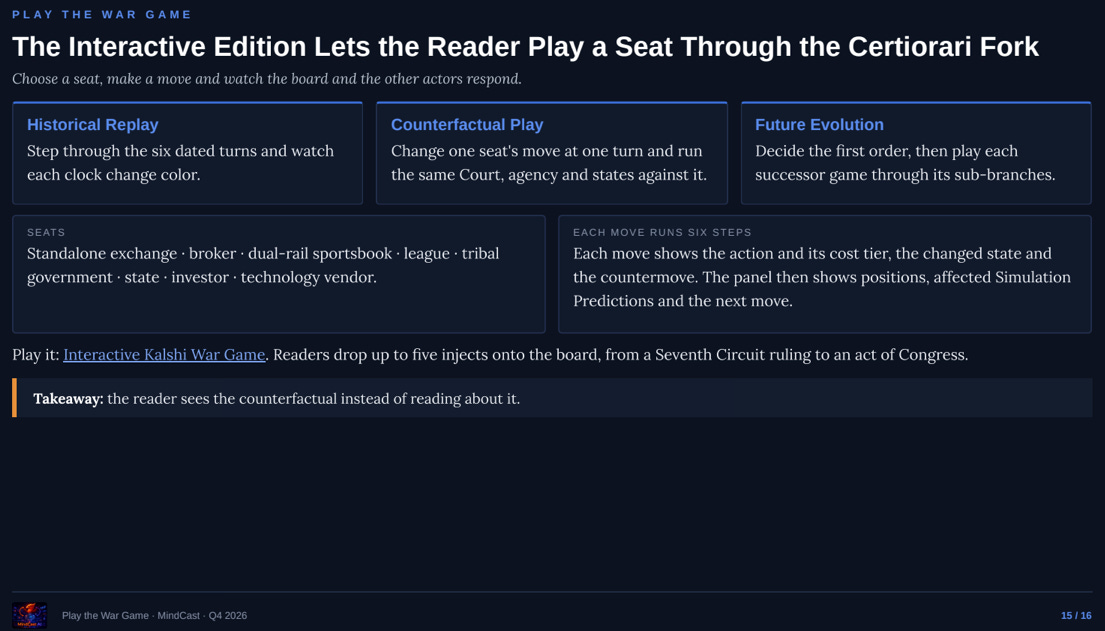
Readers can replay the six turns and play the five alternatives in the Interactive Kalshi War Game. The Kalshi War Game Executive Presentation carries the full board for briefings.
MindCast offers a complimentary Snapshot built from public filings before any retainer, and a private engagement begins after a nondisclosure agreement (NDA) and retainer. Contact mcai@mindcast-ai.com or visit www.mindcast-ai-simulation.com.
Selected MindCast Works
Kalshi War Game Executive Presentation. Condenses the six turns, four branches and three groups into a briefing for executives and counsel.
Interactive Kalshi War Game. Lets a reader replay the turns and play a seat through the certiorari fork without changing any published odds.
CFTC Seeks to Exclude Sportsbooks and Proposes to Claim Prediction Markets as Kalshi Petitions Reach the Supreme Court. Supplies the eleven Cognitive Digital Twins, the delay split and the governing forecast set.
Both A Swap And A Bet: Simulating The Looming Supreme Court Battle Over Prediction Markets. Supplies the merits layer, the justice-level bands and the capital entries.
Kalshi At The Supreme Court: 39 State Attorneys General Tribal Gaming Authority and Prediction-Market IPO Risk. Supplies the state, tribal and operator entries, including the Utah exit entry.
Kalshi Supreme Court Amicus Briefs: The NFL and Dodd-Frank’s Architects Split the Fight Into Jurisdiction and Game-Integrity Safeguards. Supplies the entries on Kalshi’s brief in opposition and the league seat.
The Kalshi Vehicle Contest: New Jersey Puts Prediction-Market Sports Betting Before the Supreme Court. Supplies the certiorari-stage moves and the Ninth Circuit rehearing entry.
The Kalshi Circuit Split: The Ninth Circuit Defines the Prediction-Market Gaming Boundary the CFTC Would Not. Supplies the circuit-configuration entry that resolved false.
MindCast CFTC Public Comments Ask the Agency to Separate Swap Classification From Listing Permission and Preemption. Supplies the agency lane and both October comments.
AI Chip Export Enforcement War Game Shows When Verification Protects US Firms and When It Arrives Too Late. Supplies the clock method this paper applies to a certiorari fork.
OpenAI Liability War Game — When AI Safety Controls Reduce Exposure and When They Become Evidence. Supplies the war game format.
Sources
Ben S. Bernanke, Irreversibility, Uncertainty, and Cyclical Investment, Quarterly Journal of Economics 98, no. 1 (1983): 85–106. Supplies the bad-news principle behind the governing rule.
KalshiView, Is Kalshi Legal in New Jersey?, September 2026. Dates the April 2025 injunction and the extension to November 9.
SBC Americas, Nevada judge tells Kalshi it’s time to pull sports contracts in the state, November 25, 2025, and Robinhood freezes sports contracts in Nevada after injunction denied, November 26, 2025. Date the Nevada turn.
Third Circuit, KalshiEX v. Flaherty opinion, April 6, 2026.
Ninth Circuit, opinion in No. 25-7516, August 28, 2026.
Sixth Circuit, opinion 26a0272p, September 25, 2026.
Gaming.net, Michigan judge orders Kalshi to maintain geofence on sports contracts, September 2026. Dates the June order and the September injunction.
Decrypt, Michigan judge bars Kalshi sports bets, threatens $500K daily fine, September 2026. Reports the licensed geolocation requirement.
InGame, report on the Tenth Circuit’s denial of an injunction pending appeal, September 2026. Reports the August district ruling in Utah.
Supreme Court, Brief of Amici Curiae Ohio, 38 Other States, and the District of Columbia, No. 26-299, October 7, 2026.
Supreme Court, Nevada extension letter in No. 26-338, October 8, 2026. Sets the November 13 response date.
CFTC, Release 9309-26 and Release 9310-26, October 9, 2026. Announce the interim exclusion rule and the proposed inclusion rule.
SBC Americas, Utah sues Kalshi, but a new target raises bigger questions, October 21, 2026. Reports the Susquehanna suit and the state’s fee estimate.
The Block, NBA becomes third league to sign CFTC prediction market pact, taps Kalshi and Polymarket, October 26, 2026. Confirms the third league memorandum and the NFL holdout.
ESPN, NBA partners with Kalshi and Polymarket amid regulation fight, October 26, 2026. Reports the clause for a ruling that ends sports contracts.
Deseret News, Utah files criminal charges against Kalshi and its founders, October 28, 2026. Reports the counts and Arizona’s March charges.
Reason, Utah files criminal charges against Kalshi co-founders, October 29, 2026.
Covers, CFTC sues Utah after state moves to block Kalshi, October 27, 2026. Dates the suit and counts ten states.
InGame, Utah Files Criminal Charges Against Kalshi And Its Founders, October 29, 2026. Reports the counts and the 37-state Tenth Circuit brief.
Kalshi, Building the next-generation financial exchange: Kalshi raises $1 billion at a $40 billion valuation, October 29, 2026. Reports the round, its co-leads and non-sports revenue.
Supreme Court, Docket No. 26-299, checked November 1, 2026. Records Kalshi’s October 29 motion and the December 7 extension.
RegInfo.gov, RIN 3038-AF73 review status. Final rule received for review October 20, 2026.
Covers, DraftKings, FanDuel withdraw Nevada license applications after jumping into prediction markets, November 13, 2025. Documents the Nevada spillover.
InGame, Fanatics latest to take down certain prediction markets in Utah, October 2026. Dates the FanDuel and Fanatics withdrawals.
Gaming.net, Ohio, 38 other states, D.C. urge Supreme Court to hear Kalshi case, October 2026. Reports the 18–4 tally and dates the May 7 Fourth Circuit and May 4 Massachusetts arguments.
Dan Schweitzer, The Modern History of State Attorneys Arguing as Amici Curiae in the U.S. Supreme Court, 22 Green Bag 2d 143 (Winter 2019), via SCOTUSblog. Reports the grant rates for Solicitor General and paid petitions.
Turtle Talk, New article on the mystery of CFRs and CVSGs, June 17, 2009. Summarizes response times and follow rates for invitations to the Solicitor General.
Gambling Harm, Red Sox partner with Kalshi while Massachusetts says it’s illegal, August 2026. Dates the May 4 high court argument.